PART 2: HOA Smashed My Snowplow Over a Parking Violation—Then a Blizzard Trapped Their Entire Mountain Community
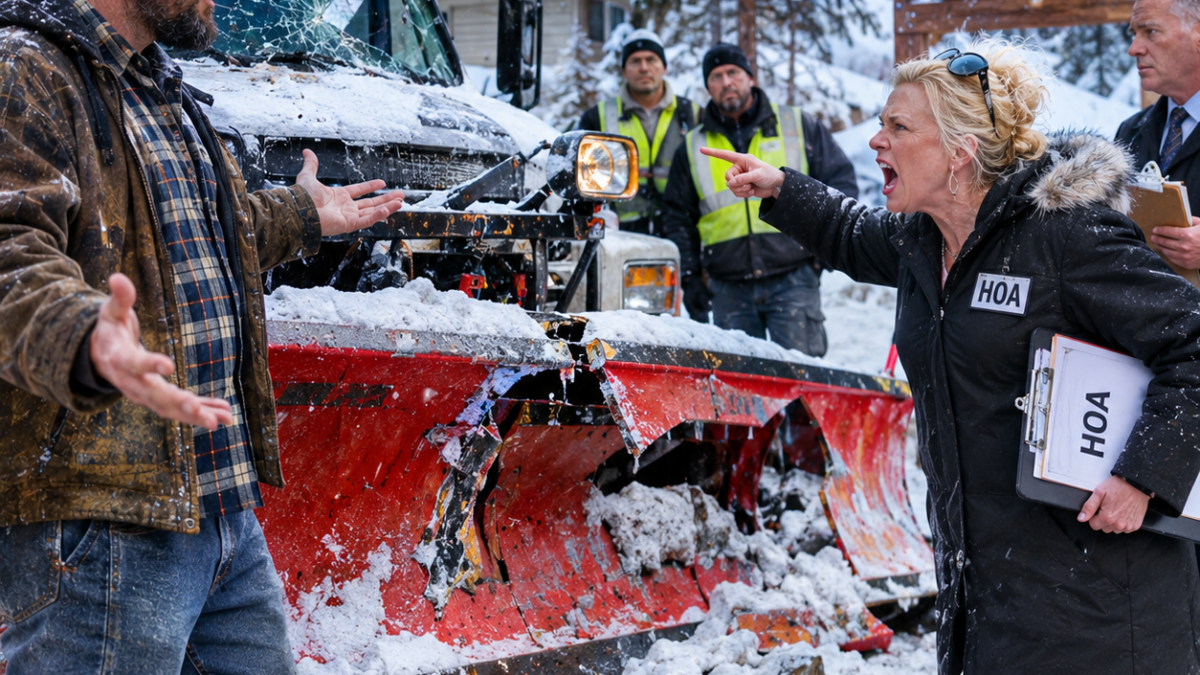
PART 2
Deputy Harris arrived about thirty minutes later.
He was a stocky man in his forties with tired eyes, a winter beard, and the kind of calm expression you develop after years of showing up to other people’s worst mornings.
He stepped out of his SUV, pulled his coat tighter against the wind, and walked slowly around the truck.
Then he stopped near the front end.
“Damn.”
That was all he said at first.
I crossed my arms.
“Yeah.”
He crouched beside the slashed tire.
Ran a gloved finger near the cut.
Then stood and looked through the shattered driver’s-side window.
“This wasn’t random.”
“No.”
“Any cameras?”
“One near the house. Doesn’t cover the whole driveway.”
“Enemies?”
I laughed once.
“Do homeowners associations count?”
His expression didn’t change.
“Sometimes.”
That got my attention.
I walked inside and came back with a folder.
Months of violation notices.
Parking warnings.
Photographs the HOA had taken of my truck.
Threats of escalating fines.
Letters demanding I remove what they called an “unauthorized commercial vehicle.”
Harris flipped through them.
“Truck registered commercially?”
“Yes.”
“Business run from here?”
“Equipment storage and dispatch, yes.”
“And the HOA says that violates their covenants?”
“They say it does.”
“Does it?”
“No.”
He looked up.
“You sure?”
“I checked before I bought the property.”
That was the important part.
My land sat at the lower bend where the county highway transitioned toward the private road climbing to Elk Ridge Estates.
The development had been built after the easement attached to my parcel already existed.
More than twenty years earlier, the original landowner had negotiated explicit commercial access rights.
The language was clear.
Commercial vehicles could operate, park, load, unload, and travel through the easement area.
When I bought the property nine years earlier, I had paid two attorneys to review that language before I signed anything.
I ran snow-removal equipment.
I wasn’t going to buy land where somebody could later tell me my trucks offended their landscaping standards.
For years, nobody cared.
Then Lorraine Beckett became president.
Everything changed.
“She started sending violations last winter,” I told Harris.
“What changed?”
“Her.”
He looked at me.
“Lorraine?”
“Yes.”
“What does she have against the truck?”
“Says it lowers property values.”
Harris looked at my driveway.
Then toward the private road.
“She knows you plow their roads with it?”
“Yes.”
He gave me a look.
I shrugged.
“I never said it made sense.”
Then I remembered the audio.
“Wait.”
I went inside again.
The HOA bylaws required official meetings to be recorded.
I had downloaded a copy of the previous week’s meeting because Lorraine’s comments had bothered me.
I returned with a flash drive.
“There’s something you should hear.”
We sat in his cruiser.
I pulled up the recording.
The meeting had started normally.
Budget.
Landscaping.
Snow service.
Then Lorraine raised the subject of my truck.
Her voice came through the speaker.
“This ongoing commercial vehicle situation is an embarrassment to the neighborhood.”
My voice answered:
“The vehicle is parked on my property under a recorded easement.”
Then Lorraine:
“Your interpretation.”
“No. The county’s.”
She continued.
“I don’t care how many attorneys you talked to. Residents are tired of seeing industrial equipment at the entrance to a residential community.”
Another board member asked:
“Doesn’t Ryan provide our snow service?”
Lorraine:
“That does not give him permission to ignore community standards.”
I replied:
“The easement gives me permission.”
A pause.
Then the line that mattered.
“One way or another, that eyesore is not going to be there much longer.”
The recording stopped.
Harris sat still.
Then he looked at the destroyed truck through the windshield.
“That could be important.”
“I thought so.”
“Did anyone respond?”
“Not really.”
“Who was present?”
“Whole board.”
He made a note.
“What’s the president’s full name?”
“Lorraine Beckett.”
He wrote it down.
Then asked:
“Anyone else especially vocal?”
“Melissa Quinn. Board member.”
“What did she say?”
“Mostly agreed.”
He nodded.
“We’ll talk to people.”
Then he looked toward the damaged engine.
“Any idea on value?”
“Truck and plow? Forty grand minimum.”
His eyebrows rose.
“That gets serious fast.”
“It was serious when they broke the engine.”
“Legally, I mean.”
“I know.”
He finished photographs.
Collected some fragments.
Measured footprints.
Then before leaving, he said:
“Don’t confront anybody.”
“I wasn’t planning to.”
His eyes stayed on me for another second.
“I mean it.”
“So do I.”
He drove away.
I stood in the driveway watching his SUV disappear toward the highway.
Then my phone buzzed.
Weather alert.
Winter storm warning.
Potential accumulation: eighteen to thirty inches.
High winds.
Dangerous travel.
Possible whiteout conditions.
I looked up the mountain.
Then at the dead truck.
And suddenly the situation became much bigger than criminal damage.
Elk Ridge Estates didn’t plow its own roads.
I did.
For six winters, my company had cleared the development.
There were reasons nobody else wanted the contract.
The main road climbed hard for almost a mile.
Two turns were tight enough that large municipal equipment struggled.
One side dropped toward a ravine.
Another section collected drifting snow from an open ridge.
During heavy storms, you needed to know the road.
Where ice formed.
Where a buried culvert could catch a blade.
Where to push snow so you didn’t create a wall that would freeze solid overnight.
I knew all of it.
That was why the HOA paid me.
The same HOA that kept fining me for parking the truck they depended on.
There was a kind of stupidity so complete it almost became impressive.
I opened my contract.
Section 12.
Force majeure.
Weather events.
Mechanical failure outside reasonable control.
Criminal damage.
Service obligations suspended when necessary equipment became unavailable through circumstances beyond the contractor’s control.
I read it twice.
Then called Lorraine.
She answered on the third ring.
“Ryan. What a surprise.”
That voice.
Sweet.
Too sweet.
“Someone destroyed my plow truck last night.”
Silence.
Not long.
Maybe a second.
But noticeable.
Then:
“What?”
“The sheriff is here investigating felony property damage.”
“Oh my God.”
Her concern sounded practiced.
I looked at the ruined engine.
“I’m calling because I won’t be able to service Elk Ridge for this storm cycle.”
The sweetness vanished.
“What?”
“My truck is destroyed.”
“You’re under contract.”
“Yes.”
“You cannot simply abandon forty families because of a mechanical inconvenience.”
I almost laughed.
“Mechanical inconvenience?”
“You know what I mean.”
“No, Lorraine. Someone smashed my engine block with what looks like a heavy tool, slashed both front tires, destroyed the plow hydraulics, and shattered every window.”
She said nothing.
I continued.
“Section twelve.”
“What?”
“Force majeure.”
Silence.
I could almost hear her thinking.
“Criminal destruction of necessary equipment is specifically listed.”
“You’re twisting contract language.”
“I’m reading it.”
“Ryan, there is a major storm coming.”
“I know.”
“People depend on you.”
“I know.”
“Then find another truck.”
“With what money?”
“That’s your business.”
“No.”
My voice stayed calm.
“My business asset was criminally destroyed. Until I have functioning equipment, service is suspended.”
Her tone sharpened.
“Are you implying the association had something to do with that?”
That question came very quickly.
Too quickly.
“I’m not implying anything.”
“I want that clear.”
“I’m telling you what happened.”
“You’ve been hostile toward the board for months.”
“I parked my truck.”
“You challenged every enforcement action.”
“Because your enforcement was wrong.”
“This is exactly the kind of attitude—”
I interrupted.
“Lorraine.”
Silence.
“There is a blizzard coming in forty-eight hours.”
“I know.”
“Find another snow contractor.”
“You are the contractor.”
“Not this week.”
I hung up.
My hand was shaking.
For months, she had treated me like I was the inconvenience.
Commercial truck.
Ugly equipment.
Parking violation.
Visual nuisance.
Now the consequences of that attitude were about to arrive in two feet of snow.
I didn’t feel good about the residents.
Most of them had nothing to do with this.
I knew that.
But I also couldn’t create a snowplow out of thin air.
And I wasn’t going to spend thousands renting equipment to rescue an HOA that was still actively fining me while my own truck sat destroyed.
That afternoon I started calling around.
Not because Lorraine had ordered me to.
Because I wanted to know my options.
First company:
Booked.
Second:
Wouldn’t touch Elk Ridge.
Third:
Could maybe send a machine for five thousand dollars per push.
Another three thousand if the HOA wanted standby service.
Another operator laughed.
“Elk Ridge? That hill?”
“Yes.”
“Nope.”
“You didn’t even ask the price.”
“Don’t care.”
“You serious?”
“I nearly rolled a truck there twelve years ago.”
Click.
That told me everything.
The storm arrived two days later.
At first, beautiful.
Large flakes drifting almost straight down.
Soft.
Quiet.
The kind of snowfall people photograph through windows while holding coffee.
Then the wind came.
By midnight, the world outside sounded like an engine.
Snow hammered sideways.
The temperature dropped.
I woke several times because gusts rattled the windows.
At four in the morning, I checked the weather station.
Fourteen inches.
At six:
Eighteen.
By sunrise:
Nearly two feet.
And still falling.
I walked to the kitchen.
Turned on the lights.
Made coffee.
The private road toward Elk Ridge had disappeared.
Not covered.
Disappeared.
The entrance looked like a white ramp.
Drifts crossed the lane.
The lower curve was already becoming impassable.
Normally, I would have been out since three.
Headlights on.
Beacon flashing.
Blade down.
Pushing the first pass before accumulation became too deep.
Instead, my destroyed truck sat beneath a tarp beside the garage.
My phone started ringing.
First call:
Unknown.
Then another.
Then Thomas Greer.
HOA vice president.
Then Lorraine.
Then residents.
Messages followed.
**Ryan, when are you coming?**
**Road is getting bad.**
**We can’t get out.**
**Please call.**
**My wife has an appointment.**
**Do you know when the road will be cleared?**
Then Lorraine:
**CALL ME NOW.**
I put the phone facedown.
Made eggs.
Toast.
Coffee.
Sat by the window.
Was that petty?
Maybe.
But there was nothing useful I could tell them that I hadn’t already told Lorraine two days earlier.
My truck had been destroyed.
The contract allowed suspension.
They needed another contractor.
The HOA had been given advance warning.
I wasn’t going to answer forty individual calls just to repeat reality.
By nine, snow was piled higher than the bottom of my porch railing.
My own property was prepared.
Heated section of driveway.
Backup generator.
Fuel.
Food.
Firewood.
In the mountains, you plan for isolation.
You don’t assume somebody else will always save you.
At 10:30, somebody started pounding on my front door.
Not knocking.
Pounding.
I checked the camera.
Lorraine.
Designer winter coat.
Expensive boots.
Red face.
Snow stuck in her hair.
I opened the door.
“You need to plow the road.”
No hello.
No apology.
Just an order.
I leaned against the frame.
“Good morning.”
“Ryan, this isn’t funny.”
“I didn’t laugh.”
“People are trapped.”
“I know.”
“Cars can’t get through.”
“I know.”
“There are medical appointments.”
“I know.”
“Children need school access.”
“School is closed.”
“That is not the point.”
“What is the point?”
Her eyes narrowed.
“The point is that you are under contract.”
“I don’t have a truck.”
“Rent one.”
“Did you call the other companies?”
Her expression shifted.
There it was.
I knew she had.
“How much?”
“That’s irrelevant.”
“How much?”
She folded her arms.
“I am not discussing HOA negotiations with you.”
“Five thousand?”
Nothing.
“Plus standby?”
Her mouth tightened.
I smiled slightly.
“How much, Lorraine?”
“Five thousand for one service.”
I whistled.
“And?”
“Another three if they stay available.”
“Eight thousand.”
“For one day.”
“That’s expensive.”
“That’s why you need to honor your agreement.”
“I am honoring it.”
“You are sitting inside while people are trapped.”
I looked past her.
Snow swirled over the road.
“My equipment was destroyed.”
“Convenient.”
I looked back at her.
“What?”
“You heard me.”
“No. Say it clearly.”
Her jaw worked.
“You’ve wanted to embarrass this board for months.”
“I wanted you to stop fining me for legal parking.”
“You kept challenging authority.”
“Because you didn’t have authority over the easement.”
“And now your truck just happens to be destroyed immediately before the largest storm of the winter.”
I stared at her.
“Are you accusing me of wrecking my own forty-thousand-dollar truck?”
“I’m saying the timing is suspicious.”
“Say it.”
“What?”
“Say I committed insurance fraud.”
She went still.
“Say I smashed my own engine, slashed my tires, shattered my windows, filed a false felony report, and manufactured evidence to extort the HOA.”
“I didn’t use those words.”
“Because those words can get you sued.”
She took a half step back.
I lowered my voice.
“Deputy Harris is investigating who attacked my truck. If you believe I did it myself, call him.”
Silence.
Wind pushed snow across the porch.
I continued.
“The sheriff recovered tool marks. Footprints. Evidence. They’re interviewing people.”
Her face became pale beneath the cold redness.
Just slightly.
“Good,” she said.
“Good?”
“Then maybe we’ll know what happened.”
I studied her.
“For someone who hates that truck, you suddenly seem very concerned about getting it back.”
“This is bigger than your petty parking dispute.”
“You’re right.”
I looked toward Elk Ridge.
“This is what happens when people forget why equipment exists.”
Her eyes flashed.
“You are enjoying this.”
“No.”
“Yes, you are.”
“I’m angry.”
“You’re punishing innocent residents.”
“No.”
I shook my head.
“I’m physically incapable of plowing the road.”
“You could rent equipment.”
“So could you.”
“We hired you.”
“And your president spent months trying to make the equipment illegal.”
“That is a separate issue.”
“No.”
I looked directly at her.
“It was separate until somebody destroyed my truck.”
She flinched again.
Small.
But I saw it.
“So who did it, Lorraine?”
“What?”
“My truck.”
“I have no idea.”
“Really?”
“Yes.”
“You said it wouldn’t be there much longer.”
“That was a policy statement.”
I almost laughed.
“A policy statement.”
“Yes.”
“About making my truck disappear.”
“Through enforcement.”
“Good.”
I stepped back.
“Then you have nothing to worry about.”
Her expression turned ugly.
“You are going to regret this.”
“Another policy statement?”
She turned.
Stormed toward her SUV.
The vehicle struggled.
Tires spun.
For a second, it slid sideways.
She corrected and disappeared into the snow.
I watched until the taillights vanished.
Then closed the door.
My chest was pounding.
Not because of the argument.
Because guilt and fear look different from anger.
And Lorraine was starting to look afraid.
Around noon, someone arrived on a snowmobile.
It bogged down near my property line.
The rider climbed off and trudged the rest of the way through knee-deep powder.
Thomas Greer.
Vice president.
I opened the door before he knocked.
“Come in before you freeze.”
He stepped inside.
Snow fell off him in clumps.
“Thank God.”
I handed him a towel.
Then coffee.
He wrapped both hands around the mug.
For several minutes, neither of us spoke.
Finally:
“People are panicking.”
“I figured.”
“Lorraine says you’re refusing to help.”
“I don’t have a truck.”
“I know.”
“That seems like an important detail.”
He sighed.
“She thinks you’re making a point.”
“I don’t need to make a point. The smashed engine block already made one.”
Thomas stared into the coffee.
Something about the way he avoided my eyes bothered me.
“Thomas.”
“Yeah?”
“Did you know they were going after my truck?”
His eyes lifted.
“What do you mean?”
“At the board meeting.”
“Everyone knew Lorraine hated it.”
“No.”
I sat across from him.
“Was there another discussion?”
His eyes dropped.
That answered me.
I leaned back.
“Jesus.”
“Ryan—”
“Tell me.”
“She was furious.”
“When?”
“Executive session.”
“Who was there?”
“Board.”
“All of you?”
“Yes.”
“What did she say?”
He rubbed his forehead.
“That the truck had become symbolic.”
“Symbolic of what?”
“Residents ignoring standards.”
I laughed in disbelief.
“My snowplow became symbolic.”
“She said if the board allowed you to keep parking it, everyone would challenge everything.”
“The easement legally allows it.”
“I know.”
“Did she?”
“She knew you claimed that.”
“I didn’t claim it.”
“I know.”
“Thomas.”
He winced.
“Sorry.”
“What else?”
“She said the truck had to go.”
“Those words?”
“Something like that.”
“Something like what?”
He breathed out.
“She said, ‘If normal enforcement won’t work, we’ll have to find another solution.’”
My entire body became still.
“Who responded?”
“Nobody.”
“Nobody?”
“Melissa told her to calm down.”
“That’s it?”
“At first.”
“At first?”
Thomas looked miserable.
“Later Melissa agreed the truck was hurting the entrance.”
I stared at him.
“Was vandalism discussed?”
“No.”
“You’re sure?”
“Yes.”
“Threats?”
“Not directly.”
“Did Lorraine talk about damaging it?”
“No.”
“Did Melissa?”
“No.”
I believed him.
Mostly.
But another question mattered more.
“Why didn’t you tell the sheriff?”
He looked up sharply.
“I didn’t know—”
“You know now.”
“I thought Lorraine was venting.”
“Thomas, somebody destroyed my truck days later.”
His shoulders sank.
“I know.”
“Forty thousand dollars.”
“I know.”
“And now forty families are trapped.”
“I know.”
“Because nobody in the room stopped her.”
“That isn’t fair.”
“Isn’t it?”
“We didn’t know she would do anything criminal.”
“You didn’t need to know.”
I stood.
“You needed to tell her the truck was legal and the conversation was over.”
Thomas looked down.
I regretted the harshness almost immediately.
Not because it was false.
Because he looked genuinely ashamed.
He said quietly:
“We should have.”
That changed the room.
I sat again.
For the first time, someone from the board had admitted it.
Not defended.
Not explained.
Admitted.
I exhaled.
“Okay.”
He looked up.
“Okay?”
“Let’s talk about getting people out.”
Hope appeared on his face.
“You’ll plow?”
“I said let’s talk.”
His face fell.
“I need equipment.”
“Yes.”
“I called Silver Creek Equipment.”
“They have something?”
“One older three-quarter-ton with a plow.”
“Can it handle the road?”
“With chains and patience.”
“How much?”
“Rental, fuel, labor, emergency rate—around two thousand dollars a day.”
“For how many days?”
“Three minimum.”
He stared.
“Six thousand.”
“Up front.”
“That’s extortion.”
I laughed.
“Thomas.”
“Sorry.”
“That’s what equipment costs in a blizzard.”
“I know.”
“It’s actually cheaper than the other companies.”
“I know.”
“Then don’t call it extortion.”
He nodded.
“Fair.”
“The HOA pays rental and emergency work. Up front.”
“Lorraine will never agree.”
“Then Lorraine can shovel.”
He almost smiled.
I continued.
“And I want the parking violations rescinded.”
“That’s separate.”
“It’s not separate anymore.”
He understood.
“The easement?”
“I want written acknowledgement that my commercial access rights are valid.”
“That might require counsel.”
“Then call counsel.”
“And the truck?”
“The truck is a criminal matter.”
“I mean compensation.”
“I haven’t decided.”
Thomas nodded.
He finished the coffee.
Then stood.
“I’ll take it back.”
I walked him to the door.
Before he stepped outside, he turned.
“Ryan?”
“Yeah?”
“I’m sorry.”
I didn’t answer immediately.
“For what?”
“For not shutting it down sooner.”
I looked at him.
“Fix it now.”
He nodded.
Then disappeared into the storm.
That night, wind hit the house hard enough to make the walls creak.
Drifts climbed over the fence.
The power flickered twice.
Generator kicked in once.
I slept badly.
At 8:32 the next morning, headlights appeared in my driveway.
Sheriff’s SUV.
Another unmarked vehicle behind it.
Deputy Harris stepped out.
A woman followed.
Detective Alvarez.
I opened the door.
Their faces told me they weren’t there to ask more questions.
“Coffee?”
Harris shook his head.
“We executed a search warrant at Lorraine Beckett’s house this morning.”
I felt something drop inside my chest.
Alvarez opened a notebook.
“We recovered a sledgehammer.”
Silence.
“Paint transfer on the head appears consistent with material from your truck.”
My mouth went dry.
“Crowbar.”
Another pause.
“Bolt cutters.”
I sat down.
They remained standing.
Alvarez continued.
“We also recovered messages.”
“Messages?”
“Between Ms. Beckett and Melissa Quinn.”
I thought about Thomas.
“About my truck?”
“Yes.”
I looked at Harris.
He nodded.
“It was them.”
The room became very quiet.
I had suspected Lorraine.
I had watched every expression.
Analyzed every pause.
Replayed the threat.
But suspicion is different from knowing.
Knowing changes the weight.
“What did the messages say?”
Alvarez hesitated.
“We can’t share everything yet.”
“Anything?”
“She discussed making the vehicle unusable.”
I closed my eyes.
Melissa.
“Melissa was there?”
“Evidence indicates she assisted.”
“Why?”
“Based on what we’ve seen, retaliation over the parking dispute and HOA conflict.”
I laughed.
One broken sound.
“They destroyed a forty-thousand-dollar plow truck over parking.”
Harris sat across from me.
“People do very stupid things when they convince themselves they’re entitled to control someone else.”
“Are they arrested?”
“Yes.”
“Charges?”
“Felony criminal mischief. Conspiracy. Trespassing. Possibly others depending on review.”
I rubbed my face.
“So that’s it.”
Alvarez shook her head.
“That’s the criminal case beginning.”
Right.
Beginning.
They asked a few more questions.
Timeline.
Insurance.
Truck value.
Contract relationship with the HOA.
Then they left.
I remained at the table long after their vehicles disappeared.
Vindication didn’t feel like I expected.
I had imagined, maybe subconsciously, that proof would make me feel powerful.
It didn’t.
It made me tired.
Lorraine had destroyed my business equipment because she couldn’t win a parking dispute.
Melissa had gone along.
Two adults.
Board members.
People trusted to manage a neighborhood.
They had stood in the dark with tools and smashed a machine that kept dozens of families safe in winter.
Then my phone rang.
Unknown number.
I almost didn’t answer.
“Ryan Calder?”
“Yes.”
“My name is Victor Quinn. I represent Elk Ridge Estates Homeowners Association.”
“Related to Melissa?”
A pause.
“No relation.”
“Good.”
He almost laughed.
“I’m calling on behalf of what remains of the board.”
“That sounds promising.”
“I believe sarcasm is probably deserved.”
That surprised me.
“Okay.”
“We would like to resolve several matters immediately.”
“I’m listening.”
“The association is prepared to compensate you for the fair market value of your destroyed vehicle.”
“How much?”
“Forty-two thousand dollars.”
No hesitation.
They had already calculated.
“And?”
“Cover emergency snow-removal costs.”
“How much?”
“Your proposed six thousand for three days, plus rental expenses at your documented rate.”
“Up front?”
“Yes.”
“And parking violations?”
“Rescinded.”
“All of them.”
“All vehicle-related notices.”
“No.”
Silence.
“All notices based on the commercial-use dispute.”
“Better.”
“The association will also formally acknowledge the recorded easement.”
“In writing.”
“Yes.”
“Recorded in the minutes.”
“Yes.”
“And added to your covenant guidance.”
“I can recommend that.”
“No.”
I leaned back.
“If you want me back on the mountain tomorrow morning, it goes into the agreement.”
Another pause.
“I understand.”
“What does the HOA want?”
“Continuation of snow services.”
“Obviously.”
“And a release from claims against the association itself related to the truck destruction.”
I laughed.
“There it is.”
“Ryan.”
“Your president and board member destroyed my truck.”
“The association’s insurer will dispute whether they were acting within authorized board duties.”
“That sounds like your problem.”
“It becomes everyone’s problem if this turns into prolonged litigation.”
He wasn’t wrong.
I hated that.
HOA money came from residents.
Insurance premiums came from residents.
Legal fees came from residents.
The people trapped up the mountain had not taken a sledgehammer to my engine.
Lorraine had.
Melissa had.
Others had enabled them, yes.
But there was a difference between accountability and burning the whole village because two people lit the match.
“What exactly are you proposing?”
“Forty-two thousand for the vehicle.”
“Okay.”
“Six thousand emergency work.”
“Okay.”
“Rental costs plus fifteen percent administrative margin.”
“Fine.”
“Rescind the violations.”
“Yes.”
“Formal easement acknowledgement.”
“Yes.”
“And mutual release between you and the association for civil claims arising specifically from the vandalism, excluding your rights against the individuals responsible.”
That mattered.
“Lorraine and Melissa remain personally exposed?”
“Yes.”
I looked out the window.
Snow.
Everywhere.
Somewhere above me, families were stuck.
Medical appointments.
Older residents.
Maybe people running low on medication.
I knew what the right decision probably was.
That didn’t mean I liked it.
“I want the agreement in writing.”
“You’ll have it this afternoon.”
“I want six thousand cleared before I start.”
“Agreed.”
“And if your board ever sends me another commercial-vehicle violation contrary to that easement, the snow contract terminates immediately.”
Victor sighed.
“I’ll include it.”
“Then we have something to discuss.”
He paused.
“Ryan?”
“Yes?”
“For what it’s worth, this never should have happened.”
I didn’t know what to say.
So I said:
“No. It shouldn’t.”
We hung up.
Then I called Silver Creek Equipment.
A man named Dean answered.
“You still have that old plow?”
“Depends who’s asking.”
“Ryan Calder.”
“Oh.”
He laughed.
“You’re the Elk Ridge guy.”
“How does everyone already know?”
“Mountain towns.”
“Can I get it tomorrow?”
“You paying emergency rate?”
“Yes.”
“Then it’s yours.”
“Condition?”
“Ugly.”
“Mechanical?”
“Mostly stubborn.”
“Perfect.”
The settlement agreement arrived that afternoon.
Thirty-seven pages.
I read every line.
Twice.
Called my lawyer.
Changed language.
Returned it.
Victor sent revisions.
We went back and forth.
By seven that evening, signatures were complete.
At 7:14, six thousand dollars hit my business account.
I stared at the transaction.
Three days earlier, I had been standing over destroyed equipment.
Now the HOA that had tried to remove that equipment from my property was paying emergency rates to bring another one back.
If you wrote it as fiction, people would call it unrealistic.
The next morning I left before sunrise.
County crews had cleared the highway.
I drove down to Silver Creek.
Dean met me beside the rental truck.
It was exactly as advertised.
Old.
Dented.
Paint faded.
Plow blade scratched.
Seat torn.
One mirror held together with black tape.
I walked around it.
“Beautiful.”
Dean laughed.
“You’re a sick man.”
“Will it push?”
“It’ll push.”
“Heat work?”
“Mostly.”
“What does mostly mean?”
“Don’t stop moving.”
He handed me the keys.
I climbed in.
Engine started with a deep rattle.
I smiled.
It wasn’t my truck.
But it would do.
By the time I reached Elk Ridge, daylight was breaking over the mountains.
The road looked worse than I expected.
Drifts rose like waves.
Cars near the lower homes were buried nearly to the windows.
Some driveways were completely invisible.
The first hill had more than thirty inches packed in places.
I stopped at the entrance.
Put the truck in low range.
Lowered the blade.
And started.
The first push barely moved ten yards.
Snow rolled up.
Heavy.
Dense.
Wind-packed.
I backed up.
Hit it again.
Slowly, the road began to reappear.
Muscle memory took over.
Angle the blade.
Push right.
Back.
Take another bite.
Don’t overload.
Watch the ditch.
Keep momentum.
I had done this for years.
The work had always felt ordinary.
That morning it felt almost sacred.
Because the people who lived there had been caught in the middle of someone else’s war.
And I had a choice.
I could make them pay.
Or I could do my job.
I chose the work.
Around ten, a garage door opened.
A man came out carrying a thermos.
He walked carefully toward the road.
When I stopped, he held it up.
“Coffee.”
I lowered the window.
“Thanks.”
He handed it to me.
“I’m sorry.”
“For what?”
“The board.”
“You didn’t wreck the truck.”
“No.”
He looked embarrassed.
“But I didn’t say anything when they kept going after you.”
I didn’t answer.
He continued.
“We all knew Lorraine had gotten out of control.”
“Why didn’t anybody stop her?”
He looked toward the mountain.
“Because it was easier not to.”
There it was.
Maybe the most honest sentence anyone in Elk Ridge would say during the entire mess.
It was easier not to.
Easier to let Lorraine fine somebody else.
Easier to let her fight Ryan about the truck.
Easier to sit through meetings quietly.
Easier to assume someone else would push back.
Until the plow disappeared.
Until the snow came.
Until “someone else’s problem” covered the only road out.
I took the thermos.
“Stay inside. I’ll get your driveway after the main road.”
He nodded.
“Thank you.”
I drove on.
By afternoon, more residents came outside.
Sandwiches.
Coffee.
Cookies.
One woman handed me a bag with gloves and hand warmers.
“My husband said you probably already have these.”
“I do.”
“Take them anyway.”
I did.
Another man apologized.
Then another.
Nobody had been told to.
That mattered.
The anger I had carried started changing.
Not disappearing.
Changing.
Lorraine and Melissa had become the HOA in my mind.
But they weren’t.
They were two people who had claimed to speak for forty families.
There is a dangerous mistake we make sometimes.
We confuse institutions with the worst people running them.
Communities aren’t presidents.
They aren’t board members.
They’re people.
Old couples.
Kids.
Workers.
Families.
Neighbors.
People who occasionally make the cowardly decision to stay quiet.
People who sometimes apologize later.
I worked twelve hours that day.
Eleven the next.
Another twelve the third.
Fuel.
Chains.
Ice.
Fogged windows.
Sore shoulders.
Frozen gloves.
By the end, Elk Ridge was open.
Driveways cleared.
Main road widened.
Emergency access restored.
The storm passed.
Sun returned.
Snow sparkled under blue sky like nothing ugly had happened.
A week later, Lorraine and Melissa were arraigned.
Both pleaded not guilty.
I saw a short news clip.
Lorraine looked furious.
Melissa looked terrified.
I turned it off.
That part wasn’t mine anymore.
The criminal case belonged to prosecutors.
My part was rebuilding.
The HOA compensation check arrived exactly thirty days after the agreement.
Forty-two thousand dollars.
Insurance paid separately under my business policy, subject to its own terms and recovery process.
I used the money to order a new truck.
Not the same.
Better.
More power.
New hydraulic system.
Improved lighting.
Stronger front suspension.
Heated windshield.
Everything I had wanted but never justified buying.
When the dealer asked whether I wanted the same plow width, I said:
“Bigger.”
He laughed.
“You expanding?”
“Maybe.”
I didn’t know yet how true that would become.
Thomas Greer became acting HOA president.
One of the first letters I received from the new board was only one page.
No threat.
No bold red heading.
No fine.
It read:
**Elk Ridge Estates hereby acknowledges the pre-existing commercial access easement attached to the Calder parcel and confirms that lawful commercial vehicles associated with snow-removal operations may be parked and operated in accordance with that easement.**
I framed it.
Not because it was beautiful.
Because after months of being told I was wrong, there was something satisfying about seeing the truth printed on HOA letterhead.
They rescinded every related violation.
Cancelled outstanding fines.
Updated the covenant guidance.
And Thomas called personally.
“I should have done this earlier.”
“Yes.”
He laughed weakly.
“You really don’t make apologies easy.”
“I accept good ones.”
“Is that acceptance?”
“Close.”
He paused.
“Thank you for clearing the roads.”
“That’s what you paid me for.”
“No.”
His voice became serious.
“You could have refused.”
I knew what he meant.
Legally, financially, emotionally, I had leverage.
I could have watched Elk Ridge suffer longer.
Part of me had wanted to.
But revenge becomes dangerous when innocent people start paying the bill.
“Your residents weren’t the ones with the sledgehammer,” I said.
“No.”
“So I cleared the road.”
Thomas was silent.
Then:
“That’s more grace than the board gave you.”
Maybe.
I didn’t answer.
About a month after the storm, my phone rang from a number I didn’t recognize.
I almost ignored it.
“Ryan?”
Woman.
Shaky voice.
“Yes?”
“It’s Melissa Quinn.”
I nearly hung up.
Then didn’t.
“What do you want?”
“I wanted to apologize.”
I said nothing.
She continued.
“My attorney told me not to call you.”
“Probably good advice.”
“I know.”
“Then why are you calling?”
She inhaled.
“I’m taking a plea.”
I leaned back.
“Okay.”
“Probation. Restitution. Community service.”
“That’s between you and the court.”
“I know.”
Another breath.
“I need you to know Lorraine didn’t force me.”
That surprised me.
“I could say she did.”
Her voice trembled.
“She pushed. She obsessed. She talked about you constantly. The truck. The easement. How you were embarrassing her.”
I closed my eyes.
“But I went.”
“Yes.”
“I held the light.”
My stomach tightened.
“She used the hammer?”
“Mostly.”
“Mostly?”
“I broke the windows.”
Silence.
“I cut one tire.”
I gripped the phone harder.
“You expect me to forgive you?”
“No.”
That answer stopped me.
“No?”
“I don’t think I deserve that.”
She sounded like she was crying now.
“I just wanted to stop pretending I was dragged into it.”
I looked toward the garage.
My new truck hadn’t arrived yet.
The empty space where the old one used to sit still bothered me.
“Why did you do it?”
Long silence.
Finally:
“Because we were all tired of Lorraine being angry.”
I frowned.
“That makes no sense.”
“I know.”
“She was angry, so you helped commit a felony?”
“She kept saying if we solved the truck problem, she’d calm down.”
I almost laughed.
“She made her emotions everybody else’s responsibility.”
“Yes.”
“And you believed her.”
“I wanted to.”
That sentence felt familiar.
People do terrible things sometimes not because they fully believe them, but because believing the lie makes the next decision easier.
“Melissa.”
“Yes?”
“You destroyed my livelihood.”
“I know.”
“You helped strand your own neighbors.”
“I know.”
“You could have stopped.”
“I know.”
I let the silence sit.
Then said:
“I’m glad you’re taking responsibility.”
She started crying harder.
“That isn’t forgiveness.”
“I know.”
“But it’s more than I felt yesterday.”
“Thank you.”
We hung up.
For the next hour, I was angry all over again.
Then strangely calm.
Her apology didn’t repair the truck.
Didn’t undo the crime.
But accountability has weight.
Hearing someone say **I did it** instead of **she made me** mattered.
Lorraine never did that.
She went to trial in the spring.
The evidence was brutal.
Texts.
Tools.
Paint transfer.
Location data.
Witness statements.
Meeting recording.
Prior threats.
She argued the prosecution exaggerated an HOA conflict into something criminal.
The jury apparently disagreed.
Eighteen months in county jail.
Fines.
Restitution obligations.
Loss of her board position was obviously irrelevant by then.
I watched footage of her leaving court.
Hands restrained.
Head down.
Reporters calling questions.
I expected triumph.
Nothing.
Mostly sadness.
Think about it.
A woman burned down her reputation, freedom, finances, and future because a snowplow offended her sense of control.
That should be funny.
It wasn’t.
Power had narrowed her world until winning a parking dispute mattered more than understanding consequences.
That felt tragic.
Not because she didn’t deserve punishment.
Because it never had to happen.
My business changed after that winter.
Word traveled.
Fast.
Mountain towns remember stories.
Suddenly people knew me as the snowplow guy whose HOA destroyed his truck and then had to pay him to rescue them.
I hated the nickname.
Loved the referrals.
A neighboring development called.
Then a private ranch community.
Then two commercial properties near Silver Creek.
One manager said:
“We heard you actually show up.”
“That’s usually the idea.”
He laughed.
“No. We heard what happened at Elk Ridge.”
“Oh.”
“You still cleared them.”
“Yes.”
“That’s why we’re calling.”
That surprised me.
I had thought standing my ground might hurt my reputation.
Instead, the opposite happened.
People trusted someone who could hold boundaries without abandoning the work.
By summer, I hired my first full-time employee.
Ethan.
Twenty-four.
Loved engines.
Hated paperwork.
Could rebuild a hydraulic pump faster than I could explain an HOA covenant.
One afternoon, we were servicing the new truck.
He stood beneath the raised hood.
“So is it true?”
“What?”
“You could’ve just left them buried.”
“Technically.”
“And they wrecked the old truck.”
“Yes.”
“And you still went back.”
“Yes.”
He tightened a fitting.
“Why?”
I thought about it.
“Because Lorraine wasn’t forty people.”
He looked confused.
“What?”
“The board president did something criminal. Melissa helped. The rest of the residents didn’t.”
“Some of them let it happen.”
“Yeah.”
“So screw them.”
I laughed.
“You’re twenty-four.”
“What does that mean?”
“It means revenge still sounds efficient.”
He grinned.
“It is efficient.”
“No.”
I wiped my hands.
“Revenge is fire.”
He waited.
“It feels warm at first.”
“Okay.”
“Then it burns everything around you.”
“Sounds dramatic.”
“It is dramatic.”
I pointed toward the new truck.
“If I’d stayed home while somebody up there had a medical emergency, would Lorraine have suffered?”
“Maybe.”
“Or would some seventy-year-old woman who never attended an HOA meeting suffer?”
He nodded slowly.
“Okay.”
“The trick isn’t refusing revenge because the people who hurt you deserve mercy.”
“What is it?”
“Making sure you don’t become part of the damage.”
He looked at me.
“That sounds like something you practiced.”
“Unfortunately.”
In September, I got an invitation that made me laugh so hard I nearly deleted it.
Regional HOA conference.
Speaker request.
Topic:
**Contract Relations, Easements, Vendor Risk, and Community Governance During Emergencies**
I thought it was a joke.
It wasn’t.
Thomas had recommended me.
I almost refused.
Then imagined standing in front of a room full of HOA board members telling them what happens when they confuse personal preference with legal authority.
I accepted.
The conference took place at a hotel outside Denver.
Rows of tables.
Name badges.
Coffee stations.
PowerPoint presentations.
I walked onto the stage and looked at more HOA presidents than I ever wanted to see in one place.
My first slide showed my old truck.
Destroyed.
Broken glass.
Bent plow.
Oil on concrete.
The room became quiet.
I said:
“This was once a parking violation.”
A few uncomfortable laughs.
I continued.
“The association president believed my commercially registered snowplow didn’t fit the appearance of the community.”
Next slide.
Recorded easement.
“So they fined me.”
Next.
Contract.
“While simultaneously paying me to use that same truck to keep their mountain roads open.”
More laughter.
Less comfortable.
Next slide.
Lorraine’s quote.
**One way or another, that eyesore won’t be there much longer.**
Then the damaged engine.
No one laughed.
I didn’t give them a revenge speech.
I talked about systems.
That’s what had actually failed.
One person got obsessed.
Other board members stayed quiet.
Nobody insisted on legal review.
Nobody separated vendor management from aesthetic enforcement.
Nobody asked what would happen if they destroyed the relationship with the one contractor willing to plow an isolated mountain road.
The vandalism was criminal.
But the culture that made Lorraine believe she could act without consequences had been built more slowly.
At the end, one board member raised his hand.
“Do you still work for Elk Ridge?”
“Yes.”
That surprised people.
“Why?”
“Because the new board follows the agreement.”
Another hand.
“After everything they did?”
“The community didn’t swing the hammer.”
Someone else asked:
“What happened to the easement dispute?”
“It stopped being a dispute when they read the easement.”
That got a bigger laugh.
Afterward, several board members approached me.
One said:
“I think we need to review our commercial vehicle rules.”
“Good.”
Another:
“We have a landscaping conflict that suddenly feels very stupid.”
“Probably good.”
One older man shook my hand.
“You know, board members forget sometimes that we’re just neighbors with paperwork.”
I smiled.
“Remember that.”
By the following winter, Elk Ridge had elected another president.
Margaret Hale.
Retired teacher.
Small woman.
Quiet voice.
No interest in ruling anything.
Before the first major storm, she drove down to my property.
Not to inspect.
Not to threaten.
She handed me a card.
“Just wanted to say thank you in advance.”
I opened it later.
Handwritten.
**Ryan,
Thank you for continuing to serve this community after we gave you every reason not to. We intend to do better.
—Margaret**
Inside was a small bonus check approved by the board for winter reliability.
I kept the card.
Not the check.
The card.
I put it in the same drawer where I had stored Melissa’s apology letter.
Two documents from the same story.
One represented failure.
One represented change.
The new truck arrived before snow season.
Black.
Heavy-duty diesel.
New plow.
Clean glass.
Straight blade.
I parked it in the exact same place the old truck had been.
Not to provoke anyone.
Because that was where my equipment belonged.
The first morning Lorraine would have seen it, she was no longer in Elk Ridge.
That felt appropriate.
The anniversary of the vandalism arrived during light snowfall.
I woke before dawn out of habit.
Made coffee.
Stepped onto the porch.
The new truck sat beneath falling snow.
For a second, memory overlaid the scene.
Broken windows.
Oil.
Twisted steel.
I could almost see it.
Then I blinked.
New truck.
Intact.
Waiting.
The world looked quiet.
I thought about everything that had happened because somebody couldn’t tolerate being told no.
A parking notice.
A meeting.
A threat.
A sledgehammer.
A blizzard.
Arrests.
Settlement.
New leadership.
New business.
New truck.
Life rarely rebuilds itself exactly the way it was.
Sometimes the replacement is better.
That doesn’t make the damage good.
I hate those stories where suffering gets romanticized because something positive eventually comes out of it.
I would have preferred Lorraine simply read the easement and leave my truck alone.
I would have preferred Melissa stay home.
I would have preferred never spending a morning photographing my destroyed livelihood.
But once the damage happened, I still had choices.
I could let rage decide everything.
Or I could decide what came next.
That turned out to matter more.
A few weeks later, Elk Ridge got another heavy storm.
Not as bad.
Maybe fourteen inches.
I started at three in the morning.
New truck.
New blade.
Ethan riding with me to learn the road.
We climbed through the dark.
Beacon reflected against snow.
Blade rolled white powder away.
At the first curve, Ethan said:
“This is the spot?”
“What spot?”
“Where they got trapped.”
“The whole road got trapped.”
“No. I mean where Lorraine lived.”
I pointed.
“Third house after the switchback.”
He looked.
Dark windows.
Someone else lived there now.
“That’s it?”
“That’s it.”
“Kind of normal.”
“Most places where bad decisions happen look normal afterward.”
We kept going.
Around five, porch lights started turning on.
Residents woke.
A kid stood behind a window and waved.
I flashed the lights.
At the top, we turned around.
The road behind us was open.
Black pavement in two tracks beneath fresh snow.
On the way down, Ethan said:
“You ever think about not renewing the contract?”
“Yes.”
“Why didn’t you?”
I considered the mountain.
“Because I like the work.”
“That’s it?”
“And because I didn’t want Lorraine deciding the last chapter.”
He nodded.
That was the truth.
If I left because of her, part of the story remained hers.
If I stayed because I chose to, it became mine again.
There’s a difference.
The following spring, the civil pieces of the case finally closed.
Restitution from Lorraine.
Restitution from Melissa under her plea.
Insurance recovery.
Attorney paperwork.
Final signatures.
One afternoon, I received the last envelope.
I opened it.
Read it.
Then walked to the garage.
The old plow blade had been saved.
Not the entire truck.
Insurance took most of that wreck.
But I kept a bent section of the blade.
Ethan thought that was strange.
“Why keep garbage?”
“History.”
“It’s six feet of bent steel.”
“Exactly.”
We mounted it on the shop wall.
Under it, Ethan made a little metal plaque as a joke.
**PARKING VIOLATION**
I laughed so hard I let him keep it.
Customers ask about it.
I tell them.
Sometimes briefly.
Sometimes the whole thing.
Most people think the best part is that Elk Ridge got snowed in.
They grin.
“They destroyed the plow and then needed the plow?”
“Yes.”
“That’s perfect.”
It is satisfying.
I understand why.
Cause and consequence lined up almost too perfectly.
But that isn’t actually the part I remember most.
What I remember is the first resident bringing coffee.
Thomas saying:
“We should have stopped her.”
Melissa saying:
“I did it.”
Margaret writing:
“We intend to do better.”
Those mattered more.
Punishment tells you someone crossed a line.
Accountability tells you they understand the line existed.
Change tells you maybe the same thing won’t happen again.
That’s harder.
Better too.
Years later, Elk Ridge Estates still hires my company.
The contract is different now.
Clear.
Simple.
Commercial equipment rights recognized.
Emergency procedures written.
Board contacts listed.
No aesthetic language attached to vendor operations.
No president can unilaterally interfere with contracted equipment.
That paragraph exists because of Lorraine.
Sometimes bad rules are born from fear.
Good rules are often born from memory.
Margaret retired from the board eventually.
Thomas moved.
New residents arrived who had never met Lorraine.
To them, I’m just Ryan.
The snow guy.
That’s exactly how I prefer it.
Every winter, I get the same question from someone new.
“Why does your contract have such a weird section about HOA officials not interfering with parked plow equipment?”
I smile.
“Long story.”
Most don’t ask again.
The ones who do get the full version.
One winter evening after clearing Elk Ridge, I stopped at the lower overlook.
Snow-covered roofs glowed under porch lights.
Smoke rose from chimneys.
Road open.
People home.
Safe.
I shut off the truck.
The sudden silence felt huge.
I thought about the morning my old engine had been smashed.
I had believed somebody had taken control away from me.
That was the intention.
Destroy the truck.
Force compliance.
Make Ryan understand who was in charge.
But control doesn’t work that way.
You can destroy someone’s equipment.
You can cost them money.
You can create fear.
You can make life harder.
You still don’t get to decide what they become afterward.
Lorraine had destroyed one truck.
She accidentally helped build a larger business.
She tried to remove commercial equipment.
The HOA permanently recognized my commercial rights.
She tried to establish authority.
She lost her position and freedom.
She tried to make me disappear from the entrance to Elk Ridge.
Years later, my trucks were working in communities across the county.
That is the kind of revenge I can live with.
Not hurting someone back.
Outlasting the damage.
Building something stronger where they expected ruin.
People sometimes ask whether I enjoyed watching Elk Ridge buried.
For a few hours?
Yes.
There was a dark little part of me that looked at that snow and thought:
*Now you understand.*
I’m not proud of that.
I’m also not going to lie.
When someone spends months attacking the tool they depend on, and then immediately experiences exactly why that tool matters, the irony is powerful.
But by the second day, satisfaction had turned into concern.
Because weather doesn’t understand guilt.
A blizzard doesn’t care whether you voted for Lorraine.
It doesn’t care if you defended me or ignored me.
Snow blocks everyone.
That was why I went back.
Not for the HOA.
For the people.
And maybe for myself.
Because I did not want my identity shaped by whatever Lorraine had done.
I wanted to remain the person who showed up.
That mattered.
One evening, Ethan and I were closing the shop when he pointed at the bent plow blade on the wall.
“Still think revenge burns everything?”
“Yes.”
“Even though all this came from that?”
He gestured around the shop.
Three trucks.
Equipment racks.
Tools.
Employee lockers.
I smiled.
“This didn’t come from revenge.”
“What did it come from?”
“Rebuilding.”
“Sounds like branding.”
“It probably is.”
He laughed.
Then I looked at the old steel.
“Revenge would’ve been leaving them buried because I could.”
“Okay.”
“Rebuilding was charging a fair emergency rate, making them acknowledge my rights, getting compensated, then going back to work.”
“Still sounds less fun.”
“You’re still young.”
He shook his head.
“Old man.”
“Go home.”
He left laughing.
I shut the lights off.
On the drive home, snow began falling.
Light.
Slow.
I thought about Lorraine again.
Not often anymore.
Time had reduced her from a constant source of anger to a cautionary story.
That might be the strangest punishment of all.
People who crave control imagine themselves becoming important.
Permanent.
Central.
Instead, sometimes they become a paragraph somebody tells new employees about.
A bent piece of metal on a wall.
A clause in a contract.
A lesson.
The new truck sat in my driveway when I got home.
Snow gathered on the hood.
Exactly where the old one had stood.
I walked around it before going inside.
Habit.
Tires good.
Windows intact.
Plow straight.
Engine quiet beneath the hood.
For a moment I rested my hand on the cold fender.
Nine years earlier, I bought that property because I wanted the freedom to run my business without somebody telling me my equipment didn’t belong.
The easement existed for that exact reason.
Lorraine looked at the same legal right and saw defiance.
That was her mistake.
Not understanding that another person having rights isn’t an attack on yours.
My truck existing didn’t diminish Elk Ridge.
My business didn’t threaten the community.
The plow wasn’t an eyesore.
It was infrastructure.
Useful things aren’t always pretty.
Neither are boundaries.
But when winter hits, usefulness matters more than appearances.
That was the lesson Elk Ridge learned under thirty inches of snow.
The following morning, I woke at 2:45.
Weather alert.
Six inches expected.
Routine.
I dressed.
Made coffee.
Started the truck.
Diesel engine rumbled into the dark.
Headlights came on.
Amber beacon flashed.
I backed out.
Turned toward the mountain.
The road ahead was white.
Quiet.
Waiting.
And for the first time in a long time, there was no anger attached to it.
Just work.
I lowered the blade.
The snow rolled away.
Behind me, a clean road appeared.
That is the ending I prefer.
Not Lorraine in handcuffs.
Not the HOA writing a forty-two-thousand-dollar check.
Not residents begging for help.
Those things were consequences.
They mattered.
But they weren’t the victory.
The victory was that after somebody tried to destroy the thing that kept my life moving, I built it back.
Bigger.
Better.
Stronger.
Then I used it to keep moving.
And that, more than revenge ever could, was what finally gave me my life back.








