PART 2: HOA Smashed My Family Fence for Being “Too Gaudy” — They Had No Idea I Could Buy the Road Their Entire Plan Needed
PART 2
I stared at Florence across a coffee table covered in lace doilies and family photographs.
“Owns it?”
She lifted one eyebrow.
“That generally is what the word means.”
I had known Florence Meadows my whole life, though not well. Her father had developed the first Meadowbrook lots back when the area was still mostly pastures and pecan trees. She was tiny now, barely five feet tall, with silver hair and the kind of posture that made you forget her age until she stood up.
“Meadowbrook Lane is a road,” I said.
“Very observant.”
“I assumed the county owned it.”
“That assumption has caused me more paperwork than three husbands.”
“You had one husband.”
“Exactly. The road is worse.”
She took a slow sip of tea.
“The Meadows Family Trust owns the original lane from County Road 17 to the eastern turn.”
My pulse shifted.
“The whole stretch?”
“The pavement, shoulders, culverts, drainage rights, maintenance obligations. Subject to the homeowners’ recorded access easements, obviously.”
That last part mattered.
Owning a private road didn’t mean you could wake up one morning and trap people inside their homes. Residents had legal rights to reach their properties. Emergency services had rights. Utilities had rights.
But ownership still mattered.
A lot.
“Why does the HOA act like it owns it?”
“Because most people don’t read deeds.”
“Vivian does.”
Florence gave me a look.
“Oh, Vivian knows.”
I put down my glass.
“What do you mean?”
“She tried to buy it.”
The room seemed to grow quieter.
“When?”
“Six months ago.”
Six months.
About the same time she had started escalating against old residents.
“How much did she offer?”
“Two hundred thousand dollars.”
“For a road that needs repairs?”
“You know it needs repairs?”
“I drive it.”
Florence smiled faintly.
“County says it needs roughly two hundred thousand in drainage, shoulders, culverts, resurfacing, and safety work before they’d consider accepting it into the public system.”
“Why did Vivian want it?”
“She said the HOA needed control of its own infrastructure.”
“And you believed her?”
“No.”
“Why not?”
“Because she asked me to sign a confidentiality agreement before she showed me the purchase contract.”
I leaned back.
“What did you do?”
“I told her if somebody needs secrecy before they’ve even explained why they want something, they probably don’t want it for the reason they’re giving.”
That sounded exactly like something Grandpa Joe would have said.
“Did she get angry?”
Florence laughed.
“Wade, that woman threatened to sue an eighty-three-year-old widow for ‘obstructing community progress.’ Of course she got angry.”
I looked toward her front window.
Meadowbrook Lane ran beneath the live oaks outside.
I had driven it thousands of times.
Never thought twice about it.
“Would you sell?”
Florence didn’t answer immediately.
Instead, she opened a drawer beside her chair and removed a folder.
“I’m tired.”
I looked up.
“My doctor says I ought to simplify things. The trust has money, but the road is becoming a liability. Insurance goes up. Repairs keep getting deferred because every homeowner has an opinion and none of them wants the bill.”
She slid a maintenance estimate toward me.
The numbers were ugly.
Failed culverts.
Shoulder erosion.
Potholes.
Drainage problems.
One section near the creek had been patched so many times it looked quilted.
“I’ve been considering selling it to the county,” she continued, “but they won’t take it as-is.”
“Vivian offered two hundred.”
“Yes.”
“What would you take?”
She watched me carefully.
“Why?”
“I don’t know yet.”
“Wrong answer.”
I smiled despite myself.
“You sound like my attorney.”
“Buck owes me twenty dollars from a poker game in 1996.”
“I’ll tell him.”
“Don’t. I enjoy the interest.”
She leaned forward.
“Why do you want the road, Wade?”
I thought about my destroyed fence.
Sarah.
The baby.
Jake’s signature.
The shell companies.
The photographs of my well.
“I think Vivian wants more than the HOA.”
Florence’s eyes sharpened.
“Go on.”
“I think she’s buying pieces of Meadowbrook.”
“Six homes that I know of.”
“You know?”
“I see transfers. The trust still receives certain road-maintenance notices.”
“Did you notice who bought them?”
“Different LLCs.”
“All linked back to her or people around her.”
Florence’s expression changed.
Not surprise.
Confirmation.
“She told me the neighborhood needed modernization.”
“What did she say that meant?”
“More valuable homes. Fewer ‘legacy problems.’”
I felt my jaw tighten.
“Legacy problems.”
“That was her phrase.”
“My ranch is a legacy problem.”
“Probably the biggest one.”
I looked at the road documents again.
“What would you sell for?”
“One hundred fifty thousand.”
I almost laughed.
Not because it was cheap.
Because I had one hundred forty-seven thousand dollars in the bank.
Almost exactly.
Grandpa Joe’s antique tractor collection had sold the previous year. Sarah and I had decided that money would become the beginning of our child’s future.
College.
Medical emergencies.
Whatever came.
Buying an aging private road had not made the list.
Florence saw my face.
“That number hurt.”
“A little.”
“Then don’t do anything stupid.”
“I’m fifty-two. Stupid takes more preparation now.”
“You’d be surprised.”
I gathered my copies.
Before I left, Florence said, “Wade.”
I turned.
“If you do buy it, understand something.”
“What?”
“A road is not a weapon.”
I said nothing.
“People live on it. Children ride bicycles on it. Ambulances may need it. You buy it, you inherit responsibility with the deed.”
“I understand.”
“Do you?”
I thought of Vivian’s fines.
Her threats.
The sledgehammers.
Part of me wanted to tell Florence I’d shut the lane, park a bulldozer across it, and make Vivian hike to her Mercedes every morning.
That part of me had no business owning infrastructure.
“I’m angry,” I admitted.
“Good.”
“That isn’t what I expected you to say.”
“Anger means you still know something matters. Just don’t let it do your arithmetic.”
I left her house with my head spinning.
By the time I reached the ranch, Sarah was sitting on the porch with one bare foot propped on another chair.
The pregnancy had begun swelling her ankles.
She watched my truck pull in.
“You have that look.”
“What look?”
“The one that means our savings account is in danger.”
I stopped halfway up the steps.
“That specific?”
“I married you.”
I sat beside her.
For a minute, I just listened to the cicadas.
Then I said, “Florence owns Meadowbrook Lane.”
Sarah blinked.
“The road?”
“The private sections. Through the family trust.”
“So?”
“Vivian tried to buy it six months ago.”
Her hand went still on her belly.
“Why?”
“That’s what I need to find out.”
Sarah studied my face.
“How much?”
“Don’t do that.”
“How much, Wade?”
“One-fifty.”
Her eyes closed.
“Oh, Lord.”
“We don’t have to.”
“You’re thinking about it.”
“I’m thinking about why Vivian needs it.”
“We saved that money for the baby.”
“I know.”
“We already have legal bills.”
“I know.”
“The ranch lost money last year.”
“I know.”
She looked toward the broken remnants of the fence.
The hand-carved horse I had rescued from the dirt was sitting on the porch rail.
One ear was missing.
Sarah touched it with one finger.
“I hate her.”
The words were quiet.
Sarah rarely hated anybody.
That scared me more than the sentence itself.
“I don’t want this turning you into somebody you aren’t,” I said.
“She did that to herself.”
“I mean us.”
Sarah looked at me.
“What are you thinking?”
“Before we spend a dollar, I find out why the road matters.”
She nodded.
“And if it matters because she wants to hurt us?”
“Then we talk again.”
“Together.”
“Together.”
She held out her hand.
I took it.
The baby moved beneath her shirt.
Sarah smiled faintly.
“Emma’s voting too.”
“You decided on Emma?”
“I decided three weeks ago.”
“I thought we were still discussing names.”
“You were discussing. I was waiting for you to catch up.”
That night, for the first time in days, I slept.
Only until two.
Then my brain woke up and refused to shut off.
I went downstairs.
Grandpa Joe’s leather chair sat near the kitchen window. The arms were cracked, the stuffing showed through one corner, and Sarah had threatened to replace it twice.
I had threatened divorce twice.
Neither of us meant it.
I opened my laptop.
County planning records were public.
So were preliminary development filings.
Business registrations.
Property transfers.
Loan notices, when recorded.
You can hide intent.
It’s harder to hide paperwork.
I searched Vivian Blackwood.
Then Marcus Blackwood.
Then every LLC connected to the properties Rita had found.
At 2:47 a.m., I found Blackwood Development Partners.
At 3:12, a preliminary concept plan.
At 3:40, I stopped breathing for a second.
The plan covered more than Meadowbrook.
Luxury residences.
Private clubhouse.
Wellness spa.
A nine-hole golf course.
Commercial entrance.
A landscaped boulevard.
And in the center of the proposed entrance district sat my ranch.
Not beside it.
My ranch.
The farmhouse was gone.
The barn was gone.
Grandpa Joe’s pecans were gone.
Where Sarah’s vegetable garden stood, the rendering showed a fountain.
Where my cattle crossed the south pasture, the plan showed valet parking.
A highlighted box read:
**Phase Two Gateway Parcel — Acquisition Pending.**
I clicked the parcel number.
Thornton Ranch.
My hands tightened.
Projected acquisition cost was far below market value.
The financial model assumed distressed purchase following “encumbrance resolution.”
I read that phrase three times.
Encumbrance resolution.
HOA liens.
Code violations.
Legal fees.
Foreclosure pressure.
It wasn’t proof of a criminal conspiracy by itself.
But it told me exactly what Vivian’s endgame looked like.
I searched the road.
There.
**Primary project viability dependent upon Meadowbrook Lane acquisition/control or equivalent access corridor.**
I pulled up maps.
The alternative access route would require crossing protected wetlands, purchasing three additional parcels, and building several miles of new roadway.
Expensive.
Slow.
Permits uncertain.
Meadowbrook Lane was the easy path.
Vivian didn’t merely want the road.
Her project depended on it.
I heard Sarah behind me.
“Wade?”
I turned.
She stood in the doorway wearing Grandpa Joe’s old quilt around her shoulders.
“What time is it?”
“Too early.”
She came over.
“What did you find?”
I rotated the laptop.
She stared at the rendering.
For a long time, she didn’t speak.
Then she pointed.
“That’s our barn.”
“Was.”
“And those trees?”
“Gone.”
Her hand moved over her belly.
“She planned all this before the fence complaint.”
“Looks that way.”
Sarah sat.
“So the fines—”
“Pressure.”
“The lien threats.”
“Pressure.”
“Jake.”
“Pressure.”
“The county citations?”
“Probably more pressure, if Tommy’s messages are real.”
She kept staring.
Finally, she whispered, “She wants us broke.”
“Yes.”
“And then she buys the ranch cheap.”
“That’s how it looks.”
Her face hardened.
“Buy the road.”
I looked at her.
“What?”
“Buy it.”
“Sarah.”
“You said we’d decide together.”
“I didn’t think you’d say yes this fast.”
“I didn’t know she planned to bulldoze our home.”
“That money was for Emma.”
Sarah placed both hands around her stomach.
“This ranch is part of Emma’s future too.”
“If we lose the savings—”
“We can rebuild savings.”
“If the road becomes a liability—”
“We deal with it.”
“If the ranch has another bad year—”
“Then we eat beans.”
“I hate beans.”
“You’ll learn.”
I stared at her.
She was scared.
I could see it.
But fear and certainty can live in the same person.
“Buck first,” she said.
“Definitely.”
“And Florence gets a fair price.”
“Yes.”
“And if we own the road, you do not use it to punish innocent neighbors.”
I smiled.
“You talked to Florence?”
“No. I know you.”
That hurt a little because she was right.
“I promise.”
Sarah squeezed my hand.
“Then go save Grandpa Joe’s ugly fence.”
“It’s not ugly.”
“It is aggressively colorful.”
“Traitor.”
She kissed me.
At six the next morning, I knocked on Buck Hartley’s door carrying coffee and donuts.
He opened it wearing a bathrobe and one cowboy boot.
I stared down.
“Why one boot?”
“Dog stole the other slipper.”
“You own no dog.”
“My wife does. I merely finance him.”
He looked at the clock.
“If nobody is dead, I’m billing you double.”
“Vivian’s development depends on Meadowbrook Lane.”
His expression changed.
“Come in.”
His kitchen became a legal war room.
I showed him everything.
The development plan.
Parcel map.
Project dependency language.
The road trust documents Florence had given me.
Buck read silently.
His wife Martha drifted through twice, refilling coffee without asking questions.
Finally, Buck removed his glasses.
“If you buy this road because you intend to deny legal access to residents, I will personally hit you with one of your own fence posts.”
“Understood.”
“Recorded easements remain.”
“Yes.”
“Emergency access remains.”
“Yes.”
“Utility access remains.”
“Yes.”
“You become responsible for maintenance.”
“I know.”
“Liability insurance.”
“I know.”
“Drainage.”
“I know.”
“Culverts.”
“I know.”
“Stop saying you know. You do not yet know how expensive water becomes when it lands where it shouldn’t.”
“That sounded personal.”
“1998. Never mind.”
He tapped the road survey.
“The interesting part is repair authority.”
“Meaning?”
“If the road is genuinely unsafe, owner can perform necessary work subject to easement rights, county rules, notice, and reasonable accommodation.”
“Can it be closed?”
“Temporarily.”
“How temporarily?”
“As required by legitimate work. Not one minute longer because you enjoy watching Vivian panic.”
I leaned back.
“What if there’s a detour?”
“Even better.”
“There is. Old South Creek route. Adds about eight miles.”
“Emergency services?”
“We maintain controlled access.”
“Residents?”
“Reasonable access when construction allows.”
I nodded.
Buck pointed his pen at me.
“This cannot be fake.”
“It isn’t.”
“You don’t buy a healthy road and invent repairs.”
“It has three hundred potholes.”
“That’s Texan exaggeration.”
“I’ll have Tommy count.”
“Who’s Tommy?”
“Construction guy. Different Tommy from Jake’s son.”
Buck stared at me.
“Small towns need more names.”
Tommy Rhodes had known me since high school.
He ran the biggest road and excavation outfit in the county.
I found him Monday morning beneath a bulldozer.
Only his boots were visible.
“Tommy.”
Metal clanged.
“Busy.”
“I might buy Meadowbrook Lane.”
Another clang.
Then his head appeared.
“You what?”
“I need an inspection.”
He rolled out.
“You buying roads now?”
“Diversifying.”
“Ranching not losing money fast enough?”
“Apparently.”
He wiped grease from his hands.
“Why?”
“Vivian.”
That was all it took.
He grinned.
“Oh, this I want to see.”
The grin vanished when he inspected the road.
We walked nearly the whole length.
His crew marked potholes.
Shoulder failures.
Culvert damage.
Drainage problems.
At one point he kicked the pavement and a chunk broke loose.
“This is bad.”
“How bad?”
“The top layer’s failing. Two culverts are partially crushed. One storm away from washing out that shoulder.”
“Safe to keep open?”
“For normal traffic today? Barely. During major reconstruction? No.”
“How long?”
“Properly?”
“Yes.”
“Several weeks in stages. Maybe more depending on culverts and weather.”
“Can residents still reach homes?”
“We phase it. Controlled one-lane periods. Full closures during excavation. Emergency lane whenever physically possible.”
“Document everything.”
He looked at me.
“You planning to sue somebody or be sued?”
“Both seems likely.”
He smiled.
“I’ll bring extra clipboards.”
Florence sold the road for one hundred forty-eight thousand.
She knocked two thousand off after Sarah visited her.
I accused my wife of negotiating behind my back.
Sarah smiled.
“She likes me.”
“She likes everybody more than me.”
“Accurate.”
We formed Meadowbrook Road Services LLC on Buck’s advice.
Not because I wanted to become some road tycoon.
Because liability and accounting needed separation from the ranch.
Insurance.
Permits.
Maintenance contracts.
Traffic plan.
Emergency access coordination.
Notice to easement holders.
The stack of paper almost made me nostalgic for fence complaints.
At closing, Sarah sat beside me.
The title officer slid the last page forward.
Our account balance had never looked so frightening.
One hundred forty-seven thousand from savings.
A small personal loan for the difference, closing costs, and insurance.
Sarah squeezed my hand.
“Still time to walk away.”
“You want to?”
“No.”
“Me neither.”
I signed.
The notary stamped the page.
A dull metal thump.
That was it.
No fireworks.
No dramatic music.
I owned a road.
Outside, I called Tommy.
“It’s ours.”
“Congratulations. You now own approximately ten thousand tons of deferred maintenance.”
“You know how to make a man feel good.”
“I’ll send an invoice.”
The legally required repair notices went out Friday.
**MEADOWBROOK LANE SAFETY REHABILITATION PROJECT**
Work beginning Monday.
Temporary closures.
Detour map.
Emergency access instructions.
Resident hotline.
Estimated phases.
Buck reviewed every word.
So did the county.
Then Vivian called.
I let it ring twice.
“Wade.”
“Vivian.”
“What did you do?”
“That’s broad.”
“Meadowbrook Lane.”
“I bought it.”
Silence.
Long enough that I checked the screen.
“Vivian?”
“You cannot buy our road.”
“Apparently I can.”
“The HOA has rights.”
“Residents have access easements. I’m honoring them.”
“You will cancel those repairs.”
“No.”
“You will not close that road.”
“The unsafe sections will close during construction.”
“Do you have any idea what you’ve done?”
I looked out at my broken fence.
“I’m beginning to.”
Her voice dropped.
“This is retaliation.”
“It’s road maintenance.”
“You spent your life savings to inconvenience me?”
“That would be financially irresponsible.”
“You think this is funny?”
“No.”
“Then why?”
I could have told her.
I could have said I knew about Blackwood Estates.
The $2.3 million projection.
The gateway parcel.
The road dependency.
Instead I said, “The road needed an owner willing to maintain it.”
She hung up.
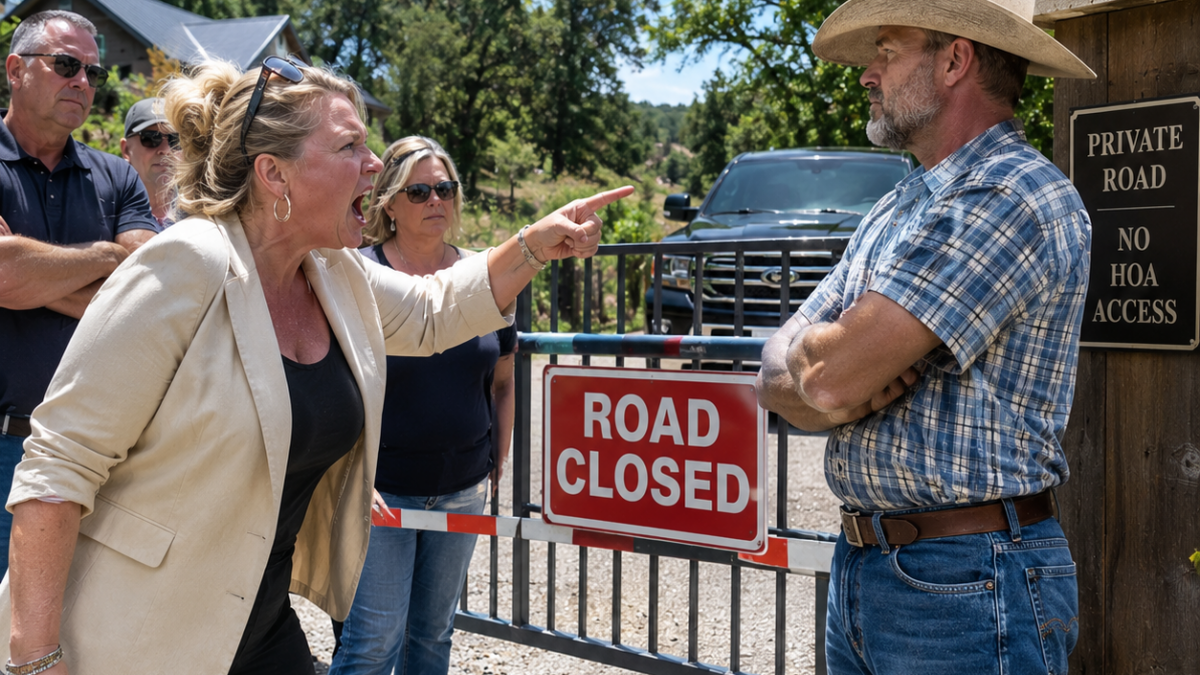
Monday at six, Tommy’s crew installed barriers.
Real barriers.
Real equipment.
Real permits.
At six-thirty, Old Pete Wilson appeared carrying coffee.
He read the sign.
Then looked at me.
“You actually bought the damn road.”
“Language.”
“I’m seventy-four.”
“Then you’ve had longer to learn manners.”
He handed me coffee.
“Magnificent.”
Maria Martinez walked up with her baby on one hip.
“How bad will traffic be?”
“Detour adds eight miles during full closures. We’ll open controlled access whenever crews can do it safely.”
“School bus?”
“Coordinated.”
“Ambulance?”
“Always priority.”
She nodded.
“That’s all I wanted to know.”
At 7:14, I heard the Mercedes before I saw it.
Vivian came down the lane too fast.
Brakes squealed.
The car stopped ten feet from the first barrier.
She climbed out.
Navy suit.
Sunglasses.
Phone already recording.
“What is this?”
Tommy looked at me.
I looked at him.
“Road work,” he said.
“I’m speaking to Wade.”
“Road work,” I repeated.
“You cannot barricade access.”
I handed her the packet Buck had prepared.
Deed.
Permit.
Construction plan.
Easement accommodations.
Detour.
Emergency plan.
She flipped through pages.
Her face slowly changed.
“You bought it.”
“Yes.”
“This is illegal.”
“Page twelve.”
“What?”
“County permit.”
“You’re holding twenty-three households hostage.”
“No. Everybody has access. Some of it is temporarily less convenient.”
Her hand shook.
“This road is essential infrastructure.”
“Then it should have been maintained.”
“You did this because of the fence.”
That was the moment I saw it.
Not anger.
Fear.
Real fear.
“Why do you need this road so badly, Vivian?”
She froze.
Old Pete stopped drinking coffee.
Maria shifted the baby higher against her shoulder.
Vivian’s eyes narrowed.
“What are you implying?”
“I asked a question.”
“You know exactly what you’re doing.”
“Do I?”
“You ignorant—”
She caught herself.
Barely.
Then Tommy’s excavator started.
The engine drowned out whatever came next.
Vivian backed toward her Mercedes.
“This will be reopened by lunchtime.”
“It won’t.”
“My lawyers will destroy you.”
“Tell them Buck says hello.”
She slammed the car door.
Old Pete whistled.
“Think she likes you.”
“I felt chemistry.”
By noon, I had been served.
Emergency injunction.
Bad-faith interference.
Economic damages.
Intentional obstruction.
Buck read it in his office.
“She’s fast.”
“Can she win?”
“Temporary relief is always possible if a judge thinks residents are being denied meaningful access.”
“They aren’t.”
“Which is why we have logs.”
He flipped through Tommy’s traffic records.
School-bus schedule.
Resident passage windows.
Emergency plan.
Detour.
Photographs of failed culverts.
Engineer’s letter.
Buck smiled.
“She has a problem.”
“What?”
“The road actually needs repairs.”
“That seemed important.”
“It is very difficult to prove a man fabricated safety concerns when the asphalt is coming apart in photographic exhibits.”
The judge declined to order an immediate full reopening.
He required us to maintain reasonable residential and emergency access.
We were already doing that.
Vivian lost the first round.
Her urgency became worse.
The next afternoon, Sarah spotted a man in a ditch near our barn.
Camera.
Expensive lens.
Cheap suit.
I walked out.
“Can I help you?”
He stood too quickly.
“Insurance documentation.”
“Whose insurance?”
“I’m not authorized to disclose client information.”
“You’re standing on my property.”
He looked down.
He had crossed the boundary by maybe twenty feet.
“I thought this was the shoulder.”
“It isn’t.”
“I’ll move.”
“Please do.”
He retreated.
Sarah watched from the porch.
“You think Vivian hired him?”
“I think we should let him tell us.”
Buck sent the man a formal notice after identifying his vehicle.
The investigator’s company responded that it had been retained by Blackwood Development Partners.
There it was.
Not HOA.
Development.
I showed Sarah.
She stared at the letter.
“She isn’t even pretending anymore.”
“No.”
Then Tommy Morrison came to our door.
Jake’s son.
He looked exhausted.
Seventeen years old and carrying more guilt than anybody that age should.
“Mr. Thornton?”
“Tommy.”
“Can I talk to you without my dad knowing?”
I stepped aside.
Sarah made hot chocolate because Sarah believed all serious conversations improved with food.
Tommy sat at the table.
His hands wouldn’t stop moving.
“I quit Vivian’s firm.”
“Good.”
“She’s losing it.”
“What happened?”
“She screamed at Marcus in the conference room yesterday.”
“About?”
“You.”
I almost smiled.
“Popular subject.”
“And the road.”
That erased the smile.
Tommy opened his backpack.
“I shouldn’t have copied this.”
Buck would later agree.
But the documents existed, and once given to us, we handled them through counsel rather than publishing them.
Bank statements.
Loan schedules.
Investor agreements.
A project-financing summary.
Two-point-three million dollars.
Houston investors.
Milestone payment due October fifteenth.
Failure to demonstrate acquisition progress triggered default penalties.
I looked at the date.
Three weeks.
“Does Vivian know you took these?”
“No.”
“Tommy, you may need your own lawyer.”
His face went pale.
“I’m trying to help.”
“I know. Helping doesn’t mean you can’t get caught in adult problems.”
Sarah put a hand on his shoulder.
“Why did you come here?”
His eyes filled.
“Because my dad signed that complaint for me.”
“He made his own choice.”
“Because of the internship.”
“That was still his choice.”
Tommy wiped his face.
“I thought I wanted it. I thought if I got into Vivian’s firm, I could get recommendations, maybe scholarship connections. Then I heard how they talked about people.”
“What do you mean?”
“Like families were numbers.”
I knew exactly what he meant.
“Properties were ‘soft targets.’ Older owners were ‘transition opportunities.’ Your ranch was ‘the gateway acquisition.’”
Sarah’s face tightened.
Tommy continued.
“Yesterday Marcus said if the road isn’t secured by October fifteenth, the investors can call the loan.”
“How bad?”
“He said they lose everything.”
I looked at the documents.
Suddenly Vivian’s panic at the barricade made perfect sense.
The road wasn’t a convenience.
It was the clock.
I called Buck.
He told me not to contact Vivian.
Not to contact Marcus.
Not to post anything.
“Why?”
“Because desperate people make excellent evidence if you don’t warn them what evidence you already have.”
The smear campaign began the next morning.
Professional flyers.
Glossy.
Expensive.
My military photograph on the front.
I had served in Iraq decades earlier. Engineering unit. Demolitions training.
The headline read:
**VETERAN WITH EXPLOSIVES EXPERIENCE BLOCKS FAMILIES FROM HOMES**
Sarah found one taped to our mailbox.
Her face went white.
“They’re calling you dangerous.”
I read the rest.
“Instability.”
“Military trauma.”
“Threat.”
“Potential escalation.”
My stomach turned.
I had never discussed my service with Vivian.
Some of it was public.
Some probably came from paid background work.
Sarah ripped the flyer in half.
“Can we sue her for this?”
“Buck.”
“No, I’m asking you.”
“I don’t know.”
“She is telling people you are mentally unstable because you served.”
“I see that.”
“What if somebody believes her?”
I thought about the baby.
My ranch.
People with guns in rural Texas who might genuinely believe they were protecting their families from a dangerous veteran.
“That’s what scares me.”
Then the community surprised us.
Old Pete called Channel 7 himself.
Maria posted photographs of me rebuilding her porch after a tornado.
Miguel from the café wrote about the year I hauled generators to elderly residents after the ice storm.
A retired teacher posted that I had spent six weekends repairing the high-school agriculture barn for free.
Someone created a page.
**Neighbors Who Actually Know Wade Thornton.**
I hated the name.
Sarah loved it.
By afternoon, stories flooded in.
Some exaggerated.
One claimed I rescued five children from a flood.
“It was one teenager.”
Sarah shrugged.
“Five is better.”
“We’re not countering lies with inflated hero stories.”
“You are no fun.”
Channel 7 called.
I refused a dramatic interview.
Instead, Buck gave them permits, repair documents, and the road deed.
The evening report was almost boring.
**Private road owner conducts county-permitted emergency repairs amid property dispute.**
Boring was perfect.
Vivian’s expensive crisis firm had tried to paint me as a domestic threat.
The news showed me wearing a reflective vest beside a culvert.
One image looked like terrorism.
The other looked like road maintenance.
Friday afternoon, Marcus Blackwood walked into Miguel’s Café.
I was halfway through enchiladas.
He sat across from me without invitation.
Tailored suit.
Gold watch.
Sweat on his forehead.
“Wade.”
“Marcus.”
“We need to talk.”
“I’m eating.”
“This will only take a minute.”
He placed an envelope on the table.
I didn’t touch it.
“What is that?”
“Three hundred thousand.”
I stopped chewing.
Miguel, behind the counter, looked over.
“Three hundred thousand what?”
“Dollars.”
“For?”
“The road.”
I laughed.
Not intentionally.
Marcus’s face tightened.
“What’s funny?”
“Vivian offered Florence two hundred.”
“This is different.”
“Why?”
“Because the situation has become destructive.”
“To whom?”
“Everyone.”
“Try again.”
His fingers tapped the table.
“You bought it for one-forty-eight. Three hundred is a phenomenal return.”
“It is.”
“Then take it.”
“No.”
He leaned closer.
“Four hundred.”
Miguel stopped wiping the counter.
I stared at Marcus.
“You came prepared to double your offer in under thirty seconds.”
“This is business.”
“Then tell me why the road is worth four hundred thousand.”
“You know why.”
“I’d like to hear you say it.”
His face changed.
That told me enough.
I took another bite.
Marcus whispered, “You don’t understand who financed this project.”
“Houston investors.”
His eyes widened.
“October fifteenth.”
He went pale.
I put down my fork.
“Two-point-three million.”
For a moment, Marcus looked physically ill.
“How did you get that?”
“Public records show more than people think.”
Not all of it was public, of course. But Tommy’s involvement was not something I intended to expose.
Marcus looked around.
Miguel had very obviously stopped pretending not to listen.
“Wade, these are serious people.”
“That sounds threatening.”
“It isn’t.”
“Then choose your next words carefully.”
“I’m saying they expect performance.”
“So did you promise them my ranch?”
“We expected a negotiated acquisition.”
“You expected me broke.”
“That is not what I said.”
“Your financial plan called my property a distressed acquisition.”
His mouth opened.
Then closed.
I leaned forward.
“You used Vivian’s HOA fines to create distress.”
“That’s speculation.”
“Her shell companies bought houses after violations.”
“Coincidence.”
“Your bank financed preferred buyers.”
“Normal business.”
“County enforcement targeted colorful properties after Vivian’s texts.”
“I know nothing about that.”
“Then you should be furious at your wife.”
His jaw clenched.
“She is trying to protect a project that would increase every property value here.”
“By bulldozing homes?”
“Progress has costs.”
I stared at him.
There it was.
Not even shame.
Just accounting.
“My grandfather’s barn is not your cost.”
“We could keep the barn.”
I almost laughed again.
Marcus hurried on.
“Make it part of the design. Heritage center. Restaurant. Ranch aesthetic.”
“Ranch aesthetic.”
“People pay for authenticity.”
“So I become what? Decoration?”
“You could benefit.”
“From pretending the thing you destroyed still exists?”
His patience cracked.
“Four hundred thousand dollars, Wade.”
“No.”
“Five.”
Miguel said from behind the counter, “Señor, he said no.”
Marcus looked at him.
“This is private.”
“No. This is my restaurant.”
Marcus stood.
At the door he turned.
“You’re making a mistake.”
“Maybe.”
“Those investors don’t lose quietly.”
I stood too.
“Is that a threat?”
He hesitated.
“A warning.”
“Good.”
I nodded toward the security camera above Miguel’s register.
“Because threats would be awkward on video.”
Marcus looked up.
His face drained.
Then he left.
Miguel brought me coffee.
“Free.”
“Why?”
“You made rich man look like he swallowed a cactus.”
I called Buck before finishing lunch.
The next two weeks were the most frightening of my life.
Not because Vivian sent another fine.
Those almost became funny.
Because strangers started appearing.
Houston plates.
Men in suits.
Questions at the hardware store.
Questions at the café.
Questions about my schedule.
Our security system.
Sarah.
One afternoon, Sarah called from town.
“Don’t panic.”
That sentence guaranteed panic.
“What happened?”
“A man followed me from the grocery store.”
“Where are you?”
“Sheriff’s office.”
“I’m coming.”
She stopped me.
“No. Stay at the ranch.”
“Sarah.”
“I’m safe.”
Sheriff Martinez—Jim to everybody who knew him—took the report.
The vehicle had Houston plates.
No crime beyond following at a distance.
Nothing they could prove.
Still, the message was obvious.
That night I checked every lock twice.
Sarah watched me from the hallway.
“Wade.”
“I’m fine.”
“You’ve checked that door three times.”
“It sticks.”
“It does not.”
I stopped.
She walked toward me.
One hand on her belly.
The other reached for mine.
“I’m scared too.”
“I know.”
“Then stop pretending you aren’t.”
I leaned my forehead against hers.
“I spent months thinking the worst thing that could happen was losing the ranch.”
“And now?”
I looked down at Emma beneath her hands.
“Now I know better.”
Sarah closed her eyes.
“We could sell the road.”
I said nothing.
“Marcus offered enough to rebuild the savings.”
“I know.”
“We could sell the ranch too.”
My chest tightened.
“I know.”
“We could leave.”
“You want to?”
She opened her eyes.
“No.”
“Then why say it?”
“Because I need to know staying is a choice, not something Grandpa Joe’s ghost is forcing you to do.”
That hurt.
Because sometimes legacy can become another kind of cage.
I sat.
Sarah sat beside me.
“If it were only me,” I said, “I’d probably fight until I had nothing left.”
“I know.”
“That’s not courage.”
“No.”
“It might just be stubbornness.”
“Also yes.”
I looked toward the window.
“The road gives us leverage.”
“But?”
“But I won’t risk you and Emma to prove something.”
Sarah was quiet.
Finally she said, “Then let’s define the line.”
“What line?”
“The point where we walk away.”
We did.
If there was a direct physical threat.
If somebody entered the ranch armed.
If doctors said stress endangered the pregnancy.
If law enforcement advised us to leave temporarily.
We would.
No debate.
No pride.
That agreement made staying feel different.
Chosen.
Not trapped.
October fifteenth approached.
Three days before the investor deadline, the county scheduled a public hearing on the road dispute.
Vivian’s lawyers wanted permanent restrictions on my ability to close Meadowbrook Lane.
Buck countered that residents’ legal easements were already protected and the actual issue was whether a private owner could conduct necessary repairs while a development company tried to compel commercial access rights it did not possess.
The community center held two hundred.
Four hundred showed.
Churches lent chairs.
People stood along walls.
Three news crews set up.
Sarah sat in the front row.
Her pregnancy was impossible to hide now.
Old Pete sat beside her.
Maria and Carlos behind them.
Jake sat three rows back.
He hadn’t spoken to me since his confession.
Tommy sat beside him.
Across the room, Vivian had a table that looked transported from a Dallas courtroom.
Three lawyers.
Presentation equipment.
Binders.
Marcus.
Twelve loyal supporters.
Most of them newer residents.
Commissioner Bradley called the hearing to order.
“Tonight concerns access, safety, easement obligations, and the private ownership of Meadowbrook Lane. It is not a referendum on anybody’s personality.”
Old Pete whispered loudly, “Shame.”
Half the room laughed.
Vivian did not.
Her lawyer spoke first.
Charts.
Traffic delays.
Property values.
Emergency-response hypotheticals.
Then Vivian took the microphone.
She wore navy.
Pearls.
Controlled expression.
For a moment, I understood why she had gotten so far.
Confidence looks a lot like truth when people don’t have documents.
“One man,” she said, “has weaponized ownership to punish an entire community.”
A photograph of me appeared.
Military uniform.
Young.
Tired.
“Mr. Thornton’s behavior has escalated from defiance of community standards to deliberate infrastructure disruption.”
Sarah’s hand tightened around mine.
Vivian continued.
“Residents feel unsafe.”
Another slide.
My fence.
Turquoise.
Orange.
Carved horses.
“His original refusal to comply may appear trivial. But rules exist because individual actions affect collective value.”
She clicked again.
Road barriers.
“He now controls the community’s primary access and has demonstrated willingness to close it whenever convenient.”
Buck wrote something.
I looked.
**SHE JUST ADMITTED PRIVATE OWNERSHIP.**
I almost smiled.
Then Vivian called Jake.
My stomach turned.
He walked to the microphone.
His shoulders were rounded.
Eyes down.
Vivian’s attorney asked, “Mr. Morrison, how long have you known Wade Thornton?”
“Eight years.”
“Did he ever discuss hostility toward Meadowbrook residents before purchasing the road?”
Jake swallowed.
“Yes.”
I stared at him.
Sarah whispered, “Oh, Jake.”
The lawyer continued.
“What did he say?”
Jake’s voice shook.
“He said people needed to learn not to cross him.”
I had never said that.
“He talked about making the neighborhood pay.”
Never said that either.
“Did Mr. Thornton reference his military background?”
Jake looked at me for the first time.
“I—”
Vivian stared at him.
He looked away.
“Yes.”
“What did he say?”
“That he learned ways to make people’s lives difficult.”
A murmur moved through the room.
I felt anger rise.
Buck placed one hand on my arm.
“Don’t.”
“I know.”
“Good.”
He stood for cross-examination.
“Mr. Morrison, you filed the original fence complaint.”
Jake closed his eyes.
“Yes.”
“Why?”
“I believed the fence violated standards.”
Buck picked up a document.
“Did Vivian Blackwood’s law firm offer your son an internship before or after you signed?”
Vivian’s attorney jumped up.
“Objection.”
“This isn’t a courtroom,” Commissioner Bradley said. “But answer if you know.”
Jake’s mouth trembled.
“Before.”
A murmur.
Buck continued.
“Was that internship discussed in connection with your cooperation?”
“No.”
“Was your son promised scholarship assistance?”
Jake looked at Tommy.
Tommy’s face had gone white.
“Possibly.”
“That isn’t an answer.”
“Yes.”
Vivian whispered something to Marcus.
Buck walked to our evidence table.
“Mr. Morrison, you testified that Mr. Thornton planned this retaliation months ago.”
“Yes.”
“Before he knew who owned the road?”
Jake hesitated.
“Yes.”
Buck turned to me.
“When did you first meet Florence Meadows regarding ownership?”
I answered.
“After the vandalism campaign had already escalated.”
Buck displayed the date.
Then Vivian’s original complaint.
Then Florence’s record showing Vivian attempted to purchase the road months earlier.
Buck faced Jake.
“So Mr. Thornton supposedly planned to weaponize a road he did not know was privately available for sale?”
Jake’s face collapsed slightly.
“I guess.”
“You guess.”
Vivian’s lawyer stood.
“This is harassment.”
Buck ignored him.
“Jake, are you under pressure to testify here tonight?”
Silence.
“Jake?”
Tommy stood.
“Dad.”
Every head turned.
Jake looked at his son.
Tommy’s eyes filled.
“Tell the truth.”
Vivian shot up.
“Sit down.”
Tommy didn’t.
Commissioner Bradley banged the gavel.
“Everybody stay where they are.”
Tommy’s voice shook.
“Mr. Commissioner, I have evidence.”
Vivian’s lawyer stared at him.
“What evidence?”
Tommy looked at me.
I hadn’t known what he planned.
Neither had Buck.
That scared me.
Tommy held up his phone.
“Recordings.”
Vivian’s face changed.
Marcus whispered, “Oh, God.”
Buck walked over.
“Tommy, before you play anything, how did you obtain it?”
“I work—worked—at Vivian’s law firm. Some was recorded in public areas. Some is from my phone when they talked around me.”
Buck’s expression became cautious.
“Give it to counsel. We need to know whether it can legally be used.”
The crowd groaned.
Buck turned.
“This is how you avoid turning evidence into a lawsuit.”
Commissioner Bradley called a twenty-minute recess.
Those twenty minutes felt like two hours.
Buck reviewed the recordings with county counsel.
One had been made in a parking area where the speakers had no reasonable expectation their conversation was private, according to the attorneys present.
Another was a voicemail Marcus had accidentally left on Tommy’s work phone.
The commissioner allowed limited playback for the administrative hearing.
We returned.
The first recording crackled through the speakers.
Vivian’s voice.
“Did you coach Morrison properly?”
Marcus.
“He knows what to say.”
Vivian again.
“He cannot get sentimental in front of Thornton. If Wade keeps control of the road past the fifteenth, the investors trigger default.”
Silence filled the room.
Then Marcus:
“What if the road repairs are legitimate?”
Vivian:
“Then we make the owner illegitimate.”
Sarah inhaled sharply.
The recording continued.
“The fence narrative worked until those idiots started painting everything. We should have pushed foreclosure sooner.”
My hands went cold.
Marcus said something too quiet to hear.
Vivian:
“Once the ranch is distressed enough, Blackwood Development acquires it. Without the gateway parcel there is no entrance, and without Meadowbrook Lane there is no project. I am not losing two years of work because some old cowboy likes orange paint.”
The room exploded.
Vivian jumped to her feet.
“That recording is illegally obtained.”
Her lawyer pulled her down.
Commissioner Bradley hammered the gavel.
Buck did not smile.
He clicked the second audio.
Marcus’s voice.
A voicemail.
“Vivian, the Houston group won’t extend. Two-point-three million due Monday. If Wade doesn’t sell the road, we’re finished. Call me before you do anything else. No more code people, no more vandalism, no more Jake. You’re making this worse.”
The audio ended.
Every eye turned toward Vivian.
She stood again.
This time her lawyer couldn’t stop her.
“You have no idea what he’s done.”
She pointed at me.
“I spent two years assembling that project.”
No one spoke.
“I brought investment into this dump.”
Old Pete stood.
“Dump?”
Vivian ignored him.
“Property values would have tripled.”
Maria called out, “After you forced us out?”
“I never forced anyone out.”
Rita Gonzalez stood near the back holding a folder.
“Six shell companies linked to you bought houses after HOA enforcement pressure.”
Vivian’s face twisted.
“Those were legitimate transactions.”
“What about the Hendersons?” somebody shouted.
“The Murphys?”
“My mother?”
Voices rose everywhere.
Commissioner Bradley hammered the gavel until nobody listened anymore.
Vivian shouted over them.
“You people don’t understand development. You don’t understand value. Half these properties were embarrassing.”
There it was.
Her composure broke completely.
She pointed toward my side of the room.
“Purple shutters. Yellow mailboxes. Rusted trucks. Broken fences. Livestock. You expect serious investors to build around that?”
Old Pete stared at her.
“You mean people.”
“What?”
“You’re talking about people.”
Vivian laughed sharply.
“I’m talking about standards.”
I stood.
Buck tried to stop me.
I shook my head.
“I’m not going over there.”
The room quieted slowly.
I faced Vivian.
“Was my fence ever actually the problem?”
She stared.
“Answer him,” someone called.
Vivian’s lawyer whispered urgently.
She ignored him.
“That fence was hideous.”
A few people laughed.
She heard it.
Her face reddened.
“You think this is funny? I had financing. Approvals. Buyers lined up. I had almost every parcel I needed.”
“Except mine.”
“You were supposed to fold.”
The room went silent.
Her lawyer closed his eyes.
Vivian kept going.
“The fines should have been enough. Then the bank pressure. Then your friend. Everybody has a price.”
Sarah stood.
“Not everybody.”
Vivian looked at her.
For the first time all night, something like shame crossed her face.
It disappeared quickly.
“You’re going to lose that ranch anyway.”
Sarah stepped beside me.
“No.”
Her voice was calm.
“Our daughter is going to grow up there.”
Vivian laughed.
“On a dying cattle operation?”
Sarah put a hand on her belly.
“Maybe.”
“Surrounded by that ridiculous fence?”
Sarah smiled.
“Especially the fence.”
People laughed again.
Vivian snapped.
“You think colors make you brave?”
“No,” Sarah said. “But I think needing everybody to be beige made you very scared.”
That was the line Vivian couldn’t take.
She lunged toward us.
Not far.
Her lawyer and Marcus caught her.
Sheriff Martinez stepped forward.
“Vivian.”
She fought against Marcus’s grip.
“This is their fault.”
Jim’s expression stayed flat.
“No. Whatever happens next comes from evidence.”
“Get away from me.”
“Ma’am, I need you to calm down.”
“I am calm.”
She clearly wasn’t.
Then two state investigators entered from the side hall.
That wasn’t part of our plan.
I looked at Buck.
He looked surprised too.
One investigator approached the commissioner, whispered, then turned toward Vivian.
“Vivian Blackwood?”
Her face went still.
“Yes?”
“We have a warrant relating to property destruction, conspiracy, and financial misconduct. Additional matters remain under investigation.”
Her lawyer immediately stood.
“She will surrender voluntarily.”
The investigator nodded.
“Fine.”
No dramatic tackle.
No cheering at first.
Just cuffs.
Procedure.
Vivian looked across the room.
For one second, she seemed small.
Then she saw me.
“This is not over.”
I thought about all the times I had imagined answering that line.
Something clever.
Something hard.
Instead I said, “It is for the fence.”
She blinked.
I looked toward Sarah.
“Tomorrow I start rebuilding.”
Vivian was escorted out.
The room remained quiet until the doors closed.
Then somebody began clapping.
I hated it.
I understood it.
But I hated it.
Because the person being taken away was still somebody’s wife, somebody’s daughter, a woman who had made destructive choices and was now watching them close around her.
Justice doesn’t need celebration to be justice.
Commissioner Bradley called everyone back to order.
The road question was easier without Vivian’s theater.
My ownership stood.
Residents’ easements stood.
Emergency access requirements stood.
The legitimate repair project stood.
Commercial development access did not magically arise merely because Blackwood Development wanted it.
The commissioner refused the request to force expanded project access.
The HOA board called an emergency meeting the next morning.
Vivian was removed as president.
Three board members resigned.
An interim committee formed.
Then came the financial audit.
That was when the real damage surfaced.
HOA funds had paid legal bills connected to Vivian’s private development interests.
Certain enforcement expenses targeted properties later acquired by companies tied to Blackwood entities.
Contractors had billed for work never completed.
County enforcement supervisor Dennis Walsh had received consulting payments from a company connected to Marcus.
The district attorney became involved.
Then state investigators.
Then federal regulators once bank transactions and interstate investors entered the picture.
Nobody used the word “RICO” around me except television reporters.
Buck hated that.
“People think every group of three criminals is the mafia.”
“Aren’t you fun at parties.”
“I bill parties hourly.”
The road reopened in stages as repairs progressed.
That mattered to me.
I didn’t keep it closed one day longer than the engineers required.
Tommy Rhodes rebuilt the culverts.
New shoulders.
Drainage.
Fresh surface.
Traffic controls.
For the first time in years, Meadowbrook Lane stopped rattling teeth out of people’s heads.
Old Pete stood beside me when the last paving roller finished.
“You know what would be funny?”
“What?”
“Leave one pothole in front of Vivian’s house.”
“No.”
“Tiny one?”
“No.”
“You’ve lost your sense of humor.”
“Liability killed it.”
The Blackwood development collapsed before the investor deadline.
Without guaranteed control of the road and without my ranch, the financing structure no longer worked.
The Houston group exercised its rights under the loan agreements.
Blackwood Development defaulted.
Properties held through shell entities went into legal and financial limbo.
Marcus’s bank came under scrutiny for lending practices tied to certain Meadowbrook transactions.
He resigned from his executive role before regulators finished their review.
Their marriage didn’t survive.
I didn’t celebrate that either.
There had been enough broken families.
Jake came to my door two weeks after the hearing.
No envelope this time.
No excuses.
He stood beside the rebuilt first section of my fence.
I had replaced four turquoise posts.
The rest still looked wounded.
“Wade.”
I waited.
“I lied under oath.”
“Yes.”
“I almost destroyed you.”
“You helped.”
He nodded.
“I thought I was helping Tommy.”
“I know.”
“That doesn’t excuse it.”
“No.”
His eyes filled.
“I don’t know how to fix this.”
I looked at the fence.
“You good with a post-hole digger?”
He stared.
“What?”
“You said words won’t fix it.”
He looked at the broken posts.
Then at me.
“I’ll get gloves.”
We worked six hours.
Barely talked.
At sunset, Sarah brought lemonade.
Jake touched one of the carved horses.
“I remember when you made this one.”
“You told me the ears were too big.”
“They are.”
“Get off my property.”
He almost smiled.
Then his face collapsed.
“I’m sorry, Wade.”
This time the apology sounded different.
Not because the words changed.
Because there was no request attached.
No demand that I forgive him.
No explanation.
Just sorry.
I put down the hammer.
“I’m still angry.”
“I know.”
“I don’t trust you.”
“I know.”
“That might take a long time.”
“I know.”
“But you can come back tomorrow.”
He nodded.
That was how trust began rebuilding.
One post at a time.
Tommy quit Vivian’s firm permanently.
He earned his college money the old way.
Grades.
Applications.
Scholarships.
Work.
A year later he was valedictorian.
Jake sat in the front row at graduation and cried hard enough that people three sections away noticed.
Sarah leaned toward me.
“Don’t look.”
“I’m not.”
“You’re looking.”
“I’m looking respectfully.”
Tommy received a legitimate scholarship to study engineering.
Before he left, he came to the ranch.
“I owe you.”
“No.”
“My dad—”
“Your dad’s debt is his.”
“The documents I gave you—”
“Helped.”
“I shouldn’t have taken them.”
“No.”
He looked surprised.
“Then why aren’t you mad?”
“I can be grateful you did the right thing and still admit you did part of it the wrong way.”
He smiled.
“That sounds like something Buck would say.”
“Don’t insult me.”
The criminal and civil cases lasted more than a year.
Vivian ultimately entered plea agreements on a group of state and federal charges connected to property destruction, fraud-related conduct, misuse of association funds, and conspiracy arising from the broader scheme.
She served eighteen months in federal custody, followed by supervision and restitution obligations.
Not ten years.
Not life.
Not some movie sentence.
Eighteen months.
Some neighbors thought it wasn’t enough.
Others thought prison at her age was severe.
I didn’t have a number in my head.
I wanted the machine she had built dismantled.
It was.
Marcus faced separate consequences connected to discriminatory and improper lending practices.
He lost his banking position and professional standing.
Civil settlements followed.
Several families received compensation.
Foreclosure transactions were reviewed.
Some former residents chose not to return.
That was one of the harder truths.
Winning didn’t rewind time.
The Hendersons had moved near Fort Worth.
Mrs. Murphy had remarried and relocated.
Another family had spent years believing they had simply failed financially when, in reality, pressure had been designed around them.
You can win a case.
You cannot give people back every night they spent awake wondering if they would lose their home.
The HOA itself nearly collapsed.
For a while, residents argued about dissolving it entirely.
Old Pete favored “launching the documents into the sun.”
Buck advised against that procedure.
Eventually Meadowbrook chose something less dramatic.
The old HOA dissolved through the proper process.
A smaller community association replaced it.
Voluntary social events.
Road and shared-property coordination where legally necessary.
Transparent accounts.
No architectural police.
No daily fines for paint colors.
No president with unilateral enforcement power.
Then came Meadowbrook Lane.
I still owned it.
By then the road was worth more than I had paid Florence.
Not because of Vivian’s failed development.
Because Tommy’s crew had made it safe.
I could have kept it.
Collected maintenance fees.
Held leverage forever.
I didn’t want that.
I had spent a year learning what happened when one person accumulated too much control over where everybody else lived.
So we created the Meadowbrook Community Road Trust.
Every property served by the lane received an equal voting interest.
Major decisions required broad approval.
Budgets published.
Maintenance reserves audited.
No one resident—not even me—could close or sell the road for personal advantage.
At the transfer meeting, Florence sat in the front row.
She was eighty-four by then.
I handed her the new trust document.
She read the ownership clause.
Then looked at me.
“You listened.”
“Sometimes.”
“Rarely.”
“Still counts.”
She smiled.
“My father would’ve liked this.”
“What about you?”
“I’m withholding judgment until I see the drainage after spring storms.”
That was Florence.
The road repairs were partly funded by contributions and later restitution from parties tied to the failed scheme.
Not every dollar.
Residents paid their fair portion too.
That mattered.
A community becomes healthier when people stop expecting somebody else to carry the entire burden.
The new entrance sign went up in April.
**MEADOWBROOK COMMUNITY**
Underneath:
**WHERE NEIGHBORS MATTER**
Maria painted it.
Turquoise.
Orange.
Purple.
Yellow.
I stared at it.
“Subtle.”
She smiled.
“I was inspired.”
Vivian would have hated it.
That was not why we kept it.
At least, not entirely.
Then Emma arrived.
Three weeks early.
At 2:14 on a Tuesday morning, Sarah woke me by grabbing my arm hard enough to leave marks.
“Wade.”
I opened one eye.
“What?”
“My water broke.”
I sat up so fast I hit my head on the bedframe.
“Now?”
“No, next Thursday.”
“Right.”
“Breathe.”
“You breathe.”
“I am literally the one in labor.”
Everything I had learned about staying calm during cattle emergencies vanished.
I put one boot on.
Couldn’t find the other.
Sarah watched me.
“You mocked Buck for this.”
“Not helpful.”
We made it to the hospital.
Fourteen hours later, I held Emma Rose Thornton.
Six pounds, nine ounces.
Tiny fist.
Dark hair.
Angry lungs.
I had survived Iraq.
Droughts.
Bank notes.
Vivian.
Courtrooms.
Watching my wife labor terrified me more than all of them.
Then the nurse handed Emma to me.
She opened one eye.
I cried.
No dignity.
No restraint.
Sarah laughed weakly from the bed.
“Cowboy.”
“I’m fine.”
“You’re dripping on the baby.”
“I’m sweating.”
“From your eyes?”
“Hospital ventilation.”
When we brought her home, the first thing we saw was the fence.
Completely rebuilt.
I had expected to finish it after the birth.
But neighbors had done it.
Pete.
Maria.
Carlos.
Jake.
Tommy before leaving for school.
Florence had apparently supervised from a folding chair.
Every post stood.
Every horse carving repaired.
Turquoise.
Orange.
And one new panel.
Emma’s name.
Small.
Not gaudy.
Even I had limits.
Sarah covered her mouth.
“Who did this?”
Old Pete emerged from behind the barn.
“Illegal community improvement.”
More people appeared.
Maria.
Jake.
Florence.
Miguel.
Tommy Rhodes.
Rita.
Half of Meadowbrook.
I stood holding my daughter beside the fence Vivian had tried to erase.
For a moment I couldn’t speak.
Jake approached.
“We figured you had more important things.”
I looked at him.
The man who had once signed the complaint that started everything.
Then at the post he had carved himself.
“You made the horse ears too big.”
He laughed.
Sarah started crying.
Then Maria cried.
Then Florence told everyone to stop being ridiculous.
Emma slept through all of it.
That fence became something else after that.
Not my revenge.
Not Vivian’s defeat.
A record.
Every mark meant somebody.
Pete painted one orange rail.
Maria’s children did a turquoise post and spilled half the bucket.
Jake carved a horse.
Tommy added a small metal plate inside the gate with the date the road trust was signed.
Sarah painted one narrow section purple just to annoy me.
“It doesn’t match.”
“That’s the point.”
Once a year, we started Fence Day.
The name was originally a joke.
Then people liked it.
Families painted mailboxes.
Kids made signs.
Neighbors repaired elderly residents’ porches.
Miguel brought food.
Pete judged a “most offensively cheerful exterior decoration” contest until we had to ban him from judging because he kept awarding himself first place.
The whole thing would have given Vivian a migraine.
But it wasn’t about her anymore.
That was important.
If your celebration depends forever on somebody else’s humiliation, you haven’t really escaped them.
Years passed.
Some relationships never healed.
Some did.
Jake took the longest.
He volunteered for everything.
Roof repairs.
Storm cleanup.
Driving Florence to medical appointments.
Helping the Murphys settle an old property claim.
He never asked whether I forgave him.
That helped.
One evening, nearly three years after the hearing, we were replacing boards on my barn.
Emma was toddling through the yard under Sarah’s supervision.
Jake watched her.
“She’s fast.”
“She cheats.”
“She’s two.”
“Exactly. No respect for rules.”
He laughed.
Then his face grew serious.
“Wade.”
“Yeah?”
“I’ve wanted to ask something.”
I kept working.
“Ask.”
“Do you forgive me?”
I stopped.
There it was.
Three years.
I set down the drill.
“I don’t know what forgiveness is supposed to feel like.”
He looked disappointed.
“I don’t wake up angry at you anymore.”
“That’s something.”
“I trust you with tools.”
“Big.”
“I let you near my child.”
His eyes filled.
“That’s bigger.”
I looked toward Emma chasing a butterfly beside the turquoise fence.
“You hurt me.”
“I know.”
“You helped someone use our friendship against my family.”
“I know.”
“But you also spent three years showing me that wasn’t the man you wanted to stay.”
Jake nodded.
“So yes?”
I held out my hand.
“Yes.”
He grabbed it.
Then pulled me into a hug.
I tolerated it for three seconds.
“That’s enough.”
He laughed against my shoulder.
“You’re still emotionally broken.”
“I’m Texan.”
“Same thing.”
Sarah later accused me of crying.
I denied everything.
Florence died at eighty-seven.
Peacefully.
Her niece asked me to speak at the memorial.
I hated public speaking unless I was angry, which is not the same skill.
I told the story of the first time Florence asked whether I knew who owned Meadowbrook Lane.
People laughed.
Then I told them what she had taught me.
A road is not a weapon.
Ownership is responsibility.
Control is not the same thing as leadership.
Florence had handed me the lever that could destroy Vivian’s development.
But she had also warned me not to become Vivian while using it.
That warning mattered more than the deed.
After the service, her niece gave me a box.
Inside was Florence’s old tea set.
And a note.
**Wade,**
**If you are reading this, I finally got out of road maintenance permanently.**
I laughed.
Below it:
**Keep the colors. They annoyed the right people.**
Sarah framed that note.
It hangs beside the kitchen door.
Rita retired from the assessor’s office.
Miguel expanded his café.
Maria eventually joined the school board.
Old Pete somehow lived forever.
Buck’s law practice grew after the Meadowbrook case became locally famous.
He handled more HOA abuse and property-pressure cases than he ever wanted.
Once, he called me.
“Do you realize what you started?”
“I hired you.”
“That was your first mistake.”
Sarah volunteered part-time with a homeowner legal-aid network.
Not a hotline promising revenge.
Something better.
Document reviews.
Referrals.
Workshops teaching people how to read deeds, covenants, liens, and notices before panic took over.
She was good at it.
Better than me.
She knew how to listen without turning every conversation into a battle.
One night she finished a call and sat beside me.
“Family in Montana.”
“What happened?”
“HOA claiming rights over old mineral access.”
“Do they have a lawyer?”
“Now they do.”
I smiled.
“You like this.”
“I like stopping people from feeling as alone as we did.”
That was the right reason.
The road trust became boring.
That might have been my proudest achievement.
Meetings about resurfacing schedules.
Insurance.
Drainage.
Tree trimming.
No schemes.
No secret investor loans.
No midnight threats.
Just ordinary neighbors arguing whether seal coating should happen in May or June.
Boring is underrated.
The ranch survived too.
Barely, some years.
Cattle prices went up.
Then down.
Rain came late.
Then too much.
We diversified.
Sarah started a small farm-stay cabin near the north pasture.
I resisted.
“You want strangers here?”
“Paying strangers.”
“Continue.”
Emma grew.
At four, she knew every fence color.
At five, she decided orange was “too loud.”
I considered disowning her.
At six, she asked why the fence looked different from all the others.
We were sitting on the porch.
Sunset.
She had blue paint on her cheek.
“Because your great-grandpa liked bright colors.”
“Why?”
“He raced horses.”
“Did horses like orange?”
“I never asked.”
She thought about that.
“Did the bad lady hate it?”
Sarah looked at me.
We had never hidden the story completely, but we also didn’t want Vivian becoming a fairy-tale monster in Emma’s childhood.
“She thought everybody’s property should look the same,” I said.
“Why?”
“She believed that made the neighborhood worth more.”
Emma frowned.
“That’s dumb.”
Sarah coughed to hide a laugh.
I continued.
“She also made some very bad choices trying to get what she wanted.”
“Did you fight her?”
“I fought what she was doing.”
“Did you win?”
I looked across Meadowbrook.
Bright mailboxes.
Different shutters.
Children riding bicycles on the road I once owned.
Jake waving from his driveway.
Pete arguing with somebody about sprinkler placement.
“I think everybody won once we stopped letting one person decide what the whole neighborhood had to be.”
Emma considered that.
Then pointed at the fence.
“Can I paint a pink horse?”
I looked horrified.
“No.”
Sarah said, “Yes.”
“Absolutely not.”
Emma smiled.
The next morning there was a pink horse.
I had been outvoted.
Years later, people still sometimes asked about Vivian.
Where she went after prison.
Whether she ever apologized.
Whether she regretted it.
For a long time, I didn’t know.
Then a letter arrived.
No return name.
Arizona postmark.
I recognized the handwriting.
Sarah watched me hold it.
“You going to open it?”
“Eventually.”
“You’ve been holding it for ten minutes.”
“I’m building suspense.”
“You’re scared.”
“I’m not scared of paper.”
“You were scared of HOA letters for six months.”
“Fair.”
I opened it.
Four pages.
Vivian did not begin with an apology.
That would have been too easy.
She explained.
Her marriage had collapsed.
Marcus blamed her.
She blamed Marcus.
The investors.
The HOA.
The old residents.
Me.
For a while.
Then she wrote that prison had done something she had spent most of her adult life avoiding.
It made her irrelevant.
Nobody cared what she thought the wall color should be.
Nobody cared who she knew.
Nobody cared what she owned.
Nobody cared that she had once run a law office or an HOA.
She wrote:
**I spent my whole life believing control was proof that I mattered. When I started losing control, I hurt people because every boundary felt like rejection.**
I kept reading.
She admitted the fence had never been the issue.
The development project needed my land.
She had believed enough financial and social pressure would make me sell.
When the neighbors rallied around the colorful fence, she became furious because it proved she no longer controlled the story.
Then came the sentence that stopped me.
**When Sarah stood beside you at the hearing and said your daughter would grow up on that ranch, I realized I had spent two years building a future in which nobody else’s future mattered.**
I read it again.
Sarah watched me.
“What?”
I handed her the page.
She read silently.
Then returned it.
“Do you believe her?”
“I believe she wrote it.”
“That isn’t what I asked.”
“I don’t know.”
The final paragraph said:
**I am not asking forgiveness. I would like to know whether the fence still stands.**
That was all.
I took the letter outside.
Emma was nine by then.
She was repainting the pink horse.
I sat on the porch.
For an hour I thought about answering.
Part of me wanted to send a photograph.
Part wanted silence.
Finally, I wrote:
**The fence still stands.**
Then I added:
**So do most of the people you tried to move.**
I stopped.
That sounded like punishment.
I crossed it out.
Started again.
**The fence still stands. It has more colors now. The road belongs to the community. My daughter painted one horse pink.**
I stared at the page.
Then added one final line.
**I hope wherever you live next, you learn to let your neighbors choose their own colors.**
I mailed it.
She never wrote back.
That was fine.
I did not need another ending from her.
The ending I cared about happened on an ordinary Saturday.
Fence Day.
Emma was eleven.
Sarah stood beneath a shade canopy handing out lemonade.
Jake and Tommy—home from college—were replacing boards on Mrs. Henderson’s old place, now owned by a young family with three kids.
Maria’s teenagers were painting a mailbox purple.
Pete, somehow still alive and louder than ever, had entered three separate decorations in his own contest.
The road was full of bicycles.
No construction barriers.
No Mercedes screaming toward a barricade.
No lawyers.
No investigators.
Just neighbors.
I walked to the far end of my fence.
The original carved horse that Vivian had knocked loose that first night had been repaired but never perfectly.
One ear remained shorter.
A deep crack ran down the cedar.
I could have replaced it.
I never did.
Sarah joined me.
“You’re staring again.”
“Thinking.”
“Dangerous.”
“Remember three in the morning?”
“I remember wanting to hit Vivian with a shovel.”
“You never told me that.”
“I was pregnant. Hormones.”
“You were terrifying.”
“Still am.”
She slipped her arm around mine.
Emma ran past.
“Dad!”
“What?”
“We need more turquoise!”
“There are six gallons by the barn.”
“Mom says I can paint the gate!”
I looked at Sarah.
“She asked me when you weren’t listening.”
“You are undermining parental authority.”
“I’m building creativity.”
Emma disappeared.
I shook my head.
“Grandpa Joe would blame you.”
Sarah rested her head on my shoulder.
“No. He’d like this.”
I looked across the neighborhood.
She was right.
Grandpa had always believed fences served two purposes.
Keep livestock where they belonged.
Tell people where your responsibility began.
Vivian had mistaken a boundary for an insult.
Then she had spent years crossing everybody else’s.
I had almost answered by becoming just as controlling.
Buying the road had given me enormous leverage.
Closing it for repairs had brought her scheme to the surface.
But keeping it forever as my private weapon would have taught the wrong lesson.
So I gave up the leverage once the danger was gone.
That was the part nobody put in headlines.
They preferred:
**RANCHER BUYS HOA ROAD.**
**COLORFUL FENCE STARTS NEIGHBORHOOD REVOLT.**
**HOA PRESIDENT’S DEVELOPMENT EMPIRE COLLAPSES.**
Those headlines were fun.
They weren’t the story.
The story was Sarah signing away our savings while carrying a baby because she believed a home was worth defending.
It was Florence reminding me that owning something means being responsible for the people affected by it.
It was Tommy choosing truth over an internship.
Jake spending years repairing what one frightened decision had broken.
Neighbors who had been manipulated into mistrusting each other deciding to talk face-to-face again.
And a child who grew up believing a pink horse on a turquoise fence was perfectly normal.
That evening the volunteers left.
Barbecue smoke faded.
Sun dropped low over the pasture.
Emma rode her bicycle down Meadowbrook Lane.
The same road Vivian had needed for her luxury entrance.
The same road I had once closed behind orange construction barriers.
Now it belonged to everyone who lived there.
Emma reached our driveway, stopped, and looked back at the fence.
“Dad?”
“Yeah?”
“Which post was Great-Grandpa Joe’s favorite?”
I walked over.
“Probably that orange one.”
“Why?”
“Because he liked orange.”
“That’s not a reason.”
“It was for him.”
She touched the post.
Then she noticed the damaged horse.
“Why don’t you replace this one?”
I ran my fingers over the crack.
“Because it survived.”
She thought about that.
“It looks broken.”
“It was.”
“Then why keep it?”
I looked at Sarah on the porch.
At our house.
At Meadowbrook beyond it.
“Because repaired doesn’t always mean you erase where something broke.”
Emma nodded.
Then she pointed toward the road.
“Can I ride to Maria’s?”
“Homework done?”
“Yes.”
“Helmet?”
She tapped it.
“Back before dark.”
She pushed off.
I watched her ride between purple shutters, yellow mailboxes, blue porch swings, ordinary pickup trucks, messy yards, neat yards, old homes, renovated homes.
Different.
Alive.
Sarah came beside me.
“You know what I think?”
“That worries me.”
“I think you spent all that money buying a road just so our daughter could ride her bike on it someday.”
“That is an outrageous rewriting of history.”
“Sounds better than revenge.”
I looked at the faded turquoise paint beneath my hand.
“Yeah.”
She smiled.
“It does.”
The sun dropped behind the pecan trees.
Emma’s bicycle bell rang somewhere down Meadowbrook Lane.
I closed the ranch gate—not because anybody outside frightened me anymore, and not because some rule told me what my property had to look like, but because the cattle needed to stay in and dinner was waiting.
Before walking toward the house, I glanced once more at the fence Vivian had called gaudy enough to destroy.
Turquoise.
Orange.
Purple.
One ridiculous pink horse.
Not perfect.
Not tasteful according to anybody’s rulebook.
Ours.
And after everything it had cost to protect that simple right, I finally understood why Grandpa Joe had painted his racing colors so bright in the first place.
Some things are meant to be seen.
[END OF STORY]








