PART 2: HOA Sent Workers to Rip Off My Solar Panels — Then the Whole Neighborhood Went Dark While My House Stayed Lit
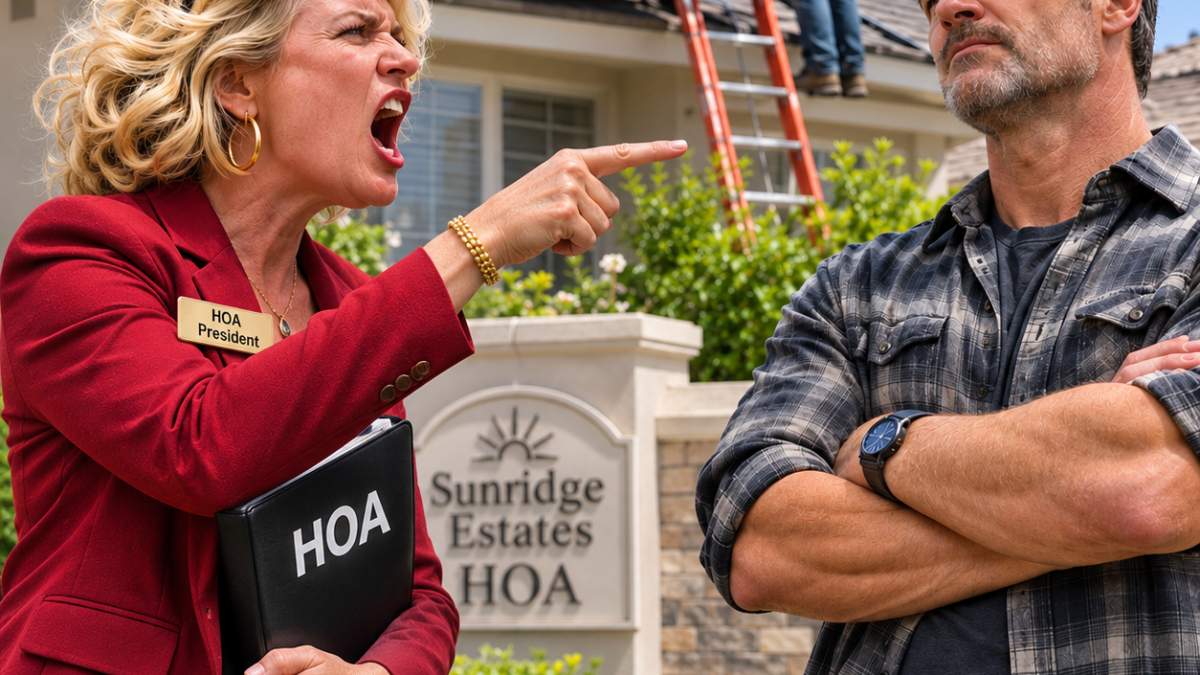
The first thing I heard was metal screaming above my bedroom, followed by the unmistakable crack of tempered glass hitting my driveway.
When I ran outside barefoot, three men in orange vests were tearing forty thousand dollars’ worth of solar equipment off my roof while my HOA president watched from the lawn with a smile.
By sunset, I would understand that those shattered panels were only the first move in a much bigger game.
My name is Dex Monroe.
I was fifty-two years old when Pine Haven Estates taught me that some wars don’t begin with gunfire.
Sometimes they begin with a clipboard.
Before moving to Colorado, I had spent twelve years in the Navy working electrical systems, including deployments where I helped keep substations, generators, and field power running under conditions most people would never voluntarily step into.
When electricity fails in a combat zone, the inconvenience isn’t that someone can’t watch television.
Medical units lose equipment.
Communications disappear.
Security lights die.
People can get hurt.
So I learned to respect systems.
More importantly, I learned never to assume that a system worked simply because somebody claimed to be in charge of it.
After leaving the service, I went into private electrical consulting. The money was decent. For a while, so was my marriage.
Then Lacey and I reached that sad stage where two people stop fighting because they’ve stopped believing there is anything left to fight for.
Our divorce was unusually peaceful.
No courtroom screaming.
No attempts to destroy each other.
We split what we had, shared custody of our daughter, and tried to behave like adults.
The hardest part wasn’t losing the marriage.
It was watching my seventeen-year-old daughter, Skyler, pretend she wasn’t scared about what came next.
She wanted to study environmental science at CU Boulder.
She had dreamed about it since middle school.
Scholarships would cover part of the tuition.
The rest was on us.
So when I bought the oldest house in Pine Haven Estates eighteen months after the divorce, I wasn’t looking for luxury.
I was looking for math that worked.
The house was a tired 1990s ranch surrounded by newer two-story homes with beige siding, immaculate garages, and lawns trimmed so evenly they looked computer generated.
Mine had peeling paint.
The shrubs were overgrown.
The driveway had cracks.
The roof was old but structurally sound.
And it received sunlight for nearly ten hours a day.
Perfect.
I had been saving for two years.
Forty thousand dollars.
Most people heard that number and thought I was insane.
I saw something different.
A solar array.
A Powerwall battery.
A dramatically lower electric bill.
And several hundred dollars every month that could go toward Skyler’s college fund instead of disappearing into a utility company.
I filed the permits.
Hired licensed installers.
Passed county inspection.
The system went live in April.
The first time I watched my meter run backward, I called Skyler outside.
“You’re smiling at an electric meter,” she said.
“I’m getting old.”
“You’re getting weird.”
“Look at that.”
She folded her arms.
“What am I looking at?”
“We’re producing more than we’re using.”
“So?”
“So the house is making money.”
“That is not how electricity works.”
“Close enough.”
She rolled her eyes.
But she smiled.
That was why I remembered that moment later.
Because three months after that conversation, I stood barefoot in my driveway watching one of those same panels slide off my roof and explode against the concrete.
“Stop!”
One worker looked down.
“Sir, stay back.”
“What are you doing?”
“We were authorized to remove the installation.”
“Authorized by who?”
Then I saw her.
Bryn Keller.
HOA president.
Forty-eight years old.
Blond bob.
White athletic jacket.
Yoga pants.
Clipboard.
She stood on my lawn as calmly as if she were supervising a landscaping crew.
“Morning, Dex.”
“What the hell is this?”
“You’ve been notified.”
“No, I haven’t.”
She lifted a sheet of paper.
“Exterior modification violation. Section 14.3.”
“I have county permits.”
“This is HOA property.”
“No. This is my property.”
Her smile barely moved.
“You live in an HOA.”
Another metal bracket snapped above us.
I looked up.
“Get those men off my roof.”
Bryn shook her head.
“You were given adequate opportunity to comply.”
A panel shifted.
One of the workers lost his grip.
Glass shattered.
Then came a sharp pop from the inverter.
Smoke curled from the side of my house.
My stomach dropped.
That system represented two years of savings.
Skyler’s tuition.
My plan after divorce.
My second chance.
And Bryn watched it happen without blinking.
“Remove the remaining panels voluntarily,” she said, “or fines begin at five hundred dollars per day.”
I stared at her.
She turned toward her white Lexus.
“Welcome to Pine Haven, Dex.”
I looked up at the torn roof.
At the dangling wires.
At the broken glass.
Then at the clipboard in her hand.
And for the first time since leaving the Navy, I felt the old part of my brain switch back on.
Not rage.
Not panic.
Assessment.
Document.
Understand the system.
Find the weak point.
Because Bryn Keller had just made one assumption that people like her always make eventually.
She thought patience meant surrender.
She was about to learn the difference.
PART 2
## THE FIRST THING I DID WAS NOTHING
That probably sounds strange.
A woman had sent workers onto my roof.
My equipment was damaged.
My inverter had smoked.
Every instinct in my body wanted me to charge across that lawn, get in Bryn’s face, and give her the kind of confrontation she would remember for the rest of her life.
Instead, I took photographs.
Every angle.
The workers.
Their truck.
License plates.
Broken brackets.
The damaged panel on my driveway.
The smoke stain beside the inverter.
Bryn standing on my lawn.
The violation notice.
Then I called the sheriff’s non-emergency number.
Then the county.
Then my installer.
Then my insurance company.
Only after all of that did I call Bryn.
She answered on the second ring.
“Pine Haven Homeowners Association.”
“This is Dex.”
A pause.
“I assumed it would be.”
“Who authorized those workers?”
“The board.”
“Names.”
“Excuse me?”
“I want the names of every board member who voted to enter my property and dismantle permitted electrical equipment.”
Her tone cooled.
“You need to direct requests through the proper process.”
“I am.”
“You’re being hostile.”
“No.”
I looked through the kitchen window at broken glass glittering on the driveway.
“I’m being very calm.”
That bothered her more.
People who live on intimidation need emotional reactions.
They need shouting.
They need threats.
They need you to lose control so they can point and say, See? This is exactly why we had to deal with him.
I wasn’t giving her that.
“Expect a formal notice,” she said.
“I’ll expect several.”
She hung up.
At 3:32 that afternoon, Skyler pulled into my driveway.
She had been at her mother’s house.
I was on the roof with the installer when I heard her.
“Dad?”
Something in her voice stopped me.
I climbed down.
She was staring at the shattered panels stacked near the garage.
“What happened?”
“HOA.”
Her face changed.
“What do you mean, HOA?”
I explained.
She didn’t say anything for a long time.
Then she looked at the roof.
Her college essay had been about that solar project.
Not because she thought panels were glamorous.
Because to her, the project represented something larger.
Her father had gone through divorce, moved into a smaller house, lost half the financial security he once had, and still decided to invest in something he believed would help both his daughter and the future she cared about.
She had written about resilience.
Now half the system looked like junk.
“You saved forever for this.”
“I know.”
“They can’t just do that.”
“I know.”
Her eyes filled.
That was the moment my anger became something else.
Bryn hadn’t just damaged equipment.
She had made my daughter feel that something we had built together could be destroyed because the wrong person held a title.
Skyler wiped her face quickly.
“I’m sorry.”
“For what?”
“Crying.”
“Come here.”
I hugged her.
She buried her face against my chest like she had when she was ten.
“I don’t want this to mess up college.”
“It won’t.”
“You don’t know that.”
“No.”
I pulled back and looked at her.
“But I know me.”
She gave a weak laugh.
“That sounded very Navy.”
“Good.”
“Are you going to do something stupid?”
“Define stupid.”
“Dad.”
“No.”
I looked toward the damaged roof.
“I’m going to do something careful.”
That promise mattered later.
Because there would be many moments when careful was the only thing separating justice from revenge.
## THE RULE BRYN FORGOT
Two days later, a certified letter arrived from county zoning.
A complaint had been filed alleging my solar system was unsafe, unpermitted, and not compliant with county construction standards.
The return address belonged to Bryn’s real estate office.
She wasn’t even pretending.
I drove to the county building.
An inspector named Doug pulled up my file.
He looked at the screen.
Then at me.
Then back at the screen.
“Your installation passed.”
“I know.”
“I inspected it.”
“I know.”
He sighed.
“Then why are we having this conversation?”
“Because my HOA president doesn’t like solar panels.”
Doug leaned back.
“That’s above my pay grade.”
“She had workers on my roof.”
His expression changed.
“Without you hiring them?”
“Yes.”
“That’s a different problem.”
“Can you dismiss the complaint?”
“I have to record it.”
“Of course.”
He rubbed his forehead.
“I can schedule a reinspection.”
“How soon?”
“Three weeks.”
I laughed.
He didn’t.
“Sorry.”
Three weeks.
That meant three weeks for Bryn to tell everyone my house was dangerous.
Three weeks for rumors.
Three weeks for another excuse to fine me.
When I got home, a cease-and-desist letter was taped to the front door.
The attorney was Clayton Voss.
I had never met him.
But the address on his letterhead caught my attention.
Same street as Bryn’s husband’s office.
A little research told me why.
Clayton was Bryn’s brother-in-law.
Family lawyer.
Convenient.
The letter demanded complete removal of the solar array within fourteen days.
I took a photo.
Then I posted the photo to the Pine Haven neighborhood Facebook group.
No insults.
No accusations.
One sentence.
**This is the notice I received after HOA contractors entered my property and damaged a county-approved solar installation.**
Bryn replied within an hour.
**Exterior modifications require HOA approval. The board will continue protecting community standards and property values.**
Twelve people liked it almost immediately.
I stared at the screen.
Then private messages began arriving.
Greta Lawson.
Three streets away.
**She fined me $800 over a Little Free Library because it was teal. She made us remove it. I’m sorry this is happening.**
Then Harlan Price.
**She tried to fine me for installing an EV charger. State law protected it. She hated me after I challenged her. Let me know if you need help.**
Then Felix Romano.
**My Ring camera caught Bryn directing the crew onto your property. Do you want the footage?**
I sat back.
That was the first time I smiled since the incident.
Bryn thought she had attacked one man.
What she had actually done was remind an entire neighborhood of every time she had attacked them.
I pulled the HOA guidelines from my closing documents.
Forty-seven pages.
I started reading.
Page six.
Page eleven.
Page twenty.
By page thirty, my coffee was cold.
Then I found Section 14.3.
Bryn’s section.
No exterior modification without architectural approval.
I kept reading.
Subsection A.
Subsection B.
Then C.
I stopped.
Read it again.
**Energy-efficiency improvements, including solar installations, were exempt from prior architectural approval when compliant with applicable county standards.**
The amendment had been added in 2019.
Two years before Bryn became president.
I leaned back in my chair.
She had sent workers onto my roof based on a rule that specifically exempted my installation.
Not a gray area.
Not interpretation.
Not a technicality.
She was wrong.
Completely.
The next morning I met Marion Chase.
She was a paralegal who had spent years working with property attorneys and homeowner disputes.
Her office was wedged between a nail salon and a tax preparation business.
She read my documents.
Then she looked at me.
“This is ridiculous.”
“Good ridiculous?”
“For you.”
She tapped subsection C.
“Your HOA president either didn’t read the rule or assumed nobody else would.”
“Which do you think?”
Marion smiled.
“Does it matter?”
Not really.
## EIGHTY-SEVEN LETTERS
There were eighty-seven homes in Pine Haven.
Marion suggested something simple.
Tell every one of them what the rule actually said.
We drafted a one-page letter.
No profanity.
No emotional language.
No accusations of corruption.
Just facts.
My permit number.
Inspection date.
Section 14.3.
Subsection C.
Timeline of the HOA intervention.
And one question:
**Did you know the HOA rule being used against my solar installation specifically exempts county-compliant solar systems?**
We printed eighty-seven copies.
That evening I walked the entire neighborhood.
By house forty, my calves were burning.
By house sixty, two residents had already opened their doors to ask what was happening.
By house eighty-seven, I understood something.
Pine Haven was quiet.
Too quiet.
Not peaceful.
Careful.
The difference is subtle.
People waved.
Smiled.
Maintained lawns.
But very few talked openly about the HOA.
It reminded me of military units under bad leadership.
Everyone sees the problem.
Everyone complains privately.
Nobody wants to be first to speak publicly.
The next evening, somebody knocked on my backyard gate.
Troy Keller.
Bryn’s husband.
City councilman.
He wore jeans and a polo shirt, but he still had the posture of a politician who expected rooms to become polite when he entered.
“Got a minute?”
“Sure.”
He looked around.
“You need to let this go.”
I folded my arms.
“The solar panels?”
“The conflict.”
“Your wife sent people onto my roof.”
“She was enforcing community rules.”
“The rule exempts solar.”
He ignored that.
“You’re making things complicated.”
“For who?”
“Everyone.”
He stepped closer.
“Older homes get inspected more thoroughly when complaints start coming in.”
There it was.
Not a direct threat.
Worse.
A threat wearing plausible deniability.
“Permit reviews can take time,” he continued. “Code enforcement can get very interested in properties.”
I had started recording before he got through the gate.
Not because I was clever.
Because years ago, a chief petty officer had drilled one lesson into me:
When someone asks for an “off the record” conversation, assume the conversation needs a record.
Troy lowered his voice.
“Take the panels down. Bryn backs off. Everything goes away.”
I looked at him.
“Say that again.”
“What?”
“The part about code enforcement.”
His face changed.
Not dramatically.
Just enough.
His eyes went to my phone.
Then back to me.
“You’re making a mistake.”
He turned and left.
That evening, Skyler found me making three copies of the audio.
“Dad?”
“Yeah?”
“Are we okay?”
That question hurt more than anything Bryn had done.
Because children can tell when adults are frightened even when adults think they are hiding it.
“We’re staying.”
She stood in the kitchen doorway.
“And the panels?”
“We’re fixing them.”
“And the HOA?”
I closed the laptop.
“We’re fixing that too.”
She smiled faintly.
“You sound scary when you say things quietly.”
“Good.”
## THE EMERGENCY MEETING
Bryn called an emergency board meeting.
Tuesday.
7:00 p.m.
Agenda:
**Authorization of legal action against 428 Ridgewood Lane.**
My address.
Thirty-two residents attended.
Bryn sat at the front with two board members.
Luther Markham, a retired dentist who nodded every time she spoke.
And Joss Palmer, a stay-at-home mother who looked physically uncomfortable being there.
Bryn used a PowerPoint presentation.
Of course she did.
Photographs of my roof.
Close-ups of solar panels.
Sections of the bylaws.
But subsection C was missing.
I waited.
She spoke about property values.
Architectural integrity.
Safety.
Community cohesion.
Then she called for a vote to spend fifteen thousand dollars from HOA reserves on legal action against me.
Someone behind me said, “Fifteen thousand?”
Bryn looked annoyed.
“Legal enforcement requires resources.”
“Do homeowners get a vote?”
“The board has authority.”
Luther raised his hand immediately.
“Yes.”
Joss looked at Bryn.
Then at me.
She swallowed.
“I abstain.”
Bryn raised her own hand.
“Motion passes.”
That fast.
Fifteen thousand dollars.
Community money.
Spent because one woman didn’t like panels on my roof.
When the meeting ended, Harlan caught me outside.
“She can really do that?”
“Maybe.”
“Maybe?”
“Depends on reserve requirements.”
He looked at me.
“You already checked, didn’t you?”
“Not yet.”
I smiled.
“But I will.”
## BRYN STARTED FINING EVERYTHING
Within three days:
Mailbox rust.
$150.
Lawn height.
$200.
Holiday lights supposedly visible from the street.
$100.
Trash bin placement.
$175.
Six hundred twenty-five dollars.
I measured my lawn.
Photographed the mailbox.
Photographed eight other rusty mailboxes.
Photographed my trash bins and four neighbors’ bins in identical locations.
Selective enforcement.
Document.
Photograph.
Date.
Time.
No arguments.
Meanwhile, I started reading public records.
That was where the story changed.
Troy Keller sat on the city council energy committee.
His annual financial disclosure listed consulting income.
Rocky Mountain Power.
Eight thousand dollars.
The local utility.
His wife was attacking a solar installation while Troy received money from a company that profited when people remained dependent on the grid.
Maybe coincidence.
Maybe not.
But it looked terrible.
I saved the record.
Then I kept digging.
Marion called me that evening.
“Found something.”
“What?”
“HOA reserves.”
Pine Haven’s governing documents required a minimum reserve position.
The association had been slightly above it.
Until Bryn authorized fifteen thousand dollars in legal spending.
Now it was below the stated threshold.
“That bad?”
“For the board? Potentially.”
“How bad?”
“Fiduciary-duty bad.”
I understood fiduciary duty.
People entrusted with other people’s money are supposed to protect it.
Not use it as a private weapon.
Then Harlan came over with three years of meeting minutes.
We spent hours going line by line.
At 10:36 p.m., he stopped.
“What’s Keller and Associates?”
I looked.
Monthly administrative consulting.
$500.
Every month.
Harlan searched the state business registry.
His mouth opened.
“Dex.”
“What?”
“Keller and Associates belongs to Bryn.”
We stared at each other.
Three years.
Eighteen thousand dollars.
We kept going.
Mountain Vista LLC.
Landscaping.
$3,200.
Owner?
Clayton Voss.
Bryn’s brother-in-law.
Then a software subscription.
PropertyIQ Pro.
A real-estate tool.
Paid by the HOA.
Another $1,800.
By midnight, questionable spending approached $28,000.
Harlan leaned back.
“She’s been paying herself.”
“Looks that way.”
“We’ve got her.”
“No.”
He stared at me.
“No?”
“We have documents.”
“That’s what I said.”
“Not the same thing.”
I pointed toward the papers.
“If we accuse her before everything is verified, she says we’re angry because of my solar panels.”
“She is stealing.”
“Then we prove it so completely that she can’t hide behind me.”
My phone buzzed.
Unknown number.
One message.
**Back off or your daughter’s college applications get interesting.**
Everything inside me went cold.
Harlan read it.
His chair scraped backward.
“Police.”
“Yeah.”
“Now.”
I forwarded it.
Saved screenshots.
Made another backup.
Then another.
For the first time, I was no longer enjoying the strategy.
Mentioning my daughter changed the temperature of the room.
I called Skyler.
She was with Lacey.
“Hey, Dad.”
“You okay?”
“Yeah. Why?”
“Just checking.”
She laughed.
“You’re weird.”
“I know.”
When we hung up, I stared at the message again.
Bryn wanted me afraid.
She had succeeded.
The mistake was assuming fear would make me quit.
## THE LAWSUIT
Monday morning, Pine Haven HOA sued me.
Twenty-five thousand dollars in damages.
Forced removal of the panels.
Legal fees.
The complaint described the system as dangerous, unauthorized, and damaging to community aesthetics.
All the same claims.
Now stamped by a court.
Then Bryn announced a special assessment.
Four hundred dollars per household.
For legal defense.
Eighty-seven homes.
More than thirty thousand dollars.
The meeting was scheduled for two o’clock on a Tuesday afternoon.
Of course it was.
Most working families couldn’t attend.
Nineteen people did.
The assessment passed.
Yellow envelopes appeared in mailboxes.
Pay within thirty days.
Failure could result in collection action.
That evening, my phone didn’t stop ringing.
“Dex, is this because of your panels?”
“Is the HOA really spending our money suing you?”
“Why do I owe four hundred dollars?”
“Can they lien my house?”
People who had ignored the conflict suddenly cared.
Not because I had become more convincing.
Because Bryn had sent them a bill.
Greta organized a petition demanding a financial audit.
Thirty-one signatures in forty-eight hours.
Bryn rejected it.
Two families listed their homes for sale.
One had a newborn.
The husband stood in my driveway with dark circles under his eyes.
“We can’t keep getting surprise assessments.”
“I’m sorry.”
“Not your fault.”
I didn’t answer.
Part of me still wondered whether fighting had made everything worse.
He seemed to sense that.
“Dex.”
I looked at him.
“She was doing this before you got here.”
That mattered.
People like Bryn survive by convincing the person who resists that resistance caused the conflict.
It didn’t.
The conflict existed.
Resistance merely made it visible.
Marion helped connect me with an attorney and a legal team willing to pursue a counterclaim.
Property damage.
Harassment.
Due-process violations.
Potential fiduciary breaches.
Clayton Voss withdrew after his conflicts became harder to ignore.
Bryn had to hire a new law firm.
More money.
More reserves.
More pressure.
That was when I began studying the neighborhood electrical infrastructure.
Not because I intended to touch it.
That distinction matters.
I knew electricity too well to play games with power equipment.
But I also knew aging infrastructure when I saw it.
Pine Haven’s eighty-seven homes and community center were served through an old transformer system installed when the development was built.
1998.
The equipment sat behind fencing on HOA common property near the playground.
The landscaping around it was badly overgrown.
Shrubs crowded service access.
Safety signage had deteriorated.
I pulled the old development plans.
Then utility easements.
Then maintenance requirements.
The system was old.
Very old.
And unlike Bryn’s opinions about my roof, electrical infrastructure doesn’t care who the HOA president is.
It either meets safety requirements or it doesn’t.
I called Rocky Mountain Power.
“I want to report possible transformer access and clearance issues in Pine Haven Estates.”
The representative took the complaint.
An inspector arrived three days later.
He spent almost an hour at the equipment.
Measured clearances.
Photographed vegetation.
Checked access.
Then attached an orange notice.
Required remediation.
Further assessment.
I photographed it.
Because by then, I photographed everything.
The important part wasn’t revenge.
It was one line.
**Load-capacity review required.**
The transformer was twenty-seven years old.
Near the end of a normal service life.
If it failed modern testing, Rocky Mountain Power could replace it.
That would mean a planned outage.
My house?
My repaired solar array and battery could run independently.
The irony was obvious.
But irony wasn’t yet a plan.
## SKYLER ASKED THE QUESTION THAT MATTERED
That evening, Skyler found me surrounded by utility diagrams.
“You’re not doing anything illegal, right?”
I looked up.
“No.”
“Like… you’re not actually cutting power to people?”
“No.”
“Promise?”
“Absolutely.”
She sat across from me.
“What are you doing?”
“Making sure the utility inspects old equipment that should have been inspected anyway.”
“And if they shut it down?”
“That’s their decision.”
She studied me.
I knew what she was doing.
Trying to see whether anger had changed me.
“Dad.”
“Yeah?”
“You know what I wrote in my college essay?”
“Solar is cool and your father is handsome?”
“No.”
“Missed opportunity.”
She smiled despite herself.
“I wrote that rebuilding something matters more than destroying something.”
That landed harder than she intended.
I closed the file.
“Good essay.”
“I mean it.”
“I know.”
“Bryn destroyed our panels.”
“Yes.”
“If you become obsessed with destroying her, then she still controls what you become.”
Seventeen years old.
And there I was receiving strategic guidance from my daughter.
“I’m proud of you.”
“Because I’m right?”
“Don’t push it.”
She stood.
At the doorway she turned.
“You can beat her.”
A pause.
“Just don’t become her.”
That sentence became my line in the sand.
## LUTHER BREAKS
Marion called Wednesday.
“Office. Now.”
When I arrived, she was waiting with a laptop.
“Luther gave a deposition.”
“The dentist?”
“The former dentist who apparently thought board service meant nodding at Bryn.”
She played the video.
Luther sat under fluorescent lights.
Marion’s voice asked:
“Did you know Keller and Associates was owned by Bryn Keller?”
He looked confused.
“No.”
“Did you approve payments?”
“I approved what was presented.”
“Did you review who owned the company?”
“No.”
“Did you know Mountain Vista LLC was owned by Mrs. Keller’s brother-in-law?”
His face changed.
“No.”
“Did the board obtain multiple bids?”
“I thought Bryn handled that.”
“What did you handle?”
Silence.
Luther stared at the table.
Then he whispered:
“I trusted her.”
Marion stopped the video.
“He’s cooperating.”
I didn’t feel triumphant.
I felt tired.
Luther wasn’t innocent.
But he also wasn’t the mastermind.
He was what abusive leaders need most.
A passive person who enjoys the title but refuses responsibility.
Marion slid a document toward me.
The spending trail was now verified.
Nearly $28,000 in payments benefiting Bryn or people close to her.
“She’s exposed.”
“What happens now?”
“Homeowners can pursue claims.”
“And Bryn?”
“If the evidence holds, she could face personal liability.”
I thought about the day she stood on my lawn.
About the smile.
The broken panels.
The threat against Skyler.
Part of me wanted to celebrate.
Instead I asked:
“How do we tell the neighborhood?”
Marion smiled.
“Publicly.”
## THE WAR ROOM
Sunday morning I made waffles.
By nine, my kitchen looked less like a house and more like an election headquarters.
Marion.
Greta.
Harlan.
Folders.
Financial records.
HOA minutes.
Utility reports.
Whiteboard.
Coffee.
Too much coffee.
Marion drew three columns.
LEGAL.
COMMUNITY.
INFRASTRUCTURE.
“Legal,” she said, “we continue the counterclaim and financial complaints.”
Greta nodded.
“Community?”
“Town hall.”
Harlan opened his laptop.
“All eighty-seven homes?”
“All.”
I said, “Saturday. Pavilion.”
Greta looked at me.
“Bryn will try to stop it.”
“Then we document that too.”
Harlan typed.
“What headline?”
He read:
“YOUR HOA PRESIDENT STOLE $28,000.”
Marion immediately shook her head.
“Too aggressive.”
“But accurate.”
“Maybe. We still don’t advertise conclusions ahead of formal findings.”
Greta suggested:
“PINE HAVEN FINANCIAL RECORDS REVEALED — WHAT HOMEOWNERS DESERVE TO KNOW.”
Everyone agreed.
Marion would prepare large copies of financial documents.
Harlan would build a simple website containing public records.
Greta would contact homeowners.
I would stay in contact with the utility regarding transformer safety.
Nobody would tamper with anything.
Nobody would threaten anyone.
Nobody would vandalize property.
No anonymous attacks.
No lies.
Evidence only.
That mattered to me.
Because Skyler was right.
If we had to become Bryn to defeat Bryn, Bryn had already won.
## THE TRUCK
Wednesday morning, I walked outside and stopped.
Red spray paint covered the driver’s side of my truck.
**LEECH**
Across the tailgate:
**GET OUT**
The paint was still tacky.
I photographed it.
Called police.
Then Felix crossed the street.
“You need to see this.”
His Ring camera showed a white Lexus passing three times around two in the morning.
On the third pass, somebody got out near my driveway.
The image wasn’t perfect.
But the vanity plate caught enough light to be recognizable.
Bryn’s vehicle.
The officer’s attitude changed.
By noon, detectives were talking to her.
She denied everything.
That afternoon my truck wouldn’t start.
My mechanic found contamination in the fuel system.
Another repair bill.
Another police report.
Another folder.
The stack of evidence was getting ridiculous.
That evening, the neighborhood Facebook group erupted.
Our town hall flyer had gone public.
Bryn posted:
**Misinformation campaign being spread by a disgruntled resident.**
Then:
**Continued litigation may threaten HOA solvency and property values.**
Greta responded with one question.
**Why won’t the board release complete financial records?**
Forty-three likes.
Bryn deleted comments.
People reposted screenshots.
The control she had held for years was slipping.
And for the first time, she couldn’t fine the internet.
## TROY COMES BACK
Thursday morning, Troy knocked.
No polo.
No politician smile.
He looked exhausted.
“Can we talk?”
“Garage.”
We stood beside my damaged truck.
He stared at the floor.
“She won’t stop.”
I said nothing.
“I told her to resign.”
Still nothing.
“I told her to pay back the money.”
I finally spoke.
“Did she?”
He laughed once.
No humor.
“She thinks everyone will back down.”
“She learned that somewhere.”
Troy looked at me.
“You think this is easy for me?”
“No.”
“You’re destroying my family.”
That made me angry.
But Skyler’s voice came back.
Don’t become her.
So I slowed down.
“Troy, I didn’t create the payments.”
He looked away.
“I didn’t hire her relatives.”
Nothing.
“I didn’t send workers onto my roof.”
His jaw tightened.
“I didn’t send myself threats.”
Silence.
Then I said:
“Will you testify?”
His head snapped toward me.
“What?”
“Your utility consulting payments.”
“That’s legal.”
“Maybe.”
“It is.”
“Then testify to what they were for.”
He stepped back.
“You’re coming after my career now?”
“No.”
I looked directly at him.
“Your career is already part of this. I’m asking whether you want to explain it voluntarily or let investigators explain it for you.”
He stared at me for several seconds.
Then left.
As his car disappeared, I felt something I didn’t expect.
Pity.
Not enough to stop.
But enough to remind me that collapse looks different when you see it up close.
## FRIDAY NIGHT
The utility confirmed its final transformer assessment for Saturday morning.
Three hours before the town hall.
I tested my solar system.
Disconnected from the grid.
Battery mode.
Lights.
Refrigerator.
Internet.
HVAC.
Everything worked.
Six hours.
No issue.
The utility engineer had been direct.
If the transformer failed safety testing, it could be red-tagged.
Emergency replacement could require a forty-eight-to-seventy-two-hour outage.
That was not my decision.
I had not touched the equipment.
I had not sabotaged anything.
I had simply reported conditions that should have been addressed long before I ever moved into Pine Haven.
Still, the symbolism was impossible to miss.
Bryn had tried to destroy the system that gave my home energy independence.
If the utility shut down Pine Haven’s aging equipment, the entire neighborhood could go dark while my repaired solar system kept running.
I went to bed after midnight.
Barely slept.
## SATURDAY
5:30 a.m.
Coffee.
No appetite.
At 7:15, my phone exploded with messages.
Bryn had emailed every homeowner.
**EMERGENCY NOTICE — TOWN HALL CANCELED**
She claimed safety concerns.
Police activity.
Legal advice.
None of it gave her authority to cancel a private homeowner gathering at the common pavilion.
Greta called.
“People will believe her.”
“Then we knock on doors.”
We divided the neighborhood.
I took twenty-two houses.
At the Hendersons’ home, the retired couple answered wearing matching robes.
“We got her email,” Mr. Henderson said.
“You coming?”
“Wouldn’t miss it.”
Another home.
A mother holding a toddler.
She had been fined because her child’s playhouse was yellow.
“I’ll be there.”
Another.
A remote-working accountant already had our financial records printed.
“This is amateur corruption,” he said.
“Bring copies.”
“Already made fifty.”
At 8:45, Rocky Mountain Power arrived.
Two engineers.
Hard hats.
Cones.
Testing equipment.
I stayed on my property.
Watched from a distance.
They examined the transformer.
Then connections.
Then load readings.
One engineer shook his head.
Another made a phone call.
At 10:20, a red tag went onto the fence.
My phone rang fifteen minutes later.
“Mr. Monroe?”
“Yes.”
“Rebecca Chen, operations manager.”
I gripped the phone.
“We completed the transformer assessment.”
“And?”
“The unit failed load-capacity and safety testing.”
I closed my eyes.
“What happens now?”
“Emergency replacement.”
“When?”
“Crews begin at two this afternoon.”
Two.
Town hall start time.
“How long is the outage?”
“Estimated forty-eight to seventy-two hours.”
I almost laughed.
Not because people were losing electricity.
That wasn’t funny.
Because after months of planning, the timing sounded too perfect to be real.
“Understood.”
I texted the group.
**Utility red-tagged transformer. Replacement starts 2:00 p.m. Outage expected. Town hall continues. Bring flashlights.**
Harlan responded first.
**You cannot make this stuff up.**
Skyler texted:
**YOU DID NOT TOUCH ANYTHING, RIGHT?**
I replied:
**NO. PROMISE.**
Three dots appeared.
Then:
**Okay. This is objectively hilarious.**
At 11:30, three women arrived at my door.
Friends of Bryn.
One held an envelope.
“Mrs. Keller has authorized a settlement.”
“How much?”
“Fifteen thousand dollars.”
I almost admired the confidence.
“Terms?”
“You dismiss all claims, stop the town hall, remove defamatory online material, and sign a nondisclosure agreement.”
“No.”
She blinked.
“You didn’t even read it.”
“I heard enough.”
“You’re destroying this neighborhood.”
“No.”
“You moved here and immediately started creating conflict.”
I stepped closer to the doorway.
“I installed solar panels.”
“You don’t fit Pine Haven.”
There it was.
The real issue.
Not architecture.
Not safety.
Belonging.
I smiled.
“You’re right.”
She seemed surprised.
“I don’t fit the version of Pine Haven where one person gets to decide who belongs.”
I closed the door.
## 1:58 P.M.
The pavilion was packed.
Sixty-three residents.
Some sitting.
Some standing.
Channel 9 had arrived after learning about the financial allegations.
Marion had prepared a projector.
Harlan had a portable generator.
Greta organized documents.
At 1:58, Bryn arrived.
Navy blazer.
Cream blouse.
Hair perfect.
New lawyer.
She looked at the crowd and showed nothing.
Whatever else Bryn was, she was disciplined when performing power.
She sat in the front row.
Two minutes later, every light in Pine Haven went out.
The hum of electricity vanished.
Streetlights.
Community center.
Homes.
Everything.
For one second there was complete silence.
Then gasps.
Harlan’s generator kept running.
The PA system crackled.
Somebody near the pavilion edge pointed.
“Look.”
Three streets away, my house was still lit.
Porch lights.
Kitchen.
Battery system.
Solar array shining under the Colorado afternoon sun.
Bryn turned.
She saw it.
I watched the realization reach her face.
She had tried to tear the panels from my roof.
Now, as the entire neighborhood entered a utility shutdown, the one house she had targeted was the one house that remained powered.
I stepped to the microphone.
“Good afternoon.”
The crowd quieted.
“My name is Dex Monroe.”
Camera light on.
No going back.
“Some of you know me as the guy with the solar panels.”
A few laughs.
“Some of you probably know me as the reason Bryn says your property values are in danger.”
More laughter.
Bryn didn’t move.
“Three months ago, HOA-authorized workers came onto my property and began removing a forty-thousand-dollar solar system.”
The first photograph appeared.
Shattered panel.
People murmured.
“Bryn cited Section 14.3.”
Next slide.
Full bylaw.
Subsection C highlighted.
“Here is the part you weren’t shown.”
Silence.
I read the solar exemption.
Someone said:
“You’ve got to be kidding.”
“No.”
I looked at Bryn.
“She had the rule.”
Bryn stood.
“This presentation is defamatory.”
Marion stood too.
“You’ll have an opportunity to respond.”
“This is an unauthorized meeting.”
Greta called from the side:
“So was spending our money on your lawyer.”
Applause.
Bryn’s attorney touched her arm.
She sat.
I continued.
County complaints.
Cease-and-desist.
Legal spending.
Emergency assessment.
Then the financial records.
The projector displayed Keller and Associates.
Five hundred dollars each month.
“Who owns Keller and Associates?” I asked.
The next slide answered.
**BRYN KELLER.**
The pavilion changed.
People leaned forward.
“The HOA paid eighteen thousand dollars over three years to a company owned by its own president.”
Bryn stood again.
“For administrative services!”
“Where are the competing bids?”
No answer.
Next.
Mountain Vista LLC.
$3,200.
Owned by Clayton Voss.
Her brother-in-law.
Next.
Real-estate software paid with association funds.
Then smaller expenses.
Fees.
Subscriptions.
Questionable reimbursements.
Final slide.
**$28,000**
Someone shouted:
“Twenty-eight thousand?”
Another:
“That’s our money!”
Noise surged.
I raised a hand.
“Please.”
People quieted slowly.
“We have documents available.”
Greta pointed toward the table.
“Bank statements. Meeting minutes. Corporate ownership records.”
Then Harlan played part of Luther’s deposition.
Luther looked directly into the camera.
“I trusted her.”
His voice cracked.
“I didn’t know the company belonged to Bryn.”
The pavilion became silent.
Bryn’s expression changed.
Not shame.
Rage.
She stood.
“You self-righteous son of a bitch.”
Her lawyer whispered something.
She pulled away.
“You think you’re better than everyone?”
I said nothing.
“You’re a broke divorced electrician living in the worst house in this development.”
Nobody moved.
Bryn was breathing hard.
“You brought this chaos here. Your truck looks like junk. Your house drags down the street. Those ugly panels destroy the roofline. You don’t belong in Pine Haven.”
The camera was pointed directly at her.
I let the silence stay.
Then leaned toward the microphone.
“Thank you.”
She blinked.
“For what?”
“For finally saying what this was actually about.”
Her face changed.
“You didn’t care about Section 14.3.”
I pointed toward the slide.
“You didn’t care about safety.”
Another slide.
“You didn’t care about community.”
I looked around.
“You cared about control.”
Applause started somewhere behind me.
Slowly.
Then spread.
Bryn raised her voice.
“I have protected this neighborhood for three years!”
Greta stood.
“You fined me for a children’s library.”
Harlan rose.
“You tried to block my EV charger.”
The woman with the toddler stood.
“You fined us nine hundred dollars over a yellow playhouse.”
Another man:
“You threatened liens over garbage cans.”
Another:
“You ignored my appeal for six months.”
One by one.
People stood.
The pavilion became a wall of voices.
Not a mob.
Witnesses.
That is far more powerful.
Bryn looked around.
For years, she had fought homeowners individually.
Now every isolated complaint existed in one place.
She couldn’t make them all believe they were alone anymore.
Greta stepped to the microphone.
“I move that homeowners begin formal recall proceedings against Bryn Keller.”
Hands went up.
Dozens.
More than enough to show where the community stood.
Bryn’s lawyer whispered urgently.
She shook her head.
He whispered again.
Her shoulders dropped.
The change was tiny.
But visible.
“I resign.”
Someone yelled:
“What?”
She closed her eyes.
Then said it louder.
“I resign as president of Pine Haven Estates, effective immediately.”
No one cheered at first.
They simply absorbed it.
Months of fear.
Years for some people.
Gone in one sentence.
Bryn looked at me.
“Happy?”
I thought about Skyler.
The roof.
The truck.
The threats.
The families selling homes.
Then I looked toward my house glowing in the distance while Pine Haven sat dark.
“No.”
She seemed surprised.
“I’m relieved.”
“That’s it?”
“That’s it.”
Her face hardened.
“You destroyed everything I built.”
I shook my head.
“No, Bryn.”
I glanced at the neighbors.
“You built this.”
Then she left.
## THE DARK WEEKEND
Pine Haven remained without grid power until Monday evening.
My house never lost electricity.
At first, I expected resentment.
Instead, neighbors began knocking.
Mrs. Henderson needed refrigeration for insulin.
“Bring it.”
A family needed to charge phones.
“Bring them.”
The mother with the toddler had a freezer full of breast milk.
We moved it to my freezer.
Three homes had sump-pump concerns.
We ran safe temporary power arrangements under professional guidance and within what my system could support.
My kitchen became a charging station.
My garage became a refrigerator depot.
Skyler came over Sunday.
There were phones lined across the counter.
Coolers everywhere.
Neighbors in the backyard drinking coffee.
She looked around.
“This was not in my essay.”
“Your essay lacked vision.”
She smiled.
Then looked through the window at the solar panels.
“Remember when Bryn said they hurt the community?”
“Yeah.”
Skyler pointed toward Mrs. Henderson’s medication in our refrigerator.
“Looks pretty community-minded now.”
I put an arm around her shoulders.
“Did I pass?”
“Pass what?”
“The not-becoming-Bryn test.”
She pretended to consider.
“Barely.”
“Harsh.”
Then she hugged me.
“I’m proud of you, Dad.”
That meant more than the resignation.
More than the cameras.
More than seeing my house lit while Bryn’s went dark.
Because children eventually figure out whether their parents’ principles survive anger.
I wanted mine to.
## THE AFTERMATH
When the power came back Monday evening, the entire neighborhood seemed to exhale.
Streetlights flickered.
Air conditioners restarted.
Garage doors moved.
Somebody cheered.
The legal consequences took longer.
The new board commissioned a complete audit.
The audit confirmed serious financial irregularities.
The civil case expanded.
Dozens of homeowners joined.
Luther agreed to cooperate and contribute toward restitution.
Joss, the other board member, resigned and provided records.
She admitted that Bryn had pressured her repeatedly and had made her afraid to vote against board proposals.
Troy resigned from the city council not long afterward as scrutiny increased around his financial relationships.
I never celebrated that.
People assumed I would.
I didn’t.
There is a difference between wanting accountability and enjoying somebody’s family falling apart.
Eventually Bryn’s financial problems became public.
Her home went into foreclosure.
She left Colorado.
I heard later that she had moved to Arizona.
I didn’t verify it.
By then, I no longer wanted updates.
That surprised me.
For months I had tracked every move she made.
Every filing.
Every expense.
Every post.
Every threat.
Then one morning, I realized I had gone almost an entire week without thinking about her.
That felt better than revenge.
## THE NEW PINE HAVEN
Greta became interim HOA president.
Harlan became treasurer.
Their first meeting was held Saturday morning.
Not Tuesday at two.
Saturday.
When people could attend.
Financial records went online.
Monthly reports.
Invoices.
Vendor names.
Architectural requests had clear deadlines.
Renewable-energy installations received explicit protection.
Homeowners could appeal without waiting months.
Board conflicts had to be disclosed.
Recall requirements were revised.
And the strangest thing happened.
Pine Haven became less uniform.
And more valuable.
People painted doors different colors.
Children’s play equipment returned.
Greta rebuilt her Little Free Library.
Still teal.
Especially teal.
Harlan installed another EV charger.
The woman with the toddler repainted the playhouse yellow.
Brighter yellow.
Nobody died.
Property values did not collapse.
Civilization survived.
People started talking.
Real talking.
Driveway conversations.
Cookouts.
Tool sharing.
Someone created a neighborhood text chain for emergencies.
The silence I had noticed while delivering those eighty-seven letters disappeared.
It turned out Pine Haven had never needed tighter control.
It needed trust.
## THE CHECK
Six months after the town hall, I received a settlement check.
Forty-seven thousand dollars.
Compensation tied to the damage, litigation, and insurance resolution.
There were additional financial consequences for the people responsible.
I sat at the kitchen table holding the check.
Skyler was there.
“Well?”
I handed it to her.
She read the number.
“Whoa.”
“Technical legal term.”
“What are you doing with it?”
“First?”
“Yeah.”
“College fund.”
Her smile disappeared.
“Dad.”
“What?”
“You don’t have to put it all back.”
“I’m not.”
“How much?”
“Enough.”
She shook her head.
“You already sacrificed a ton.”
“Correct.”
“And you’re going to keep sacrificing?”
“Correct again.”
“Why?”
I looked at her.
“Because you’re my kid.”
“That’s manipulative.”
“Fatherhood.”
She laughed.
I replaced every dollar the solar fight had pulled away from her education.
Then I used the rest for something I had been thinking about since the outage.
The Pine Haven Solar Cooperative.
## TWENTY-THREE ROOFS
At first, people thought I was joking.
Group purchasing.
Negotiated installation rates.
Financing connections.
Battery options.
Education sessions.
No sales pressure.
Just homeowners pooling buying power.
Three installers agreed to participate.
Within six months, twenty-three Pine Haven houses had solar.
Twenty-three.
The neighborhood Bryn once insisted would be destroyed by panels now had sunlight flashing from roofs across every block.
The first time I stood at the end of the street and saw them all, I laughed.
Harlan came beside me.
“What?”
“Nothing.”
“No. Tell me.”
“I’m imagining Bryn driving through here.”
He looked up.
Panels everywhere.
“She’d explode.”
“Probably.”
“Think she watches the news?”
“Hope not.”
He glanced at me.
“You’re getting soft.”
“No.”
I looked toward the houses.
“I just don’t need her watching anymore.”
That was true.
Bryn was no longer the audience.
We weren’t building anything to upset her.
We were building it because it made sense for us.
That difference was freedom.
## SKYLER GETS THE LETTER
The CU Boulder envelope arrived in March.
Skyler called me from Lacey’s house.
She was crying so hard I couldn’t understand her.
“Slow down.”
“I got in.”
I stood up.
“What?”
“I got in!”
I shouted loud enough that my neighbor’s dog started barking.
Then she said:
“And Dad…”
“What?”
“Scholarship.”
I sat back down.
“How much?”
She told me.
More than expected.
I closed my eyes.
For months, her education had sat in the back of my mind during every legal bill, every repair invoice, every night spent reading HOA documents.
Now she had done it.
“You still there?” she asked.
“Yeah.”
“You’re crying.”
“No.”
“You are.”
“Electrical issue.”
“Dad.”
“Very localized moisture event.”
She laughed through her own tears.
That weekend, she came over.
We climbed onto the roof together to clean the solar panels.
She sat beside me looking across Pine Haven.
Twenty-three solar roofs.
Children playing.
Greta’s teal library visible from two blocks away.
“You know what’s weird?” she said.
“What?”
“If Bryn hadn’t attacked these panels, none of the other ones might exist.”
“That doesn’t make what she did good.”
“I know.”
She wiped a panel.
“But it means she didn’t get to decide what the damage became.”
I stopped.
That was good.
Very good.
“You’re using that in another essay, aren’t you?”
“Maybe.”
“I want royalties.”
“You can have ten percent of zero.”
“Deal.”
## THE THIRD BLOCK PARTY
By the time Skyler came home for Thanksgiving break her first year at college, Pine Haven was hosting its third major block party since Bryn’s resignation.
Harlan owned an electric smoker now.
Solar powered, naturally.
Greta still made too much potato salad.
Felix had somehow become responsible for music.
The accountant who helped review the HOA finances brought a spreadsheet showing neighborhood electricity savings.
More than thirty thousand dollars collectively in six months.
Almost the same amount of money tied up in the financial scandal that had torn Pine Haven apart.
I stared at the number.
“What?”
Skyler asked.
“Nothing.”
“You’re making the face.”
“What face?”
“The ironic Dad face.”
“I don’t have one.”
“You absolutely do.”
Somebody tapped a glass.
“To Dex!”
I raised my beer.
“No.”
People looked at me.
I pointed around.
“To everyone who finally read the fine print.”
Laughter.
Then glasses lifted.
“To Pine Haven.”
That one felt right.
## WHAT ACTUALLY HAPPENED WHEN THE LIGHTS WENT OUT
For years afterward, people exaggerated the story.
They said I “shut down” the neighborhood.
I didn’t.
They said I “cut Bryn’s electricity.”
I didn’t.
I never touched the transformer.
Never touched utility equipment.
Never tampered with anybody’s service.
What I did was simpler.
I noticed a legitimate safety problem.
Reported it.
Made sure the right people inspected it.
They found equipment that should not remain in operation.
They replaced it.
That process caused the outage.
The reason the story became legendary wasn’t because I had some secret switch.
It was because Bryn had spent months attacking the very technology that allowed my house to remain powered when the aging system she took for granted finally had to be shut down.
She tried to make solar look like a threat.
Then solar became the refrigerator holding her neighbor’s insulin.
The phone charger people used to contact family.
The freezer protecting a young mother’s milk.
The lights in the kitchen where people gathered.
That was the part I cared about.
Not that Bryn’s house went dark.
That ours stayed useful.
## YEARS LATER
I’m fifty-five now.
Skyler is studying environmental engineering.
She changed majors after her first semester.
Apparently watching her father turn a suburban HOA fight into a lesson about decentralized energy ruined her for normal career choices.
She wants to design microgrids.
Especially for rural communities and disaster-prone regions.
One Thanksgiving she told me:
“I think houses should be able to help each other.”
I knew exactly what she meant.
Not just socially.
Electrically.
Energy sharing.
Storage.
Resilience.
Infrastructure that doesn’t collapse because one component fails.
I smiled.
“That’s basically what people should do too.”
She groaned.
“Oh my God.”
“What?”
“Dad metaphor.”
“It was excellent.”
“It was painful.”
“Same thing.”
We were standing on my roof.
The same roof.
The repaired panels were still there.
The original damaged units had long since been replaced.
Some brackets still carried faint marks from the day Bryn’s workers tore into them.
I had considered replacing everything until no trace remained.
Eventually I decided not to.
Scars aren’t always defects.
Sometimes they are documentation.
Below us, Pine Haven looked completely different from the neighborhood I had moved into.
Not physically.
Still suburban Denver.
Still lawns.
Still beige siding.
Still pickup trucks and basketball hoops and dogs barking at delivery drivers.
But the atmosphere had changed.
People weren’t afraid of letters anymore.
The HOA still existed.
That was important.
The lesson wasn’t that every HOA was evil.
The lesson was that any institution becomes dangerous when ordinary people stop watching it.
A good HOA can maintain common property.
Handle shared expenses.
Resolve legitimate problems.
A bad one becomes a private kingdom.
The difference isn’t paperwork.
It’s accountability.
Greta understood that.
Every annual meeting began with financial reports.
Nobody got special treatment.
Nobody got secret contracts.
Nobody was fined without the exact rule being cited.
If a board member had a conflict, they disclosed it and stepped away from the vote.
Boring.
Transparent.
Healthy.
Exactly the way governance should be.
## I SAW LUTHER AGAIN
One afternoon, years after everything ended, I saw Luther at a grocery store.
He was pushing a cart.
Older.
Smaller somehow.
He noticed me.
Almost turned away.
Then stopped.
“Dex.”
“Luther.”
He looked at the floor.
“I owe you an apology.”
I wasn’t expecting that.
“You don’t have to—”
“Yes.”
He looked up.
“I wanted to be important.”
That honesty stopped me.
He continued.
“After I retired, nobody needed me anymore. Patients used to need me. Staff needed me. Then suddenly… nothing.”
His hands tightened around the cart.
“Bryn asked me to join the board.”
I waited.
“She made me feel useful.”
His eyes watered.
“So I stopped asking questions.”
That sentence stayed with me.
Because that is how a lot of bad systems survive.
Not through evil people.
Through people who want belonging badly enough to surrender judgment.
“I’m sorry,” he said.
“I accepted that deposition because it helped fix things.”
“That’s not forgiveness.”
“No.”
He nodded.
“I know.”
I thought for a moment.
“But I don’t hate you.”
He looked surprised.
“That’ll have to be enough.”
He smiled weakly.
“It is.”
We walked away in opposite directions.
I felt lighter.
## BRYN
People still occasionally asked if I hated Bryn.
For a long time, yes.
Absolutely.
I hated the sound of glass breaking on my driveway.
I hated the look on Skyler’s face.
I hated every certified letter.
I hated the red spray paint on my truck.
I hated checking cameras before going to sleep.
I hated feeling like my home was an enemy position.
I hated that a woman with a title could take a peaceful neighborhood and teach everyone to whisper.
Then the hatred got boring.
That is the best way I can describe it.
It required energy.
Attention.
Memory.
Eventually I had better places to put those things.
Skyler.
Work.
Neighbors.
Solar co-op.
Life.
I never forgave Bryn in some dramatic movie scene.
We never met again.
She never apologized.
I never needed her to.
Closure is overrated when it depends on the person who hurt you cooperating.
Sometimes closure is simply building a future where their name stops appearing in your daily thoughts.
## ONE SUMMER EVENING
A few years after the town hall, I was sitting on my porch when the power flickered.
Once.
Twice.
Then the neighborhood went dark.
Transformer protection had tripped during a storm.
Nothing serious.
Automatic system response.
Within seconds, backup batteries in several homes activated.
Mine.
Harlan’s.
Greta’s.
Others.
Lights blinked back on house by house.
Not all twenty-three solar homes had storage, but enough did that the street never became completely black.
I could see porch lights spaced throughout Pine Haven.
Small islands.
Skyler happened to be visiting.
She stepped outside.
“Grid down?”
“Looks like it.”
Lightning flashed in the distance.
She looked along the street.
“Remember the first time?”
“Hard to forget.”
Neighbors started texting.
Everyone okay?
Need anything?
Mrs. Henderson fine?
Sump pumps good?
Nobody panicked.
The utility restored power forty minutes later.
But during those forty minutes, something struck me.
The first outage had exposed Pine Haven’s weakness.
This one exposed its strength.
Not because every house had solar.
Because people had learned to think collectively.
The technology helped.
The community mattered more.
Skyler sat beside me.
“You look sentimental.”
“I’m fifty-five. It happens.”
“You gonna make another speech?”
“No.”
“Thank God.”
We watched rain begin to hit the street.
Then she said:
“You know, your original title for this whole thing would be terrible.”
“What title?”
“Old Navy Guy Fights HOA.”
“That’s strong.”
“That’s awful.”
“Solar Dad Versus Clipboard Woman.”
“Worse.”
I laughed.
“What would you call it?”
She thought.
Then looked at the homes glowing on backup power.
“She tried to make everyone afraid of your panels.”
“Yeah.”
“And then everybody learned why they mattered.”
“Yeah.”
She smiled.
“I’d call it something about turning the lights back on.”
I looked down the street.
Maybe she was right.
Because that was what this had always been about.
Not darkness.
Light.
## THE REAL REVENGE
When Bryn sent workers to my house, I wanted revenge.
I wanted her embarrassed.
I wanted her exposed.
I wanted her to feel helpless.
And I got some of that.
I watched her lose the room.
I watched homeowners raise their hands for recall.
I watched television cameras capture the moment her authority collapsed.
I watched the neighborhood go dark while my home remained illuminated.
At the time, it felt perfect.
Almost too perfect.
But years later, none of that is the part I remember most.
I remember Mrs. Henderson placing her insulin in my refrigerator.
I remember Skyler charging phones for neighbors at the kitchen counter.
I remember Greta rebuilding the teal Little Free Library.
I remember the mother who repainted her daughter’s playhouse yellow.
I remember twenty-three rooftops shining in the afternoon sun.
I remember Skyler opening her college acceptance.
I remember the first transparent HOA budget.
I remember neighbors learning each other’s names.
That was the revenge Bryn never could have imagined.
She tried to make my house an example of what happened when someone disobeyed her.
Instead, my house became an example of what happened when someone stopped being afraid.
She tried to remove solar from one roof.
Years later, panels covered twenty-three.
She tried to isolate one homeowner.
Instead, eighty-seven homes finally started acting like a neighborhood.
She tried to protect her power.
She taught us to understand ours.
## THE LAST LESSON
I spent twelve years working around electrical systems.
One thing electricity teaches you quickly is that power always needs a path.
Interrupt the path and everything stops.
Communities are similar.
Fear needs a path too.
It travels through silence.
Isolation.
Ignorance.
The belief that nobody else will stand beside you.
Bryn’s power moved through those things.
The moment people started talking, the circuit broke.
Greta spoke.
Harlan spoke.
Felix shared footage.
Luther eventually told the truth.
Joss cooperated.
Troy’s financial records became visible.
Homeowners read their bylaws.
The board books opened.
The circuit that had powered Bryn’s control failed.
And unlike a transformer, nobody wanted to repair it.
The new system was better.
Distributed.
Transparent.
Harder for one person to dominate.
Maybe that sounds like an engineer turning life into an electrical diagram.
Skyler would definitely say it does.
But I believe it.
The strongest system is rarely one giant source of power.
It is many sources supporting each other.
That is true for electricity.
And people.
## ONE LAST MORNING ON THE ROOF
Last spring, Skyler came home for the weekend.
We cleaned the panels.
Annual maintenance.
Bird droppings.
Dust.
Pollen.
Nothing dramatic.
She stood near the ridge of the roof and looked across Pine Haven.
Twenty-three homes with solar.
Some with batteries.
One with a heat pump Harlan talked about far too much.
Greta’s teal library below.
Children racing bicycles.
A yellow playhouse visible between fences.
Normal life.
Skyler said:
“Dad?”
“Yeah?”
“Do you ever wish she never did it?”
I knew who she meant.
Bryn.
I sat on the roof.
“That’s complicated.”
“Obviously.”
“Part of me does.”
She waited.
“I wish you never had to see the damage.”
She looked down.
“I wish we never got the threats.”
Nothing.
“I wish those families never got scared enough to sell.”
Still waiting.
“I wish Luther had asked questions earlier.”
Then I looked across the roofs.
“But I don’t wish this neighborhood went back to what it was.”
Skyler sat beside me.
“So was it worth it?”
“No.”
She looked surprised.
I continued.
“Pain doesn’t become good just because something good comes later.”
She nodded slowly.
“But you can decide what happens after.”
“Exactly.”
She smiled.
“That’s better than the electrical metaphor.”
“Nothing is better than the electrical metaphor.”
“Everything is.”
We laughed.
The sun reflected off the panels.
For a second I had to shield my eyes.
The first panels Bryn’s workers ripped from my roof had represented money.
Then anger.
Then evidence.
Now they represented something simpler.
A future.
Skyler’s.
Mine.
Pine Haven’s.
Bryn believed authority meant having the ability to shut someone down.
I learned something different.
Real power is having enough strength to keep something running.
Your home.
Your principles.
Your family.
Your community.
Even when somebody else is desperately trying to pull the wires apart.
So when people ask what happened after the HOA sent workers to rip the solar panels from my roof, I tell them this:
They expected me to surrender.
Instead, I read the rules.
Then my neighbors read the rules.
Then we read the financial records.
Then the utility finally inspected equipment that should have been inspected long before.
And one Saturday afternoon, the transformer was shut down for emergency replacement.
Eighty-seven homes went dark.
Mine stayed lit.
But that wasn’t the victory.
The victory came three days later when the electricity returned and Pine Haven was no longer the same neighborhood.
The lights came back.
The fear didn’t.
And years later, when the afternoon sun hits twenty-three solar roofs at once, I sometimes stand in my driveway and remember Bryn Keller telling me that my panels didn’t belong here.
She was wrong.
They belonged.
I belonged.
The families she tried to silence belonged.
And Pine Haven finally became something it had never been under her control.
A real community.
That is the ending Bryn never saw coming.
She tried to tear the power off my roof.
Instead, she taught an entire neighborhood how to take its power back.








