PART 2: HOA Sent Hired Muscle to Take My Grandpa’s Farm — They Had No Idea What He’d Already Found
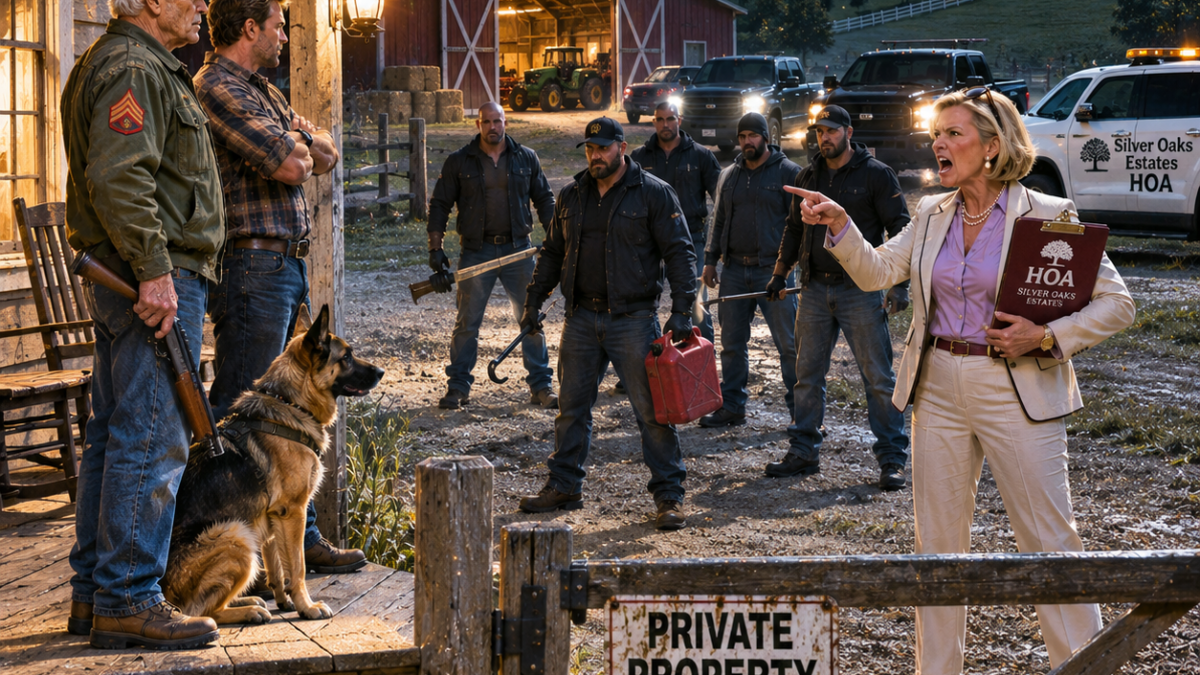
At midnight, three black trucks rolled through the gate of Whitaker Farm with their headlights dimmed, and six men climbed out carrying crowbars, gas cans, and the kind of confidence that comes from believing an old farmer can be frightened off his own land. My grandfather Frank stood beside me on the porch in his faded Marine jacket, watched them fan out toward the barn, and said so quietly I almost missed it, “They sent strangers to do what their paperwork couldn’t.” What those men didn’t know was that Grandpa had spent weeks documenting every threat, every survey stake, every midnight trespass, and every lie coming out of Silver Oaks Estates—and before the night was over, somebody was finally going to explain why Martha Whitcomb wanted our farm badly enough to send muscle after it.
My name is Daniel Whitaker, and I moved back to my grandfather’s 120-acre farm after my father died.
I had spent nearly twenty years in the city working behind a computer, which meant my first month back was mostly blisters, sore shoulders, and Grandpa laughing every time I held a post-hole digger wrong.
The farm had belonged to our family for decades.
Grandpa worked it since he was sixteen. He served in Korea, came home, married my grandmother, raised cattle, rebuilt the barn after a storm, and never once acted as though owning land made him important.
He treated ownership like responsibility.
That mattered later.
Across the ridge sat Silver Oaks Estates, a new luxury development of oversized houses, ornamental fountains, walking paths, and carefully planted trees all the same height.
At first, nobody bothered us.
Then Martha Whitcomb became HOA president.
Her first letter arrived on cream-colored paper.
Your barn negatively impacts community aesthetics.
Grandpa read it at breakfast.
Then looked out the window at the barn.
“That barn is older than their community.”
The second letter complained about our rooster.
The third questioned our fencing.
Then Martha herself came up the driveway in a white Lexus carrying a clipboard.
“Mr. Whitaker,” she said, “Silver Oaks is expanding the walking trail.”
Grandpa leaned against the fence.
“Congratulations.”
“The best route crosses approximately forty feet of this pasture.”
“My pasture.”
“The boundary is somewhat ambiguous.”
“No, ma’am.”
She smiled as if he had misunderstood.
“We’d like you to sign a maintenance easement. You still retain ownership.”
“Then you don’t need it.”
Her smile tightened.
“The community would benefit.”
Grandpa looked toward the ridge.
“So would I if you moved the trail.”
That ended the conversation.
It did not end Martha.
Orange survey stakes appeared inside our fence.
Someone tore down one of our property markers.
A drone began hovering over the barn at night.
Then our mailbox was ripped from the ground.
Pinned to the post was a note:
SELL BEFORE THIS GETS WORSE.
I wanted to call the sheriff immediately.
Grandpa stopped me long enough to photograph everything first.
“Evidence before anger,” he said.
We filed reports.
Installed cameras.
Replaced locks.
Posted clear private-property signs.
Then Martha returned with two men in dark suits.
One stood too close.
The other kept looking past us toward the barn.
“This is the final opportunity,” Martha said. “Sign the easement.”
Grandpa didn’t raise his voice.
“No.”
“The HOA has legal options.”
“Then use legal options.”
Her expression changed.
Not much.
Enough.
After she left, Grandpa walked the fence line without speaking. I followed him past the cattle trough and down toward the low pasture where the new development’s trail curved closest to us.
“You scared?” I asked.
“Of her?”
“Of what she might do.”
He looked at me for a long moment.
“Fear is useful if it makes you pay attention. Useless if it makes you surrender before anything happens.”
That was Grandpa: never pretending danger wasn’t real, never allowing it to make decisions for him.
That night, Grandpa pulled a weathered folder from an old chest.
Inside were deeds, surveys, photographs, tax records, and a hand-drawn boundary map his father had kept.
I expected him to talk about defending the farm.
Instead he pointed at a line on a survey.
“Look.”
I leaned closer.
“What am I looking at?”
“Silver Oaks.”
“What about it?”
“They built something where they shouldn’t have.”
Before he could explain, the motion light near the paddock snapped on.
Then another.
A third.
Headlights appeared beyond the gate.
Three black trucks.
Slow.
Deliberate.
Grandpa closed the folder.
“Now,” he said, “we find out whether they came to negotiate—or whether Martha finally made the mistake we’ve been waiting for.”
PART 2
Grandpa didn’t reach for the rifle hanging in the mudroom.
That surprised me.
The Frank Whitaker I remembered from childhood always kept that old M1 Garand polished and locked away like a piece of family history, and after weeks of threats, I expected him to at least bring it to the porch.
Instead, he picked up his phone.
“Sheriff already knows they’re here.”
“You called?”
“Camera sent an alert twenty seconds before you saw the lights.”
He pointed toward a small monitor mounted beside the kitchen.
Six figures.
Three trucks.
Timestamp.
License plates visible on two.
The third plate had been covered.
“Grandpa.”
“What?”
“One of them has a gas can.”
“I can see that.”
My stomach tightened.
“Shouldn’t we go inside?”
“We are going inside.”
He looked at me hard.
“And we stay there.”
That mattered.
Grandpa was stubborn.
He was not stupid.
The men reached the first gate.
One shook it.
Locked.
Another shouted:
“Frank Whitaker!”
Grandpa opened the kitchen window just enough to answer.
“Who’s asking?”
“You know.”
“No, I don’t.”
A heavier voice came from the dark.
“Silver Oaks says time’s up.”
Grandpa looked at me.
Then back outside.
“Silver Oaks sends legal notices through lawyers.”
“Tonight they sent us.”
“That sounds like their mistake.”
One man kicked the gate.
“Come out here.”
“No.”
“We need to talk.”
“Then talk.”
“This is your last chance to sign.”
Grandpa leaned closer to the window.
“You boys carrying a notary?”
Silence.
I almost laughed.
Wrong moment.
One man grabbed bolt cutters from the truck.
Grandpa closed the window.
“Daniel.”
“Yeah?”
“Start recording the camera feeds locally.”
“They already record.”
“Secondary copy.”
I did it.
“Now call Dale.”
“Our mechanic?”
“He’s also a witness who lives four minutes away.”
“You want him here?”
“No. Tell him stay on the county road and film the entrance if he can do it safely.”
I called.
Dale answered on the third ring.
“What?”
“It’s happening.”
“I’m awake.”
“How?”
“Your grandpa called me fifteen minutes ago.”
Of course he had.
“I’m heading toward the road now.”
“Stay back.”
“Your grandfather already yelled that at me.”
The first chain snapped outside.
I heard metal hit gravel.
The men entered the outer drive.
Grandpa pressed another button.
Every floodlight around the barn came on.
The farm transformed.
Dark pasture became white light.
Men froze.
Cameras captured faces.
Clothing.
Tools.
One lifted an arm to shield his eyes.
Another yelled:
“Turn that off!”
Grandpa reopened the window.
“No.”
The man with the gas can shouted:
“You think lights are going to save you?”
Grandpa replied:
“No.”
He held up his phone.
“The sheriff might.”
That changed them.
Not enough.
But I saw uncertainty.
They had expected isolation.
An elderly farmer.
Maybe me.
Darkness.
Fear.
Instead, there were cameras, lights, and a deputy already on the way.
The largest man walked toward the house.
“Mr. Whitaker, don’t make this worse.”
Grandpa laughed.
“You cut my gate.”
“We’re here on behalf of a property dispute.”
“With a gas can?”
The man looked back.
For the first time, he seemed irritated with his own people.
“Put that down.”
The man holding the can set it beside the truck.
Grandpa said:
“Good decision.”
Then one of them moved toward the generator shed.
I could hear voices through the exterior microphones.
“Kill the lights.”
“Don’t.”
“Do it.”
My hands went cold.
Grandpa saw my face.
“Breathe.”
“They’re trying to cut the power.”
“Lights are on separate circuits.”
“You planned this.”
“I maintain a farm.”
“That’s not what I mean.”
“I know.”
The man reached the generator enclosure.
A siren activated.
Not a weapon.
Not a trap.
An ordinary agricultural alarm loud enough to wake cattle three counties over.
The trespasser jumped backward.
Two others ran toward him.
Then a sprinkler line near the barn kicked on automatically because one of them had broken a sensor hose while crossing a restricted livestock area.
Water blasted sideways across the muddy ground.
One man slipped.
Another collided with him.
Both went down.
Under different circumstances, it would have been funny.
My heart was beating too hard to laugh.
The largest man yelled:
“Everybody stop!”
Finally, someone in that group understood the situation was getting worse with every second.
Then sirens sounded from the county road.
Real ones.
The men looked toward the gate.
Red and blue light flashed against the trees.
One ran toward a truck.
Another shouted:
“Leave it!”
Too late.
Deputy Collins’s cruiser blocked the entrance.
Two more units arrived behind him.
“Hands where we can see them!”
The men froze.
The large one slowly raised his arms.
Another started arguing.
“We’re private security.”
Deputy Collins shouted:
“Then you should know how to follow instructions.”
Grandpa closed the window.
He sat at the kitchen table.
Just sat.
As though this were weather.
I stared at him.
“That’s it?”
“For tonight.”
“You’re not going out?”
“When Collins tells us.”
I looked at the monitor.
Deputies separated the men.
Tools were photographed.
The gas can.
Bolt cutters.
Crowbars.
A lighter.
A folder.
One officer found a handgun inside a truck.
Nobody had fired it.
Nobody had pointed it.
That was a mercy.
Deputy Collins called ten minutes later.
“Frank.”
“Morning.”
“It’s twelve thirty.”
“Still morning.”
Collins sighed.
“You two stay inside another five minutes.”
“Fine.”
“Any injuries?”
“No.”
“Any shots fired?”
“No.”
“Any physical confrontation?”
“No.”
“Good.”
He paused.
“Frank?”
“Yeah?”
“Thank you.”
“For what?”
“For not trying to turn this into Normandy.”
Grandpa looked toward the locked gun cabinet.
“I’m old, Collins. Not stupid.”
Eventually we were allowed outside.
The men stood near their trucks.
Wet.
Muddy.
Angry.
Handcuffed.
One of them looked at Grandpa.
“You set us up.”
Grandpa shook his head.
“You cut my gate.”
“You knew we were coming.”
“I suspected somebody would.”
“That’s a setup.”
“No, son.”
Grandpa pointed toward the PRIVATE PROPERTY sign hanging beside the broken chain.
“That’s a boundary.”
Deputy Collins stepped between them.
“Frank.”
Grandpa stopped.
The largest man was named Victor Hale.
Forty-two.
Former construction foreman.
Two prior trespass charges.
The others worked for a company called Meridian Site Security.
That was interesting.
Martha had introduced those two suited men days earlier as “legal consultants.”
Meridian was not a law firm.
It was a private security and site-clearing contractor.
Collins opened the folder found in their truck.
Inside:
A printed aerial map of our farm.
A copy of the easement agreement.
A handwritten note.
GET SIGNATURE.
REMOVE RESISTANCE.
I read it twice.
“Who wrote this?”
Victor looked away.
Collins said:
“We’ll figure that out.”
One younger man spoke from beside the cruiser.
“She said this would be easy.”
Victor snapped:
“Shut up.”
Deputy Collins turned.
“She who?”
The young man stared at the ground.
Victor said:
“Lawyer.”
“What lawyer?”
No answer.
Grandpa put one hand on my shoulder.
“Let the sheriff do his job.”
That was hard.
I wanted answers immediately.
Grandpa didn’t.
Or maybe he did and was simply better at waiting.
By sunrise, the trucks were gone.
The broken gate remained.
Mud covered part of the drive.
One cattle fence needed repair.
That was all.
No barn burned.
No one hurt.
No shots.
No blood.
Standing there in the gray morning, I realized how badly the night could have gone.
Grandpa seemed to understand too.
He leaned against the damaged gate.
“You all right?”
“Are you?”
“I asked first.”
“I’m angry.”
“That’s not what I asked.”
I exhaled.
“Yeah.”
He nodded.
“Good.”
Then he looked toward the barn.
“We fix the gate.”
“Today?”
“Why not?”
“Because six men just got arrested on our property.”
“Gate doesn’t care.”
That was Grandpa.
The world could collapse.
Fence still needed fixing.
At eight, Dale arrived with coffee and a camera full of footage from the county road.
He found us replacing chain.
“You two are unbelievable.”
Grandpa said:
“Hold that post.”
Dale held it.
“Local station already called me.”
“Why?”
“Somebody heard police radio.”
“No interviews.”
“Frank.”
“No.”
“This is going to become public anyway.”
“Then let the sheriff speak.”
Dale looked at me.
I shrugged.
Grandpa drove the new bolt through the hinge.
“People talk too early when they’re angry.”
Dale said:
“You’re not angry?”
Grandpa looked toward Silver Oaks.
“Plenty.”
“Then why are you calm?”
“Because angry men make expensive mistakes.”
That line came back later.
By noon, Martha Whitcomb was on television.
Of course she was.
She stood outside the Silver Oaks clubhouse in a pale blue blazer with three board members behind her.
“The individuals arrested last night were independent contractors acting outside the knowledge and authority of the Silver Oaks Homeowners Association.”
I stared at the screen.
Grandpa ate soup.
Martha continued.
“We condemn any unlawful behavior and remain committed to peaceful resolution of the ongoing boundary disagreement with the Whitaker property.”
I looked at Grandpa.
“She’s lying.”
“Probably.”
“Probably?”
“Prove it.”
“They had our easement document.”
“Could’ve gotten it from a lawyer.”
“They said she sent them.”
“Man in handcuffs saying a name isn’t enough.”
“You believe her?”
“No.”
“Then why are you defending her?”
“I’m not.”
Grandpa set down the spoon.
“I’m defending the difference between what we know and what we think.”
That annoyed me because he was right.
Two days later, the first man talked.
Not Victor.
The young one.
His name was Cody Ames.
Twenty-six.
No serious record.
Apparently he had believed they were going to pressure us into signing and perhaps remove some fencing.
He told investigators Meridian had been hired through an intermediary connected to Silver Oaks.
Cash bonus if the easement was signed that night.
Another payment if we “stopped interfering with development operations.”
The sheriff subpoenaed company records.
Then Martha sent a lawyer.
Daniel Cross.
Charcoal suit.
Black Mercedes.
No sunglasses this time.
He stood by the repaired gate.
“Mr. Whitaker?”
Grandpa was changing a tractor tire.
“That depends who’s asking.”
“I represent Silver Oaks Homeowners Association.”
“Then you should probably stay on the other side of that gate.”
Cross stopped.
I liked him slightly more for listening.
“We’re interested in resolving the dispute.”
“Good.”
Grandpa tightened a lug.
“Withdraw the easement demand.”
“It’s more complicated than that.”
“It isn’t from here.”
Cross opened a leather folder.
“The association is prepared to offer fifty thousand dollars.”
“For what?”
“Settlement.”
Grandpa stood.
“Settlement of what?”
“Boundary claims, reputational harm, and any complaints arising from last week’s incident.”
I almost laughed.
“You want us to drop the criminal complaint?”
Cross looked at me.
“Criminal matters are controlled by the state.”
“You know what I mean.”
“I’m speaking about civil claims.”
Grandpa wiped his hands.
“What do I have to sign?”
“Mutual nondisparagement.”
“No.”
“Release of liability.”
“No.”
“Recognition of the proposed pedestrian easement.”
Grandpa smiled.
There it was.
Cross continued:
“The easement is narrow.”
“No.”
“Forty feet at its widest.”
“No.”
“It would significantly increase your property value.”
“No.”
“Mr. Whitaker, respectfully, litigation—”
Grandpa raised a hand.
“I’ve been alive eighty-one years.”
Cross stopped.
“I’ve buried a wife.”
Grandpa’s voice changed.
Softer.
“My son.”
I looked away.
“Friends from Korea.”
He continued.
“I’ve rebuilt this barn after two storms and watched drought kill fields I planted myself.”
He looked directly at Cross.
“You think the thing that scares me now is a lawyer billing by the hour?”
Cross’s smile disappeared.
Grandpa pointed toward the gate.
“Tell your clients this farm is not for sale.”
Cross said:
“They may pursue adverse claims.”
“Then file them.”
“They have substantial resources.”
“So do I.”
Cross glanced at the old tractor.
Maybe he thought Grandpa was joking.
Grandpa tapped his chest.
“Time.”
Then his head.
“Records.”
Then pointed down.
“And land.”
Cross left without taking the settlement papers out again.
That afternoon, Grandpa brought out the weathered folder.
The one he had closed when the trucks arrived.
“Now.”
I sat beside him.
He unfolded a survey from 1957.
Then another from 1984.
Then the recorded plat from when Silver Oaks’s developer acquired land across the ridge.
He placed transparent tracing sheets over them.
“See this line?”
“Yes.”
“Old fence line.”
“Okay.”
“This line?”
“Silver Oaks parcel.”
“They overlap.”
“Maybe survey error.”
“That’s what I thought.”
He tapped another page.
“Then I found this.”
A drainage easement map from the county.
One corner of Silver Oaks’s park crossed onto our parcel.
Not by inches.
By feet.
Enough that a decorative fountain, maintenance shed, and part of the walking path appeared to be sitting on Whitaker property.
I stared.
“How long have you known?”
“Suspected? Months.”
“Confirmed?”
“Not yet.”
“Why didn’t you tell me?”
“Because we don’t accuse until we know.”
There it was again.
Evidence before anger.
He called Dale Roberts.
Different Dale from our mechanic.
This Dale was seventy-three and had surveyed half the county before retiring.
He arrived the next morning with modern GPS equipment and old-fashioned suspicion.
“Frank.”
“Dale.”
“You look uglier.”
“You look expensive.”
“Retirement does that.”
They shook hands.
Dale spent most of the day walking lines.
I followed.
He reset reference points.
Checked recorded monuments.
Compared coordinates.
By late afternoon, he removed his hat.
“Well.”
Grandpa waited.
Dale pointed toward Silver Oaks.
“They crossed you.”
“How far?”
“Varies.”
“Worst point?”
“About twelve feet near the park infrastructure.”
“And the houses?”
Dale frowned.
“Two corner lots may have improvements over the line. Not necessarily structures themselves. Landscaping, retaining features, maybe part of a driveway depending on final verification.”
That was less dramatic than Grandpa’s initial guess.
But still serious.
Dale warned us:
“Do not start claiming houses.”
“I wasn’t.”
“Good.”
“Can I claim the fountain?”
Dale smiled.
“Survey says part of it is yours.”
Grandpa sat on the tailgate.
Then laughed.
Not loud.
Just one short breath.
“Woman tried to take forty feet of my pasture while her fountain’s already trespassing.”
Dale nodded.
“Life likes jokes.”
We hired a licensed boundary firm to verify independently.
Then an attorney.
Samuel Larkin.
Seventy.
Bow tie.
Voice like gravel.
He reviewed everything.
“Frank.”
“Yeah?”
“Do not put up a sign demanding rent.”
Grandpa looked offended.
“I was thinking about it.”
“I know.”
“How?”
“Because you’re eighty-one and still twelve.”
Grandpa frowned.
Larkin continued.
“You have a legitimate encroachment issue. Treat it legitimately.”
“So no sign?”
“No sign.”
“Small sign?”
“Frank.”
“Fine.”
I was grateful.
The source of Grandpa’s power wasn’t intimidation.
It was patience.
Turning the whole thing into a stunt would weaken us.
Larkin sent Silver Oaks a formal notice.
Survey discrepancy.
Encroachment.
Demand to preserve records.
No construction within disputed strip.
Request for mediation.
No insults.
No threats.
Martha arrived forty minutes after receiving it.
She drove through our repaired gate so fast gravel sprayed.
Grandpa was feeding chickens.
She got out holding the survey.
“What is this?”
“Paper.”
“You know what I mean.”
“Then ask better.”
Her face reddened.
“This claim is fraudulent.”
“Licensed surveyor disagrees.”
“You fabricated a boundary issue to retaliate.”
“County records existed before I met you.”
“You are trying to extort homeowners.”
“No.”
“You want money.”
“No.”
“What do you want?”
Grandpa pointed toward the pasture.
“My line respected.”
She laughed.
“You expect us to move infrastructure because of twelve feet?”
“You expected me to give you forty.”
Her face changed.
Again.
That little crack.
I stepped closer.
“Martha, why do you need our easement so badly?”
She looked at me.
“For community access.”
“No.”
Grandpa glanced toward me but didn’t interrupt.
I continued.
“The trail already connects at the north end.”
“It’s inefficient.”
“You sent people at midnight.”
“I did no such thing.”
“Then someone’s risking prison over an inefficient walking trail.”
Silence.
Her eyes moved toward Grandpa.
“Your family has always been difficult.”
That stopped him.
“Always?”
Martha realized she had said too much.
Grandpa’s voice became very quiet.
“How long have you been looking at this farm?”
She folded the survey.
“This conversation is over.”
She got back into the Lexus.
As she drove away, Grandpa stared after her.
“What?”
I asked.
“Nothing.”
“That wasn’t nothing.”
He rubbed his chin.
“She said always.”
“So?”
“She moved here two years ago.”
That night we searched old correspondence.
Grandpa had boxes.
County notices.
Tax records.
Offers.
Development inquiries.
My father had saved some too.
Then we found a letter from twelve years earlier.
Silver Oaks Development Group.
Before the HOA existed.
Offer to purchase a western strip of Whitaker Farm for Phase Two Access and Amenities.
Grandpa had rejected it.
Three years later, another.
Rejected.
Then another after my father died.
Rejected.
The signature on the most recent old letter:
Evan Lockwood.
Regional development director.
I searched the name.
Lockwood Development Partners had financed Silver Oaks.
Martha Whitcomb had worked as a property consultant on two Lockwood projects before becoming HOA president.
I stared at the laptop.
“This wasn’t her idea.”
Grandpa read the screen.
“No.”
“She’s working for the developer.”
“Maybe.”
“Grandpa.”
“Maybe.”
I slammed one hand against the table.
“How much proof do you need?”
“Enough.”
“You’re impossible.”
He looked at me.
“And you’re angry.”
“Yes.”
“Good.”
He pushed the old letters toward me.
“Use it to read.”
I hated that lesson.
I needed it.
Sheriff Collins called the next morning.
“Frank, we have a connection.”
Grandpa put him on speaker.
“Meridian received payment from a consulting company.”
“Which one?”
“Whitcomb Community Strategies.”
I stopped breathing for a second.
Martha’s consulting company.
Collins continued.
“That doesn’t prove she ordered criminal conduct.”
“But?”
“But Cody Ames says she attended a meeting.”
“When?”
“Two days before the trespass.”
“Where?”
“Silver Oaks clubhouse.”
Grandpa asked:
“Recording?”
“No.”
“Witnesses?”
“Three.”
“Documents?”
“We’re working on it.”
Then Collins said:
“One more thing.”
“What?”
“One of the men says the objective wasn’t just the signature.”
My skin prickled.
“What else?”
“Find old survey records stored in your barn office.”
I looked at Grandpa.
He looked at me.
Collins continued.
“They were told those records could interfere with Phase Two.”
Grandpa said:
“Well.”
That single word held more anger than shouting.
After the call, he walked outside.
I followed.
He stood at the western fence.
Wind moved through grass.
“Grandpa.”
No response.
“Say something.”
He finally did.
“They weren’t coming for land.”
“What?”
“They were coming for memory.”
I understood.
The old surveys.
Deeds.
Handwritten maps.
Those records were not just paperwork.
They were the chain connecting our family to the farm.
Destroy enough evidence, manufacture enough uncertainty, pressure an old man hard enough, maybe eventually the developer gets what it wants.
I said:
“Now are you angry enough?”
Grandpa looked at me.
“I was angry when they sent the first letter.”
“Then what are we doing?”
“Winning slowly.”
News broke that afternoon.
LOCAL HOA CONTRACTOR ARRESTED AFTER FARM TRESPASS.
No “gangster.”
No sensational headline.
Just facts.
Martha held another press conference.
“Silver Oaks denies authorizing unlawful activity.”
Then Cody’s attorney confirmed his client was cooperating.
Two board members resigned.
Not because they admitted wrongdoing.
Because they wanted distance.
One called Grandpa privately.
Her name was Elise Warren.
She had served as HOA secretary.
“I should have spoken sooner.”
Grandpa put her on speaker.
“About what?”
“Martha’s spending.”
I looked at him.
“What spending?”
Elise continued.
“She created special project accounts.”
“For the trail?”
“For several things.”
“Board approved?”
“Some.”
“Some?”
“She said developer reimbursements would cover the rest.”
“Did they?”
“I don’t know.”
Grandpa asked:
“Why call now?”
Elise started crying.
“My husband told me if I knew something and kept quiet, I was no better than her.”
Grandpa’s face softened.
“Ma’am.”
“I signed minutes.”
“Did you falsify them?”
“No.”
“Then tell investigators what you know.”
“I’m afraid.”
“So am I.”
That surprised her.
“You?”
“Courage isn’t lack of fear.”
He looked at me when he said it.
“It’s deciding fear doesn’t get the vote.”
Elise agreed to cooperate.
The county audit followed.
Then the numbers.
Landscaping reimbursements to companies sharing addresses with Martha’s consultancy.
“Special security” expenses.
Trail planning fees.
Consulting retainers.
Almost sixty thousand dollars in questionable transfers.
Not all necessarily stolen.
Enough to trigger a formal investigation.
Then investigators found payments to Meridian.
Martha’s attorney stopped returning reporters’ calls.
Silver Oaks residents began showing up at our gate.
Not angry.
Confused.
One woman named Patricia brought a folder.
“My husband and I paid a special assessment for the trail.”
“How much?”
“Twenty-eight hundred.”
Grandpa frowned.
“Why?”
“They said the western access had to be completed before next spring.”
“Did they say why?”
“Property values.”
Another homeowner brought a newsletter.
PHASE TWO CONNECTIVITY INITIATIVE.
There it was.
Phase Two.
Same wording as Lockwood’s old purchase offers.
The HOA project wasn’t merely about a walking trail.
It was creating access needed for future development.
And our farm was the missing link.
Larkin filed suit.
Trespass.
Encroachment.
Property interference.
Damage.
He did not ask for revenge.
He asked for injunctions.
Record preservation.
Restoration.
Costs.
A declaration of boundary.
That sounded boring.
It was devastating.
The court temporarily blocked any Silver Oaks construction within the disputed area.
Then the developer sent its own legal team.
The first demand letter accused us of obstructing infrastructure.
Larkin laughed.
“They’re bluffing.”
“How do you know?”
“Because they didn’t attach the easement they supposedly have.”
The developer threatened a multimillion-dollar defamation claim after Grandpa gave one interview saying Silver Oaks had “tried to bully its way across the fence.”
Larkin responded with eleven exhibits.
Photos.
Letters.
Survey markers.
The broken gate.
Arrest report.
Payments.
Old purchase offers.
The threat disappeared.
Then came something uglier.
An article in a city lifestyle publication.
OLD FARMER’S FEUD THREATENS SILVER OAKS FAMILIES.
It showed Grandpa holding the M1 on our porch.
The image had been taken years earlier during a Veterans Day photo with my father.
The article implied he regularly patrolled the property armed.
My hands shook reading it.
“They’re making you look insane.”
Grandpa drank coffee.
“I’ve looked worse.”
“This isn’t funny.”
“No.”
“They’re using Dad’s photo.”
That changed him.
He took the tablet.
Looked carefully.
My father stood cropped out of the original.
Grandpa’s jaw tightened.
“That picture was taken the last Veterans Day before your dad got sick.”
“I know.”
He handed it back.
“Send the original to Larkin.”
We did.
Then we sent unedited security footage from the trespass night to the reporter.
No armed confrontation.
No warning shots.
No booby traps.
Just men cutting a gate, entering at midnight, moving toward buildings with tools and fuel, while Grandpa stayed inside and called law enforcement.
The publication updated its story.
Then issued a correction.
The original image source had been misleading.
The narrative shifted.
Other reporters became interested.
I wanted to feed them everything.
Grandpa refused.
“Case first.”
“But they’re lying.”
“Court doesn’t care about trending.”
“They’re destroying your reputation.”
“Reputation with who?”
“People.”
“Which people?”
I had no answer.
He continued.
“The people I care about know where I sleep.”
He pointed toward the farm.
“Here.”
A week later, Martha was arrested.
Fraud-related charges.
Conspiracy allegations.
Coercion.
Nothing was final.
No conviction yet.
But seeing her led from the Silver Oaks clubhouse in handcuffs stunned the neighborhood.
Grandpa didn’t watch television coverage.
He was repairing irrigation pipe.
I brought him my phone.
“They arrested her.”
He barely glanced.
“Pipe still leaks.”
“How can you not care?”
“I care.”
“You don’t look like it.”
He tightened a fitting.
“Her being arrested doesn’t put water on the south pasture.”
Again, life continued.
But that evening, after dinner, I found him alone on the porch.
No pipe.
No chores.
Just darkness.
“You okay?”
He nodded.
I sat.
After a minute, he said:
“I didn’t want this.”
“I know.”
“I wanted neighbors.”
“They aren’t our HOA.”
“I mean all of it.”
He looked toward the ridge.
“When Silver Oaks started, I thought maybe it’d be good.”
“That surprises me.”
“Your grandma wanted more families nearby.”
I had forgotten that.
“She said the county was getting too old.”
He smiled.
“She liked kids.”
Silence.
“Then she died before the first house went up.”
I looked toward the lights.
For the first time, Silver Oaks didn’t look like an enemy camp.
It looked like houses.
Families.
People who had mostly followed what they were told.
Grandpa said:
“They didn’t send those men.”
“No.”
“Most probably didn’t know about the easement scheme.”
“No.”
“Remember that.”
“Why?”
“Because anger likes to grow.”
He looked at me.
“Don’t water it.”
That may have been the hardest lesson.
The financial investigation widened.
Developer records were subpoenaed.
Evan Lockwood’s name appeared repeatedly.
Emails showed pressure to secure western access.
Language like:
RESOLVE WHITAKER OBSTACLE.
ACCELERATE COMMUNITY LEVERAGE.
USE HOA CHANNELS WHERE POSSIBLE.
Nothing explicitly said “send men.”
Then investigators recovered deleted messages from a Meridian supervisor’s phone.
One from Martha:
He won’t sign voluntarily. Make him understand the alternative.
Another:
Do not involve police. Keep it quiet.
Another:
The old files are part of the problem.
That changed her case.
Then Lockwood emails showed Martha reporting progress on “property pressure.”
The developer claimed she exceeded instructions.
Martha claimed the developer pushed her.
Everyone blamed everyone.
Grandpa said:
“That’s what happens when rats hear water.”
I said:
“You really need better metaphors.”
“No.”
Then came the anonymous package.
Left at our gate.
Brown envelope.
Inside were copies of HOA emails, vendor invoices, and development projections.
A note:
YOU DIDN’T GET THESE FROM ME.
Larkin told us not to rely on them until investigators authenticated them.
Grandpa agreed.
I wanted to read everything immediately.
He stopped me.
“Chain of custody.”
“You sound like Larkin.”
“Terrible disease.”
Investigators verified several documents against subpoenaed records.
The development plan was real.
Phase Two required a western service connection.
The cheapest path crossed our pasture.
Without our easement, Lockwood faced an expensive reroute and additional environmental review.
Suddenly the entire conflict made sense.
Martha wasn’t obsessed with forty feet because she hated cows.
She was protecting a project tied to money.
Her consulting firm stood to receive bonuses if access milestones were met.
The HOA had been used as pressure.
Aesthetic violations.
Noise complaints.
Fences.
The walking trail.
All of it created a paper narrative that Whitaker Farm was obstructive, problematic, incompatible with community needs.
If we eventually sold or signed, it could be framed as resolution.
I sat at the kitchen table staring at the records.
“They planned this.”
Grandpa nodded.
“For years.”
“Somebody should destroy them.”
He looked at me.
“Careful.”
“I mean legally.”
“Say legally.”
“Legally.”
He smiled faintly.
“Better.”
The federal environmental review produced another problem for Lockwood.
Some Silver Oaks construction had affected a wet drainage area without proper review.
Not the apocalypse some headlines claimed.
But enough to trigger remediation and fines.
Assets were not magically seized overnight.
The process took months.
Hearings.
Filings.
Engineers.
Surveyors.
Accountants.
The boring machinery of consequences.
Grandpa loved it.
“See?”
“What?”
“Paperwork.”
“You spent six months complaining about paperwork.”
“Bad paperwork.”
He held up a certified survey.
“This is beautiful paperwork.”
The community turned on Martha long before trial.
Silver Oaks suspended its board operations.
Homeowners formed an interim committee.
They hired independent counsel.
They audited dues.
They learned some “special assessments” had been approved under questionable procedures.
Several residents sued the HOA and developer.
Others were furious with us.
One man came to our gate.
“You’re destroying property values.”
Grandpa walked out.
“What’s your name?”
“Richard Hall.”
“Richard, I’m sorry you’re caught in it.”
“You’re suing the association.”
“Association crossed my line.”
“You could settle.”
“I tried.”
“You could accept money.”
“For what?”
“The strip.”
“I don’t want money.”
Richard looked genuinely confused.
“Then what do you want?”
Grandpa pointed toward the boundary marker.
“That to mean something.”
Richard shook his head.
“It’s dirt.”
Grandpa looked at him.
“So is your yard.”
Richard started to reply.
Stopped.
Grandpa continued.
“Difference is which dirt you’re responsible for.”
A month later, Richard returned.
He brought a pie.
I opened the gate.
“Peace offering?”
“Apology.”
“What changed?”
He held up a folder.
“The developer lied to us too.”
His lot had been sold with promises about protected open space that Phase Two would have replaced.
Martha had told residents the trail project was purely recreational.
It wasn’t.
Richard looked toward Grandpa.
“He was right.”
I said:
“You can tell him.”
“I plan to.”
Silver Oaks residents started cooperating with investigators.
The thing Martha had counted on—community loyalty—collapsed because loyalty based on incomplete information is fragile.
Elise testified.
Todd from finance testified.
Contractors testified.
Cody Ames testified.
Victor Hale eventually took a plea and confirmed the pressure operation.
He did not describe himself as a gangster.
He was a contractor who agreed to do something stupid, illegal, and frightening for money.
That realism made it worse.
Monsters are easy to dismiss.
Ordinary men making terrible choices for a paycheck are harder.
Victor came to the farm once after his case was resolved.
Not alone.
His attorney arranged it.
He stood outside the gate.
Grandpa met him there.
I stayed nearby.
Victor looked smaller without the black truck.
“I owe you an apology.”
Grandpa said nothing.
“I thought you’d scare easy.”
Still nothing.
“We were told you were holding up a project for money.”
“I wasn’t.”
“I know.”
Victor rubbed his hands.
“They said no one would get hurt.”
Grandpa looked at him.
“You brought fuel to my barn.”
Victor lowered his eyes.
“I didn’t.”
“One of your men did.”
“I told him put it down.”
“After you entered.”
“Yes.”
Silence.
Victor said:
“I was wrong.”
Grandpa nodded.
“That’s a start.”
“I lost my job.”
“That’s a consequence.”
“My wife left for a while.”
“That’s between you and her.”
“I’m trying to fix things.”
Grandpa studied him.
Then opened the gate.
Not wide.
Enough to shake hands.
Victor looked surprised.
Grandpa said:
“Don’t mistake forgiveness for forgetting.”
“I won’t.”
“Good.”
They shook.
After Victor left, I said:
“You forgave him?”
“No.”
“You shook his hand.”
“Hands are cheap.”
“That makes no sense.”
“It will.”
The main court hearing came in spring.
By then, Silver Oaks looked different.
Fountain shut down pending boundary resolution.
Walking trail blocked.
HOA office closed.
Martha’s white Lexus gone.
News trucks returned.
Grandpa wore a denim jacket with his old Marine patch.
Not his uniform.
I asked why.
“I’m not using the Corps to win a property case.”
That answer mattered.
Inside, Martha looked thinner.
No pearls.
No pastel blazer.
Gray suit.
Evan Lockwood sat two tables away with separate counsel.
The case had become tangled.
Criminal allegations.
Civil restitution.
Property disputes.
Environmental claims.
The hearing we attended focused on restitution and the boundary case.
Judge Helen Ward presided.
She had the expression of someone allergic to theatrics.
Good.
Martha’s attorney argued she had acted under pressure from developers.
Lockwood’s attorney argued she exceeded authority.
HOA counsel argued residents had been misled.
Everyone wanted to be the least guilty person in the room.
Then Grandpa testified.
Larkin asked:
“Mr. Whitaker, how long has your family held the property?”
“Since 1957.”
“Were you ever a member of Silver Oaks HOA?”
“No.”
“Did you grant Silver Oaks an easement?”
“No.”
“Did you negotiate one?”
“They tried.”
“Did you refuse?”
“Yes.”
“Why?”
“I didn’t want a public path across cattle pasture.”
Simple.
No speech.
Larkin introduced letters.
Maps.
Surveys.
Photos of stakes inside our property.
The broken gate.
Threat note.
Settlement offer.
Old development purchase requests.
Then the certified boundary survey.
The judge studied it.
Lockwood’s attorney objected to portions.
The surveyor testified.
Dale testified only about historical monuments.
County survey staff verified records.
The boundary stood.
Then Cody Ames testified.
He looked nervous.
Larkin asked:
“Who told you the Whitaker easement had to be signed?”
“Martha Whitcomb.”
Martha looked down.
“Did she tell you to threaten Mr. Whitaker?”
“She said make him understand things would get worse if he didn’t cooperate.”
“Did she instruct you to damage property?”
“No.”
“Did anyone?”
“Victor talked about cutting the gate.”
“Did Mrs. Whitcomb know you intended to enter at night?”
“Yes.”
“How?”
“She suggested night.”
A murmur moved through the room.
Judge Ward looked up.
Silence returned.
Then came the authenticated messages.
MAKE HIM UNDERSTAND THE ALTERNATIVE.
KEEP IT QUIET.
THE OLD FILES ARE PART OF THE PROBLEM.
Martha’s attorney challenged context.
Fair.
Then her own voice appeared on an audio message retained by Meridian’s supervisor.
“Handle it quietly. Make him sign. If not, make him afraid enough to stop fighting us.”
The courtroom went still.
I looked at Grandpa.
He did not look at Martha.
He looked at the judge.
Judge Ward asked:
“Mrs. Whitcomb, is that your voice?”
Her attorney stood.
“My client invokes her rights regarding pending criminal matters.”
The judge nodded.
No cinematic confession.
No collapse.
Procedure.
That was reality.
Then came the financial documents.
Martha’s consulting company.
Payments.
Milestone bonus.
Developer connection.
Evan Lockwood’s emails.
Pressure.
The western access.
The entire shape of the scheme emerged.
Not one evil mastermind.
A network of incentives.
Greed.
Pride.
Convenience.
People telling themselves they were advancing development.
Then escalating because admitting the project was wrong would cost too much.
Judge Ward turned to Grandpa during the civil portion.
“Mr. Whitaker, your complaint requests injunctive relief and restoration more than monetary damages.”
“Yes, ma’am.”
“You are entitled to seek substantial damages.”
“I know.”
“You’re declining some categories?”
“On advice of counsel.”
Larkin smiled.
The judge asked:
“What outcome are you asking this court to prioritize?”
Grandpa stood straighter.
“My boundary.”
“Specifically?”
“Recorded line restored.”
“Yes.”
“Encroaching community infrastructure removed or relocated.”
“Yes.”
“No access rights created without agreement.”
“Yes.”
“And reimbursement for actual damage.”
“Yes.”
She glanced at the filings.
“You’re not asking for punitive transfer of Silver Oaks land?”
“No.”
“You’re not seeking ownership of homeowners’ lots affected by landscaping encroachment?”
“No.”
A few Silver Oaks residents visibly relaxed.
Grandpa continued:
“Those people bought homes. They didn’t send men to my farm.”
Martha finally looked at him.
Judge Ward asked:
“Anything else?”
Grandpa paused.
“I want the court record to say we never gave them the land.”
Larkin put a hand on the table.
Grandpa’s voice softened.
“My son believed one day this farm would go to Daniel.”
I swallowed.
“He died before we could settle everything between us.”
My eyes burned.
Grandpa kept going.
“I can’t fix that.”
He looked at me.
“But I can make sure when I’m gone, my grandson doesn’t inherit an argument I was too tired to finish.”
The courtroom stayed silent.
That was the first moment this entire fight stopped being about Martha for me.
It became about Dad.
About why I had returned.
About the farm.
I had spent twenty years away because I thought staying meant becoming smaller.
Dad and I fought about it.
He wanted me to come home.
I wanted a city career.
Then cancer took him before either of us learned how to say we understood the other.
Grandpa had never pressured me.
He simply kept the farm going.
Waiting.
Suddenly I understood.
He wasn’t fighting because land mattered more than people.
He was fighting because people lived through what they cared for.
The ruling came weeks later.
Boundary confirmed substantially in our favor.
Silver Oaks required to remove or relocate encroaching common-area improvements from Whitaker property or negotiate a voluntary agreement.
Grandpa refused an easement.
So they moved the fountain.
Part of the path too.
The two affected homeowners did not lose houses.
Independent survey clarified their structures were outside the Whitaker parcel, though some landscaping and a retaining edge crossed.
We signed narrow corrective licenses allowing temporary access for removal.
No rent.
No revenge.
Just restoration.
Grandpa insisted.
“Why not charge them?”
I asked.
“Because they didn’t know.”
“Still your land.”
“Exactly.”
He looked at me.
“If I start using ownership to punish innocent people, what makes me better than Martha?”
I didn’t have an answer.
Silver Oaks HOA as originally operated was dissolved after residents voted to replace it with a new association under revised governing documents.
Not because a judge simply erased every HOA in existence.
The homeowners did it themselves.
They elected a new board.
Open financial records.
Independent audits.
Conflict-of-interest policy.
No contracts to board members’ family companies without disclosure and competitive review.
No invented “intent notices.”
No enforcement against properties outside HOA jurisdiction.
Elise became interim secretary.
Richard Hall joined the new board.
He hated meetings.
Grandpa said that made him qualified.
Martha’s criminal case concluded months later.
Probation on some counts.
Restitution.
Financial penalties.
Restrictions tied to association management and consulting work.
The coercion-related charges resulted in a plea agreement that kept her under strict supervision and no-contact restrictions.
Some people thought it was too lenient.
Some thought her financial ruin and reputation loss were punishment enough.
Grandpa didn’t discuss sentencing.
When I asked, he said:
“Judge heard more than I did.”
That was it.
Evan Lockwood’s case was separate.
Regulatory investigations into the development resulted in fines, environmental remediation, and civil settlements.
His company survived in smaller form after restructuring.
That annoyed me.
I wanted dramatic collapse.
Grandpa didn’t.
“Companies aren’t people.”
“What does that mean?”
“Receptionist didn’t send men here.”
“Neither did the janitor.”
“Exactly.”
He had an irritating habit of making revenge less satisfying and justice more complicated.
Then Richard Whitcomb came to see us.
Martha’s husband.
Former HOA treasurer.
White sedan.
Wrinkled shirt.
He looked exhausted.
“Mr. Whitaker.”
Grandpa was replacing a fence board.
“Richard.”
“I wanted to apologize.”
“For what?”
Richard looked toward me.
“All of it.”
“Specific helps.”
That was Grandpa again.
Richard took a breath.
“I knew Martha was pushing too hard.”
“Okay.”
“I knew she was using her consulting firm.”
Grandpa stopped hammering.
“Did you know about Meridian?”
“No.”
“Did you know about the payments?”
“Some.”
“Did you sign?”
“Some.”
“Then tell investigators everything.”
“I have.”
Grandpa nodded.
Richard’s eyes filled.
“I lost my house.”
Grandpa said nothing.
“My marriage is over.”
Still nothing.
“My reputation.”
Grandpa finally spoke.
“Reputation can come back.”
Richard looked at him.
“Trust is harder.”
Richard swallowed.
“I know.”
Grandpa extended his hand.
Richard stared.
Then shook it.
Afterward, Grandpa returned to the fence.
I said:
“That’s the second person you’ve shaken hands with.”
“Your counting skills improve.”
“Victor and Richard.”
“Yep.”
“You keep telling me hands are cheap.”
“They are.”
“Then why?”
Grandpa drove a nail.
“Because a man asking forgiveness needs somewhere to start.”
That stayed with me.
Spring came.
Grass covered the tire ruts from the trucks.
The broken gate was replaced.
The fountain disappeared from our boundary.
Silver Oaks moved its trail.
The western pasture returned to cattle.
For the first time in nearly a year, no one sent certified mail.
Grandpa hated that.
“Nothing to read.”
“You complained about letters.”
“Still gave breakfast purpose.”
He had become a local figure.
I hated the word celebrity.
He hated it more.
People mailed him hats.
Pies.
Letters.
One kid sent a drawing of Grandpa standing behind a giant fence while tiny HOA people ran away.
Grandpa framed that one.
The others went in a box.
A television producer offered money for a documentary appearance.
Grandpa declined.
A security company offered an endorsement deal.
Declined.
A firearm company sent a letter.
Declined.
A fence manufacturer sent free posts.
Those he considered.
I stared at him.
“Hypocrite.”
“Fence posts are useful.”
“You said you wouldn’t sell the story.”
“I’m not selling anything.”
“They’re giving you product.”
“Fine.”
He sent them back.
Complaining the whole time.
Then the letters from veterans started.
Those changed him.
Men who had served.
Women who had served.
People who came home and struggled with institutions, debt, land disputes, family.
One wrote:
I spent years believing standing up for myself meant becoming angry again. Watching you stay calm reminded me strength can look different when you’re older.
Grandpa read that twice.
Then went outside.
I found him near the pond.
“You okay?”
“Yep.”
“You’re crying.”
“Allergies.”
“In February?”
“Strong pollen.”
I sat beside him.
He handed me the letter.
After I read it, he said:
“People are giving me too much credit.”
“Maybe.”
“That supposed to comfort me?”
“You did something.”
“I fixed a fence.”
“You also documented a conspiracy.”
“Mostly Daniel Cross did that by sending stupid letters.”
I laughed.
He smiled.
Then became serious.
“Don’t make heroes out of stubborn old men.”
“Why?”
“Because then people think they need a hero before they can say no.”
I looked at him.
He continued.
“Most of this was simple.”
“Nothing about this was simple.”
“Sure it was.”
He counted on his fingers.
“Know your line.”
“Keep records.”
“Call the right people.”
“Don’t lie.”
“Don’t hit anyone.”
“Wait.”
I laughed.
“That’s your grand strategy?”
“Worked.”
The farm settled.
So did I.
I started taking on remote consulting work again, but less.
Three days a week.
The rest of the time, Grandpa taught me things I should have learned twenty years earlier.
Irrigation.
Cattle rotation.
Fence tension.
Soil.
Weather.
How to listen to a tractor before assuming something was broken.
How to sharpen tools.
How to wait for rain.
One morning, he found me repairing the western fence.
“You’re doing that wrong.”
“I knew you were going to say that.”
“Then why keep doing it wrong?”
“Character.”
He took the pliers.
Showed me.
Again.
“There.”
“You could’ve taught me this when I was sixteen.”
“I tried.”
“No, you yelled.”
“Same thing in 1989.”
I laughed.
Then said:
“Dad was better at it.”
Grandpa stopped.
The air changed.
“Yeah.”
We didn’t talk about Dad enough.
Maybe because grief had become easier to carry unopened.
I leaned against the post.
“Did he really want me to come back?”
Grandpa looked toward the pasture.
“Always.”
“He never said.”
“He said it to me.”
“Why not me?”
“Pride.”
“His?”
“Yours.”
I stared.
Grandpa grinned.
“Both.”
That hurt because it was true.
I said:
“We wasted a lot of time.”
“Everyone does.”
“You don’t seem bothered.”
“I’m old enough to know regret isn’t a refund.”
That was brutal.
And kind.
I looked toward the farm.
“What did he want me to do here?”
“Whatever you wanted.”
“Then why ask me back?”
“Because he wanted you near.”
I swallowed.
Grandpa continued working.
“He didn’t need another farmer.”
“What did he need?”
“His son.”
For a minute I couldn’t move.
All those years I thought Dad judged the life I chose.
Maybe he had.
Maybe I had judged his too.
But underneath it, he had wanted proximity.
Not obedience.
The same mistake Martha had made in a different way.
Confusing control with connection.
I stayed longer at the fence that day.
That summer, the county held a veterans ceremony.
They asked Grandpa to speak.
He refused.
Then Sheriff Collins asked.
Still refused.
Then Mrs. Thompson from town told him she had already ordered cake.
He surrendered.
“Woman fights dirty.”
He wore the denim Marine jacket.
No medals.
At the courthouse lawn, maybe two hundred people gathered.
Silver Oaks residents too.
Richard Hall.
Elise.
Families.
Veterans.
Dale.
Larkin.
Deputy Collins.
Grandpa walked to the microphone.
He hated microphones.
“Afternoon.”
The crowd quieted.
“I was asked to talk about courage.”
He looked at Collins.
“Which was a mistake.”
People laughed.
Grandpa continued.
“I’m not brave because I didn’t sign away pasture.”
“It was mine.”
“That helps.”
More laughter.
He looked toward the veterans.
“Courage isn’t being fearless.”
“Everybody who tells you they aren’t scared is either lying or hasn’t paid attention.”
Silence.
“I was scared when those trucks came.”
I looked at him.
He had never said that.
Not once.
“I was scared my grandson would get hurt.”
My throat tightened.
“I was scared I’d make a bad decision because I was angry.”
He looked toward me.
“And I was scared I’d spend the last years of my life fighting instead of living.”
No one moved.
“But fear is like a fence.”
He paused.
“You need to know whether it marks your boundary or your prison.”
Grandpa looked across the crowd.
“Sometimes standing your ground means fighting.”
“Most times it means not moving when somebody else wants you to.”
“And sometimes it means admitting you were wrong and walking back.”
He glanced toward Richard Hall.
Richard nodded.
“Build good fences.”
Grandpa smiled faintly.
“Then learn who deserves a gate.”
That was his whole speech.
The crowd stood.
He looked horrified.
“Sit down.”
They applauded harder.
On the drive home, I said:
“You cried.”
“No.”
“You almost did.”
“Allergies.”
“Summer?”
“Worst season.”
He stared out the window.
Then said:
“Did I sound stupid?”
“No.”
“Too long?”
“About four minutes.”
“Terrible.”
At the farm, we found a wooden crate near the porch.
FROM THE PEOPLE OF SILVER OAKS.
Inside:
Letters.
Homemade bread.
Coffee.
A framed photograph of workers removing the old trail section from our property.
On the back:
Mr. Whitaker,
Most of us never knew what was being done in our name.
You could have punished all of us for the choices of a few.
You didn’t.
Thank you for defending your boundary without making us your enemy.
—Residents of Silver Oaks
Grandpa read it slowly.
Then again.
He sat down.
I said:
“You okay?”
“Allergies.”
“Indoors?”
“Bad year.”
We framed the photograph.
Not because it showed victory.
Because of the note.
Late summer brought another surprise.
Agent Maria Ramirez from a federal housing and development oversight office came to the farm.
Not dramatic.
No black-suited invasion.
Just a government SUV and a woman with a folder.
“Mr. Whitaker?”
“Depends what you’re selling.”
“Nothing.”
“Come in.”
She explained that documentation from Silver Oaks had contributed to investigations into related developments where association structures and developer relationships raised similar issues.
Not every HOA was corrupt.
Not every developer was guilty.
But patterns in contracting and financial disclosures had prompted broader audits.
“Your records helped.”
Grandpa shrugged.
“I kept receipts.”
Agent Ramirez smiled.
“You kept very good receipts.”
She handed him the final certified property order.
Boundary recognized.
Temporary construction access closed.
Disputed easement claim withdrawn.
Common-area encroachments remediated.
Grandpa read every page.
Then handed it to me.
“Put it in the fire safe.”
“You don’t want to frame it?”
“No.”
“Why not?”
“Paper belongs with paper.”
I held up the Silver Oaks photograph.
“You framed that.”
“That’s people.”
He walked outside.
I followed.
We stood at the western field.
No trail.
No fountain.
No stakes.
Just pasture.
Agent Ramirez joined us.
Grandpa said:
“Looks boring.”
She smiled.
“Is that good?”
“Best thing land can look.”
The months passed.
Then winter.
Grandpa slowed.
Not dramatically.
Little things.
Longer pauses climbing stairs.
More naps.
Hands shaking when the weather turned cold.
One morning, I found him sitting in the barn instead of feeding cattle.
“You sick?”
“No.”
“Then why are you sitting?”
“Practicing.”
“For what?”
“Retirement.”
“You’ve been retired twenty years.”
“Bad at it.”
He smiled.
But I saw exhaustion.
The doctor called it age.
No crisis.
No dramatic diagnosis.
Just the accumulated weight of eighty-two years.
For the first time, I started doing more without being asked.
Feed.
Repairs.
Invoices.
Veterinary appointments.
Taxes.
Grandpa noticed.
Said nothing.
One evening, he brought me the old compass.
The one from Korea.
Brass case.
Scratched glass.
I had seen it in the chest during the HOA fight.
He placed it on the porch table.
“What’s this?”
“Compass.”
“I know.”
“Then why ask?”
“Why are you giving it to me?”
He leaned back.
“Because one day this place is yours.”
“Grandpa.”
“Not tonight.”
“I know.”
“Good.”
He pushed it closer.
“I carried that when I was younger than you.”
“Useful?”
“Mostly told me I was lost.”
I laughed.
He didn’t.
“Daniel.”
“Yeah?”
“True north isn’t where you live.”
I looked at him.
“It’s what you refuse to betray.”
Wind moved over the pasture.
He continued.
“For me, this farm helped.”
“But don’t make land into an idol.”
“That sounds unlike you.”
“Land is dirt.”
I stared.
“You nearly started World War Three over dirt.”
“No.”
He shook his head.
“I fought over consent.”
That silenced me.
“They weren’t wrong because they wanted land.”
“They were wrong because they decided wanting gave them rights.”
He pointed at the compass.
“You remember that when I’m gone.”
“I will.”
“And if Silver Oaks asks to borrow forty feet?”
“No.”
“Good.”
We laughed.
A year after the midnight trucks, Victor Hale wrote Grandpa a letter.
He had completed his sentence and probation requirements.
Back working construction.
His wife had returned.
The letter said:
I used to think strength meant making another man afraid. That night I learned fear works both ways. I’m teaching my son something different.
Grandpa read it.
Then handed it to me.
“What do we do with this?”
“Keep it?”
He nodded.
“Good.”
“Why?”
“Because that’s the part people forget.”
“What part?”
“Consequence is supposed to change something.”
I thought about Martha.
She had not written.
Not to us.
But through her attorney, she eventually agreed to formal restitution.
Years later, I heard she worked administrative jobs and stayed far away from association leadership.
I never knew whether she changed.
Grandpa never asked.
“Not our job.”
That was his answer.
Silver Oaks changed too.
The fountains came back on after they were relocated.
Lawns recovered.
Children used the walking paths.
The new association invited Grandpa to a barbecue.
He almost refused.
Richard Hall called personally.
“Frank, please.”
Grandpa said:
“Who’s cooking?”
“Me.”
“No.”
Richard laughed.
“We hired somebody.”
“Then maybe.”
We went.
That afternoon was one of the strangest of my life.
The people from the development that once treated Whitaker Farm as an obstacle were handing Grandpa potato salad.
A little girl asked if he was “the fence man.”
Grandpa said:
“I’ve been called worse.”
The rebuilt trail ended well before our line.
A small sign stood there:
PRIVATE LAND BEYOND THIS POINT — PLEASE RESPECT OUR NEIGHBORS.
Grandpa stared.
Richard came beside him.
“You approve?”
“Could use better font.”
Richard laughed.
“I walked into that.”
“You did.”
Then Richard became serious.
“We almost lost this place.”
Grandpa looked around.
“Silver Oaks?”
“Yes.”
“No.”
Richard waited.
“You almost lost yourselves.”
Richard nodded slowly.
“We know.”
“No.”
Grandpa smiled.
“Now you do.”
When we returned home, he slept in the truck for the last five miles.
I let him.
That fall was quiet.
No reporters.
No court.
No letters except bills.
We harvested hay.
Fixed the north barn roof.
Dale’s transmission failed.
Mrs. Thompson brought pie.
Ordinary life returned.
And I discovered ordinary life was what we had been fighting for all along.
Not victory.
Not headlines.
Not humiliation.
The right to wake up without fear.
To feed animals.
Repair fences.
Argue about weather.
Drink coffee.
Bury yourself in chores when grief got too close.
One October morning, Grandpa didn’t come down for breakfast.
I found him awake in bed.
Just tired.
“I’m fine.”
“You’re not.”
“Bossy.”
“Learned from you.”
The doctor admitted him overnight for observation.
Nothing catastrophic.
Dehydration.
Heart rhythm issue.
Age.
He came home two days later furious.
“They wouldn’t let me salt eggs.”
“Criminal.”
“I may sue.”
“Get Larkin.”
“Finally, sensible.”
He recovered.
Mostly.
But something had changed.
He used a cane more.
Stopped climbing ladders.
Let me drive.
The first time he handed me truck keys without arguing, I almost cried.
He noticed.
“Don’t get emotional.”
“You’re trusting me with the truck.”
“It’s twelve years old.”
“Still.”
“Hit something cheap.”
We drove the western boundary.
He made me stop at every marker.
“You know them?”
“Yes.”
“Say them.”
“You’re testing me?”
“Yes.”
I named each.
Fence corner.
Creek bend.
Stone marker.
Old oak.
County monument.
He nodded.
At the last one, he said:
“Good.”
“What happens if I forget?”
“Surveyor.”
“So why memorize?”
“Because maps tell you where a line is.”
He tapped his chest.
“You should know why it matters.”
We sat under the old oak.
He looked toward Silver Oaks.
“You hate them?”
“No.”
“Sure?”
I thought.
“No.”
“Good.”
“Do you hate Martha?”
Long pause.
“No.”
“Really?”
Grandpa shrugged.
“Hate rents space.”
“What does that mean?”
“I’m eighty-two. Space is expensive.”
I laughed.
He smiled.
Then became serious.
“I hated what she did.”
“That’s different?”
“Yes.”
“How?”
“If I hate what you did, you can stop doing it.”
“If I hate you, there’s nowhere to go.”
That was Grandpa’s final lesson about Martha Whitcomb.
Not forgiveness.
Possibility.
Spring returned.
The pond filled.
Grass greened.
Calves came.
Grandpa sat on the porch more.
Worked less.
Complained constantly.
One evening, we ate steak, mashed potatoes, green beans, and sweet tea.
His favorite.
Sunset turned the fields gold.
He raised his glass.
“To peace.”
I raised mine.
“To peace.”
He smiled.
“And proper paperwork.”
I laughed so hard I almost spilled the tea.
He laughed too.
For a moment, he looked twenty years younger.
After dinner, we sat outside.
Crickets.
Cattle.
Wind.
No trucks.
No drones.
No headlights.
Just home.
Grandpa said:
“You know the funniest thing?”
“What?”
“They thought they needed forty feet.”
“Yeah.”
“Should’ve just asked to use the north road during construction.”
I stared at him.
“You would’ve allowed that?”
“Probably.”
“Are you serious?”
“Temporary access?”
He shrugged.
“Could’ve worked something out.”
I felt personally betrayed.
“We spent a year in court.”
“They didn’t ask.”
“So all of this—”
“Wasn’t about the road.”
I stopped.
There it was.
Everything reduced to one truth.
It was never about forty feet.
It was about believing they could take because asking risked hearing no.
Grandpa leaned back.
“People make expensive messes avoiding simple manners.”
He closed his eyes.
Not asleep.
Resting.
I looked toward the fence.
The one we repaired after the trucks.
Same posts.
New chain.
The farmhouse light cast a soft rectangle across the gravel.
I thought about the six men.
Martha.
Lawyers.
Surveys.
News crews.
Courtrooms.
The compass in my pocket.
Then Grandpa spoke without opening his eyes.
“Daniel.”
“Yeah?”
“Tomorrow we fix the south gate.”
“It’s not broken.”
“It drags.”
“Barely.”
“Broken.”
“Fine.”
A pause.
“You staying?”
The question caught me.
“On the farm?”
“Yeah.”
I looked toward the fields.
Two years earlier, I would have hesitated.
Now I didn’t.
“Yes.”
His eyes opened.
“Because you want to?”
“Yes.”
“Not because of me?”
“No.”
He studied my face.
Then nodded.
“Good.”
That mattered to him.
More than the boundary case.
More than the court.
He wanted the farm inherited as a choice.
Not an obligation.
The next morning, we fixed the south gate.
He mostly watched.
Criticized.
I mostly worked.
“You’re setting it too high.”
“It clears.”
“Now.”
“What does that mean?”
“Ground moves.”
“The ground does not move that much.”
He stared.
“City boy.”
I lowered it.
He smiled.
When we finished, the gate swung perfectly.
He tested it twice.
“Good.”
“That’s all?”
“What do you want, medal?”
“You gave the property order more emotion.”
“Paperwork was harder.”
We walked back slowly.
Halfway to the porch, Grandpa stopped.
Looked over the pasture.
“Your father would like this.”
I swallowed.
“The gate?”
“You.”
I couldn’t speak.
Grandpa put a hand on my shoulder.
Then kept walking.
He died the following winter.
Quietly.
In his sleep.
No final speech.
No dramatic last stand.
Coffee cup washed in the sink.
Boots beside the door.
Marine jacket hanging where he always kept it.
I found him early.
For a while, I sat beside the bed and held his hand.
Eighty-three years had turned those hands into maps.
Scars.
Calluses.
Knuckles.
Hands that carried a rifle in Korea.
Held my grandmother.
Raised my father.
Built fences.
Fixed tractors.
Signed deeds.
Refused easements.
Shook hands with men who had wronged him.
Taught me how to stay.
I cried harder than I had when Dad died.
Maybe because Dad’s death had sent me home.
Grandpa’s death made home mine.
That scared me.
The funeral filled the county church.
Silver Oaks residents came.
Deputy Collins.
Larkin.
Both Dales.
Richard.
Elise.
Mrs. Thompson.
Agent Ramirez sent flowers.
Victor Hale stood in the back.
I saw him but didn’t approach until afterward.
He handed me an envelope.
“I’m sorry.”
“Thank you.”
“He changed my life.”
I looked at him.
Victor smiled sadly.
“Not the way he planned.”
“He didn’t plan most of it.”
Victor laughed.
“That makes it worse.”
Inside the envelope was a photograph.
Security-camera still from the first trespass night.
Victor muddy.
Handcuffed.
Grandpa visible far behind him on the porch.
On the back Victor had written:
Worst night of my life.
Best lesson I ever got.
I put it with Grandpa’s papers.
Months later, the new Silver Oaks board asked permission to dedicate a bench near the trail to him.
I almost refused.
It sounded too sentimental.
Then Richard showed me the plaque.
FRANK WHITAKER
GOOD FENCES. OPEN GATES. HONEST NEIGHBORS.
I approved it.
The bench faced the farm but stayed on Silver Oaks property.
Grandpa would’ve liked that detail.
I kept working the land.
Badly at first.
Then less badly.
Some mornings, I reached for my phone to call him.
When irrigation failed.
When a calf got sick.
When property taxes arrived.
Especially taxes.
I kept the compass in the kitchen drawer for almost a year.
Then one morning, I put it in my pocket.
Not because I needed direction.
Because I finally understood what he meant.
True north wasn’t the farm.
It wasn’t property.
It wasn’t winning.
It was the line between defending what matters and becoming the thing you hate.
Grandpa never crossed it.
He came close.
He was angry.
He scared people sometimes.
He had an old soldier’s instincts that I didn’t always understand.
But when strangers arrived at midnight, he called the sheriff instead of becoming one.
When innocent homeowners accidentally occupied pieces of our boundary, he gave them time to remove improvements instead of punishing them.
When Victor apologized, Grandpa offered a hand.
When Richard broke down, Grandpa told him trust could be rebuilt.
When Martha fell, he did not celebrate.
That was the brutal lesson she never expected.
Not violence.
Restraint.
She had believed strength meant forcing another person to yield.
Grandpa showed her strength could mean having every reason to destroy someone and choosing only what justice required.
One evening, almost two years after his funeral, I sat on the porch watching sunset.
A Silver Oaks family walked along their trail.
Parents.
Two children.
Dog.
At the new boundary sign, the little boy stopped.
He pointed toward our pasture.
“Can we go see the cows?”
His father read the sign.
“No, buddy. That’s Mr. Whitaker’s land.”
I nearly corrected him.
Grandpa was Mr. Whitaker.
Then I realized the father meant me.
The boy looked disappointed.
I stood.
“You can come over if you use the gate.”
The father looked surprised.
“Are you sure?”
“Yeah.”
I walked down.
Opened it.
The children came through.
They stayed beside their parents.
No running.
No touching fences.
The dog remained leashed.
The little girl stared at a calf.
“What’s his name?”
“Hank.”
“Can I pet him?”
“Not this one.”
“Why?”
“He’s nervous.”
She nodded.
No argument.
No entitlement.
Just a boundary accepted.
As they left, the father said:
“Thanks for letting us visit.”
“Anytime you ask.”
He smiled.
Then they returned through the gate.
I closed it.
Not locked.
Just closed.
The sun dropped behind Silver Oaks.
Fountain running in its new location.
Trail ending exactly where it should.
On our side, cattle moved through tall grass.
I could almost hear Grandpa.
Good fences.
Open gates.
Honest neighbors.
I walked back toward the farmhouse.
The old photograph of the dismantled Silver Oaks sign hung inside.
The certified property ruling remained in the fire safe.
His Marine jacket was in my closet.
His compass rested against my leg.
And beside the front door stood the same post we had replaced the morning after the men came.
The scar from the broken chain was still visible.
I had thought about replacing it.
Never did.
Some things deserve to remain imperfect.
Not as monuments to anger.
As proof that damage can be repaired without pretending it never happened.
I rested my hand on the post.
Then looked across the land Grandpa had spent his life protecting.
They had come for forty feet.
They had brought threats.
Money.
Lawyers.
Men in black trucks.
They had believed an old farmer would eventually get tired enough, frightened enough, or lonely enough to surrender.
They misunderstood him.
More importantly, they misunderstood what he was protecting.
It was never just acreage.
It was the right to decide.
To say yes.
To say no.
To open a gate because you choose to—not because someone convinced themselves they had the right to push through it.
The people who came that first night did eventually crawl back in their own ways.
Some through plea agreements.
Some through apologies.
Some through restitution.
Some by admitting the truth after months of denying it.
But Grandpa never needed them on their knees.
He needed them to understand the fence.
And eventually, they did.
I opened the farmhouse door.
Then heard a truck slowing outside.
Old instinct made me turn.
A delivery driver.
He stopped near the gate.
Stayed on the road.
Called out:
“Whitaker Farm?”
“That’s us.”
“Got feed.”
“Gate’s open.”
He waited.
“Okay if I come in?”
I smiled.
“Yes.”
He drove through.
Simple.
Asked.
Answered.
Permission.
Grandpa had spent his last battle teaching half a county something that should never have required courts, arrests, or broken gates.
The land belonged to us.
Respect belonged to everyone.
And a boundary only becomes a battlefield when somebody decides another person’s “no” doesn’t count.
I watched the feed truck roll toward the barn.
Then closed the gate behind it.
Not because I was afraid of anyone coming in.
Because Grandpa taught me the difference between keeping people out and knowing when to let them through.
[END OF STORY]








