PART 2: HOA Sent Deputies to My 24 Acres Again and Again—Then One Finally Read the Last Page of My Deed
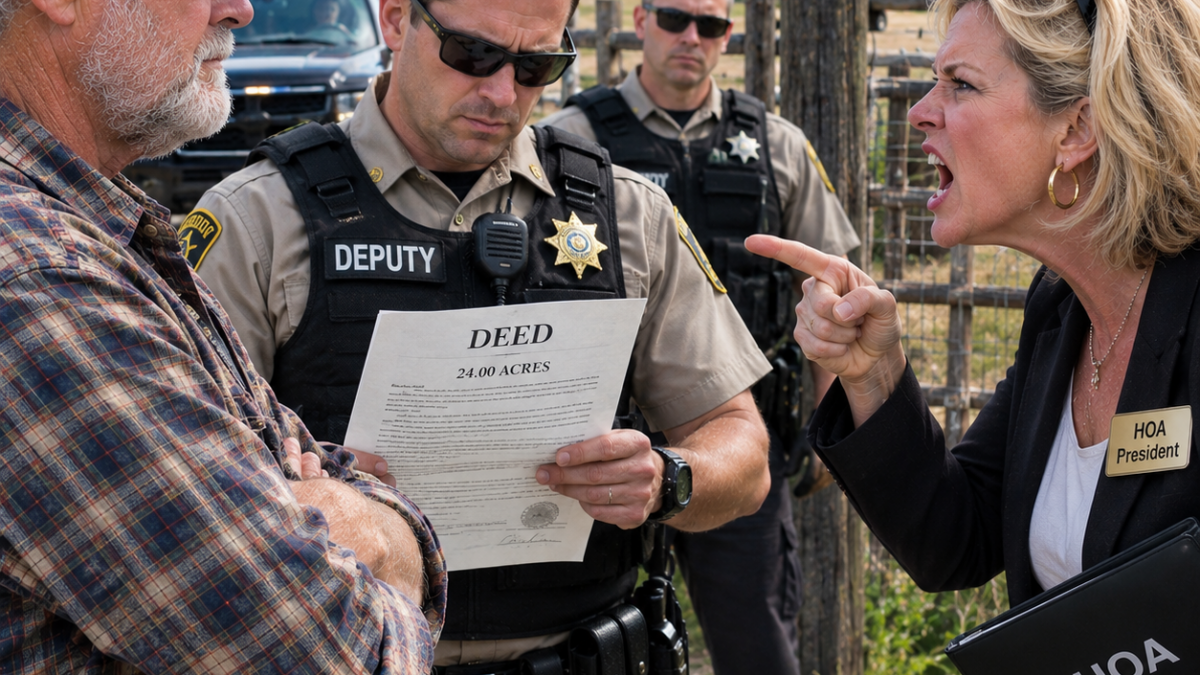
PART 2
The phrase was simple.
**AMENDMENT TO COMMUNITY BOUNDARY.**
I read it three times while sitting at my kitchen table.
According to that document, my land had somehow been pulled inside the homeowners association years after I purchased it.
No sale.
No new deed.
No covenant signed by me.
No agreement I remembered.
Just an amendment.
And Marceline Ror’s name at the bottom.
The county records office opened at eight.
I was waiting outside at seven-fifty.
A woman named Audrey Bellamy eventually called me to her counter.
She was in her sixties, silver-haired, with reading glasses hanging from a chain around her neck.
I gave her the parcel number and the amendment.
“I need somebody to explain this.”
She looked at the first page.
Then at me.
“What are you trying to determine?”
“Whether my property is inside the neighboring HOA.”
“That’s not something we decide at the counter.”
“I understand. I’m asking what your records say.”
That seemed to earn me a little patience.
She typed my parcel number.
Clicked through several screens.
Then frowned.
“Your deed is clean.”
“What does clean mean?”
“No recorded HOA covenant in your chain of title. No transfer of ownership. No voluntary annexation that I can see.”
I slid the amendment toward her.
“Then what is this?”
Audrey picked it up.
Her eyes moved slowly over the text.
She stood.
“Give me a few minutes.”
She disappeared into a records room.
Ten minutes passed.
Then twenty.
By the time she returned, she was carrying a thick folder and a rolled map.
She opened the map across a side table.
“This predates your purchase.”
“How far?”
“Years.”
The original subdivision appeared in faded lines.
Lots.
Roads.
Common spaces.
The HOA development boundary.
My property sat beside it.
Not inside it.
Across my twenty-four acres were two words.
**EXCLUDED PARCEL.**
I stared.
“What exactly does that mean?”
“In this plan?”
“Yes.”
“It means exactly what it sounds like.”
She pointed.
“This parcel was intentionally excluded from the subdivision boundary.”
“Not forgotten?”
“No.”
“Not accidentally left out?”
“Not based on this record.”
“So my land was never part of the association.”
“I can tell you the recorded subdivision plan marks it as excluded.”
I leaned over the map.
Eleven years of ownership suddenly felt different.
I had always known I wasn’t an HOA member.
But that was personal knowledge.
This was historical.
My land had been carved out before I ever bought it.
Audrey tapped another page.
“There’s more.”
The amendment.
She placed it beside the original plan.
Years after the subdivision was recorded, somebody had attempted to expand the community boundary.
The amendment included my parcel.
At the bottom:
Marceline Ror.
Her title at the time was not HOA president.
She had signed in another capacity connected to development planning.
I scanned the signature blocks.
“Where’s mine?”
Audrey looked at me.
“Your signature?”
“If my property was being added, where did I agree?”
She didn’t answer.
I checked again.
Nothing.
“No prior owner signature either?”
“Not on this document.”
“Can they do that?”
Audrey folded her hands.
“I’m not going to give you legal advice.”
“I’m not asking you to represent me.”
“I know.”
She lowered her voice.
“But if someone tried to subject privately owned land to restrictive covenants or association authority without the required owner consent, that would raise serious questions.”
“Is this enforceable?”
“That’s a lawyer question.”
I hated that phrase.
It usually meant the answer was important enough to cost money.
Audrey pointed near the bottom of the filing.
“Before you leave, look at this.”
A company name.
**Ror Development Holdings.**
I looked at her.
“Ror.”
“I noticed.”
“Marceline?”
“I can’t tell you ownership from this file.”
“But that’s her last name.”
“Yes.”
I took certified copies of everything.
On the drive home, my anger changed shape.
Up until then, I had believed Marceline was an aggressive HOA president.
Controlling.
Entitled.
Maybe convinced that anything near her neighborhood fell under her influence.
But development holdings?
An amendment?
Someone requesting my deed six months before the complaints began?
That was not entitlement alone.
That looked like preparation.
I spent the next week researching.
I had never considered myself an investigator.
But I knew records.
Construction work teaches you that projects leave paper trails long before they leave concrete.
Businesses register.
Land transfers record.
Road plans appear in public minutes.
Zoning discussions create agendas.
And land rarely becomes valuable by accident.
Ror Development Holdings had been formed nearly six years earlier.
Marceline was listed as a managing member from the beginning.
The company had acquired land along the county road near me.
One parcel.
Then another.
Then another.
Small deals spread across several years.
I printed each property record.
Then I pinned them to a map.
By midnight, the pattern was obvious.
Ror Development Holdings had assembled land around me.
Eleven significant parcels.
My twenty-four acres sat between several of them like a missing puzzle piece.
The next morning I drove to the feed store.
The owner, Sam, had once mentioned surveyors asking about properties nearby.
“You remember those guys who came through asking questions about land?”
He looked up from a box of invoices.
“Last winter?”
“Yeah.”
“What about them?”
“Who were they working for?”
He scratched his chin.
“Development outfit.”
“Ror Development Holdings?”
His eyes narrowed.
“That sounds right.”
“What were they asking?”
“Road frontage. Water access. Owners willing to sell.”
“Did they ask about mine?”
Sam hesitated.
“That matters?”
“Yes.”
He leaned against the counter.
“They asked who owned the Vance parcel.”
“What did you tell them?”
“That you did.”
“Anything else?”
“I told them you’d probably die before selling.”
I stared.
“Thanks.”
“You’re welcome.”
“I’m forty-six.”
“You’re stubborn.”
“Different thing.”
“Not really.”
I almost laughed.
Then he became serious.
“They asked whether you had a mortgage.”
That stopped me.
“What?”
“Whether the property was financed.”
“Why would they ask you?”
“I said I didn’t know.”
I did know.
No mortgage.
I had paid the loan off years earlier.
Land without a lender meant no bank to pressure.
No foreclosure vulnerability.
No easy financial lever.
Unless someone invented another one.
That afternoon I searched county transportation records.
There it was.
A long-term road expansion concept.
Not approved yet.
Not publicly announced in any major way.
But active.
The county was considering widening and improving the road bordering the properties Ror Development Holdings had been buying.
If that happened, land along the corridor could become dramatically more valuable.
Commercial possibilities.
Higher-density development.
Better traffic access.
Utility extension.
My parcel sat directly in the middle of the assembled tract.
I printed the map.
Laid it beside Marceline’s HOA boundary map.
Then beside the acquisition records.
The shed suddenly seemed ridiculous.
The gate.
The fence.
All those complaints.
They were excuses.
What she wanted was leverage.
If the HOA could establish control over my land, it could make my ownership miserable.
Fines.
Inspections.
Restrictions.
Legal bills.
Maybe a lien.
Keep pressing until selling seemed easier than fighting.
I called Marceline.
She answered after four rings.
“Elias.”
She didn’t sound surprised.
“How much is my property worth to you?”
Silence.
Then:
“I don’t know what you mean.”
“Yes, you do.”
“If this is about your latest violation—”
“It isn’t.”
“Then what is it?”
“Ror Development Holdings.”
Nothing.
I continued.
“Eleven parcels.”
Her voice changed.
Barely.
But enough.
“I have private business interests that are unrelated to my duties as association president.”
“County road expansion.”
“Public planning information is available to anyone.”
“Then why were your people asking whether I had a mortgage?”
“I have no idea what you’re talking about.”
“Why did somebody request my deed six months ago?”
“I don’t control the title company.”
“Why did you sign an amendment trying to put my land inside your HOA?”
Her answer came too quickly.
“That amendment predates my presidency.”
“That wasn’t my question.”
She exhaled.
“You’re becoming paranoid.”
“I’m becoming organized.”
She laughed once.
Cold.
“Elias, nobody is trying to take your property.”
“Good.”
“Good?”
“Then stop sending deputies to it.”
“I don’t send deputies. Complaints are handled by law enforcement.”
“Complaints you sign.”
“I protect the neighborhood.”
“No.”
I looked out my kitchen window toward the field.
“You’re protecting an investment.”
Silence.
For the first time since this started, Marceline did not have a prepared answer.
She hung up.
That evening an email arrived.
**NOTICE OF HOA LIEN REVIEW.**
I read the subject twice.
The association claimed unpaid fines and ongoing violations might justify attaching a lien to my property.
That was the first moment I felt real fear.
A fine is paper.
A lien is pressure attached to ownership.
Even a bad claim can become expensive to remove.
I had spent eleven years building a life around one thing:
This land was mine.
Now Marceline was trying to put her name into that sentence.
The next morning, I called Nadia Whitlock.
Audrey had given me three real estate attorneys to consider.
Nadia was the first one who answered her own phone.
Her office was twenty-five minutes away.
Late forties.
Short dark hair.
No wasted movement.
I brought two boxes.
She looked at them.
“How long has this been happening?”
“About two months.”
“And you have two boxes?”
“I worked construction.”
“That explains nothing.”
“I document.”
“That explains everything.”
She spent three hours reading.
Not skimming.
Reading.
Occasionally she asked a question.
“When was this shed built?”
“Last spring.”
“Permit?”
I handed it over.
“This gate?”
“Eight years.”
“Any easement?”
“No.”
“Any HOA dues ever paid?”
“No.”
“Any covenant acknowledgment?”
“No.”
“Any property inspection requested before this year?”
“No.”
She reached the amendment.
Stopped.
Then found the original excluded-parcel map.
She looked from one to the other.
“Interesting.”
“I hate when lawyers say that.”
“You should.”
She kept reading.
Finally she closed the folder.
“The association has a problem.”
“What kind?”
“The kind created when people mistake paperwork for magic.”
She turned the amendment around.
“No owner consent.”
Next page.
“Legal description inconsistent with your certified survey.”
Another page.
“No recorded covenant in your chain of title.”
Another.
“Original subdivision explicitly excludes the parcel.”
She looked at me.
“On the documents you’ve shown me, I do not see a lawful basis for them to regulate your property as part of the HOA.”
I leaned back.
“So we win.”
“No.”
My stomach tightened.
“You just said—”
“I said their claim appears weak. Winning is a process.”
“I’ve had six police visits.”
“Which is why you stop communicating directly with Marceline unless necessary.”
“She’s threatening a lien.”
“We’ll answer it.”
“Can she file one?”
“People can attempt to file many things.”
“That’s comforting.”
“My job is not comfort.”
I almost smiled.
“Then what is?”
“Making her prove every inch of authority she claims.”
Nadia requested records.
Association complaints.
Boundary documents.
Board votes.
Emails.
County filings.
She also asked the sheriff’s department to preserve dispatch and complaint records involving my parcel.
Within a week, she called.
“I need you in my office.”
“What happened?”
“I found a signature.”
Another one.
A former county employee had certified one of the boundary-related documents used by the HOA.
The man no longer worked for the county.
He was now a paid consultant for the association.
I stared at the employment filing.
“So the guy who helped validate the boundary works for Marceline.”
“Now.”
“Did he when he signed?”
“No. But the timeline needs scrutiny.”
“Can we prove coordination?”
“Not yet.”
There it was again.
Not yet.
I was learning to respect those words.
Suspicion made me angry.
Evidence made me dangerous.
Nadia also compared the complaints.
Anonymous resident complaint.
Safety concern.
Access concern.
Structure concern.
Different names.
Different dates.
But the wording repeated.
Same phrases.
Same sentence patterns.
Same unusual language.
“Community integrity hazard.”
It appeared three times.
“Nonconforming private obstruction.”
Four.
“Potential threat to regulated access.”
Twice.
Nadia placed the complaints side by side.
“What do you see?”
“Somebody needs a thesaurus.”
She almost smiled.
“Anything else?”
“They sound like one person.”
“Exactly.”
“Marceline?”
“Possibly. Or somebody drafting them for multiple complainants.”
“Can we trace it?”
“We try.”
Corbin Shaw came back before Nadia finished.
No Marceline.
No second vehicle.
He parked at the gate and walked up carrying a folder.
I met him outside.
“Another shed emergency?”
He shook his head.
“Not exactly.”
“What then?”
“I reviewed the previous calls.”
I waited.
He looked uncomfortable.
“Some don’t make sense.”
“Some?”
“Most.”
That surprised me.
He opened the folder.
“One says unauthorized residence.”
“I’ve lived here eleven years.”
“I know.”
“One says obstruction of shared community access.”
“There isn’t any.”
“I know.”
“Another says illegal construction.”
“Permitted shed.”
“I checked.”
I folded my arms.
“So what do you need?”
“Your deed.”
I stared at him.
“You’ve been here before.”
“I know.”
“You took complaints before.”
“I know.”
“You’re asking to read it now?”
His face tightened.
“Yes.”
At least he was honest.
I walked inside.
By then I kept a certified copy near the front door.
I handed it over.
Corbin stood beside his cruiser reading.
Page one.
Page two.
Legal description.
Granting language.
Exceptions.
Survey reference.
Then the final pages.
His expression changed.
He looked toward the road.
Then back at the deed.
“Where is the HOA covenant?”
“There isn’t one.”
He read further.
“Your title specifically references the excluded subdivision parcel.”
“Yes.”
He looked at me.
“Who told the department this was HOA property?”
I didn’t answer.
We both knew.
A vehicle turned onto the road.
Marceline.
Of course.
She parked behind Corbin’s cruiser and walked toward us.
“Deputy Shaw.”
He closed the folder.
“Ma’am.”
“I understand there is another compliance issue.”
“No.”
She stopped.
“No?”
“I’m reviewing the property record.”
“You are not here to interpret property law.”
Corbin’s voice stayed level.
“Neither are you.”
The silence after that was almost physical.
Marceline looked at me.
“You’ve been feeding him documents.”
“It’s my deed.”
She turned to Corbin.
“The association has recorded authority.”
“I’ve requested the county-certified record.”
“You are overstepping.”
“I’m checking whether there’s a legal basis for repeatedly dispatching deputies here.”
Her eyes sharpened.
“Our complaints involve legitimate community concerns.”
Corbin lifted one.
“Unauthorized residence?”
Her face changed.
He continued.
“He owns the residence.”
“That complaint was submitted by a resident.”
“Which resident?”
“I don’t have that information.”
“I do.”
She said nothing.
Corbin looked at me.
“Keep the original deed available.”
“Why?”
“Because I’m starting to think somebody’s been using this department to scare you off your own property.”
Marceline took a step forward.
“That is an outrageous accusation.”
Corbin looked at her.
“I didn’t accuse anyone.”
She realized it too late.
Her reaction had said enough.
He left.
Marceline stayed.
We stood on opposite sides of my gate.
“You think this ends because one deputy likes you?”
“No.”
“Good.”
“I think it ends when somebody reads every document.”
She smiled.
“You have no idea how expensive this can become.”
That was the closest thing to a direct threat she had given me.
I opened the gate just enough to step through.
“You’re right.”
Her smile grew.
“I spent twenty years reading contracts for projects worth more money than either of us will ever personally have.”
The smile faded.
“I know exactly how expensive bad paperwork becomes.”
She got into her SUV.
The lien notice moved forward anyway.
Nadia responded immediately.
She demanded the legal instrument establishing HOA authority.
Again.
She demanded calculation of the alleged debt.
She demanded board authorization.
She demanded copies of every covenant supposedly binding my parcel.
The association’s attorney sent forty-three pages.
Most were irrelevant.
General bylaws.
Architectural standards.
Road maintenance rules.
Complaint procedures.
None attached my property.
Nadia put the stack in front of me.
“This is what people do when they don’t have the page you asked for.”
“Send more pages?”
“Exactly.”
Then discovery produced the email.
I remember the time.
8:12 p.m.
Nadia called.
“Check your email.”
I opened the attachment.
One message.
From Marceline.
To an associate tied to Ror Development Holdings.
Months before the first deputy visit.
**We need to secure Vance’s parcel before the county makes its announcement. Once the corridor plan is public, our leverage disappears.**
I read it twice.
Then a third time.
Every shed complaint collapsed into those two sentences.
Nadia said, “Still think this is about your gate?”
“No.”
“Good.”
“What do we do with it?”
“Nothing impulsive.”
“I want to drive to her house.”
“That would be impulsive.”
“I want to print it six feet tall.”
“Also impulsive.”
“She knew.”
“Yes.”
“All along.”
“It strongly supports that conclusion.”
“She used the HOA to pressure me before the road announcement increased my land value.”
“That is the theory the documents now support.”
I sat down.
For weeks I had wanted proof.
Now that I had it, I felt sick.
Being right about someone trying to hurt you is not satisfying when the proof confirms they were willing to go farther than you wanted to believe.
The HOA scheduled an emergency meeting.
Notice went to every member.
The stated purpose:
**Legal action concerning noncompliant adjoining property.**
That was me.
Nadia said we should attend.
“I’m not a member.”
“You’re the agenda.”
Fair point.
The clubhouse parking lot was full.
Inside, maybe seventy residents sat in folding chairs.
Marceline stood at the front.
She looked exactly as she always did.
Perfect jacket.
Perfect posture.
Calm voice.
“Mr. Vance has consistently refused reasonable cooperation.”
People nodded.
“He has rejected community standards.”
More nods.
“He has obstructed inspections.”
A man near the aisle shook his head.
“His property is affecting all of us.”
Marceline continued.
“This board must authorize legal action before his defiance threatens property values.”
I entered halfway through.
Heads turned.
Marceline paused.
“You’re not a member.”
“No.”
“Then this meeting is private.”
Nadia entered behind me.
“He is the person you’re proposing to sue.”
Murmurs.
Marceline looked irritated.
“You may observe from the back.”
I walked toward the front instead.
“I brought something.”
“Elias—”
I placed my folder on the board table.
“You should read it before anyone votes.”
She laughed lightly.
“More paperwork?”
“Yes.”
“This board has already reviewed the relevant documents.”
“Then five minutes won’t hurt.”
One board member reached for the folder.
Marceline put a hand over it.
“That is unnecessary.”
The man looked at her.
“Why?”
“Because we’ve already received counsel.”
Nadia spoke.
“Then your counsel should have no objection to comparing the county records.”
Another board member said, “Let’s see it.”
Marceline removed her hand.
The folder moved around the table.
Original deed.
Certified survey.
Original subdivision map.
**EXCLUDED PARCEL.**
The flawed amendment.
Marceline’s signature.
Ror Development Holdings acquisitions.
County road concept.
Then her email.
**We need to secure Vance’s parcel before the county makes its announcement.**
The room changed.
A board member named Desmond Cray read it aloud.
“Secure?”
Marceline folded her arms.
“You’re taking private business correspondence out of context.”
“What context?” Desmond asked.
“Development negotiations.”
“With his property?”
“Adjacent holdings.”
I spoke for the first time.
“My land is the one named.”
She looked at me.
“You live beside this community. What happens to your property affects our residents.”
“Beside.”
Silence.
I repeated it.
“I live beside your community. Not inside it.”
A woman in the second row whispered:
“Is his parcel really excluded?”
Marceline answered before I could.
“The old map is outdated.”
Nadia stepped forward.
“Show us the valid replacement.”
Marceline’s jaw tightened.
“The amendment is in the record.”
“Without owner consent.”
“The association has operated under it for years.”
“Operating under a document does not cure a defective document.”
“You’re not here to give the board a law lecture.”
“No.”
Nadia looked toward the residents.
“I’m here because your president is asking you to authorize litigation based on authority she has been unable to establish.”
That landed.
Marceline looked toward the entrance.
“Someone call the sheriff.”
I almost laughed.
After months of using deputies as pressure, she was reaching for the same weapon again.
The door opened.
Corbin Shaw walked in.
He was already carrying a folder.
Marceline looked relieved for exactly one second.
“Deputy, Mr. Vance has disrupted a private association meeting.”
Corbin walked to the table.
“I’m not here about the meeting.”
Her relief vanished.
“Then why are you here?”
He placed the folder beside mine.
“County-certified property record.”
Marceline stared at it.
“This is inappropriate.”
Corbin opened the deed.
“Mr. Vance asked that complaints regarding his property be documented. Our department has also been reviewing why we’ve been repeatedly dispatched there.”
“This is civil.”
“Some of it is.”
“Then leave it to the lawyers.”
“I intend to.”
He turned to the second page.
“But before we respond to another association complaint, I wanted the board to hear what the county record actually says.”
He read the legal description.
Slowly.
No drama.
No raised voice.
My twenty-four acres belonged to me.
The original subdivision records listed the parcel as excluded.
No recorded HOA covenant bound the land.
No valid owner-signed annexation appeared in the chain.
The later amendment did not contain the owner consent needed to make Marceline’s claim what she had been telling everyone it was.
Marceline interrupted.
“That record is outdated.”
Corbin flipped another page.
“No.”
“Deputy—”
“It’s current.”
“You don’t understand association law.”
“I understand the property record.”
“You are exceeding your authority.”
He looked at her.
“For months I accepted complaints about this man’s property without reading the deed myself.”
Nobody moved.
“That was my mistake.”
His voice remained calm.
“I won’t make it again.”
A resident asked:
“So he was never in the HOA?”
Corbin looked toward Nadia.
“I’m not giving legal advice.”
Then he tapped the county record.
“But this parcel is not within the recorded association boundary shown here.”
Marceline looked toward the board.
“This proves nothing about community obligations.”
Desmond held up her email.
“What about this?”
Her eyes moved toward him.
“You said we were protecting neighborhood standards.”
“We are.”
“You wrote that you needed his land before a county announcement.”
“That was separate.”
“Then why did our HOA send the complaints?”
No answer.
Another resident stood.
Patricia Alden.
She had lived in the neighborhood since its early years.
Her voice was quiet.
“Marceline, was his parcel the only one?”
Marceline frowned.
“What does that mean?”
“Have we done this to other people outside the HOA?”
“No.”
Patricia looked toward Desmond.
He was scrolling through something on his phone.
“Wait.”
Everyone turned.
He looked up.
“There were complaints against the Garner property.”
Marceline’s face tightened.
Desmond continued.
“And the Ellison parcel.”
Nobody spoke.
“Both were outside the original subdivision.”
Marceline snapped:
“Those were separate issues.”
“Both sold afterward.”
Her composure cracked.
Just slightly.
Nadia noticed.
So did I.
Before anyone could continue, another man entered.
Gray suit.
County identification.
He introduced himself as an investigator.
“I need to speak with the association regarding several property filings submitted over the last few years.”
The room became completely silent.
Marceline looked at the door.
Then at him.
Then at the residents.
For months, she had controlled every room by speaking first and speaking with certainty.
Now nobody seemed interested in her certainty.
They wanted documents.
The investigator asked:
“Would you prefer to schedule an interview at the county office, or answer preliminary questions here?”
Marceline gathered her papers.
“My attorney will contact you.”
Her hands shook.
Barely.
But I saw it.
She walked out.
Nobody followed.
The meeting did not end.
It exploded.
Residents asked questions all at once.
“Were our dues paying for this?”
“Did the board know?”
“What other properties?”
“Why were deputies involved?”
“Who approved the lien?”
The board could not answer most of them.
Nadia told everyone to slow down.
“Do not turn suspicion into fact. Let the records establish what happened.”
That mattered.
I had spent months being accused by people who didn’t check.
I did not want my side to win by doing the same thing.
Patricia came to me.
“I owe you an apology.”
“You don’t know me.”
“That’s why.”
I waited.
“I believed her.”
“So did a lot of people.”
“I thought you were some angry landowner trying to avoid rules everybody else followed.”
“I was an angry landowner.”
She almost smiled.
“Apparently with reason.”
I accepted the apology.
Not because I needed it.
Because I was tired of carrying strangers’ opinions.
The county investigation widened.
I learned most of it through Nadia and public findings.
Audrey pulled older association records.
Meeting minutes from the founding years confirmed the twenty-four-acre parcel had been intentionally excluded at the request of the farming family who owned it before me.
Not overlooked.
Excluded.
The family had refused HOA restrictions because they wanted to preserve agricultural independence.
That agreement was part of the original plan.
Someone later tried to erase it with an amendment that did not contain the necessary owner consent.
Investigators also mapped Ror Development Holdings acquisitions.
Eleven parcels.
All near the road corridor.
All surrounding or approaching my tract.
Then they found two former property owners whose experiences looked disturbingly familiar.
One was a man named Gerald Ellison.
He had moved away three years earlier.
The other was an elderly widow named Ruth Garner.
She lived with her daughter in another state.
Nadia called me after investigators interviewed Ruth.
“You’re going to hate this.”
“What?”
“She received repeated violation complaints before selling.”
“From the HOA?”
“Some directly. Some through county channels.”
“What kind?”
“Fence. Drainage. Outbuilding. Access.”
My stomach tightened.
“What happened?”
“She got tired.”
Those three words hurt more than I expected.
Ruth had eventually sold her property to Ror Development Holdings.
Below market value.
Not because anyone physically forced her.
Because every month brought something new.
Letters.
Inspections.
Warnings.
Complaints.
She was widowed.
Her daughter lived hundreds of miles away.
At some point, peace became worth more than maximizing the sale.
That was Marceline’s model.
Not one dramatic seizure.
Exhaustion.
Make ownership feel expensive.
Then arrive with a solution.
I told Nadia:
“I want to talk to Ruth.”
“No.”
“Why?”
“Because she is part of an active investigation.”
“I just want—”
“I know what you want.”
She looked at me.
“You want to apologize for not knowing.”
I said nothing.
“You didn’t do this to her.”
“I might have seen the pattern earlier.”
“You didn’t know there was a pattern.”
I looked away.
She softened.
“When the investigation allows it, maybe.”
Months later, Ruth called me herself.
Her daughter had found my number.
Her voice was thin but clear.
“Mr. Vance?”
“Elias.”
“I heard you kept your land.”
“Yes.”
“Good.”
I didn’t know what to say.
She continued.
“I wish I had.”
“I’m sorry.”
“For what?”
“For what they did.”
She was quiet.
Then:
“I thought I was weak.”
“You weren’t.”
“I sold.”
“You chose peace.”
“I chose sleep.”
That sentence stayed with me.
I knew exactly what she meant.
There had been nights when headlights on the road made my body tense before my brain caught up.
Nights when I wondered whether another complaint was sitting in an inbox.
Nights when I imagined a lien attached to my land.
Ruth said:
“They make you feel foolish for caring about a fence or a shed. Then one day you realize the fight was never about the fence.”
“No.”
“It was about whether you’d get tired first.”
“Yes.”
She sighed.
“I’m glad you didn’t.”
After we hung up, I sat on my porch until dark.
I no longer thought of patience as a personality trait.
It had been my defense.
The investigation found that supposedly independent complaints against my property repeated language because several had been drafted through the same small group connected to association leadership.
A former county employee who later worked as an HOA consultant had certified boundary-related documents that did not match the original records.
His role came under separate scrutiny.
The attempted lien was halted.
Then formally released.
Every HOA violation against me was withdrawn.
The association issued written confirmation:
My twenty-four acres had never been subject to its governing covenants.
I kept that letter.
Not because I needed their permission.
Because there was something satisfying about the organization that had spent months claiming authority finally putting the opposite in writing.
Marceline resigned days after the investigation became public.
The board did not let that end the matter.
At the next meeting, they voted unanimously to remove her authority formally while records were still being reviewed.
I attended.
She did too.
This time she sat in the audience.
No podium.
No prepared presentation.
No place at the front.
Desmond read the motion.
Patricia seconded it.
The vote passed.
Every hand.
Marceline remained seated.
Then she looked at me.
For months, I had imagined what I would feel if she lost her position.
Triumph.
Satisfaction.
Maybe anger finally discharged.
Instead, I felt tired.
She walked over after the meeting.
“You got what you wanted.”
“No.”
Her mouth tightened.
“You destroyed me anyway.”
“I didn’t file those documents.”
“You dug until everything became public.”
“You sent cops to my house.”
“I never ordered anyone to intimidate you.”
“You filed complaints you knew would bring them.”
Her eyes flashed.
“I was protecting something I spent years building.”
“Ror Development?”
“The community.”
“Which one?”
She looked away.
That answer mattered.
I continued.
“You could have made me an offer.”
“You would have refused.”
“Yes.”
“Exactly.”
I stared at her.
“That sentence is your whole problem.”
“What?”
“You thought my no meant you needed a different method.”
For a second, the anger left her face.
Something else replaced it.
Fear.
Maybe regret.
Maybe just recognition.
“The road project would have changed everything,” she said.
“For you.”
“For this entire area.”
“For you.”
She shook her head.
“You have no idea what that development could have been worth.”
“Then you should have offered me what my land was worth.”
“You would’ve held out.”
“Probably.”
“Indefinitely.”
“Maybe.”
“That’s not reasonable.”
“It’s ownership.”
She laughed bitterly.
“Twenty-four acres.”
“Yes.”
“You would block millions over twenty-four acres?”
I stepped closer.
“I wasn’t blocking your money.”
I pointed toward the road.
“You were building your money on something you didn’t own.”
She stared at me for a long time.
Then said:
“You think paper makes you righteous.”
“No.”
I shook my head.
“Paper just tells people where your rights stop and mine begin.”
She walked away.
That was our last real confrontation.
Ror Development Holdings abandoned its pursuit of my parcel.
Within a year, it sold several surrounding holdings.
The grand assembled tract Marceline had been building never became what she planned.
The county road project moved more slowly than investors expected anyway.
Some improvements eventually happened.
But the dramatic commercial transformation she had gambled on never materialized in the way she had imagined.
Her rush had been built partly on prediction.
My land had almost been taken apart by people betting on a future that was not guaranteed.
The HOA underwent an audit of violation enforcement covering the previous five years.
Dozens of fines were reconsidered.
Some were valid.
Many were not.
Residents received refunds or credits where records did not support the charges.
The board created new procedures.
No property outside the recorded boundary could receive an association compliance notice.
Boundary disputes required legal review before enforcement.
Anonymous complaints involving outside parcels required independent verification before referral to law enforcement.
Corbin told me later that the sheriff’s department changed its own habits too.
He stopped by one afternoon wearing jeans instead of a uniform.
No cruiser.
Just an old pickup.
I opened the gate.
“Should I be worried?”
“No badge.”
“That’s what worries me.”
He laughed.
“I brought coffee.”
“That gets you access.”
We sat on my porch.
For a while we talked about nothing important.
Weather.
Road construction.
A broken transmission in his truck.
Then he said:
“You know I handled the first call badly.”
“You were polite.”
“That’s not the same thing.”
I waited.
“I accepted the complaint framework.”
“What do you mean?”
“Somebody said HOA violation, so I arrived thinking the question was whether you violated something.”
He looked toward the gate.
“The first question should’ve been whether those rules applied at all.”
“That wasn’t your job to adjudicate.”
“No.”
“But?”
“But I could’ve read the document sooner.”
He took a sip of coffee.
“I keep thinking about that.”
“The deed?”
“The fact that everybody had an opinion before anybody read it.”
I smiled.
“That seems to happen a lot.”
“Not on my calls anymore.”
He told me that after my case, he started asking for documentation whenever property disputes involved associations, easements, or private roads.
Not because deputies were suddenly real estate attorneys.
Because a badge should not become leverage in a private dispute merely because one side knew how to make a complaint sound official.
“One guy got mad at me last month,” Corbin said.
“Why?”
“HOA president.”
I laughed.
“Of course.”
“He wanted me to tell a farmer to move a gate.”
“What did you do?”
“Asked for the easement.”
“And?”
“He didn’t have it.”
“What happened?”
“Nothing.”
I looked at him.
“Nothing?”
“That’s the point.”
For the first time, I understood that my fight had changed something beyond my fence line.
Not dramatically.
One deputy asking one extra question.
Sometimes that was enough.
Saurin Pike visited too.
He admitted that several deputies had compared notes after Corbin raised concerns.
Once they put the calls together, the pattern looked ridiculous.
Shed.
Gate.
Residence.
Access.
Waste.
Inspection refusal.
All on one property.
All in a few months.
All tied directly or indirectly to the same association.
“How did nobody notice?” I asked.
Saurin shrugged.
“Different shifts. Different reports. Different deputies.”
“That simple?”
“That simple.”
I thought about construction.
Catastrophic failures often looked obvious after the collapse.
Beforehand they were scattered warnings nobody assembled.
Marceline had counted on fragmentation.
One complaint here.
One officer there.
One letter.
One fine.
No single event large enough to trigger alarm.
I beat her because I put everything in one file.
Dates beside dates.
Words beside words.
Ownership beside claims.
It was exactly what I had done for twenty years on construction sites.
You don’t argue with a failing structure.
You trace the load path.
Audrey Bellamy retired not long after the county investigation closed.
I found out from Nadia.
I drove to the records office on her last week.
She was clearing her desk.
“You stalking county employees now?”
“Only retired ones.”
She smiled.
I handed her a small plant.
“I didn’t know what people give records clerks.”
“Whiskey.”
“I can go back.”
“This is fine.”
We stood awkwardly.
Then I said:
“You saved my land.”
She shook her head.
“No.”
“You found the excluded map.”
“It was already there.”
“Nobody else found it.”
“Nobody asked.”
“That’s my point.”
She opened a desk drawer.
Inside was a photocopy.
The original subdivision map.
My parcel circled.
EXCLUDED PARCEL.
“You kept this?”
“Reminder.”
“Of what?”
She looked at the page.
“That old files are old because people stop looking at them, not because they stop being true.”
I liked that.
I visited Ruth Garner later that year.
She lived with her daughter three states away.
Nadia confirmed the investigation no longer required distance between us.
Ruth was smaller than I imagined.
White hair.
Sharp eyes.
She made terrible coffee and apologized for it before I drank any.
“I sold too cheap,” she said.
I didn’t argue.
She knew.
“Do you want your land back?”
“No.”
That surprised me.
“I miss parts of it.”
She looked toward her daughter’s backyard.
“But my husband is buried here now. My grandchildren are ten minutes away.”
She smiled.
“I’m all right.”
“Then why did you talk to investigators?”
Her expression hardened.
“Because being all right afterward doesn’t make what they did right.”
That sentence taught me more than most of the legal filings.
I asked whether she blamed herself.
“Less now.”
“Why?”
“Because I met you.”
I frowned.
“That doesn’t make sense.”
“It does.”
She leaned forward.
“You had the money for a lawyer.”
I started to object.
She raised a hand.
“You had records. Experience. Confidence around paperwork. You had no husband dying in the back room. No daughter begging you to move closer.”
I said nothing.
“I used to think if I were tougher, I would have fought.”
Her eyes stayed on mine.
“Now I think the people pressuring me chose me because they knew I had other things to lose.”
I looked down.
That was the ugliest part of what Marceline’s system had done.
It was not pressure applied equally.
It worked best on tired people.
Busy people.
Old people.
People who couldn’t afford lawyers.
People who would trade equity for sleep.
My victory did not prove everyone could win by simply standing firm.
Sometimes standing firm requires resources people do not have.
That understanding changed what I did afterward.
I never became an activist.
Never ran for office.
Never joined the HOA board.
That would have required joining the HOA, which after everything seemed like a poor joke.
But when older landowners along the county road received strange notices, I helped them organize paperwork.
Not legal advice.
Just folders.
Dates.
Deeds.
Surveys.
Copies.
Once, a rancher named Miguel showed me a letter demanding he remove fencing because it supposedly blocked future road access.
I asked:
“Do they have an easement?”
He shrugged.
“They say they do.”
“Do you have your deed?”
“Somewhere.”
“Find it.”
Two days later, he called.
“No easement.”
“Then call a lawyer before you move anything.”
He did.
The matter ended with one letter.
No cruisers.
No months of pressure.
That felt better than revenge.
My own property returned slowly to normal.
The shed stayed.
I repainted it the next spring.
Dark red.
No architectural committee approved the color.
I spent ten full minutes considering whether that made me happier than it should.
Probably.
The front gate stayed where it had been for eight years before anyone complained.
I repaired the hinge.
Replaced the weathered posts.
Added no dramatic sign.
Just:
**PRIVATE PROPERTY
ELIAS VANCE**
Nadia visited while I was mounting it.
“That’s restrained.”
“I considered ‘No HOA Beyond This Point.’”
“You should’ve done that.”
“I thought you were the serious one.”
“I bill by the hour. I need entertainment.”
She had taken two other cases involving association overreach near the county road.
Both settled quickly.
Once the Vance records became known to opposing counsel, nobody wanted another public meeting with Corbin reading deeds aloud.
Nadia never called my case a precedent in the formal sense.
She called it a warning.
Documents mattered.
Authority had boundaries.
And motive became relevant when enforcement behavior stopped matching legitimate community needs.
The former county employee who had certified questionable boundary documents lost his consulting work and faced separate professional scrutiny.
The county never claimed every filing he touched was fraudulent.
They reviewed them.
Some held.
Others did not.
That distinction mattered to me.
Truth was not a weapon you swung broadly.
It worked because it was precise.
Marceline did not go to prison.
Some residents expected that.
They were disappointed.
The evidence supported serious misconduct in the association’s civil actions and property filings, but proving criminal intent beyond the standards required for other remedies was another matter.
Nadia explained it simply.
“You wanted the truth recognized.”
“Yes.”
“You got that.”
“I wanted consequences.”
“You got those too.”
“Not all of them.”
“No one gets to design every consequence.”
I hated that answer.
Then eventually accepted it.
Marceline lost the presidency.
Lost control of the board.
Lost the development strategy.
Lost the credibility that had made her threats effective.
Ror Development Holdings abandoned the assembly.
The association publicly corrected its boundary records.
The attempted lien disappeared.
The county scrutinized the filings.
Residents questioned years of enforcement.
That was not nothing.
And the most satisfying part?
I never had to invent a single thing against her.
Her own map failed.
Her own amendment failed.
Her own acquisition pattern exposed motive.
Her own email explained timing.
Her own complaints created the pattern.
Her own confidence made her believe nobody would read deeply enough.
The revenge, if that was what people wanted to call it, was giving every document enough room to speak.
One year after the first cruiser arrived, I walked my entire twenty-four acres at sunrise.
I had done that almost every morning before the trouble started.
During the worst months, I stopped.
Not consciously.
I just got busy.
Calls.
Meetings.
Records.
Lawyers.
I spent so much time defending the land that I stopped enjoying it.
That morning I started at the front gate.
The gravel was damp.
A line of fog sat low over the field.
I followed the eastern fence past the shed.
The same shed that supposedly threatened community integrity.
It looked absurdly ordinary.
Wood.
Metal roof.
Tools inside.
No revolution.
No danger.
I laughed.
Then I continued toward the tree line.
At the back of the property stood one of the original survey monuments.
A small piece of steel driven into the earth.
Eleven years earlier, the farmer who sold me the land had pointed it out.
“Don’t lose that.”
I didn’t.
I knelt and cleared leaves from around it.
The marker had survived storms.
Freeze cycles.
Mud.
Years of grass.
And Marceline’s new maps.
It had never moved.
That struck me harder than I expected.
All that conflict.
All those complaints.
All those official-looking envelopes.
And the actual boundary had sat quietly in the dirt the whole time.
I stayed there until my knees hurt.
Then kept walking.
At noon, Corbin stopped by.
Not planned.
He saw me near the gate.
“You celebrating?”
“What?”
“One year.”
I checked my phone.
He was right.
Exactly one year since the first complaint.
“I forgot.”
“That’s probably healthy.”
He leaned against the fence.
“What are you going to do with the place?”
“Same thing I was doing before everybody became interested.”
“Which is?”
“Live here.”
“No development?”
“No.”
“No commercial deal?”
“No.”
“Twenty-four acres near a future road improvement?”
I looked at him.
“You sound like Marceline.”
He held up both hands.
“Never mind.”
We laughed.
Then he became quiet.
“I’ve been meaning to ask.”
“What?”
“When did you know?”
“Know what?”
“That you were going to win.”
I thought about it.
Audrey’s map?
Nadia’s first meeting?
Marceline’s email?
The board meeting?
Corbin reading the deed?
“No single moment.”
“That’s disappointing.”
“Sorry.”
He waited.
“I knew the deed was right from the beginning.”
“But?”
“I didn’t know being right would be enough.”
He nodded.
That was the truth.
Property rights feel simple until someone with money, paperwork, influence, and confidence decides to test how expensive defending them can become.
The deed mattered.
But so did Audrey retrieving the old map.
Nadia knowing what to ask for.
Corbin deciding to look deeper.
Ruth telling investigators what happened to her.
Board members questioning Marceline.
County staff comparing filings.
No single heroic act saved my property.
A lot of people eventually decided to read instead of assume.
That was enough.
The HOA elected new leadership.
Patricia Alden became president.
The irony amused me.
One of her first letters was addressed to me.
For several minutes, I considered leaving it unopened simply because of the return address.
Then I laughed at myself and opened it.
The letter acknowledged the property boundary.
Apologized for the association’s improper attempts to regulate the parcel.
Confirmed no future HOA enforcement would be directed toward my land absent a legally established basis.
Signed:
Patricia Alden, President.
I put it with the deed.
Not because the HOA had granted my independence.
It hadn’t.
My independence existed before their letter.
I kept it because apologies should be preserved too.
There were enough threat letters in the box.
One summer evening, Patricia stopped by.
She remained outside the gate until I opened it.
I noticed that.
“Come in.”
“You sure?”
“Yes.”
We sat on the porch.
She brought lemonade.
“I want to ask something awkward.”
“Those are usually the interesting questions.”
“Do you hate the HOA?”
I thought about it.
“No.”
She looked surprised.
“I hate what people can do with unearned authority.”
“That sounds like yes.”
“No.”
I shook my head.
“An HOA is paperwork and people. Same as a company. Same as a county office. Same as a construction project.”
“And?”
“Good structure can still fail when the wrong people ignore limits.”
She smiled.
“Engineer answer.”
“Sorry.”
“Don’t be.”
She told me residents were struggling with the fallout.
Some were embarrassed.
Others angry at the board.
Some angry at me because scandal had affected the neighborhood’s reputation.
“That last group may take a while,” she said.
“They’re allowed.”
“That doesn’t bother you?”
“It used to.”
“What changed?”
I looked toward the field.
“I spent months trying to convince people who didn’t own my land that I owned my land.”
I laughed quietly.
“That cures you of needing universal approval.”
She nodded.
Before leaving, Patricia stopped at the gate.
“One more thing.”
“What?”
“We removed the association boundary map from the clubhouse.”
“The wrong one?”
“Yes.”
“What replaced it?”
“County-certified map.”
I smiled.
“Good choice.”
Two years later, Audrey mailed me something.
A photocopy of an old handwritten note found in an archived subdivision folder.
It came from the farming family that owned my property before I did.
The note was dated decades earlier.
One sentence underlined:
**Parcel to remain independent from community covenants.**
I called her.
“You’re retired.”
“I know.”
“Why are you still looking through records?”
“Some people golf.”
“You’re strange.”
“I know.”
I framed the copy and put it in my study.
Not because it added legal strength anymore.
That fight was over.
I liked knowing the independence of those twenty-four acres had mattered to somebody before me.
The farmer who sold me the property hadn’t just passed me dirt.
He had passed me a decision other people made decades earlier.
Keep it separate.
Keep it free of the subdivision.
I had almost lost sight of that because Marceline spoke more confidently than an old map.
The filing box eventually moved out of my kitchen.
For months it sat within arm’s reach.
Every violation.
Every complaint.
Every dispatch record.
Every photograph.
Every certified copy.
Eventually I carried it to the spare room.
Then to the closet.
The deed went back into the fireproof safe.
The original certified survey beside it.
The excluded-parcel map.
The released lien notice.
Patricia’s apology.
I closed the door.
For the first time in almost two years, I did not feel the need to keep documents beside the front entrance.
That night it rained.
Hard.
The kind of rain that rattled the metal roof on the shed and turned the gravel dark.
I sat on the porch.
No headlights appeared.
No cruiser.
No HOA vehicle.
No complaint taped to the gate.
Just rain.
I had forgotten how powerful ordinary silence could feel.
People sometimes asked why I had fought so hard.
Twenty-four acres.
Why not sell?
Why spend money on Nadia?
Why endure months of pressure?
Why not take a development offer and move somewhere else?
The answer changed depending on the day.
Sometimes I said because the land was mine.
Sometimes because Marceline lied.
Sometimes because giving in would have validated the method.
But the deepest answer was simpler.
I bought those twenty-four acres because I wanted one place where my life did not belong to somebody else’s plan.
For twenty years, I built warehouses, bridge supports, apartment buildings, offices.
Every project had an owner.
A client.
A schedule.
A budget.
Someone else decided what happened next.
When I bought my land, I wanted the opposite.
No master plan.
No community vision.
No developer’s rendering.
Just a house.
A shed.
A fence.
Trees.
Space.
Marceline looked at that same land and saw an obstacle between purchased parcels.
That was our entire conflict in one sentence.
I saw home.
She saw leverage.
Years after everything ended, the county finally improved part of the road.
Not the massive transformation Ror Development Holdings had expected.
A practical widening.
Drainage.
Safer intersections.
My property value probably rose.
I never checked closely.
One morning, a developer left a business card in my mailbox.
I called him.
“You interested in selling?”
“No.”
“Do you know what the acreage could be worth now?”
“Probably.”
“I can make a strong offer.”
“No.”
“You haven’t heard the number.”
“I don’t need to.”
Pause.
“You sure?”
“Yes.”
“All right.”
That was it.
No complaints afterward.
No inspectors.
No deputies.
No boundary amendment.
Just a man asking.
Me answering.
And him respecting the answer.
I stood at the mailbox after the call thinking how unbelievably easy the whole thing could have been.
Ask.
Answer.
Respect.
No scandal required.
That autumn, Corbin came over to help replace a section of fence after a storm dropped a tree on it.
He was terrible at setting posts.
“You sure you’re qualified?”
“I carry a gun for a living.”
“That’s unrelated.”
“I’ve noticed you enjoy reminding me.”
“Post is crooked.”
“It is not.”
I placed the level against it.
He stared.
“Your level is biased.”
“Probably HOA affiliated.”
He laughed.
We worked until sunset.
When we finished, he leaned on the fence.
“You know what’s funny?”
“What?”
“The first time I stood here, I thought you were difficult.”
“I am difficult.”
“You were so calm it annoyed me.”
“That sounds like your problem.”
“It was.”
He looked toward the house.
“I thought if someone got this many complaints, there had to be something.”
I nodded.
“That’s what they were counting on.”
“Volume becoming credibility.”
“Exactly.”
He shook his head.
“Changed the way I think.”
“Good.”
He looked at me.
“You know what changed mine?”
“What?”
I pointed toward the safe inside the house.
“One deputy finally reading the deed.”
Corbin smiled.
“Should’ve done it sooner.”
“Yes.”
We stood there in the fading light.
I didn’t need him to apologize again.
He had already changed what he did afterward.
That mattered more.
The sun dropped behind the trees.
I closed the gate.
The latch clicked.
Nothing dramatic.
No cameras.
No board meeting.
No investigator.
No Marceline.
Just a gate on private property.
Mine.
The next morning I walked the boundary again.
Past the shed.
Past the repaired fence.
Past the place where cruisers used to park.
At the far edge of the field, I stopped beside the old survey marker.
I bent down.
Brushed leaves away.
Still there.
Still straight.
Still exactly where the original survey said it should be.
For months, people had tried to move the boundary with maps, complaints, amendments, fines, and confidence.
The steel marker had never moved an inch.
Neither had the deed.
They had simply been waiting for someone to read them.
I stood up and continued home.
[END OF STORY]








