PART 2: HOA Sent Armed “Cops” Onto My Vineyard—They Learned Too Late My Land Was Never Theirs
PART 2
That bothered me more than I expected.
If they had returned immediately, angry and loud, I could have treated the situation for what it looked like.
Two idiots trespassing.
But silence after a confrontation feels different.
It gives people time to make plans.
On the third morning, I was repairing a sagging hinge on the workshop door when I heard tires grinding slowly over gravel.
Not a delivery truck.
Too deliberate.
I straightened.
A black Yukon stopped outside my gate.
Older model.
Tinted windows.
Engine running.
The driver’s door opened.
A man climbed out.
He looked somewhere in his late fifties or early sixties.
Broad shoulders softened by time.
Gray hair cut short.
Mirrored aviators.
A tactical jacket that looked expensive twenty years ago.
There was an old sheriff’s department patch stitched onto one sleeve.
Faded.
Fraying around the edges.
Not current.
That detail mattered.
The pistol on his belt looked current enough.
He walked toward my gate.
“Morning.”
“Morning.”
“Paul Merrick.”
He waited.
Like the name should mean something.
It didn’t.
“I oversee community enforcement for Ridgeview Estates.”
I wiped my hands on a shop rag.
“That so?”
“You the property owner?”
“I am.”
He placed one hand on my gate.
I looked at it.
Then at him.
Paul noticed.
He removed his hand.
Good.
“We’ve had concerns.”
“About?”
“Activity.”
“That’s specific.”
“Safety.”
“Even better.”
He smiled.
It wasn’t friendly.
It was the smile of a man who wanted me to know he had performed conversations like this before.
“Your vineyard borders our residential community.”
“Yes.”
“Things that happen here can affect our residents.”
“Things that happen in Canada can affect your residents. That doesn’t give you jurisdiction there either.”
His smile disappeared.
“We operate under expanded oversight during certain conditions.”
“There’s that word again.”
“What word?”
“Oversight.”
Paul pushed his sunglasses onto his forehead.
His eyes were pale.
Restless.
They reminded me of men who had once had real authority and spent the rest of their lives trying to recreate the feeling.
“You refusing a safety inspection?”
“I’m refusing you.”
That did it.
His posture changed.
Less performance.
More anger.
“Be careful.”
“About what?”
“If something happens out here—anything—you’ll remember I tried to handle this the easy way.”
I folded the rag in my hands.
“Paul.”
He waited.
“If the county sheriff wants to inspect my property, he knows the legal process.”
His jaw tightened.
“If a state agricultural inspector wants something, they have my number.”
Nothing.
“If the fire marshal needs access, I’ll cooperate.”
Still nothing.
“But you?”
I pointed toward the Yukon.
“Go home.”
Paul stared at me.
“You think this is funny?”
“No.”
“You think because you’re not technically inside Ridgeview boundaries, you can ignore community standards?”
“Yes.”
That answer caught him off guard.
I continued.
“Because that is literally what property boundaries mean.”
“You benefit from living beside us.”
“I don’t live inside Ridgeview.”
“You use county infrastructure supported by our residents.”
“I pay taxes.”
“You enjoy increased property values because of our development.”
“I had vines here before half your houses existed.”
His mouth tightened.
“People like you always think you’re an island.”
I stared at him.
“People like me?”
“Independent landowners.”
“Ah.”
“Until you need something.”
“If I need something from Ridgeview, I’ll ask.”
He put the sunglasses back on.
“Fine.”
Then:
“Just remember you chose the difficult route.”
I watched him turn.
The Yukon threw gravel when he left.
That was unnecessary.
Which made it revealing.
I stood at the gate for a long time.
Something about Paul bothered me differently than the two patrolmen.
They had looked like men playing authority.
Paul looked like someone who missed it.
Later that day, curiosity got the better of me.
I searched his name.
Paul Merrick had spent twenty-three years in law enforcement.
County sheriff’s office.
Patrol.
Then investigations.
Retired several years earlier.
No public scandal.
No dramatic firing.
Just retired.
Then he became “Director of Community Safety” for Ridgeview Estates.
That explained the old patch.
The posture.
The way he spoke in warnings.
It also made him more dangerous.
The two patrolmen probably didn’t know what authority looked like.
Paul did.
Which meant if he crossed lines, he would understand exactly where they were.
That night, I pulled every property document I owned.
Deed.
Survey.
Agricultural zoning certificate.
Water rights.
County maps.
Old parcel records.
The vineyard’s boundary was clear.
Ridgeview had no easement.
No covenant.
No inspection right.
No secondary anything.
I printed copies.
Then created a folder.
RIDGEVIEW.
Inside went photographs.
Times.
Names.
Vehicle descriptions.
Screenshots.
Copies of the deed.
Everything I could think of.
I slept badly anyway.
Two days later, a county deputy arrived.
He stood on my porch holding his hat.
Young.
Professional.
Already slightly uncomfortable.
“Mr. Mercer?”
“That’s me.”
“We received a complaint.”
“Ridgeview?”
His face changed just enough.
“About improperly stored firearms visible from the public roadway.”
I stared at him.
“Come with me.”
We walked to the workshop.
Inside, bolted to the wall, was a steel firearms cabinet.
Locked.
Legal.
I kept two hunting rifles there.
Nothing exotic.
Nothing displayed.
The deputy inspected the cabinet.
Then the window.
Then walked outside.
He backed up toward the fence.
Looked.
Moved farther.
Looked again.
Finally:
“Yeah.”
“What?”
“That’s not visible from the road.”
“I know.”
“From the Ridgeview side, maybe if someone was standing near the boundary with binoculars.”
“That sounds less like public visibility and more like surveillance.”
He rubbed his jaw.
“I’m not making accusations.”
“I am.”
He gave me a tired look.
“I’ll document no violation.”
“Who filed the complaint?”
“You know I can’t tell you.”
“I can guess.”
He almost smiled.
“Have a good day.”
Four days later, he returned.
Same deputy.
This time he looked embarrassed before I opened the door.
“What now?”
He sighed.
“Odor complaint.”
“What kind?”
“Alcohol fumes.”
I stared at him.
“Alcohol fumes.”
“Yeah.”
“I operate a vineyard.”
“I know.”
“Grapes become wine.”
“I know.”
“Sometimes fermentation smells like fermentation.”
“I know.”
“Do you hear how stupid this sounds?”
His shoulders dropped.
“Yes.”
I showed him my fermentation room.
Permits posted.
Ventilation compliant.
Everything clean.
Everything legal.
Before leaving, he stopped beside his cruiser.
“Someone’s messing with you.”
“I noticed.”
“I’m serious.”
“So am I.”
He looked toward Ridgeview.
“You might want security cameras.”
“I have some.”
“More.”
“That’s encouraging.”
He didn’t laugh.
Neither did I.
That was when the harassment stopped feeling ridiculous.
Someone was trying to make government agencies look at me.
The complaint itself was the weapon.
It didn’t need to be valid.
It needed to create doubt.
Firearms.
Alcohol.
Safety.
Words that force officials to respond.
Two weeks earlier, I had been repairing trellis wire at sunrise.
Now I was explaining locked rifles and legal fermentation to county deputies.
The transformation happened quietly.
That was the unsettling part.
Then I started noticing the road.
A Ridgeview utility vehicle parked too long near my eastern boundary.
Tire marks beside the fence.
Someone had walked close enough to leave boot prints after rain.
A neighbor from the development who used to wave suddenly pretended to be deeply interested in his phone.
Then the flyers appeared.
Folded neatly.
Slipped into my mailbox.
COMMUNITY SAFETY ADVISORY
NON-COMPLIANT AGRICULTURAL ACTIVITY
POTENTIAL FIREARM HAZARD
UNREGULATED ALCOHOL OPERATIONS
No signature.
No direct accusation.
Everything phrased just carefully enough to frighten without creating easy liability.
I photographed each one.
Added them to the folder.
Then I found the camera.
The first one was mounted high on a utility pole near the eastern fence.
Black housing.
Small lens.
Angled toward my driveway and porch.
Ridgeview oak-tree logo on the side.
I did not touch it.
I called the utility company.
They sent a technician the next afternoon.
He stood beneath the pole and frowned.
“This isn’t ours.”
“I know.”
“HOA?”
“Looks like it.”
“They don’t have permission to mount equipment here.”
“Can you remove it?”
He shook his head.
“Not until our legal department confirms ownership.”
Of course.
I took more photographs.
The camera disappeared two days later.
Then I found another.
That one was worse.
Smaller.
Cheaper.
Hidden inside a cottonwood just beyond my fence.
Lens pointed directly toward my back patio.
No logo.
No sign.
No attempt at legitimacy.
I stood beneath it.
Looked straight into the lens.
Didn’t wave.
Didn’t gesture.
Just looked.
For maybe thirty seconds.
Long enough to make whoever was watching uncomfortable.
That night at nine, I sat on the porch with a glass of wine.
I looked toward the cottonwood.
Raised the glass.
No smile.
The next night, I did it again.
By the end of the week, I had identified five cameras.
Some obvious.
Some poorly hidden.
One near the road.
One near the east boundary.
One facing the equipment shed.
Another with partial line of sight toward my side door.
I documented every one.
Then I started checking my network logs.
That was when things got serious.
I had a private system supporting irrigation sensors, weather monitors, security cameras, and a few automated systems around the winery.
Nothing connected to critical infrastructure.
But enough that unauthorized access mattered.
At 9:14 one evening, an unfamiliar device connected.
Three minutes.
Disconnected.
Next night:
9:13.
Three minutes.
Next:
9:17.
Four minutes.
Same pattern.
I changed passwords.
Added segmentation.
Moved the cameras to isolated networks.
The unknown device came back.
Longer this time.
Someone was testing.
The USB stick showed up three nights later.
Jammed into the maintenance port of an outdoor surveillance hub.
I stared at it without touching it.
Then called a cybersecurity consultant I trusted.
His name was Aaron.
He came the next morning.
We analyzed the device on an isolated machine.
The malware wasn’t sophisticated.
But it didn’t need to be.
It was designed to redirect camera traffic.
Suppress local recordings.
Create remote access.
Aaron leaned back.
“Whoever wrote this knows enough to be annoying.”
“Can they get in?”
“Before the changes you made?”
“Maybe.”
“After?”
“Not easily.”
“Can you identify them?”
“Not yet.”
I looked toward the window.
“Ridgeview.”
Aaron followed my gaze.
“You sure?”
“No.”
He nodded.
“Good answer.”
“What does that mean?”
“It means don’t decide the conclusion before the evidence gets there.”
Fair.
I spent the next few days doing exactly that.
Evidence.
Logs.
Photographs.
Dates.
I said nothing publicly.
No social media.
No neighborhood confrontation.
That frustrated Paul.
I know because he returned.
This time he didn’t come to the gate.
He parked outside on the county road.
I walked toward him.
He lowered his window.
“You enjoying your little game?”
“What game?”
“You know.”
“I’m growing grapes, Paul.”
“You’ve been interfering with Ridgeview equipment.”
I almost smiled.
“What equipment?”
“Monitoring devices.”
“On whose property?”
He stared.
“Community safety devices.”
“Interesting.”
“Don’t touch them.”
“I haven’t.”
That bothered him.
“What?”
“I haven’t touched anything.”
“You expect me to believe that?”
“I expect you to understand how cameras work.”
His jaw flexed.
“You’re deliberately escalating.”
“Paul, you drove to my road.”
“Because you won’t cooperate.”
“With what?”
“A safety review.”
“We already had this conversation.”
“You have unusual activity on this property.”
I laughed once.
“I make wine.”
“You know what I mean.”
“No, I don’t.”
He leaned closer through the open window.
“You think hiding behind agricultural zoning makes you untouchable?”
Something about that sentence chilled me.
“Hiding from what?”
He realized he had gone too far.
He sat back.
“Have a good afternoon.”
“Paul.”
He looked.
“Stop watching my property.”
His face went blank.
“I don’t know what you’re talking about.”
“Good.”
I stepped back.
“Then you won’t mind when I document everything.”
He drove away.
That night, I made a decision.
Not a reckless one.
A controlled one.
I had fertilizer bags.
Fermentation yeast.
Yeast nutrient.
Potassium bicarbonate.
Legal agricultural materials.
Some were white powders.
On a grainy surveillance feed, they looked suspicious enough.
I moved several near the equipment shed.
Then I made sure one of the suspected Ridgeview cameras had a clear view.
A friend named Marcus helped me.
He had known me long enough not to ask sensible questions.
“What are we doing?”
“Cleaning.”
“This is the weirdest cleaning I’ve ever seen.”
“Just put that bag there.”
He did.
“Now what?”
“Now when I say something stupid, don’t laugh.”
He grinned.
“I make no promises.”
I raised my voice slightly.
“Make sure those are gone before morning.”
Marcus bit his lip.
“Don’t want questions,” I added.
His shoulders started shaking.
I stared at him.
He turned away.
That night, the unknown network connection appeared.
Seven minutes.
Disconnected.
Then returned.
Ten minutes.
Someone was watching.
And someone was interested.
I didn’t feel clever.
I felt uneasy.
Because if Paul behaved legally, nothing happened.
If he filed another complaint, authorities would find vineyard supplies.
If he did something worse, that would be his choice.
I had stopped trying to predict him.
I simply created a situation where he could reveal himself.
The following night, just after ten, someone knocked at the side gate.
Not the front.
The side gate.
Almost nobody used it.
I stepped outside.
A man stood under the light.
Mid-thirties.
Nervous.
Shoulders hunched.
I recognized him.
Clipboard guy.
One of the two patrolmen from the first morning.
“I shouldn’t be here.”
“You already are.”
He glanced behind him.
“Can I come in?”
“Why?”
“They’re going too far.”
That changed things.
I opened the gate enough.
He stepped through.
I locked it behind him.
“Name?”
“Evan Holt.”
“I know.”
He looked surprised.
“I looked you up.”
“Oh.”
He rubbed his palms against his jeans.
“Paul’s been watching you.”
“I figured.”
“No.”
His eyes lifted.
“I mean really watching.”
I waited.
“He has a surveillance setup in his garage.”
“What kind?”
“Monitors. Storage drives. Maps. Camera feeds.”
“Mine?”
“Yours.”
He swallowed.
“And other people.”
My stomach tightened.
“Who?”
“Residents.”
“Why?”
“Problem properties.”
“Meaning?”
“People who challenge fines. People who fight the board. People Paul thinks are difficult.”
I leaned against the porch rail.
“Who authorized that?”
Evan didn’t answer.
“Elaine?”
His face changed.
Elaine Crow.
Ridgeview HOA president.
I had seen her name on public documents.
Never met her.
“She knows.”
“How much?”
“Enough.”
“What does that mean?”
“It means she knows Paul goes beyond the official program.”
“What official program?”
“Neighborhood safety monitoring.”
“Where?”
“Entrances. Common areas.”
“Not my vineyard.”
“No.”
“Not people’s backyards.”
“No.”
“Not private visitor records.”
“No.”
Silence.
“Why does she allow it?”
Evan looked toward the dark road.
“Paul has things on her.”
“What things?”
“Money.”
The word sat heavily between us.
“What money?”
“Vendor contracts. Security invoices. Landscaping. Consulting payments.”
“And Paul knows?”
“He helped.”
That made sense.
Power rarely survives on ego alone.
Usually there is money underneath.
Or fear.
Or both.
Evan reached inside his jacket.
I tensed.
He noticed.
“Sorry.”
He pulled out a folded piece of paper.
“Login information.”
“For what?”
“HOA cloud storage. Internal accounts. Paul’s surveillance portal.”
I didn’t take it.
“Why are you giving me this?”
“Because you’re the only person he’s afraid of.”
I almost laughed.
“He isn’t afraid of me.”
“He is.”
“Why?”
“Because you keep saying no.”
That silenced me.
Evan continued.
“Everyone else eventually backs down.”
“Everyone?”
“Most.”
“Why didn’t you?”
His face changed.
“I did.”
“With what?”
“The cameras.”
I stared.
“I installed some.”
“Which ones?”
He looked away.
“Not all.”
“That wasn’t the question.”
“The utility-pole one.”
I waited.
“And?”
“The one near the east fence.”
“Anything else?”
His breathing changed.
“I helped with the hidden camera.”
“The cottonwood?”
He nodded.
That one had been aimed at my patio.
I felt anger rise.
Fast.
Hot.
Evan saw it.
“I know.”
“No, you don’t.”
“I’m sorry.”
“You watched my house.”
“I installed it. Paul watched.”
“That distinction helps you more than me.”
He nodded.
“I know.”
“Why?”
“He said you were meeting people.”
“I have friends.”
“He thought you were contacting lawyers.”
“I was.”
“Later.”
“Reporters?”
“Not then.”
“Investigators?”
“Not until now.”
Evan wiped his face.
“He turns everything into evidence.”
“What does he think I’m doing?”
His eyes met mine.
“He thinks you’re moving drugs through the vineyard.”
I laughed.
Actually laughed.
“Why?”
“The bags.”
“Yeast?”
“He doesn’t know that.”
“He could ask.”
Evan gave me a tired look.
“You know he won’t.”
No.
He wouldn’t.
I finally took the paper.
Then immediately placed it in an envelope.
“I’m not logging in.”
Evan blinked.
“Why?”
“Because I don’t want Paul’s defense attorney claiming I hacked Ridgeview.”
“But the evidence—”
“Will still be there when actual investigators access it legally.”
That seemed to surprise him.
Maybe he expected revenge.
Maybe he expected me to dump every file online.
I wanted something harder to dismiss.
Evidence.
Chain of custody.
Legitimate warrants.
I called my attorney before Evan left.
She answered on the third ring.
“What happened?”
“I have a whistleblower on my porch.”
Silence.
Then:
“Do not let him leave with any documents he brought.”
I looked at Evan.
He looked terrified.
“I think you just became evidence.”
He nearly sat down.
My attorney arrived forty minutes later.
Her name was Claire Donovan.
No relation to Ridgeview.
Sharp.
Calm.
The kind of attorney who became quieter when everyone else got louder.
She interviewed Evan for nearly two hours.
No threats.
No drama.
Just questions.
When did surveillance begin?
Who ordered cameras?
Who paid for equipment?
Where were feeds stored?
Who had access?
What did Elaine know?
What did Paul say about me?
Evan answered.
Sometimes confidently.
Sometimes with shame.
At one point, Claire asked:
“Did Paul instruct you to access Mr. Mercer’s private network?”
Evan hesitated.
“Yes.”
“Did you?”
“I helped configure the device.”
“The USB device?”
His face went pale.
“You found that?”
“Yes.”
Evan covered his face.
“I’m sorry.”
Claire didn’t comfort him.
Good.
“Who wrote the malware?”
“Paul hired someone.”
“Who?”
“I don’t know.”
“Did you deploy it?”
“I delivered it.”
“Installed it?”
He looked toward me.
Then down.
“Yes.”
I said nothing.
I wanted to.
Claire gave me one glance.
Don’t.
So I didn’t.
When the interview ended, she said:
“Evan, you need your own lawyer.”
His eyes widened.
“Am I being arrested?”
“I am not law enforcement.”
“I’m trying to help.”
“I know.”
“Then why do I need—”
“Because helping now does not erase what you already participated in.”
He nodded slowly.
That was the most honest thing anyone had told him all night.
The next morning, Claire contacted county investigators.
We provided photographs.
Network logs.
The malware device.
Evan’s statement.
The handwritten access information.
We did not access Ridgeview systems ourselves.
That mattered later.
Investigators took things seriously immediately.
Not because I was important.
Because unauthorized surveillance plus network intrusion plus possible financial misconduct is the kind of combination nobody wants to ignore after it is documented clearly.
Then came the barbecue.
It was already planned.
Saturday evening.
Friends.
Ribs.
Wine.
String lights.
I almost canceled.
Claire told me not to.
“Live normally.”
“While investigators are looking at my neighbor?”
“Especially then.”
“Why?”
“Because fear is already costing you enough.”
That stuck with me.
So people came.
Marcus arrived early.
He pointed toward the equipment shed.
“Drug empire still operating?”
“Get off my property.”
He laughed.
We cooked.
Talked.
For two hours, the vineyard felt normal.
Around nine-thirty, red and blue lights appeared at the end of the road.
Conversation stopped.
Two patrol vehicles.
Then an unmarked black van.
Doors opened.
Deputies stepped out.
The same young deputy from the false complaints was among them.
He looked unhappy.
“Mr. Mercer?”
“Yes.”
“We received a report concerning illegal alcohol sales and suspected narcotics storage.”
Marcus whispered:
“No way.”
I held up one hand.
“Not now.”
The senior officer stepped forward.
“We need to ask about the equipment shed.”
“Fine.”
“Do you consent to us looking inside?”
“Yes.”
That surprised him.
“Just like that?”
“Just like that.”
Before we moved, tires screamed on gravel.
Black Yukon.
Paul.
He jumped out.
“It’s in there!”
Every deputy turned.
Paul marched forward.
“It’s in the shed.”
The senior officer held up a hand.
“Mr. Merrick, stay back.”
“I saw it.”
The deputy’s face changed.
“Saw what?”
“White powder. Bags.”
I crossed my arms.
The deputy asked:
“How did you see inside the property?”
Paul paused.
“Community surveillance.”
The deputy glanced at me.
Then back at Paul.
“This property isn’t part of Ridgeview.”
Paul’s face tightened.
“It affects Ridgeview.”
“That wasn’t my question.”
“I oversee safety.”
“Still wasn’t my question.”
Paul pointed toward the shed.
“He’s hiding something.”
The deputy looked at me.
“Mr. Mercer?”
“Go ahead.”
We walked to the shed.
Paul followed despite being told not to.
Inside, the white bags sat where they always had.
He saw them.
His whole face changed.
There it was.
Victory.
He thought he had me.
“That one!”
He pointed.
The deputy moved closer.
Before anyone could stop him, Paul stepped around.
Pulled a box cutter.
Slashed open the nearest bag.
White powder exploded upward.
Into his face.
Hair.
Jacket.
Mouth.
Paul stumbled backward coughing.
Someone behind me made a choking noise.
Marcus.
Trying not to laugh.
The deputy grabbed Paul’s arm.
“What are you doing?”
“That’s it!”
Paul coughed.
“That’s the stuff.”
I picked up the torn bag.
Read the label.
Then held it out.
“Fermentation yeast.”
Silence.
Paul stared.
I pointed toward another.
“Yeast nutrient.”
Another.
“Potassium bicarbonate.”
Another.
“Fertilizer.”
His face turned red beneath the white powder.
“You staged this.”
“I stored vineyard supplies in a vineyard.”
“You knew.”
“Knew what?”
“What I would think.”
That sentence hung in the room.
The deputy looked slowly at Paul.
“Mr. Merrick.”
Paul stopped.
“You said you saw footage.”
His eyes widened.
“I—”
“What footage?”
Nobody moved.
Paul tried to recover.
“Community safety footage.”
“From where?”
“The perimeter.”
The deputy’s voice hardened.
“This is private property.”
Paul looked toward me.
Then the exit.
The senior officer stepped into his path.
“Did you access Mr. Mercer’s surveillance system?”
“No.”
Too fast.
“Then what footage did you see?”
Paul’s mouth opened.
Closed.
The younger deputy spoke.
“The firearms complaint.”
Paul looked at him.
“That was you?”
Paul said nothing.
“Alcohol fumes?”
Nothing.
“Was that based on surveillance too?”
Paul started backing away.
The senior officer reached for him.
“Turn around.”
“What?”
“Hands behind your back.”
Paul laughed once.
It sounded wrong.
“You can’t arrest me.”
“Turn around.”
“I’m former law enforcement.”
“I know.”
“You know who I am?”
“Yes, sir.”
First cuff.
“Paul Merrick.”
Second cuff.
“And right now you need to remain silent.”
The click of metal sounded louder than it should have.
White powder still clung to Paul’s hair.
His old sheriff patch looked almost tragic.
He had spent weeks dressing himself in pieces of authority.
Uniforms.
Weapons.
Words like jurisdiction.
Reports.
Surveillance.
And then actual law enforcement showed up.
Suddenly none of his costume mattered.
I expected satisfaction.
I got some.
I’m human.
But mostly I felt exhausted.
Marcus stood beside me.
“You planned that.”
“No.”
“You absolutely planned that.”
“I moved legal supplies.”
“You practically gift-wrapped his stupidity.”
“I didn’t make him slash the bag.”
Marcus shook his head.
“That was the most beautiful thing I’ve ever seen.”
“It wasn’t beautiful.”
I watched deputies guide Paul toward the cruiser.
“It was inevitable.”
That difference mattered.
I hadn’t forced Paul to watch.
I hadn’t forced him to file false reports.
I hadn’t forced him to enter my property.
I hadn’t forced him to grab a box cutter.
His certainty did all of that for me.
The barbecue ended early.
Nobody complained.
By midnight, investigators had taken copies of logs.
The USB device.
The camera-location photographs.
The Ridgeview folder.
Evan’s materials.
Claire stayed until almost one.
Before leaving, she stood at my gate.
“You okay?”
“No.”
“Good.”
I stared at her.
“That’s comforting.”
“I’d be more worried if you said yes.”
“I thought I’d feel victorious.”
“You will later.”
“I don’t.”
“This wasn’t a game.”
“I know.”
“You were being watched on your own land.”
I looked toward the cottonwood.
“Yeah.”
“Your nervous system doesn’t care that the man watching you is in handcuffs tonight.”
That turned out to be true.
I barely slept.
Every time headlights passed on the county road, I woke.
At seven the next morning, investigators returned.
By noon, state authorities were involved.
Then warrants came.
Paul’s garage was searched.
That was where everything changed.
Investigators found what Evan described.
Monitors.
Storage drives.
Camera credentials.
Property maps.
Printed photographs.
Visitor logs.
Vehicle information.
Notes.
Folders.
Some labeled with names.
Some with addresses.
Some with phrases like:
NON-COMPLIANT
HIGH ATTENTION
BOARD HOSTILE
My property map was pinned to one wall.
A thick red circle around the vineyard.
Inside it:
TARGET.
Claire showed me the photograph.
I stared at it for a long time.
Target.
One word.
For weeks, I had wondered if I was becoming paranoid.
If I was letting Paul get under my skin.
If maybe the cameras were temporary.
If maybe the reports were just an overenthusiastic HOA safety program.
That word ended every doubt.
Target.
Not neighbor.
Not adjacent landowner.
Not safety concern.
Target.
Paul had turned me into an enemy because I told him no.
Investigators also found photographs of Ridgeview residents.
A woman entering her own house.
A teenager’s car.
Contractors.
Delivery vehicles.
Visitors.
One elderly man’s backyard had been photographed repeatedly.
Another family’s license plates were logged.
The surveillance wasn’t about preventing crime.
It was about maintaining leverage.
People who challenged the board got watched.
People who asked questions became “problem residents.”
And because Ridgeview residents themselves had funded the program under vague “community safety” expenses, they had unknowingly paid for their own surveillance.
That revelation detonated the neighborhood.
Elaine Crow resigned within forty-eight hours.
Too late.
Financial investigators had already begun following the money.
Security contracts.
Landscaping vendors.
Consulting invoices.
Emergency maintenance.
Payments routed through companies connected to Elaine, Paul, and people close to them.
Invoices just below thresholds requiring additional approval.
Services that seemed inflated.
Some never performed.
Paul knew.
Elaine knew.
And their relationship suddenly made sense.
He protected her power.
She financed his.
Each one held enough information on the other that neither could walk away cleanly.
Ridgeview called an emergency meeting.
People packed the clubhouse.
Then the lobby.
Then the parking lot.
I was invited.
I didn’t go.
“It’s their HOA,” I told Claire.
“You’re central to the investigation.”
“I’m central because they wouldn’t leave me alone.”
“Fair.”
“I don’t want to become the guy who arrives and tells them how to rebuild.”
She nodded.
“Probably smart.”
Evan went.
So did investigators.
Residents demanded records.
A widow named Margaret Ellis stood holding years of violation notices.
According to Evan, she shook so badly somebody offered her a chair.
She refused.
“I complained about drainage four years ago,” she said.
Nobody answered.
“After that, my fines doubled.”
Someone from the board tried to explain.
Margaret held up photographs recovered from Paul’s garage.
Pictures of her house.
Her driveway.
Her visitors.
“You watched me because I complained about drainage?”
Silence.
Another homeowner stood.
“My daughter’s car is in those files.”
Another.
“My contractor.”
Another.
“My mother.”
Another.
“My boyfriend.”
Someone shouted:
“How many people were watched?”
No answer.
That was worse than any answer.
People who had spent years obeying Ridgeview because they feared becoming targets suddenly realized they had already been targets.
The old board collapsed in days.
Members resigned.
Lawyers got involved.
Insurance carriers sent letters.
An independent trustee stepped in.
Records were frozen.
Accounts audited.
Contracts reviewed.
The cameras started coming down.
I watched the first crew remove one near my eastern fence.
A technician climbed the utility pole.
Unscrewed the camera.
Lowered it.
That should have felt satisfying.
Instead, I stared at the empty bracket.
For months, my eyes had automatically searched that spot.
Now nothing was there.
Still, every time I walked past, I looked.
That bothered me.
The camera had been removed.
My habit remained.
Fear learns quickly.
Peace learns slowly.
One night, around nine, I sat on the porch.
Same chair.
Same glass of wine.
Same cottonwood.
For weeks I had made a ritual out of looking at the hidden camera.
Let them watch me watching them.
I lifted the glass automatically.
Then stopped.
The camera was gone.
Nobody was watching.
At least nobody I knew of.
I lowered the glass.
Suddenly I felt ridiculous.
Then angry.
Paul had trained me.
Without permission.
He had turned my evenings into performance.
Even with him gone, I was still behaving as though he had an audience.
I turned off the porch light.
Sat in darkness.
No defiance.
No message.
No lens.
Just crickets and wind.
I stayed there until the glass was empty.
That was the first evening the vineyard began to feel like mine again.
The investigation continued.
Paul’s defense tried to characterize the surveillance as community protection.
That became harder when investigators recovered notes showing specific residents were assigned monitoring after disputes.
My own file included:
OWNER HOSTILE TO RIDGEVIEW AUTHORITY.
Underneath:
PROBABLE ILLEGAL ACTIVITY — CONTINUE PRESSURE.
Pressure.
Not investigation.
Pressure.
That word made Claire smile grimly.
“Defense lawyers hate words like this.”
“I hate words like this.”
“Different reason.”
Elaine’s emails were worse.
One message to Paul said:
Keep pressure on vineyard issue. We cannot have outside landowners treating Ridgeview authority as optional.
Another:
No formal board discussion. Handle through safety.
Another:
If county action becomes necessary, use available complaints.
Available complaints.
As though complaints were tools on a shelf.
Pick one.
Firearms.
Alcohol.
Noise.
Traffic.
Whatever made government arrive.
The evidence showed Elaine had not personally installed cameras.
She didn’t need to.
She created permission.
Paul created machinery.
That became a recurring theme.
People who build abusive systems often keep their own hands clean.
They don’t break locks.
They authorize inspections.
They don’t spy.
They approve safety initiatives.
They don’t retaliate.
They enforce standards.
Language provides distance.
Records remove it.
Financial investigators then found vendor payments.
Paul’s consulting arrangement.
Companies tied to Elaine’s relatives.
Inflated contracts.
Association funds covering surveillance equipment.
Residents became furious.
Some blamed Elaine.
Some blamed Paul.
A few blamed me.
That surprised me at first.
Then one afternoon a man from Ridgeview confronted me in a hardware store.
“You happy now?”
I looked around.
“About lumber?”
“You know what I mean.”
“I don’t know you.”
“My name’s Greg Wallace.”
“Okay.”
“My HOA fees are going up.”
“I don’t set your HOA fees.”
“This investigation is costing us thousands.”
“The investigation didn’t create missing money.”
He crossed his arms.
“If you hadn’t pushed this—”
“If Paul hadn’t surveilled me?”
“That’s not what I mean.”
“What do you mean?”
“If this had been handled quietly—”
“He put cameras on my property.”
“I know.”
“He accessed my network.”
“I know.”
“He filed false reports.”
“I know.”
“He watched your neighbors.”
Greg’s anger flickered.
“I know.”
“Then what exactly should I have handled quietly?”
He rubbed his forehead.
For the first time, he looked less angry than exhausted.
“We just want things normal.”
That softened me.
Because I understood.
Truth is expensive.
Audits cost money.
Lawyers cost money.
Mismanagement creates bills innocent people eventually pay.
Sometimes the person who exposes the damage gets blamed for the repair.
I said:
“Greg, I didn’t make the hole.”
He looked at me.
“I stopped putting a rug over it.”
He didn’t answer.
A month later, an envelope arrived at my gate.
No return address.
Inside:
You were right. Sorry.
Maybe Greg.
Maybe not.
I kept it anyway.
Paul’s court case took more than a year.
Courtrooms are nothing like television.
Mostly waiting.
Wood benches.
Fluorescent lights.
Whispered conversations.
Paper.
Endless paper.
At the first hearing, Paul entered in a dark suit.
No tactical jacket.
No aviators.
No weapon.
He looked smaller.
That surprised me.
Authority had been part of his physical presence.
Remove it and you saw an aging man whose shoulders bent slightly forward.
I wondered how many people had obeyed him simply because he had learned how to stand.
His attorney argued Paul believed he was protecting Ridgeview residents.
The prosecution displayed photographs from his garage.
Vehicle logs.
Private images.
Network information.
My vineyard map.
Red circle.
TARGET.
Belief became harder to defend after that.
Then Evan testified.
I attended.
He looked terrified on the stand.
Paul stared at him.
Evan avoided eye contact at first.
The prosecutor asked:
“Did Mr. Merrick direct surveillance of properties outside Ridgeview?”
“Yes.”
“Did he know those properties were outside association authority?”
“Yes.”
“How do you know?”
“I heard him say it.”
The prosecutor paused.
“What did he say?”
Evan swallowed.
“He said legal boundaries only mattered if people enforced them.”
The courtroom became very still.
I looked at Paul.
No reaction.
That sentence explained everything.
Not just my case.
His philosophy.
Boundaries only matter if people enforce them.
He wasn’t entirely wrong.
Which is what made the statement dangerous.
The prosecutor continued.
“Did Mr. Merrick order surveillance of Mr. Mercer’s vineyard?”
“Yes.”
“Why?”
“He was angry Mr. Mercer had removed patrol officers.”
“I told them to leave,” I whispered.
Claire beside me touched my arm.
Quiet.
The prosecutor asked:
“What did Mr. Merrick say about Mr. Mercer?”
Evan hesitated.
“He said he needed to be made an example.”
My stomach tightened.
“Why?”
“So other adjacent property owners wouldn’t challenge Ridgeview.”
There it was.
I had not been an isolated dispute.
I was supposed to become a lesson.
Something public enough that others would think twice before telling the HOA no.
Instead, Paul became the lesson.
That irony would have been funny if the damage weren’t real.
Evan admitted his own role.
Installing cameras.
Delivering malware.
Assisting with monitoring.
His attorney had negotiated cooperation.
He did not pretend innocence.
That mattered.
At one point, the defense attorney asked:
“Mr. Holt, you are testifying because you expect favorable treatment, correct?”
“Yes.”
“So you have incentive to blame Mr. Merrick.”
“I have incentive to tell the truth.”
The attorney smiled.
“You only came forward after realizing you might face consequences.”
“Yes.”
“You’re not a hero.”
Evan looked at Paul for the first time.
“No.”
Then:
“I’m the guy who waited too long.”
That answer stayed with me.
Not hero.
Not victim.
Not monster.
A person who waited too long.
There were many of those in Ridgeview.
People who knew something felt wrong but didn’t want to become the next problem.
I had been one in other situations in my life.
Most of us have.
That was why I never became comfortable with the simple revenge version of the story.
There were villains.
Yes.
But there were also frightened people.
Tired people.
People balancing mortgages, jobs, medical bills, children, and the cost of becoming the board’s newest obsession.
Paul and Elaine depended on that exhaustion.
It was their real power.
Eventually, verdicts and negotiated resolutions came.
Paul faced serious consequences related to unauthorized surveillance, computer access, false reporting, and other misconduct tied to the operation.
Elaine faced financial charges and consequences connected to association funds and contracts.
Several vendors cooperated.
Board members resigned.
The old Ridgeview structure was dissolved under outside supervision while residents rebuilt.
The private patrol program disappeared.
No armed HOA officers.
No off-property “jurisdiction.”
No surveillance of residents without legitimate legal basis.
The phrase secondary oversight jurisdiction became a neighborhood joke.
Someone printed it on coffee mugs.
Evan sent me one.
I stared at the package.
Then laughed for almost a minute.
The mug had a tiny oak-tree logo beneath the words.
I used it every morning for months.
Humor returned slowly.
That mattered.
For a long time, I couldn’t laugh about any of it.
The yeast incident was objectively ridiculous.
A man slicing open agricultural fermentation yeast in front of sheriff’s deputies while accusing me of hiding narcotics should have been funny.
At first, it wasn’t.
Because underneath the white powder was the memory of being watched.
Later, it became funny.
My friends helped.
The first harvest dinner after Paul’s arrest, Marcus raised his glass.
“To the most dangerous yeast operation in the county.”
I pointed toward the driveway.
“You know where the gate is.”
Everyone laughed.
Claire lifted her wine.
“To chain of custody.”
More laughter.
Even I laughed.
And suddenly I realized the vineyard no longer felt like a crime scene.
It felt like home.
That night, after everyone left, Evan remained.
I had debated inviting him.
He had helped create the system.
He had also helped destroy it.
Both were true.
He stood near the cottonwood where he had installed the hidden camera.
“I put it there.”
“I know.”
“I wanted to tell you sooner.”
“You didn’t.”
“No.”
“Why?”
He shoved his hands into his pockets.
“My wife was pregnant.”
I waited.
“I needed the job. Insurance. Paul got me hired.”
“And?”
“He reminded me constantly.”
I looked toward the tree.
“He owned your fear.”
Evan nodded.
“Pretty much.”
“That doesn’t make what you did okay.”
“I know.”
He looked at me.
“Do you hate me?”
The question caught me off guard.
“No.”
He looked relieved.
“Don’t look relieved yet.”
His expression changed.
“I don’t hate you because hate takes energy.”
“Okay.”
“I also don’t trust you.”
He nodded.
“That makes sense.”
“You installed a camera aimed at my home.”
“I know.”
“You helped access my system.”
“I know.”
“You should carry that.”
He looked down.
“I do.”
“But carrying it doesn’t mean destroying yourself.”
He looked back up.
“Then what?”
“Do better.”
“That’s it?”
“That’s harder than guilt.”
He thought about that.
Then nodded.
“I’m trying.”
I believed him.
Not completely.
Enough.
The vineyard taught me patience long before Paul.
You cannot rush vines.
If you overcorrect, they suffer.
If you ignore problems, they spread.
You prune at the right time.
Treat disease early.
Leave enough structure for growth.
People aren’t vines.
But the lesson wasn’t useless.
I stopped trying to force myself to forgive Evan.
Stopped trying to force myself to feel satisfied about Paul.
Stopped trying to create a clean emotional ending.
Instead, I returned to ordinary life.
Winter pruning.
Spring growth.
Irrigation repairs.
Checking for mildew.
Managing workers.
Watching the weather.
The harvest after the investigation began was smaller than usual.
Too many missed mornings.
Too many legal meetings.
Too many days distracted.
That angered me.
Paul had taken something the court couldn’t restore.
Time.
Settlements can reimburse money.
Nobody refunds a season.
But the grapes we harvested were good.
That mattered.
The next spring, a developer contacted me.
Ridgeview was expanding.
Land values had climbed.
He made an offer large enough that I sat at the kitchen table reading the number twice.
Sell.
Leave.
Buy another vineyard farther away.
No cameras.
No Ridgeview.
No memories.
For one evening, the idea felt almost irresistible.
I poured wine.
Walked outside.
Looked toward the eastern fence.
The cottonwood.
The workshop.
The lower rows.
Everything had a memory now.
Two patrolmen.
Paul’s Yukon.
The first false complaint.
The hidden camera.
Police lights.
Maybe leaving would free me.
Then I realized something uncomfortable.
If I wanted another life, selling was fine.
If I sold because Paul had made this one unbearable, he would still be deciding what happened to my land.
Even after losing everything.
That was unacceptable.
I deleted the offer.
The following spring, I planted another half-acre.
It was probably not the most financially rational decision.
Young vines take time.
They demand work before they produce anything useful.
That was exactly why I wanted them.
New growth.
A future unrelated to Paul.
The first season, the vines looked pathetic.
Thin trunks.
Tiny leaves.
Easy to imagine dying.
Three years later, they filled the trellis.
By the time they produced a meaningful harvest, half the people moving into Ridgeview had never heard of Paul Merrick.
That surprised me.
History becomes local mythology faster than you expect.
A young couple came into my tasting room one afternoon.
“We just bought in Ridgeview.”
“Congratulations.”
The husband pointed toward my gate sign.
PRIVATE PROPERTY
NO RIDGEVIEW HOA AUTHORITY BEYOND THIS POINT
“Is that because of the old HOA story?”
I sighed.
“Apparently the story survived.”
Their realtor had warned them:
“The vineyard is not part of Ridgeview. Do not bother the owner about HOA rules.”
I laughed.
“Good realtor.”
The wife smiled.
“She said there was some kind of police thing.”
“There was a misunderstanding involving yeast.”
They looked confused.
“Long story.”
They bought six bottles.
Came back two weeks later.
Then brought friends.
Eventually, Ridgeview residents became some of my best customers.
I loved the irony.
Not because I wanted their money.
Because the neighborhood that once treated my property like a threat now came over by invitation.
Permission.
That word mattered.
A stranger entering without consent is a trespasser.
A neighbor invited for wine is a guest.
A camera secretly aimed at a patio is surveillance.
A photographer invited during harvest is welcome.
Paul never understood that distinction.
He thought authority replaced consent.
It never does.
Ridgeview’s new structure eventually invited adjacent property owners to a meeting.
I went.
Not because I wanted a role.
Because the agenda specifically addressed boundaries.
The new administrator was Deborah Mills.
Retired accountant.
Quiet.
No tactical jacket.
No fake jurisdiction.
She opened the meeting with:
“For clarity, Ridgeview Estates exercises no authority over parcels outside the recorded declaration.”
Several people looked at me.
I lifted my coffee mug.
SECONDARY OVERSIGHT JURISDICTION
Laughter moved through the room.
Even Deborah smiled.
Afterward, she approached.
“Mr. Mercer.”
“Deborah.”
“I wanted to say something.”
“Go ahead.”
“The new board understands your vineyard is outside Ridgeview authority.”
“Good.”
“If there are future issues affecting both properties, we will contact you as a neighboring landowner.”
“Also good.”
“No patrol officers.”
“Excellent.”
“No surveillance.”
“Better.”
“And no invented jurisdiction.”
I smiled.
“You’re learning.”
She laughed.
“Painfully.”
That was the entire conversation.
Normal.
Respectful.
No threats.
No surrender.
Just boundaries.
Amazing what becomes possible when nobody needs to dominate.
Margaret Ellis visited the vineyard a few months later.
The older woman whose house had been photographed after she challenged drainage fines.
She carried a pie.
“I bake when I’m nervous.”
“You’re nervous?”
“No.”
She handed it to me.
“I bake when I’m grateful too.”
We sat outside.
For a while, she watched the vines.
Then:
“I almost sold my house.”
“So did I.”
She looked surprised.
“You?”
“I got an offer.”
“Why didn’t you take it?”
“Didn’t want them deciding when I left.”
Margaret nodded slowly.
“That’s why I stayed.”
Then she said something that hit me harder.
“I spent four years thinking I was weak.”
“Why?”
“I stopped complaining.”
“You were afraid.”
“Yes.”
“Reasonably.”
“I should have fought.”
“Maybe.”
She looked at me.
“Maybe?”
“You had a husband with cancer then.”
Her eyes changed.
“How did you know?”
“Evan mentioned it.”
She looked away.
“I couldn’t fight everyone.”
“Exactly.”
“So I was weak.”
“No.”
I leaned back.
“You were surviving.”
“Is that different?”
“Yes.”
“How?”
“Cowardice is telling yourself something wrong is actually right because you’re afraid to challenge it.”
She listened.
“Survival is knowing it’s wrong and deciding you don’t have the capacity to fight yet.”
Margaret’s eyes filled.
“Where did you learn that?”
I looked toward Ridgeview.
“Recently.”
We ate pie.
It was excellent.
The legal cases became less important as years passed.
I stopped checking court records.
Stopped reading articles.
Stopped asking Claire for updates.
At first, that felt irresponsible.
Like forgetting meant forgiving.
Then I realized memory and obsession weren’t the same.
I could remember what Paul did without allowing him to occupy every quiet moment afterward.
That became the final part of taking my vineyard back.
One afternoon, I found the old Ridgeview evidence folder.
It was buried behind tax records.
Thick.
Heavy.
I opened it.
Boot-print photographs.
Flyers.
Vehicle notes.
Camera locations.
Copies of false complaints.
Network logs.
USB analysis.
Statements.
Near the back was the photograph from Paul’s garage.
My vineyard circled in red.
TARGET.
Once, that word made my stomach tighten.
Now it looked pathetic.
Red marker.
Block letters.
A man trying to turn another human being into an object because objects are easier to justify hurting.
I sat there for several minutes.
Then separated what I legally needed to preserve.
Court records.
Final agreements.
Property documents.
Everything else went into the shredder.
The machine ran for almost half an hour.
I fed pages into it.
One after another.
Flyers.
Duplicate screenshots.
Printouts.
Old notes.
Somewhere halfway through, I realized I was smiling.
Not because the past had changed.
Because I no longer needed every scrap to prove it happened.
For months, evidence had protected me.
Years later, carrying all of it had become another form of vigilance.
I didn’t need vigilance anymore.
I needed memory.
Those are different.
The folder ended almost empty.
I closed it.
Placed it in the cabinet.
Then went outside.
The new vines I had planted after rejecting the developer’s offer were mature.
Healthy trunks.
Full canopy.
Fruit turning color.
They had grown while the folder sat in darkness.
That felt almost too symbolic.
I touched one of the vines.
Then laughed at myself.
“Don’t get poetic.”
The vineyard didn’t care.
That was another gift.
Land does not care about your court case.
Vines do not care who won.
They care about sun.
Water.
Soil.
Timing.
That indifference helped me heal more than any verdict.
The county deputy who responded to the first firearms complaint eventually became a sergeant.
Years later, he came to buy wine.
I recognized him immediately.
He recognized me.
“Mr. Mercer.”
“Sergeant.”
He picked up a bottle.
Then glanced toward the equipment shed.
I pointed at him.
“Don’t.”
He laughed.
“I wasn’t going to say anything.”
“Yes, you were.”
He held up both hands.
“Okay. Is this where the county’s largest yeast cartel operated?”
“Leave.”
He laughed harder.
Then became serious.
“I still think about those complaints.”
“Why?”
“We should have seen the pattern sooner.”
“One complaint doesn’t look like a pattern.”
“I know.”
“Two barely does.”
“Still.”
“You responded.”
“We also gave whoever was behind it exactly what they wanted.”
“What?”
“Pressure.”
I nodded.
That was true.
The deputy had done his job.
But Paul had weaponized that job.
He knew police had to respond.
He used procedure itself as harassment.
That’s what made the entire thing dangerous.
Abuse of systems often looks like normal procedure from the outside.
The wrongdoer simply feeds false inputs into legitimate machinery.
Complaint.
Inspection.
Report.
Violation.
Repeat.
Eventually, the target spends so much time proving innocence that surrender seems easier.
Paul had almost succeeded.
Not by proving I was wrong.
By exhausting me.
That became the deepest lesson.
Power does not always defeat people through force.
Sometimes it defeats them through paperwork.
Calls.
Visits.
Uncertainty.
The constant demand to explain yourself.
Eventually, peace becomes so expensive you consider buying it with obedience.
That’s why saying no matters.
But I also learned something else.
Saying no is only the beginning.
If the other side does not respect boundaries, you need systems.
Documentation.
Lawyers.
Legitimate authority.
Witnesses.
People who can turn your private truth into public evidence.
I had Claire.
Evan eventually.
The deputies.
Investigators.
Margaret.
Residents who finally spoke.
The story was never one man defeating an HOA.
That makes a better title.
But it isn’t true.
I held the first line.
Other people held the next ones.
That was how Paul finally stopped.
Not because I was stronger.
Because enough people stopped cooperating with the lie.
One evening, years later, I found myself standing beside the cottonwood at sunset.
The small mounting scar from the hidden camera was still visible in the bark.
Weather had softened it.
The tree had grown around it.
I ran my thumb over the mark.
Once, I would have looked up instinctively.
Checked for another lens.
I didn’t.
Wind moved through the branches.
Leaves rattled.
Nothing else.
That was healing.
Not the scar disappearing.
The scar becoming irrelevant.
I walked back toward the house.
The gate sign caught the last light.
PRIVATE PROPERTY
NO RIDGEVIEW HOA AUTHORITY BEYOND THIS POINT
I considered taking down the second line.
Deborah’s board had respected the boundary for years.
Nobody from Ridgeview had challenged me.
The old system was gone.
Maybe the sign was unnecessary.
Then a truck slowed near the entrance.
A new Ridgeview resident rolled down his window.
“Hey, is the tasting room still open?”
“Ten more minutes.”
“Can we come in?”
I looked at the sign.
Then at him.
“You just asked.”
He laughed.
“Is that the trick?”
“That’s the whole trick.”
I opened the gate.
He drove in.
Permission.
Simple.
Civilized.
Something Paul had never learned.
The tasting room eventually closed.
The sun disappeared.
I locked the gate.
Walked up the gravel road.
For a moment, I remembered that first morning.
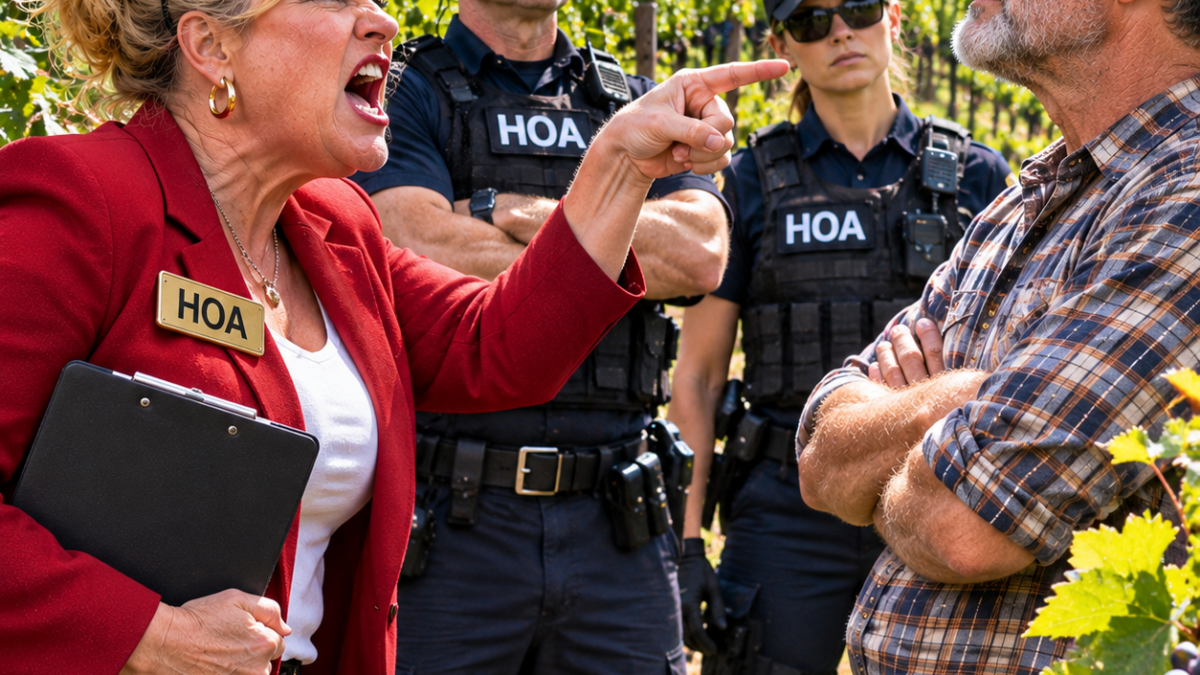
Two men in navy shirts.
Hand near holster.
Clipboard.
Secondary jurisdiction.
Me standing among the vines trying to understand how absurdity had walked onto my property wearing a gun.
If I could speak to that version of myself, I’m not sure I would warn him.
He already knew enough.
Photograph the prints.
Save everything.
Don’t get angry when they expect anger.
Don’t confuse calm with surrender.
Don’t confuse fear with weakness.
And most of all:
Make them prove their authority.
People with legitimate authority can.
People borrowing it become furious when asked.
That was Paul from the beginning.
He hated proof.
Because proof had boundaries.
Deeds.
Maps.
Policies.
Warrants.
Jurisdiction.
Paul needed everything vague.
Community safety.
Oversight.
Concern.
Suspicious activity.
Target.
Vagueness gave him room.
Evidence removed it.
That is why the final outcome felt inevitable in retrospect.
The moment investigators started asking precise questions, Paul’s world collapsed.
What camera?
Who authorized it?
Where was it installed?
What data was collected?
Who accessed it?
What legal authority?
What budget line?
What vendor?
What invoice?
What vote?
What warrant?
What probable cause?
What jurisdiction?
He had built power out of nobody asking.
Once people asked, there wasn’t much left.
Elaine’s system collapsed the same way.
Where did the money go?
Who approved the contract?
Why was the vendor related to you?
Why were invoices split?
Why were surveillance expenses hidden under general safety?
Why were board minutes incomplete?
Why did you tell Paul to keep pressure off the record?
Questions.
Boring questions.
That was all it took.
Not revenge.
Questions.
Years later, I still think that is funny.
Paul had guns.
Uniforms.
Cameras.
Computers.
A former law-enforcement background.
Elaine had titles.
Accounts.
Votes.
Contracts.
And what finally beat them?
People asking them to explain themselves.
Maybe that’s why I never became cynical about authority itself.
Good authority can explain.
A legitimate inspector can show credentials.
A police officer can state the law.
A court can show the order.
A board can cite its declaration.
A government agency can show jurisdiction.
Real power has structure.
Fake power has attitude.
That distinction saved me.
It saved Ridgeview too.
The new board was boring.
Spectacularly boring.
Monthly financial statements.
Public agendas.
Recorded votes.
Independent audits.
Clear complaint processes.
No armed patrol.
No secret cameras.
Some residents complained the board had become too cautious.
Good.
Caution is healthier than paranoia.
Deborah once told me:
“We now spend forty-five minutes discussing whether we’re allowed to send a reminder about trash cans.”
I laughed.
“You’re welcome.”
She glared.
Then laughed too.
Eventually, even Ridgeview began treating the old scandal like ancient history.
Kids who were toddlers during the surveillance controversy became teenagers.
New families moved in.
The original residents told stories.
Some exaggerated.
According to one version, I intentionally filled twenty bags with cocaine-looking powder and tricked Paul into leading a SWAT raid.
Completely false.
Another version said I was a retired federal agent.
Also false.
Someone claimed Paul tried to arrest me with zip ties.
Never happened.
Stories improve themselves over time.
The real story was less cinematic.
Which made it more important.
Nobody needed secret-agent skills.
I needed a deed.
Cameras.
Logs.
A lawyer.
Patience.
And the willingness to say no.
That was all.
One Saturday, a teenager from Ridgeview came into the vineyard with his father.
The kid stared at my coffee mug.
SECONDARY OVERSIGHT JURISDICTION.
“What does that mean?”
His father groaned.
“Don’t ask.”
I laughed.
“It means somebody once used three impressive words instead of admitting he had no authority.”
The kid thought.
“So…lying?”
“Basically.”
His father bought two bottles.
Before leaving, the boy looked at the sign.
“Why do you still keep that up?”
“Which part?”
“No HOA authority.”
I looked at him.
“History.”
He nodded like that made sense.
Maybe it did.
Boundaries are partly physical.
Partly remembered.
Forget them completely and somebody eventually tests them again.
But living only for the boundary isn’t healthy either.
So I kept the sign.
And removed the extra cameras.
Kept the documentation.
And shredded the duplicates.
Remembered Paul.
And stopped tracking his life.
That balance took years.
One morning, long after the cases ended, I woke before sunrise.
Coffee.
Boots.
Lower vineyard.
Same routine.
The eastern slope was wet with dew.
I found a loose trellis wire.
Of course.
Some things never change.
I tightened it.
Then stopped.
For a second, the scene was almost identical to the morning everything began.
Same light.
Same soil.
Same quiet.
But no men.
No uniforms.
No weapons.
No clipboard.
I stood there listening.
Nothing.
Then I realized I had gone weeks without thinking about Paul.
Maybe months.
I smiled.
That was the final victory.
Not his conviction.
Not Elaine’s downfall.
Not Ridgeview’s restructuring.
Not the mug.
Not the sign.
Forgetting to be angry.
That was freedom.
People sometimes ask whether I regret not going harder.
Whether I should have sued everyone.
Publicized every name.
Destroyed every reputation.
Made sure nobody involved ever worked in security again.
No.
Consequences are not the same thing as annihilation.
Paul deserved consequences.
Elaine did too.
Evan needed accountability.
The patrolmen needed to understand their role.
The board needed reform.
But I never wanted to become a man who needed someone else ruined before I could feel whole.
That would have made my peace dependent on their suffering.
I had already given Ridgeview too much influence.
I wasn’t giving them that too.
The vineyard stayed.
That was enough.
Friends still gather under string lights.
We still joke about the yeast.
Marcus still claims he deserves credit for his “performance.”
He does not.
Claire still tells me I almost made her career more entertaining than she wanted.
Margaret still brings pie occasionally.
Evan came to harvest twice as a volunteer.
The first year, nobody fully knew how to treat him.
The second year, he was just Evan.
That felt right.
People are allowed to become more than the worst thing they participated in—if they actually change.
Paul never did.
At least not where I could see.
But eventually, even that stopped being my concern.
The new vines produced their best harvest yet three years after the final court proceedings.
We bottled a small reserve.
I considered naming it Target.
Too bitter.
Then Jurisdiction.
Too obvious.
Marcus suggested Yeast of Evidence.
I threatened to ban him.
In the end, I named it Boundary Red.
Simple.
The label showed a thin black line across a vineyard at sunrise.
Nothing else.
People asked about the name.
Sometimes I told the story.
Sometimes I didn’t.
The wine didn’t need Paul attached to it.
Neither did I.
One bottle sits in my office.
Not because it is our best vintage.
Because it represents the first harvest from the vines I planted after deciding not to sell.
Those vines matter more than the courtroom records.
They grew after.
That is what I want to remember.
After surveillance.
After fear.
After anger.
After court.
Growth.
That is the part revenge stories often leave out.
They stop when the villain falls.
Real life continues.
You wake up Monday.
There are bills.
Work.
Weather.
Broken irrigation.
Family.
Friends.
Vines.
You either build something after the fight or the fight becomes the biggest thing you ever built.
I refused that.
Paul Merrick was not going to become the defining chapter of my vineyard.
He became a chapter.
Important.
Ugly.
Finished.
The vineyard story continued.
That is why I still open the gate every morning.
Walk the rows.
Check leaves.
Touch soil.
Watch the sunrise.
Not because I am guarding territory.
Because I am living on it.
There is a difference.
Sometimes a Ridgeview vehicle passes on the county road.
Nobody slows.
Nobody watches.
People wave.
I wave back.
No tension.
No hidden meaning.
Just neighbors.
That was always possible.
All it required was respect.
Elaine and Paul made respect sound complicated because complexity gave them leverage.
In truth, it was one sentence.
Your authority ends where my property begins.
That was the entire conflict.
Everything after came from their refusal to accept it.
And everything that finally healed came from everyone else deciding the line mattered.
That is the ending I wanted.
Not destruction.
Not humiliation.
Not permanent war.
A line.
Recognized.
A home.
Restored.
And a quiet vineyard at sunrise where the only footprints between the rows are supposed to be there.
Years ago, two men stood among those vines and told me my land was under their authority.
Today, I can barely remember their faces.
But I remember the feeling.
The cold certainty that if I gave them one step, they would ask for two.
I was right about that.
What I didn’t know then was how many people inside Ridgeview were waiting for someone to stop giving ground.
Margaret.
Evan.
Former board members.
Residents.
Even the deputy who eventually recognized the pattern.
Nobody changed everything alone.
That matters.
Bullies depend on isolation.
They want every target believing they are the only difficult person.
The only complainer.
The only one who sees something wrong.
Once people compare stories, the system becomes visible.
That happened in Ridgeview.
One complaint became ten.
One camera became dozens.
One suspicious invoice became years of questionable payments.
One whistleblower became several.
Isolation broke.
So did Paul’s power.
That is why, when people ask what I did to “take down the HOA,” I correct them.
“I didn’t.”
They look disappointed.
“I told two trespassers to leave.”
That was the beginning.
Everything else happened because the people running Ridgeview could not tolerate a boundary.
They escalated until their own actions exposed them.
My job was mostly to stay calm long enough to let evidence survive.
That sounds less exciting.
It is also true.
And truth, I learned, is devastating to people whose power depends on everyone being too tired to verify anything.
Now, on good mornings, I take my coffee outside.
No security ritual.
No scanning trees.
No checking feeds.
I sit.
The vineyard wakes slowly.
Birds first.
Then wind.
Then light.
Somewhere beyond the ridge, doors open in Ridgeview.
People leave for work.
Kids wait for school buses.
Ordinary life.
That neighborhood is no longer an enemy.
It is simply next door.
Exactly where it always should have been.
There is peace in that.
Not the dramatic peace of winning.
The ordinary peace of not needing to fight anymore.
And after everything, ordinary became precious.
If I could reduce the entire experience to one thing, it would not be the court case.
It would not be surveillance.
It would not be Paul covered in yeast.
It would be the word I said the first morning.
Out.
One word.
No speech.
No threat.
No revenge.
Just a boundary.
He could have respected it.
Everyone could have gone home.
Instead, they spent more than a year proving why the boundary had been necessary.
That choice belonged to them.
The vineyard remained mine.
And every sunrise since has felt a little more valuable because of it.








