PART 2: HOA Sent a Sheriff to Evict Me From My Own House—Then He Asked to See the Last Line of My Deed
PART 2
My hands were shaking badly enough that I nearly dropped the deed.
I hated that.
For fifteen minutes I had managed to sound calm while people stood on my porch preparing to remove me from my own house.
Then Caleb asked for the last page, and suddenly the cardboard box felt heavier than it had when I carried it outside.
I unfolded the document.
He leaned closer.
Regina Hartwell did too.
Marissa stayed near the sidewalk.
She had stopped smiling.
Caleb read the legal description once silently.
Then again.
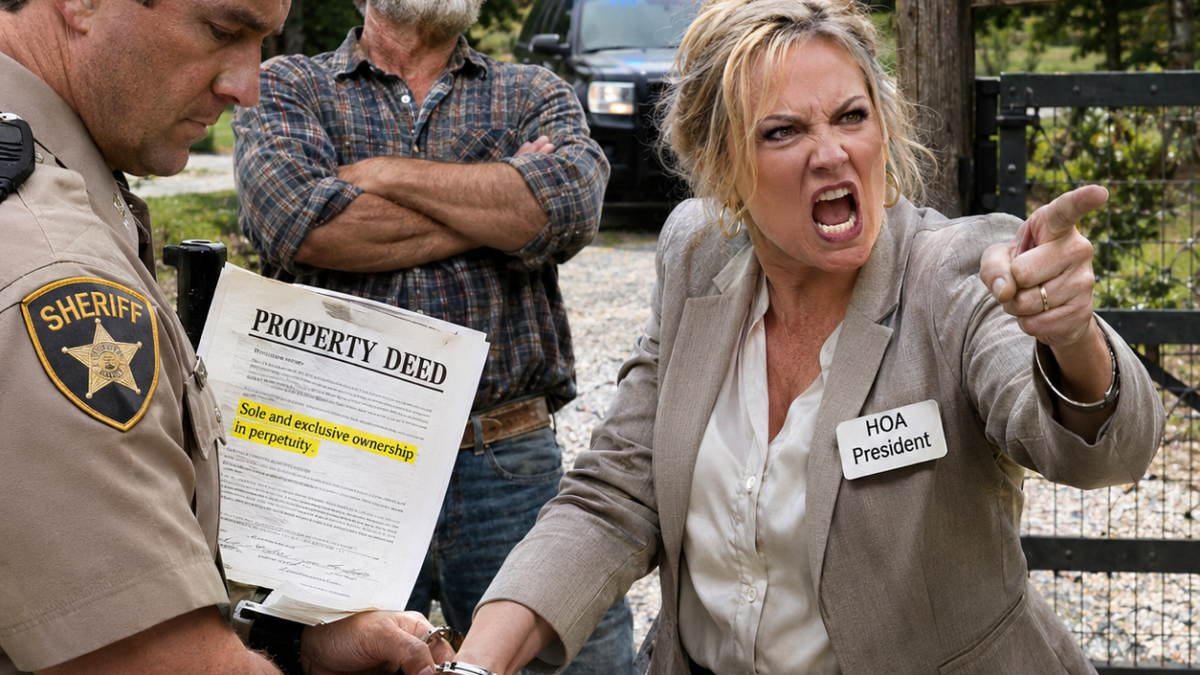
His finger moved to one sentence close to the bottom.
He looked at me.
“Did you know this was here?”
“I knew the property was mine.”
“That’s not what I asked.”
I stepped beside him.
The language was formal, but the meaning was clear enough once he broke it apart.
Any alteration to the legal description, property boundary, or permitted use of the disputed section had to be executed through a properly recorded instrument and required the valid consent of the property owner.
Me.
No consent.
No valid change.
No HOA takeover of the side yard.
Caleb looked toward Regina.
“What recorded instrument changed this?”
She shifted the folder under her arm.
“The association’s survey and subsequent enforcement documents establish—”
“That wasn’t my question.”
His tone changed.
Not angry.
Worse.
Precise.
“Where is the recorded instrument bearing Mr. Mercer’s consent?”
Regina opened the folder.
Flipped through several pages.
Marissa walked up onto the porch.
“This is exactly why we brought counsel.”
Caleb glanced at her.
“Then counsel should have the document.”
“Sheriff, the order has already been entered.”
“What was the order based on?”
“A corrected property description.”
“Corrected by whom?”
Marissa’s expression tightened.
“Through the association’s legal process.”
Caleb turned to me.
“Do you have the original survey?”
I handed it over.
The survey had been folded so many times the creases were almost white.
Caleb spread it across the porch table beside the newer HOA survey.
Even I could see the problem.
My original eastern line ran straight from the rear monument to the front reference point.
The HOA version shifted that line several feet.
Not enough to swallow my whole house.
Enough to carve a corridor from the side yard toward the rear of the neighborhood.
Caleb traced both with his finger.
“These don’t match.”
Regina said:
“Surveys are updated all the time.”
“By licensed surveyors.”
“Yes.”
“Who prepared this one?”
Silence.
Caleb turned to the certification page.
No surveyor I recognized.
There was a company name.
And a filing number.
He pulled out his radio.
“Dispatch, I need county recorder verification on a parcel and a filing history.”
Marissa stepped toward him.
“This is unnecessary.”
He looked at her.
“I’m about to remove a man from his home.”
That ended the conversation.
He read the parcel number from my deed.
Then the parcel number from the eviction order.
Then the filing number from the altered survey.
The officer who had arrived first stood near the curb.
Two neighbors had come outside.
Then four.
Curtains moved in windows all along Bellhaven Court.
I could feel the neighborhood waking up around us.
Marissa noticed too.
She lowered her voice.
“Caleb, we can sort paperwork afterward.”
His head turned slowly.
“After I evict him?”
“The court has already ruled.”
“Then the court file will support the order.”
“It does.”
“Good.”
He waited.
No one said anything.
My stomach was still tight.
Because even then, part of me wondered whether Marissa really did have something I had missed.
Maybe some later deed had been recorded.
Maybe I had signed something buried in refinancing documents.
Maybe eleven years of believing that yard was mine could be undone by a page I never understood.
Fear does that.
It makes even absurd claims feel possible when the other person sounds certain enough.
The radio crackled.
Caleb stepped away.
Listened.
Asked the clerk to repeat something.
Then his face changed.
He came back to the porch.
“The county says Mr. Mercer’s original parcel number is current.”
Marissa crossed her arms.
“Then the enforcement number contains a clerical error.”
Caleb continued.
“The survey filed eighteen months ago is not the original survey on record.”
Regina looked toward Marissa.
Caleb noticed.
“So who filed it?”
He checked his phone.
“Submission came through an LLC.”
Marissa said:
“Lots of association vendors are LLCs.”
Caleb read the name.
“Bellridge Property Services.”
Her face changed.
Tiny.
But visible.
“Do you know it?”
“No.”
Too fast.
Caleb stared at her.
“Never heard of it?”
“No.”
He scrolled.
Then stopped.
A long silence.
I remember a lawn sprinkler clicking somewhere down the block.
A dog barking behind one of the houses.
That was how quiet the porch became.
Caleb looked up.
“The registered agent is Marissa Vance.”
Nobody moved.
Regina’s eyes dropped.
One of the board members behind her whispered:
“What?”
Marissa shook her head.
“That’s my cousin’s company.”
Caleb said nothing.
“It handles filing work.”
“What kind?”
“Administrative.”
“Why would an administrative filing company submit a revised survey for a privately owned home?”
“It was association business.”
“Mr. Mercer’s deed is association business?”
She looked at me.
Then back at Caleb.
“You’re taking this out of context.”
“What context makes this parcel number change legitimate?”
She didn’t answer.
Caleb stepped off the porch.
He radioed again.
This time he asked for the eviction enforcement to be suspended.
Marissa’s voice sharpened.
“You cannot do that.”
He turned.
“I can refuse to execute an order when the property description underlying it is disputed and county records don’t match what I was given.”
“We have attorneys.”
“So does the county.”
She pointed toward my house.
“He has been noncompliant for months.”
Caleb looked at me.
Then the maple tree.
Then my side yard.
Then back at Marissa.
“What does his mailbox have to do with an altered property survey?”
That question landed harder than anything else.
Because suddenly all the violations looked different.
Fence.
Mailbox.
Trees.
Assessment.
Side yard.
Maybe they had never been about neatness.
Maybe they had been pressure.
Caleb handed me the eviction order.
“You’re staying.”
My knees nearly gave out.
I hated that too.
I had imagined feeling victorious if someone finally said those words.
Instead I felt exhausted.
Marissa did not leave.
She stood on the sidewalk arguing with Regina.
The two HOA board members quietly moved toward their cars.
One of them, a man named Paul Danner, stopped beside me.
“I didn’t know the parcel was disputed.”
I looked at him.
“You came to watch me get evicted.”
His face reddened.
“We were told the order was final.”
“So was I.”
He looked away.
That was the first crack in the board.
By noon, the story was everywhere in Ashford Ridge.
Not the truth.
A story.
Marissa called an emergency HOA meeting for that evening.
The notice said:
**URGENT COMMUNITY SAFETY AND GOVERNANCE ISSUE**
I almost stayed home.
Then my neighbor Karen Lowell knocked on my door.
“You’re going.”
“I wasn’t planning to.”
“You need to.”
“I’ve had enough people looking at me today.”
She folded her arms.
Karen was seventy-one and had lived three houses down longer than I had owned mine.
“Then let them look at paperwork.”
That sounded like something Caleb would say.
So I packed the cardboard box.
The clubhouse was full.
Marissa stood at the front.
No handcuffs.
No arrest.
Not yet.
She spoke for fifteen minutes.
According to her, the morning had been a misunderstanding.
The county records had not been fully updated.
The association had relied on professional survey information.
I was resisting legitimate enforcement.
Rumors about misconduct were irresponsible.
Then she said:
“Mr. Mercer has chosen to turn an ordinary property clarification into an attack on this board.”
I stood.
Not dramatically.
I carried my box to the front table.
Marissa stopped.
“This is not an evidentiary hearing.”
“No.”
I set down my original deed.
“It’s a meeting.”
Then the original survey.
“I brought documents.”
Then the HOA’s newer survey.
The eviction order.
Side by side.
A woman in the second row asked:
“Why are the property lines different?”
Marissa said:
“Survey methodology.”
Caleb was standing near the rear wall.
He had come because the county had opened a preliminary investigation into the filing.
He spoke.
“That isn’t what the recorder said.”
Every head turned.
Marissa’s face tightened.
“The sheriff is not a land surveyor.”
“No.”
Caleb walked forward.
“But the county confirmed the surveys do not share the same legal description.”
A murmur spread.
I opened my deed.
“Here.”
I pointed at the last line.
People leaned.
Marissa said:
“That language is being misinterpreted.”
A woman holding a sleeping toddler stood near the back.
“Then explain it.”
Marissa looked at her.
The woman continued.
“You told us the association owned that strip.”
“We have regulatory authority.”
“That isn’t ownership.”
Silence.
Another board member stood.
Daphne Sloan.
She had served beside Marissa for nearly six years.
“I saw another survey.”
Marissa turned.
“What?”
“Years ago.”
“You’re confused.”
“No.”
Daphne’s voice trembled.
Then steadied.
“You showed the board a map with different lines.”
“That was preliminary.”
“It didn’t cut through Elliot’s yard.”
Marissa took one step toward her.
“You don’t remember correctly.”
“I do.”
“Daphne—”
“I asked why the association needed that corridor.”
The room went completely quiet.
Corridor.
That word mattered.
Caleb stepped closer.
“Who gave you the map?”
Daphne looked directly at Marissa.
“She did.”
Marissa closed her eyes for half a second.
Then:
“This meeting is adjourned.”
She reached for her folder.
Caleb said:
“No.”
Not loud.
Not dramatic.
Enough.
“The county is now investigating a potentially falsified property filing. The board should preserve all records.”
Regina Hartwell stepped forward.
“My client is entitled to counsel.”
“She has counsel.”
Regina did not look comfortable being identified that way anymore.
Caleb continued.
“We’ll need access to association records tied to parcel changes and enforcement actions.”
Daphne said:
“You can have it.”
Marissa turned on her.
“You do not have authority to surrender association data.”
Paul Danner spoke from the back.
“Then let’s vote.”
Marissa stared at him.
Another crack.
The board voted.
Not unanimously.
But enough.
Investigators got access to the association server that night.
I went home.
For the first time that day, the house was quiet.
I put the cardboard box on the kitchen table.
Made coffee.
Didn’t drink it.
At one in the morning I was still awake.
The idea that someone might have deliberately altered my property record would not leave me alone.
It wasn’t the land itself.
The side yard was not worth enough money to explain an eviction.
A garden.
Two trees.
Grass.
Why would anyone risk fraud over that?
The answer arrived the next morning.
Caleb called.
“Can you come to the clubhouse?”
“Now?”
“Yes.”
“What did you find?”
“Better if you see it.”
I hated when people said that.
The investigators had located a folder buried three levels deep on the HOA’s shared drive.
**REVISED LOT MAP — CONFIDENTIAL**
Inside were boundary changes.
Not just mine.
Multiple lots.
Tiny strips.
Five feet here.
Eight feet there.
A corner shaved from one backyard.
A side-yard adjustment on another.
Each change small enough that an ordinary homeowner might believe a surveyor simply measured differently.
But placed on one map, the strips connected.
They formed a corridor.
From the clubhouse property.
Through private lots.
Across my side yard.
Toward undeveloped acreage beyond Ashford Ridge.
Caleb looked at me.
“You see it?”
“Yes.”
A regional development company had been negotiating to purchase that acreage.
The problem was access.
Without a continuous corridor through Ashford Ridge, the property was far less useful.
My house sat directly in the way.
I stared at the map.
“So this isn’t about my tomatoes.”
Caleb gave me a tired look.
“No.”
One investigator opened an email.
From Marissa.
To Regina Hartwell.
Three weeks earlier.
**If Mercer refuses, use enforcement.**
I read it twice.
Regina had gone pale.
Caleb looked at her.
“Who prepared the eviction package?”
“My office.”
“Who gave you the survey?”
She hesitated.
Marissa.
“Did you verify it against the recorded deed?”
“We relied on the association’s submission.”
“That isn’t what I asked.”
Regina looked away.
Caleb’s jaw tightened.
That email changed everything.
The eviction hadn’t been the final stage of rule enforcement.
It had been a tool.
Remove me.
Clear the corridor.
Complete the access path.
And somewhere in that process, somebody expected the development deal to become valuable enough that questions would stop mattering.
I asked:
“How much?”
Caleb looked at me.
“What?”
“How much is the land deal worth?”
The investigator said:
“We’re still working that out.”
I looked at Marissa’s emails.
“Somebody knows.”
Eventually, records showed that the development firm stood to gain substantial value if the access corridor could be assembled.
What Marissa personally expected to gain remained less clear at first.
I learned not to guess.
The temptation was strong.
Everybody in the neighborhood started guessing.
Kickbacks.
Consulting fees.
Secret payments.
Promises of a job.
I refused to repeat any of it.
There was already enough evidence without inventing motives.
But the pattern grew.
I started contacting neighbors whose names appeared in the confidential folder.
A man named Robert Chen lived two streets over.
The HOA had fined him repeatedly over a fence.
According to his deed, the fence was legal.
He paid anyway.
“I thought their survey controlled,” he told me.
“Did you see it?”
“No.”
“Did they?”
“They sent me a diagram.”
“Recorded?”
He laughed bitterly.
“I didn’t know to ask.”
Another family, the Morrises, had sold twelve feet of backyard to the association after months of fines.
The amount they received barely covered legal bills.
A retired teacher named Wanda Pruitt had been pressured for nearly a year over a side setback.
We sat at her kitchen table.
She poured coffee.
“I thought it was just me.”
“That’s what Robert said.”
She looked at me.
“What happened to you?”
“They tried to evict me.”
Her cup stopped halfway to her mouth.
“For land?”
“For access.”
She set it down.
“My husband told me before he died that something didn’t make sense.”
“What?”
“The board kept changing the line.”
“What do you mean changing?”
“Every time we fixed what they asked, there was another measurement.”
She left the room.
Returned with a folder.
Not as organized as mine.
But enough.
Violation notices.
Survey sketches.
Fine schedules.
Dates.
I started a legal pad.
Names.
Dates.
Property issue.
Outcome.
Nine names.
Then eleven.
Then thirteen.
Thirteen families.
Different streets.
Different complaints.
Same pattern.
Altered lines.
Aggressive enforcement.
Pressure.
Fines.
One family simply moved.
Another paid almost four thousand dollars because the husband said fighting would cost more.
When I brought the list to Caleb, he read it silently.
Then:
“This is not carelessness.”
I waited.
“This is a pattern.”
That sentence scared me more than the eviction.
Because my case had become survivable the moment Caleb stopped.
Those other families had already paid.
Lost land.
Sold.
Moved.
Some never knew there was anything to question.
The county found another filing.
This one carried a homeowner consent signature approving a boundary change.
The homeowner had moved out of state years earlier.
Investigators called him.
He denied signing anything.
Not vaguely.
Completely.
Never saw it.
Never approved it.
Never gave anyone permission.
A forgery.
That pushed the investigation beyond bad surveying.
Beyond aggressive HOA governance.
Into something much darker.
Marissa started avoiding public meetings.
The woman who once stood across from my porch smiling as a sheriff prepared to remove me now entered the clubhouse through a side door.
One evening Caleb confronted her after investigators confirmed the false consent document.
“Do you want to explain this?”
She said:
“I relied on vendors.”
“Which vendor?”
“Administrative services.”
“Bellridge Property Services?”
“Yes.”
“The company listing you as registered agent.”
“My cousin handles operations.”
“Your signature appears on filings.”
“I sign many association documents.”
“Do you read them?”
Her face hardened.
“Of course.”
Caleb looked at me.
Then back at her.
“That answer may matter.”
She reached for her phone.
“I’m calling counsel.”
“You’re entitled to.”
Then Daphne stood.
“We elected you to protect this neighborhood.”
Marissa turned.
Daphne continued.
“Not sell pieces of it while people slept.”
“That is defamatory.”
“Is the map fake?”
“No.”
“Did you know Elliot’s deed required owner consent?”
Marissa said nothing.
Daphne pointed toward me.
“You sent a sheriff to take his house.”
“I enforced the rules.”
“No.”
Daphne’s voice cracked.
“You enforced a map you wanted to be true.”
Marissa turned toward the door.
Caleb said:
“Marissa Vance, stop.”
She stopped.
The clubhouse was full.
Board members.
Residents.
Investigators.
Me.
Caleb stepped forward.
“We’ve secured relevant records. Do not access, delete, transfer, or alter association files.”
“You have no right to threaten me.”
“I’m advising you.”
Her phone buzzed repeatedly.
Messages.
Residents.
Board members.
Whatever support she once took for granted was disappearing in real time.
She looked at me.
“You have no idea what you’re tearing apart.”
I answered:
“I’m not tearing anything apart.”
She laughed sharply.
“Thirteen families are reopening old disputes. The development company is walking away. This association is going to be sued into the ground.”
“I kept my deed.”
“That’s all you think this is?”
“That’s all it should have been.”
She stepped closer.
“You could have cooperated.”
“With what?”
“You knew the neighborhood needed development access.”
“No.”
“I told you the association had authority.”
“You told me my own yard wasn’t mine.”
“Because your deed was outdated.”
Caleb moved between us.
“Her deed wasn’t outdated.”
Marissa looked at him.
“You’re not a judge.”
“No.”
He opened the certified record.
“But the county is clear.”
He read the final line of my deed again.
Any change to the boundary or permitted use required a properly recorded instrument and valid owner consent.
He looked up.
“There is no valid instrument.”
Marissa folded her arms.
“You’re treating a technical defect like fraud.”
Caleb said:
“It stopped being technical when somebody filed false information.”
“I filed nothing false.”
He raised his phone.
“Then explain the consent signature.”
“I didn’t create it.”
“Explain the altered survey submitted through a company where you’re registered agent.”
“I relied on staff.”
“Explain the email directing counsel to use enforcement if Mercer refused.”
Her eyes flashed.
“That means legal enforcement.”
“Based on which valid property document?”
No answer.
Regina stood to the side.
She looked sick.
Then one investigator brought up another file.
A certification.
Marissa’s signature.
Filed months earlier.
It stated that before submitting the enforcement request against my property, she had personally reviewed the homeowner’s original deed.
Every relevant provision.
Every restriction.
Every boundary clause.
The room went silent.
Caleb held it up.
“You signed this?”
Marissa stared.
“I sign certifications based on staff review.”
“It says personally reviewed.”
“That’s standard language.”
“Did you review his deed?”
She looked toward me.
Then toward Regina.
Then at the exit.
Caleb waited.
Finally:
“Yes.”
My chest tightened.
She knew.
Before the threats.
Before the side-yard notice.
Before the eviction.
Before she stood across the street smiling.
She had read the deed.
She had seen the line requiring my consent.
And still proceeded.
I did not feel victory.
I felt something colder.
Recognition.
All those months I had wondered whether I was misunderstanding things.
Whether I was difficult.
Paranoid.
Stubborn.
Whether I had missed paperwork.
Whether I had somehow created the conflict by refusing to cooperate.
No.
She knew.
Caleb’s radio crackled.
The county confirmation had arrived.
A critical filing supporting the enforcement action contained knowingly false property information.
Combined with the altered survey.
The false consent signature.
The certification.
The email.
The investigators now believed there was probable cause for charges involving fraudulent property filings and attempted use of falsified records in an unlawful eviction.
Marissa stepped back.
The wall was behind her.
“You cannot arrest me here.”
Caleb’s voice stayed quiet.
“You called me to his house.”
“This is retaliation.”
“No.”
“You’re humiliating me.”
“I’m enforcing the law based on the evidence presently established.”
“You don’t know what this will do to the community.”
Daphne answered from the crowd.
“You should have thought about that before using us.”
Marissa looked around.
No one cheered.
That mattered.
These were people who had elected her.
Trusted her.
Defended her.
Some still looked stunned rather than angry.
Caleb stepped forward.
“Turn around.”
She stared at him.
“You can’t do this.”
“You called me out there to remove a man from his own home.”
A long pause.
“Now you’re the one leaving.”
She turned.
The handcuffs closed.
Somewhere near the back, a child asked:
“Why are they taking that lady?”
Nobody answered.
I stood by the doorway.
Wanda Pruitt came beside me.
“It’s about time.”
I shook my head.
“No.”
She looked at me.
“No?”
“I didn’t want this.”
“You wanted justice.”
“I wanted my house.”
That was the truth.
People later called what happened revenge.
It never felt like revenge.
Revenge would have meant I built a plan to destroy Marissa.
I didn’t.
I opened a cardboard box.
Everything after that came from what she had already done.
The investigation expanded.
County auditors reviewed property filings connected to the HOA.
Independent surveyors rechecked disputed lots.
The state regulator responsible for association practices became involved.
Every enforcement action tied to falsified or unsupported survey data was reopened.
The list was much longer than thirteen families by the time professionals finished.
Some cases involved legitimate violations.
Others did not.
That distinction mattered.
The new board refused to repeat the old mistake of assuming every complaint was corrupted merely because Marissa’s system had been.
They checked each one.
One by one.
Robert Chen’s fence was cleared.
Wanda’s side setback was corrected in county records.
The Morris family pursued compensation tied to the strip they had been pressured to sell.
The elderly widower who paid nearly four thousand dollars in questionable fines received a refund.
Several households received checks.
Others received corrected surveys.
One family that had moved away because of the pressure was contacted and told the association would cooperate if they pursued a claim.
Daphne Sloan became the reluctant leader of a reform committee.
I say reluctant because she called me three times begging me to take the job instead.
“No.”
“You uncovered half of this.”
“No.”
“People trust you.”
“That’s a terrible reason to give me authority.”
“You’re impossible.”
“Yes.”
She showed up at my porch anyway.
“You need to help.”
“I’ll answer questions.”
“Join the board.”
“No.”
“Why?”
“Because I spent months trying to get the board out of my yard.”
“That is not how boards work.”
“Marissa thought it was.”
She stopped.
Fair point.
I gave advice.
No title.
No vote.
No key to the clubhouse.
Daphne’s first proposed reforms were simple.
Independent verification for property-line enforcement.
No boundary change without certified owner consent.
All vendor relationships disclosed to the full board.
Outside review for major property disputes.
Open access to meeting minutes.
No executive session used to hide land negotiations from affected homeowners.
Residents laughed at how obvious some of it sounded.
Then Wanda said:
“It only sounds obvious because we know what happens when nobody checks.”
Nobody laughed after that.
Regina Hartwell resigned within days.
Through another attorney, she said she had acted in good faith based on material supplied by association leadership.
I did not know whether that was true.
Caleb’s office and prosecutors handled her separately.
I refused to decide guilt from neighborhood gossip.
I had learned too much about what assumptions could do.
The development company abandoned the undeveloped-acreage deal.
Without the corridor, access costs changed the economics.
And once the falsified filings became public, nobody wanted their name attached to the project.
The confidential map disappeared from planning.
No corridor through my yard.
No strip across Robert’s fence.
No backyard carve-out.
Nothing.
My maple tree stayed.
The crooked mailbox stayed.
The side garden stayed.
It felt almost ridiculous that ordinary things had become symbols of winning.
One evening, weeks after the arrest, I stood in the yard watering tomato plants.
Karen Lowell stopped on the sidewalk.
“You know the mailbox is still crooked.”
“I know.”
“After all that, you’re leaving it?”
“Yes.”
“Why?”
“Because I can.”
She laughed.
That was the first moment the whole thing felt over.
Not legally.
Emotionally.
The new board held an open budget review the following spring.
More than sixty households attended.
Sixty people voluntarily sat through spreadsheets.
That alone may have been Marissa’s most lasting legacy.
People who once ignored HOA meetings started reading.
Budgets.
Minutes.
Vendor contracts.
Surveys.
People asked questions.
Daphne told me:
“You created monsters.”
“Good.”
“They want footnotes.”
“Better.”
“One resident asked for the parcel number behind a landscaping expense.”
I smiled.
“Excellent.”
She glared.
Wanda Pruitt became the unofficial historian of everything that happened.
At the first reform meeting, she brought her old notices.
She read the fines aloud.
Dates.
Amounts.
Rules cited.
Then showed where the recorded documents contradicted them.
When she finished, nobody applauded.
Wanda sat down.
Later she told me:
“I thought I was stupid.”
“What?”
“For paying.”
“You were scared.”
“I should have fought.”
“You were alone.”
“So were you.”
“No.”
I looked toward Daphne.
Caleb.
Karen.
The neighbors who eventually came forward.
“I thought I was for a while.”
Wanda was quiet.
Then:
“That’s how they did it.”
“What?”
“Made everyone think it was only happening to them.”
She was right.
Isolation had been part of the system.
Robert thought his fence dispute was unique.
Wanda thought the setback problem was hers.
The Morris family believed selling the backyard strip was simply cheaper than fighting.
Nobody compared notes.
Marissa’s power relied partly on each person assuming every other resident was complying happily.
Once we talked, the pattern appeared.
That changed the neighborhood more than her arrest.
People started knocking on doors.
Not threatening.
Comparing.
“Did you get this notice?”
“What survey do you have?”
“Does your deed say that?”
“Who approved this?”
Annoying?
Probably.
Healthy?
Definitely.
Caleb stopped by my house months later.
No uniform.
He had coffee.
We sat on the porch.
He looked at my maple tree.
“You really planted that?”
“Closing week.”
“Why?”
“House looked empty.”
He nodded.
We sat quietly.
Finally I said:
“You almost evicted me.”
He looked at me.
“I know.”
“If I hadn’t noticed the parcel number?”
He did not answer immediately.
“That bothers me.”
“Me too.”
“I had a court-looking order.”
“Yes.”
“HOA counsel present.”
“Yes.”
“Board members.”
“Yes.”
“Every surface-level sign said proceed.”
“But?”
“But the legal description didn’t match.”
I nodded.
He looked toward my front door.
“You said ‘read the last line.’”
“You looked annoyed.”
“I was.”
“That helps.”
“I thought you were stalling.”
“I was.”
He laughed.
“You were also right.”
We drank coffee.
Then Caleb became serious.
“Your case changed some procedures.”
“What kind?”
“Property enforcement with disputed parcel descriptions gets verified before field action when possible. Direct recorder check.”
“That wasn’t already standard?”
“There were checks.”
“That is sheriff language for no.”
“It’s sheriff language for procedures can improve.”
I smiled.
He looked at me.
“You know something else?”
“What?”
“You never yelled.”
“I wanted to.”
“I know.”
“How?”
“You had the face.”
“What face?”
“The face people make before they decide whether to call somebody an idiot.”
“That’s my normal face.”
“Unfortunate.”
We laughed.
Then he said:
“Calm helped.”
I looked at him.
“Why?”
“If you’d started screaming that morning, it would’ve made everything harder. Not legally. Practically.”
“I was scared.”
“I know.”
“I thought you were taking my house.”
“I know.”
“That’s the closest I’ve ever come to punching someone.”
He raised his eyebrows.
“Me?”
“No. Marissa.”
“Good answer.”
I smiled.
Truthfully, I never would have hit her.
But fear and humiliation create ugly thoughts.
I had them.
That mattered to me.
I wasn’t some perfect, patient hero.
There were nights I wanted her destroyed.
Days I fantasized about lawsuits that would take everything.
Hours I wanted every neighbor who defended her to apologize publicly.
Then people did start apologizing.
And it felt less satisfying than I expected.
Paul Danner came by.
The board member who stood at my porch during the attempted eviction.
He looked embarrassed before he spoke.
“I should have asked to see the deed.”
“Yes.”
“I trusted Marissa.”
“Yes.”
“I thought you were a chronic violator.”
“I grow tomatoes.”
He almost smiled.
“I know.”
“Dangerous tomatoes.”
“Apparently.”
He looked at his shoes.
“I’m sorry.”
I believed him.
That didn’t erase the morning.
It just made carrying it lighter.
The woman with the toddler from the emergency meeting stopped me one evening.
She had been one of Marissa’s strongest supporters.
“I defended her for years.”
“I know.”
“I told people you were trying to avoid rules.”
“I heard.”
“I’m sorry.”
I nodded.
She looked surprised.
“That’s it?”
“What do you want?”
“I don’t know.”
“You apologized.”
“Yes.”
“I accept.”
She looked almost disappointed.
Maybe she expected punishment.
People sometimes want forgiveness to be harder because guilt feels too easy otherwise.
I wasn’t interested in collecting debts I couldn’t spend.
Marissa’s case moved through the legal system.
I followed only what my attorney said affected my property.
Charges were based on the filings investigators believed they could prove.
The neighborhood invented much larger stories.
I ignored them.
One rumor said she had stolen millions.
No evidence I saw supported that.
Another claimed every board member was involved.
False.
Daphne had fought her.
Paul had been negligent, not necessarily criminal.
Regina’s role remained under separate scrutiny.
Reality was complicated.
That made it more believable, not less.
Marissa’s real wrongdoing was serious enough.
She did not need folklore added.
The state review found governance failures.
Lack of oversight.
Vendor conflicts.
Poor record controls.
Excessive concentration of authority.
The reform board opened financial and legal records.
For the first time, homeowners could see more than summaries.
Daphne hated the first open budget meeting.
“What if people misunderstand things?”
“They will.”
“That’s your advice?”
“Yes.”
“What do we do?”
“Explain.”
She stared at me.
“You should be on the board.”
“No.”
“Still trying.”
“Stop.”
She never did.
The association installed a small sign beneath the old Ashford Ridge entrance marker.
Three words:
**TRANSPARENCY. ACCOUNTABILITY. COMMUNITY.**
I thought it was a little dramatic.
Wanda loved it.
“Needs a fourth word.”
“What?”
“READ.”
I laughed.
She was right.
The most important change was not the sign.
It was that residents had learned to read documents they once assumed somebody else had checked.
A year later, I refinanced the house.
The bank sent a packet.
I sat at my kitchen table and read every page.
The loan officer called.
“You can sign electronically.”
“I’m reading.”
“Oh.”
That one syllable told me most people didn’t.
Two days later she called again.
“You still reviewing?”
“Yes.”
“Any questions?”
“Page forty-three.”
Long pause.
“What about it?”
The escrow description had an outdated reference.
Minor.
Harmless.
Corrected.
But I smiled after the call.
Once, a tiny number on a page had been the only thing standing between me and being removed from my home.
I wasn’t going to skim anymore.
Wanda brought pie the anniversary week.
Apple.
She sat on my porch.
“You know what everybody says?”
“That’s usually a dangerous opening.”
“They say you saved the neighborhood.”
“No.”
“You did.”
“Caleb stopped the eviction.”
“You noticed the number.”
“The county found the filing.”
“Daphne spoke.”
“The investigators found the folder.”
“Thirteen families came forward.”
She pointed her fork at me.
“Exactly.”
“What?”
“Nobody did it alone.”
I thought about that.
She smiled.
“Maybe that’s what saved it.”
That felt closer to truth.
Marissa’s system worked because everyone experienced pressure alone.
It failed when we stopped being alone.
The following spring, Daphne invited me to the reform committee’s first annual review.
I declined.
She showed up with meeting minutes anyway.
“You said you’d answer questions.”
“I regret that.”
She sat at my kitchen table.
“Procedure for deed disputes.”
“What about it?”
“We require the homeowner to provide documentation.”
I frowned.
“Why?”
“So we can verify.”
“That puts the burden on them.”
She looked down.
“What would you write?”
“If the HOA claims authority, the HOA should identify the recorded basis first.”
She stared.
Then crossed out a paragraph.
“You’re annoying.”
“I know.”
“That’s better.”
We worked for two hours.
When she left, I realized I had helped write HOA policy.
I considered moving.
The biggest personal change was harder to admit.
Before all this, I liked being left alone.
Afterward, I understood the danger of being invisible.
I still didn’t attend block parties often.
Still hated committee meetings.
Still preferred mowing my lawn to making small talk.
But I knew more neighbors.
Robert waved.
Wanda stopped for coffee.
Daphne sent irritating emails.
Karen yelled if my trash cans stayed out too long.
Normal relationships.
The kind Marissa’s system had quietly discouraged because isolated homeowners were easier to pressure.
One afternoon, Robert asked:
“Why didn’t we talk before?”
“About what?”
“Property stuff.”
“Because property stuff is boring.”
He laughed.
“That simple?”
“Usually.”
He nodded.
“Until somebody lies.”
“Then it gets interesting.”
He looked at my side yard.
“That corridor would’ve gone through here?”
“Yes.”
“Straight through my fence too.”
“Yes.”
He shook his head.
“Crazy.”
I looked at the grass.
It looked exactly like grass.
That was another lesson.
Fraud often targets boring things because people don’t watch them closely.
Survey lines.
Parcel numbers.
Meeting minutes.
Assessment formulas.
Nobody expects drama there.
That makes them perfect places to hide it.
Several years passed.
The undeveloped acreage eventually sold to another buyer.
Different development concept.
Different access.
No corridor through Ashford Ridge.
The new developer approached the county openly and negotiated access from a public road.
No private lots taken.
No altered surveys.
No eviction orders.
Construction happened.
Nobody cared.
That may have been the most satisfying ending possible.
The development Marissa insisted required my land happened another way once people stopped pretending the only solution was taking mine.
One evening, I walked along the side yard.
The maple tree had grown thick.
Its roots had pushed one section of edging crooked.
My tomato beds were empty for winter.
The old mailbox leaned as always.
I considered replacing it.
Then didn’t.
Some imperfections belonged to the home.
I went inside and pulled the cardboard closing box from the closet.
I no longer kept it by the front door.
That alone felt like progress.
Original deed.
Survey.
Title policy.
Closing statement.
The same documents.
I found the last line.
Read it slowly.
The sentence that had looked like boring legal language for eleven years.
Valid owner consent required for any alteration to boundary or permitted use.
I thought about Marissa.
She had read it.
Signed a certification saying she had read it.
Then gambled that nobody else would.
That was the mistake.
Not that the sentence was powerful by itself.
Paper doesn’t defend anyone unless someone reads it.
Caleb read it.
Daphne remembered the old map.
Wanda kept her notices.
Robert kept his fence records.
The out-of-state homeowner answered the investigator’s call.
Everyone supplied one piece.
That was how the system collapsed.
Not through a dramatic secret weapon.
Through people finally comparing documents.
I placed the deed back into its sleeve.
Closed the box.
Then changed my mind.
I took the deed out again.
Walked upstairs.
Opened the small fireproof safe bolted beneath the bedroom floor.
Placed it inside.
Locked it.
The latch clicked.
Same sound as always.
But this time I didn’t feel like I was hiding evidence for the next fight.
I was simply putting my deed away.
A few weeks later, Ashford Ridge held another open budget review.
More than sixty households attended.
Daphne texted me a photograph.
Rows of bored-looking people staring at spreadsheets.
Her message:
**LOOK WHAT YOU DID.**
I replied:
**Beautiful.**
She sent:
**You’re sick.**
Probably.
At the neighborhood entrance, the transparency sign caught the headlights whenever I drove home.
I thought the wording was still a little dramatic.
But one evening I stopped long enough to read it.
Transparency.
Accountability.
Community.
Behind the sign, houses glowed.
People cooked dinner.
Kids played.
Dogs barked.
Ordinary life.
My own house stood at the end of Bellhaven Court exactly where it always had.
No grand renovation.
No new gate.
No giant fence built out of spite.
The maple tree.
Crooked mailbox.
Side yard.
Garden.
Home.
I walked up the path.
Porch light came on automatically.
For months, I had wondered whether somebody else could redefine that word with enough paperwork.
They couldn’t.
Not legally.
Not permanently.
Not once people bothered to read what the paperwork actually said.
I stepped inside.
Closed the door.
And for the first time since the notices began, I did not look through the front window to see whether an HOA vehicle was coming down the street.
There was nothing left to defend that night.
The house was mine.
The yard was mine.
And the last line of the deed was back where it belonged—not on a sheriff’s clipboard, not under clubhouse lights, not in an investigation file, but locked quietly inside my safe, waiting to become boring again.
[END OF STORY]