PART 2: HOA Sent a Bulldozer to Tear Down the Covered Bridge I Built for My Injured Wife—Then Their Emergency Plan Fell Apart
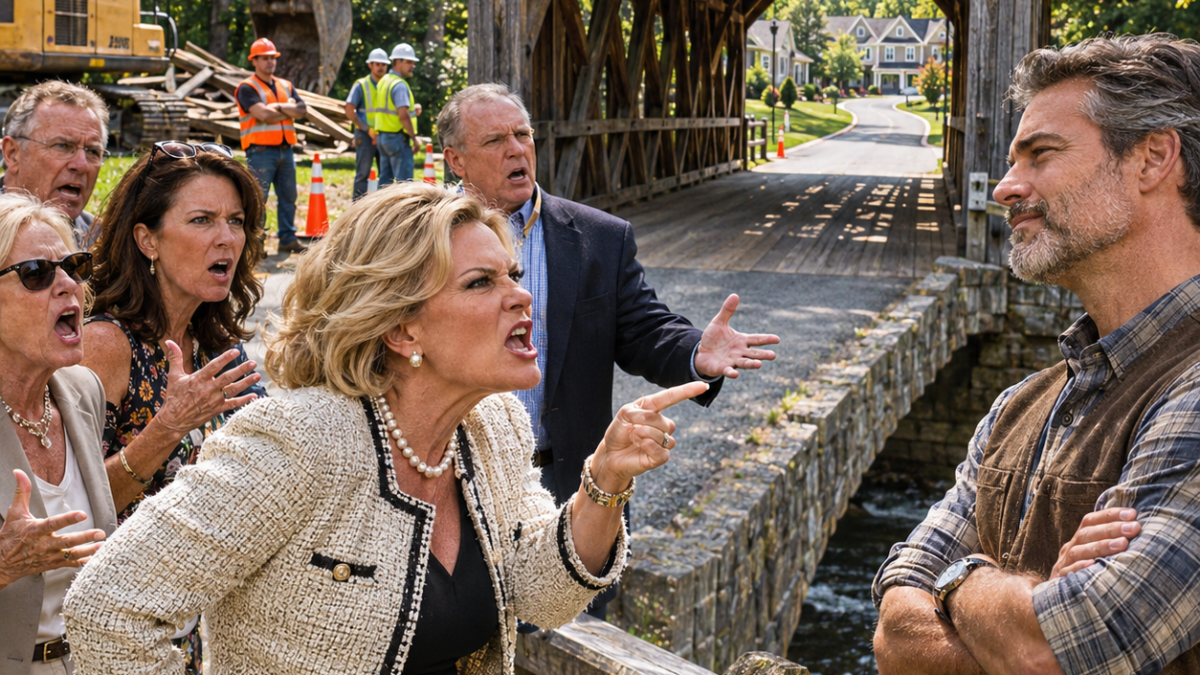
PART 2
For a moment, I thought I was reading it wrong.
I spread the county map flat across my desk.
Then the HOA emergency-access plan beside it.
Then the recorded easement agreement.
Sarah entered slowly behind me, one hand on the doorframe.
“What is it?”
I pointed.
“When did they install that gate?”
“Last spring.”
“That’s what I thought.”
Whispering Pines had added a large automated emergency gate at the rear of the subdivision.
Karen had bragged about it for months.
Fire safety.
Emergency preparedness.
Resident protection.
All the words she liked because they made ordinary HOA decisions sound important.
Behind that gate was an old logging road.
Part of it crossed the back corner of my property.
When Sarah and I bought the land, the title search revealed a narrow emergency-use easement benefiting the future subdivision.
It allowed emergency vehicles to use that stretch if the main neighborhood entrance ever became blocked.
I had never objected.
Why would I?
An ambulance or fire engine needing another route wasn’t exactly an inconvenience I wanted to fight over.
The easement itself wasn’t the problem.
The geography was.
The emergency gate sat east of the creek.
The logging road continued west.
And between those two points was water.
Before I built the covered bridge, the only crossing had been a primitive low-water route consisting of rock, compacted dirt, and a steep bank.
My truck could cross during dry weather.
A loaded fire engine?
Maybe.
In spring flood conditions?
Absolutely not.
The bridge changed that.
It joined the HOA’s new emergency gate to the emergency easement across my land.
Sarah leaned closer to the map.
“Oh.”
“Yeah.”
“So they need the bridge.”
“They might.”
“Might?”
“I need somebody official to tell me.”
She stared at me.
Then she laughed.
Not because anything was funny.
Because the absurdity finally landed.
“She brought a bulldozer to destroy the road to her own emergency exit.”
“That appears to be what happened.”
Sarah lowered herself into the chair.
For several seconds, we said nothing.
Then she reached across the desk and put her hand over mine.
“Don’t do anything angry.”
I looked at her.
“I wasn’t planning to.”
“You’re doing the Marine face.”
“I don’t have a Marine face.”
“You absolutely have a Marine face.”
“What does it look like?”
“Like you’re mentally assigning everybody coordinates.”
I almost smiled.
She squeezed my hand.
“Jack.”
“Yeah?”
“This bridge matters to me.”
“I know.”
“But I don’t want it to become the only thing we talk about.”
That landed.
The accident had already taken enough from her.
Months of hospitals.
Physical therapy.
Headaches.
Memory gaps.
Fear of stairs.
Fear of ice.
Fear of riding in a car when rain started.
We had spent two years rebuilding ordinary life.
The bridge had been part of that healing.
I wasn’t going to let Karen turn it into another source of trauma.
“I’ll handle it.”
Sarah raised one eyebrow.
“That phrase has historically worried me.”
“I’ll handle it legally.”
“Better.”
The next morning, the first official fine arrived.
Three thousand dollars.
Thirty days at one hundred dollars per day for maintaining an “unapproved exterior structure.”
I had completed the bridge less than two weeks before Karen’s bulldozer stunt, so even the arithmetic was fictional.
Two days later came another notice.
Five hundred dollars for “obstruction of HOA emergency operations.”
I read that line three times.
Then laughed.
Apparently my bridge was simultaneously an obstruction to the HOA’s emergency operations and the only structure connecting their emergency gate to the legal exit route.
Karen was building contradictory evidence faster than I could organize it.
Then came the third notice.
Unauthorized heavy equipment.
I stared at it.
Sarah read over my shoulder.
“Is she fining you for her bulldozer?”
“Yes.”
She sat down.
“Jack?”
“Yeah?”
“I changed my mind.”
“About what?”
“You may enjoy this a little.”
That afternoon I bought a three-inch black binder.
On the spine I printed:
**WHISPERING PINES / K. MILLER**
Every document went inside.
Fine notice.
My response.
Certified-mail receipt.
Deed.
Survey.
Title policy.
Bridge permit.
Final inspection.
Photographs.
Easement agreement.
Emergency gate map.
I created a spreadsheet too.
Date.
Sender.
Claim.
Amount.
Response.
Supporting document.
Status.
It wasn’t glamorous.
It was calming.
Twenty years in the Marines had taught me that panic loves disorder.
So when something becomes chaotic, organize it.
Karen, meanwhile, was organizing something else.
A narrative.
I learned about it from Margaret Ellis.
She knocked on our door one evening holding an HOA envelope.
Margaret was seventy-three, tiny, and usually cheerful.
That night she looked frightened.
“Mr. Sterling?”
“Jack.”
“I don’t want to cause trouble.”
“Come inside.”
Sarah made tea.
Margaret sat at our kitchen table with both hands around the mug.
She finally opened the envelope.
Her violation:
Seven hand-painted garden gnomes.
Twenty-five dollars per gnome per day.
I thought I’d misread it.
“She’s fining you one hundred seventy-five dollars a day for gnomes?”
Margaret nodded.
“They were gifts from my grandchildren.”
Sarah looked at the photograph attached to the notice.
The gnomes were about twelve inches tall.
One held a fishing rod.
Another carried a tiny watering can.
They sat among roses behind a low hedge.
“You’ve had these for years?” Sarah asked.
“Eight.”
“Why now?”
Margaret looked down.
“I signed the petition asking Karen to explain the emergency gate costs.”
There it was.
Sarah and I exchanged a look.
“What petition?” I asked.
Margaret explained.
The new emergency gate had cost far more than residents had originally been told.
Some homeowners wanted details.
Karen accused them of undermining community safety.
Margaret signed anyway.
Two weeks later, her gnomes became a violation.
“Don’t pay this tonight,” I said.
Her eyes widened.
“I don’t want more penalties.”
“Dispute it in writing.”
“I don’t know how.”
“I’ll show you.”
I didn’t give legal advice.
I wasn’t a lawyer.
But I showed her my process.
Ask which covenant.
Request hearing.
Document the timeline.
Send certified.
Keep copies.
Margaret looked at my binder.
“You’ve saved everything.”
“Everything.”
“My husband used to do that.”
“Was he military?”
“Navy.”
That made me smile.
Margaret smiled too.
“Arthur used to say a bully wins the deck only when everybody else decides it’s easier to go below.”
Before she left, she touched Sarah’s arm.
“The bridge is beautiful, dear.”
Sarah smiled.
“Thank you.”
“I didn’t know why he built it.”
Sarah looked toward me.
“He doesn’t tell people.”
“It’s not their business.”
Margaret nodded.
Then she said something I didn’t forget.
“It makes a difference when you understand what something is for.”
After she left, I added a divider to the binder.
**OTHER RESIDENTS**
Sarah looked at it.
“You’re collecting allies?”
“Evidence.”
“Marine face.”
I ignored her.
The fines kept climbing.
$6,200.
$8,900.
Then $11,400.
The latest letter threatened a lien.
That was when the humor ended.
A lien, even a baseless one, could create expensive complications.
Mortgage.
Credit.
Future sale.
Title.
Sarah read the letter at the kitchen table.
Her hand started trembling.
I noticed.
She tucked it under the table.
Too late.
“Sarah.”
“I’m fine.”
“No.”
“I said I’m fine.”
I sat across from her.
She looked toward the window.
“I’m tired.”
“Of Karen?”
“Of fighting.”
The words came softly.
“My body fights me every morning, Jack.”
That hurt.
“Some days I wake up and don’t know whether my leg is going to cooperate.”
I listened.
“Then I fight through therapy exercises. I fight balance. I fight headaches. I fight people staring when I use the chair.”
Her eyes filled.
“This house was supposed to be where I didn’t have to fight.”
I reached across the table.
She held my hand tightly.
“I don’t care about eleven thousand dollars in fake fines.”
“I know.”
“I care that she’s making you angry all the time.”
“I know.”
“I care that every envelope changes the whole house.”
That was true.
Cream-colored HOA envelopes had started feeling like incoming rounds.
“Then I need help.”
Sarah looked at me.
“A lawyer?”
“Yes.”
“Good.”
I drove into the city the next day.
Valor Legal Group occupied the ninth floor of a steel-and-glass building overlooking downtown.
Amelia Davis met me at nine.
Former Army JAG.
Late thirties.
Gray suit.
Direct eyes.
No wasted motion.
She shook my hand.
“Marine?”
“Yes.”
“Explains the binder.”
She placed it on her desk.
“Army people use tabs.”
“I use tabs.”
“Not enough.”
For the next hour she read.
Occasionally, she made a note.
Once, she laughed under her breath.
“What?”
She held up the heavy-equipment fine.
“They hired the bulldozer.”
“Yes.”
“And fined you for it.”
“Yes.”
She put the paper down.
“Outstanding.”
“That’s one word.”
Then she reached the emergency easement.
She stopped.
Read it again.
Opened the survey.
Opened the gate plan.
Her expression changed.
“Who designed the HOA’s emergency route?”
“I don’t know.”
“Who approved the gate?”
“Town had some involvement.”
“Did fire services inspect the whole route?”
“Apparently not after construction.”
She leaned back.
“Jack, do you understand what this means?”
“I have an idea.”
“Karen is threatening to destroy a structure that may currently be necessary for the emergency route her own board created.”
“That’s my reading.”
“That’s more than an HOA dispute.”
She closed the binder.
“First, good news.”
“I’ll take some.”
“Her jurisdiction argument is terrible.”
“How terrible?”
“On a scale where ten means you’re doomed?”
“Yes.”
“Negative four.”
I laughed.
She continued.
“Your title and survey are clear. The bridge permit is clear. Her lien threat is far more dangerous to her than to you if she knowingly files a false claim.”
“So we sue?”
“We could.”
“And?”
“I don’t like winning small.”
I studied her.
“What does that mean?”
“It means if we file a normal injunction tomorrow, her board will blame the lawyer, rescind your fines, and Karen will survive politically.”
“I don’t care whether she survives politically.”
“Maybe not.”
She opened the Margaret divider.
“But your neighbors might.”
I didn’t answer.
Amelia continued.
“She has abused discretionary authority. If all we do is protect you, the gnome lady gets another letter next month.”
“What are you proposing?”
“First, we put every board member on notice individually.”
“Why?”
“So nobody can later say Karen hid the problem.”
She held up the lien threat.
“Second, we notify the HOA’s insurance carrier.”
“That seems aggressive.”
“It is.”
“Third?”
She tapped the emergency map.
“We ask the fire chief a question.”
I smiled.
“What question?”
“Whether Karen is allowed to demolish the bridge connecting his emergency route.”
That evening, Sarah listened while I explained.
She smiled slowly.
“I like Amelia.”
“You’ve never met her.”
“I like her anyway.”
Amelia’s cease-and-desist went out two days later.
Every board member received one.
Certified mail.
HOA counsel.
Insurance carrier.
The letter was clinical.
Property boundary.
Permit.
Invalid fines.
Trespass.
Bulldozer incident.
Lien warning.
Potential personal exposure.
No insults.
No dramatic threats.
Facts.
Bob Chambers called me forty-eight hours later.
Bob was one of Karen’s strongest supporters.
He also washed his Lexus so often I had privately wondered whether paint could dissolve from over-cleaning.
“Jack?”
“Yeah?”
“This is Bob from the board.”
“I know.”
Pause.
“Listen, that letter from your attorney…”
“Yes?”
“I think some things may have been presented to us inaccurately.”
“By who?”
Longer pause.
“You know.”
“No, Bob. Say it.”
“Karen.”
There it was.
“She told us your property was partially inside the HOA.”
“It isn’t.”
“I see that now.”
“Good.”
“She also told us the bridge wasn’t permitted.”
“It is.”
“I see that too.”
“Good.”
Another silence.
“We’re meeting tonight.”
“Okay.”
“I just want you to know not everybody supports the lien.”
“You voted on the fines?”
“I voted based on information given to us.”
“That wasn’t my question.”
He exhaled.
“Yes.”
“Then maybe you should read documents before voting next time.”
He didn’t like that.
But he didn’t argue.
“Fair.”
Progress.
Sarah’s idea came the next morning.
“Barbecue.”
I looked up from coffee.
“What?”
“Neighborhood barbecue.”
“Why?”
“Because Karen keeps telling everyone you’re dangerous.”
“I don’t care.”
“I do.”
“Sarah.”
“She also keeps telling people the bridge is ugly and unsafe.”
“So?”
She pointed toward the creek.
“Let them see it.”
I thought.
“We’re not turning our house into a political rally.”
“Exactly.”
She smiled.
“No speeches.”
“No petitions?”
“No.”
“No anti-Karen signs?”
“Obviously.”
“Gnomes?”
“Mandatory.”
I laughed.
Sarah designed a simple flyer.
**BRIDGESIDE BARBECUE
Come See What All the Fuss Is About**
Saturday.
Food.
Neighbors welcome.
At first, I expected ten people.
Nearly sixty came.
Families arrived cautiously.
Some parked down the road and walked.
A few looked uncomfortable being seen.
Then they saw Sarah cross the bridge.
She moved slowly with her walker.
The incline was gentle.
Deck smooth.
Rails high.
At the far end, she turned and waved.
I watched people’s expressions change.
One woman whispered:
“Oh.”
Exactly.
The bridge stopped being abstract.
It wasn’t an architectural rebellion.
It was accessibility.
Love turned into lumber.
Margaret arrived carrying lemon bars.
She placed the fishing gnome beside them.
“I brought security.”
George Garcia came with his wife Elena and their three-year-old son.
They had their own HOA story.
The toddler’s plastic slide was “noncompliant green.”
Retired Air Force Colonel Richard Miles had been fighting over his flagpole.
A nurse received a warning because her work vehicle occasionally stayed in the driveway overnight.
People talked.
Really talked.
Karen’s entire system depended on residents believing their individual dispute was embarrassing and isolated.
The barbecue destroyed that assumption.
Then Arthur Henderson arrived.
Retired forensic accountant.
Sixty-eight.
Thin.
Quiet.
The kind of man who looked like he balanced his checkbook for recreation.
He found me at the grill.
“Mr. Sterling.”
“Jack.”
“Arthur Henderson.”
We shook hands.
“I’ve reviewed HOA financial statements.”
I flipped a burger.
“That sounds miserable.”
“It has become interesting.”
“That’s worrying.”
He adjusted his glasses.
“The emergency gate cost approximately twice the original budget.”
I stopped.
“Why?”
“That’s the question.”
He continued.
Consulting fees.
Administrative expenses.
Contractors.
Vague invoices.
Repeated payments.
“Anything illegal?”
“I didn’t say that.”
“Good.”
“I said unclear.”
Important distinction.
Arthur looked around.
“Under the bylaws, ten percent of homeowners can compel an independent financial audit.”
He produced a clipboard.
Of course he did.
“I prepared a petition.”
“You accountants travel armed?”
“Only when necessary.”
By sunset, he had more than twice the signatures required.
The barbecue ended with children running across the lawn.
Sarah sat on the bridge bench laughing with Margaret.
The fishing gnome rested beside them.
I stood near the grill with Amelia, who had stopped by for half an hour.
She watched residents leave.
“This was smarter than anything I planned.”
“Sarah’s idea.”
“Of course.”
“Why of course?”
“Because lawyers think litigation solves everything.”
“And wives?”
“Know people.”
A week later, Amelia sent the letter to Fire Chief Michael O’Connell.
Not accusatory.
Not dramatic.
It asked for clarification and inspection.
If Whispering Pines designated a rear emergency exit using a route crossing my private easement, was the covered bridge compliant?
Would its removal affect emergency access?
Could the town formally inspect the route?
Chief O’Connell called me personally.
“What the hell is going on?”
I laughed.
“Which part?”
“The part where an HOA wants to tear down the bridge leading to its own emergency gate.”
“That’s fairly accurate.”
“Who approved this setup?”
“I was hoping you’d know.”
He grunted.
“Thursday. Ten.”
“You coming?”
“Personally.”
“Should I tell Karen?”
“I already invited the board.”
That was better.
Thursday morning, the bridge looked almost too peaceful for what was about to happen.
Sarah stood beside me.
“You nervous?”
“No.”
“Marine face again.”
“I built it correctly.”
“That wasn’t my question.”
“Yes.”
She smiled.
“Good.”
At 9:45 Amelia arrived.
At ten exactly:
Fire chief command SUV.
Town planner Carol.
Police cruiser.
Then Ladder One.
A massive red engine.
Karen arrived five minutes late.
White SUV.
Navy suit.
Bob beside her.
Another director named Linda in the back.
Karen stepped out smiling.
She saw the fire engine.
Her smile widened.
She thought the truck was there to prove my bridge inadequate.
“Chief!”
She strode toward O’Connell.
“Thank you for coming. We have been trying for months to address this dangerous noncompliant structure.”
Chief O’Connell looked at her.
Then at the bridge.
“Let’s inspect.”
No handshake.
Karen’s smile slipped.
The engine rolled toward the creek.
Stopped before the bridge.
I had designed the structure conservatively.
Very conservatively.
Still, seeing a full-size fire engine face it made my mouth go dry.
O’Connell walked the span.
Checked deck.
Rails.
Footings.
Joinery.
Approach angle.
Clearance.
He asked Carol for permit records.
She handed them over.
“Town approved?”
“Yes.”
“Final inspection?”
“Yes.”
“Any waterway issues?”
“No.”
He looked at me.
“You build this yourself?”
“Yes.”
“Background?”
“Combat engineer.”
“Marine?”
“Yes.”
He nodded.
“That explains why you’ve got enough timber here for a small railroad.”
Amelia smiled.
Karen didn’t.
O’Connell motioned to the driver.
“Bring her across.”
Karen stared.
“What?”
The engine moved.
Slowly.
Front tires touched the bridge.
Sarah gripped my hand.
The beams took the load.
Nothing shifted.
Nothing groaned.
The engine reached the center.
Stopped.
Chief O’Connell stood beside it.
He bounced once on the deck.
“Not even interesting.”
The driver laughed.
Then continued across.
The truck cleared the far end and stopped near the HOA emergency gate.
O’Connell looked at the gate.
Then the road.
Then Karen.
“Is this your official emergency egress?”
“Yes,” she answered proudly.
“And this road?”
“Yes.”
“Approved exit route?”
“Yes.”
He pointed toward the bridge.
“Then why are you trying to demolish the only all-weather crossing connecting the two?”
Silence.
Bob looked at Karen.
Linda looked at the ground.
Karen opened her mouth.
Closed it.
O’Connell waited.
She finally said:
“The bridge violates our architectural standards.”
O’Connell stared.
“Architecture?”
“It was not approved.”
“By who?”
“Our committee.”
“Is it on HOA property?”
Karen hesitated.
“It’s adjacent.”
Carol spoke.
“No. County survey puts it entirely on the Sterling parcel.”
Karen glared at her.
Chief O’Connell’s expression hardened.
“So you attempted to demolish privately permitted infrastructure that your emergency plan depends on because you don’t like how it looks?”
Karen bristled.
“That is an oversimplification.”
“Good.”
He folded his arms.
“Complicate it.”
Nothing.
The engine idled beyond her.
O’Connell pointed.
“If your main entrance is blocked by wildfire, fallen trees, collision, or utility damage, where does that truck go?”
Karen looked toward the gate.
“Here.”
“How?”
Silence.
“Across the creek.”
“Yes.”
“On what?”
Her face changed.
The answer was my bridge.
Chief O’Connell stepped closer.
“Ms. Miller, you don’t have a bridge problem.”
His voice was loud enough for everyone.
“You have an emergency-planning problem.”
Karen’s face reddened.
“And Mr. Sterling solved it for you.”
Her mouth opened.
O’Connell continued.
“This structure is permitted. It carries my equipment safely. It makes your rear egress functional.”
He struck the railing with his palm.
Solid thud.
“As of today, I’m documenting this bridge as a critical component of the Whispering Pines emergency route.”
Karen said:
“You can’t override our covenants.”
O’Connell turned.
“I don’t care what color your mailboxes are.”
Bob looked away to hide a smile.
“Fire access is my concern.”
He pointed at her.
“You will not obstruct this route.”
Then at the bridge.
“You will not interfere with this structure without town review.”
Karen’s voice rose.
“But—”
“No.”
That single word stopped her.
“I am also documenting the fact that the HOA attempted to remove infrastructure necessary to its own designated emergency plan.”
Karen’s face went pale.
“Documenting for who?”
“Town planning.”
Pause.
“Emergency management.”
Pause.
“And your insurer if they ask.”
Amelia didn’t smile.
She didn’t need to.
Karen looked at me.
“You set this up.”
I answered quietly.
“I asked whether the route was safe.”
“You wanted to embarrass me.”
“I wanted you to stop threatening my bridge.”
“You knew what he would say.”
“No.”
That was true.
I believed the bridge was strong.
I didn’t know exactly how the chief would classify the route.
Karen turned toward Bob.
“Say something.”
Bob looked at her.
Then at the fire engine.
Then at me.
Finally:
“You told us the bridge blocked the emergency exit.”
Karen froze.
“You said it created a safety problem.”
“It does aesthetically.”
Bob stared.
“That’s not safety.”
Something broke right there.
Not legally.
Politically.
Karen’s power depended on people accepting her interpretation before checking facts.
Bob had finally checked one.
And found her wrong.
Chief O’Connell walked toward his vehicle.
Before leaving, he shook my hand.
“Good work.”
“Thank you.”
“Keep the route clear.”
“I will.”
Then he looked toward Sarah.
“Ma’am, I hear this was really built for you.”
Sarah smiled.
“Yes.”
He looked back at the bridge.
“Best infrastructure usually starts by solving a real problem.”
The fire engine gave a short horn blast before leaving.
Sarah laughed.
Karen didn’t.
When the officials were gone, Amelia approached Karen.
“All fines related to the bridge should be withdrawn immediately.”
Karen stared at her.
“And the lien threat?”
“Withdrawn.”
“You don’t order me.”
Amelia’s voice stayed calm.
“No.”
She glanced toward Bob.
“Your board’s legal obligations do.”
Bob said:
“We’re meeting tonight.”
Karen spun toward him.
“What?”
“Special meeting.”
“You can’t schedule one without me.”
“Yes, we can.”
Her face twisted.
“You traitor.”
Bob flinched.
But held.
“You lied to us.”
“I protected this community.”
“You almost had its emergency bridge bulldozed.”
Karen’s voice rose.
“This is my board!”
That sentence finished her.
Even Linda looked up.
“Karen,” she said quietly, “that’s the problem.”
Karen stared at all of us.
Then marched to her SUV.
Gravel sprayed as she left.
Sarah watched.
“Do you feel good?”
I thought.
“Not yet.”
“Why?”
“Because she still thinks she’s right.”
Sarah squeezed my arm.
“Then don’t make changing her mind your goal.”
Again, she was right.
The audit began the next week.
Arthur Henderson led the homeowner effort but insisted on an independent accounting firm.
Smart.
Residents had started expecting scandal.
Secret accounts.
Embezzlement.
Maybe theft.
The truth was less cinematic.
And, in some ways, more instructive.
Poor controls.
Cronyism.
Careless spending.
Contracts awarded to friends and relatives without competitive bids.
Board retreats charged as meetings.
Expensive dinners.
Consulting fees with vague descriptions.
Legal fees.
Lots of legal fees.
The emergency gate was the worst.
Original estimate:
About half the final cost.
Contractor:
Karen’s brother-in-law.
Invoices:
Poorly itemized.
Was the work real?
Mostly.
Was it overpriced?
Apparently.
Was it approved correctly?
Not consistently.
Had money gone directly into Karen’s pocket?
The auditors found no proof.
That mattered.
Arthur insisted on saying it clearly.
“We have found no evidence of direct embezzlement.”
Some residents looked disappointed.
Arthur continued.
“What we found is governance failure.”
He displayed expense categories.
“Conflict of interest.”
Another page.
“Inadequate procurement.”
Another.
“Excessive discretionary spending.”
Then legal fees related to me.
Over $7,000 already spent.
The room erupted.
A man shouted:
“Seven grand to send him fake fines?”
Arthur corrected him.
“Legal consultation, correspondence, collection planning, and related activity.”
“Same thing!”
Karen sat at the front table.
Pale.
Angry.
She had fought the audit.
Lost.
Now every expense was projected behind her.
Margaret sat near the aisle.
Her fishing gnome was on the chair beside her.
I hadn’t known she planned that.
Sarah saw it and laughed quietly.
The Garcias came.
Colonel Miles.
Bob.
Linda.
Nearly every homeowner.
Arthur reached the emergency gate.
Cost overruns.
Related-party contractor.
Insufficient documentation.
Then the bridge dispute.
He spoke carefully.
“Residents should understand that association funds were used to pursue enforcement against property the recorded survey does not place within association control.”
Karen stood.
“That’s not true.”
Arthur turned.
“Which part?”
“The association has architectural authority over adjacent properties impacting visual harmony.”
Amelia, sitting beside me, whispered:
“No, it doesn’t.”
Arthur asked:
“Can you identify the recorded covenant granting that authority?”
Karen pointed toward the table.
“Our bylaws—”
“Do not bind non-members.”
Karen’s face reddened.
Bob said:
“We’ve already confirmed this with counsel.”
Karen turned on him.
“You don’t speak for me.”
He stood.
“No.”
He paused.
“I speak for the board.”
That was the shift.
Residents applauded.
Karen grabbed the microphone.
“I have spent years maintaining your property values.”
Someone shouted:
“You spent my dues on spa retreats!”
Another:
“And lawyers!”
“That’s not fair!”
Karen shouted.
The room grew louder.
Then Margaret stood.
She didn’t need a microphone.
“I have seven gnomes.”
People laughed.
Even Arthur.
Margaret held up the HOA notice.
“Karen fined me one hundred seventy-five dollars per day because my grandchildren gave me garden decorations.”
Karen snapped:
“They violated the approved aesthetic.”
Margaret looked at her.
“I am seventy-three years old.”
The room quieted.
“My husband died four years ago.”
Karen shifted.
“My grandchildren painted those gnomes with him before he died.”
Sarah inhaled beside me.
Margaret continued.
“You knew that.”
Karen looked away.
“I told you at the hearing.”
Silence.
“You still fined me.”
She held up the fishing gnome.
“This isn’t really about a plastic man with a fishing pole.”
Her voice shook.
“It’s about whether you believe rules matter more than the people they’re supposed to serve.”
Karen said nothing.
Margaret sat.
That speech did more damage than the audit.
Then Colonel Miles stood.
“My flagpole.”
Garcias.
Toddler slide.
Nurse.
Work van.
One after another.
Not everyone had been unfairly cited.
Some admitted they had violated clear rules.
The larger issue was inconsistency.
Selective enforcement.
Personal grudges.
Karen had turned administration into judgment.
Judgment into punishment.
Punishment into identity.
The insurance representative spoke next.
Their directors-and-officers policy was under review.
Renewal required governance changes.
Stronger financial controls.
Conflict policies.
Leadership reform.
Karen looked around.
The structure protecting her was gone.
The motion came from the floor.
No confidence.
Remove Karen.
Then a second motion:
Remove the entire current board and elect an interim board.
Bob immediately stood.
“I’ll resign voluntarily.”
Linda did the same.
Two others followed.
Karen remained seated.
“No.”
Arthur said:
“The members can vote.”
“This meeting is invalid.”
It wasn’t.
Amelia had checked.
The vote was overwhelming.
Hands rose across the room.
Karen remained frozen.
For years she had equated silence with approval.
Now the people she believed she governed were visibly rejecting her.
The result was announced.
Removed.
Her face changed.
Not anger.
Not yet.
Confusion.
Almost disbelief.
Then:
“Who is going to run this place?”
Nobody answered immediately.
Someone shouted:
“Jack Sterling!”
I felt Sarah’s hand tighten around mine.
Then more voices.
“Jack!”
“Sterling!”
I stood.
“No.”
The room quieted.
I walked toward the front.
“Thank you.”
I meant it.
“But no.”
Someone laughed.
I continued.
“I didn’t fight Karen because I wanted Karen’s chair.”
Arthur watched me.
“The whole problem started because one person believed the community needed her personally to control everything.”
Karen stared.
“If you replace her with another strong personality, you haven’t fixed anything.”
I pointed toward Arthur.
“I nominate Arthur Henderson.”
Arthur’s mouth actually dropped open.
The room erupted.
“Absolutely not.”
He didn’t use the microphone.
Laughter.
I smiled.
“You wanted an audit.”
“That does not mean I want people calling me about shrubs.”
Colonel Miles called:
“Too late!”
Arthur looked doomed.
Perfect.
He was elected interim president.
Colonel Miles joined the board.
Elena Garcia, a project manager, became secretary.
Bob declined nomination.
Probably wisely.
Margaret was nominated.
She declined.
“My gnomes need supervision.”
Best answer of the night.
The new board’s first action:
Rescind every fine against me.
Second:
Formal written apology.
Third:
Review pending aesthetic fines under $500.
Fourth:
Suspend discretionary architectural enforcement until rules could be rewritten.
Margaret whispered:
“Amnesty.”
Her fishing gnome returned home the next morning.
All seven lined up in the garden.
Karen left the meeting carrying a cardboard box.
Sarah and I were walking toward the parking lot when we saw her beside the white SUV.
No crowd.
No board.
No clipboard.
Just Karen.
She looked at me.
“I don’t understand.”
Her voice was quiet.
I stopped.
Sarah beside me.
Karen continued.
“I followed the rules.”
I could’ve listed everything she’d done.
Bulldozer.
False fines.
Lien threat.
Crony contracts.
Gnomes.
Instead, I said:
“No.”
She frowned.
“You followed your interpretation of the rules.”
“Same thing.”
“It isn’t.”
“I was protecting property values.”
“You hurt people.”
“Standards require discomfort sometimes.”
Sarah spoke.
“Discomfort?”
Karen looked at her.
Sarah leaned on her cane.
“You tried to destroy the bridge my husband built so I could cross our own creek.”
Karen’s expression flickered.
“It wasn’t approved.”
“By you.”
“Yes.”
Sarah smiled sadly.
“That was never the same thing as illegal.”
Karen looked away.
I said:
“Rules are supposed to help people live together.”
She looked at me.
“They aren’t supposed to make one person feel powerful.”
Her eyes hardened again.
“You think you’re better than me.”
“No.”
“Everyone does now.”
“I can’t control that.”
She slammed the box into the back of her SUV.
Before getting in, she said:
“You’ll regret letting these people run things.”
Arthur, who had walked outside behind us, called:
“We heard that.”
Karen closed her eyes.
For half a second, even I almost laughed.
Then she drove away.
We heard months later she’d sold her house.
Moved two states away.
No dramatic prosecution.
No prison.
No financial ruin.
She lost the authority she had abused.
That was enough.
The new board spent nearly a year cleaning everything up.
Contracts rebid.
Financial reports published.
Legal spending required recorded board approval.
Conflict-of-interest disclosures.
Fine caps.
Independent appeals.
Architectural rules rewritten.
No more “aesthetic harmony” as a weapon without specific standards.
The emergency gate stayed.
So did the easement.
And my bridge officially appeared on the town’s emergency-response map.
That created another question.
Liability.
Maintenance.
Responsibility.
The bridge was mine.
Emergency responders might need it.
Whispering Pines benefited.
Arthur approached me one evening.
“Jack.”
“Yes?”
“We need an agreement.”
“That sounds terrible.”
“It is extremely reasonable.”
“Worse.”
He brought a proposed maintenance arrangement.
The HOA would contribute annually toward inspection and upkeep related to emergency-readiness standards.
I retained ownership.
No general HOA access.
No recreational easement.
Emergency use only.
Fire department inspection annually.
We had Amelia review it.
She changed fifteen paragraphs.
Arthur complained.
She changed two more out of spite.
Eventually we signed.
That was what cooperation looked like.
Not assumption.
Agreement.
Sarah kept using the bridge every day the weather allowed.
Some mornings she walked.
Some days walker.
Some days wheelchair.
No judgment.
The meadow didn’t care how she arrived.
I added a small bench beside the pond.
Then another inside the covered span where she could rest halfway.
One evening we sat there together.
Water beneath us.
Autumn leaves moving in the creek.
She looked at the roof beams.
“This bridge has had a strange life.”
“It’s two years old.”
“You know what I mean.”
I did.
“It was supposed to be ours.”
“It still is.”
“Now it’s on a fire map.”
“Unfortunately.”
“And people take pictures of it.”
“More unfortunately.”
Sarah smiled.
“Do you regret building it?”
I stared at her.
“No.”
“Even Karen?”
“No.”
“Really?”
I thought.
“I regret how much time I gave her.”
That was true.
For months, Karen occupied breakfast.
Dinner.
Sleep.
Mail.
Phone calls.
The binder sat on my desk like a permanent weapon.
After she left, I moved it to a shelf.
Then weeks later, into a cabinet.
Sarah noticed.
“Retiring?”
“The binder?”
“Yes.”
“Honorable discharge.”
She saluted.
Badly.
I corrected her.
She told me not to be annoying.
Peace returned slowly.
At first, I expected every vehicle in the driveway to be another confrontation.
Every certified envelope felt dangerous.
Then weeks passed.
No fines.
No threats.
One day I realized three months had gone by without anyone mentioning Karen.
That was when the victory started feeling real.
Margaret’s garden became famous.
Not intentionally.
After the gnome story spread, grandchildren brought her more.
Seven became nine.
Nine became twelve.
Arthur sent her a written warning.
She nearly had a heart attack.
Then she read the second line.
**Violation: exceeding recommended levels of neighborhood joy. Penalty: one tray of lemon bars.**
She baked two.
Even Amelia came.
George Garcia rebuilt his son’s slide.
Bright green.
Colonel Miles’ flagpole remained.
The flag still snapped in the wind.
Nobody fined sound.
The nurse kept her work van.
Residents learned the difference between community standards and personal preference.
Not perfectly.
There were still arguments.
One homeowner wanted to park a boat trailer permanently in the front yard.
Another painted his garage door bright orange without approval.
People complained.
Arthur handled it.
Slowly.
Documented.
Boringly.
Excellent.
One afternoon, a real emergency finally tested the route.
A violent windstorm swept through the county.
Trees down.
Power lines.
The main entrance to Whispering Pines became blocked by a huge oak.
A resident on the far side of the neighborhood suffered chest pain.
911 dispatched an ambulance.
The primary road was inaccessible.
Fire dispatch opened the rear emergency gate.
The ambulance came down the logging road.
Across my bridge.
Into Whispering Pines.
I stood near the window as it passed.
Sarah stood beside me.
Neither of us spoke.
The ambulance returned thirty minutes later.
Lights on.
Moving fast.
The bridge took the load.
No drama.
No cracking.
No hesitation.
Later we learned the patient survived.
Heart attack.
Rapid treatment.
Arthur called that evening.
“Jack.”
“Yeah?”
“I suppose we’re never going to hear the end of this.”
“About what?”
“The bridge.”
“I wasn’t going to say anything.”
“Liar.”
He paused.
Then:
“Thank you.”
I looked toward the creek.
“You’re welcome.”
The next morning, someone left flowers at the bridge entrance.
No name.
Sarah found them.
She cried.
That ambulance trip did something Karen’s humiliation never could.
It changed the bridge from symbol to proof.
People stopped seeing it as the thing from the HOA war.
It was simply useful.
A road across water.
A structure that existed because one person needed to reach a meadow and later helped an ambulance reach someone else.
That felt right.
A month later, Chief O’Connell stopped by.
Off duty.
No command SUV.
He carried coffee.
“Thought I’d check the famous bridge.”
“Don’t call it that.”
“Too late.”
He examined the deck.
“Fine.”
“You came all the way here to say fine?”
“No.”
He handed me an envelope.
Town commendation.
I groaned.
“You hate recognition?”
“Deeply.”
He looked toward Sarah.
“She doesn’t.”
Traitor.
The commendation mentioned emergency preparedness and private cooperation.
I framed it.
Not for me.
Sarah insisted.
It went in the workshop.
Years passed.
Sarah grew stronger in some ways.
Not cured.
That word stopped mattering.
She learned how to live with the body she had.
She gardened again.
Designed landscapes part-time from home.
Consulted on accessible outdoor spaces.
The meadow became her project.
Native flowers.
Path.
Raised beds.
A small shaded seating area.
One afternoon she said:
“I want a name.”
“For the meadow?”
“The bridge.”
“No.”
“Why?”
“Bridges don’t need names.”
“Covered bridges absolutely need names.”
“Who made that rule?”
“America.”
Hard to argue.
I refused for months.
Then one autumn afternoon, while she visited a friend, I went into the workshop.
Cedar board.
Carving tools.
Two hours.
Simple lettering.
**THE SARAH GRACE CROSSING**
I waited until sunset.
Then carried the plaque outside.
Sarah followed.
“What are you doing?”
“Maintenance.”
“With a carved sign?”
“Special maintenance.”
I nailed it to the center crossbeam.
She stepped closer.
Read it.
Touched the letters.
Then looked at me.
Her eyes filled.
“You named it after me.”
“Apparently.”
“Jack.”
“Don’t make this dramatic.”
She hugged me.
Carefully.
Still enough to hurt my ribs.
“It’s perfect.”
We stood in the center.
The same place where years earlier she had first whispered that I’d given her a path back to her meadow.
The bridge had become a lot of things.
Evidence.
Battlefield.
Emergency infrastructure.
Neighborhood landmark.
But underneath all of that, it was still what it had always been.
A path for Sarah.
That’s the part I almost lost sight of during the fight.
Conflict has a way of taking ownership of the things it touches.
Karen turned my bridge into her issue.
I turned it into my legal defense.
Neighbors turned it into a reform symbol.
The fire department turned it into emergency access.
But none of those things were why I built it.
I built it because my wife stood on our deck one morning after her accident and stared across the creek at a meadow she thought she would never walk through again.
That was the beginning.
Sarah was the reason.
Everything else was noise.
One day, many years later, I found Margaret’s fishing gnome sitting inside the bridge.
I laughed.
Called her.
“Missing something?”
“What?”
“A fisherman.”
“Oh.”
Pause.
“My granddaughter put him there.”
“Why?”
“She said every bridge needs a troll.”
“This is a gnome.”
“I explained that.”
“Come get him.”
“No.”
“Margaret.”
“He likes it.”
I left him.
He stayed near the bench.
Residents began taking pictures.
Somebody gave him a tiny reflective vest.
Chief O’Connell saw it during inspection.
“Required equipment?”
“Yes.”
“Good.”
The bridge acquired character.
Sarah loved it.
I pretended not to.
Arthur served two terms as HOA president.
Then refused a third.
“Why?”
He stared at me.
“Do you know how many emails I’ve received about garbage cans?”
“No.”
“Four hundred and seventeen.”
“You counted?”
“I’m an accountant.”
“Fair.”
Colonel Miles took over.
Lasted one year.
Then Elena Garcia.
She proved best of all.
Organized.
Practical.
No ego.
She created online budget dashboards.
Residents could see expenditures.
Complaints decreased.
Not because everyone agreed.
Because fewer things felt hidden.
Transparency is boring.
It also works.
The old Karen-era documents stayed archived.
Not displayed.
Not used for revenge.
Just retained.
Future boards received training on authority boundaries.
Property lines.
Conflict disclosures.
Emergency routes.
One page showed my parcel.
Large bold note:
**PRIVATE PROPERTY — HOA JURISDICTION DOES NOT EXTEND BEYOND RECORDED COVENANT AREA.**
Basic.
Necessary.
When I was sixty, I replaced several deck boards.
The bridge had aged.
Weather.
Snow.
Summer heat.
Normal wear.
I enjoyed normal wear.
No politics.
No accusations.
Just maintenance.
Sarah sat on the bench.
“You’re slower.”
“I’m sixty.”
“Excuses.”
“Want to help carry lumber?”
“No.”
“Then your opinion is noted.”
She laughed.
I tightened a bolt.
The fishing gnome watched.
Years earlier, I’d been ready to fight a woman over this structure.
Now my greatest challenge was whether my knees could handle crawling underneath it.
Time has perspective.
Karen became less vivid.
I stopped remembering the pink tracksuit first.
Instead, I remembered the final parking-lot conversation.
“I was just following the rules.”
At the time it sounded pathetic.
Later, it sounded like warning.
People can do enormous damage when they stop asking whether the rules they enforce still serve a purpose.
Karen’s mistake wasn’t liking standards.
Communities need standards.
Her mistake was believing that being responsible for enforcing some rules made her the final authority over everyone.
She stopped seeing boundaries.
Legal.
Personal.
Moral.
My bridge happened to sit directly on one.
She tried to cross it.
Not physically.
Authority-wise.
That’s what brought everything down.
I also learned something uncomfortable about myself.
I enjoyed winning too much for a while.
The legal letter.
Bob panicking.
Karen getting corrected by Chief O’Connell.
The audit.
The vote.
Each one gave me a small rush.
That can become addictive.
A fight begins because you want peace.
Then peace starts feeling boring compared with victory.
Sarah noticed before I did.
After Karen left, I kept checking HOA emails.
“Why?”
I shrugged.
“Just making sure.”
“Making sure what?”
“They’re doing things correctly.”
Sarah stared.
“Are you on the board?”
“No.”
“Did they ask you?”
“No.”
“Then stop.”
I laughed.
She didn’t.
“Jack, don’t become the man who watches everybody because Karen once watched you.”
That hit hard.
I unsubscribed from the board update thread.
Took down two unnecessary cameras.
Put the binder away.
Went fishing with Sarah.
She caught more.
I blamed the fish.
Healing sometimes means giving up the watchtower.
The storm emergency years later became part of neighborhood lore.
Kids exaggerated it.
By the third retelling, a tornado had apparently destroyed the entire main entrance and my bridge had saved fifty people from a fire.
None of that happened.
One ambulance.
One blocked road.
One patient.
Enough.
Truth doesn’t need decoration.
Chief O’Connell retired.
At his final bridge inspection, he stood under the Sarah Grace plaque.
“Name finally official?”
“Unfortunately.”
“Good name.”
“Don’t encourage her.”
Sarah smiled.
He checked the rail.
Deck.
Approaches.
Then said:
“You know this thing will probably outlast us.”
“That was the plan.”
“Marine engineer.”
“Fire chief.”
He held out his hand.
I shook it.
“Take care of it.”
“I will.”
His replacement arrived the next year.
Young.
Tablet instead of clipboard.
Asked good questions.
No drama.
I liked him immediately.
Margaret died at eighty-one.
Her grandchildren came to the funeral.
Afterward, her daughter brought us the fishing gnome.
“Mom wanted this to stay at the bridge.”
Sarah cried.
I didn’t.
Until later.
I mounted a small cedar shelf near the bench.
The gnome remained.
No plaque.
No memorial.
People who knew, knew.
George Garcia’s son eventually outgrew the infamous green slide.
They gave it to another young family.
Elena joked that it should go into the HOA museum.
There was no museum.
Thank God.
Arthur moved to Florida.
Before leaving, he brought me a small box.
Inside:
The original audit binder.
“I don’t want this.”
“Neither do I.”
“Then why?”
“Archive copy.”
“Give it to the board.”
“They have one.”
“Burn it.”
He looked horrified.
“Records retention.”
Accountants.
I stored it beside the Karen binder.
History.
Sometimes ugly history still deserves a shelf.
Sarah’s health changed with age.
The accident’s long-term effects never disappeared.
Arthritis made the old injury worse.
The walker returned more often.
Then the wheelchair on longer outings.
The bridge still worked.
That’s what mattered.
One morning, she rolled herself to the center and stopped.
I came behind her.
“You okay?”
“Perfect.”
She looked through the open side toward the creek.
“You made this before you knew what I’d need later.”
“I made it wide.”
“You overbuilt.”
“Engineering.”
She touched the railing.
“I used to hate the chair.”
“I know.”
“It felt like losing.”
I waited.
“Then I realized this bridge doesn’t care whether I’m walking.”
That broke something open in me.
She smiled.
“It just gets me across.”
Simple.
That was the whole point of accessibility.
Not forcing somebody to prove recovery.
Making sure life remains reachable either way.
We sat there for almost an hour.
No emergency vehicles.
No HOA.
No lawyers.
Just water.
Years later, after Sarah died, the bridge became the hardest part of the property.
Everything else carried memories.
Kitchen.
Bedroom.
Garden.
But the bridge carried intention.
Every board.
Every joint.
Every railing height.
I had shaped them for her.
For months, I avoided it.
Used the front meadow instead.
Then one evening, Elena knocked.
Now HOA president.
“Jack.”
“Yeah?”
“Can I ask something strange?”
“Probably.”
“A little girl in the neighborhood wants to cross the bridge.”
“Why?”
“Her mother uses a wheelchair.”
I understood immediately.
The mother had seen the bridge from the trail.
Wanted to know whether the meadow path was accessible.
I almost said no.
Not because of property.
Because grief had made the bridge feel private again.
Then I heard Sarah.
It just gets me across.
“Bring them Saturday.”
The mother came.
Name was Rachel.
Her daughter, Lily, seven.
Rachel’s chair rolled smoothly onto the deck.
She stopped halfway.
Exactly where Sarah had.
Ran her hand along the same railing.
“This is beautiful.”
“Thank you.”
“You built it?”
“Yes.”
“For the emergency road?”
I smiled.
“No.”
“For my wife.”
Rachel looked toward the plaque.
Sarah Grace.
She understood.
Lily found the fishing gnome.
“Is he the bridge guard?”
“Absolutely.”
By the time they crossed back, something in me had changed.
The bridge no longer belonged only to grief.
It could still do what Sarah wanted.
Connect.
I began allowing limited neighbor walking access with permission.
Not a public easement.
Not HOA control.
Just neighborly use.
People respected it.
That distinction mattered.
Access offered freely feels different from access demanded.
I eventually added a second bench in the meadow.
A small sign:
**PLEASE LEAVE THE PLACE BETTER THAN YOU FOUND IT.**
No fines.
No enforcement committee.
Remarkably, civilization survived.
I got older.
The bridge got older.
The neighborhood changed.
Karen became a story new residents barely believed.
One young couple moved in and asked Elena why there was an emergency map with a private covered bridge marked on it.
She sent them to me.
They arrived one Sunday.
“Are you Mr. Sterling?”
“Depends.”
They looked nervous.
“We heard there was an HOA war.”
“Overstated.”
“Did Karen really bring a bulldozer?”
“Yes.”
Their eyes widened.
“Did the fire chief really yell at her?”
“Depends who’s telling it.”
“Did she get arrested?”
“No.”
“Someone said she did.”
“Someone lied.”
They looked disappointed.
Truth again.
The husband asked:
“So what actually happened?”
I pointed toward the bridge.
“She tried to destroy something she didn’t understand.”
That was the shortest version.
The longer version involved fear.
Power.
Love.
Paperwork.
Emergency planning.
Gnomes.
Accounting.
But underneath all of it:
She saw a bridge.
I saw Sarah’s path.
The fire chief saw emergency access.
The neighbors eventually saw proof that Karen wasn’t absolute.
Same structure.
Different meaning.
That’s why people fight so hard over things.
Often they’re not fighting over the thing itself.
They’re fighting over what it represents.
One autumn evening, I stood on the bridge with Sarah’s old cane in my hand.
I had found it while clearing a closet.
She hadn’t used that particular cane for years.
Wooden handle.
Small scratch near the base.
For some reason, I brought it outside.
I leaned it against the railing beneath her plaque.
Then sat beside the fishing gnome.
The creek flowed.
Leaves moved under the bridge.
A fire engine passed in the distance on the main road.
Not coming here.
Good.
The best emergency route is the one nobody needs.
I thought about the day Karen’s bulldozer sat in my yard.
How angry I had been.
How certain I was that victory would feel like defeating her.
It didn’t.
Defeating Karen was temporary satisfaction.
Keeping the bridge was victory.
Sarah crossing it was victory.
The ambulance using it was victory.
Margaret’s gnome remaining absurdly cheerful was victory.
Neighbors learning to govern themselves without fear was victory.
Peace was victory.
That’s what revenge stories often miss.
If your ending still revolves around the person who hurt you, they haven’t fully left your life.
Karen left mine years before Sarah did.
I’m grateful for that.
The HOA never became perfect.
No organization does.
Residents still argue.
Tree removal.
Parking.
Budgets.
Pool hours.
One president resigned because people complained about Christmas-light dates.
Arthur called from Florida just to laugh.
“You see?”
“Yes.”
“Leadership is terrible.”
“You volunteered.”
“So did you.”
“I declined.”
“Smartest thing you ever did.”
Maybe.
The bridge remains privately owned.
Annual inspection.
Emergency agreement.
Maintenance contribution.
Clear responsibilities.
No confusion.
That’s the part I’d recommend to anyone dealing with shared access.
Write it down.
Friendship is good.
Paper is better when memories fail.
Every spring, the fire department drives a truck across.
Slow.
Controlled.
Routine.
No applause.
I prefer that.
Once, after inspection, the young fire chief asked:
“You ever consider donating the bridge to the town?”
“No.”
He laughed.
“Fast answer.”
“I learned boundaries.”
“Fair.”
“Emergency use is fine.”
“Understood.”
Agreement.
Respect.
No problem.
A few years ago, I replaced the roof shingles.
Neighbors volunteered.
Elena.
Colonel Miles, much older but still stubborn.
Garcia kids, now teenagers.
Rachel and Lily came too.
Lily was nearly grown.
She repainted the fishing gnome’s hat without asking.
Bright red.
Technically unauthorized modification.
I considered issuing a fine.
She threatened to involve the HOA.
We called it even.
At lunch, everybody sat in the meadow.
I looked around.
This place had once been Sarah’s private refuge.
Now it held people.
Not crowds.
Not strangers.
Neighbors.
She would’ve liked that.
Maybe that was the final transformation.
At first, the bridge gave Sarah access to the meadow.
Then it gave firefighters access to the neighborhood.
Then it gave neighbors access to one another.
Not because wood has magic.
Because conflict forced people to finally talk.
Karen had created community accidentally by giving everyone a common problem.
That’s not a compliment.
But consequences can grow things the cause never intended.
The black binder is still in my office.
Dusty.
Sometimes I consider throwing it away.
I don’t.
Not because I’m waiting for another war.
Because it’s a reminder.
On page one:
Karen’s first fine.
Near the middle:
Bulldozer photographs.
Fire chief letter.
Audit.
Final apology.
At the back:
A copy of the emergency-access agreement.
Last page:
A photograph Sarah printed.
The two of us standing in the middle of the covered bridge the day I installed her name.
She’s leaning on the rail.
I’m pretending not to smile.
On the back she wrote:
**You built me a way back.**
That’s the document that matters most.
The rest is paperwork.
If Karen had succeeded, there would be no bridge.
Maybe the HOA would’ve eventually built a concrete crossing for emergency access.
Maybe not.
Sarah would’ve lost the meadow again.
That’s what I defended.
Not cedar.
Not property pride.
Her way back.
The strange part is that Karen believed I built the bridge to make a statement.
I didn’t.
I built it quietly.
Without HOA permission because I didn’t need HOA permission.
With town approval because I did need town approval.
There is an important difference between refusing authority and refusing legitimate authority.
I wasn’t anti-rule.
I was anti-invented-rule.
That’s why Amelia’s strategy worked.
We never had to scream louder than Karen.
We asked:
What does the deed say?
What does the survey say?
What does the permit say?
What does the easement say?
What does the fire chief say?
What do the bylaws actually say?
What did the books show?
Facts don’t always win quickly.
But they age better than intimidation.
Karen’s certainty collapsed.
The documents remained.
The bridge remained.
One summer, a letter arrived from another state.
No return name I recognized.
Inside:
**Mr. Sterling,**
**I heard through someone in Whispering Pines that Sarah passed away. I am sorry. I know the bridge mattered to her.**
**Karen Miller**
That was all.
I sat with it for a while.
Years earlier I might have thrown it away.
Instead, I wrote back.
**Thank you. She loved it until the end. I hope you’re well.**
No accusation.
No lesson.
No gloating.
Karen never replied.
Fine.
Closure doesn’t need dialogue.
Sometimes one sentence is enough.
The day I mailed that response, I walked to the bridge.
Touched Sarah’s plaque.
The letters had weathered.
I removed it.
Brought it to the workshop.
Sanded.
Re-oiled.
Reinstalled.
Fresh but unchanged.
That’s how memory should work.
Maintained.
Not frozen.
The sunset that evening was almost identical to the day I first named it.
Orange.
Purple.
Water reflecting underneath.
I stood exactly where Sarah had once whispered:
“You built me a path back.”
The fishing gnome sat nearby.
Ridiculous.
Perfect.
A family from Whispering Pines walked along the emergency trail on the far side.
They waved.
I waved back.
Nobody asked permission to own anything.
Nobody threatened fines.
Nobody carried a clipboard.
Just neighbors.
Sometimes people ask whether I got revenge.
I understand the question.
They want the satisfying moment.
The fire chief humiliating Karen.
The audit exposing her spending.
The residents voting her out.
Her own ally turning against her.
Yes.
Those moments were satisfying.
But revenge wasn’t the ending.
The ending was much quieter.
It was the first night after Karen moved away when Sarah and I sat inside the bridge during a summer rainstorm.
Water drummed on the roof.
The meadow smelled wet and green.
Sarah had brought two mugs of coffee.
We sat side by side.
She listened for a minute.
Then said:
“Do you hear that?”
“Rain?”
“No.”
I listened.
Creek.
Rain.
Wind.
Nothing else.
“No envelopes.”
I laughed.
She smiled.
“No bulldozer.”
“No Karen.”
“No lawyers.”
I took her hand.
“Peace.”
She nodded.
“That’s what I wanted.”
That was what I wanted too.
Not dominance.
Not humiliation.
Not victory for its own sake.
Peace.
Years later, I still think about that whenever someone admires the Sarah Grace Crossing.
They see cedar siding.
Joinery.
Covered roof.
Classic lines.
Some see emergency infrastructure.
Old residents remember the HOA fight.
I see my wife.
Standing halfway across it for the first time.
Her hand on the railing.
Tears in her eyes.
The meadow ahead.
That’s why Karen never really stood a chance.
She thought she was fighting a structure.
I was defending a promise.
Those are not the same thing.
One crisp October evening, I walked out with a small lantern.
Leaves covered the approach.
I swept them aside.
Checked the rail.
Sat.
The neighborhood lights glowed faintly through the trees.
Somewhere, children were laughing.
A dog barked.
The fishing gnome’s red hat caught the lantern light.
I looked up at the cedar plaque.
**THE SARAH GRACE CROSSING**
Then toward the emergency gate beyond the creek.
Still there.
Still functional.
Still dependent on the bridge Karen once wanted crushed beneath a bulldozer.
The irony never completely disappeared.
But it no longer felt sharp.
It felt almost gentle.
A reminder that arrogance can be loud.
Love usually isn’t.
Karen arrived with diesel noise, threats, fines, lawyers, and authority she didn’t possess.
Sarah crossed the bridge slowly, one careful step at a time.
In the end, her quiet journey mattered more.
The bridge outlasted the bulldozer.
It outlasted the fines.
It outlasted Karen’s presidency.
It outlasted the anger.
And someday, after I’m gone, I hope it keeps standing long enough for somebody who never knew any of us to cross it during an emergency and simply think:
Good thing this bridge is here.
They won’t need to know the war behind it.
They won’t need to know Karen Miller’s name.
Maybe they won’t even know mine.
But they’ll see Sarah’s.
That’s enough.
I rested my hand against the railing one last time as the creek moved beneath me.
No battle.
No meeting.
No gavel.
No bulldozer.
Just the steady sound of water passing under a bridge that had been built for love and survived everything fear could throw at it.
And in the quiet, I finally understood something Sarah had known long before I did.
The strongest thing I ever built wasn’t the bridge itself.
It was the life we were able to keep living on the other side of it.
[END OF STORY]








