PART 2: HOA Sent 14 Guards With a Court Warrant to Seize My Loading Dock—So I Let Them Walk In
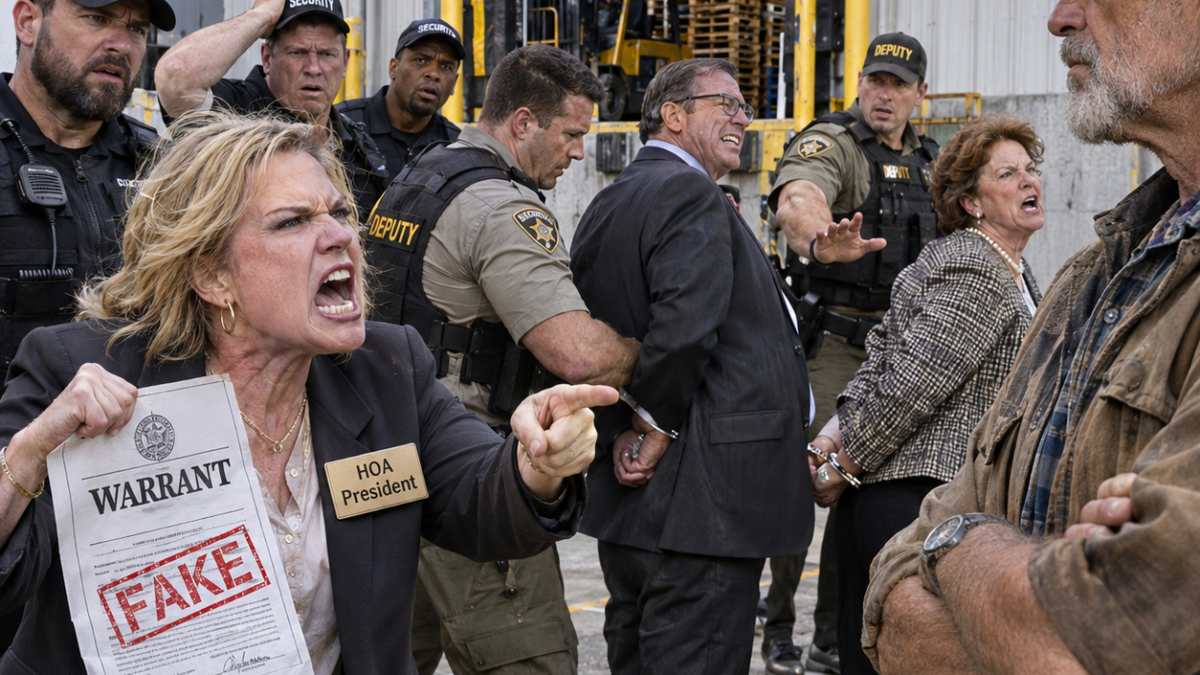
PART 2:
I ended the call and slipped my phone back into my pocket.
Sabrina watched me with the satisfied expression of somebody who thought silence meant defeat.
“Dock Four,” she said.
I looked toward my operations manager, Luis Herrera.
He stood about thirty feet away with three drivers and our morning dispatcher. All of them had already received my instructions the night before.
No touching anyone.
No arguing.
No blocking the guards.
No trying to play hero.
If somebody moved a cone, filmed.
If somebody opened a gate, filmed.
If somebody damaged property, filmed.
Everything from a safe distance.
I gave Luis a small nod.
“Pull our people back.”
He hesitated only long enough to show that he hated the order.
Then he turned.
“You heard him. Everybody clear the bay.”
Sabrina’s smile widened.
One of the guards looked at me strangely.
He probably expected shouting.
Most people do when they imagine someone trying to seize part of a business.
They imagine threats.
Fists.
A screaming match beside a gate.
I had spent too many years in transportation contracts to believe anger improved evidence.
Sabrina had brought fourteen witnesses onto my property.
I intended to let them witness everything.
Cole Barrett approached me holding another copy of the warrant.
He was in his forties, heavyset, clean-shaven, professional without trying to look intimidating.
Unlike Sabrina, he seemed uncomfortable.
“Mr. Callahan, I need to formally advise you that we’ve been retained to enforce temporary possession of this section of the property.”
“By the HOA.”
“Yes.”
“Based on that paper.”
He looked down.
“Correct.”
“Did you verify it?”
His eyes came back to mine.
“Our client represented it as a valid court order.”
“That wasn’t what I asked.”
Sabrina stepped between us.
“Cole, stop indulging him.”
He glanced at her.
She pointed toward Dock Four.
“Secure it.”
Cole looked at the warrant again.
Then gave a reluctant hand signal.
Two guards walked toward the front gate.
Four more headed for Dock Four.
Another pair moved orange barricades aside.
The rest spread out across the yard.
Sabrina carried herself like somebody touring newly purchased property.
She pointed at parked trailers.
“That one needs to move.”
Luis looked at me.
I said nothing.
Sabrina snapped her fingers at one of her guards.
“Tell the driver to clear it.”
The guard approached a tractor where one of my men sat waiting.
My driver rolled down the window.
“Boss didn’t tell me to move.”
“The area is under court control.”
The driver looked at me.
I called out:
“Do not physically resist. If you can safely relocate, relocate.”
He started the engine.
The trailer pulled away.
One of the guards cut a padlock on our side access gate.
I heard the bolt cutter snap through steel.
Sabrina turned toward me as if she expected that to be the moment I lost control.
I raised my phone.
Clicked a photograph.
Then another.
“You just damaged private property.”
“We’re executing an order.”
“Good.”
She frowned.
“Good?”
“Keep talking.”
Her expression hardened.
“Wade, this childish performance is over.”
“You’re the one who brought fourteen men and a fake—”
I stopped myself.
Not yet.
She didn’t know I knew.
That mattered.
I corrected:
“—a piece of paper you say gives you possession.”
“It does.”
“Then you won’t mind the cameras.”
She glanced toward one mounted above the dispatch building.
“I expect copies of all recordings.”
“That request can go through my attorney.”
She gave me the same smile she had used throughout the previous week.
“The court can order you.”
“Then let the court.”
That irritated her.
Good.
Angry people become careless.
One of her guards drove a metal stake into the ground beside the entrance to Dock Four.
A sign went up.
**AUTHORIZED HOA ACCESS
COURT CONTROLLED AREA**
Luis muttered under his breath.
I heard only the last two words.
“…unbelievable.”
I walked over.
“Stay calm.”
“They’re putting a sign in our dirt.”
“I can see it.”
“We’ve got eight outbound loads stacked behind this.”
“I know.”
“Two customers already calling.”
“I know.”
He looked at me like maybe I had finally lost my mind.
“Wade, what are we doing?”
“Documenting.”
“For how long?”
“Not long.”
He studied my face.
“You know something.”
“Yes.”
“Want to tell me?”
“Not here.”
He exhaled.
“All right.”
That level of trust hit me harder than I expected.
Luis had worked for me nine years.
He had seen me through fuel spikes, a warehouse fire two blocks over, the pandemic, a driver shortage, and one Christmas when half our trailers froze because somebody bought the cheapest air-line fittings known to man.
Now I was asking him to watch strangers seize the most important dock in his operation and simply trust me.
I hated that part.
But my attorney had been explicit.
Let law enforcement handle it.
Do not create a physical confrontation.
Do not give Sabrina a video clip where she could claim my staff attacked guards supposedly acting under court authority.
So I waited.
Sabrina pointed toward the automated gate controller.
“I’ll need that access code.”
“No.”
She turned.
“Excuse me?”
“You don’t get my security system.”
“The order grants possession.”
“Then use whatever rights that paper actually gives you.”
“I’m not going to negotiate every operational detail.”
“You asked for my password.”
“And I am directing you to provide it.”
“No.”
Her voice sharpened.
“You are defying a court order.”
“Call the sheriff.”
She froze.
Barely.
A fraction of a second.
But I saw it.
So did Cole.
I repeated it.
“If I’m violating a court order, call the sheriff.”
She looked toward him.
“We don’t need the sheriff.”
“Why not?”
“Because the order speaks for itself.”
Cole’s jaw tightened.
Sabrina turned away.
That tiny hesitation was the first crack.
Cole took out his phone.
He walked several steps from her.
I couldn’t hear everything, but I saw him searching.
Then scrolling.
Then checking the warrant.
He returned to Sabrina.
“Case number isn’t online.”
She waved him away.
“It was issued after business hours.”
“You said your attorney verified it.”
“They did.”
“Which attorney?”
“Cole, do your job.”
“I am.”
“You’re being paid to secure this dock.”
“My company’s being paid to execute a lawful instruction.”
“It is lawful.”
He looked down at the paper.
“Then give me counsel’s contact.”
She lowered her voice.
I couldn’t hear the answer.
But Cole’s face told me he hadn’t gotten one.
A few minutes later, Sabrina picked up her phone.
“Preston?”
She walked toward Dock Four.
“Yes. We have possession.”
I glanced toward the nearest camera.
Still recording.
“Bring everyone down.”
She listened.
“No, the whole board. I want photographs.”
That almost made me smile.
She didn’t just want the dock.
She wanted a victory ceremony.
I had suspected that from the beginning.
Now she was about to make the worst possible version of it.
Her entire board.
On my property.
Standing beneath a fake court order.
Signing paperwork.
On camera.
Luis came beside me again.
“What did she just say?”
“She’s bringing the board.”
His eyes widened.
“You want to stop that?”
“No.”
He stared at me.
“You really do know something.”
I looked toward the front entrance.
“Luis, when county deputies arrive, I need everybody calm.”
His expression changed.
“Deputies?”
“Yes.”
“You called them?”
“Before sunrise.”
He looked at Sabrina.
Then at the fake sign.
Then back at me.
“Is that warrant bad?”
“I’m not discussing it in the yard.”
A slow smile appeared.
I pointed at him.
“No celebrating.”
“I’m not celebrating.”
“You’re smiling.”
“I smile under stress.”
“You’ve never done that once.”
He walked away.
At 6:49, three vehicles pulled into the yard.
Not patrol cars.
HOA board members.
Preston Vail came first.
Mid-fifties, retired insurance executive, vice president of the association.
Meredith Sloan followed in a silver crossover.
She handled the HOA finances.
Jocelyn Pike arrived last with two additional board members.
Sabrina walked toward them like a general greeting reinforcements.
“It’s done.”
Preston looked toward Dock Four.
“You have possession?”
“Officially.”
He smiled.
“Finally.”
Meredith seemed less comfortable.
“Has Callahan agreed?”
“He doesn’t need to agree.”
Sabrina lifted the warrant.
“Court order.”
Jocelyn asked:
“Did counsel clear everything?”
“Yes.”
Again.
Confident.
Immediate.
Recorded.
Sabrina had a folding table brought near the bay.
Then she removed another document from her folder.
Large type across the top:
**POSSESSION ACCEPTANCE RESOLUTION**
I nearly admired the audacity.
She wasn’t improvising.
This had been planned.
Preston signed first.
Meredith hesitated.
“What exactly are we acknowledging?”
“That the association has taken lawful possession of the temporary access area.”
“Should counsel sign?”
“No need.”
“Why not?”
“Because the warrant already establishes authority.”
Meredith looked at the paper.
Then signed.
Jocelyn followed.
The remaining board members added their names.
Sabrina signed at the top.
Every camera captured it.
Then she turned to me.
“There’s a line for previous operator acknowledgment.”
“Previous operator?”
“The party surrendering control.”
I stared at her.
“I own Callahan Freight.”
“For the duration of the order, Blackridge controls this section.”
“I’m not signing anything.”
“That’s fine.”
She pushed the paper away.
“Your signature isn’t required.”
I looked toward Cole.
He had stopped pretending everything was normal.
Sabrina gathered the board in front of Dock Four.
One of them pulled out a phone.
“Everybody closer.”
I watched them line up.
The HOA sign visible.
The warehouse behind them.
The fake warrant held by Sabrina.
One board member joked:
“Should we rename it Sabrina Dock?”
People laughed.
Sabrina did too.
The camera snapped several photographs.
Cole came toward me.
Quietly.
“Can we talk?”
I stepped aside.
“What?”
“Is that document fake?”
I looked at him.
“You should call the courthouse.”
“Wade.”
“Call the courthouse.”
“I’m asking you.”
“And I’m telling you where the answer comes from.”
He stared for a second.
Then walked away.
He dialed.
I watched his face.
At first neutral.
Then confused.
Then pale.
“No case at all?”
Pause.
“You’re sure?”
Another pause.
“Can you verify whether Judge—”
He stopped.
Listened.
“Thank you.”
He lowered the phone.
Then shouted:
“All Meridian personnel stop.”
The yard froze.
One guard still had a traffic cone in his hand.
Cole pointed.
“Put it down. Nobody touches another piece of Callahan property.”
Sabrina spun.
“What are you doing?”
Cole walked toward her.
“The courthouse says this warrant does not exist.”
Her eyes flashed.
“The clerk you reached doesn’t have access to emergency filings.”
“They checked the judge.”
“It was sealed.”
“Then give me the attorney.”
“I already told you—”
“No, you didn’t.”
His voice changed.
The professional detachment was gone.
“You told my company this came from a sitting judge.”
“It did.”
“The courthouse says it didn’t.”
“You are creating a contractual problem for yourself.”
“You created a bigger one for me.”
She stepped closer.
“I’m withholding payment if your team stops.”
“I don’t care.”
“Eighteen thousand dollars says you do.”
That number caught Meredith’s attention.
She turned sharply.
“Eighteen thousand?”
Sabrina looked at her.
Meredith walked over.
“What is he talking about?”
“Security contract.”
“No.”
She shook her head.
“The eighteen thousand was Meridian Compliance.”
Silence.
I filed that away.
Cole looked from one woman to the other.
“Who is Meridian?”
Meredith’s face had begun to pale.
“A compliance vendor.”
“What kind?”
“I don’t know. Sabrina submitted the invoice.”
Sabrina snapped:
“This is not the time.”
I asked:
“Meridian Compliance Services?”
Meredith turned toward me.
“How do you know that name?”
“Because it appears in the payment records my attorney received.”
Sabrina’s head whipped toward me.
“You had no right to—”
“Association records were produced.”
Meredith looked at Sabrina.
“You said the money covered emergency court processing.”
“It did.”
“Through Meridian?”
“Yes.”
“Meridian isn’t a law firm.”
“You approved the payment.”
“Because you told me it was legal processing.”
Sabrina’s voice hardened.
“And you signed the check.”
Meredith stepped back as if the words had physically hit her.
That was when I realized Sabrina’s board did not know as much as she had wanted me to believe.
Some had been careless.
Some arrogant.
Some willing to benefit from a result without asking enough questions.
But that was different from knowing the warrant was fabricated.
The distinction mattered.
Especially with deputies on the way.
Jocelyn walked toward the table.
Her eyes landed on the signed resolution.
She reached for it.
“Don’t.”
She froze.
I kept my voice calm.
“Everything here is being recorded. Leave the documents where they are.”
She looked frightened.
“I’m not taking it.”
“Good.”
Sabrina turned on me.
“You are interfering with association property.”
“This is my loading yard.”
“Not currently.”
“Then call the sheriff.”
Her face tightened again.
I almost felt sorry for her.
Almost.
Then she pulled out her phone.
“All right.”
She dialed.
When the dispatcher answered, Sabrina put the call on speaker.
“I need deputies at Callahan Freight immediately. We have a court-authorized possession order, and the former operator is obstructing enforcement.”
Former operator.
Luis, twenty feet away, covered his mouth with one hand.
The dispatcher asked for a case number.
Sabrina read the one from the fake warrant.
A pause.
Then:
“Units are being dispatched.”
Sabrina ended the call.
She looked at me.
“There.”
I nodded.
“Good.”
She frowned.
“What?”
“Nothing.”
I checked the road.
Cole came beside me.
His phone was in his hand.
“I found messages from her I should’ve paid more attention to.”
“Save them.”
“One says not to let you contact the clerk until after possession is established.”
“Forward them to your attorney.”
“And law enforcement?”
“If your attorney says yes.”
He looked toward the gate.
“I think we’re past worrying about whether my company’s embarrassed.”
He began forwarding them.
Meredith was questioning Sabrina again.
“Who prepared the warrant?”
“Outside compliance counsel.”
“Who?”
“Meridian.”
“Who at Meridian?”
“That’s confidential.”
Meredith laughed.
Not because anything was funny.
“Confidential from the treasurer who paid them?”
Sabrina lowered her voice.
“You need to stop.”
“No.”
It was the first time anyone on her board said that word to her and meant it.
Preston stepped in.
“Everyone needs to calm down.”
Meredith turned on him.
“You signed the resolution without reading the warrant.”
“So did you.”
“Yes.”
She looked sick.
“And that may have been the dumbest thing I’ve ever done.”
Jocelyn spoke quietly.
“She asked me for board signature files.”
Everyone looked at her.
Sabrina’s voice snapped.
“Jocelyn.”
“You said it was routine records cleanup.”
“Stop talking.”
“No.”
Jocelyn’s hands were trembling.
“You had me compile electronic signatures.”
“When?”
“Three weeks ago.”
Preston stared at Sabrina.
“For what?”
Sabrina said nothing.
I didn’t either.
That question belonged to investigators.
Then we heard engines.
More than one.
The sound came down the access road.
Luis stepped beside me.
“Those yours?”
“Not mine.”
The first county cruiser entered.
Then a second.
Then a third.
They didn’t stop near the gate.
One pulled toward Dock Four.
Another positioned near the main exit.
A third angled across the side lane.
Sabrina exhaled in visible relief.
She grabbed the warrant and marched toward the first cruiser.
Lieutenant Audrey Keen stepped out.
I had spoken to her by phone before sunrise.
Now she was expressionless.
Sabrina held up the document.
“Lieutenant, thank God. Mr. Callahan is refusing to recognize a lawful judicial possession order.”
Audrey looked at the paper.
“Place it on the hood.”
Sabrina blinked.
“What?”
“Put the document on the hood.”
“I need you to enforce it.”
“Put it on the hood.”
Something in Audrey’s tone finally reached her.
Sabrina laid the warrant flat.
Two deputies moved toward the board.
Another went to Cole.
Not aggressively.
Methodically.
“Everybody stay where you are.”
Preston frowned.
“Are we being detained?”
“At this moment, we’re securing the scene and identifying everyone present.”
Meredith raised both hands slightly.
“I’m the treasurer. I did not know that document was fake.”
Audrey looked at her.
“We’ll speak to you separately.”
Jocelyn started crying.
Sabrina looked toward me.
Then toward the cruisers blocking both exits.
Then back at Audrey.
“This is absurd.”
Audrey opened a clear evidence sleeve.
“The county clerk verified before dawn that this warrant was never issued.”
Sabrina’s face went still.
“You’re mistaken.”
“No.”
“The order was processed privately.”
“No.”
“It may not appear in the public system.”
Audrey pointed toward the signature.
“We also contacted chambers.”
That ended it.
No case.
No warrant.
No judicial signature.
No emergency order.
Sabrina turned toward Cole.
“What did you tell them?”
He stepped back.
“The truth.”
“You worked for me.”
“My company worked for you based on representations that we were enforcing a valid order.”
“You have no idea what you’re doing.”
“I know enough to stop.”
Audrey asked Cole for his phone.
He unlocked it voluntarily.
“These are the messages.”
She reviewed the screen.
One instructed him not to allow me time to call the clerk before the dock was secured.
Another said:
**Once your people are inside, do not withdraw simply because Callahan disputes the paperwork. The board will confirm authority after physical possession is established.**
Audrey’s expression didn’t change.
She handed the phone to another deputy for documentation.
Then Meredith said:
“Lieutenant, you need to know about Meridian.”
Sabrina turned.
“Do not say another word without counsel.”
Meredith stared at her.
“You told me it was court filing money.”
“I said call your attorney.”
“You used my approval.”
“You are the treasurer.”
“And you gave me the invoice.”
Audrey stepped between them.
“You’ll each have an opportunity to give a statement.”
Sabrina pointed toward me.
“He orchestrated this.”
I almost answered.
Audrey beat me to it.
“Mr. Callahan reported the document for verification.”
“He let us come in.”
“Yes.”
“He deliberately let this happen.”
I finally spoke.
“I told you not to enter my property without lawful authority.”
“You knew the warrant was being questioned.”
“You said it was valid.”
“You set a trap.”
“No.”
I shook my head.
“You brought fourteen guards.”
I pointed toward the board.
“You brought them.”
Then toward the fake sign.
“You planted that.”
Then the resolution.
“You signed that.”
My voice stayed level.
“I just didn’t stop you from showing everybody exactly what you were willing to do.”
Her face changed.
For the first time since I’d met her, Sabrina looked afraid.
Not angry.
Afraid.
Audrey asked:
“Sabrina Voss?”
“Yes.”
“Turn around and place your hands behind your back.”
The yard went silent.
Even the idling trucks seemed quieter.
Sabrina stared at her.
“You cannot be serious.”
“Turn around.”
“My attorney—”
“You may contact counsel.”
“I am president of Blackridge Estates.”
“That does not change my instruction.”
Sabrina looked toward her board.
Nobody moved.
Preston looked down.
Meredith was crying quietly.
Jocelyn had both hands over her mouth.
Sabrina turned.
The handcuffs closed.
Then everything she had held together began coming apart at once.
“You should arrest Cole,” she said.
Cole looked at her.
“He ran the operation.”
“I relied on your warrant.”
“You should arrest Meredith. She approved payment.”
Meredith’s head snapped up.
“You told me what the payment was for.”
“Jocelyn provided the signatures.”
“At your request!” Jocelyn shouted.
Audrey raised her voice.
“Enough.”
Sabrina fell silent.
Deputies separated everyone.
The board members most directly tied to the documents and unauthorized entry were questioned individually, and those investigators had probable cause to take into custody were processed based on the evidence already gathered and what had happened in the yard.
Not everyone who stood there was treated the same.
That mattered.
Some had clearly made reckless decisions.
Others appeared to have been misled about parts of the scheme.
The investigation would sort out who knew what and when.
But Sabrina?
She had signed her name all over it.
Then something happened I will never forget.
A deputy walked toward the metal sign beside Dock Four.
**AUTHORIZED HOA ACCESS
COURT CONTROLLED AREA**
He photographed it.
Pulled it from the dirt.
Placed it into evidence.
Sabrina watched.
Her shoulders dropped.
That sign had been planted less than an hour earlier as proof of her authority.
Now it was evidence of the opposite.
As deputies led her toward a cruiser, she looked at me.
“You’ve ruined Blackridge.”
I said nothing.
She stopped.
“Do you understand what happens to our clubhouse now?”
Still nothing.
The deputy guided her forward.
She twisted enough to look back.
“All because you wouldn’t let trucks cross one loading dock.”
That finally made me answer.
“No.”
She stopped walking.
“All because you thought asking once gave you the right to take it after I said no.”
The deputy led her away.
I watched the cruiser leave through the gate.
Then I turned toward Luis.
He was staring at me.
“What?”
He shook his head.
“I have about twenty questions.”
“Later.”
“Fair.”
I looked toward Dock Four.
“How bad?”
He checked his tablet.
“Two outbound loads late. Four inbound trucks stacked. One customer threatening to call every seven minutes until civilization ends.”
“Locks?”
“Side gate is cut.”
“Barriers?”
“One bent.”
“Freight?”
“Untouched.”
“Good.”
I looked at the overhead door.
“Get the dock moving.”
He grinned.
“Best order you’ve given all morning.”
Within minutes, the yard came back to life.
Diesel engines started.
Backup alarms sounded.
Forklifts moved.
Drivers checked manifests.
A trailer backed slowly into Dock Four.
The ordinary sounds of work returned while deputies were still photographing the place where Sabrina had declared victory.
I had never loved those sounds more.
The arrest was only the beginning.
The financial investigation led straight back to Meridian Compliance Services.
Nearly eighteen thousand dollars had left HOA accounts shortly before the fake warrant appeared.
The company had no attorneys.
No real office.
No meaningful staff anyone could locate in the way a legitimate legal vendor should.
Its listed address led to a mailbox rental.
Investigators compared the warrant with authentic county documents.
The differences became obvious once experts looked.
The seal had been copied.
Formatting came from a generic legal template.
The case number structure didn’t match the county system.
The supposed judge signature was not authentic.
The document had been designed to look official enough to scare someone who would never check.
That person was supposed to be me.
Sabrina’s biggest mistake was assuming freight operators don’t read paperwork.
My entire business existed because paperwork had to match reality.
Bills of lading.
Weight tickets.
Insurance certificates.
Delivery windows.
Hazard declarations.
Rate confirmations.
Contracts.
One wrong number can send a truck six hundred miles in the wrong direction.
Of course I checked the case number.
Cole’s security company cooperated fully.
Every text.
Every contract.
Every invoice.
Every instruction.
His guards became witnesses.
The exact people Sabrina hired to make me feel outnumbered became fourteen independent sets of eyes describing what she did.
Cole called me two days later.
“I owe you an apology.”
“You were lied to.”
“I still should’ve verified.”
“Yes.”
He went quiet.
I probably could have made it easier on him.
But I wasn’t going to tell a man carrying a fake court order onto my land that verification was optional.
He said:
“I’ve changed our policy.”
“What policy?”
“No enforcement work based solely on client-provided judicial documents. We verify directly with the issuing court.”
“That wasn’t already policy?”
“No.”
“That seems like a problem.”
“I’m aware.”
I laughed.
He did too.
Then became serious.
“Wade, if you had pushed back physically, this could’ve gone bad.”
“I know.”
“My guys thought they were acting lawfully.”
“I know.”
“That’s been bothering me.”
“Good.”
He paused.
“Good?”
“It should bother you.”
Silence.
Then:
“Fair.”
The Blackridge clubhouse project stopped immediately.
The contractor wanted nothing to do with the disputed route after learning what had happened.
And without the shortcut through my yard, the project faced the same problem Sabrina had created months earlier.
The legal route was longer.
More expensive.
Less convenient.
But legal.
Residents called an emergency meeting.
I was invited.
I almost didn’t go.
Then Meredith called.
She had been released pending the investigation after giving a full statement and producing financial records.
Her voice sounded exhausted.
“You should come.”
“Why?”
“People need to hear what actually happened.”
“They can read the reports.”
“Most people don’t.”
That was unfortunately true.
I attended.
Blackridge’s community room was packed.
Sabrina’s chair at the front was empty.
Preston wasn’t there either.
Jocelyn sat in the second row with an attorney beside her.
Meredith stood near a projector.
No makeup.
No polished presentation.
Just folders.
A temporary oversight committee had taken control.
The first speaker was an older resident named Henry Walsh.
“How much did this cost us?”
Meredith looked at the figures.
“Before legal expenses from the incident?”
“Yes.”
She gave the number.
The room erupted.
Another resident stood.
“Why did we pay Meridian?”
Meredith swallowed.
“I approved the transaction based on representations from the president that it covered emergency legal processing.”
“Did you verify the company?”
“No.”
“Why?”
She looked down.
“Because I trusted her.”
Nobody shouted after that.
Trust was the word underneath everything.
Sabrina trusted nobody except herself.
The board trusted Sabrina.
Cole trusted his client.
Residents trusted the board.
And she used that trust like a blank check.
When I was asked to speak, I stood reluctantly.
I didn’t bring a speech.
“I don’t want your clubhouse.”
People looked confused.
“I don’t want your money either, except whatever my company legitimately lost because your board disrupted our operation.”
A man asked:
“Then what do you want?”
“My property left alone.”
“That’s all?”
“That was all from the beginning.”
I looked around.
“If your board had asked for temporary access and negotiated something workable, maybe we’d have reached an agreement. Maybe not. But you would’ve had an answer.”
Someone near the back said:
“Sabrina said you refused everything.”
“I refused six months of unrestricted construction traffic through an active freight terminal.”
“That’s different.”
“Yes.”
I continued.
“She promised your contractor access before I agreed to it. That created your emergency. I didn’t.”
The room went quiet.
Henry Walsh asked:
“So the contract really guaranteed your dock?”
“Through my property.”
“And you never signed?”
“No.”
He shook his head.
“Then why would she do that?”
Meredith answered from the side.
“Because she believed she could make him.”
That sentence stayed with me.
The oversight committee commissioned a full review.
The transportation agreement was declared unenforceable.
Every Blackridge claim involving Dock Four was withdrawn.
The association sent me a written acknowledgment:
Callahan Freight and Storage was not HOA property.
No easement gave Blackridge Estates access to the loading yard.
No board resolution could create one.
No association official had authority to direct my operations.
I framed that letter.
Not for display.
I kept it in my office drawer beside the original deed and survey.
The civil side took months.
My company documented everything.
Delayed trucks.
Extra storage.
Customer penalties.
Broken lock.
Damaged barrier.
Employee overtime.
Legal expense.
The numbers mattered because pretending damage had been done was exactly the kind of behavior I was fighting against.
So I claimed what I could prove.
Not one dollar more.
One customer had nearly terminated a regional distribution contract because two priority loads were delayed that morning.
When I called to explain what happened, their logistics director was silent for several seconds.
“An HOA tried to seize your dock?”
“With a fake warrant.”
Another silence.
“Wade, I’m going to need that in writing because nobody here will believe me.”
He didn’t cancel the account.
That alone saved several jobs.
The investigation into the board divided responsibility carefully.
What I learned through public filings and my attorney was less dramatic than neighborhood rumors but more credible.
Sabrina remained at the center.
The evidence against her included the fake warrant, Meridian payment trail, instructions to Cole, her representations to the contractor, and the attempt to establish physical possession before verification.
Other board members faced different consequences depending on their involvement.
Some had signed things recklessly without understanding what they were joining.
Others had participated more directly.
I stopped listening to gossip about who might go to prison for how long.
The case was no longer mine to control.
That realization helped me sleep.
For weeks before the loading yard incident, I had gone to bed expecting another message.
Another threat.
Another invented deadline.
Afterward, I kept waking at four in the morning anyway.
My body had learned the schedule even after the danger changed.
I would walk into the kitchen.
Make coffee.
Sit in the dark.
One morning I drove to the yard at 4:30.
No reason.
Just couldn’t stay home.
Luis was already there.
“You sleep here now?”
“I could ask you the same.”
“My wife snores.”
“That’s brave to admit.”
“She’s not here.”
We stood in the dispatch room.
On the wall was the daily schedule.
Dock Four had eight assignments.
Normal.
Boring.
Perfect.
Luis looked at me.
“You know what scared me most that morning?”
“The guards?”
“No.”
“The fact that you let them in.”
I smiled.
“You thought I lost it.”
“Yes.”
“Fair.”
“I almost ignored you.”
“That would’ve been bad.”
“I know.”
He rubbed his forehead.
“When the guy cut our lock, I wanted to hit somebody.”
“I know.”
“You didn’t even flinch.”
“I flinched internally.”
“That doesn’t help.”
I laughed.
Then he became serious.
“You trusted us to stay calm.”
“Yes.”
“Why?”
“Because if one of us had started a fight, Sabrina would’ve spent the next six months talking about violence instead of the fake warrant.”
Luis nodded slowly.
“That would’ve worked.”
“Probably.”
He looked at the framed company safety awards on the wall.
“You know, I hate when you’re right.”
“Most employees do.”
He threw a pen at me.
The clubhouse eventually got redesigned.
Blackridge used a legally approved transportation route.
It cost more.
Construction took longer.
They had to alter staging.
But it got built.
I heard about the opening months later.
Someone from the new board invited me.
I didn’t go.
Not because I was angry.
I had freight to move.
That amused me more than any dramatic refusal could have.
For Sabrina, the consequences extended beyond losing the presidency.
Blackridge residents removed her authority almost immediately.
Her name disappeared from official notices.
People who once treated her calls like commands started referring questions to counsel.
The thing she lost most completely was not a title.
It was automatic obedience.
That mattered because her entire method depended on momentum.
Speak confidently.
Present a document.
Set a deadline.
Act before anyone checks.
Once people started checking, the power disappeared.
Months after the incident, an envelope arrived at my office.
No return address.
Inside was a copy of the Possession Acceptance Resolution the board had signed in my yard.
Sabrina Voss at the top.
Preston.
Meredith.
Jocelyn.
Others.
A document declaring the HOA had accepted possession of Dock Four.
I read it.
Then laughed.
Luis came in.
“What?”
I handed it to him.
He read.
“They mailed you this?”
“Apparently.”
“What are you going to do with it?”
“Frame it.”
He stared.
“You’re becoming petty.”
“Educational.”
We had it mounted in the dispatch room.
Underneath, I added a small brass plaque.
**AUTHORITY REQUIRES MORE THAN A PRINTER.**
Drivers asked about it.
New hires asked about it.
I never gave them the dramatic version.
I told them:
“Verify the paperwork before you act.”
That became a company rule far beyond court documents.
Customer changes.
Third-party pickups.
Release forms.
Account instructions.
People make mistakes.
People also lie.
Verification is cheaper than regret.
Cole visited about six months later.
No guards.
Just himself.
He stood beneath the framed resolution.
“You actually hung it.”
“Yes.”
“That’s cruel.”
“It’s training material.”
He shook his head.
His company survived.
Barely, according to him.
He lost one major contract because of the incident.
He accepted that.
“I should’ve checked.”
“You said that already.”
“I know.”
“You checking now?”
“Every time.”
“Then stop punishing yourself.”
He looked surprised.
“You telling me to move on?”
“I’m telling you guilt is only useful if it changes behavior.”
He considered that.
“Construction guy philosophy?”
“Freight.”
“Same difference.”
“No.”
We walked to Dock Four.
A trailer was backing in.
Cole stood aside automatically.
“So this was worth risking all that over?”
“To Sabrina?”
“Yes.”
“No.”
“Then why?”
“Because she’d promised something.”
He frowned.
“What?”
“The access route.”
“So?”
“She would’ve had to admit she signed a multimillion-dollar contract guaranteeing property she didn’t control.”
Cole nodded.
“Pride.”
“And money.”
“Mostly pride?”
“Probably both.”
He looked toward the framed HOA sign we had not kept.
“That morning, she really thought you were scared.”
“I was.”
That surprised him.
“You didn’t look scared.”
“Fourteen armed security guards walked into my business carrying a fake warrant. Of course I was scared.”
“Then how were you so calm?”
“I had employees watching me.”
That was the truth.
Courage sounds impressive when people talk about it later.
In the moment, it was mostly knowing that if I panicked, thirty other people might panic with me.
I didn’t have that luxury.
The incident changed my relationship with Blackridge Estates in an unexpected way.
Most residents had nothing to do with Sabrina’s plan.
A few eventually became customers.
One owned a regional furniture business.
Another managed a chain of garden centers.
At first, those conversations were awkward.
Then less so.
One man named Carl Benton stopped by the yard.
“I live in Blackridge.”
“I won’t hold it against you.”
He laughed.
“Appreciate that.”
He needed short-term pallet storage.
We signed a normal contract.
No HOA.
No drama.
Just business.
That was when I realized I didn’t want a permanent enemy next door.
Sabrina had tried to turn geography into authority.
I wasn’t going to turn geography into guilt.
The residents didn’t own what she did.
The new board eventually sent me a formal apology.
It was three pages.
Lawyered to death.
I read the first paragraph and skipped to the signatures.
Then a handwritten note fell out.
Meredith.
Wade,
I should have asked more questions before approving that payment. I trusted a title instead of verifying a fact. I am sorry your employees and business paid the price for that.
—Meredith
I kept that note.
Her legal signature on the fake possession resolution told one story.
Her handwritten apology told another.
People can make cowardly decisions and still later do something decent.
I preferred remembering both.
One year after the loading dock takeover, Monday morning landed on the same date.
6:07 a.m.
I knew because Luis sent me a message.
**No invasion yet.**
I replied:
**Give it five minutes.**
At 6:12, I walked outside.
A line of trailers waited at the gate.
The sky was pale.
Dock Four door open.
Forklift moving.
One truck backed into position.
Another waited.
Exactly normal.
I stood near the place where Sabrina had planted her sign.
There was no mark left.
No stake.
No hole.
Nothing.
A year earlier, fourteen guards had stood there.
Sabrina had told me I was no longer allowed inside part of my own freight yard.
She had believed a court seal copied onto paper could erase ownership.
She had believed uniforms would prevent questions.
She had believed if she acted fast enough, possession would become authority before anyone had time to check.
For about forty minutes, it almost worked.
That was the part I remembered most.
Not her arrest.
Not the handcuffs.
How close appearance came to becoming reality simply because people were prepared to obey it.
Luis stepped outside carrying two coffees.
He handed me one.
“Anniversary.”
“That’s depressing.”
“I put extra sugar in yours.”
“That’s worse.”
We watched the trucks.
“You ever think about what would’ve happened if you signed?”
He asked it casually.
I had thought about it many times.
“If I signed the acknowledgment?”
“Yeah.”
“Lawyers would’ve fought over what it meant.”
“But you’d still win?”
“Maybe.”
He looked at me.
“That bothers you.”
“Yes.”
Because “maybe” was the lesson.
People like Sabrina don’t need a perfect legal claim.
Sometimes they only need confusion.
Enough signatures.
Enough uniforms.
Enough urgency.
Enough people willing to assume someone else verified the details.
I sipped the coffee.
Luis said:
“You know what I tell new guys when they ask about the framed resolution?”
“What?”
“Boss let fourteen armed guards steal Dock Four just to prove they couldn’t.”
I nearly choked.
“That is not what happened.”
“It’s a better story.”
“It’s inaccurate.”
“They like it.”
“Stop telling it.”
“No.”
I pointed toward the building.
“You work for me.”
“So did the guards.”
I stared at him.
He smiled.
“Too soon?”
“Possibly.”
He went inside laughing.
I stayed outside.
The first trailer finished loading.
Its door shut.
Seal attached.
Paperwork signed.
The driver pulled away.
Another truck moved into place.
Everything flowed.
Dock Four did what Dock Four was built to do.
Nothing more.
Nothing less.
Several weeks later, Lieutenant Audrey Keen stopped in.
She was off duty.
I had not seen her since the investigation moved beyond my involvement.
She stood in the dispatch room reading the framed resolution.
“Really?”
“People seem judgmental about this.”
She read the plaque.
“Authority requires more than a printer.”
“Accurate?”
“Yes.”
She looked at me.
“You know your phone call made our morning interesting.”
“You’re welcome.”
“You could’ve warned us they were bringing fourteen security guards.”
“I didn’t know the number.”
“Still.”
We walked outside.
I asked:
“Did Sabrina really call dispatch herself after everything was already in motion?”
Audrey nodded.
“Yes.”
“She actually requested my arrest.”
“Yes.”
“And used the fake case number.”
“Yes.”
I shook my head.
Audrey smiled faintly.
“Some people mistake commitment to a lie for proof.”
“Did her emergency call speed anything up?”
“It certainly removed ambiguity about her willingness to rely on the document.”
That sounded like Audrey.
Measured.
Exact.
I asked:
“You ever seen anything like it?”
“Not exactly.”
“Good.”
“I hope not to again.”
She looked across the yard.
“Your cameras helped.”
“We added more.”
“I noticed.”
“License plate reader too.”
“That seems excessive.”
“Fourteen guards.”
“Fair.”
Before leaving, she said something that stuck with me.
“You did one important thing right.”
“Only one?”
“You didn’t try to become law enforcement yourself.”
I waited.
“You reported what you believed was fraudulent. You documented. You kept your employees back. Then you let us deal with it.”
“That felt like doing nothing.”
“It wasn’t.”
She looked at me.
“Restraint is action when confrontation would make things worse.”
Then she left.
I thought about that for a long time.
Because the morning everyone remembered as my revenge had felt almost entirely passive while it happened.
I never forged a counter-document.
Never threatened Sabrina.
Never locked her in.
Never arranged some theatrical ambush.
I checked the warrant.
Reported it.
Kept cameras running.
Then let her decisions become evidence.
That was enough.
The investigation finally wound down in stages.
I never got one movie-style day when somebody handed me a complete answer tied with a ribbon.
Instead, information came through court filings, attorneys, association reports, and public records.
Meridian Compliance had been part of the chain used to prepare and process the fraudulent document.
Messages tied the warrant’s creation directly to the planned seizure.
Sabrina’s own instructions made it difficult to maintain that she believed everything was a simple clerical error.
The board’s signed resolution established who had participated in the possession attempt.
Cole’s records showed the security company had been told the order was legitimate.
The timing of the eighteen-thousand-dollar payment mattered.
The contractor agreement mattered.
Every piece alone could be explained.
Together, they told a story.
Sabrina had created an obligation she could not legally satisfy.
Instead of admitting that, she tried to manufacture authority.
Then used intimidation to make the paperwork real.
The revenge was built into that sequence.
Her contract.
Her warrant.
Her guards.
Her board.
Her call to dispatch.
Her signature.
Nothing I invented.
That was why it held.
Blackridge finished its clubhouse eventually using the longer approved route.
I saw photographs.
Nice building.
Stone entrance.
Meeting rooms.
Fitness center.
Probably exactly what they wanted.
I wondered whether Sabrina ever saw it.
Then decided it didn’t matter.
She had treated my business like an obstacle on a site plan.
I wasn’t going to spend the rest of my life treating hers like a story I needed to follow.
Callahan Freight grew.
Not dramatically.
I added two regional clients.
Replaced an old forklift.
Resurfaced part of the yard.
Dock Four got a new overhead motor.
Luis complained the new motor was too quiet.
“Sounds expensive.”
“It was.”
“The old one had character.”
“The old one screamed.”
“Character.”
I hired more drivers.
One was Cole Barrett’s nephew.
I only found that out after the interview.
Luis came into my office.
“You know who that kid is related to?”
“Yes.”
“You’re hiring him?”
“His record is clean.”
“His uncle invaded us.”
“His uncle cooperated with investigators.”
Luis stared.
“You’re annoyingly reasonable.”
“I try.”
That was another thing the whole experience changed.
For months, everybody had been divided into sides.
Us.
HOA.
Security.
Board.
Deputies.
Residents.
But real life was messier.
Cole made a serious mistake by failing to verify the document.
Then he stopped the operation when he learned the truth.
Meredith approved money carelessly.
Then she helped expose what happened.
Jocelyn collected signatures without asking enough questions.
Then told investigators why.
Blackridge residents backed a clubhouse plan they had been told was legal.
None of that made Sabrina innocent.
It just meant accountability worked better when it stayed specific.
One winter morning, nearly two years later, I arrived before sunrise.
The yard lights reflected on wet pavement.
A driver named Mason was already lining up with Dock Four.
He was new.
Too new to know the full story.
He pointed through the dispatch-room glass at the framed resolution.
“What’s that?”
I looked at it.
“A bad contract decision.”
Luis shouted from behind me:
“Fourteen armed guards!”
I turned.
“Luis.”
“What? He should know company history.”
Mason’s eyes widened.
“What happened?”
I picked up my coffee.
“Some people showed up with paperwork that wasn’t real.”
“That’s it?”
“That’s the useful part.”
He looked disappointed.
Luis shook his head.
“You’re terrible at storytelling.”
“I run freight.”
Mason went back to his truck.
I stood beneath the framed document.
For the first time in a long time, I considered taking it down.
The joke had done its job.
The warning had done its job.
Maybe the yard didn’t need to carry Sabrina forever.
I removed it from the wall.
Luis saw.
“Whoa.”
“What?”
“You’re taking down history.”
“I’m repainting.”
“You better put it back.”
I looked at the empty rectangle left on the wall.
Then at the plaque.
**AUTHORITY REQUIRES MORE THAN A PRINTER.**
I unscrewed the plaque from the frame.
“Maybe this stays.”
Luis nodded.
“Better.”
We mounted the small brass strip beside the dispatch door.
No names.
No HOA.
No arrests.
Just the sentence.
That felt right.
The resolution went into storage with the rest of the case files.
The fake warrant already existed where it belonged.
In evidence records.
Not in my daily life.
That morning, I walked out to Dock Four.
The overhead door rose.
A long-haul trailer backed slowly toward the bumpers.
I guided the driver with one hand.
A few feet.
Straight.
Slow.
Then the trailer settled into place.
Perfect.
The driver killed the engine.
For a moment, the yard was quiet.
I looked at the patch of ground near the entrance where Sabrina’s sign had once stood.
Nothing remained.
No hole.
No paint.
No reminder unless you knew where to look.
That was what I wanted.
Not a monument to winning.
A business that no longer had to think about the fight.
The dock belonged to me before Sabrina arrived.
It belonged to me while she stood there holding that fake warrant.
It belonged to me when fourteen guards filled my yard.
And it belonged to me after deputies led her away.
Her paper had never changed ownership.
It had only changed how many people were finally willing to verify the truth.
The warehouse buzzer sounded behind me.
Luis called:
“Wade! Truck on Five needs paperwork.”
I turned toward the office.
“Coming.”
Behind me, Dock Four’s door rolled down after another trailer was loaded.
The metal door reached the concrete with a heavy, ordinary thud.
No applause.
No cameras.
No black SUVs.
Exactly the way I liked it.
[END OF STORY]








