PART 2: HOA Security Put Their Hands on My Wife During Her Morning Run—Then They Learned She Was a CIA Officer
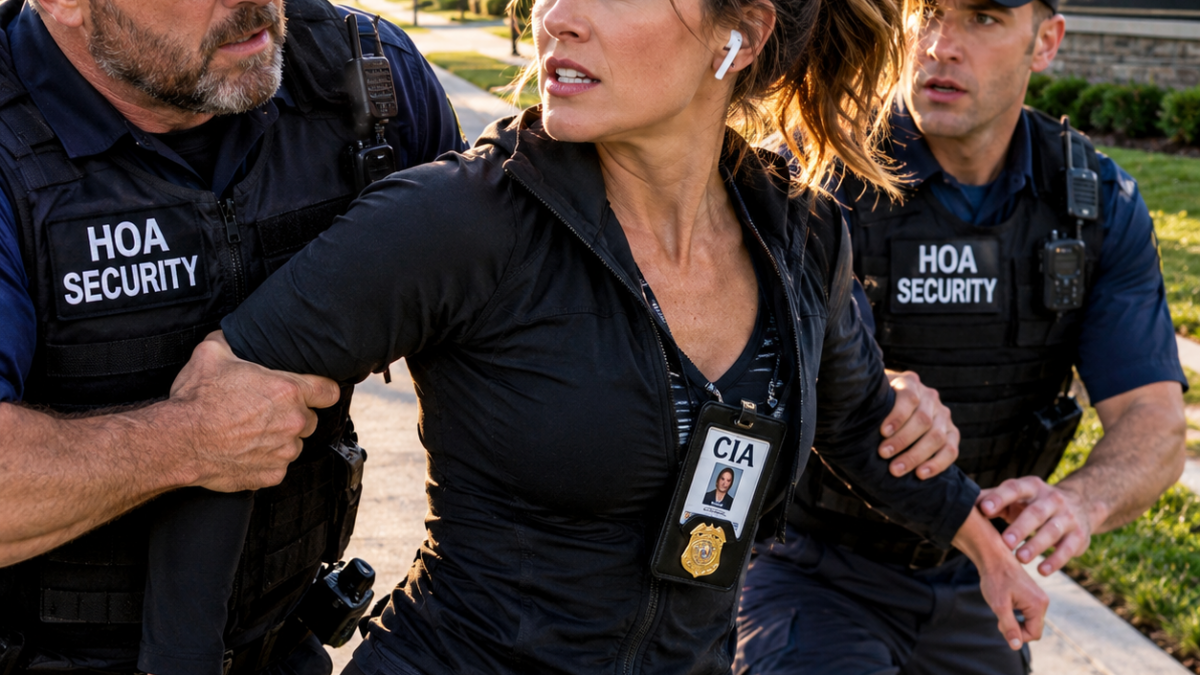
part 2
I knew none of this yet.
At that moment, I was standing in our kitchen waiting for an aging coffee maker to decide whether it intended to finish its job.
Rachel usually left around six.
Five miles if she had time.
Three if she had an early meeting.
She liked running before the neighborhood fully woke up.
For most people, running was exercise.
For Rachel, it was how she made the world quiet.
That mattered more than most of our neighbors understood.
Rachel worked for the federal government.
That was the sentence we used.
Always.
It was accurate.
It was also deliberately incomplete.
If someone asked what department, I usually said:
“Intelligence.”
If they pushed, Rachel smiled and changed the subject.
Her actual position was with the Central Intelligence Agency.
Not the movie version.
No sports cars.
No exploding briefcases.
No license to break local laws.
She wasn’t a police officer.
She couldn’t arrest people because they annoyed her.
Most of her career had been far less glamorous than strangers imagined.
Analysis.
Languages.
Travel.
Long stretches away from home.
Security training.
Defensive training.
Situational awareness drilled so deeply into her that she noticed exits in restaurants before she noticed the menu.
There had been overseas assignments she almost never discussed.
There had been years when a phone call at the wrong hour could change our lives for months.
When she eventually transferred into a quieter domestic role, we bought a house in what was supposed to be the most boring neighborhood in America.
That was the point.
We wanted boring.
Trimmed lawns.
Kids riding bicycles.
Neighbors arguing over Christmas lights.
The biggest emergency should have been somebody leaving their garbage can out a day too long.
For three years, that was mostly what we had.
Then Evelyn Hart became HOA president.
Evelyn was not physically imposing.
She didn’t need to be.
She had mastered the suburban version of authority.
A clipboard.
An email distribution list.
A title.
And complete confidence that nobody would challenge her.
At first, our interactions with her were merely irritating.
She once sent us a warning because our trash can remained visible seventeen minutes after the HOA’s recommended collection window.
Another time, she complained that a planter near our porch was “inconsistent with community color standards.”
Rachel read that email twice.
“What color is the illegal plant?”
“Green.”
She looked at me.
“The approved plants are also green.”
“Yes.”
“Dangerous.”
We laughed.
That was the mistake.
Not laughing.
Assuming Evelyn was harmless.
Several months before the confrontation, Evelyn made her first personal comment about Rachel.
We were leaving a neighborhood meeting when Evelyn looked at Rachel’s running clothes.
Leggings.
Long-sleeve athletic top.
Nothing unusual.
Evelyn smiled.
“You know, some of the older residents feel certain outfits are a little inappropriate for a family neighborhood.”
Rachel looked down at herself.
Then back up.
“Which part?”
Evelyn’s smile tightened.
“I’m simply passing along concerns.”
“From whom?”
“I don’t identify complainants.”
“Then I don’t respond to anonymous fashion reviews.”
I nearly choked trying not to laugh.
Evelyn didn’t.
From then on, there was tension.
Not open conflict.
Just the kind that sits underneath polite conversations.
Then the HOA hired a new private security company.
The official reason was vandalism.
Someone had damaged a community mailbox.
Some teenagers had been seen near the clubhouse after hours.
The board approved a six-month trial contract.
Most of us barely noticed.
The guards drove around in a white SUV with yellow lights on top.
They looked official enough from a distance that people began calling them “the HOA cops.”
They were not cops.
They had no police powers.
And according to what we later discovered, their actual instructions had somehow expanded from “observe and report” into “enforce community compliance.”
Rachel was learning exactly what that meant.
Back on the sidewalk, she stared at the first guard.
“Am I being detained?”
He shifted.
“You’re being asked to cooperate.”
“That wasn’t my question.”
“You can’t leave until we verify who you are.”
“So you’re detaining me.”
The third guard raised his radio.
“Requesting supervisor. Female subject becoming argumentative.”
Rachel looked around.
Curtains were moving.
A front door had opened across the street.
Mr. Larson—the man who watered his roses every morning—had stopped holding the hose over the flowers.
Water was running onto his shoes.
Rachel lowered her voice.
“Gentlemen, I’m going to make this very simple.”
The first guard crossed his arms.
“Good.”
“I live at 1417 Briar Ridge.”
No reaction.
“I have offered to walk you there and provide identification.”
“We’ve already told you no.”
“You have no lawful authority to keep me here.”
“That’s your opinion.”
“No.”
Rachel paused.
“It’s not.”
The younger guard laughed.
“What are you, a lawyer?”
“No.”
“Then stop pretending you know our job.”
That sentence almost made her laugh.
Instead, Rachel asked:
“What exactly do you think your job is?”
“Community security.”
“Meaning?”
“Enforcing HOA regulations.”
“Show me the regulation prohibiting jogging.”
The first guard snapped:
“We don’t have to debate policy with you.”
“Then call actual police.”
That surprised them.
Rachel continued.
“If you believe I’m trespassing, call the sheriff. I’ll wait.”
The men exchanged glances.
That should have told Rachel everything.
They didn’t want actual law enforcement.
Real police officers would ask uncomfortable questions.
Like:
What crime occurred?
Why was a resident being detained?
What authority did private HOA security have to demand identification from a jogger?
The first guard stepped closer.
“Ma’am, you need to stop making this difficult.”
“I’m standing still.”
“We’re trying to help you.”
“You’re blocking me from going home.”
“We’re following procedure.”
“Show me the procedure.”
His face hardened.
Rachel knew then.
There wasn’t one.
Or if there was, it didn’t authorize what they were doing.
She took out her phone.
The younger guard immediately said:
“No recording.”
Rachel looked at him.
“What?”
“You can’t record security operations.”
“I’m standing on a sidewalk.”
“You need to put the phone away.”
“No.”
The first guard moved closer.
“Ma’am.”
Rachel began recording.
She stated the time.
Location.
Then calmly:
“I have told HOA security that I live at 1417 Briar Ridge. They have refused to allow me to walk home to retrieve identification and have stated that I am not free to leave.”
The first guard pointed at the phone.
“Stop recording.”
“No.”
“Final warning.”
“For what?”
The second guard moved behind her again.
Rachel felt her heartbeat slow.
That sounds strange.
But she once explained it to me.
Training doesn’t necessarily make fear disappear.
It gives fear somewhere to go.
Breathing.
Distance.
Hands.
Exits.
Angles.
She began noticing details automatically.
First guard: maybe six feet, heavier than her, weight too far forward.
Second: right-handed, standing close enough to grab but not close enough to strike efficiently.
Third: nervous, hands moving constantly toward radio and belt.
No visible firearms.
No police equipment.
No legitimate restraint authority.
Rachel didn’t want a fight.
That is important.
She tried one last time.
“Move away from me.”
The first guard laughed.
“Or what?”
Rachel looked directly at him.
“If you touch me, you are going to create a problem you do not understand.”
That sounded dramatic.
It wasn’t meant to.
It was a warning.
He smiled.
“What are you going to do?”
Then he reached for her arm.
Later, we watched the video.
Dozens of times.
It happened fast.
His fingers closed around Rachel’s forearm.
She rotated toward his thumb—the weakest part of a grip—stepped offline, broke contact, and created distance.
That should have ended it.
He could have stepped back.
He didn’t.
He lunged again.
Rachel planted her palm against his upper chest and drove him backward.
Not a wild strike.
Not a punch.
A controlled shove powered by his own forward momentum.
He went down onto the grass.
Hard.
Mostly because he wasn’t expecting resistance.
The second guard shouted:
“What the hell!”
He reached for Rachel.
She caught his wrist.
Turned.
Stepped.
His balance disappeared.
He landed face-first beside the sidewalk.
The third guard froze.
Rachel backed away.
“Stop.”
He didn’t.
Maybe embarrassment took over.
Maybe he thought three men losing control of one woman was unacceptable.
He rushed her.
Rachel moved sideways.
Hooked his momentum.
Swept his base.
He hit the pavement.
Then everything stopped.
Three men.
One on the grass.
One holding his wrist.
One staring upward like the sky had personally betrayed him.
Rachel stood several feet away.
Hands visible.
Breathing steadily.
Phones were everywhere now.
Mr. Larson had finally dropped his hose.
A woman across the street was recording from her porch.
Someone shouted:
“I called the police!”
Good.
Actual police.
Rachel said loudly:
“Do not approach me again.”
The first guard sat up.
“You assaulted security!”
Rachel almost smiled.
“You grabbed me.”
“You’re under—”
He stopped.
Under what?
Arrest?
He couldn’t say it.
Rachel bent down, picked up one earbud that had fallen during the scuffle, wiped grass from her knee, and looked toward our street.
Then she waited.
She did not run away.
That mattered later.
Police arrived within seven minutes.
Two patrol cars.
Rachel stood in the same spot.
The guards started speaking simultaneously.
“She attacked—”
“She refused—”
“We were trying to—”
One officer raised his hand.
“Everybody stop talking.”
His partner separated Rachel from the guards.
“Ma’am, are you injured?”
“No.”
“Do you need medical attention?”
“No.”
“What happened?”
Rachel glanced toward the phones.
“Before I answer, you should know at least four people recorded the entire incident.”
The officer looked around.
Several neighbors immediately lifted their phones higher.
That was the moment the guards’ version became much more difficult.
Rachel explained everything.
No drama.
No CIA.
No impressive résumé.
Just facts.
Morning run.
Stopped.
Asked for identification.
Offered to walk home.
Told she was not free to leave.
Recorded.
Grabbed.
Defended herself.
The officer nodded.
“Do you have ID at home?”
“Yes.”
“How far?”
“Two blocks.”
“I can walk with you.”
“Thank you.”
Exactly what she had originally offered.
The first guard shouted from across the sidewalk:
“She’s trespassing!”
The officer looked at him.
“She says she lives here.”
“We couldn’t verify that.”
“So you detained her?”
The man hesitated.
“We were conducting community enforcement.”
The officer’s expression changed.
“What law enforcement authority do you have?”
“We’re HOA security.”
“I heard you.”
Silence.
Rachel and the officer walked home.
That was the moment I finally became part of the story.
I was standing at the kitchen counter when the door opened.
Rachel came in.
Sweat on her face.
Grass on one knee.
Small scrape on her forearm.
A police officer behind her.
I stared.
Rachel looked at me.
“Morning.”
“What happened?”
She lifted one eyebrow.
“Run got complicated.”
I looked at the officer.
Then at her.
Then at the grass stain.
“What happened?”
This time my voice came out very differently.
Rachel walked to the drawer where we kept identification.
The officer waited politely.
She handed him her driver’s license.
Address matched.
He nodded.
Then Rachel pulled another credential holder from a locked drawer.
I knew what it was before she opened it.
She didn’t display it dramatically.
She simply said:
“My employment occasionally creates security concerns. Since this incident involved an attempted detention and multiple strangers demanding personal information, I need the report to accurately document my occupation.”
The officer looked at the credential.
His posture changed.
Not fear.
Attention.
“Ma’am, you’re federal?”
“Yes.”
“With CIA?”
“Yes.”
He looked toward me.
Then back at her.
“Understood.”
Rachel closed the credential holder.
“I’m not claiming any special law-enforcement authority. I’m asking for accurate documentation.”
“I understand.”
That distinction mattered to her.
Rachel hated people using titles as weapons.
That was, after all, how this had started.
The officer returned to the sidewalk.
Twenty minutes later, Rachel came back inside.
I set my coffee down.
“Start over.”
She sighed.
Then told me everything.
I listened without interrupting.
When she described the first guard grabbing her, I felt my chest tighten.
“You okay?”
“Yes.”
“He put his hands on you.”
“Yes.”
“You’re sure you’re okay?”
She looked at me.
“I’m angry.”
That was worse.
Rachel rarely got angry.
Frustrated, yes.
Annoyed, definitely.
Angry?
Rare.
“What do you want to do?”
She opened the refrigerator.
“Eat.”
I stared at her.
“You just dropped three security guards and you want yogurt?”
“I ran four miles before that.”
I laughed despite myself.
That was Rachel.
The universe could be burning.
She would still remember breakfast.
Then our phones began buzzing.
First mine.
Then hers.
Then mine again.
Neighborhood group chat.
We barely used it.
Now there were eighty-seven unread messages.
Someone had uploaded video.
Then another angle.
Then a third.
One clip began with Rachel asking:
“Am I free to leave?”
The guard clearly answered:
“No.”
Another captured him grabbing her.
Another showed the entire physical exchange.
No ambiguity.
No dramatic editing necessary.
Although someone made dramatic editing anyway.
By ten in the morning, a video appeared with slow-motion replay.
Rachel watched ten seconds.
“Turn that off.”
“You don’t like the music?”
“They used action-movie music.”
“It’s kind of appropriate.”
She glared at me.
I turned it off.
The caption spreading online said:
**HOA SECURITY TRIES TO DETAIN LOCAL JOGGER. TERRIBLE IDEA.**
Comments exploded.
Some people cheered.
Some argued she should have complied.
Others asked the obvious question:
Why were private security guards detaining residents?
Then another question appeared.
Who hired them?
By noon, the answer was everywhere.
The HOA board.
President Evelyn Hart.
Rachel’s phone rang at 1:06.
She looked at the screen.
Then at me.
“I need to take this.”
“Work?”
“Yes.”
She went into the office and closed the door.
The call lasted less than ten minutes.
When she came back, I didn’t ask what was said.
That was part of being married to Rachel.
You learn which questions not to ask.
She sat beside me.
“My security office needs the police report when it’s available.”
“Because you were attacked?”
“Because my personal information may have been targeted.”
I frowned.
“What do you mean?”
“They were demanding identification.”
“That’s normal harassment.”
“Maybe.”
Something in her tone changed.
“What?”
She looked at me.
“Evelyn has made comments before about where I work.”
My stomach tightened.
“What comments?”
“At the pool last summer. She asked whether my travel was ‘government related.’”
“You never told me that.”
“It didn’t matter then.”
“And now?”
“Now three men hired by her board stopped me, demanded ID, refused to let me walk home, and tried to physically detain me.”
“You think they were trying to find out where you work?”
“I don’t know.”
Rachel held up one hand.
“And until we have evidence, we don’t invent motives.”
That was another Rachel rule.
Facts first.
Always.
At 4:30 that afternoon, the security company released a statement.
It was corporate language at its finest.
**Incident under investigation.**
**Employee conduct inconsistent with training standards.**
**Commitment to professionalism.**
Blah, blah, blah.
But underneath it was the important part.
The three guards had been suspended.
By the next morning, all three were terminated.
Then Evelyn sent an email.
That was when she made everything worse.
Subject:
**COMMUNITY SAFETY UPDATE**
It began:
**Dear Residents,**
**Yesterday morning, an unfortunate misunderstanding occurred between a homeowner and members of our newly contracted security team.**
Rachel read that sentence.
“Misunderstanding.”
I nodded.
“Apparently your arm misunderstood his hand.”
She almost smiled.
The email continued.
Evelyn described “heightened emotions.”
“Failure of communication.”
“An unfortunate physical escalation.”
Then she wrote:
**Residents are reminded that cooperation with authorized community security personnel is essential to maintaining a safe and orderly neighborhood.**
Rachel stopped reading.
“She’s blaming me.”
“She’s trying.”
“No apology.”
“No.”
“No admission they detained me.”
“No.”
She handed me the phone.
“Save it.”
I did.
That became the beginning of our evidence file.
Not because we planned revenge.
Because Rachel had learned long before I met her that people become surprisingly creative once they realize the facts make them look bad.
The neighborhood response came quickly.
Mrs. Hernandez from two streets over replied-all.
**What authority did HOA security have to detain a resident?**
Then Mr. Larson:
**I witnessed the event. Mrs. Cole repeatedly offered to walk home and show identification. Security refused.**
Then another resident:
**Why are guards enforcing imaginary “no running” rules?**
Another:
**Please identify the HOA policy prohibiting jogging.**
Then:
**Why were these men permitted to physically touch residents?**
And finally, from a retired attorney named Samuel Reed:
**Please preserve all board communications concerning the hiring, training, instructions, and scope of authority of this security company.**
That email changed everything.
Evelyn stopped replying.
Three days later, Rachel encountered her near the mailboxes.
Evelyn stood beside her luxury SUV.
Perfect blouse.
Perfect hair.
The same controlled smile.
“Rachel.”
Rachel kept walking.
“We need to talk.”
Rachel stopped.
“About?”
“About what happened.”
“Okay.”
Evelyn folded her arms.
“The entire neighborhood is being disrupted because you chose to escalate a misunderstanding.”
Rachel stared at her.
“Your security guards told me I wasn’t free to leave.”
“They were doing their job.”
“What job?”
“Protecting residents.”
“From jogging?”
Evelyn’s jaw tightened.
“You know very well there had been reports of suspicious activity.”
“Then why didn’t they call police?”
“They tried to verify your identity.”
“I offered to show them.”
“You refused to cooperate.”
“No.”
Rachel stepped closer.
“I refused to surrender my rights to people who had no authority to detain me.”
Evelyn lowered her voice.
“You could have handled it differently.”
“So could they.”
“Three men lost their jobs.”
Rachel’s expression changed.
That sentence bothered her.
Not because she felt guilty.
Because Evelyn wanted her to.
“They lost their jobs because of their decisions.”
“They were inexperienced.”
“They put their hands on me.”
Evelyn waved it away.
“They were just trying to control the situation.”
Rachel went very still.
“Evelyn.”
“What?”
“You don’t get to lecture me about control.”
Evelyn flushed.
“You think because you work for some government office—”
Rachel interrupted.
“Stop.”
Evelyn froze.
Rachel’s voice was barely above conversational volume.
“My employment has nothing to do with this.”
“I’m just saying—”
“You sent private security personnel into a neighborhood with instructions they clearly didn’t understand. They detained a resident. They used physical contact. And now you’re trying to make their victim responsible for the consequences.”
“I did not send them after you.”
Rachel stared at her.
“I didn’t say you did.”
Evelyn’s face changed.
Tiny.
But enough.
Rachel noticed.
Of course she noticed.
She came home and told me.
“You think that means something?” I asked.
“It means she reacted to an accusation I didn’t make.”
“Which could mean guilt.”
“Could.”
“Rachel.”
She looked at me.
“I know that face.”
“What face?”
“The one where you already have a theory.”
She sighed.
“I have questions.”
Those questions became much bigger after the next HOA meeting.
For years, almost nobody attended.
Eight people was considered a crowd.
That Thursday night, seventy-four residents packed the clubhouse.
People stood against the walls.
Someone opened the rear doors because the room became too hot.
Evelyn sat at the center of the board table.
She looked furious.
Beside her sat the HOA attorney.
The security-company regional director attended by video.
Samuel Reed, the retired attorney, sat in the front row carrying a yellow legal pad.
Rachel and I sat near the back.
She didn’t want attention.
That was impossible.
The moment we entered, people turned.
A woman whispered:
“That’s her.”
Rachel leaned toward me.
“I hate this.”
“I know.”
“Please don’t enjoy it.”
“I’m not.”
“You’re smiling.”
“Only because the guy who watered his shoes is here.”
Mr. Larson waved.
Rachel covered her face.
The meeting began.
Evelyn read from prepared remarks.
“We recognize the community has concerns regarding last week’s incident—”
Samuel Reed raised his hand.
Evelyn ignored him.
He kept it raised.
Finally:
“Mr. Reed?”
“What authority did the guards have to detain residents?”
Evelyn looked at the attorney.
He answered.
“The security contract permits observation, reporting, and certain compliance-support activities.”
Samuel nodded.
“Detention?”
“No.”
The room erupted.
Evelyn tapped her microphone.
“Please.”
Samuel continued.
“Physical restraint?”
“No.”
“Demanding government identification from homeowners?”
The attorney hesitated.
“No explicit authority that I’m aware of.”
Samuel turned toward the board.
“Then why did three employees believe they possessed those powers?”
Silence.
The regional director spoke through the screen.
“Our company did not train them to detain residents.”
A woman near the front called out:
“Then who did?”
Evelyn’s eyes flashed.
“This is not productive.”
That was exactly the wrong thing to say.
Another resident stood.
“My sixteen-year-old son was stopped two days before this happened.”
The room went quiet.
“What?” Evelyn asked.
The woman held up her phone.
“They asked him why he was walking near the clubhouse.”
The regional director leaned toward his camera.
“We were not informed of that complaint.”
Another man stood.
“My landscaper was questioned.”
Then another.
“They followed my daughter home.”
Another.
“They told my guest they could search his vehicle.”
That last one changed the attorney’s face.
Rachel leaned toward me.
“This is bigger.”
I nodded.
The board had not hired security.
They had unleashed people without boundaries.
Then Samuel asked:
“Were the guards given lists of residents considered non-compliant?”
Evelyn immediately said:
“No.”
Too fast.
Rachel’s head turned.
The HOA secretary, a woman named Karen—ironically one of the nicest people in the neighborhood—looked at Evelyn.
The pause was visible.
Samuel noticed.
“Mrs. Blake?”
The secretary swallowed.
“There were…briefing sheets.”
Evelyn snapped:
“Those were routine.”
“What was on them?”
“Property issues.”
“Names?”
Silence.
Rachel sat straighter.
Samuel asked again.
“Were residents named?”
Karen looked miserable.
“Yes.”
The room exploded.
Evelyn slammed her hand onto the table.
“They were not target lists!”
Nobody had used the phrase **target list**.
Not until she did.
Rachel whispered:
“Oh, Evelyn.”
The attorney leaned toward Evelyn.
She ignored him.
“They were simply addresses requiring increased awareness due to compliance history.”
Samuel said:
“Was 1417 Briar Ridge on that list?”
The secretary looked down.
“Yes.”
Every head turned toward us.
My stomach dropped.
Rachel didn’t move.
Samuel asked:
“Why?”
Evelyn answered this time.
“Prior hostile interactions.”
Rachel stood.
Her chair scraped softly across the floor.
The room went silent.
“What hostile interaction?”
Evelyn stared at her.
Rachel continued.
“Name one.”
“You were confrontational regarding several compliance matters.”
“You sent me a complaint about my running clothes.”
Laughter broke out.
Evelyn’s face reddened.
Rachel didn’t smile.
“You sent a violation because our trash can remained visible for seventeen minutes.”
More laughter.
“Then you put our address on a security briefing sheet.”
“It was not personal.”
“Did the sheet include my name?”
Evelyn said nothing.
Rachel looked at the secretary.
Karen nodded.
Rachel asked:
“Did it include my work information?”
Evelyn finally snapped:
“Your employment is publicly accessible.”
Rachel’s face changed.
I felt it from five rows away.
The room became completely still.
Rachel spoke slowly.
“What employment information?”
Evelyn realized her mistake.
“I just mean that everyone knows you work for the government.”
“No.”
Rachel stepped toward the aisle.
“What exactly did you put on that sheet?”
The attorney whispered:
“Evelyn, don’t answer.”
That answered enough.
Rachel sat down.
She took out her phone.
Sent one message.
Then folded her hands.
The meeting dissolved after that.
Not formally.
Emotionally.
Residents shouted.
The board attorney requested executive session.
Samuel demanded document preservation.
People wanted copies of the briefing sheets.
Evelyn looked like someone standing on ice while hearing it crack beneath her feet.
Outside, Rachel and I walked home.
“What happens now?” I asked.
“Now we find out exactly what information she collected.”
“You think this becomes a work issue?”
“If someone compiled sensitive personal information about a federal employee and distributed it to private security personnel, my employer will want to know.”
“Can you tell me more?”
“No.”
I nodded.
“Fair.”
She reached for my hand.
Then stopped.
Her fingers were trembling.
That scared me more than the fight.
Rachel rarely trembled.
“You okay?”
She looked toward the dark street.
“I can handle being stopped.”
I waited.
“I can handle idiots grabbing me.”
Another pause.
“What bothers me is not knowing what they knew.”
I squeezed her hand.
That was when the story stopped being funny.
The videos had been funny to some people.
Three overconfident guards hitting grass.
Internet captions.
Memes.
The “HOA cops.”
But underneath it was something invasive.
Someone had taken ordinary neighborhood authority and begun collecting information about residents.
About my wife.
The woman I loved had spent years protecting details about her professional life for a reason.
Now a petty HOA president might have put some of those details onto a clipboard.
Rachel didn’t sleep much that night.
Neither did I.
By the following afternoon, the HOA attorney sent a preservation notice to the board.
Rachel’s attorney sent another.
The security company received one.
No emails deleted.
No briefing sheets destroyed.
No messages erased.
No training materials changed.
Then came subpoenas and formal requests through the civil case that followed.
I wish I could say Evelyn suddenly became reasonable.
She didn’t.
She became desperate.
First came a neighborhood email accusing “certain residents” of weaponizing legal processes.
Then anonymous posts appeared online claiming Rachel had “assaulted three unarmed workers.”
The videos made that argument difficult.
Then somebody leaked that Rachel worked for the CIA.
That was the first moment I watched my wife become genuinely furious.
The social-media post appeared at 6:20 one morning.
**FUN FACT: THE WOMAN WHO ATTACKED HOA SECURITY IS A CIA AGENT. MAYBE ASK WHY SHE’S HIDING IN OUR NEIGHBORHOOD.**
Rachel stared at the screen.
I said nothing.
“Screenshot.”
Already doing it.
“Archive the page.”
“Done.”
“Don’t reply.”
“I wasn’t going to.”
She looked at me.
“You absolutely were.”
“I was considering punctuation.”
“No.”
Then she called work.
That post disappeared within an hour.
But screenshots existed.
They always do.
Investigators eventually traced the account to the adult daughter of a board member who had been in regular contact with Evelyn.
Whether Evelyn personally ordered the post became disputed.
What mattered more was where the information came from.
Discovery answered that.
The briefing sheet contained Rachel’s full name.
Our address.
Vehicle description.
Approximate running schedule.
A note identifying her as:
**FED GOV / POSS INTEL**
I read that line and felt physically sick.
Approximate running schedule.
Someone had written down when my wife left the house.
Rachel stared at the document for a long time.
Then asked:
“Who created this?”
The metadata showed it originated from the HOA president’s computer.
Evelyn.
She had compiled it.
The security company claimed it never asked for that level of information.
Its contract required only addresses associated with active property concerns.
Evelyn had added names.
Vehicles.
Personal observations.
Schedules.
And speculation.
Why?
Her explanation, through attorneys, was “safety.”
Safety became the most abused word in the entire case.
Rachel’s lawyer, Melissa Grant, was almost insultingly calm.
I liked her immediately.
She sat at our dining room table with the briefing sheet in front of her.
“Here’s what we do not do.”
Rachel nodded.
“We don’t dramatize.”
“Correct.”
“We don’t speculate.”
“Correct.”
“We don’t say this was espionage.”
Melissa smiled.
“Thank you.”
I raised a hand.
“Can I say it’s creepy?”
Both women looked at me.
Melissa said:
“Yes.”
Rachel said:
“Very.”
The lawsuit was not about Rachel being a CIA officer.
That was important.
Her employer handled its own security concerns.
Our civil case focused on much more ordinary things.
Wrongful detention.
Battery.
Negligent hiring and supervision.
Privacy issues.
Defamation-related claims.
HOA governance violations.
Abuse of authority.
The boring legal labels were almost comforting.
Because boring law was exactly what Evelyn had spent years pretending didn’t apply to her.
The security company settled first.
They knew they had problems.
Video.
Three terminated employees.
A written policy saying guards could not detain residents absent circumstances not present that morning.
Briefing sheets containing personal information the company admitted it should never have accepted.
They apologized.
Not the fake corporate apology.
A real one.
Their regional director came to our house.
No camera.
No press.
He sat at our dining room table.
“I failed.”
Rachel looked at him.
“You weren’t there.”
“I approved the contract.”
“You didn’t grab me.”
“No.”
He paused.
“But I put poorly trained people in a position where they believed they had authority they didn’t have.”
That mattered to Rachel.
Accountability always did.
He continued:
“We’ve changed training. We’ve changed onboarding. We’ve prohibited client-supplied watch lists without legal review.”
Rachel asked:
“What happened to the three men?”
“Terminated.”
“I know.”
She hesitated.
“Were they offered retraining?”
The director looked surprised.
“So was I.”
Rachel said:
“What they did was wrong. I’m not asking because I want them rehired here. I’m asking whether your company learned anything beyond ‘fire the embarrassing people.’”
I loved her for that.
The director answered honestly.
Two were no longer in the industry.
One had entered a different position after training.
Rachel nodded.
“Good.”
The HOA was harder.
Because the HOA meant Evelyn.
And Evelyn could not separate admitting a mistake from losing herself.
Her entire identity had become the presidency.
Every landscape rule.
Every warning letter.
Every committee appointment.
Every security contract.
She didn’t administer the HOA.
She was the HOA.
Which meant criticism of policy felt to her like an attack on her personally.
That became obvious at the next board meeting.
Standing room only again.
This time, residents had organized.
Petition sheets.
Proxy votes.
Questions submitted in writing.
Samuel Reed had discovered the bylaws permitted a recall vote if enough homeowners signed.
They had more than enough.
Evelyn entered the clubhouse and saw the petition table.
Her face changed.
“What is that?”
Samuel answered:
“Democracy.”
I nearly laughed.
Rachel elbowed me.
The meeting began badly.
Evelyn tried to remove the recall vote from the agenda.
Residents objected.
The attorney advised her she could not.
She tried to adjourn.
The board majority refused.
Then the security briefing documents were discussed.
That was when Evelyn finally lost control.
“I was protecting this community!”
A woman in the front row shouted:
“From what?”
“From people who refuse rules!”
Rachel sat completely still.
Evelyn pointed across the room.
“She thinks she’s above everyone because of who she works for!”
Every eye moved toward Rachel.
Melissa, sitting beside us, whispered:
“Do not respond.”
Rachel didn’t.
Evelyn continued.
“She walks around like normal standards don’t apply to her.”
Samuel said:
“What standard did she violate?”
“Her attitude!”
The room fell silent.
There it was.
Not jogging.
Not trespassing.
Not safety.
Attitude.
Rachel had failed to defer.
That was the real violation.
Samuel looked at Evelyn.
“So you created a security watch document because you disliked a resident’s attitude?”
“No!”
“Your words.”
“I meant—”
The attorney touched her arm.
“Stop talking.”
For once, Evelyn listened.
Then residents voted.
The recall passed overwhelmingly.
Evelyn sat behind the table while the numbers were announced.
I expected satisfaction.
Maybe Rachel did too.
But when I looked at my wife, she wasn’t smiling.
She looked tired.
Evelyn stared at the room.
People she had controlled for years were avoiding her eyes.
A strange silence settled.
Then Evelyn stood.
“This community will regret this.”
Samuel answered from the front row:
“I think we already regret enough.”
She left.
No applause.
I’m glad.
Humiliation is easy to enjoy when you’re angry.
It is harder when you see another human being realize that the power they built their identity around is gone.
Evelyn had caused real harm.
She deserved consequences.
But Rachel didn’t need cruelty added to them.
Outside, I asked:
“You okay?”
She nodded.
“Thought I’d feel better.”
“You don’t?”
“A little.”
She looked toward the clubhouse.
“But this wasn’t the finish line.”
She was right.
The civil case continued.
The police investigation into the physical incident ended without charges against Rachel after video review and witness statements established the sequence clearly enough for prosecutors to decline action against her.
The guards faced their own consequences through employment and civil processes.
The HOA’s insurance carrier negotiated.
Records were audited.
The new board commissioned an independent review.
That review uncovered something residents had suspected for years.
Evelyn had routinely stretched board authority.
Selective violations.
Personal notes attached to homeowner files.
Informal “problem resident” lists.
Nothing as dramatic as Rachel’s document in most cases.
But enough.
A widower had been labeled “hostile” after challenging a landscaping fine.
A young couple was marked “difficult” after requesting financial records.
A mother was listed as “watch closely” after complaining about playground maintenance.
The pattern was obvious.
Compliance had become personal.
The new board erased those informal designations.
They rewrote the security policy.
Private contractors could observe.
Report.
Call police.
They could not invent crimes.
They could not demand IDs from residents simply because somebody was walking, running, or existing in public areas.
They could not detain people except in narrow circumstances recognized by law.
Most importantly, no board member could create personal intelligence-style files on residents.
Rachel found that last wording unintentionally funny.
“Intelligence-style?”
I asked.
“They’re terrible at intelligence.”
I laughed.
“Clearly. They tried to surveil an actual intelligence officer.”
She gave me a look.
“You’ve been waiting months to say that.”
“Yes.”
“Never say it again.”
“Worth it.”
The settlement arrived almost a year after the morning run.
There was compensation.
Legal fees.
Formal corrections.
An acknowledgement that HOA security lacked authority to detain Rachel under those circumstances.
Privacy reforms.
Training requirements.
I won’t pretend the money was meaningless.
Legal fights cost money.
Time costs money.
Stress costs money.
But the part Rachel cared most about was one paragraph.
The HOA acknowledged that no homeowner could be designated for enhanced scrutiny based solely on personal conflict with a board member.
Rachel read that line twice.
Then signed.
“Done?”
Melissa asked.
Rachel exhaled.
“Done.”
The first morning after final settlement, Rachel woke at 5:45.
Put on running clothes.
Tied her shoes.
Inserted her earbuds.
I stood in the kitchen.
“You sure?”
She looked at me.
“About running?”
“Same route?”
“Yes.”
I hated how protective my voice sounded.
She heard it too.
“You know I’m okay.”
“I know.”
“You know there’s a different security company.”
“I know.”
“You know the old guards are gone.”
“I know.”
“Then what are you worried about?”
I took a second.
“That you won’t enjoy it anymore.”
Her expression softened.
That was the truth.
I wasn’t afraid she couldn’t protect herself.
She had proven that.
I was afraid Evelyn had taken something ordinary away from her.
The ability to run through our neighborhood without calculating angles and exits.
Without wondering who was watching.
Without seeing every vest as a threat.
Rachel walked over.
Kissed me.
“I’m taking it back.”
Then she left.
I watched through the window.
She stretched beside the driveway.
Started slowly.
Turned toward Oak Ridge.
For the first few minutes, I tracked her location on my phone.
Then felt ridiculous.
I put it down.
Twenty minutes later, the front door opened.
Rachel came inside breathing hard.
Sweaty.
Smiling.
“How was it?”
“Boring.”
I smiled.
“Perfect.”
She opened the refrigerator.
“Absolutely perfect.”
Life became boring again.
Kids rode bicycles.
Mr. Larson watered his roses.
The new HOA president, a quiet accountant named Thomas Lee, apparently believed power was something best exercised through agendas and spreadsheets.
Nobody feared him.
That was a compliment.
The new security company rarely interacted with residents.
When they did, they said things like:
“Good morning.”
Revolutionary stuff.
Rachel became locally famous despite desperately wanting the opposite.
People still recognized her from the video.
A teenager once asked for a selfie.
She refused.
A woman asked if Rachel could teach self-defense.
At first she laughed.
Then she thought about it.
That request stayed with her.
Eventually, Rachel and a retired police instructor organized a free two-hour personal safety workshop at the community center.
Not fighting.
That was the first thing she told everyone.
“Self-defense is not about winning fights.”
About twenty-five women attended.
Several teenagers.
A few older residents.
Rachel stood at the front wearing sweatpants and a plain T-shirt.
I sat in the back.
She talked about awareness.
Distance.
Using your voice.
Leaving whenever possible.
Recognizing when someone is using authority language without actual authority.
Calling real police.
Recording safely.
Keeping hands visible.
Creating witnesses.
And only then—if somebody crosses the physical line—defending yourself long enough to get away.
One woman raised her hand.
“What if you’re scared?”
Rachel smiled.
“You probably will be.”
The woman looked surprised.
Rachel continued.
“Training isn’t magic. Courage isn’t the absence of fear. It’s making useful decisions while fear is there.”
I had heard Rachel say things like that privately.
Never publicly.
Something about that morning had changed her too.
Not made her harder.
More willing to speak.
After the class, an older woman approached.
Her name was Margaret.
She was nearly seventy.
“I’ve never told anyone this.”
Rachel waited.
Margaret explained that years earlier, an HOA board member had entered her backyard without permission to photograph a violation.
She had been furious.
But afraid to complain.
“He told me the board had inspection authority.”
Rachel asked:
“Did they?”
“I found out later they didn’t.”
“Why didn’t you challenge it?”
Margaret shrugged.
“I didn’t want trouble.”
Rachel nodded.
That answer appeared everywhere.
I didn’t want trouble.
It was how bad systems survived.
Most people weren’t weak.
They were tired.
Busy.
Caring for children.
Working jobs.
Managing illnesses.
Trying to get through normal life.
People like Evelyn relied on the fact that resistance was expensive.
A $75 fine was cheaper than an attorney.
A rude email was easier to ignore than confront.
An inappropriate demand might be simpler to obey than challenge.
Until the demands became bigger.
Rachel didn’t become a neighborhood revolutionary.
She didn’t run for HOA president.
She would rather have eaten the bylaws.
But she started attending meetings occasionally.
Whenever security policy was discussed.
Whenever homeowner privacy was discussed.
Whenever someone proposed rules that seemed to grant vague authority.
She asked one question constantly.
“Where is that written?”
Evelyn had hated that question.
Thomas loved it.
Usually because he had the answer printed.
Two years passed.
Then one afternoon, I saw Evelyn again.
At a grocery store.
I almost didn’t recognize her.
Not because she looked dramatically different.
Because she looked ordinary.
No clipboard.
No title.
No room full of people waiting for her decision.
She was comparing cereal prices.
I turned toward another aisle.
Then heard:
“Daniel.”
I stopped.
Rachel wasn’t with me.
I considered pretending I hadn’t heard.
Instead, I turned.
“Evelyn.”
She pushed her cart closer.
For a moment neither of us spoke.
Then:
“How is Rachel?”
“Good.”
“She still running?”
“Yes.”
Evelyn nodded.
“I’m glad.”
I didn’t answer.
She looked down.
“I handled things badly.”
That might have been the understatement of the decade.
But something in her face stopped me from saying it.
“I thought if people challenged me, everything would become chaos.”
She gave a small laugh.
“Then I created chaos trying to stop anyone from challenging me.”
I studied her.
“Have you told Rachel that?”
“No.”
“Why?”
“I don’t think she wants to hear from me.”
“She probably doesn’t.”
Evelyn nodded.
“I understand.”
She started to leave.
Then stopped.
“I didn’t know she was CIA when I told security to watch her.”
That sentence froze me.
“You told them to watch her.”
Evelyn realized what she had said.
“I mean—”
“No.”
I stepped closer.
“What exactly did you tell them?”
Her face went pale.
“Daniel, this was settled.”
“I know.”
“I’m not trying to reopen anything.”
“Then answer.”
She looked around the grocery aisle.
Ridiculous setting for a confession.
Breakfast cereal on one side.
Paper towels on the other.
“I told them she was confrontational.”
“That’s in the records.”
“I told them to verify residents they didn’t recognize.”
“Also known.”
She swallowed.
“And?”
Evelyn closed her eyes briefly.
“I said Rachel was someone they shouldn’t let intimidate them.”
There it was.
Not an order to assault her.
Not an explicit order to detain her.
Something more ordinary.
A bias.
A warning.
A story given to inexperienced men before they ever met my wife.
They approached Rachel already believing she was difficult.
Already believing defiance was expected.
Every calm answer became suspicious.
Every question became resistance.
Every refusal became proof.
I understood then how the entire morning had happened.
Evelyn hadn’t needed to say:
Go harass that woman.
She had just needed to tell them who Rachel supposedly was before they met her.
I looked at Evelyn.
“You understand what you did?”
“Yes.”
“Do you?”
She met my eyes.
“I turned her into a problem before she had done anything.”
Exactly.
I left without saying anything else.
At home, I told Rachel.
She listened.
Then sat quietly.
“You okay?”
“Yes.”
“You want to do anything?”
“No.”
“You sure?”
“The case is over.”
“She admitted—”
“I know.”
Rachel took my hand.
“I don’t need another fight.”
That was one of the hardest lessons for me.
Sometimes accountability ends before every emotional question is answered.
There will always be one more email.
One more detail.
One more thing somebody should admit.
At some point, continuing to chase the final piece gives the person who hurt you permanent residence in your life.
Rachel was done.
So I became done too.
A few months later, the neighborhood held a charity 5K.
The route passed the exact spot where the guards had stopped Rachel.
Thomas asked if she wanted to start the race.
She initially said no.
Then changed her mind.
The morning of the event, maybe two hundred people gathered near the clubhouse.
Kids.
Parents.
Older residents.
Runners.
Walkers.
Rachel stood near the starting line.
No dramatic speech.
Thomas handed her a microphone.
She looked horrified.
“I was told there would be no speech.”
People laughed.
Thomas said:
“Thirty seconds.”
Rachel sighed.
Then looked at the crowd.
“Two years ago, I learned that apparently running in this neighborhood could be controversial.”
Laughter.
She smiled.
“But the thing I remember most isn’t what happened to me.”
The crowd quieted.
“It’s how many people afterward told me they had been afraid to question someone who claimed authority over them.”
She paused.
“Rules matter.”
That surprised some people.
“Good rules protect people. Good institutions protect people. But authority should always be able to explain itself.”
She looked down the street.
“If someone tells you that you have no choice, it’s okay to ask why.”
Then she handed the microphone back.
“Can we run now?”
Everyone cheered.
The race started.
Rachel disappeared into the crowd.
I stood near Mr. Larson.
He was holding a cup of coffee.
“You running?”
I asked.
He looked offended.
“I’m seventy-six.”
“You water roses for three hours every morning.”
“Different muscles.”
We laughed.
Twenty-four minutes later, Rachel came around the final corner.
Not first.
Not trying to be.
She crossed the finish line somewhere in the middle of the front group.
People clapped.
She immediately looked embarrassed.
I handed her water.
“How was it?”
She drank.
Then said:
“Boring.”
That word again.
I smiled.
“Perfect?”
She nodded.
“Perfect.”
The story people told online became simpler over time.
That always happens.
**HOA cops picked on the wrong woman.**
**Three guards attacked CIA agent.**
**CIA woman destroys HOA security.**
Catchy.
Mostly wrong in spirit.
Rachel never wanted to destroy anyone.
She wanted to finish her run.
She didn’t win because she worked for the CIA.
Her employment didn’t magically make her rights more important than anyone else’s.
That was the point many people missed.
If Rachel had been a teacher, nurse, accountant, waitress, stay-at-home mother, retiree, or unemployed, those guards still would not have had the right to invent authority.
Her CIA background mattered because it meant she had training.
It meant she stayed calm.
It meant the men who expected easy compliance badly misjudged her.
But the moral wasn’t:
Be careful who you harass because they might secretly be powerful.
The moral was:
Don’t harass people.
Period.
Don’t mistake a uniform for unlimited authority.
Don’t mistake questions for defiance.
Don’t mistake somebody’s patience for permission.
And never assume that a person standing quietly in front of you is powerless simply because they haven’t told you who they are.
Rachel still runs most mornings.
Same route.
Same earbuds.
Same ponytail.
Mr. Larson still waters his roses.
There’s a different guard at the neighborhood entrance now.
His name is Marcus.
Professional.
Polite.
The first morning he saw Rachel, he waved.
“Morning, ma’am.”
She waved back.
That was it.
No ID.
No interrogation.
No invented crime.
No drama.
One day she stopped near him.
I learned this later.
She said:
“Thank you.”
Marcus looked confused.
“For what?”
“For being boring.”
He laughed.
“I’ll take that as a compliment.”
“It is.”
Sometimes peace is boring.
That’s what people who crave authority never understand.
Evelyn wanted control.
The old security guards wanted obedience.
The internet wanted drama.
Rachel wanted none of those things.
She wanted an ordinary morning.
And eventually, she got it back.
There is one last detail I rarely tell people.
Several months after the settlement, Rachel came home from work carrying a cardboard box.
She placed it on the kitchen table.
“What’s that?”
“Old office stuff.”
She had changed assignments.
Less travel.
More predictable schedule.
Still CIA.
Still classified enough that my questions remained mostly useless.
Inside the box were notebooks.
A coffee mug.
A photograph from one of our vacations.
At the bottom was an old pair of running shoes.
I recognized them.
The shoes she had worn that morning.
Grass stain still visible along one side.
“You kept those?”
“Apparently.”
She sat down.
For a moment she just held one.
Then said:
“I almost stopped running.”
I looked at her.
“You never told me that.”
“I know.”
“Why?”
“Because I didn’t want them to have changed me.”
I sat beside her.
“But they did.”
“Yes.”
The honesty hurt.
She continued.
“For a while, every time someone slowed a car near me, I noticed.”
I nodded.
“Every time I heard a radio behind me, my shoulders tightened.”
I put my arm around her.
“I hated that.”
“Why didn’t you tell me?”
“Because you were already worried.”
“I’m your husband. That’s literally part of the job.”
She smiled.
“Bad job description.”
“I signed anyway.”
She leaned against me.
Then she looked at the shoe again.
“You know what fixed it?”
“The settlement?”
“No.”
“The guards getting fired?”
“No.”
“Evelyn losing the board?”
“No.”
I waited.
“Running.”
I understood.
She kept going back.
Morning after morning.
Same sidewalk.
Same corner.
Same place where someone had tried to take an ordinary part of her life and turn it into fear.
She reclaimed it one mile at a time.
That was the real revenge.
Not three men hitting the ground.
Not Evelyn losing an election.
Not legal fees.
Not a viral video.
Not the neighborhood discovering my quiet, five-foot-four wife had spent years working for one of the most secretive agencies in the federal government.
The revenge was that none of them got to keep anything they had taken from her.
Not her route.
Not her confidence.
Not her peace.
Rachel put the old shoes in the trash.
I looked at her.
“You sure?”
“They’re worn out.”
“That’s unusually practical for a symbolic moment.”
She smiled.
“I’m not keeping sweaty shoes for emotional reasons.”
“Fair.”
The next morning, she laced up a new pair.
I stood in the kitchen drinking coffee.
She kissed me on the cheek.
“Five miles?”
“Probably.”
“Any plans to assault neighborhood security?”
She stared at me.
I smiled.
“Too soon?”
“Two years too soon.”
She opened the door.
Sunrise was beginning to turn the street gold.
Rachel stepped outside.
No cameras waiting.
No crowd.
No security men.
No Evelyn.
Just a quiet neighborhood.
She started running.
And disappeared around the corner.
I stood there for another moment.
Then went back to my coffee.
That was how I knew we had actually won.
Because nothing happened.
And nothing was exactly what we had wanted from the beginning.








