PART 2: HOA Security Harassed Us for Weeks—Then My 79-Year-Old Grandfather Locked Their Convoy Behind His Bridge Gate Overnight
PART 2
I leaned over the kitchen table.
The page smelled faintly of dust and old paper.
“What am I looking at?”
Orson adjusted the lamp.
“Completion transfer.”
“For the bridge?”
He nodded.
The document identified Blackstone Crossing by its original engineering designation, then described the bridge, the western approach, and the service road beyond it.
Whitcomb Infrastructure had built the crossing.
When the company was dissolved, ownership had been transferred to Orson personally along with the surrounding Whitcomb land.
I read the paragraph twice.
“So Vanessa is lying.”
“Slow down.”
“Grandpa, it says your name.”
“It does.”
“She put up a sign calling it Blackstone Heights property.”
“I saw.”
“She’s charging us for using it.”
“I know.”
“How are you this calm?”
He looked at me over his glasses.
“Because getting angry doesn’t change ink.”
I paced toward the stove.
“Then tomorrow we show them this.”
“No.”
I turned.
“What?”
“We verify everything first.”
“It’s your document.”
“That doesn’t mean I remember every condition written around it.”
He pulled another folder from the cabinet.
Inside was an old agreement between Whitcomb Infrastructure and the developer who had originally subdivided land east of the river.
Some property owners had crossing rights.
Not ownership.
Not control.
A right to pass over the bridge under defined conditions.
Orson tapped the agreement.
“This matters.”
“Why?”
“Because being right about ownership does not give me the right to pretend nobody else has rights.”
I stared at him.
“They’re trying to take your bridge.”
“And I’m not going to answer that by taking something from people who lawfully use it.”
That was my grandfather.
He could be stubborn enough to argue about a quarter-inch steel tolerance for an hour, but once he believed a principle applied to him too, you could not move him from it.
“So what do we do?”
“We find a lawyer.”
“I thought you hated lawyers.”
“I hate paying lawyers.”
“That sounds more like you.”
He almost smiled.
Then he gathered the papers.
“We also find out exactly what Vanessa thinks she owns.”
Around midnight, one of the motion cameras chimed.
I had installed several after the security patrols started lingering around the property.
The camera facing the bridge showed three people under the association’s new sign.
Darla.
Two guards.
Tools.
I turned up the volume.
Metal scraped.
One guard was loosening bolts from the post that had once held our old wooden sign.
Another dragged something toward their SUV.
I zoomed in.
Our weathered sign.
WHITCOMB PRIVATE BRIDGE
AUTHORIZED CROSSING ONLY
Darla pointed toward the vehicle.
“Get every piece of it.”
One of the guards muttered, “Why?”
Her reply came clearly through the microphone.
“Mrs. Kingsley-Carrington wants every trace of the Whitcombs gone by Friday.”
I stopped the video.
Rewound it.
Played it again.
Orson had come up behind me.
He watched without saying anything.
I expected anger.
Instead, he reached down and pressed the button to save the clip.
“Make another copy.”
“That’s it?”
“What else do you want me to do?”
“Something.”
“I am.”
“What?”
“Remember.”
Friday morning arrived cold and bright.
Orson needed a pump fitting from town.
I offered to go.
He shook his head.
“I can still drive.”
“You’re seventy-nine.”
“Truck doesn’t know that.”
He left in his old blue pickup.
Forty minutes later, my phone rang.
“Calder.”
Something in his voice made me stand.
“What happened?”
“They’ve blocked the bridge.”
“I’m coming.”
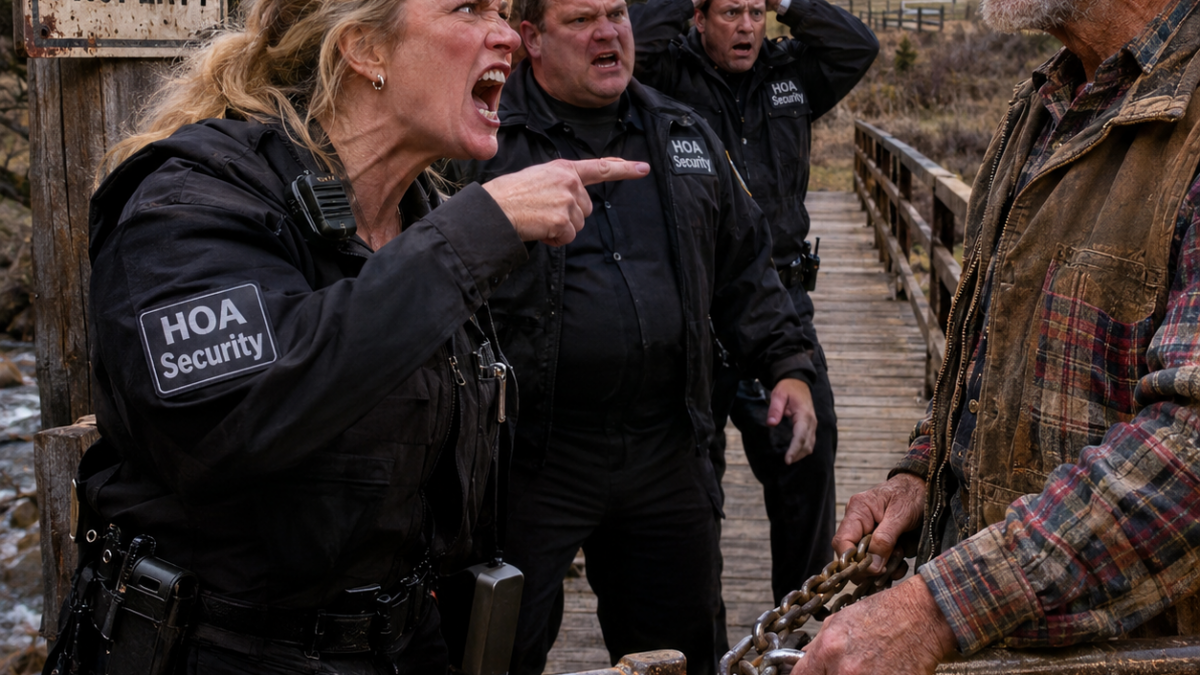
When I reached Blackstone Crossing, three security vehicles sat near the eastern approach.
Orson’s pickup idled in front of them.
Darla stood beside his window holding a handheld payment terminal.
I parked and walked toward them.
“What is this?”
Darla glanced at me.
“Crossing fee.”
“How much?”
“Two hundred fifty dollars.”
I laughed.
“You’re charging the man who owns the bridge to drive across it?”
Darla ignored me.
Orson rolled down the window farther.
“Who approved the fee?”
“The association.”
“Who at the association?”
“President Kingsley-Carrington.”
“Does President Kingsley-Carrington have a deed to this bridge?”
Darla’s face reddened.
“You can discuss ownership with legal.”
“I’m discussing the two hundred fifty dollars you’re asking me to pay.”
Cars had begun stacking up behind us.
Residents from Blackstone Heights.
An SUV.
A pickup.
A sedan.
People watched through windshields.
Darla picked up her radio.
“Call Vanessa.”
I looked at Orson.
He seemed almost amused.
Ten minutes later a white SUV appeared.
Vanessa Kingsley-Carrington stepped out.
Forty-eight.
Perfect hair.
Long winter coat.
The kind of confidence that comes from being obeyed often enough that you begin to mistake habit for authority.
She walked toward my grandfather’s battered pickup.
“Mr. Whitcomb.”
“Mrs. Kingsley-Carrington.”
“I’m told you’re refusing to cooperate.”
“I’m asking who authorized a toll on my bridge.”
She glanced at his truck.
“Frankly, vehicles in this condition are exactly why we need stronger access standards.”
Orson looked at his dashboard.
“This truck?”
“Yes.”
“This truck crossed Blackstone Crossing before your neighborhood had curbs.”
A couple of people behind us laughed.
Vanessa heard them.
Her expression tightened.
“That is precisely the problem.”
Orson rested his wrists on the steering wheel.
“Explain.”
“You and your family continue behaving as if nothing around you has changed.”
“Steel changes.”
“What?”
“Wood changes. Concrete changes. Load changes. Rivers change.”
He looked directly at her.
“Ownership doesn’t change because you find it inconvenient.”
Vanessa laughed.
“People like you always say that.”
“People like me?”
“People who refuse to understand progress.”
I stepped closer.
“Don’t talk to him like that.”
One security guard moved toward the driver’s door.
His hand reached for the handle.
I stepped between him and the truck.
“Do not touch my grandfather.”
The guard stopped.
Vanessa looked me over.
“You want to defend this old man?”
“Yes.”
“Then be prepared to pay the price alongside him.”
I pulled out my phone.
Started recording.
“Say that again.”
Her eyes narrowed.
I held the camera steady.
“Does Blackstone Heights claim to own this bridge?”
She looked toward the line of residents.
Then back at me.
“Yes. Blackstone Crossing is under the control of Blackstone Heights.”
“Do you know who paid to build it?”
“I don’t care.”
Four words.
She said them casually.
Like history was something inconvenient people used when they could not afford the future.
I kept recording.
“Do you know who maintains it?”
“The association maintains community infrastructure.”
Orson’s eyebrow lifted.
That was the first time I saw a genuine reaction from him.
Not anger.
Interest.
As though she had just said something more important than she realized.
Vanessa pointed toward his pickup.
“If you continue resisting, your vehicle will be prohibited from crossing.”
Orson turned off the engine.
The sudden silence felt deliberate.
“You intend to ban the bridge owner from his own bridge?”
Vanessa smiled.
“I intend to enforce community standards.”
I stepped beside the truck.
“You’re on record.”
“Good.”
She walked back to her SUV.
Eventually Darla waved Orson through.
No fee paid.
But the message was obvious.
Vanessa had stopped pretending this was a misunderstanding.
Back at the house, I paced the kitchen.
“We sue.”
Orson hung his coat.
“We call the lawyer first.”
“We have video.”
“I know.”
“They removed our sign.”
“I know.”
“They threatened you.”
“Yes.”
“They’re charging tolls.”
“Yes.”
“How many more things do you need?”
He turned.
“A complete picture.”
I threw my hands up.
“You can’t engineer your way through every problem.”
“No.”
He pulled out a chair.
“But I can avoid creating a new one because I’m mad.”
I sat down hard.
“What does that mean?”
“It means some Blackstone residents may have legitimate crossing rights.”
“So?”
“So I cannot close the bridge against them because Vanessa is a fool.”
I leaned back.
He continued.
“If there is an emergency route obligation, we understand it. If there are notice requirements, we follow them. If the bridge has load restrictions, we verify them.”
“And then?”
“Then nobody gets to say we acted recklessly.”
He called Marin Ellis that afternoon.
Marin specialized in land-access disputes.
She drove out from Knoxville the next morning.
She was in her early forties, practical, direct, and had the unnerving habit of letting a question sit until the person answering it became uncomfortable enough to tell the truth.
She spent three hours at our kitchen table.
Deed.
Transfer records.
Crossing agreement.
Survey.
Security videos.
Citations.
Vanessa’s recorded statements.
When she finished, she stacked everything neatly.
“The good news is straightforward.”
“Finally,” I said.
“Blackstone Heights does not appear to own Blackstone Crossing.”
I looked at Orson.
He didn’t celebrate.
Marin continued.
“The more complicated part is that several original parcels do hold easement rights that run with the land.”
Orson nodded.
“I expected that.”
“So residents attached to those parcels cannot simply be excluded.”
“I don’t want them excluded.”
“Good.”
I asked, “Can the HOA put guards on the bridge?”
“Not merely because residents have rights to cross.”
“Charge tolls?”
“Not under the documents I’ve seen.”
“Use it for whatever they want?”
“No.”
“Construction trucks?”
“Depends on the scope of the easement, weight restrictions, safety, historical use, and any separate permits.”
“Luxury resort traffic?”
Marin looked at me.
“Why did you say luxury resort?”
I didn’t know.
Maybe because Vanessa’s obsession with “progress” had sounded bigger than mailbox rules.
“I’m guessing.”
Orson spoke.
“She said the association maintains the bridge.”
Marin turned toward him.
“And?”
“They haven’t.”
“How much maintenance has Blackstone Heights funded?”
“As far as I know? Almost none.”
“Who does?”
“I do.”
That interested her.
“Records?”
Orson pointed toward the cabinet.
Marin smiled.
“Of course you have records.”
“Engineer.”
“I noticed.”
She spent the rest of the afternoon copying invoices.
Guardrail replacements.
Deck repairs.
Inspection costs.
Drainage work.
Timber treatment.
Structural checks.
Nearly all paid through Orson.
As Marin prepared to leave, she stopped at the bridge.
I stood beside her.
“What are you thinking?”
“I’m thinking Vanessa is either badly advised or highly motivated.”
“Those are our options?”
“Maybe both.”
That evening an email arrived from an address I didn’t recognize.
No message.
One attachment.
I nearly deleted it.
Then I saw the filename.
BLACKSTONE EAST DEVELOPMENT MASTER PLAN.
I opened it.
The first page showed architectural renderings.
Stone villas.
Golf course.
Conference center.
Pools.
Private lodge.
Estimated project value:
$85,000,000.
I scrolled.
Site plan.
Transportation routes.
Construction phases.
Then I saw Blackstone Crossing.
A thick line ran across the bridge.
Beside it:
FUTURE EXCLUSIVE RESORT ENTRANCE
HOA CONTROLLED ASSET
I stopped moving.
Orson was cleaning a carburetor at the other end of the table.
“Grandpa.”
He looked up.
I turned the laptop.
He read the label.
Once.
Twice.
Then he took off his glasses.
“So that’s the hurry.”
I called Marin.
She came back the next morning.
We spent days in planning records.
What we found gave Vanessa’s behavior a price tag.
Kingsley-Carrington Development, a company tied to Vanessa’s family, had been involved in negotiations for the resort.
The proposed site lay east of the river.
Blackstone Crossing offered the shortest, most marketable route from the main highway.
Without it, the alternative public route wound miles around difficult terrain.
Construction cost rose.
Guest access worsened.
Emergency planning became harder.
The resort’s value dropped.
Marin pointed at the development map.
“This bridge is not a side issue.”
“It’s the entrance,” I said.
“It’s the premium entrance.”
Orson stood behind us.
“And they’ve told investors they control it.”
“Yes.”
He nodded slowly.
Vanessa had not been trying to regulate us.
She had been trying to turn a claim into a fact.
If enough signs said HOA property, if enough security officers acted as if they controlled the road, if enough residents paid fees, if enough people stopped questioning the arrangement, maybe the fiction would become useful.
Not legally true.
Useful.
That difference mattered.
Then Tessa Rowan showed up.
She was a local reporter, thirty-four, carrying two folders and enough handwritten notes to cover our kitchen table.
“I’ve been looking at Blackstone Heights for months,” she said.
“Why?”
“Residents.”
“What about them?”
“Fines. Security pressure. selective enforcement.”
Harold Pruitt’s warning came back to me.
Tessa showed us receipts.
Annual charges labeled BRIDGE MAINTENANCE RESERVE.
Four hundred dollars.
Six hundred.
Seven hundred fifty.
Different years.
Different residents.
Orson picked one up.
“I replaced the west guardrail that year.”
“Did the HOA contribute?”
“No.”
Another receipt.
“Deck treatment.”
“I paid that too.”
Tessa looked at Marin.
“Residents think the association maintains Blackstone Crossing.”
Marin cautioned us immediately.
“Charging a fee is not automatically improper. We need to know what the money was represented as funding and where it went.”
Tessa nodded.
“I know.”
She pulled out newsletters.
One headline read:
**PROTECTING OUR SHARED COMMUNITY TREASURE**
Another referred to a “bridge reserve fund.”
Not one mentioned Whitcomb ownership.
I felt anger rising.
“They erased him.”
Orson looked at me.
“Paper doesn’t erase anybody.”
“They made everyone think it was theirs.”
“That’s different.”
“You’re not angry?”
“I’m getting there.”
That was the closest he came to admitting it.
Gideon Pike visited the next afternoon.
He had worked as a bridge inspector for Whitcomb Infrastructure decades earlier.
Sixty-one now.
Gray beard.
Heavy boots.
He carried a copy of the original crossing agreement.
He greeted Orson with a handshake.
“You still have that miserable coffee?”
“You still drink it?”
“Unfortunately.”
They smiled.
Then business began.
Gideon confirmed what Marin had found.
Some Blackstone properties held legitimate rights of passage.
The rights traveled with the land.
But the agreement did not grant the HOA ownership.
It did not allow tolls.
It did not allow management transfer.
It did not give a development company unlimited commercial access.
Most importantly, the original bridge had been designed around a limited traffic profile.
Gideon walked the structure with Orson.
They crawled beneath the west approach.
Measured connections.
Photographed old steel.
Looked at the deck.
At dinner, Gideon said, “If they’re planning construction convoys, we need a load review.”
Orson nodded.
“I was thinking the same.”
I asked, “Is the bridge unsafe?”
“No.”
“Then what’s the issue?”
Gideon set down his fork.
“Safe for what?”
I frowned.
He continued.
“A bridge isn’t safe or unsafe in the abstract. It’s safe for a defined load, frequency, condition, and use.”
“Cars?”
“Likely fine.”
“Six security SUVs?”
“Probably.”
“Loaded concrete trucks?”
“That’s different.”
The resort plan included heavy construction traffic.
Equipment trailers.
Survey vans.
Material deliveries.
Potentially thousands of commercial crossings.
Orson hired an independent engineering firm.
Not one connected to him.
Not one that had worked for Whitcomb Infrastructure.
He wanted an outside opinion nobody could dismiss as family bias.
The early report was troubling.
The bridge remained appropriate for ordinary authorized traffic under the existing conditions.
But the proposed heavy commercial usage needed review.
Some combinations could exceed recommended loads.
Marin drafted formal notices.
One to Blackstone Heights.
One to Kingsley-Carrington Development.
One to security.
The letters did not threaten to close the bridge to lawful residents.
They demanded an end to unauthorized commercial use.
They demanded removal of misleading ownership signs.
They notified everyone that the western service yard beyond the easement boundary was private Whitcomb property with no general right of access.
They warned that commercial equipment entering the yard would be stopped pending safety review.
Three days later, my phone buzzed.
Darla.
**Tomorrow night we bring a survey convoy across that bridge. Get in the way and you will be arrested.**
I read it twice.
Then handed it to Orson.
He put on his glasses.
Read it.
Set the phone down.
“Then they picked the worst possible night to test that bridge.”
Something about his tone made me sit up.
“What are you planning?”
“Nothing reckless.”
“That is not an answer.”
“It’s the important part.”
Marin arrived before sunset the next day.
So did a licensed contractor.
They installed a controlled gate at the entrance to our private service yard west of the bridge.
Not across lawful residential passage.
Not across the main bridge itself.
At the point where documented access rights ended.
Signs went up.
PRIVATE SERVICE AREA
NO UNAUTHORIZED COMMERCIAL ENTRY
VEHICLE EXIT SUBJECT TO COUNTY/OWNER COORDINATION DURING SAFETY REVIEW
Marin had contacted the county road authority.
She had notified the sheriff’s office that an access dispute was escalating.
She confirmed an alternate pedestrian route and a supervised exit method for any individual who needed to leave.
Nobody was going to be imprisoned.
Nobody was going to be stranded without an exit.
Orson was meticulous about that.
At eight-thirty that night, snow began falling.
At nine, headlights appeared across the river.
One pair.
Then another.
Then another.
Six black SUVs.
Two service vans.
A convoy.
Darla drove the lead vehicle.
Vanessa rode near the rear in her white SUV, a fur-collared coat visible through the windshield.
They stopped at the bridge.
I stood beside Orson and Marin.
Our breath drifted in the air.
Darla got out.
“We’re conducting an authorized security and survey inspection.”
“Authorized by who?” I asked.
“Blackstone Heights.”
Marin stepped forward.
“Show me the permit allowing commercial survey entry into the Whitcomb service yard.”
Darla handed her a paper.
Marin read it.
Then handed it back.
“This is an internal HOA memorandum.”
“It authorizes us.”
“It authorizes you to do what your HOA believes it can authorize. It does not create permission from the landowner.”
Vanessa stepped out.
Snow caught in her hair.
“Your attorney can argue semantics Monday.”
Marin looked at her.
“Property boundaries are not semantics.”
“Tonight we are going through.”
Orson spoke.
“Residents with lawful crossing rights are not being stopped.”
“I’m not asking permission.”
“I noticed.”
Darla signaled.
One guard walked to a temporary barricade marking the entrance to our service road.
He pulled it away.
Threw it into the ditch.
Another approached one of our cameras.
I raised my phone.
“Don’t touch that.”
He looked at Vanessa.
She gave a small nod.
He knocked the camera from its pole.
The housing cracked against frozen ground.
I filmed every second.
“Thank you,” Marin said quietly.
Vanessa turned.
“For what?”
“Evidence.”
Vanessa walked toward Orson.
She stopped close enough that I could see the condensation of her breath between them.
“Do you honestly believe one rotting old bridge can stop an eighty-five-million-dollar project?”
Orson’s voice did not change.
“No.”
That surprised her.
“But its ownership can.”
He pointed toward the river.
“And its load limits can.”
Vanessa laughed.
Then waved the convoy forward.
“Move.”
Engines started.
One vehicle after another crossed Blackstone Crossing.
The bridge groaned beneath the tires in the ordinary way old timber and steel do in cold weather.
I watched Orson’s face.
He knew every sound that structure made.
His eyes followed each axle.
Each service van.
Each SUV.
The convoy crossed the bridge.
Passed the point of lawful residential access.
Entered our private service yard.
Drove beyond the warning signs.
Past the gate line.
Guards spread out.
Flashlights swept across trees.
Survey instruments came out.
Tripods.
Measuring equipment.
One crew began marking the edge of the road.
They were not conducting security inspection.
They were surveying.
Exactly what Darla’s text had said.
We waited.
That was the part Vanessa never expected.
No confrontation.
No shouting.
No attempt to physically stop eight vehicles on a narrow bridge at night.
We simply documented.
Forty-five minutes later, the convoy began turning around.
When the lead SUV returned to the service-yard entrance, the controlled gate was closed.
Locked.
Floodlights illuminated the signs.
Darla braked.
Vanessa got out before her own vehicle had completely stopped.
“What is this?”
Orson stood outside the gate.
“Our service area is closed to unauthorized vehicles pending inspection and release.”
“You cannot lock us in.”
“You can leave.”
“Open the gate.”
“A deputy can escort every person out safely. Your vehicles stay until the access and safety issue is documented.”
Vanessa stared at him.
“You’re holding us hostage.”
“No.”
Marin stepped beside Orson.
“You have a pedestrian exit. County transport has been notified. Nobody is prevented from leaving.”
“I am not abandoning my vehicles.”
“That is your choice.”
Vanessa turned toward her security team.
“Stay where you are.”
Darla looked uncertain.
“Vanessa—”
“No.”
“You can walk out,” I said.
She glared at me.
“You think this is funny?”
“No.”
It wasn’t.
That night was too serious for funny.
They had crossed onto private land after written notice.
Destroyed property.
Begun unauthorized survey work.
Now their vehicles were sitting exactly where they had been warned commercial equipment could be held for coordination.
Vanessa called the sheriff.
At 11:47 p.m.
She reported that my seventy-nine-year-old grandfather had imprisoned eight people.
Sheriff Everett Sloan arrived himself.
He was fifty-six, broad-shouldered, gray at the temples, and had the steady tone of somebody who had spent decades dealing with people who believed volume could improve facts.
He stepped out of his cruiser.
Looked at the gate.
Looked at Vanessa.
Looked at the convoy.
Then at Marin.
“I have the notices.”
Vanessa rushed toward him.
“Sheriff, this man has unlawfully confined us.”
Sloan raised a hand.
“Can you walk out?”
“That is irrelevant.”
“Can you walk out?”
“Yes, but our vehicles—”
“Has anyone physically prevented you from leaving?”
She hesitated.
“Our vehicles are trapped.”
Sloan looked toward Orson.
“Mr. Whitcomb?”
“Commercial vehicles entered the private service yard after written notice. We’re asking that they remain until the access dispute and bridge safety issue are documented. Every person may leave.”
Marin handed over the survey.
The crossing agreement.
The notice.
The engineering recommendation.
Sloan read without hurry.
Vanessa folded her arms.
Snow collected on her shoulders.
Finally Sloan looked up.
“Mrs. Kingsley-Carrington, why is your convoy inside the Whitcomb service yard after written notice not to enter?”
Her mouth opened.
Closed.
“They had no right to interfere with association operations.”
“That wasn’t my question.”
Silence.
Sloan turned to his deputies.
“Mark a safe pedestrian route. Offer transport to anyone who wants out.”
Vanessa stepped closer.
“No one leaves.”
Sloan looked at her.
“Ma’am, your employees make their own decisions.”
She turned toward the guards.
“Anyone who walks out is done.”
There it was.
The reason they stayed.
Not confinement.
Fear of her.
The temperature dropped.
Snow blew sideways.
Heaters ran inside the SUVs.
Deputies moved from vehicle to vehicle offering transportation.
Everyone had phones.
Water.
Heat.
A safe exit.
Two guards eventually accepted.
One was young, maybe twenty-four.
He stepped through the lit walkway without looking at Vanessa.
She called after him.
“Dale.”
He stopped.
“You walk away now, don’t come back Monday.”
Dale Hutchins turned.
“Ma’am, I was hired to guard a neighborhood.”
He looked toward the survey equipment.
“Not trespass on somebody’s farm.”
Then he kept walking.
That hit her harder than anything we had said.
Near three in the morning, my phone started ringing.
Vanessa.
I was back at the house with Orson while Marin and deputies remained near the yard.
I answered on speaker.
“Open that gate.”
“You’ve been offered a way out.”
“Your grandfather is going to prison.”
Orson sat beside the fireplace.
Coffee in hand.
He did not look up.
“No one is keeping you there,” I said.
“My vehicles are being held.”
“Talk to the sheriff.”
“This is your family’s doing.”
“You drove past the notices.”
“You will regret this.”
Orson finally looked toward the phone.
I asked, “Want to say anything?”
He shook his head.
After I ended the call, I leaned back.
“You’re really not worried?”
“I’m worried.”
“About what?”
“The bridge.”
“That’s what you’re worried about?”
“A gate can be opened.”
He looked into the fire.
“Recklessness is harder to repair.”
At dawn, Sheriff Sloan came to the house.
He wanted originals.
Deed.
Crossing agreement.
Survey.
Engineering notice.
He inspected everything.
Then said what Marin had been saying all night.
“This remains largely a civil property and easement dispute.”
Vanessa, standing near the doorway, immediately smiled.
Sloan continued.
“But trespass, property damage, knowingly false statements, or other separate conduct are different questions. Those will be reviewed on their own facts.”
Her smile disappeared.
He looked at Orson.
“I am not declaring every right Blackstone residents possess extinguished.”
“I don’t want that.”
“I know.”
“I want lawful neighbors to cross.”
Sloan nodded.
“Good.”
Vanessa pointed at my grandfather.
“He did this to humiliate me.”
Sloan looked at her.
“Ma’am, feeling humiliated does not establish a property right.”
Even Marin looked like she was trying not to smile.
Then one deputy noticed the logo on a service van.
Kingsley-Carrington Development.
Gideon Pike, who had returned before dawn, walked closer.
He looked through the rear window.
“That isn’t security gear.”
I joined him.
Tripods.
Measuring rods.
Survey instruments.
Orange marker flags.
A laser scanner.
Gideon pointed.
“That’s a full survey package.”
I turned toward Vanessa.
“What were you surveying?”
She looked away.
For the first time since I met her, she had no polished response.
A few minutes later, Darla asked to speak with me.
Alone.
We walked toward the edge of the yard, still within sight of the deputies.
Her hands shook.
“Calder.”
“What?”
“If I tell you what tonight was really about, can you help me keep this from landing entirely on me?”
I almost laughed.
Not because it was funny.
Because weeks earlier she had handed me seven thousand dollars in fake fines before breakfast.
Now she wanted help.
“I can’t promise you anything.”
“I’m not asking—”
“Yes, you are.”
She looked down.
“What should I do?”
“Talk to a lawyer.”
She swallowed.
“And the sheriff.”
She nodded.
Then pulled out her phone.
“I have work messages.”
“Give them to your lawyer or the deputies. Not me.”
That mattered.
I did not want anyone later claiming I pressured her.
Darla asked for Sheriff Sloan.
With her own attorney eventually involved, she turned over messages she had lawful access to.
One was from Vanessa.
**Finish the survey before Sunday morning. Do not let the Whitcombs learn the real purpose.**
Another referenced “resort access conversion.”
A third told security to characterize the operation as a routine HOA safety inspection if questioned.
Then came the document.
BLACKSTONE CROSSING ACCESS CONVERSION.
It described the bridge as a long-term HOA-controlled asset.
Near the back was an appendix.
Signature:
Orson Whitcomb.
I stared at it.
Something was wrong immediately.
My grandfather signed his full name.
Orson L. Whitcomb.
Always.
His signature was tight.
Upright.
This one was wide and rounded.
Just:
Orson Whitcomb.
Marin leaned over.
“Don’t call it forged.”
“It is.”
“You believe it is.”
“I know his signature.”
“That is useful. It is not expert authentication.”
She told the deputy to preserve the document.
Chain of custody.
Original source.
Metadata if available.
No accusations beyond what could be supported.
At sunrise, I placed a copy in front of Orson.
He put on his reading glasses.
He stared at it for a long time.
I expected anger.
Instead, his face changed in a way that frightened me more.
Hurt.
Not because of the bridge.
Because someone had used his name.
“Grandpa?”
He removed the glasses.
“That’s not mine.”
“I know.”
He stood.
Walked to the old cabinet.
This time he brought out letters.
Old offers.
Developers asking to purchase Blackstone Crossing.
One from decades earlier.
Another after Blackstone Heights expanded.
Then a more recent letter.
Vanessa Kingsley-Carrington.
She had offered Orson money for control of the bridge.
He had refused.
“You knew she wanted it.”
“I knew she wanted to buy it.”
“You never told me.”
“You were in Nashville.”
“That doesn’t answer me.”
He sat down.
“I didn’t want you coming home because an old man had an argument with a rich woman.”
I felt anger rise.
“You think that’s why I came home?”
“No.”
“Then what?”
He looked toward the window.
“I fell.”
The answer stopped me.
Months earlier, a neighbor had called because Orson slipped on ice.
He refused the hospital.
I drove through the night.
What was supposed to be a week became a month.
Then longer.
“I came home because you’re my grandfather.”
“I know.”
“Do you?”
He looked at me.
For the first time, he seemed seventy-nine.
Not stubborn.
Not invincible.
Old.
“I didn’t want to become the reason you stopped living your own life.”
I sat across from him.
“You’re not.”
“You quit mentioning Nashville.”
“I noticed.”
“You stopped asking when I was going back.”
“I noticed that too.”
“I’m here because I chose to be.”
He nodded.
Neither of us said anything for a while.
Then he touched Vanessa’s old purchase letter.
“I refused because I built that bridge for connection.”
“What does that mean?”
“Farmers used it. Families used it. Ambulances used it during floods. Blackstone residents used it.”
He looked at the false signature.
“I never wanted it turned into a toll booth or a private entrance for people who could pay more.”
“Vanessa wants investors to think she owns guaranteed access.”
“Yes.”
“And if she can’t prove it?”
“Her project has a problem.”
By eight that morning, Marin received notice of an emergency county meeting for Monday.
Association.
Investors.
County officials.
Owners.
Attorneys.
Then another document arrived.
Vanessa’s side had filed a demand alleging that the Whitcombs had caused twelve million dollars in damages by interfering with commercial activity and project access.
I read the number aloud.
“Twelve million.”
Orson nodded.
“That’s absurd.”
“Probably.”
“You’re smiling.”
“Am I?”
“Yes.”
He folded the demand.
“Good.”
“What is good about being threatened for twelve million dollars?”
“Now they have to explain their numbers.”
I stared at him.
He stood and put on his coat.
“People become careless when they need paperwork to support a lie.”
Monday morning, the county meeting room was packed.
Lawyers.
Residents.
Reporters.
Investors.
HOA board members.
I saw Harold Pruitt near the back.
He gave me a nervous nod.
Vanessa arrived in a white suit with Kingsley-Carrington Development counsel.
Darla did not walk beside her.
That alone told me something.
Vanessa saw Orson.
He wore the same faded canvas coat he wore while splitting wood.
She smiled.
“I hope you’re prepared to lose that bridge.”
Orson sat down.
Didn’t answer.
“Grandpa?”
He leaned toward me.
“Never interrupt someone who came prepared to talk too much.”
The association’s attorneys went first.
They described an obstruction of lawful community operations.
They displayed access maps.
Financial projections.
The twelve-million-dollar damages chart.
Vanessa spoke.
“No private party has the right to place personal interests above the growth and economic future of an entire community.”
Several people nodded.
I felt anger climbing my neck.
Marin touched my wrist.
“Not yet.”
When her turn came, she stood without drama.
She began with ownership.
Blackstone Crossing.
Original construction.
Whitcomb Infrastructure.
Transfer to Orson.
Recorded land description.
County confirmation.
Then the crossing rights.
“This dispute is not about denying residents lawful access,” she said. “Mr. Whitcomb has never taken that position.”
She displayed the original easement map.
“Certain parcels possess defined rights of passage. Those rights matter. They will be honored.”
Then she changed slides.
“What they do not create is ownership.”
Next.
“No management transfer.”
Next.
“No toll authority.”
Next.
“No unlimited commercial access.”
Next.
“No authority to convey the bridge to a development project.”
The room became quieter.
The association’s attorney objected to the characterization.
Marin invited him to identify the document granting broader rights.
He shuffled papers.
Nothing.
She introduced the independent engineering report.
“The bridge was maintained for ordinary authorized traffic. Proposed heavy commercial use requires separate structural consideration.”
She showed the notices.
Dates.
Delivery confirmation.
Warnings sent before the Saturday convoy.
Then the security video.
Our old Whitcomb sign being removed at midnight.
A guard’s voice:
“Mrs. Kingsley-Carrington wants every trace of the Whitcombs gone by Friday.”
People shifted.
Vanessa stared straight ahead.
Marin played the video of the camera being knocked down.
Then my recording from the bridge.
Vanessa’s voice filled the room.
**Yes, this bridge is under the control of Blackstone Heights.**
My question:
**Do you know who paid to build it?**
Her answer:
**I don’t care.**
The atmosphere changed.
Not dramatically.
No one gasped.
It was smaller than that.
Investors stopped looking at us.
They started looking at her.
Marin held up the access-conversion appendix.
“We request that no agency, lender, investor, or association rely on this document until the signature attributed to Mr. Whitcomb has been independently authenticated.”
Vanessa stood.
“That is a confidential business record.”
A man at the investor table leaned forward.
“Why?”
She turned.
He introduced himself as Malcolm Sutter, representative of the principal investment fund behind the resort.
“Our firm was told access across Blackstone Crossing was secured.”
“It is.”
Marin said nothing.
Malcolm looked at Vanessa.
“Can you prove it today?”
She held herself perfectly still.
“Our attorneys have provided extensive documentation.”
“That was not my question.”
The room went silent.
He repeated it.
“Can you prove today that your association or development company has the right to use that bridge as the exclusive commercial entrance represented in our investment materials?”
Vanessa looked toward counsel.
Counsel whispered.
She answered:
“We have long-standing community control.”
Malcolm leaned back.
“Which is documented where?”
No answer.
He closed the binder in front of him.
“Effective immediately, our fund is suspending further disbursements related to the project pending full legal review of access.”
Voices erupted.
Vanessa turned toward him.
“You cannot do that based on an unresolved technicality.”
Malcolm’s expression hardened.
“Control of the primary access route is not a technicality.”
Vanessa grabbed her coat.
She started toward the door.
Then Orson rose.
Slowly.
One hand on the chair.
The room quieted.
“Before everybody leaves.”
Vanessa stopped.
Orson reached into the inside pocket of his old coat.
Pulled out a yellowed envelope.
County archive stamp.
More than thirty years old.
He handed it to Marin.
Vanessa’s face changed.
Just a little.
But I saw it.
Fear.
Marin opened the envelope carefully.
Inside was a certified copy of the original Blackstone Crossing agreement.
Not a summary.
Not a later interpretation.
The actual recorded terms.
She read.
The bridge belonged to the Whitcomb family.
Eligible original parcels held rights of passage under defined conditions.
The rights did not transfer ownership.
They did not authorize the HOA to sell control.
They did not allow unrestricted new commercial usage.
They did not permit the association to execute agreements in Orson’s name.
They did not authorize tolls.
Orson spoke.
“I never wanted to take away anyone’s right to cross.”
He looked toward the residents.
“I built roads and bridges for most of my life.”
His voice was rough.
Not theatrical.
“A bridge should connect people.”
Harold Pruitt lowered his head.
Orson continued.
“I only refused to let somebody sell what was never theirs.”
That was the moment the story finally changed.
For weeks, Vanessa had described us as selfish outsiders blocking progress.
But people in that room began remembering.
Flood years when Orson opened the bridge to emergency vehicles.
Ice storms when he sanded the deck himself.
The guardrail he replaced.
The inspections he paid for.
The timber he treated.
The bolts he checked.
Residents had crossed for decades because he allowed and protected lawful use.
Then Tessa Rowan stood.
Her reporting was separate from our legal presentation, and Marin had warned her repeatedly not to call financial discrepancies crimes before authorities reviewed them.
Tessa was careful.
“Residents provided me with bridge-maintenance assessments totaling more than a quarter-million dollars over multiple years.”
Whispers spread.
She displayed samples.
“Association newsletters repeatedly told residents these funds supported maintenance of Blackstone Crossing.”
Then Orson’s actual repair invoices.
“The Whitcomb family’s records show substantial maintenance paid privately during overlapping periods.”
She looked toward the HOA board.
“I am not alleging where any missing or unsupported funds went.”
Then she placed the figures side by side.
“I am saying the association should be able to show residents what their bridge fees purchased.”
That was enough.
One homeowner stood.
“I paid seven hundred dollars last year.”
Another:
“So did we.”
A woman near the aisle:
“They said it was for structural repairs.”
Orson whispered to me.
“Structural repairs?”
“What?”
“I’d like to see them.”
Despite myself, I smiled.
County officials announced that the association’s financial handling of the maintenance assessments would be reviewed through proper channels.
Malcolm’s investment group announced its own audit.
Vanessa tried to speak.
Nobody wanted another speech.
The HOA board called a special session that evening.
We attended.
This time residents did most of the talking.
Harold Pruitt stood first.
He held a four-hundred-dollar fine from two years earlier.
“For a flag.”
A woman held up photographs of security vehicles.
“They sat outside our house for two nights because my husband challenged a landscaping fee.”
Another resident described being threatened with escalating fines over mailbox paint.
Then Dale Hutchins—the young security guard who had walked out of the service yard—stood.
Darla sat near the wall.
Vanessa’s chair at the front suddenly looked smaller.
Dale said, “We were told not to ask whether citations were enforceable.”
Vanessa interrupted.
“That is false.”
Dale looked at her.
“You told us compliance mattered more than debate.”
“That is standard security procedure.”
“For parking issues, maybe.”
He swallowed.
“But Saturday wasn’t security.”
The room went still.
“It was a survey.”
Vanessa pointed at him.
“You were not involved in planning.”
“No.”
“Then you have no basis—”
Darla stood.
Everyone turned.
She looked exhausted.
“I was.”
Vanessa froze.
“Darla.”
Darla held a folder.
“I was told the convoy was to survey the resort access route.”
“You are violating privileged communications.”
“My lawyer has the messages.”
“Sit down.”
Darla looked at the board.
“Mrs. Kingsley-Carrington instructed us to finish before Sunday and not let the Whitcombs know the real purpose.”
Vanessa’s face drained.
Then she changed strategy.
Fast.
“You supervised the operation.”
Darla stared at her.
“Yes.”
“You made field decisions.”
“Yes.”
“You ordered the barricade removed.”
“You told me the access had already been cleared.”
“I did not tell you to break the law.”
Darla’s voice shook.
“You told us the Whitcombs had no legitimate authority left.”
Vanessa turned toward the board.
“This is a disgruntled employee attempting to protect herself.”
One board member raised his hand.
“We have the messages.”
She stopped.
Another board member asked:
“How long did you know the Whitcomb family owned the bridge?”
Vanessa’s attorney leaned toward her.
She ignored him.
“The issue was never that simple.”
“How long?”
“Historical ownership was complicated by community use.”
“That’s not an answer.”
She looked around the room.
For years, these people had been her audience.
Now they were witnesses.
Finally she said:
“I knew Orson claimed ownership.”
Orson’s voice came from behind me.
“I didn’t claim it.”
Everyone turned.
“I recorded it.”
The board voted to suspend Vanessa’s authority pending investigation and begin the formal process required to remove her.
She stood.
No security team moved with her.
No assistant picked up her bag.
No one followed.
She walked out alone.
I watched her go.
Then looked at Orson.
“Do you feel like we won?”
He shook his head.
“No.”
“How can you say that?”
“I’ll feel better when people stop being afraid of the people they pay to represent them.”
Harold approached us.
He held his hat in both hands.
He looked at Orson.
“Thirty years.”
Orson waited.
“I’ve driven across your bridge for thirty years.”
His voice cracked.
“And I never said thank you.”
Orson held out his hand.
“You just did.”
Harold shook it.
I looked away.
My eyes had started burning.
The next few weeks were quieter than the months before them, but the consequences kept moving.
Vanessa was formally removed through the HOA’s bylaws.
Every unauthorized citation against us was withdrawn.
The seven-thousand-dollar stack of nonsense Darla had handed me disappeared.
The association removed its sign.
We put ours back.
The development company was required to stop describing Blackstone Crossing as an HOA-controlled asset.
The twelve-million-dollar demand collapsed.
Whatever legitimate easement questions remained were handled through attorneys instead of guards with clipboards.
The disputed Orson signature went to review.
Authorities examined the circumstances surrounding it.
I learned something from Marin during that process.
“Do you want me to call it forgery yet?” I asked.
“No.”
“Still?”
“Not until the evidence establishes exactly what happened.”
“You lawyers really know how to ruin a good word.”
“We also know how to keep you from saying something you can’t prove.”
Eventually the questionable document became part of the broader investigation.
So did the unauthorized survey.
The security activity.
The damaged cameras.
The financial records.
I never pretended to know every final legal conclusion that might come from each issue.
I didn’t need to.
The most important part was already clear.
Vanessa could no longer threaten us with paper while refusing to show where her authority came from.
She had to answer with evidence.
The resort project stalled.
Then changed.
The exclusive entrance plan disappeared.
Kingsley-Carrington Development had to redesign access using routes it could actually acquire or lawfully negotiate.
The glamorous rendering that showed Blackstone Crossing beneath a resort crest vanished from investor materials.
Malcolm Sutter’s fund did not release new money until the revised plan separated itself from our bridge.
One afternoon, Malcolm visited Orson.
No attorneys.
No camera.
He stood on the bridge looking at the river.
“I owe you an apology.”
Orson leaned on the railing.
“For what?”
“We should have verified access before accepting representations.”
“You’re an investor.”
“Yes.”
“That’s your job.”
Malcolm smiled ruefully.
“I’m aware.”
They stood quietly.
Then Malcolm asked:
“Would you ever sell?”
I nearly groaned.
Orson laughed.
“At least you asked.”
“That’s more than the previous people managed.”
“Everything has a price?”
Malcolm said it lightly.
Orson looked at the bridge.
“No.”
Malcolm nodded.
“I suspected that.”
He left without making an offer.
That conversation mattered to me.
Not because Orson refused money.
Because someone finally treated his answer like it belonged to him.
The HOA elected a new board.
Eleanor Hayes, a retired accountant, became president.
Her first request was to meet with Orson and Marin.
I expected another fight.
Instead, Eleanor arrived with coffee.
“We need to fix this.”
Orson looked suspicious.
“Define fix.”
“Put everything in writing so no future board gets to invent it.”
That got his attention.
Over the next two months, attorneys, engineers, residents, and county staff worked through the old crossing agreement.
Who held lawful passage rights?
Which parcels?
What types of vehicles?
Who paid for maintenance?
How were inspections handled?
What happened during emergencies?
How would commercial requests be evaluated?
What loads were safe?
What notice was required for unusual traffic?
It was boring.
Painfully boring.
Orson loved every minute.
I sat through one three-hour meeting about snow removal responsibility.
At the end I told him, “I think Vanessa was less painful.”
He stared at me.
“Don’t say foolish things.”
Residents with lawful rights kept using Blackstone Crossing.
That had always been the point.
No toll booth.
No random security stops.
No invented fees.
No guards demanding ID from people whose deed already carried passage rights.
Commercial use outside those rights required separate review.
Public emergency access remained protected.
The bridge stayed what Orson believed a bridge should be.
A connection.
Not a weapon.
On the first Saturday after the new arrangement took effect, I heard voices outside.
I looked through the window.
A group of Blackstone Heights residents stood near our gate.
Maybe twenty people.
Harold at the front.
Someone held a casserole.
Someone else had cider.
A woman carried a card large enough to use as a windshield shade.
Orson opened the door.
“What’s this?”
Harold smiled.
“Peace offering.”
“We’re not at war.”
“That’s why we brought food.”
More than sixty residents had signed the card.
Thank you for keeping Blackstone Crossing open.
Thank you for maintaining it.
We’re sorry we didn’t ask sooner.
Orson read it once.
He cleared his throat.
“Coffee?”
Twenty people ended up around our house and shop.
Someone brought folding chairs.
Someone else found paper plates.
A child asked Orson whether he had built the bridge by himself.
“No.”
“How many people?”
“Enough.”
“Were you the boss?”
“Unfortunately.”
The child thought.
“Did everybody listen to you?”
I laughed.
Orson pointed at me.
“He doesn’t.”
The room relaxed.
For the first time since I returned to Brier Hollow, the people across the river didn’t feel like “the HOA.”
They were neighbors.
Some rich.
Some not.
Some quiet.
Some difficult.
Some embarrassed.
Most had simply wanted to live their lives.
Vanessa had benefited from convincing everyone that the fight was us against them.
It never was.
It was ownership against assumption.
Limits against power.
Truth against repetition.
Winter settled in.
The security spotlights stopped appearing.
The black SUVs disappeared from our gate.
Darla resigned from Blackstone Heights security not long after giving her statement.
She called me once.
“I’m leaving Tennessee.”
“Where?”
“Arizona.”
“That seems warm.”
“That’s the idea.”
A pause.
“I’m sorry about your grandfather.”
“He’s fine.”
“I mean what we did.”
I leaned against the workbench.
“You scared him.”
“I know.”
“You scared me too.”
“I know.”
“You knew some of those fines were garbage.”
Silence.
“Yes.”
“Why?”
“I had a job.”
“That’s not a reason.”
“No.”
She breathed out.
“It was an excuse.”
I respected that answer more than I expected.
“Good luck in Arizona.”
“Calder?”
“Yeah?”
“Your grandfather really wasn’t worried that night?”
I looked across the shop.
Orson was using a grinder, sparks falling around his boots.
“He was worried.”
“About us?”
“The bridge.”
She laughed.
Then started crying.
Quietly.
“I’m sorry,” she said again.
The call ended.
I never heard from her after that.
Vanessa was different.
She did not apologize quickly.
For weeks she challenged the board’s process.
Disputed interpretations.
Blamed subordinates.
Argued the resort had been misunderstood.
But emails made it difficult to place everything on Darla.
Instructions carried Vanessa’s name.
Survey urgency.
Access conversion.
Pressure tactics.
Investor representations.
Her own recorded statement that she did not care who built the bridge.
Her own prior offer to buy it from Orson.
That last piece hurt her credibility most.
If she genuinely believed the HOA already owned Blackstone Crossing, why had she previously tried to buy control from the man she later claimed had none?
Marin asked me that question one afternoon.
“You see the problem?”
“Yes.”
“Her own history contradicts her later position.”
“That’s the revenge.”
Marin frowned.
“What?”
“Nothing.”
But it was.
Not revenge in the movie sense.
We didn’t destroy her house.
We didn’t humiliate her children.
We didn’t threaten her.
We didn’t manufacture anything.
We let her past statements meet her present claims.
That was enough.
Kingsley-Carrington Development suffered financially when the resort had to be redesigned.
I never learned an exact number I trusted, so I never repeated rumors.
I knew only what public planning filings showed.
The original access concept was withdrawn.
Timelines changed.
Financing slowed.
Contractors renegotiated.
The road that had been drawn through our land disappeared.
That was satisfying enough.
One afternoon in early spring, a white SUV stopped near the bridge.
I recognized it.
Vanessa.
She got out alone.
No fur collar.
No security.
No folder.
I was replacing bolts on a guardrail.
Orson was upriver checking drainage.
She stood near the approach.
“Calder.”
I kept working.
“Vanessa.”
“Is Orson here?”
“Yes.”
“Can I speak with him?”
“About what?”
She looked toward the bridge.
“I don’t know.”
I set down the wrench.
“That’s a new one.”
“I deserve that.”
I didn’t answer.
She moved closer.
“Do you think I’m a terrible person?”
The question surprised me.
“I think you did terrible things.”
“That wasn’t what I asked.”
“It’s the answer I have.”
She nodded.
“I believed the resort would save Blackstone Heights.”
“From what?”
“Stagnation.”
I looked across the river at million-dollar houses.
“Looks brutal.”
She almost smiled.
Then didn’t.
“Property values had flattened. Infrastructure costs were rising. The board had reserve problems. Residents complained about everything but fought every dues increase.”
“So you found a project.”
“Yes.”
“And the project needed the bridge.”
“Yes.”
“You knew Orson wouldn’t sell.”
“Yes.”
That was the first time I heard her say it plainly.
“So you decided ownership was flexible.”
She looked down.
“I decided the old agreement could be interpreted broadly.”
“Then why remove our sign?”
No answer.
“Why tell security to erase every trace of us?”
Silence.
“Why the fake fines?”
“I thought pressure would force negotiation.”
“You threatened to ban the bridge owner from the bridge.”
“I was angry.”
“You told investors access was secured.”
She looked up.
“That was the mistake that destroyed me.”
“No.”
She frowned.
“The mistake was thinking Orson’s answer didn’t matter.”
For a moment neither of us spoke.
Then she said:
“I used to think he was selfish.”
“Because he wouldn’t sell?”
“Because one man could block something so large.”
I picked up my wrench.
“Maybe large things still need permission.”
She looked toward the house.
“I don’t expect forgiveness.”
“Good.”
“That sounds like him.”
“It probably is.”
She turned to leave.
Then stopped.
“Tell him I’m sorry.”
“You can tell him.”
“I don’t think he wants to hear it.”
From behind us came Orson’s voice.
“That depends.”
Vanessa turned.
He stood twenty yards away, work gloves tucked into his belt.
She looked suddenly unsure of herself.
“Mr. Whitcomb.”
“Mrs. Kingsley-Carrington.”
Some habits survived.
She took a breath.
“I’m sorry.”
Orson waited.
“For what?”
She seemed startled.
“Everything.”
“That’s too easy.”
I stared at him.
Vanessa swallowed.
“For claiming control I didn’t have.”
He said nothing.
“For using security to pressure your family.”
Still nothing.
“For the signs.”
She glanced at me.
“The fees.”
Her voice weakened.
“The survey.”
“And?”
She looked at Orson.
“For using your name on a document you didn’t sign.”
That one landed.
Orson’s jaw tightened.
He looked toward the bridge.
Then back at her.
“Thank you for saying it.”
Vanessa’s eyes filled.
“Does that mean you forgive me?”
“No.”
She flinched.
“But it means I heard you.”
Something about that seemed to relieve her.
Maybe because it was more honest than absolution.
She walked away.
Her SUV crossed Blackstone Crossing slowly.
Authorized passage.
No guard.
No convoy.
No resort.
Just one woman driving home.
Orson watched until she disappeared.
“You forgive her?” I asked.
“Not today.”
“Maybe someday?”
“Maybe.”
He picked up my wrench.
“You’re using the wrong socket.”
I laughed.
“That’s your transition?”
“What do you want, a speech?”
I took the wrench back.
“I’m starting to understand why Grandma used to yell at you.”
“Your grandmother yelled because she was usually wrong.”
“Sure.”
He smiled.
That spring, I made a decision I had been avoiding.
My firm in Nashville called.
They wanted to know whether I was coming back.
The leave had stretched far beyond what anyone expected.
My supervisor was kind about it.
“We can hold the position another month.”
I sat on the porch with the phone.
Orson was below the house repairing a mower.
I looked toward the bridge.
“Don’t.”
“What?”
“Don’t hold it.”
“You’re resigning?”
“Yes.”
“You sure?”
I took a breath.
For months I had told myself I stayed because Orson needed help.
The porch.
The ice.
The HOA.
The bridge.
But somewhere during all of it, the reason changed.
I liked Brier Hollow.
I liked waking before sunrise.
I liked working with my hands again.
I liked hearing Orson complain that engineers younger than sixty had no patience.
More than that, I realized I had spent eleven years building things in Nashville for people I barely knew while the person who taught me why structures mattered was getting old without me.
“Yes,” I said. “I’m sure.”
When I told Orson, he frowned.
“Don’t stay because of me.”
“I’m not.”
“Calder.”
“I’m staying because of me.”
That silenced him.
I had been waiting months to win one.
Finally he nodded.
“What will you do?”
“Engineering consulting. Restoration. Maybe bridge inspection.”
“You’re too soft for bridge inspection.”
“I worked construction for eleven years.”
“Nashville construction.”
“Concrete is concrete.”
“Not in Tennessee mountains.”
I stared at him.
“We are in Tennessee.”
“Different Tennessee.”
There was no winning with him.
I set up a small office in part of the old Whitcomb shop.
Nothing fancy.
Desk.
Computer.
Drafting table.
Old engineering books.
Orson contributed a steel cabinet so heavy it could probably survive a tornado.
I started taking local work.
Farm structures.
Retaining walls.
Small bridges.
Drainage.
Restoration.
For the first time in years, I felt like the work connected to the place around me.
The new Blackstone Heights board hired an independent company to audit its security practices.
Private guards lost the ability to issue invented “citations” beyond actual association rules.
Fines required documented authority.
Residents gained clearer appeal procedures.
Bridge fees were reviewed.
Any legitimate maintenance contribution had to be transparent and connected to real costs.
Harold Pruitt became more involved than anyone expected.
At seventy, he joined an oversight committee.
I teased him.
“Thought you were afraid of the board.”
“I was.”
“What happened?”
He looked toward Orson.
“Embarrassing when a man older than you has to teach you courage.”
Orson overheard.
“I’m not older than everybody.”
Harold laughed.
“Feels like it.”
By summer, Blackstone Crossing had a new inspection.
Not because it was failing.
Because Orson wanted a clean baseline.
Engineers checked steel.
Timber.
Deck.
Bearings.
Foundations.
Load ratings.
The report recommended ordinary rehabilitation.
Nothing dramatic.
Orson insisted on doing half the work himself.
Marin threatened to have me restrain him.
“That seems familiar,” I said.
“Not funny.”
He was seventy-nine turning eighty.
We replaced weathered boards.
Repaired drainage.
Repainted steel.
Installed clearer load signage.
Residents volunteered.
Dale Hutchins even returned for one weekend.
He no longer worked security.
He had taken a job with a utility company.
He showed up in jeans carrying a toolbox.
“I figured I owed the bridge a day.”
Orson looked him over.
“You know how to use that?”
Dale held up a wrench.
“Yes.”
“Prove it.”
By lunch they were arguing about torque values.
I sat on the railing eating a sandwich.
Harold walked up.
“Look at that.”
“What?”
“Six months ago those two were on opposite sides of a locked gate.”
I watched Dale hand Orson a socket.
“Bridge,” I said.
Harold smiled.
“Your grandfather would like that.”
The investigation into the disputed signature and association finances continued longer than our personal conflict.
Marin was careful about what she told us.
Not every unanswered question became a criminal case.
Not every suspicious payment became theft.
That distinction mattered.
We had spent months fighting people who treated assumptions as facts.
I didn’t want to become like them once the assumptions favored me.
What became publicly clear was enough.
Vanessa had directed the pressure campaign.
She had authorized the secret survey effort.
She had misrepresented the certainty of resort access.
Her board removed her.
The development company changed leadership around the project.
Investors demanded new controls.
Financial handling inside the HOA was scrutinized.
Residents got answers they had been afraid to request.
And Blackstone Crossing stayed ours.
Not exclusively ours to use.
That was never the same thing.
Ours to own.
Ours to protect.
Ours to maintain under the agreements.
Ours to say no when somebody tried to stretch neighborly passage into an eighty-five-million-dollar commercial entitlement.
Late that year, Orson turned eighty.
He insisted he did not want a party.
So naturally Harold told everyone.
Cars began crossing the bridge around noon.
One after another.
Residents.
Old Whitcomb Infrastructure employees.
Former clients.
Neighbors.
Marin.
Tessa.
Gideon Pike.
Sheriff Sloan stopped by out of uniform.
Even Malcolm Sutter sent a bottle of bourbon.
Orson stood in the yard looking offended.
“You did this.”
He pointed at me.
“I have no idea what you mean.”
“There are forty people on my lawn.”
“Maybe they’re lost.”
“They brought cake.”
“Suspicious.”
He looked toward the bridge.
A small handmade sign had been placed beside it.
HAPPY 80TH, ORSON
THANK YOU FOR KEEPING US CONNECTED
His face changed.
He looked away.
“You okay?”
“Smoke.”
“There’s no smoke.”
“Someone’s grill.”
“We’re upwind.”
“Calder.”
“Yeah?”
“Stop talking.”
I did.
That evening, after everyone left, we sat beside the fire.
The big signed card from the residents rested on the mantle.
Orson pretended not to look at it.
“You were right,” I said.
“About?”
“A bridge being for connection.”
He sipped coffee.
“I’m right about many things.”
“Don’t ruin it.”
He chuckled.
I leaned back.
“Did you ever think the HOA fight would end with half of Blackstone Heights eating birthday cake in your yard?”
“No.”
“Me neither.”
He looked toward the window.
“You know the part that bothers me?”
“What?”
“I almost let them make me hate those people.”
“The residents?”
“Yeah.”
“They paid the fees.”
“Because they were told to.”
“Some supported Vanessa.”
“Because they believed her.”
“Some were jerks.”
“That too.”
He smiled.
Then became serious.
“Power likes to turn neighbors into sides.”
I thought about the SUVs.
The signs.
The meetings.
Us.
Them.
Whitcomb.
Blackstone Heights.
Vanessa had needed residents to see us as an obstacle.
We had nearly started seeing all of them as accomplices.
Orson tapped his mug.
“Hard to sell a bridge if both sides start talking to each other.”
That may have been the smartest thing he said through the whole ordeal.
Or maybe I just finally understood it.
One year after the night of the locked convoy, snow fell again.
Almost the same kind.
Dry.
Fine.
Wind pushing it sideways.
I walked down to the bridge around nine.
No security SUVs.
No floodlights.
No survey vans.
Just two sets of headlights approaching from Blackstone Heights.
A resident slowed.
Rolled down the window.
“Evening, Calder.”
“Evening.”
“Bridge okay with the snow?”
“Fine. Watch the west side. Little slick.”
“Will do.”
He drove across.
That simple exchange would once have seemed impossible.
I continued toward the service yard.
The gate Orson had closed that night still stood.
Same steel frame.
Different sign.
The old temporary warning had been removed.
Now it read:
WHITCOMB SERVICE YARD
PRIVATE ACCESS
AUTHORIZED ENTRY ONLY
No threat.
No drama.
Just a boundary.
I ran my hand along the cold steel.
That gate had become famous around town for the wrong reason.
People told the story as if Orson trapped an HOA convoy overnight.
That wasn’t what happened.
Nobody was imprisoned.
Nobody was denied a safe exit.
Vanessa had been offered transportation.
Her guards had been offered transportation.
Two accepted.
The others stayed because she refused to leave the SUVs and survey equipment behind.
Pride kept them there.
Not Orson.
That detail mattered to him.
Every time someone joked, “Old Orson locked them up,” he corrected them.
“I locked my gate.”
That was all.
He closed one gate on his own property.
Everything else happened because Vanessa had built her authority on people assuming she possessed rights nobody had bothered to verify.
I heard footsteps behind me.
Orson.
Eighty now.
Still wearing the same faded canvas coat.
“You planning to stand in the snow all night?”
“Thinking.”
“Dangerous hobby.”
I smiled.
He stood beside me.
Across the river, Blackstone Heights glowed between trees.
“Grandpa?”
“Hmm?”
“Why didn’t you just sell?”
He looked at me.
“The bridge?”
“Yeah.”
“You know why.”
“I know the answer you give everybody.”
“What answer?”
“Connection. Farmers. Neighbors. Emergencies.”
“All true.”
“What’s the other answer?”
He was quiet.
Snow collected on his shoulders.
Finally he said:
“Your grandmother loved that bridge.”
I had not expected that.
“She did?”
“Not the bridge itself.”
He smiled.
“She hated bridge talk.”
“Smart woman.”
“She liked what it did.”
“What?”
“When Blackstone was first developed, she said I was worried rich people would change the valley.”
“Were you?”
“Yes.”
“What did she say?”
Orson looked across the water.
“She said, ‘Then build something that makes them neighbors instead of strangers.’”
I swallowed.
“So you kept it.”
“Yeah.”
“Because of Grandma.”
“Partly.”
He rubbed the bridge rail.
“I promised her I wouldn’t let it become a wall.”
The fight suddenly felt different.
Vanessa had seen Blackstone Crossing as leverage.
Investors saw access.
Residents saw convenience.
I had seen family property.
Orson saw a promise.
That was why his refusal had never been about money.
There was no number that could purchase the meaning he had attached to it.
We stood quietly.
Then headlights appeared.
A car came across slowly.
Harold.
He rolled down the window.
“You two freezing yourselves on purpose?”
“Calder is thinking,” Orson said.
Harold grimaced.
“Bad sign.”
“Apparently everybody’s a comedian.”
Harold drove on.
Orson started toward the house.
“You coming?”
“In a minute.”
“Coffee’s hot.”
“I’ll be there.”
I remained at the bridge.
The river moved dark beneath the deck.
Snow softened the tire tracks.
The new sign stood near the approach.
We had installed it months earlier.
The letters were carved into cedar.
BLACKSTONE CROSSING
WHITCOMB FAMILY PROPERTY
AUTHORIZED ACCESS RESPECTED
I had argued for something harsher.
Orson refused.
“No HOA jurisdiction?”
“No.”
“No trespassing without permission?”
“Too much.”
“What about PRIVATE BRIDGE?”
“Already says family property.”
“You’re no fun.”
He tapped the last line.
“This is the important one.”
Authorized access respected.
Not:
Keep out.
Not:
We won.
Not:
Vanessa lost.
Respect.
The whole fight had come down to that word.
Respect the deed.
Respect the easement.
Respect the residents’ real rights.
Respect Orson’s ownership.
Respect safety limits.
Respect the word no.
Respect the fact that an eighty-five-million-dollar project did not automatically become more important than one old man’s signature.
I looked back toward the house.
Warm light filled the windows.
Orson’s shape moved past the kitchen.
For years I had thought I left Brier Hollow because life was somewhere else.
Nashville.
Projects.
High-rises.
Construction sites.
Promotions.
Bigger contracts.
Then one phone call about my grandfather falling on ice brought me home.
I thought I had come back temporarily to take care of him.
Instead, he reminded me what I wanted my own life to look like.
Useful work.
People I knew.
Promises that meant something.
A place where a bridge could be worth more than the profit somebody wanted to drive across it.
I went inside.
Orson had two mugs waiting.
I sat across from him.
He slid one over.
“You check the gate?”
“Yeah.”
“Locked?”
“Yeah.”
“Bridge?”
“Fine.”
“Good.”
He took a drink.
Outside, another pair of headlights crossed Blackstone Crossing.
Slow.
Steady.
Welcome.
Neither of us looked up.
[END OF STORY]








