PART 2: HOA Secretly Buried a Sewer Main Under My Family Ranch—So I Gave Them 30 Days, Then Lawfully Cut the Line Feeding All 70 Homes
PART 2
The first person I told after hanging up with Pippa Rasmussen was my mother. Vivian Callaway was seventy-nine years old and had lived on that land since 1946. She had been a child when the dairy still smelled like warm milk and wet straw, a young woman when my grandfather died, a wife to my father for decades, and the mother who had stood beside me on the worst morning of both our lives after Daniel disappeared over that bluff. She lived thirty feet behind the main house in a small cottage and still helped Pearl at the bakery on Saturdays, still kept the Christmas-tree farm office every December, and still had a way of listening so completely that people often confessed more than they intended.
I sat with her on the porch and explained what Carl had found.
She did not interrupt.
I told her the route.
Under the upper Christmas-tree field.
Under the gravel access road.
Across the prairie.
Under the North Ridge Trail.
She set down her coffee.
“Holt.”
“Yes, Mama?”
“They’ve been pumping their toilets under Daniel’s trail?”
“Yes.”
“For how long?”
“About five and a half years.”
She stared toward the ridge.
Her face changed, but her voice did not.
“I want you to do what your father would do.”
I knew what she meant before she finished.
“The proper way.”
“Yes.”
“Not the angry way.”
“Yes.”
She looked at me.
“And after you have done it properly?”
“Yes?”
“When the consequences are real and nobody can say you acted out of rage, I want you to take me to the place where that pipe crosses Daniel’s trail.”
I swallowed.
“All right.”
“I want to stand on it.”
“You will.”
That was my mother.
She had every reason to be furious.
She chose procedure.
I think that decision saved me from making at least three stupid ones during the month that followed.
## **THE LINE THAT SHOULD HAVE COST FOUR MILLION DOLLARS**
Pippa had worked fifteen years as an environmental attorney for the Oregon Department of Justice before entering private practice. She knew county infrastructure, environmental enforcement, land-use law and the specific kind of developer who treated regulatory compliance as an optional budget item.
She called me again later that night.
“Holt, I found the recorded plat.”
“What does it show?”
“The Bluff View sewer line is supposed to leave the development and follow the Highway 101 right-of-way toward the Newport wastewater treatment system.”
“That’s not where it is.”
“I know.”
“What would the recorded route have required?”
“ODOT engineering review, permits, excavation planning, traffic-control plans, environmental approvals.”
“Cost?”
“Rough estimate?”
“Yes.”
“Four million.”
I closed my eyes.
There it was.
Money.
Not mystery.
Not confusion.
Not an ancient title mistake.
Somebody had looked at the legal route, looked at the price tag, then found a cheaper diagonal across 240 acres of land that did not belong to them.
“Can they claim an easement by necessity?”
“Not on what I’m seeing.”
“Implied agreement?”
“No recorded support.”
“Utility authority?”
“No.”
“Then this is what?”
“Trespass.”
“Anything else?”
“If Aldridge Coastal Development knowingly installed an unauthorized wastewater line, potentially criminal mischief and environmental violations. I’m going to want DEQ involved.”
I leaned back in my chair.
“Pippa.”
“Yes?”
“If I serve them thirty days and they refuse?”
“You coordinate with DEQ. You prepare sanitation contingency. You notify every affected homeowner. Then yes, Oregon law provides a mechanism to remove an unauthorized encroachment.”
“Cut it.”
“You keep using that word.”
“That’s because I intend to cut it.”
“Holt, seventy houses depend on that line.”
“I’m not hurting the homeowners.”
“I know.”
“We give them toilets. Holding tanks. Haulers. Whatever regulators require.”
“I know.”
“I want zero health risk.”
“I know.”
“And then I cut it.”
Pippa went quiet.
Finally:
“You really were a public-works director.”
“Twenty-eight years.”
“You’re going to make me earn my fee.”
“Probably.”
“All right. I’m drafting notice tonight.”
## **PEARL**
My wife was at the kitchen island when I came inside.
Pearl was fifty-one and ran Hazel’s, a farm-to-table bakery on Highway 101 named after my grandmother. Four mornings every week, she got out of bed around three-thirty and came home smelling like rosemary, butter and sourdough starter.
She had lived with me long enough to recognize the face I wore when an infrastructure problem had become personal.
“What?”
I sat down.
“They buried a sewer through the ranch.”
Her hands stopped.
“Who?”
“Bluff View.”
“How much sewer?”
“Fourteen-inch trunk.”
Her eyebrows lifted.
“Under where?”
I didn’t answer immediately.
Pearl understood.
“Oh.”
“Daniel’s trail.”
She came around the island and sat opposite me.
“Does your mother know?”
“Yes.”
“What did she say?”
“Do it properly.”
Pearl almost smiled.
“That sounds like Vivian.”
“I’m serving thirty-day notice.”
“What happens after thirty days?”
“If they don’t relocate or reach a lawful agreement, I can sever it with DEQ coordination.”
Pearl stared at me for several seconds.
Then:
“Do it.”
“That’s it?”
“No.”
She reached across the island and took my hand.
“Do it properly.”
I laughed.
“Everyone in this family has the same line.”
“Your mother is usually right.”
“That’s because you two coordinate.”
“We do.”
Then Pearl squeezed my hand.
“And Holt?”
“Yes?”
“I love you.”
“I love you too.”
“Whitney Aldridge picked the wrong family.”
## **THE NOTICE**
At 9:14 the following morning, a process server delivered the thirty-day notice to Whitney Aldridge at her home.
Whitney had been president of the Bluff View Estates HOA for six years.
Her husband, Cooper, owned Aldridge Coastal Development, the company that built the seventy luxury homes between 2017 and 2020.
Average home price: roughly two and a half million.
Ocean views.
Stone fireplaces.
Architectural lighting.
Perfect landscaping.
And apparently one sewer system they had chosen to run illegally across my ranch.
The process server called afterward.
“She read the first page.”
“And?”
“Went pale.”
“Anything else?”
“She shut the door.”
Five hours later, she sued me.
That told me almost everything I needed to know.
The emergency complaint called my notice harassment.
Frivolous.
Vindictive.
It claimed “mutually understood community easement rights.”
No recorded easement was attached.
Because there wasn’t one.
Pippa called.
“She’s asking for an injunction.”
“Will she get it?”
“No.”
“You sound confident.”
“I am.”
“What happens next?”
“We respond.”
“And my thirty-day clock?”
“Still running.”
I looked at the calendar.
Twenty-nine days.
## **THE CHRISTMAS TREES**
Friday morning at 4:30, a pickup crossed the southwest corner of our upper Christmas-tree field.
We did not see who drove it.
We saw what it left behind.
Approximately 140 noble fir seedlings with broken tops.
My mother and I had planted those trees in March.
She was seventy-nine, and even though I told her she did not need to kneel in wet soil planting seedlings anymore, she had told me to mind my own business.
Sheriff Bo Yardley came out.
He had known my father.
He photographed the tire tracks.
Walked the field.
Looked at the damaged seedlings.
“Holt.”
“Yes?”
“You have cameras?”
“Not enough.”
“Get more.”
“I will.”
“I’m going to put a deputy through here at night.”
“You don’t have to.”
“I didn’t ask.”
He looked toward Bluff View.
“I’d like very much to know who’s doing this.”
## **THE BAKERY VAN**
The next morning, Pearl called from Hazel’s.
Her delivery van window had been smashed.
Nothing stolen.
Instead, somebody had scratched two words into the dashboard.
**SETTLE QUIETLY**
I drove into Newport.
Pearl stood behind the bakery with her arms folded.
No tears.
No shaking.
That was worse.
Bo arrived again.
He photographed the glass.
Then the dashboard.
Pearl said:
“I want her gone.”
I knew exactly who she meant.
“She will be.”
“How many days?”
“Twenty-seven.”
“Too many.”
“I know.”
“Proper way?”
“Proper way.”
She nodded.
“Fine.”
## **THE HEALTH INSPECTION**
Monday morning, somebody reported Hazel’s for rodents, unwashed produce and uncertified flour sources.
Pearl had run that bakery long enough to know exactly what retaliation looked like.
The health inspector came Tuesday.
Forty minutes.
Clean storage.
Cold holding temperatures correct.
No pests.
Sanitation records complete.
Suppliers documented.
The inspector, Marley Chen, paused on the way out.
“Mrs. Callaway?”
“Yes?”
“I can’t discuss the complainant.”
“I didn’t ask.”
“No.”
Marley glanced toward the street.
“But this office is aware that complaints can be abused.”
Pearl thanked her.
That night at home, she laughed for four straight minutes.
Not a happy laugh.
When she stopped, she wiped her eyes.
“Holt.”
“Yes?”
“I really want this woman gone.”
“Twenty-six days.”
She pointed at me.
“I am counting.”
“So am I.”
## **OUR COUNTERSUIT**
Pippa filed ours next.
Whitney Aldridge.
Cooper Aldridge.
Aldridge Coastal Development.
Bluff View Estates HOA.
Trespass.
Conversion-related claims.
Intentional infliction of emotional distress.
Interference with Pearl’s business.
Defamation connected with false allegations.
Vandalism claims.
Anti-SLAPP issues where applicable to their litigation tactics.
Damages requested: $2.8 million.
Then Pippa referred the wastewater line to Oregon DEQ.
By Friday, they had assigned a senior investigator.
Her name was Innis Holberg.
She arrived from Salem with equipment.
Carl came back too.
The three of us walked the route.
Innis took photographs.
Independent measurements.
Coordinates.
At the point where the line crossed North Ridge Trail, she stopped.
“So this is the trail?”
“Yes.”
She looked toward Daniel’s cairn.
I nodded.
She said nothing for a few moments.
Then:
“Mr. Callaway, our preliminary view is that you have an unpermitted municipal-grade conveyance crossing a private parcel without a recorded easement.”
“How long?”
“Approximately five and a half years, based on installation data.”
“What happens now?”
“Formal enforcement file.”
“And EPA?”
“I will be making a referral.”
She shook my hand.
Then drove north.
Twenty-three days.
## **THE MONEY**
Pippa’s subpoena work began revealing the financial side.
Bluff View homeowners had paid roughly $400,000 per year in infrastructure-related dues and sewer allocations.
Five and a half years.
About $2.2 million.
Cooper’s development company had also treated the sewer infrastructure as an asset for tax purposes.
Pippa’s preliminary analysis indicated several hundred thousand dollars of deductions tied to infrastructure whose legal status was now in serious question.
I sat at the kitchen table after midnight reading numbers.
Rowan came downstairs.
Sixteen years old.
Cross-country runner.
Planning to study marine biology despite my argument that civil engineering was obviously more respectable.
She looked at the stack.
“You okay?”
“Yes.”
“That means no.”
“I’m tired.”
“What happens in twenty-three days?”
I looked up.
“How do you know?”
“Mom and Grandma talk.”
“Of course they do.”
She smiled.
Then got serious.
“Whatever you do, Dad, we’re with you.”
I had spent my career making decisions that affected roads, culverts, water systems, bridges and budgets.
That sentence mattered more than any county vote I ever won.
## **DAY FIFTEEN: COOPER COMES TO HAZEL’S**
He did not come to me.
Smart.
He went to Pearl.
Stupid.
Cooper Aldridge entered Hazel’s around eleven-thirty.
Navy Range Rover outside.
Patagonia quarter-zip.
Leather portfolio.
He ordered black coffee and a cardamom bun.
Waited until the lunch rush eased.
Then asked Pearl to sit.
He opened the folder.
One-year consulting agreement.
Hazel’s would become “preferred culinary partner” for three upcoming Aldridge Coastal developments.
Forty-eight thousand dollars.
Plus fifteen-thousand-dollar signing bonus.
Check clipped to the paperwork.
Pearl read everything.
Twice.
Then placed it down.
“Cooper.”
“Yes?”
“My husband notified you that your company has thirty days to remove or lawfully resolve an unauthorized sewer line.”
“We’re trying to resolve that.”
“No.”
She tapped the contract.
“You’re trying to buy me.”
“That’s not fair.”
“You vandalized our tree field.”
“You can’t prove that.”
“You intimidated my bakery.”
“I had nothing to do with—”
“Cooper.”
Pearl’s voice can become very quiet when people should stop talking.
“You came into my business at lunch and offered me money while your company is in litigation with my family.”
“It’s a legitimate commercial opportunity.”
“I want you to leave.”
“Pearl—”
“I want you to leave.”
He stood.
Took his portfolio.
Forgot the check.
Pearl photographed it.
Photographed the letter.
Then photographed his half-eaten cardamom bun.
She emailed everything to Pippa.
And because Pearl has an occasionally terrifying sense of humor, she wrapped the remaining bun in wax paper and put it in her freezer.
“Why?”
I asked that night.
“Evidence.”
“The bun?”
“Yes.”
“Evidence of what?”
“Poor judgment.”
I married well.
## **THE SPECIAL ASSESSMENT**
Day eighteen.
Whitney called an emergency HOA meeting.
Sixty-three homeowners attended.
She described me as a hostile neighbor trying to deprive families of essential sanitation because of a personal vendetta.
Then she proposed a $9,000 special assessment per household.
Emergency legal defense.
Infrastructure protection.
Seventy homes would have meant $630,000 if fully collected.
Twenty-two residents walked out before the vote.
The motion passed among those remaining.
Then something changed.
Homeowners started contacting me.
Quietly.
Fourteen emails by Tuesday.
What really happened?
Was the pipe truly unpermitted?
Was DEQ involved?
Was there a legal easement?
I forwarded the names to Pippa.
She sent everyone the same factual three-paragraph response.
No rhetoric.
No accusation.
Recorded records.
DEQ enforcement file number.
Thirty-day notice.
Within a week, nine homeowners hired their own lawyers.
Not against me.
Against the Aldridges.
That was when Whitney began losing the neighborhood.
## **CAPTAIN OLSON BRACKETT**
He came down to the ranch Saturday morning.
Retired Coast Guard.
Lot twenty-three.
Six-pack of local IPA.
Handwritten letter from his wife thanking my mother for Christmas trees she had delivered over the years.
He sat on our porch for an hour.
Did not ask much.
Finally:
“Holt.”
“Yes?”
“You’re doing the right thing.”
“I hope.”
“About thirty people up there know it.”
“Only thirty?”
“About fifteen will say it publicly when the time comes.”
“And the rest?”
“Hoping the problem disappears.”
“It won’t.”
He nodded.
“I know.”
Before leaving, he shook my hand.
Then left five beers.
I drank one that night.
Saved four.
For after the cut.
## **THE PRIVATE INVESTIGATOR**
Day twenty-two.
Silver sedan at the bottom of the driveway.
Six-thirty in the morning.
Stayed ninety minutes.
Next morning, same car.
Next morning again.
Fourth day, I carried two cups of coffee down.
Knocked on the window.
The man lowered it.
I smiled.
“Marvin.”
His expression changed.
“Holt.”
Marvin Boatwright had worked as a county public-works inspector under me years earlier.
Then retired into private security.
He took the coffee.
“Company didn’t tell me who I was watching.”
“I figured.”
He looked embarrassed.
“I’m ending the contract.”
“You don’t have to.”
“Yes, I do.”
“Who hired you?”
He hesitated.
“I’ll give it to your lawyer under affidavit.”
By Friday, he did.
Six days remained.
## **MY MOTHER’S CEDAR CHEST**
Day twenty-four.
Vivian called me to her cottage.
Manila folder on the table.
“I forgot this.”
I sat.
“What is it?”
“Your Uncle Bart’s.”
Her older brother had managed the family land for years.
The folder had been sitting in her cedar chest for more than three decades.
Inside were two documents.
First:
A 1957 aerial survey.
Black-and-white photography.
The ranch before modern development.
Fields.
Barns.
Trails.
North Ridge Trail visible.
No sewer.
Of course.
The second document mattered more.
A 2018 letter from a Newport surveyor named Glenn Carter.
He had observed unusual subsurface disturbance near our north property boundary.
Signs consistent with mini-tunneling.
Recommended investigation.
Date:
September 4, 2018.
The same period Aldridge Coastal was constructing infrastructure for Bluff View.
The letter had been addressed to my dead uncle’s estate.
Forwarded.
Then forgotten.
My mother looked devastated.
“I should have remembered.”
“No.”
“Holt.”
“Mama, you didn’t know what it meant.”
“I kept it.”
“Yes.”
“I forgot.”
“You were seventy-three and had just lost Dad.”
She stared at the folder.
“I am still sorry.”
I reached across the table.
“Stop.”
She looked at me.
“This is not your fault.”
She nodded but did not believe me entirely.
Then:
“Are you still doing it?”
“The cut?”
“Yes.”
“Saturday.”
She nodded.
“I want to go to Daniel’s trail first.”
“You will.”
She poured us each a little bourbon.
Then she smiled faintly.
“Daniel would have helped carry the saw.”
That almost broke me.
## **THE KILL SHOT**
I emailed the documents to Pippa.
Ten-oh-two that night, she replied.
One line:
**Holt, this is the kill shot. Sleep well.**
The 2018 letter tied the hidden tunneling activity to the installation period.
The aerial records established prior conditions.
Combined with GPR, plat discrepancies, DEQ findings and construction timing, the picture became exceptionally difficult to explain as a misunderstanding.
Over the next six days, everything accelerated.
DEQ.
EPA Region 10.
Sheriff.
County counsel.
Federal investigators.
Second GPR confirmation.
Engineering review.
Sanitation contingency.
Media.
I stayed focused on one thing.
No innocent homeowner was going to be left without safe sanitation.
That mattered.
The line could be illegal and the residents could still be victims.
Both things could be true.
## **THE CONTINGENCY PLAN**
Thirty portable toilets.
Four sewage hauling trucks.
Temporary holding capacity.
Emergency service at the Bluff View entrance.
Households instructed how to reduce usage during the brief physical interruption.
No raw discharge.
No uncontrolled overflow.
No public-health hazard.
The cost was drawn from Aldridge Coastal’s bonded performance reserves.
Not from residents.
Not from me.
The goal was never to make seventy families suffer.
The goal was to remove an illegal line from my land.
There is a difference between consequences and cruelty.
I intended to preserve it.
## **PEARL’S FOCACCIA**
While lawyers coordinated agencies, Pearl baked.
Eighteen large rosemary focaccia loaves.
For the crew.
Nobody asked her.
She simply did it.
Friday night, I found the kitchen full of sheet pans.
“What is all this?”
“Lunch.”
“For who?”
“Anyone who has to spend Saturday digging up somebody else’s illegal sewer.”
I looked at her.
“You know this is why I married you.”
“No.”
“Why?”
“My cheekbones.”
“Also true.”
## **THE GIRLS**
Rowan asked to attend.
“There’ll be cameras.”
“I know.”
“You sure?”
“Yes.”
“Why?”
She thought.
“Because this land is ours too.”
That answer made me say yes.
Wren, twelve, asked if she could turn the entire situation into stand-up material.
I told her only if Grandma approved the jokes.
Vivian took that assignment much more seriously than expected.
Three evenings later, I heard my eighty-year-old-adjacent mother explaining comic timing.
Our family handles trauma unusually.
## **WHITNEY CALLS**
Friday.
4:14 p.m.
Landline.
Whitney had not called me directly in twenty-nine days.
I answered.
No hello.
“Holt, please.”
Her voice sounded different.
“I’ll agree to anything.”
I said nothing.
“We can give you an easement.”
“You need an easement from me, Whitney.”
“I know. That’s what I mean.”
I waited.
“One dollar.”
“What?”
“We can formalize it for one dollar. We’ll pay relocation costs. We’ll pay damages. Anything. Just don’t cut it tomorrow.”
I kept my voice calm.
“You had thirty days.”
“Holt.”
“You spent them suing me.”
“I was protecting the homeowners.”
“You spent them while my trees were vandalized.”
“That wasn’t us.”
“My wife’s van was damaged.”
“I didn’t—”
“Your husband offered Pearl money.”
“It was a business agreement.”
“You hired surveillance.”
Silence.
“Holt, please.”
“The contingency system is ready.”
She started crying.
That surprised me.
“Your homeowners will not be placed in a sanitary emergency.”
“Please.”
“The cut happens at noon.”
“You’re doing this because of your brother.”
There are moments when one sentence can make anger rise so quickly you physically feel heat in your neck.
I closed my eyes.
Then remembered Mama.
Proper way.
“Whitney, I am doing this because your company installed infrastructure without an easement.”
Silence.
“You should hire criminal defense counsel.”
“What?”
“The federal process is moving.”
“Holt—”
“Good night.”
I hung up.
Pearl stood at the island holding tea.
“That was her?”
“Yes.”
“And?”
“Tomorrow.”
Pearl nodded.
“I’m going to bed.”
“Already?”
“I have eighteen focaccias to finish.”
## **SATURDAY**
I woke at four.
Pearl had been awake since three.
By five, the house smelled like rosemary, bread and coffee.
Mama arrived wearing my late father’s denim jacket.
Pressed Wranglers.
Hair done.
Hands around a mug.
At 5:14, someone knocked.
Deputy.
Manila envelope.
Emergency motion.
Whitney had retained a Salem attorney overnight and filed for an ex parte temporary restraining order preventing the cut.
Hearing at 6:30.
I called Pippa at 5:18.
She answered before the second ring.
“Holt.”
“I’ve been served.”
“Email it.”
“Done.”
“Do nothing.”
“I’m making coffee.”
“Good.”
“Anything else?”
“Breakfast.”
“What?”
“Make breakfast.”
“Pippa.”
“Until the judge rules, you are a man making pancakes.”
So I made pancakes.
Wren came downstairs in pajamas.
“Dad?”
“Yeah?”
“Is the lady still trying?”
“She is.”
“Will she stop today?”
I flipped a pancake.
“Yes.”
## **THE LAST MOTION**
At 6:42, Pippa called.
“Holt.”
“Yes?”
“Denied.”
I stopped moving.
“Entirely?”
“Yes.”
The judge found no prima facie showing of a legally recognized easement.
Proper notice had been provided.
The sanitation contingency was adequate.
And the recent conduct raised serious concerns about good faith.
“The cut proceeds.”
I exhaled for what felt like the first time all morning.
“Thank you.”
“Eat your pancakes.”
“I did.”
“I’m driving down.”
## **THE CREW ARRIVES**
By nine, Coastal Excavation was on site.
Six men.
Mini excavator.
Pickup trucks.
Dump trailer.
Foreman Trent Halliday had worked under me at Public Works for eleven years before entering private contracting.
He shook my hand.
No speeches.
“Morning.”
“Morning.”
“Location marked?”
“Yes.”
“DEQ confirmed?”
“On the way.”
“Good.”
Then he worked.
Exactly what I wanted.
By 9:30, Innis from DEQ arrived.
Assistants.
Mobile inspection equipment.
By 9:45, EPA criminal enforcement.
By ten, reporters.
Portland television.
Local paper.
Oregonian.
Radio.
The ranch looked less like a farm and more like a government staging area.
I hated that.
But secrecy had allowed the pipe to exist.
Sunlight was part of removing it.
## **THE TRAIL**
Rowan and Mama walked North Ridge Trail before noon.
Each carried flowers.
They stopped at Daniel’s cairn.
I stayed near the work site.
I needed to.
But I watched them disappear up the path.
Mama in Dad’s jacket.
My daughter beside her.
Forty years between two girls who never knew each other: Daniel’s mother and Daniel’s niece.
That image stayed with me more than any camera footage from later.
## **SEVENTY HOUSEHOLDS GET NOTICE**
At six that morning, Pippa’s office had emailed every Bluff View household.
Interruption time.
Contingency instructions.
Sanitation locations.
Emergency contacts.
Waste-hauling schedule.
Temporary services.
No surprises.
By eleven-fifteen, sanitation trucks were already moving uphill.
Nobody would wake up and discover sewage backing into a house.
That was not revenge.
That would have been negligence.
And I had spent twenty-eight years cleaning up other people’s negligence.
I was not going to create my own.
## **11:42 A.M.**
Whitney’s white Range Rover appeared over the gravel rise.
Fast.
Too fast.
Stopped ten feet from the work zone.
Whitney got out.
Cream linen pants.
Quilted vest.
Pearl earrings.
Face exhausted.
Cooper exited the passenger side.
Navy quarter-zip.
Eyes down.
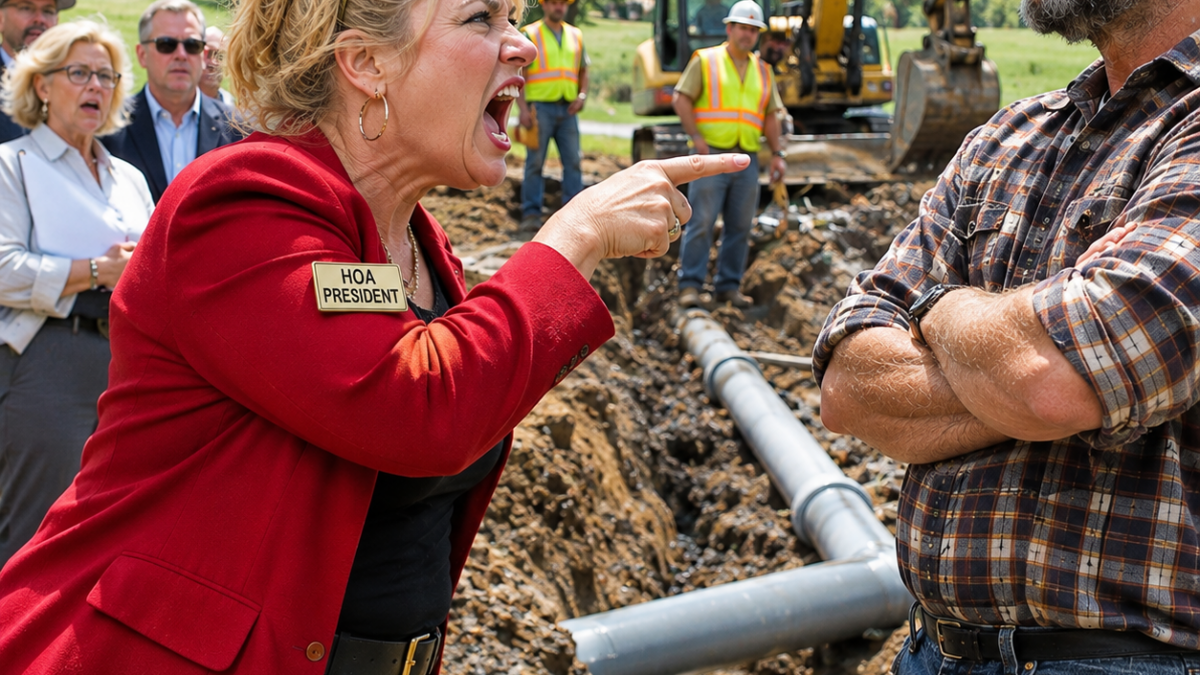
Whitney walked straight into the orange paint marking the excavation.
Cameras turned.
“Holt Callaway!”
I walked toward her.
She pointed at the trench.
“If you cut this line today, you are intentionally harming seventy families.”
“No.”
“You will be sued by every homeowner.”
“The contingency plan is active.”
“You will be hated in this county.”
“Whitney.”
“There is still time.”
Her voice cracked.
“Please.”
That word changed the mood.
Not mine.
The crowd’s.
For a month, Whitney had behaved as if authority belonged naturally to her.
Now she was begging the owner of the land not to exercise a remedy she had spent thirty days refusing to take seriously.
I said:
“The sanitation trucks are already in Bluff View.”
She shook her head.
“You don’t understand.”
“I understand exactly.”
“No homeowner will be left without safe service.”
“You’re doing this for revenge.”
“I’m doing this because the pipe is trespassing.”
She stepped deeper into the marked area.
“I’ll stand here.”
“Whitney.”
“You’ll have to cut around me.”
Sheriff Bo Yardley stepped forward.
“Mrs. Aldridge.”
She ignored him.
“I will block this trench with my body if I have to.”
Then my mother walked forward.
## **VIVIAN CALLAWAY**
Mama had returned from Daniel’s cairn.
She crossed the orange line.
Stopped two feet from Whitney.
Every camera moved.
I knew the voice Mama used before she spoke.
I had heard it only a few times.
The day Daniel died.
The day Dad died.
The day she signed over the ranch to me.
Quiet enough that everybody else automatically became quiet too.
“Mrs. Aldridge.”
Whitney looked at her.
“My granddaughter walked that trail this morning.”
Silence.
“She carried flowers to the place where my son died when he was twelve.”
Whitney’s face changed.
Mama continued.
“Your sewer pipe runs beneath that trail.”
No one moved.
“That pipe was not there when my boy died.”
Her voice never rose.
“You put it there without asking us.”
Whitney opened her mouth.
Mama kept going.
“For five and a half years, seventy homes have sent their waste underneath ground where I still stand every October and remember my son.”
Whitney’s eyes moved toward me.
Mama did not allow the escape.
“Look at me.”
Whitney did.
“My son gave you thirty days to fix this.”
A pause.
“You spent those days fighting him.”
Mama glanced toward the work crew.
Then back.
“In a few minutes, you are going to watch him turn that saw on.”
Nobody breathed.
“Then you are going home.”
Whitney said nothing.
She stepped backward.
Then another step.
Walked to the Range Rover.
Cooper followed.
They sat inside.
Did not leave.
## **11:58**
The trench was open.
Fourteen-inch PVC.
Black soil.
Gray sky.
The pipe sat exposed at the property line.
Trent handed me the reciprocating saw.
Big cordless unit.
Eight-inch bi-metal blade.
“Holt.”
“Yeah?”
“You sure?”
I looked at him.
He knew the answer.
“Yeah.”
I climbed down.
Above me stood my wife.
My daughters.
My mother.
Pippa.
DEQ.
EPA.
Sheriff.
Press.
And, uphill, the people whose development had spent five and a half years depending on something buried where it did not legally belong.
I looked at my watch.
11:59:30.
Thirty seconds.
My hands were steady.
That surprised me.
Twenty seconds.
I thought about Dad.
Ten.
Daniel.
Five.
Mama.
Noon.
I squeezed the trigger.
## **THE CUT**
The saw screamed.
The blade bit into PVC.
Twenty-two seconds.
First cut.
I shifted four inches.
Second cut.
A narrow section came free.
The line was empty at that moment because households had been instructed to pause water use.
No spray.
No overflow.
No environmental release.
Just a clean cut.
I lifted the section.
Cameras clicked.
Then handed it to Innis.
She bagged it as evidence.
EPA photographed it.
Trent’s crew capped both ends.
Installed the planned flange arrangement for inspection and future removal.
Eleven minutes.
That was all.
Years of unauthorized infrastructure.
Thirty days of escalation.
Millions of dollars of litigation and enforcement exposure.
Physically ended in eleven minutes.
At 12:14, the line was severed.
At 12:15, reporters were already filing.
At 12:30, television banners read:
**RANCHER CUTS UNAUTHORIZED SEWER LINE AT BLUFF VIEW**
I climbed out.
Pearl handed me focaccia.
“Eat.”
“I’m not hungry.”
“Holt.”
I ate.
It was excellent.
## **MAMA**
She came beside me.
Hooked her arm through mine.
We looked at the trench.
Then toward the bluff.
Then toward North Ridge.
She whispered:
“Daniel would have laughed his head off.”
I nearly cried.
Nearly.
Instead, I leaned my head toward hers for a second.
The Range Rover stayed parked until 12:47.
Whitney and Cooper watched everything.
Then left.
## **THE SHERIFF**
Bo came over around one.
Shook my hand.
“That may be the most dignified thing I’ve ever seen anyone do with a reciprocating saw.”
I laughed.
“Low bar?”
“Your mother was magnificent.”
“That part is true.”
## **EPA**
Special Agent Quinn Larkin approached after.
Nineteen years in environmental enforcement.
Calm.
Professional.
“Mr. Callaway.”
“Yes?”
“The federal grand jury process begins Monday.”
I nodded.
“I have rarely seen a private-property remedy executed with this much regulatory coordination.”
“That was the point.”
“The Aldridges are going to have a difficult year.”
“I suspect so.”
## **THE AFTERNOON**
By three, most press had gone.
Pippa sat on our porch with Pearl, Mama and me.
Iced tea.
Pacific light through clouds.
She outlined the next steps.
Partial summary judgment motion.
Trespass.
Damages.
Federal investigation.
Settlement pressure.
Estimated restitution in the millions.
Then she said several organizations wanted to publicly support us.
Bar association.
Environmental advocates.
Agricultural groups.
I almost laughed.
Instead:
“Tell them thank you.”
“That’s it?”
“We still have work.”
Pippa smiled.
“You really did retire badly.”
## **ROWAN**
That evening, Rowan came down from the trail.
Sat beside me on the porch swing.
No words.
Leaned against my shoulder.
I looked toward the Pacific.
The sky went orange.
Pink.
Then gray.
I thought about Daniel.
About Dad.
About thirty days.
About the fact that when I woke the next morning, Whitney Aldridge would still exist, Cooper would still exist, Bluff View would still exist.
But the pipe would not still be crossing my ranch.
That was enough.
## **EIGHT MONTHS LATER**
June.
Warm afternoon.
North Ridge Trail.
Wren stood in front of forty-three people performing a thirty-minute comedy set.
She was twelve.
She destroyed.
In a good way.
Neighbors.
Two state senators.
An environmental reporter.
My mother laughing so hard she had to sit down.
I stood near the cairn.
The ground underneath us was clean.
No sewer.
No hidden infrastructure.
Just trail.
Soil.
Prairie.
Memory.
That was the ending I cared about.
But before we reached it, the Aldridges had to face theirs.
## **THE FEDERAL CASE**
Cooper and Whitney were indicted in January on the offenses described in the source, including federal environmental and fraud-related charges along with state conduct tied to the unauthorized infrastructure.
They eventually accepted plea agreements.
Cooper received five years federal custody.
Whitney received three.
Restitution to my family came in just under three million dollars.
Pearl received a separate award tied to interference with Hazel’s.
Aldridge Coastal Development was hit with a separate $1.6 million environmental penalty.
The company and both Aldridges were barred from future Oregon development and HOA service under the resolution described in the source.
When Pippa told me the final numbers, I did not celebrate.
Pearl asked:
“You okay?”
“Yes.”
“You look disappointed.”
“I’m not.”
“Then what?”
I looked toward the ranch.
“Money doesn’t unbury Daniel’s trail.”
“No.”
“But removing the pipe did.”
I nodded.
“That part feels different.”
## **BLUFF VIEW CHANGES**
The homeowners did not disappear.
That matters.
Seventy families had bought expensive houses believing their sewer system was lawful.
Many had been misled.
They reorganized under court-supervised receivership.
The old HOA became the Bluff View Coastal Association.
New bylaws.
Twelve pages.
Plain English.
Dues dropped by nearly a third.
Captain Olson Brackett became president.
Apparently he had been waiting years for the chance.
He came to the ranch after the election.
“I got the gavel.”
“I heard.”
“My wife says I’m enjoying it too much.”
“You probably are.”
“I promise not to bury infrastructure on your ranch.”
“Strong first policy.”
## **THE APOLOGY BARBECUE**
Twenty-nine Bluff View homeowners came to our pasture in April.
Not required.
They organized it themselves.
Side dishes.
Chairs.
Kids.
Someone brought a carved cedar plaque.
**THANK YOU FOR HOLDING THE LINE**
I did not know what to say.
Mama did.
“Put it at Hazel’s.”
Pearl agreed.
So it hangs on the bakery wall.
Customers ask about it.
Pearl sometimes gives the short version.
“They buried a sewer on our land.”
“What did Holt do?”
“Cut it.”
Then she sells them bread.
She is much more efficient than I am.
## **THE REAL SEWER ROUTE**
The replacement system followed the route it should have followed from the beginning.
Highway 101 right-of-way.
Permits.
Engineering.
Environmental review.
Proper construction.
Expensive.
Exactly why Aldridge had avoided it.
The reroute took six months.
Paid from the developer’s bonded reserves.
Not from the Callaway family.
Not from homeowners directly.
When the new system became operational, crews removed the old unauthorized line from my property.
All 1.3 miles.
## **RESTORING THE LAND**
May.
Trenches filled.
Grades restored.
Christmas-tree field repaired.
Prairie reseeded.
Road rebuilt.
Carl returned with the GPR cart.
We walked the route again.
Same machine.
Different day.
At the point where he first detected the pipe, he stopped.
Looked at the screen.
Then at me.
“Nothing.”
“Nothing?”
“Nothing foreign.”
We kept walking.
At North Ridge Trail, same result.
No pipe.
Carl folded his equipment.
“I’m not billing you.”
“You’re absolutely billing me.”
“No.”
“Carl.”
“Thirty years doing this work.”
“Yes.”
“Most satisfying survey of my career.”
“That doesn’t make it free.”
“It does today.”
I tried arguing.
Lost.
## **DANIEL’S TRAIL**
Our family placed sixty acres surrounding North Ridge Trail into a permanent public-access conservation easement with the Lincoln Land Trust.
Sunrise to sunset.
Public trail.
Coastal prairie.
Views.
Wildlife.
At the trailhead, a small carved sign bears my brother’s name.
**DANIEL CALLAWAY COASTAL TRAIL**
Dates of his life.
Nothing about sewer pipes.
Nothing about Whitney.
Nothing about lawsuits.
That was intentional.
Daniel deserved a trail named for his life, not for what someone buried beneath the place where it ended.
## **MAMA WALKS IT**
Every Sunday morning.
Sometimes with Rowan.
Sometimes Wren.
Sometimes alone.
Dad’s denim jacket when wind comes hard off the Pacific.
She walks to the cairn.
Stands.
Comes home.
One Sunday, I went with her.
At the spot where the pipe had once crossed, she stopped.
“This was it?”
“Yes.”
“Exactly?”
“Yes.”
She pressed the toe of her boot into the restored soil.
Then looked up.
“Good.”
That was all.
Forty years of grief and five and a half years of insult reduced to one word.
Good.
## **THE WALT CALLAWAY COASTAL EDUCATION FUND**
The second thing we created carried my father’s name.
Dad had been principal of Newport High School for twenty-eight years.
The fund awards $5,000 each year to a graduating student entering civil engineering, environmental science or vocational construction trades.
The first recipient was Mira Bjornson.
Seventeen.
Future civil engineer.
She wrote me a letter thanking us.
I keep it on my desk.
One line says:
**I want to build infrastructure people can trust even when they never see it.**
I read that more than once.
Because that was the real failure at Bluff View.
Not a pipe.
Trust.
Infrastructure is mostly invisible.
People flush.
Water disappears.
Lights turn on.
Roads drain.
Bridges hold.
Society works because most of us trust that somebody did the invisible part correctly.
The Aldridges exploited that trust.
## **PEARL’S BAKERY**
Hazel’s survived everything.
Health inspection.
Broken van.
Threat.
Bribe.
Press.
Pearl still wakes at three-thirty.
Still bakes cardamom buns.
Still uses the same sourdough starter.
Cooper’s half-finished bun remains in our freezer.
I have asked several times when it becomes biohazardous.
Pearl says:
“It’s evidence.”
“Evidence has retention schedules.”
“This one doesn’t.”
I stopped arguing.
## **ROWAN**
She was admitted early to Oregon State.
Marine biology.
I lost that argument too.
At dinner, she waved the acceptance letter.
“Say it.”
“No.”
“Dad.”
“Civil engineering remains available.”
“Say you’re proud.”
“I’m proud.”
“Of marine biology?”
“Of you.”
She smiled.
“Close enough.”
## **WREN**
The stand-up clip from the June celebration went viral locally.
She booked several paid appearances in Portland for the next summer.
At twelve.
I am deeply concerned.
Her favorite line about the entire dispute:
“My dad cut a sewer line legally, which is apparently what happens when engineers finally develop emotions.”
Mama laughed hardest.
## **MARVIN**
Marvin Boatwright, the former inspector hired to surveil me, ended up working for the new Bluff View association.
Full-time investigator.
Captain Brackett hired him.
Same silver sedan.
Same black coffee.
He came by once.
“Still mad?”
“No.”
“You should be.”
“You quit when you learned the truth.”
“I still took the job.”
“You didn’t know.”
He nodded.
“Your mother scares me.”
“She scares everybody.”
## **THE ATTORNEYS**
The emergency lawyer who filed the last-minute TRO faced professional consequences following the court’s referral, as described in the source.
Cooper’s Portland firm later reached its own confidential resolution with affected homeowners.
I stayed out of most of that.
By then, I wanted my life back.
There is a point in every legal fight where continuing to watch every consequence becomes another form of being controlled by the people who caused it.
I did not want to spend retirement monitoring Whitney Aldridge.
I wanted to plant trees.
## **THE TREES**
The 140 damaged noble fir seedlings were replaced.
Some survived.
Some didn’t.
Christmas-tree farming teaches patience.
You do not fix vandalism in an afternoon.
You replant.
Wait.
Water.
Prune.
Years later somebody carries that tree into a living room and has no idea it was planted because somebody drove a pickup through a field during an HOA dispute.
That is probably healthy.
## **THE PIPE SECTION**
DEQ retained the cut section as evidence.
For a while.
Eventually Pippa asked whether I wanted it after the case closed.
I said no.
She seemed surprised.
“No trophy?”
“No.”
“You kept every county road map from 1997.”
“Different.”
“You sure?”
I looked toward Daniel’s trail.
“Absolutely.”
I did not want a piece of that pipe in my barn.
Removing it was the point.
## **THE $3 MILLION**
People asked what I did with the restitution.
Some went to taxes.
Legal expenses.
Restoration.
Trusts.
Education fund.
Land stewardship.
Family security.
No yacht.
No sports car.
No revenge mansion.
Pearl said:
“We could buy something ridiculous.”
“Like?”
“Second mixer.”
“You already own two.”
“Exactly.”
That was the extent of our extravagance.
## **THE DAY AFTER THE CUT**
The sanitation plan worked.
That mattered tremendously.
Most Bluff View residents experienced inconvenience, not crisis.
Temporary holding.
Hauling.
Portable units.
Scheduled service.
The physical interruption was brief.
I received several angry emails.
I also received apologies.
One homeowner wrote:
**I hated you yesterday. Then I read the DEQ file. I’m sorry.**
I answered:
**Take care of your family. Let the lawyers handle the rest.**
No victory speech.
## **THE HOMES WERE NEVER THE ENEMY**
This became important as the story spread.
The title made it sound like I shut down seventy families’ toilets.
That is dramatic.
It is also incomplete.
I severed an illegal trunk with a fully funded sanitation contingency already operating.
The homeowners were not the target.
The encroachment was.
Whitney wanted those two things blurred because frightened homeowners were useful to her.
I refused.
## **CAPTAIN BRACKETT’S FIRST MEETING**
He mailed me the minutes.
Actual pages.
Financial controls.
Conflict disclosures.
Contract review requirements.
No undocumented utility arrangements.
Independent engineering approval.
Public budget summaries.
I called.
“Olson.”
“Yes?”
“This is painfully responsible.”
“Thank you.”
“I hate it.”
“Come to the next meeting.”
“No.”
“Why?”
“I retired from government.”
“You cut a sewer on live television.”
“That was personal.”
He laughed.
## **THE PLAQUE AT HAZEL’S**
Customers touch it sometimes.
**THANK YOU FOR HOLDING THE LINE.**
Pearl eventually mounted it near the register.
One morning I asked:
“Do you think that sounds smug?”
“Yes.”
“Should we take it down?”
“No.”
“Why?”
“Because they gave it to us.”
Fair.
## **MAMA’S VERSION OF THE STORY**
She tells it in six sentences.
“They buried the sewer.”
“Holt found it.”
“They acted foolish.”
“I told Whitney about Daniel.”
“Holt cut the pipe.”
“Then we fixed everything.”
No details about statutes.
No GPR.
No federal case.
No millions.
When I point this out, she says:
“You talk too much.”
She is right.
## **DANIEL**
For decades, I carried guilt about being thirty feet behind him.
I know intellectually that fourteen-year-old boys cannot control wet basalt.
I know that.
Understanding is not the same as releasing.
The sewer fight did not cure that grief.
Nothing will.
But creating the Daniel Callaway Coastal Trail changed the shape of it.
People walk there now.
Families.
Runners.
Birders.
School groups.
My brother’s name is spoken by people who never knew him.
That feels different from a cairn only my mother and I visited.
## **THE FIRST SCHOOL GROUP**
A teacher brought students to the trail.
One kid read Daniel’s sign.
“Who was he?”
“My brother.”
“What happened?”
“He died here when we were kids.”
The boy looked embarrassed.
“Sorry.”
“Thank you.”
Then he asked:
“Is that why the trail is protected?”
“Partly.”
I looked across the prairie.
“Mostly because it deserves to be.”
## **THE BLUFF PRAIRIE**
Native bluff prairie is fragile.
Salt.
Wind.
Thin soils.
Specialized plants.
The unauthorized drilling had crossed beneath it.
After removal, restoration crews reseeded disturbed areas.
Rowan helped select native-species guidance.
She enjoyed reminding me that marine biologists know things about coastal ecology.
I pretended not to enjoy that.
## **THE IRONY OF THE PIPE**
The Aldridges had buried it because the legal route was expensive.
Their shortcut eventually cost vastly more.
That is the pattern of dishonest infrastructure.
Compliance looks expensive until noncompliance is discovered.
Then the original price seems cheap.
Four-million-dollar lawful route.
Millions in fines.
Restitution.
Criminal cases.
Destroyed business.
Lost development rights.
Years of litigation.
All to avoid building the pipe where the recorded plans said it should go.
## **WHY I WAITED THIRTY DAYS**
Some people thought I should have cut it immediately.
I could not.
Legally.
Ethically.
Practically.
Active wastewater infrastructure affects human health.
You do not swing a saw because you are angry.
You notify.
Coordinate.
Engineer.
Plan.
Protect.
Then act.
Those thirty days were miserable.
They were also what made the final action defensible.
Mama had been right.
Proper way.
Then consequences.
## **THE WORST NIGHT**
It was not the night before the cut.
It was after Pearl’s van was damaged.
She had gone to bed.
I stayed in the kitchen.
I thought:
Maybe we should settle.
Not because they were right.
Because I had daughters.
A wife.
A mother.
A business.
A farm.
One sewer line did not seem worth watching somebody terrorize my family.
Then I looked through the window.
The bluff lights.
I realized that was exactly why intimidation works.
Not because victims become convinced they are wrong.
Because being right gets exhausting.
That night I almost let exhaustion decide.
I’m glad I didn’t.
## **THE BEST THING PIPPA SAID**
Not “kill shot.”
Something later.
After settlement.
We sat at Hazel’s.
Pearl brought coffee.
Pippa said:
“Good cases are not about humiliating the other side.”
“What are they about?”
“Making the next person think twice.”
I looked at Bluff View through the window.
“That happen?”
“Oh, yes.”
## **THE NEXT DEVELOPER**
A developer contacted us the following year about a legal utility easement near the far edge of the ranch.
Completely unrelated project.
They arrived with surveyors.
Engineers.
Written plans.
Compensation proposal.
Environmental review.
Everything.
The project manager joked:
“We thought we should ask.”
I stared at him.
He immediately stopped smiling.
Good instinct.
We negotiated normally.
That is how it is supposed to work.
## **THE DIFFERENCE PERMISSION MAKES**
I am not opposed to infrastructure.
I spent twenty-eight years building it.
Roads.
Drainage.
Utilities.
Public systems.
Civilization needs pipes.
The problem was never that a sewer existed.
The problem was somebody deciding my family’s land was cheaper than permission.
That distinction matters.
## **THE RANGE ROVER**
I never saw Whitney’s Range Rover after the case ended.
Good.
Unlike Pearl, I do not preserve vehicles as emotional artifacts.
## **THE FOCACCIA**
The crew still talks about Pearl’s bread.
Trent Halliday called six months later.
“Your wife catering?”
“She has a bakery.”
“I mean job sites.”
“No.”
“Shame.”
“You got free focaccia while cutting a fourteen-inch sewer. Don’t be greedy.”
## **THE SAW**
I did keep the reciprocating saw.
Not as a trophy.
It belongs to Trent.
He gave it to me afterward.
“Why?”
He shrugged.
“Historic.”
“It’s a DeWalt.”
“You know what I mean.”
It hangs in the barn.
I use it.
Fence posts.
Old lumber.
Normal things.
That is better.
## **WREN’S JOKE**
Her cleanest version:
“My dad spent twenty-eight years working for county government, so when the HOA made him angry, he didn’t yell. He created a thirty-day compliance schedule.”
That one always gets a laugh.
Even me.
## **MY FATHER**
Walt Callaway would have hated the media attention.
Principal for twenty-eight years.
He believed public embarrassment should be used sparingly.
He also believed rules mattered.
When I imagine telling him what happened, I hear:
“You notified them?”
“Yes, Dad.”
“In writing?”
“Yes.”
“Certified?”
“Yes.”
“Environmental review?”
“Yes.”
“Contingency sanitation?”
“Yes.”
“Then why are you asking me?”
That was Walt.
## **OTIS AND THE BUTTER**
My grandfather bought this land partly with butter.
That sounds ridiculous now.
But every Friday for nine years, butter left the farm because a debt had been promised.
There is something profound about that to me.
Contracts matter.
Promises matter.
Ownership matters.
The Aldridges believed modern money and development somehow made old boundaries negotiable.
Otis would have understood exactly what was wrong with that.
You pay what you owe.
You ask before using what belongs to someone else.
Simple.
## **THE SEVENTY HOMEOWNERS**
I eventually met many.
Some apologized.
Some never did.
That is fine.
I did not need seventy apologies.
I needed the pipe removed.
The new association manages things properly.
That is more valuable than symbolic remorse.
## **THE PEOPLE WHO DEFENDED WHITNEY**
A few homeowners stayed loyal until the end.
One accused me of destroying community value.
I asked:
“Would your home be more valuable with an illegal sewer?”
He did not answer.
Another said I should have negotiated privately.
I reminded him we tried.
Thirty days.
He stopped calling.
## **THE 30-DAY NOTICE ON MY WALL**
I framed the first page.
Not the criminal charges.
Not a newspaper.
Not the cut photo.
The notice.
Why?
Because that was the moment anger became process.
Everything after flowed from it.
Proper notice.
Chance to cure.
Deadline.
Consequence.
A line anyone could understand.
## **WHY WHITNEY LOST**
Not because I was louder.
She was louder.
Not because I had better press.
She knew how to work a room.
Not because I had more money.
I did not.
She lost because the documents lined up.
Deed.
No easement.
GPR.
Recorded plat.
2018 survey letter.
DEQ findings.
Notice.
Contingency plan.
Evidence of retaliation.
When facts line up, personality becomes less useful.
## **COOPER’S BRIBE**
Pearl still calls it the Bun Incident.
Whenever somebody offers her an overly complicated business proposal, she says:
“Does this come with a bribe check and half a cardamom bun?”
Most people do not understand.
I do.
## **THE CHRISTMAS SEASON AFTER**
Our tree farm was busy.
Families arrived.
Sawed trees.
Kids ran between rows.
Some trees showed scars from the vandalism.
Most customers never noticed.
Mama did.
She touched one damaged noble fir.
“This one stays.”
“Why?”
“Let it grow.”
“It’ll be crooked.”
“So?”
We kept it.
It stands near the field entrance.
Crooked.
Alive.
## **THE NEW TRAIL SIGN**
Simple cedar.
No grand plaque.
**DANIEL CALLAWAY COASTAL TRAIL**
Below:
**Public Access Sunrise to Sunset**
That is all.
No villain.
No sewage.
No revenge.
Exactly right.
## **MAMA TURNS EIGHTY**
We held lunch at the ranch.
Captain Brackett came.
Pippa.
Carl.
Trent.
Pearl baked cake.
Wren did ten minutes of comedy that Mama insisted was “mostly appropriate.”
At sunset, Mama asked me to walk the trail.
Just us.
At Daniel’s cairn, she set flowers.
Then looked toward where the sewer had crossed.
“Nothing there.”
“No.”
“Good.”
Again that word.
Good.
## **I SLEEP WELL**
During those thirty days, I did not.
Every truck at night.
Every phone call.
Every unknown number.
Every sound near the bakery.
I wondered who was watching.
What would be damaged next.
Whether the family had become collateral damage in a fight I could have avoided by taking money.
Now I sleep.
Wind off Pacific.
Rain.
Occasional coyote.
Normal worries.
That is wealth.
## **THE LAND REMEMBERS**
People say land does not care.
In one sense, true.
Soil has no emotion.
But land holds evidence.
Old fence lines.
Compacted roads.
Tree scars.
Utility trenches.
Cairns.
Trails.
Foundations.
Radar finds what people thought was hidden.
My grandfather’s dairy is gone.
You can still see where parts of it were.
Daniel is gone.
His trail remains.
The sewer is gone.
For a while, GPR could still read disturbed soil.
The land remembers physically even when people prefer forgetting.
## **THE FINAL PRESS INTERVIEW**
A reporter asked:
“Was cutting the line revenge?”
I answered:
“No.”
She looked disappointed.
“What was it?”
“Removal.”
“Did it feel like revenge?”
That was a better question.
I thought.
“For eleven minutes.”
“And afterward?”
“Work.”
That was true.
## **WHAT REALLY FELT LIKE WINNING**
Not the saw.
Not Whitney stepping backward.
Not the federal sentence.
Not the money.
June.
Wren telling jokes near the trail.
Rowan home from a run.
Pearl handing out bread.
Mama sitting under a canopy laughing.
Captain Brackett talking with neighbors.
Children walking a trail named for Daniel.
No pipe underneath.
That was winning.
## **THE LAST WALK WITH CARL**
After his final radar survey, he and I stood near the Christmas trees.
“You were angry the first day,” he said.
“Was I?”
“You barely spoke.”
“That means angry.”
“I know.”
He folded the GPR handle.
“Worth it?”
“What?”
“Everything.”
I looked toward North Ridge.
“Yes.”
He nodded.
“Good.”
Apparently everyone in my life had reduced the entire affair to that word.
## **THE STORY PEOPLE TELL**
They tell it like this:
HOA buried sewer.
Rancher found sewer.
Rancher gave warning.
HOA refused.
Rancher cut pipe.
HOA lost millions.
Accurate enough.
But incomplete.
The real story is about restraint.
If I had cut it the first day, I would have become the problem.
If I had ignored it, the pipe might still be there.
If I had taken Cooper’s money, Daniel’s trail would still have sewage beneath it.
If Mama had shouted at Whitney, cameras would remember shouting.
Instead, she spoke quietly.
If we had abandoned homeowners, they would have been victims twice.
Instead, we built sanitation backup.
That is the story.
## **THE LAST EVENING**
Recently, Pearl and I sat on the porch after sunset.
Hazel’s was closed for the day.
Rowan was reading an Oregon State housing email.
Wren was editing jokes.
Mama’s cottage light glowed behind us.
Bluff View lights shone uphill.
Different association now.
Different leadership.
Legal sewer route.
Normal life.
Pearl leaned against me.
“You know what’s strange?”
“What?”
“You never wanted this fight.”
“No.”
“But you seem more settled.”
I thought.
“Maybe.”
“Why?”
I looked toward North Ridge.
“Because the thing that bothered me wasn’t the pipe.”
“What was?”
“That somebody thought our family wouldn’t notice.”
Pearl nodded.
Then:
“You noticed.”
“Yes.”
## **THE FINAL MORNING**
On the anniversary of Daniel’s death, Mama and I walked the trail.
Cold wind.
Pacific gray.
She wore Dad’s denim jacket.
At the cairn, she placed flowers.
I stood beside her.
Forty years earlier, I had been a fourteen-year-old boy thirty feet too far away.
There is no remedy for that.
No statute.
No thirty-day notice.
No lawyer.
No saw.
You carry certain things.
Then Mama reached for my hand.
Not something she does often.
We stood there.
Under our feet was soil.
Just soil.
No pipe.
After a while she said:
“Your brother would be fifty-two.”
“I know.”
“He’d still be trouble.”
“Definitely.”
“He would have liked Pearl.”
“He did meet her once.”
“Briefly.”
She nodded.
Then she smiled.
“He would have carried the saw.”
I laughed.
“Probably two saws.”
We started home.
## **THE END**
Whitney Aldridge thought the sewer line was untouchable because seventy expensive homes depended on it.
She thought necessity would turn trespass into permission.
She thought money could make a hidden pipe permanent.
She thought thirty days was enough time to intimidate me into backing down.
She used those thirty days badly.
She sued.
Someone destroyed trees.
Pearl’s van was vandalized.
Her bakery was reported.
Cooper offered money.
A private investigator watched my driveway.
Whitney raised a special assessment and told seventy families I was the threat.
All while the clock kept moving.
Thirty.
Twenty-nine.
Twenty-eight.
Fifteen.
Six.
One.
Then zero.
What they never understood was that I had spent twenty-eight years dealing with infrastructure people only notice when it fails.
I knew what had to happen before a line could be interrupted.
Notice.
Engineering.
Regulators.
Environmental controls.
Health safeguards.
Backup sanitation.
Documentation.
Everybody protected.
Then—and only then—removal.
At noon, the saw took twenty-two seconds to make the first cut.
But that cut took thirty days to earn.
And nearly six years of secrecy to deserve.
The most dramatic part was not the sound of the blade.
It was my mother standing two feet from Whitney Aldridge.
Seventy-nine years old.
My father’s denim jacket.
No shouting.
No insult.
Just the truth.
Her son died on that trail.
The Aldridges put sewage beneath it without permission.
The time to fix it had passed.
Those words moved Whitney out of the trench more effectively than any deputy could have.
Months later, the Aldridges were gone.
The pipe was gone.
The old HOA was gone.
The ranch remained.
Bluff View remained too.
That matters.
The people in those seventy homes were never erased from the story just because their developer lied.
They got a legal sewer.
A functional association.
Lower dues.
Better governance.
Some became friends.
That is a better ending than seventy families suffering because two people made terrible decisions.
My family got restitution.
But the money is not what I think about when I walk North Ridge.
I think about the new sign.
Daniel Callaway Coastal Trail.
I think about my mother walking it on Sunday mornings.
Rowan heading toward marine biology despite my objectively superior career recommendations.
Wren testing jokes on anyone unable to escape.
Pearl waking before dawn to make bread.
The education fund carrying Dad’s name.
The Christmas trees growing again.
And the dirt beneath my boots finally containing nothing somebody hid from us.
My grandfather bought this ranch in 1939 with $1,100 and butter.
My grandmother kept it when things were hard.
My mother protected it.
My father taught a generation of kids while raising us on it.
Daniel died on it.
Pearl built a business beside it.
My daughters are growing up on it.
I do not believe owning land means refusing every change.
I spent most of my career building public things across private places.
Roads need rights-of-way.
Utilities need easements.
Communities need infrastructure.
But there is a process for a reason.
You ask.
You negotiate.
You record.
You compensate.
You protect the people whose land makes the project possible.
The Aldridges skipped all of that because the shortcut saved money.
In the end, the shortcut cost them almost everything.
That is the part people call revenge.
Maybe a piece of it was.
I would be lying if I said I felt nothing when the pipe section came free in my hands.
For eleven minutes, anger felt good.
Then I climbed out of the trench and Pearl handed me bread.
Mama took my arm.
My daughters were watching.
And the feeling changed.
It stopped being revenge.
It became restoration.
Last Sunday, I walked the North Ridge Trail alone.
The Pacific was silver beyond the bluff.
Wind moved through the prairie.
At Daniel’s cairn, I stopped.
The restored ground around me looked ordinary.
That was exactly what I wanted.
No pipe.
No trench.
No cameras.
No Whitney.
No crowd.
Just land.
I put one hand on the stone.
“Hey, Danny.”
Wind off the ocean.
Nothing else.
I smiled.
“You would’ve carried the saw.”
Then I walked home.
And for the first time in years, there was nothing hidden beneath my family’s ground that did not belong there.








