PART 2: HOA Ripped Out My EV Charger, Calling It ‘Ghetto.’ Right-to-Charge Law Ended Them
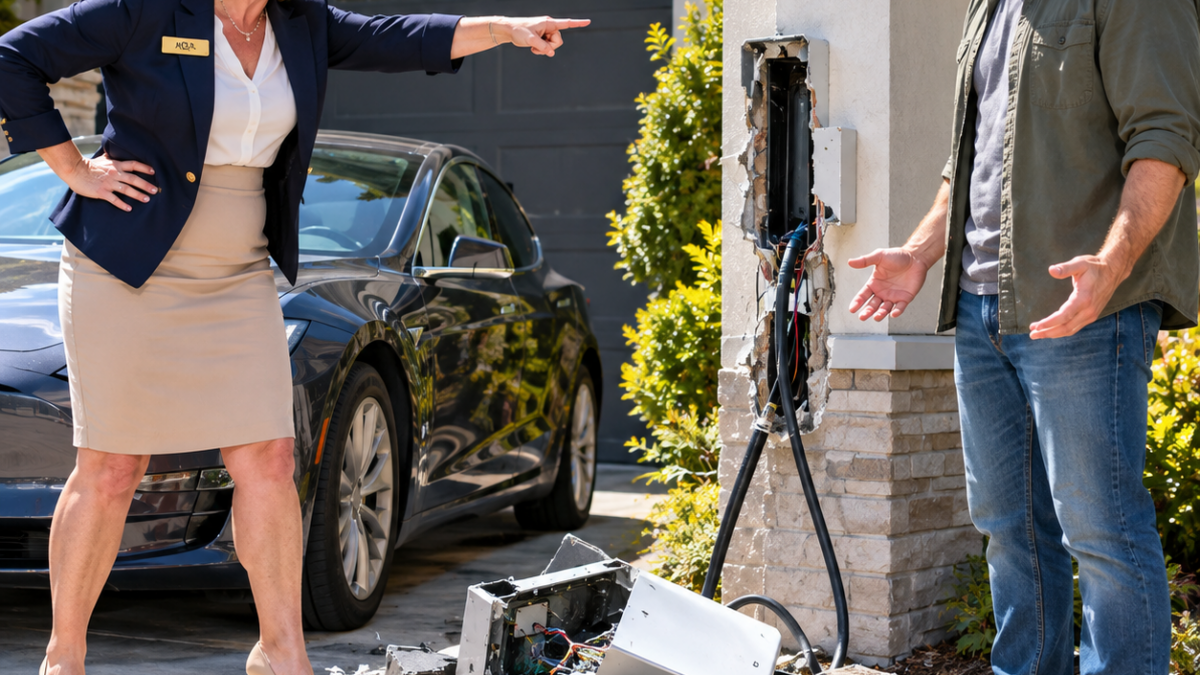
PART 2
For several seconds, I said nothing.
The refrigerator hummed behind me. A ceiling fan clicked faintly over the breakfast nook. Through the kitchen window, I could see Bill watering his hydrangeas as if this were an ordinary Thursday evening.
Then I looked back at the number on Sarah’s screen.
“Is that what they paid Miller & Sons?”
“That’s what I can document.”
It was more than sixty thousand dollars over roughly two years.
Sarah pulled out the chair across from me and sat down.
“I started keeping records after Karen fined us for our daughter’s playhouse.”
I remembered the little yellow-and-blue structure visible above their fence.
“She said it violated the approved color palette,” Sarah continued. “My husband wanted to pay the fine and move on. I did too, at first. Then I started wondering where the fine money went.”
She opened another folder.
Invoices.
Meeting minutes.
Budgets.
Violation notices.
Screenshots from the HOA portal.
Some were mundane. Lawn mowing. Mulch. Trimming common-area hedges.
Others were different.
“Emergency enforcement service,” Sarah read. “One hundred seventy-five dollars.”
“What was the emergency?”
“A basketball hoop.”
She clicked again.
“Special compliance removal. Two hundred fifty.”
“What did they remove?”
“A plastic storage bench from somebody’s porch.”
Another invoice.
“Corrective landscape action. Three hundred twenty-five dollars.”
I stared at it.
Sarah gave a tired smile.
“They trimmed Mrs. Franklin’s azaleas.”
I knew Mrs. Franklin. She was seventy-eight, lived alone, and walked every morning with a silver cane.
“Did she ask them to?”
“No.”
I sat down slowly.
Karen tearing out my charger had felt personal.
This was bigger.
Not necessarily criminal. Not yet. We didn’t know enough for that.
But it was a pattern.
Sarah turned the laptop toward herself.
“I’ve been requesting records for months. The HOA gives me just enough to claim they’re complying. Some invoices. Partial minutes. Budgets without attachments.”
“And nobody questioned it?”
“People questioned plenty.”
She looked toward the window.
“They just did it privately.”
That sentence stayed with me.
Privately.
Lakeside Meadows looked friendly from the street. People waved while walking dogs. Children rode bicycles in loops around the lake. On weekends, grills smoked behind fences and somebody was always washing a truck.
But underneath all that politeness was a peculiar silence.
People complained about Karen one household at a time.
A fine for a garbage can.
A warning about a garden flag.
A letter over mulch color.
A threat about a mailbox.
Each family thought its problem was too small to justify making enemies.
Karen’s power lived inside that isolation.
“What do you want from me?” I asked.
Sarah closed the laptop halfway.
“I want you not to settle quietly.”
That surprised me.
“I haven’t even been offered a settlement.”
“You will be.”
“You sound certain.”
“Because you have something most people didn’t.”
“What?”
“A law they can’t rewrite.”
She was right about that.
But Elena was right too.
Anger was useful only if I kept it under control.
“I need an attorney.”
“I know one.”
Sarah smiled for the first time.
“He lives on Birch Court.”
That was how Arthur Weinberg entered my life.
Arthur was seventy-three years old, retired, narrow-shouldered, silver-haired, and incapable of answering a simple legal question without first correcting your terminology.
He had spent thirty-eight years doing corporate litigation and regulatory compliance.
More importantly, he had lived in Lakeside Meadows since before Karen Miller knew where the clubhouse keys were kept.
He arrived at my house the next evening carrying a yellow legal pad and reading glasses.
Elena poured coffee.
Arthur ignored it until it was cold.
I showed him everything.
The application.
Certified-mail tracking.
Installation invoice.
Photos.
Sheriff’s incident report.
Karen’s violation letter.
The removal bill.
Sarah’s financial spreadsheet.
He read in silence for nearly forty minutes.
Finally he took off his glasses.
“First thing,” he said, “stop talking about destroying anybody.”
I looked at Elena.
She raised one eyebrow.
Arthur continued.
“Not because your anger is unreasonable. Because every unnecessary word is ammunition. From this point forward, assume everything you say to the board will be quoted without context.”
“Understood.”
“Second, a statute protecting EV charging does not mean a homeowner can install anything anywhere without reasonable conditions.”
“I know.”
“Good. Because that is what they will argue. They’ll say they weren’t banning the charger. They were regulating installation.”
“I submitted everything they asked for.”
Arthur tapped the certified-mail receipt.
“That matters.”
Then he tapped the HOA bylaws.
“This matters too.”
The architectural committee had thirty days to issue a written response.
Not a discussion.
Not a conversation Karen claimed happened privately.
A written response.
They had issued none.
“And then,” Arthur said, “they physically removed the equipment.”
He leaned back.
“That was reckless.”
Sarah sat forward.
“Illegal?”
Arthur frowned at her.
“Lawyers who use that word too casually end up apologizing in court.”
Sarah smiled.
“Which is why you’re here.”
He almost smiled back.
“What I can tell you is that they appear to have substantial exposure. Whether the association, individual directors, contractor, or insurer ultimately bears responsibility depends on facts we don’t have yet.”
“What do we do?”
Arthur finally picked up his coffee, discovered it was cold, and put it down again.
“We ask for something reasonable.”
That wasn’t what I expected.
“How reasonable?”
“Repair the electrical damage. Replace your charger. Cancel the fine and removal invoice. Confirm in writing that you may reinstall according to the original specifications. Reimburse documented costs.”
“That’s it?”
“For your charger dispute, yes.”
Sarah pointed toward her laptop.
“What about Miller & Sons?”
Arthur looked at her.
“That is a different question.”
Karen had made a mistake by combining both questions on the same afternoon.
We didn’t need to.
Arthur helped me draft a formal demand.
No insults.
No threats.
No references to tyranny, corruption, kingdoms, dictators, or war.
Just dates.
Documents.
Costs.
Rights.
I requested $2,184.63.
That number included the damaged charger, electrician’s repair estimate, drywall repair, permit-related costs, towing to a public fast charger when my battery became too low for the trip I had planned, and the certified mailing expenses.
Arthur made me remove the towing charge.
“Why?”
“Because it muddies the cleanest claim.”
“But I paid it because they destroyed my charger.”
“And you would rather win twenty-one hundred dollars cleanly than argue for twenty-two hundred messily.”
That was Arthur.
Precision over satisfaction.
The letter gave the board ten business days.
I mailed one certified copy to the association’s management company.
Another went to the board.
Then I waited.
On the third day, Karen walked past my house with another board member, Tom Albright.
She did not look toward the garage.
On the fifth day, an HOA violation notice appeared taped to my front door.
Not mailed.
Taped.
It concerned “unauthorized exterior electrical infrastructure.”
The charger was gone.
I photographed the notice before touching it.
Arthur laughed when I emailed him the image.
Not a happy laugh.
A lawyer’s laugh.
The kind that meant somebody had just made his job easier.
On day nine, the board responded.
They denied reimbursement.
They denied wrongdoing.
They claimed my application had been “administratively incomplete.”
They claimed the charger presented an aesthetic concern.
They claimed that because the garage door could sometimes be open, the equipment became “visible from the common streetscape.”
At the bottom was a paragraph warning me against “hostile communications toward volunteer board leadership.”
Elena read that twice.
“Hostile?”
“I’ve sent two letters.”
“You said ‘Dear Board of Directors.’”
“Maybe it was too aggressive.”
She laughed despite herself.
Then she stopped.
“There’s something else.”
She handed me a printed email.
Karen had sent it to residents on our block.
It described an unnamed homeowner who was creating “an increasingly confrontational atmosphere” and refusing to respect community standards.
She didn’t use my name.
She didn’t need to.
Everyone knew.
“I’m sorry,” Elena said.
“For what?”
“That this is happening where we wanted to finally feel settled.”
That landed harder than the email.
We had spent years measuring life in assignments.
Fort Hood.
Fort Lewis.
Germany.
Virginia.
Colorado.
Deployments.
Rentals.
Temporary furniture.
Boxes we never completely unpacked.
Lakeside Meadows was supposed to be the permanent place.
Elena had chosen paint colors for rooms because, for once, we might live with them long enough for the colors to fade.
Now she was checking the driveway before leaving for night shift.
I put Karen’s email down.
“This ends without us moving.”
Elena looked at me carefully.
“Promise me something.”
“What?”
“Don’t make winning more important than living.”
I nodded.
That became the rule I returned to whenever my anger got ahead of me.
The following Saturday, Sarah invited us to her house.
Arthur came too.
So did Bill.
Then Mrs. Franklin.
Then the young couple from across the lake whose basketball hoop had been removed.
Seven people became eleven.
Sarah put a stack of printed invoices on her dining table.
“This is not a rebellion,” Arthur said before anyone got carried away.
Bill grinned.
“Can we call it a committee?”
“No.”
“A coalition?”
“No.”
“A concerned citizens brigade?”
Arthur stared at him.
Bill chuckled.
“Fine. Neighbors.”
That was better anyway.
We began with stories.
Mrs. Franklin had received a $100 violation after part of her front lawn browned during county watering restrictions.
“They told me to replace the sod,” she said.
“During watering restrictions?” Elena asked.
Mrs. Franklin nodded.
“I asked whether I was supposed to violate the city order to satisfy the HOA. They never answered. They just sent another letter.”
The young couple, Daniel and Heather, had been billed $180 after Miller & Sons removed their son’s portable basketball hoop from beside the driveway.
“They didn’t even call us,” Daniel said. “We came home and it was gone.”
“Did you get it back?” I asked.
“After I paid.”
Arthur looked up.
“You paid the contractor?”
“The HOA.”
“And then?”
“They told me where the landscaping company had stored it.”
Arthur wrote something down.
Bill’s offense had been his garden hose.
He had left it uncoiled after watering plants.
“I’m not proud of my criminal past,” he said solemnly.
Even Arthur smiled at that.
The laughter helped.
It reminded me these weren’t angry people looking for a fight.
They were ordinary homeowners who wanted the temperature turned down.
Sarah showed us what she had found.
Miller & Sons had received a growing share of the HOA’s maintenance and enforcement work after Karen became president.
No document we possessed showed competitive bids.
That did not automatically mean anything improper had happened.
But it raised questions.
Especially because Karen’s brother-in-law owned the company.
“Conflict-of-interest policy?” I asked.
Arthur flipped through the bylaws.
“There is one.”
Everyone leaned toward him.
He read aloud.
A director with a financial or familial interest in a proposed contract was required to disclose that interest and abstain from voting.
“Do the meeting minutes show her abstaining?” Sarah asked.
“Not the minutes you have.”
“Do they show disclosure?”
“No.”
The room got quiet.
That was our first genuinely important discovery.
Not proof of theft.
Not proof of fraud.
Proof that the process deserved scrutiny.
Arthur looked around the table.
“Everybody needs to understand something. We are not accusing anyone of crimes. We are requesting records and demanding proper governance.”
Sarah nodded.
“Facts.”
“Only facts.”
I thought about Karen’s brother-in-law throwing my charger into his truck.
Facts would be enough.
Over the next two weeks, something changed in Lakeside Meadows.
Not loudly.
At first, it happened in driveways.
At mailboxes.
Beside the community pool.
One neighbor told another.
Sarah created a password-protected website called Lakeside Ledger.
No insults were allowed.
No anonymous accusations of crimes.
Every published claim had to be supported by a document.
That rule became our strength.
A violation notice could be posted.
A meeting minute could be posted.
An invoice could be posted.
A personal theory could not.
The first article was called simply:
WHERE DO OUR ENFORCEMENT FEES GO?
It displayed five anonymized invoices from Miller & Sons.
The second explained the conflict-of-interest provision in the bylaws.
The third showed my charger application timeline.
Karen reacted within forty-eight hours.
The board’s management company emailed a warning that residents were spreading “misleading and divisive information.”
Sarah posted the email.
Under it she wrote one sentence:
“If any document on this site is inaccurate, please identify the specific document and correction.”
No correction came.
That was when the mood shifted.
People who had never spoken at HOA meetings began asking for financial records.
Karen had spent years dealing with individual homeowners.
She did not know what to do with twenty-seven of them asking the same question.
Then Janice Peterson knocked on our door.
It was 8:20 on a Tuesday evening.
Elena was preparing for work.
I opened the door and found Janice standing under the porch light in a gray cardigan.
She was the board secretary.
She looked terrified.
“Can I come in?”
I stepped aside.
Elena stopped halfway down the hall.
Janice sat on the edge of our sofa and kept both hands around a glass of water without drinking.
“I shouldn’t be here.”
Arthur’s warnings went through my head.
I did not ask her to reveal confidential legal advice.
I did not record her secretly.
I simply said, “Then you don’t have to stay.”
Her eyes filled.
“You don’t understand Karen.”
“I’m beginning to.”
“No.”
She shook her head.
“You understand what she does when she’s in control. You haven’t seen what she does when she thinks she’s losing it.”
Elena sat beside her.
“What happened?”
Janice stared into the water.
“The charger removal wasn’t voted on.”
I felt every muscle in my shoulders tighten.
“Excuse me?”
“Karen told Tom and me that management had authorized enforcement. She said the association’s attorney agreed. I assumed there was paperwork.”
“Was there?”
“I’ve never seen any.”
Elena spoke softly.
“Did you authorize Miller & Sons to enter our garage?”
Janice looked at her.
“No.”
“Did Tom?”
“I don’t know.”
Janice wiped her cheek.
“Karen told us after it was done.”
There it was.
The part of the story I had been waiting for.
The board had been hiding behind collective authority.
But according to its own secretary, the collective decision might never have existed.
I wanted to call Arthur immediately.
Instead I asked one question.
“Why tell us now?”
Janice looked toward the garage door.
“Because today she asked us to sign minutes saying we approved it.”
Nobody spoke.
“What minutes?” I asked.
“Minutes for an executive session she says occurred before the removal.”
“Did it occur?”
“No.”
I stood.
Elena immediately touched my wrist.
I sat again.
Blueprint.
Not sledgehammer.
“Janice,” I said, “don’t sign anything you believe is false.”
“I know.”
“And talk to your own lawyer.”
She looked surprised.
“Your own lawyer,” I repeated. “Not the association’s lawyer if your interests may be different from the board’s.”
Janice nodded slowly.
Before leaving, she turned at the front door.
“I should have stopped her sooner.”
Elena answered before I could.
“Then stop helping her now.”
The next morning Arthur came over.
When I told him what Janice had said, he became very still.
“Did you ask her to bring documents?”
“No.”
“Did you tell her what to say?”
“No.”
“Did you threaten her?”
“No.”
“Good.”
He made a phone call to an attorney he trusted who represented homeowners in community-association disputes.
By afternoon, I had hired her.
Her name was Rebecca Cho.
Rebecca did not care about Karen’s personality.
She cared about evidence.
Her first meeting with me lasted ninety minutes.
At the end she said, “Your strongest position is still boring.”
I almost laughed.
“What does that mean?”
“It means everybody wants the dramatic theory. Corruption. Retaliation. Conspiracy. Those theories require evidence.”
She tapped the charger application.
“This requires a calendar.”
She laid out the case.
I had submitted an application.
The association had received it.
The governing documents imposed a response deadline.
The state law restricted the association’s ability to prohibit EV charging installations, while allowing reasonable safety and architectural requirements.
My installation had been performed by a licensed electrician and located inside my garage.
The association had not provided a timely written denial identifying a correctable safety issue.
Then somebody acting on behalf of the association had entered and removed the equipment.
“That,” Rebecca said, “is enough to send a serious letter.”
She did.
Unlike my demand, Rebecca’s letter went directly to the HOA’s insurer and counsel as well as the management company.
Seven days later, the insurer assigned defense counsel.
Karen stopped emailing me personally.
That was progress.
Then the association offered $1,500 if I signed a confidentiality agreement and released all claims.
I read the offer twice.
Elena sat across from me at the kitchen table.
“That’s what Sarah predicted.”
“Pretty close.”
“You going to take it?”
I thought about the damaged wall.
Then I thought about our lives before this house.
Sometimes peace is worth more than being right.
But there was a problem.
The settlement did not expressly approve a replacement charger.
It did not cancel the original violation.
It did not address the enforcement invoice.
And the confidentiality language was broad enough that I might not even be able to tell neighbors why the dispute ended.
I called Rebecca.
“I’ll settle,” I said, “if they restore the status quo.”
“Meaning?”
“Replace what they damaged, clear the fine, approve a compliant charger, and no gag order about public records.”
“That is a reasonable position.”
Karen rejected it.
Two days later, I received the lien warning.
I was standing in the driveway when I opened it.
The letter stated that my outstanding violation and enforcement charges could lead to collection remedies against my property if not paid.
The amount was $700.
I read it once.
Then again.
My hands shook.
Not because I believed Karen could simply take my house over seven hundred dollars.
She could not.
But the letter was designed to make the threat feel larger than the amount.
Home.
Title.
Lien.
Collections.
Those words do something to people.
I understood why neighbors had paid questionable fines rather than fight.
Elena came outside wearing scrubs.
“What is it?”
I handed her the letter.
She read it.
Then her face changed.
Not fear this time.
Anger.
Quiet, controlled anger.
“She knows what this house means to us.”
“Yes.”
“And she sent this anyway.”
“Yes.”
Elena folded the letter carefully.
“Call Rebecca.”
Rebecca’s reaction was concise.
“Do not pay it.”
Arthur’s was even shorter.
“Oh, she really should have spoken to counsel first.”
The dispute was already formal.
The charges were contested.
The board had been notified through counsel.
Whether the association could ultimately pursue collection depended on state law, the declaration, notices, hearings, amount, timing, and other procedural requirements.
Rebecca believed this warning failed several of them.
More importantly, the timing looked retaliatory.
Within a week, she filed suit seeking declaratory relief over the charger, damages for the removal, and an order preventing the association from enforcing the disputed charges while the case was pending.
The lawsuit changed everything.
Karen’s arguments now had to survive outside the clubhouse.
They had to survive documents.
Depositions.
Discovery.
Calendars.
Emails.
Insurance lawyers.
And judges.
Sarah posted only the public case number and complaint.
She did not editorialize.
Neighbors read it for themselves.
By Sunday afternoon, forty-three homeowners had signed a request for a special association meeting.
The bylaws required signatures from twenty-five percent of the membership.
We reached that threshold the next day.
We kept going.
Fifty-one percent.
Fifty-six.
Sixty-two.
People who had never complained openly were knocking on my door asking where to sign.
One man brought a folding table.
Another brought coffee.
Mrs. Franklin brought lemon cookies and sat beneath an umbrella while homeowners arrived.
Karen responded with a neighborhood-wide email.
She accused “certain residents” of attempting to destabilize the community and expose every homeowner to unnecessary legal expense.
That point was not entirely unfair.
Lawsuits cost money.
Insurance premiums could rise.
HOA funds belonged to all of us.
So at the next neighborhood gathering, I addressed it directly.
“This case has a cost,” I said.
About fifty people stood around Sarah’s backyard.
“So does misconduct. If you think I should have accepted the first settlement, you’re allowed to think that. If you think the board is right, you’re allowed to say it. But nobody should be asked to vote based on rumors.”
I held up copies of the documents.
“Read them.”
An older man near the fence raised his hand.
“What do you actually want?”
It was the best question anybody had asked.
I thought about it before answering.
“My charger replaced. My record cleared. A board that follows the same rules it enforces.”
“That’s all?”
“And transparent contracts.”
People laughed.
I smiled.
“Yes. That too.”
The special meeting was scheduled for October 17.
The clubhouse had never hosted anything like it.
Normally twelve people attended HOA meetings.
Maybe twenty if someone was angry about pool hours.
That night, 146 homeowners showed up in person.
More submitted proxies.
Cars lined both sides of Lakeside Drive.
Rebecca advised me not to turn the meeting into a trial.
Arthur agreed.
“This is governance,” he reminded me. “Not revenge.”
Sarah prepared a presentation.
No dramatic music.
No insulting photographs.
No memes.
Just documents.
The first slide showed the charger application and certified delivery.
The next showed the response deadline.
The next showed photographs after removal.
Then invoices.
Then the conflict-of-interest clause.
Then Miller & Sons payment totals.
Then the lien warning.
Each slide had a source.
Karen sat at the front table with Tom and Janice.
Janice looked down most of the night.
Tom looked ill.
Karen looked furious.
When homeowner comments opened, Bill spoke first.
“I’ve lived here sixteen years,” he said. “This board fined me seventy-five dollars over a garden hose.”
A few people laughed.
Bill waited.
“The funny part is I paid it.”
The laughter stopped.
“I paid because seventy-five dollars felt cheaper than conflict. That’s how we got here. Everybody paid the price of avoiding one argument until the person causing the arguments assumed nobody would ever object.”
He sat down.
Mrs. Franklin spoke next.
Then Daniel.
Then Heather.
Then Sarah.
Nobody screamed.
That mattered.
Karen had spent weeks describing us as a mob.
We gave her a room full of neighbors holding paper.
Finally she stood.
Her voice was tight.
“I have served this community without compensation for four years.”
That was true.
“I have been insulted, harassed, and personally attacked for enforcing rules that every homeowner agreed to follow.”
Parts of that were also true from her perspective.
She looked at me.
“Mr. Thorne installed electrical equipment without final approval.”
I waited.
She continued.
“The association took action to preserve standards.”
Rebecca had warned me not to cross-examine Karen at a homeowners meeting.
So I asked only one question.
“Can you show everyone the written denial issued within the review period?”
Karen stared at me.
“We discussed the application.”
“That wasn’t my question.”
Arthur touched my arm.
Enough.
Karen turned toward the audience.
“The board cannot function if residents refuse to respect its authority.”
From the second row, Janice suddenly spoke.
“Karen.”
Karen turned.
Janice’s hands were shaking.
“We didn’t vote to remove the charger.”
The entire clubhouse went silent.
Tom closed his eyes.
Karen’s face hardened.
“Janice, this is not the appropriate—”
“There was no vote.”
Janice’s voice got stronger.
“You told us afterward.”
“Executive discussions occurred.”
“No, they didn’t.”
Nobody moved.
Janice opened a folder.
“And I will not sign minutes saying they did.”
That was the moment the meeting changed.
Before then, residents were deciding whether Karen had exercised her authority badly.
Now they were asking whether she had possessed the authority she claimed at all.
Tom leaned toward the microphone.
“I didn’t authorize entry into Marcus’s garage either.”
Karen stared at him.
“You both knew enforcement was necessary.”
“That is not the same thing,” Tom said.
For the first time, Karen looked alone.
The recall vote followed.
The association’s counsel supervised the process because everybody agreed the result needed to be beyond procedural challenge.
The ballots were counted twice.
Karen was removed.
Tom was removed.
Janice was removed too.
Janice voted for her own removal.
The margin was overwhelming.
There was no cheering at first.
Just exhalation.
People looked at one another as though they had been bracing against a strong wind and had suddenly realized it had stopped.
Then somebody clapped.
Others joined.
I did not.
Neither did Elena.
She simply reached for my hand.
An interim board was elected that night.
Arthur agreed to serve as president for six months.
Sarah became secretary.
A CPA named Michael Grant became treasurer.
Their first motion was not about my charger.
It was about records.
The new board authorized an independent review of contracts, enforcement expenditures, and conflict-of-interest compliance for the previous three years.
Their second motion suspended disputed violation collections pending review.
Their third directed counsel to negotiate resolution of my charger case.
I walked home with Elena shortly after midnight.
The neighborhood was quiet.
Our porch light glowed at the end of the block.
“You okay?” she asked.
“I think so.”
“You thought you’d feel happier.”
“Yes.”
She understood.
Removing Karen from the board solved a governance problem.
It did not erase six weeks of tension.
It did not repair the wall.
It did not restore the feeling I’d had the day we first received our house keys.
Justice rarely arrives as one clean emotion.
Sometimes it comes mixed with exhaustion.
Three days later, Arthur called.
“Come to the clubhouse.”
When I arrived, Rebecca was there.
So was Michael, the new treasurer.
A folder sat on the table.
Arthur pushed it toward me.
Inside was a proposed settlement.
The HOA would reimburse the replacement charger, electrical repair, drywall restoration, filing fees, and documented attorney costs subject to insurer approval.
The violation and enforcement charges would be rescinded.
The board would acknowledge in writing that my proposed installation could proceed subject only to standard electrical permitting and safety requirements consistent with state law.
No confidentiality clause.
No admission that every allegation in the lawsuit was true.
No dramatic apology.
Just correction.
Rebecca watched me read.
“What do you think?”
I reached the signature line.
“This is what I asked for.”
“Almost exactly.”
I signed.
The HOA’s insurer covered most of the settlement.
Association counsel recommended that the board resolve the matter rather than continue spending homeowners’ money litigating a weak position.
My lawsuit was dismissed after payment and written approval.
The independent contract review took longer.
That part became more complicated than the neighborhood gossip had suggested.
Miller & Sons had performed real work.
The company was not fictitious.
Some invoices were consistent with market pricing.
Others were poorly supported.
Several enforcement charges lacked clear authorization.
Records showed that Karen had disclosed her relationship to the owner once when the original landscaping contract was discussed.
But the minutes did not consistently show her abstaining from later decisions that financially benefited the company.
That distinction mattered.
The review did not accuse her of stealing sixty thousand dollars.
It concluded that the association’s procurement and conflict-of-interest controls had been inadequate and that several payments should not have been approved without better documentation.
The new board negotiated a refund on disputed charges and terminated the contract.
That might not have sounded as dramatic as handcuffs.
It was more believable.
And more important.
Because the goal was never to invent a crime large enough to match our anger.
It was to stop bad governance.
Karen retained a lawyer.
Through him, she disputed several findings and insisted she had always acted in what she believed were the community’s best interests.
I believe she probably did believe that.
That realization took me months.
Karen had not woken every morning wondering how to hurt people.
She had convinced herself that property values required discipline.
Then that discipline became control.
Control became certainty.
And certainty made disagreement feel like disobedience.
Once that happened, every limit on her authority looked like an attack.
Understanding that did not excuse what happened in my garage.
It just made the story less simple.
Janice stopped me near the mailbox one afternoon.
She had resigned from all association involvement.
“I’m sorry,” she said.
“You already told Elena.”
“I wanted to tell you.”
I waited.
She swallowed.
“I knew Karen went too far sometimes. I told myself I was balancing her out by staying on the board.”
I understood that logic.
“How did that work?”
She gave a sad laugh.
“It didn’t.”
“No.”
“I should have objected sooner.”
“Yes.”
She seemed surprised that I agreed.
Then I added, “But you objected when it mattered.”
Tears filled her eyes.
“That doesn’t erase it.”
“No. It doesn’t.”
We stood quietly beside the mailboxes.
Forgiveness is sometimes confused with pretending something never happened.
I didn’t need that.
Neither did she.
“I hope you’re okay, Janice.”
“I’m getting there.”
“So are we.”
Winter arrived.
The damaged section of my garage wall was repaired and repainted.
A licensed electrician installed a new 48-amp charging unit in nearly the same location as the old one.
The installation looked almost boring.
Gray conduit.
Black charger.
White wall.
Permit sticker.
The first evening I plugged the car in, Elena stood beside me.
A small green indicator illuminated.
The car chimed.
“That’s it?” she asked.
“That’s it.”
“All this over that little box?”
I looked at the charger.
“Apparently.”
She leaned against my shoulder.
“For the record, I think it looks nice.”
“Not ghetto?”
She laughed.
It was the first time either of us had used Karen’s original insult since the day of the removal.
“No,” Elena said. “Very sophisticated.”
I kissed the top of her head.
A few weeks later, our next-door neighbor bought a plug-in hybrid.
He submitted his charger request.
Sarah, now serving as secretary, emailed the application to the full architectural committee.
They responded within eight days.
Approved.
Another homeowner applied.
Approved with a requirement that the electrician route conduit differently for safety.
A third wanted an exterior pedestal near a detached parking area.
That took longer because insurance and common-property questions were involved.
The board did not automatically say yes.
It did not automatically say no.
It followed a process.
That was the difference.
The new board rewrote the architectural rules the following spring.
The EV section became one page.
Residents could install qualifying charging equipment subject to reasonable safety requirements, applicable law, licensed electrical work, and objective placement standards.
Applications had clear deadlines.
Denials had to identify the specific rule or technical issue.
Applicants had an appeal process.
No enforcement contractor could enter the interior of a homeowner’s residence or garage without express permission or lawful authority.
That last sentence made me stare at the page for a while.
Then I signed my acknowledgment as a homeowner.
Arthur refused to remain president after six months.
“You people are exhausting,” he announced at the annual meeting.
The room laughed.
Sarah became president.
She immediately regretted it.
“At least once a week,” she told me, “somebody emails me like I personally invented mosquitoes.”
“That’s leadership.”
“Yesterday someone demanded an emergency hearing because a neighbor’s wind chime is emotionally aggressive.”
“What did you do?”
“Sent them the nuisance policy.”
I smiled.
“Very authoritarian.”
She pointed at me.
“You’re banned.”
The truth was that serving on the board changed Sarah’s perspective too.
Rules had purposes.
Shared communities created legitimate conflicts.
One homeowner’s freedom could become another homeowner’s problem.
Parking mattered.
Drainage mattered.
Noise mattered.
Maintenance mattered.
Property rights mattered.
Safety mattered.
The answer was not to abolish the HOA.
It was to stop treating discretion like unlimited power.
Sarah’s first year was not perfect.
People complained.
Meetings ran too long.
The pool pump failed.
One resident yelled about a fence.
Another accused the board of favoring dog owners because the waste-bag station was repaired before a tennis-court light.
Normal community nonsense.
It was beautiful.
The landscaping budget fell the next year, partly because the board competitively bid the work.
Enforcement revenue fell dramatically too.
Nobody considered that a financial problem.
The HOA had never been supposed to operate like a business selling punishment.
Bill eventually joined the architectural committee.
That terrified everyone.
At his first meeting, someone submitted an application for a decorative hose reel.
Bill studied the photograph.
“I believe in redemption,” he said solemnly.
It was approved unanimously.
Mrs. Franklin replaced the brown section of her lawn after the drought restrictions ended.
The association waived her old fines.
Daniel put the basketball hoop back.
His son grew tall enough to dunk badly and celebrate as though he had won the NBA Finals.
Elena finally planted the second row of roses she had planned before everything happened.
I built her raised garden beds.
For weeks I found myself watching unfamiliar vehicles that slowed near our driveway.
That habit faded gradually.
The house began feeling like ours again.
The biggest change was harder to photograph.
Neighbors started talking.
Not whispering.
Talking.
When somebody received a violation, they asked questions rather than assuming resistance would make them an enemy.
When the board proposed a rule, residents attended meetings.
When financial reports appeared online, people actually opened them.
Accountability became ordinary.
That was what I wanted most.
A year after the charger was removed, Lakeside Meadows held its first community barbecue under the new board.
Elena volunteered me for grill duty.
By noon, I was standing beside a smoking grill with two spatulas and approximately seventy-five hamburgers.
Arthur sat beneath an oak tree refusing to discuss legal issues.
People kept asking him legal questions anyway.
Sarah’s little girl ran across the grass chasing bubbles.
Bill had brought a photograph of his prize-winning hydrangeas and somehow managed to show it to everybody.
Mrs. Franklin arrived carrying potato salad in a glass bowl older than I was.
There were folding tables.
Coolers.
Paper plates.
Children screaming near the playground.
Someone’s speaker playing old rock music too quietly to bother anybody.
It was completely unremarkable.
And I loved it.
At one point I walked back toward our house to get another bag of ice.
My garage door was open.
The charger was visible from the street.
That irony made me stop.
The little green light was glowing.
A neighbor named Carlos was standing in my driveway looking at it.
“Hey, Marcus?”
“Yeah?”
“I’m thinking about getting an EV.”
“Okay.”
“Mind if I ask you about the charger?”
I laughed.
“You sure you have time?”
He looked confused.
“It’s kind of a long story.”
Elena came up behind me carrying lemonade.
“No,” she said. “It used to be a long story.”
She looked at the charger.
“Now it’s just a charger.”
That hit me.
Because she was right.
For months, that black box had represented everything.
Karen.
The broken wall.
The insult.
The violation notice.
The lawsuit.
The recall.
It had become a symbol because people had fought over it.
But maybe the final victory was letting it become ordinary again.
Something that charged a car.
Nothing more.
I showed Carlos the electrical panel.
Explained the circuit.
Recommended he get two electrician quotes.
Then I went back to the barbecue.
Near sunset, Sarah tapped a spoon against a cup.
Everybody expected some kind of speech.
She kept it short.
“I just want to thank everyone who helped this neighborhood through a difficult year.”
Someone applauded.
Sarah raised a hand.
“And before anybody gets sentimental, the clubhouse roof needs replacing, so enjoy your food while I still have friends.”
Everyone laughed.
People began talking again.
Elena stood beside me watching the lake turn gold beneath the evening sun.
“You know what I remember most?” she asked.
“What?”
“That first night.”
“The garage?”
She nodded.
“I remember standing there looking at the wall and thinking maybe we had made another mistake.”
“Buying the house?”
“Yes.”
I put my arm around her.
“And now?”
She looked across the park.
Bill was arguing playfully with Arthur.
Mrs. Franklin was cutting a piece of pie.
Sarah was helping her daughter wash ketchup from both hands.
Daniel’s son had talked three other kids into playing basketball.
“This,” Elena said.
“This is what I wanted.”
I knew exactly what she meant.
Not perfect quiet.
Not perfect lawns.
Not perfect agreement.
Roots.
We had finally grown some.
Later that evening, after everyone went home, Elena and I carried folding chairs back into the garage.
The car had finished charging hours earlier.
I unplugged the cable and looped it neatly around the holder.
Elena watched me.
“What?”
“You’re coiling it.”
“Of course.”
“Bill would be proud.”
“I have standards.”
She smiled.
I switched off the garage light.
Before the door came down, the charger’s green indicator remained visible in the darkness for one last second.
Karen had once looked at that kind of equipment and seen something ugly enough to remove.
I looked at it now and saw something else.
Not revenge.
Not victory over a person.
A boundary restored.
A law respected.
A community reminded that authority always has limits.
And a house that finally, completely, felt like home.








