PART 2: HOA Ripped Out My Boundary Markers—Then a Federal Survey Put 20 Feet of Their Main Road on My Land
PART 2
The worker wrapped the chain around the iron pipe as if he were dragging out an old fence post.
I stood behind the split-rail fence with my phone in one hand and a second camera running from a tripod twenty yards behind me.
Every instinct in my body told me to walk over there.
To stop them.
To tell those men exactly what they were about to destroy.
But Ben’s words repeated in my head.
Let them complete the act.
I had already warned Karen.
I had the written notice.
I had photographs proving the markers existed.
I had county records showing what they were.
Now I needed proof of who removed them and under whose authority.
The landscaper hooked the chain to a come-along attached to the rear of the truck.
Karen sat twenty feet away in her golf cart.
She had sunglasses on despite the overcast morning.
Her arms were folded.
The worker began cranking.
The chain tightened.
For a moment, nothing happened.
Then the soil around the pipe lifted.
I could hear metal groaning.
The marker had been in that earth for more than sixty years.
My grandfather had leaned against it while showing my father the property line.
My father had pointed it out to me when I was a boy.
“Everything west of that marker,” he had told me, “belongs to us. But more important, everything east of it belongs to somebody else. A good neighbor knows both facts.”
That sentence had stayed with me my entire life.
Property rights weren’t only about keeping people out.
They were about knowing where your authority stopped.
The worker cranked again.
The pipe came free with a wet sucking sound.
He dragged it across the grass and threw it into the truck bed.
The clang seemed impossibly loud.
Sarah flinched beside the kitchen window.
I kept filming.
Karen looked toward my house.
For one brief second, I thought she saw me.
Then she smiled.
Not broadly.
Just enough.
A little expression of satisfaction.
That smile probably cost the HOA more than anything else she did that morning.
Because my camera captured it perfectly.
They moved to the second marker.
Then the third.
Then the fourth.
Each one was chained, pulled, dragged, and thrown into the truck like scrap.
Nobody measured anything.
Nobody documented the original locations.
Nobody had a licensed surveyor present.
Nobody seemed to understand that once an official monument is destroyed, reconstructing a legal boundary can become expensive very quickly.
When the last pipe hit the truck bed, Karen waved to the workers.
They climbed inside and drove away.
She remained for another minute, looking over the clean grass.
Then she drove off too.
I lowered the camera.
Sarah came outside.
For years, she had been the calmer one in our marriage. During deployments, moves, funerals, and every crisis life handed us, she had an ability to make one sentence feel more useful than an hour of shouting.
That morning she walked to one of the holes and stared down into it.
“They really did it.”
“Yeah.”
She looked at me.
“You knew they would.”
“I hoped they wouldn’t.”
“That isn’t the same thing.”
No.
It wasn’t.
I crouched beside the empty hole.
The disturbed soil looked insignificant.
A little dark circle in a wide green field.
But I felt something I hadn’t expected.
Grief.
It wasn’t about metal.
Those markers had survived storms, tractors, droughts, freezes, and generations of people coming and going.
Then a stranger decided they were ugly.
And just like that, they were gone.
I called Ben.
“They did it.”
“All four?”
“All four.”
“Did you get Karen?”
“Watching the whole thing.”
A pause.
Then my son exhaled slowly.
“Okay.”
That one word carried a different weight now.
“Send me copies of everything. Not the originals. Back everything up.”
“I already have.”
“I figured.”
“What’s next?”
“We give them one opportunity to fix it.”
I stood.
“They won’t.”
“I know. But judges like reasonable people, Dad. So today, you’re going to be the most reasonable man in the county.”
Ben drafted the letter that afternoon.
It was calm enough to make me uncomfortable.
There were no insults.
No threats about ruining anyone.
No dramatic language.
He cited the county records, identified the four removed monuments, described their legal significance, and explained that the HOA had been warned before acting.
Then he made two demands.
First, the HOA and its agents would immediately stop entering or altering my property.
Second, within thirty days, the HOA would hire a licensed surveyor at its expense to determine the original locations and install permanent replacement monuments.
That was it.
They had damaged something.
We asked them to restore it.
We sent the letter certified.
Karen signed for it herself.
Then nothing happened.
A week passed.
Then two.
I continued my normal routine.
I repaired fencing.
I cut hay.
Sarah planted tomatoes.
I drove into town for groceries.
But every morning when I passed the eastern line, I saw four holes where something permanent used to be.
The thirty-day deadline moved closer.
On day twenty-five, an envelope arrived.
Prestwick Commons letterhead.
Karen’s signature.
I read it in the kitchen.
Then I read it again because I genuinely wondered if I had misunderstood.
The HOA rejected our demands.
According to Karen, the removed objects had been “hazardous debris.”
She claimed the HOA had acted within its authority to preserve the appearance and safety of the community perimeter.
Then came the sentence that finally made Sarah set down her coffee.
The HOA was fining me five hundred dollars because the four holes left after the removal violated landscaping standards along the greenbelt.
Sarah stared at me.
“They made the holes.”
“Yes.”
“And now they’re fining you because the holes exist?”
“Yes.”
She took the letter.
Read it herself.
Then looked at me again.
“Are people actually allowed to become HOA presidents without adult supervision?”
I laughed for the first time in weeks.
Ben laughed harder when I called him.
“This is excellent.”
“I’m being fined five hundred dollars.”
“Exactly.”
“I’m glad one of us is enjoying it.”
“Dad, they just documented retaliation in writing. We asked them to restore damage their contractor caused, and their answer was to punish you for the damage. Keep that letter somewhere safe.”
I leaned back in my chair.
“So now?”
His voice changed.
“Now we stop asking Karen to understand property law.”
That night I went into my office.
There were shelves of engineering manuals, military photographs, land records, and boxes I had brought home when I retired.
At the back of one drawer was an old address book.
I hadn’t opened it in years.
I found a name.
David Chen.
Dave and I had served together early in our careers.
I had eventually moved toward command.
Dave never stopped being a surveyor.
He was one of those men who could look at a landscape and somehow see invisible geometry running through it.
After retiring from the Army, he had gone into federal land and cadastral work.
I called the number.
“Chen.”
“Dave?”
Silence.
Then laughter.
“Jack Harrison. Either you’re finally admitting I beat you at pinnacle in Germany, or somebody died.”
“You cheated in Germany.”
“So nobody died.”
“Not yet.”
We spent a few minutes catching up.
Then I told him what happened.
The HOA.
The markers.
The contractor.
Karen’s fine.
Dave became quieter as I talked.
When I finished, he said, “Tell me about your chain of title.”
That question caught my attention.
“What do you want to know?”
“How far back?”
“Federal patent.”
“What year?”
“Eighteen eighty-eight.”
Another pause.
“Still have the records?”
“Copies.”
“Jack, if your current legal description descends from the original federal patent, there may be a way to conduct a formal retracement tied to the original control framework.”
“How formal?”
“The kind your HOA president can’t wave away with a landscaping bylaw.”
I smiled.
“That formal.”
“Don’t celebrate yet. There are applications, jurisdictional questions, historical records, control points. It may take months.”
“I have months.”
“And it may cost you.”
“I have money.”
“Still stubborn?”
“Professionally.”
Dave laughed.
“Send me what you have.”
For the next several weeks, my office became a command post.
Ben handled the legal side.
I handled the technical history.
We traced deeds through decades.
My father.
My grandfather.
The original tract.
The old federal patent.
County plats.
Road construction records.
Development plans from when Prestwick Commons was built in the 1990s.
The deeper I looked, the more curious I became.
Some of the dimensions in the development drawings didn’t sit right.
Nothing dramatic.
Just little inconsistencies.
Distances that seemed to have been rounded.
Reference points that didn’t perfectly correspond with the older plats.
A road alignment that looked slightly too far west.
If I hadn’t spent half my career staring at surveys, I might never have noticed.
I called Dave.
“The development plat bothers me.”
“In what way?”
“I can’t prove it yet.”
“That wasn’t my question.”
“The eastern line on my older plat and the western edge of their road don’t reconcile cleanly.”
Dave was quiet.
“How much?”
“Could be nothing. Could be several feet.”
“Or?”
“I don’t know.”
“Good answer.”
Surveyors distrust certainty until the measurements arrive.
That discipline was one of the reasons I respected him.
While we worked, Karen became more aggressive inside Prestwick Commons.
At first, I heard about it secondhand.
Then people started coming to me.
Tom Bradley lived two houses east of the entrance.
Retired firefighter.
Broad shoulders, gray beard, and the habit of saying exactly what he meant.
One morning, I saw him removing a bird feeder from his yard.
“What happened?”
He pointed toward the clubhouse.
“Wildlife violation.”
I thought he was joking.
“What wildlife?”
“Birds, apparently.”
He handed me the notice.
The feeder supposedly encouraged “undesirable animal activity.”
“How long have you had it?”
“Twenty years.”
“And suddenly it’s a problem?”
“Suddenly Karen’s president.”
A few days later I met Priya Patel near her mailbox.
She was holding paint cards.
Her front door was a muted blue.
“Changing colors?” I asked.
She gave me a tired smile.
“Apparently.”
“What’s wrong with this one?”
“Unapproved.”
“What are the approved colors?”
“That’s what I asked.”
“And?”
She held up six paint samples.
“They told me to submit alternatives.”
“But what are you choosing from?”
“That’s the problem. Nobody will give us an approved list.”
Her husband Raj came outside.
“We submitted three colors last month,” he said. “All rejected.”
“Did they say why?”
“Not consistent with neighborhood character.”
I looked around.
Three houses within sight had blue doors.
Raj followed my eyes.
“Yes,” he said. “We noticed.”
Then there was Mrs. Gable.
Eighty-two years old.
Widowed.
Had lived in Prestwick Commons longer than Karen.
Her roses had won county garden awards.
Karen fined her because the branches extended two inches toward the sidewalk.
Her son showed me the notice.
“Mom cried,” he said.
That bothered me more than anything Karen had done to me.
I could handle a fight.
Mrs. Gable shouldn’t have needed one.
One Saturday I invited a few neighbors over for barbecue.
Nothing official.
Tom came.
The Patels came.
Mrs. Gable’s son came.
The Martinez family came after their children had been cited for having a brightly colored backyard slide visible from the street.
Sarah made potato salad.
I grilled burgers.
For the first half hour, nobody mentioned the HOA.
Then I brought out my laptop.
“I want to show you something.”
I played the video.
The room went silent.
They watched the workers chain the first marker.
They watched the pipe rip free.
They watched Karen sitting in her golf cart.
Then I showed them her letter fining me for the holes.
Tom let out a low whistle.
“She actually put that in writing?”
“Yes.”
Priya shook her head.
“That’s insane.”
“It’s useful,” I said.
Raj looked at me.
“What are you planning?”
“Right now? Documentation.”
I put a thick binder on the table.
“I think Karen’s strength comes from making everyone believe they’re alone. You get a ridiculous letter, you assume maybe you’re the difficult one. Mrs. Gable gets another letter, she assumes the same thing. Nobody compares notes.”
I opened the binder.
“Let’s compare notes.”
For two hours, people talked.
Not screamed.
Not ranted.
Talked.
Dates.
Letters.
Fines.
Appeals ignored.
Rules that couldn’t be produced.
Warnings that seemed to change depending on who was being targeted.
I gave every family a section in the binder.
“If you have documents, give me copies. Keep your originals.”
Tom leaned back.
“What are we building?”
“A record.”
“Against Karen?”
“Against bad governance. Karen is temporary. A system that lets somebody behave like this can survive her.”
Priya nodded slowly.
“So we prove the pattern.”
“Exactly.”
The binder grew.
So did the group.
Nobody called it an alliance at first.
Tom eventually did.
“Your little army’s getting bigger, Colonel.”
“Don’t call it an army.”
“What should I call it?”
“Neighbors.”
He smiled.
“That sounds more dangerous.”
Three months after I first called Dave, a certified envelope arrived from the Department of the Interior.
The requested survey work had been approved.
A field team would arrive the following month to retrace and reestablish the relevant historic boundary.
I read the notice twice.
Then I handed it to Sarah.
She smiled.
“So this is the part where Karen realizes you weren’t bluffing?”
“No.”
“When does that happen?”
“When the measurements are finished.”
A copy of the notice went to the HOA.
That was the first time Karen appeared genuinely worried.
She drove to my house the next afternoon.
No clipboard.
No floral power suit.
Just slacks and a sweater.
“Jack.”
She had never called me Jack before.
“Karen.”
“I received an unusual federal notice.”
“I assumed you would.”
She studied me.
“Is this really necessary?”
That almost impressed me.
Not an apology.
Not an admission.
Just a request to stop the consequences.
“You removed my markers.”
“We’ve discussed that.”
“No. You discussed it. You made a decision. Then your contractor acted.”
“The board acted based on information available at the time.”
“You were warned.”
“We believed our position was correct.”
“Then you should welcome an accurate survey.”
Her jaw tightened.
“This could create unnecessary confusion.”
I looked toward the entrance road.
“Accurate measurements usually reduce confusion.”
“What exactly are you trying to accomplish?”
“I’m trying to find the property line.”
“You know where the property line is.”
“I thought I did.”
Something changed in her expression.
Just slightly.
“What does that mean?”
“It means the markers you removed were the physical evidence of the line. Now professionals have to reconstruct it.”
She stared at me.
“You’re enjoying this.”
“No.”
And I meant it.
I wasn’t enjoying the lost sleep.
I wasn’t enjoying Sarah worrying.
I wasn’t enjoying seeing an eighty-two-year-old woman humiliated over roses.
But I would admit to one thing.
I was deeply interested in the truth.
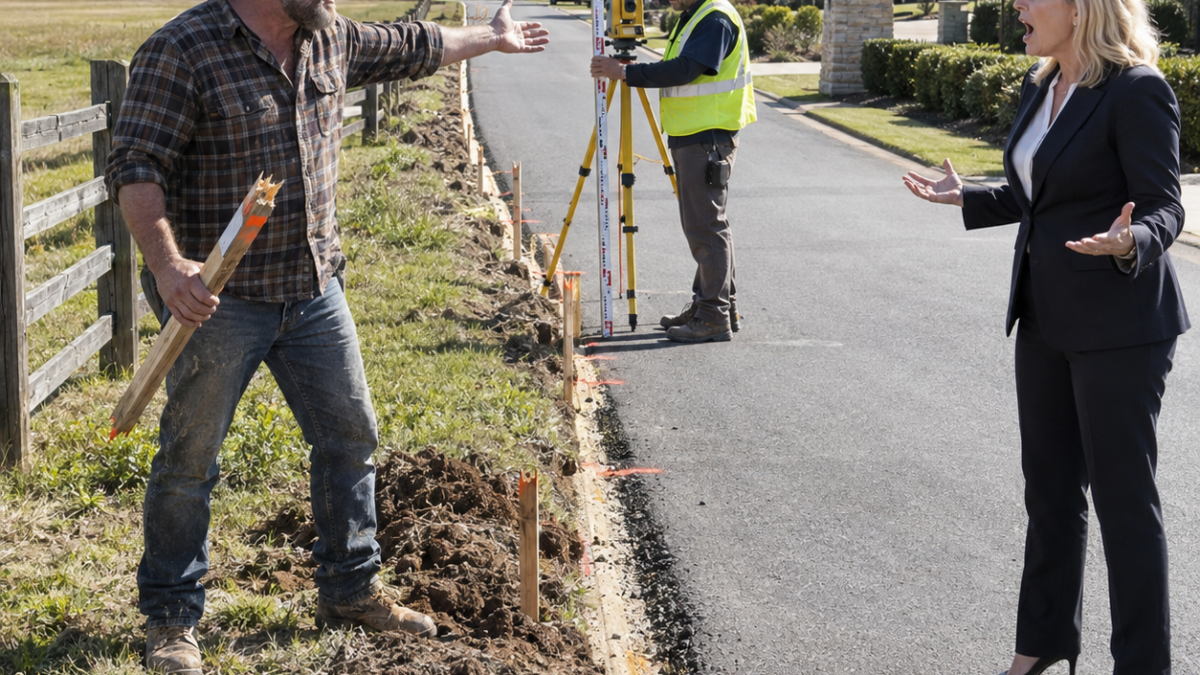
Four weeks later, two white government vehicles arrived shortly after eight in the morning.
The survey team came prepared.
Tripods.
GNSS receivers.
A robotic total station.
Historical plats.
Metal-detection equipment.
Ground-penetrating radar.
The lead surveyor was Marcus Thorne.
Weathered face.
Quiet voice.
He shook my hand.
“Mr. Harrison.”
“Jack is fine.”
“I’ve reviewed the record.”
“And?”
“And I prefer measurements to opinions.”
I liked him immediately.
They started with older control points well beyond my property.
That matters.
A professional retracement isn’t simply somebody standing where you say the corner is and agreeing with you.
They reconstruct.
They compare.
They work backward through recorded evidence.
By midmorning, Karen appeared.
Of course she did.
She came down the entrance road in her golf cart and stopped beside the survey team.
“What is all this equipment doing on HOA property?”
Marcus kept adjusting his instrument.
Nobody answered immediately.
That irritated her.
“I asked a question.”
Marcus finally looked up.
“We’re conducting authorized survey work.”
“I’m the president of Prestwick Commons.”
He nodded.
“Then you should have received notice.”
“I did. That does not give you permission to occupy our community property.”
Marcus held out a copy of his work authorization.
Karen barely glanced at it.
“I’m asking you to leave.”
“We’re not finished.”
“Then I’ll contact law enforcement.”
Marcus looked toward one of his assistants.
Then back at Karen.
“Ma’am, you may contact anyone you wish. But you may not interfere with our equipment or obstruct our authorized work.”
“I am protecting private property.”
Marcus glanced across the landscape.
“That’s exactly what we’re determining.”
Tom happened to be walking his dog fifty yards away.
I watched him turn his head so Karen wouldn’t see him smiling.
Karen remained for several minutes.
Then she drove away.
The team worked for three days.
By the second day, I noticed Marcus paying unusual attention to the entrance road.
He measured it repeatedly.
His crew checked buried features.
They compared observations.
On the third afternoon, I found him standing near the location of the first removed marker.
He was looking at his tablet.
“Jack.”
Something in his voice made me walk faster.
“What did you find?”
“I’m going to emphasize that this is preliminary until we process everything.”
“Understood.”
“Your old markers appear to have been very close to the proper locations.”
“How close?”
“Inches.”
I folded my arms.
“So Karen removed the right markers.”
“Yes.”
“That doesn’t explain why you’ve been measuring the road for two days.”
Marcus looked toward the asphalt.
Prestwick Commons had a wide entrance with two lanes separated by landscaping.
Decorative stonework.
Curbs.
Storm drains.
A large sign surrounded by flowers.
It had always looked permanent.
Confident.
Official.
Marcus enlarged a map on his tablet.
Then he showed it to me.
A line ran through the image.
“What am I looking at?”
“Your boundary.”
It took me several seconds to understand.
The line wasn’t beside the road.
It was inside it.
“How far?”
“Approximately twenty feet.”
I looked from the tablet to the asphalt.
Then back.
“You’re saying—”
“A portion of this roadway appears to have been constructed on your parcel.”
I said nothing.
Marcus continued.
“Roughly a quarter mile, depending on final computation. Some curb, drainage structures, landscaping, and entrance improvements appear to be within the same strip.”
“Twenty feet.”
“Approximately.”
I walked to the edge of the grass.
Suddenly I saw the road differently.
Not as the border of Prestwick Commons.
As an encroachment.
For decades, everyone had assumed the pavement defined the line.
Apparently it didn’t.
“How does something like this happen?”
Marcus shrugged.
“Bad control. Bad assumptions. Construction based on an incorrect reference. Sometimes someone simply uses the wrong line and nobody challenges it.”
“My grandfather’s marker was here.”
“Yes.”
“And the road crossed it.”
“Yes.”
“And then Karen removed the marker because she thought it interfered with their landscaping.”
Marcus looked at me.
“I’m a surveyor, Jack. I generally avoid commenting on irony.”
“You’re thinking it.”
“I didn’t say I wasn’t.”
The preliminary map arrived the next week.
Ben drove out that evening.
We spread the documents across the same dining table my father had owned.
Sarah brought coffee.
Ben stared at the map.
Then looked at me.
“Dad.”
“I know.”
“No, I don’t think you do.”
He pointed.
“The road isn’t the only problem.”
I leaned closer.
Utility lines ran beneath parts of the disputed strip.
Water.
Sewer.
Communications.
Drainage.
The infrastructure serving the entrance portion of Prestwick Commons had followed the road corridor.
Ben sat back.
“This changes everything.”
Sarah looked worried.
“In what way?”
“If the boundary is confirmed and Dad owns this strip, the HOA has a major title problem. They’re using private land for access and utilities.”
“I don’t want anyone’s water shut off,” I said.
Ben looked at me.
“I know.”
“I don’t want families trapped in their homes.”
“I know.”
“I want Karen held responsible. I want the HOA fixed. I don’t want innocent people punished because a developer made a mistake thirty years ago.”
Ben smiled slightly.
“That actually makes our position stronger.”
“How?”
“Because we have leverage without needing to use the most destructive remedies.”
Sarah sat beside me.
“So what happens now?”
I looked at the map.
For months, Karen had acted like power came from a title.
President.
Board.
Authority.
Enforcement.
But real power isn’t the ability to impose your will.
Real power is having the ability to cause damage and choosing restraint.
“We give them another chance,” I said.
Ben understood immediately.
“But we don’t show them the survey.”
“Not yet.”
The next letter was even shorter than the first.
Because the HOA had claimed my historical markers were invalid, we formally requested the survey or recorded document they had relied upon when determining the boundary.
Simple.
If Karen knew where the line belonged, she should be able to prove it.
Thirty days.
That was the deadline.
We mailed it certified.
Then we waited.
Two weeks later, signs appeared throughout Prestwick Commons.
EMERGENCY HOMEOWNERS MEETING.
The stated purpose was to discuss a major legal threat and a proposed special assessment for legal defense.
Tom brought me a copy.
“She took the bait.”
“Looks that way.”
“What aren’t you telling me?”
“A lot.”
His eyebrows lifted.
“Good lot or bad lot?”
“Interesting lot.”
That evening I invited the core group back to my patio.
Tom.
The Patels.
The Martinez family.
Mrs. Gable’s son.
Several others.
The binder sat on the table.
Beside it was the survey.
“I’ve been holding something back,” I said.
Tom grinned.
“I knew it.”
I unfolded the map.
Nobody understood immediately.
Then Raj leaned closer.
“What’s the red section?”
“The encroachment.”
Priya looked at the road.
Then the map.
Then back at me.
“Wait.”
Tom stood.
“No.”
“Yes.”
“That’s their entrance road.”
“Part of it.”
“How much?”
“About twenty feet into my land for roughly a quarter mile.”
Nobody spoke.
Then Tom started laughing.
Not because it was funny.
Because sometimes the truth becomes so absurd there is nothing else to do.
“She removed your markers…”
“While the HOA’s road was crossing the actual line.”
Mrs. Gable’s son covered his mouth.
“Oh, my God.”
I raised a hand.
“This is important. Tomorrow night, nobody goes into that clubhouse looking for revenge.”
Tom stopped laughing.
“Why not?”
“Because anger makes people sloppy.”
I tapped the binder.
“We don’t need to shout. We have facts.”
I looked around the table.
“Karen is going to tell the community I’m trying to steal their property. She’ll probably ask everyone for money. She’ll create fear because fear makes people stop asking questions.”
“So we ask questions,” Priya said.
“Exactly.”
Tom leaned forward.
“What question do you want me to ask?”
“Ask why the HOA needs money to establish the boundary if they already had evidence proving where the boundary was when they ordered my markers removed.”
He smiled.
“That’s nasty.”
“It’s logical.”
“Sometimes those are the same thing.”
Priya would ask about the mysterious approved paint-color list.
Mrs. Gable’s son would ask Karen to identify the bylaw supporting his mother’s rose-bush fine.
Others had their own questions.
Nobody needed to coordinate speeches.
Just questions.
Simple ones.
Questions are dangerous to people who depend on nobody checking their answers.
The clubhouse was packed the next night.
Nearly a hundred residents filled every chair.
People stood against the walls.
Karen sat at the front beside Gary and Brenda, the other two board members most closely aligned with her.
She looked exhausted.
But the moment she raised the gavel, the old voice returned.
“Prestwick Commons is facing an unprecedented legal attack.”
There it was.
She described me as an outside landowner making an aggressive claim against community property.
She implied homes could lose value.
She suggested the association might face catastrophic litigation.
She never mentioned who removed the markers.
She never mentioned my first letter.
She never mentioned the fine for the holes.
Then she announced the board’s solution.
Five hundred dollars from every household.
A special legal-defense assessment.
The room exploded.
“You expect us to pay for this?”
“Five hundred dollars?”
“Why?”
Karen hammered the gavel.
“This assessment is necessary to defend the community against a land grab.”
Land grab.
I sat in the back.
Silent.
She continued.
“Our legal position is strong. But defending that position requires resources.”
Tom raised his hand.
Karen looked reluctant.
“Yes, Tom?”
He stood.
“If our position is strong, why can’t we just show Mr. Harrison the survey proving where the property line is?”
Karen blinked.
“The original development documents are complex.”
“Okay.”
Tom nodded.
“But you removed his markers because you said they were on HOA property, right?”
Karen’s eyes narrowed.
“They were hazardous objects affecting a common area.”
“So you knew exactly where the boundary was.”
“The board acted based on its understanding.”
“Based on what survey?”
The room went quiet.
Karen shuffled papers.
“Our attorneys have advised us that a modern survey may be necessary.”
Tom looked around.
“So we didn’t have one?”
“We have plats.”
“Do those plats show the boundary?”
“They contain information relevant to the boundary.”
“Then why not show them?”
Karen’s face reddened.
“This meeting is not about debating technical documents.”
Priya raised her hand.
Karen tried to ignore her.
Someone shouted, “Let her speak.”
Karen sighed.
“Mrs. Patel.”
Priya stood.
“You fined my family because our front door is an unapproved color.”
“This is unrelated.”
“I’m asking about board documentation.”
“Your architectural issue is separate.”
“You told us there is an approved color palette. I’ve requested it three times. Can you show it to everyone tonight?”
Karen stared.
“No.”
“Does it exist?”
“This meeting is about a serious threat to our community.”
Priya’s voice remained calm.
“That is why I’m asking. You want us to give you five hundred dollars because you say we should trust the board’s judgment. I’m asking whether a document you repeatedly cited actually exists.”
People murmured.
Karen struck the table with the gavel.
“Mrs. Patel, sit down.”
Priya did.
Mrs. Gable’s son stood without waiting.
“My mother was fined for her roses.”
Karen closed her eyes briefly.
“Please—”
“I read every bylaw I could find. There is no rule saying roses cannot extend toward the sidewalk. When I asked you for the rule, you told me, ‘The rule is what I say it is.’”
More murmurs.
“Did you say that?”
Someone shouted from the side.
Karen’s control began slipping.
People started raising their own notices.
A basketball hoop.
A mailbox.
A wind chime.
A garden flag.
A child’s bicycle.
One by one, the private frustrations became public.
Karen pounded the gavel.
“This is not why we are here!”
That was when I stood.
The room quieted.
I carried one photograph.
Not the survey.
Not yet.
The photograph.
The contractor’s chain stretched tight around my marker.
Karen in the background.
Watching.
I walked toward the front.
“Since my name has been used several times tonight, I’d like to correct one thing.”
Karen stiffened.
“You were not invited to speak.”
Tom laughed.
“He was invited to pay attention while you called him a thief.”
A few people applauded.
I held up the photograph.
“I am not attempting to take anyone’s home.”
Silence.
“I am not attempting to bankrupt Prestwick Commons.”
I faced the residents.
“This started because the HOA entered my property after being warned not to and removed four recorded boundary monuments.”
I held the photograph higher.
People leaned forward.
Karen’s face changed.
“This image shows the contractor removing one of those markers. Karen is present.”
I put the photograph on the table.
Then another document.
“This is the notice she gave me before they acted.”
Another.
“This is the letter my attorney sent giving the association thirty days to replace what it destroyed.”
Another.
“And this is Karen’s response.”
I looked at her.
“The HOA refused.”
Then I placed the fine beside it.
“And after its contractor left four holes in the ground, the board fined me five hundred dollars for the holes.”
The room erupted.
Karen stood.
“That is a gross distortion!”
“Which part?”
“We had authority—”
“Then produce the survey.”
Her mouth closed.
“That is all I have asked.”
I looked at the residents again.
“Karen told you tonight that I launched a hostile legal attack. The only current demand I made is that the association produce the document it relied upon when determining the location of the boundary.”
I paused.
“There are ten days left on that request.”
Someone yelled, “Show us the survey, Karen!”
Another voice joined.
“Where is it?”
She raised the gavel.
Nobody listened.
I watched residents who had spent months whispering suddenly speak openly.
That was the moment Karen lost Prestwick Commons.
Not when the federal team arrived.
Not when the marker came out.
Not when the hidden boundary was discovered.
She lost it when people stopped being afraid of asking her questions.
I walked out before the meeting ended.
Sarah was waiting outside.
“Well?”
I heard shouting through the clubhouse doors.
“I think they’re finally talking to each other.”
She slipped her hand into mine.
“You didn’t show them the map?”
“No.”
“When do you?”
“When it matters.”
Within forty-eight hours, residents collected enough signatures to demand a no-confidence vote.
Karen refused to resign.
Gary stopped returning calls.
Brenda began telling neighbors she had “never fully supported” the president’s enforcement strategy.
Amazing how quickly loyal soldiers discover moral concerns when the battle turns.
Our thirty-day deadline expired.
No survey arrived.
On day thirty-one, Ben filed suit.
That was when we showed the map.
The complaint included a quiet-title claim asking the court to recognize the boundary determined through the new survey evidence.
It included claims relating to trespass and destruction of the monuments.
It described the retaliatory fine.
And attached as an exhibit was the document Karen had never seen.
The road.
Twenty feet.
Quarter mile.
Utilities.
The whole problem laid out in lines and measurements.
Ben called me shortly after filing.
“They’ve been served.”
“How long until Karen sees the exhibit?”
“She probably has it now.”
I looked toward the Prestwick Commons entrance from my porch.
For years I had watched cars drive over that pavement without thinking twice.
Now twenty feet of it represented the most expensive mistake in the neighborhood.
An hour later, Karen’s golf cart appeared.
She didn’t drive to my house.
She stopped near the entrance.
Got out.
Stood on the road.
Then walked slowly toward where the first marker used to be.
She looked at the pavement.
Then at my field.
Then at the papers in her hand.
For once, I didn’t need to hear what she was saying.
Her posture told me enough.
She finally understood.
The marker she called junk had been telling the truth.
The lawsuit also asked the court for temporary relief preventing continued unauthorized use of my property unless the parties reached an agreement.
We had no intention of suddenly barricading the neighborhood.
But the request made one fact impossible to ignore.
Access to that strip was not something the HOA could simply assume anymore.
Their attorney called Ben within two days.
His name was Martin Keller.
He had apparently not been the attorney advising Karen when the markers were removed.
According to Ben, Keller sounded like a man who had inherited a burning building and wanted to know where the fire extinguishers were.
“Did your client really warn them before removal?” he asked.
“Yes.”
“Writing?”
“We have the notice they gave him, video of the work, correspondence afterward, and witnesses.”
“And the survey?”
“You have it.”
Silence.
Then Keller said, “We need time.”
Ben answered, “You’ve had months.”
Meanwhile, the no-confidence vote went forward.
I did not attend.
It was their association.
Their decision.
Tom called afterward.
“Ninety-one percent.”
“Against Karen?”
“Against Karen.”
“And Gary and Brenda?”
“Resigned before the count was announced.”
I sat quietly.
I had imagined feeling triumphant.
Instead, I mostly felt tired.
“What happens now?”
“They want me as interim president.”
I smiled.
“Congratulations.”
“That sounded cruel.”
“It was.”
Tom laughed.
Then became serious.
“Jack, what are you going to do to us?”
That question hurt.
Not because I was angry.
Because I realized how scared people had become.
“Nothing to you.”
“You own part of our entrance.”
“I own land underneath part of your entrance.”
“That distinction sounds expensive.”
“It probably will be.”
“Are you going to close the road?”
“No.”
“Utilities?”
“No.”
His exhale was audible.
“But,” I said, “the HOA needs to fix this permanently.”
“I agree.”
“And I’m not settling just so everyone can return to business as usual.”
“We won’t.”
“I need more than your promise, Tom.”
“You’ll have it.”
The situation reached local news after a reporter obtained the lawsuit.
Suddenly television trucks appeared near Prestwick Commons.
The story was irresistible.
HOA removes neighbor’s boundary markers.
Federal retracement reveals HOA road crossing the neighbor’s land.
Residents revolt against board.
The footage of the contractor ripping out the marker became the image everybody used.
I hated that part.
The story became entertainment.
People online chose heroes and villains without knowing any of us.
Karen was mocked.
I was praised by strangers who seemed disappointed that I hadn’t bulldozed the road.
Some suggested I put up a toll booth.
Others wanted me to block the sewer.
They didn’t understand that real families lived there.
Children.
Retirees.
People with mortgages.
People who had not built that road.
A satisfying revenge fantasy is simple when the people suffering are imaginary.
Real justice is harder.
It has to stop the wrongdoing without becoming another form of it.
The publicity created another problem for the HOA.
Its insurance carrier began reviewing whether Karen’s intentional actions were covered.
That uncertainty terrified the new board.
If coverage disappeared, every dollar in damages could ultimately fall back on homeowners.
Tom came to see me one evening.
He looked older than he had a month earlier.
“Jack.”
I poured coffee.
“Sit.”
He stayed standing.
“People are scared.”
“I know.”
“Two sellers had buyers hesitate because of the lawsuit.”
“I know.”
“My phone hasn’t stopped ringing.”
“I’m sorry.”
He looked frustrated.
“You’re sorry?”
“Yes.”
“You could end this.”
“I could.”
“Then why haven’t you?”
That was the first time Tom and I truly argued.
“Because ending the lawsuit without fixing anything means the next Karen can do this again.”
“She’s gone.”
“Karen is a person. I’m talking about the structure.”
“People could lose money.”
“They already did.”
“Not like this.”
“No. They paid in smaller amounts. Fines. Legal fees. Stress. Fear. Being told their homes weren’t really theirs because a board president could invent rules whenever she wanted.”
Tom looked away.
I softened my voice.
“I am not keeping this case alive to hurt anyone.”
“Then tell me what you want.”
“I will.”
“When?”
“When the board has authority to make a permanent agreement.”
He finally sat.
“We’re installing a new board next week.”
“Call Ben afterward.”
Tom nodded.
As he left, Sarah came into the kitchen.
“You two okay?”
“We will be.”
“You sure?”
“No.”
She sat across from me.
“Jack, can I tell you something you won’t like?”
“Those are usually your favorite things to tell me.”
“You’re starting to treat this like an operation.”
“It is an operation.”
“No.”
She shook her head.
“It was. At first. But these aren’t soldiers and Karen isn’t an enemy commander. Tom is your neighbor. Priya is your neighbor. Mrs. Gable is your neighbor.”
“I know.”
“Then make sure the ending remembers that.”
I didn’t answer immediately.
She reached across the table.
“Your father taught you boundaries. Not because he wanted walls everywhere. Because good neighbors need to know where one person’s rights stop and another person’s begin.”
I looked toward the dark window.
She was right.
She usually was.
The settlement conference took place two weeks later in Ben’s office.
The new board attended.
Tom sat with them.
Their attorney sat beside them.
Ben and I sat opposite.
Karen was not present.
The argument was no longer about whether the markers had been ugly.
That world had vanished.
Now there was only the survey.
The encroachment.
The road.
The cost of continued litigation.
Ben opened.
“My client has no intention of depriving residents of reasonable access to their homes or disrupting essential utilities.”
You could feel the tension leave the other side of the table.
Only a little.
“He does, however, require a permanent resolution.”
Keller nodded.
“What is he proposing?”
I slid a single document across the table.
Four principal terms.
First, compensation.
The HOA would reimburse survey expenses, legal costs, property damage, and the value associated with acquiring the strip necessary to regularize its road and utility corridor.
The total settlement payment would be four hundred fifty thousand dollars.
Nobody liked that number.
They weren’t supposed to.
But it was survivable.
Their lawyer read the section twice.
“Four hundred fifty.”
“Yes,” Ben said.
“Our association does not have that sitting in an account.”
“We can discuss payment structure,” I said. “Not the total obligation.”
Tom watched me.
I continued.
“Second, the monuments.”
The HOA would pay for professionally installed permanent replacements at the four primary corners.
Not decorative pipes.
Concrete-encased monuments placed under licensed supervision.
Permanent enough that nobody could mistake them for trash again.
“Third,” I said, “every unsupported fine documented in this binder gets reviewed.”
I placed the binder on the table.
Priya’s door.
Mrs. Gable’s roses.
Tom’s bird feeder.
The Martinez children’s slide.
Dozens more.
“If there is no actual covenant supporting the citation, it is rescinded. Any collected fine is credited or refunded where appropriate.”
One board member shifted.
“That could involve a lot of cases.”
“It should.”
“Why?”
“Because you need to know how much damage was done.”
Nobody argued.
“Fourth,” I said, “governance reform.”
That was the term I cared about most.
No fine without citation to a specific written rule.
No made-up standards.
No secret palettes.
A real appeal process.
Meeting records accessible to members.
Stronger notice requirements.
And no HOA action affecting a deeded property boundary unless the association first obtains proper survey evidence.
Their attorney read silently.
Then looked up.
“And in exchange?”
I pointed to the survey.
“I convey the necessary twenty-foot strip to the association under agreed terms so the road, drainage, and utility corridor remain in place.”
One of the new board members stared at me.
“You’re selling it to us.”
“Yes.”
“You could keep it.”
“Yes.”
“You could make this extremely difficult.”
“Yes.”
“Why aren’t you?”
I thought about Sarah.
My father.
My grandfather.
The empty holes.
Mrs. Gable crying over roses.
“Because I never wanted your road.”
I looked at Tom.
“I wanted my boundary respected.”
Nobody spoke.
Then I added, “And I wanted the people who live here to stop being afraid of their own association.”
The board asked for a private conversation.
Ben and I left the conference room.
We stood beside the windows overlooking the city.
“You okay?” he asked.
“Yes.”
“You sure about selling the strip?”
“Yes.”
“You could probably demand more.”
“I know.”
“You could demand a lot more.”
“I know.”
He smiled.
“Mom got to you.”
“Your mother has been getting to me for forty years.”
“Good.”
Twenty minutes later, Keller opened the door.
“They accept the structure.”
Negotiations continued over details.
Payment schedule.
Language.
Releases.
Insurance.
Future access.
Survey descriptions.
Refund procedures.
Nothing about a settlement is as cinematic as people imagine.
Justice often arrives in tracked changes.
Three weeks later, we signed.
The lawsuit would be dismissed after the obligations were satisfied.
The HOA would purchase the strip.
The road would remain.
Utilities would remain.
Residents would keep driving home like they always had.
But the legal foundation under that road would finally be legitimate.
The four hundred fifty thousand dollars wasn’t a jackpot.
By the time expenses, professional fees, land value, restoration, and other costs were accounted for, it represented compensation and consequence, not a lottery ticket.
That mattered to me.
I didn’t want people saying I had engineered the entire fight for money.
Karen had started it with a clipboard.
I ended it with a boundary everyone could see.
The HOA reform took longer.
Tom insisted the residents participate.
Priya joined the review committee.
Raj helped create a searchable digital archive of governing documents.
Mrs. Gable’s son volunteered for the appeals panel.
For the first time, meetings became boring.
I considered that progress.
Nobody wanted a charismatic president promising to fix everything.
They wanted agendas.
Minutes.
Budgets.
Written procedures.
Rules that meant the same thing on Monday as they did on Friday.
Mrs. Gable’s rose fine disappeared.
So did the Patel door citation.
Tom put his bird feeder back up.
The Martinez kids’ slide remained bright red and yellow.
For months, every time I drove through Prestwick Commons, I noticed more color.
Blue doors.
Garden flags.
Different flowers.
Small signs of personality returning.
The neighborhood looked less perfect.
It looked more alive.
Karen disappeared from public view after the no-confidence vote.
I heard rumors.
That she blamed Brenda.
That she blamed Gary.
That she blamed me.
That she considered suing the HOA herself.
I never knew which stories were true.
I didn’t ask.
One afternoon, several months after the settlement, I saw a moving truck in front of her house.
A FOR SALE sign stood near the driveway.
She was carrying a box toward her car.
For a moment, I considered driving past.
Instead, I stopped.
Karen saw me.
Neither of us spoke immediately.
She looked different without the clipboard.
Smaller somehow.
Not physically.
Just ordinary.
“I suppose you’re pleased,” she said.
“No.”
She gave me a bitter laugh.
“You won.”
“This wasn’t supposed to be a game.”
“You humiliated me.”
“I asked you not to remove the markers.”
“You made me look like a criminal.”
“I showed what happened.”
“You turned the neighborhood against me.”
“They voted.”
Her eyes hardened.
“You knew exactly what you were doing from the beginning.”
“No.”
That was the truth.
“When you came to my porch, I knew you were wrong. When you removed the markers, I knew you created liability. I did not know your road crossed my land.”
She looked toward the entrance.
“I was told those pipes were junk.”
“By whom?”
She didn’t answer.
“That’s the question you should have asked before ordering them removed.”
Her face changed.
For the first time since this began, I saw something beneath the anger.
Regret.
Maybe not remorse.
But regret.
“I wanted this place to look better.”
“I believe you.”
That surprised her.
“You do?”
“Yes.”
“Then why—”
“Because good intentions don’t create authority.”
She looked away.
I continued.
“You wanted everything uniform. Clean. Controlled. Somewhere along the way, you started treating disagreement like disobedience.”
Her eyes filled slightly.
“You think you’re better than me?”
“No.”
“I think I was luckier.”
She looked confused.
“My career taught me what happens when people stop checking their assumptions.”
The moving crew carried furniture behind her.
I nodded toward the house.
“I hope wherever you go next, you remember that.”
I drove away.
I never saw her again.
A month later, the replacement monuments were installed.
That Saturday morning became something I never expected.
A gathering.
Not official.
No grand ceremony was required.
But people came anyway.
The survey crew set the final monument beneath the old oak.
Concrete deep below grade.
A brass cap at the surface.
Clean.
Precise.
Permanent.
I stood beside Sarah.
Tom walked over.
“You want to do the honors?”
“What honors?”
He handed me a bottle of water.
“Christen it.”
I stared at him.
“That is the dumbest thing you’ve suggested through this entire ordeal.”
“Not even close.”
He poured a little water over the brass disk.
People laughed.
Even I did.
Mrs. Gable came with her son.
She was moving slowly with a cane.
I hadn’t seen her outside much.
She stopped beside the new monument.
“So that little thing caused all this trouble?”
I smiled.
“No, ma’am.”
“What did?”
“People forgetting what it meant.”
She considered that.
Then nodded.
“I understand.”
She handed Sarah a bouquet of roses from her garden.
Nobody had ordered her to cut them back.
Priya approached next.
Her front door was visible in the distance.
Still blue.
“You know,” she said, “Tom suggested putting a plaque near the entrance.”
“No.”
“I haven’t told you what it says.”
“Still no.”
She laughed.
“What if it just says Respect the Line?”
“No plaques.”
Tom shouted from several feet away.
“Colonel hates fun.”
“I hate maintenance.”
The crowd slowly dispersed.
Eventually, only Sarah and I remained.
The late afternoon sun came through the oak branches.
I crouched and ran my fingers across the brass cap.
My father would have appreciated it.
My grandfather probably would have complained that the old iron pipe worked fine and didn’t cost nearly as much.
That thought made me smile.
Sarah squeezed my shoulder.
“Worth it?”
I considered everything the question contained.
Months of stress.
Legal bills.
Survey work.
Neighbors arguing.
Television cameras.
Karen losing her position.
A road suddenly discovered on the wrong land.
Then I thought about Mrs. Gable’s roses.
The Patels’ blue door.
Tom’s bird feeder.
The Martinez children playing outside without their parents worrying about another letter.
“Yes.”
Sarah nodded.
“So what are you going to do tomorrow?”
“Nothing.”
She laughed.
“You don’t know how.”
“I’m retired.”
“You’ve been retired for years.”
“Tomorrow I’m going to try it properly.”
We walked back toward the farmhouse.
Halfway there, I turned.
From that distance, the marker was almost invisible.
That was the funny thing.
Karen had started this entire war because she believed four little pieces of metal were ruining the appearance of her neighborhood.
She had thought removing them would make the boundary disappear.
Instead, their removal forced everyone to discover exactly where the boundary had always been.
Twenty feet into the road.
A quarter mile long.
Buried beneath asphalt, pipes, assumptions, and thirty years of nobody asking the right question.
In the end, the federal survey didn’t really take twenty feet of Prestwick Commons’ road.
It revealed that those twenty feet had never legally belonged to them in the first place.
And I didn’t keep the road.
I didn’t shut off their utilities.
I didn’t try to destroy the families who lived there.
I sold the strip back under terms that forced the association to repair what it had broken—both in the ground and in the community.
That was enough.
More than enough.
My father once told me that a boundary has two purposes.
It tells you what belongs to you.
And it reminds you what doesn’t.
Karen had understood the first part.
She never understood the second until it was too late.
Years later, the new brass monuments are still there.
Tom is no longer HOA president. He served long enough to establish the reforms, then happily handed the job to someone else.
Priya eventually chaired the architectural committee.
Her first proposal was simple: publish the actual approved standards online so nobody would ever again be punished by a rule they couldn’t see.
Mrs. Gable’s roses spread farther along her walkway.
Nobody measured them.
Kids leave bicycles on driveways.
Doors come in different colors.
Lawns sometimes grow a little too long before somebody gets around to mowing.
And somehow, property values survived.
The community didn’t collapse because people were allowed to be people.
If anything, neighbors started speaking to each other again.
That was the victory I valued most.
Prestwick Commons had spent years polishing its appearance while quietly losing its sense of community.
The conflict over my land forced the residents to choose which one mattered more.
They chose each other.
As for my fifty acres, not much changed.
The barn still needs paint every few years.
The oaks still drop more leaves than I can rake.
The fields still get muddy after spring rain.
Sarah still says I keep too many old maps.
I still tell her maps are history.
And every once in a while, I walk down to the eastern boundary and stop beside that brass marker.
I think about the morning the landscapers came.
The chain tightening.
The iron groaning.
Karen watching from the golf cart.
At the time, I thought I was watching somebody tear away a piece of my family’s history.
I didn’t know she was exposing something older.
Something that had been sitting beneath all of us for thirty years.
The truth.
And truth has a strange relationship with boundaries.
You can ignore a line.
You can pave over it.
You can landscape around it.
You can build signs beside it.
You can call it inconvenient.
You can even pull its marker out of the ground and throw it into a truck.
But removing the marker doesn’t move the line.
Eventually, someone measures again.
And when they do, the truth is still exactly where you left it.
My grandfather understood that.
My father understood it.
After everything that happened, Prestwick Commons understood it too.
The old markers were gone.
But the lesson they left behind became permanent.
Respect the land.
Respect your neighbors.
And never confuse authority with ownership.
Because sometimes the rusty pipe you think is ruining your perfect view is the only thing standing between your certainty and a twenty-foot mistake.








