PART 2: HOA Repainted My $90,000 Wall and Destroyed My Security System—They Went Silent When the Judge Saw Who Actually Owned the Land
PART 2
Construction changed the entire mood along that side of the property.
For years, the boundary between my land and the subdivision had been mostly conceptual.
A fence line.
Tree line.
Survey markers.
Enough for anyone who respected property.
Not enough for people determined to pretend boundaries were negotiable.
The wall made the boundary visible.
Six feet of it.
Concrete.
Steel reinforcement.
Stucco.
Not hostile.
Not decorative nonsense.
Just solid.
Permanent.
My wife, Claire, was the one who chose the exterior color.
I had been looking at standard concrete gray.
She hated it.
“If we’re going to stare at this thing for the rest of our lives,” she said, holding three color samples in the afternoon sun, “I refuse to spend retirement looking at prison gray.”
“What do you want?”
She held up a warm sand tone.
“This.”
“It’s a wall.”
“It can still be a nice wall.”
That was Claire.
Practical enough to tolerate my stubbornness.
Stubborn enough to improve it.
We chose the sand color.
Construction moved steadily.
Marcus Bell supervised the project.
Marcus had worked with heavy equipment longer than some HOA board members had been alive.
He was calm.
That was one of the reasons I hired him.
If Marcus sounded concerned, something was wrong.
During the first week, complaints arrived before the concrete had even cured.
Noise.
Dust.
Equipment visibility.
Vehicle movement.
Construction hours.
One letter alleged that heavy machinery created an “unacceptable visual impact on community residents.”
I read that twice.
Then looked out the window at seventeen hundred-plus acres of agricultural land.
Apparently the bulldozer offended people who had built a subdivision beside a farm.
I sent each complaint to my attorney, Laura Grant.
Laura’s responses became progressively shorter.
The first:
**Construction is properly permitted and outside your association’s jurisdiction.**
The second:
**Please refer to prior correspondence.**
The third:
**Stop contacting my client about lawful construction on land not governed by your association.**
The HOA did not stop.
They called county code enforcement.
Inspector came.
Checked permits.
Left.
They called the sheriff’s office about noise.
Deputy came.
Looked at operating hours.
Left.
Environmental services.
Another inspection.
Nothing.
Every complaint produced another government employee walking onto the site, reviewing paperwork, and confirming what we already knew.
We were legal.
That seemed to make the HOA angrier.
One afternoon, Marcus called.
“Dan.”
His voice was calm.
Too calm.
“What?”
“We’ve got two people out here saying they’re board members.”
“What are they doing?”
“Standing inside the marked work area.”
My chair moved backward.
“On my land?”
“Yep.”
“Tell them to leave.”
“I did.”
“And?”
“They said they have inspection rights.”
I laughed once.
“No, they don’t.”
“I figured.”
“Don’t touch them.”
“I’m seventy-one, Dan. I’m not wrestling HOA people.”
“Good.”
I drove over.
Two board members were standing near a skid steer.
Clipboard.
Phones.
One was speaking loudly into a call.
“Yes, I am currently observing an unauthorized improvement adjacent to Willow Glen property—”
I walked up.
“Stop.”
He turned.
“Mr. Mercer.”
“You’re trespassing.”
“We’re conducting an association inspection.”
“You don’t have association authority here.”
“This structure affects the community.”
“That doesn’t give you permission to enter my land.”
The second board member raised his phone.
“We have a right to document.”
“From your side.”
I pointed toward the survey stakes.
“You crossed the line.”
He smiled.
“Don’t be dramatic.”
That sentence made something inside me settle.
Not flare.
Settle.
I had been called dramatic for objecting to fake fines.
Difficult for refusing membership.
Uncooperative for defending agricultural zoning.
Now dramatic for telling strangers to leave private property.
I pulled out my phone.
Called the sheriff.
The board members laughed.
They stopped laughing when a deputy arrived.
The same deputy who had responded to one of their earlier noise complaints.
He recognized me.
Then recognized them.
“What happened?”
I pointed.
“They were told to leave.”
The deputy looked toward the board members.
“Did he tell you to leave?”
“Yes, but—”
“Are you on HOA common property?”
“No, but—”
“Then leave.”
One tried explaining their inspection authority.
The deputy cut him off.
“You don’t have police authority.”
The trespass warning became official.
That incident should have embarrassed them into backing down.
Instead, they tried to have Marcus’s construction equipment towed.
The tow truck arrived around eight one morning.
I wasn’t there.
Marcus called laughing.
Not concerned this time.
“Dan, you need to hear this.”
“What?”
“HOA sent a tow company.”
“To tow what?”
“Excavator.”
“From my land?”
“Apparently.”
I drove out.
Tow operator was standing beside his truck reading the posted permits.
He looked at me.
“You Mercer?”
“Yes.”
“I’m leaving.”
“Good decision.”
He nodded toward the subdivision.
“They told dispatch this equipment was abandoned on community property.”
Marcus laughed.
The tow operator looked annoyed.
“I don’t find that funny.”
“Neither would I.”
He left without touching anything.
I photographed his truck only to document that he had arrived.
No complaint against him.
He had been misled.
That distinction mattered.
Most people who got pulled into this mess were not villains.
They were contractors being told the HOA had authority.
Employees.
Residents.
People who assumed someone else had verified the facts.
The board was different.
They had already been through court with me.
They knew.
By February 2020, the wall was finished.
Six feet.
Smooth stucco.
Warm sand color.
Subtle lighting installed on my side.
Integrated security cameras.
Decorative iron gate at the main drive.
The wall sat five feet inside the legal property line.
That five-foot strip mattered.
We maintained it.
Mowed it.
Controlled it.
Nothing touched HOA land.
I stood with Claire near the gate the afternoon Marcus finished.
She ran her hand across the stucco.
“See?”
“What?”
“Better than gray.”
I smiled.
“You were right.”
She looked at me.
“Can you say it louder?”
“No.”
She laughed.
For the first time in years, I thought:
Maybe this is finished.
The HOA had lost its liens.
Lost its fine cases.
Lost the zoning fight.
The wall was approved.
Built.
Inside my property.
What else could they possibly do?
The first letter arrived four days later.
Grass violation.
Five feet of grass.
The strip outside the wall but still inside my parcel.
The HOA claimed the grass exceeded approved community height.
I handed the letter to Claire.
She read it.
Looked out the window.
Then at me.
“You know we’re not in the HOA, right?”
“That’s what I’ve heard.”
Second letter.
Grass clippings had not been bagged.
Third.
Wall height violation.
Willow Glen restrictions allegedly capped residential walls at four feet.
Fourth.
Exterior finish not approved.
Fifth.
Color noncompliant.
Apparently sand was not sufficiently neutral.
I started laughing.
Claire walked into the kitchen.
“What?”
I handed her the color letter.
She read it.
Her face became genuinely offended.
“They don’t like my color?”
“Apparently not.”
“That’s it.”
“What?”
“Now I’m angry.”
I laughed harder.
Claire was joking.
Mostly.
Laura sent another cease-and-desist.
The HOA ignored it.
Then came the morning Marcus called.
This time, his voice was different.
No humor.
No calm professionalism.
“Dan.”
I stood immediately.
“What happened?”
“You need to get out here.”
“What?”
“There’s a crew painting your wall.”
I thought I misheard him.
“A crew doing what?”
“Painting.”
“Mine?”
“No.”
“Who hired them?”
“You already know.”
I was in my truck before the call ended.
When I reached the wall, a commercial painting company had already covered roughly seventy feet.
Our warm sand finish was disappearing beneath dead off-white paint.
Not white.
Not gray.
That miserable color landlords use when they want tenants to have no emotional reaction to a room.
A large sprayer hissed.
Paint ran down the stucco.
Plastic sheets covered sections of grass.
Two workers rolled a second coat.
I got out.
“Stop.”
The foreman turned.
“Sir?”
“Stop painting.”
He hesitated.
A voice behind him said:
“Continue.”
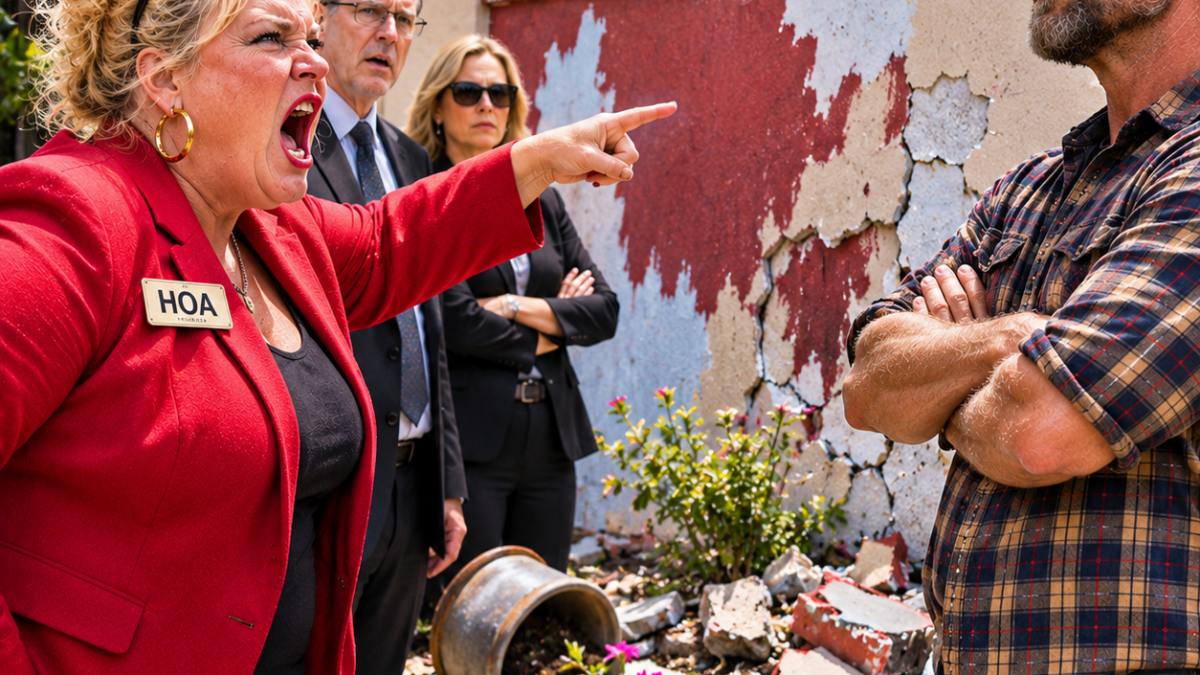
One of the HOA board members stood near the gate.
Thomas Avery.
The same man who had previously entered the construction site.
Arms folded.
Smiling.
The foreman looked between us.
“Who owns the wall?”
“I do.”
Thomas said:
“The association has authorized corrective work.”
I stared at him.
“Corrective work.”
“The wall violates community standards.”
“You’ve been told repeatedly that community standards don’t apply here.”
“The board made a determination.”
“Your board cannot determine the color of a wall it doesn’t own.”
Thomas’s smile became colder.
“The association gave you reasonable opportunities to bring the property into compliance.”
“I’m not a member.”
“You’re adjacent to members.”
I almost admired the sentence.
“You understand that isn’t law?”
“Our counsel disagrees.”
“Then tell your counsel to come paint it personally.”
The foreman put his sprayer down.
Thomas snapped:
“Keep going.”
The foreman looked uncomfortable.
I walked toward him.
Not threatening.
Just direct.
“My name is Daniel Mercer. I own this wall and the land beneath it. I am telling you that you do not have permission to alter my property.”
He looked toward Thomas.
Thomas said:
“You’re operating under our contract.”
The foreman asked:
“Do you have ownership paperwork?”
Thomas held up an HOA work order.
I almost laughed.
“That’s not a deed.”
The foreman finally understood he had walked into something ugly.
He turned off the sprayer.
Thomas stepped forward.
“I’m instructing you to continue.”
The foreman shook his head.
“I need my office.”
He walked away to make a call.
Thomas looked furious.
“You’re going to pay for this.”
“For what?”
“The correction.”
“You trespassed and painted my wall.”
“We corrected a violation.”
“You altered private property after receiving written notice that you have no authority.”
He smiled.
“Tell it to the judge.”
That was probably the worst sentence he ever said to me.
Because I intended to.
I took photographs.
Video.
Names.
Company information.
Work order.
Paint containers.
Vehicle plates.
Everything.
Then I walked the wall.
At first, I thought the paint was the entire problem.
It wasn’t.
Near the first camera housing, one of the integrated security units was dark.
Then another.
The lighting circuit did not respond.
I opened a locked service panel on my side.
Cut wire.
Clean.
Not weather damage.
Not accidental.
A camera cable had been disconnected.
Another removed entirely.
Mounting hardware lay in the grass.
Someone had intentionally disabled sections of the security system.
My anger changed.
The wall color was insulting.
Security interference was different.
Claire came out ten minutes later.
I hadn’t called her.
Marcus had.
She stood beside me looking at the off-white paint.
“They actually did it.”
“Yes.”
Then I showed her the wires.
Her expression disappeared.
Not anger.
Concern.
“They touched the cameras?”
“Yes.”
“Why?”
“I don’t know.”
“What if someone came onto the property last night?”
“I know.”
That was when this stopped being funny.
Not because cameras were sacred.
Because our house, livestock, equipment, and family depended partly on that system.
Somebody had decided that HOA aesthetics justified disabling security equipment on private land.
And we still weren’t done.
The next morning, a landscaping company arrived.
This time I was already watching.
Three trucks.
Sod equipment.
Seed.
Grading tools.
They entered the five-foot strip.
Started digging.
I walked over.
“What are you doing?”
The supervisor handed me a work order.
**LANDSCAPE REMEDIATION — WILLOW GLEN HOA**
My grass was being regraded to meet association standards.
Grass.
On land outside the association.
They planned to reseed.
Install edging.
Create an ongoing maintenance schedule.
Then bill me annually.
I read the document.
“Stop.”
The supervisor looked nervous.
“The HOA authorized—”
“I own the parcel.”
He paused.
“Do you have proof?”
“Yes.”
I showed him.
He called his office.
Work stopped.
But damage had already been done.
Soil disturbed.
Grass removed.
I looked at the wall.
Wrong paint.
Cut wires.
Missing cameras.
Torn ground.
Something inside me finally moved past anger.
Anger still assumes the other person might respond to reason.
I no longer believed that.
I called Laura.
“I’m sending you everything.”
“What happened?”
“Painting.”
Silence.
“Security system.”
Longer silence.
“Landscaping.”
She said:
“Come to my office.”
I arrived with two binders and a digital folder.
Laura stood at her desk flipping through documents.
Photographs.
County permits.
Survey.
Prior court rulings.
Trespass notices.
HOA work orders.
Painting invoices.
Security damage.
Landscaping orders.
She did not sit down.
After several minutes she looked at me.
“Dan.”
“What?”
“They detonated their entire position.”
That sentence gave me the first genuine sense of relief I had felt all week.
“What does that mean?”
“It means before this, they could still pretend they were confused.”
“They’ve lost three cases.”
“I said pretend.”
Fair.
She held up a photo of the repainting crew.
“This is affirmative entry onto private property.”
Another photo.
“Physical alteration.”
Cut wire.
“Interference with security equipment.”
Landscaping.
“Unauthorized improvement.”
Then the wall permit.
“And they did all of it after receiving repeated written notice that their covenants do not govern your parcel.”
She sat.
“That matters.”
“How?”
“Intent.”
She looked at me.
“They can no longer credibly argue administrative misunderstanding.”
“What happens now?”
“We file.”
“How fast?”
“Today.”
The court moved faster than I expected.
Partly because we already had history.
The judge reviewing the filings could see prior litigation.
Prior lien disputes.
Prior rulings.
The same underlying issue repeated again and again:
Willow Glen did not govern my property.
An emergency order preserved the evidence and stopped further HOA-directed work pending hearing.
The painting company was instructed not to continue.
Security contractor records were requested.
Landscaping work ceased.
The HOA received service.
Thomas apparently stopped smiling.
The weeks before the hearing were strange.
Quiet outside.
Chaotic on paper.
Discovery produced work orders.
Emails.
Invoices.
Board communications.
The painting company provided the authorization it had received.
The HOA had represented the wall as a community-facing structure subject to correction.
The security contractor had been told certain cameras and lights interfered with HOA-approved maintenance.
That phrase infuriated me.
Interfered.
My cameras interfered with their trespass.
The landscaping company had received instructions to “bring the exterior strip into compliance with community standards.”
Laura read that email aloud.
Then looked at me.
“They put everything in writing.”
“Helpful.”
“Extremely.”
Then we found the board minutes.
That changed the case emotionally for me.
This had not been one rogue board member freelancing.
The wall had been discussed.
Its color.
Height.
Grass strip.
Security equipment.
One board member reportedly warned:
**Mercer has already beaten us in court. We should confirm jurisdiction before taking action.**
The response recorded in the minutes:
**The wall affects Willow Glen residents and therefore falls within the association’s aesthetic oversight.**
Laura read it twice.
“So they discussed jurisdiction.”
“Yes.”
“Then ignored it.”
“Yes.”
That was ugly.
Another member had asked whether entering my property could create liability.
Thomas reportedly answered:
**We are performing corrective maintenance, not trespassing.**
Words again.
They thought renaming conduct changed it.
It doesn’t.
The hearing date arrived.
Claire came with me.
She didn’t need to.
I wanted her there.
This had been her home too.
Her color.
Her security.
Her years of opening envelopes filled with fake authority.
On the drive, she said:
“You’re quiet.”
“I’m thinking.”
“Dangerous.”
I smiled.
“What are you thinking?”
“How much time we’ve spent on these people.”
She looked out the window.
“Too much.”
“That’s what bothers me.”
“Not the money?”
“That too.”
“The wall?”
“Yes.”
“The cameras?”
“Yes.”
She reached over.
Put her hand on mine.
“Then end it.”
Courtrooms are less dramatic than people imagine.
No orchestra.
No shouting if the judge is competent.
Just people sitting under fluorescent lights while years of conflict become exhibits with numbers.
Our judge was older.
Calm.
No patience for speeches.
Laura began with the simplest fact.
My parcel was not subject to Willow Glen covenants.
That was already established through prior litigation.
She entered certified copies of those rulings.
Then the wall permit.
County approval.
Survey.
Photographs showing wall placement five feet inside my property.
The HOA attorney tried arguing that the exterior face of the wall affected community aesthetics.
The judge stopped him.
“Does the association own the wall?”
“No, Your Honor.”
“Does the association own the land under it?”
“No.”
“Is the owner a member?”
“No.”
“Is there a recorded covenant burdening that parcel?”
The attorney hesitated.
“No.”
The judge looked at him.
“Then explain the source of your claimed authority.”
Silence.
The attorney shifted.
“The association believed it possessed limited authority over improvements materially affecting—”
“Believed based on what?”
That question.
Always the question.
The attorney referenced community impact.
Prior correspondence.
Aesthetic standards.
The judge listened.
Then:
“Where is the document?”
There wasn’t one.
Laura moved on.
Painting.
Photographs.
Work order.
Emails.
The painting company’s representative testified.
He had been told the HOA possessed authority to correct the exterior finish.
He had not independently checked title.
The judge asked:
“When the owner told you to stop, did you?”
“Yes.”
Good.
That mattered.
I did not want the painting company destroyed for relying on bad information.
They had stopped when ownership became disputed.
Next came the security contractor.
Harder.
Their technician admitted that he had disconnected power and removed components under instruction that those devices obstructed association work.
My attorney asked:
“Did you receive authorization from Mr. Mercer?”
“No.”
“Did you ask?”
“No.”
“Did you verify the equipment belonged to the association?”
“No.”
“What did you rely on?”
“HOA authorization.”
Laura let the answer sit.
Then landscaping.
Same pattern.
No owner authorization.
No property verification.
HOA work order.
Then I testified.
Laura asked about the land.
Family history.
Development.
Attempts to force membership.
Prior litigation.
The wall.
I kept answers short.
Documents did most of the work.
Then she asked:
“Why did you build the wall?”
I thought carefully.
“Peace.”
The courtroom was quiet.
“Explain.”
“I had spent years receiving letters from an association that did not govern my property.”
I looked toward the judge.
“Board members entered my land. They attempted to enforce restrictions. They filed liens. We litigated repeatedly.”
“What did you hope the wall would accomplish?”
“A clear physical boundary.”
“Was it intended to harm Willow Glen?”
“No.”
“Block residents’ lawful access?”
“No.”
“Was it built within your parcel?”
“Yes.”
“County permitted?”
“Yes.”
“Did the HOA receive notice during permitting?”
“Yes.”
“Did it file a timely objection?”
“No.”
Then:
“What happened after completion?”
I looked at the photographs.
“They decided they didn’t like the color.”
A few people reacted.
The judge did not.
“And then?”
“They hired people to repaint it.”
“Your permission?”
“No.”
“Security equipment?”
“Disabled and partially removed.”
“Landscaping?”
“Excavated and altered.”
“Permission?”
“No.”
Laura stopped.
The HOA attorney cross-examined.
He tried to make me sound combative.
Asked whether I had repeatedly refused to cooperate.
“Yes.”
“Refused HOA membership?”
“Yes.”
“Rejected community proposals?”
“Yes.”
“Built a six-foot wall facing residents?”
“Yes.”
“Filed trespass complaints?”
“Yes.”
“Filed lawsuits?”
“Yes.”
He looked pleased.
“Would you describe your relationship with Willow Glen as hostile?”
I thought.
“I would describe it as involuntary.”
The judge looked up.
The attorney changed direction.
“Isn’t it true you built the wall partly because you were angry with the association?”
“Partly.”
Claire looked at me.
Laura stayed still.
The attorney smelled opportunity.
“So this was retaliation.”
“No.”
“You just admitted anger.”
“Anger and retaliation aren’t the same thing.”
“You deliberately erected a six-foot barrier facing the community.”
“I erected a county-approved wall entirely inside my property.”
“To send a message.”
“Yes.”
He smiled.
“What message?”
This time, I looked directly at the board.
“Stay on your side.”
No laughter.
No theatrics.
Just truth.
The attorney stopped smiling.
The judge recessed.
Those thirty minutes felt longer than some entire trials I had handled professionally.
Claire and I sat outside.
She handed me water.
“You think we’re okay?”
“Yes.”
“You said that very confidently.”
“I’m trying not to become Elaine.”
She smiled.
“Wrong HOA.”
“Right disease.”
When court resumed, the judge began slowly.
He reviewed jurisdiction.
Ownership.
Prior litigation.
The recorded documents.
Then he addressed the HOA.
“This dispute should not exist.”
That sentence landed harder than shouting would have.
He continued.
“The court has already been presented, in prior matters, with questions concerning the association’s authority over Mr. Mercer’s property.”
He looked at their counsel.
“The association has repeatedly been placed on notice that Mr. Mercer is not a member and that his parcel is not governed by Willow Glen’s private restrictions.”
Then:
“Yet the association authorized contractors to enter or alter property it did not own.”
He picked up a photograph of the wall.
“Because it disliked the color.”
Silence.
“Disabled security equipment.”
Another photograph.
“Because the equipment allegedly interfered with corrective activity the association had no authority to conduct.”
Then landscaping.
“And altered land under standards that did not apply.”
He set the papers down.
“This is not enforcement.”
I remember that line exactly.
“This is trespass dressed in administrative language.”
Claire squeezed my hand.
The painting company was ordered to restore the wall to the original permitted sand finish.
At the HOA’s expense.
Not mine.
Not through some reimbursement process where I paid first and argued later.
HOA pays.
The security system was to be restored fully.
Every camera.
Every cable.
Every light.
Any damaged component replaced.
HOA pays.
Landscaping work was declared unauthorized.
No continuing service contract.
No annual charges.
No HOA control over that five-foot strip.
HOA pays the remediation necessary to correct damage.
Then legal fees and related costs.
The association absorbed them.
No shifting them to me.
No future assessment against my parcel.
No fine.
No “maintenance charge.”
Nothing.
I thought that was the ending.
It wasn’t.
The judge looked toward the board.
His tone changed.
Not louder.
Harder.
“This court is also entering a permanent prohibition on direct enforcement contact with the Mercer family concerning this parcel.”
The HOA attorney stood slightly.
“Your Honor—”
The judge raised one hand.
“No violation notices.”
He looked toward the board.
“No inspection demands.”
“No direct enforcement letters.”
“No uninvited entry.”
“No attempts to impose association standards.”
Then:
“If there is a legitimate legal issue in the future, it will proceed through counsel and proper legal channels.”
He paused.
“What will not happen is another cycle of private notices and unauthorized self-help.”
Thomas was staring at the table.
The gavel came down.
Done.
No cheering.
I didn’t smile.
Not immediately.
Claire and I walked outside.
The sun felt too bright after the courtroom.
We reached the truck.
She stopped.
“How do you feel?”
I put my briefcase in the back.
For years I had imagined winning would feel explosive.
Vindication.
Victory.
Maybe revenge.
Instead:
“Tired.”
Claire nodded.
Then I added:
“And maybe a little amused.”
She smiled.
“Why?”
“Because they hated your paint color enough to pay for it twice.”
That got her.
She laughed.
Then I did too.
A month later, the painting company returned.
This time with my permission.
The foreman met me.
Same man from before.
He looked embarrassed.
“I’m sorry.”
“You stopped when I told you.”
“Should’ve checked first.”
“Yes.”
“We changed policy.”
“Good.”
He pointed toward the off-white.
“We’re putting it back exactly.”
“Sand.”
“Sand.”
Claire came outside.
She held the original paint card.
“Not beige.”
The foreman smiled.
“I have been warned.”
For several days, the wrong color disappeared.
Warm sand returned.
The security contractor restored everything.
New cables.
New cameras where components had been damaged.
Lights tested.
System checked in front of me.
Landscaping damage was corrected.
Then everyone left.
No HOA representative attended.
Court order.
The wall stood.
Quiet.
Exactly what it had been built to do.
That should have been the end of the story.
Legally, it almost was.
Financially, Willow Glen had another problem.
Its own residents.
For months after the ruling, I heard rumors.
I did not attend meetings.
Did not request records.
Did not celebrate.
But neighbors talk.
Contractors talk.
People who spent years telling residents that legal costs were necessary eventually had to explain why they were paying to repaint another man’s wall twice.
Assessments increased.
Questions followed.
How much had prior litigation cost?
How much for the liens?
How much for the painting company?
Security restoration?
Landscaping?
Legal fees?
Insurance?
Why had the board continued after losing earlier cases?
One evening, Frank Turner—one of the few Willow Glen residents I actually liked—stopped by.
He stood on my side of the driveway.
Careful about the boundary.
That made me smile.
“Coffee?”
“Please.”
We sat on the porch.
He looked toward the wall.
“People are furious.”
“At me?”
“Some.”
“Expected.”
“Mostly at the board.”
I said nothing.
He continued:
“The special assessment is ugly.”
“How ugly?”
He named the amount.
I whistled.
Frank nodded.
“People finally asked for detailed legal expenses.”
“And?”
“Turns out arrogance has invoices.”
That was a good line.
I told him.
He smiled.
“Wish it wasn’t true.”
I looked toward the subdivision.
Rows of homes beyond the wall.
Families.
Kids.
Most residents had never trespassed on my property.
Never painted anything.
Never cut a camera.
They bought houses in good faith.
Paid dues.
Expected somebody else to govern responsibly.
Now they were paying for decisions they had not individually made.
That complicated my satisfaction.
“Frank.”
“Yeah?”
“I don’t like that residents are paying.”
“You didn’t order the work.”
“I know.”
“You warned them.”
“I know.”
“They lost in court before.”
“I know.”
“Then stop trying to feel guilty for the invoice.”
“I’m not guilty.”
“What are you?”
I thought.
“Uncomfortable.”
Frank understood.
“That’s probably a good sign.”
The board began fracturing.
One member resigned.
Then another.
Thomas did not.
Not initially.
He defended the decisions.
Claimed they had acted to protect property values.
That argument aged badly.
A homeowner reportedly stood at a meeting holding a copy of the judgment and asked:
“Whose property value were you protecting when you cut his security cameras?”
No good answer.
Another resident:
“Why were we paying lawyers to regulate property that wasn’t even ours?”
Another:
“Why didn’t you stop after losing the first case?”
That question mattered most.
Why didn’t they stop?
Because each loss had become personal.
At the beginning, maybe it was ordinary HOA overreach.
A new board assuming surrounding property fell under community standards.
Wrong.
But potentially correctable.
Then I said no.
They interpreted no as disrespect.
Then courts said no.
They interpreted that as challenge.
Then I built the wall.
They interpreted the physical boundary as humiliation.
By the time they repainted it, they weren’t enforcing anything.
They were fighting the fact that they could not control me.
That distinction became obvious only afterward.
Power becomes dangerous when preserving authority matters more than whether authority is legitimate.
I had seen it in law.
Business.
Government.
Now a neighborhood board.
The scale changed.
The psychology didn’t.
A few months after the ruling, I ran into Marcus at a diner.
Old place.
Coffee refills without asking.
Waitress called everyone honey.
He slid into the booth opposite me.
“You really filing that permit?”
“What permit?”
He smiled.
“You know.”
I did.
The shooting range.
My acreage was large enough.
Agricultural/residential zoning allowed certain uses subject to safety requirements.
Distance from homes could be satisfied.
Berms.
Orientation.
Noise standards.
Proper design.
I had started considering a private range long before the HOA war.
Never prioritized it.
Then after years of being told what I could not do on land they did not control, the idea returned.
I smiled.
“Maybe.”
Marcus laughed.
“Oh, they’ve heard.”
“Good.”
“You doing it to annoy them?”
“No.”
“Be honest.”
“Five percent.”
“More honest.”
“Ten.”
He laughed.
I became serious.
“I’m not building something unsafe just for revenge.”
“I know.”
“If I do it, it’ll be because I want it.”
“That’s what I figured.”
The permit rumor alone traveled through Willow Glen.
I heard residents were terrified I planned to build some enormous commercial shooting complex beside their homes.
I didn’t.
Never intended to.
I eventually filed preliminary inquiries for a modest private range deeper inside my acreage, far from the wall.
Everything safe.
Everything lawful.
The board could do nothing.
That was satisfying in a quieter way.
They had spent years trying to convince me my land was practically theirs.
The court reminded everyone exactly how much land remained mine.
Still, I never turned the range into a weapon against the neighborhood.
That would have made me the thing I disliked.
The older I got, the more clearly I understood that revenge is easiest when you have legal power.
You can be technically right and still become cruel.
I didn’t want that.
I wanted my freedom back.
Not their misery.
Claire understood that before I did.
One evening we walked along the inside of the wall.
Security lights glowed softly.
Cattle beyond us.
She touched the stucco.
“Our color survived.”
“Barely.”
She smiled.
“You know what I like most?”
“What?”
“I can’t see their houses from here anymore.”
I laughed.
“That was the point.”
“No.”
She looked at me.
“The point was you stopped looking at them too.”
That hit.
For years, every HOA letter pulled my attention toward Willow Glen.
What are they doing?
What will they try next?
What notice arrived?
Which board member is standing at the road?
The wall did more than block physical access.
Eventually, it interrupted the mental access they had into my life.
I stopped checking.
Stopped expecting letters.
Stopped reading HOA message boards people forwarded me.
Stopped needing updates.
Peace returned slowly.
Not because the board apologized.
It never really did.
Because the court order created enough separation that apology became unnecessary.
That taught me something I wish I had learned earlier.
Not every conflict needs reconciliation.
Sometimes resolution is distance.
A clear line.
Stay there.
I’ll stay here.
Life can continue.
The board eventually changed leadership.
Thomas resigned after another round of homeowner pressure.
The new president sent one message through counsel.
Not directly.
Good start.
The message said the association intended to comply fully with the judgment and focus on its actual membership.
Laura showed it to me.
“You want to respond?”
“No.”
“Nothing?”
“What would I say?”
“Thank you?”
“I’ll thank them by not suing them again.”
She laughed.
“Fair.”
The wall became ordinary.
That mattered.
First year, people talked about it constantly.
Second year, less.
Then vines grew along some interior sections.
Birds landed on it.
Cattle ignored it.
My grandchildren drew chalk pictures on the inside where we allowed them.
The wall that Willow Glen considered so offensive became background.
Like most things people swear will destroy property values.
One afternoon, my granddaughter asked:
“Why is there a big wall?”
I gave the short answer.
“Neighbors had trouble understanding boundaries.”
She nodded like that made perfect sense.
Then drew a purple dinosaur on it.
Claire looked at the drawing.
“Do you think the HOA approves that color?”
“Definitely not.”
“Good.”
We left it until rain washed it away.
Years of conflict had made humor easier.
But some memories were harder.
The camera wires.
That still bothered me.
Not financially.
Emotionally.
Someone had looked at security equipment protecting my home and decided their aesthetic complaint mattered more.
That was the moment the dispute stopped being silly.
Claire admitted later she had trouble sleeping for weeks.
I had not known.
“You never told me.”
“You already had enough.”
“That’s not how marriage works.”
“It was at the time.”
She looked toward the wall.
“I kept wondering if they’d come back at night.”
“They didn’t.”
“I know that now.”
I took her hand.
“I’m sorry.”
“For what?”
“All of it.”
“You didn’t repaint the wall.”
“No.”
“You didn’t cut the cameras.”
“No.”
“You built something legal to protect our property.”
“Yes.”
“Then stop carrying their decisions.”
Claire was very good at saying things I spent years learning how to believe.
I tried.
The court judgment remained in my office.
Not framed.
I’m not that person.
Okay, I considered framing one paragraph.
Didn’t.
Laura called me about a year afterward.
“Cleaning files.”
“Congratulations.”
“You want originals?”
“Which?”
“HOA cases.”
“How many boxes?”
“Six.”
I groaned.
“I thought retirement meant less paper.”
“You chose litigation.”
“They chose litigation.”
“Same paper.”
I picked them up.
At home, I sorted.
First HOA membership demand.
Fine notices.
Lien filings.
Trespass correspondence.
Wall permit.
Painting work order.
Security invoices.
Judgment.
Years reduced to paper.
I found the original letter fining me for “unapproved trees.”
I took it outside.
Looked at the oak they had apparently objected to.
It was enormous.
Probably older than the development company.
Maybe older than my father.
I laughed.
Then put the letter back.
Not because it mattered.
Because someday my grandchildren might need evidence of how ridiculous adults can become when given a logo.
Willow Glen residents gradually rebuilt their own governance.
Frank kept me informed occasionally.
New financial controls.
Independent approval for large contracts.
Required legal review before enforcement involving boundary disputes.
Open accounting.
Board minutes published faster.
Some residents pushed to reduce fining authority.
Others wanted the HOA dissolved.
It stayed.
That was their business.
I respected that.
HOAs are not automatically evil.
People voluntarily choose neighborhoods with shared restrictions because they value predictability.
That is legitimate.
The problem begins when a private association forgets its authority comes from agreement.
My agreement never existed.
That was all.
Everything else came from their refusal to accept that simple fact.
One resident named Melissa eventually came to my gate.
She looked nervous.
“Mr. Mercer?”
“Yes?”
“I live over there.”
She pointed beyond the wall.
“I figured.”
She smiled awkwardly.
“My husband and I moved in after everything happened.”
“Lucky you.”
She laughed.
“I wanted to ask something.”
“Go ahead.”
“People tell two versions of the story.”
“Only two?”
“One says the old board was crazy.”
“Promising.”
“The other says you hated the neighborhood and built the wall to punish everyone.”
I leaned against the gate.
“And?”
“I wanted to ask you.”
That surprised me.
“Why?”
“Because everybody else has an opinion.”
Fair.
I thought before answering.
“I did not build the wall because I hated residents.”
“Why did you?”
“Because board members repeatedly entered my property, claimed authority they didn’t have, filed liens, issued fines, and ignored court losses.”
She nodded.
“Were you angry?”
“Yes.”
“Did part of you want them to see the wall every day?”
I smiled.
“Yes.”
She laughed.
“Okay.”
“But that wasn’t why I spent the money.”
“Why?”
“Because I wanted a boundary nobody could pretend not to understand.”
She looked at the wall.
Then back at me.
“Do you regret it?”
“No.”
“Any of it?”
That was harder.
“I regret how much time it consumed.”
She nodded.
Then:
“I’m sorry.”
“You didn’t do anything.”
“I know.”
She looked toward the neighborhood.
“But I think people should say it more.”
I appreciated that.
Not because I needed an apology from someone uninvolved.
Because it showed the culture had changed.
People were willing to ask before assuming.
I started seeing the wall differently after that.
Not only as defense.
As a teaching tool.
Physical clarity where social clarity failed.
There is a survey line five feet outside it.
That detail amused me.
The wall wasn’t even exactly on the property boundary.
I deliberately built inside.
My land continued beyond it.
The HOA had obsessed over controlling a wall that was not merely outside its jurisdiction, but set back from the jurisdictional line.
That fact came up repeatedly in court.
The judge had seemed almost irritated by it.
People want disputes to be gray.
Sometimes they are.
Ours wasn’t.
That made the board’s conduct worse.
Years later, one former board member reached out.
Not Thomas.
A woman named Susan Hale.
She had resigned before the painting incident.
She asked to meet.
We sat in a coffee shop.
She looked uncomfortable.
“I should have done more.”
“You resigned.”
“After too long.”
I waited.
She continued:
“When the membership issue first came up, I thought it was administrative.”
“Okay.”
“Developer told us your property would eventually be integrated.”
“That was never agreed.”
“I know now.”
“They tried rezoning.”
“I know.”
She wrapped both hands around her cup.
“Every time you won something, Thomas and Elaine would say it was temporary.”
“Elaine?”
Different Elaine from other stories—this board had another strong personality involved.
I listened.
“They said eventually pressure would make you sign.”
That sentence made me cold even years later.
“Pressure.”
Susan looked ashamed.
“Fines. Liens. Complaints.”
“So they knew the goal.”
“Yes.”
“Force membership.”
She nodded.
“Why tell me now?”
“Because I’ve felt guilty.”
I didn’t know what to do with that.
She continued:
“I voted against repainting the wall.”
That surprised me.
“Minutes showed one objection.”
“That was me.”
“I didn’t know.”
“Then I resigned.”
I looked at her.
“Thank you.”
She shook her head.
“Too late.”
“Maybe.”
Honesty doesn’t rewrite the past.
But it changes what comes after.
Susan apologized.
I accepted.
No hug.
No friendship.
Enough.
That conversation clarified something.
The wall conflict had not been caused by one terrible morning.
It grew out of years of institutional refusal to accept no.
Every fine was pressure.
Every lien.
Every inspection.
Every letter.
Repainting the wall was simply the moment their private theory of authority became physical.
That is why the judge reacted so strongly.
They had moved from claiming rights to exercising them through self-help on land they knew was disputed.
That is a dangerous line.
I used that lesson later in my own legal work, even in retirement when friends asked advice.
“Don’t solve a legal dispute with a chainsaw, paint sprayer, tow truck, or locksmith.”
People laugh.
I don’t.
If ownership is disputed, get an order.
Get a survey.
Get counsel.
Do not decide your interpretation is law and physically alter someone else’s property.
Willow Glen learned that at enormous cost.
The original repainting invoice had been modest compared with the restoration.
Court costs.
Legal fees.
Security replacement.
Settlement expenses.
Board turnover.
Insurance complications.
One stupid decision multiplies.
That is another principle engineers understand.
Load paths.
A small failure transfers stress somewhere else.
Then something bigger fails.
The HOA’s structure worked the same way.
Painting the wall transferred pressure to legal exposure.
Legal exposure transferred cost to residents.
Cost transferred anger to the board.
Anger broke leadership.
The system collapsed along the path it had created.
Marcus liked that analogy.
He said:
“You lawyers make everything complicated.”
“I’m an engineer emotionally.”
“You’re not an engineer.”
“I listen to engineers.”
“Close enough.”
Marcus retired a couple years later.
At his retirement party, he gave me a small gift.
A paint roller.
Mounted on wood.
Under it:
**FOR HOA-APPROVED COLORS ONLY**
I laughed until I nearly spilled my drink.
Claire put it in my office.
Unlike the judgment, that got displayed.
The wall survived hurricanes.
Not every one perfectly.
One storm cracked a small section near the east end.
We repaired it.
County permit where required.
No HOA letter.
Beautiful.
The first time I saw an inspection truck near the property after the court order, old anxiety returned immediately.
Then the inspector stepped out.
“Storm damage review.”
I relaxed.
He looked at the wall.
“Nice color.”
“Careful.”
He looked confused.
“Long story.”
We repaired the crack.
Life.
Not conflict.
That difference mattered.
The shooting range idea eventually became real in a limited form.
Private.
Deep inside my acreage.
Engineered berm.
Safety review.
All proper distances.
No commercial operation.
I used it occasionally with family.
The HOA could barely hear anything from the development.
I could have designed something louder.
Closer.
Legal in some configurations.
I deliberately did not.
That decision gave me more satisfaction than revenge would have.
Freedom is most meaningful when you can exercise restraint voluntarily.
If I had built the range solely to punish neighbors, the HOA would still have been controlling my behavior.
Just in reverse.
I refused.
People online love stories where the winner destroys the loser.
Real winning often looks boring.
I built exactly what I wanted.
No more.
That was enough.
Claire died several years after the dispute.
Not suddenly.
Cancer.
That changed the wall for me.
Her color became important in a way I never expected.
For months after she was gone, I walked along that warm sand stucco and remembered her standing there holding samples.
“Not prison gray.”
I could hear her.
The HOA once called that color noncompliant.
Now it was one of the last decisions about our home we had made together.
I became grateful all over again that the judge ordered it restored.
Not because sand was better than off-white.
Because it was hers.
One afternoon, my daughter visited.
She touched the wall.
“Mom really picked this?”
“Yes.”
“It’s very Mom.”
“Exactly.”
“Did the HOA actually repaint it?”
“Halfway.”
“She would’ve killed them.”
“She nearly did.”
We laughed.
Then cried.
That was when I realized the property dispute had become part of family history.
Not just legal history.
Claire had lived through the letters.
The stress.
The court.
The restoration.
She had seen the peace afterward.
I was glad.
The wall did what I built it to do.
It gave us separation.
Years later, I stopped thinking of Willow Glen when I looked at it.
I thought of Claire.
That was healing.
Frank eventually moved away.
Before leaving, he came over.
We drank coffee.
He looked older.
So did I.
“You know,” he said, “new residents barely know the story.”
“Good.”
“You don’t want the legend?”
“No.”
“They think the wall was always here.”
“Even better.”
He smiled.
“The new board president asked why there’s five feet of grass outside it that the HOA can’t mow.”
“What did you say?”
“I told him to ask your lawyer.”
I laughed.
“Cruel.”
“Learned from you.”
Before he left, Frank said:
“I’m sorry for what the neighborhood put you through.”
“You didn’t.”
“Still.”
I nodded.
“Thank you.”
He pointed toward the wall.
“Was it worth it?”
I looked at the fields.
Cattle.
Trees.
House.
Open sky.
“Yes.”
Then:
“But I wish it had never been necessary.”
That remained the truth.
Justice can be satisfying without making the conflict desirable.
I would have preferred no fake fines.
No liens.
No lawsuits.
No trespass.
No repainting.
No judge.
Just land.
But life rarely gives you the clean version.
When people cross lines, sometimes you have to defend them.
Then afterward, if you’re lucky, you stop fighting.
The original HOA eventually became almost unrecognizable from the one that had targeted me.
New board.
New counsel.
New procedures.
Residents demanded votes before major enforcement campaigns.
Legal review.
Conflict-of-interest disclosures.
Better financial reporting.
Some restrictions were softened.
Not because I led reform.
I didn’t.
Their residents did.
That pleased me.
A community should correct itself.
Not because an outsider dominates it.
I had spent years insisting I was not part of Willow Glen.
It would have been hypocritical to then decide how Willow Glen should govern itself.
My job ended at the wall.
That was another boundary.
One afternoon, a little boy’s baseball flew over.
Hit the inside grass.
He stood on the other side.
Couldn’t see over the wall.
I heard:
“Sir?”
I walked over.
“Yes?”
“My ball went over.”
“Okay.”
“Can I get it?”
I looked toward the gate.
“Wait there.”
I retrieved it.
Tossed it over.
“Thank you!”
Simple.
Then I laughed.
There was a time when a board member might have sent a notice accusing my wall of interfering with recreational activity.
Now a ball crossed.
I threw it back.
Civilization survived.
That is how most boundary interactions should work.
No lawsuit.
No doctrine.
Just respect.
My grandchildren inherited the story as family humor.
One Christmas, they gave me a custom mug:
**PROPERTY LINE ENFORCEMENT DEPARTMENT**
Claire would have loved it.
I used it.
A neighbor saw it once.
“Is that official?”
“Very.”
We both laughed.
Humor is what conflict becomes when it no longer has power.
I kept the paint roller.
The mug.
One piece of off-white paint that had flaked off during restoration.
That last one is ridiculous.
I know.
But I stored it in a small envelope.
Not because I treasure the HOA.
Because physical evidence fascinates lawyers.
Label:
**EXHIBIT: BAD DECISION**
My daughter found it after Claire died.
“Dad.”
“Yes?”
“You need hobbies.”
“This is a hobby.”
“No.”
Fair.
Eventually, I began preparing the estate.
Land that had traveled through generations needed another transfer.
My children did not all want to farm.
I understood.
History does not require repetition.
It requires stewardship during your turn.
I had learned that from my father.
And probably his father.
I explained the wall.
The judgments.
The no-contact order.
The five-foot strip.
The zoning.
The range.
The easements.
Everything.
My daughter sighed.
“This is a lot.”
“Land is paperwork with grass on top.”
She laughed.
“That should be on your tombstone.”
Maybe.
I also told them something more important.
“If Willow Glen ever asks for something reasonable, listen.”
She looked surprised.
“After everything?”
“Yes.”
“Why?”
“Because today’s board is not the old board.”
“But the wall—”
“The wall is a boundary.”
I looked at her.
“Not a grudge.”
That distinction mattered enough that I wrote it into a letter stored with the estate documents.
**Protect the property without letting the conflict become the property’s identity.**
My great-grandfather did not buy land so I could spend my old age hating a subdivision.
He bought land because land meant work.
Food.
Home.
Future.
The HOA conflict was one chapter.
Not the definition.
I refused to let it become more.
I thought about the judge occasionally.
His phrase:
**Trespass dressed in administrative language.**
That was the cleanest description of everything.
The HOA had believed paperwork could sanctify conduct.
But paperwork only matters when authority exists beneath it.
A violation notice from someone with no jurisdiction is still a piece of paper.
A work order cannot make trespass legal.
A board vote cannot make another person’s wall yours.
A logo cannot convert preference into law.
Those are simple lessons.
People forget them when organizations become confident.
That is why boundaries require maintenance.
Not constant war.
Attention.
A survey updated.
A deed kept safe.
A permit filed correctly.
A contractor asking the right question.
A homeowner refusing to sign what they do not agree to.
Small acts.
Much cheaper than court.
One spring morning, years after Claire died, I walked the inside length of the wall.
Sunrise.
Warm light made the sand finish almost golden.
Some sections had small weather stains.
Not perfect.
Good.
Perfect things often look unused.
I reached the gate.
Stopped.
On the other side, I could hear children laughing.
A dog barking.
Someone mowing.
Willow Glen living its life.
On my side:
Cattle moving through pasture.
Birds.
Wind.
Different lives.
Neither wrong.
Just separate.
That was what the wall had always needed to say.
Not:
I hate you.
Not:
You are bad.
Just:
Your rules stop here.
My responsibility begins here.
There is freedom in that clarity.
People often think boundaries create conflict.
Sometimes.
More often, unclear boundaries do.
Once the judge made ours undeniable, conflict fell away.
No letters.
No inspectors.
No fake fines.
No contractors painting walls at sunrise.
Peace.
It took an absurd amount of money and years of frustration to reach what should have been obvious on day one.
I was never in their HOA.
The land was mine.
The end.
If I could go back to the morning the first membership demand arrived, would I do anything differently?
Maybe hire Laura sooner.
Maybe stop laughing at the letters earlier.
Document more aggressively from day one.
But would I sign?
No.
Would I let them place liens without fighting?
No.
Would I let them dictate agricultural use?
No.
Would I remove the wall?
No.
Would I accept the repainting?
Absolutely not.
Standing your ground becomes stubbornness when the ground is not yours.
Mine was.
Recorded.
Surveyed.
Taxed.
Worked.
Inherited.
Maintained.
The real danger would have been surrendering simply because resistance was tiring.
That is how illegitimate authority grows.
Not always through force.
Through exhaustion.
A hundred-dollar fine.
A threatening letter.
A lawyer envelope.
An inspection.
Eventually people say:
Fine.
Whatever.
I almost did once.
Before hiring Laura.
I remember sitting at the kitchen table with a stack of notices thinking:
Maybe I should just sign.
Not because they were right.
Because I was tired.
Claire sat across from me.
She asked:
“Do you want to join?”
“No.”
“Do they have the right to make you?”
“No.”
“Then why are you considering it?”
“Peace.”
She stared.
“That isn’t peace.”
She was right.
Surrender can stop noise without creating peace.
There is a difference.
Peace without dignity eventually becomes resentment.
The wall cost money.
Court cost money.
Stress cost something harder to calculate.
But afterward I could walk my land without wondering when somebody with a clipboard would appear.
That was worth defending.
Years after everything, a new Willow Glen president requested a formal meeting.
Through counsel first.
Professional.
I agreed.
His name was Martin Cole.
Retired accountant.
We sat in Laura’s conference room even though Laura joked we could probably handle coffee without supervision.
Martin brought two items.
First, a map showing a drainage problem on the HOA side near our boundary.
Second, a request for temporary access across a portion of my land so contractors could repair it safely.
He said:
“I want to be very clear that we understand this requires your permission.”
Good opening.
I reviewed the plan.
Temporary.
Insured.
Specific dates.
Restoration requirement.
No permanent easement.
I said:
“Yes.”
Martin looked relieved.
“That easy?”
“That easy.”
He smiled.
“I was warned.”
“By who?”
“Everyone.”
We signed a temporary license.
Work completed.
Contractors cleaned up.
No dispute.
Laura called afterward.
“Look at you cooperating with the HOA.”
“Different HOA.”
“Same houses.”
“Different people.”
That mattered.
If I had refused a reasonable request solely because of old anger, the wall would have become a monument to bitterness.
Instead it remained what it should be.
A boundary.
Nothing more.
When people respect boundaries, doors can open.
When they don’t, sometimes walls go up.
That is not profound.
Just true.
My private range was eventually completed.
Small.
Safe.
Far from houses.
One afternoon Marcus visited.
We fired a few rounds.
He looked toward the distant wall.
“Think they can hear us?”
“Probably not.”
“Shame.”
I looked at him.
He laughed.
“Kidding.”
Mostly.
We packed up.
That was enough revenge.
Not noise.
Not harassment.
The simple fact that I could lawfully use my own land without asking people who once believed they could regulate my front door color.
Freedom had returned to being ordinary.
That is the goal.
Rights feel most secure when you don’t have to think about them every day.
The wall eventually needed repainting.
After many years.
Weather.
Sun.
Normal maintenance.
The contractor asked:
“Same color?”
I looked at Claire’s old sample card.
Faded.
Kept in a drawer.
“Yes.”
“Sand?”
“Sand.”
He painted it.
I stood outside afterward.
Same warm color.
Different decade.
Claire gone.
Old board gone.
Conflict gone.
The wall remained.
I touched the stucco.
For a second, grief and gratitude arrived together.
That happens more often with age.
I whispered:
“You were right.”
About the color.
About peace.
About refusing to surrender just because fighting was tiring.
All of it.
The wind moved through the pasture.
No answer.
Didn’t need one.
The judge’s ruling had given me legal victory.
Time gave me something better.
Perspective.
The board members who seemed enormous during the fight became small figures in memory.
The land stayed large.
That is probably the final lesson.
People who crave control often feel powerful because they occupy your attention.
Every letter makes them bigger.
Every argument.
Every meeting.
Every angry night.
Eventually, if you win correctly, they shrink.
The wall stopped representing them.
It became ours again.
Mine.
Claire’s.
My children’s.
The family’s.
The property did not remain a battlefield.
It returned to being home.
That is the ending I wanted.
Not the HOA bankrupt.
Not residents suffering.
Not former board members humiliated forever.
Just home.
One morning, I stood outside with coffee.
The cattle were moving slowly toward shade.
A hawk circled.
The sand-colored wall caught early sun.
Beyond it, Willow Glen woke up.
Garage doors.
School buses.
People leaving for work.
Nobody thinking about me.
I smiled.
That was perfect.
They had their lives.
I had mine.
The line between us was no longer an argument.
It was simply a line.
And after everything, that felt like the biggest victory possible.
The HOA had hated my wall.
They repainted it.
They damaged my property.
They cut my security system.
They tore up my grass.
They sent contractors where they had no right to send them.
Then they stood in court and tried one last time to explain why their preferences should matter more than my deed.
The judge did not yell.
He didn’t need to.
He looked at the documents.
Looked at the prior rulings.
Looked at the photographs.
Then told them, in effect, what I had been saying for years.
Their authority ended at my boundary.
They paid to restore everything.
The wall returned to Claire’s color.
The cameras came back online.
The grass stayed mine.
The board stopped contacting us.
And the silence I had once moved there to find finally returned.
Not the silence of surrender.
The silence that comes after somebody tests your boundary, loses, and finally learns where the line is.
That wall still stands.
And every time the morning sun turns it warm gold, I remember why.
Not because I wanted a war.
Because sometimes peace needs a boundary strong enough that nobody can pretend they didn’t see it.








