PART 2: HOA Raised Our Dues for 3 Years to “Fix the Pool”—Then I Forced an Audit and Found Nearly $90,000 Missing
PART 2
I paid the $300 supervision fee, took the receipt, and walked out of the management office into bright afternoon sunlight.
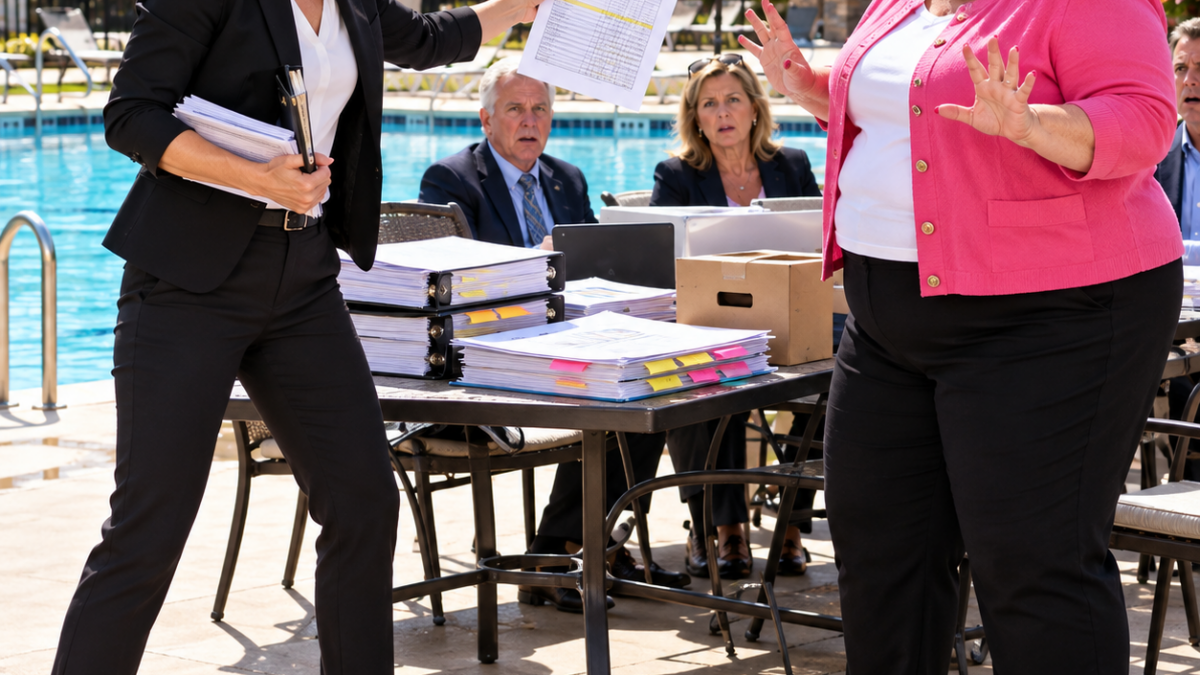
For four hours, I had sat beneath fluorescent lights surrounded by cardboard boxes and accounting debris.
Outside, everything looked too clean.
Too normal.
Cars moved through the shopping center.
A woman pushed groceries toward her SUV.
Someone stood outside the coffee shop laughing into a phone.
Meanwhile, I was carrying thousands of scanned pages showing that my neighborhood had been paying a nonexistent company two thousand dollars every month to maintain a pool that had been closed long enough for mosquitoes to consider filing homestead claims.
I sat in my truck.
Did not start the engine.
Instead, I opened my notebook.
PRESTIGE PROPERTY SOLUTIONS.
$2,000/MONTH.
P.O. BOX.
POOL CLOSED.
I underlined the final line twice.
My military career had taught me to distrust conclusions that arrived before evidence.
Suspicion is not proof.
Coincidence is not proof.
Bad accounting is not automatically theft.
I had seen honest people make sloppy mistakes.
I had also seen dishonest people rely on that possibility to hide deliberate ones.
So I did not go home and tell my neighbors Karen was stealing.
I went home and started checking.
The first thing I searched was the state’s corporate registry.
Prestige Property Solutions.
Nothing.
I tried variations.
Prestige Property Services.
Prestige Pool Solutions.
Prestige Property Management.
Nothing matching the invoices.
Then I searched the P.O. box.
Commercial mail-receiving business fifty miles away.
No operating address.
No contractor license attached.
No company website.
No business registration.
Prestige Property Solutions appeared to exist only on twelve invoices and twelve HOA payments.
I sat back.
My wife had died several years before I moved to Whispering Pines.
That meant nobody was there to walk into my dining room and tell me I had been staring at spreadsheets too long.
So I stared longer.
I pulled up the HOA bank statements.
The twelve payments had cleared.
Regularly.
Like clockwork.
Two thousand dollars.
Month after month.
The statements did not show the backs of the checks.
I needed the canceled images.
I added them to my next records request.
Then I moved to landscaping.
That category was nearly double what it had been three years earlier.
Yet anyone with functioning eyes could see service had declined.
Invoices claimed winter tree trimming.
I could not remember crews appearing.
Mulch deliveries.
No fresh mulch.
Seasonal flower installations.
Several entrance beds were mostly weeds.
That was not proof of theft either.
But now there were two categories where money and reality did not match.
Then I looked at the reserve fund.
Withdrawals.
Consulting.
Special projects.
Capital planning.
Amounts large enough to matter but vague enough to disappear in a summarized annual budget.
By midnight, the dining room was covered in paper.
The next morning, I went walking.
I needed air.
I also needed to think.
Halfway down Magnolia Lane, a lifted Ford F-250 rolled past me.
New.
Black.
Oversized tires.
Custom wheels.
The kind of truck that could swallow ninety thousand dollars before the driver added anything unnecessary.
The driver was Kevin.
Karen’s son.
Early twenties.
Lived at home.
I knew him only because he was impossible not to notice.
He spent afternoons washing vehicles in Karen’s driveway, usually while the rest of the neighborhood was at work.
He did not appear to have regular employment.
That was none of my business.
What became my business was the small white sticker across the rear window.
PPS.
Stylized letters.
I stopped walking.
The truck turned into Karen’s driveway.
I stood on the sidewalk long enough that a passing woman probably thought I had forgotten where I lived.
PPS.
Prestige Property Solutions.
Maybe coincidence.
Maybe a real business with no state registration.
Maybe Kevin worked for it.
Maybe Karen had nothing to do with it.
I repeated those possibilities because I needed to.
Then I walked home faster.
A search of Kevin’s social-media pages was not difficult.
He was not secretive.
The new truck appeared everywhere.
Gas station.
Lake.
Barbecue.
Boat ramp.
One photograph had been posted six weeks earlier.
Caption:
HARD WORK PAYS OFF.
Beside it:
#PPS
That gave me a working theory.
Not proof.
I saved public screenshots.
Printed them.
Added them to a folder.
PRESTIGE PROPERTY SOLUTIONS.
Then I called Dave Miller.
Dave lived next door with his wife, Rachel, and two children.
He worked two jobs.
One full-time warehouse-management position and weekend appliance repair.
The $1,200 assessment had hit him harder than almost anyone I knew.
He opened the door still wearing his work boots.
“What happened?”
“You free?”
“If you tell me Karen raised the assessment again, I’m moving to another planet.”
“Not yet.”
He let me inside.
His daughter was doing homework at the kitchen island.
His son was eating cereal.
Rachel sat with a calculator and a pile of bills.
That image did something to me.
Because Karen’s letters were abstract.
“Assessment.”
“Capital improvement.”
“Reserve contribution.”
At Dave’s kitchen table, twelve hundred dollars meant his wife’s car transmission.
It meant a child’s dental bill.
It meant overtime.
It meant choices.
I showed him the Prestige invoices.
He read them slowly.
“Two thousand a month?”
“Yes.”
“For the pool?”
“Yes.”
“The closed pool?”
“Yes.”
“Maybe they were still maintaining it.”
“Possible.”
He looked at me.
“Do you think that?”
“No.”
“Neither do I.”
Then I showed him the truck photograph.
PPS.
Kevin.
Dave stared.
“No.”
“Not proof.”
“That’s her kid.”
“Yes.”
“He bought that thing like three months ago.”
“Yes.”
“Do you know what he does?”
“No.”
“Nothing.”
“We don’t know that.”
Dave looked at me as if patience itself had become irritating.
“You think Karen is paying her son HOA money.”
“I think the relationship needs to be independently verified.”
“You were in the military too long.”
“Probably.”
Rachel turned from the bills.
“What do we do?”
“Not accuse.”
Dave laughed.
“I know. Independent verification.”
“Exactly.”
“How?”
“Forensic audit.”
That stopped him.
“An actual audit?”
“Not normal bookkeeping review. I mean independent forensic accounting with direct bank verification.”
“How much?”
“Several thousand dollars.”
Dave looked at his wife.
She looked at him.
“Karen will never approve that.”
“I know.”
“So?”
I opened the bylaws.
“Twenty-five percent of homeowners can force a special meeting.”
Dave leaned closer.
“We have two hundred houses.”
“We need fifty signatures.”
“And then?”
“A homeowner vote can direct the board to commission the audit.”
Dave gave a slow smile.
“That she can’t stop?”
“She can make it difficult.”
“But not stop it?”
“Not legally.”
He looked toward Rachel.
She nodded.
“I’m in.”
That afternoon I went to Mrs. Gable.
Every neighborhood has one resident who remembers what the place was before everybody else forgot.
Mrs. Evelyn Gable was ours.
Late seventies.
Widowed.
Sharp enough to remember which board repaired which roof twenty years earlier.
She invited me onto the porch.
I showed her the assessment.
She snorted.
“Twelve hundred dollars.”
“You got one?”
“Oh, yes.”
“Can you afford it?”
“That isn’t the point.”
Exactly the answer I expected.
“What were dues when you moved here?”
“Two hundred quarterly.”
“When?”
“Twenty-two years ago.”
“Special assessments?”
“Never under Mr. Abernathy.”
She spoke of the previous HOA president as though discussing a beloved school principal.
“He kept everything written down. Every check. Every invoice.”
“Pool repairs?”
“Several.”
“Expensive?”
“New liner once.”
“Assessment?”
“No.”
“Pump replacements?”
“At least twice.”
“How long did repairs take?”
“A week? Maybe two.”
I looked across the street toward the green pool.
Mrs. Gable followed my eyes.
“That thing is a disgrace.”
She lowered her voice.
“Karen told us it needed a complete mechanical overhaul.”
“Did she provide bids?”
“Not that I saw.”
“How many meetings do you attend?”
“Every one.”
That mattered.
“If there were bids presented, you’d remember.”
“Yes.”
I showed her the Prestige invoices.
She read.
Then looked at me.
“Never heard of them.”
“Neither had I.”
“Two thousand a month?”
“Yes.”
She became very still.
“My husband would’ve raised holy hell.”
“I think we should raise questions first.”
She smiled.
“You really were an officer.”
I ignored that.
“I’m circulating a petition for a forensic audit.”
“Give it here.”
“I haven’t printed it yet.”
“Then why did you come?”
“To see whether you’d support it.”
She stood.
“Come back tomorrow with copies.”
“Copies?”
“I know people.”
Mrs. Gable knew everybody.
That changed everything.
For three days, I built the petition package.
One page.
No accusations.
Just documented facts.
Quarterly dues had increased from $300 to $475 in three years.
The pool had been closed more than a year.
Prestige Property Solutions received $24,000 during the most recent twelve-month period for ongoing pool services.
Prestige did not appear in the state corporate registry.
Its invoices listed a commercial mailbox.
The board had levied a $1,200 special assessment without providing homeowners a detailed project budget.
At the bottom:
We request a special homeowners meeting to authorize a full independent forensic audit of HOA finances for the previous three fiscal years.
That was it.
No “Karen is a thief.”
No Kevin.
No truck.
No speculation.
Evidence works better when you don’t decorate it.
Dave and I began walking door to door.
House one:
Immediate signature.
House two:
Questions.
House three:
Refused.
House four:
Signed.
House five:
No answer.
House six:
An older man opened the door six inches.
“Karen know you’re doing this?”
“She can see me.”
He looked toward the street.
“You trying to get on the board?”
“No.”
“Everybody says that before they get on the board.”
“Then don’t sign for me.”
He seemed surprised.
“Read the facts. Verify them. Sign if you think an audit is warranted.”
He opened the door wider.
“What company?”
“Prestige Property Solutions.”
“Never heard of it.”
“Neither have I.”
He signed.
Others were harder.
A woman on Cedar Court whispered:
“I don’t want my name on anything Karen sees.”
“Why?”
“She’ll fine me.”
“For what?”
“She always finds something.”
Then she told me last month’s story.
Recycling container visible two hours before collection window.
Violation notice.
No fine yet.
Warning.
“That’s why the petition needs names,” I said.
“She can’t retaliate against everyone.”
She looked unconvinced.
“I have kids.”
“I understand.”
I did.
Fear in a neighborhood looks ridiculous until your home is the collateral.
I left the petition with her.
No pressure.
She signed the next day.
Mrs. Gable collected eleven signatures almost by herself.
She called retirees.
Old neighbors.
People who had lived there since the development opened.
Her endorsement did more than my spreadsheets could.
“Mr. Gable used to look at every budget,” she told people.
“If he were alive, he’d be asking the same thing.”
By day three, Karen noticed.
Of course she noticed.
Her curtains seemed to move every time we crossed the street.
Late that evening, I was talking to a couple at the end of Pine View when a sheriff’s cruiser turned into the neighborhood.
Slow.
Then slower.
It stopped beside us.
The deputy stepped out.
Hand resting near his belt.
“Evening.”
“Evening.”
“We got a call about suspicious people going door to door. Possible solicitation scam.”
I looked toward Karen’s house.
She was standing on her porch.
Watching.
I handed the deputy my driver’s license.
“I live at 114 Pine Crest.”
Then the petition.
“We are homeowners gathering signatures to call a special HOA meeting.”
He read.
“You selling anything?”
“No.”
“Collecting money?”
“No.”
“Threatening anybody?”
“No.”
He gave the clipboard back.
“HOA issue?”
“Yes.”
He sighed.
The sigh of a man who had seen enough subdivision arguments to know exactly what kind of evening this was.
“All right. Keep it civil.”
“Yes, sir.”
He returned to the cruiser.
As he drove away, Karen remained on her porch.
I looked at her.
Did not wave.
Did not smile.
Neither did she.
But the next morning, six homeowners who had been hesitant called me.
One said:
“I saw the sheriff.”
“Yes.”
“That was Karen?”
“I can’t prove who called.”
“Come over. I’ll sign.”
Karen’s intimidation attempt had transformed a petition into a principle.
By the end of the week:
Ninety-four signatures.
Almost half the neighborhood.
Dave stared at the stack.
“Think that’s enough?”
“We need fifty.”
“So yes.”
“Yes.”
Mrs. Gable said:
“Get one hundred.”
“Why?”
“I like round numbers.”
We got ninety-eight.
Good enough.
I sent the formal demand by certified mail to the board and the management company.
Karen responded with a neighborhood-wide email.
SUBJECT: IMPORTANT COMMUNITY WARNING.
I opened it at breakfast.
Dave texted before I finished reading.
SHE HAS LOST IT.
Karen described me as a “newly arrived disgruntled resident.”
I had lived there longer than she implied, but technically I was newer than many.
She accused me of launching a personal vendetta.
Claimed the forensic audit would cost “tens of thousands of dollars.”
Warned legal expenses caused by “hostile homeowners” could force dues even higher.
Suggested property values could suffer if “baseless accusations” became public.
Then:
The current board has always acted with the highest integrity.
I printed that line.
Not because it proved anything.
Because I suspected I would want it later.
Over the next two weeks, tension spread.
An anonymous email accused me of planning to seize the presidency.
Violation notices suddenly appeared.
Dave received a warning involving his basketball hoop being one inch too close to the sidewalk.
He measured.
It wasn’t.
He sent photographs with a tape measure.
The notice disappeared.
Mrs. Gable received a letter about an unapproved garden ornament.
A small stone angel her late husband had given her thirty years ago.
She called me furious.
“They’re coming after George now.”
“No.”
“They’re coming after what he gave me.”
“I know.”
A strange thing happened.
Word spread.
Within three days, stone angels began appearing throughout Whispering Pines.
One.
Then six.
Then twenty.
Different sizes.
Different designs.
Some cheap.
Some beautiful.
Dave put one beside his mailbox.
I bought one too.
Karen withdrew Mrs. Gable’s violation.
No explanation.
That was when I knew her authority was breaking.
Not because she had less technical power.
Because people had stopped being afraid individually.
The special meeting took place on a Tuesday.
The clubhouse had never held that many people.
More than one hundred homeowners.
Standing room.
People along the walls.
Others in the hallway.
Karen sat at the folding table with Treasurer Frank Benson and board secretary Carol Pierce.
Frank had always seemed quiet.
Not malicious.
The kind of man who looked down when Karen spoke.
Carol looked permanently tired.
Karen looked furious.
She opened by reading part of her community warning email.
Then talked about volunteers.
Dedication.
Legal expenses.
Community harmony.
When she finished, she opened discussion.
I stood.
The room became quiet.
“My purpose tonight is simple.”
I held up the assessment.
“We’ve been asked for another twelve hundred dollars per household.”
I pointed toward the window facing the pool.
“For repairs to a community asset that has been closed for more than a year.”
Then the dues history.
$300.
$350.
$400.
$475.
“The issue is not whether costs can increase. They can.”
I projected a simple slide.
“The issue is whether homeowners can verify where money is going.”
Next:
Prestige Property Solutions.
$2,000 monthly.
“For at least twelve months, records I reviewed show payments to this vendor for ongoing pool maintenance.”
Someone shouted:
“What maintenance?”
Murmurs.
I continued.
“The pool was closed.”
Next slide.
State corporate search.
No record found.
P.O. box.
Commercial mail center.
I did not show Kevin’s truck.
I did not need to.
Karen interrupted.
“This proves nothing.”
I looked at her.
“Correct.”
That surprised her.
“It proves enough to justify an audit.”
She opened her mouth.
I continued.
“If Prestige is legitimate, an audit will establish that.”
Applause.
“If all funds are properly accounted for, an audit protects the board.”
More applause.
“If they aren’t, an audit protects homeowners.”
Someone yelled:
“Audit!”
Another:
“Yes!”
Karen banged the gavel.
“This is not a barn!”
The room went quiet enough to hear people laugh.
Karen’s face reddened.
“We will conduct an orderly vote.”
Good.
That was all I wanted.
“All in favor of commissioning an independent certified forensic accounting firm to review the previous three years?”
Hands rose.
Across the room.
Front.
Back.
Middle.
Dave counted one side.
Mrs. Gable another.
I counted the center.
Overwhelming.
Nearly ninety percent.
“Opposed?”
Karen.
Frank.
Carol.
A handful of others.
The motion passed.
Karen looked at me.
If anger had weight, that room would have collapsed.
But she had lost.
Not the presidency.
Not yet.
Control.
She spent the next weeks trying to recover it.
No available audit firms.
I gave the board three qualified firms.
Too expensive.
Homeowners reminded them the vote was binding.
Records too complicated.
Exactly why we needed auditors.
Finally, the board signed with Davies & Cole Forensic Accounting.
Independent.
Well regarded.
No prior relationship with anyone in Whispering Pines.
The audit began.
Real auditors do not care about neighborhood gossip.
That is why I wanted them.
They requested direct banking records.
Accounting-software access.
Invoices.
Electronic payment history.
Contracts.
Minutes.
Vendor files.
Canceled checks.
Deposit records.
They asked questions I had not known to ask.
Then they disappeared into the numbers.
For almost two months, nothing.
Karen changed during that period.
She stopped walking the neighborhood.
Violation letters slowed.
Her SUV remained in the driveway.
Kevin’s truck disappeared for days at a time.
Then the petty harassment began again.
Dogs belonging to Karen’s allies repeatedly wandered onto my lawn.
I installed cameras.
Sent polite notices quoting the pet-cleanup rule.
Stopped.
Dave’s hoop violation came back.
He produced measurements.
Dropped.
Mrs. Gable’s angel.
Neighborhood rebellion.
Dropped.
Every time Karen tried the old tactics, someone documented them.
She had spent years ruling people individually.
Now every attack produced twenty witnesses.
Her model was broken.
Then the auditor called me.
His name was Samuel Davies.
Dry voice.
Professional.
“We’ve identified substantial irregularities.”
I sat straighter.
“How substantial?”
“I’d rather discuss specific findings in person.”
“Prestige?”
“Yes.”
“What did you find?”
“Before I answer, confirm the board president’s son’s first name.”
“Kevin.”
Silence.
Then:
“The bank account receiving Prestige Property Solutions payments belongs to Kevin.”
My hand tightened around the phone.
“The business?”
“There is no registered entity.”
“Account opened when?”
“One day after the HOA issued the first Prestige payment.”
I closed my eyes.
There.
The connection.
Not social media.
Not a truck sticker.
Bank record.
Independent auditor.
“What else?”
“We’re still quantifying.”
“Landscaping?”
“Yes.”
“Consulting?”
“Yes.”
“Personal charges?”
A pause.
“Yes.”
“How bad?”
“Bad enough that we recommend immediate referral to law enforcement.”
I did not feel victorious.
That surprised me.
I felt sick.
Because numbers stop being theoretical once fraud is confirmed.
Every dollar belonged to someone.
Dave.
Mrs. Gable.
Retirees.
Young families.
People who had skipped repairs or worked overtime to pay assessments.
“Samuel.”
“Yes?”
“The $1,200 assessment?”
“Do not pay it yet.”
That was all he said.
The final audit presentation was scheduled for the next quarterly meeting.
The clubhouse could never hold everyone.
We moved it to the high school auditorium.
Almost every household attended.
Rows of seats.
Stage lights.
Large screen.
The atmosphere felt less like neighborhood governance and more like a sentencing hearing.
Karen sat behind a table with Frank and Carol.
Frank looked physically ill.
Carol stared at her hands.
Samuel Davies stepped to the podium.
No theatrics.
Gray suit.
Glasses.
A stack of organized notes.
“Good evening.”
The room quieted.
“Our firm was retained by the association following a membership vote directing an independent forensic examination of the prior three fiscal years.”
He explained methodology.
Direct bank verification.
Vendor confirmation.
Contract review.
Invoice testing.
Reserve analysis.
Credit-card review.
Related-party examination.
Then:
Pool.
The first slide showed the closure date.
The next showed Prestige payments.
Twenty-four months.
$48,000.
That was already double what I had seen in the first document session.
The source story likewise states that the independent audit eventually identified 24 months of $2,000 payments—$48,000 total—to the unregistered pool vendor while the pool remained officially closed.
Samuel said:
“Prestige Property Solutions is not registered as a legal business entity in this state.”
Silence.
“The address appearing on its invoices is a commercial mailbox.”
Next slide.
Bank-account signature card.
Name:
Kevin.
Karen’s son.
Same residential address as Karen.
People gasped.
Karen stood.
“This is a lie!”
Samuel stopped.
Did not flinch.
She pointed toward the screen.
“My son has a business!”
Samuel looked over his glasses.
“Ma’am, the bank records are legal records obtained directly through appropriate process.”
“You don’t know what services he performed!”
Samuel clicked.
Pool closure minutes.
Official board document.
The pool had been declared unusable two months before Prestige’s first payment.
“Records show payments began after closure.”
Karen’s mouth moved.
No sound.
Samuel continued.
“Additionally, we found no service logs, chemical-purchase receipts, employee records, contractor licensing, or operational documentation supporting the recurring pool-maintenance invoices.”
A man behind me said:
“Forty-eight thousand dollars.”
Another:
“For nothing.”
Samuel moved to landscaping.
Greenscape Unlimited.
Owner:
Karen’s brother-in-law.
Contract awarded shortly after Karen became president.
No competitive bid.
Cost substantially above market.
Our own later quotes showed we could save more than twenty thousand annually.
Samuel did not call the entire difference stolen.
He called it an undisclosed related-party arrangement and procurement failure.
Then consulting fees.
Karen’s friend.
Community Planning Services.
No plan.
No report.
No meaningful documented deliverables.
Then credit card.
Restaurants.
Fuel.
Expenses labeled:
Board working dinner.
Property inspection mileage.
Association development meeting.
Dates frequently did not match board activity.
Samuel’s team traced enough to classify several charges as personal or unsupported.
Next:
Reserve fund.
Falling.
Dues.
Rising.
Then a graph.
Three years.
The relationship was unmistakable.
More money entering.
More money leaving through weakly controlled vendors.
Less available for actual capital needs.
The pool sat green because the money supposedly maintaining community assets was disappearing elsewhere.
Samuel finally displayed the total.
Approximately $89,700 in expenditures classified as fraudulent, misappropriated, unsupported, or materially conflicted and subject to recovery or law-enforcement review.
That was why I changed the title of this story.
People later exaggerated the number.
Two million.
Three million.
Rumors always grow.
The records supported something closer to ninety thousand dollars directly identified in the forensic review—not two million—and that was more than enough to devastate a neighborhood association our size. The later source account similarly describes the completed audit expanding the known improper spending to roughly $90,000 after including inflated contracts, bogus consulting fees, and personal HOA-card charges.
Samuel closed his presentation.
“I recommend immediate preservation of all financial records, suspension of access credentials for persons under review, notification of the association’s insurance carrier, and referral to law enforcement.”
The auditorium exploded.
People stood.
Shouted.
“Thief!”
“Give it back!”
“You stole from us!”
Karen grabbed the microphone.
“This is a conspiracy!”
Nobody listened.
She banged the gavel.
Ridiculous sound in a high school auditorium.
Frank wiped sweat from his face.
Carol began crying.
I stood.
Not at the podium.
In the aisle.
“Everyone!”
Nobody heard.
Dave stood too.
“LET HIM TALK!”
The room slowly quieted.
I turned toward the crowd.
“Let the record stay clean.”
That mattered.
“No threats.”
A few people grumbled.
“No touching anyone.”
Silence.
“No mob.”
I looked toward Karen.
“This is no longer about winning an argument.”
Then the side doors opened.
Two uniformed officers walked inside.
The entire auditorium became quiet.
Karen saw them.
Her face collapsed.
They did not rush.
No television drama.
They walked toward the stage.
One officer spoke quietly with Samuel.
Then approached Karen.
“Ma’am, please stand.”
She stared.
“What?”
“We have a warrant.”
“No.”
“Please stand.”
“This is an HOA meeting.”
“Yes, ma’am.”
“You can’t arrest me here.”
The officer’s expression did not change.
“Please stand.”
Karen looked toward Frank.
He looked away.
Carol covered her mouth.
Karen stood.
For years, she had ordered residents around from behind folding tables.
Now she followed an instruction because the person giving it possessed actual legal authority.
The officer placed her hands behind her back.
Handcuffs clicked.
That sound traveled through the auditorium.
Not loud.
Still, everyone heard it.
Karen looked at me as they turned her toward the aisle.
Her expression was not anger anymore.
Not really.
Shock.
Maybe betrayal.
As if the world had violated an agreement she believed existed only for her.
She passed my row.
I said nothing.
No smile.
No comment.
No satisfaction I needed her to see.
The officers led her out.
The doors closed.
For several seconds, nobody moved.
Then Mrs. Gable whispered:
“Well.”
Somebody laughed.
Not cruelly.
Nervously.
The spell had broken.
Frank resigned the next morning.
Carol resigned ten minutes later.
Both retained attorneys.
Investigators eventually concluded Frank had been negligent and had signed checks without adequate oversight, but the evidence supporting deliberate theft was much stronger against Karen and Kevin.
Frank cooperated.
So did Carol.
The management company came under scrutiny.
They had processed payments that should have triggered basic questions.
Unregistered vendor.
P.O. box.
Recurring invoices.
No documentation.
Related-party contracts.
They claimed the board had directed everything.
That excuse did not save the relationship.
We terminated them.
The bylaws required an interim board.
To my horror, my neighbors nominated me for acting president.
“No.”
Dave laughed.
“You started this.”
“I started an audit.”
“Congratulations. Promotion.”
“I don’t want it.”
Mrs. Gable said:
“Good.”
I stared at her.
“How is that good?”
“People who desperately want HOA power shouldn’t have it.”
That argument was annoyingly difficult to defeat.
I accepted temporarily.
Dave became vice president.
Maria Alvarez, a retired accountant who lived on Juniper Lane, became treasurer.
Her first statement after examining the books:
“We’re in trouble.”
“How much trouble?”
She removed her glasses.
“Not bankruptcy tomorrow.”
“Comforting.”
“But one major roof failure away from a serious cash crisis.”
The reserve fund had been badly depleted.
Restitution would take time.
Insurance claims would take time.
The pool remained unusable.
Clubhouse paint peeled.
Entrance landscaping looked exhausted.
Homeowners were angry.
And the $1,200 special assessment?
We canceled it.
Immediately.
That produced applause.
It also produced a problem.
Now we had to fix things without it.
A week later, we held a town hall beside the closed pool.
Not a stage.
No gavel.
No tables separating board from residents.
We stood in a circle.
The green water behind us smelled terrible.
I told them everything.
Reserve balance.
Pending insurance claim.
Legal recovery process.
Contract terminations.
Outstanding obligations.
No pretending.
Dave’s wife Rachel asked:
“So what do we do?”
I pointed toward the pool.
“First, we find out what’s actually wrong with that.”
A voice:
“Karen said full mechanical replacement.”
“I know.”
“Cost?”
“No verified estimate in the records.”
Another voice:
“So nobody even checked?”
“Apparently not properly.”
Then a man raised his hand.
His name was Bill Foster.
Retired mechanical engineer.
“I’ll look at it.”
The next morning Bill arrived with tools.
Dave.
Me.
Two other volunteers.
We opened the equipment room.
Dust.
Neglect.
Pump.
Filter.
Electrical panel.
Bill spent twenty minutes inspecting.
Then:
“Motor.”
“What?”
“Pump motor’s dead.”
“How bad?”
“Replacement motor maybe seven hundred dollars.”
I stared at him.
“Seven hundred?”
“Could be six-fifty. Depends on model.”
“Not forty thousand?”
He looked confused.
“Who said forty thousand?”
“Never mind.”
I sat on an overturned bucket.
Three years of rising dues.
A year-plus closed pool.
Forty-eight thousand dollars to Kevin.
A $240,000 proposed special assessment community-wide.
The mechanical issue might be solved for less than a thousand dollars plus maintenance and cleaning.
Dave leaned against the wall.
“You okay?”
“No.”
“Angry?”
“Yes.”
“Good.”
“Why good?”
“Thought you were going to cry.”
“I might do both.”
Bill ordered the motor.
Seven hundred twelve dollars.
We paid from operating funds.
The harder part was cleaning.
The pool looked like swamp water.
We hired a licensed company for chemical assessment and safe restart.
But dozens of residents volunteered for the nontechnical work.
Drain.
Scrub.
Clean furniture.
Pressure-wash deck.
Paint fence.
Repair gate.
Replace faded signs.
The first Saturday felt like a block party disguised as manual labor.
Dave’s kids scraped paint.
Mrs. Gable brought lemonade and insulted everyone’s work ethic.
Maria inventoried supplies.
A dentist trimmed shrubs.
A software engineer pressure-washed concrete.
Three teenagers volunteered because community-service hours looked good on college applications.
Nobody cared why they came.
They worked.
At lunch, Rachel passed sandwiches.
Dave sat beside me.
“Funny.”
“What?”
“Six months ago I knew maybe four people here.”
I looked around.
“Karen united everyone.”
“Don’t give her credit.”
“Fair.”
The pump motor arrived.
Bill installed it under appropriate professional supervision.
The licensed pool technician verified the system.
Then we turned it on.
For one second:
Nothing.
My heart sank.
Then the motor caught.
A low mechanical hum.
Water moved.
A cheer went up.
Actual cheering.
Over a pool pump.
Mrs. Gable clapped like we had landed on the moon.
Dave’s son yelled:
“IT’S ALIVE!”
The water took days to balance and clear safely.
But it did.
Blue returned slowly.
First cloudy.
Then lighter.
Then clean.
When we finally saw the bottom again, somebody sent me a picture.
Caption:
$700 VIEW.
I saved it.
The criminal case continued.
Kevin was charged alongside his mother.
His lawyer initially claimed Prestige had performed legitimate consulting and pool-related support.
The problem:
No employees.
No chemical purchases.
No equipment expenses.
No service records.
No business registration.
No meaningful evidence that work occurred.
Bank records showed HOA payments entering Kevin’s personal account.
Then large purchases.
Truck payments.
Accessories.
Travel.
Entertainment.
The lifted Ford became part of asset recovery.
Kevin took a plea.
First-time offender.
Probation.
Restitution obligations.
The truck was surrendered.
Auctioned.
Money returned to the HOA.
I happened to see the truck one final time at the county impound lot when meeting an investigator.
The PPS sticker was still on the rear window.
I stood beside it.
A detective asked:
“Want a souvenir?”
“No.”
“Sticker?”
“No.”
“Photograph?”
“No.”
I had enough paper.
Karen fought longer.
Then pleaded too.
Five years probation.
One thousand hours of community service.
Full restitution tied to amounts prosecutors could establish.
Other civil recovery addressed additional losses.
The house had to be sold.
The immaculate corner property.
Perfect landscaping.
The symbol people had used as shorthand for her success.
A FOR SALE sign appeared.
I saw it from my kitchen window.
Dave came over.
“You watching?”
“Apparently.”
Moving trucks arrived weeks later.
Karen stepped outside carrying a box.
She looked older.
No HOA polo.
No gavel.
No clipboard.
Just a woman leaving a house.
For half a second, I expected satisfaction.
Instead, I felt tired.
Justice is satisfying from a distance.
Up close, consequences are heavy.
She had done this.
No question.
But watching a person lose a home is not entertainment just because the person once threatened other people’s security.
Dave stood beside me.
“You feel bad for her?”
“No.”
“Good.”
“I don’t feel good either.”
He thought about that.
“Probably healthier.”
The truck drove away.
Mrs. Gable called twenty minutes later.
“She gone?”
“Yes.”
“Good.”
A pause.
“Did you gloat?”
“No.”
“Shame.”
I laughed.
Insurance recovery came next.
Our fidelity coverage applied to certain board-member dishonesty losses.
Claims were slow.
Documentation intense.
Maria loved it.
She built binders that made mine look amateur.
Eventually, substantial funds returned.
Restitution payments.
Insurance.
Vendor settlement.
Auction proceeds.
Savings from renegotiated contracts.
The reserve fund began breathing again.
We rebid landscaping.
Three contractors.
Transparent scope.
Greenscape Unlimited—the brother-in-law’s company—did not participate.
New contract:
More service.
Lower price.
Savings above twenty thousand dollars annually.
The common beds improved within months.
People noticed.
That was important.
Transparency feels theoretical until flowers actually grow.
We adopted new financial rules.
Three competitive bids for major contracts.
Any related-party relationship disclosed before discussion.
Board members with conflicts recuse from votes.
All expenses over $500 require documented approval.
Monthly bank reconciliation independently reviewed.
Credit-card charges posted.
Full financial package online.
Quarterly reserve report.
Annual outside financial review.
No mystery vendors.
No P.O. box companies without verification.
No check signed simply because Karen—or anyone else—said sign it.
When we announced the rules, someone asked:
“Isn’t this overkill?”
Maria answered:
“Fraud always looks like overkill prevention until after the fraud.”
Rule adopted unanimously.
HOA meetings changed too.
At first, attendance stayed enormous.
People came angry.
Suspicious.
Every invoice questioned.
“Why $318 for fertilizer?”
“Why $640 plumbing?”
“Why did the landscaper charge fuel adjustment?”
It was exhausting.
I answered anyway.
Because after secrecy, transparency feels like reopening a wound and showing everyone the stitches.
People needed to see.
Months passed.
Trust returned slowly.
Attendance fell.
One meeting had thirty-seven people.
Then twenty-nine.
Then twenty-two.
Dave worried.
“People getting apathetic again?”
“Maybe.”
“Isn’t that how Karen happened?”
“Yes.”
“So?”
“Difference is they can look at the books online from home.”
Maria nodded.
“The goal isn’t forcing everyone to attend meetings forever.”
“What is the goal?”
“Making sure nobody needs courage to ask a question.”
That became our standard.
The grand reopening of the pool happened July Fourth.
We almost delayed because the new county inspection required one minor handrail repair.
Old board would have complained.
New board fixed it.
Inspection passed.
Families arrived with towels.
Barbecue smoke drifted across the clubhouse lawn.
Music.
Children.
Coolers.
Someone hung red, white, and blue streamers.
Dave’s kids stood at the edge of the deep end.
His son looked at me.
“You ready?”
“For what?”
He cannonballed.
Water hit my shoes.
Dave laughed.
“That’s your reward.”
I looked around.
Mrs. Gable stood beside me holding iced tea.
“You know,” she said, “Mr. Abernathy would be proud.”
“The old president?”
“He always said the neighborhood wasn’t the houses.”
“What was it?”
“The people.”
I watched Rachel talking with Maria.
Teenagers tossing a football.
Bill Foster explaining pool mechanics to somebody who regretted asking.
Children splashing in clear water.
“Sounds right.”
Mrs. Gable looked toward Karen’s old house.
New owners had moved in.
Young couple.
Baby due soon.
“They seem nice.”
“Yes.”
“Know the story?”
“They said that’s why they liked the neighborhood.”
I looked at her.
“What?”
“They heard everyone worked together after what happened.”
That surprised me.
Karen’s house had become an advertisement for the community she nearly destroyed.
Life has a sense of humor.
I remained acting president longer than planned.
Every time I tried to resign, somebody said:
“After one more quarter.”
One more quarter became a year.
Then formal election.
Dave nominated me.
I glared.
He enjoyed it.
I ran on one promise:
I would serve two years.
No more.
The vote passed easily.
Mrs. Gable told me:
“Congratulations.”
“Feels like punishment.”
“It is.”
Being HOA president after fighting a corrupt HOA teaches humility quickly.
Homeowners can be unreasonable too.
A man demanded the association pay to remove leaves from his private hot tub.
Another wanted us to ban a neighbor’s wind chime because “sound travels.”
Someone filed three complaints about a mailbox leaning approximately three degrees.
I began to understand why volunteer boards become exhausted.
What I never accepted was using exhaustion as permission for secrecy.
Whenever I felt irritated, I remembered Karen’s first email:
Dear Homeowner.
No name.
Condescension.
Obstruction.
So I answered questions.
Even dumb ones.
Especially angry ones.
Because authority becomes dangerous when leaders start deciding which citizens deserve information.
One afternoon, Kevin came back.
That surprised me.
Probation still active.
Restitution underway.
He parked an old sedan near Karen’s former house, then walked toward mine.
I stepped outside.
“Can we talk?”
“Yes.”
He looked thinner.
No backwards cap.
No arrogance.
“I wanted to apologize.”
I waited.
“For the money.”
“Okay.”
“That sounds bad.”
“It is bad.”
He swallowed.
“My mom said it wasn’t stealing.”
“What did she call it?”
“Paying me for work.”
“Did you do the work?”
His eyes dropped.
“Some.”
“What?”
“I picked up chemicals twice.”
“Anything else?”
“I helped a guy look at the pump.”
“Who?”
“Friend.”
“Licensed?”
“No.”
“Twenty-four months of invoices?”
“No.”
I let the silence sit.
Kevin finally said:
“She said everybody wastes HOA money.”
“That was her justification?”
“Kind of.”
“Did you believe her?”
“At first.”
“And later?”
He looked toward the pool.
“No.”
Children were swimming.
He stared.
“I drove past during the reopening.”
“I didn’t see you.”
“I didn’t stop.”
“Why come now?”
“Probation counselor.”
I almost smiled.
“At least that’s honest.”
“He said apologies only count if the person can tell you to go to hell.”
“Interesting counselor.”
Kevin shifted.
“I’m sorry.”
I believed he was sorry for some combination of consequences, guilt, humiliation, and whatever his mother had convinced him was normal.
Human motives are rarely pure.
“What are you doing now?”
“Warehouse.”
“Legitimate?”
He looked at me.
Then laughed despite himself.
“Yes.”
“Good.”
“Are we okay?”
“No.”
He flinched.
Then I continued.
“But we don’t need to be enemies.”
He nodded.
That was enough.
Karen never came back.
Years later, I heard she had finished probation.
No idea where she lived.
No interest.
Her legacy in Whispering Pines became rules designed to prevent another version of her.
But I resisted turning her into folklore.
At new-resident orientation, people sometimes asked:
“Is this the neighborhood with the crazy HOA president?”
I would answer:
“This is the neighborhood with published financials.”
More useful.
The pool pump became a running joke.
Every annual budget included:
POOL EQUIPMENT RESERVE.
Someone inevitably asked:
“How much?”
Maria would answer:
“More than seven hundred dollars.”
Laughter.
Then we would review the actual reserve requirement.
The lesson was not that all pool repairs are cheap.
They aren’t.
The lesson was that claims need evidence.
When the pool later needed a genuine resurfacing project, the cost was substantial.
We obtained three bids.
Published them.
Held a meeting.
Explained why.
Homeowners voted.
Assessment approved.
Almost nobody complained.
Why?
Because they could see the problem.
They could see the bids.
They could see the contract.
They could see every payment.
People will accept bad news more easily than hidden news.
Mrs. Gable lived to see that project.
She sat beside me during the meeting.
“Funny.”
“What?”
“Karen could’ve saved herself so much trouble by just telling the truth.”
“Yes.”
“Think she ever understood?”
“I don’t know.”
Mrs. Gable smiled.
“Not our problem anymore.”
She was right.
She died the following spring.
Eighty-three.
Peacefully.
Her daughter asked me to speak at the funeral.
I talked about the stone angel.
Not fraud.
Not Karen.
The angel still stood in her garden.
Her daughter gave it to the neighborhood afterward.
We placed it near the clubhouse entrance.
Small plaque:
FOR EVELYN GABLE — WHO REMINDED US THAT HOME BELONGS TO PEOPLE, NOT RULES.
Dave said it sounded sentimental.
I told him to shut up.
He cried at the dedication.
Years later, Dave’s daughter married.
His son—the kid whose family worried about the $1,200 assessment—became an electrician.
He repaired pool lighting for us once.
Sent an invoice.
Maria checked it.
Dave said:
“You’re auditing my kid?”
Maria answered:
“Yes.”
He smiled.
“Good.”
That was culture changing.
Not trusting people because you like them.
Trusting systems because everyone follows them.
I served exactly two years.
At the final meeting, several homeowners asked me to stay.
“No.”
Why not?
“Because this board does not belong to me.”
Silence.
“We spent years dealing with someone who forgot that.”
Nobody argued.
Maria became president.
Best choice we ever made.
Her first act was to shorten meetings by thirty minutes.
Attendance increased.
I returned to retirement.
Real retirement.
Morning walks.
Grandkids.
Sometimes pool duty.
One summer afternoon, my grandson asked why everybody in the neighborhood knew me.
“I was HOA president.”
He looked disappointed.
“That’s it?”
“Pretty much.”
Dave’s son, standing nearby, said:
“He caught a lady stealing money.”
My grandson’s eyes widened.
“You caught a robber?”
“No.”
“Police did.”
“But you found her?”
“An auditor did.”
“But you found the first thing?”
“Yes.”
“What?”
I pointed toward the water.
“The pool.”
He frowned.
“The pool was stealing?”
I laughed so hard people looked over.
Children should not understand HOA fraud.
That is another kind of success.
The old special-assessment letter stayed in my desk drawer for years.
One thousand two hundred dollars.
Emergency capital improvements.
Cheap card stock.
Official words.
The document that started everything.
Eventually, during a cleanup, I considered throwing it away.
Then stopped.
On the back, I wrote:
ASK FOR THE RECEIPTS.
I gave it to Maria when she retired from the board.
She framed it in the clubhouse office.
Not as a monument to me.
As a warning.
New board members saw it when they signed bank-authority forms.
ASK FOR THE RECEIPTS.
Simple.
Years later, Whispering Pines was healthier financially than it had ever been.
Reserve fund fully funded.
Dues stable.
No special assessments for avoidable emergencies.
Landscaping good.
Pool maintained.
Management company responsive.
Fraud controls boring.
Nobody became famous.
Perfect.
I sometimes thought back to the afternoon I first noticed Kevin’s truck.
PPS.
Had he removed that sticker, maybe I would have taken longer to connect him.
Had Karen organized the document dump better, maybe some invoices would’ve been harder to spot.
Had she repaired the pool for a few hundred dollars, maybe homeowners would not have questioned the assessment.
Had she raised dues more slowly, maybe resentment would have stayed manageable.
Dishonest systems often collapse through arrogance rather than sophistication.
Karen thought nobody would check.
That was her real mistake.
Not the truck.
Not the invoices.
Not even Prestige.
Her fundamental assumption was that two hundred families were too busy, too intimidated, or too divided to compare what they were paying with what they were receiving.
For several years, she was right.
Then one green pool became too obvious to ignore.
People later asked whether I felt like I got revenge.
The answer changed over time.
At first?
Yes.
Watching the audit expose Prestige felt satisfying.
Watching Karen lose control felt satisfying.
Watching the handcuffs close?
Complicated, but yes.
Watching her house sell?
Less than I expected.
But revenge did not become the ending.
Clean water did.
Dave’s children jumping into the pool.
Mrs. Gable’s angel staying in her garden.
Rachel fixing her car because we canceled the $1,200 assessment.
Neighbors repainting the clubhouse together.
Financial statements anyone could open online.
Those things lasted longer than anger.
If justice had ended with Karen leaving, Whispering Pines would only have traded one story for another.
Instead, we rebuilt the system that allowed her to operate.
That was the real victory.
Because corruption is rarely only one bad person.
It needs shadows.
Weak controls.
Low participation.
Blind signatures.
Unasked questions.
People assuming somebody else checked.
Once those things disappeared, another Karen would have a much harder time.
One July Fourth, almost ten years after the first special assessment, I sat beside the pool again.
Different board.
Different children.
Same clubhouse.
Fresh paint.
A little worn already because communities are never finished.
Dave joined me carrying two drinks.
“Remember the swamp?”
“Yes.”
“Remember Todd?”
“The management guy?”
“Wonder what happened to him.”
“No idea.”
“Remember paying three hundred dollars so he could play on his phone while you scanned records?”
“Yes.”
“Worth it?”
I looked at the pool.
A little girl in pink goggles jumped into the shallow end.
Her father caught her.
Water splashed across his shirt.
Someone grilled hamburgers.
Teenagers argued over music.
Mrs. Gable’s angel stood near the flowers.
The new owners of Karen’s old house had added a porch swing.
I smiled.
“Yeah.”
Dave raised his cup.
“To overpriced document supervision.”
I raised mine.
“To receipts.”
We drank.
A moment later, a boy performed an enormous cannonball.
Water hit both of us.
Dave shouted.
The kid disappeared underwater laughing.
I looked at the sunlight moving across the surface.
Clear.
Blue.
Circulating.
Alive.
Three years of rising dues had taught us to stop looking at the number on the invoice and start looking at what the money actually bought.
For too long, we paid for maintenance nobody performed.
Contracts nobody questioned.
Consultants nobody needed.
A president nobody challenged.
Then we did one simple thing.
We opened the books.
The pool had never needed $240,000 in emergency money.
The pump did not need a grand overhaul.
The community did not need higher dues to survive.
What Whispering Pines needed was something far cheaper.
People willing to ask where their money went.
And once we finally asked together, Karen’s entire empire turned out to be worth less than the seven-hundred-dollar motor she had spent years pretending she couldn’t afford.








