PART 2: HOA Put “No Trespassing” Signs on My Cabin While I Was Overseas—Then I Came Home With the Deed
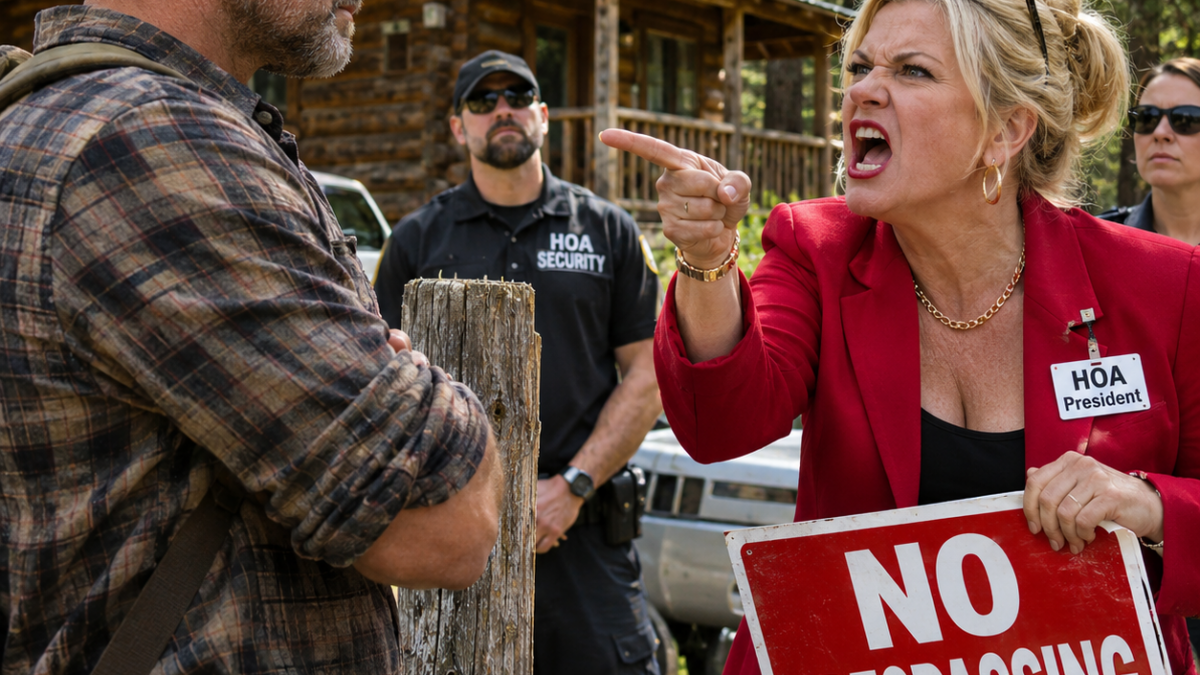
PART 2
I stood in Gladys Morrison’s living room holding that envelope while the grandfather clock behind me ticked loud enough to feel like somebody counting down.
“What is this?”
Gladys wiped beneath her eyes.
“I saved everything she gave me.”
“Why?”
“Because my grandson told me to.”
She pointed toward the kitchen.
“Sit down.”
I didn’t want to sit.
I wanted to tear the envelope open, march back across the road, and demand answers.
Instead, I sat.
Gladys was seventy-six, maybe seventy-seven. She had lived on Lake Thornton almost as long as my grandfather had. She was the kind of neighbor who always knew when you arrived because she could identify vehicles by sound.
When I was a kid, she kept freezer pops in the garage for us.
Now her hands shook as she poured coffee.
“About a year after you left,” she said, “Deirdre started telling everybody the road needed organized management.”
“What does that mean?”
“At first? Twenty dollars here. Twenty-five there. Gravel. Snowplowing. Things people didn’t mind helping with.”
“That road is county maintained.”
“I know that now.”
I looked at the envelope.
“What did she tell you about me?”
Gladys lowered herself into the chair opposite mine.
“She said your grandfather had died.”
“That part was true.”
“She said nobody could reach you.”
“That wasn’t.”
“She said she had spoken with someone connected to the military and been told there had been an incident overseas.”
My fingers stopped against the envelope flap.
“What kind of incident?”
“She didn’t say at first.”
Gladys swallowed.
“Later she told us you’d been killed.”
I stared at her.
Nobody spoke.
Outside, wind moved through the pines.
“Everyone believed that?”
“Not everyone. Mike Patterson said it sounded strange. Your grandfather always talked about you. We figured somebody from your family would come.”
“They couldn’t. My mother died years ago. Grandpa was my closest family.”
“I know.”
“So Deirdre just announced I was dead?”
“She made it sound official.”
“How?”
“Words.”
Gladys looked embarrassed.
“Legal words. Military words. Probate words. She talks like if she says something confidently enough, you feel foolish for questioning her.”
I understood exactly what she meant.
I opened the envelope.
The first page was a photocopy of a county parcel map.
My property had been outlined in yellow.
Someone had written:
**Potential Phase II Development — 40 acres**
Underneath that was a typewritten letter addressed to something called the Brennan Estate.
It described an offer of fifteen thousand dollars for my entire property.
I looked up.
“Fifteen thousand?”
Gladys nodded.
“My grandfather paid twelve in 1987.”
“She said the land had serious compliance problems.”
I flipped to the next page.
An unsigned purchase proposal.
Another document claiming that prolonged abandonment could require estate intervention.
A draft power of attorney.
I stopped.
“Why is your name on this?”
Gladys looked away.
“She wanted me to sign as a local witness.”
“To what?”
“That I had not seen you on the property for years and believed the place had been abandoned.”
I felt heat climbing my neck.
“Did you sign?”
“No.”
“Why not?”
“My grandson Daniel came up from Duluth for my birthday. He works as a paralegal. I showed him the papers.”
She gave a small, humorless laugh.
“He nearly drove straight to the sheriff’s office.”
“What stopped him?”
“Me.”
“Why?”
“Because Deirdre had everyone frightened.”
“Of what?”
“Lawsuits. Liens. Losing access. She kept saying if we interfered with her management plan, property values would collapse.”
I looked around Gladys’s modest cabin.
The linoleum near the refrigerator had worn pale.
A stack of grocery coupons sat beside the phone.
This wasn’t a woman sitting on piles of cash.
“How much has she charged you?”
Gladys hesitated.
“Gladys.”
“Road fees. Environmental assessments. Septic compliance. Gate maintenance.”
“How much?”
“Almost four thousand dollars.”
My coffee mug hit the table harder than I meant it to.
She flinched.
I immediately lowered my voice.
“Sorry.”
“It’s all right.”
“No, it isn’t.”
I looked at the draft power of attorney again.
“She tried to get you to help transfer authority over my land?”
“She said she was protecting it.”
“For who?”
“For the community.”
“What community?”
Gladys gave me a tired look.
“Exactly.”
I spent another hour going through the envelope.
There were invoices.
Notices.
Letters with legal citations.
Threats of penalties for people who didn’t pay.
A document naming Deirdre as president of Willow Brook Estates Property Association.
What I didn’t see was anything proving the association legally existed.
I asked Gladys for permission to copy everything.
“Take it,” she said.
“You may need it.”
“I want you to keep originals.”
“Marcus.”
“Keep originals.”
I tapped the envelope.
“If she realizes I’m home and starts trying to clean this up, I want copies in more than one place.”
Gladys studied me.
“You sound like your grandfather.”
“That good or bad?”
“Depends on whether somebody is lying to you.”
I left with photographs of every page and drove back toward the cabin.
The orange signs looked different now.
Not just insulting.
Strategic.
Someone had been building a narrative.
Abandoned property.
Dead owner.
Community management.
Potential development.
And the person building that narrative had spent three years assuming I would not walk back into it.
The next morning, a certified letter arrived.
Technically, it arrived at the brass mailbox someone had installed where Grandpa’s old black metal one used to stand.
The new box had **WILLOW BROOK ESTATES MANAGEMENT** engraved on the side.
I took another photo before opening it.
The letter came from Hutchinson Property Management.
Eight pages.
According to Deirdre, I owed $3,600 in past community assessments, $500 toward the electronic gate, $200 for a compliance inspection, plus monthly penalties.
My grandfather’s tool shed was listed as unauthorized.
His compost pile was described as a potential environmental hazard.
The cabin had unspecified architectural violations.
The letter gave me ten days to cure all outstanding violations or face a lien.
I actually laughed.
Not because it was funny.
Because it was so outrageous my brain needed somewhere to put the reaction.
Ten minutes later, I was driving to the county courthouse.
For the next week, I treated the dispute the way I would have treated an engineering problem.
No assumptions.
No emotion in the record.
Start with what exists.
Confirm what does not.
The first thing I searched was the alleged HOA.
Nothing.
Then variations.
Willow Brook Estates.
Willowbrook Estates.
Lake Thornton Willow Brook.
Hutchinson Community Association.
Nothing matching the organization Deirdre claimed to represent.
A clerk named Linda helped me search filings.
She finally pushed her glasses up and said, “There could be something under another corporate name.”
“So this doesn’t prove it doesn’t exist?”
“Correct.”
“What would prove authority over my parcel?”
“Recorded covenants. Deed restrictions. Association documents tied to the parcel. Something.”
We searched my title.
Nothing.
No HOA covenant.
No membership agreement.
No community declaration.
No management contract.
Nothing.
Then I asked about the road.
That produced an uncomfortable silence.
The county road engineer, Paul Granger, met me two days later.
He was a broad man with suspenders, gray hair, and the expression of somebody who already knew the conversation would ruin his morning.
I spread the maps across his desk.
“This used to be open county access.”
“Yes.”
“Now there’s a private gate.”
“Yes.”
“Who approved that?”
He rubbed his jaw.
“There was an application.”
“From Deirdre?”
“From a development management entity.”
“What development?”
He didn’t answer.
“Paul.”
“I wasn’t handling the file when the application came in.”
“But?”
“The access classification was changed based on representations that the road served a private planned community.”
“Was there a hearing?”
His eyes shifted.
“That’s one of the things we’re reviewing.”
“Was there public notice?”
Another pause.
“We’re reviewing that too.”
I leaned back.
“So she filed paperwork saying this was a private planned community, and somebody accepted it without confirming the people living there had actually formed one?”
“I’m not saying that.”
“What are you saying?”
“That we need to review the file.”
“That sounds like government language for yes.”
He gave me a tired look.
“I understand why you’re angry.”
“I’m not angry.”
That was a lie.
I was furious.
But fury wasn’t useful yet.
“I need copies of everything.”
“You’re entitled to the public record.”
“Good.”
Before I left, he said something that stuck with me.
“Mr. Brennan?”
I turned.
“If your deed and access history are what you say they are, don’t remove the gate yourself.”
“I wasn’t planning to.”
“Good.”
“Why?”
“Because however wrong the paperwork may be, you don’t want this turning into a property-damage case while ownership and access are being reviewed.”
It was the first professional advice anyone had given me.
I took it.
That afternoon, I found something else in Deirdre’s property file.
A reference to her divorce.
Normally I wouldn’t have cared.
I wasn’t interested in her personal life.
But the settlement included unusual language involving continued support payments and the appraised value of her residence.
I read it twice.
If her property value dropped below a specified threshold for a sustained period, certain payments from her ex-husband could stop.
Her home had recently been appraised dangerously close to that threshold.
I sat at a courthouse table and stared at the number.
Suddenly the landscaping made sense.
The fake stone entrance.
The gate.
The aggressive branding.
The repeated references to protecting property values.
Maybe this wasn’t only about power.
Maybe Deirdre needed Willow Brook Estates to look real because she needed her own house to look more valuable than it was.
That was theory.
Not proof.
I wrote it down and kept digging.
Next came the money.
Talking to neighbors was harder than finding public records.
Documents don’t feel embarrassed.
People do.
Mike Patterson ran the bait shop near the public launch.
He was sixty, lean, permanently sunburned, with a beard that made him look like he had personally discovered fishing.
He stared at me for five seconds when I walked inside.
“Son of a—”
“Good to see you too.”
He came around the counter and hugged me.
Then punched my shoulder.
“You’re alive.”
“Apparently that’s news around here.”
His face hardened.
“So you know.”
“Enough to start asking.”
Mike locked the front door and flipped the sign to CLOSED.
“Then ask.”
“How much has she taken?”
“From me personally?”
“Yes.”
“Couple thousand.”
“For road maintenance?”
“Road. Gate. Emergency security. Environmental review.”
“Did you see receipts?”
He laughed.
“Marcus, I asked for receipts once. She threatened to sue me for interfering with community administration.”
“What happened to your business after the gate?”
He leaned against the minnow tank.
“Down about forty percent on summer weekends.”
“Why?”
“People don’t want to stop at a gate, call some number, explain where they’re going, then get told there’s a twenty-dollar day-use fee.”
I stared at him.
“Day-use fee?”
“Boat access.”
“To Lake Thornton?”
“Yep.”
“Who gets the money?”
He raised his eyebrows.
“Excellent question.”
I drove to the public launch that Saturday.
Deirdre had a folding table near the approach.
A handwritten sign read:
**DAY USE — $20
ENVIRONMENTAL PROTECTION FUND**
I parked farther away and watched.
Three boat trailers stopped.
Two drivers paid.
One argued and left.
Deirdre put the cash into her purse.
I photographed the sign from public property.
Then I drove home and ordered trail cameras.
If she was going to document me, I would document my land.
Within forty-eight hours, I had footage of her landscaping crew crossing onto my property and dumping yard waste near the shoreline.
Another camera captured workers moving one of my old boundary markers.
Another showed Deirdre walking around the cabin while I was away.
She never entered.
But she photographed windows.
Doors.
My truck.
The trail cameras.
On Sunday morning, I woke to seventeen social-media notifications.
Deirdre had created a community Facebook page.
My face was on it.
The photograph came from one of her gate cameras.
The caption described me as an unstable individual with military training who had repeatedly threatened families.
I read it once.
Then again.
There were dozens of comments.
People I had never met were asking whether children were safe.
Some suggested contacting the sheriff.
Others asked whether I had PTSD.
That one hurt differently.
Not because there is anything shameful about PTSD.
There isn’t.
It hurt because she was using the idea of veterans struggling with mental health as a weapon.
She wasn’t concerned about me.
She wanted people afraid of me.
I took screenshots.
Every post.
Every comment she made personally.
Then I shut the phone off.
For twenty minutes, I sat on Grandpa’s porch listening to the lake.
I had spent three years imagining home as the place where I could finally stop scanning every room for trouble.
Now I was home and still documenting threats.
That realization hit harder than the gate.
I called Mike.
“Who around here understands property law?”
He gave me one name.
Sarah Justice.
Her last name sounded made up.
It wasn’t.
She and her husband, Tom, owned a cabin two lots over.
Both were attorneys, although Tom handled corporate work and Sarah focused on real estate disputes.
She invited me over that evening.
Her dining table disappeared under documents.
I showed her my deed.
Probate records.
The assessment letter.
Road files.
Screenshots.
Gladys’s envelope.
Sarah read in silence.
Finally, she said, “I need to tell you something you may not like.”
“Go ahead.”
“Some of the claims being thrown around here are legally sloppy. That doesn’t mean this disappears overnight.”
“I figured.”
“A fraudulent-looking document still has to be challenged if somebody files it. A bad road decision still needs correction through procedure. A fake association can still scare people into paying if nobody forces disclosure.”
“Can she lien my land?”
“Anyone can attempt to file things. Whether they’re valid is another question.”
“So what do we do?”
“We establish your title, challenge anything she records, and stop feeding her emotional material.”
“She’s calling me dangerous.”
“I know.”
“She’s telling people I’m mentally unstable.”
“I know.”
“You sound very calm.”
“That’s because one of us should be.”
I almost smiled.
Then she pointed at the social-media post.
“If you threaten her, even verbally, you make her story easier.”
“I haven’t.”
“Keep it that way.”
The next morning, Deirdre escalated.
A state environmental inspector called.
Someone had reported my grandfather’s septic system as a groundwater hazard.
An inspection was scheduled.
Two hours after that, my commanding officer called.
“Brennan, you got a minute?”
“Yes, sir.”
“We received a civilian contact concerning your mental health.”
I closed my eyes.
He continued carefully.
“The caller claimed you were threatening neighbors and exhibiting severe post-deployment instability.”
“Deirdre Hutchinson.”
“You know who it is?”
“Yes.”
I explained.
Not dramatically.
Deed.
Gate.
Fake HOA.
Social-media campaign.
He listened.
“Do you need support?”
“I need whoever receives these reports to know they are part of an ongoing property dispute.”
“I can help document that.”
“Thank you.”
“And Marcus?”
“Yes?”
“Don’t let pride stop you from using support if you actually need it.”
That sentence stayed with me.
Because he was right.
I was angry.
Sleeping badly.
Checking cameras too often.
Not because Deirdre’s diagnosis was true.
Because constant harassment affects people.
Sarah helped me document the military contact without turning it into another public fight.
The environmental inspector arrived two days later.
His name was Aaron Feld.
He spent over an hour reviewing the system, old permits, drainage, and the surrounding ground.
Finally, he closed his clipboard.
“I don’t see the violation alleged in the complaint.”
“Nothing?”
“I didn’t say nothing. I’m saying the specific emergency claim isn’t supported.”
“Can I get that in writing?”
“You’ll receive the report.”
“Was the complaint anonymous?”
He gave me the government-worker expression that meant I had asked something he wasn’t going to answer.
“Fair enough.”
Then he looked toward Deirdre’s property.
“If people knowingly misuse complaint systems during private disputes, documentation matters.”
“I’m documenting everything.”
“Keep doing that.”
Sarah filed a quiet-title action regarding my parcel and requested judicial clarification of competing claims.
The county began reviewing the road designation.
Several neighbors asked for refunds.
Deirdre responded with another letter.
This one claimed she had filed an $8,900 lien against my property.
Sarah examined the copy.
Her eyes narrowed.
“Don’t call her.”
“I wasn’t going to.”
“Good.”
“What is it?”
“There are problems.”
“Fake?”
“Don’t use that word yet.”
She pointed at the notary block.
“This needs to be verified.”
We checked the county system.
Something had been submitted.
That was enough.
My inheritance was now clouded by a document from a woman who had spent three years telling people I was dead.
For the first time since returning home, I lost my temper.
Not with Deirdre.
With Sarah.
“This is insane.”
“Yes.”
“How can somebody just file something?”
“Systems rely partly on people not committing fraud.”
“So I have to spend money proving I own what I already own?”
“For now.”
I stood.
“That’s justice?”
“No.”
She met my eyes.
“That’s process.”
I hated that answer because it was true.
I walked outside and stood beside my truck until I could breathe normally again.
Sarah came out five minutes later.
“You done?”
“No.”
“Good. Anger is useful if you don’t let it drive.”
I looked at her.
“You always talk like this?”
“Occupational hazard.”
“What now?”
“Now we verify every signature on that lien.”
That verification became important.
So did Deirdre’s finances.
Sarah told me not to dig into private information illegally.
I didn’t.
Everything I reviewed came from public court records, recorded property documents, neighbor-provided statements, or lawful discovery.
The more we looked, the clearer the pressure around Deirdre became.
Her divorce agreement tied continuing support to financial conditions involving her residence.
Her appraisal was close to the threshold.
Her mortgage was under stress.
She needed money.
And she had created an organization that collected money from neighbors.
Gladys estimated she paid nearly four thousand dollars.
Mike had paid thousands more.
Five other families produced receipts.
Some monthly fees.
Some special assessments.
Some “compliance” charges.
When Janet Holloway, a county commissioner, started receiving complaints about restricted lake access, the issue finally moved beyond our little road.
She called me directly.
“I’ve reviewed the public road file.”
“And?”
“I’m not going to prejudge the county review.”
“Understood.”
“But I can tell you we have questions.”
“About the gate?”
“About process.”
That was political language for something had gone wrong.
Mike’s bait shop became our unofficial meeting place.
Not because we were planning revenge.
Because people finally felt safe talking somewhere without Deirdre’s cameras.
Seven families attended the first meeting.
Gladys brought her envelope.
Sarah explained the difference between allegations and proof.
That mattered.
Every time someone said, “She stole—”
Sarah corrected them.
“Say what you paid. Say what you were told. Say what documentation you received. Let investigators decide what crime occurred.”
Mike grumbled.
“You lawyers remove all the fun.”
“We also keep you from being sued.”
“Fine.”
The receipts added up quickly.
Road maintenance.
Gate upgrades.
Environmental studies.
Legal consultation.
Professional management.
Sarah asked one question repeatedly.
“Did anyone receive accounting?”
Nobody had.
“Bank statement?”
No.
“Annual report?”
No.
“Budget?”
A few photocopied spreadsheets with no supporting records.
Then one younger couple, Anna and Josh Weber, produced invoices totaling almost twelve thousand dollars for alleged community planning and management services.
“Did you ask who performed the work?” Sarah asked.
Anna nodded.
“Deirdre said Hutchinson Property Management.”
I searched the business registry.
No active licensed entity matching the way the invoices described it.
Sarah stopped me from jumping to conclusions.
“Give this to the state agency that regulates the relevant activity. Let them determine whether licensing was required.”
Again: process.
I was learning to appreciate it.
Slowly.
Deirdre was not.
Two days after the bait-shop meeting, a Honda appeared repeatedly at the public launch.
Same driver.
Same telephoto lens.
At first I thought reporter.
Then the man followed me into town.
Private investigator.
I didn’t confront him.
I photographed his plate and told Sarah.
A week later, he contacted me.
His name was Rick Danner.
We met in a coffee shop.
He looked uncomfortable before he even sat down.
“I was hired to investigate you.”
“By Deirdre.”
“Yes.”
“What for?”
“To document aggressive conduct.”
“Have you?”
“No.”
I waited.
He rubbed both hands over his face.
“She wanted more than that.”
“How much more?”
“She wanted me to create a situation.”
“What kind?”
His eyes met mine.
“She asked whether I could put something illegal near the cabin and photograph it.”
My stomach tightened.
“What?”
“Marijuana. Pills. Something.”
“Did you?”
“No.”
“Why are you telling me?”
“Because after I refused, she accused me of breach of contract and threatened to report me to police.”
“Do you have proof?”
He nodded.
“I record client instructions when allowed by my agreements.”
Sarah joined us ten minutes later.
She listened to the recording.
Deirdre’s voice was unmistakable.
Not explicitly saying, *Plant drugs.*
She was smarter than that.
But close enough to make your skin crawl.
She suggested “creating discoverable evidence.”
She asked whether something could “appear naturally.”
She said law enforcement “just needed a reason to look harder.”
Sarah stopped the audio.
“This goes to law enforcement.”
Rick swallowed.
“I know.”
“You understand they’ll want the original recording and context?”
“Yes.”
I looked at him.
“Why did you take the job?”
He looked embarrassed.
“Money.”
“Why quit?”
“Because surveillance is one thing. Framing somebody is another.”
Not heroic.
Not noble.
But honest.
I could work with honest.
Meanwhile, Deirdre’s pressure campaign intensified.
Floodlights were positioned toward my cabin.
Music started early.
Survey stakes disappeared.
Landscaping debris blocked part of an alternate route I had arranged with Tom and Sarah.
Each incident got documented.
Some were violations.
Some were merely obnoxious.
That distinction mattered.
I refused to exaggerate.
When a deputy came after another complaint accusing me of storing illegal weapons, I showed him my legal records, property cameras, and the ongoing case file.
He looked exhausted.
“Mr. Brennan, we have to respond to certain calls.”
“I understand.”
“We’re seeing a pattern.”
“So am I.”
“Keep doing what you’re doing.”
“Documenting?”
“Staying boring.”
That became my strategy.
Stay boring.
Deirdre wanted the dangerous veteran.
I gave her the man filing paperwork.
She wanted yelling.
I gave her certified mail.
She wanted confrontation.
I gave her surveyors.
She wanted chaos.
I gave her folders.
It drove her crazy.
Then the local newspaper called.
The Lake County Gazette had heard about the road dispute and the questionable HOA.
At first I said no.
I didn’t want media.
Sarah changed my mind.
“Facts don’t stop being facts because you decline to discuss them. But if she’s already talking publicly, silence can leave only one story available.”
So I spoke.
Carefully.
I showed the reporter the deed.
The gate.
The public road records.
The assessment letters.
I refused to diagnose Deirdre.
Refused to call her crazy.
Refused to speculate about crimes.
“I came home,” I said, “and found someone else claiming authority over land my family owns. I want the records corrected and the neighbors protected from fees nobody can explain.”
The headline the following week read:
**SOLDIER RETURNS TO LAKE THORNTON PROPERTY DISPUTE**
Not the sensational headline Deirdre wanted.
Which probably made her angrier.
She hired an attorney.
He sent a cease-and-desist letter accusing me of harassment through “aggressive assertion of disputed property claims.”
Sarah read that phrase twice.
Then laughed.
“I’m keeping this.”
“For what?”
“Personal enjoyment.”
She replied professionally.
The television station came next.
Deirdre contacted a Minneapolis news producer with a story about an unstable veteran terrorizing a peaceful lake community.
A crew drove up.
She dressed for television.
Pearls.
Cardigan.
Concerned-community-leader expression.
She told them residents were frightened.
She said my military training made my behavior especially alarming.
She referenced PTSD repeatedly.
The reporter then crossed the road to Mike’s bait shop.
That was Deirdre’s mistake.
Mike had six neighbors waiting.
Gladys came with her envelope.
Sarah came with documents.
I came with my service record and nothing else.
The reporter’s entire angle changed.
“What do you say to the claim that you’ve threatened Ms. Hutchinson?”
“I haven’t.”
“She says police have been notified.”
“They have responded to complaints. I encourage you to request the reports.”
“Do you have PTSD?”
I looked at her for a second.
“That’s private medical information, and whether I did or didn’t would not determine who owns my land.”
The reporter nodded.
“Fair.”
“What matters is that she is using veterans’ mental health as evidence of dangerousness without any basis.”
The camera lowered slightly.
That was the line they used.
When the segment aired, Deirdre looked less like a community leader and more like someone whose accusations had been checked.
Neighbors described fees.
Mike described lost business.
Gladys described being told I was dead.
Sarah explained there was an active title dispute and that my deed predated Deirdre’s arrival by decades.
The station also noted it had found no documented HOA authority over my parcel.
Deirdre responded by building a website.
**CITIZENS AGAINST MILITARY VIOLENCE.**
My photograph appeared on the front page.
There were “testimonials” from people I didn’t recognize.
Claims I had threatened specialized violence.
Claims my cabin contained dangerous weapons.
Claims the county needed to condemn my property.
I stared at the screen until my hands stopped shaking.
Then I called Sarah.
“This is defamation.”
“Likely actionable material is accumulating.”
“Can we sue now?”
“We already have related claims in preparation. But before we do anything, archive everything.”
“I want it down.”
“I know.”
“I want her to stop.”
“I know.”
For the first time, Sarah sounded less like a lawyer and more like a friend.
“Marcus, I know.”
I sat on the edge of Grandpa’s bed.
The old quilt was still there.
Deirdre had moved photographs.
Changed locks.
Installed cameras.
But she hadn’t thrown out the quilt.
Grandpa used to fall asleep under it during football games.
I ran my hand over one frayed square.
“I thought coming home would be easier,” I said.
Sarah was quiet on the phone.
Then she asked, “Are you sleeping?”
“Not much.”
“Talk to somebody.”
“I don’t need—”
“Stop.”
I did.
“I’m not saying she’s right. I’m saying sustained harassment wears people down. Talk to somebody because you deserve support, not because she gets to define why.”
I hated how sensible that was.
So I did.
A counselor through military support services.
Two appointments.
Then more.
Not because I was dangerous.
Because I was tired.
There was freedom in refusing to let Deirdre own that too.
The next major break came from her mortgage activity.
My lender called.
A fraud investigator wanted to verify whether I had authorized someone to question my legal occupancy and title status.
I had not.
Someone had contacted the company claiming my deed might be fraudulent and the property improperly occupied.
I documented the call.
Sarah requested preservation of records.
At almost the same time, another bank started asking questions about community assets Deirdre allegedly controlled.
Through later legal discovery, we learned she had presented documents claiming her management operation controlled millions of dollars in road, infrastructure, and lake-access assets.
Assets that did not belong to her.
That was when I stopped thinking of the gate as the center of the story.
The gate was camouflage.
Deirdre was trying to manufacture value.
My shoreline improved the image of her “community.”
The road gave her control.
The fees gave her cash flow.
The fake association gave her authority.
And authority made her house appear to sit inside something more valuable than seven old cabins on a gravel road.
We still didn’t know exactly how far she had gone.
Then I found the offer.
She came to my porch herself.
October wind pushed leaves across the yard as she walked up holding a cashier’s check.
No golf cart.
No sunglasses.
No shouting.
For the first time since I’d met her, Deirdre looked tired.
“Fifty thousand dollars.”
I didn’t take the check.
“For what?”
“Your property.”
“All forty acres?”
“Yes.”
I stared at her.
“It’s worth several times that.”
“Not with the legal problems.”
“The legal problems you created?”
Her mouth tightened.
“I’m trying to end this.”
“So am I.”
“Then sell.”
“No.”
She inhaled slowly.
“You’re not emotionally attached to this place because of the land. You’re attached because of your grandfather.”
“That sounds like a reason not to sell.”
“Memories aren’t property strategy.”
“Neither is fraud.”
Her eyes flashed.
“Careful.”
“Why?”
“Because you don’t know what you’re accusing me of.”
“I didn’t accuse you of anything.”
“You just said fraud.”
“I said fraud is not a property strategy.”
“You think you’re clever.”
“No.”
I looked at the check.
“I think you’re scared.”
That stopped her.
She recovered quickly.
“You have no idea what I’m dealing with.”
“Then tell me.”
For half a second, I thought she might.
Her shoulders dropped.
The performance disappeared.
She looked like a fifty-two-year-old woman who had slept badly for months.
Then the wall returned.
“If you sell now, you walk away with fifty thousand dollars and no legal expenses.”
“And everyone else?”
“What about them?”
“The fees.”
“Legitimate.”
“The gate.”
“Necessary.”
“Gladys.”
Her eyes shifted.
“What about Gladys?”
“You told her I was dead.”
“I told her I’d received information that you weren’t returning.”
“From who?”
“I don’t remember.”
“Convenient.”
She held the check out again.
“Take it.”
“No.”
“You’re making a mistake.”
“Maybe.”
“You’ll regret it.”
“That’s the second time you’ve threatened me.”
“I didn’t threaten you.”
“Good.”
I pointed at the camera above the porch.
“Then we’ll both remember it the same way.”
She looked at the camera.
Then at me.
The check lowered.
“You really are determined to ruin me.”
I shook my head.
“No, Deirdre. I’m determined to stop you from using my land to save yourself.”
Her face drained.
That was the first time she knew I had found the divorce records.
She walked away without another word.
Six weeks before the county property assessment deadline, she became reckless.
The private investigator’s recording reached law enforcement.
The road supervisor reported an improper approach involving money and road paperwork.
Several neighbors filed complaints with state authorities over the fees.
The county formally reopened the gate authorization.
My quiet-title case moved forward.
The disputed lien faced challenge.
Deirdre responded with more social-media posts, more accusations, more complaints.
But they no longer frightened me the way they had.
Because by then I understood the pattern.
Every attack served one purpose.
Delay the moment everyone looked at her records instead of mine.
The county commission scheduled a public meeting for November 15.
Property access around Lake Thornton would be on the agenda.
The room was full before the meeting began.
I sat beside Sarah.
Mike sat behind us.
Gladys held the original envelope against her chest.
County staff lined one wall.
Reporters filled another.
A state investigator sat near the front.
Then Deirdre entered.
Power suit.
Heels.
Attorney.
For a moment she looked exactly like she had at the gate the day I came home.
Confident because confidence had always worked before.
Commissioner Janet Holloway called the meeting to order.
Several routine agenda items passed.
Then Lake Thornton.
Deirdre was first to speak.
“Commissioners, I represent the law-abiding residents of Willow Brook Estates.”
I heard Mike whisper behind me.
“No, you don’t.”
Sarah nudged him.
Deirdre continued.
“For months, our families have been subjected to threats, intimidation, and increasingly unstable conduct from an individual claiming ownership rights that are actively disputed.”
She glanced at me.
“Mr. Brennan has extensive military training and documented psychological concerns—”
Sarah stood.
“Point of order. Any claim of documented medical concerns should be supported or withdrawn.”
The chair nodded.
“Ms. Hutchinson, keep remarks to matters relevant to property access.”
Deirdre stiffened.
“Our concern is public safety.”
She opened a binder.
Photos appeared on the screen.
My truck.
My trail cameras.
Me speaking to a sheriff’s deputy.
She described all three as evidence of escalating behavior.
Then she presented purported community documents.
Bylaws.
Management authority.
Financial statements.
Maps showing Willow Brook Estates extending around portions of Lake Thornton.
For ten minutes she spoke with absolute certainty.
If I hadn’t spent months checking records, even I might have wondered whether I’d missed something.
That was her skill.
Not paperwork.
Certainty.
When she finished, the county attorney stood.
“Ms. Hutchinson, before public comment continues, the county needs to clarify several matters.”
Her attorney leaned closer to her.
The county attorney looked at the commission.
“County review has not located evidence that Willow Brook Estates was validly established with authority over Mr. Brennan’s parcel.”
The room shifted.
Deirdre opened her mouth.
He continued.
“The prior road-access classification is under corrective review because required procedures appear not to have been completed.”
Her attorney started writing.
“Additionally, law-enforcement and regulatory agencies are reviewing allegations involving collected fees, submitted property documents, and representations made to county personnel.”
Deirdre turned toward her attorney.
He whispered something.
She shook her head.
Then Commissioner Holloway said, “Mr. Brennan, you may speak.”
I walked to the microphone with my grandfather’s deed.
No speech.
No revenge monologue.
Just documents.
“My name is Marcus Brennan.”
I held up the deed.
“My grandfather purchased our forty-acre property in 1987. The deed was recorded with this county.”
Next document.
“He died while I was deployed. Probate transferred the property to me.”
Next.
“Here is the title report.”
Next.
“Here are the surveys.”
Next.
“Here are the notices I received after returning home demanding fees from an association I had never joined.”
Then Gladys stood.
Her voice shook.
“My name is Gladys Morrison. I was told Marcus had died.”
Deirdre turned.
Gladys continued.
“I was given documents asking me to confirm his property was abandoned.”
She held up the envelope.
“I nearly signed them.”
The room went completely still.
Mike spoke next.
He documented fees.
Lost customers.
The gate.
Boat charges.
Three other families followed.
Each stayed factual.
Dates.
Amounts.
Letters.
Threats.
No insults.
No theatrics.
The facts did enough.
Then Rick Danner, the private investigator, entered.
I hadn’t known he would testify.
Sarah did.
She hadn’t told me because his cooperation was being coordinated through counsel.
Deirdre saw him and went pale.
Rick sat at the witness table.
“I was retained by Ms. Hutchinson to investigate Mr. Brennan.”
Her attorney stood.
“My client objects to—”
The county attorney reminded him this was a public administrative meeting, not a trial, and that criminal matters would proceed separately.
Rick described his assignment.
Surveillance.
Photographs.
Attempts to identify misconduct.
Then he described the conversation about creating evidence.
Deirdre rose.
“He’s lying!”
Her attorney grabbed her wrist.
“Sit down.”
“No. He’s lying.”
Rick produced the recording.
It wasn’t played in full publicly.
But the county attorney confirmed investigators had received it.
Then came the financial records.
Not everything.
Enough.
Neighbor fee receipts.
No matching community account that anyone had been shown.
Invoices from Hutchinson Property Management.
Questions about licensing.
Questions about road authority.
Questions about claimed community assets.
Then Sarah presented the part Deirdre had been trying hardest to hide.
Not the details of her divorce for spectacle.
Only the financial motive relevant to the property scheme.
Documents showed severe pressure tied to her residence.
Foreclosure risk.
Appraisal pressure.
Representations to lenders involving community assets.
The room changed again.
People finally saw what I had come to understand.
Deirdre had not built Willow Brook Estates because she loved neighborhood organization.
She needed the illusion of a valuable managed lake community.
My shoreline was part of the illusion.
My road was part of the illusion.
My absence was the opportunity.
Her attorney stood.
He looked at Deirdre.
Then at the commission.
“I need a recess to confer with my client.”
Deirdre whispered fiercely.
He shook his head.
She said something louder.
His chair scraped back.
“I am advising my client to make no further statements.”
She grabbed the microphone anyway.
“You people have no idea what I’ve done for this community.”
Nobody answered.
“I kept property values up.”
Still nothing.
“I maintained order.”
Mike said quietly, “You charged Gladys to visit her own grandson.”
Deirdre turned.
“She agreed to those fees.”
“I was afraid,” Gladys said.
That sentence broke something.
Not legally.
Socially.
Deirdre looked around the room.
People she had controlled for two years were no longer looking down.
No one was frightened of her anymore.
She pointed toward me.
“He did this.”
I didn’t answer.
“You came back and destroyed everything.”
I stood.
“No.”
My voice came out quieter than I expected.
“I came back to my house.”
The room stayed silent.
“You put up the gate.”
She stared at me.
“You put signs on my trees.”
Her mouth opened.
“You told people I was dead.”
Nothing.
“You sent bills to families who trusted you.”
Her attorney touched her arm.
She jerked away.
I continued.
“I didn’t make those choices.”
A deputy stepped forward after the meeting adjourned.
He didn’t dramatically handcuff her in front of cameras.
Real investigations rarely work like television.
He served paperwork and instructed her regarding the next steps in the investigation.
The state investigator did the same.
Her attorney stayed close.
Deirdre walked out past the reporters without speaking.
For the first time since I had known her, she had nothing to say.
The aftermath took months.
That part matters.
People like neat endings.
Life usually gives you forms.
Hearings.
Depositions.
Insurance claims.
Court dates.
Revised filings.
Bank records.
The county removed the unauthorized gate after its review determined the access change could not stand as it had been approved.
Watching the machinery dismantle those fake stone pillars felt surreal.
I stood beside Mike as a loader lifted one section.
He grinned.
“Want a souvenir?”
“No.”
“Not even the sign?”
“Especially not the sign.”
The road returned to something close to what Grandpa knew.
Gravel.
Trees.
No keypad.
No cameras pointed at my cabin.
The disputed lien against my property was cleared through the legal process.
The quiet-title case confirmed my ownership.
The neighbors’ complaints over fees moved through civil and regulatory channels.
Investigators reconstructed what money had been collected and where it went.
Some of the claims Deirdre had made turned out to be exaggerations.
Others were worse than we knew.
She had used money collected for supposed community purposes toward personal expenses and housing obligations.
She had misrepresented authority.
She had submitted documents that investigators determined were fraudulent.
She eventually entered a plea agreement rather than take several charges to trial.
Restitution was ordered.
So were court costs.
Her house went into foreclosure.
I didn’t celebrate that.
I know the source story treated her losing the house like the final punch line.
Standing there in real life, it didn’t feel funny.
She had tried to take mine.
That didn’t make watching another person lose hers joyful.
It felt like the final consequence of someone who had spent years using fear to outrun numbers that were never going away.
One afternoon, several months after the commission meeting, I saw her beside a moving truck.
I had not expected to.
She looked smaller without the golf cart, the gate, the signs, and the authority she had invented.
I almost kept driving.
Instead, I stopped.
She stared at me through the open passenger window.
“Come to enjoy it?”
“No.”
“I don’t believe you.”
“That’s fine.”
She laughed bitterly.
“You got everything.”
“My property was already mine.”
“You got the road.”
“The county restored access.”
“You got everyone against me.”
“You did that.”
Her eyes filled with anger.
Then something else.
“What was I supposed to do?”
I didn’t answer immediately.
“My ex left me with debts. The house was drowning me. Every appraisal pushed me closer to losing the only thing I had left.”
“So you took from everyone else?”
“I was trying to build something.”
“You were trying to make it look like you owned things you didn’t.”
“I would’ve fixed it.”
“When?”
No answer.
“After Gladys ran out of savings?”
She looked away.
“After Mike lost his shop?”
Silence.
“After somebody bought my land because you convinced everyone I was dead?”
Her face tightened.
“I didn’t know whether you were coming back.”
“That didn’t make me dead.”
“No.”
The word was almost a whisper.
For the first time, Deirdre admitted something without turning it into an argument.
No.
I nodded.
Then I drove away.
That was our last conversation.
The neighborhood had to decide what came next.
Some people wanted nothing organized ever again.
Mike proposed burning any paperwork containing the letters H, O, or A.
Sarah vetoed that.
Gladys wanted basic road cooperation without giving anybody unchecked power.
So we created something simple.
A road-maintenance cooperative.
Transparent account.
Elected representatives.
Published expenses.
Voluntary contributions where legally appropriate.
No invented fines.
No architectural policing.
No private gate.
No one-person empire.
The first meeting lasted forty-two minutes.
Mike called it “the greatest achievement in American governance.”
Sarah told him to calm down.
His bait-shop business slowly recovered.
Fishermen returned.
The public access disputes eased.
Gladys got most of her money back through restitution and settlements.
The first thing she bought wasn’t anything she needed.
She bought an enormous Christmas wreath.
I stopped by when she hung it.
“Is that compliant?”
“With what?”
“Community aesthetic guidelines.”
She narrowed her eyes.
“Get off my porch.”
I laughed all the way back to my truck.
Restoring Grandpa’s cabin took most of the following summer.
Neighbors volunteered.
At first I resisted.
The Army had trained me to believe competence meant handling problems.
Grandpa had taught me the opposite without ever saying it.
He always accepted help.
Not because he couldn’t do something.
Because letting people help gave them a place in your life.
Mike replaced damaged dock boards.
Tom Justice rewired outdoor lighting.
Sarah helped strip old paint from the porch and complained that law school had not prepared her for scraping.
Gladys supervised everybody.
That was her word.
Supervised.
She mostly sat in a lawn chair and told us we were doing things wrong.
One Saturday I opened the tool shed and found the family photographs Deirdre had moved.
Boxes of them.
Dusty.
Some frames cracked.
I carried them into the cabin one at a time.
Grandpa holding a walleye bigger than my arm.
My mother standing on the dock before she got sick.
Me at sixteen, sunburned and stupidly proud of an old aluminum boat I had repaired.
The last photograph was Grandpa sitting on the porch.
Same chair I had been using every night since I returned.
I sat down with the picture in my hand.
For three years overseas, I had told myself I was protecting home.
But home had never been the acreage.
Not really.
It was proof that somewhere in the world my history remained intact.
That somebody couldn’t rewrite my family simply because I was absent.
Deirdre came dangerously close to doing exactly that.
The thought stayed with me.
So did something my commanding officer had said.
Support is not surrender.
I started talking with other service members about property problems during long deployments.
Some stories were simple.
Unpaid taxes.
Bad tenants.
Relatives fighting over estates.
Others involved scams.
Forged documents.
Predatory purchases.
People taking advantage of families who couldn’t easily return home.
Sarah and I began helping informally.
Nothing grand at first.
A list of reliable attorneys.
Surveyors willing to work with military families.
Templates for keeping property records organized.
Advice about designating trustworthy local contacts.
Mike organized a fishing tournament fundraiser.
He named it Operation Homecoming before asking anyone.
The name stuck.
We raised enough the first year to pay for a handful of surveys and legal consultations.
Gladys insisted on running the sign-in table.
She flirted shamelessly with every veteran over fifty.
No one complained.
Operation Homecoming grew more slowly than the dramatic version people later told.
There was no overnight national organization.
No army of lawyers.
No miraculous millions.
Just people helping.
A survey paid here.
A filing fee covered there.
An attorney donating two hours.
A deployed soldier sleeping better because somebody trustworthy had photographed his property after a storm.
That was enough.
Sarah and I also grew closer.
Not because she rescued me.
She would hate that description.
She challenged me.
When I got stubborn, she told me.
When I started treating every letter from Deirdre as a battle, she reminded me that lawsuits weren’t combat.
When I wanted to respond immediately, she made me wait until I could respond intelligently.
One evening after we finished painting the cabin porch, she sat beside me looking over the lake.
“You know,” she said, “the first time Mike called me about you, I expected a nightmare client.”
“Why?”
“Army engineer. Inheritance dispute. Angry neighbor. Property line.”
“That’s profiling.”
“Professional experience.”
“And?”
“You were only moderately terrible.”
“High praise.”
She leaned against my shoulder.
Two years later, we married beside Lake Thornton.
Small ceremony.
No television.
No speeches about defeating tyrants.
Gladys sat in the front row.
Mike handled the fish fry.
Tom claimed he deserved credit for introducing us even though he had done absolutely nothing.
My Army friends came.
At sunset, Sarah and I walked down to the dock.
The same shoreline Deirdre once tried to fold into a fake development plan was quiet except for loons across the water.
The cabin lights reflected behind us.
I thought about the day I returned.
The gate.
The orange signs.
The camera.
Deirdre shouting that I was trespassing.
For months, I had imagined the perfect ending would be watching every trace of her disappear.
It wasn’t.
The best ending was what replaced it.
Gladys’s ridiculous wreath every Christmas.
Mike complaining about tourists while relying on them for business.
Neighbors arguing openly about road gravel instead of whispering about Deirdre.
A cabin filled with family photographs again.
A porch that no camera watched.
A road nobody had to pay fifty dollars just to cross and visit someone they loved.
One autumn morning, almost three years after I came home, I walked the boundary with fresh survey maps.
Not because anyone challenged it.
Just because we were updating some conservation work.
Near the old oak where my childhood treehouse had once stood, I noticed two rusty nail holes.
That was where Deirdre had attached one of her orange signs.
**NO TRESPASSING.**
The sign was long gone.
The holes remained.
I ran my thumb across them.
Then I looked toward the cabin.
Smoke rose from the chimney.
Sarah was inside making coffee.
Mike’s truck was coming down the road.
Gladys had already called twice that morning because she wanted help moving a flower planter she absolutely could have moved herself.
Everything looked ordinary.
That was what I had wanted from the beginning.
Not victory.
Not revenge.
Just the right to come home and recognize my own life.
I folded the survey, slipped it beneath my arm, and headed back toward the cabin.
Behind me, the old oak moved softly in the wind, with no sign nailed to it telling me where I was allowed to stand.
[END OF STORY]








