PART 2: HOA President’s Spoiled Son Kept Destroying My Lawn—So I Built a Legal Trap That Caught His Entire Family
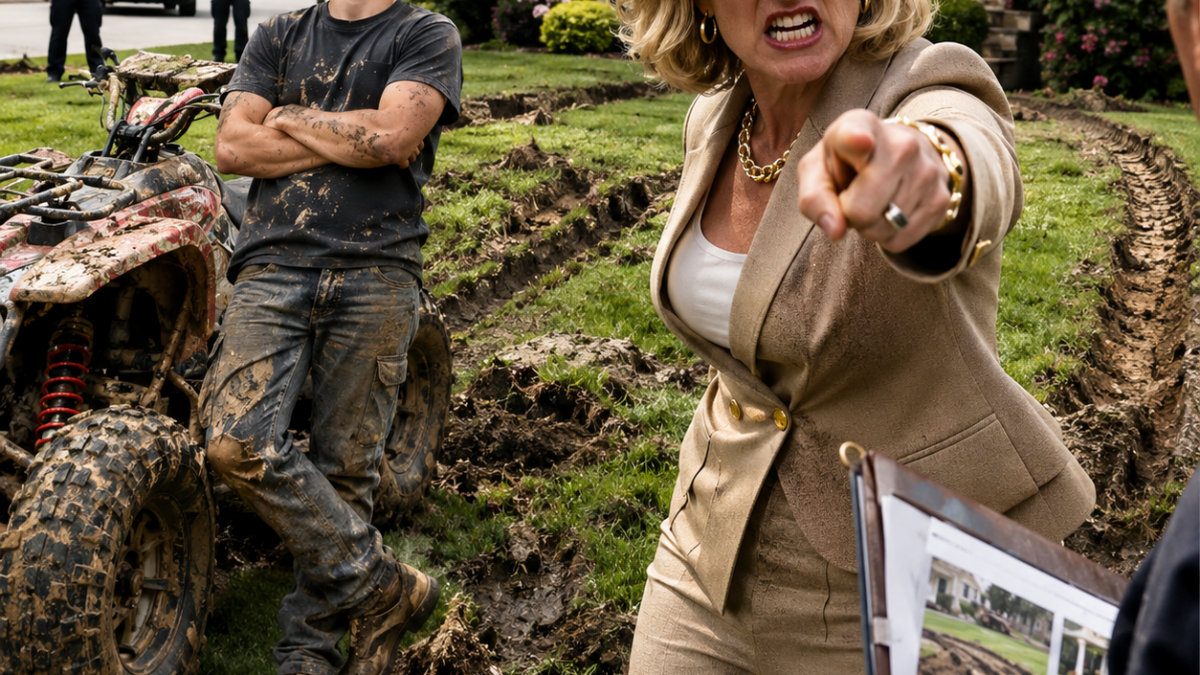
PART 2:
Trevor Blackwood was nineteen years old and had the confidence of someone who had never experienced a consequence that couldn’t be paid for by somebody else.
His current car was a red Mustang GT.
According to Bill, it was his third car in two years.
“What happened to the first two?” I asked.
Bill looked toward Cynthia’s house.
“First one ended up in a ditch.”
“And the second?”
“Tree.”
“Trevor okay?”
“Unfortunately for the insurance industry, yes.”
Dorothy elbowed him.
“Bill.”
“What? Boy drives like Satan’s late for work.”
I learned quickly that Trevor treated Willowbrook’s twenty-five-mile-per-hour streets as a private racetrack.
He revved the Mustang in driveways.
Did burnouts at stop signs.
Blasted music loud enough to vibrate windows.
Parked across sidewalks.
Blocked hydrants.
Nobody officially complained.
That puzzled me.
Then I understood.
Cynthia controlled the HOA.
And Cynthia retaliated.
My first mistake, according to the neighborhood, was reporting Trevor for blocking a fire hydrant during the Hendersons’ sixtieth-anniversary party.
There were elderly guests.
Cars everywhere.
Trevor had parked directly beside the hydrant because apparently walking an additional forty feet would have violated his constitutional rights.
I asked him to move.
He looked me up and down.
“You a cop?”
“No.”
“Then mind your business.”
“It becomes my business if a fire truck needs that hydrant.”
He laughed.
“My mom runs the HOA.”
“I didn’t ask who your mom was.”
He stared.
That sentence apparently offended him more than profanity could have.
He moved the Mustang.
The next morning, three HOA violations were taped to my door.
Mailbox two inches too high.
Garden edging incompatible with architectural standards.
Irrigation timer creating excessive noise.
I stood on the porch reading them.
Then Bill appeared across the street.
He didn’t have to ask.
“Cynthia?”
I held up the papers.
He sighed.
“Should’ve warned you harder.”
“How does everyone tolerate this?”
Bill looked toward Cynthia’s house.
“At our age, Donte, you learn the difference between being right and having the energy to prove you’re right.”
That sentence bothered me.
Not because Bill was weak.
Because he sounded practiced.
I read the HOA covenants that night.
All forty-seven pages.
Twice.
Most people treat governing documents as something to sign and forget.
Military engineering taught me otherwise.
Specifications matter.
One sentence buried on page thirty-nine can determine whether a bridge stands.
Or whether an HOA president can fine you.
Section 12.3 was clear.
A homeowner had to receive fourteen days’ written notice and an opportunity to cure before monetary penalties could begin.
Cynthia had fined me immediately.
Total:
Six hundred dollars.
Daily penalties threatened after that.
Legally sloppy.
I wrote a formal response.
No emotion.
No accusations.
Just the section number.
The notice requirement.
A request for a hearing.
A demand that the fines be suspended pending review.
Cynthia replied by scheduling the hearing during the exact hours I’d told her I had a client meeting.
Cute.
I rescheduled my work.
She canceled the HOA hearing fifteen minutes before it began.
Then Trevor started driving past my house.
Seventeen times one evening.
Yes.
I counted.
Every pass came with an engine rev.
Sometimes he stopped at the sign.
Sometimes he accelerated hard enough to leave rubber.
Around midnight that weekend, I woke to tires screaming.
The Mustang was doing donuts in the cul-de-sac.
I stepped outside in a robe.
Trevor saw me.
He straightened the car.
Then accelerated directly toward the corner of my lawn.
For half a second, I thought he was going to hit me.
At the last moment, he swerved.
He laughed through the open window.
“Go back to bed, Grandpa!”
The next morning, fast-food bags covered my grass.
Soda had been poured over the flagstone.
Three sprinkler heads were broken.
Not accidentally.
The heads sat several feet apart.
Each one had been shattered.
I stood there looking at water spraying onto the sidewalk.
Something inside me changed.
Anger wasn’t useful yet.
Evidence was.
I installed cameras.
Front yard.
Driveway.
Side gate.
Rear yard.
Night vision.
Cloud backup.
Nothing fancy by professional-security standards.
More than enough for a nineteen-year-old who believed consequences were fictional.
I also started a notebook.
Date.
Time.
Incident.
Witness.
Estimated damage.
Police report number when applicable.
Every receipt went into a folder.
Sprinkler repair.
Plants.
Cleaning.
Everything.
Within seven days, I had documented seventeen incidents.
Trevor throwing trash.
Trevor revving outside during quiet hours.
Trevor blocking my driveway.
Trevor driving partially over the curb.
The Mustang crossing onto my property twice.
Maria provided video from her doorbell camera.
Mrs. Patterson, another neighbor, had footage too.
Bill and Dorothy wrote statements.
I compiled it all into a twelve-page complaint.
Printed in color.
Tabs.
Timeline.
Photographs.
Covenant references.
I hand-delivered it to Cynthia.
She opened the door.
Vanilla candles.
Expensive furniture behind her.
The faint smell of wine even though it was two in the afternoon.
I held out the binder.
“Formal complaint regarding Trevor’s conduct.”
She didn’t take it.
“My son?”
“Yes.”
“What exactly are you accusing him of?”
“Read the binder.”
Her eyes narrowed.
“You’ve been photographing him?”
“My property cameras have.”
“That’s invasive.”
“He keeps driving onto my property.”
She finally took the binder.
“You veterans sometimes have difficulty adjusting to civilian neighborhoods.”
There it was.
A warning wrapped in fake concern.
“I’ve adjusted fine.”
“Have you?”
Her smile sharpened.
“You’ve been confrontational.”
“I reported a blocked hydrant and vandalism.”
“Some people perceive hostility where none exists.”
“And some people call retaliation enforcement.”
Her smile disappeared.
I turned to leave.
She said:
“I’d hate for you to become uncomfortable here.”
I looked back.
“Cynthia, I spent years building things in places where people were actively trying to kill us.”
She didn’t blink.
“HOA paperwork isn’t going to scare me.”
That may have been the moment she decided to make me an example.
Forty-eight hours later, three new violation notices arrived.
My mailbox.
My edging.
My irrigation.
Again.
This time fines totaled six hundred dollars plus daily penalties.
No hearing.
No fourteen-day cure period.
Same violations she’d already issued.
I smiled.
Not because I enjoyed it.
Because Cynthia had just documented retaliation in writing.
Then she excluded me from the Fourth of July planning meeting.
I arrived at the community center.
Forty-seven residents inside.
Cynthia blocked the doorway.
“I’m sorry, Donte. This meeting is for residents in good standing.”
Behind her, I saw Maria.
Bill.
Mrs. Patterson.
Everyone looking uncomfortable.
“My account is disputed.”
“Your violations remain outstanding.”
“The fines were imposed contrary to your own rules.”
“That is your opinion.”
“It’s literally section 12.3.”
Her lips tightened.
“You’ll need to leave.”
I could have argued.
Instead, I looked past her.
People were staring at the floor.
That told me something important.
They weren’t on Cynthia’s side.
They were afraid.
That night, thirty-six eggs hit my house, car, and roses.
My cameras caught Trevor and two friends.
Clear faces.
Clear license plates.
Clear laughter.
Trevor held up his phone while one friend shouted:
“HOA special delivery!”
I sent the footage to police.
A report was taken.
No arrest.
Minor property damage.
Juvenile-style nonsense even though Trevor was legally an adult.
Cynthia sent me a notice the next morning.
Exterior cleanliness violation.
I almost admired the audacity.
Almost.
Then came the garden tour.
That was the day Trevor destroyed the thing he’d underestimated most.
Not my landscaping.
My patience.
Willowbrook hosted an annual spring garden event.
Residents walked property to property.
Dorothy’s roses were famous.
My landscaping had been added that year because apparently the HOA could hate me and still use my yard for neighborhood prestige.
I was standing beside the Japanese maple explaining irrigation zones to an older couple when I heard the Mustang.
You learn the sound of a machine that has repeatedly ruined your day.
The red car came around the corner too fast.
Trevor accelerated.
Not down the road.
Toward my lawn.
People screamed.
The Mustang jumped the curb.
Tires tore through new sod.
The first rose bed disappeared under the front wheel.
Mud exploded.
He swung wide.
Then carved a figure eight through the center of the yard.
I stood frozen.
Not because I was afraid.
Because I was watching months of work die in seconds.
The yellow climbing rose snapped.
The flagstone edge shifted.
Sprinkler lines burst.
A Japanese maple barely survived.
Trevor rolled down his window.
“Oops!”
He laughed.
“Shortcut!”
Then he spun another circle.
Mud hit three guests.
Mrs. Cecilia dropped a camera into my decorative fountain.
Trevor finally returned to the street.
He stopped.
Looked at me.
And said:
“What’s wrong, war hero? You gonna cry about your flowers?”
I walked toward him.
People moved.
Maria later told me my face scared her.
Maybe it did.
Trevor revved.
Then his mother appeared.
Cynthia stood near her Lexus.
Phone raised.
Recording.
She smiled.
“Donte.”
I stopped.
She lowered the phone slightly.
“Maybe now you’ll learn your place.”
Trevor laughed.
Then shouted:
“I’ll burn your house down with you inside before you ever win against us.”
The street went silent.
Twelve people had phones out.
Trevor had just threatened my life in front of witnesses while his mother recorded.
I looked around at my destroyed yard.
Something unexpected happened.
I calmed down.
Completely.
Military people know that feeling.
There is panic.
Then training takes over.
My anger became a checklist.
Witnesses.
Video.
Damage appraisal.
Survey.
HOA documents.
Police report.
Insurance.
Property lines.
Pattern.
I looked at Trevor.
“Thank you.”
He frowned.
“For what?”
“The statement.”
His grin faded slightly.
I walked inside.
The next morning, I called Johnson & Associates Professional Surveying.
Pete Johnson arrived three days later.
Sixty-something.
Sunburned.
Hands permanently stained with survey chalk.
He spent hours locating monuments, comparing plats, measuring easements, and checking the subdivision map.
Eventually he called me outside.
“Interesting.”
I hate when professionals say interesting.
“What?”
He pointed toward the curb.
“Your property line isn’t where the HOA landscaping map shows it.”
“How far off?”
“In spots? Six feet.”
I stared.
“Six?”
“Original plat controls. HOA maintenance maps appear approximate.”
He walked toward the corner.
“Your lot extends much closer to the roadway than they’ve been treating it.”
That mattered.
Trevor’s so-called shortcuts weren’t just clipping a common strip.
He had repeatedly driven deep onto private property.
Pete also identified a county utility easement crossing the corner.
That didn’t give Trevor permission to use it.
It meant certain areas needed to remain accessible to utilities.
I asked the obvious question.
“What can I legally place here?”
Pete smiled.
“That’s a question for planning and code.”
So I asked them.
I did not build a spike strip.
I did not dig a hidden ditch.
I did not stretch cable.
I’m an engineer, not a cartoon villain.
I applied for permits to install large decorative boulders along my surveyed boundary.
Visible.
Reflective markers where required.
Proper setbacks.
Utility access preserved.
I upgraded drainage and irrigation inside the yard, something I’d already planned because Trevor’s tires had destroyed the grade.
The repaired soil remained soft for several weeks.
I also installed new landscaping behind the boulders.
Expensive landscaping.
Documented landscaping.
Receipts.
Photographs.
Professional valuations.
And cameras.
More cameras.
Nothing was hidden.
Nothing illegal.
Nothing designed to hurt anyone.
The message was simple:
Stay on the road and nothing happens.
Cross onto my land again and every inch will be documented.
When Cynthia saw the boulders, she arrived within two hours.
“What are those?”
“Rocks.”
“Don’t be cute.”
“Granite, if we’re being specific.”
“They’re a traffic hazard.”
“They’re inside my surveyed boundary.”
“The HOA recognizes a different boundary.”
“The county recorder doesn’t.”
Her eyes narrowed.
“You paid for a survey?”
“Yes.”
“Without HOA approval?”
“I don’t need HOA approval to determine where my deed ends.”
She stared at the nearest boulder.
“Remove them.”
“No.”
“You’ll be fined.”
“For what?”
“Unsafe landscaping.”
“Send it in writing.”
She did.
One thousand dollars per day.
That letter became exhibit material later.
Because every boulder had a permit.
Every placement had been reviewed.
Her fine wasn’t enforcement.
It was retaliation.
Then the neighborhood started talking.
Maria came to my house one evening.
She looked around before stepping inside.
“He did it to us.”
“Trevor?”
She nodded.
“Last summer.”
“What happened?”
“My tomato garden.”
Her voice tightened.
“Miguel’s birthday party. Trevor drove through the side fence, crushed everything.”
“You reported it?”
She laughed without humor.
“To Cynthia?”
“What did she do?”
“She said there wasn’t enough proof.”
“Did Trevor admit it?”
“Everyone saw him.”
I pulled out a legal pad.
“Tell me everything.”
Maria hesitated.
“You’re really fighting them?”
“Yes.”
She sat.
“Then I have more.”
The Hendersons came next.
Trevor had destroyed part of Dorothy’s century-old rose garden while reversing through the wrong driveway.
Cynthia convinced them it would be easier to let the HOA “handle” it.
Nothing happened.
Mrs. Patterson had two years of videos.
Noise.
Trespass.
Trash.
Threats.
Property damage.
Seven families had moved away after prolonged conflicts with Cynthia.
That number caught my attention.
Seven.
I started checking county property records.
The first sale involved a retired teacher.
Repeated HOA violations.
Sold below market.
Listing agent:
Blackwood Realty.
Second family.
Same pattern.
Blackwood Realty.
Third.
Fourth.
Fifth.
Seven families.
Average sale roughly twenty-three percent below comparable homes.
Every transaction involved Cynthia’s family brokerage.
I sat at my workbench staring at the spreadsheet.
The answer was ugly.
Trevor wasn’t simply a spoiled son Cynthia protected.
His harassment had economic value.
Make someone miserable.
Cynthia fines them.
Trevor escalates.
Neighbors isolate them.
Owner gives up.
Sells cheap.
Blackwood Realty handles the transaction.
Commission.
New buyer.
Reset.
I called an attorney.
Sarah Cecilia had spent years as a prosecutor before moving into civil litigation.
She listened for forty minutes without interrupting.
Then asked:
“How much can you document?”
“All of it.”
“Don’t say all.”
“Why?”
“Clients always say all. Then I discover they have three blurry screenshots and a strongly worded Facebook post.”
I smiled.
“I have forty-seven gigabytes of video, twenty-three witness statements, HOA notices, certified mail receipts, property records, repair invoices, police reports, and a professional survey.”
Silence.
Sarah said:
“Okay.”
“What?”
“You actually mean all.”
“Close to it.”
“Donte, stop talking to Cynthia except in writing.”
“Already did.”
“Don’t threaten Trevor.”
“Haven’t.”
“Don’t touch his car.”
“Wouldn’t.”
“Don’t set anything designed to cause injury.”
“My boulders are permitted, visible, and inside the property line.”
She paused.
“You put boulders up?”
“Yes.”
“I like you.”
Sarah began reviewing the HOA finances.
I went deeper into county archives.
That’s where Janet worked.
Janet was somewhere in her late sixties and had spent so long in county planning that she seemed personally offended by poorly organized public records.
She brought snickerdoodles.
I brought questions.
“The original Willowbrook covenants?”
“Basement.”
“Financial remittance agreements?”
“Basement.”
“Development amendments?”
“Basement.”
“Does anything live upstairs?”
“Politicians.”
I liked Janet immediately.
Three hours into old filings, I found section 47B of the original development agreement.
Penalties collected above a defined threshold for certain covenant-related enforcement had to be reported and, in specified categories, remitted to a county-associated fund under the development arrangement.
Cynthia’s records showed none of that.
Instead, HOA money moved into a vendor called Blackwood Property Management.
I asked Sarah to subpoena full banking records through the proper civil process.
When they arrived, the picture sharpened.
Residents paid fines.
The HOA paid administrative and consulting fees to Blackwood Property Management.
Blackwood Property Management paid Cynthia.
Over three years:
Approximately $73,000.
Not millions.
Not some Hollywood fortune.
Seventy-three thousand dollars stolen a few hundred or few thousand at a time.
Which is often how local corruption survives.
Small enough that nobody fights each individual charge.
Large enough to matter after years.
Then we found Trevor’s old insurance case.
That was almost comical.
His previous Mustang had supposedly been stolen from a shopping-center parking lot while Trevor was “studying at the library.”
The car was later found wrapped around an oak tree.
Security footage placed Trevor street racing that night.
Cell records did too.
Cynthia had signed an affidavit saying Trevor was home asleep.
The insurance company had already suspected fraud but lacked cooperative witnesses.
Sarah read the file.
“Perjury.”
“Potentially.”
“Insurance fraud.”
“Potentially.”
“False police report.”
“Potentially.”
She smiled.
“You’re very careful with words.”
“Occupational habit.”
Then Trevor hit Bill Henderson.
That ended any remaining hesitation in the neighborhood.
Bill and Dorothy took their evening walk every night at seven.
Same route.
Same pace.
That evening, the Mustang came around the corner doing far more than twenty-five.
Bill was near the edge of the street.
Trevor passed close.
Too close.
The side mirror struck Bill’s shoulder.
He fell.
His head hit the pavement.
Dorothy screamed.
I heard it from my yard.
By the time I reached them, Bill was sitting against the curb.
Blood ran from his temple.
His glasses were broken.
Dorothy’s hands shook so hard she couldn’t operate her phone.
I called 911.
Bill grabbed my wrist.
“He looked at me.”
“Don’t talk.”
“He smiled.”
“Bill.”
“He smiled and accelerated.”
The Mustang was already gone.
Mrs. Patterson had video.
Three angles.
Maria’s doorbell camera caught the approach.
My corner camera captured the departure.
You could see Trevor glance toward Bill.
You could see the mirror make contact.
You could hear the engine rise afterward.
Bill was lucky.
Bruised ribs.
Concussion.
Fractured wrist.
No hip fracture.
No brain bleed.
Lucky is a strange word for an eighty-five-year-old man hit by a car.
Cynthia did not visit.
The HOA sent flowers.
No signature.
Trevor disappeared for three days.
Sarah called me that night.
“We’re done handling this as an HOA problem.”
“What changes?”
“Law enforcement.”
The police already had the assault report.
Sarah helped organize the evidence.
The insurance investigator reopened Trevor’s earlier claim.
The county began reviewing Cynthia’s financial handling.
And for the first time, people stopped whispering.
Maria signed a statement.
Mrs. Patterson signed.
The Hendersons signed.
Mr. Kim signed.
Five more homeowners came forward.
The wall around the Blackwoods began to crack.
Then Cynthia scheduled an emergency HOA meeting.
Purpose:
Removal of dangerous landscaping.
Review of my “ongoing hostile behavior.”
Possible litigation to compel compliance.
She gave only twenty-four hours’ notice.
The bylaws required seventy-two.
She invited selected households.
The bylaws required notice to all members.
She wanted the meeting before county auditors could review the records.
That timing wasn’t subtle.
Sarah laughed when she saw the notice.
“She’s panicking.”
“Good.”
“No.”
Her tone changed.
“Panicked people are dangerous. Don’t assume she becomes rational because she knows she’s losing.”
I thought of Trevor.
Sarah was right.
The county audit was scheduled for that week.
Supervisor Jennifer Walsh would attend.
An insurance fraud investigator wanted Trevor.
Local reporter David Kim had been investigating allegations of HOA retaliation.
We had evidence.
We had witnesses.
We had a legal process moving.
I did not need another incident.
Unfortunately, Trevor did.
His girlfriend did us a favor.
Her name was Ashley.
She had apparently reached the stage of dating Trevor where contempt outweighed loyalty.
She sent Maria a screen recording from a private social-media story.
Trevor was drinking with friends.
He announced:
“We’re hitting every snitch house before college.”
Someone laughed.
Trevor continued.
“Rivera first.”
Then he listed others.
The Hendersons.
Maria.
Mr. Kim.
The video was forwarded to police.
They advised residents to call immediately if he appeared.
Extra patrols were assigned.
I checked my cameras.
Tested the lights.
Confirmed the boulders were visible.
I did not modify anything.
That matters.
The yard was exactly as permitted.
Soft soil behind the landscape edge.
Irrigation lines.
Large rocks preventing direct access.
Safe if you stayed on the road.
Trevor’s first pass came at 7:31 Tuesday evening.
Mustang.
Two cars behind him.
Music.
Revving.
My phone alerted.
Camera one.
Camera two.
Maria texted:
**He’s here.**
Mrs. Patterson:
**Recording.**
Mr. Kim:
**Called police.**
I stayed inside.
Trevor circled once.
Then again.
At 7:46, Cynthia’s white Lexus appeared.
She parked near the corner.
That detail shocked me.
Whatever I had thought of her, I still hadn’t expected her to supervise.
Trevor stopped beside her.
They spoke.
My camera captured no usable audio from that distance.
Then Cynthia pointed toward my property.
The Mustang moved.
Trevor rolled down his window.
“Hey, Rivera!”
I stepped onto the porch.
He smiled.
“You like your rocks?”
“They’re fine.”
“Think they can stop me?”
I didn’t answer.
“Come on, old man.”
One of his friends held up a phone.
Livestreaming.
Trevor shouted:
“You wanted war!”
I said:
“No, Trevor.”
My voice was calm.
“I want you to stay on the road.”
He laughed.
Then accelerated.
The first boulder prevented his old entry line.
So he turned wider.
Exactly what any visible barrier is supposed to make a driver do.
Except a normal driver would have stayed on pavement.
Trevor crossed the curb farther down.
Entered the yard.
His front tires hit recently irrigated soil.
The Mustang slowed.
He gave it more throttle.
Bad decision.
The rear tires dug.
Mud sprayed.
The vehicle sank deeper.
Trevor reversed.
Wheels spun.
Forward.
More spinning.
The rear end slid sideways.
He crushed two roses.
Then one Japanese maple support.
He screamed something I couldn’t hear.
His friends stopped cheering.
One car left.
Then another.
Trevor floored it.
The Mustang sank nearly to the lower wheel line.
Burnt rubber mixed with wet soil.
He was stuck.
Completely.
I stood on the porch.
Trevor climbed out.
Shoes disappeared ankle-deep in mud.
He pointed at me.
“You did this!”
I looked at the road.
“You drove onto my lawn.”
“You trapped my car!”
“I installed permitted landscaping.”
“You knew I’d come through here.”
That sentence was beautiful.
Not because it proved every crime.
Because it proved intent.
Ashley was still recording.
I said:
“I knew you had driven through my property before.”
Trevor screamed.
“You set me up!”
“No.”
I looked toward the street.
“You chose to leave the road.”
Then Cynthia arrived on foot.
Her perfect white blouse lasted approximately four seconds before Trevor flung mud toward her trying to pull himself free.
“What have you done?” she shouted at me.
“Nothing.”
“You’re responsible for this!”
I almost admired the family consistency.
Cynthia turned toward Trevor.
“Get out of there.”
“I can’t!”
“Move the car!”
“It won’t move!”
She looked toward me.
“Call a tow truck.”
“After police finish documenting the trespass.”
Her face changed.
“Police?”
Sirens answered for me.
Two sheriff’s vehicles entered the cul-de-sac.
Then another.
Behind them:
County Supervisor Jennifer Walsh.
She had been heading to an unrelated meeting nearby after receiving updates from investigators.
Then the Channel 7 van arrived.
That part I hadn’t planned.
David Kim had been monitoring the neighborhood story and heard the scanner traffic.
Within five minutes, the street was full.
Deputy Martinez approached Trevor.
“Step away from the vehicle.”
Trevor looked at his mother.
Cynthia said:
“He’s on private property with permission.”
I blinked.
Trevor blinked.
The deputy looked at me.
“Did you give him permission?”
“No.”
Cynthia snapped:
“He’s a resident. This is HOA-maintained landscaping.”
Pete’s survey folder was already in my evidence binder.
I walked inside.
Returned with it.
“Recorded deed and professional survey.”
Deputy Martinez reviewed the boundary.
Supervisor Walsh stepped closer.
She knew the file.
“This lot is privately owned to that line.”
She pointed.
Trevor was well beyond it.
Cynthia’s face tightened.
“This isn’t about property lines. His landscaping is dangerous.”
Walsh looked at the boulders.
“Those have permits.”
Cynthia went quiet.
I almost felt sorry for her.
Almost.
Then Trevor made everything worse.
He was covered in mud.
Humiliated.
Camera phones everywhere.
He shouted:
“You can’t arrest me. My mother runs this neighborhood.”
Deputy Martinez said:
“Your mother does not run the sheriff’s office.”
Trevor pointed toward the houses.
“We own these people!”
Silence.
Every neighbor heard it.
Cynthia rushed toward him.
“Trevor, stop talking.”
He pulled away.
“You said nobody could touch us!”
There are moments when years of hidden behavior collapse into one sentence.
That was one.
Cynthia looked at the cameras.
Then at Trevor.
Then at me.
“Shut up.”
Too late.
Deputy Martinez separated them.
Another officer inspected the Mustang.
Witnesses approached.
Maria.
Mrs. Patterson.
Mr. Kim.
Ashley.
Yes.
Trevor’s own girlfriend.
She looked terrified.
But she handed over her phone.
“I recorded what he said before tonight.”
Trevor stared.
“You’re kidding me.”
She shook her head.
“You hit an old man.”
His expression changed.
“That was an accident.”
Bill’s video would argue otherwise.
Then Channel 7’s David Kim approached Cynthia.
“Mrs. Blackwood, do you have a response to allegations of financial impropriety involving HOA funds?”
Cynthia froze.
Wrong question.
Not Trevor.
Money.
Supervisor Walsh stepped forward.
“Mr. Rivera provided documents relevant to an ongoing county audit.”
I handed Deputy Martinez a binder.
Not triumphantly.
Carefully.
“This includes the property incidents from my address. Sarah Cecilia has the financial package and witness index.”
Cynthia stared at me.
“What have you done?”
I looked at her.
“Read the rules.”
That was it.
No speech.
No grand announcement.
Because legal consequences are rarely delivered through one clever line.
They’re built through records.
That night, Trevor was taken in for questioning and later charged in connection with trespass, property damage, reckless driving, and the Henderson incident.
The Mustang was towed.
Not because it was stuck.
Because investigators wanted it preserved.
Watching a tow truck winch that red car out of my lawn was satisfying.
I won’t lie.
But it was only the beginning.
Cynthia initially went home.
She believed the crisis could still be managed.
Attorneys.
Statements.
Damage control.
Maybe blame me.
Maybe call the landscaping a trap.
Then the county audit team froze access to certain HOA records.
Sarah filed for an injunction preventing destruction or alteration of documents.
The insurance investigator obtained Cynthia’s old affidavit.
Law enforcement interviewed Trevor’s friends.
One of them admitted Cynthia had repeatedly paid repair bills in exchange for silence.
Another described Trevor targeting homeowners who had argued with the HOA.
Ashley turned over months of messages.
Some were juvenile insults.
Others mattered.
One from Trevor to Cynthia:
**Rivera still won’t break.**
Her response:
**Keep pressure on him. He’ll sell eventually.**
Another:
**Hendersons are scared enough. Don’t overdo it.**
That message made me physically sick.
Not because it was legally perfect.
Because it was humanly clear.
Cynthia knew.
She knew Trevor was frightening elderly people.
She knew residents were selling because of pressure.
And she managed the intensity.
The county financial review confirmed the $73,000 pattern.
HOA fine revenue.
Administrative fees.
Blackwood Property Management.
Payments to Cynthia.
Some transactions had legitimate descriptions.
Others did not.
The county referred the matter to prosecutors.
The insurance fraud evidence became its own case.
Trevor’s old Mustang claim.
Cynthia’s affidavit.
Phone-location data.
Video.
A racing companion who decided loyalty wasn’t worth criminal exposure.
The district attorney’s office built the case slowly.
Sarah warned me repeatedly.
“Do not expect a movie.”
“I don’t.”
“People think evidence equals arrest the next morning.”
“I know.”
“Months.”
“I know.”
“Possibly years.”
“I know.”
She studied me.
“You’re unusually calm.”
“I spent twenty-two years waiting for concrete to cure.”
She nodded.
“Okay. That explains a lot.”
The HOA meeting Cynthia had scheduled never happened.
Instead, homeowners petitioned for a special recall meeting.
This time notice was proper.
Quorum documented.
Votes independently counted.
The community center was packed.
Cynthia entered with an attorney.
Trevor wasn’t there.
Conditions of release restricted certain behavior and contact.
Cynthia sat at the front.
For the first time since I’d met her, she wasn’t carrying a clipboard.
Maria spoke first.
She described the tomato garden.
Then the retaliation.
Bill attended wearing a wrist brace.
He stood slowly.
Dorothy held his arm.
“My wife and I lived here fifteen years.”
His voice shook.
“Never feared our own street until that boy started driving through it.”
Cynthia looked down.
Mrs. Patterson presented a timeline of complaints.
Seven families who had moved submitted written statements.
Two appeared by video.
One woman cried.
“We sold because we couldn’t take it anymore.”
Her family had lost nearly sixty thousand dollars against expected market value.
Blackwood Realty had represented the buyer.
Then Sarah addressed the members.
Not as prosecutor.
As counsel for several residents.
She explained fiduciary duty.
Conflict of interest.
Notice procedures.
Financial transparency.
She did not scream.
She didn’t need to.
Facts sound loud in quiet rooms.
The recall vote:
Eighty-seven percent in favor.
Cynthia Blackwood was removed as HOA president.
People applauded.
I didn’t.
She looked across the room at me.
Her eyes contained something beyond anger.
Disbelief.
She had believed power was permanent because nobody had challenged it successfully.
The gavel passed to an interim chair.
That small physical movement mattered.
Cynthia’s hand no longer controlled the room.
Outside, reporters waited.
She left through a side door.
Three weeks later, she was charged.
The exact charging structure was more mundane than neighborhood gossip imagined.
Nobody announced she was the head of a suburban mafia.
Prosecutors alleged financial crimes involving HOA money, fraud-related conduct, false statements connected to insurance matters, and conspiracy-related behavior supported by the communications and witness evidence.
Trevor faced his own charges arising from property damage, reckless driving, the assault on Bill, and related conduct.
Civil suits followed.
Mine.
The Hendersons’.
Maria’s.
Former homeowners.
Insurance companies.
Cynthia’s empire didn’t explode in one moment.
It was dismantled invoice by invoice.
Statement by statement.
Account by account.
Trevor’s confidence disappeared first.
His attorney advised him to stop posting online.
He ignored that advice for three days.
Then his social media vanished.
His friends stopped visiting.
The Mustang sat in an evidence-storage lot.
No engine revs.
No burnouts.
Willowbrook became so quiet that the first week felt unnatural.
One evening, I was watering my new roses.
Bill approached.
His wrist still healing.
“Too quiet.”
I laughed.
“I was thinking that.”
He looked toward the Blackwood house.
“You know, I used to hear that car and tense up.”
“So did I.”
“I thought maybe I was becoming a coward.”
I turned off the hose.
“No.”
“At eighty-five?”
“Fear doesn’t have an age limit.”
He looked at the grass.
“You weren’t scared.”
“Yes, I was.”
Bill looked surprised.
“Of Trevor?”
“Of what I might do if I stopped thinking.”
He nodded slowly.
Military service doesn’t erase anger.
Sometimes it makes you more aware of what anger can cost.
The lawn healed.
Not perfectly.
I left one narrow section unrepaired for several months.
Maria asked why.
“Evidence?”
“No.”
“Then?”
I looked at the tire rut.
“Reminder.”
“Of Trevor?”
“Of not becoming Trevor.”
She understood.
The criminal cases resolved the following year.
Trevor ultimately entered a plea resolving multiple charges.
He received jail time, probation, driving restrictions, restitution obligations, and court-ordered conditions.
The exact sentence didn’t matter to me as much as one provision.
Restitution.
Bill’s medical expenses.
Dorothy’s damaged garden.
Maria’s fence.
My landscaping.
Other documented victims.
For the first time in his life, Trevor’s destruction had invoices attached to it that his mother could not quietly erase.
At sentencing, Bill was allowed to speak.
He walked to the lectern.
No brace now.
Still slower than before the collision.
Trevor sat at the defense table.
Bill looked at him.
“You know what bothered me most?”
Trevor stared forward.
“Not my wrist.”
Bill paused.
“You smiled.”
The courtroom stayed silent.
“My wife and I raised three boys. They did stupid things.”
He glanced toward Dorothy.
“Very stupid things.”
A few people smiled.
“But when they hurt someone, they were ashamed.”
Bill looked back at Trevor.
“You were proud.”
Trevor finally lowered his eyes.
Bill continued.
“I don’t want your life destroyed.”
That surprised me.
“I want you to understand that a car is not power. Money is not power. Making an old man afraid to walk down his own street is not power.”
Bill stepped away.
That speech did more to Trevor than any insult could have.
Cynthia’s case took longer.
Financial documents.
Accountants.
Insurance evidence.
Homeowner testimony.
Blackwood Realty transactions.
Eventually, she accepted a plea agreement covering the strongest supported counts.
Restitution included the misused HOA funds.
Assets connected to illegal proceeds were subject to forfeiture.
She was prohibited from serving in HOA leadership and faced significant criminal penalties, supervision, and civil exposure.
The Blackwood Realty business collapsed.
Not because the government magically seized every dollar she owned.
Because clients disappeared.
Licensing scrutiny increased.
Civil claims mounted.
Insurance problems surfaced.
Reputation matters in real estate.
Trust matters more.
Cynthia had destroyed both.
At her sentencing hearing, Judge Patricia Morrison looked over the file.
I attended with Bill, Dorothy, Maria, and several former residents.
Cynthia wore a dark suit.
No sunglasses.
No clipboard.
Judge Morrison said:
“You held a position of community trust.”
Cynthia stared ahead.
“You used that position not to administer shared obligations fairly, but to retaliate, enrich yourself, conceal misconduct, and protect repeated harmful behavior by a member of your own household.”
The judge paused.
“The most troubling part is not that you made one bad decision.”
Another pause.
“It is how many opportunities you had to stop.”
That sentence landed on me too.
Cynthia could have stopped after the hydrant.
After the first broken sprinkler.
After the eggs.
After the garden.
After Bill.
After the audit.
She didn’t.
Bullies often mistake the absence of immediate consequences for proof that consequences will never arrive.
The sentence included custody, financial restitution, forfeiture where legally appropriate, and restrictions that ended any realistic possibility of Cynthia returning to HOA power.
It wasn’t twenty years.
It wasn’t some fantasy punishment.
It was real.
Which made it more satisfying.
Because it would survive outside the story.
When we exited court, reporters crowded the steps.
One asked me:
“Mr. Rivera, do you feel like you got revenge?”
I stopped.
The question caught me off guard.
For months, I’d imagined revenge.
Trevor’s car destroyed.
Cynthia humiliated.
Their money gone.
Their house sold.
All those primitive fantasies anger produces at two in the morning.
I looked at Bill.
Dorothy.
Maria.
Then back at the reporter.
“No.”
“You don’t?”
“I got accountability.”
“What’s the difference?”
“Revenge would’ve been me destroying their property because they destroyed mine.”
I nodded toward the courthouse.
“This is them answering for what they chose to do.”
The reporter tried again.
“But you deliberately built the landscaping that trapped Trevor’s Mustang.”
I smiled.
“I deliberately built landscaping that prevented cars from driving across my property.”
“Did you expect him to try?”
“Yes.”
“Isn’t that a trap?”
“It was a boundary.”
I looked straight at the camera.
“He turned it into a trap by refusing to respect it.”
That became the quote Channel 7 used.
For weeks, neighbors repeated it.
Mrs. Patterson printed it on a coffee mug.
I hated the mug.
She gave me one anyway.
The HOA election happened a month later.
I refused to run.
Everyone asked.
“Donte, you’d win.”
“That’s exactly why I’m not doing it.”
Maria laughed.
“Explain.”
“I didn’t spend a year fighting someone who confused leadership with ownership just to replace her with another person everyone is afraid to challenge.”
We changed the structure instead.
Term limits.
Independent financial review.
Open meeting notices.
Published minutes.
Clear appeals.
No single board officer could issue major penalties alone.
Conflicts of interest had to be disclosed.
Vendor contracts required competitive review above a threshold.
Fines followed the written cure process.
No selective enforcement.
No midnight clipboard patrols.
Bill attended the first meeting.
He raised his hand.
“Can we add a rule?”
The interim president looked nervous.
“What rule?”
“No HOA president may own a clipboard larger than nine inches.”
The room exploded in laughter.
We did not add the rule.
Mrs. Patterson proposed it again the next month.
Willowbrook changed.
Slowly.
People started talking in driveways again.
Maria’s boys played basketball without being told the bouncing noise violated community peace.
Bill and Dorothy resumed their evening walks.
The first night they passed my house, I stepped outside.
Bill raised both hands.
“No Mustang.”
“Don’t jinx it.”
Dorothy laughed.
The old rose garden needed rebuilding.
Trevor had damaged part of it years earlier.
Then Bill’s accident had destroyed the Japanese maple beside the sidewalk.
We organized a neighborhood workday.
Not an HOA mandate.
Volunteers.
Maria brought food.
Mrs. Patterson brought cameras because apparently she no longer knew how to participate in life without surveillance equipment.
I brought roses.
Dorothy walked through them slowly.
One variety stopped her.
Deep red.
Heavy fragrance.
“My mother grew these.”
“Then that’s the one.”
We planted twelve.
The area became the Henderson Memorial Garden—not because Bill had died.
He objected strongly to the name.
“I’m standing right here.”
Maria said:
“Memorial can mean honoring.”
“Usually means dead.”
Dorothy patted his arm.
“Stop complaining. You got a bench.”
He liked the bench.
My own yard took longer.
The legal process had turned it into evidence.
Survey stakes.
Markers.
Repair zones.
Photographs.
I had spent months looking at every broken plant as a dollar amount.
Eventually, I realized I’d stopped gardening for the reason I started.
To heal.
One Saturday, I removed the last evidence marker.
Not the boulders.
Those stayed.
They looked good.
More importantly, cars stayed on the street.
I dug out the damaged soil.
Rebuilt the rose bed.
Replaced the Japanese maple.
Maria’s boys helped.
One held the tree while I set the root ball.
“Mr. Rivera?”
“Yeah?”
“Did you know Trevor would get stuck?”
Kids ask dangerous questions with perfect innocence.
“I knew the ground was soft.”
“So yes?”
“I knew that if he stayed on the road, he wouldn’t.”
The twin considered this.
“So he trapped himself?”
“Exactly.”
He nodded.
“That’s dumb.”
“Excellent legal analysis.”
The Blackwood house went on the market.
Cynthia’s husband had largely stayed outside the HOA operation.
Their marriage did not survive the criminal case.
I didn’t celebrate that.
Families carry consequences farther than courtrooms.
The house sold.
A pediatric nurse and her husband bought it.
They had two young daughters.
The first weekend after moving in, one daughter drew flowers in chalk across the driveway.
I saw her father glance around nervously.
Old Willowbrook reflex.
I walked past.
“Looks good.”
He smiled.
“You sure the HOA allows it?”
“I have no idea.”
His face fell.
Then I added:
“That’s how normal neighborhoods work.”
A week later, there were chalk rainbows everywhere.
Property values did not collapse.
The republic survived.
Six months after Cynthia’s sentencing, the county completed its broader review.
The Blackwood case had exposed weaknesses in HOA financial oversight.
Not every board was corrupt.
Most weren’t.
But too much depended on residents knowing rules nobody read.
The county created clearer reporting channels.
State legislators held hearings.
I testified.
I wore a suit.
No military uniform.
No dramatic binder slam.
Just facts.
A lawmaker asked:
“What ultimately protected you?”
I thought about cameras.
Survey maps.
Sarah.
Janet.
Maria.
Bill.
Dorothy.
Mrs. Patterson.
“Documentation.”
“Not the police?”
“They mattered.”
“Not the courts?”
“They mattered.”
“Then why documentation?”
“Because institutions can only act on what people can prove.”
I explained the notebook.
Dates.
Photos.
Receipts.
Written complaints.
Certified letters.
Witness statements.
Rules.
Property records.
“Bullies like ambiguity,” I told them. “Documentation reduces it.”
That line became part of the homeowner education materials later.
I was asked repeatedly whether the state should outlaw HOAs.
“No.”
That surprised people.
“Why not?”
“Because shared communities sometimes need shared rules.”
I paused.
“The answer to abused authority isn’t pretending authority is never necessary. It’s transparency, limits, due process, and accountability.”
Twenty-two years building military infrastructure taught me the same lesson.
A structure can be useful.
Or dangerous.
Depends on the design.
And whether anyone inspects the foundation.
The restitution money eventually arrived.
Not all at once.
Some through insurance.
Some civil settlements.
Some criminal restitution.
Some asset recovery.
I didn’t become rich.
I got paid for damage I’d never wanted.
I used part of it to create a neighborhood legal-defense fund.
Sarah hated the name I suggested.
**The Trevor Blackwood Don’t Drive on Other People’s Lawns Fund.**
“No.”
“Memorable.”
“No.”
We called it the Willowbrook Homeowner Assistance Fund.
Boring.
Responsible.
It helped elderly residents pay for consultations when facing serious HOA disputes.
Mrs. Patterson taught documentation workshops.
I taught residents how to read plats and surveys.
Maria organized meetings.
Bill sat in the back and heckled everyone.
One afternoon, an elderly woman from another neighborhood arrived carrying violation letters in a grocery bag.
She was seventy-four.
Widowed.
Her HOA had assessed daily fines over a ramp installed for mobility access.
She was afraid she’d lose the house.
We connected her with an attorney.
The fines were challenged.
The ramp stayed.
She cried.
That moment changed how I thought about the entire Blackwood nightmare.
Trevor had torn up my lawn.
I built a legal boundary.
Cynthia retaliated.
We uncovered theft.
A neighborhood fought back.
But if the story ended with two people punished, it would have been small.
Instead, what they did forced us to build something better.
That mattered more.
Two years later, Trevor returned to Willowbrook.
I didn’t know he was coming.
I was trimming roses when an older gray sedan stopped at the curb.
No Mustang.
Trevor got out.
He looked different.
Thinner.
Hair shorter.
No expensive sunglasses.
For a moment, we simply stared at each other.
I set down the shears.
“You’re not supposed to be on my property.”
“I’m not.”
He stayed beside the curb.
Fair.
“What do you want?”
He looked at the boulders.
“They’re still here.”
“Yes.”
He almost smiled.
“That car was totaled.”
“I heard.”
“Insurance wouldn’t pay.”
“I also heard.”
Silence.
He looked toward the Henderson house.
“Is Bill alive?”
“Yes.”
Trevor nodded.
“I wrote him.”
“I know.”
Bill had shown me.
The letter wasn’t perfect.
It contained excuses.
But also an apology.
Bill never replied.
His choice.
Trevor looked down.
“I was an idiot.”
I said nothing.
“I thought because Mom could fix everything…”
He stopped.
I waited.
“She always did.”
“Until she couldn’t.”
“Yeah.”
He kicked lightly at the curb.
“I blamed you for a long time.”
“I’m sure.”
“For setting me up.”
I looked toward the lawn.
“Do you still?”
“No.”
That surprised me.
He pointed to the road.
“I could’ve just stayed there.”
“Yes.”
“I knew the cameras were there.”
“Yes.”
“I knew the boulders were legal.”
“Yes.”
“I did it because I wanted everybody to see me beat you.”
There it was.
More honesty than he’d shown at nineteen.
I nodded.
“That sounds right.”
He looked at me.
“Did you hate me?”
“Yes.”
The answer surprised him.
I wasn’t going to lie.
“For a while.”
“What about now?”
I thought.
“No.”
“Why?”
“Hate is expensive.”
He laughed once.
Then looked away.
“My mom still says you ruined her life.”
“I didn’t.”
“I know.”
He looked back at me.
“She won’t admit it.”
“That isn’t my problem anymore.”
Trevor nodded.
Then he said:
“I’m sorry about the roses.”
Such a ridiculous sentence.
After the threats.
Bill.
The intimidation.
The property damage.
The corruption.
Roses.
Yet somehow I believed him.
“Dorothy’s mattered more.”
“I know.”
“You should apologize to her.”
“I tried.”
“She doesn’t have to forgive you.”
“I know.”
That was another sign he’d changed.
Nineteen-year-old Trevor had believed wanting something meant receiving it.
Adult Trevor was learning that apology doesn’t purchase forgiveness.
He turned to leave.
Then stopped.
“Mr. Rivera?”
“Yeah?”
“Was the mud really planned?”
I smiled.
“The irrigation was planned.”
He waited.
“The soft soil?”
“Necessary for drainage repair.”
“The boulders?”
“Traffic control.”
“So technically…”
“You drove a performance car off a public road, around visible barriers, over a curb, and into irrigated soil on private property.”
Trevor stared.
Then laughed.
For real.
“God, I was stupid.”
“Yes.”
He walked away.
That was the last conversation we ever had.
I heard later he got a job working at an auto-body shop.
Irony has style.
Cynthia never came back.
Her appeals ended.
Her name disappeared from neighborhood conversation.
That’s how power really dies.
Not when people hate you.
When they stop organizing their lives around you.
Willowbrook stopped checking Cynthia’s old house.
Stopped whispering when white Lexuses entered the street.
Stopped worrying about clipboards.
Kids grew up.
New families moved in who barely knew the story.
My Japanese maple grew.
Five feet.
Then seven.
The roses filled out.
One spring morning, I stood barefoot in the grass drinking coffee.
The yard smelled wet from irrigation.
For a second, I remembered the first time Trevor drove across it.
Mud.
Rubber.
Cynthia smiling.
“Maybe now you’ll learn your place.”
I had learned my place.
Right there.
On my property.
In a neighborhood where I had every right to exist.
Not because I was stronger.
Not because I was a veteran.
Not because I could afford lawyers.
Because rights don’t depend on a bully agreeing you deserve them.
Maria walked over carrying a folder.
“Don’t tell me.”
She smiled.
“New resident workshop.”
“Today?”
“You promised.”
“I promised Saturday.”
“It is Saturday.”
I looked at my phone.
She was right.
Retirement brain.
We walked toward the former HOA office.
It had been transformed into a community tool library and meeting room.
No president’s private office.
No locked financial cabinets.
Transparent glass.
Open records.
A teenager was borrowing a pressure washer.
Bill sat outside on the bench pretending to supervise.
“Late,” he called.
“I’m not late.”
“Military standards have declined.”
“You were Army.”
“Korea.”
“Yes, and you mention it every eleven minutes.”
“Earned the right.”
Dorothy handed me coffee.
Inside, twelve residents waited.
Some new.
Some old.
I placed a copy of the HOA covenants on the table.
Groans.
I smiled.
“Exactly.”
Maria laughed.
I continued.
“The most dangerous sentence in community governance is ‘I assume somebody else read it.’”
We reviewed notice requirements.
Fines.
Hearings.
Budgets.
Conflict disclosures.
Records.
Boring things.
The things that would have stopped Cynthia years earlier if enough people had known how to use them.
Afterward, a young homeowner approached.
“Can I ask something?”
“Sure.”
“Is it true you set a trap for Trevor’s Mustang?”
I smiled.
The legend had apparently survived.
“No.”
He looked disappointed.
“I’ve seen the video.”
“I built a legal boundary.”
“The mud?”
“My yard.”
“The rocks?”
“My yard.”
“The cameras?”
“My yard.”
“So what’s the difference?”
I leaned against the table.
“A trap tries to make someone fail.”
He listened.
“A boundary tells them where to stop.”
I pointed toward the window.
“Trevor saw the boundary and crossed it anyway.”
The homeowner nodded slowly.
“So the trap was his own entitlement.”
“Now you’re getting it.”
That is the version of the story I prefer.
Not that I outsmarted a teenager with mud.
Not that karma attacked a Mustang.
Not that a Navy veteran defeated an HOA Karen.
Those are fun headlines.
The truth is better.
Cynthia and Trevor survived for years because everyone reacted individually.
Bill stayed quiet.
Maria stayed quiet.
Mrs. Patterson recorded but stayed quiet.
Families sold.
Each person believed their problem was isolated.
Then we compared notes.
The pattern appeared.
That’s how systems of intimidation survive.
They convince every victim the story begins and ends with them.
It rarely does.
The roses were never just roses.
The mailbox was never just a mailbox.
The basketball hoop was never just a basketball hoop.
Those were pressure points.
Tests.
How much will this person tolerate?
Will they fight?
Will anyone stand with them?
The moment the answer became yes, Cynthia’s system stopped working.
People sometimes ask whether I would do anything differently.
Yes.
I would have talked to my neighbors sooner.
I thought documentation alone would solve it.
Documentation mattered.
But community turned documents into accountability.
Maria’s statement.
Bill’s testimony.
Mrs. Patterson’s video.
Janet’s records.
Pete’s survey.
Sarah’s lawyering.
Ashley deciding silence made her complicit.
Supervisor Walsh taking the audit seriously.
Deputy Martinez treating Trevor like a nineteen-year-old adult instead of somebody’s protected child.
Every piece mattered.
My evidence binder wasn’t magic.
It was simply the place all those pieces met.
On the third anniversary of the night Trevor got stuck, the neighborhood held a barbecue.
Nobody planned the date intentionally.
At least Maria claimed nobody did.
I didn’t believe her.
The grill stood near the Henderson garden.
Children played basketball.
Mrs. Patterson took pictures.
Someone placed a toy red Mustang in the flower bed.
I found it immediately.
“Who did this?”
Bill looked innocent.
Too innocent.
“Bill.”
“I am eighty-eight years old.”
“That doesn’t answer the question.”
“Respect your elders.”
Maria nearly fell over laughing.
I left the car there.
It stayed all summer.
Eventually, one of the kids painted tiny mud streaks on it.
The joke no longer hurt.
That surprised me.
For years after my divorce, I thought healing meant returning to who I had been.
It doesn’t.
A repaired structure isn’t identical to the original.
Ask any engineer.
New material.
Reinforced weak points.
Different load path.
Still functional.
Sometimes stronger.
The lawn Trevor destroyed had been something I built to recover from losing my marriage.
The lawn I rebuilt afterward meant something else.
It wasn’t where I escaped people.
It was where neighbors gathered.
Maria’s kids helped plant it.
Bill supervised from a chair.
Dorothy chose flowers.
The place I had created to be alone became the place that taught me I wasn’t.
That’s the part I never expected.
Years later, when my knees started complaining about hauling stone, I finally hired help for the heavy work.
Miguel’s Landscaping returned.
Remember Miguel?
Cynthia had once pressured his clients and nearly destroyed his business because he continued working for me.
After the Blackwood case, neighbors deliberately hired him.
His company grew.
He added two trucks.
Then four.
One afternoon he stood beside my roses with his son, who now worked with him.
“Looks good, hermano.”
“Your crew did most of it.”
“You started it.”
I shook my head.
“Trevor technically did a lot of excavation.”
Miguel laughed so loudly Bill heard from across the street.
The county eventually resurfaced the corner near my property.
The tire marks disappeared.
I thought I’d feel something.
I didn’t.
Scars in concrete aren’t sacred.
Memory doesn’t require permanent damage.
The boulders stayed.
Weather softened them.
Wildflowers grew around the edges.
People forgot why they were there.
One new neighbor asked:
“Decorative?”
“Yes.”
That was enough.
I didn’t need every person who came after us to carry the story.
The whole point of fixing a system is that future residents shouldn’t need the war stories to live safely inside it.
One evening, Dorothy and Bill walked past.
Much slower now.
Bill used a cane.
They stopped.
Dorothy smelled the yellow roses.
“Still my favorite.”
“I know.”
Bill looked toward the corner.
“Remember that stupid car?”
“Hard to forget.”
“He came to apologize, didn’t he?”
“Yes.”
“Good.”
“You never answered his letter.”
“No.”
“Why?”
Bill considered.
“Forgiveness and reconciliation are not the same thing.”
I waited.
“I forgave him because I didn’t want to spend my last years angry.”
He squeezed Dorothy’s hand.
“But I didn’t need him back in my life.”
That was wisdom Cynthia would never have understood.
Boundaries again.
Not punishment.
Not revenge.
Knowing where something ends.
Years after the case, I received a letter.
Federal prison return address.
Cynthia.
I almost threw it away.
Then curiosity won.
She wrote three pages.
Most of it was still Cynthia.
She blamed bad advice.
Trevor.
Financial pressure.
The board.
Former partners.
The economy.
Her attorney.
Me.
But near the end, one paragraph changed.
She wrote:
**I spent years thinking people respected me. I understand now that most of them were afraid of what I could do to them. I am not sure I knew the difference.**
I read it twice.
That sentence was the first honest thing I’d ever heard from her.
She asked whether I could tell the neighborhood she was sorry.
I didn’t.
An apology doesn’t require an audience.
And redemption, if Cynthia ever found it, would be work she did without needing former victims to validate her.
I placed the letter in the old evidence box.
Not as ammunition.
As an ending.
My divorce papers were in another box.
I hadn’t opened those in years either.
Life accumulates documents.
Some describe losses.
Some describe boundaries.
Some simply prove something happened.
One afternoon, I pulled out the notebook I’d started after the first broken sprinklers.
Page one:
**Trevor Mustang — 12:41 a.m. — donuts in cul-de-sac.**
Page two.
Page three.
Seventeen incidents.
Then more.
By the end, hundreds of entries.
I thought about the man who had written the first page.
Newly divorced.
Angry.
Determined to control the one piece of ground he had left.
I wanted to tell him:
The lawn will survive.
So will you.
But you’re going to learn something you didn’t expect.
The enemy isn’t really the kid in the Mustang.
It’s the belief that power becomes legitimate when everyone is too exhausted to challenge it.
And you’re not going to defeat that with anger.
You’re going to defeat it with paper.
Cameras.
Neighbors.
Patience.
And one very expensive survey.
I kept the notebook.
Beside it sits the ridiculous coffee mug Mrs. Patterson made.
Printed across the front:
**IT WASN’T A TRAP. IT WAS A BOUNDARY.**
I still hate the mug.
I use it every morning.
Sometimes people want revenge stories to end with the villain losing everything.
Cynthia lost plenty.
Her position.
Her business.
Money.
Freedom.
Reputation.
Trevor lost his Mustang, his freedom for a period, money through restitution, friends who disappeared when consequences arrived, and the illusion that his mother’s authority made him untouchable.
But that wasn’t the ending that satisfied me most.
The best part came one ordinary summer evening.
I was sitting outside.
The roses were blooming.
Maria’s twins—no longer little kids—were teaching a younger neighbor how to shoot a basketball.
Mrs. Patterson was walking her dog without carrying a camera.
Bill and Dorothy were on their porch.
Miguel’s crew had finished for the day.
Someone’s music was a little too loud.
Nobody filed a violation.
A car came around the cul-de-sac.
Slowly.
Stayed on the street.
Continued.
I looked at the boulders near the corner.
Then at the lawn behind them.
Green.
Whole.
Peaceful.
Cynthia had once believed authority meant deciding everybody else’s place.
Trevor believed power meant being able to destroy something and laugh while the owner watched.
They were both wrong.
Power was Bill deciding to testify after years of fear.
Power was Maria putting her name on a statement.
Power was Mrs. Patterson saving video instead of deleting it.
Power was Janet opening dusty records nobody had bothered to read.
Power was a survey pin six feet away from where an HOA map claimed it should be.
Power was writing dates down.
Saving receipts.
Knowing the rules.
Standing together.
And sometimes power was simply planting another rose exactly where somebody had tried to convince you nothing beautiful could grow again.
Trevor tore up my lawn because he thought destruction proved I was powerless.
Instead, every tire track became evidence.
Every bogus fine became a document.
Every threat became a recording.
Every frightened neighbor became a witness.
Every property sale became a pattern.
And when the Blackwoods finally fell, they did not fall because I broke the rules better than they did.
They fell because, for the first time, somebody made them live under the same rules they had spent years twisting against everyone else.
That’s why I never called it revenge.
Revenge would have been driving across Cynthia’s lawn.
Smashing Trevor’s car.
Making them afraid because they had made us afraid.
That would have felt good for a night.
Then I would have become another man confusing destruction with strength.
What we did lasted longer.
We documented.
We measured.
We spoke.
We voted.
We testified.
We rebuilt.
And the next time someone drove into Willowbrook believing the neighborhood belonged to whoever had the loudest engine or the biggest clipboard, they found something Cynthia and Trevor never expected.
A community that had finally learned where its boundaries were.
And how to defend them.








