PART 2: HOA President’s Spoiled Daughter Stole My $12,000 Adaptive ATV—She Called Herself Untouchable Until the Handcuffs Clicked
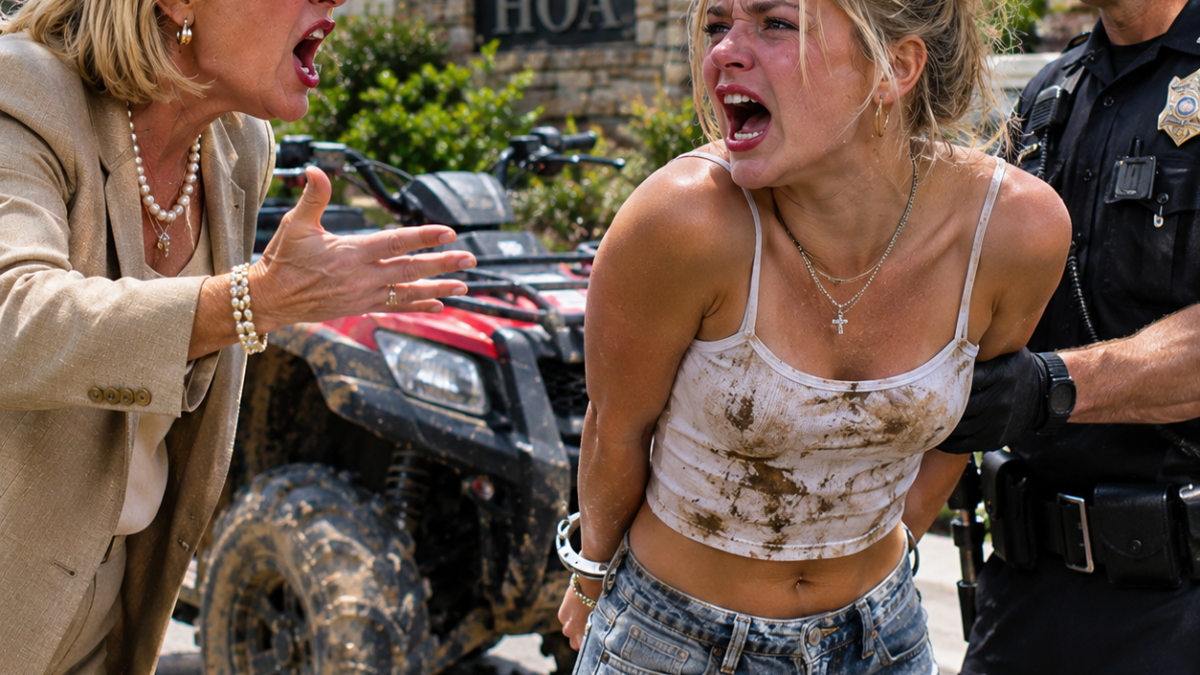
PART 2
Brooklyn dropped into a chair beside her mother without lowering her phone.
“Is he seriously fighting you over that ugly thing?” she asked.
I kept my eyes on Delilah.
“I’m discussing whether your HOA can legally fine me for medically necessary adaptive equipment.”
Brooklyn laughed.
“Medically necessary?”
She said it like the phrase itself was hilarious.
“It’s a four-wheeler.”
“It was modified around my disability.”
“Still a toy.”
A few people shifted in their chairs.
That was the first thing I noticed about Willowbrook.
People weren’t comfortable with Delilah.
They were afraid of being noticed by her.
There was a difference.
Delilah leaned forward.
“My daughter isn’t part of this discussion.”
“Then maybe she shouldn’t be participating.”
Brooklyn slowly lowered her phone.
Her expression changed.
She had expected irritation.
Maybe embarrassment.
What she hadn’t expected was indifference.
Bullies hate indifference.
It denies them the emotional payment they came to collect.
“Wow,” she said. “Mom, he’s rude.”
Delilah ignored her.
“Mr. Steele, we maintain standards here.”
“So do I.”
“And people who purchase homes in Willowbrook agree to respect community expectations.”
“I did.”
“Then remove the vehicle.”
“No.”
The word landed harder than I intended.
Not because I raised my voice.
Because I didn’t.
Delilah’s fingers stopped tapping.
Brooklyn stared at me.
Around the room, people suddenly became fascinated with their papers.
Delilah wasn’t accustomed to hearing no.
“You might want to reconsider your tone,” she said.
“My tone isn’t the problem.”
“Excuse me?”
“Selective enforcement is.”
I opened the folder I’d brought.
“I read Bylaw 47C. It prohibits commercial storage. Your garage currently contains approximately twenty real estate signs, multiple lockboxes, staging materials, and branded equipment connected to Thornfield Realty.”
Her face changed.
Barely.
But I saw it.
“That is different.”
“How?”
“Temporary business materials.”
“There’s no temporary exception in the rule.”
Brooklyn snorted.
“Are you stalking my mom now?”
“No. I walk past her house.”
“Creepy.”
I ignored her.
“Either the rule applies consistently, or it doesn’t.”
Delilah’s cheeks had begun turning red.
Several board members exchanged uncomfortable looks.
Finally, one of them suggested delaying enforcement until the HOA’s attorney reviewed the disability accommodation.
The vote passed four to three.
It wasn’t a victory.
But it wasn’t surrender.
That mattered.
I gathered my papers and walked outside.
Behind me, people began talking again.
As I crossed the parking lot, I heard voices near a black SUV.
Delilah and Brooklyn.
I wasn’t trying to listen.
They simply weren’t being quiet.
“He embarrassed you,” Brooklyn said.
“He embarrassed himself.”
“You should just tow it.”
“I can’t tow it while the accommodation review is pending.”
“So?”
“Brooklyn.”
“What? Dad says everyone has a pressure point.”
There was a pause.
Then Delilah said, “There are ways of encouraging difficult residents to cooperate.”
Brooklyn laughed.
“What are they gonna do? Arrest me?”
“Don’t be stupid.”
“Mom, seriously. Chief Martinez plays golf with Dad. Judge Watson knows us. Half the city comes to your Christmas parties.”
“You talk too much.”
“I just know how things work.”
I reached my truck and opened the door.
Then Brooklyn said something that stayed with me.
“I’m untouchable around here.”
I looked back.
Neither of them noticed me.
Delilah only smiled.
That night, I couldn’t sleep.
Not because of Brooklyn.
I’d met entitled people before.
Not because of Delilah either.
I’d dealt with arrogant authority before.
What bothered me was how everyone else reacted to them.
Carlos lowering his voice when he mentioned her.
Neighbors looking at the floor during meetings.
Board members hesitating before disagreeing.
People don’t behave like that because somebody is annoying.
They behave that way because they’ve seen consequences.
So I started reading.
Not just HOA bylaws.
Financial reports.
Vendor contracts.
Meeting minutes.
County filings.
Management agreements.
What I found was interesting.
Thornfield Realty wasn’t simply associated with the HOA.
Delilah’s management company controlled a remarkable portion of Willowbrook’s spending.
Landscaping contracts.
Emergency repairs.
Security services.
Pool equipment.
Roof repairs.
Consulting.
And somehow, a surprising number of those vendors traced back to people connected to the Thornfields.
I created a folder on my computer.
Then another.
Then another.
Maybe it was nothing.
Maybe it was exactly what it looked like.
Either way, engineers don’t guess when measurements are available.
We document.
Three nights later, I heard an engine outside shortly after midnight.
Then laughter.
I moved to the window.
A dark SUV rolled slowly past my house.
Brooklyn was hanging halfway out the passenger window.
Music shook the glass.
Something metallic hit my driveway.
Beer can.
The SUV stopped.
Brooklyn pointed toward my garage.
I couldn’t hear every word.
But I heard enough.
“Toy soldier!”
Her friends laughed.
The SUV accelerated.
The next morning, I found tire tracks cutting through the edge of my lawn.
Two crushed beer cans.
One broken bottle.
I photographed everything.
Then I called HOA security.
Delilah answered.
“Thornfield residence.”
“Why are you answering the security number?”
A pause.
Then sweetness.
“Good morning, Mr. Steele.”
“Someone drove across my lawn after midnight.”
“Do you have proof?”
“I have damage.”
“That isn’t proof.”
“I also have video from my doorbell camera.”
Another pause.
“Teenagers sometimes make poor choices.”
“So you know who it was?”
“I said no such thing.”
“Then why are you calling them teenagers?”
Her voice hardened.
“Be careful with accusations.”
“I’m being very careful.”
She ended the call.
That afternoon, Brooklyn was waiting by the mailbox cluster.
She leaned against her car wearing sunglasses that probably cost more than my first month’s rent after the Army.
“Hey, soldier boy.”
I kept walking.
“I’m talking to you.”
“I know.”
She stepped into my path.
Up close, she smelled like expensive perfume and cigarettes.
“Nice ATV.”
“Thanks.”
“You really love that thing, huh?”
I looked at her.
“What do you want?”
She smiled.
“Nothing.”
Then she leaned slightly closer.
“Just saying. Be a shame if something happened to it.”
I felt my entire body go still.
Not fear.
Recognition.
Some moments tell you what comes next before it happens.
This was one of them.
“Are you threatening me?”
She grinned.
“God, you’re dramatic.”
“Then repeat what you just said.”
“For what?”
“The camera.”
I pointed toward the neighborhood entrance.
Her smile flickered.
Then returned.
“Have a nice day, Grandpa.”
She walked away.
I went home and ordered more cameras.
Not because I wanted revenge.
Not yet.
I wanted proof.
## THE PRESSURE CAMPAIGN
Two weeks later, Delilah scheduled an emergency board meeting.
The official reason was “ongoing vehicle compliance.”
My ATV.
Again.
When I walked into the community center, almost every chair was occupied.
That should have impressed me.
It didn’t.
I recognized maybe half the people.
Some were residents.
Many weren’t.
Real estate agents.
Contractors.
Friends of the Thornfields.
People Delilah had apparently invited to create the appearance of overwhelming community opposition.
She stood behind the board table wearing a cream-colored suit.
Brooklyn lounged against the wall filming.
A projector displayed photographs of my ATV.
One image made my stomach tighten.
It had clearly been taken inside my garage.
I knew the angle because I’d built the workbench visible in the background.
Someone had opened or entered my garage while I wasn’t home.
Delilah spoke as if she were presenting a criminal indictment.
“This vehicle generates excessive noise, threatens community safety, creates insurance exposure, and damages the environmental character of Willowbrook.”
I nearly laughed.
My adaptive ATV was quieter than half the motorcycles owned by residents who were friendly with her family.
She clicked to another photo.
Tire tracks on a legal public desert trail.
“Evidence of environmental destruction.”
Brooklyn appeared beside the screen holding her phone.
“I personally documented those.”
“On public land?” I asked.
She rolled her eyes.
“You think that makes it okay?”
“Yes. When motorized use is permitted there.”
Several people chuckled.
Brooklyn glared at them.
Delilah moved quickly.
“The broader issue is that Mr. Steele believes his personal circumstances exempt him from community rules.”
That did it.
I stood.
“No.”
The room quieted.
“My circumstances don’t exempt me from rules. They protect me from discriminatory enforcement of rules that don’t even apply.”
I opened my folder.
“I have documentation supporting a disability accommodation for the modifications and use of my ATV.”
I handed copies to the board.
One member immediately began reading.
Another avoided looking at Delilah.
I continued.
“More importantly, the rule you’ve cited concerns commercial storage.”
I held up photographs.
Delilah’s garage.
Stacks of real estate signs.
Lockboxes.
Staging equipment.
Advertising materials.
Boxes carrying the Thornfield Realty logo.
“If you interpret Bylaw 47C the way you’ve interpreted it against me, your own property has violated the same provision for years.”
Dead silence.
Then Brooklyn laughed.
“You’re comparing Mom’s business to your little toy?”
I looked at her.
“That ‘little toy’ is why I can travel independently over terrain my prosthetic doesn’t handle well.”
“So?”
The word came out almost casually.
A woman near the back whispered, “Jesus.”
Brooklyn heard her.
“What?”
Nobody answered.
Brooklyn turned back to me.
“My mom actually contributes something here. You’re just using being a veteran to get special treatment.”
There are insults that hurt because they’re true.
And there are insults that hurt because they reveal how little the person saying them understands.
I thought about the hospital.
The first time I saw what was left of my leg.
The first time a physical therapist asked me to stand.
The first time I fell.
The first time I drove again.
The eight months in my garage building something that allowed me to feel capable instead of dependent.
I kept my voice quiet.
“That machine helped me rebuild my life.”
Brooklyn shrugged.
“Whatever.”
Then she said it again.
Louder.
“So what? I’m untouchable in this neighborhood anyway.”
Even Delilah looked uncomfortable.
“Brooklyn.”
“What?”
“Enough.”
Brooklyn rolled her eyes.
“Daddy handles everything.”
A board member cleared his throat.
Another stared directly at Delilah.
For the first time, I realized Brooklyn wasn’t merely cruel.
She was dangerous to her own family because she had never learned the value of silence.
People who believe consequences don’t exist tend to confess freely.
The board delayed the decision again.
Outside, I heard Delilah tearing into her daughter.
“Never say things like that in public.”
“Oh my God, Mom.”
“Do you understand me?”
“What’s he going to do?”
“That’s not the point.”
“He can’t do anything.”
I walked toward my truck without looking back.
But something inside me had changed.
Until then, I’d been defending myself.
Now I wanted to understand why an entire neighborhood was afraid.
The answer arrived the next morning.
Seven HOA complaints.
All filed overnight.
Engine noise at 2:00 a.m.
Chemical runoff.
Unlicensed mechanical business.
Improper vehicle storage.
Unauthorized exterior activity.
Hazardous materials.
Community disturbance.
Each came with a threatened fine.
There was only one problem.
At the times listed on several complaints, I had been at the VA.
Documented.
At one of the others, the ATV hadn’t even been home.
The complaints weren’t mistakes.
They were manufactured.
That afternoon, I checked my cameras.
Three had black paint covering the lenses.
Whoever did it had approached from angles designed to avoid the remaining cameras.
That was when I stopped thinking of Brooklyn as a spoiled teenager acting impulsively.
Someone was planning.
That night, six motorcycles entered Willowbrook.
They circled the streets revving engines.
Music blasted.
Beer cans hit pavement.
One motorcycle performed a burnout near the community center.
Then they gathered outside the Thornfield house.
Brooklyn stood in the middle of them.
When she saw me filming from my driveway, she raised both arms.
“There he is!”
Several heads turned.
“Hey, soldier boy!”
I kept recording.
One of the young men shouted something about my leg.
The others laughed.
Brooklyn joined them.
I felt anger moving through me like electricity.
For years, people had asked whether combat made me afraid.
The truth was more complicated.
Combat had taught me what fear was for.
Fear wasn’t an order to run.
It was information.
Anger worked the same way.
You could let it control you.
Or you could use it to sharpen your attention.
So I recorded.
License plates.
Faces.
Times.
Statements.
Property damage.
Then I called HOA security.
Delilah answered again.
“Mr. Steele.”
“There are six motorcycles violating the noise restrictions outside your house.”
“I don’t observe any violation.”
“I can hear them through the phone.”
“You’ve mentioned difficulties adjusting since your service.”
My hand tightened around the phone.
“What exactly are you suggesting?”
“I’m suggesting stress can affect perception.”
She paused.
“Some veterans experience auditory symptoms.”
There it was.
She wasn’t just ignoring the violation.
She was trying to use my military history against me.
“Thank you, Delilah.”
“For what?”
“For saying that clearly.”
I ended the call.
Then I saved the recording.
## 3:47 A.M.
I installed trail cameras the next afternoon.
Small ones.
Motion activated.
Night vision.
The sort of equipment hunters use to see what moves when everybody else is sleeping.
At 3:47 the following morning, my phone vibrated.
Motion detected.
I opened the feed.
Brooklyn was beside my garage.
Alone.
Dark clothing.
Hair tied back.
No drunken stumbling.
No laughing friends.
She pulled something from her pocket.
Lock picks.
I sat up.
For almost twelve minutes, she worked at my garage door.
Every few seconds she glanced toward the street.
This wasn’t a prank.
She had planned it.
When the motion floodlight finally came on, Brooklyn froze.
For one beautiful second, she looked directly into the trail camera.
Then she ran.
By sunrise, I had copied the footage to three separate storage drives.
At eight-thirty, someone knocked on my door.
Carlos Vega.
He kept glancing over his shoulder.
“Can I come inside?”
“Sure.”
The moment the door closed, he exhaled.
“I saw her.”
“Brooklyn?”
“Last night.”
My pulse quickened.
“You saw her at my garage?”
He nodded.
“I was coming home from an emergency pool repair. Saw somebody crouched by your door. When the light hit, I recognized her.”
“Would you give a statement?”
His expression collapsed.
“I can’t.”
“Carlos—”
“You don’t understand.”
“I think I do.”
“No, man. Delilah controls maintenance contracts in six developments. Six. If she blacklists my company, I lose most of my business.”
“So she owns the contracts.”
“Her company influences them.”
“Same thing.”
He sat down.
“My wife handles the books. My daughter starts college next year. I can’t be brave with their mortgage.”
I understood.
Courage sounds simple when someone else is paying the price.
“I’m not asking you to sacrifice your family.”
Carlos looked ashamed.
“I hate that woman.”
“Then help me quietly.”
He looked up.
“How?”
“Keep records.”
“Of what?”
“Every job involving Thornfield contractors. Normal cost. What they charge. Dates. Invoices.”
He stared at me.
Then something changed in his face.
“I can do that.”
“Don’t tell anyone.”
“I won’t.”
That afternoon, I visited Meredith Hendricks.
She was seventy-three and had the unnerving ability to look at you like a teacher who already knew exactly what lie you were planning to tell.
When I showed her the trail camera footage, she barely reacted.
“I told you.”
“You knew Brooklyn was doing this?”
“I knew she’d escalate.”
“How?”
Meredith disappeared into a back room.
She returned carrying a thick folder.
Then another.
Then a USB drive.
“What is this?”
“Three years.”
“Of what?”
“Of them.”
Inside were violation notices, photographs, recorded threats, board minutes, payment records, screenshots of Brooklyn boasting online about vandalism and getting away with it.
Meredith folded her arms.
“I was a history teacher for forty-one years, Garrett. You know what history teaches better than almost anything?”
“What?”
“People who abuse power depend on everyone believing they’re the first victim.”
I looked down at the folders.
“They did this to others.”
“Of course they did.”
“How many?”
“Enough.”
She sat beside me.
“Cars keyed. Fines invented. Contractors threatened. People pressured into using Delilah’s vendors. Families embarrassed at meetings until they moved.”
“Why hasn’t anybody gone to the police?”
“Some did.”
“And?”
She gave me a long look.
“Nothing.”
That night, Brooklyn called me.
Unknown number.
Her voice was slurred.
“Soldier boy.”
I pressed record.
“What do you want?”
“You know what your problem is?”
“I assume you’re going to tell me.”
“You think rules matter.”
I said nothing.
She continued.
“My family is the rule.”
“Did you call to discuss philosophy?”
“No.”
She laughed.
“I called to warn you.”
“About what?”
“Tomorrow, or maybe the next day, I’m taking your precious ATV.”
I felt my chest tighten.
“You’re threatening to steal it?”
“I’m promising.”
“Why?”
“Because you love it.”
Her voice changed.
Less playful.
Crueler.
“And because you need to understand your place.”
For several seconds, neither of us spoke.
Then I asked, “You understand this call is being recorded?”
She laughed so hard she nearly choked.
“You think I care?”
Click.
The line died.
I replayed the recording twice.
Then I forwarded it to my attorney.
After that, I sat alone in my garage beside the ATV.
My hand rested on the custom control lever I’d spent weeks designing.
I remembered the first version failing.
The second version binding under load.
The third finally moving smoothly beneath my palm.
People who had never lost mobility thought mobility was transportation.
It wasn’t.
Mobility was choice.
And choice was dignity.
Brooklyn didn’t want the machine because she liked ATVs.
She wanted it because she knew taking it would hurt me.
That made what happened next easier.
I stopped thinking about protecting the ATV.
I started thinking about documenting whoever came for it.
## THE PARTY
Three days later, Delilah and her husband left for Cabo.
Brooklyn announced a party.
By sunset, cars lined both sides of the street.
By nine, there were at least sixty people at the Thornfield house.
By eleven, Willowbrook looked like a college parking lot after a championship game.
Broken bottles.
Beer cans.
Music.
People in the pool despite community quiet hours.
Cars blocking driveways.
Someone tore a sprinkler head out of the lawn near the clubhouse.
Someone else spray-painted the mailbox structure.
I recorded everything.
At midnight, Brooklyn saw me.
She staggered across the street holding a bottle.
Her makeup was smeared.
Her phone was live-streaming.
“Guys!”
She turned the camera toward me.
“Look who came outside!”
Comments moved rapidly across her screen.
I couldn’t read them from where I stood.
I didn’t need to.
“Still spying on people?” she asked.
“Documenting property damage.”
She pointed her phone toward the broken mailbox.
“Oh no.”
Fake horror.
“Call the Army.”
Her friends laughed from behind her.
“Go home, Brooklyn.”
“This is my home.”
“Then stop destroying it.”
She stepped closer.
“You really think you’re better than us because you got hurt overseas?”
“No.”
“You act like it.”
“I asked you to stop damaging community property.”
“My mom told me about people like you.”
“People like me?”
“Broken guys who come home and expect everybody to feel sorry for them.”
Something in my chest went cold.
Not hot.
Cold.
That was worse.
I looked at the phone in her hand.
Thousands of people might eventually see this.
Good.
“I’m not asking for sympathy.”
“Then stop playing victim.”
She took another drink.
I turned away.
A bottle smashed against the metal garage door beside my head.
I spun around.
Brooklyn stared at the broken glass.
Then at me.
For half a second, fear appeared on her face.
Then she grinned at the phone.
“Oops.”
Her friends erupted.
I didn’t.
I photographed the glass.
Then I went inside.
At approximately two in the morning, the motion alerts began.
Camera one.
Camera two.
Camera three.
Four figures approached my garage.
Brooklyn.
Three young men.
One carried bolt cutters.
Another held a phone displaying some kind of security utility.
This time, I didn’t move.
I watched.
The exterior lock failed.
Then the garage door opened.
Brooklyn stepped inside.
One of the men whispered, “Just grab it and go.”
Brooklyn laughed.
“Relax.”
“You said there were cameras.”
“There aren’t anymore.”
There were.
Several.
Hidden behind rafters.
Inside an old electrical enclosure.
Behind a shelf.
Under the workbench.
Every feed uploaded remotely.
Brooklyn took the ATV keys from the pegboard.
One accomplice looked nervous.
“Brooklyn, seriously, this is felony stuff.”
“My dad knows everybody.”
“Still.”
“Judge Watson owes him. Chief Martinez golfs with him. My mom owns the HOA.”
She swung one leg over my seat.
“Who are they going to believe?”
The engine started.
The sound hurt more than I expected.
Not mechanically.
Emotionally.
I had built that machine.
Every modification had a memory attached to it.
And now Brooklyn sat on it laughing.
She backed out of the garage.
Then accelerated across my lawn.
One of her friends shouted.
Brooklyn turned in a wide circle.
Mud and gravel flew.
She raised one hand toward my house.
Middle finger.
Then she disappeared down the street.
My GPS tracker woke up.
Location transmitted.
I stood in the dark garage.
The empty space where the ATV had been looked enormous.
For a moment, I felt exactly what Brooklyn wanted me to feel.
Powerless.
Then another notification appeared.
Cloud upload complete.
Video evidence stored.
GPS active.
I smiled.
Not because I knew how everything would end.
I didn’t.
I smiled because Brooklyn had just stopped being a nuisance.
She had become evidence.
## WHAT THE TRACKER REVEALED
Brooklyn drove straight to the country club.
Of course she did.
She didn’t steal my ATV to hide it.
She stole it to display it.
By eight the next morning, she had posted a video.
My ATV sat beneath the portico behind her.
She leaned against it wearing sunglasses.
“Thanks for the donation, soldier boy.”
Then she kissed two fingers and tapped the camera.
“Maybe next time you’ll know your place.”
I downloaded the video.
My attorney forwarded the evidence to investigators.
I also contacted a local television station whose corruption reporter, Cassidy Walsh, had recently covered HOA financial abuse.
What I didn’t know was that Cassidy already knew Willowbrook.
Because Meredith had been talking to her for months.
When I told Meredith where the ATV had gone, she said, “Come over.”
She had documents spread across her kitchen table.
Invoices.
Contracts.
Meeting minutes.
Vendor registrations.
Cassidy joined us by phone.
“Mr. Steele,” she said, “your HOA dispute intersects with an investigation we’ve been conducting for eight months.”
“Into Delilah?”
“Into several management companies.”
She explained that payments connected to Thornfield-linked entities had appeared across multiple developments.
Repairs billed far above market rates.
Emergency contracts awarded without competitive bidding.
Repeated work sent to related vendors.
Reserve funds diverted into questionable projects.
I looked at Meredith.
“You knew?”
“I suspected.”
“How much?”
Cassidy answered.
“Enough that we’ve already spoken with federal investigators.”
I sat back.
The fight suddenly became much larger than my garage.
That afternoon, Carlos delivered invoices.
He looked almost embarrassed by how simple the numbers were.
“This filter costs me forty dollars wholesale.”
The invoice from a Thornfield contractor showed eight hundred.
Another routine repair normally cost around twelve thousand dollars.
Willowbrook had paid forty-seven thousand.
A security vendor had billed for guards residents claimed they had never seen.
One landscaping contract had been renewed repeatedly without competing bids.
Then my friend Jake called.
Jake and I had served together years earlier.
He worked in cybersecurity now and had been helping me preserve copies of digital evidence.
“I ran the public entities you sent.”
“And?”
“Garrett, several vendors share mailing addresses.”
My stomach tightened.
“How many?”
“Enough to be interesting.”
He kept talking.
Shell companies.
Related names.
Shared officers.
Contracts across twenty-three communities.
When Cassidy eventually called back, her voice had changed.
Less journalist.
More serious.
“We believe this may be a multimillion-dollar fraud operation.”
I stared out Meredith’s window.
Across the street, a kid rode a bicycle.
A woman walked a dog.
Sprinklers swept across front lawns.
Normal life.
And beneath it, people had potentially been robbed for years.
“What does my ATV have to do with any of this?”
“Your case establishes retaliation.”
“Retaliation for what?”
“For challenging enforcement tied to people connected to the financial scheme.”
“That sounds like a reach.”
“Not by itself.”
She paused.
“But we now have your recorded conversations, the manufactured violations, the break-in attempt, witness intimidation allegations, Delilah’s management conflicts, and Brooklyn openly boasting about protection through local connections.”
I rubbed my forehead.
“So what happens?”
“We keep investigating.”
“When do I get my ATV back?”
“Soon, hopefully.”
That answer wasn’t good enough emotionally.
But it was legally sensible.
Brooklyn kept posting.
Every video strengthened the case.
One showed her driving circles outside the country club.
Another showed friends posing on my seat.
One caption read:
SPOILS OF WAR.
Another:
UNTOUCHABLE.
She didn’t know investigators were watching.
She didn’t know journalists were saving everything.
She didn’t know the girl who had spent years broadcasting her life had finally broadcast the wrong thing.
## THE WILLOWBROOK RESISTANCE
Once people realized somebody was listening, silence broke quickly.
Meredith brought five neighbors to my house.
Janet Torres.
Bob Mueller.
Sarah Kim.
Carlos.
And a couple named the Hendersons.
Each carried records.
Janet had a water-damage claim.
Her request for repair assistance had been rejected twice.
Then a Thornfield-affiliated contractor received an “emergency” project worth nearly four times the normal rate.
Bob was a retired accountant.
He had been questioning reserve-fund calculations for two years.
Every time he asked for details, Delilah gave him incomplete spreadsheets.
Sarah’s story made me angry.
She had received repeated landscaping violations.
Dead grass.
Incorrect hedge height.
Improper shrub placement.
Then someone suggested she hire a company favored by Delilah.
The violations disappeared.
The Hendersons had almost moved after repeated harassment involving their son’s vehicle.
Their son was active-duty military and visited during leave.
His older truck apparently hurt “community aesthetics.”
“This isn’t an HOA,” Bob said. “It’s a pressure system.”
Meredith corrected him.
“No. A legitimate HOA is an HOA. This is a pressure system wearing one as a costume.”
For three hours, we built a timeline across my dining room table.
I had expected neighbors to be frightened.
Instead, once they saw they weren’t alone, they became furious.
That’s how abusive power survives.
Not by being stronger than everyone.
By keeping everyone isolated.
Delilah had made each person believe his problem was private.
His fine.
Her contractor issue.
Their violation.
My ATV.
Once we put everything in the same room, the pattern became impossible to ignore.
Jake created digital backups.
Cassidy copied documents.
Carlos provided pricing comparisons.
Bob analyzed the financial statements.
Meredith provided witness histories.
For the first time since I moved to Willowbrook, I didn’t feel like a man fighting a neighborhood.
I felt like part of one.
That mattered more than I expected.
Because anger can keep you moving.
But belonging gives you somewhere to move toward.
## DELILAH RETURNS
Delilah came back from Cabo on a Friday morning.
By then, Brooklyn had kept my ATV for almost a week.
Her parents’ circular driveway looked like a showroom.
My machine sat in plain view.
A trophy.
At 9:15 a.m., two investigators visited the Thornfield house.
At 9:47, Delilah called an emergency HOA meeting.
At 10:06, she emailed the entire community accusing “certain disgruntled residents” of spreading false and defamatory claims.
At 10:40, she appeared at my door.
I didn’t open it.
I spoke through the camera.
“What do you want?”
“You need to stop.”
“Stop what?”
“Whatever you’re doing.”
“That’s specific.”
“You contacted journalists.”
“I reported a stolen vehicle.”
“My daughter borrowed your ATV.”
I almost laughed.
“Borrowed?”
“Yes.”
“She broke into my garage.”
“Allegedly.”
“I have video.”
Silence.
“Return the ATV,” I said.
“You’re creating unnecessary hostility.”
“Your daughter committed a felony.”
“You don’t get to decide that.”
“Neither do you.”
Her voice lowered.
“Garrett, you’re making a mistake.”
It was the first time she’d used my first name.
“You’ve lived here three years. You don’t understand how communities like this function.”
“I think I’m beginning to.”
“People need relationships.”
“Is that what you call it?”
“Be very careful.”
“With what?”
“With destroying your own reputation.”
I leaned closer to the doorbell camera.
“Delilah, your daughter stole twelve thousand dollars’ worth of adaptive equipment from a disabled veteran after threatening to do it on a recorded call.”
Nothing.
“So if your plan is to convince people I’m the problem, you’re going to need a better plan.”
She stepped away.
Then stopped.
“You think you’re winning.”
“I think I want my ATV.”
“You won’t have a place in Willowbrook when this is over.”
That sentence told me everything.
She still believed she owned the community.
Not represented it.
Owned it.
I saved the video.
At noon, Brooklyn began a parade around my house.
Six luxury cars.
Windows down.
Music blasting.
Her friends shouted insults.
One held a cardboard sign:
GARAGE SALE — SOLDIER BOY LIQUIDATION.
Neighbors watched from windows.
A few came outside.
Brooklyn stood through a convertible roof filming.
“Smile, Garrett!”
I didn’t.
She circled again.
And again.
On the fourth pass, Meredith came outside.
Seventy-three years old.
Five-foot-four.
House slippers.
She stood at the edge of my driveway with her arms folded.
When Brooklyn’s car approached again, Meredith raised one hand.
Not a rude gesture.
Just a teacher’s stop signal.
The car slowed.
Brooklyn stared at her.
Meredith stared back.
Nobody said anything.
The car moved on.
Then Carlos came outside.
Then Janet.
Then Bob.
Then the Hendersons.
By the time Brooklyn made another lap, there were fifteen residents standing silently along the sidewalk.
She stopped laughing.
That was the moment Willowbrook changed.
Not when agents arrived.
Not when television cameras came.
Right there.
Because fear had finally become embarrassing.
## THE BAIT
That afternoon, investigators contacted me.
They already had enough to move forward on several aspects of the broader financial case.
But Brooklyn continued using my ATV publicly.
She was planning another appearance at the country club.
That created an opportunity to recover the property cleanly while documenting possession.
I didn’t need to invent a trap anymore.
Brooklyn was constructing one herself.
Still, I gave her a final push.
I called.
She answered immediately.
“Well, well.”
“You win.”
Silence.
Then laughter.
“What?”
“I said you win.”
“Oh my God.”
I forced exhaustion into my voice.
“The legal bills aren’t worth it.”
“Finally.”
“I’m selling the ATV when I get it back.”
She giggled.
“If.”
“Brooklyn.”
“What?”
“Just return it.”
“Maybe I’ll buy it.”
“You don’t own it.”
“I basically do.”
“For how much?”
“Ten dollars.”
Her friends laughed in the background.
“Charity,” she said. “For veterans.”
I ended the call.
The bait wasn’t the ATV.
It was her ego.
Brooklyn couldn’t tolerate the idea that I was quitting without seeing her victory.
That evening she posted:
ONE LAST VICTORY LAP TOMORROW.
COUNTRY CLUB SUNSET.
Then a video.
She stood beside my ATV.
“Daddy’s lawyers handled the crazy vet. Tomorrow we’re celebrating.”
Jake called me thirty seconds later.
“Please tell me she didn’t just post that publicly.”
“She did.”
“She’s unbelievable.”
“No.”
I watched the video again.
“She’s consistent.”
The next morning, Willowbrook felt strange.
News vans appeared near the entrance.
People pretended not to notice them.
Delilah made phone calls from her driveway.
Investigators moved quietly.
I stayed home.
For three years, Delilah and Brooklyn had made every confrontation loud.
Public meetings.
Violations.
Threats.
Parties.
Humiliation.
I decided the last thing I would give them was panic.
At four in the afternoon, an emergency board meeting began.
Delilah had packed the room.
Again.
She spoke for twenty minutes about “dangerous residents,” “hostile conduct,” and “community standards.”
Photographs of me appeared on the projector.
Some taken outside VA appointments.
That detail bothered people.
“Why were you photographing him there?” one resident asked.
Delilah ignored the question.
She proposed authorizing the HOA to remove or seize “hazardous noncompliant equipment” from my property.
Seven people voted yes.
Two voted no.
Delilah smiled at me.
“You see?” she said after the meeting. “Rules matter.”
My phone vibrated.
Message from Cassidy.
Brooklyn confirmed at country club.
ATV in possession.
I looked at Delilah.
“You’re right.”
For the first time all afternoon, she seemed confused.
“Rules do matter.”
I left.
## THE COUNTRY CLUB
The Scottsdale country club looked beautiful at sunset.
Perfect lawns.
Warm lights.
White tablecloths.
Golf carts moving quietly between palm trees.
Families eating dinner on the terrace.
And in the middle of it all sat my ATV.
Brooklyn had parked it beneath string lights.
Her friends gathered around holding champagne.
Phones were everywhere.
She was live.
Thousands watching.
I stayed out of sight.
Cassidy’s news crew was positioned nearby.
Investigators were already on the property.
Some looked like staff.
Some waited in vehicles.
Some were inside.
Brooklyn didn’t notice any of them.
Why would she?
People who believe the world exists for them don’t study the background.
She climbed onto the ATV.
“Okay, guys,” she said into her phone. “Final victory lap.”
Her friends cheered.
She revved the engine.
That sound hit me again.
My machine.
My work.
My freedom.
Under someone who had stolen it because she believed humiliating me was entertainment.
Brooklyn turned the phone toward herself.
“You know what my dad always says?”
Someone yelled, “What?”
“There are winners and losers.”
More cheering.
“And some people just need to accept which one they are.”
One of her friends shouted my name.
Brooklyn laughed.
“The veteran?”
“Yeah!”
She looked directly into the camera.
“He should’ve learned his lesson.”
That was when several agents moved.
Not dramatically at first.
Just efficiently.
One stepped into the path of the ATV.
Another approached from behind.
A third spoke.
“Brooklyn Thornfield.”
Her smile vanished.
“What?”
“Turn off the vehicle and step down.”
“Who are you?”
He identified himself.
Brooklyn looked around.
More agents.
Her friends stopped filming for about two seconds.
Then started again.
She laughed nervously.
“This is ridiculous.”
“Turn off the vehicle.”
“My dad’s attorney—”
“Step down.”
Brooklyn gripped the controls.
Then she did exactly what someone like Brooklyn would do.
She tried to drive away.
The ATV lurched forward.
I already had remote access to the modified ignition system.
One command.
Engine off.
The machine rolled several yards.
Then stopped.
Brooklyn twisted the throttle.
Nothing.
Again.
Nothing.
Her face changed.
Not anger.
Not yet.
Confusion.
The world had always moved when Brooklyn told it to move.
Now it hadn’t.
An agent reached her.
“Step off.”
“You can’t do this.”
“Step off the vehicle.”
“My father knows—”
“Off.”
She climbed down.
Her phone was still streaming.
Thousands of people watched the first handcuff close around her wrist.
Brooklyn stared at it.
Then at the agent.
“You’re arresting me?”
“Yes.”
“For what?”
The agent began listing allegations associated with the theft and the broader investigation.
Brooklyn shook her head.
“No.”
The second cuff clicked.
“No. You don’t understand.”
Nobody answered.
She became louder.
“My dad knows Chief Martinez.”
Silence.
“My mom runs Willowbrook.”
Still nothing.
“My family’s attorney is Judge Watson’s—”
“Brooklyn.”
The agent’s voice remained calm.
“Stop talking.”
Then she said it.
The sentence I’d heard so many times that I had almost begun believing she believed it more than she believed her own name.
“You can’t arrest me.”
She looked around wildly.
“I’m untouchable.”
One of her friends lowered his phone.
The agent holding her arm didn’t smile.
Didn’t gloat.
Didn’t insult her.
He simply guided her toward a waiting vehicle.
And that was more devastating than anything I could have said.
Because Brooklyn had spent years confusing attention with power.
Now nobody was debating her.
Nobody was negotiating.
Nobody was impressed.
She was simply under arrest.
Cassidy’s camera captured everything.
The country club terrace had gone silent.
Brooklyn looked back once.
That was when she saw me.
Across the parking lot.
Leaning on my cane.
For several seconds, we stared at each other.
I expected anger.
Maybe hatred.
What I saw instead was disbelief.
I didn’t wave.
I didn’t smile.
I didn’t give her the satisfaction of seeing revenge on my face.
I only looked at my ATV.
Then at her.
And she understood.
She hadn’t stolen a toy.
She had stolen the wrong man’s freedom and broadcast herself doing it.
## DELILAH’S LAST STAND
Brooklyn’s arrest wasn’t the end.
It was the signal.
Investigators moved on the Thornfield residence while other teams executed warrants connected to businesses and properties tied to the financial case.
When Cassidy’s crew returned to Willowbrook, half the neighborhood was already outside.
Federal vehicles filled Delilah’s circular driveway.
Boxes came out of the home office.
Computers.
Records.
Files.
Hard drives.
Delilah stood on the front steps wearing a white blouse and diamond earrings.
Even surrounded by agents, she looked furious rather than frightened.
“This is political harassment!”
Nobody responded.
“I know Judge Watson personally!”
An investigator calmly told her the matter was being handled through federal court.
The sentence seemed to physically weaken her.
For three years, Delilah’s greatest weapon had been the belief that every system around Willowbrook could be influenced.
Local contracts.
Local officials.
Local relationships.
Federal jurisdiction removed her favorite battlefield.
Then she saw the neighbors.
Carlos.
Meredith.
Janet.
Bob.
Sarah.
The Hendersons.
Dozens more.
People she had fined.
Threatened.
Embarrassed.
Ignored.
Used.
Delilah pointed at me.
“This is because of him!”
I shook my head.
“No.”
“Don’t lie!”
“This is because of you.”
“You poisoned them against me.”
Meredith stepped forward.
“No, Delilah.”
Her voice carried across the driveway.
“You taught us.”
Delilah stared at her.
Meredith held up a thick folder.
“You taught us what silence costs.”
Carlos raised his own records.
Janet stood beside him.
Others followed.
One by one.
Not shouting.
Not throwing anything.
Just holding paper.
Evidence.
That was the sight that finally scared Delilah.
Not guns.
Not agents.
Not cameras.
Neighbors with documentation.
Because people like Delilah understand something most bullies pretend not to.
Power is strongest when victims can’t compare notes.
Once we compared notes, she was finished.
An investigator began reading the allegations.
Conspiracy.
Wire fraud.
Money laundering.
Racketeering-related offenses.
Civil-rights violations connected to discriminatory retaliation.
Other counts tied to the wider network.
Delilah’s mouth opened.
No sound came out.
Then she asked one question.
“Where’s Brooklyn?”
Nobody answered immediately.
Her face changed.
“My daughter.”
Finally, the investigator said, “She’s in custody.”
Delilah took one step backward.
“For what?”
“Among other matters, the stolen ATV.”
She looked at me.
This time there was no superiority in her expression.
Only shock.
I walked toward the steps.
My prosthetic clicked against the pavement.
Once.
Twice.
Three times.
For years, I’d hated that sound.
In quiet rooms, it announced me before I entered.
It reminded me that one side of my body no longer moved the way it once had.
That night, the sound felt different.
Steady.
Mechanical.
Unapologetic.
Delilah stared at my leg.
Then at my face.
“You ruined my family.”
I stopped.
“No.”
Her eyes filled.
“You wanted this.”
“I wanted my ATV back.”
“You set us up.”
“I installed cameras after your daughter threatened to steal it.”
“You knew what she would do.”
“Yes.”
“You could’ve stopped her!”
That sentence silenced the entire driveway.
I looked at Delilah.
“Do you hear yourself?”
She blinked.
“Your daughter threatened me. Broke into my garage. Stole my property. Mocked my disability. Broadcast the theft. And your defense is that I should’ve protected her from the consequences?”
Delilah said nothing.
I continued.
“You spent three years teaching her that your money could erase every mistake.”
Her face hardened.
“Don’t lecture me about my child.”
“I’m not.”
I nodded toward the federal vehicles.
“They are.”
Someone in the crowd laughed softly.
I didn’t.
This wasn’t funny.
That surprised me.
For weeks I’d imagined the moment Delilah finally lost.
I’d imagined satisfaction.
Heat.
Triumph.
Maybe even cruelty.
Instead, watching a mother discover she couldn’t protect her daughter anymore made the whole thing feel heavier.
Not sad enough to excuse them.
Never that.
But heavy.
Choices had finally arrived to collect their debt.
Delilah’s hands were placed behind her back.
The cuffs closed.
She looked down.
Then at the neighborhood.
Nobody applauded at first.
Meredith simply watched.
Carlos lowered his head.
Some residents cried.
Not for Delilah.
For themselves.
For three years of being afraid inside homes they owned.
For money lost.
For humiliation swallowed.
For the strange relief of discovering that the monster had always been human.
Then Brooklyn’s arrest appeared live on Cassidy’s broadcast.
Someone held up a phone.
Delilah heard her daughter’s voice.
“You can’t arrest me! I’m untouchable!”
Delilah shut her eyes.
That was the moment she broke.
Not when the warrant appeared.
Not when her office was searched.
Not when the handcuffs closed.
When she heard the worldview she’d taught her daughter spoken out loud while consequences arrived.
Tears ran down her face.
She looked at me one last time.
I didn’t say anything.
I didn’t need to.
## GETTING MY FREEDOM BACK
My ATV was returned after investigators finished processing it as evidence.
The first time I saw it again, there was dried mud on the tires.
A scratch near the rear rack.
A small stain on the custom seat.
I stood in my garage staring at it.
Jake was beside me.
“You okay?”
“Yeah.”
I wasn’t sure.
“Thought you’d be happier.”
“So did I.”
He leaned against the workbench.
“You want me to fix the scratch?”
I ran my thumb across it.
“No.”
“Why?”
“Leave it.”
He looked at me.
I shrugged.
“Some scars should stay.”
Jake smiled.
“That sounds incredibly dramatic.”
“Shut up.”
He laughed.
It was the first easy laugh I’d had in weeks.
We checked every system.
Hand controls.
Brakes.
Suspension.
Tracker.
Ignition.
Everything worked.
When Jake finished, he held out the key.
I didn’t take it immediately.
“You know what scares me?”
“What?”
“That I almost let them make me hate this place.”
He looked toward the open garage.
Kids were riding bicycles outside.
Meredith was talking to Carlos across the street.
Neighbors were helping remove damaged landscaping near the mailbox.
“Maybe that’s why they lost,” Jake said.
“What do you mean?”
“They thought the neighborhood belonged to whoever controlled everybody.”
He held the key closer.
“Turns out it belonged to the people who stayed.”
I took it.
Then I climbed onto the ATV.
My hands settled naturally onto the controls.
Eight months of engineering.
Years of recovery.
Weeks of anger.
The engine started.
I closed my eyes.
For a moment, I was back on that desert ridge watching the sunrise after my first successful ride.
Just Garrett.
I drove slowly through Willowbrook.
People waved.
Some applauded.
That embarrassed me more than I expected.
At the entrance, Meredith stood with her coffee.
“You planning to become insufferable now?” she asked.
“Absolutely.”
“Good.”
I stopped beside her.
“You were right.”
“About what?”
“History.”
She smiled.
“I usually am.”
“That’s a dangerous personality trait.”
“I was a teacher. It was required.”
I laughed.
Then I headed toward the desert.
This time I rode farther than I had before.
Not recklessly.
Just far enough to feel the neighborhood disappear behind me.
At the top of a ridge, I stopped.
The Arizona sky stretched forever.
I thought about Afghanistan.
The hospital.
The prosthetic.
The garage.
Brooklyn laughing.
Delilah threatening me.
The handcuffs.
Then I thought about Carlos knocking on my door even though he was terrified.
Meredith keeping files for three years.
Janet carrying records.
Bob checking numbers.
Jake preserving footage.
Cassidy refusing to stop digging.
The story wasn’t that one combat engineer defeated an untouchable family.
That version was cleaner.
More cinematic.
Also wrong.
The truth was that dozens of ordinary people stopped being isolated at the same time.
That’s what broke the Thornfields.
## SIX MONTHS LATER
The trials and plea negotiations moved faster than many residents expected.
Brooklyn faced serious consequences tied to the ATV theft, the break-in, harassment, and her participation in conduct investigators connected to the larger case.
Eventually, she received an eighteen-month sentence.
Her social-media life collapsed almost immediately.
Sponsors disappeared.
Accounts were restricted or removed.
Friends who had laughed beside her suddenly claimed they barely knew her.
Videos she once posted to prove her status became exhibits demonstrating her behavior.
The strangest part was watching people who had encouraged her pretend they had been horrified all along.
Delilah’s outcome was worse.
The financial investigation spread across twenty-three communities.
Investigators calculated millions of dollars in questionable or fraudulent activity.
She lost her real-estate license.
Assets were seized or sold to satisfy restitution orders.
She ultimately received a multi-year federal sentence tied to the financial scheme.
Several associates made deals.
Others faced charges.
A few board members resigned before investigators ever contacted them.
Willowbrook held an emergency election.
Carlos Vega became president.
I laughed when I heard his name nominated.
Six months earlier he had been afraid even to give a witness statement.
Now he stood in front of the entire community and said, “No contract gets approved here again unless every resident can understand where the money is going.”
His first reform required open competitive bidding.
Bob Mueller chaired the finance committee.
Every monthly report went online.
Vendor relationships had to be disclosed.
Violation appeals were reviewed by residents with no financial relationship to HOA contractors.
Meeting recordings became publicly available to homeowners.
Within months, maintenance costs fell dramatically.
Our HOA dues decreased.
Service improved.
Turns out when you stop paying friends eight hundred dollars for forty-dollar parts, budgets become surprisingly manageable.
Meredith refused every official position.
When Carlos asked why, she said, “I spent forty-one years attending meetings. Retirement means never voluntarily joining another committee.”
Instead, she became the person everyone consulted anyway.
The recovered money funded several community projects.
One of them mattered more to me than the others.
The Willowbrook Veterans Memorial Garden.
It wasn’t my idea.
Meredith proposed it.
Accessible walking paths.
Shaded benches.
Low-maintenance desert plants.
A small workshop space near the community center where veterans and residents with disabilities could learn adaptive engineering.
When they asked me to run the first class, I almost refused.
I didn’t consider myself a teacher.
Then a twenty-four-year-old Marine named Luke showed up.
He used a wheelchair.
He wanted to modify it for rough desert terrain.
He had the same expression I’d probably worn years earlier.
Not hopeless.
Worse.
Dependent.
He hated needing help.
I understood immediately.
So we worked.
Different tires.
Reinforced mounts.
Adjusted center of gravity.
Tool storage.
Nothing magical.
Just engineering.
But the first time Luke rolled independently across the packed-earth section behind the workshop, he stopped.
Turned around.
And smiled.
I knew that smile.
It was the one I’d worn on the ridge.
Freedom.
That was when I understood what the ATV had actually become.
Brooklyn thought she had stolen my weakness.
She had accidentally exposed my purpose.
## BROOKLYN’S LETTER
About eight months after the arrest, an envelope arrived.
No return address I recognized.
Inside was a letter.
From Brooklyn.
My first reaction was irritation.
My second was curiosity.
The handwriting looked nothing like the person I’d known.
No glittering confidence.
No performance.
Just blue ink.
Garrett,
I don’t expect you to forgive me.
My lawyer told me not to write, which is probably why I need to.
For most of my life, whenever something went wrong, somebody fixed it before it became real.
My parents paid.
Called someone.
Threatened someone.
Explained it away.
I started thinking consequences were proof that a person wasn’t important enough.
I thought being powerful meant never hearing no.
You were one of the first people who told me no and didn’t get scared when I pushed harder.
I hated you for it.
So I took the thing I knew mattered most.
I told myself it was funny.
It wasn’t.
I told myself you deserved it.
You didn’t.
I told myself being hurt overseas had made you weak.
Now I understand I was looking at someone who rebuilt his life while I had never built anything.
I’m not asking you to answer.
I just needed to write the sentence nobody in my family taught me to say.
I was wrong.
Brooklyn
I read it twice.
Then I put it down.
Meredith found me staring at the letter later that afternoon.
“What is it?”
I handed it to her.
She read silently.
“Well?”
I asked.
“Well what?”
“Do you believe her?”
Meredith folded the paper.
“Wrong question.”
“What is the right one?”
“Does she believe herself?”
I considered that.
“And?”
“We won’t know for years.”
I laughed softly.
“You really can’t just give a simple answer?”
“Forty-one years of teaching children cured me of that.”
I took the letter back.
“Do you think I should forgive her?”
Meredith looked toward the memorial garden.
Luke was showing another veteran how to adjust a suspension bracket.
Carlos was arguing with Bob about irrigation costs.
A group of kids chased each other along the path.
“Forgiveness isn’t a parole hearing,” she said. “You don’t have to decide today.”
So I didn’t.
I kept the letter.
Not because it erased anything.
It didn’t.
Brooklyn still broke into my garage.
Still stole the machine that restored my independence.
Still mocked my disability.
Still helped terrorize people because she thought her surname made her immune.
An apology doesn’t rewrite history.
But maybe it can change what someone writes next.
That part wasn’t mine to control.
## ONE YEAR LATER
On the first anniversary of the arrest, Willowbrook held a community barbecue.
I almost skipped it.
Anniversaries are strange things.
Sometimes people celebrate dates your body would rather forget.
But Meredith knocked on my door at four.
“You’re coming.”
“That’s not how invitations work.”
“I didn’t say it was an invitation.”
“I have plans.”
“No, you don’t.”
“How do you know?”
“You’ve had the garage open for three hours and you’ve tightened the same bolt four times.”
I looked down.
She was right.
“That’s invasive.”
“Put on a clean shirt.”
At the community center, nearly two hundred people had gathered.
Families.
Veterans.
Residents from neighboring developments.
Carlos had invited representatives from other HOAs interested in Willowbrook’s new transparency policies.
Cassidy Walsh was there too.
Her original investigation had won awards.
More importantly, it had triggered audits in other communities.
She found me near the workshop.
“You’ve become difficult to interview.”
“I was always difficult.”
“True.”
She pointed toward the ATV parked nearby.
“You kept the scratch.”
“Yeah.”
“Why?”
“Proof.”
“Of what?”
“That getting something back doesn’t mean it comes back untouched.”
Cassidy studied the scratch.
“That’s good.”
“Don’t use it.”
“Too late.”
I groaned.
She laughed.
Later, Carlos walked to a small stage.
He thanked volunteers.
Talked about financial reforms.
Mentioned the memorial garden.
Then he did something I hadn’t expected.
He called my name.
I shook my head immediately.
Meredith shoved me forward.
“Traitor,” I muttered.
“Go.”
I climbed the ramp beside the stage.
Carlos handed me a microphone.
I looked at the crowd.
Public speaking still made me more nervous than most things I had done in uniform.
Carlos whispered, “Say something inspiring.”
“I hate you.”
“That’s not inspiring.”
I looked toward my ATV.
Then the memorial garden.
Then the neighbors.
Finally I spoke.
“A year ago, I thought this whole fight was about a machine.”
The crowd quieted.
“And don’t get me wrong. I really love that machine.”
Laughter.
“But I was wrong.”
I looked toward Carlos.
“Brooklyn stole my ATV because she believed taking away something I needed would make me powerless.”
Then toward Meredith.
“Her mother used fines, contracts, meetings, money, and fear for the same reason.”
I paused.
“They wanted everyone dealing with them alone.”
Nobody moved.
“And for a long time, it worked.”
I saw Janet.
Bob.
Sarah.
The Hendersons.
“Then people started comparing stories.”
I raised one hand.
“That was it.”
“Not revenge.”
“Not some genius trap.”
“Not me being a veteran.”
“People talked.”
“People saved receipts.”
“People recorded threats.”
“People showed up.”
“People stopped whispering.”
I looked around Willowbrook.
“This place changed because enough ordinary people finally decided that being afraid separately was worse than standing together.”
For a moment there was silence.
Then applause.
I hated every second of it.
And loved it.
Afterward, Luke rolled up beside me.
“You left out the cool part.”
“What cool part?”
“The remote kill switch.”
I smiled.
“That was pretty cool.”
“Definitely the best part.”
“Don’t tell Meredith.”
“She already knows.”
Of course she did.
## THE FINAL RIDE
That evening, after everyone went home, I took the ATV into the desert.
The sun was low.
The air smelled like dust and sage.
I followed the same trail I’d ridden after finishing the machine years earlier.
Same hills.
Same rocks.
Same ridge.
I parked at the top.
Below me, the lights of Willowbrook were beginning to appear one house at a time.
I thought about the man who had moved there three years earlier.
He wanted quiet because he thought healing meant avoiding conflict.
He built machines because metal felt safer than people.
He believed independence meant never needing anyone.
I understood him.
But he was wrong.
There are wounds you rebuild alone.
There are others that require a community.
My prosthetic rested against the ATV frame.
For years, its hard pressure had reminded me of what I’d lost.
That night, it reminded me of adaptation.
My missing leg wasn’t coming back.
The months Delilah stole from us weren’t coming back.
Brooklyn couldn’t unbreak the garage lock.
She couldn’t unthrow the bottle.
She couldn’t erase the videos.
Delilah couldn’t refund fear.
Some damage remains.
But remaining damage isn’t the same thing as defeat.
My phone vibrated.
A message from Carlos.
Don’t forget HOA meeting Tuesday.
I stared at it.
Then typed:
I’d rather lose the other leg.
Three dots appeared.
Meredith says you’re coming.
I laughed so hard the sound echoed across the ridge.
Of course she did.
I put the phone away.
Then I looked toward the city.
Somewhere beyond those lights, Brooklyn was serving the consequences she once believed could never touch her.
Delilah was facing the ruins of an empire built on fear and connections.
Their name didn’t control Willowbrook anymore.
Nobody whispered when they mentioned them.
Nobody checked over a shoulder.
Nobody lowered a voice.
And my ATV—the thing Brooklyn had stolen because she thought it represented my weakness—had become the machine I used every week to teach other injured veterans how to rebuild pieces of their independence.
That was the revenge I never could have planned.
Not watching Brooklyn in handcuffs.
Not seeing Delilah lose her mansion, licenses, influence, and reputation.
Not even getting my twelve-thousand-dollar ATV back.
The real revenge was that everything they tried to take from me became larger after they touched it.
They tried to isolate me.
I found a community.
They tried to make me ashamed of my disability.
I turned adaptive engineering into my work.
They tried to convince Willowbrook that money was power.
We opened the books and showed everyone what real power looked like.
They tried to make my ATV a symbol of humiliation.
It became a symbol of independence.
And they tried harder than anything to make me believe I was powerless.
That was their biggest mistake.
I started the engine.
The controls settled beneath my hands.
The same hands that had rebuilt this machine bolt by bolt.
The same hands that had gathered evidence page by page.
The same hands that had once gripped hospital rails because standing seemed impossible.
Below me, Willowbrook glowed peacefully beneath the Arizona night.
I remembered Brooklyn sitting on my ATV at the country club, laughing into her phone.
I remembered the exact second the engine stopped.
The confusion on her face.
The first handcuff closing.
And the words she’d screamed as if saying them loudly enough could make them true.
I’m untouchable.
She was wrong.
Everyone is touchable by consequences.
Money can delay them.
Connections can hide them.
Fear can silence the people trying to deliver them.
But none of those things make a person untouchable forever.
Sometimes all it takes is one frightened contractor saving invoices.
One retired teacher keeping records.
One accountant checking numbers.
One journalist refusing to drop a story.
One neighborhood deciding it has had enough.
And sometimes it takes a disabled veteran sitting alone in a garage, staring at the empty space where his freedom used to be, deciding that the people who stole it are going to have to answer for what they did.
I pushed the throttle.
The ATV moved forward.
Not Brooklyn’s trophy.
Not evidence.
Not a symbol.
Mine.
I rode down the ridge toward home.
And for the first time since coming back from Afghanistan, I understood something I had spent years trying to learn.
Freedom isn’t pretending nobody can hurt you.
Freedom is knowing they can hurt you—and discovering they still don’t get to decide who you become.
Behind me, the desert swallowed the sound of the engine.
Ahead of me, Willowbrook’s lights grew brighter.
I headed home.
On my own machine.
Under my own power.
And nobody in that neighborhood would ever tell me my place again.








