PART 2: HOA President’s Daughter Stole My Disabled-Vet ATV — She Laughed Until the Handcuffs Came Out
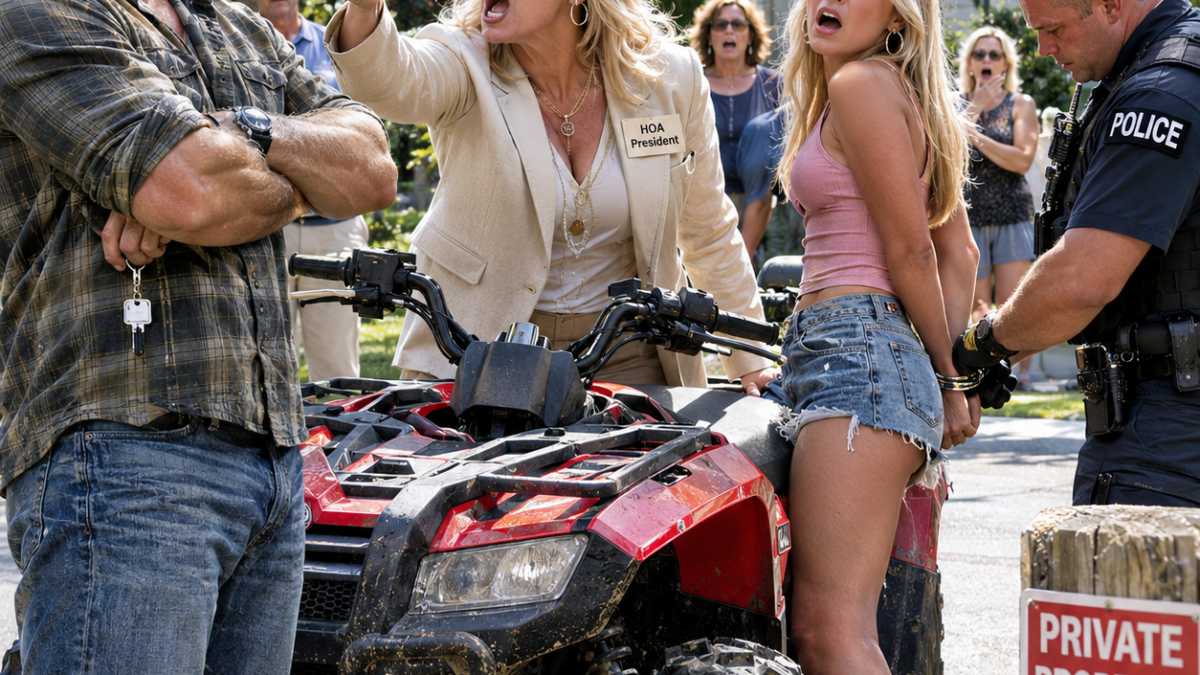
PART 2
The first thing I did when I got home was create folders.
Not metaphorical folders.
Real ones.
Red for HOA notices.
Blue for photographs.
Black for financial records.
Digital copies backed up twice.
Combat engineers are not glamorous people.
We build.
Measure.
Mark.
Recheck.
Then recheck the recheck because the price of being wrong can be enormous.
I approached Delilah the same way.
She believed anger was my weakness.
She was wrong.
Anger made me methodical.
—
Three nights after the meeting, engines woke me at midnight.
Not one.
Several.
I sat up.
The room flashed with headlights moving across my walls.
Then came laughter.
Young.
Drunk.
Deliberately loud.
I pulled myself out of bed, fitted my prosthetic, and looked through the blinds.
Brooklyn.
Two cars.
A motorcycle.
Her friends.
Someone threw a beer can toward my garage.
Another landed in the grass.
Brooklyn leaned halfway out of the passenger window.
“Wake up, soldier boy!”
The cars peeled away.
Tires tore through the edge of my lawn.
The next morning, she found me at the mailbox.
She wore sunglasses large enough to cover half her face.
“Nice ATV.”
I didn’t answer.
She looked toward my garage.
“Be a shame if something happened to it.”
There are threats people try to disguise as jokes.
This wasn’t even disguised.
“Anything else?”
She smiled.
“You really don’t understand how things work here.”
“What am I missing?”
“My family owns this place.”
“You own a house.”
She laughed.
“Adorable.”
Then walked away.
I wrote down the time.
10:17 a.m.
Date.
Exact wording.
The first black folder got thicker.
—
My next step was the HOA financial records.
Delilah had made one mistake during our first confrontation.
She bragged too much about how much she controlled.
Thornfield Realty held the management contract.
Thornfield-approved companies got emergency work.
Delilah influenced enforcement.
Those relationships may have had innocent explanations.
I wasn’t interested in assumptions.
I wanted numbers.
So I requested budgets.
Vendor lists.
Invoices.
Meeting minutes.
Reserve-fund statements.
Contract awards.
Some documents came quickly.
Others took repeated requests.
That interested me.
If a document is boring and harmless, people usually don’t fight hard to keep you from seeing it.
—
Two weeks later, Delilah called another emergency meeting.
The agenda said:
**IMMEDIATE RESOLUTION OF ONGOING VEHICLE VIOLATIONS.**
The room was packed.
But not with the usual neighbors.
Real-estate agents.
Country-club friends.
Contractors.
People I had never seen at a regular Willowbrook meeting.
Delilah sat in the center like a judge.
Behind her, a projector showed photographs of my ATV.
Several were taken inside my garage.
That detail hit me immediately.
Someone had been on my property.
“This vehicle,” Delilah announced, “creates noise concerns, wildlife disruption, insurance exposure, and ongoing damage to neighborhood values.”
I raised my hand.
“Noise complaints?”
“Yes.”
“When?”
“Multiple occasions.”
“Can I see them?”
“They’re confidential.”
“Wildlife damage?”
Brooklyn entered twenty minutes late carrying expensive coffee.
“Actually, I documented that.”
She connected her phone.
Photos appeared.
Tire tracks on legal public trails.
Nothing on HOA property.
Nothing prohibited.
But when pictures are shown without context, people see whatever they are told to see.
Brooklyn looked at the room.
“This thing tears up the desert.”
I stood.
“Those are public off-road trails.”
She rolled her eyes.
“Same difference.”
“No, it isn’t.”
Then I distributed my own packet.
Documentation from my medical and veterans’ providers regarding why the ATV had been adapted for my disability.
I kept my argument narrow.
Not:
I served, therefore I win.
I hated that.
Service doesn’t erase rules.
I said:
“The association is attempting to prohibit an adaptive mobility device under a bylaw governing commercial vehicles.”
Delilah’s eye twitched.
I continued.
“And if you’re enforcing 47C consistently, here is commercial equipment stored in Mrs. Thornfield’s garage.”
Photographs.
For-sale signs.
Electronic lockboxes.
Staging inventory.
Marketing banners.
Three years of visible business storage.
A board member named Margaret Walsh leaned forward.
“Delilah, is this accurate?”
“It’s temporary business material.”
“Three years?”
I asked.
Delilah’s voice sharpened.
“Mr. Steele, you are not chairing this meeting.”
“No. I’m asking why identical language applies only to me.”
Brooklyn stood.
“You’re seriously comparing Mom’s business to your little toy truck?”
Nobody spoke.
Her phone was still recording.
She continued.
“She contributes to this neighborhood. You’re some angry veteran playing victim.”
The sentence hit harder than I wanted it to.
Not because she called me angry.
I was angry.
Because she called the machine that gave me independence a toy.
I looked directly at her.
“That ‘toy truck’ gave me back parts of my life I lost overseas.”
She smirked.
“Whatever.”
Then:
“I’m literally untouchable here.”
Even Delilah looked uncomfortable.
“Brooklyn.”
“No, Mom. Why are we pretending? Daddy knows the police chief. Judge Watson owes him favors. What is this guy actually going to do?”
Several people shifted in their seats.
People tolerate arrogance until somebody says the quiet part aloud.
The vote was four to three to delay enforcement again.
Not a victory.
Not a defeat.
A warning.
Outside, I heard Delilah hiss:
“That was sloppy.”
Brooklyn laughed.
“What?”
“Never say things like that in public.”
“Relax.”
“Just be careful.”
“Fine.”
Pause.
“Want me to start phase two?”
I stopped walking.
Delilah said:
“Yes.”
—
Phase two arrived the next morning.
Seven HOA complaints.
All anonymous.
Engine noise at 2:00 a.m.
Chemical spill.
Unlicensed repair business.
Improper vehicle maintenance.
Commercial activity.
Parking violation.
Public nuisance.
Every single incident supposedly happened while I was either asleep or at a documented VA appointment.
I saved everything.
Then checked my cameras.
Three exterior lenses had been spray-painted black.
Not smashed.
Painted.
Someone had walked directly to each camera and disabled it without making enough noise to wake me.
That wasn’t random vandalism.
That was preparation.
So I added cameras they couldn’t easily see.
Not traps.
Not weapons.
Evidence.
—
That evening, six motorcycles roared into Willowbrook.
Brooklyn’s friends.
Music blasted.
Beer cans hit pavement.
A burnout left a black circle near the community center.
I stood in my doorway recording.
Brooklyn saw me.
“Look!”
She pointed.
“Peg-leg Pete!”
Laughter.
One of the riders shouted something about Afghanistan.
Another revved his motorcycle.
My body reacted before my mind did.
Jaw tight.
Hands cold.
Metallic taste in my mouth.
I had learned years earlier that rage feels physical before it becomes a thought.
So I kept the phone steady.
Called HOA security.
Delilah answered.
“Thornfield residence.”
“This is Garrett Steele. There’s an active noise and property violation on our street.”
“Oh, Mr. Steele.”
She sounded delighted.
“I’m not seeing anything.”
“You can hear motorcycles through the phone.”
“Perhaps you’re under stress.”
I said nothing.
She continued.
“Some veterans experience auditory sensitivity.”
There it was.
Weaponizing my disability.
I hung up before I said something useful to her.
Then called local authorities through normal channels.
By the time anyone arrived, most of the group had left.
Fine.
The recording remained.
—
At 3:47 the next morning, my phone vibrated.
Motion alert.
Night-vision camera.
A person moving toward my garage.
Brooklyn.
No party clothes.
Dark hoodie.
Hair pulled back.
She approached the side door.
Took something from her pocket.
Lock tools.
For twelve minutes, she worked on the garage lock.
Not a drunk teenager kicking a door.
Calm.
Methodical.
When the motion floodlight activated, she ran.
The camera captured her face.
Hands.
Tools.
Everything.
I sat on the edge of the bed watching the replay.
Once.
Twice.
Then a third time.
My stomach sank.
Because now I knew she was serious about the ATV.
—
Carlos Vega knocked on my door later that morning.
Carlos handled pool maintenance in Willowbrook and several nearby developments.
He looked nervous before he said a word.
“I saw her.”
“Brooklyn?”
“Last night.”
“You saw her at my garage?”
He nodded.
“How long?”
“Maybe ten minutes.”
“Will you give a statement?”
His face changed.
Fear.
“Mr. Steele…”
“Garrett.”
“Her mom controls contracts in six communities.”
I understood.
“If I testify, Delilah blacklists me. I lose half my business.”
“How long has this been happening?”
“What?”
“People staying quiet because she controls their income.”
Carlos looked toward the street.
“Years.”
That answer bothered me more than Brooklyn.
Brooklyn was nineteen and arrogant.
Delilah had built a system where ordinary adults were afraid to tell the truth.
That was different.
—
Then I met Meredith Hendricks.
Seventy-three.
Retired teacher.
Tiny woman.
No fear whatsoever.
Her kitchen smelled like coffee and chocolate-chip cookies.
I showed her the footage.
She adjusted her glasses.
“That girl is worse than her mother.”
“You’ve dealt with them?”
Meredith disappeared into a back room.
Returned with two storage boxes.
“Oh, honey.”
She set them on the table.
“I’ve been dealing with them for three years.”
Violation notices.
Neighbor statements.
Contract concerns.
Copies of emails.
Photographs.
One recording in which Delilah warned a resident that “cooperation with community leadership” affected how quickly maintenance requests were addressed.
Meredith looked at me.
“She thinks old people don’t know computers.”
I smiled.
“Does she?”
“I taught computer literacy after retirement.”
I liked Meredith immediately.
—
That night my phone rang.
Unknown number.
“Steele?”
Female.
Young.
Slurred.
“Brooklyn?”
“Good guess.”
“What do you want?”
“I wanted to warn you.”
“About?”
“Tomorrow.”
“What happens tomorrow?”
“I’m taking your ATV.”
I sat still.
She laughed.
“Your precious little freedom machine.”
“Are you threatening to steal my vehicle?”
“It’s not a threat if I’m telling you what’s going to happen.”
“Why?”
“Because I can.”
I said nothing.
Then she delivered the part I would never forget.
“I own this neighborhood, soldier boy. You’re about to learn what happens when people like you forget your place.”
She hung up.
The call was preserved.
I stared at the dark phone screen.
Then looked through the garage window at the ATV.
Eight months of work.
My hands.
My independence.
My therapy.
Part of me wanted to move it immediately.
Lock it somewhere off-site.
End the opportunity.
But by then, law enforcement had already been given footage of the attempted entry and I had begun coordinating with counsel and investigators about documenting any further criminal conduct safely.
I wasn’t going to create danger.
I wasn’t going to confront a drunk nineteen-year-old.
I was going to let evidence speak.
—
Three days later, Delilah and her husband left for Cabo.
Brooklyn threw a party.
Not twenty kids.
Sixty.
Cars lined the street.
Speakers shook windows.
Beer bottles.
Broken glass.
Sprinkler heads ripped out.
Pool furniture thrown into the water.
Graffiti on the mailbox cluster.
I recorded from my property.
So did Meredith.
Carlos recorded from his truck.
Other neighbors finally started documenting too.
Something changes when one frightened person raises a phone.
The second person realizes they can.
Then the third.
By midnight, Brooklyn noticed me.
She crossed the street.
Dress torn at one shoulder.
Makeup smeared.
Phone streaming live.
“Look, everybody.”
She turned the camera.
“The crazy vet.”
Comments flew past her screen.
She read some aloud.
Laughed.
Then lifted a beer bottle.
I saw her arm move.
Instinct took over.
I shifted.
The bottle exploded against my garage wall.
Glass sprayed across the concrete.
A shard hit my sleeve.
Brooklyn laughed.
“Oops.”
I looked at my phone.
Still recording.
“Anything else?”
Her smile disappeared for half a second.
Then returned.
“Yeah.”
She leaned close.
“You’re going to remember tonight.”
I did.
So did the cameras.
—
At around two in the morning, the garage sensors triggered.
Brooklyn.
Three young men.
Bolt cutters.
Tools.
Not stumbling now.
Focused.
One whispered:
“You sure?”
Brooklyn:
“Daddy said we were never here.”
The garage lock gave.
They entered.
One camera captured the door.
Another the interior.
A third the ATV.
Brooklyn took the keys.
One guy said:
“Just hurry.”
She laughed.
“Relax.”
Then came another confession.
“Dad owns half this town.”
She climbed onto the ATV.
My hands were shaking.
Not fear.
Something deeper.
I had spent eight months building that machine.
Now someone was sitting on it because she believed my disability made me easier to bully.
The engine started.
She tore out of the garage.
Across my driveway.
Across part of the lawn.
Then circled.
Donuts.
Gravel sprayed.
She raised one hand.
Middle finger.
Her friends cheered.
Then she disappeared down the street.
My ATV’s tracking system immediately showed movement.
I called police.
Filed the theft.
Sent the video.
No dramatic pursuit.
No vigilante chase.
That part matters.
I wanted the machine back.
I wanted her caught.
I did not want anyone dead because an ATV had been stolen.
—
Brooklyn drove it to the country club.
Of course she did.
She posted a video.
My ATV beneath her.
Caption:
**THANKS FOR THE DONATION, SOLDIER BOY.**
Another:
**#UNTouchable**
Another video showed her doing donuts.
Thousands of views.
I sat at my kitchen table watching the theft evidence distribute itself to the internet.
Some people believe social media makes them famous.
Sometimes it just makes prosecutors’ jobs easier.
—
By morning, I was at the courthouse reviewing HOA financial filings.
The theft was personal.
But the financial records were becoming bigger.
Emergency roof repairs:
$47,000.
Comparable work:
Far less.
Pool equipment replaced suspiciously often.
Security services billed for guards residents rarely saw.
Then:
Bylaw requirement.
Contracts above a threshold needed competitive bids.
Delilah’s preferred vendors repeatedly received major contracts without meaningful competition.
Over two years:
Hundreds of thousands of dollars.
Companies connected to Thornfield business interests.
I took photographs.
Requested copies.
Cross-referenced.
Meredith helped.
Carlos brought invoices.
Then my cybersecurity friend Jake compared public corporate records.
Twenty-three HOA communities.
Similar vendor patterns.
Same family network.
Same contractors.
The estimated exposure climbed into the millions.
I remember sitting in Meredith’s kitchen looking at the spreadsheet.
“This can’t all be them.”
Jake said:
“It is.”
Meredith whispered:
“My God.”
The ATV theft suddenly felt like the smallest crime on the table.
—
Then Meredith showed me her biggest secret.
She had already been talking to investigative reporter Cassidy Walsh at Channel 12.
Eight months.
Emails.
Documents.
Financial questions.
Cassidy called me that afternoon.
“Mr. Steele?”
“Yes.”
“Meredith says you have video of Brooklyn stealing your adaptive ATV.”
“Yes.”
“And HOA financial records?”
“Yes.”
“And disability-related enforcement?”
“Yes.”
Pause.
“Your case connects several pieces we’ve been missing.”
“What pieces?”
“Statewide HOA contractor fraud.”
I sat down.
She explained that her team had been investigating related companies and suspicious contract awards across Arizona.
Financial investigators were involved.
Federal authorities had taken interest where federal funds, communications, or civil-rights issues overlapped.
My neighborhood wasn’t the whole story.
It was one chapter.
Brooklyn stealing my ATV had just created the kind of public, undeniable conduct that made every other allegation easier to understand.
—
That evening, she posted another video.
Country club.
My ATV.
Champagne.
“Poor soldier boy learned his place.”
Cassidy texted:
**Save everything.**
Already had.
—
The days leading to the takedown were strange.
The Thornfields acted like people who knew something was wrong but still believed money could fix it.
Delilah returned from Cabo early.
FBI agents requested interviews.
News vans began appearing.
She spent hours on the phone.
Brooklyn doubled down.
Her posts got worse.
More insults.
More bragging.
More statements about how her father’s friends would shut down investigations.
It was like watching someone dig through bedrock because the hole still didn’t feel deep enough.
—
Delilah also tried to regain control through the HOA.
Emergency emails.
Another meeting.
More fines against me.
Threats to seize property for “community safety.”
At the same time, residents started bringing evidence to Meredith.
Janet Torres.
Water-damage claim denied while a Thornfield contractor received the work.
Bob Mueller.
Retired accountant.
Reserve-fund discrepancies.
Sarah Kim.
Violations mysteriously stopped after she hired a preferred landscaping vendor.
Folders appeared faster than we could catalog them.
For the first time, people stopped asking:
“Can they hurt me if I speak?”
They started asking:
“What do you need copies of?”
That was how Delilah lost Willowbrook.
Before the arrest.
Before television.
Before charges.
The fear broke.
—
Cassidy told me investigators had confirmed questionable use of federal housing-related money in some projects tied to the broader network.
That brought more agencies.
I did not pretend to understand every jurisdictional piece.
I didn’t need to.
My job remained simple.
Preserve what happened to me.
Tell the truth.
Provide records.
Do not embellish.
Do not interfere.
That last one was harder than it sounds.
—
Delilah tried bribery.
Not me.
Board members.
I watched her move between homes carrying envelopes.
I photographed only what I could lawfully see from my property.
No conclusions.
Just dates.
Vehicles.
Visits.
The investigators could decide what mattered.
Then she announced another emergency board meeting.
**FINAL RESOLUTION OF THE STEELE VIOLATION.**
I almost admired the commitment.
The woman was under investigation and still worried about my ATV.
—
The meeting was packed with her supporters.
Real-estate agents.
Contractors.
Country-club friends.
Some didn’t even live in Willowbrook.
Delilah gave a presentation.
My ATV.
My house.
Photos of me.
Even pictures taken near my VA appointments.
That bothered me.
“This resident,” she announced, “has created a hostile environment and refused repeated opportunities to comply.”
I sat in the back.
Quiet.
The vote was seven to two.
Authorize “immediate property seizure” pending enforcement.
Whether the order had any legal force was beside the point.
The paper became evidence.
My phone vibrated.
Cassidy:
**ATV located at country club. Agents have visual. Broadcast tonight.**
I looked at Delilah.
She smiled from the front table.
She thought she had won.
I felt nothing.
Not anger.
Not triumph.
Calm.
The kind I remembered from Afghanistan when a plan had moved beyond debate and all that remained was execution.
Not violence.
Procedure.
—
At six that evening, Brooklyn stood on the country-club terrace with my ATV positioned like a trophy.
Friends around her.
Phones recording.
Champagne.
String lights.
Friday-night crowd.
She livestreamed.
Hundreds watching.
Then thousands.
I watched remotely with Cassidy’s team while agents positioned nearby.
Brooklyn revved the machine.
“This is what happens when nobody messes with royalty.”
She laughed.
Her friends cheered.
Then she said:
“Daddy’s lawyers killed the investigation.”
That line got everyone’s attention.
She continued.
“The board seized his property.”
More laughter.
“And I get to keep my new toy.”
Cassidy turned toward one of her producers.
“Did we get that?”
“Every word.”
Brooklyn had turned confession into content.
—
Cassidy went live.
“This is Channel 12 News with breaking coverage of a major investigation into alleged HOA fraud involving multiple communities across Arizona…”
Her voice continued behind me.
I barely heard it.
I was watching the ATV.
That machine had taken me eight months.
Every custom control represented a problem I had solved after losing the leg.
Watching Brooklyn treat it like a party prop felt more personal than I expected.
Then she climbed aboard.
“Who wants a victory lap?”
Her friends shouted.
She started toward the course.
That was when law enforcement moved.
Unmarked vehicles activated lights.
Agents appeared from several directions.
Commands.
Clear.
Professional.
“Stop the vehicle.”
Brooklyn’s face changed.
Confusion first.
Then anger.
Then fear.
She tried to continue.
The ATV slowed and stopped as authorities closed in and the vehicle’s existing safety systems were secured.
She looked around.
People filming.
Agents.
News cameras.
No mother.
No father.
No golf buddy.
No judge.
No protective bubble.
“Get off the vehicle.”
She didn’t.
“Do you know who my father is?”
One agent said:
“Step down.”
“You can’t do this.”
“Step down.”
Then the line that had defined her for weeks:
“I’m untouchable.”
Nobody laughed.
An agent took her arm.
Another secured her.
Metal cuffs closed around her wrists.
The sound was small.
Almost disappointing.
After everything, justice didn’t sound like thunder.
It sounded like two pieces of steel clicking together.
Brooklyn stared at the cuffs.
Then at the cameras.
For the first time since I met her, she had nothing to say.
—
Then she screamed for her father.
Agent Martinez—who had been coordinating the local arrest portion—said quietly:
“Your parents are being detained as part of the broader investigation.”
Brooklyn’s face collapsed.
“No.”
Nobody answered.
“No, my dad knows people.”
Still nobody.
She looked at me then.
I had stayed back.
Far enough away that nobody could say I had created the confrontation.
Her expression changed.
Recognition.
Not remorse.
Not yet.
She finally understood that my refusal to yell back had never meant helplessness.
I nodded once.
Nothing more.
I didn’t need a speech.
The handcuffs were enough.
—
At almost the same time, agents were executing warrants at the Thornfield mansion.
By the time the news crew reached Willowbrook, the circular driveway was full of government vehicles.
Boxes came out.
Computers.
Records.
Financial files.
Delilah stood on the front steps.
Still furious.
Still performing.
“This is harassment!”
Meredith arrived carrying her evidence box.
Carlos came with invoices.
Janet Torres.
Bob Mueller.
Sarah Kim.
Residents started gathering.
Not a mob.
Witnesses.
People who had spent years swallowing complaints because they were scared of contracts, fines, and retaliation.
Meredith stepped toward an investigator.
“I have records.”
Delilah stared at her.
“Meredith, don’t.”
Meredith smiled.
“Three years’ worth.”
That hurt Delilah more than anything I could have done.
Because Meredith had looked harmless.
Older woman.
Cookies.
Quiet home.
Delilah had mistaken age for weakness.
Another bad assumption.
—
Carlos turned over the pool records.
Janet produced repair correspondence.
Bob brought financial spreadsheets.
Sarah Kim showed the relationship between her violations and preferred vendors.
Investigators already had much of it.
But now the community had found its voice.
Delilah shouted:
“I protected your property values!”
Carlos finally answered her.
“You charged us eight hundred dollars for filters I can buy wholesale for forty.”
A neighbor yelled:
“You threatened my insurance!”
Another:
“You targeted my family!”
The complaints came from every direction.
Delilah looked smaller with each one.
Then an agent read the allegations being pursued in connection with the wider case.
Fraud.
Conspiracy.
Money laundering.
Civil-rights issues.
Racketeering theories tied to the broader financial network.
The exact charges would be sorted in court.
But the empire was finished that night.
—
Delilah asked one question.
“Where’s Brooklyn?”
Agent Martinez answered.
“In custody.”
That was the moment her face changed.
Not when agents entered the mansion.
Not when boxes came out.
Her daughter.
For all Delilah’s arrogance, she was still a mother.
For one second I felt sympathy.
Then I remembered the first HOA meeting.
**He thinks his disability gives him special rights.**
I remembered Brooklyn telling me soldiers like me should know our place.
I remembered the beer bottle.
The garage break-in.
The stolen ATV.
Sympathy did not erase accountability.
Both emotions could exist.
That was something war had taught me too.
—
The criminal process took months.
The television version made it look like everything ended that evening.
It didn’t.
Lawyers.
Hearings.
Financial audits.
Plea negotiations.
Asset tracing.
Victim interviews.
Evidence authentication.
Brooklyn faced consequences tied to the ATV theft and the broader conduct investigators attributed to her.
Her sentence included incarceration and supervision.
More damaging to her personally, the “untouchable” social-media identity imploded overnight.
Brands vanished.
Friends disappeared.
People who had laughed at the disabled-veteran jokes deleted comments.
Screenshots remained.
The internet is cruel that way.
So is evidence.
—
Delilah faced far more serious consequences because the financial scheme extended beyond one neighborhood.
The investigation connected Thornfield-related business practices across multiple communities.
Restitution climbed into the millions.
Her real-estate career ended.
Businesses collapsed.
Properties and financial assets became part of recovery proceedings.
The woman who once decided which neighbor deserved a $500 fine now answered questions from people who did not care about her social circle.
That was the first institution she had encountered in years that she could not bully.
—
But punishment wasn’t what changed Willowbrook.
Carlos Vega did.
Meredith did.
Janet.
Bob.
Sarah.
The people who had spent years believing they were alone.
Emergency elections removed the remaining Thornfield loyalists.
Carlos ran for HOA president.
He hated the idea.
Meredith made him.
“You already know the pool budget,” she told him.
“That doesn’t qualify me to run an HOA.”
“It qualifies you more than Delilah.”
Fair argument.
He won.
—
His first rule:
Full quarterly financial statements.
Second:
Competitive bidding for major contracts.
Third:
Any board member with a financial connection to a vendor had to disclose it publicly and recuse from the vote.
Fourth:
Violation appeals were heard by more than one person.
Fifth:
No board member could weaponize an accommodation request against a disabled resident.
Within months, costs dropped.
Pool maintenance fell dramatically.
Fake “emergency” repairs disappeared.
Monthly dues decreased.
Services improved.
The neighborhood didn’t collapse without Delilah.
That seemed to surprise the people who had believed she was indispensable.
Powerful people often confuse being feared with being necessary.
—
My ATV came back after evidence processing.
The first morning I saw it again, I didn’t immediately start it.
I stood in the garage.
Ran my hand across the seat.
Scratches on one panel.
Mud near the suspension.
Brooklyn had changed the mirror angle.
That tiny detail nearly broke me.
I sat.
Not riding.
Just sitting.
The custom hand controls were still where I built them.
I thought about the first day I drove it after finishing the modifications.
I had laughed.
Actually laughed.
Because for the first time after losing my leg, I had built something around the disability instead of trying to pretend the disability wasn’t there.
The machine had become proof that adaptation was not surrender.
Brooklyn had tried to turn it into proof that she owned me.
She failed.
I started the engine.
Listened.
Still smooth.
Then drove to my VA appointment.
No celebration.
That ride was enough.
—
Meredith cried when she saw me return.
She was standing at her mailbox.
“You got it back.”
“Yep.”
She touched the fender.
“Runs?”
“Perfect.”
She smiled.
“I told you records matter.”
“I think I told you.”
“No.”
“You’re impossible.”
“I’m seventy-three. I earned it.”
She handed me cookies.
Naturally.
—
Then Willowbrook did something I never expected.
The new board asked what to do with restitution money recovered through the financial proceedings.
People suggested:
Lower dues.
Road repairs.
Pool improvements.
Then Carlos proposed something else.
A veterans’ accessibility project.
Walking paths.
Adaptive workshop.
Mobility-equipment repair area.
Benches accessible for wheelchairs.
Shade structures.
Therapeutic space.
He looked at me.
“Not named after you.”
“Good.”
“Thought you’d say that.”
We called it the Willowbrook Veterans Memorial Garden.
Memorial Day opening.
Desert wildflowers.
Fresh lumber.
Accessible paths.
Tools.
Worktables.
The first workshop had nine veterans.
One had lost mobility after a training accident.
One Marine used a wheelchair.
Another older vet had tremors that made conventional controls difficult.
We worked on modifications.
Not therapy in the formal sense.
But anyone who has rebuilt something after life broke knows the line between engineering and therapy gets blurry.
—
The Marine’s name was Lucas.
Twenty-six.
He stared at an adaptive hand-control design.
“You really built your ATV yourself?”
“Most of it.”
“After you lost the leg?”
“Yes.”
“How long?”
“Eight months.”
“That’s insane.”
“Correct.”
He looked at the design.
“I used to rebuild dirt bikes.”
“Then why’d you stop?”
He looked down at the wheelchair.
I didn’t answer for him.
Eventually:
“Guess I figured that was over.”
I handed him a wrench.
“Maybe not.”
That moment mattered more than Brooklyn’s arrest.
I’m serious.
Watching someone in handcuffs satisfies anger.
Watching someone realize part of his life is still possible heals something deeper.
—
Cassidy Walsh returned six months later for a follow-up.
She filmed the garden.
Carlos showing transparent budgets.
Meredith teaching residents how to request records.
Me helping Lucas adjust an adaptive control.
Cassidy asked:
“Do you still think about Brooklyn stealing the ATV?”
“Yes.”
“Every time you ride?”
“No.”
“What changed?”
I looked toward Lucas.
“That story stopped belonging to her.”
Cassidy lowered the microphone slightly.
“What do you mean?”
“At first, every scratch on the ATV reminded me of what she did.”
I rested a hand on the machine.
“Now it reminds me of what happened afterward.”
She used that line.
I wished she hadn’t.
Reporters always know when you accidentally say something decent.
—
Brooklyn eventually issued an apology.
Lawyer-reviewed.
Carefully written.
She said privilege had blinded her.
That she had mocked struggles she did not understand.
That she regretted what she did to me and Willowbrook.
People asked whether I believed it.
Wrong question.
I didn’t need to decide whether she felt enough remorse.
The court handled consequences.
Her future behavior would prove whether the apology meant anything.
Forgiveness is not a press release.
It is not something another person can demand because they finally use polite language.
I kept living.
That was my answer.
—
One afternoon I received a letter from her.
Not public.
No attorney letterhead.
Handwritten.
I almost threw it away.
Then read it.
She wrote that in custody she met women who did not know her father.
Did not care about the Thornfield name.
Could not be impressed by money she no longer controlled.
She said the first week was terrifying because she had never entered a room where her family’s reputation meant nothing.
That sentence felt honest.
She apologized for the disability jokes specifically.
Then wrote:
**I thought your ATV was just a machine. I understand now that I stole something that represented your independence.**
I put the letter down.
Read that line again.
It did not erase anything.
But it was the first time I believed she understood what she had taken.
I filed the letter.
Not in the evidence box.
A separate drawer.
—
Delilah never wrote me.
That was fine.
Not every villain learns.
Not every ending needs reconciliation.
—
The broader Thornfield investigation changed state HOA practices more than I expected.
Public pressure brought financial-transparency reforms.
Competitive bidding became a larger issue.
Disability accommodations received more attention.
People began asking simple questions they should have asked years earlier.
Who owns the management company?
Who owns the vendor?
Who approved the contract?
Where are the competing bids?
How much went to related parties?
Those questions are boring.
That is why fraud loves them.
People pay attention to dramatic meetings.
Nobody wants to read page forty-seven of a budget.
Delilah built an empire on that boredom.
—
Our neighborhood became almost aggressively transparent.
Carlos posted vendor bids.
Invoices.
Quarterly financials.
Contract renewals.
Meeting minutes.
One resident complained:
“Do we really need all this?”
Meredith nearly climbed over a chair.
“Yes.”
Nobody asked again.
—
The violation system changed too.
A family painted their house an unapproved shade one year.
The board sent a notice.
They appealed.
The committee reviewed it.
The rule was real.
The color genuinely didn’t comply.
The family repainted.
No harassment.
No retaliation.
No midnight motorcycles.
No $500 daily punishment campaign.
Rules are not inherently tyranny.
Rules without accountability are.
That distinction matters.
—
I became Willowbrook’s disability liaison.
Mostly because nobody else wanted the job.
It sounded more impressive than it was.
I reviewed accessibility complaints.
Helped residents communicate accommodation requests.
Worked with the board.
Made sure medical information stayed private.
The first case involved an older resident needing a handrail modification.
Old Delilah-era design rules prohibited the style she needed.
Under the new system:
Request.
Review.
Approval.
Seven days.
No drama.
She cried when it was installed.
That angered me more than it should have.
People should not cry because a board finally behaved normally.
But I understood.
When you’ve spent years expecting a fight, basic decency feels extraordinary.
—
The veterans’ workshop grew.
ATVs.
Wheelchairs.
Handcycles.
Garden tools.
Modified workbenches.
Adaptive controls.
Anything someone needed to keep building.
The VA started sending people informally.
Then formally.
One man arrived after losing both lower legs.
He stood—on prosthetics—beside my original ATV for a long time.
“That the famous one?”
“Unfortunately.”
He laughed.
“You mind if I sit?”
“Go ahead.”
He tested the hand controls.
“Smooth.”
“Took forever.”
“Worth it?”
I looked toward the garden.
“Yeah.”
He nodded.
“Maybe I build one.”
“That’s the idea.”
—
My prosthetic stopped being something I tried to hide.
That was another change.
When I first moved to Willowbrook, I wore long pants even in Arizona heat.
Habit.
People stare.
Kids stare honestly.
Adults pretend not to.
Brooklyn weaponized it.
Peg-leg jokes.
Broken veteran.
Crazy vet.
For months, every time the prosthetic clicked against concrete I heard her voice.
Then the workshop filled with veterans whose bodies had all adapted differently.
Suddenly the sound meant something else.
Equipment.
Movement.
Life.
The body changes.
You engineer around it.
Combat engineers understand that.
Apparently it took me years to apply the lesson to myself.
—
Carlos eventually stepped down as HOA president.
Voluntarily.
Imagine that.
No palace coup.
No emergency petition.
He said:
“I have pools to clean.”
Meredith replied:
“You have a community to protect.”
“I did my term.”
“You’re selfish.”
“I learned from you.”
She threw a cookie at him.
The next president was Janet Torres.
Independent audit background.
Terrifying with spreadsheets.
Perfect.
—
Meredith died several years later.
Eighty-one.
Quietly.
Her family invited half of Willowbrook.
Her kitchen evidence boxes had been donated to our community archive.
On the first box, in her handwriting:
**IF SOMETHING FEELS WRONG, WRITE IT DOWN.**
We framed that.
It now hangs in the meeting room.
Much better than a portrait of any president.
—
Carlos stood next to me at her memorial.
“She saved us.”
“She helped.”
“No.”
He looked at the framed note.
“She was collecting this before any of us had guts.”
He was right.
People love the visible hero.
The arrest.
The stolen ATV.
The veteran fighting back.
But Meredith had spent years quietly copying papers.
That kind of courage rarely gets a headline.
It should.
—
Years after Brooklyn stole the ATV, I finally replaced part of the engine.
Normal wear.
The mechanic asked:
“You want to restore the body panels too?”
They had scratches from the theft.
I looked at them.
“Leave them.”
“Sentimental?”
“No.”
He raised an eyebrow.
“Maybe.”
I kept one scratch.
Not as a trophy.
As a scar.
Machines can carry history too.
—
One Saturday, Lucas—the Marine from the first workshop—arrived driving his own adaptive off-road vehicle.
Custom.
Beautiful.
Better wiring than mine.
I walked around it.
“You did this?”
“Most of it.”
“How long?”
“Six months.”
“Show-off.”
He grinned.
Then handed me a small metal plate.
Engraved:
**NOT A TOY.**
I laughed so hard my side hurt.
We mounted it inside the workshop.
That was the only reference to Brooklyn.
Anybody who knew, knew.
Everybody else assumed it was about adaptive equipment.
Both interpretations worked.
—
The Thornfield mansion eventually sold.
For months it sat empty.
No one wanted the house associated with the scandal.
Then a family bought it.
Three kids.
Two dogs.
Normal jobs.
The first week, the youngest child rode a bicycle through the circular driveway where FBI vehicles had once parked.
I watched from the road.
No ghosts.
Houses recover faster than reputations.
That seemed fair.
—
The new family asked me about Delilah.
Not details.
Just:
“Was she really that bad?”
I thought about it.
Then said:
“She got used to nobody saying no.”
That was the simplest explanation.
Power does not always begin with evil.
Sometimes it begins with one exception.
Then another.
Then people stop challenging you.
Eventually, entitlement feels like law.
Delilah crossed that line years before I met her.
Brooklyn grew up inside the result.
That explained her.
It did not excuse her.
—
One of the strangest moments came when I received an invitation to speak at a veterans’ conference.
Topic:
Adaptive Independence and Community Advocacy.
Terrible title.
I almost declined.
Then remembered the VA therapist.
Build something.
So I went.
I did not tell the audience how to destroy their enemies.
I didn’t teach traps.
I talked about documentation.
Medical accommodation letters.
Security.
Community allies.
Professional legal help.
When not to confront someone.
When to call police.
When to step away.
Then I showed a photograph of the ATV.
Not Brooklyn on it.
Me.
The day I finished it.
Grease on my hands.
Huge stupid smile.
I told them:
“This is where the story starts.”
Not with theft.
With building.
That distinction mattered.
—
Afterward, a veteran approached.
Older than me.
Vietnam.
He used a cane.
“My HOA’s been giving me trouble over a ramp.”
I felt the old anger rise automatically.
Then stopped it.
“What exactly does the letter say?”
He handed me the notice.
That became habit.
Before outrage:
Read.
Before revenge:
Document.
Before assuming:
Verify.
The boring skills are what keep you from becoming as reckless as the people you’re fighting.
—
Willowbrook eventually created annual ethics training for the board.
Meredith would have laughed.
The training included:
Conflict disclosures.
Competitive bidding.
Disability accommodation.
Records access.
Retaliation policies.
Whistleblower process.
One new board member asked why all of it was necessary.
Janet pointed toward the archived Thornfield investigation boxes.
“That.”
Fair.
—
The neighborhood finances stabilized.
Fees remained lower.
Maintenance improved.
Competitive bids exposed how badly the old system had inflated costs.
Carlos’s pool-filter example became legendary.
Eight hundred dollars billed.
Forty-dollar part.
Even after labor, the numbers made no sense.
People became curious about invoices.
That curiosity may have been the most durable reform.
—
One year, the board proposed resurfacing the roads.
Three bids.
All published.
Residents reviewed them.
Arguments.
Questions.
One contractor lost because neighbors noticed exclusions in the proposal.
The project went to the second-lowest bidder because the scope was better.
No scandal.
No cousins.
No mystery.
At the ribbon cutting—yes, they had one for roads because HOAs are weird—I stood beside Carlos.
He said:
“This is boring.”
“Beautiful, isn’t it?”
“Absolutely.”
—
Brooklyn completed her sentence.
I heard about it through Cassidy.
“She’s doing community service.”
“Good.”
“You want to know where?”
“No.”
Cassidy laughed.
“Really?”
“Yes.”
That chapter did not need me watching.
I had spent enough time thinking about her.
Let her future become her responsibility.
That was freedom too.
—
Cassidy’s statewide investigation won awards.
She thanked Meredith publicly.
That mattered.
News stories often center the dramatic event.
A stolen ATV.
An arrest.
Handcuffs.
But Cassidy understood who had done the slow work.
Meredith’s family attended the ceremony.
Her daughter cried.
So did I.
I blamed allergies.
Nobody believed me.
—
One evening, Agent Martinez visited the veterans’ workshop.
No cameras.
No press.
She had retired.
She looked at the ATV.
“That thing caused a lot of paperwork.”
“Sorry.”
“No, you’re not.”
“Not really.”
She smiled.
Then became serious.
“You did one thing right.”
“Only one?”
“You didn’t chase her.”
I knew what she meant.
The theft night.
I could have followed.
Blocked roads.
Tried to drag Brooklyn off the machine.
Maybe gotten hurt.
Maybe hurt her.
Maybe turned myself from victim into defendant.
“I wanted to.”
“I know.”
“Badly.”
“I know.”
She tapped the ATV.
“Patience is underrated.”
Combat engineer lesson again.
Build the bridge before crossing the river.
—
I eventually sold my original house.
Not because Willowbrook defeated me.
Because the veterans’ workshop had become more important and I wanted something closer.
The sale was ordinary.
Fair market.
No violations.
No pressure.
No shell company.
I signed closing papers.
Then stood in the empty garage.
For years, that room had been:
Therapy.
Evidence site.
Burglary scene.
Workshop.
I ran my hand across the pegboard where Brooklyn took the ATV keys.
For a second I heard her voice again.
**I’m untouchable.**
Then it faded.
I locked the garage.
Handed the keys to the new owner.
Left.
—
The new property had a larger workshop.
The veterans helped build it.
They put a sign above the entrance.
**STEELE ADAPTIVE ENGINEERING SHOP**
I objected.
They ignored me.
Military people are terrible at respecting modesty.
Inside:
Tool benches.
Welders.
Small lifts.
Electronics.
3D printers.
Adaptive controls.
Photos of completed projects.
No photo of Brooklyn.
No Delilah.
I wanted the place defined by what we built, not who tried to stop us.
—
Years after the story went viral, somebody asked me what revenge felt like.
I answered:
“Short.”
They laughed.
I wasn’t joking.
Watching Brooklyn get handcuffed?
Satisfying.
Watching Delilah lose control?
Satisfying.
Seeing investigators carry boxes from the mansion?
Satisfying.
But that feeling faded.
What stayed:
Carlos running honest elections.
Meredith’s archive.
Lucas building his own machine.
A veteran using a modified wheelchair to cross desert terrain.
A homeowner getting an accessibility ramp approved without humiliation.
That lasted.
Revenge is a spark.
Rebuilding is heat.
You live on the second one.
—
I still ride.
Not as far as before.
Age.
Prosthetic wear.
Common sense.
Some mornings I take the ATV out before sunrise.
Arizona desert.
Cool air.
Creosote.
Engine vibration through the seat.
The hand controls feel automatic now.
My body knows them.
Sometimes I stop on a ridge outside Willowbrook.
Look back at the roofs.
Hard to believe one wealthy family once convinced nearly nine hundred homes that resistance was impossible.
They were never untouchable.
We were isolated.
Different problem.
Once neighbors compared records, their power shrank.
Once witnesses spoke, fear shrank.
Once law enforcement saw evidence instead of rumors, connections mattered less.
That is what really happened.
Not one combat engineer defeating an empire.
A community stopped whispering.
—
On the tenth anniversary of the theft, Carlos texted:
**You taking the famous ATV out today?**
I replied:
**It’s not famous.**
He sent:
**LOL**
Meredith would have sided with him.
I rode to the Veterans Memorial Garden instead.
The trees were taller.
Paths worn smooth.
Workshop doors open.
A young veteran sat at a bench adjusting a hand-control assembly.
He looked up.
“Mr. Steele?”
“Garrett.”
“Is that the ATV?”
I sighed.
“Yes.”
“The stolen one?”
“Recovered one.”
He smiled.
“Can I see the controls?”
That question I never get tired of.
I parked beside him.
Showed him.
Brake.
Throttle.
Steering modifications.
Emergency systems.
Seat.
We talked engineering for forty minutes.
Not Brooklyn.
Not Delilah.
Engineering.
Exactly how I wanted it.
—
Before I left, he asked:
“You ever regret staying?”
“In Willowbrook?”
“Yeah.”
I thought.
“There were nights.”
“Why didn’t you move?”
“Stubborn.”
He laughed.
“Seriously.”
I looked at the garden.
“Because moving would’ve solved my problem.”
“And?”
“There were hundreds of people still living there.”
That answer surprised me when I said it.
But it was true.
At first I fought for the ATV.
Then my house.
Then my dignity.
Eventually the fight became about what kind of neighborhood we were willing to accept.
You don’t always know when a private fight becomes a public responsibility.
Sometimes it happens while you’re busy trying to survive it.
—
I drove home near sunset.
The desert turned gold.
My prosthetic rested against the custom support exactly where I designed it years earlier.
The same support Brooklyn mocked.
The same machine she treated like a toy.
The same machine that now helped veterans understand that adaptation can be designed instead of apologized for.
I thought about the first morning.
Her tearing across my lawn.
Middle finger raised.
Delilah smiling.
**Brooklyn’s untouchable around here. Deal with it.**
At the time, those words made me furious.
Now they seemed almost childish.
No one is untouchable.
Not Brooklyn.
Not Delilah.
Not me.
Accountability works both directions.
That is why documentation matters.
That is why rules matter.
That is why power should never depend on whose father plays golf with whom.
—
The sun dropped behind Willowbrook.
I stopped the ATV at the edge of the Veterans Memorial Garden.
A plaque near the accessible workshop read:
**INDEPENDENCE IS BUILT, NOT GIVEN.**
Lucas came up with that.
Better than anything I would have written.
I shut off the engine.
For a moment, everything was quiet.
Then I heard tools inside the workshop.
Metal against metal.
A drill.
Someone laughing.
People building.
The sound took me back to those first eight months after Afghanistan.
Garage door open.
Oil on my hands.
Trying to make one machine fit the body I came home with instead of the body I remembered.
I had thought I was building an ATV.
I wasn’t.
I was rebuilding myself.
Brooklyn stole the machine for one night.
She never touched what it represented.
And in the end, that was the part her family could never take from me.
Not with money.
Not with an HOA vote.
Not with political friends.
Not with threats.
Not even with a stolen key.
I started the engine again.
Drove home.
And for once, the sound of my ATV crossing Willowbrook didn’t feel like defiance.
It sounded like freedom.
[END OF STORY]








