PART 2: HOA President Tried to Seize My Workshop—Then She Trapped Her $300,000 Maybach Inside It
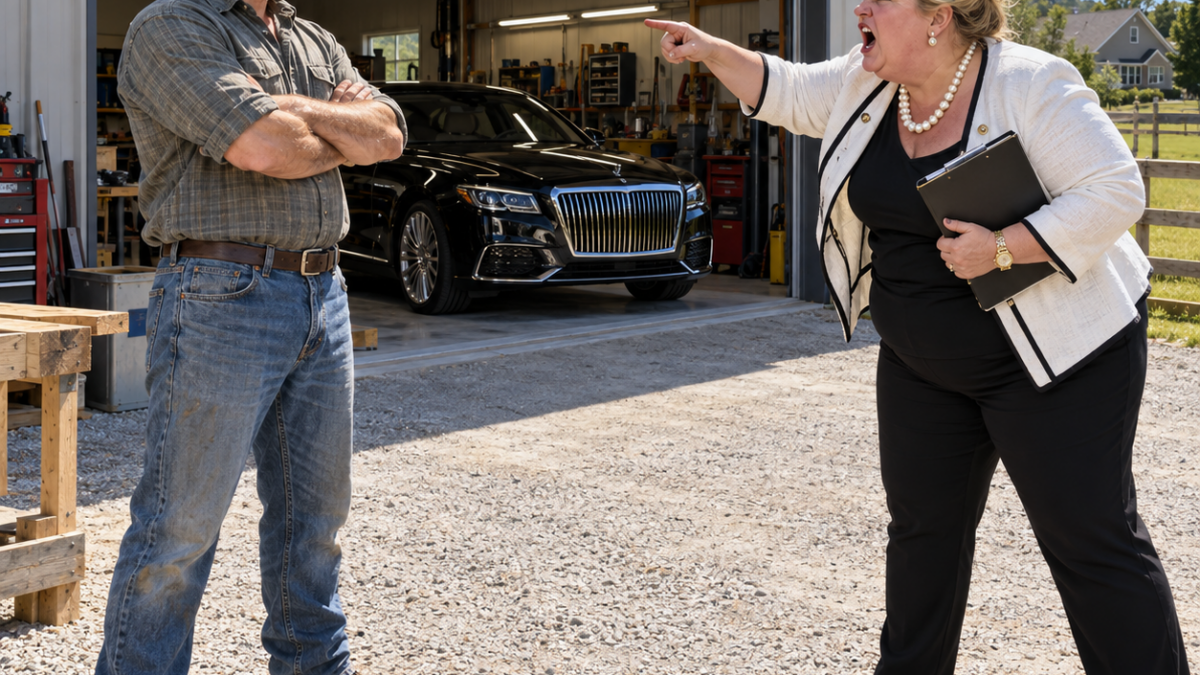
The HOA president spent two years trying to take the workshop I had built with my own hands, but the day she cut my lock and parked her $300,000 Maybach inside it, she finally made the mistake I had been waiting for.
She left a handwritten note ordering me not to touch her car, as if breaking into my property had somehow made the building hers.
By the time she came back for that Maybach, the doors were sealed, the police had her on video, and the neighborhood she had ruled for twelve years was about to discover what happened when somebody finally told Karen Whitmore no.
I stood inside my workshop at nine o’clock that Thursday night staring at a black Mercedes-Maybach parked between my welding table and a half-finished pair of chapel gates.
For several seconds, I honestly wondered whether exhaustion had finally broken something in my brain.
Then I saw the note.
Karen Whitmore had taped it to my workbench.
“This structure is under association review for code violations. Vehicle secured here pending resolution. Do not move.”
Underneath that:
K. WHITMORE
HOA PRESIDENT
I read it twice.
Then a third time.
Behind me, the Maybach’s polished body reflected the fluorescent lights like black glass.
Three hundred thousand dollars of German luxury sitting in the middle of the workshop Karen had spent two years calling illegal.
My workshop.
The one I had built eighteen years earlier.
Permitted.
Inspected.
Approved for a small home-based fabrication business by the county years before Wellington Park’s HOA ever adopted its current restrictions.
Karen knew that.
Or at least she had been told.
A county inspector had stood inside this exact building months earlier, looked at the framed permits on my wall, and told her directly, “Mr. Mercer’s structure is lawful and grandfathered.”
Karen’s response had not been embarrassment.
It had been anger.
People like Karen didn’t change direction when facts proved them wrong.
They changed tactics.
I’m Cal Mercer.
I’m sixty-three years old, and I’ve worked metal for more than forty years.
Railings.
Gates.
Fire escapes.
Historical restorations.
The kind of work where being off by an eighth of an inch can ruin three days of labor.
My hands are scarred.
My hearing isn’t what it used to be.
And I measure everything twice because steel has no sympathy for confidence.
Karen Whitmore had never understood men like me.
To her, my workshop was an eyesore.
“A commercial operation incompatible with Wellington Park.”
Her words.
She once called my life’s work “a hobby that had gotten out of control.”
I remembered that while staring at her Maybach.
Then I walked over to the camera recorder mounted beside my office.
I rewound the footage.
Wednesday.
12:07 p.m.
My gate appeared on screen.
Locked.
A locksmith’s van pulled up.
Then Karen’s Maybach.
Karen stepped out wearing cream slacks, dark sunglasses, and the expression of someone arriving at property she already believed belonged to her.
The locksmith pointed at my gate.
Karen showed him a sheet of Wellington Park letterhead.
He hesitated.
She pointed again.
Eventually, he cut my lock.
My jaw tightened.
Karen drove onto my property.
Across my yard.
Straight toward the workshop.
The shop’s big roll-up door had been left open because I was away for two days working on an old courthouse staircase four hours north.
She drove right inside.
Parked.
Got out.
Looked around.
Then taped her note to my bench.
Another car picked her up twelve minutes later.
I froze the image on her face.
For two years, Karen had hit me with noise complaints on days I wasn’t even home.
Fines for operating machinery that wasn’t running.
Threats that the HOA might place a lien against my house.
Twice, she entered my property without permission.
Once, she walked directly into my workshop with a county inspector and announced that the HOA had “access authority.”
The inspector had corrected her.
My attorney had corrected her.
My permits had corrected her.
Nothing worked.
Karen had been HOA president for twelve years.
People didn’t beat her.
They got tired.
Arthur, a retired teacher down the street, once questioned an $11,000 landscaping contract awarded to Karen’s brother-in-law.
Within weeks, his twenty-year-old vegetable garden suddenly became an “unauthorized agricultural use.”
He fought.
Karen buried him in notices, fees, and hearings until he tore out the tomatoes himself.
I watched him do it.
I had promised myself I would never become Arthur.
Yet one month earlier, I had sat alone inside this workshop wondering whether surrender might be cheaper.
Karen almost won.
Then she became impatient.
And now her most valuable possession was sitting on my concrete floor beside a signed note explaining exactly why she had put it there.
I photographed everything.
The car.
The note.
The cut lock.
The tire tracks.
Then I called the one person Karen should have feared more than any welder with a temper.
My property attorney.
Eleanor Voss answered on the second ring.
I said, “Eleanor, you’re not going to believe what Karen did.”
Ten minutes later, after watching the security footage I sent her, Eleanor became completely silent.
Finally she said:
“Cal, do not touch that car.”
I looked at the Maybach.
“Wasn’t planning to.”
“Good. Because Karen Whitmore just turned your two-year HOA dispute into something very different.”
I stared at the signed note again.
“How different?”
Eleanor exhaled slowly.
“Call the police.”
Then she added four words that changed everything.
“And preserve every camera.”
PART 2
I called the police before I called anyone else.
Not Karen.
Not the HOA.
Not my neighbor Doug, who could spread information across Wellington Park faster than cable television.
The police.
Officer Daniel Reeves arrived forty minutes later.
He was younger than my oldest son and had the patient expression of somebody accustomed to hearing grown adults argue over fences, dogs, branches, parking spaces, and every other petty thing neighbors convince themselves is worth ruining their lives over.
Then he saw the footage.
His expression changed.
We stood in my office beside the workshop while the video played.
Locksmith van.
Karen.
Letterhead.
Cut lock.
Maybach.
My property.
My workshop.
Officer Reeves leaned closer to the monitor.
“Can you play that part again?”
I backed it up.
Karen was pointing toward my gate.
The locksmith hesitated.
She held the paper higher.
He cut the lock.
Reeves watched without speaking.
Then Karen drove onto the property.
When the Maybach disappeared inside my workshop, he looked toward the real vehicle twenty feet away.
“She left it?”
“Yes.”
“On purpose?”
I handed him her note.
He read it.
His eyebrows lifted.
“She signed this?”
“Apparently pride has administrative requirements.”
His mouth twitched.
He almost smiled.
Almost.
Then professionalism returned.
“Don’t alter anything yet.”
“My lawyer said the same thing.”
“Good lawyer.”
“One of the reasons she costs so much.”
He photographed the lock.
The gate.
The note.
The Maybach.
The shop.
He took copies of the camera footage and wrote down the locksmith company’s name from the van.
Then he asked, “Did Ms. Whitmore have permission to enter?”
“No.”
“Any easement?”
“No.”
“Association inspection rights?”
“Not like this.”
“Has she entered before?”
“Twice.”
“Documented?”
“One incident on camera. One witnessed by a county inspector.”
He wrote that down.
Then he looked at me.
“Do you want to make a formal complaint?”
I almost laughed.
After two years of being told to be reasonable, patient, neighborly, cooperative, and flexible, the question felt strange.
“Yes.”
He nodded.
“Then we’ll document it properly.”
That sentence did something to me.
For two years, Karen had made me feel like I was the difficult one.
Every letter from the HOA framed me as uncooperative.
Every meeting made me sound unreasonable.
Every violation notice transformed my legal workshop into an act of aggression against four hundred houses.
Now somebody neutral had looked at what Karen actually did and used two words I hadn’t heard often enough.
Document it.
Properly.
Officer Reeves left with the footage.
The Maybach stayed.
I closed the gate using a temporary chain.
Then I called Eleanor again.
“Police report is open.”
“Good.”
“What now?”
“Nothing impulsive.”
“You keep saying that like you know me.”
“I do know you.”
“I’m very calm.”
“You once threatened to build a twelve-foot sculpture out of HOA violation letters.”
“That was conceptual art.”
“Cal.”
“All right.”
She paused.
“Tomorrow morning, come to my office. Bring every document you have.”
“You mean the Karen file?”
“How big?”
“Two binders.”
Silence.
Then:
“I underestimated you.”
“You shouldn’t.”
That night I slept better than I had in months.
Not because the fight was over.
It wasn’t.
But for the first time, Karen’s mistake was larger than my response.
I no longer needed to prove she had targeted me.
I only needed to preserve what she had already done.
The next morning I carried my binders into Eleanor Voss’s office.
Eleanor was sixty-eight, silver-haired, sharp-eyed, and built like a woman who had spent three decades making opposing lawyers regret adjectives.
She specialized in property law.
Not glamorous law.
Boundary disputes.
Easements.
Deeds.
Nuisance claims.
Land-use restrictions.
The ugly arguments that decide whether somebody gets to keep the land under their feet.
She loved it.
When I first hired her six months earlier, she read Karen’s letters and said:
“Your HOA president has confused confidence with jurisdiction.”
That was the moment I knew I had hired the right person.
Now she watched the footage from beginning to end.
Then again.
Then she read Karen’s note.
Then she looked at me over her glasses.
“Do you understand what she has done?”
“Made parking complicated?”
“Cal.”
“I’m listening.”
“She entered locked private property without permission. She appears to have induced a locksmith to cut your lock by asserting authority she may not possess. She drove her vehicle inside your private structure. And she signed a note claiming she did it under HOA authority.”
“That sounds bad.”
“For her.”
Eleanor pointed toward me.
“Now listen carefully. This is the part where people ruin good cases because being right feels too good.”
I nodded.
“Do not tow the car.”
“I thought about it.”
“I know you did.”
“Impound lot across town.”
“No.”
“Very far across town.”
“No.”
“Bad neighborhood?”
“Cal.”
“All right.”
“You move that Maybach, and Karen’s attorneys spend six months arguing you scratched it, damaged suspension, interfered with electronics, or caused some imaginary depreciation.”
“So it stays.”
“Untouched.”
“What if she wants it?”
“She can retrieve her property through a documented lawful arrangement.”
Eleanor leaned back.
“But she doesn’t get to pretend none of this happened.”
That was the line.
Not revenge.
Accountability.
Eleanor dictated three letters.
The first went directly to Karen by certified mail.
It informed her that her Maybach had been placed without authorization inside my private, permitted workshop after access had been obtained by removal of my lock.
It stated that the matter had been reported to police.
It informed her that the vehicle had not been moved or damaged.
It advised that retrieval would need to be coordinated through counsel in a manner preserving evidence and protecting all parties.
The second letter went to Wellington Park HOA.
Not Karen personally.
The association.
It demanded preservation of every email, text, board note, committee communication, invoice, locksmith authorization, legal opinion, and internal discussion relating to me, my workshop, or the Maybach.
The third went to the association’s insurance carrier and registered agent.
That one made Eleanor smile.
“Why are you happy?”
“I enjoy early notice.”
“You lawyers have peculiar hobbies.”
“So do men who weld decorative leaves onto gates.”
“That’s craftsmanship.”
“And this is mine.”
The insurance letter attached the footage.
Karen’s note.
The police report number.
My permits.
The grandfathering documentation.
The history of fines.
Every letter in which Karen claimed the shop was unlawful.
Everything.
By noon, people other than Karen knew what she had done.
That mattered.
Then came the question of securing the workshop.
My original padlock was destroyed.
The gate had been compromised.
Karen had already demonstrated she would enter when I was gone.
“What can I legally do to secure my own building?” I asked.
Eleanor looked at me.
“What do you normally do when someone cuts your lock?”
“Upgrade.”
“Then upgrade.”
I waited.
She knew what I wanted to ask.
“No games.”
“No games.”
“Do not create a hazard.”
“I don’t create bad welds.”
“That was not what I said.”
“I know.”
“Do not damage the car.”
“I won’t.”
“And photograph every step.”
I smiled.
“Can I reinforce the doors?”
“You can secure your property reasonably.”
That was enough.
I returned home.
First, photographs.
Every panel of the Maybach.
Front.
Rear.
Both sides.
Wheels.
Mirrors.
Windshield.
Roof.
Interior through the glass.
Mileage visible through the cluster.
I didn’t touch the handle.
Then the shop.
Door frame.
Roll-up door.
Side entrance.
Floor.
Camera positions.
I placed clean protective barriers several feet from the Maybach so sparks could not reach it.
Then I strengthened my doors.
Heavy steel security plates.
Cross-bracing.
New locking points.
Nothing attached to Karen’s car.
Nothing touching it.
Nothing damaging it.
When I finished, the workshop was more secure than it had been before she cut my lock.
The Maybach sat exactly where Karen left it.
I took another round of photographs.
Time-stamped.
Backed up.
Sent to Eleanor.
She responded with one sentence:
Now do absolutely nothing interesting.
That became difficult around four o’clock.
Because Karen arrived.
She came in her husband’s Range Rover.
Fast.
Too fast for a residential street.
She stopped beside my driveway and marched toward the gate.
“CAL!”
I was in the yard.
I put down my hose.
“Afternoon, Karen.”
“What have you done?”
“Watering hydrangeas.”
“To my car!”
“Nothing.”
She reached the gate.
“What is that?”
“My gate.”
“You sealed the shop!”
“I secured my property after somebody cut my lock.”
Her face reddened.
“Open it.”
“No.”
Her mouth actually fell open.
I had never simply told Karen no.
Not like that.
I had argued.
Explained.
Cited permits.
Requested hearings.
Appealed fines.
But I had always participated in her structure.
Now there was no appeal.
My gate.
My land.
My shop.
No.
She pointed toward the workshop.
“You are unlawfully holding my property.”
“You parked it there.”
“I placed it there temporarily under association authority.”
“What authority?”
“We have enforcement rights.”
“Show me the clause allowing you to cut locks.”
“That shop is under active violation review.”
“Still waiting on the lock-cutting clause.”
“You cannot imprison my vehicle.”
“I haven’t touched your vehicle.”
“Then open the building.”
“Have your attorney call mine.”
“I am the HOA president.”
“I’m aware.”
“I don’t need an attorney to retrieve my own property.”
“You needed a locksmith to enter mine.”
That landed.
Her face went still.
Then her eyes moved toward the camera mounted over the gate.
She saw the red status light.
“You’re recording me.”
“My security cameras record my property.”
“You have no right.”
“Karen.”
I almost laughed.
“You might want to stop telling property owners what rights they have today.”
For one second, I saw something I had never seen in her expression.
Fear.
Then it vanished.
“I’m calling the police.”
“They already have the footage.”
That brought the fear back.
She stared at me.
“What footage?”
I said nothing.
“What footage, Cal?”
“Have a good afternoon.”
I picked up the hose.
She didn’t move.
I watered the hydrangeas.
It took her almost thirty seconds to turn around.
That night she called the police anyway.
Officer Reeves told me later.
Karen demanded officers force me to open the workshop.
She claimed I had “seized” her automobile.
The dispatch notes apparently became complicated when officers discovered the vehicle was inside the property of the same man who had reported Karen for cutting his lock.
Police came out.
Different officer this time.
He spoke to Karen first.
Then me.
Then called a supervisor.
The result was not what Karen wanted.
She was informed that ownership of the Maybach was not disputed.
Nobody was claiming it belonged to me.
But because the vehicle was inside a private building following a documented unauthorized entry, the police were not going to break into my workshop to retrieve it for her.
The officer advised both parties to work through counsel.
Karen exploded.
I heard it from my porch.
“You don’t understand! I am president of the homeowners association!”
The officer replied loudly enough for me to hear:
“Ma’am, that does not make this your building.”
I turned away so nobody would see me smile.
That sentence traveled through Wellington Park before sunset.
The next morning, Doug knocked on my door.
Doug had lived beside me for fifteen years.
He was the kind of neighbor who borrowed my tools and returned them cleaned.
For years we got along fine.
Then Karen’s pressure increased.
Doug went quiet.
Not hostile.
Just absent.
When Karen complained about noise, Doug suddenly remembered that maybe the grinder was occasionally irritating.
When I asked whether he would tell the board the shop had existed peacefully for years, he said he didn’t want to get involved.
I understood.
I hated it.
But I understood.
Now he stood holding two coffees.
“Peace offering.”
“What did you do?”
“Nothing yet.”
“Suspicious phrase.”
He handed me coffee.
Then he looked toward the shop.
“Is her car really in there?”
“Yes.”
“The Maybach?”
“Yes.”
“Her Maybach?”
“Unless somebody else owns a black Maybach with KWHIT plates.”
Doug stared.
“How?”
“She put it there.”
He started laughing.
Not polite laughter.
Deep, uncontrollable laughter.
He bent over.
Coffee nearly spilled.
“Doug.”
“I’m sorry.”
“No, you’re not.”
“She broke into the workshop she says shouldn’t exist and stored her luxury car in it?”
“That’s approximately the issue.”
He laughed harder.
Eventually he wiped his eyes.
Then he became serious.
“Cal.”
“What?”
“I should’ve backed you.”
I said nothing.
“When she started the noise stuff.”
“You didn’t owe me a war.”
“I owed you the truth.”
That was different.
Doug stared at his coffee.
“You helped me build my daughter’s wheelchair ramp after her accident.”
I remembered.
Five summers earlier.
Three days of work.
He bought material.
I donated labor.
“You didn’t charge me.”
“You’re my neighbor.”
“Exactly.”
He looked up.
“And when you needed somebody to say your shop wasn’t some industrial nightmare, I kept my head down.”
“Karen makes keeping your head down feel practical.”
“Yeah.”
He glanced toward the street.
“Maybe that’s how she got twelve years.”
That sentence stayed with me.
Not because it was profound.
Because it was true.
Karen did not control four hundred houses.
Four hundred houses repeatedly decided resisting her was more trouble than obeying.
She built her power from other people’s fatigue.
Arthur had taught us that.
Arthur lived six houses down.
Retired history teacher.
Widower.
Seventy-six now.
For twenty years, he grew tomatoes, peppers, basil, cucumbers, and beans beside his house.
Then, at one HOA meeting, he asked why Wellington Park had paid $11,000 to Greenleaf Landscape Services.
Greenleaf happened to be owned by Karen’s brother-in-law.
Arthur did not accuse anyone of theft.
He asked for bids.
Invoices.
Conflict disclosures.
Perfectly reasonable questions.
Three weeks later, his garden became a violation.
Karen called it unauthorized agricultural use.
She claimed vegetables visible from the street harmed community standards.
Arthur fought.
He attended hearings.
Sent letters.
Asked neighbors for support.
Most people agreed privately.
Nobody stood publicly.
Fines accumulated.
Arthur finally surrendered.
I saw him removing tomato cages one Saturday morning.
He did it slowly.
Carefully.
Like taking apart a grave.
I walked over.
“Need help?”
“No.”
“Arthur.”
“No, Cal.”
He kept pulling stakes.
“She won.”
He said it without anger.
That was worse.
A defeated man does not always shout.
Sometimes he simply uproots tomatoes.
Now everybody in Wellington Park was watching Karen discover that my workshop was not Arthur’s garden.
The story spread.
Not the legal details.
Neighborhood details mutate quickly.
By Saturday, I heard three versions.
In one, I had confiscated Karen’s Maybach.
In another, I had welded the car itself to the floor.
In a third, I had somehow hidden the building.
That was my favorite.
The truth was simpler.
Karen put her car in my workshop.
I secured my workshop.
Karen refused to acknowledge what she had done.
Therefore, Karen’s car stayed exactly where Karen left it.
The situation could have ended within twenty-four hours.
Eleanor sent a retrieval agreement.
Simple.
Karen would acknowledge that the Maybach had been placed inside without my permission.
She would arrange retrieval through insured professionals at a scheduled time.
She would cover the documented cost of replacing the lock and any reasonable expense involved in opening and resecuring the building.
No admission of criminal liability.
No humiliation clause.
No public apology.
Nothing theatrical.
Karen refused.
Her attorney called Eleanor’s office and demanded immediate access.
Eleanor repeated the proposal.
They refused.
Why?
One sentence.
Karen would not acknowledge she lacked authority to enter.
That was it.
Three hundred thousand dollars trapped behind pride.
A week passed.
Then something almost beautiful happened.
My vacation.
Tulum.
Two weeks.
Booked eight months earlier.
Paid.
Nonrefundable.
I had nearly canceled because Karen’s campaign against the workshop had become exhausting.
Now Eleanor told me to go.
“You’re serious?”
“Yes.”
“My workshop contains a Maybach.”
“I noticed.”
“What if Karen tries something?”
“The police know.”
“The cameras—”
“Backed up.”
“My gate?”
“Secure.”
“You?”
“I’m your lawyer.”
“I’m suddenly not reassured.”
She ignored that.
“Go to Mexico.”
“Why?”
“Because you have done everything required of you.”
She leaned across her desk.
“And because a sixty-three-year-old man sitting on a beach is very difficult to portray as a dangerous aggressor terrorizing an HOA president.”
That made sense.
So I went.
Before leaving, I verified the cameras.
Locked the gate.
Checked the shop.
Photographed the Maybach.
Sent everything to Eleanor.
Then I drove to the airport.
I turned my phone off before boarding.
For the first time in two years, Karen Whitmore could not reach me.
Tulum was hot.
Bright.
Salt air.
White sand.
For three days, I thought about the workshop constantly.
On the fourth, less.
By day six, I could hear waves without mentally drafting a response to an HOA violation notice.
I slept in a hammock.
Ate fish cooked over charcoal.
Drank beer at noon.
Read half a terrible mystery novel.
Walked barefoot.
There is a strange freedom in being somewhere your mailbox cannot find you.
I checked voicemail only once.
Eleanor had left a message.
Her voice sounded amused.
“Cal, do not call back. Everything is fine. Karen has filed suit seeking immediate return of the Maybach.”
I sat up.
Then Eleanor continued.
“This is good news. Her complaint contains admissions. Stay on your beach.”
I listened again.
Admissions.
Karen had sued me.
That seemed like escalation.
To Eleanor, it sounded like Christmas.
So I ordered another beer.
Back in Wellington Park, Karen’s two weeks became legendary.
I reconstructed them later from police records, neighbors, Eleanor, and eventually court filings.
Day one after my departure, Karen returned with a locksmith.
Not the original locksmith.
A different one.
He looked at the reinforced doors and declined.
Apparently he told her:
“Ma’am, that is not a lock problem.”
She asked whether he could drill the side entrance.
He asked whether she owned the building.
She said no.
He left.
Day two, Karen called a towing company.
The dispatcher asked where the Maybach was.
“Inside a garage.”
“Your garage?”
“No.”
“Owner’s permission?”
“He’s unavailable.”
“Then we’re unavailable.”
Day three, she contacted the fire department.
She described the situation as a vehicle-access emergency.
The dispatcher asked whether anyone was trapped.
No.
Fire?
No.
Medical emergency?
No.
Hazardous materials?
No.
The department declined to turn firefighters into a luxury-car retrieval team.
Day four, she called police again.
Police repeated that she should coordinate through counsel.
Day five, she tried the association’s attorney.
By then, the insurance carrier had received Eleanor’s preservation letter and footage.
That changed the HOA’s legal atmosphere considerably.
The insurer apparently asked a simple question:
Did the board authorize President Whitmore to cut a homeowner’s lock and use his private workshop to store her personal automobile?
Nobody wanted to answer.
Karen claimed she acted under emergency enforcement authority.
The bylaws contained no provision remotely close to that.
Day six, one board member resigned.
Not publicly.
He sent Karen an email saying he had never authorized entry onto my property and wanted his name removed from all enforcement activity related to the workshop.
Someone forwarded that email to Eleanor.
Day seven, another board member requested independent counsel.
Day eight, Wellington Park discovered Karen could bleed.
Metaphorically.
For twelve years, everybody believed opposing Karen created consequences only for them.
Now Karen was the one making frantic phone calls.
Karen was the one receiving legal letters.
Karen was the one whose authority was being questioned.
People began asking their own questions.
Priya Anand asked the biggest.
Priya was thirty-eight.
Software project manager.
Two kids.
Moved into Wellington Park six years earlier.
Quiet at meetings.
Polite.
Observant.
Karen had fined her once because a solar panel installation supposedly violated roofline symmetry.
Priya paid.
Never forgot.
While I was in Mexico, she downloaded the HOA bylaws.
All sixty-seven pages.
On page fifty-two, she found the recall procedure.
Twenty percent of membership could demand a special removal vote.
Karen had apparently never worried about it.
Why would she?
Nobody challenged Karen.
Priya started collecting signatures.
Door by door.
Not secretly.
That mattered.
At the first house, she felt nervous.
At the fifth, less.
By the twentieth, residents were waiting for her.
Stories poured out.
Garden fines.
Paint fines.
Mailbox fines.
Deck fines.
Parking fines.
Late fees added after checks were supposedly received late.
Architectural applications lost and then penalized for lacking approval.
People had boxes of documents.
Years of resentment.
Once somebody gave them a place to put it, Wellington Park began building its own binder.
Then Arthur signed.
Priya later told me that moment nearly made her cry.
Arthur opened his door.
She explained the recall petition.
He listened.
Then he asked:
“Is Cal fighting?”
“Yes.”
“Actually fighting?”
“Yes.”
Arthur signed.
Then he said:
“I should have fought longer.”
Priya shook her head.
“No.”
According to her, Arthur looked toward the patch of lawn where his garden used to be.
“I should’ve had neighbors.”
That line spread too.
By the time my plane landed back in the United States, Priya had more signatures than required.
I returned home on Sunday.
Doug met me outside.
Not intentionally.
At least he claimed it wasn’t.
“You look tan.”
“You look nosy.”
“Welcome home.”
He pointed toward my workshop.
“Still in there.”
“Good.”
“The entire neighborhood has seen it.”
“The building?”
“The idea of it.”
I stared at him.
“That was almost poetic.”
“I’ve had two weeks.”
Then Priya arrived.
Folder under her arm.
“Mr. Mercer?”
“Cal.”
She held out the petition.
“We have enough.”
I looked at the pages.
Names.
Addresses.
Signatures.
People who had spent years whispering now signing in ink.
“What do you want from me?”
“Nothing.”
That surprised me.
“We’re not doing this for your workshop.”
She looked toward the shop.
“That just proved she can lose.”
I handed the petition back.
“Then make sure this is done properly.”
Priya smiled.
“I was hoping you’d say that.”
Karen’s lawsuit hearing was scheduled for Tuesday.
The claim was essentially simple.
She owned the Maybach.
It was inside my structure.
She wanted judicial assistance compelling access.
Her complaint described the vehicle as “wrongfully detained.”
But then her attorney included Karen’s explanation of how the car came to be there.
That was the problem.
According to her filing, she had placed the Maybach inside my workshop while “acting within her authority as president of the Wellington Park Homeowners Association to manage a structure under continuing enforcement review.”
Eleanor read that paragraph aloud in her office.
Then stopped.
“Did she just admit she entered?”
“Yes.”
“Under nonexistent HOA authority?”
“Yes.”
“On a signed court filing?”
“Yes.”
I leaned back.
“Is it wrong that I feel cheerful?”
“Enjoy it privately.”
The courthouse hearing was smaller than people imagine.
No dramatic jury.
No television cameras.
No orchestra.
Just a judge.
Clerk.
Attorneys.
Parties.
A few observers.
Priya came.
Doug came.
Arthur came.
I was surprised by that.
He wore a brown jacket and sat in the back row.
Karen arrived in a navy suit.
No floral colors.
No clipboard.
Her lawyer was named Richard Pell.
Experienced.
Professional.
I felt almost sorry for him.
Almost.
Pell stood first.
He argued the Maybach was Karen’s undisputed property.
True.
That its continued confinement caused loss of use and risk.
Fair argument.
That I should be ordered to provide immediate access.
Then Eleanor stood.
“Your Honor, my client has never claimed ownership of Ms. Whitmore’s vehicle.”
The judge looked toward her.
“He wants it removed?”
“Very much.”
A faint smile crossed the courtroom.
Eleanor continued.
“My client offered immediate retrieval through a documented arrangement on the first business day after discovering the vehicle.”
She presented the certified letter.
“Why did retrieval not occur?” the judge asked.
“Because Ms. Whitmore refused to acknowledge that she lacked permission to place the vehicle inside the structure.”
Pell stood.
“Your Honor, the underlying HOA dispute is separate.”
Eleanor nodded.
“Ordinarily, I would agree.”
Then she lifted a thumb drive.
“But the plaintiff’s own complaint asserts she entered pursuant to association authority. Before the court orders my client to open a secured private structure, we believe the court should understand how that entry occurred.”
Pell objected.
The judge considered.
Then allowed limited footage.
The courtroom screen came alive.
My gate.
My lock.
Locksmith van.
Karen.
Even after seeing it dozens of times, my stomach tightened.
Karen showed the locksmith the paper.
The lock was cut.
Then the Maybach entered.
Karen parked inside.
She taped the note to my bench.
Eleanor paused the video on Karen standing beside the car.
“Your Honor, this is the location where Ms. Whitmore asserts association authority allowed her to place the vehicle.”
The judge looked toward Pell.
“Counsel?”
Pell stood slowly.
“My client believed she possessed enforcement authority.”
“Authority to cut locks?”
Pell paused.
“I would need to address the governing documents.”
The judge looked at Karen.
Then at Eleanor.
“Was law enforcement contacted?”
“Yes, Your Honor.”
“Before the building was secured?”
“Yes.”
“Vehicle damaged?”
“No.”
“Moved?”
“No.”
“Has the defendant refused its return?”
“No.”
Eleanor handed up another document.
“My client’s written retrieval proposal.”
The judge read.
Silence.
Then he looked at Karen.
“Ms. Whitmore, why did you not accept this?”
Pell stood.
“I would advise—”
“I’m asking counsel through you.”
Pell turned.
Whispered with Karen.
Her expression hardened.
He faced the judge.
“Ms. Whitmore objected to language characterizing her original entry as unauthorized.”
The judge leaned back.
“So the obstacle to retrieving a three-hundred-thousand-dollar automobile is a disagreement over whether she had authority to cut Mr. Mercer’s lock.”
Nobody spoke.
The judge looked at the screen again.
Then at the photograph of my destroyed padlock.
Then at Karen’s handwritten note.
“Was that note written by your client?”
Pell looked.
“Yes.”
“And the line ‘Do not move’ refers to her vehicle inside Mr. Mercer’s building?”
“Yes.”
The judge removed his glasses.
I knew that gesture.
Not personally.
Humanly.
It was the gesture of a man preparing to say something he wished he did not need to explain.
“Ms. Whitmore may own the vehicle.”
He looked toward Karen.
“But ownership of a vehicle does not confer ownership of every structure into which one chooses to drive it.”
No one laughed.
Good.
This was not a comedy anymore.
The judge continued.
“The court will not endorse self-help conduct that appears to involve forced entry onto disputed private property.”
Pell shifted.
“The motion for immediate compelled access is denied without prejudice.”
Karen’s face changed.
The judge added:
“I encourage the parties to use the retrieval procedure already proposed, subject to counsel reaching appropriate language.”
Then his voice became firmer.
“I also direct that the clerk transmit relevant portions of today’s record to the appropriate local authorities handling the existing complaint.”
Karen went perfectly still.
Not angry still.
Real still.
For twelve years, Karen had sat at the center table in Wellington Park and said words such as violation, authority, enforcement, and compliance.
People obeyed because she sounded certain.
Now she sat at a different table.
Different room.
Different authority.
Her certainty meant nothing.
When court adjourned, I stood.
Arthur remained seated in the back.
I walked over.
“Didn’t expect to see you.”
He looked toward Karen.
“Neither did she.”
I smiled.
Arthur didn’t.
His eyes moved toward me.
“Don’t become her.”
That stopped me.
“What?”
“You won.”
“Not yet.”
“You’re going to.”
He pointed subtly toward Karen.
“She enjoyed people losing.”
I understood.
Arthur stood.
“Don’t.”
Then he walked away.
I think that conversation saved me from doing something ugly later.
Because the temptation was there.
Not illegal.
Not violent.
Something worse in a quieter way.
Humiliation.
Karen had humiliated residents for years.
Part of me wanted repayment.
I wanted her to stand at a packed meeting while every person she had fined laughed.
I wanted Arthur to hand her a tomato.
I wanted to park her Maybach beside a sign reading UNAPPROVED COMMERCIAL VEHICLE.
I wanted clever revenge.
Arthur reminded me revenge can change the person holding it.
So I let process do what it was supposed to do.
Karen finally signed a retrieval agreement.
Not a confession.
Eleanor did not demand one.
The agreement stated that the vehicle had been placed in my workshop during a disputed exercise of claimed HOA authority without my express permission.
That was enough.
A flatbed towing company came Thursday morning.
Karen did not.
Her attorney did.
Officer Reeves attended to preserve the scene.
I photographed the building before opening.
Then I cut my own reinforcing welds.
Slowly.
Carefully.
The roll-up door opened.
Sunlight reached the Maybach for the first time in almost three weeks.
It was flawless.
Exactly as Karen left it.
The tow operator inspected it.
No damage.
No scratches.
No marks.
He documented everything.
Then he drove it out.
I watched the car cross my property.
At the gate, Arthur stood on the sidewalk.
He held a paper grocery bag.
The Maybach stopped while the tow operator adjusted something.
Arthur reached into the bag.
Pulled out a tomato.
Held it up.
Not sarcastically.
Not smiling.
Just held it.
The tow operator looked confused.
I started laughing.
Arthur finally smiled.
That was our revenge.
One tomato.
Then the Maybach left.
I went back to work.
The chapel gates were overdue.
For three days, I lost myself in iron.
Heat.
Hammer.
Grinding.
Fit.
Alignment.
Decorative scrolls.
Work has always been how I put my mind back in order.
Steel tells the truth.
Too hot?
It warps.
Bad joint?
It fails.
Wrong measurement?
It doesn’t fit.
No committees.
No spin.
No interpretation.
Truth measured in fractions.
While I worked, Wellington Park moved toward its recall vote.
Karen fought it.
Of course she did.
She challenged signatures.
Claimed Priya had improperly solicited residents.
Accused homeowners of spreading misinformation.
Called an emergency board meeting.
Three directors didn’t attend.
Without a quorum, she could do nothing.
Then the association’s insurance carrier sent its own attorney.
That changed everything.
The insurer did not care about Karen’s reputation.
It cared about exposure.
A written demand went to the board.
Preserve documents.
Stop unilateral enforcement related to my workshop.
Do not destroy communications.
Cooperate with investigation.
Suddenly Karen’s board email account was no longer her private kingdom.
People began producing records.
That was when Priya found the landscaping invoices.
Greenleaf Landscape Services.
Karen’s brother-in-law.
Arthur had been right.
The $11,000 contract was real.
So were several others.
Whether they constituted unlawful self-dealing was a question for attorneys and auditors.
But the conflict had never been properly disclosed to membership.
Worse, Karen had repeatedly used association money for projects approved through processes she largely controlled.
The new issue was no longer my workshop.
It was governance.
Records.
Oversight.
Authority.
The recall meeting filled the Wellington Park clubhouse beyond capacity.
People stood along walls.
Outside doors.
In the hallway.
I arrived late.
Not dramatic.
I had been finishing the chapel gates.
Karen sat at the front.
Same chair.
Same table.
No gavel.
Apparently somebody thought removing props might lower the temperature.
Priya chaired the recall proceeding with a neutral parliamentarian beside her.
The rules were explained.
Votes would be secret.
Membership verified.
No shouting.
No speeches during balloting.
Karen objected twice.
The parliamentarian calmly overruled her.
That alone would have been unimaginable months earlier.
I sat beside Arthur.
He wore the same brown jacket.
“Bring tomatoes?” I whispered.
“No.”
“Disappointing.”
“Serious occasion.”
Voting took forty minutes.
Counting took another twenty.
Nobody talked much.
Karen sat with her arms folded.
Then Priya received the result.
She read it twice.
“Total valid ballots cast: 327.”
The room tightened.
“Votes against removal: 61.”
Karen’s face did not move.
“Votes in favor of removing Karen Whitmore from the Wellington Park board: 266.”
For half a second, silence.
Then the room erupted.
Applause.
Shouts.
People standing.
Doug hugged me.
I hated it.
“Get off.”
“You’re emotional.”
“I’m armed with old-man elbows.”
Maria from down the block cried openly.
Priya tried to restore order.
Arthur remained seated.
He watched Karen.
So did I.
She did not collapse.
Did not cry.
Did not scream.
She gathered papers.
Slowly.
Methodically.
For the first time, I saw something in her face besides rage or command.
Confusion.
As though the universe had violated an agreement she had assumed existed.
Karen stood.
People quieted gradually.
She looked at the room.
“You’ll regret this.”
A few people laughed.
Priya said:
“Karen, don’t.”
Not angrily.
Almost kindly.
Karen looked at her.
Priya continued.
“This is exactly why we’re here.”
Karen’s mouth tightened.
She left.
No dramatic confrontation.
No final insult.
The door closed.
And twelve years ended.
The criminal investigation moved more slowly.
Real investigations do.
The locksmith mattered.
His name was Evan Hart.
Thirty-four.
Local company.
Good reputation.
He had believed Karen.
That embarrassed him.
He met investigators voluntarily.
He produced Karen’s work request.
The association letterhead.
Text messages.
One message read:
Emergency HOA enforcement access authorized by president. Owner has refused compliance.
Owner.
Me.
Nobody had contacted me.
Evan told investigators he had asked Karen twice whether she owned the gate or had legal authority.
She said yes.
That detail mattered.
So did the camera footage.
So did Karen’s court filing acknowledging she acted under claimed association authority.
Eventually, criminal charges were filed relating to the damaged lock and unauthorized entry.
I will not turn what happened next into a fantasy.
Karen was not dragged away in handcuffs during an HOA meeting.
Nobody sentenced her to decades in prison.
She was a sixty-something first-time offender in a property dispute with strong evidence against her.
Her attorney negotiated.
She accepted responsibility through a plea arrangement.
Probation.
Restitution.
Court costs.
No contact with my property except through counsel while related civil matters remained pending.
The conviction mattered less to me than one sentence the judge said at sentencing.
“Community office is not a license to enter another citizen’s property.”
That should have been obvious.
Yet it had taken two years, police, lawyers, video footage, a cut lock, a Maybach, and a courtroom to make Karen hear it.
The new HOA board moved faster.
Priya joined.
So did Doug.
I teased him mercilessly.
“You? Government?”
“Someone has to keep Priya under control.”
Priya looked at him.
“You voted for everything I proposed.”
“Strategic oversight.”
Arthur refused nomination.
He said he had already spent enough of his life attending meetings.
But the first rule the new board changed came from him.
No enforcement action could be initiated against a longstanding use without review of grandfather status and governing authority.
Second:
No single board officer could authorize entry onto private property absent a genuine emergency or clear legal right.
Third:
Conflicts involving vendors had to be disclosed.
Fourth:
Major enforcement actions required consultation with association counsel.
Fifth:
Term limits.
That one passed almost unanimously.
Doug called it the Anti-Karen Clause.
Priya made him remove that phrase from the minutes.
The audit of previous fines took months.
Some were valid.
That mattered.
Not every person who hated Karen had been wrongly fined.
Rules existed.
Cars really had blocked sidewalks.
Structures really had been built without approval.
Dues really had been unpaid.
The new board did something Karen rarely had.
It distinguished.
Evidence.
Procedure.
Context.
Some fines stood.
Others were refunded.
Arthur received his money back.
The board formally apologized for the way his garden complaint had been handled.
Priya personally delivered the letter.
Arthur read it.
Then asked:
“Can I grow tomatoes?”
“Yes.”
That spring, half the neighborhood showed up.
Arthur had not asked for help.
That did not matter.
We rebuilt his garden.
Raised cedar beds.
New soil.
I fabricated low iron supports for climbing vines.
Kids painted plant markers.
Doug brought compost.
Priya brought lunch.
Arthur stood in the middle looking increasingly alarmed by the number of people touching his yard.
At one point he shouted:
“Stop improving things!”
Nobody listened.
By May, tomatoes were growing again.
Arthur sat beside them every evening.
Sometimes I joined him.
He never talked about Karen.
Neither did I.
The chapel gates were installed in June.
St. Matthew’s Chapel had stood downtown since 1894.
Small limestone building.
Steep roof.
Old stained glass.
The original iron gates were beyond repair.
My replacements used traditional joinery wherever practical, forged scrollwork, leaves, and hammered details designed to look like they belonged to another century.
When we installed them, Reverend Collins ran his hand over the metal.
“You made these in that workshop everybody fought over?”
“Yes.”
He smiled.
“Then I suppose they’re stubborn gates.”
“Best kind.”
He asked whether I wanted my name on a small plaque.
I said no.
The shop was enough.
It had always been enough.
Then came the civil settlement.
The HOA’s insurer wanted the matter resolved.
So did I.
Eleanor negotiated.
My goals were simple.
All workshop-related fines rescinded.
No lien.
Written acknowledgment of the shop’s lawful grandfathered status.
Reimbursement for the lock.
Security improvements directly caused by the break-in.
Legal fees where recoverable or negotiated.
And reforms already being implemented by the new board.
Eleanor asked:
“What about damages?”
“I don’t need Karen’s money.”
“This isn’t only Karen.”
“I know.”
“You lost work.”
She was right.
The stress had delayed projects.
Legal meetings consumed time.
I had spent money.
We reached a settlement.
Enough to make me whole.
Not enough to become a spectacle.
I used part of it to finish upgrading the workshop.
The rest went somewhere Eleanor did not expect.
Arthur’s garden.
Not literally.
A community grant.
Tools.
Home-repair assistance for older residents.
Small projects people had postponed because money was tight.
I insisted my name stay off it.
Priya ignored me.
She called it the Mercer Neighbor Fund.
I threatened litigation.
She said:
“Get a lawyer.”
Eleanor laughed for three consecutive minutes when I told her.
Karen put her house on the market before the criminal matter was completely finished.
People assumed she was fleeing humiliation.
Maybe.
I think the truth was more complicated.
Wellington Park had become a place where she was no longer important.
For twelve years, everybody reacted when Karen entered a room.
They lowered voices.
Straightened lawns.
Moved garbage cans.
Read letters nervously.
Argued about her.
Feared her.
After the recall?
People stopped.
That may have been the hardest consequence.
Indifference.
The moving truck arrived on a gray Tuesday.
I was working in the shop.
Roll-up door open.
For the first time since the Maybach incident, Karen walked onto my driveway only after calling Eleanor and receiving permission to speak to me.
That detail alone told me the world had changed.
I turned off the grinder.
Karen stopped outside the shop.
She did not enter.
“Cal.”
“Karen.”
She looked inside.
New lock.
Reinforced doors.
Chapel-gate photographs on the wall.
Permits framed beside her handwritten note.
Her eyes stopped there.
“You framed it.”
“Yes.”
“You would.”
“I’m sentimental.”
Her mouth twitched.
Not quite a smile.
Then she looked toward the space where the Maybach had been.
“I still have the car.”
“I assumed.”
“Insurance went up.”
“That happens when paperwork gets interesting.”
She nodded.
Silence.
Then she looked at the workshop walls.
“I hated this building.”
“I noticed.”
“Do you know why?”
“I assumed because you told me repeatedly.”
“No.”
She stepped closer but remained outside.
“When Charles died, I didn’t know what to do.”
Her husband.
He had passed away fourteen years earlier.
I knew almost nothing else about him.
“He handled everything,” she continued. “Money. Contractors. House. Cars. Problems.”
She stared toward the street.
“I hated feeling useless.”
I leaned against the bench.
“So you joined the board.”
“Committee first.”
“Then president.”
She nodded.
“At first people thanked me.”
“I’m sure.”
“They wanted somebody to handle things.”
“That’s how most power begins.”
She looked at me.
“You always talk like everything belongs on a courthouse wall.”
“I make gates.”
That almost produced a smile again.
Karen rubbed her fingers together.
“I got good at solving problems.”
“No.”
Her face tightened.
I continued.
“You got good at making decisions.”
“That’s different?”
“Very.”
She looked down.
“I suppose it is.”
For a moment, neither of us spoke.
Then Karen said:
“When people stopped thanking me, I decided they were ungrateful.”
I waited.
“When they disagreed, I decided they were troublemakers.”
She looked toward her former house.
“When they wouldn’t do what I wanted, I punished them.”
There it was.
No lawyer.
No judge.
No gavel.
Just truth.
“I’m not asking you to forgive me,” she said.
“Good.”
Her eyes flashed.
Then I added:
“That’s not something you should ask for.”
The anger faded.
“What should I ask?”
“Nothing.”
She looked surprised.
“You don’t get to control this part either.”
That hurt.
I could see it.
But it was true.
Apologies are not contracts.
Regret does not entitle someone to absolution.
She nodded.
Then looked at the framed note.
“Why keep that?”
“Reminder.”
“Of me?”
“Of paperwork.”
She laughed once.
“Liar.”
“Fine.”
I took off my safety glasses.
“It reminds me what happens when people stop questioning authority.”
Karen absorbed that.
“Fair.”
She turned to leave.
Then stopped.
“Cal?”
“Yeah?”
“I’m sorry about Arthur.”
That surprised me more than anything.
“Tell Arthur.”
“I don’t think he wants to see me.”
“Probably not.”
She nodded.
Then walked away.
Two days later, Arthur found an envelope in his mailbox.
Not HOA letterhead.
No demand.
No violation.
Inside was a handwritten apology and a check reimbursing what Karen personally believed she had cost him beyond the HOA refund.
Arthur never told me how much.
I never asked.
He did not cash it.
Not immediately.
He put it in a drawer.
Months later, he donated the money to the elementary school garden program.
That felt exactly like Arthur.
Karen moved away.
The Maybach moved with her.
Wellington Park remained.
The first year after her departure felt strange.
People expected conflict.
When an HOA newsletter arrived, half the neighborhood braced instinctively.
Then they opened it.
Pool hours.
Tree-trimming schedule.
Annual meeting date.
Lost dog.
No threats.
No red print.
No “Violation of the Month.”
Just information.
Doug called me.
“Is this legal?”
“What?”
“A newsletter without somebody being threatened.”
“We should consult counsel.”
Eleanor refused to participate.
Arthur’s garden became absurd.
He planted twice as many tomatoes as before.
He distributed them from a folding table near his driveway.
FREE TOMATOES.
One afternoon he put up another sign.
NOT AN AGRICULTURAL OPERATION.
Priya made him remove it.
Not because it violated rules.
Because she said he was becoming annoying.
He replaced it with:
DEFINITELY NOT AN AGRICULTURAL OPERATION.
Nobody could stop him.
My workshop continued exactly as it had for eighteen years.
One or two clients a week.
Reasonable hours.
No Sunday grinding.
No early-morning hammering.
The Hendersons next door still disliked noise.
And that is important.
Because Karen being wrong did not make me automatically right about everything.
The Hendersons came over one evening.
Mrs. Henderson said:
“We should have talked to you before going through Karen.”
“Yes.”
“And maybe you could avoid grinding after five?”
I thought about it.
“Most days.”
Her husband nodded.
“And if you have a big project?”
“I’ll text.”
We exchanged numbers.
Problem solved in four minutes.
No violation.
No fines.
No lawyers.
No Maybach.
That may be the most embarrassing lesson in the entire story.
Some disputes only become wars because somebody benefits from making peace impossible.
A year after the recall, Priya invited me to the annual meeting.
“I attend only under subpoena.”
“Arthur is speaking.”
“That’s blackmail.”
“Yes.”
I went.
The clubhouse looked the same.
Beige walls.
Bad fluorescent lights.
Stacking chairs.
But the room felt different.
People talked before the meeting.
Laughed.
Disagreed.
Nobody lowered their voice when board members entered.
Priya gave the financial report.
Every contract above a threshold had competing bids.
Vendor relationships disclosed.
Legal expenses listed.
Enforcement totals published.
Then Arthur stood.
He carried something under his arm.
A wooden box.
“I hate speeches,” he began.
Everybody laughed.
“I was told that meant I should give one.”
He looked toward me.
I immediately distrusted him.
Arthur continued.
“A few years ago, I removed a garden because I thought one person had more power than all the rest of us.”
The room grew quiet.
“I blamed Karen for that.”
He paused.
“She deserved some of the blame.”
A few people nodded.
“But I blamed the rest of you too.”
Silence.
“And Cal.”
I looked up.
He pointed.
“He watched me tear it out.”
“That’s not fair,” I said.
“It isn’t supposed to be.”
People chuckled nervously.
Arthur opened the wooden box.
Inside were tomatoes.
Of course.
He lifted one.
“This is from the same soil.”
He looked around.
“What changed?”
Nobody answered.
“Not the dirt.”
He set the tomato down.
“Us.”
That was Arthur’s entire speech.
He sat.
Standing ovation.
He hated every second.
Afterward, he handed me the wooden box.
“For your workshop.”
“I don’t want forty tomatoes.”
“You watched me remove the garden.”
“That was years ago.”
“Debt accrues interest.”
I took the tomatoes.
There are worse punishments.
I carried the box back to the shop.
Set it on the workbench.
Right beneath Karen’s framed note.
For a long moment, I looked at both.
A note from someone who believed authority let her take whatever space she wanted.
Tomatoes from someone who once believed he had none.
If I were writing the story, I might have stopped there.
But life kept going.
Two years later, I received a package.
No return name.
Postmarked from another state.
Inside was a small photograph.
Karen’s Maybach.
Parked in front of a modest brick house.
Not Wellington Park.
No glass display garage.
No manicured monument.
Just a driveway.
On the back, one sentence:
I ask before I park now.
I laughed so hard Doug came over to see whether I was dying.
“Karen?”
I handed him the photo.
He read it.
“No way.”
“Yes.”
“Frame it.”
“I have standards.”
“You framed the note.”
“That’s evidence.”
“This is art.”
Arthur disagreed.
Priya wanted it displayed at the annual meeting.
Eleanor said all of us needed hobbies.
I put the photograph in a drawer.
Not everything needs a monument.
Sometimes knowing is enough.
I’m sixty-six now.
I do less fabrication.
My shoulders tell me when rain is coming.
My knees complain about concrete floors.
I hire a young man named Mateo three days a week.
Twenty-seven.
Talented.
Impatient.
Thinks computers can solve problems steel has been laughing at for centuries.
He calls me stubborn.
I call him employed.
One afternoon, Mateo noticed Karen’s note.
He read it.
“Vehicle secured here pending resolution. Do not move.”
He looked around.
“Is that the Maybach story?”
“You heard it?”
“Everybody’s heard it.”
“What version?”
“You welded a rich lady’s car inside your shop and went to Mexico.”
I sighed.
“That is the problem with stories.”
“So it’s not true?”
“Parts are.”
“Did you weld the doors?”
“I reinforced and secured my building after reporting the break-in.”
He stared.
“That sounds less cool.”
“It was legally smarter.”
“Did you go to Mexico?”
“Yes.”
“Did she freak out?”
“I was in Mexico.”
He nodded.
“So yes.”
I went back to work.
Then Mateo asked:
“Why didn’t you just destroy the car?”
I put down my file.
“Because then I would’ve become the person doing something wrong.”
He shrugged.
“But she deserved it.”
“No.”
He looked surprised.
“What she deserved was consequences.”
“Difference?”
“Big one.”
I pointed toward the Maybach photograph now hidden in my drawer.
“If I damaged her car, the story becomes two people behaving badly.”
He listened.
“If I threaten her, same thing.”
“If I trap it illegally, same thing.”
“If I humiliate her just because I can, eventually I’m using power the way she did.”
Mateo leaned against the bench.
“So the trick is staying right?”
“No.”
I shook my head.
“The trick is staying yourself.”
That answer surprised me.
Maybe because I had spent years thinking this story was about winning.
It wasn’t.
Karen tried to take my workshop because she believed making me tired would eventually become the same thing as proving me wrong.
She nearly succeeded.
There was a night when I almost tore the building down.
Nobody remembers that part.
People remember the Maybach.
The welded doors.
Mexico.
Court.
Recall.
They remember the funny part.
I remember sitting alone beneath fluorescent lights wondering whether being right was worth what it cost.
That is how bullies usually win.
Not with better arguments.
Not with legal authority.
Attrition.
They make resistance expensive.
Lonely.
Exhausting.
They convince you surrender is peace.
Arthur surrendered his garden.
It did not bring him peace.
It taught Karen surrender worked.
Doug stayed quiet.
It did not make him neutral.
It made Karen stronger.
I nearly tore down my shop.
Had I done it, Karen would have learned the same lesson again.
Instead, she became impatient.
She cut my lock.
She drove her greatest possession into the very building she said had no right to exist.
And without realizing it, she placed her $300,000 argument inside my evidence room.
That Maybach did not defeat Karen.
Her certainty did.
She had been obeyed for so long that she stopped distinguishing permission from desire.
She wanted access.
Therefore she believed she had authority.
She wanted the shop gone.
Therefore she treated it as already condemned.
She needed storage.
Therefore she decided my space could become hers.
The moment she wrote “Do not move” and signed her name, the entire logic of her presidency sat exposed on one piece of paper.
Your property is mine when I say it is.
Your rights exist only until I disagree.
Your no is temporary.
That philosophy governed Wellington Park for twelve years.
Until somebody finally said no and meant it.
People ask me whether welding the doors was revenge.
Not really.
The revenge came later.
Arthur’s tomatoes returning.
Priya reading budgets aloud.
Doug challenging a vendor contract.
The Hendersons knocking on my door instead of filing complaints.
Kids walking past my workshop without their parents telling them to stay away from “the problem house.”
The HOA becoming boring.
That was revenge.
Karen wanted Wellington Park orderly.
She got something much more dangerous to people like her.
Independent.
The association still exists.
I still pay dues.
I still disagree with it sometimes.
Last year they wanted everyone to standardize mailbox posts.
I spoke against it.
Lost the vote.
Know what I did?
Changed the mailbox post.
Because sometimes rules legitimately apply to you.
That lesson matters too.
If every dispute becomes tyranny just because you lost, community becomes impossible.
Karen’s mistake was not enforcing rules.
It was believing she was the rules.
The new board understood the difference.
Mostly.
Doug once tried to fine me for leaving building materials visible.
I asked whether he enjoyed walking.
He rescinded it.
He claims the materials were technically compliant.
Coward.
Arthur died last winter.
Eighty-one.
Peacefully.
His daughter found him in his recliner with a history book open on his chest.
The neighborhood filled the little chapel for his funeral.
My iron gates stood open.
That was difficult.
I had made those gates because I refused to surrender my workshop.
Now they framed the entrance as Arthur’s family carried him inside.
After the service, his daughter pulled me aside.
“Dad left something for you.”
She handed me a small envelope.
Inside was a packet of tomato seeds.
And a note.
Cal—
Don’t just watch this time.
Plant them.
—Arthur
I stood outside that chapel for a long time.
Then I laughed.
Then I cried.
I am not ashamed of either.
That spring, I dug a garden beside my workshop.
Small.
Tomatoes.
Peppers.
Basil.
No agricultural operation.
Priya stopped by.
She stared at the beds.
“You file architectural approval?”
“No.”
She narrowed her eyes.
“Cal.”
“Grandfathered emotionally.”
“That is not a category.”
“It is now.”
She made me submit the form.
Approved unanimously.
Arthur would have been furious.
The first tomatoes ripened in July.
I put them in a wooden box.
Same kind Arthur gave me years earlier.
Then I carried them into the workshop.
One went beneath Karen’s framed note.
Just for an afternoon.
No shrine.
No plaque.
No speech.
A red tomato on a steel workbench.
I thought about that old man tearing up his garden while all of us watched.
Then about four hundred homeowners finally learning they did not have to.
That may be the only monument Wellington Park ever needed.
The shop still stands.
Permitted.
Grandfathered.
Legal.
Inside, my original county documents remain framed beside the wall.
Next to them is Karen’s note.
Sometimes new clients ask why.
I tell them the short version.
A woman mistook authority for ownership.
Steel corrected her.
They laugh.
Then I take measurements.
There is always another gate.
Another railing.
Another piece of old iron somebody wants saved.
That is what I like about restoration.
You are not creating something out of nothing.
You are deciding that because something survived long enough to reach you, it deserves the effort required to carry it farther.
Maybe that is what I was doing with the workshop all along.
Preserving more than a building.
My work.
My word.
The chapel gates.
Forty years of craft.
A place where my children once sat on overturned buckets doing homework while I finished jobs.
A place where my wife brought dinner when deadlines ran late.
A place where apprentices learned to strike metal correctly.
Karen saw corrugated siding.
Noise.
A violation.
People like her often mistake what they cannot measure for something without value.
That was the deepest insult.
Not the fines.
Not the inspections.
Not even the Maybach.
She looked at the thing I had built my life inside and called it disposable.
Then she discovered it could hold something she valued.
Suddenly it became secure enough.
Climate-stable enough.
Useful enough.
Funny how that works.
The day she parked that Maybach inside my supposedly worthless workshop, Karen accidentally admitted what I had been saying for two years.
The building had value.
She trusted it with the most expensive thing she owned.
She just did not believe the man who owned the building deserved control over it.
That was her mistake.
The law disagreed.
The neighbors eventually disagreed.
Even Karen, years later, seemed to disagree with the woman she had been.
I hope so.
Not for my sake.
For hers.
A person can spend an entire life winning and still discover too late that nobody wanted them to win.
I would rather lose an HOA vote among neighbors who respect one another than rule four hundred homes that go silent when I enter.
That is the thing Karen never understood until silence turned into signatures.
The workshop taught Wellington Park that Karen could lose.
Arthur taught us why it mattered.
Priya taught us where the recall clause was.
Eleanor taught me not to tow a Maybach when patience would hurt more.
Officer Reeves taught Karen that HOA president is not a police rank.
And the judge taught all of us that writing “I have authority” on letterhead does not create authority.
As for me?
I learned that being right is not enough.
You need records.
Patience.
Good counsel.
Neighbors willing to stop whispering.
And occasionally, apparently, one extremely expensive German automobile parked in exactly the wrong building.
Last summer, Mateo finished his first full commission without me.
A pair of garden gates.
Hand-forged.
Simple leaves.
Beautiful welds.
He stood back when we finished installing them.
“Think they’ll last?”
“Longer than you.”
“Encouraging.”
“Steel doesn’t care about your feelings.”
He rolled his eyes.
Then asked:
“You ever regret not tearing the shop down?”
I looked at him.
At the young man whose livelihood now partly came from the building Karen had tried to erase.
“No.”
“Even when the fight got bad?”
I thought about it.
“Yes.”
He frowned.
“You just said no.”
“I regretted keeping it plenty of nights.”
I ran my hand across the gate.
“But regret isn’t always instruction.”
He waited.
“Sometimes regret just means you’re tired.”
He nodded slowly.
“That another old-man saying?”
“It is now.”
We loaded the truck.
Back at Wellington Park, the sun was low.
Arthur’s tomatoes were visible beside the shop.
Kids rode bicycles past.
Doug was arguing with Priya near the clubhouse about parking policy.
Normal life.
I opened the workshop.
The framed permits caught the late light.
So did Karen’s note.
I stopped beneath it.
Vehicle secured here pending resolution.
Do not move.
She had meant the Maybach.
Years later, those words mean something else to me.
The workshop did not move.
I did not move.
Arthur’s neighbors finally moved.
Karen moved away.
Funny how sentences change.
I reached up and straightened the frame.
Then Mateo called from outside.
“Cal! Where do you want this steel?”
“Inside.”
“Shop’s getting crowded.”
“It’s a workshop.”
“Could use more space.”
I looked toward the exact patch of floor where Karen’s Maybach had once sat.
For three weeks, it had occupied enough room for two welding tables.
I smiled.
“You have no idea.”
He carried the steel inside.
I rolled the door down at sunset.
Locked it.
My lock.
My door.
My building.
Nothing dramatic happened.
That was the best part.
Because peace is different when somebody gives it to you and when you defend the conditions that make it possible.
For years Wellington Park had looked peaceful.
Lawns trimmed.
Cars polished.
Mailboxes matching.
Nobody shouting.
Karen called that order.
But people were frightened.
Arthur was pulling tomatoes out of the ground.
Neighbors whispered instead of speaking.
That is not peace.
That is silence under pressure.
Now our mailboxes occasionally mismatch.
Kids leave bicycles in driveways.
Neighbors disagree at meetings.
Doug talks too much.
Priya tells him so.
Arthur’s garden grows beside my shop because I plant it every spring.
And sometimes a grinder can be heard on a Tuesday afternoon.
Nobody panics.
That is peace.
Imperfect.
Noisy.
Negotiated.
Real.
Karen thought she could take my workshop because she believed everything in Wellington Park existed beneath her authority.
Then she left the most expensive thing she owned inside it.
In the end, I never kept her Maybach.
I never wanted it.
I kept something far more valuable.
The shop.
My work.
My neighbors.
And the knowledge that when one person finally refuses to surrender what is legally and rightfully theirs, everybody watching may remember they have a spine too.
Her $300,000 car sat in my workshop for less than three weeks.
The lesson it left behind has been there ever since.








