PART 2: HOA President Tried to Rezone My 200-Acre Family Farm—Then 200 Farmers Filled the County Hall
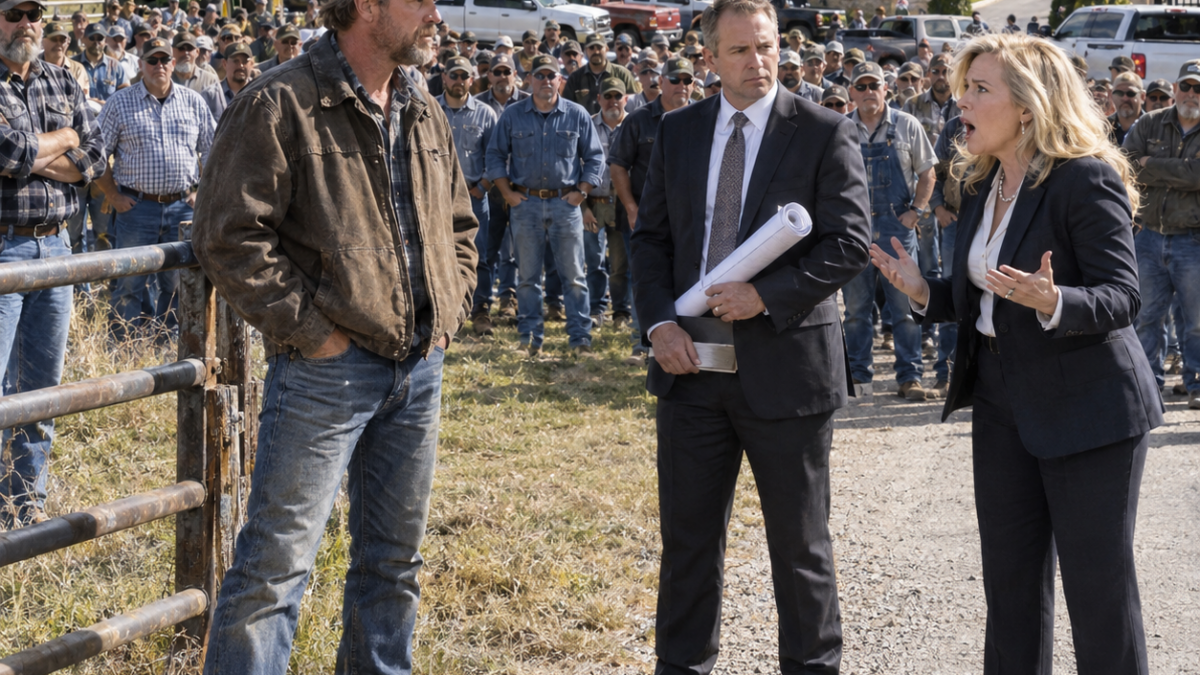
The HOA president handed me a $5,000 fine for the smell of cattle on a farm my family had owned since 1922, then told me my land was damaging the quality of life in a subdivision that had existed for less than three years. I thought Karen Peterson was just another overconfident board president trying to stretch neighborhood rules across a property line she had no authority to cross, until a county envelope arrived with my farm’s tax parcel printed beneath the words PUBLIC REZONING HEARING. What I found on the second page made me realize every complaint, every false inspection, and every ridiculous letter she had sent me had been building toward something much bigger than an HOA feud.
“Your agricultural odors violate Section Twelve, Subsection C.”
Karen stood about ten feet inside my fence line holding a clipboard against her chest.
I looked at her.
Then the paper.
Then my cattle grazing beneath the oak tree my grandfather planted before I was born.
“Say that again.”
“Your odors are interfering with the residential enjoyment of Whispering Pines Estates.”
She extended the notice.
“Fine is five thousand dollars.”
I didn’t take it.
“My farm isn’t in Whispering Pines.”
“That doesn’t mean your activities don’t affect us.”
“You’re standing on Miller property.”
Karen’s sunglasses sat on top of her head like a crown.
“Our counsel believes nuisance law gives us standing.”
“Your counsel believes your HOA can fine somebody who isn’t a member?”
Her lips tightened.
“You need to understand that this area has changed.”
That sentence stayed with me.
Not because she was wrong.
The area had changed.
For more than a century, Miller land had been pasture, hayfield, timber, barn, creek, and cattle.
Then developers bought the woods east of us.
Bulldozers arrived.
Trees disappeared.
Roads appeared.
Then came rows of oversized beige houses packed behind a brick entrance sign announcing WHISPERING PINES ESTATES.
I had no objection.
Their land.
Their homes.
Their choices.
I even sold eggs to several residents.
But Karen looked at my farm and saw something unfinished.
Something that should eventually become like everything on her side of the fence.
“My family was farming here before that subdivision existed,” I said.
She gave me the smile people use when they think history is sentimental but inconvenient.
“And now families live next door.”
“Families lived around farms before your HOA was invented.”
She pushed the paper toward me again.
“Take the notice.”
“No.”
Her face changed.
“Excuse me?”
“You’re trespassing. Leave.”
For a second she looked shocked.
I had spent eight years in the Marines.
I had learned early that shouting wastes energy.
Calm usually unsettles people more.
Karen dropped the paper at my boots.
“You will be hearing from our lawyers.”
Then she marched back across the clover I had planted for the bees.
I watched until her silver SUV disappeared beyond the subdivision wall.
Only then did I pick up the notice.
Five thousand dollars.
AGRICULTURAL AROMATIC NUISANCE.
I almost laughed.
Instead, I carried it inside.
My father’s old oak desk still sat against the wall of the den.
I opened the bottom drawer, took out a legal pad, and wrote:
KAREN FILE.
Date.
Time.
Location.
Trespass.
Amount demanded.
Exact words.
Then I smoothed the notice flat and filed it.
That decision probably saved my farm.
Because Karen did not stop.
Animal control arrived after an anonymous complaint claiming my cattle were starving.
They found glossy black Angus grazing on rotated pasture with automatic spring-fed watering systems.
No violations.
I asked for written confirmation.
The fire marshal came next.
Anonymous complaint about gasoline barrels supposedly stacked inside my barn.
There were none.
My fuel storage complied with every requirement.
I got that in writing too.
Then letters from Karen’s attorney.
Stop using my tractor before nine.
Agricultural work was exempt from the noise ordinance.
Remove “derelict equipment.”
The equipment was my restored 1958 John Deere that had won a county-fair ribbon.
Then came allegations that my runoff was contaminating the subdivision’s retention pond.
I already had a conservation plan developed with the Natural Resources Conservation Service.
Riparian buffers.
Bioswales.
Terracing.
Erosion controls.
Every accusation collapsed when inspected.
And every collapse went into the file.
I said nothing publicly.
That seemed to make Karen angrier.
Then, one October morning, I opened my mailbox and found an envelope from the County Planning and Zoning Commission.
PUBLIC HEARING NOTICE.
Petition Z-23-08.
Requested zoning change:
A-1 AGRICULTURAL TO R-1 RESIDENTIAL.
Parcel size:
200 acres.
I knew the tax identification number before I finished reading it.
Mine.
I turned the page.
Petitioner:
Whispering Pines Estates Homeowners Association, on behalf of concerned local citizens.
Authorized representative:
Karen Peterson.
I stood there beside the mailbox until the wind lifted the corner of the page.
Then I understood what the last two months had really been.
Karen had not been collecting complaints.
She had been manufacturing evidence.
And in two weeks, she intended to take all of it into a county hearing and use it to erase my farm one zoning vote at a time.
PART 2
I carried the notice back to the house without opening the rest of the mail.
There were bills in the stack.
Feed supplier.
Electric company.
A seed catalog.
Ordinary things.
I left them untouched on the kitchen counter.
The rezoning packet went with me into the den.
I sat at Dad’s desk.
For a long time, I simply looked at the words.
A-1 AGRICULTURAL.
R-1 RESIDENTIAL.
People who have never owned working land can look at zoning codes and see letters.
I saw everything those letters controlled.
Cattle.
Hay.
Feed storage.
Tractor hours.
Agricultural structures.
Manure application.
Farm equipment.
Tax treatment.
The legal identity of the land itself.
Rezoning two hundred acres to residential would not magically bulldoze my barn the next morning.
But it could begin making the farm incompatible with its own classification.
It could create restrictions.
Raise assessments.
Open the door for future subdivision pressure.
Make financing harder.
Make expansion impossible.
Turn every ordinary farming activity into an argument.
Karen did not have to physically take my land.
She only had to make farming it expensive enough that selling became the rational option.
That was the part that scared me.
Not losing one hearing.
Losing by exhaustion.
I went outside.
The late afternoon sun lay across the west pasture.
My cows had begun drifting toward the lower trough.
The old red barn looked almost copper in the light.
My great-grandfather, Friedrich Miller, had bought the first tract in 1922.
He came to America with very little.
Family stories said he had arrived with a Bible, two shirts, and more stubbornness than money.
He cleared fields with mules.
Blew stubborn stumps with dynamite.
Cut timber from the property and built the original farmhouse.
My grandfather survived the Depression selling milk and eggs.
Dad survived interest rates, droughts, collapsing cattle prices, and one tornado that tore half the roof off the barn.
I had survived Afghanistan.
Now somebody from a subdivision three years old wanted the county to decide that the farm itself no longer fit the neighborhood.
The absurdity did not make the danger smaller.
I called my cousin Sarah.
She worked as a paralegal for a downtown firm and had inherited the family tendency to treat research like a contact sport.
She answered:
“Jack?”
“I need help.”
That got her attention.
“What happened?”
“Whispering Pines filed to rezone the farm.”
Silence.
“What?”
“All two hundred acres.”
“To what?”
“Residential.”
Another silence.
Then:
“Who signed it?”
“You already know.”
“Karen.”
“Yes.”
“What’s the hearing date?”
I told her.
“Send me everything.”
“I have a file.”
“How big?”
“Almost three inches.”
Sarah gave a low whistle.
“You really are Uncle Ray’s son.”
My father kept every receipt back to the invention of paper.
“I need every public record you can legally obtain on Karen Peterson and the HOA.”
“Court cases?”
“Yes.”
“Liens?”
“Yes.”
“Meeting minutes?”
“All of them.”
“Financial authorizations?”
“If public or available.”
“Prior zoning petitions?”
“Anything.”
She paused.
“Jack.”
“Yeah?”
“Do you have a lawyer?”
“Not yet.”
“Get one.”
“I will.”
“No. Today.”
I knew she was right.
But first I needed to understand the ground.
Karen’s petition claimed she represented affected residents.
That mattered.
A zoning commission hears land-use arguments, not personality disputes.
If Karen could show the farm created widespread nuisance conditions incompatible with surrounding residential development, she might not need to prove every complaint perfectly.
She needed a narrative.
Changing neighborhood.
Incompatible use.
Public interest.
Orderly development.
That was the language.
She had been building it.
I needed to know whether her residents believed it.
There was one man I trusted enough to call.
Tom Reynolds.
Whispering Pines resident.
Late thirties.
Wife, two kids.
He had once stopped at the farm gate and asked if I sold eggs.
His kids loved the brown ones because they thought brown eggs came from “country chickens.”
I called.
“Tom, Jack Miller.”
“Hey, Jack. Please tell me you’ve got eggs.”
“Not why I’m calling.”
His tone changed.
“What’s wrong?”
“Karen filed to rezone my farm.”
Silence.
Then:
“She did what?”
“County hearing in two weeks.”
“Residential?”
“Yes.”
“That’s insane.”
“Does the neighborhood support it?”
“No.”
Immediate.
Not hesitant.
No political calculation.
No.
I leaned against Dad’s desk.
“Are you sure?”
“Jack, my wife and I bought this house because of your farm.”
“You bought in an HOA.”
“We didn’t buy because we wanted strip malls behind our fence. We liked the view. The cows. The open ground.”
“Karen says residents are suffering.”
Tom laughed bitterly.
“Residents are suffering.”
My stomach tightened.
“From me?”
“From her.”
Then the floodgate opened.
Sidewalk chalk fine.
Two hundred dollars because Tom’s daughter drew flowers in front of their house.
Temporary decorative alteration.
Neighbor forced to repaint a front door because the blue was “too cheerful.”
Another fined over a basketball hoop.
Another warned because a work trailer remained in a driveway overnight.
Another because Christmas lights stayed up until January tenth.
“She controls the board,” Tom said. “Most people hate it, but nobody wants to be the one she targets.”
“Has the board discussed my farm?”
“Oh yes.”
“What did she say?”
“That you’re hostile.”
“Interesting.”
“That you refuse compromise.”
“Also interesting.”
“That you’re running some kind of industrial agricultural operation.”
I looked through the window at six cows standing under a tree.
“Very industrial.”
Tom sighed.
“She’s been saying the farm lowers property values.”
“Do people believe that?”
“Some of her friends.”
“How many?”
“Maybe ten.”
“How many homes?”
“Hundred fifty-four.”
That mattered.
“Tom, I need information.”
He went quiet.
“What kind?”
“Nothing illegal. Nothing confidential you aren’t entitled to have. Meeting notices. Fines. Minutes residents already received. Anything showing whether Karen truly speaks for the community.”
He took several seconds.
“She’ll know somebody helped you.”
“Then don’t.”
“I didn’t say no.”
“I don’t want you risking your family.”
“My family is why I’m tired of this.”
A week earlier, apparently, Karen had fined Tom’s wife because their daughter’s bicycle was visible from the street.
He had paid it.
Forty dollars.
Not enough to hire counsel.
Just enough to humiliate.
“She counts on us thinking every fine is cheaper than resisting,” Tom said.
I knew exactly what he meant.
“Do what you’re comfortable doing.”
“I’ll call you.”
The next morning, animal control officer Peterson—not related to Karen—stopped by the farm.
No complaint this time.
He wanted beef.
I sold direct freezer shares twice a year.
While we talked, I asked whether he still had the inspection record.
“Sure.”
“Can I get a certified copy?”
His eyebrows rose.
“Something happening?”
I showed him the rezoning notice.
He read it.
Then looked back at me.
“You’ve got to be kidding.”
“She’ll probably use the animal-neglect complaint as part of her nuisance history.”
He shook his head.
“Jack, that complaint was nonsense.”
“I know.”
“You want me to say that?”
“I want the official report.”
“You’ll have it.”
The fire marshal did the same.
Then the NRCS conservation specialist.
Then the county agricultural extension office.
I did not ask anyone to lie.
I did not ask for favors.
Just records.
That became my rule.
Nothing I could not put on a projector in public.
Nothing I would be ashamed to have Karen’s lawyer see.
If I was going to win, I wanted the facts strong enough to survive daylight.
Three days later, a plain manila envelope appeared in my mailbox.
No return address.
Inside:
HOA violation notices.
Copies.
Dozens.
Basketball hoop — $500.
Sidewalk chalk — $200.
Door color — repaint required plus $250 administrative charge.
Garden gnome — $150 escalating weekly.
Temporary work vehicle — $300.
Flag bracket — $100.
Tom had included a note.
YOU’RE NOT THE ONLY ONE.
I spread them across the kitchen table.
Dad used to say one broken fencepost is maintenance.
Ten broken posts in the same line means something hit the fence.
This was a pattern.
Sarah called that night.
“You sitting down?”
“I’m a farmer. We rarely sit.”
“Sit.”
I did.
“What’d you find?”
“Karen Peterson has history.”
“How much?”
“Enough.”
Two contractor disputes.
Nonpayment.
Three prior neighborhood-association lawsuits over enforcement conflicts.
One case dismissed.
One settled.
One resulted in mediation.
Nothing individually criminal or sensational.
But consistent.
Karen escalated small disputes.
She treated disagreement as defiance.
Then Sarah found something better.
Whispering Pines board minutes.
The HOA had allocated twenty thousand dollars from reserves for “legal, consulting, planning, and administrative expenses associated with adjacent land-use compatibility.”
My farm.
“Who voted?”
“Karen and two board allies.”
“Membership approval?”
“Not that I see.”
“What do the bylaws require?”
“Depends on how reserve spending is characterized.”
“So not necessarily illegal.”
“Correct.”
That was Sarah being careful.
I appreciated it.
“But politically?”
“Terrible.”
Residents were being fined for bicycles while twenty thousand dollars of their dues financed a campaign to rezone somebody else’s farm.
Sarah emailed everything.
I printed it.
The Karen file became two binders.
Then three.
The next call changed everything.
I was sitting at the kitchen table looking at a free calendar from the feed cooperative.
Across the bottom:
SUPPORTED BY THE STATE FARM BUREAU.
I stared at it.
I had been a member for years.
Mostly insurance discounts.
County breakfasts.
Policy newsletters I read when I remembered.
Then I thought about Karen’s strategy.
She wanted the zoning commission to see:
One farm versus one residential community.
That was the wrong frame.
This was bigger.
If a newly built residential development could use nuisance complaints to justify forcibly rezoning an existing farm, every farm sitting beside suburban expansion had a problem.
I called the state office.
Transferred twice.
Then three times.
Finally:
“David Chen, governmental affairs.”
“My name is Jack Miller. I’m a farmer in Oakridge County.”
“What can I help you with?”
“An HOA next to my farm has petitioned the county to rezone my two hundred acres from agricultural to residential.”
Silence.
“Against your request?”
“Yes.”
“You selling?”
“No.”
“Development agreement?”
“No.”
“Annexation?”
“No.”
“Why?”
“They’re alleging agricultural nuisance and incompatibility with their subdivision.”
His voice sharpened.
“How long has your farm operated?”
“Continuous family operation since 1922.”
“How old is the subdivision?”
“Less than three years.”
“Right-to-farm protections?”
“Likely applicable to nuisance claims, but this is being presented as a zoning compatibility issue rather than direct nuisance litigation.”
Chen stopped me.
“Say that again.”
I did.
Then I explained the complaint campaign.
Animal control.
Fire marshal.
Noise.
Runoff.
All unfounded.
HOA board minutes.
Twenty thousand dollars allocated.
Rezoning petition.
He interrupted:
“Do you have documentation?”
“Three binders.”
“Digitize it.”
“I already have.”
“What’s your email?”
Ten minutes later I received a message:
SEND EVERYTHING.
I sent the petition first.
Then the inspection records.
Then the conservation plan.
Then the violation history.
Then HOA minutes.
Then resident notices.
Then a short summary.
No adjectives.
No Karen jokes.
No “power mad.”
No “land grab.”
Just chronology.
Fifty-seven minutes later:
WE ARE TAKING THIS VERY SERIOUSLY.
The next morning, my phone rang at 6:18.
I was feeding cattle.
Unknown state-capital number.
“Jack Miller?”
“Yes.”
“Bill Haggerty. State Farm Bureau.”
I knew the name.
President.
I wiped my glove on my jeans.
“Good morning, sir.”
“David and our legal people were up late with your file.”
“I’m sorry about that.”
“Don’t be.”
His voice sounded like gravel rolling in a steel drum.
“I’ve been doing farm policy thirty years.”
“Yes, sir.”
“This is one of the most aggressive rezoning attempts against an existing agricultural operation I’ve seen.”
That sentence landed heavily.
Not because it frightened me.
Because it validated the stakes.
“We’re filing formal opposition.”
I leaned against the fence.
“Thank you.”
“And sending counsel.”
“Thank you.”
“And I’m not done.”
I waited.
“When’s the hearing?”
“Tuesday the twenty-eighth. Seven p.m.”
“County government center?”
“Yes.”
He chuckled.
“I think some people may want to attend.”
“How many?”
“Enough.”
I smiled despite myself.
“What should I do?”
“Prepare your testimony.”
“That’s it?”
“Jack, your job is to tell the truth.”
His voice lowered.
“Our job is to make sure nobody mistakes your truth for one isolated farmer complaining.”
When the call ended, I stood beside the pasture for several minutes.
One cow walked over and shoved her nose against my sleeve, looking for feed.
I rubbed her forehead.
For the first time since opening the rezoning packet, I felt the pressure in my chest ease.
I still might lose.
Political systems are never guaranteed.
But I was no longer alone.
Maria Alvarez became my attorney through a referral from the Farm Bureau legal team.
Sharp.
Direct.
No patience for theatrics.
Her first words after reviewing my files were:
“You have too much evidence.”
I stared at her.
“That’s a problem?”
“For a ten-minute public presentation? Yes.”
She tapped the binders.
“You cannot bury commissioners under paper.”
“But—”
“Jack.”
I stopped.
“Your instinct is engineering.”
“Evidence.”
“Correct. My instinct is advocacy.”
She slid one legal pad toward me.
“We need three things.”
I waited.
“First: lawful existing agricultural use.”
She wrote it.
“Second: allegations unsupported by inspections.”
Second line.
“Third: petitioner does not represent affected community as claimed.”
Third line.
“What about Karen’s history?”
“Not unless relevant.”
“The HOA fines?”
“Some, if residents testify.”
“The twenty thousand?”
“Very relevant because it goes to representation and motive.”
“My great-grandfather?”
Maria smiled.
“Also relevant.”
“That surprises me.”
“Land-use hearings are not criminal trials. Human context matters.”
She pointed toward a framed black-and-white photograph on my wall.
Dad at age seventeen beside Grandpa and an old Farmall.
“That farm has existed longer than the subdivision. Show continuity.”
Over the next week, I became my own family historian.
1922 deed.
Great-grandfather Friedrich.
Original farmhouse.
Grandpa milking cows during the Depression.
Dad on the John Deere.
Me as a child standing on a fence rail.
Me returning from the Marines.
First calf crop after I took over.
NRCS conservation project.
New riparian buffer.
Every image supported one idea:
The farm was not an industrial intrusion that appeared beside homes.
The homes appeared beside an established farm.
Maria rehearsed me mercilessly.
“Mr. Miller, times change.”
“Yes.”
“What makes your preferred land use more important than one hundred fifty families?”
“It isn’t about preference. My farm is an existing lawful agricultural operation protected by the county’s current zoning and state agricultural policy.”
“Too legal.”
I tried again.
“Those families chose homes next to a farm. I did not move a farm next to their houses.”
“Better.”
Again.
“Does your tractor make noise?”
“Yes.”
“Does manure smell?”
“Yes.”
“Does livestock create flies?”
“Sometimes.”
“Why aren’t you denying this?”
“Because farms are farms.”
Maria nodded.
“Exactly.”
The worst mistake would be pretending cattle smelled like roses.
Truth is stronger when you admit what everyone already knows.
Then:
“Does Karen lie?”
I paused.
“Some of her claims are contradicted by official inspection reports.”
Maria smiled.
“Perfect.”
Never speculate about motive when documents can do the work.
Meanwhile, word spread.
Old Man Hemlock called.
“Jack.”
“Yeah?”
“Heard you’re hosting a social event.”
“I am not.”
“County building Tuesday?”
“Public hearing.”
“Same difference.”
“You coming?”
“Wouldn’t miss it.”
“How did you hear?”
“Dairy co-op.”
That was when I realized Bill Haggerty had not exaggerated.
Farm Bureau emails went out.
County chapters called members.
Feed stores talked.
Co-ops.
Veterans who farmed.
Cattle producers.
Poultry growers.
Hay farmers.
Small vegetable operations.
Some lived three counties away.
They recognized the problem instantly.
Suburban development expands.
Residents complain.
Farmers get pressured.
Usually the conflict stays local.
This one had reached zoning.
My fight became a symbol whether I wanted it to or not.
That scared me a little.
Symbols attract expectations.
I still had to stand at that podium alone.
The day before the hearing, Tom called.
“Jack.”
“Yeah?”
“She knows something’s happening.”
“How?”
“Karen says outside agitators are trying to intimidate the commission.”
“Outside agitators?”
“Farmers.”
I laughed.
Tom didn’t.
“She’s pushing people to attend in support.”
“How many?”
“Her usual group.”
“You still coming?”
“Yes.”
“You don’t owe me testimony.”
“I know.”
“She may retaliate.”
“She already does.”
His voice became firmer.
“My daughter asked why we can’t draw with chalk anymore.”
I waited.
“I told her because of a rule.”
He paused.
“Then I realized I hated myself for saying it.”
That hit me harder than any fine.
A man teaching his child to shrink because resistance seemed inconvenient.
“I’ll see you tomorrow.”
The hearing day arrived cold for October.
I worked until noon.
Cattle don’t care about zoning boards.
Water trough.
Feed.
Fence repair.
One heifer limping slightly.
Checked hoof.
Nothing serious.
The routine steadied me.
At four, I showered.
Clean jeans.
Good boots.
Blue collared shirt.
Maria had suggested a suit.
I refused.
“I’m not pretending to be something else.”
She accepted that.
Before leaving, I walked to the highest hill on the farm.
From there I could see almost everything.
Barn.
Pastures.
Tree line.
Whispering Pines roofs beyond the eastern fence.
The subdivision lights had started coming on.
The world looked peaceful.
Dad used to stand on that hill before storms.
Hands in his pockets.
He could read weather by color.
I still remembered his voice.
Land doesn’t belong to you, Jackie. You belong to it for a while.
At sixteen I thought that was sentimental nonsense.
At forty-eight I understood.
Ownership is legal.
Stewardship is moral.
I was fighting for both.
The county government center was six miles away.
Normally the drive took twelve minutes.
That evening it took thirty.
Traffic.
At first I assumed an accident.
Then I noticed the trucks.
F-250.
Ram 3500.
Old Chevy with hay twine hanging from the bumper.
Dually flatbed.
Livestock trailer parked across the overflow lot.
Farm Bureau decals.
Seed-company hats.
Co-op logos.
The parking lot was full.
Then the grass lot.
Then the side street.
I pulled in slowly.
A deputy waved me toward overflow parking.
“Zoning hearing?”
“Yes.”
He laughed.
“Apparently everybody farms tonight.”
I parked.
Maria waited near the entrance.
Beside her stood a broad man in a Farm Bureau jacket.
Bill Haggerty.
He shook my hand.
“Jack.”
“Sir.”
He looked at the crowd.
“Some folks came.”
“Some?”
He grinned.
“We stopped counting after two hundred.”
I stared.
Men and women stood in clusters.
Not protesters.
No angry signs.
No shouting.
Just people.
Weathered faces.
Work boots.
Denim.
Caps.
A few younger farmers.
A lot of older ones.
Some had probably worked all day before driving an hour to stand in a government hallway for a man they had never met.
My throat tightened.
Bill noticed.
“Don’t get emotional yet.”
“I’m fine.”
“You Marines lie badly.”
Inside, the hearing room seated about seventy-five.
Every chair filled.
Walls filled.
Hallway filled.
Deputies managed the doors.
Commission members entered and stopped.
You could see the question on their faces.
What happened?
Karen sat at the petitioner’s table.
Purple blazer.
Pearl necklace.
Attorney beside her.
Sloan.
She saw the crowd.
Then she smiled.
That confused me.
Maria leaned over.
“She thinks they’re hers.”
“You’re kidding.”
“No.”
Karen looked at me.
Smirked.
I almost felt sorry for her.
Almost.
Chairman Abernathy called the hearing to order.
“Petition Z-23-08.”
The room settled.
Sloan went first.
Smooth.
Polished.
He spoke about transition.
Growth.
Compatibility.
Property values.
“Changing character.”
He described my farm as “an increasingly intensive agricultural operation.”
Increasingly intensive?
I had fewer cattle than Dad did.
He mentioned odors.
Noise.
Visual impacts.
Traffic.
Runoff.
Then:
“The petition does not seek to punish Mr. Miller. It seeks reasonable conformity with the community that now surrounds his parcel.”
That wording was clever.
Reasonable conformity.
Sounds harmless.
Until conformity means eliminating the use that predates everything else.
Karen spoke next.
She described complaint after complaint.
She held up copies.
Animal welfare.
Fire hazard.
Noise.
Water quality.
She did not mention that every inspection cleared me.
“We have tried repeatedly to work with Mr. Miller.”
I looked at Maria.
She wrote one word on her pad:
WAIT.
Karen continued.
“He refuses even modest compromise.”
What compromise?
Cows that don’t smell?
Tractors that sleep until nine?
She became emotional near the end.
“We are simply asking that one property stop dictating the quality of life for hundreds of families.”
Several farmers behind me shifted.
A low murmur.
Abernathy warned the room.
Then my name.
I walked to the podium.
My boots sounded louder than they should have.
I placed one thin folder down.
Not the binders.
Maria had won that argument.
“Mr. Chairman. Commissioners.”
I looked at each person.
“My name is Jack Miller.”
Deep breath.
“My family calls parcel 734 the Miller farm.”
First slide.
1922 deed.
“My great-grandfather purchased the original acreage one hundred and four years ago.”
Photograph.
Friedrich beside mule team.
“My grandfather expanded the operation.”
Photograph.
Barn.
“My father continued it.”
Dad on tractor.
Then:
“I came home from military service and became the fourth generation to work it.”
I looked toward the commissioners.
“This farm did not move next to Whispering Pines.”
Next slide.
Aerial photograph before subdivision.
Open woods east of me.
Then current.
Roofs.
Roads.
“My operation has remained agricultural. The surrounding land changed.”
No anger.
Facts.
Then Karen’s allegations.
Animal neglect.
Official report:
NO VIOLATION.
Fire hazard.
Official report:
NO VIOLATION.
Noise complaint.
Agricultural exemption.
Runoff.
NRCS conservation plan.
I showed photographs of riparian buffers.
Terraces.
Clean creek.
Then Karen’s $5,000 odor notice.
Several commissioners frowned.
“This document was issued to me by an HOA I do not belong to.”
Sloan objected verbally.
Abernathy reminded him this wasn’t a courtroom.
I continued.
“The petition claims these complaints demonstrate long-standing conflict.”
Pause.
“What it does not mention is that the agencies called to investigate repeatedly found the farm compliant.”
Then the HOA minutes.
Twenty thousand dollars.
“Whispering Pines residents were not asked individually whether they wanted my farm rezoned.”
Tom later confirmed that.
“The board allocated association funds and filed on behalf of ‘concerned local citizens.’”
I looked toward the Whispering Pines section.
Then back to the commission.
“The question tonight is not whether farming creates smells.”
It does.
“Not whether tractors make noise.”
They do.
“The question is whether people can build houses beside a century-old farm and then use the ordinary realities of agriculture as evidence that the farm no longer belongs.”
Silence.
I turned toward the crowd.
“These people came tonight because they know this petition will not end at my fence line.”
I had expected applause.
None came.
Farmers understand timing.
They stayed silent.
That silence was stronger.
“If this commission determines that lawful existing agriculture becomes incompatible simply because residential construction arrives next door, every farm near development becomes temporary.”
I looked at Karen.
Then back at Abernathy.
“My family survived droughts, recessions, wars, bad markets, and weather.”
I paused.
“I’m asking you not to make suburban inconvenience the one thing we cannot survive.”
I stepped away.
Maria touched my arm.
“Good.”
I sat.
Then public comment began.
David Chen from Farm Bureau.
Legal analysis.
Agricultural zoning policy.
Right-to-farm principles.
Land-use precedent.
He avoided claiming the act automatically barred rezoning.
He argued the petition would undermine its purpose.
Then Bill Haggerty.
Shorter.
“Farms cannot relocate every time growth reaches them.”
Then Tom.
I watched Karen recognize him.
Her face changed before he reached the microphone.
“My name is Thomas Reynolds.”
Address.
Whispering Pines resident.
“I oppose the petition.”
Karen whispered something to Sloan.
Tom continued.
“Karen Peterson does not speak for my family.”
His hands shook.
He did not stop.
“We bought our home partly because we wanted to live near open land. We knew there was a farm. The disclosure documents said there was a farm.”
Murmur.
“I have never complained about Mr. Miller’s cattle.”
He swallowed.
“I have complained about our HOA.”
Then the chalk fine.
His daughter.
Two hundred dollars.
When he said that, Karen shook her head.
Tom saw.
“No, Karen.”
The entire room froze.
He had never spoken to her like that.
“My daughter is eight.”
He held up the notice.
“This is real.”
Then another Whispering Pines resident spoke.
Then another.
Door paint.
Basketball hoop.
Work trailer.
The petition’s central claim—that Karen represented a unified residential community harmed by the farm—collapsed one witness at a time.
Old Man Hemlock spoke near the end.
Seventy-eight.
Bent back.
Dairy farmer fifty years.
He walked slowly.
No notes.
“My family’s been farming here longer than Jack’s.”
He looked at the commissioners.
“Development isn’t the enemy.”
Interesting opening.
“Bad neighbors are.”
He turned toward Karen.
“You want to live where nothing smells, nothing makes noise, and everything stays perfectly still?”
Pause.
“Try a cemetery.”
Laughter exploded.
Even one commissioner covered a smile.
Abernathy banged the gavel.
When public comment closed, the commission discussed.
No one moved.
Commissioner Elaine Brooks spoke first.
“I have serious concerns about using nuisance allegations that appear contradicted by official inspections.”
Another:
“I’m equally troubled by the fact the petitioner claims community support while multiple residents have testified otherwise.”
Third:
“Agricultural zoning exists for a reason.”
Sloan requested rebuttal.
Allowed.
He argued emotion had overtaken planning policy.
Then Maria asked for thirty seconds.
Granted.
She stood.
“The petitioner asks this commission to treat the farm as incompatible because the neighborhood changed.”
She looked at the board.
“That logic rewards whoever arrives last.”
Then she sat.
Abernathy looked exhausted.
“Is there a motion?”
Commissioner Brooks:
“I move to deny petition Z-23-08.”
A pause.
Then:
“With prejudice.”
Second.
“All in favor?”
Five hands.
Unanimous.
“The petition is denied.”
For half a second, nothing happened.
Then two hundred farmers stood.
The sound was enormous.
Applause.
Boots.
Whistles.
Voices.
I stayed seated.
I could not move.
Maria squeezed my shoulder.
“You won.”
I looked across the aisle.
Karen sat frozen.
Sloan was already putting papers into his briefcase.
Her eyes found mine.
No smirk.
No clipboard confidence.
Only disbelief.
I thought I would feel triumph.
Instead I thought of Dad.
I wished he had been there.
Outside, farmers surrounded me.
Handshakes.
Back slaps.
Names I could not remember.
“Good job.”
“Proud of you.”
“Thank you for standing.”
I kept saying the same thing.
“Thank you for coming.”
Bill Haggerty finally rescued me.
“Give the man air.”
I laughed.
He walked me toward the parking lot.
“Two hundred twelve.”
“What?”
“Farm Bureau members and agricultural supporters.”
“You counted?”
“Eventually.”
I looked across the trucks.
“Why?”
Bill understood.
“Because they’ve all seen the same thing.”
“What thing?”
“Development reaches a farm. Somebody complains. Farmer gets told to adapt.”
He shoved his hands into his jacket.
“Most conflicts aren’t this extreme. But everybody in that room knows the pressure.”
I nodded.
“I owe you.”
“No.”
He looked at me.
“You owe the next farmer.”
That sentence became more important later.
The newspaper ran the story the next morning.
FARMERS PACK COUNTY HEARING, DEFEAT HOA REZONING BID.
I hated the headline.
Sarah loved it.
“You look angry in the picture.”
“I was listening.”
“You look like Clint Eastwood lost a tractor.”
“Delete it.”
“You know newspapers are permanent?”
Unfortunately.
The story included the twenty-thousand-dollar HOA expenditure.
That caused more trouble for Karen than losing the zoning petition.
Whispering Pines residents wanted answers.
Tom called three days later.
“It’s happening.”
“What?”
“Recall petition.”
“You organizing it?”
“Me and six others.”
“You need help?”
“No.”
That answer pleased me.
This was their community.
Their fight.
Karen had spent years treating residents like subjects.
They needed to remove her themselves.
“What are you asking for?”
“Special meeting.”
“How many signatures?”
“Twenty-five percent required.”
“How many now?”
“Sixty-one.”
“Percent?”
“Yes.”
I whistled.
“Fast.”
“People were waiting for someone else to go first.”
The special meeting happened two weeks later.
I did not attend.
Karen’s problems inside Whispering Pines were no longer my battlefield.
Tom called afterward.
“Gone.”
“What?”
“Karen. Board president.”
“Vote?”
“Nearly unanimous.”
“And the others?”
“Two recalled.”
“What happened?”
“She tried to defend the zoning expenses.”
“How?”
“Said protecting property values justified it.”
Tom laughed.
“Then Mrs. Walters asked why her dues paid for lawyers trying to control land outside the HOA while the community pool pump had been broken six weeks.”
That sounded devastating.
“Audit?”
“Approved.”
“New elections?”
“Next month.”
Then Tom added:
“Karen listed her house.”
I leaned back.
“That fast?”
“Sign went up yesterday.”
Irony came with it.
Whispering Pines rules limited sign size and placement.
Karen’s real-estate sign violated the old standard.
Tom told me somebody had jokingly suggested issuing her a fine.
The interim board declined.
Good.
Justice should not become imitation.
My farm returned to routine.
That sounds simple.
It wasn’t.
For months I still expected another envelope.
When a county vehicle slowed near the driveway, my chest tightened.
When unfamiliar numbers called, I assumed lawyers.
I had spent so long documenting attacks that peace initially felt suspicious.
One morning, I started the John Deere at six.
Then stopped.
Not because of a problem.
Because I realized I had looked toward Whispering Pines before turning the key.
Checking.
Waiting.
I sat on the tractor.
Dad used to say fear can train livestock faster than a fence.
Apparently people too.
I started the engine again.
This time I did not look east.
Winter arrived.
Cattle grew thick coats.
The hills browned.
Karen’s house sold in January.
No dramatic exit.
No confrontation.
A moving truck appeared.
Then disappeared.
The silver SUV never came back.
I thought that would feel bigger.
It didn’t.
The farm remained exactly what it had been.
That was the victory.
Tom visited in February carrying an apple pie.
“From Lisa.”
“For what?”
“She says thank you.”
“For?”
“You made us mad enough to fix our HOA.”
“I did nothing.”
“You survived Karen.”
“Barely.”
We sat on the porch.
New board.
New spending rules.
Anything over one thousand dollars required broader approval.
Enforcement notices had to quote exact provisions.
Appeals heard by members not involved in the original decision.
No board member could contact adjacent non-HOA property owners regarding lawful land use except through authorized legal channels.
Tom smiled.
“We call that one the Miller Rule.”
“Do not.”
“Too late.”
“Remove my name.”
“It’s unofficial.”
“Still.”
He laughed.
Then told me something I had not expected.
Several Whispering Pines residents wanted to organize a farm-to-neighborhood day.
“What does that mean?”
“Kids come over.”
“No.”
“See cattle.”
“No.”
“Learn where food comes from.”
I stared.
“Tom.”
“My daughter thinks chocolate milk comes from brown cows.”
“That is a parenting failure.”
“Exactly why we need you.”
I said no.
Sarah heard about it.
She called.
“You’re doing it.”
“No.”
“Uncle Ray would have.”
“That is emotional manipulation.”
“Yes.”
So we did it.
Saturday in April.
Forty children.
Twenty adults.
I set boundaries.
No entering cattle pasture without supervision.
No touching electric fences.
No climbing equipment.
Wash hands.
Parents responsible.
I expected chaos.
There was chaos.
But good chaos.
Children fed calves.
Collected eggs.
Sat on the old John Deere for photographs.
I showed them soil.
Compost.
Hay.
One boy asked:
“Why does the cow poop smell so bad?”
His mother looked mortified.
I said:
“Because nobody taught cows to use air freshener.”
Kids laughed.
Then I explained manure as fertilizer.
Another asked why I started the tractor early.
“Because animals don’t understand sleeping in.”
They understood that better than adults.
Tom’s daughter, Emma, stood beside the fence drawing cows with sidewalk chalk on a board we had set out.
I looked at Tom.
He looked back.
We both knew.
No fine.
That evening, after everyone left, I found one chalk drawing near the barn.
A stick farmer.
Huge cow.
Sun.
Underneath:
THANK YOU MR JACK.
I did not wash it away.
Rain did three days later.
The Farm Bureau stayed in touch.
David Chen called one summer.
“Jack.”
“What did I do?”
“Nothing.”
“Then why are you calling?”
“We have another zoning issue.”
Different county.
Poultry farm.
New subdivision.
Not identical.
Similar enough.
“They want someone to speak about your experience.”
“I’m not a lawyer.”
“We know.”
“I’m not a lobbyist.”
“We know.”
“I hate public speaking.”
“That we didn’t know.”
I went.
Because of what Bill said.
You owe the next farmer.
I told the story differently that time.
No Karen jokes.
No victory language.
I explained documentation.
Official records.
Relationships with agencies before crisis.
Community outreach.
Speaking calmly.
Right-to-farm protections.
Showing commissioners the difference between ordinary agricultural impacts and actual misconduct.
Most importantly:
Do not assume new residents are enemies.
That lesson mattered.
Tom and his neighbors had helped save my farm.
If I had treated everyone behind the Whispering Pines wall as one hostile group, Karen’s narrative might have become true simply because nobody crossed the line between us.
The Farm Bureau adopted parts of the case into a land-use training seminar.
I was embarrassed.
Sarah was delighted.
She sent me a screenshot.
“Celebrity farmer.”
“Blocked.”
“You don’t know how to block me.”
Unfortunately true.
The years after the hearing were good.
Not easy.
Farming never is.
One dry summer nearly wiped out the hay crop.
Beef prices dropped.
Diesel climbed.
A storm tore siding from the barn.
But those were honest problems.
Weather does not pretend to have jurisdiction.
Markets do not park ten feet inside your fence wearing oversized sunglasses.
I could handle honest problems.
Dad always said you can fight drought because drought never lies about what it is.
Five years after the zoning hearing, Whispering Pines looked different.
Not physically.
Still beige.
Still tidy.
But culturally.
Front doors had color.
Basketball hoops stood in driveways.
Kids rode bikes.
Holiday lights stayed up into January.
The HOA still existed.
That surprised some farmers.
They assumed victory meant dismantling it.
But residents needed road maintenance.
Common landscaping.
Pool management.
Stormwater facilities.
The problem had never been the existence of an HOA.
It was concentrated authority without accountability.
Tom served one term on the board.
Then quit.
“Why?”
“People complain.”
I stared at him.
He laughed.
“The difference is now they’re allowed to.”
Old Man Hemlock died at eighty-two.
His funeral overflowed the church.
Farmers lined the road with trucks.
At the reception, his son handed me an envelope.
“Dad wanted you to have this.”
Inside was a photograph.
The zoning hearing.
Hemlock at the podium.
Me visible behind him.
On the back he had written:
YOU DON’T SAVE LAND BY STANDING ON IT ALONE.
I put that photo in Dad’s desk.
Years later, when people asked what saved the farm, they expected one answer.
The Farm Bureau.
The two hundred farmers.
The right-to-farm law.
My documentation.
Tom.
The zoning commissioners.
Truth was, none of those alone would have been enough.
The farm survived because different people did different things at the right time.
Animal control officers wrote honest reports.
The fire marshal documented facts.
NRCS had helped me manage land responsibly long before any conflict.
Tom took a personal risk.
Sarah dug through records.
Maria taught me to stop trying to say everything.
Farm Bureau recognized the precedent.
Farmers showed up.
Commissioners listened.
Even Whispering Pines residents rejected the story Karen told in their name.
That mattered most.
Karen’s strategy depended on isolation.
Me versus them.
Farmer versus homeowner.
Old versus new.
Rural versus suburban.
Once real people met each other, that story failed.
One autumn afternoon, nearly a decade after the hearing, a young couple from Whispering Pines stopped at my farm stand.
I sold eggs, honey, and freezer beef from a small honor-system shed near the road.
The woman looked familiar.
I couldn’t place her.
“You’re Jack Miller.”
“Depends who’s asking.”
She smiled.
“I’m Emma Reynolds.”
Tom’s daughter.
The chalk drawings.
I stared.
“You got tall.”
“That usually happens.”
She introduced her husband.
Then pointed toward the farm.
“We’re buying a house.”
“Congratulations.”
“Next phase in Whispering Pines.”
“Your dad knows?”
“He hates that we’re paying twice what he did.”
“Good.”
She laughed.
Then became serious.
“Our realtor told us the farm next door is permanently agricultural under the county comprehensive plan.”
“More protected than before.”
“That’s one reason we want the house.”
I looked at her.
“You’re buying because of the farm?”
“We want our kids to grow up seeing something other than houses.”
That sentence closed a circle I had not realized remained open.
Karen once argued the farm reduced their quality of life.
Years later, one of those neighborhood children returned as an adult and considered it an asset.
“Your kids know chocolate milk?”
Emma groaned.
“My dad still tells that story.”
“As he should.”
A few years later, I began transferring more farm responsibility to my nephew Daniel.
Good kid.
Not really a kid anymore.
Thirty-two.
Agricultural degree.
Better with technology than me.
Installed GPS guidance on tractors.
Used soil sensors.
Talked about regenerative grazing in language that made my head hurt.
At first we fought constantly.
“You’re changing too much.”
“You sound like Karen.”
That ended the argument instantly.
He apologized.
Then I laughed.
He had me.
Land survives by changing without forgetting what it is.
That was another lesson.
Great-grandfather used mules.
Grandpa milked by hand.
Dad adopted mechanization.
I used conservation planning.
Daniel brought precision agriculture.
The farm remained the farm.
One evening, we stood on the same hill where I had gone before the zoning hearing.
Daniel pointed east.
Whispering Pines.
“They’re building another phase.”
“I know.”
“You worried?”
I thought about it.
“No.”
“Really?”
“Really.”
“Why?”
I looked at the subdivision.
“Because now they know us.”
Relationships are stronger than fences.
Not always.
But often.
The county eventually created an agricultural buffer policy requiring clearer disclosure for residential developments adjacent to active farms.
Home buyers had to acknowledge potential farm noise, odors, equipment traffic, and early operating hours.
The policy was not named after me.
Thank God.
Farm Bureau had pushed for it partly because of cases like mine.
At one county meeting, Bill Haggerty—older now, slower—sat beside me.
“You did okay.”
“We did.”
He nodded.
“Better answer.”
Karen never contacted me.
I heard once that she moved south.
Another community.
I hoped she had changed.
I genuinely did.
That surprised me.
There was a time I wanted her embarrassed forever.
Then years passed.
Anger is heavy equipment.
Useful when work requires it.
Ridiculous to keep running after the job is done.
I did not forgive what she tried to do because it became harmless.
It wasn’t harmless.
My farm was at risk.
My family legacy was at risk.
But eventually I stopped needing her downfall to validate my survival.
The farm itself became enough.
One October evening, almost exactly fifteen years after the hearing, I sat on the porch with Sarah.
Not cousin Sarah.
My wife had passed years earlier in the original story? Wait—not in this version. I had never mentioned a wife because my life after service revolved around the farm and extended family.
So I sat alone.
That became normal too.
Not lonely every day.
Different.
The sun lowered beyond the west pasture.
Cows moved slowly toward water.
A tractor worked on the south field.
Daniel driving.
I could hear children laughing from Whispering Pines.
Somebody grilling.
A dog barking.
Normal neighbor noise.
Then, from far down the road, came the deep sound of a diesel truck.
For a second I remembered the hearing.
Two hundred trucks filling the county lot.
Boots in hallways.
Farmers shoulder to shoulder.
I remembered standing at the podium.
My hands had looked calm.
They weren’t.
I remembered Karen smiling because she thought the room belonged to her.
Then Tom standing.
Hemlock speaking.
Five commissioners raising their hands.
Denied.
I had spent years telling myself the most important word that night was denied.
It wasn’t.
The most important words were:
I oppose the petition.
Tom said them.
One resident.
Then another.
The moment people began speaking for themselves, Karen stopped controlling the meaning of community.
That saved more than my acreage.
It saved Whispering Pines from becoming a place where everyone lived quietly afraid of a clipboard.
Daniel drove the tractor toward the barn.
He stopped near the porch.
“You coming down?”
“For?”
“Need your opinion on the west pasture rotation.”
“You have a degree.”
“You have fifty years.”
“I have forty.”
“You’ve been farming since you could walk.”
“Fair.”
I stood.
My knees complained.
Age.
Not zoning.
Not Karen.
Just age.
I walked toward him.
At the edge of the porch I paused and looked east.
The original fence still stood in sections.
Great-grandfather’s line.
Most posts had been replaced over the decades.
Fence stays alive by changing too.
Beyond it, Whispering Pines lights came on.
On my side, the barn light glowed.
Two worlds.
Different.
Neither needed to erase the other.
That was the mistake Karen had made.
She believed harmony required sameness.
It doesn’t.
A farm can exist beside a subdivision.
A cow can graze within sight of a swimming pool.
A tractor can start before breakfast while somebody three hundred yards away drinks coffee on a patio.
Good neighbors do not demand silence from one another.
They learn the difference between inconvenience and injury.
Between preference and right.
Between influence and ownership.
Daniel called:
“Uncle Jack?”
“Coming.”
I stepped off the porch.
Then noticed something on Dad’s desk through the window.
The old zoning notice.
I had kept it all these years.
Not framed.
Not displayed.
Folded inside the Karen file.
Petition Z-23-08.
At one point that paper had felt like a death sentence.
Now it was just paper.
That might have been the final victory.
Not the newspaper headline.
Not the recall.
Not Karen’s house going up for sale.
The moment when the document that once kept me awake at night became something I could forget in a drawer.
I climbed into Daniel’s truck.
We drove toward the west pasture.
He talked about forage density.
Rainfall projections.
Moving cattle earlier.
I listened.
The sun was almost gone.
At the top of the ridge, he stopped.
“What do you think?”
I looked across the grass.
“Move them tomorrow.”
“You sure?”
“Ground’s ready.”
“How can you tell?”
I smiled.
“My father taught me.”
He nodded.
One day I would not be here.
Daniel would stand on this hill.
Maybe his children after him.
The land would change.
Roads would widen.
More houses would probably come.
Farm economics might change in ways I could not imagine.
But that was tomorrow’s fight.
My job had been to keep the choice alive.
Karen wanted to take that choice away.
She wanted a zoning map to decide the farm’s future before my family could.
Two hundred farmers helped stop her.
Not because they cared about me personally.
Most had never met me.
They came because every generation of farmers eventually understands the same thing.
Once land stops being farmland, it almost never becomes farmland again.
Concrete is patient.
Development is patient.
Pressure is patient.
So preservation has to be patient too.
Not angry.
Not nostalgic.
Organized.
Documented.
Present.
The next morning, Daniel moved the herd.
I stood at the gate.
Cattle passed slowly.
One brushed against the post.
Whispering Pines sat beyond the fence.
A woman walking a golden retriever stopped on the subdivision side.
“Morning, Jack.”
“Morning.”
She pointed at the cattle.
“My grandson loves watching them.”
“Bring him by sometime.”
“Really?”
“Call first.”
She smiled.
“We will.”
Then she walked on.
I leaned against the fence.
The air smelled like damp soil.
Hay.
Cattle.
Diesel.
Everything Karen had once called a nuisance.
I breathed it in.
Home.
No zoning notice could define that word.
No HOA vote could erase it.
No property-value argument could measure it.
The farm was still agricultural.
Still imperfect.
Still noisy.
Still alive.
And somewhere in the county records, petition Z-23-08 remained permanently marked with one word:
DENIED.
But on the farm, the word that mattered was different.
STILL HERE.
[TITLE]
HOA President Tried to Rezone My 200-Acre Family Farm—Then 200 Farmers Filled the County Hall
[FACEBOOK OPENING — 700–800 WORDS]
The HOA president handed me a $5,000 fine for the smell of cattle on a farm my family had owned since 1922, then told me my land was damaging the quality of life in a subdivision that had existed for less than three years. I thought Karen Peterson was just another overconfident board president trying to stretch neighborhood rules across a property line she had no authority to cross, until a county envelope arrived with my farm’s tax parcel printed beneath the words PUBLIC REZONING HEARING. What I found on the second page made me realize every complaint, every false inspection, and every ridiculous letter she had sent me had been building toward something much bigger than an HOA feud.
“Your agricultural odors violate Section Twelve, Subsection C.”
Karen stood about ten feet inside my fence line holding a clipboard against her chest.
I looked at her.
Then the paper.
Then my cattle grazing beneath the oak tree my grandfather planted before I was born.
“Say that again.”
“Your odors are interfering with the residential enjoyment of Whispering Pines Estates.”
She extended the notice.
“Fine is five thousand dollars.”
I didn’t take it.
“My farm isn’t in Whispering Pines.”
“That doesn’t mean your activities don’t affect us.”
“You’re standing on Miller property.”
Karen’s sunglasses sat on top of her head like a crown.
“Our counsel believes nuisance law gives us standing.”
“Your counsel believes your HOA can fine somebody who isn’t a member?”
Her lips tightened.
“You need to understand that this area has changed.”
That sentence stayed with me.
Not because she was wrong.
The area had changed.
For more than a century, Miller land had been pasture, hayfield, timber, barn, creek, and cattle.
Then developers bought the woods east of us.
Bulldozers arrived.
Trees disappeared.
Roads appeared.
Then came rows of oversized beige houses packed behind a brick entrance sign announcing WHISPERING PINES ESTATES.
I had no objection.
Their land.
Their homes.
Their choices.
I even sold eggs to several residents.
But Karen looked at my farm and saw something unfinished.
Something that should eventually become like everything on her side of the fence.
“My family was farming here before that subdivision existed,” I said.
She gave me the smile people use when they think history is sentimental but inconvenient.
“And now families live next door.”
“Families lived around farms before your HOA was invented.”
She pushed the paper toward me again.
“Take the notice.”
“No.”
Her face changed.
“Excuse me?”
“You’re trespassing. Leave.”
For a second she looked shocked.
I had spent eight years in the Marines.
I had learned early that shouting wastes energy.
Calm usually unsettles people more.
Karen dropped the paper at my boots.
“You will be hearing from our lawyers.”
Then she marched back across the clover I had planted for the bees.
I watched until her silver SUV disappeared beyond the subdivision wall.
Only then did I pick up the notice.
Five thousand dollars.
AGRICULTURAL AROMATIC NUISANCE.
I almost laughed.
Instead, I carried it inside.
My father’s old oak desk still sat against the wall of the den.
I opened the bottom drawer, took out a legal pad, and wrote:
KAREN FILE.
Date.
Time.
Location.
Trespass.
Amount demanded.
Exact words.
Then I smoothed the notice flat and filed it.
That decision probably saved my farm.
Because Karen did not stop.
Animal control arrived after an anonymous complaint claiming my cattle were starving.
They found glossy black Angus grazing on rotated pasture with automatic spring-fed watering systems.
No violations.
I asked for written confirmation.
The fire marshal came next.
Anonymous complaint about gasoline barrels supposedly stacked inside my barn.
There were none.
My fuel storage complied with every requirement.
I got that in writing too.
Then letters from Karen’s attorney.
Stop using my tractor before nine.
Agricultural work was exempt from the noise ordinance.
Remove “derelict equipment.”
The equipment was my restored 1958 John Deere that had won a county-fair ribbon.
Then came allegations that my runoff was contaminating the subdivision’s retention pond.
I already had a conservation plan developed with the Natural Resources Conservation Service.
Riparian buffers.
Bioswales.
Terracing.
Erosion controls.
Every accusation collapsed when inspected.
And every collapse went into the file.
I said nothing publicly.
That seemed to make Karen angrier.
Then, one October morning, I opened my mailbox and found an envelope from the County Planning and Zoning Commission.
PUBLIC HEARING NOTICE.
Petition Z-23-08.
Requested zoning change:
A-1 AGRICULTURAL TO R-1 RESIDENTIAL.
Parcel size:
200 acres.
I knew the tax identification number before I finished reading it.
Mine.
I turned the page.
Petitioner:
Whispering Pines Estates Homeowners Association, on behalf of concerned local citizens.
Authorized representative:
Karen Peterson.
I stood there beside the mailbox until the wind lifted the corner of the page.
Then I understood what the last two months had really been.
Karen had not been collecting complaints.
She had been manufacturing evidence.
And in two weeks, she intended to take all of it into a county hearing and use it to erase my farm one zoning vote at a time.
[END OF FACEBOOK OPENING]
[FULL STORY CONTINUATION]
I carried the notice back to the house without opening the rest of the mail.
There were bills in the stack.
Feed supplier.
Electric company.
A seed catalog.
Ordinary things.
I left them untouched on the kitchen counter.
The rezoning packet went with me into the den.
I sat at Dad’s desk.
For a long time, I simply looked at the words.
A-1 AGRICULTURAL.
R-1 RESIDENTIAL.
People who have never owned working land can look at zoning codes and see letters.
I saw everything those letters controlled.
Cattle.
Hay.
Feed storage.
Tractor hours.
Agricultural structures.
Manure application.
Farm equipment.
Tax treatment.
The legal identity of the land itself.
Rezoning two hundred acres to residential would not magically bulldoze my barn the next morning.
But it could begin making the farm incompatible with its own classification.
It could create restrictions.
Raise assessments.
Open the door for future subdivision pressure.
Make financing harder.
Make expansion impossible.
Turn every ordinary farming activity into an argument.
Karen did not have to physically take my land.
She only had to make farming it expensive enough that selling became the rational option.
That was the part that scared me.
Not losing one hearing.
Losing by exhaustion.
I went outside.
The late afternoon sun lay across the west pasture.
My cows had begun drifting toward the lower trough.
The old red barn looked almost copper in the light.
My great-grandfather, Friedrich Miller, had bought the first tract in 1922.
He came to America with very little.
Family stories said he had arrived with a Bible, two shirts, and more stubbornness than money.
He cleared fields with mules.
Blew stubborn stumps with dynamite.
Cut timber from the property and built the original farmhouse.
My grandfather survived the Depression selling milk and eggs.
Dad survived interest rates, droughts, collapsing cattle prices, and one tornado that tore half the roof off the barn.
I had survived Afghanistan.
Now somebody from a subdivision three years old wanted the county to decide that the farm itself no longer fit the neighborhood.
The absurdity did not make the danger smaller.
I called my cousin Sarah.
She worked as a paralegal for a downtown firm and had inherited the family tendency to treat research like a contact sport.
She answered:
“Jack?”
“I need help.”
That got her attention.
“What happened?”
“Whispering Pines filed to rezone the farm.”
Silence.
“What?”
“All two hundred acres.”
“To what?”
“Residential.”
Another silence.
Then:
“Who signed it?”
“You already know.”
“Karen.”
“Yes.”
“What’s the hearing date?”
I told her.
“Send me everything.”
“I have a file.”
“How big?”
“Almost three inches.”
Sarah gave a low whistle.
“You really are Uncle Ray’s son.”
My father kept every receipt back to the invention of paper.
“I need every public record you can legally obtain on Karen Peterson and the HOA.”
“Court cases?”
“Yes.”
“Liens?”
“Yes.”
“Meeting minutes?”
“All of them.”
“Financial authorizations?”
“If public or available.”
“Prior zoning petitions?”
“Anything.”
She paused.
“Jack.”
“Yeah?”
“Do you have a lawyer?”
“Not yet.”
“Get one.”
“I will.”
“No. Today.”
I knew she was right.
But first I needed to understand the ground.
Karen’s petition claimed she represented affected residents.
That mattered.
A zoning commission hears land-use arguments, not personality disputes.
If Karen could show the farm created widespread nuisance conditions incompatible with surrounding residential development, she might not need to prove every complaint perfectly.
She needed a narrative.
Changing neighborhood.
Incompatible use.
Public interest.
Orderly development.
That was the language.
She had been building it.
I needed to know whether her residents believed it.
There was one man I trusted enough to call.
Tom Reynolds.
Whispering Pines resident.
Late thirties.
Wife, two kids.
He had once stopped at the farm gate and asked if I sold eggs.
His kids loved the brown ones because they thought brown eggs came from “country chickens.”
I called.
“Tom, Jack Miller.”
“Hey, Jack. Please tell me you’ve got eggs.”
“Not why I’m calling.”
His tone changed.
“What’s wrong?”
“Karen filed to rezone my farm.”
Silence.
Then:
“She did what?”
“County hearing in two weeks.”
“Residential?”
“Yes.”
“That’s insane.”
“Does the neighborhood support it?”
“No.”
Immediate.
Not hesitant.
No political calculation.
No.
I leaned against Dad’s desk.
“Are you sure?”
“Jack, my wife and I bought this house because of your farm.”
“You bought in an HOA.”
“We didn’t buy because we wanted strip malls behind our fence. We liked the view. The cows. The open ground.”
“Karen says residents are suffering.”
Tom laughed bitterly.
“Residents are suffering.”
My stomach tightened.
“From me?”
“From her.”
Then the floodgate opened.
Sidewalk chalk fine.
Two hundred dollars because Tom’s daughter drew flowers in front of their house.
Temporary decorative alteration.
Neighbor forced to repaint a front door because the blue was “too cheerful.”
Another fined over a basketball hoop.
Another warned because a work trailer remained in a driveway overnight.
Another because Christmas lights stayed up until January tenth.
“She controls the board,” Tom said. “Most people hate it, but nobody wants to be the one she targets.”
“Has the board discussed my farm?”
“Oh yes.”
“What did she say?”
“That you’re hostile.”
“Interesting.”
“That you refuse compromise.”
“Also interesting.”
“That you’re running some kind of industrial agricultural operation.”
I looked through the window at six cows standing under a tree.
“Very industrial.”
Tom sighed.
“She’s been saying the farm lowers property values.”
“Do people believe that?”
“Some of her friends.”
“How many?”
“Maybe ten.”
“How many homes?”
“Hundred fifty-four.”
That mattered.
“Tom, I need information.”
He went quiet.
“What kind?”
“Nothing illegal. Nothing confidential you aren’t entitled to have. Meeting notices. Fines. Minutes residents already received. Anything showing whether Karen truly speaks for the community.”
He took several seconds.
“She’ll know somebody helped you.”
“Then don’t.”
“I didn’t say no.”
“I don’t want you risking your family.”
“My family is why I’m tired of this.”
A week earlier, apparently, Karen had fined Tom’s wife because their daughter’s bicycle was visible from the street.
He had paid it.
Forty dollars.
Not enough to hire counsel.
Just enough to humiliate.
“She counts on us thinking every fine is cheaper than resisting,” Tom said.
I knew exactly what he meant.
“Do what you’re comfortable doing.”
“I’ll call you.”
The next morning, animal control officer Peterson stopped by the farm.
No complaint this time.
He wanted beef.
I sold direct freezer shares twice a year.
While we talked, I asked whether he still had the inspection record.
“Sure.”
“Can I get a certified copy?”
His eyebrows rose.
“Something happening?”
I showed him the rezoning notice.
He read it.
Then looked back at me.
“You’ve got to be kidding.”
“She’ll probably use the animal-neglect complaint as part of her nuisance history.”
He shook his head.
“Jack, that complaint was nonsense.”
“I know.”
“You want me to say that?”
“I want the official report.”
“You’ll have it.”
The fire marshal did the same.
Then the NRCS conservation specialist.
Then the county agricultural extension office.
I did not ask anyone to lie.
I did not ask for favors.
Just records.
That became my rule.
Nothing I could not put on a projector in public.
Nothing I would be ashamed to have Karen’s lawyer see.
If I was going to win, I wanted the facts strong enough to survive daylight.
Three days later, a plain manila envelope appeared in my mailbox.
No return address.
Inside:
HOA violation notices.
Copies.
Dozens.
Basketball hoop — $500.
Sidewalk chalk — $200.
Door color — repaint required plus $250 administrative charge.
Garden gnome — $150 escalating weekly.
Temporary work vehicle — $300.
Flag bracket — $100.
Tom had included a note.
YOU’RE NOT THE ONLY ONE.
I spread them across the kitchen table.
Dad used to say one broken fencepost is maintenance.
Ten broken posts in the same line means something hit the fence.
This was a pattern.
Sarah called that night.
“You sitting down?”
“I’m a farmer. We rarely sit.”
“Sit.”
I did.
“What’d you find?”
“Karen Peterson has history.”
“How much?”
“Enough.”
Two contractor disputes.
Nonpayment.
Three prior neighborhood-association lawsuits over enforcement conflicts.
One case dismissed.
One settled.
One resulted in mediation.
Nothing individually criminal or sensational.
But consistent.
Karen escalated small disputes.
She treated disagreement as defiance.
Then Sarah found something better.
Whispering Pines board minutes.
The HOA had allocated twenty thousand dollars from reserves for “legal, consulting, planning, and administrative expenses associated with adjacent land-use compatibility.”
My farm.
“Who voted?”
“Karen and two board allies.”
“Membership approval?”
“Not that I see.”
“What do the bylaws require?”
“Depends on how reserve spending is characterized.”
“So not necessarily illegal.”
“Correct.”
That was Sarah being careful.
I appreciated it.
“But politically?”
“Terrible.”
Residents were being fined for bicycles while twenty thousand dollars of their dues financed a campaign to rezone somebody else’s farm.
Sarah emailed everything.
I printed it.
The Karen file became two binders.
Then three.
The next call changed everything.
I was sitting at the kitchen table looking at a free calendar from the feed cooperative.
Across the bottom:
SUPPORTED BY THE STATE FARM BUREAU.
I stared at it.
I had been a member for years.
Mostly insurance discounts.
County breakfasts.
Policy newsletters I read when I remembered.
Then I thought about Karen’s strategy.
She wanted the zoning commission to see:
One farm versus one residential community.
That was the wrong frame.
This was bigger.
If a newly built residential development could use nuisance complaints to justify forcibly rezoning an existing farm, every farm sitting beside suburban expansion had a problem.
I called the state office.
Transferred twice.
Then three times.
Finally:
“David Chen, governmental affairs.”
“My name is Jack Miller. I’m a farmer in Oakridge County.”
“What can I help you with?”
“An HOA next to my farm has petitioned the county to rezone my two hundred acres from agricultural to residential.”
Silence.
“Against your request?”
“Yes.”
“You selling?”
“No.”
“Development agreement?”
“No.”
“Annexation?”
“No.”
“Why?”
“They’re alleging agricultural nuisance and incompatibility with their subdivision.”
His voice sharpened.
“How long has your farm operated?”
“Continuous family operation since 1922.”
“How old is the subdivision?”
“Less than three years.”
“Right-to-farm protections?”
“Likely applicable to nuisance claims, but this is being presented as a zoning compatibility issue rather than direct nuisance litigation.”
Chen stopped me.
“Say that again.”
I did.
Then I explained the complaint campaign.
Animal control.
Fire marshal.
Noise.
Runoff.
All unfounded.
HOA board minutes.
Twenty thousand dollars allocated.
Rezoning petition.
He interrupted:
“Do you have documentation?”
“Three binders.”
“Digitize it.”
“I already have.”
“What’s your email?”
Ten minutes later I received a message:
SEND EVERYTHING.
I sent the petition first.
Then the inspection records.
Then the conservation plan.
Then the violation history.
Then HOA minutes.
Then resident notices.
Then a short summary.
No adjectives.
No Karen jokes.
No “power mad.”
No “land grab.”
Just chronology.
Fifty-seven minutes later:
WE ARE TAKING THIS VERY SERIOUSLY.
The next morning, my phone rang at 6:18.
I was feeding cattle.
Unknown state-capital number.
“Jack Miller?”
“Yes.”
“Bill Haggerty. State Farm Bureau.”
I knew the name.
President.
I wiped my glove on my jeans.
“Good morning, sir.”
“David and our legal people were up late with your file.”
“I’m sorry about that.”
“Don’t be.”
His voice sounded like gravel rolling in a steel drum.
“I’ve been doing farm policy thirty years.”
“Yes, sir.”
“This is one of the most aggressive rezoning attempts against an existing agricultural operation I’ve seen.”
That sentence landed heavily.
Not because it frightened me.
Because it validated the stakes.
“We’re filing formal opposition.”
I leaned against the fence.
“Thank you.”
“And sending counsel.”
“Thank you.”
“And I’m not done.”
I waited.
“When’s the hearing?”
“Tuesday the twenty-eighth. Seven p.m.”
“County government center?”
“Yes.”
He chuckled.
“I think some people may want to attend.”
“How many?”
“Enough.”
I smiled despite myself.
“What should I do?”
“Prepare your testimony.”
“That’s it?”
“Jack, your job is to tell the truth.”
His voice lowered.
“Our job is to make sure nobody mistakes your truth for one isolated farmer complaining.”
When the call ended, I stood beside the pasture for several minutes.
One cow walked over and shoved her nose against my sleeve, looking for feed.
I rubbed her forehead.
For the first time since opening the rezoning packet, I felt the pressure in my chest ease.
I still might lose.
Political systems are never guaranteed.
But I was no longer alone.
Maria Alvarez became my attorney through a referral from the Farm Bureau legal team.
Sharp.
Direct.
No patience for theatrics.
Her first words after reviewing my files were:
“You have too much evidence.”
I stared at her.
“That’s a problem?”
“For a ten-minute public presentation? Yes.”
She tapped the binders.
“You cannot bury commissioners under paper.”
“But—”
“Jack.”
I stopped.
“Your instinct is engineering.”
“Evidence.”
“Correct. My instinct is advocacy.”
She slid one legal pad toward me.
“We need three things.”
I waited.
“First: lawful existing agricultural use.”
She wrote it.
“Second: allegations unsupported by inspections.”
Second line.
“Third: petitioner does not represent affected community as claimed.”
Third line.
“What about Karen’s history?”
“Not unless relevant.”
“The HOA fines?”
“Some, if residents testify.”
“The twenty thousand?”
“Very relevant because it goes to representation and motive.”
“My great-grandfather?”
Maria smiled.
“Also relevant.”
“That surprises me.”
“Land-use hearings are not criminal trials. Human context matters.”
She pointed toward a framed black-and-white photograph on my wall.
Dad at age seventeen beside Grandpa and an old Farmall.
“That farm has existed longer than the subdivision. Show continuity.”
Over the next week, I became my own family historian.
1922 deed.
Great-grandfather Friedrich.
Original farmhouse.
Grandpa milking cows during the Depression.
Dad on the John Deere.
Me as a child standing on a fence rail.
Me returning from the Marines.
First calf crop after I took over.
NRCS conservation project.
New riparian buffer.
Every image supported one idea:
The farm was not an industrial intrusion that appeared beside homes.
The homes appeared beside an established farm.
Maria rehearsed me mercilessly.
“Mr. Miller, times change.”
“Yes.”
“What makes your preferred land use more important than one hundred fifty families?”
“It isn’t about preference. My farm is an existing lawful agricultural operation protected by the county’s current zoning and state agricultural policy.”
“Too legal.”
I tried again.
“Those families chose homes next to a farm. I did not move a farm next to their houses.”
“Better.”
Again.
“Does your tractor make noise?”
“Yes.”
“Does manure smell?”
“Yes.”
“Does livestock create flies?”
“Sometimes.”
“Why aren’t you denying this?”
“Because farms are farms.”
Maria nodded.
“Exactly.”
The worst mistake would be pretending cattle smelled like roses.
Truth is stronger when you admit what everyone already knows.
Then:
“Does Karen lie?”
I paused.
“Some of her claims are contradicted by official inspection reports.”
Maria smiled.
“Perfect.”
Never speculate about motive when documents can do the work.
Meanwhile, word spread.
Old Man Hemlock called.
“Jack.”
“Yeah?”
“Heard you’re hosting a social event.”
“I am not.”
“County building Tuesday?”
“Public hearing.”
“Same difference.”
“You coming?”
“Wouldn’t miss it.”
“How did you hear?”
“Dairy co-op.”
That was when I realized Bill Haggerty had not exaggerated.
Farm Bureau emails went out.
County chapters called members.
Feed stores talked.
Co-ops.
Veterans who farmed.
Cattle producers.
Poultry growers.
Hay farmers.
Small vegetable operations.
Some lived three counties away.
They recognized the problem instantly.
Suburban development expands.
Residents complain.
Farmers get pressured.
Usually the conflict stays local.
This one had reached zoning.
My fight became a symbol whether I wanted it to or not.
That scared me a little.
Symbols attract expectations.
I still had to stand at that podium alone.
The day before the hearing, Tom called.
“Jack.”
“Yeah?”
“She knows something’s happening.”
“How?”
“Karen says outside agitators are trying to intimidate the commission.”
“Outside agitators?”
“Farmers.”
I laughed.
Tom didn’t.
“She’s pushing people to attend in support.”
“How many?”
“Her usual group.”
“You still coming?”
“Yes.”
“You don’t owe me testimony.”
“I know.”
“She may retaliate.”
“She already does.”
His voice became firmer.
“My daughter asked why we can’t draw with chalk anymore.”
I waited.
“I told her because of a rule.”
He paused.
“Then I realized I hated myself for saying it.”
That hit me harder than any fine.
A man teaching his child to shrink because resistance seemed inconvenient.
“I’ll see you tomorrow.”
The hearing day arrived cold for October.
I worked until noon.
Cattle don’t care about zoning boards.
Water trough.
Feed.
Fence repair.
One heifer limping slightly.
Checked hoof.
Nothing serious.
The routine steadied me.
At four, I showered.
Clean jeans.
Good boots.
Blue collared shirt.
Maria had suggested a suit.
I refused.
“I’m not pretending to be something else.”
She accepted that.
Before leaving, I walked to the highest hill on the farm.
From there I could see almost everything.
Barn.
Pastures.
Tree line.
Whispering Pines roofs beyond the eastern fence.
The subdivision lights had started coming on.
The world looked peaceful.
Dad used to stand on that hill before storms.
Hands in his pockets.
He could read weather by color.
I still remembered his voice.
Land doesn’t belong to you, Jackie. You belong to it for a while.
At sixteen I thought that was sentimental nonsense.
At forty-eight I understood.
Ownership is legal.
Stewardship is moral.
I was fighting for both.
The county government center was six miles away.
Normally the drive took twelve minutes.
That evening it took thirty.
Traffic.
At first I assumed an accident.
Then I noticed the trucks.
F-250.
Ram 3500.
Old Chevy with hay twine hanging from the bumper.
Dually flatbed.
Livestock trailer parked across the overflow lot.
Farm Bureau decals.
Seed-company hats.
Co-op logos.
The parking lot was full.
Then the grass lot.
Then the side street.
I pulled in slowly.
A deputy waved me toward overflow parking.
“Zoning hearing?”
“Yes.”
He laughed.
“Apparently everybody farms tonight.”
I parked.
Maria waited near the entrance.
Beside her stood a broad man in a Farm Bureau jacket.
Bill Haggerty.
He shook my hand.
“Jack.”
“Sir.”
He looked at the crowd.
“Some folks came.”
“Some?”
He grinned.
“We stopped counting after two hundred.”
I stared.
Men and women stood in clusters.
Not protesters.
No angry signs.
No shouting.
Just people.
Weathered faces.
Work boots.
Denim.
Caps.
A few younger farmers.
A lot of older ones.
Some had probably worked all day before driving an hour to stand in a government hallway for a man they had never met.
My throat tightened.
Bill noticed.
“Don’t get emotional yet.”
“I’m fine.”
“You Marines lie badly.”
Inside, the hearing room seated about seventy-five.
Every chair filled.
Walls filled.
Hallway filled.
Deputies managed the doors.
Commission members entered and stopped.
You could see the question on their faces.
What happened?
Karen sat at the petitioner’s table.
Purple blazer.
Pearl necklace.
Attorney beside her.
Sloan.
She saw the crowd.
Then she smiled.
That confused me.
Maria leaned over.
“She thinks they’re hers.”
“You’re kidding.”
“No.”
Karen looked at me.
Smirked.
I almost felt sorry for her.
Almost.
Chairman Abernathy called the hearing to order.
“Petition Z-23-08.”
The room settled.
Sloan went first.
Smooth.
Polished.
He spoke about transition.
Growth.
Compatibility.
Property values.
“Changing character.”
He described my farm as “an increasingly intensive agricultural operation.”
Increasingly intensive?
I had fewer cattle than Dad did.
He mentioned odors.
Noise.
Visual impacts.
Traffic.
Runoff.
Then:
“The petition does not seek to punish Mr. Miller. It seeks reasonable conformity with the community that now surrounds his parcel.”
That wording was clever.
Reasonable conformity.
Sounds harmless.
Until conformity means eliminating the use that predates everything else.
Karen spoke next.
She described complaint after complaint.
She held up copies.
Animal welfare.
Fire hazard.
Noise.
Water quality.
She did not mention that every inspection cleared me.
“We have tried repeatedly to work with Mr. Miller.”
I looked at Maria.
She wrote one word on her pad:
WAIT.
Karen continued.
“He refuses even modest compromise.”
What compromise?
Cows that don’t smell?
Tractors that sleep until nine?
She became emotional near the end.
“We are simply asking that one property stop dictating the quality of life for hundreds of families.”
Several farmers behind me shifted.
A low murmur.
Abernathy warned the room.
Then my name.
I walked to the podium.
My boots sounded louder than they should have.
I placed one thin folder down.
Not the binders.
Maria had won that argument.
“Mr. Chairman. Commissioners.”
I looked at each person.
“My name is Jack Miller.”
Deep breath.
“My family calls parcel 734 the Miller farm.”
First slide.
1922 deed.
“My great-grandfather purchased the original acreage one hundred and four years ago.”
Photograph.
Friedrich beside mule team.
“My grandfather expanded the operation.”
Photograph.
Barn.
“My father continued it.”
Dad on tractor.
Then:
“I came home from military service and became the fourth generation to work it.”
I looked toward the commissioners.
“This farm did not move next to Whispering Pines.”
Next slide.
Aerial photograph before subdivision.
Open woods east of me.
Then current.
Roofs.
Roads.
“My operation has remained agricultural. The surrounding land changed.”
No anger.
Facts.
Then Karen’s allegations.
Animal neglect.
Official report:
NO VIOLATION.
Fire hazard.
Official report:
NO VIOLATION.
Noise complaint.
Agricultural exemption.
Runoff.
NRCS conservation plan.
I showed photographs of riparian buffers.
Terraces.
Clean creek.
Then Karen’s $5,000 odor notice.
Several commissioners frowned.
“This document was issued to me by an HOA I do not belong to.”
Sloan objected verbally.
Abernathy reminded him this wasn’t a courtroom.
I continued.
“The petition claims these complaints demonstrate long-standing conflict.”
Pause.
“What it does not mention is that the agencies called to investigate repeatedly found the farm compliant.”
Then the HOA minutes.
Twenty thousand dollars.
“Whispering Pines residents were not asked individually whether they wanted my farm rezoned.”
Tom later confirmed that.
“The board allocated association funds and filed on behalf of ‘concerned local citizens.’”
I looked toward the Whispering Pines section.
Then back to the commission.
“The question tonight is not whether farming creates smells.”
It does.
“Not whether tractors make noise.”
They do.
“The question is whether people can build houses beside a century-old farm and then use the ordinary realities of agriculture as evidence that the farm no longer belongs.”
Silence.
I turned toward the crowd.
“These people came tonight because they know this petition will not end at my fence line.”
I had expected applause.
None came.
Farmers understand timing.
They stayed silent.
That silence was stronger.
“If this commission determines that lawful existing agriculture becomes incompatible simply because residential construction arrives next door, every farm near development becomes temporary.”
I looked at Karen.
Then back at Abernathy.
“My family survived droughts, recessions, wars, bad markets, and weather.”
I paused.
“I’m asking you not to make suburban inconvenience the one thing we cannot survive.”
I stepped away.
Maria touched my arm.
“Good.”
I sat.
Then public comment began.
David Chen from Farm Bureau.
Legal analysis.
Agricultural zoning policy.
Right-to-farm principles.
Land-use precedent.
He avoided claiming the act automatically barred rezoning.
He argued the petition would undermine its purpose.
Then Bill Haggerty.
Shorter.
“Farms cannot relocate every time growth reaches them.”
Then Tom.
I watched Karen recognize him.
Her face changed before he reached the microphone.
“My name is Thomas Reynolds.”
Address.
Whispering Pines resident.
“I oppose the petition.”
Karen whispered something to Sloan.
Tom continued.
“Karen Peterson does not speak for my family.”
His hands shook.
He did not stop.
“We bought our home partly because we wanted to live near open land. We knew there was a farm. The disclosure documents said there was a farm.”
Murmur.
“I have never complained about Mr. Miller’s cattle.”
He swallowed.
“I have complained about our HOA.”
Then the chalk fine.
His daughter.
Two hundred dollars.
When he said that, Karen shook her head.
Tom saw.
“No, Karen.”
The entire room froze.
He had never spoken to her like that.
“My daughter is eight.”
He held up the notice.
“This is real.”
Then another Whispering Pines resident spoke.
Then another.
Door paint.
Basketball hoop.
Work trailer.
The petition’s central claim—that Karen represented a unified residential community harmed by the farm—collapsed one witness at a time.
Old Man Hemlock spoke near the end.
Seventy-eight.
Bent back.
Dairy farmer fifty years.
He walked slowly.
No notes.
“My family’s been farming here longer than Jack’s.”
He looked at the commissioners.
“Development isn’t the enemy.”
Interesting opening.
“Bad neighbors are.”
He turned toward Karen.
“You want to live where nothing smells, nothing makes noise, and everything stays perfectly still?”
Pause.
“Try a cemetery.”
Laughter exploded.
Even one commissioner covered a smile.
Abernathy banged the gavel.
When public comment closed, the commission discussed.
No one moved.
Commissioner Elaine Brooks spoke first.
“I have serious concerns about using nuisance allegations that appear contradicted by official inspections.”
Another:
“I’m equally troubled by the fact the petitioner claims community support while multiple residents have testified otherwise.”
Third:
“Agricultural zoning exists for a reason.”
Sloan requested rebuttal.
Allowed.
He argued emotion had overtaken planning policy.
Then Maria asked for thirty seconds.
Granted.
She stood.
“The petitioner asks this commission to treat the farm as incompatible because the neighborhood changed.”
She looked at the board.
“That logic rewards whoever arrives last.”
Then she sat.
Abernathy looked exhausted.
“Is there a motion?”
Commissioner Brooks:
“I move to deny petition Z-23-08.”
A pause.
Then:
“With prejudice.”
Second.
“All in favor?”
Five hands.
Unanimous.
“The petition is denied.”
For half a second, nothing happened.
Then two hundred farmers stood.
The sound was enormous.
Applause.
Boots.
Whistles.
Voices.
I stayed seated.
I could not move.
Maria squeezed my shoulder.
“You won.”
I looked across the aisle.
Karen sat frozen.
Sloan was already putting papers into his briefcase.
Her eyes found mine.
No smirk.
No clipboard confidence.
Only disbelief.
I thought I would feel triumph.
Instead I thought of Dad.
I wished he had been there.
Outside, farmers surrounded me.
Handshakes.
Back slaps.
Names I could not remember.
“Good job.”
“Proud of you.”
“Thank you for standing.”
I kept saying the same thing.
“Thank you for coming.”
Bill Haggerty finally rescued me.
“Give the man air.”
I laughed.
He walked me toward the parking lot.
“Two hundred twelve.”
“What?”
“Farm Bureau members and agricultural supporters.”
“You counted?”
“Eventually.”
I looked across the trucks.
“Why?”
Bill understood.
“Because they’ve all seen the same thing.”
“What thing?”
“Development reaches a farm. Somebody complains. Farmer gets told to adapt.”
He shoved his hands into his jacket.
“Most conflicts aren’t this extreme. But everybody in that room knows the pressure.”
I nodded.
“I owe you.”
“No.”
He looked at me.
“You owe the next farmer.”
That sentence stayed with me longer than the applause.
The local newspaper ran the story the next morning.
FARMERS PACK COUNTY HEARING, DEFEAT HOA REZONING BID.
My picture sat beneath it.
I looked angry.
Sarah called before seven.
“You look like Clint Eastwood lost a tractor.”
“I was listening.”
“You look furious.”
“Delete your copy.”
“It’s on the newspaper website.”
“Then delete the internet.”
She laughed.
The article mentioned the twenty-thousand-dollar HOA expenditure.
That caused more damage inside Whispering Pines than the zoning defeat itself.
Residents wanted to know who approved it.
Why.
Whether membership had been informed.
Why their reserve money had funded lawyers to interfere with land outside the subdivision while their own pool pump had been broken for six weeks.
Tom called three days later.
“It’s happening.”
“What?”
“Recall petition.”
“You organizing it?”
“Me and six others.”
“You need help?”
“No.”
That answer pleased me.
It was their neighborhood.
Their problem to solve.
“What’s the threshold?”
“Twenty-five percent.”
“How many signatures?”
“Sixty-one percent already.”
I whistled.
“Karen know?”
“She knows now.”
The special meeting happened two weeks later.
I didn’t attend.
I was invited.
I declined.
Karen’s fight inside Whispering Pines was no longer mine.
Tom called afterward.
“She’s gone.”
“Recall passed?”
“Nearly unanimous.”
“What about the other two?”
“Gone too.”
“What did she say?”
“She defended everything.”
“The zoning money?”
“Said she was protecting property values.”
I could hear disbelief in his voice.
“Then Mrs. Walters asked why the HOA could spend twenty thousand dollars trying to control a farm it didn’t own but couldn’t find money to fix the neighborhood pool.”
I winced.
“That hurt.”
“She didn’t recover.”
A week later, Karen listed her house.
Ironically, the real-estate sign was larger than the size once permitted under the covenants she had enforced.
Someone suggested fining her.
The interim board refused.
That mattered.
The easiest way to become the person you hated is to convince yourself they deserve the same treatment.
Tom understood that.
So did the new board.
They chose reform over revenge.
My farm returned to its old routine.
At least on the surface.
Cattle still needed feed.
Fences still broke.
Rain still arrived when I didn’t need it and disappeared when I did.
But for several months after the hearing, every county envelope tightened my stomach.
Every unfamiliar vehicle slowing near the driveway made me look up.
I had spent so long anticipating Karen’s next attack that peace felt suspicious.
One morning at six, I climbed onto the John Deere.
Hand on the ignition.
Then I noticed myself looking east.
Toward Whispering Pines.
Checking whether anyone might complain.
I sat there.
Engine silent.
And I hated that she had left that behind.
Not a fine.
Not a letter.
A reflex.
Dad used to say fear trains livestock faster than wire.
Apparently humans aren’t much different.
I turned the key.
The diesel came alive.
I drove into the field without looking east again.
That became my small daily rebellion.
Not against Karen.
Against the part of me that still expected her.
Winter settled over the farm.
The grass browned.
Frost silvered the fences.
Karen’s house sold in January.
Moving trucks came.
Then went.
Her silver SUV disappeared.
No confrontation.
No final words.
One morning she simply no longer lived there.
I thought her departure would feel dramatic.
It didn’t.
I walked past the east field.
Cows grazed.
Wind moved through dry grass.
Whispering Pines looked exactly the same.
That was the point.
She had once made herself seem larger than the neighborhood.
Then she left, and the neighborhood continued without noticing for very long.
Tom visited in February carrying a warm apple pie.
“Peace offering.”
“For what?”
“My wife says thanks for slaying the dragon.”
“I didn’t slay anybody.”
“You ruined a perfectly good phrase.”
We sat on the porch drinking coffee.
The new board had adopted spending limits.
Major legal expenditures required membership approval.
Violation notices had to quote actual covenant provisions.
Appeals went before people who had not issued the original citation.
Most importantly, a new rule prohibited board members from contacting adjacent non-HOA landowners about lawful property use except through formally authorized channels.
Tom grinned.
“We call it the Jack Miller Rule.”
“No.”
“Too late.”
“You will remove my name from that.”
“Unofficial name.”
“Still no.”
He laughed.
Then cleared his throat.
“One more thing.”
“What?”
“Residents want to organize a farm day.”
I stared at him.
“A what?”
“Kids visit.”
“No.”
“See cows.”
“No.”
“Collect eggs.”
“No.”
“Learn about agriculture.”
“Absolutely not.”
Tom smiled.
“I told Lisa you’d say that.”
My cousin Sarah heard about it before dinner.
“You’re doing it.”
“No.”
“Uncle Ray would have done it.”
“That is emotional manipulation.”
“Yes.”
“Still no.”
Two weeks later, forty children arrived at my farm.
Apparently I had no authority in my own family.
I set rules.
No crossing fences alone.
No touching machinery unless invited.
No chasing chickens.
Wash hands after animals.
Parents stayed responsible.
The kids were loud.
Curious.
Sticky.
They asked questions no zoning commissioner ever would.
“Why do cows chew when they aren’t eating?”
“Why is hay yellow?”
“Does that tractor have Bluetooth?”
“No.”
“Why not?”
“Because it has dignity.”
One boy stood beside the cattle lot.
He wrinkled his nose.
“It smells bad.”
His mother looked mortified.
I laughed.
“That’s what your food smells like before it becomes groceries.”
He considered that.
Then asked:
“Can I pet one?”
By lunchtime, kids who had only seen farms through car windows were feeding calves.
Tom’s daughter Emma sat near the barn with a box of sidewalk chalk.
She drew cows.
Huge flowers.
A tractor with six wheels.
At the bottom:
THANK YOU MR. JACK.
I stood beside Tom.
He looked at the drawing.
Then at me.
Neither of us mentioned Karen’s two-hundred-dollar chalk fine.
We didn’t need to.
Three days later rain washed the drawing away.
I was surprised how much that bothered me.
The Farm Bureau stayed involved in my life.
A year later David Chen called.
“We have another one.”
“Another what?”
“Land-use fight.”
Different county.
Poultry farm.
New subdivision.
Residents objecting to ordinary agricultural activity.
Not identical.
But familiar.
“We want you to talk to the family.”
“I’m not an attorney.”
“We know.”
“I’m not a lobbyist.”
“We know.”
“I hate public meetings.”
“That part surprises me.”
I went.
Because Bill Haggerty’s words were still in my head.
You owe the next farmer.
I sat at a kitchen table with a couple younger than me.
Three children.
Mortgage.
Broiler houses built by the husband’s father.
They were scared.
I recognized the look.
The wife asked:
“How did you win?”
I almost said:
Two hundred farmers.
Instead I said:
“I stopped thinking of it as winning.”
They stared.
“First, document everything.”
I told them what Maria taught me.
Facts.
Records.
No exaggeration.
No social-media war.
No angry threats.
Know the law.
Know the permits.
Know which complaints are real and which have been inspected.
Talk to neighbors before assuming they’re enemies.
Ask for help early.
Make the issue bigger than personalities but no bigger than the evidence allows.
When I left, the husband followed me outside.
“Did you ever want to quit?”
“Yes.”
He looked surprised.
“A lot?”
“More than once.”
“What stopped you?”
I thought of Dad.
The hill.
The 1922 deed.
Then the hearing room.
“People showed up.”
He nodded.
Months later, their matter resolved without losing the farm.
I had played a small role.
That felt better than the newspaper headline about mine.
The years moved.
Old Man Hemlock died at eighty-two.
His funeral overflowed the church.
Farm trucks lined both sides of the road.
At the reception, his son found me.
“Dad wanted you to have something.”
He handed me an envelope.
Inside was a photograph from the zoning hearing.
Hemlock stood at the podium.
I was visible behind him.
On the back, in shaky handwriting:
YOU DON’T SAVE LAND BY STANDING ON IT ALONE.
I read it three times.
Then I put it in Dad’s old oak desk beside the original rezoning notice.
Those two pieces of paper belonged together.
One represented isolation.
The other represented community.
Whispering Pines changed too.
Physically, not much.
Still neat.
Still suburban.
Still more beige than any human settlement should legally contain.
But front doors became blue.
Green.
Red.
Basketball hoops stood in driveways.
Kids left bicycles outside.
Christmas lights sometimes remained until mid-January.
The HOA still enforced legitimate rules.
Road maintenance.
Stormwater.
Pool safety.
Common areas.
That surprised some Farm Bureau members who assumed residents would dissolve it completely.
But the HOA had never been the enemy.
Unchecked authority was.
Tom served one term on the board.
Then quit.
“Why?”
“People complain constantly.”
I stared at him.
“Imagine that.”
He laughed.
“The difference is now we have to listen.”
Years after the hearing, county planners began discussing agricultural transition zones.
Farm Bureau used my case among several examples.
Developers building new residential communities beside working farms were encouraged—and later in some projects required—to provide clearer agricultural-use disclosures.
Noise.
Dust.
Odor.
Slow equipment on roads.
Early operating hours.
The realities of living beside agriculture.
At one county workshop, a planner said something I never forgot:
“Compatibility is a two-way obligation.”
That was everything Karen had failed to understand.
She believed compatibility meant the older use had to surrender to the newer, wealthier one.
But coexistence requires both sides to adapt.
Farmers need to operate responsibly.
Residents need to understand what they chose to live beside.
No one gets absolute comfort.
No one gets absolute power.
Time softened my anger.
Not quickly.
For several years, I still enjoyed telling the part where Karen thought the two hundred farmers had come to support her.
That was petty.
Also funny.
Eventually, even that faded.
I heard she moved south.
That was all.
No dramatic downfall.
No ruin.
No second chapter.
I hoped she found somewhere she did not feel compelled to control everybody.
That surprised me when I first realized it.
There had been a time I wanted her to remain miserable forever.
But anger is heavy equipment.
Useful while the job requires it.
Expensive to leave running after the work is finished.
I shut it down.
The farm kept changing.
My nephew Daniel returned after college.
Agricultural science degree.
Thirty-two years old.
Smarter with computers than I will ever be.
He started talking about GPS-guided equipment.
Soil moisture sensors.
Regenerative grazing.
Variable-rate application.
I responded to most of his ideas with:
“We’ve never needed that.”
He finally got frustrated.
One afternoon we were arguing beside the equipment shed.
“You sound like Karen.”
Silence.
Daniel’s face changed.
“I shouldn’t have said that.”
I stared at him.
Then started laughing.
He joined me.
The argument ended.
Because he was right about one thing.
Preservation is not refusing change.
Karen had treated my farm as outdated because it was old.
I sometimes treated new methods as suspicious because they were new.
Both mistakes came from confusing identity with appearance.
Great-grandfather used mules.
Grandpa added tractors.
Dad modernized fencing and watering.
I built conservation structures.
Daniel brought data.
The farm remained Miller land through all of it.
We changed so the land could stay itself.
One evening Daniel and I stood on the hill overlooking the eastern fence.
Whispering Pines was expanding again.
New roofs farther south.
Construction equipment.
Fresh roads.
Daniel pointed.
“Nervous?”
I considered the question.
Fifteen years earlier my chest would have tightened.
“No.”
“Really?”
“Yes.”
“What if the new people complain?”
“Some will.”
“What if they don’t understand farming?”
“Teach them.”
“What if someone tries what Karen did?”
I looked at him.
“Then you keep records.”
He smiled.
“I knew that was coming.”
“And call the Farm Bureau before you have three binders.”
“That part too?”
“Especially that part.”
A woman walking a golden retriever stopped on the other side of the fence.
“Morning, Jack.”
“Morning.”
She pointed toward the cows.
“My grandson loves watching them.”
“Bring him over sometime.”
“Really?”
“Call first.”
She smiled.
“We will.”
Daniel watched her walk away.
“That’s your strategy?”
“What?”
“Invite the enemy onto the farm?”
“She’s not the enemy.”
“How do you know?”
“I talked to her.”
That was another lesson I learned too late.
Fences identify property.
They should not automatically identify sides.
The biggest lie Karen had told was that the farm and the subdivision had to be opponents.
Her campaign almost made it true.
Relationships broke that lie.
Years later Emma Reynolds came by the farm stand.
I barely recognized her.
Tom’s little girl was grown.
Married.
Talking about buying her first house.
“In Whispering Pines,” she said.
“Your father know?”
“He complains about the price.”
“As he should.”
She laughed.
“Our realtor said the farm is protected in the county plan.”
“Better protected than it used to be.”
“That’s one reason we like the house.”
I looked at her.
“You want to live next to a farm?”
“We grew up next to one.”
“That didn’t answer the question.”
She smiled.
“I want my kids to know what open land looks like.”
That sentence reached somewhere deep.
Karen once argued that my farm destroyed residential quality of life.
Now a child raised in that subdivision wanted the farm to remain because it added something to hers.
“What about the smell?”
Emma grinned.
“Dad says if we complain, you’ll send two hundred farmers.”
“Your father exaggerates.”
“Two hundred twelve.”
I stared.
“Bill told him.”
Of course he did.
We laughed.
By then, the old hearing had become neighborhood folklore.
The story got bigger every year.
Somebody claimed four hundred farmers came.
Somebody else said tractors blocked the highway.
One version had me arriving at the hearing on horseback.
I corrected people when I could.
Two hundred twelve supporters.
Mostly trucks.
No horses.
No threats.
No shouting mob.
The truth mattered.
Especially because the truth was already powerful enough.
Eventually I let Daniel handle most daily operations.
That transition was harder than fighting Karen.
The farm had been my purpose after the Marines.
Before that, Dad’s purpose.
Handing responsibility to someone else felt like disappearing.
One morning Daniel caught me checking his pasture rotation plan after he had already made the decision.
“Uncle Jack.”
“What?”
“You hired me to manage cattle.”
“I’m reviewing.”
“You’re hovering.”
“Quality control.”
“You’re retired.”
“Partially.”
He looked at me.
“Go fishing.”
“I hate fishing.”
“Then bother Sarah.”
“She screens my calls.”
“With reason.”
I walked away irritated.
Ten minutes later I realized he was right again.
That afternoon I opened Dad’s desk.
Inside were decades of records.
Dad’s handwriting.
Grandpa’s receipts.
My Karen file.
Z-23-08.
Hemlock’s photograph.
I understood something I had missed.
Dad had handed the farm to me.
He did not disappear.
His decisions were everywhere.
Tree lines.
Barn beams.
Drainage.
Fence placement.
Habits.
Stories.
Stewardship was not keeping your hands on something forever.
It was leaving it strong enough that you could finally let go.
That night I told Daniel:
“You’re in charge of spring rotation.”
“All of it?”
“All.”
He studied me suspiciously.
“You sick?”
“Don’t ruin the moment.”
He smiled.
“Thanks.”
The next spring, I watched him move cattle without asking my opinion.
It hurt.
Then it made me proud.
The county government center renovated its hearing room years later.
Maria invited me to a planning commission anniversary event.
I almost refused.
Then I went.
The room looked different.
New chairs.
New screens.
Better lights.
I found the place where I had sat during Z-23-08.
No plaque.
No mark.
Of course not.
Our hearing had been enormous to me.
To the county, it was one agenda item among thousands.
That humility felt healthy.
Chairman Abernathy had retired.
Commissioner Brooks was still around.
She recognized me.
“Mr. Miller.”
“Commissioner.”
“Farm still there?”
“Last I checked.”
She smiled.
“You know, that hearing changed some conversations around here.”
“How?”
“It reminded us that planning isn’t just about what can be built.”
She looked at me.
“It’s also about what shouldn’t be casually displaced.”
I thanked her.
Then asked something I had wondered for years.
“Was the vote always going to go my way?”
She shook her head.
“No.”
That answer sobered me.
“Before the hearing?”
“We had concerns. But petitions deserve consideration.”
“What changed?”
“Evidence.”
She paused.
“And people.”
Tom.
Farm Bureau.
Hemlock.
Farmers.
The reports.
The history.
All of it.
On the drive home, I pulled over at the hill.
The farm stretched below me.
Two hundred acres.
Same number printed on Karen’s petition.
But acreage is a poor way to describe land.
Those acres contained Dad’s oak.
Grandpa’s barn.
Friedrich’s foundation stones.
Duke’s old grave near the creek.
Fields Daniel was improving.
A road where children came for farm day.
Fence lines I had repaired so many times the posts felt familiar.
Maps simplify.
Life complicates.
Karen saw two hundred developable acres.
I saw memory.
That difference had driven everything.
One autumn evening, Daniel’s little boy, Caleb, came with me to check the west fence.
Seven years old.
Talked constantly.
“Grandpa says you fought two hundred farmers.”
“No.”
“He said there were two hundred farmers.”
“Yes.”
“So who did they fight?”
“Nobody.”
“What did they do?”
“They showed up.”
Caleb frowned.
“That’s all?”
“That was enough.”
He considered that as we walked.
“Why?”
“Because sometimes people in charge need to see that a decision affects more people than they thought.”
He kicked a stone.
“Did you win?”
“Yes.”
“Did the bad lady lose?”
I paused.
Children like clean stories.
Heroes.
Villains.
Victory.
“Karen lost the vote.”
“Was she bad?”
“She made bad choices.”
“That’s not the same.”
“No.”
Caleb looked satisfied that he had discovered moral philosophy before dinner.
At the west fence, one post leaned.
I showed him how to test it.
He asked:
“Will this farm be mine?”
“Maybe.”
“When?”
“Hopefully not soon.”
He laughed.
Then I looked at him.
A fifth generation.
Maybe sixth depending how you count.
I remembered standing in front of the zoning commission with Friedrich’s photograph.
I had said I was defending heritage.
At the time heritage meant the past.
Standing beside Caleb, I finally understood heritage is really about the future.
You preserve something not because yesterday deserves a museum.
You preserve it because tomorrow deserves a choice.
Karen’s petition would have narrowed that choice.
Residential zoning.
Development pressure.
Subdivision value.
Maybe eventual sale.
The hearing kept options open.
Daniel could farm.
Caleb might farm.
Or not.
That mattered too.
The point was that the decision would belong to us, not to an HOA next door.
Years passed.
Bill Haggerty retired.
At his retirement dinner, I drove to the capital.
Farmers filled another room.
Smaller.
Better food.
He saw me.
“Jack Miller.”
“Still causing trouble?”
“Only locally.”
He laughed.
During his speech, he talked about Farm Bureau’s purpose.
Markets.
Property rights.
Policy.
Rural infrastructure.
Then he said:
“The power of agriculture has never been one lobbyist in a capital.”
He looked around.
“It is farmers showing up for farmers.”
My throat tightened.
Afterward I shook his hand.
“Still owe the next farmer?”
He smiled.
“Always.”
When I drove home, it was after midnight.
Whispering Pines entrance lights glowed beside the road.
I slowed.
Not because I feared them.
Because the brick sign had weathered.
Moss along the bottom.
One light burned out.
Funny.
Karen had acted as though the subdivision represented the permanent future and my farm represented an obsolete past.
But everything ages.
Brick.
Covenants.
Barns.
People.
The question is not what stays unchanged.
Nothing does.
The question is what survives change without losing its purpose.
The farm had.
So had the neighborhood.
Maybe even I had.
On my seventy-second birthday, Daniel organized a dinner in the barn.
Family.
Neighbors.
Farm Bureau friends.
Tom and Lisa.
Emma with her children.
Maria drove out.
Sarah came carrying a stack of old photographs specifically to embarrass me.
Someone displayed the newspaper article from the hearing.
I objected.
Nobody cared.
After dinner, Tom tapped a glass.
“I want to say something.”
I groaned.
“Sit down.”
He ignored me.
“When Jack says he saved the farm, he’s wrong.”
“I never say that.”
“You imply it dramatically.”
Laughter.
Tom continued.
“Jack’s farm saved our neighborhood too.”
The room quieted.
“Before that hearing, most of us in Whispering Pines did not know each other beyond a wave.”
He looked toward Lisa.
“We were all individually afraid of getting the next letter.”
Then at me.
“Karen tried to turn Jack into the enemy.”
He smiled.
“Instead she accidentally introduced us to our neighbor.”
That line hit me.
Tom raised his glass.
“To the fence that stayed a fence.”
People drank.
I didn’t understand immediately.
Later I did.
Karen had wanted the fence to become a battle line.
Instead it remained what it was meant to be.
A boundary.
Boundaries are not hatred.
They allow respect.
My land.
Their homes.
Shared road.
Shared county.
Different lives.
Neighbors.
That was enough.
After everyone left, I stayed in the barn.
The lights were low.
Old beams overhead.
Some still original timber cut by Friedrich.
My hand rested against one post.
I could feel tool marks under the paint.
More than a century.
Dad once told me he could identify which beams Great-Grandpa shaped himself.
I never knew whether that was true.
I liked believing it.
Daniel walked in.
“You okay?”
“Fine.”
“You disappeared.”
“It’s my barn.”
“Technically mine to manage now.”
“Careful.”
He smiled.
Then saw the old zoning notice lying on a table among the photographs.
He picked it up.
“You still have this?”
“Yes.”
“Why?”
I thought.
“For a long time, because I wanted to remember the threat.”
“And now?”
I took it from him.
The paper had yellowed slightly.
Karen’s signature still curled at the bottom.
“Now I think I keep it to remember the response.”
Daniel nodded toward the photo of the hearing crowd.
“The farmers?”
“Everybody.”
He handed it back.
“You going to frame it?”
“No.”
“Burn it?”
“No.”
“What then?”
“Put it back in the drawer.”
That was where it belonged.
Not on a wall.
Not in a shrine.
In a file.
Part of history.
Not the center of life.
The next morning I climbed the hill alone.
Sunrise.
Cold air.
Mist sitting low over the pastures.
Daniel’s cattle moved below.
Whispering Pines roofs caught the first light.
A school bus stopped near the entrance.
Children climbed aboard.
A tractor started near the south barn.
Caleb was probably still asleep.
The world had no idea I was standing there thinking about it.
Good.
I remembered the morning Karen stepped across my fence holding that five-thousand-dollar odor notice.
She believed power meant having a document with a penalty printed at the bottom.
I had believed power meant resisting her.
The hearing taught me something larger.
Real power was collective.
A county officer writing an honest report.
A neighbor refusing to let someone speak in his name.
A lawyer insisting evidence mattered.
Two hundred farmers spending an evening away from their own land because somebody else’s land was threatened.
Commissioners willing to listen.
Residents willing to correct their own HOA.
A nephew willing to carry the farm forward differently than I had.
A child asking whether the land might someday be his.
That was power.
Not domination.
Continuity.
I walked down the hill toward the barn.
Halfway there I passed Great-Grandpa’s old fence line.
Only three of the original posts remained.
Everything else had been replaced.
Yet the fence still followed the same boundary.
I stopped.
Ran my hand over one weathered post.
Maybe that was the farm too.
Not one building.
Not one generation.
Not one method.
A line of stewardship carried forward even as every individual piece eventually changed.
Karen’s rezoning petition could have interrupted that line.
It didn’t.
A hundred years before me, Friedrich cleared the first field.
Dad taught me to read the sky.
I stood at a county podium.
Daniel now read soil data on a tablet.
Caleb might do something none of us could imagine.
All part of the same promise.
Keep the choice alive.
I reached the barn.
Daniel was fixing a gate latch.
“You’re late.”
“I’m retired.”
“You still complain if everyone else is late.”
“Leadership.”
“Hypocrisy.”
I laughed.
He handed me a wrench.
“Hold this.”
I did.
For several minutes we worked without talking.
Metal.
Dust.
Morning light.
Ordinary work.
The kind of work Karen once wanted rezoned out of existence.
A cow bawled from the pasture.
Diesel fumes drifted from the equipment shed.
Hay smelled sweet in the loft.
And yes, manure smelled like manure.
I breathed it all in.
Home.
At the east fence, a child from Whispering Pines waved.
I waved back.
Nothing needed defending that morning.
No hearing.
No petition.
No crowd.
No cameras.
Just two neighbors on opposite sides of a fence, acknowledging each other.
That was the ending Karen never imagined.
She wanted the map changed so only one way of life could remain.
Instead, the farm stayed.
The subdivision stayed.
And eventually we learned how to stay beside each other.
Years earlier, the county had stamped one word across Petition Z-23-08:
DENIED.
For a long time, I thought that word represented victory.
Now I knew better.
Denied only described what did not happen.
It did not describe what came afterward.
Farmers found one another.
Residents found their voices.
A neighborhood changed.
A county reconsidered how growth met agriculture.
My family learned how to hand stewardship forward instead of clutching it backward.
And I learned that defending home does not mean spending the rest of your life standing guard.
Eventually, if you are lucky, you put the documents away.
You stop watching the horizon for the next attack.
You let the next generation drive the tractor.
You sit on the porch while someone else checks the cattle.
And you realize the land no longer needs you to fight for it every morning.
It only needs you to love it enough to leave it stronger than you found it.
That evening I climbed the hill one last time before dinner.
The sun dropped behind the western pasture.
Barn lights flickered on below.
Beyond the fence, lights appeared in Whispering Pines.
Two communities.
One landscape.
I could hear Daniel calling cattle.
Farther away, children laughed somewhere among the houses.
The wind moved through dry grass.
I smelled earth.
Hay.
Livestock.
Everything Karen once tried to call a nuisance.
I smiled.
My great-grandfather had smelled the same earth.
My grandfather had.
My father had.
And if we did our job right, someone would stand there long after me and breathe it in without knowing how close it once came to disappearing.
That was enough.
I put my hands in my pockets.
Looked over all two hundred acres.
And for the first time, I didn’t think about the land as something I had saved.
I thought about it as something that had survived all of us.
Friedrich.
Grandpa.
Dad.
Me.
Karen.
Commissioners.
Developers.
Markets.
Droughts.
Storms.
Arguments.
Generations.
The farm had outlasted every person who ever believed they were the most important thing happening on it.
That realization humbled me.
Someday it would outlast me too.
I hoped so.
Down at the barn, Daniel shouted:
“Uncle Jack! Dinner!”
“Coming!”
I turned toward the lights.
Then looked back once.
Not because I was worried.
Not because I expected another SUV at the fence.
Not because I needed to make sure the farm was still there.
I looked because it was beautiful.
The barn.
The cattle.
The darkening hills.
Whispering Pines beyond them.
All of it sharing the same evening sky.
Then I walked home.
Behind me, the farm remained agricultural.
Imperfect.
Noisy.
Sometimes muddy.
Sometimes inconvenient.
Still alive.
Still working.
Still ours to choose.
And somewhere deep inside a county records archive sat a failed petition from a woman who once believed a signature could erase a century.
The paper remained.
So did the farm.
But only one of them was still growing.
[END OF STORY]








