PART 2: HOA President Tried to Rezone My 150-Acre Family Farm—Then 200 Farmers Packed the Hearing and Destroyed Her Plan
PART 2
The official notice arrived the following afternoon.
It came in a thick manila envelope from the Brighton County Department of Planning and Zoning.
Sarah carried it in from the mailbox and placed it on the kitchen table without opening it.
“You do it.”
I dried my hands on a dish towel.
“Why?”
“Because I’m already angry, and if I read it first, I may drive to Whispering Pines and commit several zoning violations personally.”
Despite everything, I smiled.
“That doesn’t sound like you.”
“It didn’t used to.”
I sat down and opened the envelope.
The first page confirmed exactly what Karen had told me.
PETITION Z-23-14
Applicant: Whispering Pines Homeowners Association.
Request: Rezone Parcel 7B-4 from A-1 Agricultural to R-2 Residential.
I read the legal description twice.
Our property number.
Our land.
The accompanying statement described the farm as “underutilized acreage adjacent to established residential infrastructure.”
Underutilized.
That word hit me harder than I expected.
I looked through the kitchen window.
In the nearest field were forty acres of soybeans.
Beyond those stood the equipment barn.
Behind it were hay fields, pasture, timber, the creek, and the rise where my father’s ashes were scattered.
Underutilized.
Sarah was reading over my shoulder now.
“The expansion would provide a compatible transition between existing suburban development and surrounding rural land,” she read aloud.
Her voice grew colder.
“Compatible with whom?”
I kept reading.
The petition claimed the rezoning could increase county tax revenue.
It referenced “community demand for quality residential housing.”
There were glossy maps showing my southern field carved into residential blocks.
Not five houses.
Five houses were only the first phase.
A conceptual map showed roads extending farther into the farm.
I felt my stomach turn.
Karen had lied by omission.
This wasn’t about half-acre lots beside the subdivision.
The long-term diagram cut across nearly forty acres.
Sarah saw it too.
“Oh my God.”
I didn’t answer.
She pointed.
“That road goes through the hay field.”
“Yes.”
“And that—”
“The old orchard.”
“Jake.”
“I see it.”
Her hand flattened on the table.
“This isn’t a zoning change. It’s a plan.”
I nodded.
“And she has no right to make plans for our land.”
“Can a county rezone property if the owner objects?”
“In some circumstances, yes.”
That frightened her.
I wished I could have given her a simpler answer.
Instead I gathered the papers.
“What are you doing?”
“Going downtown.”
“To a lawyer?”
“Not yet.”
“Then where?”
“The records office.”
Sarah stared at me.
I had spent enough years in uniform that she recognized the change in my voice.
The emotional part of me was furious.
The useful part had just taken over.
When you are angry, you want to react.
When you are trained, you learn to gather facts first.
The county courthouse was a beige brick building in the center of town.
I had been there dozens of times while settling Dad’s estate.
Marge Thompson was still behind the records counter.
She had been working there since before I joined the Army.
She looked over her glasses when I walked in.
“Jacob Hayes.”
“Marge.”
“I was hoping the next time I saw you would involve a marriage license for one of your children instead of land records.”
“Only child is twenty-three and currently thinks commitment means signing a one-year apartment lease.”
She laughed.
“What trouble now?”
I slid the rezoning notice across the counter.
Her expression changed immediately.
“Oh.”
“You knew?”
“I process records, Jacob. I don’t make planning decisions.”
“That is not an answer.”
She sighed.
“I heard something was filed.”
“By Whispering Pines.”
“I heard.”
“Against my property.”
“I see that.”
“I need everything.”
“That narrows it down considerably.”
“The original subdivision plat. Their declaration. Articles of incorporation. Amendments. County master land-use plans. Planning commission minutes from when Whispering Pines was approved. Anything mentioning the Hayes property.”
Marge looked at me for a moment.
Then she stood.
“Bring coffee.”
“Why?”
“Because you’re going to be here all day.”
She was right.
For the next six hours, I read.
The Whispering Pines documents were dry enough to make a man nostalgic for Army field manuals.
Page after page of setbacks, landscaping easements, common-area obligations, decorative restrictions, drainage plans, and road dedications.
But buried inside the governing documents was language that mattered.
The association existed to maintain common areas and enforce private covenants within the boundaries of Whispering Pines.
Those boundaries were shown on Plat 138-C.
I pulled the plat.
There was the subdivision.
Curved streets.
Uniform lots.
Retention ponds.
And beside them, clearly labeled:
HAYES PROPERTY — A-1 AGRICULTURAL
My farm was not part of the subdivision.
It never had been.
That seemed obvious, but obvious things are worth documenting when someone is trying to rewrite reality.
Then I noticed a handwritten planning note near the boundary.
I leaned closer.
Maintain minimum 50-foot nondisturbance buffer adjacent to Hayes agricultural operation to minimize conflict between residential and agricultural uses.
I sat back.
The county had anticipated this problem thirty-one years earlier.
When Whispering Pines was approved, planners knew they were building suburban houses beside active farmland.
So they required a buffer.
Not to protect the subdivision from me.
To protect both uses from conflict.
I photographed the notation.
Then requested a certified copy.
Marge watched me from the counter.
“You found something.”
“One of the reasons God invented archives.”
“God invented archives?”
“Probably delegated.”
She shook her head.
The county master plan was even better.
Agriculture wasn’t treated as leftover land waiting for houses.
It was described as a central economic sector.
The plan identified my area as part of a rural agricultural preservation corridor.
It warned against scattered residential expansion that could create land-use conflicts and gradually undermine commercial farming.
The language might as well have been written specifically for Karen.
Residential encroachment into active agricultural districts should be discouraged where it threatens long-term farm viability.
I copied that page too.
By five o’clock, my eyes hurt.
But the fear I had felt the previous afternoon was gone.
Karen’s petition was not unbeatable.
It was simply dangerous.
There is a difference.
I drove home and spread everything across our dining room table.
Sarah brought in two plates of food.
“You eat while explaining.”
“Yes, ma’am.”
“What did you find?”
I showed her the HOA boundaries.
Then the buffer.
Then the master plan.
Her face changed with each document.
“So the county already said development was supposed to stay away from the farm?”
“More or less.”
“And Karen is asking them to do the opposite.”
“Yes.”
Sarah pointed to the HOA documents.
“And their association only governs their own subdivision.”
“Yes.”
“Then how can they petition about us?”
“That’s one of the questions I’m going to ask a lawyer.”
She sat beside me.
“You feel better.”
“I feel informed.”
“That means yes.”
I looked around at the maps covering the table.
“There’s something else.”
“What?”
“I don’t think she expects us to fight correctly.”
Sarah frowned.
“What does that mean?”
“She expects anger.”
“Well, she has achieved that magnificently.”
“She expects me to show up at the hearing, yell about private property, call everybody communists, maybe threaten to sue.”
Sarah smiled slightly.
“You considered it.”
“For about twelve seconds.”
“What are you going to do instead?”
“Make her prove every sentence in that petition.”
The next morning, I called Ben Carter.
Ben had been a JAG officer when I knew him overseas.
We had crossed paths in Afghanistan after a logistics dispute that involved three contractors, two colonels, a missing generator, and language in a procurement contract that apparently nobody except Ben had bothered to read.
He had walked into a room filled with angry officers, opened a folder, quoted two paragraphs, and ended a six-hour argument in four minutes.
After leaving the Army, he built a property and contract practice an hour west of us.
He answered his phone with:
“Carter Law.”
“Still making a living arguing about paper?”
There was silence.
“Hayes?”
“Unfortunately.”
“Jake Hayes. I heard you retired to become a gentleman farmer.”
“Gentleman might be overstating it.”
“What did you break?”
“Nothing.”
“What did someone else break?”
“My patience.”
“That sounds expensive. Start talking.”
I told him everything.
The letters.
Karen.
The surveyors.
The rezoning petition.
The county records.
The buffer.
The master plan.
Ben didn’t interrupt.
When I finished, I heard a chair squeak.
“You’ve already done most of the factual work.”
“I learned from deeply unpleasant people.”
“You mean officers?”
“I said what I said.”
He laughed.
Then his tone changed.
“The HOA filing is interesting.”
“Illegal?”
“Careful.”
I appreciated that answer.
Ben had always disliked dramatic legal claims unsupported by facts.
“An association can take positions on nearby land use if its board is authorized to do so. Whether Karen had authority under their documents, whether she followed board procedures, and whether she is using association money properly are separate questions.”
“So my first conclusion was too broad.”
“Potentially. But the zoning case itself still looks weak based on what you’re telling me.”
“Why?”
“Master plan conflict. Agricultural designation. Existing operation. Required buffer. Owner opposition. And if the proposal creates classic residential-agricultural incompatibility, the board is going to care.”
I leaned back.
“You think we win?”
“No.”
That annoyed me.
“You could have lied for morale.”
“You didn’t call me for morale.”
“Fair.”
“Zoning hearings are political-administrative creatures. Facts matter. Law matters. Public sentiment also matters. Karen is probably counting on presenting your place as one stubborn man blocking orderly growth.”
“That sounds exactly like her.”
“So don’t let the case stay about one stubborn man.”
“What do you suggest?”
“Talk to the farmers around you.”
I was silent.
Ben continued.
“Not just your friends. Anyone affected by development pressure. Anyone who uses those roads. Anyone who has fought nuisance complaints after subdivisions arrived.”
“You think they’ll care about my farm?”
“I think Karen may have accidentally chosen a fight that symbolizes something much larger.”
That afternoon I drove to Arthur Hemlock’s place.
Arthur was seventy-eight.
His family had farmed the road nearly as long as mine.
We weren’t close.
Farm neighbors don’t always need friendship.
Sometimes a raised hand from the tractor is enough communication for twenty years.
Arthur was on his porch shelling peas when I arrived.
He watched me climb the steps.
“Hayes.”
“Hemlock.”
“You selling something?”
“No.”
“Borrowing something?”
“No.”
“Then this is already suspicious.”
I sat in the old wooden chair beside him.
“You heard about Whispering Pines?”
His hands stopped.
“What did she do?”
That answer told me plenty.
I explained the petition.
By the time I finished, Arthur’s jaw was tight.
“That woman.”
“You two have history?”
“Not by choice.”
He placed the bowl of peas on the porch floor.
“Last year she tried to convince the county that the creek trail behind their development ought to be designated for public recreational access.”
I frowned.
“The creek crosses your parcel.”
“Exactly.”
“What happened?”
“I spent five thousand dollars proving to people who already had the map that private property was private.”
“Why did she want access?”
“She said residents needed ‘green-space connectivity.’”
Arthur spat into the grass.
“What she meant was her neighborhood wanted somewhere prettier to walk dogs.”
I told him about the farm complaints Karen had sent us.
Fence.
Truck.
Dust.
Horse.
He laughed without humor.
“You think you’re special?”
“No.”
“The Millers get health department calls every few months.”
“The chicken farm?”
“Yep. Smell. Flies. Egg washing. Roosters.”
“They don’t have roosters.”
“That hasn’t stopped complaints about roosters.”
He leaned back.
“You know the Garcias on Miller Creek Road?”
“Orchard?”
“No. Small cattle place.”
“Right.”
“She complained that their daughter practicing trumpet outside was disturbing neighborhood peace.”
“That isn’t farming.”
“No. It is annoying though.”
I laughed.
Arthur didn’t.
“She wants a clean horizon.”
“What?”
He looked toward Whispering Pines.
“Everything she sees, she wants controlled. Fences. Roads. Creeks. Fields. Smells. Sounds. If it doesn’t fit whatever picture she has in her head, she files something.”
He picked up another pea pod.
“Your farm is just the biggest thing she can see.”
That sentence stayed with me.
On the drive home, I looked differently at the road.
The Millers’ chickens.
The Garcias’ cattle.
Arthur’s creek bottom.
My fields.
All independent properties.
All older than Whispering Pines.
All now pressed against an expanding subdivision filled with people who had bought homes beside farms and then discovered farms behaved like farms.
Ben had been right.
This wasn’t only about me.
That evening Sarah and I wrote down every landowner on the old county road.
Twelve families.
I called each one.
Some were immediately interested.
Some were suspicious.
One man told me he had no desire to get involved with “HOA nonsense.”
Then he called back forty minutes later.
“What time’s the meeting?”
“Thursday.”
“Your barn?”
“Yes.”
“I’ll be there.”
Twelve people became seventeen because spouses came.
Arthur brought a folding chair and refused to use it.
The Millers brought copies of dismissed health complaints.
The Garcias brought a noise citation that had been closed without action.
One family had letters demanding they screen farm equipment from subdivision view.
Another had been pressured to stop using a gravel access road at certain hours because residents disliked tractor headlights.
I stood in my barn listening.
For years these things had happened separately.
That was Karen’s advantage.
Everybody assumed their problem was isolated.
When we placed them together on one table, a pattern emerged.
Not necessarily criminal.
Not necessarily illegal.
But unmistakable.
Agricultural activities were being treated as defects.
Sarah stood beside a folding table taking notes.
Arthur pointed toward a stack of letters.
“You know what she counts on?”
“What?” I asked.
“Everybody being too tired to fight.”
The room went quiet.
He continued.
“She sends one complaint. You answer. Another. You answer. Then another. Eventually you say to yourself, hell, maybe moving would be easier.”
Mrs. Miller nodded.
“That’s exactly what I told my husband last winter.”
Her husband looked down.
She continued.
“I said maybe we should sell the chickens and just keep the house.”
Arthur looked at me.
“That’s how land changes hands without anybody admitting they forced it.”
The meeting ended after ten.
I walked everyone to their trucks.
Sarah remained in the barn afterward, gathering cups.
“You see it now, don’t you?” she asked.
“Yes.”
“What?”
I looked at the table covered with complaint letters.
“This isn’t going to end if we only beat the rezoning.”
She stopped.
“What does that mean?”
“It means even if the board says no, Karen will keep filing complaints unless there are consequences.”
Sarah’s face hardened.
“Then give her consequences.”
Karen apparently sensed that something was happening.
Because three days later, the bureaucracy arrived.
A bright yellow notice appeared on my gate.
POTENTIAL PUBLIC HEALTH NUISANCE — INVESTIGATION PENDING
I read the complaint number.
Allegation: runoff from livestock paddock contaminating nearby waterway.
We owned one horse.
One.
A county environmental inspector named Dave came the following morning.
He was young, apologetic, and sweating before nine.
“Mr. Hayes?”
“Jacob.”
“I need to inspect the paddock and drainage area.”
“Come on.”
I showed him everything.
The paddock sat on high ground.
A grassed swale redirected heavy rain.
Manure was collected and composted in a covered system away from the creek.
Dave looked around.
“You build this?”
“Mostly.”
He took photos.
“Soil samples.”
Measured distance.
Finally he closed his clipboard.
“This exceeds our recommended practices.”
“Meaning?”
“Meaning unless the lab finds something shocking, there’s no issue.”
He looked toward Whispering Pines.
Then back at me.
“I probably shouldn’t say this.”
“Then don’t.”
He hesitated.
“We get a lot of complaints from over there.”
“That doesn’t surprise me.”
The complaint closed.
Two weeks later, Air Quality called.
Someone alleged I was conducting illegal open burning and producing acrid chemical smoke.
Inspector Sharon Mills arrived.
She was in her fifties and had the exhausted expression of a woman who had spent twenty years investigating things people could have solved by looking out a window.
“You burning plastic?”
“No.”
“Tires?”
“No.”
“Paint?”
“No.”
“Bodies?”
Sarah looked at her.
Sharon shrugged.
“Long week.”
I showed her the old burn pile.
A few storm branches.
Nothing fresh.
No ash.
No fire.
No chemical residue.
Sharon inhaled dramatically.
“I smell grass.”
“I apologize.”
“Extremely suspicious grass.”
She signed her report.
“Closed.”
Before leaving, she paused.
“The complaint says residents experienced ‘persistent acrid industrial smoke.’”
“There hasn’t been a fire here in over a year.”
“I believe you.”
She glanced toward the subdivision.
“Somebody is trying very hard to create documentation.”
That sentence worried me.
I called Ben.
He agreed.
“Save every closure report.”
“Already doing it.”
“Good.”
Then came the sheriff.
Noise complaint.
Tractor starting before sunrise.
A deputy parked near the county road with a sound meter at six in the morning.
I started the tractor normally.
He recorded it.
Then a garbage truck servicing Whispering Pines came around the bend.
The deputy looked at his meter.
Then at me.
“The garbage truck is louder.”
“Can I get that in writing?”
He laughed.
“Yes.”
Department of Transportation came next.
Mud allegedly being tracked onto public pavement.
I showed photographs of the tire-wash area I had installed precisely because I hated being the farmer who left half a field on the road.
Complaint closed.
Animal control followed.
Our horse, Daisy, had supposedly been observed in a “malnourished and socially isolated condition.”
Daisy weighed twelve hundred pounds and believed carrots were a constitutional right.
The animal-control officer spent twenty minutes rubbing her neck while Daisy attempted to search his pockets.
“She’s suffering terribly.”
“I can tell.”
“Especially from neglect.”
Daisy pushed him toward the carrot bucket.
He laughed.
“Closed.”
Each complaint was ridiculous.
Collectively, they were exhausting.
That was the point.
Every inspection took time.
Every letter interrupted work.
Every call made Sarah tense.
Every government vehicle approaching the farm made us wonder what Karen had invented next.
One evening I came inside after losing almost half a day to an inspector.
Sarah was at the sink.
She didn’t turn around.
“I hate this.”
“I know.”
“No, Jake. I hate what it’s doing to us.”
I pulled off my cap.
“What do you mean?”
She turned.
“You wake up thinking about her.”
“That’s not true.”
“You check the mailbox before breakfast.”
“That’s because—”
“You take pictures every time the tractor leaves the barn.”
“Documentation matters.”
“You keep three notebooks on the kitchen counter.”
“Documentation—”
“I know what documentation does.”
Her voice cracked.
“I also know we came here because you said we were finally going to live.”
That stopped me.
Sarah rarely raised her voice.
She had waited through deployments.
Moved houses more times than she wanted to remember.
Packed Christmas gifts into military shipping boxes.
Raised our son through long absences.
When Dad died and I decided to leave the Army, she had followed me to a farm despite knowing almost nothing about farming.
Not because she loved tractors.
Because she loved me.
“I’m sorry.”
She shook her head.
“I’m not blaming you.”
“It sounds like you are.”
“I’m blaming her.”
She wiped her face angrily.
“And I’m blaming myself because I keep wishing you would just sell the southern field so she’ll leave us alone.”
I felt as if the floor shifted.
“You want to sell?”
“No.”
“But you thought about it.”
“Yes.”
That hurt.
Not because Sarah had betrayed the farm.
Because Karen’s strategy was working.
This was exactly what Arthur had described.
Make resistance more painful than surrender.
Sarah sat at the table.
“I hate that I even thought it.”
I sat beside her.
“Don’t.”
“Your father trusted you with this place.”
“My father trusted me with you too.”
She looked at me.
“I mean it.”
I took her hand.
“The farm matters. But not more than you.”
“So what do we do?”
I thought about every complaint.
Noise.
Dust.
Odor.
Livestock.
Equipment.
Normal farming activity.
Then something from an old co-op calendar came back to me.
A phrase printed under the Farm Bureau logo.
Protecting Your Right to Farm.
I stood up.
Sarah looked startled.
“What?”
“I think I’ve been calling the wrong people.”
The next morning, I found the State Farm Bureau number.
The receptionist transferred me to governmental affairs.
A man named Frank Miller answered.
“What can I do for you?”
His tone suggested he had six other calls waiting.
“My name is Jacob Hayes. I farm in Brighton County.”
“Okay.”
“I have an HOA president petitioning to rezone my property while simultaneously filing nuisance complaints about ordinary farming operations.”
The impatience disappeared.
“What kind of complaints?”
“Noise from farm equipment. Dust. Livestock odor. Runoff. Burning. Road mud.”
“How long has the farm operated?”
“My great-grandfather bought it in 1922.”
“And the subdivision?”
“Mid-1990s.”
There was silence.
“Tell me everything.”
So I did.
I told him about Karen’s welcome basket.
The letters.
The surveyors.
The rezoning.
The county buffer.
The master plan.
The complaints.
The inspection reports.
The neighbors.
Then I mentioned the state’s Right-to-Farm protections.
Frank stopped me.
“You have the complaints in writing?”
“Most of them.”
“And closure reports?”
“Every one.”
“Dates?”
“Yes.”
“Timing relative to the zoning petition?”
“Yes.”
His voice changed.
“Mr. Hayes, I need you to send us all of it.”
“How much?”
“All.”
“That’s a lot.”
“Good.”
I smiled despite myself.
He continued.
“This may look like one zoning fight in Brighton County. It is not.”
“What is it?”
“A precedent problem.”
He explained that farms near expanding residential areas constantly faced pressure.
New residents complained about early equipment noise.
Manure odor.
Dust.
Slow tractors on public roads.
Spraying.
Harvest activity.
The Right-to-Farm framework existed precisely because agriculture could not survive if every ordinary farming practice became vulnerable whenever houses appeared next door.
“If an HOA can build a paper trail of nuisance complaints, call the land incompatible, then use that incompatibility as an argument for rezoning the farm itself, every agricultural county in the state should care.”
I leaned against the barn wall.
“So what happens?”
“Send the documents.”
“And then?”
“We decide how loud to become.”
I spent that afternoon scanning.
Hundreds of pages.
The petition.
Maps.
County plan.
HOA letters.
Inspection notices.
Closure reports.
Photographs.
My log.
Neighbor statements.
At eleven that night, the upload finally finished.
Sarah came into the office.
“Did you send it?”
“Yes.”
“To the Farm Bureau?”
“Yes.”
“What did they say?”
“That we may have made new friends.”
The next morning my phone began ringing.
First was Eleanor Vance, Farm Bureau chief legal counsel.
She had the kind of voice that made you sit straighter even when she couldn’t see you.
“Mr. Hayes, I’ve reviewed the materials.”
“That was fast.”
“I don’t sleep much.”
“That makes two of us.”
“I’d prefer you start again.”
I laughed.
She didn’t.
Then she said, “Your zoning case is stronger than I expected.”
“That sounds encouraging.”
“It is.”
She walked me through the issues.
The county master plan.
Existing agricultural designation.
Required buffer.
Compatibility concerns.
The documented history of the farm.
The timing of nuisance complaints.
She was careful not to promise victory.
Good lawyers, I was learning, rarely promised anything except bills.
Then she said something that mattered.
“We can help you frame this correctly.”
“How?”
“Karen’s argument is that your farm is incompatible with the subdivision.”
“Yes.”
“Our argument is that the subdivision was approved beside an existing farm with a buffer specifically designed to acknowledge that agriculture would continue.”
I smiled.
“She says the farm is the problem.”
“Exactly.”
Eleanor continued.
“The record suggests the residential development was required to accommodate agriculture, not erase it.”
For the first time, I felt the structure of our defense become simple enough to explain in one sentence.
The farm had not moved next to Whispering Pines.
Whispering Pines had moved next to the farm.
More calls came.
A dairy farmer named Bill Crawford had fought a similar land-use dispute.
“Don’t let them make you sound sentimental.”
“That’s difficult. My family’s been here a hundred years.”
“Tell that story. Then give numbers.”
“What numbers?”
“Economic output.”
I had never thought of my farm that way.
Bill did.
“How much seed do you buy?”
I told him.
“Fuel?”
I estimated.
“Repairs?”
“Too much.”
“Property tax?”
I gave him the number.
“Feed? Veterinary services? Equipment? Fertilizer? Contractors?”
By the end of the conversation, I realized the farm supported far more than our household.
Money moved from those fields into the co-op, equipment dealer, mechanic, fuel distributor, veterinarian, seed supplier, local stores, and county tax base.
Five houses didn’t simply replace empty land.
They displaced an operating economic unit.
Then came Rachel Monroe, an orchard owner and regional planning commissioner.
She reviewed Karen’s consultant report.
Two days later she emailed a rebuttal.
Page one began:
The proposal incorrectly characterizes active agricultural land as underutilized solely because it is not developed residentially.
I read that sentence three times.
Sarah found me smiling.
“What?”
“Somebody finally said it better than I could.”
Rachel identified infrastructure costs Karen’s consultant had ignored.
Road maintenance.
School burden.
Utility extension.
Stormwater.
Emergency services.
She questioned whether five initial lots could realistically produce the tax benefit claimed.
She challenged the idea that R-2 zoning was consistent with the rural corridor.
“This is good,” I told Ben.
He flipped through the report.
“This is excellent.”
“So now you believe we win?”
“No.”
“Still no morale.”
“I’m consistent.”
But even Ben was smiling.
Our next barn meeting felt different.
The first meeting had been people telling stories about what had happened to them.
Now people arrived with assignments.
Arthur coordinated local farmers.
Mrs. Miller organized written statements.
Bill Crawford prepared economic testimony.
Rachel prepared land-use testimony.
Eleanor planned to address agricultural protections.
Ben would tie everything together.
I would speak last among our main witnesses.
“What should I say?” I asked Ben.
“The truth.”
“That seems dangerously unsophisticated.”
“Your job isn’t to sound like a lawyer.”
“What is my job?”
“To make the board remember they’re not discussing an abstract parcel.”
Sarah spoke from across the table.
“Tell them about your father.”
I looked at her.
She nodded.
“Tell them what the place means.”
After everyone left, I found her alone in the barn.
“You’re okay with that?”
“With what?”
“Making it personal.”
“Jake, it is personal.”
She looked across the dark field.
“Just don’t let personal become angry.”
That was harder.
Karen’s response to Farm Bureau involvement was predictable.
She doubled down.
Whispering Pines residents received a glossy newsletter.
A copy appeared anonymously in our mailbox.
The headline read:
PLANNING FOR RESPONSIBLE COMMUNITY GROWTH
There were artist renderings.
Tree-lined streets.
Perfect houses.
Smiling families.
The word “farm” appeared only once.
Transitioning underused agricultural acreage to compatible residential development.
Sarah read it.
“Underused again.”
“Yes.”
“Your soybeans are going to take that personally.”
The newsletter claimed the project would “enhance rural character.”
That line made Arthur laugh so hard when I showed him that he started coughing.
“They’re going to preserve the countryside by putting houses on it.”
“Apparently.”
“Brilliant.”
Then something unexpected happened.
A flatbed truck pulled into my driveway.
On it sat a massive green tractor.
New.
Polished.
Far larger than anything I needed.
The driver climbed down.
“Jacob Hayes?”
“Yes.”
“Equipment dealer over in Mason County.”
“I didn’t order a tractor.”
“Nope.”
He handed me an envelope.
Inside was a note from Frank Miller.
You said they keep calling your farm underutilized. Park this where they can see it until the hearing. We’ll collect it afterward.
Sarah read it.
Then looked at the tractor.
“That thing costs more than our house.”
“Probably.”
“What are you going to do?”
“Apparently intimidate suburban landscaping.”
I parked it near the road.
Not obstructing anything.
Not on HOA property.
Just inside our fence.
It was ridiculous.
And magnificent.
Its tires came nearly to my shoulder.
The first time Karen drove past, she slowed.
I was repairing a gate.
She stopped her SUV.
“That isn’t yours.”
“No.”
“What is it doing here?”
“Standing.”
“You’re trying to provoke people.”
“With a tractor?”
She looked at the Farm Bureau sticker on the cab.
Something changed in her expression.
“You called them.”
“I called a lot of people.”
“This is a local zoning issue.”
“Apparently they disagree.”
She stepped out of the SUV.
For the first time since the conflict began, she looked less certain.
“You think a bunch of farmers can intimidate the county?”
“No.”
“Then what is this?”
I rested both arms on the fence.
“Information.”
Her eyes narrowed.
“You’re turning this into some crusade.”
“You petitioned to rezone somebody else’s farm.”
“For community growth.”
“You filed complaints about farming because you wanted the county to believe farming was a nuisance.”
“You can’t prove I filed anything.”
Interesting.
I had not accused her personally of filing the anonymous complaints until then.
She had heard more than I expected.
“I didn’t say you filed them.”
Her mouth opened.
Then closed.
I smiled.
Karen got back into her SUV.
Before leaving, she rolled down the window.
“The hearing board won’t be impressed by theatrics.”
“Then you should stop printing brochures.”
She accelerated hard enough to throw gravel.
I added the conversation to my log.
The hearing was scheduled for 7:30 on a Thursday evening.
We decided to gather at the grain co-op at six.
I expected thirty people.
Maybe forty.
Sarah and I arrived at 5:52.
There were already more than sixty vehicles.
Pickup trucks.
Work vans.
Farm trucks.
Two tractors parked near the back.
People stood in groups holding coffee and talking.
FFA students in blue jackets were gathering beside their advisor.
I stopped my truck.
Sarah stared through the windshield.
“Jake.”
“I see it.”
More vehicles arrived behind us.
Then more.
Arthur’s old Chevy rolled in.
He climbed out wearing a clean white shirt and the same work boots he had probably owned since the first Bush administration.
Frank Miller appeared from the crowd.
He was taller than I expected.
Heavyset.
Gray hair.
Rumpled suit.
He hugged me before I had decided whether we were people who hugged.
“Look around.”
I did.
“How many?”
“Lost count around one-fifty.”
My throat tightened.
“Frank.”
“What?”
“These people drove here for my farm.”
“No.”
I looked at him.
“They drove here for every farm.”
That hit differently.
A reporter from the state agricultural paper approached.
Another from the local newspaper.
Frank introduced us.
Then he climbed onto the tailgate of a pickup.
“Everybody!”
Conversations faded.
“We’re not here to scare anybody.”
Arthur muttered, “Speak for yourself.”
People laughed.
Frank continued.
“We are here because local government deserves to hear from the people who actually work the land affected by its decisions.”
He pointed toward the road.
“Obey traffic laws.”
More laughter.
“No horns. No blocking streets. No yelling at residents. No nonsense.”
He looked around.
“We walk in respectful. We speak facts. We let the evidence do the work.”
That mattered to me.
I didn’t want a mob.
I wanted witnesses.
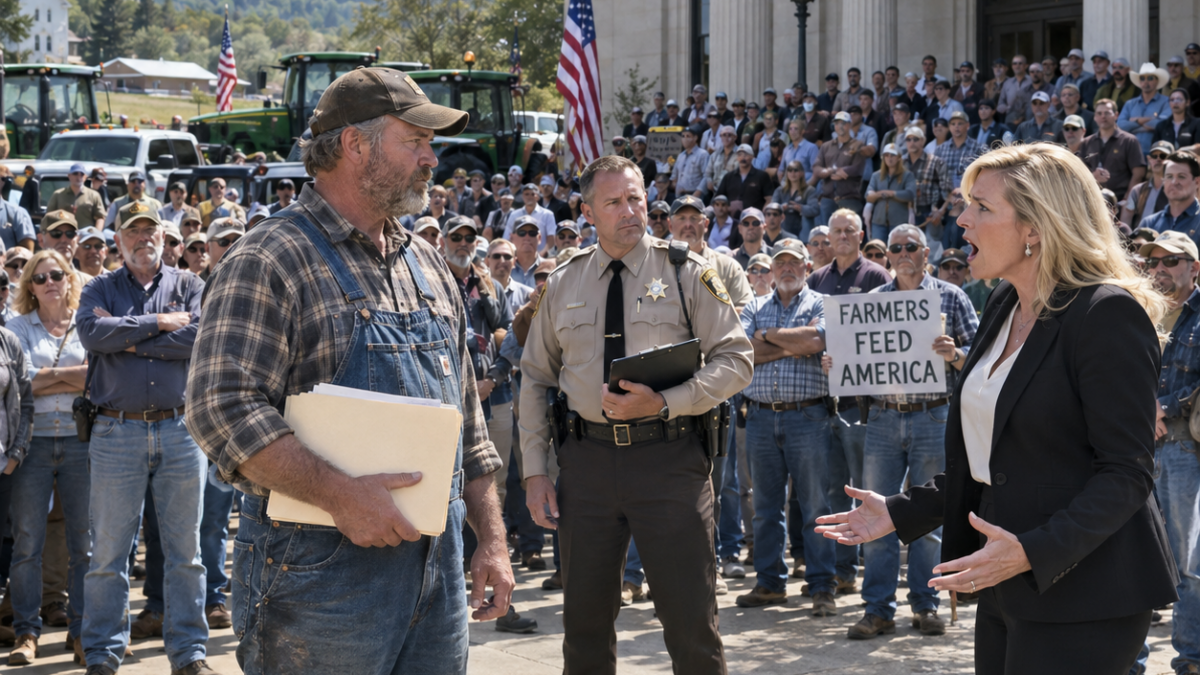
By 6:45, nearly two hundred farmers, farm families, agricultural students, and local supporters had gathered.
The convoy into town was unlike anything I had seen.
It wasn’t a parade.
No signs.
No chanting.
Just truck after truck after truck.
Farm plates.
Mud on tires.
Toolboxes.
Fuel tanks.
Seed-company caps visible through windshields.
A few tractors moved slowly at the legal road speed, with flashing amber lights.
People came out of stores to watch.
At one intersection, an elderly man removed his cap as the vehicles passed.
Sarah saw him.
Her eyes filled.
“You okay?”
She nodded.
“Your dad would have loved this.”
That almost broke me.
Dad had spent his final years worrying that I would never come home for good.
He understood the Army.
He was proud of my service.
But every time I visited, he would walk me along the fields and mention some repair that “might need doing when you’re around more.”
He never asked me to leave the Army.
He didn’t have to.
His hope lived in those conversations.
Now hundreds of people were driving toward town because someone had threatened the thing he trusted me to preserve.
I gripped the steering wheel.
Sarah placed her hand on mine.
“Don’t cry before the hearing.”
“I’m not.”
“You are.”
“Dust.”
“We’re inside a truck.”
“Persistent dust.”
The town hall parking lot held maybe fifty vehicles.
We overwhelmed it immediately.
County staff directed overflow parking onto side streets and a church lot.
By the time Sarah and I climbed the stairs to the hearing room, Karen was already seated in the front.
Cream pantsuit.
Hair perfect.
Professional folders arranged on the table.
Beside her sat a young planning consultant with a laptop.
Behind them were maybe ten Whispering Pines supporters.
Karen saw me enter.
Then she saw Arthur.
Then Rachel.
Then the first wave of farmers.
Her eyes shifted toward the door.
People kept coming.
Every chair filled.
Then the back wall.
Then the side wall.
The hallway.
County staff brought more chairs.
Still not enough.
FFA students took one row.
Farm Bureau members occupied another.
Local farmers stood wherever they could.
Karen whispered to her consultant.
He looked behind him.
His face changed.
I almost felt sorry for him.
Almost.
The five zoning board members entered at 7:29.
Chairman Henderson stopped when he saw the crowd.
He was a tired-looking man in his sixties.
He sat.
Adjusted his microphone.
Looked at the hallway packed with people.
Then said:
“Well.”
A few people laughed.
He banged the gavel.
“We appear to have significant public interest tonight.”
The room settled immediately.
Henderson read the petition number.
“Request by Whispering Pines Homeowners Association to rezone Parcel 7B-4 from A-1 Agricultural to R-2 Residential.”
My parcel sounded clinical when he said it.
A number.
A classification.
I reminded myself that this was exactly why I had to speak.
The consultant went first.
His name was Tyler Reeves.
He was polished.
Prepared.
Good, actually.
I disliked his argument, but not his professionalism.
He presented population growth.
Housing demand.
Tax projections.
Maps.
Renderings.
He repeatedly used the phrase “logical transition.”
The conceptual plan showed five initial homesites beside Whispering Pines.
Then potential future residential expansion.
He called the farm “a low-density land use immediately adjacent to established infrastructure.”
Arthur leaned toward me.
“What does that mean?”
“He doesn’t like corn.”
Arthur grunted.
Tyler concluded with a rendering of a beige house standing exactly where my barn was.
“This proposal offers Brighton County an opportunity to plan proactively for growth rather than react to it later.”
He sat.
Ten people applauded.
The rest of the room remained silent.
Henderson looked at our side.
“Opposition.”
Ben stood.
He walked to the podium.
“My name is Benjamin Carter. I represent Jacob and Sarah Hayes.”
He placed one folder on the lectern.
“I could spend the next twenty minutes discussing statutory standards, comprehensive planning consistency, procedural questions, and agricultural protections.”
Karen shifted.
Ben continued.
“And I will address those matters in the written record.”
He turned slightly toward the crowd.
“But before this board decides what this land should become, it should hear what this land already is.”
Then he sat down.
Simple.
Effective.
Eleanor Vance spoke first.
She didn’t introduce herself initially as Farm Bureau counsel.
“My family has farmed in this state for five generations.”
She looked directly at the board.
“The language used in this petition repeatedly describes agricultural land as underutilized because it lacks houses.”
She held up the consultant report.
“That assumption is economically false and planning-wise dangerous.”
Then she walked through the numbers.
Farm output.
Supply-chain spending.
Tax contribution.
Infrastructure.
She explained how residential development often requires public expenditures not reflected in simplistic revenue estimates.
She did not say houses were bad.
That mattered.
“This is not agriculture versus housing. Counties need both. Good planning means locating each where it can function without destroying the other.”
Then she displayed the 1995 plat note.
The fifty-foot buffer.
“The county already anticipated this conflict.”
Henderson leaned forward.
Eleanor continued.
“When Whispering Pines was approved, the record did not say agricultural land should eventually yield to the subdivision. It required the subdivision to maintain separation from existing agriculture.”
Karen whispered urgently to Tyler.
Eleanor finished.
“Calling a farm incompatible after building homes beside it does not make the farm the planning mistake.”
That line rippled through the room.
Rachel Monroe spoke next.
As a planning commissioner herself, she understood exactly what would matter.
She did not raise her voice.
She dismantled the proposal with a level of calm that was almost cruel.
The requested rezoning contradicted the agricultural preservation language in the master plan.
The projected revenue omitted infrastructure costs.
The proposed residential classification could create greater conflict with nearby agricultural operations.
The petition’s claim of compatibility depended on ignoring the very activities that made the property agricultural.
Then she addressed the word that had bothered me from the beginning.
“Underutilized.”
She looked at Henderson.
“Land is not underutilized merely because somebody can imagine a more intensive use.”
I felt Sarah squeeze my hand.
“An orchard is not underutilized because it could hold apartments. A forest is not underutilized because it could hold a warehouse. And an operating family farm is not underutilized because a developer can draw streets over it.”
Several board members nodded.
Then Bill Crawford spoke about economics.
He had brought actual numbers from my farm.
Seed purchases.
Fuel.
Equipment maintenance.
Feed.
Local labor.
Veterinary expense.
Property tax.
He connected every dollar to local businesses.
“Mr. Hayes is not sitting on one hundred fifty idle acres waiting for somebody to give them purpose.”
He looked at Karen.
“The purpose is agriculture.”
Next came the Right-to-Farm discussion.
Eleanor handled it carefully.
She did not pretend the statute automatically decided the rezoning case.
Instead she explained why the pattern of nuisance complaints mattered.
“The state has long recognized an unavoidable truth. Farming has sounds. Farming has smells. Farming creates dust. Machinery runs early because weather does not wait for suburban schedules.”
She placed our closure reports on the table.
“Each of these complaints was investigated.”
She held up one.
“Runoff.”
Another.
“Smoke.”
Another.
“Equipment noise.”
Another.
“Animal welfare.”
“All closed without finding the alleged violations.”
Karen stared straight ahead.
Eleanor continued.
“When repeated lawful agricultural activity is characterized as nuisance behavior and then that supposed nuisance condition is used to argue agriculture no longer belongs here, the board should examine that pattern very carefully.”
She sat.
Arthur whispered:
“That woman could cross-examine the devil.”
“Devil would settle.”
Then Henderson called my name.
My legs felt heavier than they had all evening.
I had briefed generals.
Spoken to soldiers before deployments.
Given statements after incidents where people had died.
Yet walking toward that county podium frightened me.
Because this wasn’t the Army.
If I failed there, I couldn’t rotate home afterward.
This was home.
I placed both hands on the lectern.
“My name is Jacob Hayes.”
My voice sounded strange in the microphone.
“That parcel number you’ve been discussing belongs to my family.”
I looked at Henderson.
“My great-grandfather bought the farm in 1922.”
I told them about Samuel Hayes clearing fields behind a mule.
My grandfather surviving the Depression.
My father teaching me to drive a tractor before my feet comfortably reached the pedals.
A few people smiled.
I told them about leaving.
Joining the Army.
Three deployments.
Phone calls home.
Dad getting older.
Every visit revealing one more fence he could no longer repair alone.
“I spent a lot of years living wherever the government told me to live.”
I looked at Sarah.
“My wife spent those same years making whatever temporary place we were in feel like home.”
Her eyes filled.
“When my father died, I came back here for good.”
I paused.
“I didn’t come back because farming was easy.”
A few farmers laughed.
“I came back because this land was the one place in my life that had never moved.”
My throat tightened.
I looked down.
Then continued.
“The petition describes it as underutilized.”
I let that word sit.
“There are mornings I start work before sunrise and come inside after dark. My wife would like the zoning consultant to explain which part is underutilized.”
Laughter moved through the room.
Even Henderson smiled.
I turned serious again.
“I understand people need houses.”
I looked directly toward the Whispering Pines residents.
“I don’t hate your subdivision.”
Karen shifted.
“I don’t hate the families who live there. Most of them have never done anything to me.”
That distinction mattered.
“This isn’t farmers against homeowners.”
Then I looked at Karen.
“It is about whether someone who does not own your land gets to decide your land has more value serving their plan than your life.”
Silence.
“For months, my wife and I have received complaints about ordinary farm activity.”
I listed them.
Horse odor.
Dust.
Truck noise.
Tractor noise.
Runoff.
Burning.
Mud.
I held up the closure reports.
“Every one investigated.”
I placed them down.
“Every one dismissed.”
Then I said the sentence I had not planned.
“Three weeks ago, my wife told me she had started wondering whether we should sell part of the farm just to make the harassment stop.”
Sarah looked at me.
The room went completely still.
“I was angrier hearing that than I was when I saw survey stakes inside our fence.”
My voice broke.
I didn’t hide it.
“Because that is how this works.”
I looked at the board.
“You don’t always have to take land from someone.”
I swallowed.
“Sometimes you just make keeping it hurt enough that they hand it over themselves.”
Karen’s face went rigid.
I stepped back from the podium.
“I am asking you to deny this petition.”
Then I added:
“Not because my family has been here a hundred years.”
A pause.
“Deny it because the land is still doing exactly what agricultural zoning says it is supposed to do.”
I returned to my seat.
Sarah grabbed my hand.
“That was good.”
“I forgot half of what I planned.”
“That’s why it was good.”
Arthur was last.
He walked slowly toward the podium.
At seventy-eight, he had no interest in presentation strategy.
He didn’t open documents.
He didn’t cite statutes.
He looked at the board.
“I’ve lived on Old County Road since 1948.”
Somebody whispered, “Good Lord.”
Arthur glanced toward the voice.
“So yes, I’m old.”
Laughter broke the tension.
Then he continued.
“I have watched this county change.”
His rough hands rested on the podium.
“Some changes were good. Roads got better. Schools got better. Ambulances got faster.”
He looked toward the Whispering Pines section.
“People need homes. Farmers need customers. We are not enemies.”
Then his eyes moved to Karen.
“But being a neighbor means understanding there is a line between your place and mine.”
His voice grew stronger.
“When Whispering Pines was built, we welcomed people.”
He pointed toward himself.
“We slowed tractors when kids were walking.”
Toward the Millers.
“We changed hauling routes when school buses needed room.”
Toward me.
“Jake built a tire wash so he wouldn’t leave mud on the road.”
Then Karen.
“What did we get back?”
Nobody moved.
“Complaints because tractors sound like tractors.”
A murmur.
“Complaints because cows smell like cows.”
More murmuring.
“Complaints because fields have dust.”
His weathered finger tapped the lectern.
“You can’t move to farm country and then demand the farms apologize for being there.”
Applause started.
Henderson raised his gavel.
Arthur lifted his hand.
The applause stopped before Henderson had to strike.
Then Arthur said:
“Mrs. Karen thinks this fight is about Jake’s hundred fifty acres.”
He shook his head.
“It isn’t.”
He turned toward the room.
Every farmer was watching him.
“It’s about whether any of us can keep doing this if enough houses get built beside us and one person with enough paperwork decides we’ve become inconvenient.”
He faced the board again.
“We’ve always tried to be good neighbors.”
His voice softened.
“All we’re asking is that good neighbor work both ways.”
Then he sat.
The room erupted.
This time Henderson did strike the gavel.
Twice.
“Order.”
Applause continued.
Three times.
“Ladies and gentlemen.”
Gradually the room settled.
Henderson looked toward Karen’s consultant.
“Rebuttal?”
Tyler stood.
For the first time all evening, he looked unsure.
“We continue to believe the proposed classification represents a reasonable long-term transition—”
Henderson interrupted.
“Who owns the property?”
Tyler stopped.
“Mr. Hayes.”
“Does Mr. Hayes support rezoning?”
“No.”
“Is there a purchase contract?”
“Not to my knowledge.”
“Development option?”
“I don’t believe so.”
Henderson looked toward Karen.
“Then why is an HOA spending resources attempting to increase residential development potential on land it neither owns nor controls?”
Karen stood.
“Because what happens on that property directly affects our residents.”
Henderson leaned back.
“Explain.”
“The farm creates noise.”
Someone groaned.
Henderson raised a hand.
Karen continued.
“Dust. Agricultural traffic. Odors. It affects quality of life and property value.”
Eleanor closed her eyes.
Karen realized too late what she had just done.
Henderson glanced at the stack of dismissed complaints.
“So the incompatibility your petition seeks to solve consists substantially of ordinary agricultural activity?”
Karen stiffened.
“I wouldn’t characterize it that way.”
“You just did.”
Her face reddened.
“We are trying to create a more harmonious use.”
Mrs. Gable, one of the zoning board members, leaned toward her microphone.
“Mrs. Karen, when you purchased your home, was Mr. Hayes’s farm already operating?”
“I don’t see how—”
“Yes or no?”
“Yes.”
“Was it hidden?”
A few laughs.
“No.”
“Did the seller disclose nearby agricultural land?”
“I would have to check.”
Mrs. Gable looked at the plat.
“The barn appears visible from the subdivision entrance.”
Karen didn’t answer.
Another board member, Tom Reynolds, owned a construction company.
“I build houses.”
Karen brightened slightly, perhaps thinking she had found an ally.
Reynolds continued.
“I am generally supportive of development where it makes sense.”
Her expression relaxed.
Then he said:
“This does not.”
The relaxation vanished.
He pointed toward Rachel’s report.
“We already have areas in this county identified for residential expansion.”
Then toward my farm.
“This is designated agricultural preservation.”
He turned to Tyler.
“Why would we leapfrog existing planned growth areas and create a new residential edge against an active farm?”
Tyler tried to answer.
“Existing infrastructure—”
“The road is two lanes.”
“Yes, but—”
“Water?”
“Extensions would be needed.”
“Sewer?”
“Potential extension.”
“Stormwater?”
“Would require design.”
Reynolds shook his head.
“So when you say existing infrastructure, you mean the subdivision exists nearby.”
Tyler sat down.
Henderson looked over the room.
“Any further board discussion?”
Mrs. Gable spoke.
“I have one.”
She faced me.
“Mr. Hayes, are you currently under any county enforcement order related to the complaints discussed tonight?”
“No, ma’am.”
“Any outstanding environmental violation?”
“No.”
“Animal welfare violation?”
“No.”
“Road violation?”
“No.”
“Noise citation?”
“No.”
She nodded.
Then she faced Karen.
“I find the timing troubling.”
Karen’s attorney or consultant whispered to her.
She stood again.
“Are you accusing me of filing anonymous complaints?”
Mrs. Gable remained calm.
“I did not say that.”
“Because there is no proof I did.”
Henderson stared at her.
“That is an unusually specific defense to a question nobody asked.”
A ripple of laughter moved through the crowd.
Karen sat abruptly.
I remembered my conversation beside the tractor.
Same mistake.
She had spent so long controlling conversations that she no longer noticed when fear made her answer accusations before they were spoken.
Henderson folded his hands.
“I want to say something before we vote.”
The room quieted.
“I have served on this board twelve years.”
He looked toward the farmers.
“Brighton County is changing.”
Then toward Whispering Pines.
“That is not automatically bad.”
Karen straightened slightly.
“Growth brings jobs. Housing. Revenue. New families.”
Then he turned toward me.
“But good planning is not the same as replacing every lower-density use with a higher-density one.”
He lifted the original subdivision plat.
“This document required separation between Whispering Pines and the Hayes farm for a reason.”
Then the master plan.
“This plan identifies agriculture as an economic and cultural asset.”
Then the complaint reports.
“And this record shows repeated allegations involving ordinary agricultural operations that did not result in enforcement.”
His expression hardened.
“I am deeply uncomfortable using those same agricultural characteristics as justification for converting the agricultural land itself.”
He looked at the board.
“Motion?”
Mrs. Gable spoke immediately.
“I move to recommend denial of Petition Z-23-14.”
Reynolds:
“Second.”
My heart began pounding.
Henderson called the vote.
Mrs. Gable.
“Deny.”
Reynolds.
“Deny.”
Third member.
“Deny.”
Fourth.
“Deny.”
Henderson looked toward the crowd.
Then toward Karen.
“Deny.”
Five to zero.
For half a second there was no sound.
I think nobody trusted what they had heard.
Then Henderson struck the gavel.
“Petition denied.”
The room exploded.
People stood.
Farmers slapped one another on the back.
FFA students cheered.
Arthur shouted something I couldn’t understand.
Sarah wrapped both arms around me.
I felt her crying against my shoulder.
“We did it.”
I held her.
“We did.”
“No.”
She pulled back and looked at the room.
“Look.”
I did.
Nearly two hundred people.
Some I knew.
Many I didn’t.
They had driven hours.
Closed barns early.
Changed feeding schedules.
Left equipment sitting.
All to make sure one farm didn’t stand alone.
Frank Miller reached us and grabbed my hand.
“Henderson still has to follow the formal process, but that was as clear as it gets.”
I could barely speak.
“Thank you.”
He shook his head.
“Don’t thank me. Remember it.”
“What?”
“The next farmer.”
That became the most important thing anyone said all night.
Across the room, Karen was gathering her papers.
Her supporters had vanished quickly.
Tyler closed his laptop.
They had to pass through the same doorway as everyone else.
The crowd parted.
Nobody shouted.
Nobody cursed.
Nobody touched her.
That made the walk worse.
Two hundred people simply watched.
Karen’s eyes remained forward.
As she passed me, she stopped.
For a moment I thought she would say something.
Her lips tightened.
Then she kept walking.
Arthur came beside me.
“You look disappointed.”
“I’m not.”
“You wanted a speech.”
“No.”
“You wanted her to admit she lost.”
I looked toward the door.
“No.”
Arthur smiled.
“Good. Because people like that don’t lose in their own minds.”
The local newspaper story appeared the next morning.
FARMERS PACK ZONING HEARING; BOARD UNANIMOUSLY REJECTS WHISPERING PINES PETITION
The agricultural paper was less restrained.
Its article focused on residential encroachment and farming rights.
It quoted Arthur.
It quoted Eleanor.
It quoted my statement about making land painful enough that owners surrender.
By noon, my phone had thirty-seven messages.
Farmers.
Reporters.
People I had served with.
My son called.
“Dad.”
“Morning.”
“Why are you on the internet surrounded by approximately every farmer in America?”
“Your mother invited them.”
Sarah shouted from the kitchen:
“Do not blame me.”
My son laughed.
Then his voice softened.
“Grandpa would be proud.”
I looked toward Dad’s old chair.
“Yeah.”
“I mean it.”
“I know.”
“Are you okay?”
“We won.”
“That wasn’t my question.”
I thought about it.
“For the first time in months, yes.”
But winning the rezoning hearing did not end everything.
Ben had warned me about that.
Two days later, he mailed a formal cease-and-desist demand to Whispering Pines.
It documented the pattern of complaints.
The attempted survey entry.
The zoning campaign.
It demanded an end to interference and preservation of records related to the rezoning effort and complaints.
More importantly, it put the HOA board on notice that continued conduct could trigger civil litigation.
The letter changed the fight.
Until then, many Whispering Pines residents had only heard Karen’s version.
According to her, she was protecting home values from an irresponsible neighboring farmer.
Now residents began asking questions.
How much had the zoning consultant cost?
Who approved his contract?
Who paid for the renderings?
Who authorized legal fees?
Why was the HOA spending dues trying to rezone land the HOA did not own?
A Whispering Pines homeowner named David Lang called me.
I didn’t know him.
“Mr. Hayes?”
“Yes.”
“I live on Pine Hollow Drive.”
“I’m sorry.”
He laughed nervously.
“Fair.”
“What can I do for you?”
“I want to apologize.”
“You didn’t file the petition.”
“No.”
“Then why apologize?”
“Because I didn’t ask questions.”
I stayed quiet.
He continued.
“Karen told us the farm was for sale.”
My hand tightened around the phone.
“What?”
“She said the owner was considering development but refusing to cooperate with the community.”
“I have never offered that farm for sale.”
“I know that now.”
“Did she say I had?”
“She implied it repeatedly.”
That was new.
David continued.
“A lot of us thought the rezoning was preliminary planning for something you eventually wanted.”
“Why would I fight it?”
“She told people you were being difficult because you wanted more money.”
For several seconds I couldn’t speak.
That explained something.
Karen needed homeowners to support spending HOA money on a petition involving land outside the association.
So she had framed me not as a farmer refusing development, but as an owner negotiating from greed.
“Do you have any of that in writing?”
“I have emails.”
“Send them to my lawyer.”
A pause.
“You’re going to sue?”
“I don’t know.”
That was true.
“Send them to Ben Carter.”
Within days, the emails spread inside Whispering Pines.
Not publicly.
Among residents.
One message from Karen described me as “likely to become more cooperative after zoning approval increases his options.”
Another said the HOA needed to “control the narrative before Hayes begins making unreasonable financial demands.”
I had never demanded a dollar.
The residents were furious.
Then somebody leaked the HOA budget.
Thousands had been spent on the zoning consultant.
Legal review.
Printing.
Meeting expenses.
Planning work.
The amount was not enough to bankrupt the association.
But that wasn’t the problem.
The problem was consent.
People paying monthly dues for pools, landscaping, road islands, and common areas discovered their money had funded Karen’s personal land-use campaign.
David called again.
“We’re calling a special meeting.”
“We?”
“Homeowners.”
“About me?”
“No.”
That answer pleased me.
“About us.”
I declined an invitation to attend.
Sarah was surprised.
“You don’t want to see it?”
“No.”
“You’ve spent months wanting accountability.”
“Accountability doesn’t require me sitting there.”
She smiled.
“Look at you being emotionally healthy.”
“Don’t spread it around.”
The meeting happened Tuesday night.
David called afterward.
His voice sounded exhausted.
“How bad?”
He laughed once.
“You ever seen two hundred middle-class suburban adults discover their dues paid for something they hate?”
“No.”
“Be grateful.”
Karen apparently opened with a thirty-minute defense.
She called the hearing unfair.
Claimed Farm Bureau had intimidated the board.
Accused outsiders of hijacking local government.
Called me “a professional victim.”
Then residents began asking questions.
Had the board voted to authorize the rezoning petition?
Yes.
Were homeowners told?
No.
How much was spent?
Karen initially refused to say.
The treasurer eventually answered.
Why had homeowners been told I was interested in development?
Karen said that was a “reasonable inference.”
David asked:
“Based on what?”
She had no answer.
Then Margaret Ellis, a retired accountant who had lived in Whispering Pines fifteen years, introduced a motion.
Independent audit of five years of HOA finances.
Karen objected.
Motion seconded.
Vote.
Passed overwhelmingly.
Then David introduced a motion to remove Karen as president pending the audit.
Her two loyal board members tried procedural maneuvers.
Residents shouted them down.
The bylaws were pulled up.
Rules read aloud.
The vote happened.
Karen lost.
Not by one vote.
Not closely.
She was removed by a margin so wide David stopped counting after it became mathematically impossible for her to survive.
Sarah listened on speakerphone.
When David finished, she asked:
“What did Karen do?”
“Stood there.”
“Nothing else?”
“She kept saying people would regret this.”
I looked at Sarah.
She raised an eyebrow.
David continued.
“Then she picked up her binder and left.”
Her binder.
Of course.
A week later, a letter arrived.
Whispering Pines letterhead.
Signed by David Lang, Interim President.
I opened it on the porch.
Sarah read beside me.
It was short.
The association apologized for the previous board’s conduct toward our family.
All pending complaints or demands directed by the HOA would be withdrawn.
The new board would not participate in further efforts to alter the zoning of our property without our request.
Policies were being revised so extraordinary expenditures required broader board approval and clearer homeowner disclosure.
At the bottom, David had written by hand:
We moved next to a farm. The farm did not move next to us. We intend to start acting like neighbors who remember that.
Sarah read it twice.
Then she handed it back.
“Frame that.”
“You’re serious?”
“Yes.”
“We don’t frame HOA letters.”
“We do now.”
It went on the mantel.
Next to a photograph of Dad.
The audit took two months.
It found no dramatic theft.
No secret offshore account.
No embezzled millions.
Real life is usually less cinematic than people hope.
But it found something more believable.
Sloppy governance.
Unauthorized spending.
Consulting contracts initiated without adequate review.
Legal expenditures driven by Karen’s personal priorities.
Association resources used for campaigns only loosely connected to the HOA’s actual responsibilities.
Her two closest board allies resigned before the final report was presented.
Karen stopped attending meetings entirely.
Then one afternoon, I was repairing the same section of fence where the surveyors had stood.
An oversized SUV slowed on the county road.
Karen.
I recognized it immediately.
She stopped.
The passenger window lowered.
For a second neither of us spoke.
I leaned on the post driver.
She looked different.
Tired.
Less polished.
“You got what you wanted.”
I wiped sweat from my forehead.
“What did I want?”
“You know exactly what.”
“My farm?”
Her eyes flashed.
“You humiliated me.”
“I didn’t remove you.”
“You brought those people.”
“Farm Bureau brought farmers.”
“You called them.”
“Yes.”
“You made me look like a monster.”
I took a slow breath.
This was the conversation I had imagined for months.
In those fantasies, I always delivered the perfect line.
Something devastating.
Something she would remember forever.
But standing there, looking at her, I didn’t feel triumphant.
I felt tired.
“You did that yourself.”
She stared.
“You could have handled this privately.”
“I tried ignoring you.”
“You embarrassed Whispering Pines in front of the county.”
“You petitioned the county.”
Her mouth tightened.
“You don’t understand what I was trying to do.”
“Then explain it.”
That surprised her.
She opened the door and stepped out.
For the first time, we stood near the property line without a clipboard between us.
“Whispering Pines is changing.”
“So is everything.”
“Property values matter.”
“I agree.”
“People paid a lot to live there.”
“I know.”
“They shouldn’t have to look out their windows at old farm equipment.”
I almost laughed.
Instead I asked:
“What did they think they were moving beside?”
Her face hardened.
“You could modernize.”
“We have.”
“That barn is sixty years old.”
“It still works.”
“The fence is ugly.”
“It holds cattle.”
“You don’t even have cattle right now.”
“It still holds the possibility.”
She shook her head.
“This is exactly what I mean. You cling to everything because it’s old.”
There was the real conflict.
Not zoning.
Not law.
Worldview.
Karen believed old meant obsolete unless converted into something cleaner.
More controlled.
More uniform.
I looked across the field.
“Do you know why that fence line curves near the creek?”
She frowned.
“What?”
“You think it’s badly laid out.”
“I didn’t say—”
“It is.”
I pointed.
“My great-grandfather built around a stand of oaks because my great-grandmother liked them.”
Karen followed my finger.
Only two of the original trees remained.
“That barn sits where it does because there used to be a spring fifty yards below it.”
She said nothing.
“The upper pasture is narrow because my grandfather refused to plow the hillside after a neighbor lost soil in a flood.”
I pointed toward the old farmhouse.
“And the porch faces west because my mother liked sunsets.”
Karen looked at me.
“What does any of that have to do with zoning?”
“Everything.”
I rested my hands on the post driver.
“You see inefficiency.”
I looked across the land.
“I see decisions.”
She crossed her arms.
“Sentiment doesn’t pay taxes.”
“No.”
I met her eyes.
“Soybeans do.”
That finally made her look away.
I continued.
“You keep saying you wanted progress.”
“I did.”
“No. You wanted control over what progress looked like.”
Her head snapped back.
“And you think farmers don’t control things?”
“Of course we do.”
“Then what makes you different?”
I thought about it.
“The property line.”
She frowned.
“I control what happens on my side.”
I pointed toward Whispering Pines.
“You control what happens on yours, within whatever authority the people there give you.”
Then I touched the fence.
“This is where both stop.”
She stood there for several seconds.
Then she said quietly:
“They voted me out.”
“I heard.”
“People I helped.”
I didn’t respond.
“When the pool needed repairs, I handled it.”
“I believe you.”
“When the management company missed bills, I fixed it.”
“I believe you.”
“When people fought over parking, dogs, fences, I was the one they called.”
For the first time, Karen sounded less like a villain and more like a woman explaining how she had become one.
“Eventually everybody expected me to solve everything.”
“That happens.”
“You don’t understand.”
“Maybe I do.”
Her eyes narrowed.
“In the Army, responsibility can become authority very quickly.”
She waited.
“And authority can become identity if you’re not careful.”
I thought of officers I had known.
Some excellent.
Some ruined by the idea that rank proved wisdom.
“Maybe people depended on you.”
I said it carefully.
“Maybe you did good things.”
She seemed almost startled by the concession.
“But somewhere along the way, you stopped hearing no.”
Her face closed again.
“You still think this is all my fault.”
“No.”
That surprised her.
I continued.
“Your board approved things.”
She listened.
“Residents ignored things until they affected them.”
A pause.
“County employees processed complaints.”
Another.
“And I ignored your early letters because I assumed you were just annoying.”
She looked at me.
“But none of that makes the rezoning my fault.”
Silence stretched between us.
A car passed on the county road.
Karen finally looked toward the pasture.
“What happens now?”
“To what?”
“The farm.”
“Same thing that was going to happen before.”
“What?”
“I farm it.”
She laughed once.
Not happily.
“All of that for nothing.”
“No.”
“For you to just keep doing exactly what you were doing.”
“That was the point.”
She stared at me.
Then she returned to her SUV.
Before opening the door, she turned.
“People say you saved the farms around here.”
“They’re exaggerating.”
“You like that they say it.”
I thought about Frank’s words.
Remember the next farmer.
“No.”
I looked at her.
“I like that they showed up.”
She drove away.
I never saw her again.
Her house went on the market before winter.
A young family bought it.
The father, Ryan, drove over in an old pickup one Saturday.
His daughter was with him.
Maybe eight.
They found me near the equipment barn.
“You Mr. Hayes?”
“Depends.”
He smiled.
“I’m Ryan Cooper. We bought the house on Pine Ridge.”
“Karen’s old place.”
His smile became awkward.
“Yeah.”
“Welcome.”
We shook hands.
His daughter was staring at the tractor.
“Can she see it?”
“Sure.”
The girl walked around the machine in awe.
Ryan lowered his voice.
“I’ve heard stories.”
“I imagine.”
“People keep telling me you hate the HOA.”
“I don’t hate the HOA.”
He seemed surprised.
“I thought—”
“I dislike people using organizations as weapons.”
“That sounds reasonable.”
“Most reasonable things sound boring.”
He looked toward the fields.
“We moved here because my wife wanted our kids around open land.”
I laughed.
“What?”
“That’s almost too perfect.”
“What is?”
“Nothing.”
His daughter called:
“Dad! Look how big the tire is!”
Ryan smiled.
“We’re not going to complain about tractors.”
“Give it a year.”
“No.”
“When harvest starts at six in the morning?”
He hesitated.
“We’ll buy earplugs.”
“That’ll work.”
The months that followed were the quietest we had experienced since coming home.
No inspectors.
No anonymous complaint notices.
No threatening letters.
No planning maps.
Just farming.
Arthur started visiting more often.
He usually arrived around four.
Never called first.
Never brought anything.
Always expected iced tea.
One afternoon he sat on the porch staring across the field.
“You know what you did wrong?”
I looked at him.
“Good afternoon to you too.”
“You waited too long to call Farm Bureau.”
“I didn’t know I needed them.”
“You always need somebody.”
“That sounds pessimistic.”
“That’s farming.”
He sipped tea.
“Storm comes, neighbor helps with fence.”
Another sip.
“Combine breaks, somebody loans one.”
He pointed toward Whispering Pines.
“Crazy woman attacks your zoning, two hundred farmers appear.”
“Normal community process.”
“Exactly.”
Sarah came outside.
“Arthur, are you teaching my husband humility?”
“Trying.”
“He’s a slow student.”
Arthur nodded gravely.
“Veteran.”
I threw a napkin at him.
The Millers began leaving eggs on our porch.
The Garcias helped when a storm dropped a tree across the access road.
Ryan from Karen’s old house started buying hay from Arthur for his daughter’s new pony.
Whispering Pines held a fall picnic and invited surrounding landowners.
I refused.
Sarah accepted for both of us.
“We are going.”
“I have work.”
“You always have work.”
“Exactly.”
“We’re going.”
“Why?”
“Because David wrote us an apology.”
“We accepted it.”
“Now we behave like neighbors.”
“That sounds exhausting.”
She smiled.
“Wear clean boots.”
The picnic was strange at first.
People knew who I was.
Several homeowners approached to apologize.
I kept telling them the same thing.
“You didn’t do it.”
One older man shook his head.
“We let her.”
That echoed Frank’s later insight from my previous fight? No, different story. Here, it was its own truth.
“She ran unopposed for six years,” he said.
“Why?”
“Nobody wanted the job.”
“Then maybe that was the problem.”
He nodded.
“We gave her authority because responsibility was inconvenient.”
That sentence stayed with me.
The new HOA board changed several policies.
Extraordinary legal spending required full board approval.
Major external land-use positions required homeowner notice.
Anonymous complaints made in the association’s name were prohibited without documented board authorization.
The HOA still had rules.
Still sent letters.
Still argued over landscaping.
That was fine.
It wasn’t my community.
But it became less interested in expanding its authority beyond its boundary.
The county changed too.
The zoning board requested staff develop clearer procedures for third-party rezoning petitions involving active agricultural land.
The planning department began flagging Right-to-Farm considerations earlier in development review.
None of this bore my name.
I preferred it that way.
The point wasn’t building a monument to the fight.
The point was making the next fight less necessary.
Frank Miller invited me to speak at a Farm Bureau meeting the following spring.
I said no.
He called again.
“No.”
Third time.
“Frank.”
“Twenty minutes.”
“I hate speeches.”
“You spoke at a zoning hearing.”
“I was angry.”
“I can arrange that.”
I went.
There were farmers from six counties.
Some facing subdivisions.
Some dealing with road expansion.
Some worried about utility easements.
I stood at the front feeling ridiculous.
“I don’t have much advice.”
Frank shouted from the back:
“That’s never stopped anybody speaking at Farm Bureau.”
Laughter.
I continued.
“Document everything.”
People nodded.
“Don’t assume because a complaint is ridiculous that you can ignore the paper trail.”
More nodding.
“Know your county plan.”
That got less enthusiasm.
“I know. It’s boring.”
A man shouted:
“Very.”
“Read it anyway.”
Then I told them the thing I had learned too late.
“Don’t wait until you’re desperate to meet your neighbors.”
The room quieted.
“Arthur Hemlock lived half a mile from me for years. I barely knew him.”
Arthur, sitting in front, muttered:
“Blessing.”
People laughed.
I continued.
“Karen’s greatest advantage was that she fought each of us separately.”
I looked around.
“Her greatest mistake was giving us a reason to compare notes.”
Afterward, a young farmer approached.
Maybe twenty-eight.
His family ran a dairy near a growing suburb.
“We’re getting noise complaints.”
“What time?”
“Four-thirty milking.”
“Document.”
“We do.”
“Talk to your county Farm Bureau.”
He nodded.
“I already did.”
“Good.”
He hesitated.
“You think it’ll get as bad as yours?”
“I hope not.”
“What if it does?”
I remembered Frank.
Remember the next farmer.
I took out my phone.
“Give me your number.”
A year after the hearing, harvest came early.
The soybeans were ready.
My son took leave and came home for four days.
The moment he arrived, Sarah hugged him.
Then put him to work.
“You’ve been home thirty minutes,” he complained.
“You’re taller than your father. Reach that.”
I objected.
“I am not shorter.”
Both of them looked at me.
“Traitors.”
That afternoon my son rode with me in the combine.
He had seen the news stories.
He had watched clips from the hearing.
But he had missed the actual conflict.
“So where were the houses supposed to go?”
I pointed.
“South field.”
He stared through the glass.
“All that?”
“Eventually.”
“And the road?”
“Across the orchard.”
He shook his head.
“Grandpa would have lost his mind.”
“Yes.”
“He hated people driving across fields.”
“He hated people driving anywhere they could walk.”
My son smiled.
Then became serious.
“Were you scared?”
“No.”
He looked at me.
I corrected myself.
“Yes.”
“About losing?”
“About Sarah.”
“Mom?”
“She started wondering if selling would be easier.”
He was quiet.
“That bad?”
“That bad.”
The combine moved through the rows.
Then he asked:
“What would you have done if the board approved it?”
“Appealed.”
“And if you lost?”
“Kept fighting.”
“And if you lost that?”
I looked across the farm.
“I don’t know.”
For years, I had tried to give my son confident answers.
Fatherhood makes you want to sound certain.
Age teaches you that honesty is usually more useful.
“I might have sold part.”
He looked shocked.
“You?”
“I’m not a movie character.”
I smiled.
“Everybody has a limit.”
“What stopped you reaching yours?”
I thought about the hearing room.
Arthur.
Sarah.
Frank.
Eleanor.
The farmers filling the hallway.
“Other people carried some of it.”
He nodded slowly.
“That’s kind of what the Army is.”
“What?”
“Nobody carrying everything alone.”
I looked at him.
“When did you become philosophical?”
“Probably when you stopped paying my rent.”
That was my son.
That evening Sarah joined us on the hill.
Harvest dust hung golden in the sunset.
The fields looked different after a crop came off.
Bare.
Honest.
Sarah slipped her arm through mine.
“One year.”
“Since?”
“The hearing.”
I hadn’t realized.
Our son was already walking toward the house.
Sarah leaned against me.
“Do you miss it?”
“The hearing?”
“The fight.”
I looked at her as though she had asked whether I missed kidney stones.
“No.”
“You seemed very alive.”
“I was furious.”
“Same facial expression sometimes.”
I laughed.
Then she said:
“You know what I remember?”
“What?”
“The orange flag.”
I remembered too.
Karen standing in the field.
Surveyor’s hammer.
Orange plastic fluttering beside my great-grandfather’s stones.
“I still have it.”
Sarah turned.
“You do?”
“In the workshop.”
“Why?”
I thought about that.
At first I had kept it as evidence.
Then as a trophy.
Eventually it became something else.
“Reminder.”
“Of Karen?”
“No.”
I looked at the farm.
“Of how close you can come to losing something before you understand how many people care whether you keep it.”
Sarah rested her head against my shoulder.
“It’s quiet.”
I listened.
A distant tractor.
Crickets.
A dog barking from Whispering Pines.
“Hard-won quiet.”
She smiled.
Weeks later, Arthur died.
Not dramatically.
Not because of the fight.
He went to bed one November night and didn’t wake up.
His daughter called me.
I sat in the kitchen after hanging up.
Sarah knew from my face.
“Arthur?”
I nodded.
The funeral filled a rural church.
Farmers stood along the walls.
His old Chevy sat outside.
Someone had washed it.
Probably for the first time in decades.
During the service, his daughter told a story about him teaching her to drive.
Another person talked about storms.
Then the pastor asked whether anyone else wanted to say something.
I had no intention of standing.
Then I did.
I walked to the front.
Arthur’s boots were placed beside the casket.
His family had done that because he hated dress shoes.
I looked at them.
“I didn’t know Arthur well enough for most of my life.”
My voice sounded too loud.
“We were neighbors.”
I paused.
“And sometimes neighbors confuse proximity with relationship.”
People listened.
“When my farm was threatened, Arthur didn’t ask whether I had helped him enough in the past.”
My throat tightened.
“He didn’t ask whether I deserved his time.”
I looked at his daughter.
“He just showed up.”
I told them about his porch.
The peas.
His warning.
His speech at the hearing.
Then I repeated his line.
“We are the roots of this community, and we will not be poisoned.”
Several people cried.
So did I.
At the cemetery, Frank Miller found me.
“Hell of a man.”
“Yes.”
“He would have liked that speech.”
“No.”
Frank smiled.
“You’re right. He would have complained it was too long.”
A week later, Arthur’s daughter came to my farm.
She brought his old Farm Bureau cap.
“He wanted you to have this.”
I held it.
The brim was sweat-stained.
Faded.
Worth nothing.
I couldn’t speak.
“He wrote a note.”
She handed me a folded piece of paper.
Arthur’s handwriting was terrible.
Jake — Stop trying to fight everything yourself. Makes the rest of us look lazy. — Arthur
I laughed and cried at the same time.
The cap went beside David’s apology letter on the mantel.
Sarah looked at the arrangement.
“Your décor is getting strange.”
“It’s historical.”
“It’s an HOA letter and a dirty hat.”
“Artifacts.”
She smiled.
The following spring, Arthur’s granddaughter decided to lease most of his land to a young farmer instead of selling to developers.
Whispering Pines residents attended the county hearing supporting the agricultural lease and preservation plan.
David called me afterward.
“You would have enjoyed this.”
“What happened?”
“One of our residents stood up and said development should respect existing farms.”
I laughed.
“Did lightning strike?”
“Almost.”
Then he added:
“Things really did change.”
They had.
Not completely.
No community becomes perfect.
People still complained.
Farmers still got angry.
Suburban residents still got stuck behind tractors and cursed us.
Farmers still complained about suburban traffic.
Dogs barked.
Roosters escaped.
Teenagers played music too loudly.
Life remained messy.
That was the point.
Karen had believed community required making everything neat enough to control.
The rest of us eventually learned something better.
Community survives because people tolerate a certain amount of one another’s mess.
Years later, I drove past Whispering Pines and saw children standing at the fence watching a combine work.
Ryan Cooper was with them.
Karen’s old house sat behind him.
He waved.
I stopped the tractor.
One boy shouted:
“How much does that thing cost?”
“More than your first car.”
“How fast does it go?”
“Slower than your first car.”
They laughed.
Ryan walked closer.
“Hope we’re not bothering you.”
“No.”
“My daughter wanted to show her friends.”
I looked at the kids.
“Want to see the cab?”
Their faces lit up.
Ryan hesitated.
“Is that okay?”
“Sure.”
One at a time, they climbed up.
I showed them the controls.
Explained what the machine did.
A little girl asked:
“Do you make the food?”
“Some of it.”
“All of it?”
“No.”
“What happens after you grow it?”
That became a twenty-minute lesson about grain elevators, processors, feed, markets, and weather.
When they climbed down, Ryan stayed.
“You know Karen used to complain when your equipment came near the road.”
“I remember.”
“My daughter thinks harvest is the best part of living here.”
I looked toward the children.
“That’s better.”
Ryan nodded.
“We moved here for the country.”
“You moved into a subdivision.”
“Country-adjacent.”
I laughed.
“Fair.”
As I drove back toward the barn, I thought about how close those children had come to seeing houses there instead.
A different road.
Different fences.
Different horizon.
Maybe that wouldn’t have been evil.
Housing matters.
Families need places to live.
But not every field is simply a house waiting for permission.
That was the lesson Karen never understood.
Value is not always measured by what else something could become.
Sometimes value is what it already is.
The farm stayed A-1.
We expanded the soybean rotation.
Added more hay acreage.
Sarah got another horse, allegedly because Daisy needed companionship and not because Sarah had become dangerously comfortable ordering tack online.
The old barn received a new roof.
I replaced sections of fence.
Not with white vinyl.
Arthur would have haunted me.
The original stone markers remained untouched.
One afternoon I found the orange survey flag in my workshop drawer.
Sunlight came through the window.
The plastic had faded.
I carried it outside.
For years I had imagined displaying it somewhere.
Maybe framing it.
Instead I walked to the burn barrel.
Then stopped.
I thought about the inspectors.
Sharon asking whether I was hiding a chemistry lab.
The animal-control officer feeding Daisy carrots.
The garbage truck measuring louder than my tractor.
The two hundred people walking into town hall.
Sarah crying after the vote.
Arthur at the podium.
Frank telling me to remember the next farmer.
I folded the flag.
Then placed it back in my pocket.
Not yet.
That evening, Sarah and I sat on the porch.
The sunset burned orange across the western field.
She noticed something sticking from my shirt pocket.
“What’s that?”
I handed it to her.
She unfolded the flag.
“You still have this?”
“Yes.”
“Why?”
“I was thinking about throwing it away.”
“And?”
“I didn’t.”
She rubbed the plastic between her fingers.
Then smiled.
“Give it here.”
She went inside.
Returned with a small wooden frame.
“You’re kidding.”
“No.”
“We’re framing trash.”
“We framed an HOA apology.”
“Good point.”
She placed the orange flag inside.
Under it she wrote a date.
The day Karen brought the surveyors.
I looked at it.
“No quote?”
Sarah thought.
Then wrote four words.
This is still ours.
I swallowed.
“That works.”
We hung it in the mudroom.
Not prominently.
Just somewhere we would see it when we came inside from the fields.
Years from now, somebody may find that faded orange plastic and wonder why anyone saved it.
Maybe my son will know.
Maybe his children will.
Maybe the farm will still be in the family.
I hope so.
But land ownership is never permanent in the way people imagine.
Every generation only holds it for a while.
My great-grandfather held it.
Then my grandfather.
My father.
Now me.
Eventually somebody else will decide what happens.
My responsibility was not to freeze the land in 1922.
It was to make sure that when change came, it came because the people who actually owned and loved the place made the choice.
Not because an HOA president stood beside a surveyor and announced that progress had already decided for us.
That was why the fight mattered.
Not because Karen was embarrassed.
Not because she lost her title.
Not because two hundred farmers made her face fall when they walked through the hearing-room door.
Those moments were satisfying.
I’m human.
Watching the board vote five to zero felt good.
Watching her political support evaporate felt good.
Receiving that apology felt good.
But revenge was never the most important outcome.
The best part came later.
When county trucks stopped coming.
When Sarah stopped checking the mailbox with dread.
When the farm went back to smelling like hay instead of legal paper.
When neighbors who once barely waved began sitting on each other’s porches.
When Whispering Pines families brought their children to watch harvest instead of filing complaints about dust.
When Arthur’s land stayed in agriculture after he was gone.
When another farmer called me scared about development pressure and I knew exactly who to call for him.
That was the real revenge.
Karen had tried to isolate me.
Instead, she connected us.
She tried to make farming look like a nuisance.
Instead, she reminded the county how many people depended on it.
She tried to turn my land into five residential lots.
Instead, she helped turn one hundred fifty acres into a symbol people were willing to defend.
And she tried to prove that power belonged to whoever had the most forms, petitions, complaints, and committee titles.
She learned something different.
Sometimes power looks like a county board.
Sometimes it looks like an attorney with a binder.
Sometimes it looks like an old farmer standing at a microphone with dirt permanently embedded beneath his fingernails.
And sometimes it looks like two hundred pickup trucks rolling quietly into town because one neighbor finally said:
I need help.
On the anniversary of the hearing, I walked to the hill behind our house.
The fields stretched below me.
Sarah came up carrying two glasses of iced tea.
“You’re being dramatic again.”
“I’m looking at crops.”
“You’re staring into the sunset.”
“Crop inspection.”
She handed me a glass.
“Everything okay?”
“Everything’s fine.”
We stood there.
Down by the road, Ryan’s daughter rode her pony beside the fence.
A tractor moved on the Miller property.
Farther away, Whispering Pines roofs caught the evening light.
Suburban houses.
Farm fields.
Both still there.
No one had won by erasing the other.
Sarah leaned into me.
“Remember what Karen said?”
“Unfortunately, she said many things.”
“Progress is coming whether you like it or not.”
I smiled.
“I remember.”
“Was she wrong?”
I looked across the fields.
The new barn roof.
Modern irrigation controls.
Our son talking about someday bringing his own family home more often.
Farm Bureau policies strengthened.
The county planning process improved.
Whispering Pines under different leadership.
Arthur’s granddaughter leasing his fields to a young farmer.
“No.”
Sarah looked surprised.
I continued.
“Progress came.”
I lifted my glass toward the fields.
“It just didn’t look like what she thought.”
The sun touched the horizon.
For a moment everything turned gold.
The barn.
The fence.
The old stones.
The crops.
One hundred years of decisions layered across one hundred fifty acres.
I thought about Dad.
About Arthur.
About the farmers standing in that hallway.
About Sarah admitting she had almost reached the point of surrender.
Then I thought about the orange flag framed inside our house.
This is still ours.
That was enough.
Karen once believed a zoning petition could turn my family’s history into a subdivision before I even understood what was happening.
She was wrong.
Not because I was tougher than her.
Not because I had better connections.
And not because one angry farmer could defeat an entire bureaucracy alone.
I couldn’t.
That was the lesson.
I won because I stopped fighting alone.
And when Karen finally forced the question of whether one farm still mattered, two hundred farmers showed up to give the county its answer.








