PART 2: HOA President Tried to Kill My Farm by Canceling My Ag Tax Break—Then the State Sent HER the $28,500 Bill
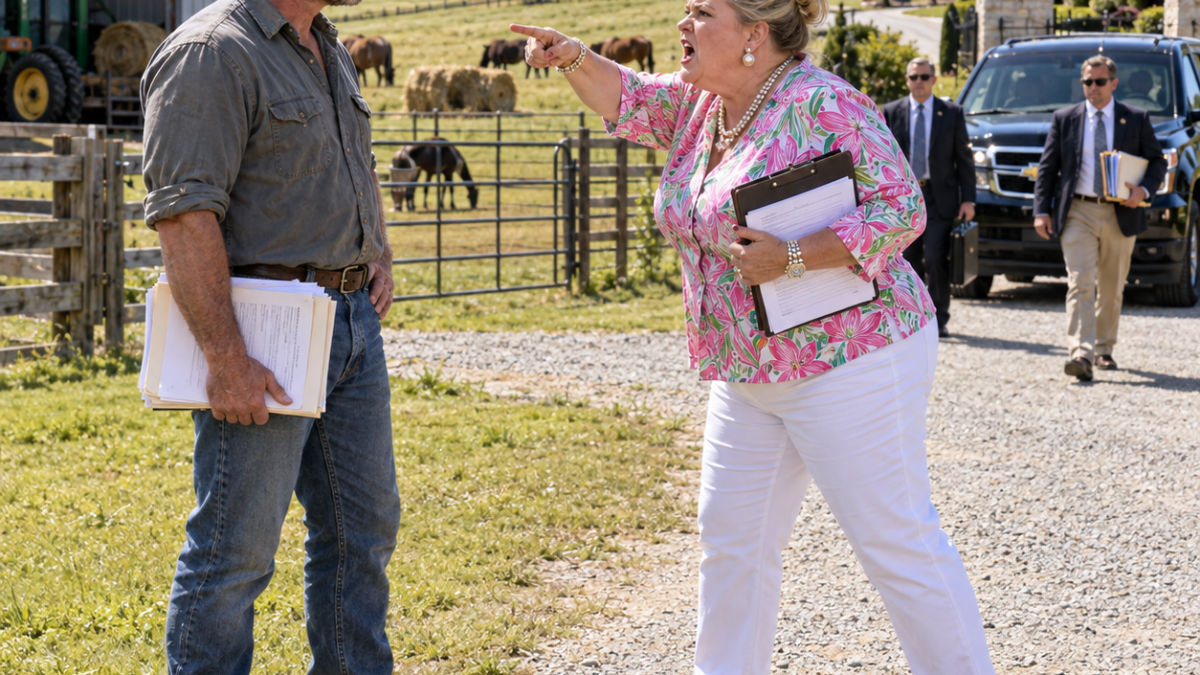
The HOA president stood outside my pasture in a pink tracksuit and calmly told me she had filed paperwork that could make me lose the farm my family had spent fifteen years building.
She expected me to yell, threaten her, or beg—but after twenty years in the Army, I had learned that the most dangerous response to a bully was sometimes silence.
What she didn’t understand was that the paperwork she was so proud of had just put her own name on something she would eventually wish she had never touched.
“Your little farm is a blight on this community.”
Karen Smith hugged a clipboard against her chest while two HOA board members stood behind her at my fence.
I killed the engine on my old Massey Ferguson.
The sudden silence made her words sound even uglier.
Twenty acres of pasture stretched behind me. Goats grazed near the lower field. Our red barn sat beneath two old oaks, and beyond it I could see rows of tomatoes Sarah and I had planted that spring.
Karen pointed at all of it as if she were inspecting a condemned building.
“The machinery. The animals. The fencing. The smell,” she said. “Oakwood Estates is supposed to be a prestigious residential community.”
“My farm was here before Oakwood Estates.”
“That is irrelevant.”
“No, Karen. Legally, it’s the only thing that matters.”
Her smile changed.
She had been waiting for that.
“I’ve already filed a formal challenge with the county assessor and the state Department of Revenue.”
My hand tightened around the tractor fender.
She continued talking, but for a second I barely heard her.
My agricultural tax classification was what made this land financially possible. I wasn’t getting some secret loophole. The property was taxed according to its agricultural use because it was an actual working farm.
We sold vegetables.
We sold eggs.
Sarah made goat cheese for several local restaurants.
The farm didn’t make us rich, but it was ours.
Without the agricultural classification, the twenty acres could be assessed like high-value residential development property.
My annual tax bill could jump from less than a thousand dollars to more than thirty thousand.
Karen knew that.
That was why she looked so pleased.
“Maybe,” she said, tapping the clipboard, “when you’re paying your fair share, you’ll finally consider selling to someone who can put this property to better use.”
There it was.
Not community standards.
Not property values.
She wanted me gone.
Fifteen years earlier, when I bought this land, Oakwood Estates did not exist. After leaving active military service, I wanted somewhere quiet where Sarah and I could raise our children and where I could build something that didn’t involve concrete barriers, convoy routes, or deployment schedules.
Then developers bought the neighboring acreage.
Before construction began, I hired a property attorney.
Best money I ever spent.
Because my parcel ended up technically surrounded by the new master-planned community, we recorded a covenant directly with my deed stating that my existing agricultural operation remained permanently exempt from future HOA restrictions involving farming, livestock, equipment, fencing, or agricultural structures.
Karen knew about that covenant.
She simply believed she could go around it.
“You’ve filed a complaint saying what, exactly?” I asked.
“That you are fraudulently claiming agricultural status to avoid paying legitimate taxes.”
The word fraud hit harder than anything else she had said.
I stepped closer to the fence.
Karen’s two companions suddenly looked uncomfortable.
“You accused me of tax fraud?”
“I reported facts.”
“No. You reported what you wanted to be true.”
Her smile remained.
“The state can decide that.”
I looked past her toward the neat rows of beige houses lining Oakwood Drive.
Then I looked back at my barn.
My son and I had framed that barn together.
Sarah had painted the white trim.
There was a notch in one post showing our daughter’s height every birthday from age eight until she left for college.
Karen wasn’t threatening a tax classification.
She was threatening fifteen years of our lives.
When I entered the kitchen ten minutes later, Sarah was kneading bread.
One look at my face and she stopped.
“What happened?”
I placed my gloves on the table.
“She went after the agricultural exemption.”
Sarah went perfectly still.
For a moment, neither of us spoke.
Then she quietly asked the question I had been asking myself since Karen left.
“Can she actually take it away?”
I opened the old cabinet beside my desk and pulled out the thick property folder containing our deed, farm records, zoning documents, and the covenant I had protected like a second birth certificate.
“I don’t know what she can make us go through,” I said.
I laid the folder on the kitchen table.
“But I know one thing.”
Sarah looked at me.
I opened the file.
“If Karen wants the state to examine this farm, then we’re going to make sure the state examines everything.”
Three days later, a government envelope arrived.
And the number printed inside it made Sarah grab the back of a chair.
PART 2
“Thirty-two thousand dollars?”
Sarah whispered the number as if saying it louder might make it real.
I nodded.
The letter from the county assessor was spread across our kitchen table between two coffee mugs neither of us had touched.
If my agricultural classification was revoked, the preliminary reassessment placed our annual property tax at approximately $32,000.
There were additional warnings beneath that number about penalties, appeal deadlines, documentation requirements, and administrative review.
But all I could see was thirty-two thousand.
The farm itself didn’t clear that much in a good year.
We weren’t wealthy people playing farmer on weekends.
My military retirement helped.
Sarah worked harder than anyone I knew.
But the operation was real, and like most small farms, every dollar already had a destination before it reached our checking account.
Feed.
Seed.
Diesel.
Veterinary bills.
Equipment repairs.
Property insurance.
Irrigation.
A thirty-two-thousand-dollar tax bill wouldn’t inconvenience us.
It would end us.
Sarah finally sat down.
“She knew.”
“Yes.”
“She knew exactly what this could do.”
“Yes.”
Her eyes filled, though she refused to let the tears fall.
That hurt worse than seeing Karen smile at the fence.
Sarah had carried this place beside me from the beginning.
She had been the one painting bedrooms while I rebuilt the porch.
She had stood with me during the first winter when a freeze killed almost an entire early crop.
She had bottle-fed newborn goats at two in the morning.
When I woke from old deployment nightmares during those first years home, she never asked me to explain something I didn’t have words for. She would simply put her hand on my chest and wait until I remembered where I was.
This farm had healed things in both of us.
And now someone who had moved into the neighborhood four years earlier had decided she could erase it with a complaint form.
I read the letter again.
Thirty days.
That was how long I had to prove that my own life existed.
The county wanted income statements, receipts, sales records, photographs, production logs, livestock documentation, crop plans, customer records, and proof that the agricultural activity was conducted with a genuine profit motive.
I almost laughed.
Not because it was funny.
Because Karen had made one spectacular miscalculation.
Paperwork did not intimidate me.
I had spent years in Army engineering units where a bridge project could generate enough documents to bury a truck.
I knew how to build a file.
And I knew something else.
Never defend only the point your opponent chooses.
Understand the whole battlefield.
By midnight, our dining table was covered.
Sarah brought boxes from the office.
I brought plastic storage totes from the barn.
Receipts.
Invoices.
Feed records.
Farmers market permits.
Restaurant orders.
Deposit slips.
Veterinary invoices.
Equipment depreciation schedules.
Seed purchases.
Photos.
Crop rotation maps.
Sarah sat cross-legged on the floor sorting papers into stacks.
At 1:17 in the morning, she held up an invoice.
“Ridgeway Bistro. Forty-eight pounds of tomatoes, twenty-four logs of chèvre.”
“July two years ago.”
She stared at me.
“How do you remember that?”
“The delivery van broke down.”
She smiled for the first time all evening.
“Right.”
“You drove the cheese in your car with the air conditioner on maximum.”
“And smelled like goat cheese for three days.”
That little laugh changed the atmosphere.
Karen had wanted fear.
Instead, she had given us a mission.
By sunrise, we had twelve labeled categories.
I drove into town that morning and called the county assessor from the parking lot of a feed store.
A woman named Brenda answered after I spent nine minutes trapped inside automated menus.
“Parcel number?”
I gave it to her.
The keyboard clicked.
Then stopped.
“Oh.”
That single syllable told me everything.
“You found the complaint.”
“Yes, sir.”
“What exactly does it allege?”
Another pause.
“It alleges that the property is not genuinely operated for commercial agricultural purposes and that agricultural classification is being fraudulently maintained for tax avoidance.”
I stared through the windshield.
Fraudulently.
Again.
“What evidence did the complainant submit?”
“I’m not authorized to discuss another party’s submission during active review.”
“Who filed it?”
“The Oakwood Estates Homeowners Association, through its president, Karen Smith.”
So she had not filed as Karen Smith, irritated neighbor.
She had used the HOA.
That mattered.
I thanked Brenda.
Then I made two calls.
The first was to the attorney who had drafted my covenant fifteen years earlier.
He had retired.
The second was to an old Army friend named Mike Callahan.
Mike had served in the Judge Advocate General’s Corps before leaving the military and becoming a civil litigation attorney.
We had not spoken in almost a year.
He answered on the third ring.
“Travers?”
“Mike.”
“You owe me a fishing trip.”
“I may owe you something more expensive.”
There was a pause.
“How expensive?”
“Potentially thirty-two thousand dollars a year.”
“Now you have my attention.”
I explained everything.
Mike asked almost no unnecessary questions.
That was one of the things I had always liked about him.
He separated anger from facts.
When I finished, he said, “Send me the covenant.”
“I will.”
“And everything the HOA has sent you.”
“There’s a lot.”
“Send it.”
I hesitated.
“Mike, I’m not calling looking for free legal work.”
“Good, because my hourly rate will make you cry.”
I laughed despite myself.
Then his tone changed.
“But I’ll look at the documents first.”
I emailed everything that afternoon.
At seven the next morning, he called.
“Mark.”
“Yeah?”
“Your covenant is strong.”
“How strong?”
“‘Any and all future restrictive covenants, regulations, rules, bylaws, aesthetic requirements, or use limitations imposed by the adjoining planned development concerning agricultural activities shall not bind parcel 7B.’ Strong enough?”
I leaned against the kitchen counter.
“That’s what I thought.”
“The HOA cannot simply vote that language out of existence.”
“What about the tax complaint?”
“That’s different. Anyone can report suspected tax misclassification. The question is whether they knowingly made false statements or used the complaint process maliciously.”
“She did.”
“I believe you. Believing isn’t proving.”
“What do you recommend?”
“Document everything. No shouting. No threats. No dramatic confrontations.”
“I was planning a dramatic confrontation.”
“I know you were. Don’t.”
I heard papers turning on his end.
“There’s an HOA meeting Thursday?”
“Yes.”
“Go.”
“Thought you said no confrontation.”
“I said no stupid confrontation. There’s a difference.”
Thursday evening, Sarah and I walked into the Oakwood Estates clubhouse carrying a folder heavy enough to qualify as gym equipment.
Karen sat at the center of the board table wearing a navy blazer and a satisfied expression.
About thirty residents had shown up.
Most HOA meetings normally attracted six people and one angry retiree arguing about sprinkler schedules.
That evening, word had spread about my farm.
Karen waited through the routine reports.
Landscaping.
Pool maintenance.
Architectural approvals.
Then she leaned toward the microphone.
“Old business. Parcel 7B.”
Several heads turned toward me.
Karen smiled.
“As many residents know, the board has taken action regarding the ongoing noncompliant agricultural operation located within Oakwood Estates.”
Agricultural operation.
She said it like organized crime.
“We have received complaints concerning odors, heavy equipment, visual blight, noise, livestock, and potential misuse of preferential tax treatment.”
Potential misuse.
That was careful language.
Mike had warned me she might suddenly become more careful when speaking publicly.
“We are pleased to announce that county and state authorities are now reviewing the matter.”
Someone actually applauded.
One person.
Then stopped when nobody joined.
Karen continued.
“We believe this is an important step toward protecting our community standards and property values.”
I raised my hand.
She ignored me.
I kept it raised.
Eventually she sighed.
“Mr. Travers, this is board business.”
I opened a copy of the HOA bylaws.
“Article four, section six allows any owner or affected parcel holder three minutes on a listed agenda item.”
Her face changed.
She knew I was right.
“Three minutes.”
I stood.
My heartbeat was steady.
Years earlier, I had briefed colonels who could end my career with a sentence.
Karen Smith did not frighten me.
“My name is Mark Travers. My family owns parcel 7B.”
I held up my deed.
“This farm existed approximately ten years before Oakwood Estates.”
I held up the covenant.
“And this recorded covenant was executed before the development was approved. It specifically exempts my agricultural operation from HOA rules.”
I distributed copies to the board.
The treasurer, Gerald Foster, immediately started reading.
Karen did not touch hers.
“That document is outdated.”
“No, it’s recorded.”
“HOA authority has evolved.”
“Recorded property rights don’t evolve because somebody buys a clipboard.”
A few people laughed.
Karen’s face reddened.
I looked at Gerald.
Then the vice president.
Then each board member.
“I also want every board member to understand that your president filed an official government complaint accusing my family of fraud.”
Gerald looked up sharply.
Karen interrupted.
“We reported suspicious circumstances.”
“You reported that my agricultural exemption was fraudulent.”
I put another paper on the table.
“This farm generated documented commercial sales every year for the last fifteen years.”
I placed another.
“We have agricultural zoning.”
Another.
“Business records.”
Another.
“Livestock records.”
Then I paused.
“Your president knows the farm predates this HOA. She knows about the covenant. She has repeatedly stated that her goal is to force us to sell.”
Karen stood.
“That is a lie.”
“Sit down, Karen,” someone said from the audience.
The room went quiet.
It had come from David Miller, a soft-spoken neighbor I had met twice at the farm stand.
Karen glared at him.
He shrugged.
“He’s speaking.”
I continued.
“Tonight I am putting the board on notice. If knowingly false actions taken in the HOA’s name financially damage my family, I will protect my property using every legal remedy available to me.”
Karen folded her arms.
“Is that a threat?”
“No.”
I looked at the homeowners.
“It’s notice.”
My three minutes expired.
I picked up my folder and returned to Sarah.
She slipped her hand into mine.
Karen tried to continue the meeting.
But something had changed.
Gerald was still reading the covenant.
Another board member whispered to him.
Homeowners were looking at Karen differently.
For the first time, people were asking themselves a question Karen never wanted them to ask.
What if she was wrong?
Outside, Sarah exhaled.
“My hands are shaking.”
“Mine too.”
“They don’t look like it.”
“Army trick.”
“What trick?”
“Hide them in your pockets.”
She laughed.
Then she kissed my cheek.
“You were terrifying.”
“I was polite.”
“You were politely terrifying.”
Two days later, the official review packet arrived.
Ninety-three pages.
Forms.
Instructions.
Definitions.
Deadlines.
Statutory excerpts.
Evidence requirements.
I spent the next week building the response.
Every receipt told part of our story.
A produce invoice from Miller’s Market.
Egg deliveries to Green Table Café.
Goat cheese orders.
Farmers market booth fees.
Livestock sale records.
Seed catalogs.
I included photographs from different seasons.
My son Ethan repairing a fence at sixteen.
Sarah holding a basket of tomatoes.
Our daughter Lily standing next to her first 4-H goat.
Me digging irrigation trenches after a storm washed out the lower field.
Photographs Karen would probably have called ugly.
To me they were fifteen years of proof that we had been here, working.
I created a binder with tabs.
Section one: property history.
Section two: zoning.
Section three: recorded covenant.
Section four: agricultural income.
Section five: expenses.
Section six: livestock.
Section seven: crops.
Section eight: customers.
Section nine: photographs.
Section ten: harassment chronology.
Sarah watched me insert the final page.
“You made an index.”
“Of course.”
“And numbered exhibits.”
“Of course.”
“You enjoyed this.”
“A little.”
She shook her head.
“You’re strange.”
“You married me.”
“I was young.”
The binder went out by certified mail.
A second copy went to Mike.
A third stayed in my office.
Then the fines started.
The first notice accused me of parking an unauthorized commercial vehicle.
The vehicle was my tractor.
Fine: $100.
The second accused me of improper outdoor material storage.
The material was compost.
Fine: $150.
The third accused me of maintaining unauthorized livestock fencing.
That fence predated the first house in Oakwood.
Fine: $200.
I did not pay.
I photographed each notice and filed it.
Karen escalated.
Noise violation.
Barn appearance.
Agricultural equipment visible from a residential roadway.
Unapproved signage.
The sign said FRESH EGGS.
Then one afternoon I found a notice taped directly to the barn door.
That was different.
Our gate had been shut.
Someone had entered.
I called Mike.
“Cameras,” he said.
“Already ordering them.”
I installed eight.
Overlapping coverage.
Gate.
Driveway.
Barn.
Equipment shed.
South pasture.
Side fence.
Three days later, at 2:14 p.m., my phone alerted.
I watched live from the feed store.
Karen’s white SUV stopped outside my gate.
She climbed out.
Pink blouse.
Clipboard.
She looked toward the house.
Then opened the gate.
I felt something cold settle in my stomach.
Karen walked forty yards onto my land.
She took photographs of the tractor.
Photographs of the barn.
Photographs of our goats.
Then she taped another violation notice to the barn.
Daisy, our smallest Nigerian dwarf goat, trotted toward the fence.
Daisy loved everyone.
Karen recoiled.
“Get away from me, you filthy animal!”
Daisy stopped.
Tilted her head.
Then sneezed.
I laughed so loudly a man in the feed store aisle looked at me.
But Mike didn’t laugh when I sent him the clip.
“That’s useful.”
“Because of the trespass?”
“Because she has now personally demonstrated a pattern of enforcement activity on land she has documentary notice she doesn’t regulate.”
His cease-and-desist letter arrived at Karen’s house by courier the next morning.
It demanded that she stop entering our property, stop issuing HOA fines against agricultural activity protected by the covenant, preserve all records relating to the tax complaint, and instruct the board to retain communications involving parcel 7B.
Her response arrived twenty-four hours later.
A new violation.
Unauthorized surveillance equipment.
I stared at it for several seconds.
Then called Mike.
He was silent.
“Mike?”
“I’m trying to decide whether she’s helping us intentionally.”
The board was beginning to crack.
Gerald called me privately.
“I voted against the last fines.”
“I appreciate you telling me.”
“She’s out of control.”
“Then stop her.”
“I’m trying.”
“No, Gerald. You’re worrying. That’s different.”
He sighed.
“She says you’re bluffing.”
“About what?”
“Suing.”
“I hope I never have to.”
“That wasn’t my question.”
“No.”
I looked toward the pasture.
“I’m not bluffing.”
Three weeks later, the county notified me that because of the complaint’s nature and the amount of documentation submitted, the matter had been referred to the State Department of Revenue’s property-tax division.
Karen treated the referral like a victory parade.
The next Oakwood newsletter arrived with a headline:
STATE TAKES ACTION ON FARM COMPLAINT.
Underneath was Karen’s photograph.
Her letter described the referral as proof that “higher authorities recognize the seriousness of the board’s concerns.”
She promised residents the HOA was “closer than ever to restoring Oakwood Estates’ residential character.”
Mike called after I emailed him a copy.
“She actually published this?”
“Two hundred copies.”
“Keep ten.”
“I already did.”
“Mark?”
“Yeah?”
“Never interrupt your opponent while she’s creating exhibits.”
A week later, my phone rang.
“Mr. Travers?”
“Yes.”
“My name is Eleanor Albright. State Department of Revenue.”
I straightened.
“I’m the field investigator assigned to your agricultural-classification review.”
Her voice was professional and efficient.
“I’ll need to inspect the property.”
“When?”
“Tuesday. Ten a.m.”
“I’ll be ready.”
She arrived at 9:56.
Practical boots.
Gray slacks.
White shirt.
Leather satchel.
No wasted movement.
She looked to be in her late fifties.
“Mr. Travers.”
“Ms. Albright.”
She shook my hand.
“I prefer to see the operation before reviewing records.”
“Good.”
That told me something.
She understood farming.
I started at the greenhouse.
Seedlings.
Irrigation.
Propagation tables.
Then the vegetable plots.
I explained the rotation.
Tomatoes after legumes.
Cover crops.
Compost management.
No-till sections.
She asked about yields.
Not superficial questions.
Real ones.
“How much marketable loss do you average during August heat?”
“Between eight and twelve percent depending on the crop.”
“Primary revenue?”
“Vegetables first. Goat dairy products second.”
“Wholesale or direct?”
“Mixed.”
She wrote everything down.
We moved to the chicken coop.
Then the pasture.
Then the milking area.
Sarah joined us in the certified kitchen.
Ms. Albright inspected sanitation logs.
Restaurant invoices.
Product labels.
Refrigeration.
At one point, she looked at Sarah.
“How many hours a week do you spend in agricultural production?”
Sarah laughed.
“Do you want the answer my husband gives or the answer I give?”
Ms. Albright almost smiled.
“Yours.”
“During kidding season? Enough that I forget what day it is.”
Two hours later, we sat in the kitchen.
I placed my evidence binder in front of her.
She examined it slowly.
No small talk.
No reassurance.
She cross-checked dates.
Asked about deposits.
Compared revenue records to production logs.
She requested three original invoices and called one restaurant from the kitchen table to verify that we supplied them.
Then she closed the binder.
The sound seemed impossibly loud.
“Mr. Travers.”
I waited.
“This is a legitimate agricultural operation.”
My shoulders dropped.
I hadn’t realized how tightly I had been holding them.
“You exceed the threshold for agricultural classification.”
Sarah closed her eyes.
Her hand found mine beneath the table.
Ms. Albright continued.
“I will be recommending that the classification remain unchanged.”
I looked at Sarah.
Her eyes were wet.
For thirty days, we had been imagining what losing the farm might look like.
What would we sell first?
The livestock?
Equipment?
A portion of the land?
Would we be able to stay?
Now, for the first time, I could breathe.
“Thank you.”
She nodded.
Then she placed one hand on the complaint file.
“Now I want to discuss something else.”
I looked at her.
“The allegations submitted against you.”
My relief disappeared.
“What about them?”
“The complainant represented that your property showed no meaningful evidence of genuine agricultural commerce.”
“That’s absurd.”
“Yes.”
The way she said it made me sit straighter.
“She also represented that the farm operation began after Oakwood Estates was established.”
I stared.
“That’s false.”
“You can prove that?”
I stood and brought the original deed.
The covenant.
Old photographs.
County permits.
Ms. Albright studied them.
“The complaint also implies that the HOA has jurisdiction over agricultural activity on this parcel.”
I pointed to the covenant.
“They were given that before filing.”
“How do you know?”
“I presented it at the HOA meeting. There were witnesses. Every board member received a copy.”
“Before or after the tax complaint?”
“After the first complaint, but Karen had been given copies previously during disputes over livestock.”
“Documentation?”
I opened the harassment folder.
Email.
Certified letter.
Violation responses.
She read.
Then I remembered the cameras.
“I also have footage.”
“Of what?”
“The HOA president entering my property after receiving legal notice that she had no authority to do so.”
Ms. Albright looked up.
“Show me.”
I played the clip.
Karen opening the gate.
Walking inside.
Photographing everything.
Taping the notice.
Yelling at Daisy.
Ms. Albright watched twice.
Then she asked, “The complaint was submitted in the HOA’s name?”
“Yes.”
“Signed by Ms. Smith?”
“Yes.”
“Official title?”
“President.”
“Did the board authorize the filing?”
“I don’t know.”
That answer mattered.
She wrote something.
Then she said, “I need a copy of the HOA newsletter.”
I brought it.
She read Karen’s triumphant explanation that state authorities were helping the HOA remove our “agricultural blight.”
For the first time all day, Ms. Albright’s professional expression cracked.
Not much.
Just enough.
Her jaw tightened.
“Mr. Travers, state law contains a provision concerning knowingly frivolous exemption challenges.”
Mike had mentioned something similar, but he had been cautious.
“What provision?”
“A complainant who knowingly submits materially false allegations, and does so maliciously or in bad faith, may be assessed administrative investigation costs.”
“Assessed?”
“Personally.”
I said nothing.
She continued.
“The state has spent field-investigation time, legal-review time, appraisal resources, and administrative hours because of this complaint.”
I felt the pieces locking together.
“If your legal department decides her complaint was malicious…”
“She may receive the bill.”
“How much?”
“That is not my determination.”
Her eyes returned to the newsletter.
“But it will not be zero.”
I almost smiled.
Almost.
Then I thought of Karen standing at my fence telling me I would pay what I owed.
I didn’t smile.
Not yet.
Ms. Albright packed her satchel.
“You’ll receive the final determination by mail.”
I walked her to her car.
Before getting in, she looked back at the barn.
“Nice operation.”
Coming from her, it felt like a medal.
After she left, Sarah hugged me in the driveway.
“We’re keeping the farm.”
“Looks that way.”
She pulled back.
“And Karen might have to pay for the investigation?”
“Looks that way.”
Sarah stared toward Oakwood Estates.
For one dangerous second, she wore the same expression I had seen on Karen.
Then she laughed.
“I’m going to bake something.”
“That’s your revenge?”
“Mine involves carbohydrates.”
Mine was going to involve patience.
Because while the state examined Karen’s tax complaint, David Miller was examining something else.
The HOA itself.
David came by the farm two evenings later.
He carried a folder.
“Do you have coffee?”
“That depends.”
“On?”
“How bad the contents of that folder are.”
“Make a full pot.”
We sat at the kitchen table.
Sarah poured coffee.
David had spent thirty-two years as a forensic accountant.
Retirement had apparently left him dangerously bored.
“After that HOA meeting,” he said, “I started looking at the financial summaries.”
“And?”
“They’re garbage.”
Sarah blinked.
“That technical?”
“Extremely.”
He pulled out HOA budget statements.
“Administrative expenses jumped from nineteen thousand dollars annually to almost fifty-eight thousand over three years.”
“Why?”
“That’s the question.”
He pointed.
“Consulting services. Legal coordination. Community management.”
“Karen said those were outside vendors.”
“She did.”
David smiled without humor.
“So I searched corporate records.”
He placed a printout in front of me.
PRESTIGE COMMUNITY MANAGEMENT LLC.
Registered owner: Melissa Smith-Carter.
“Smith?”
“Karen’s cousin.”
I looked at him.
“That alone isn’t illegal.”
“Correct.”
He produced another page.
“The HOA pays Prestige three thousand dollars every month.”
“For what?”
“The invoices say advisory services.”
“What advisory services?”
“No deliverables listed.”
Sarah sat down.
“Thirty-six thousand a year?”
“Yes.”
“For advice?”
“That is what Karen told Gerald.”
“Gerald gave you this?”
David hesitated.
“Gerald is scared.”
“He should be.”
“He knows.”
That sentence landed differently.
“Knows what?”
David opened the folder.
Bank transfers.
Prestige received monthly payments.
Then, within forty-eight hours, similar amounts moved from Prestige into another account.
Joint account holders:
Karen Smith.
Robert Smith.
Her husband.
I leaned back.
“No.”
“I traced twenty-four months.”
“How much?”
“Approximately seventy-two thousand dollars flowed out of the HOA into Prestige.”
“And then to Karen?”
“Most of it.”
Sarah whispered something I won’t repeat.
David nodded.
“That was approximately my reaction.”
“Have you shown Mike?”
“He’s meeting us tomorrow.”
The next afternoon, Mike drove down.
We spent four hours at my kitchen table.
He warned us repeatedly.
“Do not call this embezzlement publicly yet.”
David frowned.
“What would you call it?”
“Evidence potentially consistent with self-dealing and misappropriation.”
“That’s lawyer for embezzlement.”
“Yes. Lawyers enjoy syllables.”
Gerald joined us after dark.
He parked behind the barn because he was afraid Karen would see his car.
That told me how far Oakwood had fallen.
A grown man was hiding his sedan behind my hay shed because he feared his HOA president.
Gerald looked terrible.
“I should have stopped it.”
“What happened?” Mike asked.
Gerald rubbed his hands.
“Karen introduced Prestige as a community-management consultant. She said we needed outside expertise because Oakwood was growing.”
“Did the board approve the contract?”
“Yes.”
“Did she disclose the family relationship?”
“No.”
“Did anyone inspect the company?”
“No.”
“Did you ever ask for reports or work product?”
Gerald nodded miserably.
“She told me they advised her privately.”
“Did you know money was returning to Karen?”
“No. God, no.”
“Then what changed?”
“The tax complaint.”
He looked at me.
“I told her going after Mark’s tax exemption was insane. She said the farm lowered property values. Then she said if he couldn’t afford the land, a developer would buy it.”
My jaw tightened.
That confirmed what she had told me.
Gerald continued.
“When the lawyer’s letter arrived, I told her we should withdraw the complaint.”
“What did she say?”
“She said she would remove me as treasurer if I undermined her.”
David spoke.
“You resigned?”
“This morning.”
We all looked at him.
Gerald swallowed.
“I gave notice.”
“Good,” Mike said.
“Good? I feel like a coward.”
“No,” I said.
“You were a coward when you knew something was wrong and stayed quiet.”
Gerald looked at me.
“You’re here now.”
He nodded.
“Then start being useful.”
For the first time, he almost smiled.
We needed residents to see what was happening.
But Mike warned against ambushing Karen at an HOA meeting.
“She controls the agenda. She can adjourn. She can claim privileged material. She can turn it into procedural chaos.”
David proposed a community information session.
Neutral location.
No board control.
No microphones Karen could switch off.
The VFW hall in town agreed to host us.
We printed invitations:
IMPORTANT COMMUNITY INFORMATION SESSION
HOA FINANCES, LEGAL LIABILITY, AND GOVERNANCE.
No accusation.
No sensational language.
Just enough.
Sarah and I walked half the subdivision delivering them.
At one house, an elderly woman named Joan opened the door.
She read the card.
“Is this about Karen?”
“It’s about the HOA.”
“Then it’s about Karen.”
She looked around like Karen might be hiding in a shrub.
“She fined me because my grandson’s wheelchair ramp didn’t match the approved stain color.”
I stared at her.
“What?”
“Two hundred dollars.”
Something inside me hardened.
This had stopped being about my farm.
At another house, a young father told me Karen fined them for a basketball hoop.
Another homeowner had been threatened over a flag.
Another over a vegetable garden visible from the street.
One couple had received six violations in a month after questioning an assessment.
By the time we reached home, Sarah was angry enough to tear the HOA sign out herself.
“People have been afraid of her.”
“Fear grows when everybody thinks they’re alone.”
“Not anymore.”
The VFW meeting started at seven.
By six forty-five, we were setting out more chairs.
By seven, more than one hundred people had filled the room.
Karen did not attend.
Her vice president did.
So did two board members.
They sat near the back.
Faces pale.
I went first.
No theatrics.
I told the story.
The tax complaint.
The thirty-two-thousand-dollar threat.
The recorded covenant.
The fines.
The trespass.
The state investigation.
I projected Karen’s newsletter.
Then I played the security footage.
When she screamed at Daisy, people laughed.
Not friendly laughter.
The kind that happens when a bully suddenly looks ridiculous.
Then David took over.
He projected the HOA’s public financial statement.
Administrative expenses.
Consulting expenses.
Professional fees.
Then actual invoices.
Prestige Community Management.
$3,000.
Month after month.
He displayed the LLC registration.
Karen’s cousin.
Then the transfers.
A diagram.
HOA.
Prestige.
Karen and Robert Smith.
Nobody laughed.
The room became completely silent.
Finally, one man said, “That’s our money.”
David nodded.
“Yes.”
“How much?”
“Approximately seventy-two thousand dollars under the records currently available.”
The room erupted.
People shouted questions.
Mike stepped forward.
“Please.”
Eventually the noise dropped.
He explained that no final criminal conclusion had been reached.
He explained that an independent audit was necessary.
He explained that residents should preserve records and follow the bylaws for recall procedures.
Then he explained something else.
Karen’s campaign against my farm had exposed the HOA to potential civil liability.
“If Mr. Travers had lost agricultural classification because of knowingly false actions taken in the association’s name, damages could have been substantial.”
“How substantial?” someone asked.
“Potentially hundreds of thousands of dollars depending on the losses, legal fees, property impact, and related claims.”
A woman in front stared.
“Would HOA insurance pay?”
“Intentional malicious conduct may fall outside coverage.”
“So who pays?”
Mike looked around.
“Potentially the association.”
People understood immediately.
The association meant them.
Special assessments.
Higher dues.
Their money.
Gerald stood.
His legs were visibly shaking.
“My name is Gerald Foster.”
Everyone knew him.
“I served as treasurer.”
He took a breath.
“What you’re seeing is real.”
A murmur.
“I questioned several payments. I was told Prestige was providing confidential consulting services.”
He looked toward the floor.
“When I pushed harder, Karen threatened to remove me.”
Someone shouted, “Why didn’t you tell us?”
Gerald flinched.
“Because I was afraid.”
That answer quieted them.
“I’m ashamed of that.”
He lifted his head.
“But I’m not going to be afraid anymore.”
The vice president stood and walked toward the front.
Maria Lopez.
“I’m resigning from the board effective tonight.”
Gasps.
Another board member followed.
“So am I.”
Karen lost her quorum in less than sixty seconds.
The residents organized before the meeting ended.
Recall petition.
Independent audit.
Temporary governance committee.
Document-preservation demand.
Gerald volunteered to cooperate.
Maria did too.
A hundred people who had spent years complaining privately suddenly spoke openly.
I stood near the wall beside Sarah.
“You did this,” she whispered.
“No.”
I watched Joan, the woman with the wheelchair-ramp violation, collecting recall signatures.
“She did.”
“Karen?”
“Karen.”
Sarah raised an eyebrow.
“She finally made everybody angry at the same time.”
Four days later, the state envelope arrived.
Wednesday morning.
8:12.
I remember because I had just come in from feeding the goats.
The return address was the Department of Revenue.
Sarah saw it in my hand.
Neither of us spoke.
We sat at the kitchen table.
I opened it.
Twelve pages.
The first section confirmed the review.
I scanned.
Then found the sentence.
“The agricultural classification of parcel 7B is hereby upheld without modification.”
I read it twice.
Sarah covered her mouth.
“Read it out loud.”
I did.
She started crying.
Not dramatic tears.
Quiet ones.
Months of tension leaving her body.
I reached across the table.
“We’re okay.”
“We’re keeping it?”
“We’re keeping it.”
She stood and wrapped both arms around me.
I buried my face against her shoulder.
I hadn’t cried when Karen threatened me.
I hadn’t cried over the thirty-two-thousand-dollar figure.
I cried then.
Because suddenly I could see Ethan hammering boards into the barn again.
Lily painting the chicken coop.
Sarah asleep at the kitchen table after a midnight kidding.
Everything Karen had tried to turn into a tax dispute became our life again.
Then I saw another document behind the report.
One page.
Different formatting.
I pulled it free.
Sarah wiped her eyes.
“What is that?”
I looked at the addressee.
Karen Smith.
Not Oakwood Estates HOA.
Karen Smith.
Personally.
“Sarah.”
“What?”
“You need to sit down.”
“I am sitting.”
I read.
Administrative assessment.
The state had determined that Karen knowingly advanced materially misleading claims, after receiving information contradicting those claims, and continued to use the review process for purposes unrelated to legitimate tax enforcement.
The report cited investigation expenses.
Field-agent time.
Legal review.
Administrative processing.
Appraisal analysis.
One hundred twelve employee hours.
The total sat at the bottom.
$28,500.
Payable by Karen Smith.
Personally.
Due within sixty days.
Sarah stared.
Then stared again.
“That’s…”
“Twenty-eight thousand five hundred.”
“To her?”
“Yes.”
“Not the HOA?”
“Her.”
Sarah made a sound halfway between a laugh and a gasp.
“She tried to give us a thirty-two-thousand-dollar tax bill.”
I nodded.
“And got herself a twenty-eight-five bill.”
I leaned back.
For months, Karen had been telling me I would pay what I owed.
Now the government had decided she owed something.
There was no dramatic music.
No cheering crowd.
Just Sarah, me, and an itemized invoice.
It was more satisfying than any speech I could have written.
I called Mike.
“State decision arrived.”
“Good or bad?”
“Farm keeps classification.”
“I told you.”
“There’s more.”
“Oh?”
“They assessed investigation costs.”
“How much?”
“Twenty-eight thousand five hundred.”
Silence.
“Mike?”
“I’m smiling.”
“So am I.”
“Who is it addressed to?”
“Karen.”
Another silence.
Then he said, “Make several copies.”
I made two hundred.
That afternoon, I drove through Oakwood.
I didn’t knock on doors.
I didn’t write a triumphant message.
I distributed the public determination information through the community channels the residents were already using for the recall effort, and I pinned a copy of the state notice to the clubhouse bulletin board where Karen’s celebratory newsletter had been displayed.
Her newsletter:
STATE TAKES ACTION.
The state invoice:
KAREN SMITH — $28,500.
Same board.
Same complaint.
Very different ending.
The neighborhood exploded.
My phone began ringing before I reached home.
Gerald.
David.
Maria.
Residents I barely knew.
Karen attempted to call an emergency board meeting.
There was one problem.
She didn’t have a functioning board.
She reportedly demanded that the association reimburse her.
Gerald emailed residents immediately.
“The assessment is issued personally to Karen Smith and will not be paid from HOA funds.”
That single sentence probably saved him from being chased through the neighborhood.
Karen called me.
I didn’t answer.
She called Sarah.
Blocked.
She emailed.
I forwarded it to Mike without replying.
Then local television called.
A reporter named Tyler Grant lived three streets from Karen.
He had attended the VFW meeting.
“Mr. Travers, I’d like to interview you.”
“About what?”
He laughed.
“You know exactly what.”
“I’m not interested in humiliating anybody.”
“This isn’t humiliation. Your HOA president used association authority to challenge your tax classification, the state rejected it, and now the person who filed the complaint has been assessed the investigation costs. That’s public-interest reporting.”
I thought about it.
My instinct was no.
I had spent enough of my life with other people deciding what part of me became public.
Then I remembered Joan’s wheelchair ramp.
Gerald hiding his car behind my barn.
The young family fined over a basketball hoop.
And Karen telling me my home was a blight.
“Okay.”
The news crew arrived Friday afternoon.
They filmed the farm.
Not the version Karen described.
The real one.
Tomatoes.
Goats.
Chickens.
Greenhouse.
Farm stand.
Sarah stacking produce boxes.
They interviewed me beside the barn.
Tyler asked, “What was your reaction when you learned your agricultural classification had been challenged?”
“Fear.”
He seemed surprised.
“Not anger?”
“Anger came second.”
“What were you afraid of?”
“That I could lose this.”
I looked toward the fields.
“This isn’t investment land to me. It’s where my family grew up.”
“What did the potential reassessment mean?”
“A tax bill we could not sustain indefinitely.”
“Did you believe the complaint was made in good faith?”
“No.”
“Why?”
“Because the person making it had already told me she wanted the farm gone.”
He interviewed Ms. Albright’s department using written statements.
The Department of Revenue confirmed the agricultural classification had been upheld and that investigation expenses had been assessed according to state administrative authority.
Then Tyler interviewed David.
David explained the separate financial concerns surrounding Prestige.
Gerald agreed to speak on camera with his attorney present.
That surprised me.
“I stayed quiet too long,” he said.
Television forced you to look at yourself.
Gerald decided he wanted to be able to look.
The segment aired at six.
The opening drone shot showed Oakwood’s neat roofs on one side and my green pasture on the other.
Then me.
Then Karen’s newsletter.
Then the security footage.
Daisy became a local celebrity.
Tyler ended with a close shot of the state invoice.
“An attempt to challenge one farmer’s tax status has ended with the state billing the complainant herself $28,500 for the cost of the investigation.”
Karen declined interview requests.
The story spread.
Not nationally.
Not dramatically.
But enough.
Enough that everybody in our county seemed to recognize Daisy.
Enough that customers came to the farm stand just to say they had seen us.
Enough that Karen stopped going outside during daylight for several days.
Then the audit results came.
The independent accounting firm hired by residents confirmed what David had found.
Prestige Community Management had received approximately $72,000 in HOA funds.
Documentation supporting those payments was inadequate.
The relationship between Karen and the vendor had not been disclosed.
A substantial portion of the money had ultimately reached accounts connected to Karen.
The homeowners referred the matter to law enforcement.
That part was no longer my fight.
I had started by defending my farm.
Karen had made the mistake of giving two hundred people a reason to inspect everything else.
About a week after the television report aired, I was repairing fence near the front drive.
I heard tires on gravel.
White SUV.
Karen.
She parked.
For a moment, neither of us moved.
Then she got out.
No clipboard.
No blazer.
No makeup that I could see.
She wore an old gray sweater.
Her hair looked like she had run her hands through it repeatedly.
She stopped several feet from me.
“Mark.”
It was the first time she had used my first name.
I set the fencing pliers down.
“Karen.”
Her eyes were swollen.
“You have to help me.”
I said nothing.
“The state bill…”
“What about it?”
“It’s almost thirty thousand dollars.”
“I know.”
“My husband is furious.”
I waited.
“Our home-equity lender is asking questions. The audit people are treating me like a criminal. Residents are threatening lawsuits.”
“Why are you telling me?”
“Because this started with you.”
There it was.
Even broken, she was still searching for someone else to carry responsibility.
“No,” I said.
“It started when you decided my farm should disappear.”
Her mouth tightened.
“I was protecting Oakwood.”
“From tomatoes?”
“That isn’t fair.”
“From goats?”
“You know what I mean.”
“No, Karen. I spent months trying to understand what you meant.”
I stepped closer.
“You said we lowered property values. You issued fines you knew didn’t apply. You filed a tax complaint after being told the farm was protected. You accused me of fraud. You entered my land. You celebrated when the state investigation started.”
Her eyes filled.
“I made mistakes.”
“No.”
My voice stayed calm.
“A mistake is mailing a check to the wrong address.”
She looked away.
“You made choices.”
“I can withdraw things.”
“The tax review is over.”
“Tell them you don’t want the assessment.”
“I didn’t issue it.”
“They’ll listen to you.”
“I doubt that.”
“What about the criminal complaint?”
“Not mine.”
“You can tell residents to stop.”
“No.”
Her face collapsed.
“You’ve already won.”
The word bothered me.
Won.
As though this had been a tennis match.
“You think I wanted this?”
I pointed toward the barn.
“Do you know how many nights Sarah and I sat at that table wondering whether we would have to sell livestock?”
Karen said nothing.
“Do you know what it’s like to stand on land you worked fifteen years to build and calculate which part you might have to sell because somebody with a grudge filled out a government form?”
“I didn’t think—”
“That’s the closest thing to the truth you’ve said.”
She flinched.
I immediately regretted how sharp it sounded.
Not because she didn’t deserve honesty.
Because I didn’t want to become cruel simply because she had been.
So I lowered my voice.
“Karen, I’m not going to celebrate your life falling apart.”
She looked at me.
“But I am not going to rescue you from consequences you created.”
Tears rolled down her face.
“What am I supposed to do?”
That question surprised me.
For the first time, she did not sound like the president of anything.
Just a frightened woman.
“Tell the truth.”
She stared.
“All of it.”
“I can’t.”
“Then nothing changes.”
“My husband could leave me.”
“I’m sorry.”
“You don’t mean that.”
“I do.”
She looked genuinely confused.
I picked up my pliers.
“I don’t need to hate you, Karen.”
I nodded toward Oakwood.
“I need you to stop hurting people.”
She stood there for several seconds.
Then returned to her SUV.
I watched her drive away.
I expected satisfaction.
Instead, I felt tired.
Sarah found me at the fence twenty minutes later.
“She came here?”
“Yeah.”
“What did she want?”
“A way out.”
“Did you give her one?”
“I told her to tell the truth.”
Sarah looked toward the road.
“That might be harder for her than paying twenty-eight thousand dollars.”
She was probably right.
The recall vote happened eleven days later.
Karen was removed as HOA president.
The margin was not close.
David Miller was asked to serve as interim president until elections.
His first statement was exactly eight sentences long.
No insults.
No victory speech.
He apologized to our family on behalf of Oakwood Estates.
He suspended all disputed enforcement actions.
He authorized an independent review of HOA rules.
He promised monthly financial disclosures.
He asked residents to rebuild trust.
Then he did something I didn’t expect.
He walked to the back of the clubhouse where Sarah and I were sitting.
“Mark.”
“Yes?”
“We owe you more than an apology.”
“No.”
“Yes.”
He handed me a folded page.
A resolution.
The HOA formally acknowledged that parcel 7B predated Oakwood Estates and that its agricultural rights were permanently protected.
It went further.
Any future board would be prohibited from using HOA funds to challenge the lawful preexisting agricultural use of my property without an independent legal opinion and a supermajority vote of homeowners.
I read it twice.
Sarah touched the page.
“They can’t do this again.”
“No.”
David smiled.
“That was the idea.”
The residents nicknamed it the Travers Provision.
I hated the name.
Sarah loved it.
“It makes you sound historical.”
“It makes me sound dead.”
The revised rules went beyond our farm.
Subjective language disappeared.
“Unsightly.”
“Inappropriate.”
“Community harmony.”
Words Karen had stretched until they meant whatever she wanted.
The new covenants used objective standards.
Clear notice.
Appeal rights.
Conflict-of-interest requirements.
Vendor disclosures.
Board-member recusal.
Spending limits.
Open financial records.
Gerald helped design the controls.
He insisted on dual signatures for large payments.
At the first meeting under the new rules, Joan asked whether the HOA was finally going to apologize for the wheelchair-ramp stain fine.
David looked horrified.
“We did that?”
“You did.”
“Refund it.”
People applauded.
Joan smiled.
“Interest?”
Everybody laughed.
David pointed at her.
“Don’t push it.”
It was the first HOA meeting I had attended where laughter did not come at someone’s expense.
Karen listed her house for sale three weeks later.
The FOR SALE sign appeared early on a Monday.
Nobody celebrated publicly.
Privately, I’m sure some did.
I didn’t.
Her husband had not attended any HOA meetings during the conflict.
I had no idea what he knew.
I had no idea what their marriage was like.
Consequences rarely land only on the person who caused them.
That was another reason revenge did not feel as clean as people imagine.
Karen eventually entered a plea agreement connected to the HOA funds.
The final criminal resolution did not resemble the dramatic endings you see on television.
No handcuffs at the clubhouse.
No screaming courtroom showdown.
She admitted wrongdoing involving misappropriated association money.
She received probation.
Community-service requirements.
Financial penalties.
Most importantly to residents, she was ordered to pay restitution.
Approximately $72,000.
The same number David had traced.
Each month, restitution payments came back to the HOA.
David announced that recovered funds would be used first to repair reserves and then reduce dues.
For two years, homeowner dues dropped by approximately twenty percent.
Gerald called me after the vote.
“You understand what this means?”
“What?”
“Karen accidentally lowered everybody’s HOA dues.”
I laughed so hard I had to sit down.
There was something almost beautiful about it.
Her obsession with control had triggered the investigation that destroyed her control.
Her attempt to cost me thirty-two thousand dollars a year had resulted in her receiving a personal $28,500 assessment.
Her secret financial arrangement eventually returned money to the people she had taken it from.
Her campaign to remove the farm ended with the HOA permanently protecting it.
Every weapon had turned around.
But the part that mattered most happened slowly.
Spring returned.
One Saturday, I opened the farm stand at eight.
By eight fifteen, five Oakwood families were there.
By nine, we had children feeding carrots to Daisy.
By ten, Sarah had sold every wheel of goat cheese she brought out.
A little boy pointed toward the pasture.
“Is that the famous goat?”
I looked at Daisy.
She was chewing cardboard.
“Yes.”
“What did she do?”
“Absolutely nothing.”
His father laughed.
“Best kind of fame.”
People who once drove past our farm with windows closed began stopping.
Some apologized.
Not dramatically.
Just small sentences.
“I’m sorry we believed her.”
“We should’ve asked questions.”
“I didn’t understand how much work happened here.”
Those were harder to receive than anger.
When someone apologizes sincerely, you have to decide whether you want peace more than you want the right to remain offended.
I chose peace.
Not all at once.
But gradually.
David organized an Oakwood spring picnic.
He asked to use the edge of our pasture.
I almost said no.
Then Sarah looked at me.
“Come on.”
“What?”
“You know you’re going to agree.”
“I don’t know that.”
“You’ve already mentally calculated where everyone can park.”
I hated when she was right.
We hosted it.
More than one hundred residents came.
Tables lined the lower pasture.
Kids ran between hay bales.
Gerald grilled hamburgers.
Maria brought three desserts.
Joan arrived in her grandson’s van and announced loudly that her wheelchair ramp was “still the wrong color.”
David nearly choked on lemonade.
I stood by the barn watching.
Ethan drove in that afternoon.
He had moved two states away for work, but he knew the whole story.
He walked beside me.
“This is weird.”
“What is?”
“The subdivision people hanging out here.”
“Very.”
He nodded toward the barn.
“Remember when we built that wall wrong?”
“You built it wrong.”
“I was fourteen.”
“You still built it wrong.”
He smiled.
Then his expression softened.
“You really thought you might lose this?”
“Yes.”
He stared at the pasture.
“Why didn’t you tell me?”
“What were you going to do?”
“Come home.”
“That’s why.”
He looked at me.
“I would’ve come home.”
“I know.”
That was the part about being a father nobody teaches you.
Your children become adults.
You spend years hoping they build their own lives.
Then one day you realize they would still drop everything if they thought you needed them.
I put an arm around his shoulder.
“We didn’t lose it.”
“No.”
He looked toward Daisy surrounded by children.
“Looks like you accidentally became popular.”
“Worst part of the whole thing.”
A year after Karen first stood at my fence, the farm was stronger than it had ever been.
Restaurant sales increased after the television story.
The Saturday stand became profitable enough that Sarah hired a local teenager to help.
Oakwood residents started a community produce subscription.
We renovated part of the barn.
Not because the HOA demanded it.
Because we finally had the money.
I painted one wall myself.
Red.
Very red.
David came over.
“Is that an approved agricultural color?”
“Get off my property.”
He laughed.
“Just checking.”
The new family who bought Karen’s old house visited the farm their first week.
A couple named Chris and Emily.
Two children.
They looked nervous when they introduced themselves.
“We heard there was some… history.”
“That’s one word for it.”
Emily looked toward their house.
“We hope you don’t mind, but the kids are obsessed with your goats.”
“You’re allowed to like goats.”
Chris smiled.
“We were also wondering if the tractor is noisy in the morning.”
I studied him.
His smile vanished.
Then I laughed.
“Sometimes.”
He exhaled.
“You got me.”
“Farm starts early.”
“We knew that when we bought the house.”
Those words mattered.
We knew that when we bought the house.
Exactly.
No war.
No complaint.
No clipboard.
Just adults understanding where they chose to live.
That autumn, the state sent me the routine agricultural-renewal paperwork.
For fifteen years, I had treated those forms like chores.
That year, I sat at the kitchen table and stared at the classification box.
ACTIVE AGRICULTURAL USE.
I checked it.
Sarah walked behind me.
“Everything okay?”
“Yeah.”
“You’re staring at a tax form.”
“I know.”
“That isn’t normal.”
I signed.
Then I walked outside.
The sunset had started turning the pasture gold.
The barn cast a long shadow.
Daisy was harassing a bucket.
Somewhere inside the house, bread was baking.
For years after leaving the Army, peace had seemed like something temporary.
Something that could be interrupted.
A phone call.
Orders.
An emergency.
A memory.
The farm taught me another definition.
Peace was work.
It was fences repaired before winter.
Seed ordered before spring.
Animals fed whether you were tired or not.
Marriage maintained through ordinary days.
Children raised and released.
Neighbors forgiven when possible.
Boundaries defended when necessary.
Karen had nearly taken that from me.
Or so I once believed.
The truth was more complicated.
She could threaten the tax classification.
She could create paperwork.
She could cost us sleep.
But she could not erase what the land meant.
That belonged to us.
One evening, Sarah and I sat on the porch.
Children were riding bicycles along Oakwood Drive.
A neighbor stopped at the farm stand honor box and bought eggs.
David was walking his dog.
When he saw us, he raised one hand.
I waved back.
Sarah leaned her head against my shoulder.
“You know what I think?”
“That I should repaint the barn?”
“No.”
“Good.”
“I think Karen may have been the best thing that ever happened to this neighborhood.”
I looked at her.
“That is an insane sentence.”
“I know.”
“She tried to bankrupt us.”
“I remember.”
“She stole money.”
“I also remember.”
“She screamed at Daisy.”
“Unforgivable.”
Daisy bleated from the pasture as if agreeing.
Sarah laughed.
“But before Karen went too far, none of these people talked to each other.”
She gestured toward Oakwood.
“Everyone stayed inside their perfect houses and complained privately.”
I watched two neighbors talking near the sidewalk.
“Then she gave everybody the same problem.”
“Exactly.”
“You’re giving her too much credit.”
“I’m not giving her credit.”
Sarah took my hand.
“I’m saying something good survived something ugly.”
That was different.
I understood.
The state invoice remained in my office.
Not framed.
Not displayed.
Folded inside the property folder.
Sometimes people asked why I didn’t hang it in the barn.
“Because that isn’t the victory,” I would tell them.
The victory wasn’t Karen’s $28,500 bill.
It wasn’t the recall.
It wasn’t the television story.
It wasn’t her resignation, the criminal case, or the restitution.
Those were consequences.
Necessary ones.
But not victory.
Victory was Sarah selling cheese to neighbors who once complained about the smell.
Victory was Joan rolling down our driveway on a wheelchair ramp nobody cared to regulate.
Victory was Gerald sitting openly at an HOA meeting instead of hiding behind my barn.
Victory was children knowing Daisy’s name.
Victory was an ordinary tax form arriving and not frightening me.
Victory was standing on my own land and no longer wondering whether a stranger’s anger could take it away.
Almost two years after everything ended, I found one of Karen’s old violation notices in the back of a drawer.
UNAUTHORIZED AGRICULTURAL STRUCTURE.
It referred to the barn.
I carried it outside.
Ethan happened to be visiting.
“What’s that?”
“History.”
He read it.
Then looked at the barn.
“What are you going to do with it?”
I considered throwing it away.
Instead, I folded it and slipped it into the property file beside the state determination.
Not because I wanted to remember Karen.
Because I wanted my grandchildren to someday understand something.
Land doesn’t protect itself.
Rights don’t protect themselves.
Communities don’t protect themselves.
Good people have to show up.
They have to read the rules.
Ask questions.
Keep records.
Speak when silence becomes dangerous.
And sometimes they have to stand behind a fence while someone with a clipboard tells them their entire life is a blight and calmly say:
No.
That evening, after Ethan left, I walked the pasture.
The sun was low.
Our goats moved slowly toward the barn.
The chicken coop door needed repair.
A tractor tire was losing pressure.
Half the tomatoes needed picking.
Ordinary problems.
Beautiful problems.
Sarah called from the porch.
“Dinner!”
“I’m coming.”
I stopped once beside the fence where Karen had stood that first afternoon.
I could still picture her pink tracksuit.
Clipboard against her chest.
That confident smile.
“You’ll be paying what you owe.”
Funny how words return.
Karen had believed justice was something she could order for other people.
She discovered that accountability does not care who filled out the first complaint.
I looked across at Oakwood Estates.
No enemy.
No battlefield.
Just neighbors.
Then I looked back at the farm.
My home.
My livelihood.
My family’s history.
Still here.
I walked toward the porch, where Sarah was waiting beneath the warm yellow light.
She slipped her arm around my waist when I reached her.
“Everything okay?”
I looked back one last time at the darkening pasture.
“Yeah.”
And for the first time since Karen had walked up to my fence with that clipboard, I didn’t say it because I was trying to reassure my wife.
I said it because it was true.
Everything was okay.
The farm was ours.
The community had changed.
The people who had once been strangers had become neighbors.
And the woman who tried to use the state to make me pay thirty-two thousand dollars for the privilege of keeping my own land had learned, in the most painfully itemized way possible, that sometimes the bill eventually finds the person who actually created the damage.
But that wasn’t the lesson I carried with me.
The lesson was simpler.
You can defend what is yours without becoming cruel.
You can demand accountability without enjoying someone else’s destruction.
You can win a fight and still choose peace afterward.
And if you are lucky, what survives the fight can become stronger than what existed before it.
I opened the kitchen door.
The smell of bread and roasted vegetables filled the house.
Sarah walked inside ahead of me.
I took one last breath of cool country air.
Then I followed her home.
And this time, there was nobody standing at the fence trying to tell us we didn’t belong there.








