PART 2: HOA President Tried to Cancel My Legal Burn—Then the Fire Chief Gave Me a Lifetime Permit in Front of Her
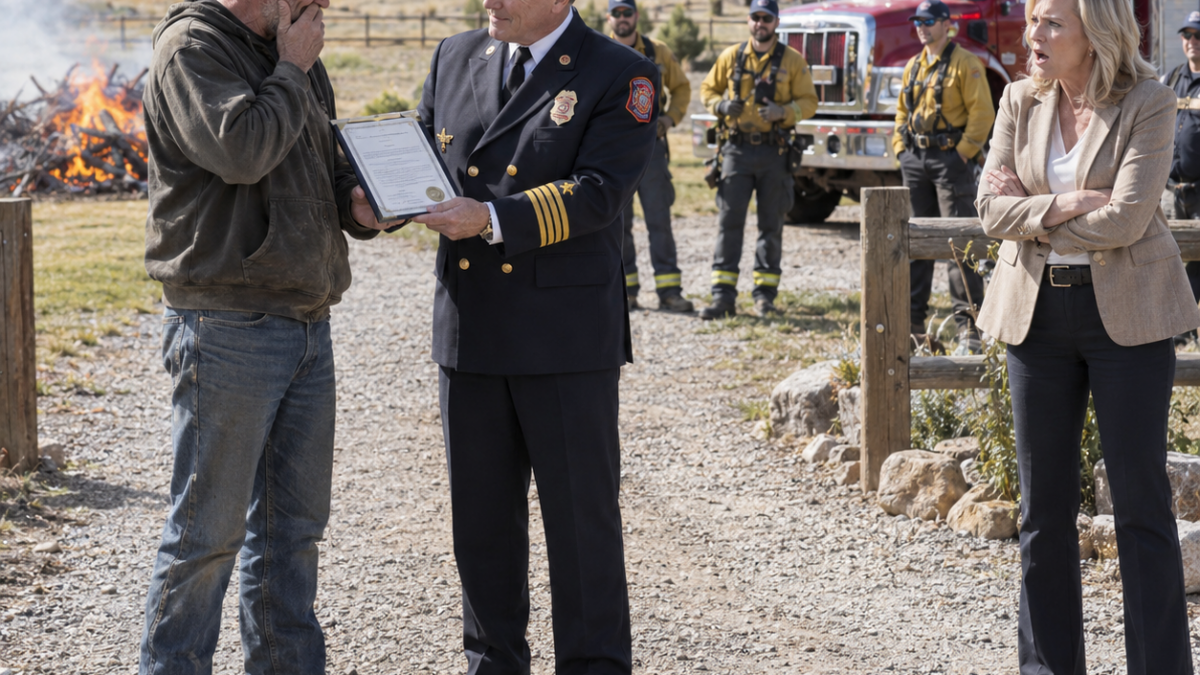
The HOA president stood twenty feet from my fire and told me she had just revoked a permit she had never issued.
She expected me to kill the flames, apologize, and learn what happened to homeowners who challenged her authority.
Then headlights appeared behind her—and the person stepping out of that truck was the last person she wanted to see.
“That’s it. I’m revoking your burn permit.”
Karen Johnson’s voice cut across my property louder than the crackle of oak branches burning inside the pit.
“Put that fire out right now, or I’ll have you fined until you can’t afford to live here.”
I rested both hands on the long steel rake I was holding and looked at her.
She stood just beyond the edge of my five-acre property, arms folded over a floral blouse, her white SUV parked behind her on the HOA road.
The fire between us was small, controlled, and legal.
I had cleared a wide dirt break around the pit.
A charged hose lay beside me.
A shovel and rake were within reach.
Behind the barn sat a five-hundred-gallon water tank.
And inside my wallet was a laminated county burn permit personally approved after an on-site inspection by Fire Chief Dave Miller.
Karen knew none of that mattered to her.
What mattered was that I had done something without asking her permission.
My wife, Sarah, and I had bought the property after I left the Marine Corps. Two deployments had taught me how precious quiet could be, and those five acres were supposed to be our refuge.
For the first six months, they were.
Then Karen discovered us.
The first letter concerned our mailbox.
Apparently, the standard black mailbox at the end of my driveway was not “in harmony with Oak Ridge Estates.”
The second letter came with a fine.
After that it was the height of my grass.
Then my vegetable garden.
Then equipment near the woods.
Every disagreement followed the same pattern.
Karen issued an order.
I checked the actual bylaws.
I discovered she had exaggerated them.
Then I answered in writing.
She hated that.
Karen was used to people becoming nervous when official-looking envelopes arrived.
I became organized.
That made me dangerous to someone like her.
The burn permit started because winter storms had dropped dead limbs across the wooded section of my property. By summer, the dry material had become a legitimate wildfire concern.
Dave Miller had known me since high school.
He didn’t approve anything because we were friends.
He walked the property himself.
He inspected the firebreak.
He checked my water supply.
He reviewed how and where I planned to burn.
Then he signed the permit.
“You’re doing exactly what I wish more property owners would do,” he told me.
So on a calm, damp evening, I started with a small pile.
Everything went perfectly.
Until Karen arrived.
“I have a county permit,” I told her.
She laughed.
“Your county permit means nothing inside this community.”
I pulled the laminated card from my wallet.
“It means quite a bit to the county.”
“I am the HOA president.”
“And?”
Her face reddened.
“Our covenants prohibit open fires without board approval.”
“The fire department already approved it.”
“I don’t care what the fire department approved.”
That sentence made me stare at her.
Karen stepped closer to the property line.
“You need to understand something, Jack. You may think because you own five acres you’re somehow separate from the rest of us, but you’re not. You live under our authority.”
“No,” I said quietly. “I live on land I own.”
“You are effectively a tenant in this community.”
That one hit me harder than the fines.
Sarah and I had paid for this land with savings accumulated over years of sacrifice. I had spent more nights sleeping under foreign skies than I cared to remember because I believed I was building toward a life where my family could finally breathe.
And this woman was standing beside my property telling me I was a tenant in my own home.
I kept my voice calm.
“You have no authority to revoke a county fire permit.”
Karen smiled.
“We’ll let law enforcement decide that.”
She pulled out her phone.
“I’m calling the sheriff.”
“Go ahead.”
She apparently expected those words to scare me.
Instead, they made her angrier.
Then we heard tires crunching over gravel.
Karen looked toward my driveway.
So did I.
A large red Ford pickup rolled toward us.
The county fire department emblem shone on the door.
Karen slowly lowered her phone.
The truck stopped.
The driver stepped out in uniform.
Fire Chief Dave Miller looked at the controlled flames, then at me, then at Karen.
He walked toward us.
“What’s going on, Jack?”
Before I could answer, Karen rushed forward.
“Chief, thank God. I’ve revoked his burn permit and ordered this fire extinguished.”
Dave stopped walking.
For several seconds, he simply stared at her.
Then he looked at me.
And the expression on his face told me this evening was about to go in a direction Karen had never imagined.
PART 2
Dave looked from Karen to the burn pit and back again.
He had spent more than twenty-five years in fire service.
I had seen him walk toward overturned trucks, burning barns, chemical spills, and panicked homeowners without raising his voice.
The calmer he became, the more serious the situation usually was.
“Ma’am,” he said, “who exactly are you?”
Karen straightened.
For a second I think she genuinely believed the introduction would change everything.
“Karen Johnson. President of the Oak Ridge Estates Homeowners Association.”
Dave nodded once.
“And you said you revoked Mr. Henderson’s burn permit?”
“Yes.”
Dave glanced at me.
I could see the question in his eyes.
I gave the smallest nod.
That was exactly what she had said.
He turned back to Karen.
“Which office do you work for?”
She frowned.
“I just told you. I’m president of the homeowners association.”
“I heard you. I’m asking which county or state fire authority employs you.”
“I don’t work for the county.”
“Are you a fire marshal?”
“No.”
“Deputy fire marshal?”
“No.”
“Certified burn inspector?”
Her face tightened.
“No, but—”
“Then you didn’t revoke anything.”
The words were not loud.
That somehow made them land harder.
Karen laughed in disbelief.
“You obviously don’t understand our governing documents.”
Dave looked toward the flames.
“I understand fire law.”
“Our covenants prohibit open burning unless the board approves it.”
“That might be an issue between your board and a resident under your private agreement, assuming the provision is lawful and applicable.”
“It absolutely is.”
Dave raised a hand.
“But you cannot cancel a county permit that my office issued.”
Karen’s lips compressed into a hard line.
“This fire threatens the entire neighborhood.”
Dave turned away from her.
He walked toward the pit.
For the next minute he ignored Karen completely.
He checked the perimeter.
Examined the damp ground.
Looked at the wind direction.
Tested the hose.
Glanced at the tank behind the barn.
He even bent down and picked up a handful of soil near the cleared firebreak.
Karen watched him with growing impatience.
Finally he stood.
“Jack.”
“Yeah?”
“How long has this been burning?”
“Just under three hours.”
“Any spotting?”
“None.”
“Wind change?”
“No.”
“Water system working?”
I squeezed the nozzle.
A strong stream shot across the dirt.
Dave nodded.
“Good.”
He looked back toward Karen.
“This is one of the safest private mitigation burns I’ve inspected this year.”
Her mouth opened.
He continued.
“The property owner removed deadfall that could become wildfire fuel. He established a proper break. He has suppression equipment on site. Weather conditions are appropriate. The fuel pile is controlled.”
Karen pointed at me.
“He’s doing it because I told him not to.”
Dave stared at her.
“That would be a very strange reason to spend several days clearing dead timber.”
“You don’t know this man.”
Dave looked at me.
“We’ve known each other since we were seventeen.”
Karen froze.
I almost felt sorry for her.
Almost.
Dave added, “And for the record, friendship isn’t why his permit was approved. His site passed inspection.”
Karen’s face darkened.
“I don’t care if it passed your inspection. Oak Ridge has rules.”
Dave took a slow breath.
“Mrs. Johnson—”
“Ms.”
“Ms. Johnson, your HOA can regulate matters it lawfully has authority to regulate. My office regulates open burning under county fire-safety rules.”
“You’re saying the HOA has no authority?”
“I’m saying your HOA president cannot unilaterally declare a county fire permit canceled.”
She folded her arms.
“Our covenant says no open flame.”
Dave frowned.
“Does it say no fireplaces?”
“That’s different.”
“Barbecue grills?”
“Different.”
“Propane fire pits?”
“That’s not the issue.”
“Then it sounds like you interpret the provision depending on what you want to stop.”
Karen looked at me.
“This is harassment.”
I almost laughed.
“Me burning storm debris on my own property is harassment against you?”
“You are deliberately provoking the association.”
Dave looked between us.
“How long has this been going on?”
I answered.
“Depends what you count.”
“Start at the beginning.”
Karen interrupted.
“That is irrelevant.”
Dave’s head turned toward her.
“I wasn’t asking you.”
Silence.
I told him about the mailbox.
The grass.
The vegetable garden.
The inspection drives.
The letters.
The fines.
Nothing dramatic.
Just enough for him to understand the pattern.
When I finished, Dave looked genuinely tired.
He leaned against the side of his truck.
“So every time Jack does something you dislike, you send him a violation?”
“We enforce standards.”
“And now you’re trying to interfere with fire mitigation.”
“I am protecting the community.”
Dave looked past her toward the wooded lots beyond Oak Ridge.
“You know what threatens this community?”
Karen’s chin lifted.
“What?”
“Dead fuel.”
He pointed toward my property.
“Exactly what he’s removing.”
He gestured toward the tree line.
“After the last two dry summers, this county has thousands of acres carrying heavier fuel loads than I’m comfortable with. Properties like Jack’s are exactly where we want owners reducing accumulated deadfall.”
Karen’s expression flickered.
Only briefly.
Then her pride reasserted itself.
“Then he can haul it away.”
“He can.”
“Good.”
Dave continued.
“Or he can conduct permitted burns under approved conditions.”
“No.”
Dave’s eyes narrowed slightly.
“No?”
“I will not have this happening whenever he feels like it.”
There it was.
Not fire safety.
Not smoke.
Not danger.
Permission.
She could not tolerate anything happening without her involvement.
Dave stared at her for a long moment.
Then he looked at me.
“Jack, how much deadfall do you estimate you still have?”
“Maybe another eight or ten piles over the next year. Depends on storms.”
“And long-term?”
“I’ll probably need to clear annually.”
Dave nodded.
“Thought so.”
He walked to his truck.
Karen looked almost relieved, as though she assumed he was retrieving something that would finally shut me down.
Instead he opened the passenger door and removed a clipboard.
He came back carrying a blank county form.
“What are you doing?” Karen asked.
“Solving an administrative problem.”
“What problem?”
“You.”
I coughed to hide a laugh.
Dave rested the clipboard against the hood of his truck.
He began writing.
Parcel number.
Owner name.
Property address.
Approved burn area.
Required notification.
Water reserve.
Firebreak standard.
Wind restrictions.
Karen stepped closer.
“You cannot possibly be issuing another permit while I’m standing here objecting.”
Dave kept writing.
“I can issue whatever permit county regulations authorize me to issue.”
“I’ll complain to your supervisor.”
“I am the fire chief.”
“I’ll call the county commissioners.”
“Please do.”
He signed his name.
Then paused at the expiration line.
He looked at me.
“Jack, you plan to remain here?”
“As long as Sarah will put up with me.”
From the porch, Sarah called, “Still under review.”
Even Dave laughed.
Karen didn’t.
Dave wrote something in the expiration field.
Then he turned the clipboard toward me.
I leaned forward.
PERMANENT LANDOWNER MITIGATION AUTHORIZATION
Valid for recurring controlled vegetation and storm-debris burns by the current property owner, subject to weather restrictions and twenty-four-hour notification.
I looked at Dave.
“Permanent?”
“As long as you own the parcel and comply with the conditions.”
Karen made a sound somewhere between a gasp and a growl.
“You cannot do that.”
Dave tore off the county copy and handed mine to me.
“Apparently I can.”
He pointed to the notification clause.
“Call the station twenty-four hours before each burn. If we issue a red-flag restriction or emergency ban, you don’t burn. Otherwise, you follow this plan exactly as inspected.”
“Understood.”
He reached into his truck, pulled out the portable embossing stamp used on field documents, and pressed the county seal into the paper.
The mark caught the sunset.
Karen stared at it.
The woman who had arrived certain she could cancel my permit had just watched the fire chief make the authorization harder for her to challenge.
She looked at me.
Then at Dave.
Then at the fire.
For the first time since I had known her, she had no words.
Dave handed me the document.
“There.”
I accepted it carefully.
“Thanks.”
“This isn’t a favor.”
His eyes shifted toward Karen.
“It’s preventing county resources from being wasted every time somebody confuses HOA authority with fire authority.”
Karen found her voice.
“You’re humiliating me.”
“No,” Dave said. “I’m explaining jurisdiction.”
“I will make sure the board hears about this.”
“I hope they do.”
She turned toward me.
“This is not over.”
Sarah stepped down from the porch.
“Karen.”
Karen looked at her.
Sarah’s voice was calm.
“It should be.”
For a moment, nobody moved.
Then Karen marched toward her SUV.
She slammed the door hard enough to shake the mirrors.
The engine started.
Gravel scattered behind her as she drove away.
Dave watched her taillights disappear.
“You weren’t exaggerating.”
“No.”
He looked at Sarah.
“You two okay?”
She nodded.
“I’m more tired than scared.”
Dave sighed.
“That kind of person can make ordinary life exhausting.”
He looked toward the fire.
“Finish the pile. Don’t add anything else tonight.”
“Got it.”
Then he looked at me.
“And Jack?”
“Yeah?”
“Document everything.”
I already knew that was good advice.
I had no idea how important it would become.
Karen did not challenge the permanent permit immediately.
That would have required admitting what had happened.
Instead, she attacked everything around it.
Three days later, an HOA envelope arrived.
Violation: Unapproved exterior material storage.
The alleged offense was my firewood rack.
The rack sat behind my workshop.
The wood was stacked neatly.
Not dumped.
Not rotting.
Not visible from most of the road.
Two hundred dollars.
I read the notice twice.
Sarah stood beside me in the kitchen.
“What now?”
I handed it to her.
She read.
Then stared at me.
“Firewood?”
“Apparently.”
“Behind the shed?”
“Yes.”
“The wood you cut from storm damage?”
“Yes.”
“The wood you’re legally allowed to burn?”
“Yes.”
She placed the paper on the counter.
“Maybe Dave should issue the logs a permit.”
That was the first time we laughed.
The laughter did not last.
A second letter came four days later.
My garden hose.
Green.
Karen claimed exterior utility equipment visible from community-facing property had to be “earth-toned.”
I walked outside and looked at the hose.
It was dark forest green.
I actually checked the manufacturer.
Forest green.
I printed the product description.
Sarah came home from the hospital and found me at the dining table with three photographs, the hose packaging, and the HOA covenants open beside me.
She stared.
“What are you doing?”
“Proving green is an earth tone.”
Her mouth twitched.
“Jack.”
“I’m serious.”
“I know. That’s why I’m worried.”
The fine was five hundred dollars.
Two days later another arrived.
Improper landscape contour.
They objected to the edge of my gravel driveway.
One thousand dollars.
Then came a notice concerning the visibility of my water tank.
Then one about a utility trailer.
Then another claiming the stack of storm debris I had prepared for the next burn constituted an “unauthorized accumulation of organic waste.”
Sarah began placing the envelopes in a pile without opening them.
One night she came home after a twelve-hour hospital shift.
Her hair was pulled back.
There were shadows under her eyes.
She dropped her purse on a chair.
“How much?”
I looked up from the spreadsheet.
“What?”
“How much are they claiming we owe now?”
I did not want to tell her.
That was answer enough.
“Jack.”
“Just under nine thousand.”
She sank into the chair.
“Nine thousand dollars?”
“Claimed. Not valid.”
“That’s still nine thousand dollars attached to our name.”
“I know.”
“They can lien the house, right?”
“Under some circumstances.”
Her eyes filled with something I hated seeing.
Fear.
“We paid for this place.”
“I know.”
“We used almost everything.”
“I know.”
Her voice trembled.
“I don’t want to lose our home because some woman hates our hose.”
I stood.
Sarah looked away.
I came around the table and knelt beside her.
“We are not losing the house.”
“How do you know?”
“Because she’s abusing the rules.”
“That doesn’t mean she can’t hurt us.”
That stopped me.
Sarah worked in a hospital.
She understood damage did not need to be fair to be real.
“You’re right,” I said.
She looked at me again.
“We can be right and still go broke.”
I took her hand.
“That’s why we stop treating each letter like an individual fight.”
“What does that mean?”
“It means we prove the pattern.”
She looked at the papers spread across the table.
“We already have a pattern.”
“We have ours.”
“And?”
“I want everyone else’s.”
Sarah leaned back.
“You think she’s doing this to other people.”
“I know she is.”
“How?”
“Because people who behave like Karen don’t wake up one morning and become like this for one homeowner.”
Sarah looked toward the dark window.
“What are you going to do?”
“Talk to the neighbors.”
She was quiet.
Then she pulled the spare chair toward her.
“Before that, show me the spreadsheet.”
I smiled faintly.
“You’re helping?”
“I’m making sure if we go bankrupt over a garden hose, at least the paperwork is organized.”
That was Sarah.
Afraid and stubborn at the same time.
We built the binder together.
Every notice received a tab.
Date.
Rule cited.
Fine demanded.
My response.
Certified-mail receipt.
Photographs.
Comparable neighboring properties.
Relevant sections of county or state code where applicable.
We created another section for Karen’s drive-bys.
Dates.
Times.
Photographs from my security cameras.
A third section held everything related to the burn confrontation.
Original permit.
Permanent authorization.
Inspection notes.
Dave’s written statement confirming compliance.
By the time the binder was three inches thick, I realized something.
Karen had tried to overwhelm me with paper.
Instead, she had given me evidence.
The next afternoon, I walked down to George Henderson’s property.
George was retired.
His wife, Martha, had heart trouble.
He spent most mornings tending roses in a garden that looked like something from a magazine.
I found him trimming a bush.
“Afternoon.”
He looked up.
“Jack.”
“Roses look good.”
“Don’t tell Karen.”
I smiled.
That little joke told me more than he intended.
“George, can I ask you something?”
His shoulders tightened.
I noticed.
“Sure.”
“Has the HOA been sending you unusual violations?”
His eyes moved toward the street.
Then toward Karen’s side of the neighborhood.
“I don’t get involved.”
“I’m not asking you to.”
“Best thing is to pay the dues and follow the rules.”
“Even when the rules aren’t real?”
He stopped trimming.
For a few seconds he stared at the rose stem in his hand.
Then he said quietly, “Martha had a birdbath.”
I waited.
“It was her mother’s.”
“What happened?”
“Karen said it attracted mosquitoes and non-native birds.”
“Non-native birds?”
“That’s what the notice said.”
“Was it dirty?”
“Cleaned every other day.”
“What was the fine?”
“Two hundred.”
“You challenged it?”
George gave me a sad smile.
“Martha’s prescriptions cost more every year. I wasn’t hiring a lawyer over a birdbath.”
“So you removed it.”
He nodded.
“Martha cried.”
That hit me.
Not because a birdbath was important.
Because to Martha it had been.
And Karen knew people like George would calculate the cost of resistance and choose surrender.
“Do you still have the letter?”
George looked at me carefully.
“Why?”
“I’m documenting selective enforcement.”
His face changed.
Fear first.
Then curiosity.
Then something harder.
“I kept everything.”
“Would you let me copy it?”
He glanced toward the road again.
“If she finds out—”
“She already hates me.”
That earned a quiet laugh.
George put down his shears.
“Come inside.”
The letter went into my binder.
Then another did.
Tom Jackson lived three houses farther down.
Thirty-eight.
Electrician.
Two kids.
When I asked whether Karen had targeted his family, he did not hesitate.
“You mean besides making me take down my daughter’s swing set?”
I stared at him.
“What?”
He pointed toward the backyard.
An empty rectangle of flattened grass sat where something had once stood.
“She called it an unapproved permanent structure.”
“Was it anchored?”
“No.”
“Concrete?”
“No.”
“Portable?”
“Yes.”
“What happened?”
“She sent a lawyer’s letter.”
He disappeared into the garage.
A minute later he returned with an envelope.
The letterhead belonged to a major city firm.
Formal.
Threatening.
Expensive-looking.
The kind of letter designed to make an ordinary homeowner feel as though a legal machine had just selected them for destruction.
“My wife cried,” Tom said.
“My daughter cried harder.”
“So you removed it.”
“What choice did I have?”
I held the letter.
“You had a choice. You just didn’t know anybody else was fighting.”
Tom stared at me.
“What are you planning?”
“I don’t know yet.”
“Whatever it is, count me in.”
After Tom came the Garcias.
Their violation concerned a small memorial stone beneath an oak tree.
Their old Labrador, Bruno, had been buried on a family farm in another state.
The stone was all they had here.
Karen called it unauthorized yard ornamentation.
They removed it.
Then the Millers.
Grass half an inch too tall after Mr. Miller’s knee surgery.
A woman named Rebecca who received three warnings because her teenage son left his basketball hoop in the driveway.
A widow cited because a wheelchair ramp installed for her visiting brother did not match her house color.
A young couple threatened over drought-resistant landscaping.
A nurse fined because her trash bin remained curbside until noon after she worked a night shift.
The stories accumulated.
One at a time.
Every story sounded petty in isolation.
Together they became something else.
Control.
Fear.
Money.
Karen had built a system in which fighting a small injustice cost more than obeying it.
That was why it worked.
Two weeks later, Sarah and I hosted a Saturday potluck.
We called it a neighborhood dinner.
Everyone knew why they were coming.
Twenty-five people filled our living room.
Casseroles covered the kitchen counter.
Children stayed with grandparents or babysitters.
Nobody wanted Karen hearing about the meeting before we understood what we were dealing with.
I put the binder on the coffee table.
It landed with a heavy thud.
Conversation stopped.
I stood.
“I’m not running for anything.”
A few people smiled nervously.
“I’m not asking anybody to pick a fight they don’t want. I’m also not telling anyone they were weak for paying a fine or removing something.”
George looked down.
I continued.
“That is exactly how this system was designed to work. Make resistance more expensive than surrender.”
People nodded.
“I started documenting what Karen was doing to me because I thought this was personal.”
I opened the binder.
“It isn’t.”
I read examples.
Birdbath.
Swing set.
Memorial stone.
Hose.
Firewood.
Wheelchair ramp.
Grass.
Trash bin.
By the time I finished, people were angry.
Not shouting.
Worse.
Quietly angry.
Then a man I barely knew stood.
Marcus Thorn.
Tall.
Early fifties.
He had a First Armored Division sticker on the back window of his truck.
“I’m an attorney.”
Every face turned toward him.
He looked at me.
“And Jack is right.”
Karen had fined him too.
His crime was a portable basketball hoop.
He had refused to pay.
“I’ve been waiting for them to enforce it,” Marcus said.
“Why?”
“Because I wanted standing.”
That was when I knew this meeting was about to change.
Marcus picked up the binder.
“May I?”
“Go ahead.”
He flipped through several pages.
Then several more.
He stopped at Dave’s fire authorization.
“What happened here?”
I told him.
All of it.
Karen arriving.
Claiming she had revoked the permit.
Dave appearing.
The confrontation.
The permanent authorization.
Marcus listened without interrupting.
Then he asked, “Did she issue a violation related to the burn afterward?”
“Not directly.”
“Why not?”
“I assume Dave scared her away from that issue.”
“But the other violations accelerated.”
“Yes.”
Marcus smiled.
Not happily.
Precisely.
“That matters.”
He sat down beside the coffee table.
“Does anyone have a current copy of the bylaws?”
Three hands rose.
One person had them electronically.
Marcus spent the next forty minutes reading.
The room slowly emptied into the kitchen for coffee and dessert.
He remained on the couch turning pages.
Finally he said, “Here.”
Everyone returned.
Marcus read aloud.
“The board shall exercise its powers consistently with applicable municipal, county, state, and federal law.”
He looked at me.
“Karen’s attempt to override a lawful county fire authorization was outside her authority.”
“Enough to matter?”
“By itself? Maybe enough to challenge an enforcement action.”
He tapped the binder.
“With this pattern? Much more useful.”
Tom asked, “Can we sue?”
Marcus raised a hand.
“Slow down.”
That was reassuring.
The first instinct of a careless attorney would have been to promise war.
Marcus wanted facts.
“We need to understand the financial structure.”
He looked around.
“Who has paid fines?”
Almost every hand rose.
“How much?”
People called out numbers.
One hundred.
Three hundred.
Seven fifty.
Two thousand.
More.
Marcus started writing.
“Where does the money go?”
George shrugged.
“HOA.”
“Obviously. Then where?”
Nobody knew.
Marcus asked for the annual budget.
Someone pulled it up.
We crowded around the dining table.
The document looked ordinary at first.
Landscaping.
Insurance.
Pool maintenance.
Utilities.
Administrative expenses.
Legal.
Compliance.
Marcus stopped.
He pointed.
“That number is insane.”
“What number?” Sarah asked.
“Legal and compliance services.”
Nearly one-third of the annual operating budget.
Tom frowned.
“They send letters all day.”
“Not enough letters for this.”
Marcus opened his laptop.
“Let me see the law firm letter about the swing set.”
Tom handed it over.
Marcus searched the firm.
Corporate litigation.
Major commercial clients.
Hourly rates that made my stomach hurt.
“No HOA this size keeps these people on a heavy retainer unless something extremely unusual is happening.”
He compared vendor entries.
Then he froze.
“Compliance Solutions LLC.”
Nobody spoke.
Marcus searched the state corporate registry.
A record appeared.
Registered agent: Sheila Peterson.
“Anyone know that name?”
Silence.
Then Sarah inhaled sharply.
“What?”
She leaned toward the screen.
“Karen’s maiden name.”
Marcus looked at her.
“You sure?”
“She talked about it at the Christmas party. Her cousin came. Sheila.”
Marcus searched.
A public social-media page confirmed it.
Karen and Sheila.
Family reunion.
Caption identifying Sheila as her cousin.
Another post congratulating Sheila for launching her business.
The room changed.
This was no longer a story about a difficult HOA president.
Marcus searched deeper.
Invoices.
Public business address.
Vendor payments.
Payment dates.
He compared them to several violation escalations.
Then he sat back.
“I’m not accusing anyone of a crime based on this alone.”
That distinction mattered.
“But this is a serious conflict of interest.”
“What does the company do?” I asked.
“According to the registration? Administrative compliance consulting.”
Tom laughed bitterly.
“So Karen fines us, then pays her cousin to process the fines?”
“That’s what we need records to determine.”
George looked sick.
“What if that’s true?”
Marcus closed the laptop.
“Then the birdbath was never just a birdbath.”
Martha began crying quietly.
George put his arm around her.
I looked at Sarah.
She had been afraid we were fighting over a garden hose.
Now we were staring at the possibility that people’s fear had become someone’s revenue stream.
Marcus took control of the room.
“No rumors.”
People looked at him.
“No Facebook posts. No accusations in public. No confronting Karen.”
Tom protested.
“She’s stealing from us.”
“We do not know that yet.”
“You just said—”
“I said the arrangement raises serious questions.”
Marcus pointed to the binder.
“This wins because it is documented. The second you exaggerate, Karen gets to call everything else a lie.”
He looked at me.
“Jack understands that.”
I nodded.
“Facts only.”
“Exactly.”
We drafted a formal records demand.
Not an attack.
A request.
Three years of financial statements.
Vendor contracts.
Invoices.
Board approvals.
Legal-service agreements.
Fine collections.
Payments to Compliance Solutions LLC.
Minutes relating to compliance enforcement.
The letter also requested a special homeowners meeting.
Marcus sent it to every board member individually.
Certified.
Signature required.
That was deliberate.
Karen could no longer control what the other directors knew.
For ten days, something remarkable happened.
My mailbox became quiet.
No violations.
No fines.
No threats.
Sarah opened it every afternoon and returned carrying ordinary things.
Medical statements.
Advertisements.
A catalog.
One evening she walked inside waving an empty hand.
“Nothing.”
“Nothing?”
“No Karen.”
We both smiled.
But Marcus warned us.
“She isn’t retreating.”
“How do you know?”
“Because people like this don’t retreat while they think they still control the room.”
He was right.
The notice appeared on the community bulletin board three days later.
SPECIAL MEETING.
Agenda:
Baseless accusations.
Disruptive residents.
Delinquent fines.
Potential lien authorization.
Sarah read the notice.
“She’s going after the houses.”
“Yes.”
“Can she?”
Marcus answered that question in our kitchen that night.
“She can try to obtain board authorization.”
“And if she does?”
“We challenge it immediately.”
“Court?”
“If necessary.”
I looked at him.
“What do you think she wants?”
“A spectacle.”
“Why?”
“She believes fear works better when everybody watches.”
Sarah folded her arms.
“So we give her one?”
Marcus smiled.
“We give her facts.”
The night of the meeting, the Oak Ridge clubhouse was full.
I had never seen that many neighbors inside at once.
Karen sat at the front behind a folding table.
Dark suit.
Perfect hair.
Gavel.
The other directors sat beside her.
One kept rearranging papers.
Another would not make eye contact with Marcus.
Sarah sat on my left.
Marcus on my right.
George and Martha occupied the next row.
Tom Jackson and his wife sat behind us.
The Garcias came.
Rebecca came.
People who had spent years keeping their heads down came.
Dave arrived too.
Civilian clothes.
Jeans and a button-down shirt.
He sat near the back.
Karen called the meeting to order.
“This association has recently become the target of an organized campaign of misinformation.”
Marcus wrote something on a legal pad.
I whispered, “What?”
“Opening lie.”
I almost smiled.
Karen continued.
“A small minority of residents have refused to comply with obligations that every responsible homeowner accepts.”
Her eyes found mine.
“Some individuals believe military service, professional status, or personal friendships with county officials exempt them from community rules.”
That one was for me.
I stayed still.
Sarah squeezed my hand.
Karen lifted a packet.
“These delinquent accounts now represent tens of thousands of dollars in unpaid fines.”
Gasps.
People looked around.
Karen had framed us exactly as Marcus predicted.
Not victims.
Deadbeats.
“Therefore,” she said, “I am requesting board authorization to initiate lien proceedings.”
George went pale.
Martha reached for his hand.
Tom muttered something I could not repeat.
Karen smiled.
“Before we vote—”
Marcus stood.
“Point of order.”
She froze.
“You are not recognized.”
Marcus held up the bylaws.
“The association adopts Robert’s Rules. A member may raise a point of order regarding procedure.”
“I said sit down.”
“And I am requesting that the chair state the basis for refusing a valid procedural objection.”
Murmurs spread.
Karen’s eyes flashed.
“Fine. State it.”
Marcus stepped into the aisle.
“The board received a formal records demand and legal notice ten days ago relating directly to the fines you are asking it to enforce.”
“That letter contained lies.”
“Then the records will establish that.”
“We are not discussing that tonight.”
“It is literally relevant to the proposed vote.”
Karen banged the gavel.
“I control the agenda.”
Marcus did not move.
“No president has unilateral authority to conceal a legal challenge from members before asking directors to authorize liens based on the challenged fines.”
One board member turned toward Karen.
“Karen, what records demand?”
There it was.
Marcus had mailed every director.
But apparently Karen had told some of them almost nothing.
He pulled out copies.
“Each director received one.”
The board member frowned.
“I got something certified. Karen said counsel was handling it.”
Marcus looked at the residents.
“The request asks for financial records homeowners are entitled to review.”
Karen’s voice rose.
“This is harassment.”
Marcus placed the letter on the front table.
“It also asks the board to address a documented incident in which President Johnson attempted to override a county-issued fire authorization.”
Karen looked toward me.
“You again.”
I stood.
“Marcus is speaking.”
That angered her more than if I had argued.
Marcus continued.
“Mr. Henderson’s original permit was inspected and issued by the county fire chief.”
Karen pointed toward Dave.
“His friend.”
Dave stood.
The room quieted.
“I inspected the site because I inspect burn sites.”
Karen’s confidence faltered.
Dave walked forward.
He placed copies of the inspection record and permanent authorization on the table.
“Mr. Henderson met every safety requirement.”
He faced the room.
“The work reduced wildfire fuel. That benefits neighboring properties.”
Karen interrupted.
“The issue is HOA permission.”
Dave looked at her.
“No. Fire-safety authority is not transferred to your board because you dislike the permitted activity.”
A resident asked, “Did she really say she revoked the permit?”
Dave answered.
“Yes.”
Whispers spread.
“She did not have authority to do that.”
Marcus stepped beside him.
“And following that confrontation, fines against Mr. Henderson accelerated.”
He opened my binder.
Page after page.
Firewood.
Hose.
Driveway contour.
Water tank.
Trailer.
Storm debris.
The laughter that followed the garden-hose notice was not kind.
Karen slammed the gavel.
“This is a circus.”
“No,” Marcus said. “This is documentation.”
Then he turned toward the board.
“Now we reach the reason you cannot vote on liens tonight.”
Karen stared at him.
Marcus placed another sheet on the table.
“Compliance Solutions LLC.”
Two board members looked confused.
One looked frightened.
Marcus continued.
“Over the last two years, this association appears to have paid substantial sums to this company under administrative and compliance expenses.”
“That is a vendor,” Karen said quickly.
“Correct.”
“So?”
Marcus looked at her.
“Who owns it?”
She said nothing.
“Would you like me to answer?”
Karen’s face drained of color.
Marcus turned to the room.
“The registered agent is Sheila Peterson.”
Nobody reacted yet.
Then he added:
“Karen Johnson’s cousin.”
Chaos.
Not metaphorical chaos.
Actual.
People stood.
Questions erupted.
George’s voice rose above the others.
“You fined Martha over her birdbath and paid your cousin?”
Karen grabbed the gavel.
“Sit down!”
Tom Jackson stood.
“The threat about my daughter’s swing set came through compliance.”
Karen banged harder.
“This meeting is out of order.”
Marcus raised his voice for the first time.
“No one has alleged a proven crime tonight.”
That forced people to quiet down.
“What we have established is a serious undisclosed family relationship involving a vendor paid with association funds.”
He looked at the directors.
“Were you aware?”
One shook his head.
Another said, “No.”
Karen snapped, “The relationship was irrelevant.”
Marcus stared at her.
“Then producing the records should be easy.”
She stood.
“This is a coordinated attempt to destroy me.”
“No,” I said.
Every head turned.
I had not intended to speak.
But I was already standing.
“This started because I wanted to burn storm debris safely.”
Karen glared.
I continued.
“I got a permit because I didn’t want smoke or fire putting anybody at risk. You came to my property and told me your authority was greater than the fire chief’s.”
I pointed toward the neighbors.
“Then I learned everybody in this room has their own version of that story.”
I looked at George.
“Birdbath.”
Tom.
“Swing set.”
The Garcias.
“Memorial stone.”
Rebecca.
“Basketball hoop.”
Then I looked back at Karen.
“You thought each of us was alone.”
Silence.
“That was your mistake.”
The room remained still.
I sat.
Sarah squeezed my hand again.
Dave spoke next.
“As fire chief, I’m not commenting on association finances.”
He looked at Karen.
“But I am formally documenting the attempted interference with an approved mitigation burn.”
He turned toward the board.
“You need to understand this. Preventing responsible fuel reduction because of private political disputes can create a public-safety problem.”
One director, Howard Mercer, looked shaken.
He had served on the board for years.
“Karen, did you tell him you revoked the county permit?”
She looked at Howard.
“I was enforcing our rules.”
“That’s not what I asked.”
She said nothing.
Howard looked at Marcus.
“How much has Compliance Solutions been paid?”
“We need the full records to know.”
Karen gathered her papers.
“This meeting is adjourned.”
Howard stood.
“No.”
She stared.
“I said adjourned.”
“And I move that before any adjournment, this board immediately suspend all lien activity and place the president’s authority under review pending production of the financial records.”
The room exploded again.
Another director seconded it.
Karen’s voice became shrill.
“You cannot do this.”
Howard looked at the bylaws.
“We just did.”
The vote passed.
Three board members supported the suspension.
One abstained.
Karen voted against.
The proposed liens were stopped.
But the meeting was not over.
Residents demanded another motion.
Removal of Karen as president.
Marcus cautioned everyone.
“Follow the procedure.”
That mattered.
We were not going to defeat abuse of rules by ignoring rules ourselves.
The bylaws permitted the directors to remove an officer from the presidency even if a separate membership process was required for removal from the board entirely.
Howard made the motion.
Seconded.
Three votes.
Karen lost the presidency that night.
She remained seated for almost a minute after the result.
Nobody cheered at first.
The silence felt heavier.
Then Martha began crying.
George wrapped his arms around her.
Tom’s wife laughed through tears.
Sarah leaned into me.
I felt none of the triumph I had imagined.
I felt tired.
Deeply tired.
Karen stood.
She looked around the room.
“You will all regret this.”
Nobody answered.
That was when I realized her power was actually gone.
Not when the vote happened.
When the threat failed to move anybody.
She walked out alone.
The financial audit began the following week.
That part was slower.
Less cinematic.
More important.
The board hired an independent accounting firm.
Marcus did not conduct the audit himself.
He wanted separation.
The records showed significant payments to Compliance Solutions.
Invoices were vague.
Administrative processing.
Compliance review.
Enforcement consulting.
Some services appeared connected to violation campaigns.
The board discovered that required conflict disclosures had not been properly recorded.
They also found vendor approvals that raised serious questions about process and oversight.
The findings were turned over to authorities.
From that point forward, Marcus stopped discussing details casually.
“Let investigators investigate.”
That became the rule.
Karen’s white SUV disappeared from the roads.
For years residents had seen it creeping slowly past houses.
Suddenly it stayed in her driveway.
The neighborhood changed before any criminal case was resolved.
George brought Martha’s birdbath back outside.
I happened to be driving past when he set it on the pedestal.
He saw me.
I stopped the truck.
“Looks good.”
His eyes were wet.
“Martha cleaned it this morning.”
“Birds better behave.”
He smiled.
“If they violate the bylaws, I’m sending you the fine.”
Tom Jackson bought another swing set.
Bigger than the first.
His daughter chose it.
Bright red slide.
Blue roof.
Green climbing wall.
It was gloriously nonconforming.
The Garcias replaced Bruno’s memorial stone.
This one was larger.
No protest.
No threats.
Rebecca put the basketball hoop back in the driveway.
For several evenings, kids from four houses played together.
Sarah and I sometimes sat on our porch listening to them.
“You hear that?” she asked once.
“Basketball?”
“Normal life.”
I understood.
Months later, prosecutors announced charges related to the financial conduct.
Karen and Sheila both faced serious legal trouble.
The final outcome was less dramatic than the neighborhood expected.
No television courtroom.
No screaming confession.
No last-minute evidence.
Negotiations.
Hearings.
Lawyers.
Documents.
Karen eventually accepted a plea agreement involving restitution, probation, and restrictions tied to future association service.
She was required to repay money.
She lost what remained of her standing in Oak Ridge.
But what mattered most to me happened before any judge signed anything.
The new board voided the disputed fines and liens from Karen’s enforcement campaign.
All of them.
We gathered in the clubhouse for the vote.
Marcus had been elected president by then.
He looked uncomfortable sitting in Karen’s old chair.
“That thing cursed?” I asked.
“Probably.”
“Burn it.”
He stared at me.
“Do you have a permit?”
Sarah laughed so hard she had to put down her coffee.
Marcus opened the meeting.
No gavel.
No speech about authority.
He read the motion.
“All fines and enforcement liens issued under the prior administration that fail independent review for proper procedure and lawful basis are hereby rescinded.”
Seconded.
Approved unanimously.
For a moment, nobody reacted.
Then applause rolled through the clubhouse.
George hugged Martha.
Tom lifted his daughter into his arms.
The Garcias held hands.
Sarah rested her head on my shoulder.
I looked at the same room where Karen had once tried to turn everyone against us.
It no longer felt like a courtroom.
It felt like a community.
Marcus spent the next several months rewriting enforcement procedures with the board.
No single officer could issue escalating fines without review.
Conflicts of interest had to be disclosed.
Major vendors required multiple approvals.
Residents received clear appeal procedures.
Accessibility requests received protection.
Financial statements became easier for homeowners to inspect.
And enforcement was supposed to solve actual problems, not manufacture obedience.
Marcus called me one evening.
“You joining a committee?”
“No.”
“Architectural review?”
“I’d rather reenlist.”
“Fire-safety advisory?”
“Dave can have me.”
“You’re sure?”
“Marcus, I fought this entire battle to get people out of my business. I’m not celebrating by getting into theirs.”
He laughed.
“Fair.”
Karen listed her house for sale.
I heard about it from George.
Then one morning the sign appeared.
Under Contract.
A few weeks later, movers arrived.
I did not drive down to watch.
I had things to do.
Fence repair.
Equipment maintenance.
A leaking faucet Sarah had reminded me about approximately eleven thousand times.
By afternoon I happened to see Karen’s white SUV leave the neighborhood.
For once, it did not slow near my property.
It kept moving.
I watched until it disappeared.
Then went back to work.
Sarah found me later.
“She gone?”
“Looks like it.”
“How do you feel?”
I considered the question.
“Hungry.”
She stared.
“That’s it?”
“What do you want me to say?”
“I thought there’d be some grand emotional conclusion.”
“I missed lunch.”
She shook her head.
Then smiled.
“Come inside.”
Life became quiet again.
Actual quiet.
The kind I had wanted when we bought the land.
The binder went onto a shelf in my office.
At first I could not bring myself to throw anything away.
Maybe I never would.
Not because I wanted a souvenir of Karen.
Because it reminded me how quickly intimidation loses power when people start keeping records and talking to each other.
Autumn arrived.
Temperatures dropped.
The leaves along the creek turned copper and red.
One afternoon I called the fire station.
“County Fire.”
“This is Jack Henderson. Notification for a permitted mitigation burn tomorrow.”
The dispatcher took the parcel number.
“Permanent authorization?”
“That’s me.”
“Conditions look good. Call if anything changes.”
“Will do.”
The following evening Sarah and I sat near the burn pit.
This time there was no tension.
No white SUV.
No folded arms at the property line.
No voice telling me I was a tenant.
The flames burned low and steady.
Sarah had wrapped herself in a blanket.
She held a mug of tea with both hands.
“You know what’s strange?” she said.
“What?”
“I hated this fire.”
I looked at her.
“You used to like fires.”
“I hated this one.”
“Why?”
“Because every time I saw the pit, I thought about Karen.”
I stared into the flames.
“And now?”
She smiled.
“Now it’s just a fire.”
Headlights appeared on the gravel road.
For a fraction of a second my body reacted.
Old habit.
Then I recognized the truck.
Red Ford.
Dave.
He parked near the barn.
This time he wore jeans and a flannel shirt.
No uniform.
He carried drinks in one hand.
“You people burning without adult supervision?”
I held up the permanent authorization.
“Apparently I have diplomatic immunity.”
“Not from stupidity.”
He sat on a log.
Sarah handed him a mug.
We watched the fire.
After a while Dave said, “Heard the plea deal became final.”
I nodded.
“Marcus told me.”
“Restitution?”
“Yes.”
“Probation?”
“Yes.”
“And the board-service restriction?”
“For years.”
Dave stared at the flames.
“Good.”
That was all he said.
No celebration.
No speech.
Just good.
I understood why.
People imagine justice feels like fireworks.
Sometimes it feels like paperwork finally being finished.
Sarah asked, “Do you regret giving him that permanent authorization?”
Dave smiled.
“No.”
“You created a monster.”
“I created more notification forms.”
I raised my bottle.
“Government efficiency.”
Dave laughed.
For several minutes we listened to the fire.
Then George and Martha appeared walking down the road.
They carried a pie.
Apparently quiet evenings on five acres were becoming less isolated than I originally planned.
Tom and his family arrived after that.
Then the Garcias.
Nobody had organized anything.
People simply saw cars and stopped.
Kids roasted marshmallows.
Adults pulled folding chairs from truck beds.
Someone brought another blanket for Martha.
George told the story of catching three blue jays in the birdbath that morning.
Tom’s daughter told Sarah she could climb to the top of the new swing set by herself.
The Garcias showed us a photograph of Bruno’s restored memorial.
Dave sat back watching everyone.
“You know,” he said quietly, “that might be the best firebreak you built.”
I looked at him.
“What?”
“This.”
He gestured toward the people.
I understood.
Karen had spent years keeping everybody isolated.
One fine at a time.
One private threat at a time.
One embarrassed homeowner at a time.
Nobody wanted to admit they had been intimidated over something as small as a birdbath or mailbox.
So everybody assumed they were alone.
The moment we talked, her power weakened.
The moment we documented, it cracked.
The moment we stood together, it ended.
Later that night, after everyone left, Sarah and I stayed by the embers.
The woods were dark.
The air smelled of oak smoke.
I thought about the first confrontation.
Karen standing beyond my property line.
Her voice sharp.
Her threat absolute.
I’m revoking your burn permit.
At the time, it felt like the beginning of another war.
Now it almost seemed absurd.
A woman with no fire authority had tried to cancel a legal permit.
The fire chief had responded by making the authorization permanent.
That was the funny part.
But it wasn’t the important part.
The important part was everything that came after.
Sarah had asked me once whether we could be right and still lose.
The answer was yes.
That can happen.
Being right does not protect anyone automatically.
What protected us was patience.
Documentation.
Neighbors willing to speak.
A lawyer willing to ask where the money went.
A fire chief willing to defend his actual jurisdiction.
Board members who eventually understood that loyalty to one officer was not loyalty to their community.
And Sarah.
Especially Sarah.
When I wanted to fight every letter individually, she helped organize them.
When I got angry, she reminded me that our goal was not revenge.
When the fines frightened her, she admitted it instead of pretending.
And when the fight became larger than our property, she never let me forget why we had bought the place.
Peace.
Not victory.
Peace.
I reached down with the poker and shifted one last ember.
A spark rose into the dark.
Sarah looked at me.
“What?”
“Nothing.”
“You’ve got that look.”
“What look?”
“The speech look.”
“I do not have a speech look.”
“You absolutely do.”
I smiled.
“I was thinking.”
“That’s usually how the speech starts.”
I set the poker down.
“I was thinking she told me I was a tenant.”
Sarah’s face softened.
“I remember.”
“She said the HOA was the landlord.”
“You were angry for three days.”
“Longer.”
“I was being generous.”
I looked toward our house.
Warm lights in the windows.
Five acres of trees and grass around it.
A place bought with years of saving and sacrifice.
“No one who owns property should feel like a guest in their own home because somebody has a title and a binder.”
Sarah nodded.
“No one should feel like a prisoner of their own neighborhood either.”
We sat quietly.
The next spring, Oak Ridge held its first community cleanup day under the new board.
I almost didn’t go.
Marcus called.
“We need your trailer.”
“That’s how all bad decisions start.”
“We’re clearing brush near the common area.”
“Fire mitigation?”
“Yes.”
I smiled.
“You have a permit?”
He hung up on me.
I brought the trailer.
Dave came too.
Families cleared storm-damaged branches from the wooded strip along the development.
Kids dragged smaller limbs.
Adults cut and stacked larger pieces.
No threatening letters.
No fines.
No arguments over hose color.
Just work.
At noon, someone set up folding tables.
People ate sandwiches and drank lemonade.
George looked around.
“Karen would’ve fined half of us for unauthorized landscaping activity.”
Martha elbowed him.
“Stop saying her name.”
“What?”
“You’ll summon her.”
Everybody laughed.
It felt good.
Not cruel.
Free.
At the end of the day, Dave inspected the debris piles and arranged a county-approved disposal plan.
Some would be chipped.
Some hauled.
A controlled burn would handle part of it.
On county property.
With proper authorization.
Marcus stared at me.
“Do not say it.”
I smiled.
“I didn’t say anything.”
“You were going to.”
“I was thinking it.”
Sarah joined us.
“What?”
Marcus sighed.
“He wants to know whether the HOA approved the burn.”
Sarah laughed.
“You two are twelve.”
The following year, almost nobody talked about Karen anymore.
That was perhaps the final consequence.
For years she had made herself the center of Oak Ridge.
Every mailbox.
Every garden.
Every driveway.
Every meeting.
Every fine.
Every rule.
She made herself unavoidable.
Then she disappeared, and the neighborhood discovered it functioned better without thinking about her at all.
George’s roses kept growing.
Martha’s birdbath remained beneath the maple.
Tom’s children outgrew the swing set.
The Garcias planted flowers around Bruno’s memorial.
Rebecca’s son graduated and left the basketball hoop to his younger brother.
Marcus survived two terms as HOA president and refused a third.
“Power corrupting you?” I asked.
“No. Meetings.”
Dave eventually retired as fire chief.
At his retirement party, he handed me an envelope.
“What’s this?”
“Your permanent authorization.”
“I already have it.”
“This is a framed copy.”
I opened it.
There it was.
The famous paper.
Permanent.
At the bottom Dave had written:
FOR JACK—WHO PROVED THAT SOMETIMES THE SAFEST WAY TO HANDLE A FIRE IS TO STOP FEEDING IT.
I looked at him.
“That’s surprisingly philosophical.”
“I stole it.”
“From who?”
“Probably somebody smarter.”
I hung the frame in my workshop.
Not because I loved burning brush.
Because that permit marked the moment Karen’s authority met a boundary she could not invent her way across.
Years later, Sarah still teases me whenever I call in a burn notification.
“Better check with the landlord.”
“Funny.”
“Maybe ask whether your firewood matches the neighborhood palette.”
“Very funny.”
“Is your smoke HOA-approved?”
“I married badly.”
“You married a woman who helped organize your three-inch revenge binder.”
“Evidence binder.”
“Revenge binder.”
We still disagree on that terminology.
But she was right about one thing.
The binder stayed.
Not as a weapon.
As a reminder.
Bullies depend on exhaustion.
They count on decent people deciding a small injustice is not worth the trouble.
Sometimes that is the sensible choice.
Not every rude neighbor deserves a war.
Not every stupid letter deserves a lawyer.
But there is a point where a pattern becomes something more dangerous.
When rules stop protecting a community and start protecting power.
When people are threatened into surrendering things that harm nobody.
When an elderly woman removes a birdbath because she is afraid.
When children lose a swing set because their parents cannot afford a legal fight.
When a family removes a memorial because somebody wants uniformity more than humanity.
When legitimate safety work becomes another opportunity for control.
That is when silence becomes expensive too.
Karen wanted to teach me that her word was final.
Instead, she taught the neighborhood something else.
Authority has boundaries.
Rules have boundaries.
Boards have boundaries.
Presidents have boundaries.
Even anger has boundaries.
And when somebody forgets that, the answer is not always to become louder than they are.
Sometimes the answer is to stay calm.
Keep the letter.
Read the rule.
Request the record.
Take the photograph.
Find the receipt.
Talk to the neighbor.
Call the proper authority.
Let facts accumulate until arrogance no longer has anywhere to hide.
The fire that started everything lasted only a few hours.
The fight lasted months.
The lesson stayed with me much longer.
One autumn evening, years afterward, I built another small fire in the same pit.
Sarah sat beside me.
No crowd.
No Dave.
No neighbors.
Just us.
The sun disappeared behind the oaks.
Flames moved gently through the wood.
I thought about how desperately I had wanted this exact life after leaving the Marines.
Quiet land.
My wife nearby.
Nothing urgent.
Nothing threatening.
Nothing requiring me to prove myself.
Sarah reached over and took my hand.
“You’re smiling.”
“I am.”
“Why?”
I looked across the darkening property.
“Because nothing’s happening.”
She laughed softly.
“That’s your perfect evening?”
“Absolutely.”
No letter waited in the mailbox.
No white SUV patrolled the street.
No fake violation sat on the kitchen table.
No one was afraid to put a swing set in a backyard.
No one needed permission to remember a dog beneath a tree.
And no HOA president was standing at my property line claiming she could revoke a permit she had never possessed the authority to issue.
The fire cracked.
A few sparks lifted into the night.
I watched them disappear.
Then Sarah rested her head against my shoulder.
For the first time since the whole mess began, the flame in front of me meant exactly what it was supposed to mean.
Warmth.
Home.
Peace.
Karen had tried to use fear to make my property feel like hers.
Instead, she lost her office, her influence, her neighborhood, and the system she had built around intimidation.
The people she had kept separated became friends.
The fines disappeared.
The liens disappeared.
Her private enforcement machine collapsed.
The board changed.
The rules changed.
And the place she had spent years controlling finally became a community after she was gone.
But the ending that mattered most to me was smaller than all of that.
I still owned my land.
Sarah still loved our home.
Our neighbors no longer lowered their voices when they talked about the HOA.
And when I wanted to clear deadfall responsibly, I called the county, checked the conditions, and lit the fire.
Just like the law allowed.
Just like Dave had authorized.
Just like Karen once swore she would never permit.
I never needed her permission.
None of us needed her fear.
And once the neighborhood understood that, her power went out faster than any fire I ever extinguished.








