PART 2: HOA President Towed My Tesla for Being Electric — She Never Read What My Grandfather Put in the Deeds
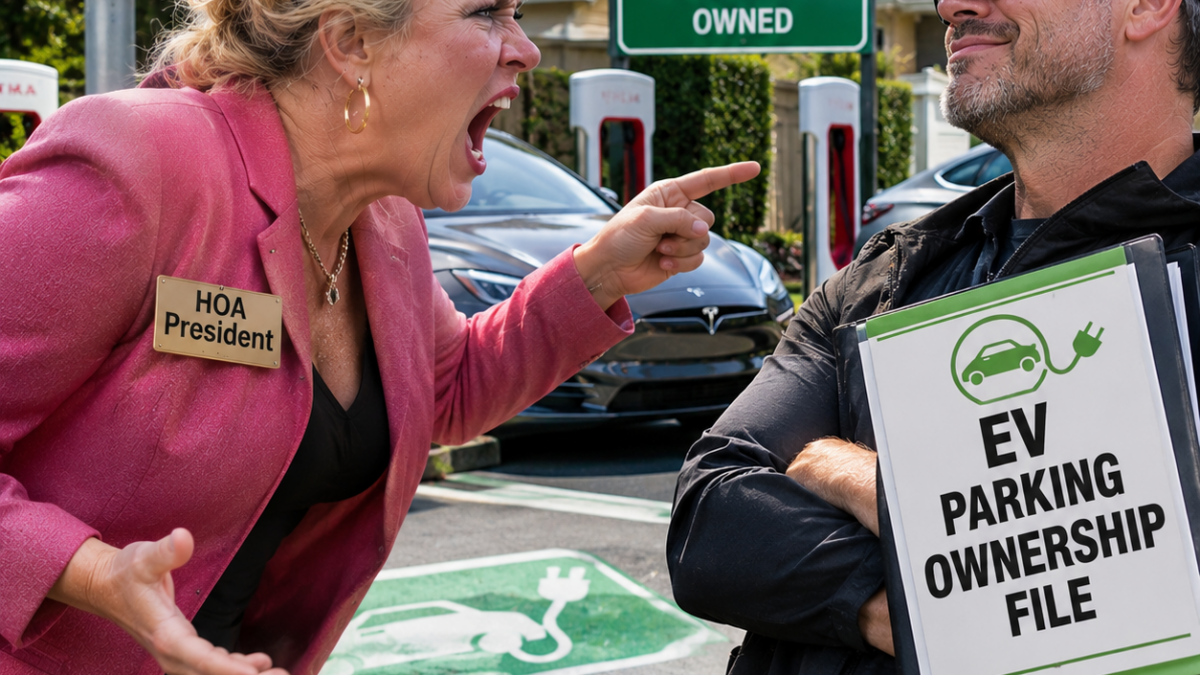
PART 2:
The workshop was colder than the house.
My grandfather had never believed in wasting heat on a room where a man was supposed to be working.
I switched on the fluorescent lights.
They flickered twice before coming alive.
Dust floated over the workbench.
For a moment, I just stood there.
My Tesla was somewhere six miles down the mountain road at Bulldog Towing.
I had a presentation worth roughly fifty thousand dollars to a client in less than an hour.
And my HOA president had just ordered my personal vehicle removed from property she did not own because she had decided electric cars were politically offensive.
My first instinct was rage.
My second was calculation.
Grandpa had trained that into me.
He used to say anger was excellent fuel but terrible steering.
So I found the folder marked:
**PINE RIDGE — ORIGINAL DEVELOPMENT.**
Then I called a rideshare.
None available.
Of course.
Mountain community.
Early morning.
Snow season.
Perfect.
I put on boots.
Grabbed my briefcase.
And started walking.
—
Six miles doesn’t sound impossible until you are trying to cover it in business clothes on a Colorado mountain road with loose gravel under your shoes and a meeting clock running in your head.
By the time I reached Bulldog Towing, my socks were wet.
My coat smelled like cold air and diesel exhaust.
My presentation shirt had a sweat mark down the back.
The tow yard looked exactly like the kind of place that would demand cash only.
Chain-link fence.
Oil-stained gravel.
A faded sign.
Three wrecked pickups.
One old Camaro with no hood.
Rick Steinberg sat behind the counter.
Veronica’s brother-in-law.
Naturally.
He looked at me.
Then at my Tesla through the window.
“Four eighty-five.”
“For what?”
“Tow.”
“From my private parking space?”
He shrugged.
“HOA authorization.”
“Storage?”
“Eighty-nine a day.”
“It’s been here less than an hour.”
“Still goes into the system.”
I stared at him.
He smiled.
“Maybe get yourself a real American car next time.”
I looked toward the Ford parts calendar behind him.
Then back.
“You understand Tesla builds cars in America, right?”
His smile disappeared.
“I need payment.”
I paid.
Not because I accepted the tow.
Because I needed my car.
I photographed the receipt.
Photographed the yard.
Photographed the time.
Then I drove directly to my presentation.
I arrived late.
But I arrived.
The Copper Mountain Ski Resort Consortium didn’t care how angry I was with my HOA.
They cared whether I could explain their renewable-energy conversion plan.
So I did.
Forty-seven slides.
Projected cost reductions.
Energy-storage options.
Charging infrastructure.
The irony almost made me laugh halfway through.
I was standing in a conference room helping a major resort reduce fossil-fuel dependence while my neighborhood association had just towed my car for being electric.
Life has a sense of humor.
Sometimes it is not kind.
—
I returned to Pine Ridge that night around eight.
Veronica’s F-350 was parked diagonally across two common spaces near the community center.
No violation notice.
No tow truck.
No ruler.
I stopped.
Took three photographs.
Time stamped.
Then went home.
I didn’t knock on her door.
I didn’t post online.
I made coffee.
Opened Grandpa’s files.
And kept reading.
My parking space had an individual deed reference.
Exclusive vehicle-storage rights.
No fuel-type limitation.
No “commercial vehicle” definition in the HOA bylaws.
And then I found Colorado statute language dealing with association restrictions on electric-vehicle charging.
I highlighted everything.
The next morning, I sent a formal dispute letter.
No insults.
No threats.
I requested reimbursement for the tow.
Rescission of the fines.
Written identification of the rule defining my Tesla as a commercial vehicle.
Written authority allowing the HOA to remove a vehicle from an individually deeded space.
And copies of the board vote authorizing electric-vehicle restrictions.
Veronica responded three days later.
By calling an emergency meeting.
—
The Pine Ridge community center smelled of industrial carpet cleaner, burnt coffee, and the quiet desperation of people who had attended too many HOA meetings.
Five board members sat behind folding tables.
Veronica in the middle.
Janet Walsh to her left.
Two men I barely knew.
Another woman who spent the entire opening checking her phone.
I sat front row.
Phone visible.
Recording.
Veronica started.
“Mr. Blackwood’s vehicle has generated multiple community complaints.”
“What kind?”
She looked at me.
“You’ll have an opportunity to speak.”
“Understood.”
She continued.
“Noise.”
I almost laughed.
“Electrical interference.”
Now I did laugh.
Small.
Couldn’t help it.
“And property-value concerns associated with nontraditional vehicle infrastructure.”
When my turn came, I stood.
“Can I see the noise complaints?”
Veronica lifted a folder.
“Written statements.”
“Can I see them?”
“They contain private resident information.”
“Can the board verify they came from actual residents?”
“The president has verified them.”
“That’s you.”
“Yes.”
I looked at Janet.
She looked uncomfortable.
“What electrical interference?”
Veronica said:
“Residents have expressed concerns.”
“Measured interference?”
“That’s not the point.”
“It is literally the point.”
Her jaw tightened.
Then she handed the folder to another board member.
I noticed the pages.
Same paper.
Same ink.
Same handwriting.
Different signatures.
Interesting.
I photographed them when they were briefly displayed during discussion.
Veronica saw.
“Unauthorized recording and photography of internal HOA proceedings violates community privacy expectations.”
I smiled.
“I’d like the specific rule.”
She ignored that.
So I pulled out my phone.
“I also have documentation.”
Her face changed.
Only slightly.
I played a recording captured near my property three days earlier.
Veronica’s voice.
Then Rick’s.
Clear enough.
“We need to get rid of the tree hugger before his liberal politics spread to other residents.”
The room stopped breathing.
Then Rick:
“If you keep writing the tow orders, I’ll keep taking the cars.”
Veronica:
“Start with his. Make it expensive enough and he’ll sell.”
Janet Walsh lowered her coffee cup.
Slowly.
One board member whispered:
“Jesus.”
Veronica recovered.
“This recording was obtained without consent.”
I said:
“We can discuss admissibility elsewhere. But I’d like the board to answer whether enforcement is based on vehicle rules or my supposed politics.”
Nobody answered.
Veronica called for executive session.
Then returned fifteen minutes later.
They voted three to two.
New daily parking inspections.
For “community safety.”
Guess whose parking space they inspected first.
—
Six in the morning.
Every morning.
Veronica.
Clipboard.
Ruler.
Once, a magnifying glass.
I wish I were joking.
Mrs. Henry came over carrying coffee.
We stood on my porch while Veronica crouched beside my Tesla examining the pavement.
“What is she looking for?” Mrs. Henry asked.
“Oil.”
Mrs. Henry stared at the car.
“From the electric motor?”
“Apparently.”
She took a sip.
“That woman is wound tighter than a tick on a hound.”
Veronica stood.
“You two realize this is a formal inspection.”
Mrs. Henry smiled.
“Honey, I survived fifty-two years of marriage to a man who rebuilt carburetors at the kitchen table. You don’t scare me.”
Veronica walked away.
Mrs. Henry handed me a cinnamon roll.
“Document everything.”
“I am.”
“Good.”
Then, quieter:
“She’ll overdo it.”
“Think so?”
“I know so.”
—
She did.
Friday morning, a new notice appeared on every bulletin board.
**OVERNIGHT GUEST VEHICLE REGISTRATION.**
Buried in the fine print:
Alternative-fuel vehicles required an environmental-impact assessment before overnight approval.
My sister Emma arrived Saturday from Boulder in a Prius.
She had tools in the trunk.
We were installing cabinets.
I registered the car.
Paid the ridiculous twenty-five-dollar guest-processing fee.
Sunday morning:
Diesel engine.
Chains.
5:47.
I ran outside.
Emma was already there in pajamas.
“No.”
She looked at the tow truck.
“Ethan, I registered.”
“I know.”
Veronica stood by the curb fully dressed.
Hair perfect.
Clipboard ready.
“Hybrid vehicles require supplementary environmental documentation.”
Emma stared.
“My Prius needs an environmental assessment?”
“For overnight parking.”
“Your truck is idling right now.”
“Don’t be childish.”
Emma looked at me.
“Is she real?”
“Unfortunately.”
Rick took the Prius.
Another $485.
Another receipt.
Another documented incident.
But this one changed something.
Because now the story wasn’t only about me.
Emma called a clean-energy advocacy organization she had worked with through Boulder.
I called too.
Within two days, I had people who understood Colorado EV protections far better than I did.
They reviewed the notices.
The tow documents.
Charging restrictions.
The guest policy.
One attorney said:
“Keep every piece of paper.”
I laughed.
“That seems to be everyone’s advice.”
“Because people who abuse authority usually document themselves.”
Good point.
—
Veronica then announced an emergency educational seminar on EV safety.
I actually attended.
Because I wanted to see the expert.
His name was Danny Steinberg.
Another relative.
His credentials were unclear.
His PowerPoint included three photographs of exploding cars.
One was from a movie.
Mrs. Henry raised her hand.
Danny called on her reluctantly.
“What’s the difference between AC and DC current?”
He froze.
“Well, obviously both can be dangerous when… mixed with water.”
Someone coughed to hide laughter.
Mrs. Henry didn’t bother.
“Son, I’ve seen squirrels with a better understanding of electricity.”
The room broke.
Even Janet laughed before catching herself.
Veronica ended questions early.
But the damage was done.
The “expert” made the HOA look ridiculous.
The problem was fear still worked.
Three residents with hybrids began parking outside the development.
One elderly neighbor stopped using her plug-in car altogether because she didn’t want trouble.
That bothered me.
People were changing their lives because Veronica made ordinary choices exhausting.
That was how bullies won.
Not through one big victory.
Through accumulated inconvenience.
—
Then she attacked my property itself.
Tuesday morning.
Mini excavator.
My front yard.
Crew in hard hats.
I ran outside in a bathrobe.
Again.
Apparently bathrobes are the official uniform for defending property from HOA overreach before sunrise.
The foreman, Mike, looked at me.
“Homeowner?”
“Yes.”
He pointed toward the charging installation.
“HOA hired us for emergency electrical remediation.”
“Emergency what?”
“Unpermitted wiring.”
“It’s permitted.”
He looked confused.
Veronica appeared.
“Your installation creates a grid hazard.”
“No, it doesn’t.”
“It’s overloading community electrical infrastructure.”
“I have a county permit.”
“HOA standards supersede local approval.”
Mike scratched his head.
“Ma’am, I’m not an electrician, but this installation looks pretty standard.”
“It has to be removed.”
“Stop,” I told him.
He looked between us.
“Who owns the property?”
“I do.”
Veronica said:
“The HOA has emergency authority.”
I pulled out my phone.
“Mike, before you continue, I’m telling you as property owner that I dispute authorization.”
He stopped.
That probably saved more damage.
But part of the installation had already been torn apart.
Conduit exposed.
Cable severed.
Concrete disturbed.
I called the county electrical inspector.
He arrived that afternoon.
Reviewed everything.
Permit valid.
Installation compliant.
In fact, according to him, the work exceeded the required safety standard.
I got that in writing.
Then I received a repair estimate.
$3,200.
The HOA’s preferred contractor offered to “correct” the system for $8,500.
Company:
Steinberg Electrical Services.
Veronica’s husband Dave.
I stared at the estimate.
Then started laughing.
Not happy laughter.
The kind you make when corruption becomes too obvious to remain subtle.
—
During the excavation, Mike’s machine had crossed near Mrs. Henry’s boundary.
Her roses were destroyed.
Not all.
Enough.
She stood beside broken stems.
Petals scattered across frozen dirt.
Her hands shook.
“Harold planted those.”
I knew Harold was her husband.
Died years earlier.
“He put every one in himself,” she said.
I didn’t know what to say.
She knelt.
Picked up one stem.
Pressed it against her coat.
That changed me.
Until then, part of me had treated Veronica as an absurd opponent.
Clipboard villain.
Ridiculous rules.
Tow trucks.
Fake electrical expert.
But Mrs. Henry’s grief was not funny.
Neither was the Ramirez family.
Neither were the Kowalskis.
I started asking harder questions.
Tom Rakestraw told me his solar panels had been damaged during one of Veronica’s “safety inspections.”
Mrs. Henry remembered emergency drainage work destroying part of the Ramirez garden before they sold.
Pattern.
Emergency.
Damage.
Preferred Steinberg contractor.
Repair bill.
Repeat.
That night I went back to Grandpa’s workshop.
—
I searched until nearly three in the morning.
Development plans.
Old deeds.
Transfer agreements.
Engineering files.
Then I found a manila envelope behind a Chevrolet service manual.
Grandpa’s handwriting:
**PINE RIDGE FINAL CONTRACTS — KEEP SAFE**
Inside were the 1994 transfer documents from when the original development conveyed community facilities to the newly organized HOA.
Parking areas.
Access lanes.
Shared structures.
And then I found the clause.
Perpetual clean-energy easement.
I read it once.
Again.
Again.
Alternative-fuel access.
Supporting infrastructure.
No discriminatory restriction.
Then the remedy.
Repeated breach could trigger reversion rights over the affected parking facilities based on original transfer valuation.
My hands went cold.
I pulled out a calculator.
127 spaces.
Original transfer price:
$400 each.
Total:
$50,800.
Estimated modern value:
Roughly $8,500 each.
Over a million dollars total.
I sat down on Grandpa’s old stool.
The fluorescent light buzzed overhead.
I had spent weeks trying to stop Veronica from touching my Tesla.
Grandpa had written something decades earlier that potentially threatened the HOA’s control of every parking space in the development if clean-energy access was unlawfully restricted.
Then I found a handwritten note.
Not legal language.
Grandpa.
**Ethan—property is responsibility before it is profit. Protect what matters for the people who come after us. The tools are here if you ever need them.**
I read it twice.
Then couldn’t read it anymore because the paper went blurry.
He had been dead.
And suddenly the workshop felt full of him.
The smell of sawdust.
The coffee stains.
The pencil marks.
That ridiculous habit of planning thirty years ahead.
I put my hand on the workbench.
“Okay, Grandpa.”
My voice sounded stupid in the empty room.
“Let’s see what you built.”
—
The next morning, I called Harold Pinkerton.
Seventy-eight.
Environmental and property lawyer.
He had worked with my grandfather.
His office in Denver looked like law had been practiced there since Theodore Roosevelt.
Leather books.
Old wood.
Stacks of paper.
Framed newspaper clippings.
Harold read the easement.
Slowly.
Then looked over his glasses.
“Your grandfather was a magnificent bastard.”
I laughed.
“So it works?”
“Don’t use the phrase works until we verify the chain of title.”
My stomach dropped.
Then he smiled.
“But yes, Ethan. This is serious.”
He walked me through it.
The easement traveled with the relevant property interests.
The environmental protections were not decorative mission statements.
They were contractual obligations tied to the transfer of facilities.
Repeated discriminatory interference could activate remedies.
“How strong?”
“Depends on the documentation.”
I put two binders on his desk.
He raised one eyebrow.
“Good boy.”
“I’m thirty-eight.”
“Compared to me, infant.”
He spent the next three hours reviewing.
Tow orders.
Guest policy.
Charging-station damage.
Meeting minutes.
Recorded statements.
Fines.
“Veronica has a remarkable talent.”
“For what?”
“Producing exhibits.”
That made me smile.
—
Harold designed three outcomes.
First:
Demand compliance.
Rescind discriminatory rules.
Reimburse damages.
Respect the easement.
Second:
Partial transfer or settlement involving parking control.
Third:
If the HOA continued the pattern, enforce the broader reversion provisions.
“Which one happens?” I asked.
He leaned back.
“If your description of Ms. Steinberg is accurate?”
“Yes?”
“She will choose the worst option available.”
“You sound confident.”
“People who have confused authority with identity rarely surrender authority voluntarily.”
That was Harold Pinkerton in one sentence.
—
We organized quietly.
Mrs. Henry.
Tom Rakestraw, licensed electrician.
Janet Clearwater, a physician interested in air quality.
Residents with hybrids.
Residents who didn’t care about EVs but hated predatory towing.
Original homeowners.
Moderates.
No inflammatory flyers.
No “war.”
Information.
I showed people the founding documents.
Not all supported me.
That was fine.
Some thought EV rules were stupid but didn’t want the HOA financially destabilized.
Others worried about legal costs.
A handful genuinely agreed with Veronica.
We listened.
Harold insisted.
“If you want community legitimacy, Ethan, you don’t silence opposition.”
So we didn’t.
—
Meanwhile, I documented the parking spaces.
All 127.
Deed references.
Condition.
Location.
Current designation.
It took two weekends.
Mrs. Henry followed me for half of one with a thermos.
“You sure you know what you’re doing?”
“No.”
“Good.”
I looked at her.
“Good?”
“Men who think they know exactly what they’re doing worry me.”
Fair.
—
The finances worried Harold.
Pine Ridge HOA had about $340,000 in debt tied to recent improvements.
Several contractors had Steinberg family connections.
Not all illegal.
But enough relationships to raise questions.
If the parking facilities reverted at original values, the association could lose control of assets worth far more than what it had originally paid.
I didn’t want innocent homeowners crushed.
That became important.
Revenge feels simple until you calculate who pays for it.
I told Harold:
“I don’t want residents hit with a giant assessment.”
“Then don’t make this about bankrupting the association.”
“What do we make it about?”
“Ownership.”
That became the plan.
If the reversion remedy could be enforced, we would give homeowners a path to own their individual parking spaces directly.
Not keep everything.
Not profit.
Return control.
My grandfather’s note kept circling in my head.
Responsibility before profit.
—
Veronica started sensing trouble.
One Tuesday night at 11:47, her F-350 rolled into my driveway.
I watched from the upstairs window.
She got out carrying an envelope.
I went downstairs.
Opened the door but stayed inside.
“Ethan.”
“Veronica.”
“We need to talk.”
“It’s almost midnight.”
“I think this has gone too far.”
“You towed my car twice if we count Emma’s.”
“Your sister’s.”
“You destroyed my charger.”
“That was safety remediation.”
“County inspector disagrees.”
She held up the envelope.
“The board is prepared to make you whole.”
She opened it.
Check.
$2,847.
Fines.
Tow costs.
Some interest.
“We’ll waive future electric-vehicle restrictions.”
“Why?”
“Because reasonable people compromise.”
“Last week you tried to classify my charger as a fire hazard.”
“We had incomplete information.”
“And my car?”
“We may have been overly aggressive.”
That was as close to apology as Veronica had come.
“What do you want?”
She exhaled.
“Withdraw the complaints. Stop involving outside organizations. No litigation.”
I looked at the check.
Then at her.
“You suddenly care about settlement?”
“Legal battles hurt property values.”
There it was.
Property values.
Always.
“I’ll think about it.”
She pushed the envelope toward me.
I didn’t take it.
“Have your attorney send it to Harold.”
“Pinkerton?”
She said his name too quickly.
She knew.
Interesting.
“You know him?”
“I know who he is.”
“Then you know where to send it.”
Her expression changed.
She realized I had noticed.
“Ethan, don’t do something reckless.”
“I’m standing inside my house at midnight. You’re on my porch.”
I closed the door.
The next morning, anonymous anti-EV flyers appeared throughout Pine Ridge.
So much for compromise.
—
Rick’s tow trucks began circling.
Slow.
Predatory.
People noticed.
Mrs. Henry found tire marks across part of her repaired garden and a note suggesting “elderly homeowners may prefer age-appropriate communities.”
She photographed everything.
Then called me.
Her voice was calm.
Too calm.
“I want that woman gone.”
“We’re getting close.”
“No, child.”
She paused.
“I want her gone correctly.”
I smiled.
Harold would like her.
—
Then came the Facebook group.
**PINE RIDGE PROPERTY PROTECTION.**
Veronica posted fire photos.
Battery explosions.
Grid-collapse articles.
Photos of my Tesla.
Comments about “wealthy outsiders.”
That one was rich coming from her.
Janet collected screenshots.
Tom responded with technical explanations.
Slowly, something unexpected happened.
Residents who didn’t care about EVs began defending me.
Not because they suddenly became environmentalists.
Because Veronica had become exhausting.
Politics can divide a community.
So can extremism.
But nothing unites ordinary people quite like somebody making every normal decision unbearable.
—
Veronica circulated a petition to ban alternative-fuel vehicles pending safety review.
She needed a large majority.
She got twenty-three signatures.
Then thirty-one.
Then stopped.
The more she pushed, the fewer people wanted to stand beside her.
Mrs. Henderson told me:
“I don’t own an electric car.”
“Okay.”
“I probably never will.”
“Also okay.”
“But I signed against Veronica.”
“Why?”
“She talked at my front door for forty-seven minutes.”
I laughed.
“I timed her.”
That may have been the single most relatable anti-Veronica argument of the entire campaign.
—
Then my homeowners-insurance company called.
Complaints.
Fire risk.
Charging hazard.
Professional opinion from Dave Steinberg.
Veronica’s husband.
Electrical contractor.
He claimed my charger exceeded residential load tolerances.
I sent the insurer:
County permit.
Inspection report.
Electrical specifications.
Tom Rakestraw’s evaluation.
The representative called back.
“Your installation is not creating the risk described.”
“Thank you.”
“Do you know Mr. Steinberg?”
“Unfortunately.”
I forwarded Dave’s written claim to the state licensing board for review.
Not revenge.
Accountability.
If a licensed electrician uses his credentials to make technical assertions, those assertions should survive technical scrutiny.
—
Veronica hired security next.
I use the word “security” generously.
Rick’s brother.
Polo shirt.
Magnetic signs on an old pickup.
Clipboard.
He parked outside homes with EVs.
Photographed chargers.
Made notes.
Mrs. Henry walked outside with cookies.
Ten minutes later, she knew:
His full name.
How much Veronica paid him.
Where he went to high school.
His divorce history.
And that he was mostly being compensated with fuel money and beer.
She called me afterward.
“He’s harmless.”
“You got all that in ten minutes?”
“He likes oatmeal chocolate chip.”
I wrote down the relevant parts.
Not the divorce.
Some records have limits.
—
The so-called community safety patrol lasted seventeen minutes before a resident called the sheriff about suspicious people photographing houses.
That was the moment even Veronica’s moderate supporters started disappearing.
Her authority had become theater.
People could finally see the stage machinery.
—
Saturday night before the meeting, I returned to Grandpa’s workshop.
I organized everything one final time.
Forty-three documented incidents.
Tows.
Fines.
Guest restrictions.
Charging destruction.
Insurance complaints.
Family-contractor conflicts.
Social-media retaliation.
Attempted settlement.
Security patrol.
Then the easement.
Then the transfer documents.
Then Grandpa’s note.
I sat on his stool.
For months, I had been angry because Veronica treated my Tesla like it represented everything she disliked about the world.
But the Tesla was almost irrelevant now.
This was about who owned decisions.
Who got to use community rules as personal weapons.
Who paid when somebody abused those rules.
Grandpa had built Pine Ridge because working families needed stable homes.
If I used his documents merely to humiliate Veronica and destabilize everybody else, I would be betraying the point.
So I wrote one sentence at the top of my meeting notes:
**NO PROFIT. RETURN CONTROL TO RESIDENTS.**
That became my compass.
—
Monday night, the community center was packed.
One hundred fifty-three residents.
Standing room.
Hallway overflow.
News cameras.
Denver Post.
Local television.
Burnt coffee.
Sweating air conditioner.
Veronica sat at the front in a dark suit.
Her clipboard trembled slightly.
She gaveled the meeting to order.
“Tonight we will address ongoing vehicle violations and vote on permanent alternative-fuel restrictions.”
Mrs. Henry stood.
“Point of order.”
Veronica stared.
“What?”
“Member comment comes first under the bylaws.”
“We’re modifying the agenda.”
“Was the modification properly noticed?”
Murmurs.
Veronica’s face reddened.
“This is not a parliamentary seminar.”
Harold Pinkerton stood near the back.
“It doesn’t need to be. Your bylaws are clear.”
Veronica pointed.
“Outside attorneys are not recognized.”
I stood.
“He represents me.”
She looked at me.
I walked forward carrying Grandpa’s folder.
“My grandfather built Pine Ridge.”
The room erupted.
People turned.
Whispered.
Veronica stared as though I had announced I owned Colorado.
I continued.
“He developed this community in 1987. And before the HOA controlled these facilities, he put legal protections into the development documents.”
I opened the folder.
“Protections Veronica never read.”
—
Harold came forward.
No drama.
That made him more intimidating.
He explained the perpetual clean-energy easement.
Alternative-fuel access.
Supporting infrastructure.
Transfer obligations.
Remedies.
Then he explained how the HOA’s repeated discriminatory actions could trigger ownership reversion mechanisms tied to the parking facilities.
Veronica laughed.
Too loudly.
“These documents are fraudulent.”
Harold held up certified copies.
“County recording information.”
Her laugh stopped.
I connected my phone to the sound system.
Then played the recording.
Veronica:
**“We need to get rid of the tree hugger before his liberal politics spread.”**
Rick:
**“You keep writing tow orders, I’ll keep taking cars.”**
Then discussion of making the costs painful enough that I would leave.
Nobody moved.
News cameras rolled.
Janet Walsh looked physically sick.
One of Veronica’s longtime board allies covered his face.
I stopped the recording.
“This was never about parking safety.”
Veronica slammed one hand on the table.
“You manipulated that conversation!”
“Did you say it?”
“You invaded my privacy.”
“Did you say it?”
She looked toward her attorney.
No answer.
Harold spoke.
“The relevant question is whether enforcement targeted protected property rights based on vehicle type and whether those acts breached the recorded easement.”
Then he showed the accounting.
127 spaces.
Original transfer valuation:
$400 each.
Total:
$50,800.
Current estimated aggregate value:
More than one million.
The room went dead quiet.
Harold said:
“The remedy language provides a basis for the affected property holders to compel reversion or reacquisition at the original stipulated value.”
Veronica stood.
“You’re trying to bankrupt this HOA.”
“No,” I said.
That got everyone’s attention.
“I’m not.”
I looked around the room.
“I don’t want the HOA’s money.”
Then I put the prepared transfer filings on the table.
“This morning, pursuant to the reversion process Harold has outlined, I initiated paperwork to acquire the 127 affected parking interests at the stipulated transfer price.”
Noise exploded.
People standing.
Questions.
Phones raised.
Veronica’s face drained white.
“You can’t do that.”
Harold said:
“The documents say otherwise.”
I raised my voice.
“And before anybody panics, listen to the rest.”
The room slowly settled.
“I am not keeping them.”
Silence again.
“If the transfer closes, tomorrow morning every homeowner can purchase the parking space associated with their property from me for exactly what I paid.”
Mrs. Henry shouted:
“Four hundred?”
“Yes.”
“Not market value?”
“No.”
“Profit?”
“Zero.”
She grinned.
“Now we’re talking.”
—
Veronica slammed her palm on the table.
“This is fraud!”
Harold answered:
“Then challenge the recorded instruments in court.”
She looked around.
Her supporters were disappearing in real time.
Mrs. Henry raised her hand.
“Motion to recognize and approve the parking-space reacquisition process under the easement documents.”
Voices:
“Second.”
“Second.”
“Second.”
Veronica shouted:
“You cannot vote on this!”
Janet Walsh spoke.
“Yes, we can.”
That surprised everyone.
Especially Veronica.
Janet continued:
“I have supported you for years.”
Veronica stared.
“And I’m done.”
The room erupted again.
Vote:
142 in favor.
11 against.
Next motion:
Rescind all fuel-type vehicle bans and discriminatory charging restrictions.
139–14.
Then:
Vote of confidence in Veronica’s presidency.
Mrs. Henry phrased it more directly.
“Remove her.”
147 in favor.
Six opposed.
Veronica stood.
“I built this community.”
Mrs. Henry laughed.
“No, honey. His grandfather did.”
That ended it.
Veronica grabbed her purse.
Stormed toward the door.
Rick’s tow truck was parked outside.
The irony was almost too perfect.
She climbed into the passenger seat.
They drove away.
I watched through the community-center windows.
Then turned back to the room.
One hundred fifty people were looking at me.
I suddenly felt terrified.
Not of Veronica.
Responsibility.
Because winning the fight was easy compared to what came next.
—
Tuesday morning at eight, we opened the community center.
Folding tables.
127 deed-transfer packets.
Harold.
Two junior attorneys.
A notary.
Coffee.
Mrs. Henry arrived first.
Of course.
She placed four one-hundred-dollar bills on the table.
“I want mine.”
I laughed.
“Good morning to you too.”
“I’ve waited sixty-eight years to own every inch associated with my house.”
“You’ve only lived here forty.”
“Don’t ruin the moment.”
She signed.
Notary stamped.
Parking space hers.
She held the deed up.
Then hugged me.
Hard.
“Your grandfather would be proud.”
That almost broke me.
By noon:
Eighty-nine transfers.
By five:
All 127.
Money received:
$50,800.
Exactly what I had paid.
Profit:
Zero.
I went home exhausted.
Put Grandpa’s note on the workbench.
And whispered:
“Responsibility before profit.”
That night, I slept better than I had since moving to Pine Ridge.
—
The transformation started immediately.
Not everybody bought an EV.
That was never the point.
Some homeowners installed chargers.
Some didn’t.
Tom Rakestraw’s electrical business suddenly had months of work.
He refused Steinberg-style markups.
“Normal price for normal work,” he said.
Mrs. Henry installed solar.
At seventy-nine.
She became fascinated by the system.
Started asking so many technical questions that Tom finally told her:
“You should teach this.”
So she did.
Her first workshop was called:
**GRANDMOTHERS FOR GREEN ENERGY.**
Standing room.
She wore Harold’s old gardening hat.
Harold, her late husband, would have loved it.
—
The charging infrastructure spread.
Within six months, Pine Ridge had become unusually EV-friendly.
Property values rose.
Young families became interested.
Not because every resident had become an environmental activist.
Because individually owned parking and predictable rules made life easier.
People like certainty.
They like controlling property they paid for.
And they like knowing a board president cannot tow their sister’s car at dawn because she dislikes the fuel type.
—
Veronica put her house on the market.
Three weeks later, a family bought it.
They owned:
One Tesla.
Two Priuses.
Mrs. Henry nearly injured herself laughing when she learned.
I told her not to gloat.
She said:
“I’m old. I have limited time.”
Fair.
Veronica moved to Florida.
I never contacted her.
Never followed her story.
I had what I needed.
Pine Ridge back.
—
Rick’s towing company faced regulatory scrutiny.
Residents submitted records of disputed towing.
Receipts.
Authorization forms.
Video.
Complaints.
The investigation took months.
Eventually Bulldog Towing lost operating authority after findings related to predatory practices.
I read the notice once.
Filed it.
No celebration.
I was learning something.
Consequences feel best when you don’t have to keep watching them.
—
Dave Steinberg’s electrical business faced its own licensing review.
Complaints about inflated work.
Technical representations.
Installation quality.
The business eventually folded.
Again:
Not my job to celebrate.
The system had evidence.
The system did what it did.
—
Pine Ridge held new elections.
Janet Walsh refused to run.
She said:
“I need a year of not looking at an HOA agenda.”
Nobody blamed her.
A quieter board took over.
First policy:
No towing without documented notice and independent authorization except genuine safety emergencies.
Second:
Conflict-of-interest disclosures for contractors.
Third:
All parking regulations required homeowner vote.
Fourth:
No restriction based solely on vehicle fuel type.
The meetings became boring.
Thank God.
—
Harold Pinkerton remained involved longer than he intended.
At eighty, he still took calls.
I asked once:
“Why?”
He tapped Grandpa’s original easement.
“Because your grandfather was right.”
“About clean energy?”
“About ownership.”
He leaned back.
“People protect what they understand belongs partly to them.”
That stayed with me.
—
My consulting business grew.
The Pine Ridge story spread.
Other communities called.
Homeowners dealing with charging restrictions.
Solar bans.
Parking disputes.
I did not become some professional HOA destroyer.
That would have been absurd.
Instead, Harold and I built a small resource toolkit.
Read the deed.
Read the covenants.
Check state law.
Document enforcement.
Look for selective treatment.
Identify conflict-of-interest contractors.
Do not assume an HOA letter equals legal truth.
Boring things.
Useful things.
—
Colorado lawmakers eventually referenced cases like ours while strengthening protections involving clean-energy vehicles and charging infrastructure.
Pine Ridge became a local example of how badly rules can go when boards treat technology as ideology.
I was invited to speak.
I hated public speaking.
Grandpa would have enjoyed watching me suffer.
I told legislators:
“This was never really about Tesla.”
That got attention.
“It was about whether an association can use property rules to punish a resident because leadership dislikes what that resident represents.”
That was the truth.
—
Janet Clearwater and I became friends during the fight.
Then more than friends.
She was the physician who had helped residents understand air-quality data.
Calm.
Smart.
Unimpressed by drama.
Six months after the community meeting, I asked her to dinner.
She said:
“You mean a real dinner, not an organizing meeting?”
“Yes.”
“No binders?”
“No.”
“No property maps?”
“I can leave them in the car.”
She laughed.
We got engaged later.
Our reception was held in the community center.
The same room where Veronica lost control.
Mrs. Henry made the cake.
Tom installed temporary lighting powered through the community solar system.
Harold gave a toast.
He said:
“Ethan’s grandfather created a development agreement so complicated it eventually helped his grandson find a wife.”
Janet said:
“That is not romantic.”
I said:
“It’s a little romantic.”
She disagreed.
We married anyway.
—
Pine Ridge’s annual clean-energy gathering eventually grew into a festival.
I resisted the name.
Lost that vote.
Visitors came.
Solar installers.
Electricians.
Students.
Families.
Grandpa’s original plans were displayed in a small historical exhibit.
People were fascinated that a mining engineer in the 1980s had been thinking about alternative energy.
The irony was beautiful.
A man whose career came from extraction helped design a community prepared for transition.
He understood something Veronica never did.
Change happens whether you like it or not.
Good planning makes room for it.
—
The workshop became my favorite room again.
Not a war room.
A workshop.
I repaired the cabinets.
Rehung tools.
Kept Grandpa’s outlines around them.
I framed his note.
Small frame.
Nothing fancy.
**PROPERTY IS RESPONSIBILITY BEFORE IT IS PROFIT.**
Underneath, I added nothing.
Didn’t need to.
—
Mrs. Henry became a minor legend.
At eighty-one, she was still teaching homeowners how to ask contractors intelligent questions.
Her presentation always included:
“What size breaker?”
“What wire gauge?”
“Where’s the permit?”
And:
“If the man cannot explain AC versus DC, do not let him touch your house.”
Danny Steinberg was never named.
Everyone knew.
—
Years after the fight, Pine Ridge had dozens of electric and hybrid vehicles.
Still plenty of trucks.
Plenty of gas cars.
That mattered to me.
We didn’t defeat vehicle discrimination by creating reverse discrimination.
People drove what worked for them.
Mrs. Henry’s nephew drove a diesel pickup.
Tom owned an electric work van and an old gasoline Mustang.
Nobody cared.
The rule became simple.
Your parking space.
Your lawful vehicle.
Your decision.
That was freedom in a form far less dramatic than television.
—
The individual parking deeds turned out to change more than charging.
Residents took better care of spaces.
Some added small weather shelters where permitted.
Some installed outlets.
Some rented unused spaces to neighbors through written agreements.
One older resident sold a second deeded space to a young family.
For the first time, parking wasn’t political territory controlled from a boardroom.
It was property.
Understandable.
Defined.
That reduced conflict more than any rule Veronica ever wrote.
—
One afternoon, years later, I found the original Bulldog Towing receipt.
$485.
Cash.
My first illegal tow.
I held it.
Remembered the six-mile walk.
My wet socks.
Rick’s office.
His “real American car” comment.
I almost threw it away.
Then brought it to Grandpa’s workshop.
Not to frame.
I put it in the old file behind the development agreement.
A reminder.
Small abuse can reveal big weaknesses.
But I didn’t keep the receipt where I could see it every day.
That would give Veronica too much rent-free space in my life.
—
Mrs. Henry eventually died.
Eighty-four.
Peacefully.
Her family held the memorial in Pine Ridge.
The room overflowed.
Exactly like the meeting years earlier.
Only quieter.
Tom spoke about her energy workshops.
Janet spoke about her kindness.
I spoke about cinnamon rolls.
Specifically the morning she stood beside me while Veronica inspected my Tesla with a magnifying glass.
People laughed.
Then cried.
Her daughter gave me Mrs. Henry’s original parking deed.
“I think she wanted you to have this.”
“I can’t.”
“Not ownership. A copy.”
Oh.
The copy had a handwritten note:
**ETHAN—KEEP PEOPLE STUBBORN.**
That was Mrs. Henry.
We created a small community education grant in her name.
Not only energy.
Trade certification.
Electrical apprenticeship.
Solar installation.
HVAC.
Community-college technical programs.
She would have approved.
Especially if cookies were served.
—
Harold Pinkerton retired at eighty-three.
Actually retired.
Mostly.
His retirement gift from Pine Ridge was a model Tesla mounted on a wooden base.
Plaque:
**FOR READING THE FINE PRINT.**
He laughed for several minutes.
Then said:
“Your grandfather still owes me fees from 1994.”
“Take it up with his estate.”
“I intend to.”
He never did.
—
The old parking-transfer clause became famous enough that law students wrote papers about it.
Some called it brilliant.
Others called it dangerous drafting.
Harold said both were correct.
I didn’t care.
For us, it did what Grandpa intended.
It stopped one governing body from turning energy choice into a tool of exclusion.
—
One year, a new board proposed installing shared fast chargers.
Public meeting.
Engineering review.
Budget.
Impact study.
Actual expert.
Vote.
I sat near the back.
Nobody looked at me.
That made me happy.
The proposal passed.
Not unanimously.
Some people thought the cost was too high.
Others worried about traffic.
Normal disagreement.
No one was threatened.
No cars towed.
No fake experts.
No dawn excavation.
That meeting may have been the moment I knew Pine Ridge was healed.
People could disagree again without becoming enemies.
—
Janet and I eventually renovated Grandpa’s cabin.
Carefully.
Kept the workshop.
Kept the original stone fireplace.
Replaced the orange countertops.
No one mourned them.
We added solar panels.
Battery backup.
Modern charger.
All properly permitted.
One morning, I stood outside looking at the finished system.
Janet came beside me.
“Think Veronica can feel this from Florida?”
“No.”
“Shame.”
I laughed.
She had developed a mean streak.
Marriage does that.
—
We had no interest in turning Pine Ridge into a monument to the fight.
No Veronica museum.
No plaque where my Tesla was towed.
No giant charging-station statue.
The community moved forward.
That was healthier.
Grandpa’s historical exhibit focused on development history.
Miners.
Original families.
Engineering.
Energy planning.
Affordable housing.
The fight got one small panel.
Enough.
—
The Ramirez family heard what had happened.
Mrs. Henry had tracked them down before she died.
They visited one summer.
Maria Ramirez stood outside their old house.
Different owners now.
She stared for a long time.
“I thought I was crazy.”
“You weren’t.”
“Veronica made everything feel like our fault.”
“I know.”
“Noise complaints.”
I nodded.
“Grandkids.”
“Yes.”
“We sold because I couldn’t sleep.”
I didn’t know what to say.
She looked at the charging stations.
The individually owned parking spaces.
Children riding bikes.
Then:
“At least somebody stopped her.”
That sentence felt heavier than praise.
Because we had been late.
Families were already gone.
We couldn’t reverse everything.
But we could make the pattern harder to repeat.
Maria attended the festival that evening.
Her grandchildren played near the workshop display.
That felt like something.
Not repair.
But recognition.
—
The Kowalskis came back too.
Their old vegetable garden had been replaced with a patio.
Mr. Kowalski hated it.
“Bad tomatoes here now.”
He pointed.
“Concrete tomatoes.”
I laughed.
He still had the same accent.
Still the same outrage.
We gave him a community garden plot for the weekend.
He spent three hours correcting everyone’s technique.
Some people are consistent.
—
The Pine Ridge legal toolkit eventually reached homeowners outside Colorado.
Twenty-three states.
Then more.
I never tracked every outcome.
Some people won.
Some discovered their HOA was actually right.
That mattered too.
The goal was not to beat associations.
The goal was to understand rights.
Sometimes reading the documents tells you the board is wrong.
Sometimes it tells you that you really do need to move the trailer.
Knowledge works both ways.
That is why it matters.
—
Years passed.
Electric cars became ordinary.
That was maybe the funniest ending.
Everything Veronica treated as an existential threat became normal.
Teslas.
Fords.
Rivians.
Hybrids.
Electric pickups.
Nobody cared.
Kids growing up in Pine Ridge couldn’t understand why adults had once held a packed meeting over fuel type.
A teenager asked me during a history presentation:
“She actually towed your car because it was electric?”
“Yes.”
“Why?”
I thought about it.
“Because she thought difference was disobedience.”
He frowned.
“That’s stupid.”
“Yes.”
Sometimes history requires no further analysis.
—
My original Tesla eventually got old.
Battery degraded.
Technology improved.
I replaced it.
The salesman asked if I wanted to trade it.
I hesitated.
That car had been towed.
Inspected.
Photographed.
Called a commercial vehicle.
Called a political statement.
Used as evidence.
Parked outside my wedding reception.
Eventually I sold it to a college student.
Fair price.
No sentimental premium.
A machine should get used.
Not worshipped.
Grandpa taught me that too.
—
The student drove away.
I stood watching.
Janet said:
“You okay?”
“It’s a car.”
“You’re staring.”
“It’s still a car.”
She smiled.
“Sure.”
I went into the workshop.
Grandpa’s note still hung there.
That was the thing worth keeping.
—
Pine Ridge eventually generated most of its shared electricity through solar and other clean-energy contracts.
Transportation costs fell for many residents.
Air quality improved.
But those numbers, while impressive, weren’t my favorite outcome.
My favorite was simpler.
People stopped being afraid of the parking lot.
Nobody checked windows at dawn to see whether a tow truck was coming.
Guests didn’t ask whether their Prius needed an environmental assessment.
Teenagers didn’t learn that a board president could decide what kind of vehicle made them socially acceptable.
That mattered more.
Home should not feel like a checkpoint.
—
One winter morning, long after Veronica was gone, I woke before sunrise.
Snow.
Quiet.
I made coffee.
Walked outside.
No bathrobe this time.
I had learned.
My newer EV sat in the same parking space where Rick’s truck had once chained up the Tesla.
Beside it was a small metal plaque installed by the homeowner parking cooperative.
Not my idea.
It read:
**SPACE 47
INDIVIDUALLY OWNED
VEHICLE CHOICE BELONGS TO OWNER**
Simple.
Boring.
Perfect.
I brushed snow off it.
Across the lane, a neighbor started his gasoline pickup.
Farther down, someone unplugged an electric SUV.
Another resident scraped ice from a hybrid.
Nobody cared what anybody else drove.
That was exactly the point.
—
I carried my coffee to Grandpa’s workshop.
Turned on the fluorescent light.
Still buzzed.
I could replace it.
Never did.
His original transfer files were now stored in archival sleeves.
The handwritten note remained on the wall.
Sometimes I wondered whether he really imagined a future like ours when he wrote those clauses.
Probably not specifically.
He didn’t predict Tesla.
Or Veronica.
Or a tow truck at sunrise.
He simply understood power.
Energy changes.
Communities change.
Technology changes.
And rules written without room for the future become weapons for people who fear it.
So he built flexibility into property law.
That was his genius.
—
I sat at the workbench.
Outside, Pine Ridge woke slowly.
A garage door.
Snow shovel.
Dog barking.
EV charger clicking off.
Truck engine rumbling.
Normal sounds.
Years earlier, Veronica stood in my driveway and told me electric cars didn’t belong there.
For a while, I thought the satisfying ending would be making her regret that sentence.
Watching her lose office.
Watching her family businesses face consequences.
Watching her leave.
Those things were satisfying.
I won’t lie.
But revenge has a short shelf life.
What lasted was ownership.
Mrs. Henry signing her deed.
Families controlling their own parking.
Neighbors installing chargers because they wanted them.
Others choosing gas vehicles without anybody judging them.
The Ramirez family coming back and seeing that someone had finally believed them.
Grandpa’s vision surviving one more generation.
That lasted.
—
I opened the old file.
The first towing receipt was still inside.
Behind it:
The original easement.
Behind that:
Grandpa’s note.
For years, I had thought the most important number in this story was $1,079,500—the approximate value of the parking spaces Veronica’s policies put at risk.
It wasn’t.
It was zero.
Zero dollars profit when I sold every space back.
Because the moment I kept those parking spaces to enrich myself, I would have turned Grandpa’s protection into another form of control.
That would have made me no better than the person I fought.
Property is responsibility before profit.
He had already told me how the story should end.
I just needed to read far enough to understand him.
—
I closed the folder.
Finished my coffee.
Then stepped outside into the Colorado morning.
Snow covered the roofs.
Sunlight was beginning to hit the ridge.
Across Pine Ridge, 127 parking spaces belonged to the people who actually used them.
No Veronica.
No tow truck.
No daily inspections.
No “environmental impact assessments” for somebody’s sister visiting overnight.
Just homes.
Cars.
Families.
And a community that had finally learned the difference between rules that protect people and rules that exist only to control them.
Grandpa built Pine Ridge almost forty years earlier because he believed ordinary families deserved a place where they could own something stable.
Veronica had spent years turning that stability into fear.
In the end, I didn’t beat her by having the more expensive car.
I didn’t beat her by shouting louder.
And I didn’t beat her because I was smarter.
I won because my grandfather had written down what he believed, preserved the documents, and left them where someone patient enough could eventually find them.
I looked toward the old workshop.
Then toward the parking space.
And for the first time since that tow truck came at sunrise, the memory didn’t make me angry.
It made me grateful.
The car had come back.
The money had come back.
The parking came back.
But more importantly, Pine Ridge belonged to its residents again.
Exactly the way Grandpa intended.
[END OF STORY]








