PART 2: HOA President Tore Out My Fence at 2:17 A.M.—She Never Knew the Ground Beneath Her Was Recording Everything
PART 2
I did not go outside.
Every instinct I had from an earlier life told me to move toward the breach.
That was exactly why I stayed in the chair.
Karen wanted a confrontation whether she understood that consciously or not.
If I walked into the yard angry at two in the morning, the story stopped being clean.
Maybe Gary panicked.
Maybe Karen screamed that I threatened her.
Maybe somebody got hurt.
Maybe the police arrived to find three angry adults standing beside damaged property.
Evidence gets muddy fast when people are emotional.
So I watched.
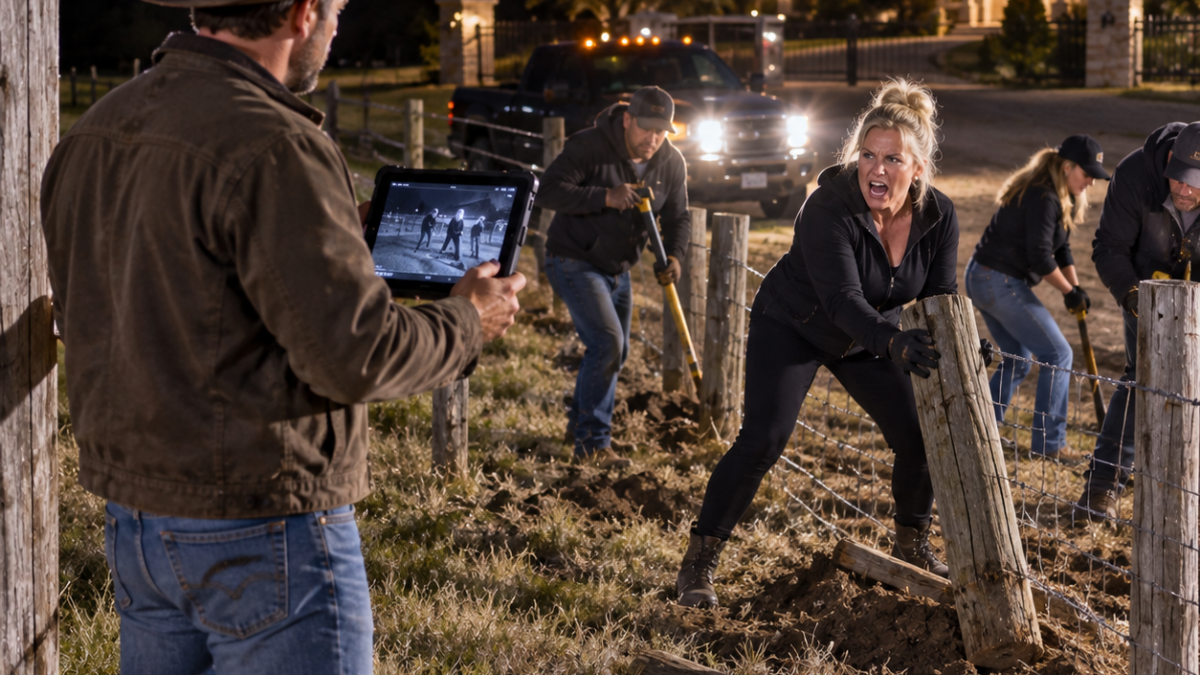
The first post came loose with a wet sucking sound.
Concrete tore through the damp Carolina clay.
Karen stumbled backward and almost fell.
Gary grabbed her elbow.
“Come on,” he whispered.
She jerked away.
“Hold the light.”
“Karen, somebody’s going to wake up.”
“Then stop talking.”
She dragged the post toward the sidewalk.
I switched the monitor to split screen.
Camera one covered the front property line.
Camera two covered the side angle.
Sensor logs ran below both feeds.
Zone One.
Human-scale ground disturbance.
Time.
Duration.
Approximate movement path.
The system was not magic.
It did not identify Karen.
The cameras did that.
The sensors did something just as useful.
They established movement independent of the video.
She repositioned the puller.
Second post.
This one fought harder.
She cursed.
Gary said, “You said the landscaper was going to do it.”
“He chickened out because Rhodes threatened him.”
“He said it was private property.”
“It’s HOA-regulated property.”
“That isn’t the same thing.”
Karen stopped.
Even through night vision I saw the look she gave him.
“Whose side are you on?”
Gary dropped his eyes.
That one exchange told me more about their marriage than I wanted to know.
Karen returned to the lever.
The second post came out.
Then the third.
Then the fourth.
Twenty-eight minutes from initial trigger to final exit.
Twenty-eight minutes of two adults trespassing onto private property at night.
Twenty-eight minutes of Karen narrating motive.
At one point she said:
“He wants a fence? He can learn what happens when he ignores me.”
Not the HOA.
Me.
That mattered.
Around the twenty-four-minute mark, Gary stopped helping entirely.
He stood near the sidewalk holding the flashlight.
“Please,” he said.
Karen leaned against the puller, breathing heavily.
“What?”
“Can we go?”
“You’re useless.”
“I don’t want any part of this.”
“You’re already here.”
That sentence would matter later too.
They dragged the four posts away.
Not all twenty-two.
Just four.
Enough to break the line.
Enough to make continuation difficult.
Enough, Karen probably thought, to force me to stop.
When they disappeared from view, I saved the footage.
Primary server.
Cloud copy.
External drive.
Then I exported the raw clip without edits.
I generated hashes for the files because old habits die hard and digital evidence is only as useful as your ability to show it has not been changed.
Then I printed the sensor log.
02:17:11 — perimeter disturbance.
02:18:03 — sustained vibration.
02:44:57 — final event.
I placed the external drive in our fireproof safe.
Only then did I return to the bedroom.
Sarah had rolled onto my side.
She opened her eyes.
“Where were you?”
“Office.”
“What happened?”
I hesitated.
“Karen came over.”
Sarah sat up.
“At two in the morning?”
“Yes.”
“What did she do?”
I looked toward the window.
“Fence.”
Her face changed.
“Mark.”
“I recorded everything.”
She stared at me.
“You didn’t go outside?”
“No.”
She let out a long breath.
“Good.”
That reaction surprised me.
Not anger.
Relief.
“You thought I would.”
“I know you.”
“I’m not twenty-five anymore.”
“That doesn’t mean you’ve stopped being you.”
Fair.
Sarah leaned against the headboard.
“What happens now?”
“Police report.”
“Then?”
“Insurance.”
“Then?”
I thought about Karen’s face when the first post came loose.
“Then I let her decide how much worse she wants this to become.”
Sarah studied me.
“That sounds like revenge.”
“It sounds like documentation.”
“Mark.”
I looked at her.
She reached for my hand.
“Protect us.”
“I am.”
“Not your pride.”
That landed harder than I wanted.
I squeezed her fingers.
“Okay.”
Morning made the damage uglier.
Four holes.
Broken concrete.
Splintered cedar.
Mud dragged across the grass.
Sarah stood at the kitchen window holding coffee.
General sat beside her, ears up, confused by the gap in the posts.
She whispered, “She actually did it.”
“Yes.”
“Why?”
Because I said no.
I didn’t say that.
Instead:
“Control.”
Sarah looked toward Karen’s house two doors down.
“I used to think people like her were funny.”
“So did I.”
“They’re not.”
“No.”
My first call went to the police non-emergency line.
Officer Daniel Miller arrived about an hour later.
Late fifties.
Calm.
The expression of a man who had mediated more neighbor disputes than anyone should endure.
He looked at the holes.
“HOA issue?”
“Yes.”
He sighed.
“Those can get ugly.”
“This passed ugly around two seventeen this morning.”
He took out a notebook.
“Any idea who did it?”
“I do.”
“Witness?”
“Digital.”
He looked up.
“I have full video.”
His demeanor changed.
“Clear?”
“Very.”
“Audio?”
“Yes.”
“You want to show me?”
“I want to give you a copy properly.”
That earned me a closer look.
“What do you do?”
“Retired Army engineer.”
He nodded as if that explained several things.
“I’ve preserved the raw files. I can export a copy while you’re here.”
“Good.”
We went to my office.
I showed him the first three minutes.
He watched Karen enter.
Watched Gary follow.
Watched the post puller go into position.
Then he leaned closer.
“That’s your HOA president?”
“Yes.”
“You sure?”
“Her house is there.”
I pointed through the window.
Officer Miller looked from screen to window.
“Huh.”
That one syllable contained a lot.
I gave him a copy of the full clip.
Sensor logs.
Photos.
Signed fence approval.
Fine notices.
Landscaper work order.
He took everything.
“I’ll add this to the report.”
“What happens?”
“Property damage amount matters. Trespass matters. Intent matters. Prosecutor decides charging.”
“I don’t want exaggeration.”
“Good.”
He looked toward the screen.
“You won’t need it.”
The insurance adjuster came that afternoon.
He photographed everything.
Three fencing contractors gave estimates.
The highest was just over sixteen hundred dollars once labor, replacement posts, concrete removal, and resetting were included.
More than the raw lumber.
Less than Karen was about to cost herself in every other way.
Then I called Ben Carter.
Former JAG.
Old friend.
Current civil litigator.
He answered:
“Rhodes.”
“Carter.”
“That formal means you need something.”
“I have an HOA president on video pulling my fence posts out at two in the morning.”
Silence.
“Say that again.”
I did.
“You have video?”
“Two angles.”
“Audio?”
“Yes.”
“Police?”
“Report filed.”
“Written approval?”
“Yes.”
“Prior fines?”
“Yes.”
“Attempted contractor removal?”
“Yes.”
He laughed once.
Not because it was funny.
Because lawyers sometimes laugh when facts arrange themselves neatly.
“Do not contact her.”
“Wasn’t planning to.”
“Do not show her the video.”
“I wasn’t.”
“Do not post it.”
“I know.”
“Do not threaten her.”
“Ben.”
“I know you know. I’m enjoying saying it.”
“What are we doing?”
“First, demand letter to the board. Every member separately.”
“Why separately?”
“Because Karen’s favorite defense six months from now will be ‘the board knew.’”
He continued.
“We make sure the board actually knows.”
That afternoon Ben drafted a letter.
He included the approval.
The fines.
The landscaper work order.
The damage estimate.
Police case number.
He did not include the video.
Not yet.
He demanded that the HOA rescind all fence fines, confirm the approval remained valid, reimburse repairs, and preserve all communications related to me.
Copies went by certified mail to every director.
Karen.
Arthur Bell.
Linda Soto.
Roger Mills.
Patricia Greene.
Five directors.
No one could later say Karen kept them in the dark.
Ben also requested the HOA’s insurer information.
Four days passed.
Then a response arrived from the association’s lawyer.
A man named Clifford Hayes.
I called Ben before reading it.
“Open it.”
“You’re on speaker.”
“Good.”
I read.
The HOA denied responsibility for “alleged vandalism.”
Then accused me of making false statements designed to extort funds.
Sarah sat across the table.
Her eyebrows climbed.
I kept reading.
Paragraph three.
I stopped.
“What?” she asked.
Ben said, “Read it.”
I did.
“Furthermore, the structures in question were not vandalized. They were removed by the association pursuant to its enforcement authority after the homeowner repeatedly refused to cure an unauthorized installation.”
Silence.
Ben spoke first.
“Again.”
I read it again.
Sarah covered her mouth.
“They admitted it.”
“Yes.”
Ben sounded almost cheerful.
“In writing.”
“They’re calling it association action.”
“Correct.”
“But Karen did it personally.”
“Which makes their explanation more interesting.”
The letter continued.
Oakmont demanded five hundred dollars from me for “removal expenses.”
I almost laughed.
Sarah didn’t.
“She wants us to pay her for ripping them out?”
“Apparently.”
Ben said, “Scan everything.”
Five minutes later he had it.
His text arrived:
Do nothing.
Then:
Actually, do one thing. Sleep well.
I did not sleep well.
The letter strengthened our civil case.
It also frightened me.
Because Karen had moved beyond personal entitlement.
She had persuaded—or claimed to have persuaded—a lawyer to frame midnight property damage as formal HOA enforcement.
That meant either the lawyer did not know the facts, or Karen had normalized her own version of them.
Neither possibility was comforting.
Sarah noticed the change.
“You’re more worried now.”
“Yes.”
“Why?”
“She thinks she was allowed to do it.”
Sarah looked toward the backyard.
“That makes it worse.”
“Yes.”
That weekend, Mrs. Gable stopped me while I walked General.
She was seventy-three.
Widowed.
Tiny.
Her front flower beds were gorgeous.
Her yard also looked strangely empty.
I had seen old listing photos showing garden gnomes everywhere.
Now none.
She knelt beside General.
“Oh, sweetheart.”
General leaned into her hand.
Mrs. Gable smiled.
“He doesn’t know he’s missing a leg.”
“He knows.”
“How?”
“He uses it to manipulate strangers.”
She laughed.
Then she noticed the gap in my fence line.
“What happened?”
I hesitated.
“HOA dispute.”
Her smile disappeared.
“Karen.”
Not a question.
“You’ve had problems?”
Mrs. Gable stood slowly.
“Everyone has had problems.”
That was the beginning.
She told me about the gnomes.
Twenty-five-dollar fine.
Then fifty.
Then one hundred.
Karen called them “visual clutter.”
Mrs. Gable put them in the attic.
“I know it sounds silly.”
“It doesn’t.”
“They were my husband’s.”
I stopped.
“What?”
“He bought one every anniversary.”
That changed everything.
“How many years?”
“Thirty-two.”
Her eyes grew wet.
“He died four years ago.”
Karen had not known that, Mrs. Gable admitted.
Maybe she would have acted differently.
Maybe not.
But intent was not the only thing that mattered.
Rules land on people with histories the rule-maker may not see.
“I kept them outside because when I watered the flowers, I felt like Tom was still teasing me.”
She wiped her cheek.
“Then suddenly they were violations.”
I looked at her porch.
“Do you still have the notices?”
“All of them.”
“Would you show me?”
She looked toward Karen’s house.
Fear.
There it was.
Then General nudged her hand.
Mrs. Gable scratched his ear.
“Yes.”
One story led to another.
The Cheng family across the street.
Young couple.
New baby.
Three front-door repaintings.
The first color wasn’t approved.
Fair enough, Mr. Cheng admitted.
They corrected it.
Then the approved green was rejected because another house within five lots already had similar green.
The third choice was beige.
Mrs. Cheng laughed when she told me.
“We bought a house to paint it the same color as oatmeal.”
Then she stopped laughing.
“Do you know how hard it is to repaint a front door with a six-week-old baby?”
Another family got cited for a basketball hoop left near the curb.
Another for a mature rose planted too close to the sidewalk.
Some complaints were legitimate technical violations.
That mattered.
I was not interested in pretending every rule was tyranny.
I was interested in patterns.
Selective enforcement.
Escalating fines.
Humiliation.
Karen’s own violations.
Those became obvious.
Garden gnomes.
A custom lighthouse mailbox despite standardized-box rules.
Trash cans visible daily.
Unapproved landscaping.
Decorative lighting beyond allowed hours.
I photographed only what could legally be seen from public areas.
Date.
Time.
Bylaw reference.
No trespass.
No peering over fences.
No obsession.
At least that was what I told myself.
Sarah caught me sorting photographs one evening.
“Mark.”
“What?”
“You have a spreadsheet for her trash cans.”
“I have a spreadsheet for enforcement inconsistency.”
“You have four photos from the same week.”
“Pattern.”
“You sound happy.”
I looked up.
That hurt.
Because she was right.
Some part of me was enjoying the campaign.
Enjoying the strategy.
Enjoying having an opponent.
For fifteen years, problems had been my profession.
Civilian life had required learning that not every disagreement was a mission.
Karen was waking up parts of me I had been glad to put away.
I closed the laptop.
“You’re right.”
Sarah sat beside me.
“I don’t want this taking you back somewhere.”
“It isn’t.”
“Not literally.”
I understood.
She touched my shoulder.
“You came home.”
“I know.”
“I need you here.”
That ended my private investigation for several days.
Then David Kim approached me.
Retired forensic accountant.
Next block.
Sharp mind.
No tolerance for nonsense.
Mrs. Gable had told him about my fence.
He knocked on my door carrying a folder.
“You Rhodes?”
“Depends.”
“On?”
“Whether you’re selling something.”
He smiled.
“I’m selling paranoia.”
“Already subscribed.”
“I’ve been looking at HOA budgets for three years.”
That got my attention.
“Why?”
“Because I’m retired and apparently hate peace.”
We sat.
David showed me annual budgets.
Landscaping expenses.
Administrative reimbursements.
Conference costs.
Some items looked merely sloppy.
Others unusual.
A landscaping vendor called Thompson Outdoor Services.
“Related?” I asked.
“Karen’s brother-in-law.”
“Proof?”
“State business filing.”
“How much?”
“About twenty-eight thousand over three years.”
“For work?”
“Some.”
“Some?”
“The invoices are vague.”
I pushed the folder back.
“Vague isn’t fraud.”
David smiled.
“You’re less fun than Mrs. Gable said.”
“I have a lawyer.”
“Good. Then you understand documentation.”
He tapped another line.
Three thousand dollars.
HOA Leadership Conference.
Orlando.
Same weekend Karen’s public social-media photos showed her and Gary at Disney World.
“That proves she went to Orlando.”
“Yes.”
“Conference could have been there.”
“It was.”
“Then not enough.”
David nodded.
“Exactly.”
I liked him.
He wasn’t hunting scandal.
He was hunting reconciliation.
Maria Alvarez joined us next.
Paralegal.
Oakmont resident.
Mid-thirties.
Mother of two.
She had already read the bylaws more carefully than Karen ever had.
Recall procedure required signatures from twenty-five percent of homeowners.
Records access rights were broad.
Finance questions could be forced into the open.
Maria’s position was simple.
“Your lawsuit is yours.”
She pointed at me.
“The board problem is ours.”
“Good.”
“We should keep those separate.”
“Very good.”
“But your video changes political reality.”
I looked at Ben.
We had called him into the meeting by speakerphone.
He answered immediately.
“Do not distribute it widely.”
Maria nodded.
“Agreed.”
Mrs. Gable frowned.
“Why?”
Ben explained.
“Because Mark’s evidence is part of an active criminal investigation and civil dispute. We do not need a hundred uncontrolled copies online.”
David said, “Can we show it at a membership meeting?”
“Possibly, after coordination.”
“And records?”
“Use proper requests.”
That became our structure.
No vigilante campaign.
No doxxing.
No secret harassment.
No following Karen around.
No fake social media.
No rumors.
Documents.
Procedures.
Votes.
The exact system Karen had abused would become the system used to remove her.
Ben sent the HOA a second letter.
This one attached the lawyer’s admission.
He gave them one final opportunity to correct the matter.
Rescind fines.
Repair damage.
Confirm fence approval.
Preserve records.
Karen doubled down.
She sent a community-wide email.
Without naming me directly, she warned residents about “militant homeowners attempting to undermine architectural authority.”
Militant.
Sarah read that word twice.
“Nice.”
“I’ve been upgraded.”
“Don’t joke.”
She looked worried.
“What if people believe her?”
“Some will.”
“What if she comes back?”
I looked at the repaired temporary security around the yard.
“She won’t surprise us.”
Sarah’s face tightened.
“That isn’t what I meant.”
She meant emotionally.
Our house no longer felt entirely like a sanctuary.
Every noise at night drew my attention.
Every car slowing near the curb.
General barked more because I reacted more.
Stress is contagious.
Especially in a home.
That was when I decided the fence needed to be finished regardless of litigation.
Ben agreed.
“Mitigate damages.”
I hired a contractor to replace the four posts.
Same approved design.
Same line.
Same stain.
The HOA sent another violation notice the day after the work resumed.
I forwarded it without replying.
Ben sent back:
Excellent.
I texted:
Lawyers are weird.
He replied:
Billable weird.
Meanwhile, Maria gathered recall signatures.
Quietly.
No pressure.
No public shaming.
Homeowners signed because they wanted a vote.
Within two weeks, she had thirty-eight percent.
Enough.
David submitted a formal records request.
Karen delayed.
Claimed some documents were confidential.
Maria responded with the sections requiring member inspection.
The board’s attorney eventually advised compliance.
Bank statements arrived.
Vendor invoices.
Receipts.
Credit-card records.
David spent days organizing them.
He did not call his review an audit.
Important distinction.
He was a homeowner reviewing association records.
A real forensic audit would require formal engagement.
His preliminary findings were still ugly.
High-end stationery purchases.
Restaurant charges without clear board purpose.
Family-vendor contracts lacking competitive bids.
Orlando hotel charges extending beyond conference dates.
Disney-area parking expenses.
Personal landscaping work bundled on invoices paid by the HOA.
Not all proved theft.
Some could be reimbursable.
Some might have explanations.
But there were enough questions to justify independent review.
Maria added a records and audit motion to the recall strategy.
Then Ben called.
“Police want a clean copy of the full footage plus system information.”
“They already have one.”
“Detective assigned wants the source export and your explanation of the sensors.”
“Fine.”
“Also the rental tool.”
“What about it?”
“They traced the post puller.”
“To Karen?”
“Gary rented it.”
I sat down.
“When?”
“The afternoon before.”
“Payment?”
“Card.”
Sarah was in the room.
She watched my face.
“What?”
I told her.
She closed her eyes.
“Gary.”
“He was there.”
“But he begged her to stop.”
“Still rented the tool.”
That complicated him.
People like simple roles.
Victim.
Villain.
Accomplice.
Gary was none cleanly.
He participated.
He enabled.
He regretted it while doing it.
Still did it.
Reality.
The detective interviewed him before Karen.
We learned that later through discovery and charging records.
Gary admitted renting the tool.
Claimed Karen told him the HOA had legal authority.
Admitted he knew they were going at night.
Admitted he asked her to wait for legal advice.
Went anyway.
His lawyer negotiated cooperation.
Karen’s interview went differently.
She maintained that the removal was an authorized enforcement action.
Then investigators confronted her with the HOA approval bearing her signature.
Her explanation shifted.
Provisional approval.
Then rescission.
Then safety concern.
Then aesthetics.
The problem with changing explanations is that every new version leaves the old one behind.
Ben filed the civil suit after the HOA refused our final demand.
Defendants:
Karen personally.
Gary personally for his participation.
Oakmont Estates HOA based on its written assertion that removal was association action.
Claims tailored to the facts.
Property damage.
Trespass.
Interference with approved property use.
Improper fines.
Related relief.
No cartoon legal language.
No promise to “destroy her empire.”
Ben hated that phrase.
“Courts do not care about empires.”
“They should.”
“They care about elements.”
The new interim strategy from the neighborhood mattered more politically.
Annual meeting approaching.
Recall item mandatory.
Independent audit motion ready.
Video ready—but still held back.
Then Karen made the mistake that destroyed her last chance to control the room.
Three days before the meeting, the HOA sent notice that it intended to sue me.
Not defend.
Sue.
The board accused me of fraudulent insurance claims, unauthorized construction, harassment, and interference with association operations.
Arthur Bell called me privately that evening.
Board member.
Quiet.
Retired dentist.
“Mark.”
“Yes.”
“I received something from your attorney.”
“I know.”
“I need to ask you something.”
“Go ahead.”
“Do you really have video?”
I paused.
“Yes.”
“Of Karen?”
“Yes.”
“Removing the posts herself?”
“Yes.”
Silence.
“Why didn’t she tell us?”
That question mattered more than any accusation.
“I can’t answer that.”
“She told us the landscaping contractor removed them.”
“They didn’t.”
“She told us the work was performed under an enforcement authorization.”
“Ask to see it.”
Another silence.
“Was Gary there?”
“Yes.”
Arthur exhaled.
“I’m resigning.”
“Don’t do it because of me.”
“I’m doing it because I’ve been voting based on information I didn’t verify.”
“That’s your decision.”
He didn’t resign immediately.
Instead, he demanded a special board session before the annual meeting.
Karen refused.
Then claimed timing didn’t allow one.
Arthur put his concerns in writing to the entire board.
Maria obtained a copy later through records.
Karen replied:
We cannot allow a disgruntled homeowner’s intimidation tactics to derail governance.
Arthur wrote:
Asking whether our president personally entered private property at 2:00 a.m. is not intimidation.
That email circulated among directors.
Patricia Greene responded:
I was never informed of any nighttime removal.
Roger Mills:
Same.
The united board was already gone before the meeting began.
Annual meeting night.
The Oakmont community center normally held maybe thirty people.
That night more than a hundred showed.
Standing room.
Fold-out chairs borrowed from a church next door.
People along walls.
Mrs. Gable wore a blouse covered in tiny flowers.
Mr. Cheng bounced the baby near the back.
David carried a binder.
Maria carried three.
Sarah sat beside me.
General stayed home.
Ben sat two rows behind us.
Not speaking unless necessary.
The projector screen stood folded at the back.
Karen entered late.
Royal blue pantsuit.
Hair perfect.
Gary followed.
He looked awful.
She took the center seat.
Banged the gavel.
“Welcome, neighbors.”
Her smile was too wide.
She gave the usual speech.
Property values.
Community pride.
Standards.
Volunteer service.
Then the budget.
David raised his hand.
Karen recognized someone else.
He raised it again.
She ignored him.
Murmurs started.
Finally:
“Mr. Kim.”
“I have questions regarding vendor payments.”
“Those are available through proper channels.”
“I used the proper channels.”
“This is not an audit hearing.”
“It can become one by member motion.”
Karen’s jaw tightened.
“Later.”
Then she arrived at new business.
“The board has authorized legal action against a homeowner who continues to disregard approved standards.”
She looked directly at me.
Sarah’s hand closed around mine.
Karen held up a document.
“Mr. Rhodes has accused this association of criminal conduct, filed an insurance claim based on alleged vandalism, and attempted to intimidate volunteers.”
I stood.
Ben leaned forward.
Not yet.
I sat again.
Karen continued.
“The association categorically denies any criminal vandalism.”
Interesting.
Their lawyer had admitted removal by the association.
Now she was denying vandalism.
Technically compatible if she claimed authorized removal.
But the room didn’t know that yet.
She said:
“The posts were subject to lawful enforcement action.”
Arthur Bell raised his hand from the board table.
Karen ignored him.
“President Thompson.”
She turned.
“Arthur.”
“Were you physically present when the posts were removed?”
The room changed.
Karen stared at him.
“That is irrelevant.”
“No.”
His voice shook slightly.
“It is relevant.”
Gary looked at the floor.
Karen said, “The association acted within its authority.”
Arthur repeated:
“Were you physically present?”
She struck the gavel.
“Move on.”
That was when I stood.
“Karen.”
She looked at me.
“You’re out of order.”
“Then recognize me.”
“No.”
Maria stood.
“Point of order.”
Karen’s eyes flashed.
Maria held up the bylaws.
“The homeowner subject to a proposed association lawsuit has a right to address allegations before membership discussion.”
Karen snapped, “That applies to disciplinary hearings.”
Ben whispered behind me:
“She’s wrong.”
Maria knew.
“The board placed the lawsuit on the annual meeting agenda. Membership questions are permitted.”
People called out:
“Let him speak.”
“Let Mark answer.”
“Five minutes.”
The pressure became impossible.
Karen said:
“Three.”
I walked to the front carrying one binder.
No theatrics yet.
I placed the approval letter on the table.
“Fence approved before construction.”
Held it up.
Karen’s signature.
“Fine notices began after work started.”
I held those up.
“Then a landscaping company came to remove my property.”
Work order.
Signed by Karen.
“The contractor refused after learning he did not have the property owner’s consent.”
Karen interrupted.
“That is your interpretation.”
I nodded.
“Correct.”
That surprised her.
“So let’s use yours.”
I lifted the attorney letter.
“Your legal counsel wrote this.”
I read:
The structures in question were removed by the association in accordance with the bylaws.
Murmurs exploded.
Arthur turned to Karen.
“The association?”
Karen said, “Yes.”
Patricia Greene leaned toward her microphone.
“Who authorized that?”
“The president has enforcement discretion.”
“Not to enter private property.”
Karen slammed the gavel.
“Enough.”
I continued.
“Your letter calls my vandalism report fraudulent.”
“It is.”
There.
Public.
Clean.
Ben had warned me never to bait her.
We didn’t need to.
Karen baited herself.
I looked toward the back.
My friend with the AV company unfolded the screen.
Karen saw it.
For the first time all night, real fear crossed her face.
“What is that?”
I answered:
“Evidence.”
The projector came on.
White rectangle.
Then black.
Then night vision.
Timestamp.
02:17:11.
Karen stepped into frame.
Gary behind her.
The entire room inhaled at once.
Nobody laughed.
That matters.
It wasn’t funny anymore.
People watched their president enter a neighbor’s yard at two in the morning carrying a post puller.
Gary’s voice came through the speakers.
“Karen, this is a bad idea.”
Her reply:
“Hold the light.”
The first post came free.
Mrs. Gable covered her mouth.
Arthur Bell stared at Karen, then at the screen.
Patricia Greene moved her chair away from Karen.
The second post.
Karen on video:
“I told him I’d take care of it myself.”
In the room, Karen stood.
“That is edited.”
I paused the playback.
“Raw copy is with police.”
The room went silent again.
Karen’s face drained.
“It could be manipulated.”
Ben stood for the first time.
“My name is Benjamin Carter. I represent Mr. Rhodes.”
He kept his voice calm.
“The original digital files, recording-system information, sensor logs, and unedited exports have been preserved and provided through appropriate channels in an open police investigation.”
Karen looked at him.
Then at me.
Then at Gary.
Gary did not look back.
We resumed the footage.
Third post.
Gary:
“Please, let’s go.”
Karen:
“They need to know who’s in charge.”
That sentence landed like a brick.
The fourth post came out.
Then the video ended.
No applause.
Just silence.
The projector fan hummed.
Karen grabbed the microphone.
“It was HOA enforcement.”
Arthur said, “At two in the morning?”
She turned.
“You knew we had removal authority.”
“No.”
“You approved enforcement escalation.”
“I approved notices.”
His voice strengthened.
“I did not approve you trespassing at night.”
Patricia added:
“Neither did I.”
Roger:
“Neither did I.”
Karen looked down the table.
Three directors.
Three refusals.
Her institutional shield vanished in real time.
She pointed at me.
“He forced this.”
I felt Sarah tense beside me.
Karen continued.
“He ignored authority. He threatened contractors. He recorded people without consent. He has military surveillance equipment aimed at neighbors.”
There it was.
The counterattack.
For a moment, some faces changed.
Security systems make people nervous.
Ben stepped forward.
“The cameras record Mr. Rhodes’s property and lawful areas surrounding his perimeter. Audio-law questions have been reviewed. Nothing presented here changes the fact that Mrs. Thompson entered the property and removed approved structures.”
Maria added:
“And the recall motion is not a criminal trial.”
Exactly.
This meeting did not need to decide guilt.
It needed to decide leadership.
Karen realized she was losing that battlefield.
So she attacked character.
“He has been compiling files on all of you.”
I stood.
“No.”
She pointed.
“You photographed my home.”
“From public areas.”
“You built a dossier.”
“On selective enforcement.”
People murmured.
Sarah looked at me.
This was the moment I could have made myself look righteous.
Instead I told the truth.
“I did document Karen’s visible violations.”
I looked around.
“And my wife told me I was becoming too invested in the fight.”
The room quieted.
“She was right.”
Karen blinked.
I continued.
“I stopped.”
That mattered.
“I am not asking you to replace one controlling neighbor with another.”
I looked at the board.
“I want my fence left alone.”
Then at the residents.
“What you do with your HOA belongs to you.”
Maria stood.
“And we have more to discuss.”
David walked forward.
Karen’s face changed again.
He carried the financial records.
“Before the recall vote, I move that membership authorize an independent third-party financial audit.”
Someone seconded.
Karen shouted:
“No.”
The room erupted.
David waited.
Then began with only what he could document.
Vendor payments to Thompson Outdoor Services.
“Is that related to you?” he asked.
Karen’s mouth tightened.
“My brother-in-law owns it.”
“Was the relationship disclosed in board minutes before contracts?”
“I don’t recall.”
Orlando conference charges.
“Did you attend the HOA leadership conference?”
“Yes.”
“Entire week?”
“Yes.”
David held up program dates.
“Conference ran Wednesday through Friday.”
He held up lodging statement.
“Association paid Sunday through Sunday.”
Karen said:
“The extended stay reduced airfare.”
Possible.
David nodded.
“That may be explainable.”
Smart.
He did not overreach.
Then:
“Why are there Disney parking charges on the association card?”
Karen looked toward Gary.
Gary looked away.
“You’re invading my privacy.”
“No.”
David’s voice remained flat.
“I am asking about association funds.”
Then personal landscaping bundled into HOA vendor invoices.
High-end office expenses.
Restaurant charges.
Unapproved reimbursements.
Nothing individually cinematic.
Together:
Pattern.
Karen’s composure finally broke.
“You people have no idea how much work I’ve done!”
Her voice cracked.
“I have spent years fixing your problems.”
Nobody interrupted.
“You call me because your neighbor’s dog barks. You call me because trash cans are out. You call me because somebody paints a door red. You want enforcement until enforcement affects you.”
There was uncomfortable truth in that.
Some residents looked down.
Karen saw it.
She pushed harder.
“I built this community.”
Mrs. Gable stood.
“No.”
Her voice was quiet.
Karen stopped.
Mrs. Gable walked toward the aisle.
“We built our homes.”
Her hands trembled.
“My husband and I lived here before you were president.”
Karen said nothing.
“You made me put away the garden gnomes he gave me every anniversary.”
Someone near the back whispered, “Jesus.”
Mrs. Gable continued.
“I paid your fines because I was afraid.”
Her voice strengthened.
“I’m not afraid tonight.”
That was the emotional break.
Not the video.
Not the money.
An elderly widow standing in a fluorescent-lit community room saying she was no longer afraid.
The recall vote proceeded.
Paper ballots.
Independent counting table.
Observers from both sides.
No unanimous fantasy.
Out of 112 valid votes:
101 for removal.
8 against.
3 abstentions.
Karen sat still when the number was read.
Gary closed his eyes.
The gavel remained in front of her.
Maria said gently:
“Under the bylaws, removal is effective immediately.”
Karen looked at her.
“You’ve wanted this.”
Maria shook her head.
“No.”
Then:
“I wanted you to stop making people afraid to live here.”
Karen picked up her purse.
The board secretary asked for the HOA credit card, keys, and records in her possession.
Karen refused at first.
“This is harassment.”
Arthur said, “Karen.”
She stared at him.
He held out his hand.
“Please.”
Something in her collapsed.
She removed the keys.
Bank card.
Community center key.
Mailbox key.
Placed them on the table.
Not dumped dramatically.
One at a time.
The sound of each item touching Formica carried through the room.
Then she looked at me.
Pure anger.
I expected a threat.
Instead she said:
“You’re proud of yourself.”
I thought about Sarah.
The nights checking cameras.
General barking.
Our backyard becoming a battlefield.
“No.”
That surprised her.
“I’m tired.”
Karen’s eyes shifted.
Then she left.
Gary followed several minutes later.
He stopped beside me.
“I’m sorry.”
I looked at him.
“You rented the tool.”
His face tightened.
“I know.”
“You came onto my property.”
“I know.”
“You could have stopped.”
“I tried.”
“No.”
I shook my head.
“You asked her to stop.”
Gary looked at the floor.
“That isn’t the same thing.”
He nodded.
“No.”
Then walked out.
That exchange stayed with me.
Because enabling someone and opposing them quietly are not opposites.
Sometimes they coexist.
And sometimes quiet opposition is simply another form of participation.
The interim board was elected according to the bylaws.
Not in a ten-minute revolution.
The membership appointed temporary officers until a proper election.
A local teacher named Helen Brooks became interim president.
Maria became secretary.
David became interim treasurer.
Their first motions:
Suspend disputed discretionary fines pending review.
Authorize an independent financial audit.
Cooperate with police and insurers.
Retain independent HOA counsel.
Preserve all records.
Review architectural approvals, including mine.
Two days later I received a certified letter.
I almost laughed when I saw Oakmont letterhead.
Then I opened it.
The Architectural Review Committee approval for your fence remains valid. All fines related to that fence are rescinded. The association apologizes for prior actions inconsistent with that approval.
Sarah read it.
Then handed it back.
“So build the fence.”
“After the case.”
“No.”
I looked at her.
“Mark, the fence was for us.”
She pointed toward the backyard.
“For General.”
Toward the garden beds she had never finished.
“For me.”
Then toward my binder.
“Not for Karen.”
She was right.
Again.
I rebuilt.
Same western red cedar.
Same six-foot design.
Same approved stain.
I removed damaged concrete.
Reset four posts.
General watched from inside through the temporary barrier.
Mrs. Gable brought lemonade.
Mr. Cheng brought a post level.
David brought opinions.
Maria brought copies of bylaws I threatened to burn.
For the first time, the fence felt like a neighborhood project rather than a line dividing enemies.
Then the official audit returned.
Worse than David’s preliminary review.
But also more nuanced.
Roughly thirty-one thousand dollars in transactions lacked proper authorization, documentation, or valid association purpose over several years.
Some expenses were sloppy but legitimate.
Some were reimbursed.
Some were duplicate billing.
Several payments to the family landscaping vendor included work at Karen’s own residence.
That crossed a different line.
The auditor documented everything.
The interim board turned the report over to counsel and the insurer.
The insurer began its own review.
The police investigation expanded beyond the fence because financial records raised separate questions.
I stayed away from that.
Ben insisted.
“Your case is your fence.”
“But the audit—”
“Belongs to Oakmont and law enforcement.”
“What if it helps punitive damages?”
“If relevant, we get it properly.”
He pointed at me.
“You are not Batman.”
“I was never Batman.”
“You installed seismic sensors in a suburban lawn.”
“Security.”
“Sure.”
The criminal case over the fence moved first.
Karen’s attorney argued she believed she had HOA authority.
The prosecutor still had:
Nighttime entry.
Personal removal.
Signed approval.
No valid rescission notice.
Video.
Audio.
Tool rental.
Damage.
Karen eventually accepted a plea on misdemeanor property-damage and trespass-related charges consistent with the value and local law.
Gary received a separate resolution reflecting his lesser role and cooperation.
No cinematic prison sentence.
No handcuffs at the clubhouse.
Real consequences.
Fines.
Restitution.
Probationary conditions.
Community service.
The financial investigation took longer.
Some accusations did not result in charges.
Others were addressed through restitution, civil recovery, insurance, and a negotiated criminal resolution involving improper use of association funds.
Ben explained it carefully.
“Bad bookkeeping is not automatically embezzlement.”
“I know.”
“Related-party contracts are not automatically crimes.”
“I know.”
“Disney parking on the HOA card?”
He raised an eyebrow.
“That one is harder to make pretty.”
The HOA’s insurer reimbursed covered losses according to policy terms and pursued recovery where appropriate.
Oakmont separately sought repayment for unsupported personal charges.
My civil case settled.
Repair costs.
Legal fees.
Damages tied to the trespass, harassment, and improper enforcement.
Karen personally carried a portion that insurance would not cover.
Gary contributed under the settlement as well.
The number hurt them.
But it did not magically bankrupt them overnight.
Months later, they chose to sell the house.
By then, Karen’s social position in Oakmont was gone.
Every walk to the mailbox meant passing people who had seen the video.
Every board notice came from people who had replaced her.
Every financial statement was published openly.
Power had been the center of Karen’s identity.
Without it, staying became harder than leaving.
The moving truck arrived on a Thursday.
I noticed while installing gate hardware.
Sarah came outside.
“Don’t.”
“I’m not doing anything.”
“You’re watching.”
“I have eyes.”
She stood beside me.
Across two houses, movers carried boxes.
Gary loaded garage equipment.
Karen directed people from the driveway.
No blue pantsuit.
No clipboard.
At one point she saw me.
We held eye contact.
I expected hatred.
There was some.
Mostly exhaustion.
She crossed the lawns toward us.
Sarah tensed.
I set down the wrench.
Karen stopped on the sidewalk.
“The fence looks nice.”
That was not what I expected.
“Thanks.”
“You set the posts deeper?”
“Yes.”
She almost smiled.
“Of course you did.”
Silence.
Then she looked at Sarah.
“I’m sorry this affected your health.”
Sarah’s face remained calm.
“It did.”
Karen swallowed.
“I didn’t know.”
“You didn’t ask.”
That landed cleanly.
Karen nodded.
“No.”
She looked toward General, who stood behind the finished fence.
“He’s the three-legged one?”
“Yes.”
“He needed the fence.”
“Yes.”
She closed her eyes for a second.
When she opened them, she said something I did not expect.
“I thought you built it because you didn’t want to look at us.”
I almost laughed.
“What?”
“That’s what started it.”
There.
The ridiculous human center beneath months of conflict.
“You thought my privacy fence was an insult?”
“You moved in, filed everything through the committee, never came to neighborhood events, barely spoke to anyone, then put up six feet of cedar.”
I looked at Sarah.
She looked at me.
Karen continued.
“It felt like you were saying the community wasn’t good enough for you.”
“That’s why you rescinded it?”
“I convinced myself the fence hurt the street.”
“Karen.”
“I know.”
She looked down.
“Now I know.”
I had spent months imagining greed.
Control.
Corruption.
All true in part.
But underneath the first conflict was something smaller.
Personal rejection.
Pride.
A woman who had fused her identity so completely with the neighborhood that my desire for privacy felt like criticism of her.
It did not excuse anything.
But it made her human again.
“I didn’t build it because of you.”
She gave a bitter laugh.
“Obviously.”
“Sarah wanted a private garden.”
I pointed toward General.
“He needed a safe yard.”
Karen looked at the dog.
General’s tail wagged.
Traitor.
Then she said:
“I’m sorry.”
Not enough to erase what happened.
Enough to be heard.
“I accept the apology.”
Sarah looked at me.
I added:
“That doesn’t erase the consequences.”
Karen nodded.
“I know.”
She walked back toward the moving truck.
That was the last time I saw her.
Oakmont after Karen was not paradise.
That is important.
The new board had problems.
People complained.
A family painted shutters without approval.
Someone parked an RV too long.
Two neighbors fought over a tree.
Dogs barked.
Grass grew.
Rules remained.
Helen Brooks lasted one full term as president and refused another.
“I have taught eighth grade for twenty-three years,” she said at the annual meeting.
“HOA leadership is worse.”
Everyone laughed.
Maria became president next.
She hated the title.
Insisted residents call her Maria.
She created a written violation-review process.
No single officer could issue escalating fines alone.
Architectural approvals required documented votes.
Related-party contracts required disclosure and recusal.
Financial records were posted quarterly.
Appeals could be heard by a panel that did not include the original decision-maker.
Boring safeguards.
Exactly what power needs.
Mrs. Gable put every gnome back in her yard.
All thirty-two.
Then neighbors started giving her more.
Within a year she had forty-seven.
Maria finally knocked on my door.
“This is your fault.”
“What?”
“The gnome escalation.”
“Freedom is complicated.”
“She has one holding a tiny beer keg.”
“Art.”
“She has a six-foot inflatable Christmas gnome.”
“Seasonal expression.”
Maria stared at me.
“You’re enjoying this.”
“Immensely.”
The Chengs painted their door dark red again.
Approved properly this time.
Their baby grew into a toddler who liked General enough to throw tennis balls badly over the fence.
General loved him.
David’s audit reforms became permanent.
He served two years as treasurer.
Then quit because, in his words:
“I retired to stop looking at spreadsheets.”
He lasted six months before volunteering for the finance committee again.
Some people cannot be saved.
Officer Miller retired the following year.
He stopped by once while I was rebuilding a gate hinge.
“Fence still standing?”
“So far.”
“Any midnight landscaping?”
“Quiet.”
“Good.”
He looked at the sensor housing disguised among the rocks.
“You still have that system?”
“Yes.”
“Of course.”
I smiled.
“Want one?”
“Absolutely not.”
He shook my hand.
“Glad it worked out.”
I thought about that phrase after he left.
Worked out.
People use it when they only see the ending.
They don’t see Sarah losing sleep.
They don’t see me checking alerts at midnight.
They don’t see a three-legged dog barking because his owner is tense.
They don’t see the way an ordinary street becomes a battlefield in your mind when someone crosses a boundary you thought was safe.
Winning does not refund all of that.
It just stops the withdrawals.
The fence aged.
Fresh cedar turned honey-colored.
Then slowly silver.
Sarah finally planted her garden.
Lavender.
Hydrangeas.
Herbs.
Tomatoes in raised beds because she liked edible rebellion.
When her autoimmune symptoms flared, the backyard became the place she recovered.
Shade chair.
Book.
General at her feet.
Privacy.
Exactly what we had wanted before Karen made the fence about authority.
One afternoon Mrs. Gable arrived carrying a cardboard box.
“For you.”
I opened it.
Garden gnome.
Fishing rod.
Red hat.
Ridiculous smile.
“No.”
“Yes.”
“I am not putting this in my yard.”
“It’s for security.”
“I have security.”
“Clearly not enough.”
Sarah laughed so hard she had to sit down.
Mrs. Gable pointed toward the first corner post.
“Captain of the guard.”
I put him there.
Not permanently.
That was my claim.
He is still there.
Months after Karen left, a young family bought her house.
Emily and Nathan Brooks.
Two children.
Soccer ball constantly in the street.
Chalk drawings on the sidewalk.
The first Saturday, Nathan walked over.
“Hey.”
“Hey.”
“I heard there was… history.”
I looked at the fence.
“So did I.”
He laughed nervously.
“We’re replacing the mailbox.”
“Okay.”
“Someone said there are rules.”
“There are.”
“Do I ask you?”
“No.”
He looked relieved.
“Good.”
“Ask Maria.”
“She scary?”
“Yes.”
Maria yelled from across the street:
“I heard that!”
Nathan looked startled.
Then everyone laughed.
That sound mattered.
No whispered warnings.
No “keep your head down.”
No fear attached to a board title.
Just neighbors teasing each other.
The final legal paperwork ended almost eighteen months after the first fine.
Ben called.
“Closed.”
“What is?”
“Your case.”
“I thought it was closed.”
“Final releases recorded.”
“So you’re finally unemployed?”
“Sadly, I have other clients.”
I walked into the backyard.
Sarah was pruning lavender.
General lay in the sun.
“Ben says it’s officially done.”
She stopped.
“Done done?”
“Done done.”
She put down the shears.
For a moment neither of us moved.
Then she walked to me.
No cheering.
She put her arms around my waist.
I held her.
“That took too long,” she whispered.
“Yes.”
“I hated that woman.”
“I know.”
“Then I felt bad for hating her.”
“I know.”
“I’m glad she’s gone.”
“I know.”
She pulled back.
“You have other words?”
“Occasionally.”
She smiled.
Then became serious.
“Do you regret fighting?”
“No.”
“Any of it?”
I looked toward the fence.
“I regret how much I enjoyed it sometimes.”
She understood.
I continued.
“I regret turning it into a mission.”
“You needed a mission for a while.”
“Maybe.”
“But not forever.”
“No.”
General suddenly stood.
A tennis ball rolled beneath the gate.
The little Cheng boy’s voice came from the other side.
“General!”
General barked.
I opened the gate.
The boy ran in with his father behind him.
“Sorry,” Mr. Cheng said.
“He keeps throwing it over.”
General grabbed the ball.
Three legs.
Full speed.
Sarah watched him run.
“Worth it?”
She meant the fence.
The fight.
The whole thing.
General sprinted across the yard, turned hard, and came back with the ball.
“Yeah.”
Years passed.
Security system stayed.
Sensors became boring again.
Rain.
Delivery vibrations.
Deer.
Occasional false alarm.
The best technology is technology you forget exists.
Then one night, around 2:15 a.m., my phone vibrated.
I opened my eyes.
Same custom alert.
Zone One.
For one second I was back there.
Karen.
Post puller.
Night vision.
Adrenaline.
I sat up.
Sarah stirred.
“What?”
“Sensor.”
I checked the camera.
A deer stood beside the fence chewing Sarah’s hydrangea.
I laughed.
Sarah groaned.
“What?”
“Enemy at the perimeter.”
She opened one eye.
“Deer?”
“Deer.”
“Tell him the ARC denied his application.”
I lay back down.
The phone screen went dark.
That was when I realized the system no longer frightened me.
The alert was just an alert again.
Home had become home again.
On the fifth anniversary of the night Karen pulled the posts, I did not remember the date until David texted.
Happy Fence Liberation Day.
I replied:
Get a hobby.
He sent a spreadsheet emoji.
Of course he did.
That weekend Oakmont held a block barbecue.
Someone convinced me to bring General.
He was older.
Gray around the muzzle.
Still three-legged.
Still convinced tennis balls existed entirely for him.
Mrs. Gable arrived with a tiny cart carrying three gnomes dressed like a marching band.
Maria threatened enforcement.
Nobody believed her.
The Cheng boy, now in elementary school, asked why everyone joked about my fence.
I looked at his father.
Mr. Cheng shrugged.
“Tell him the short version.”
I crouched.
“A lady once thought she could pull out my fence posts because she was in charge of the neighborhood.”
The boy looked at the fence.
“Why?”
“She was angry.”
“Did she get in trouble?”
“Yes.”
“Did you fight her?”
I thought.
“Not like you mean.”
“What did you do?”
I pointed toward the little landscape rock hiding one of the cameras.
“I had proof.”
He nodded as though that made perfect sense.
Then ran away.
Maybe it did.
Proof had been the difference.
Not military training.
Not intimidation.
Not being tougher than Karen.
Proof.
A signed approval.
Certified letters.
Work order.
Timestamped video.
Sensor logs.
Financial records.
Votes.
Karen’s own written admission.
Every time she tried to replace facts with authority, another record pulled her back.
That lesson stayed with Oakmont.
At board meetings, if Maria said, “Because I said so,” somebody yelled, “Karen!”
She stopped saying it.
Good governance sometimes begins as institutional trauma.
Then becomes habit.
General died at twelve.
That is the part of the story I still have trouble telling.
His back leg had carried him farther than anyone expected.
Cancer took him quickly.
Sarah and I sat with him on the floor of the veterinarian’s office.
His head in my lap.
Her hand on his chest.
The fence had given him years of running.
That mattered.
Afterward the yard felt enormous.
Too quiet.
His ball remained beside the cedar gate for weeks.
I couldn’t move it.
One morning Mrs. Gable found me outside.
She looked through the fence.
“No General?”
I shook my head.
She understood.
“Oh, honey.”
She hugged me.
I had spent fifteen years in uniform.
Buried friends.
Watched hard things.
A three-legged dog broke me.
Sarah came outside.
We stood there together.
Mrs. Gable looked at the gnome sitting on the corner post.
“The captain should stay.”
I nodded.
He stayed.
Eventually Sarah planted a small dogwood near the place General liked to lie.
No plaque.
No memorial stone.
Just a tree.
Spring flowers.
Shade later.
Life.
That changed how I remembered the fence more than anything Karen did.
At first it represented defense.
Then justice.
Then community.
After General died, I finally remembered its original purpose.
Safety.
A place where someone you love can run without fear.
Years after the case, I replaced one post.
Rot at the base.
Normal aging.
I dug around the concrete.
Pulled it.
For a moment the sound brought everything back.
Wet earth.
Wood.
2:17 a.m.
Karen straining on the lever.
Then Sarah came outside.
“Need help?”
“No.”
She handed me water.
I set the new post.
Checked level.
Added concrete.
Same way I had the first time.
Mrs. Gable’s gnome watched.
When I finished, Sarah leaned against the fence.
“Still aggressive?”
“What?”
“The cedar posts.”
I laughed.
“Extremely.”
She smiled.
The backyard was quieter without General.
But the dogwood had grown.
Hydrangeas filled the corners.
Tomatoes climbed cages.
The fence cast long shadows across the grass.
No alerts.
No fines.
No certified letters.
The most satisfying part of everything that happened was never Karen losing office.
It wasn’t the video playing before a hundred neighbors.
It wasn’t her lawyer’s admission.
It wasn’t the audit.
It wasn’t the settlement.
Those moments were justice.
They mattered.
But satisfaction is different.
Satisfaction was Sarah sitting outside on a hard health day without worrying who could see her.
It was Mrs. Gable putting her husband’s gnomes back beneath the flowers.
It was the Cheng family painting their door red.
It was a new board learning that rules can exist without becoming weapons.
It was General running full speed across a yard that finally belonged to peace again.
Karen had believed the fence was a challenge to her authority.
She never understood it was never about her.
That may have been the hardest lesson for me too.
For months, I let the battle make her important.
Too important.
I measured days by her letters.
My mood by her next move.
My evenings by documents.
My sleep by sensor alerts.
Winning meant eventually returning her to the size she should have occupied in our lives.
A former neighbor.
A bad memory.
A woman who made choices and faced consequences.
Nothing more.
The last time the ground sensors recorded something significant, it was not a trespasser.
It was a contractor replacing a section of sidewalk.
Maria had notified everyone properly.
Permit.
Schedule.
Traffic plan.
Written notice.
At 8:03 a.m., my phone buzzed.
I looked outside.
Workers.
Orange vests.
Normal.
One of them waved.
I waved back.
Then went into the kitchen.
Sarah had coffee waiting.
Through the window, the cedar fence glowed silver in the morning light.
Mrs. Gable’s ridiculous guard gnome sat on the corner post.
The dogwood moved in a light breeze.
Somewhere down the street, children were laughing.
Sarah followed my gaze.
“What?”
“Nothing.”
That was the point.
Nothing was wrong.
Nobody was crossing the perimeter.
Nobody was trying to prove who was in charge.
The sensors were quiet again.
The fence was still standing.
And after everything Karen had done to tear it out, the most important thing it protected was never the cedar, the yard, or even the property line.
It protected the ordinary life we had come there to build.
[END OF STORY]








