PART 2: HOA President Stole My Water for Her Prize Roses — She Never Expected Her Garden to Expose Everything
PART 2
The letter was waiting in my mailbox when I came home from the hardware store.
Certified.
Cream envelope.
Crestfield Lane Homeowners Association printed across the top in dark blue.
I knew before opening it that Dolores had written it.
She had a particular style.
Formal enough to look legal.
Personal enough to feel like a slap.
I carried it inside, set it on the kitchen table, and opened it with the same pocketknife I’d used for twenty years.
**NOTICE OF VIOLATION — REAR GARDEN STRUCTURES.**
According to Dolores, Norma’s raised beds exceeded the percentage of rear-yard space permitted under HOA Bylaw 7.4.
I read it twice.
Then went outside with a tape measure.
The beds had been there twelve years.
Not hidden.
Not new.
Nobody had cared until the week I challenged Dolores over the water connection.
I measured every bed.
Photographed each one.
Measured the yard.
Calculated the percentage.
The violation didn’t even make sense under the rule she cited.
Three days later, another letter arrived.
Fence weathering.
Twenty-five dollars.
My fence was four years old.
I had stained it that spring.
Then came the fine notice.
Fifty dollars for the garden.
Twenty-five for the fence.
Thirty days to pay.
After that, escalating penalties.
I sat at the kitchen table looking at the paperwork and felt something cold settle behind my ribs.
Not panic.
Recognition.
This wasn’t enforcement.
This was pressure.
—
My neighbor Wendell Baxter understood immediately.
Wendell lived across the street.
Sixty-three.
Ran a tax-preparation business from home.
Quiet man.
Always wore the same brown cardigan once the temperature dropped below seventy degrees.
He had lived on Crestfield Lane seventeen years.
When I told him what was happening, he disappeared into his office and returned with a three-ring binder.
Tabs.
Dates.
Letters.
Photographs.
“Dolores?”
I nodded.
He opened the binder.
“She did it to the Murphys.”
“Who?”
“Family that lived two houses down before you retired.”
“What happened?”
“They asked for a reserve-fund audit.”
“And?”
“Violation letters.”
He flipped pages.
“Trash cans. Fence stain. Holiday lights. Parking.”
“What happened to the audit?”
“Never happened.”
“The Murphys?”
“Sold.”
I stared at him.
“She ran them out?”
Wendell shrugged.
“They got tired.”
That phrase stuck with me.
They got tired.
You don’t always have to defeat somebody.
Sometimes you just have to exhaust them until surrender feels like peace.
“Another couple on the corner got the same treatment,” Wendell said. “Young kids. New homeowners. Seven or eight notices in less than a year.”
“Did anybody challenge her?”
“Not long enough.”
He closed the binder.
“You planning to?”
“Yes.”
Wendell nodded.
“Good.”
That was the beginning of us working together.
—
I filed a formal complaint with Mill Haven code enforcement.
Not against the HOA.
Against the unauthorized water connection.
I took Herschel’s report.
Meter readings.
Thirty-six months of water history.
Photos of the fitting.
Photos of the utility easement.
The code officer was a woman named Paulette Greer.
She read the report without interrupting.
Then asked:
“Your meter serves only your parcel?”
“Yes.”
“No shared billing agreement?”
“No.”
“No irrigation-sharing covenant?”
“No.”
“Any written consent?”
“Absolutely not.”
She tapped the report.
“I’ll send an inspector.”
“How long?”
“Ten business days.”
I hated that answer.
But I understood.
Government moves on calendars, not outrage.
Before leaving, I mailed Dolores a certified letter.
Simple.
No accusation of theft.
No threat.
I stated that a licensed plumber had identified an unauthorized connection to my metered water line and that I had requested municipal inspection.
I also wrote:
**All future communications regarding this matter should be made in writing.**
That line cost nothing.
It became one of the most valuable sentences I wrote all year.
—
Dolores responded by filing a complaint against my garden with the city.
Vermin.
Insects.
Public health concerns.
Supposedly Norma’s tomatoes were now threatening Dolores’s roses.
I found that out when the city mailed me notice.
I sat on the porch reading it while looking at rows of tomato plants heavy with fruit.
Not a rat.
Not a pile of garbage.
Not standing water.
Nothing remotely resembling what Dolores described.
I started laughing.
Not because it was funny.
Because she was frightened.
People who believe they are winning don’t usually invent rodents.
—
City inspector Roy Phelps came on a Thursday.
He looked at the garden first.
Then the easement.
Then Herschel’s report.
He photographed the brass fitting.
Followed the line as far as he could.
Checked my meter.
Then asked:
“What time does the adjacent irrigation run?”
“5:45 every morning.”
He returned early the next day.
At 5:45, Dolores’s system came alive.
My meter moved.
Roy watched.
Wrote something.
Said very little.
Three days later, I received a city letter.
**Unauthorized residential water connection confirmed.**
Violation issued to:
14 Crestfield Lane.
Dolores Fitch.
I stood at my mailbox reading it twice.
For eight months I had wondered whether I had a hidden leak.
Wondered whether my old pipes were failing.
Cut expenses.
Delayed the air-conditioning repair during the hottest part of summer because I was trying to absorb a utility bill that made no sense.
And all that time Dolores’s roses had been drinking through my meter.
I went inside.
Cooked eggs.
Made coffee.
Sat alone.
I thought I would feel victorious.
I didn’t.
I felt tired.
Then angry.
Then strangely sad.
Norma would have noticed earlier.
She watched bills more carefully than I did.
She would have said:
“Garrett, water doesn’t just disappear.”
She had always been better at simple truths.
—
Dolores responded with an emergency HOA board meeting.
I wasn’t invited.
Wendell heard about it through one of those neighborhood information chains nobody can explain.
At the meeting, Dolores claimed the connection had been an innocent landscaping mistake.
Contractor error.
Routine easement maintenance.
No intentional diversion.
Then she proposed a new bylaw.
Any homeowner who filed an “unsubstantiated third-party complaint” damaging another resident’s reputation could be fined up to five hundred dollars.
The board approved it.
Unanimously.
In one private meeting.
She had written a rule to punish me for reporting the line.
When Wendell told me, I stared at him.
“She passed it after the city confirmed the violation?”
“Yep.”
“And she calls the complaint unsubstantiated?”
“Yep.”
I rubbed my face.
“That’s not how laws work.”
Wendell smiled.
“I think someone should tell Dolores.”
I did better.
I called a lawyer.
—
Vance Pruitt charged me $150 for forty-five minutes.
Worth every cent.
I sent him the HOA declaration, bylaws, new amendment, city notice, and plumber’s report before the call.
He began:
“The amendment procedure is defective.”
“How defective?”
“If what you sent me is complete, very.”
He explained that the HOA had notice requirements for rule changes, and state law imposed additional procedural obligations.
Dolores had skipped them.
No homeowner notification.
No comment period.
Emergency board vote.
Retroactive punishment.
“Can they fine me under it?”
“They can send paper.”
“That’s not what I asked.”
“Successfully enforce it? Different question.”
“What about defamation?”
“What false statement did you make?”
“I said there was an unauthorized water connection.”
“Was there?”
“The city confirmed it.”
“Then that’s an inconvenient fact, not defamation.”
I smiled.
Then Vance said something that changed the direction of the entire fight.
“Garrett, have you requested the HOA’s financial records?”
“No.”
“Do that.”
“Why?”
“Because when an officer starts inventing procedures to protect herself, I get curious about what else the procedures are protecting.”
I wrote that down.
—
Dolores’s social campaign started the same week.
Grocery store.
Church.
Garden club.
She told people I was angry.
Unstable.
Grieving badly.
Harassing an elderly woman over a landscaping misunderstanding.
The part about Norma was what got me.
Wendell told me she had said my wife’s death “had changed me.”
Of course it had.
Losing Norma changed everything.
But Dolores used grief as if it disqualified me from recognizing theft.
That evening I walked three slow laps around the block.
No phone.
No confrontation.
Just air.
When I came home, I found Norma’s old gardening gloves hanging from a hook in the garage.
Faded green.
One thumb patched.
I held them for a while.
Then called Vance.
“How do I request the HOA financial records?”
—
Certified letter.
Again.
That green return receipt became my favorite office supply.
I requested:
Budgets.
Vendor payments.
Bank statements.
Meeting minutes.
Expense ledgers.
Reserve-fund records.
Two years at first.
Dolores delayed.
“Being organized.”
Then she produced a partial packet.
Meeting minutes.
Budget summaries.
Enough to make it look like cooperation.
Not enough to answer anything.
So I requested the detailed vendor ledger.
That arrived later.
And there it was.
**COMMON AREA IRRIGATION MAINTENANCE — $800.**
Year one.
Again year two.
Again year three.
Vendor:
**Crestfield Green Services.**
I knew that name.
Burl.
Dolores’s landscaper.
I walked outside.
Crestfield Lane had almost no HOA-maintained landscape.
Entry monument.
Mailbox cluster.
No communal flower beds.
No common irrigation network.
So what irrigation was Burl maintaining?
I already knew the answer.
But I needed proof.
—
Wendell and I mapped every common parcel.
Took photographs.
Nothing.
No system matching the expense.
Then I checked the dates against Burl’s presence next door.
They lined up.
I called Vance.
“Three payments. Roughly eight hundred per year.”
“For what?”
“Common-area irrigation.”
“Do you have common-area irrigation?”
“No.”
“Who does Burl maintain?”
“Dolores.”
Silence.
“Her roses?”
“Yes.”
Another silence.
Then Vance said:
“Now we’re asking different questions.”
The homeowners had been paying the landscaper who maintained Dolores’s private rose garden.
Approximately $2,400 over three years.
Small compared with corporate fraud.
Enormous when it’s thirty-seven families’ money being redirected without their knowledge.
Add my water line.
The picture was getting ugly.
—
I sat on the porch that evening watching Norma’s garden.
The tomatoes were turning red.
A hummingbird hovered near the beans.
Everything looked calm.
That was what made it strange.
A person can steal from you without changing the appearance of the street.
No broken window.
No alarm.
No violence.
Just a ledger entry.
A pipe under mulch.
One extra number on your utility bill.
I realized Dolores had built her power around things nobody wanted to inspect because they were boring.
Budgets.
Bylaws.
Meeting procedures.
Utility easements.
Exactly the kind of details a retired pipe fitter enjoys.
She had chosen poorly.
—
Vance told me not to confront her.
“Why?”
“Because this is no longer only your dispute.”
I looked toward her house through the trees.
“She’s using everyone’s money.”
“Potentially, yes.”
“So we tell everyone.”
“We do it correctly.”
“How?”
“Special membership meeting.”
He explained the petition threshold.
Thirty-seven households.
We needed enough signatures to force the meeting under the applicable procedures.
Wendell and I started with people we trusted.
Not rumors.
Documents.
At every house, I showed the same packet.
Plumber report.
City violation.
Invalid amendment.
Vendor ledger.
No exaggeration.
No statement that Dolores was a criminal.
Just:
“Read this.”
The reaction was nearly identical.
Confusion.
Then disbelief.
Then anger.
—
Douglas Cray signed.
Retired schoolteacher on the north end signed.
A young family fined over a swing set signed.
A homeowner who had paid a mysterious “beautification levy” signed.
Within a week:
Fourteen households.
More than enough.
We met in Wendell’s dining room.
Folding chairs.
Coffee.
Spreadsheets.
People who had barely spoken to one another beyond waving now comparing letters.
One woman said:
“I thought I was the only one.”
I heard that sentence five times.
That was when I understood what Dolores had truly controlled.
Not the bylaws.
Isolation.
If every homeowner thought his fight was private, she only had to defeat one person at a time.
The special meeting changed that.
—
And yes, there was the garden.
Dolores’s roses.
Her pride.
Her two county-fair ribbons.
Her identity.
Those flowers were watered with my money and maintained partly with neighborhood funds.
I wanted a symbol.
Something visible.
Not permanent destruction.
Not poison.
Not vandalism.
Vance made me repeat that back to him.
“Nothing harmful.”
“Correct.”
“No trespass.”
“Correct.”
“No touching her plants.”
“Correct.”
“No lasting damage.”
“Yes.”
I used a temporary agricultural marking product and a strong-smelling garden amendment only on the shared-easement side I was legally permitted to access, where the unauthorized irrigation system passed beside my property.
The goal was simple.
Make the runoff visibly obvious.
Make the absurdity impossible to ignore.
No recipe.
No attempt to kill anything.
I wasn’t interested in becoming Dolores.
I wanted evidence with theater.
There’s a difference.
Norma would still have rolled her eyes.
But I think she would have laughed eventually.
—
Dolores received the meeting petition.
Three days later, she appeared at my front door with a coffee cake.
That might have been the strangest moment of the entire story.
Mint-green blouse.
Foil-covered ceramic dish.
Warm smile.
“Garrett.”
“Dolores.”
“I thought perhaps we could reset.”
I looked at the cake.
“What kind?”
“Cinnamon walnut.”
Norma’s favorite.
I wondered if Dolores knew that.
Probably.
“I know the last few months have been difficult for you.”
There it was.
“I’m fine.”
“Of course. I only mean after Norma.”
My jaw tightened.
She continued.
“The HOA could reimburse part of your water overage as a goodwill gesture.”
“Put it in writing.”
Her smile paused.
“There’s no reason to turn neighborly discussion into litigation.”
“If it’s neighborly, writing shouldn’t hurt it.”
“I thought we could agree to drop these formal complaints.”
“I’ll have Vance review anything you send.”
The smile disappeared by half a degree.
“You really want lawyers involved?”
“I didn’t install the pipe.”
She held my eyes for several seconds.
Then looked at the cake.
“Are you sure you don’t want this?”
“Yes.”
I closed the door.
I felt guilty about the cake.
Not about Dolores.
The cake looked excellent.
—
Then she attacked Irene Cray’s dahlias.
County fair.
Amateur-grower category.
Dolores was an advisory member.
Irene planned to enter for the first time.
Suddenly a complaint appeared claiming her flowers came from prohibited commercial rootstock.
False.
Irene had germination records.
Douglas had been only mildly angry about the HOA finances before that.
After Dolores targeted his wife’s flowers, he became one of our most determined organizers.
“You don’t mess with Irene’s dahlias,” he told me.
Every marriage has its line.
That was theirs.
—
Next came letters to petition signers.
Possible legal fees.
Improper meeting.
Potential personal liability.
Two families withdrew.
We still had twelve signatures.
Still enough.
Then Dolores contacted Brianna.
My daughter called on a Tuesday afternoon.
“Dad?”
“What’s wrong?”
“A woman named Dolores Fitch messaged me.”
I sat down.
“What did she say?”
“She says she’s worried about your mental health.”
I closed my eyes.
“She says you’ve been under severe stress since Mom died and you’re fixated on a neighborhood conflict.”
“Screenshot it.”
“Dad.”
“Please.”
“What is happening?”
“Save the message. Date. Time.”
“Is she dangerous?”
“No.”
I hoped that was true.
“But she’s scared.”
Brianna was silent.
Then:
“You don’t sound okay.”
“That’s because I’m angry.”
“Are you sleeping?”
“Better lately.”
“You’d tell me if you needed help?”
“Yes.”
She exhaled.
“Good.”
“I love you.”
“Love you too.”
After we hung up, I sat in Norma’s chair.
Dolores had used my dead wife to discredit me.
Now she was reaching through grief to manipulate my daughter.
That message went directly into the meeting packet.
Not because it proved financial misconduct.
Because it showed the pattern of pressure.
—
Five mornings before the special meeting, I applied the temporary marker treatment on my side of the easement.
Dark.
Quiet.
No crossing her fence.
No touching her roses.
By sunrise, Dolores’s irrigation came on.
The runoff carried a violet tint.
The smell was impossible to ignore.
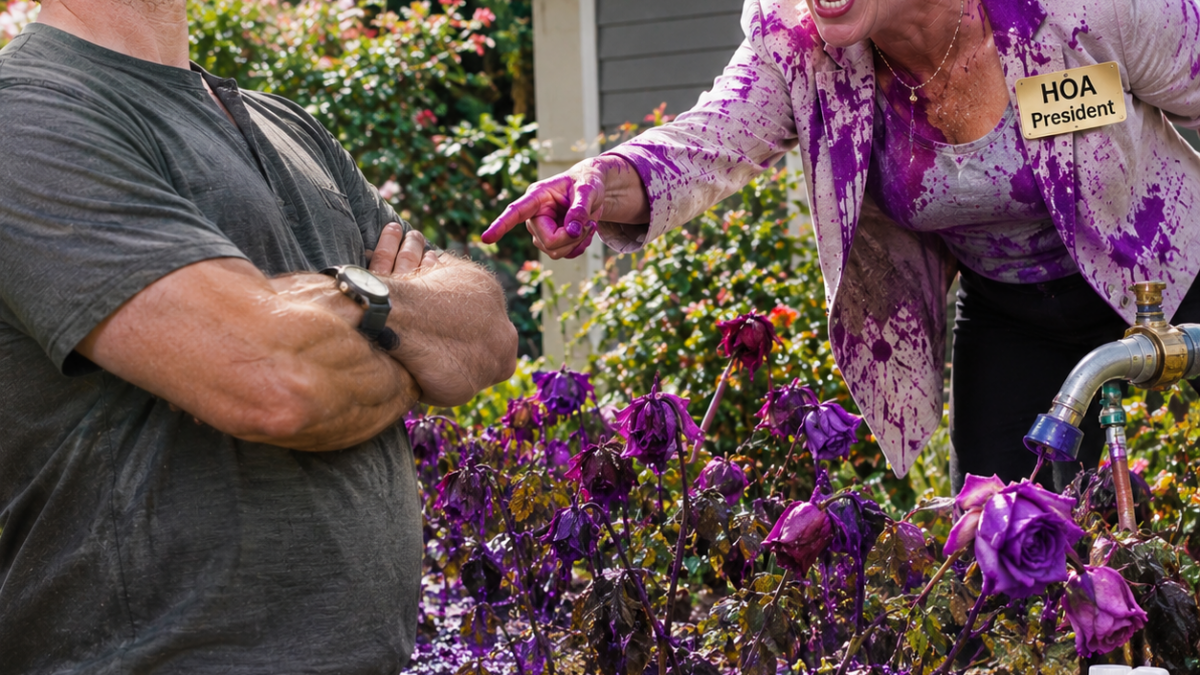
By midmorning, she was in her yard staring at the mulch.
Hands on hips.
She called Burl.
He arrived.
Looked at the soil.
Looked at the fence.
Looked at the irrigation access.
He did not look happy.
Two neighbors wandered over.
I stood on my porch with coffee.
Dolores looked at me.
I raised the mug.
She did not return the gesture.
No permanent harm.
But her immaculate showpiece suddenly looked ridiculous.
Purple-tinted runoff.
A farm-like odor hanging in August heat.
Her county-fair roses no longer felt quite so regal.
Was it petty?
Absolutely.
Was I proud?
Less than you might expect.
Satisfied?
I’d be lying if I said no.
But the garden wasn’t the real counterattack.
The meeting was.
—
Wendell reserved the large hall at the Mill Haven Community Center.
Certified notice went to all thirty-seven households.
Nineteen confirmed.
Then twenty-three.
More than half the neighborhood.
Vance attended as a legal observer.
Not to give a courtroom speech.
To make sure Dolores couldn’t invalidate the meeting with some technical trick.
Paulette Greer from city code enforcement agreed to attend and confirm only what her office had documented.
Brianna helped turn spreadsheets into simple charts.
She teaches third grade.
If anybody can make confusing information readable, it’s a third-grade teacher.
“What do you want this one to show?” she asked.
“HOA money going to Burl.”
“Then stop putting twelve numbers on one slide.”
“I like numbers.”
“Nobody else does.”
She was right.
The final chart showed:
YEAR.
PAYMENT.
VENDOR.
PURPOSE CLAIMED.
ACTUAL COMMON IRRIGATION ASSETS:
NONE.
Even I had to admit it was better.
—
I tipped off the Mill Haven Gazette.
Reporter Stella Furman called back.
“What exactly is happening?”
“Our HOA president’s private landscaper appears to have been paid through HOA irrigation expenses for three years, and the same landscaper installed an unauthorized connection that diverted metered water to her rose garden.”
Silence.
Keyboard.
“Do you have documents?”
“Twenty-two pages.”
“City finding?”
“Yes.”
“Meeting public to members and guests?”
“Yes.”
“What time?”
“Seven.”
“I’ll be there.”
—
The night arrived hot.
Late August.
Parking lot shimmered from the day’s heat.
Twenty-three households showed.
Stella sat in back.
Paulette Greer near the aisle.
Vance stood against the wall.
Dolores arrived wearing a cream blazer.
Yellow rose pinned to the lapel.
Even Wendell noticed.
He leaned toward me.
“She has no idea what irony is.”
Apparently not.
Dolores entered with two loyal board members.
She walked toward the head table.
Wendell stopped her.
“This is a petitioned special membership meeting.”
“I am president.”
“The members elect tonight’s chair.”
“I chair HOA meetings.”
“Not automatically this one.”
Dolores stared at him.
Wendell called the vote.
Twenty-two hands for Wendell.
One against.
Dolores sat.
For the first time in years, she did not control the gavel.
—
I presented first.
Not with anger.
That was deliberate.
I began with the water.
Herschel’s report.
Photographs.
Meter history.
City confirmation.
Paulette stood briefly.
“Our department confirmed an unauthorized residential connection affecting Mr. Shale’s metered service and issued a violation to the neighboring property.”
No opinion.
No drama.
Facts.
Then I showed the bills.
Eight months.
Average increase.
The total overage.
People started whispering.
Dolores tried to interrupt.
Wendell said:
“You’ll have a response period.”
She sat.
I moved to the new bylaw.
Date adopted.
Notice requirement.
No thirty-day comment period.
Vance confirmed the procedural issue.
Then Brianna’s message.
Dolores had contacted my daughter about my supposed mental state.
The room changed.
Not louder.
Colder.
People can forgive bad accounting.
They have a harder time forgiving cruelty that feels personal.
—
Then the financials.
I put the first chart on the screen.
**CRESTFIELD GREEN SERVICES**
Year one.
Eight hundred.
Year two.
Eight hundred.
Year three.
Approximately eight hundred.
“Budget category?” I asked.
Nobody answered.
“Common-area irrigation maintenance.”
Next slide.
Photos.
Entry sign.
Mailbox cluster.
No irrigation system.
No beds.
No common lawn.
Then photographs of Burl working on Dolores’s roses.
Dates matching invoices.
One homeowner behind me said:
“You’ve got to be kidding.”
I continued.
“Based on the HOA’s own records, approximately twenty-four hundred dollars was paid to the same landscaper maintaining Ms. Fitch’s private garden under a budget category for common irrigation that does not exist.”
Dolores stood.
“That is completely misleading.”
Wendell:
“You’ll have time.”
“I need to correct this now.”
“Sit down.”
Her face changed.
Twenty-two years in the neighborhood.
Years as president.
Probably nobody had told her to sit down in public for a very long time.
She sat.
—
When my presentation ended, Dolores stood again.
This time Wendell gave her the floor.
She held a folded tissue.
Her voice trembled.
She had served Crestfield Lane for twenty-two years.
She had volunteered countless hours.
The landscaping bills were a misunderstanding.
Burl performed many small services.
Records were imperfect.
The water connection was a contractor mistake.
She never intended to harm anyone.
Then she began crying.
Actual tears or performance, I still don’t know.
Maybe both.
People are complicated.
A person can believe she is a victim while victimizing everyone around her.
For a moment, the room softened.
I felt it.
Neighbors remembered decades of Christmas parties.
Garden tours.
Cakes.
Funerals.
Dolores had not spent twenty-two years being a cartoon villain.
That would have made everything easier.
She had helped people too.
That is why power like hers lasts.
Then Douglas Cray stood.
“Dolores.”
She looked at him.
“You filed a complaint against Irene’s dahlias after I signed this petition.”
“That had nothing to do with—”
“You wrote a rule to punish Garrett after the city confirmed the water violation.”
“That is not what—”
“You contacted his daughter and said he was unstable.”
Dolores’s face tightened.
Douglas continued.
“My wife kept logs because you accused her of cheating at a flower show.”
His voice stayed level.
“This isn’t a misunderstanding.”
He held up our packet.
“It’s a pattern.”
That was the sentence that ended her.
Not mine.
His.
—
The vote came.
Remove Dolores Fitch from the HOA board.
Twenty-one yes.
Two no.
Independent financial audit.
Approved.
Committee to recover questionable expenditures.
Approved.
New election within thirty days.
Approved.
Dolores left before final procedural business finished.
No gavel.
No speech.
No demand that everyone respect her years of service.
She walked out.
Stella Furman kept writing.
Paulette Greer spoke briefly with Vance.
I sat down.
For months I had pictured this moment.
Thought I would feel vindicated.
Instead, I felt pressure leaving my body.
Like a valve finally opened.
That’s the only way I know to describe it.
—
As I drove home, I passed Dolores’s property.
The roses were visible in the yard lights.
Still beautiful, honestly.
But the mulch beneath them held a faint purple stain.
And the smell lingered.
I laughed once.
Then stopped.
Norma would have called it childish.
She would also have laughed before scolding me.
I’m almost certain.
—
The independent audit took six weeks.
CPA Francine Aldridge reviewed three years.
The final amount of questionable expenditures:
Approximately $2,800.
More than we first identified.
Dolores hired her own attorney.
Ultimately she agreed to repay the association rather than continue a prolonged fight over the disputed expenditures.
The unauthorized water matter settled separately.
Eight months of overage reimbursed:
$1,460.
When the check arrived, I held it for a while.
Not because the number was enormous.
Because each dollar represented money I had spent wondering what was wrong with my house.
Money that should have fixed my air conditioner.
Money that should have bought Sunday breakfast.
Money Norma and I had worked for.
I deposited it Tuesday morning.
Then drove directly to buy the AC parts I had postponed all summer.
Paid cash.
That felt good.
—
Dolores withdrew her roses from the county fair.
“Personal reasons.”
Nobody challenged the explanation.
The temporary discoloration faded.
The smell faded.
The roses recovered.
That mattered to me.
I didn’t want them dead.
They had never done anything wrong.
Plants don’t steal water.
People do.
—
Wendell ran for HOA president.
Eighteen votes to three.
His first meeting lasted thirty-seven minutes.
A neighborhood record.
First policy:
Any expenditure above two hundred dollars required two authorized signatures.
Second:
Quarterly financial statements posted for every homeowner.
Third:
Vendor relationships involving board members or their families had to be disclosed.
Fourth:
The fictional common-area irrigation budget line disappeared permanently.
Wendell looked at me.
“Any objections?”
“Only that we paid it for three years.”
“Noted.”
Gavel.
Next item.
That was what competent governance looked like.
Boring.
Beautifully boring.
—
Douglas and Irene Cray returned to the county fair the next year.
Dahlias.
I drove over.
Found Irene standing beside her display with tears in her eyes.
Blue ribbon.
First place.
She held it like a child.
“I won.”
“I can see that.”
“She said they were commercially propagated.”
“I remember.”
Irene touched one of the blooms.
“I almost didn’t enter.”
Douglas stood beside her.
“You should’ve seen her when they announced it.”
Irene laughed.
Then cried again.
I hugged her.
That moment meant more to me than Dolores withdrawing her own roses.
There is something satisfying about revenge.
There is something better about restoration.
—
My water bill dropped by ninety-three dollars the first month after the illegal connection was removed.
I opened the statement at my mailbox.
Normal usage.
Normal charge.
I stared at it.
Then looked toward Norma’s garden.
For almost a year, every bill had made me feel slightly out of control.
Now the number made sense again.
That afternoon, I went to Sunday breakfast for the first time in months.
Wendell came.
Douglas and Irene joined.
We sat in a booth too small for four adults.
Nobody discussed the HOA for almost twenty minutes.
That might have been the biggest sign things were improving.
—
Norma’s garden had its best fall season since she died.
Tomatoes everywhere.
I canned forty-seven jars of sauce.
Forty-seven.
Brianna came over and stared at the counter.
“Dad.”
“What?”
“You’re one man.”
“I give them away.”
“To who?”
“Everyone.”
“That’s how zucchini starts wars.”
“These are tomatoes.”
“Same principle.”
I gave jars to Wendell.
The Crays.
The retired teacher on the north end.
She returned one with a loaf of fresh bread.
We stood on her porch talking for forty minutes.
Nothing important.
Weather.
School taxes.
Her grandson’s baseball team.
Exactly the kind of conversation Dolores’s version of the neighborhood had poisoned.
Under her, every interaction carried politics.
Who supported whom?
Who complained?
Who might report you?
Without her control at the center, people slowly became neighbors again.
—
The biggest surprise came from the shared utility easement.
For months I couldn’t look at it without seeing the illegal coupling.
Then Wendell proposed something.
Rainwater collection.
Properly designed.
Properly approved.
Voluntary.
The HOA partnered with the Mill Haven Conservation District.
Six shared collection points.
Rain barrels fed by approved structures.
Homeowners could use the water for gardens during dry weather.
No secret lines.
No stolen meters.
No fake budget categories.
The city provided a small sustainability grant.
Then Wendell did something I wasn’t ready for.
He named it:
**The Norma Shale Community Garden Water Initiative.**
I found out at a board meeting.
He put the title on the screen.
I stared.
“No.”
“What?” Wendell asked.
“You didn’t ask me.”
“That’s because you would’ve said no.”
“Correct.”
“So I saved time.”
People laughed.
I couldn’t.
Not immediately.
I stepped outside.
Walked behind the community center.
Stood beside a maple tree.
Norma’s name on a water program.
After months of fighting over stolen water.
She would have found the symmetry ridiculous.
Then I cried.
Not dramatically.
Quietly.
Five minutes.
Washed my face.
Went back inside.
Wendell pretended not to notice.
Good friend.
—
The next summer, I connected Norma’s vegetable garden to rainwater collection.
Legally.
My own barrel.
Overflow properly routed.
No shared-meters mystery.
No hidden fittings.
Every morning, I watered tomatoes with rain.
That felt right.
—
Dolores remained in the neighborhood for a while.
She stopped attending meetings.
Stopped garden club.
Someone else took over organizing church flower displays.
I occasionally saw her at the grocery store.
We didn’t speak.
Then one day, several months after the audit, I found an envelope in my mailbox.
No HOA letterhead.
Handwritten.
Garrett.
Inside:
A single sheet.
She apologized for the water connection.
Not everything.
Not the intimidation.
Not Norma.
Not Brianna.
Not the bylaw.
She said she had trusted Burl to make irrigation modifications and had failed to ask enough questions.
I believed half of it.
Maybe less.
But the final paragraph surprised me.
**I became accustomed to believing that years in this neighborhood gave me the right to decide what was best for people without asking them. I understand now that I was wrong.**
I sat at the kitchen table reading that sentence.
Three times.
Did it erase anything?
No.
Did I forgive her immediately?
No.
But it was the first honest thing I had seen from her.
I put the letter into the file.
Not with violations.
Separate pocket.
—
Brianna asked:
“You keeping it?”
“Yes.”
“Why?”
“Records.”
“Dad.”
I smiled.
“Okay. Maybe because people should get credit when they finally tell the truth.”
She nodded.
“That sounds like Mom.”
“Don’t insult me.”
Brianna laughed.
—
Dolores eventually sold.
Moving truck came on a cool spring morning.
No dramatic confrontation.
No crowd.
No one standing outside cheering.
I watched from the kitchen.
She carried one small rose bush herself.
Potted.
Yellow flowers.
I wondered whether it was from the old garden.
Probably.
For a moment, I felt sorry for her.
Twenty-two years on one street.
Then gone.
I didn’t confuse sympathy with absolution.
You can understand somebody’s sadness without rewriting what they did.
That distinction took me a long time to learn.
—
The new owners were a family with two children.
Within a week, the youngest came to my fence.
“Are you the tomato man?”
I looked around.
“Apparently.”
“My mom said you give tomatoes.”
“Sometimes.”
“I don’t like tomatoes.”
“Then this conversation is over.”
He laughed.
His sister liked them.
She helped me pick a basket.
Normal.
That was all I wanted from the house next door.
Normal.
—
The board eventually recovered the disputed money and created a small neighborhood education fund.
Nothing elaborate.
Workshops.
Home maintenance.
Basic budgeting.
One session every year on understanding HOA documents.
Wendell asked me to speak about utility easements.
I said:
“No one wants to hear a retired pipe fitter talk about easements.”
Thirty-seven people came.
I was wrong.
I brought a cutaway sample of the type of fitting Herschel had found.
Showed what legal work should look like.
Explained the difference between a shared easement and shared ownership.
Then one homeowner asked:
“How did you know somebody was stealing water?”
I said:
“I didn’t.”
“But you found it.”
“I noticed something that didn’t belong.”
That was the lesson.
Not everyone knows plumbing.
But everyone knows their own normal.
Bills.
Sounds.
Patterns.
When normal changes, pay attention.
—
Herschel came to the first workshop.
He sat in back.
When I thanked him publicly, he waved me off.
Afterward he said:
“You know what still bothers me?”
“What?”
“That fitting was sloppy.”
I laughed.
“Not the theft?”
“That too.”
He shook his head.
“But if you’re going to steal water, at least respect plumbing.”
Tradesmen have priorities.
—
Burl’s role became clearer through the audit and settlement process.
He had done work Dolores requested.
How much he understood about the billing arrangements was disputed.
I stayed out of it.
Vance handled what needed handling.
Burl stopped working in Crestfield Lane.
That was enough for me.
I had no interest in becoming a professional enemy collector.
—
The following summer was hot.
The kind of Ohio heat that makes the pavement look soft.
Rain barrels dropped quickly.
But the community system worked.
People took turns.
No fights.
No secret taps.
One evening, I found a note attached to the barrel station.
**PLEASE LEAVE SOME FOR THE TOMATO MAN.**
No signature.
Wendell claimed innocence.
I didn’t believe him.
—
The rose bed next door changed under the new family.
They didn’t want eleven varieties.
Removed some.
Kept four.
Planted lavender.
I thought I would care.
I didn’t.
That surprised me.
For months, Dolores’s roses had symbolized everything.
The stolen water.
The stolen money.
Her power.
Once she left, they were plants again.
Much healthier.
—
Norma’s garden remained different.
Still hers.
Even as I changed it.
One year I added garlic.
She hated growing garlic.
Said it was boring.
I planted it anyway.
For a week I felt guilty.
Then realized grief had turned me into a museum curator.
Norma built the garden to live in.
Not freeze in time.
So I changed things.
New trellis.
Different beans.
More herbs.
Kept her tomatoes.
Some things you preserve.
Some you allow to grow.
—
Wendell served two terms and refused a third.
At his final meeting:
“No Christmas Eve elections.”
People laughed.
He wasn’t joking.
The next president was Douglas Cray.
Irene made him run.
He pretended otherwise.
Her dahlias decorated the community center during his first meeting.
Blue ribbon displayed beside them.
Dolores would have hated that.
I enjoyed it more than I should have.
—
The HOA records became almost aggressively transparent.
Invoices online.
Vendor names.
Budget categories.
Quarterly balances.
Reserve reports.
At first, residents checked everything.
After a few years, fewer did.
That worried me.
So each annual meeting included a five-minute financial walkthrough.
Not because we expected fraud.
Because systems degrade when everyone assumes someone else is watching.
Douglas would say:
“Transparency is maintenance.”
Pipe fitter approved.
—
A young homeowner once asked:
“Do you think Dolores started out corrupt?”
I thought about that for days.
Eventually I told him:
“No.”
“How do you know?”
“I don’t.”
“Then why say no?”
“Because I think most people start by making one exception for themselves.”
A reimbursement nobody questions.
A shortcut.
A favor.
A rule bent because they’re sure they’re right.
Then another.
And if nobody pushes back, entitlement grows around the exception.
Like roots around a pipe.
Eventually the obstruction feels permanent.
He said:
“That’s dark.”
“Plumbing is philosophical.”
He left before I could elaborate.
Smart.
—
The reimbursement from Dolores did more than fix the AC.
I resumed Sunday breakfast.
That mattered.
I hadn’t realized how much I had isolated myself after Norma died.
Bills gave me an excuse.
So did the garden.
So did the HOA fight.
But grief had done most of it.
One Sunday Brianna joined me.
We sat in a diner booth.
She stole half my hash browns.
“You seem better.”
“I’m eating breakfast.”
“That’s not what I mean.”
I knew.
“Yeah.”
“You still talk to the tomatoes?”
“No.”
“Liar.”
“Sometimes.”
She smiled.
“Mom would approve.”
“I know.”
—
Years passed.
The Mill Haven Gazette article yellowed.
Wendell kept a framed copy.
I didn’t.
Stella Furman interviewed me once on the five-year anniversary of the water initiative.
She wanted a follow-up.
“How many homes use the rainwater program?”
“Most in some way.”
“Do people remember why it started?”
“Some.”
“Does that bother you?”
“No.”
“Why?”
“Because if the program works, it shouldn’t need a villain forever.”
She wrote that down.
I wished I had said it more elegantly.
She used it exactly as spoken.
Reporters.
—
The water initiative expanded.
School garden.
Community center landscaping.
A church two blocks over installed barrels after seeing ours.
The conservation district used Crestfield Lane as a demonstration neighborhood.
That amused me.
We became known for responsible water use because somebody stole mine.
Life has strange symmetry.
—
The garden gave me one more surprise.
Irene began trading flowers for vegetables.
Dahlias for tomatoes.
Every August, she brought a bouquet.
I gave her sauce.
One year she arrived with a purple dahlia.
Deep violet.
I stared at it.
She saw my face.
“What?”
“Nothing.”
“Oh.”
She started laughing.
“You’re thinking about the roses.”
“No.”
“Yes, you are.”
“Maybe.”
She handed me the flower.
“Put it in water.”
“I know how flowers work.”
“You’re a pipe fitter. That’s not the same thing.”
I put it on the kitchen table.
Purple.
Beautiful.
No stink.
Much better association.
—
Wendell died at seventy-two.
Cancer.
Fast.
He had complained about back pain.
Four months later, gone.
That hurt.
He had been the first person to say:
“She’s doing it to you now.”
The first person to show me that my fight was part of a pattern.
His memorial was held at the community center.
Packed.
Douglas spoke.
I spoke.
I told the story of the binder.
Not Dolores.
Wendell’s binder.
Three years of grievances.
Tabbed and dated.
People laughed.
His daughter gave the binder to the HOA archive.
On the cover, she added a label:
**WENDELL BAXTER — HE KEPT RECEIPTS.**
Perfect.
—
The rainwater initiative board voted to add his name to one of the collection stations.
I objected.
Not because he didn’t deserve it.
Because he would have complained about sentimentality.
Douglas said:
“He’s dead. He can’t object.”
“Very democratic.”
“Majority vote.”
The plaque went up.
**BAXTER STATION — CHECK THE NUMBERS TWICE.**
I approved.
—
As I got older, Brianna started helping more with the garden.
At first, she did it badly.
Too much water.
Picked tomatoes early.
Ignored pruning.
I corrected everything.
She finally said:
“Dad, if you want help, you have to let it look different.”
That sentence stopped me.
Norma could have said the same thing.
So I backed off.
The garden changed.
Brianna planted flowers among the vegetables.
I complained.
Pollinators loved them.
She won.
—
One autumn, while replacing a section of fence near the old easement, I found a piece of the original unauthorized line.
Short blue fitting.
I had kept it after Herschel removed everything.
Forgotten in a box.
I held it.
The object looked ridiculous.
Small.
Cheap.
Eight months of confusion attached to something smaller than my hand.
I considered putting it in the trash.
Then Brianna said:
“You’re going to keep that forever, aren’t you?”
“Maybe.”
“Why?”
“Evidence.”
“The case ended years ago.”
“History.”
She rolled her eyes.
I kept it.
Then changed my mind the next morning.
Threw it away.
I didn’t need it anymore.
The records were enough.
The garden was enough.
The normal water bill was enough.
—
The last document connected to Dolores eventually arrived from Vance’s office.
Settlement closure.
No outstanding claims.
No pending reimbursement.
Case complete.
He wrote one handwritten line on the cover:
**You can stop filing now.**
I called him.
“Very funny.”
“I’m serious.”
“I like files.”
“I know.”
“Files are useful.”
“Garrett.”
“Yes?”
“Go water your tomatoes.”
I did.
—
That evening was cool.
Late summer beginning to lose its edge.
Norma’s garden looked full.
Tomato leaves.
Beans climbing.
Brianna’s flowers scattered between rows.
I turned on the rainwater hose.
The water flowed.
No meter moving.
No neighbor siphoning it.
No hidden connection.
Just rain collected from roofs and stored legally for the whole neighborhood.
I stood there listening.
For months, the sound of Dolores’s irrigation at 5:45 had made me angry.
The hiss through the fence had felt like mockery.
Now water sounded ordinary again.
That might have been the deepest victory.
When something that once triggered anger becomes ordinary.
—
A few houses down, children were playing.
Someone grilling.
Dog barking.
Normal neighborhood noise.
The new residents next door were trimming lavender.
No rose competition.
No HOA politics.
I filled a watering can and walked between the tomato rows.
One plant had split under the weight of fruit.
I tied it carefully.
Then I thought of Norma.
Not the hospital.
Not the funeral.
Not the empty side of the bed.
The first spring.
Her standing barefoot in dirt.
Holding a seedling.
Telling me I was planting everything too deep.
She was right.
Usually was.
I smiled.
—
People remember the purple garden when they hear this story.
I understand why.
It’s visual.
Funny.
Petty in a satisfying way.
HOA president steals water.
Her prized roses end up surrounded by purple runoff and an odor she can’t explain days before her big meeting.
That makes a good story.
But it isn’t the part that stayed with me.
What stayed with me was my first normal water bill.
I had spent eight months blaming my house.
Blaming old plumbing.
Blaming myself for not understanding where the money was going.
Then one day the bill returned to normal and I realized how much mental space had been stolen along with the water.
That is what people like Dolores take if you let them.
Not only money.
Attention.
Sleep.
Confidence.
The feeling that your home behaves the way a home should.
Getting those things back mattered more than making her roses look ridiculous.
—
The new HOA board eventually replaced the old gavel.
Nobody planned to.
It cracked.
Douglas bought a new one online.
At the first meeting he used it, I laughed.
“What?”
“Nothing.”
“You hate gavels?”
“I have history.”
He set it down.
“We don’t actually need one.”
“Probably not.”
From then on, meetings were called to order with:
“Okay, everybody, let’s start.”
Much healthier.
—
The board also eliminated half the petty rules Dolores had accumulated.
Decorative mailbox guidelines simplified.
Garden standards rewritten.
Fine appeals moved to a three-person committee instead of the president alone.
No retroactive amendments.
No emergency rule changes without actual emergencies.
Every policy change posted publicly.
People still complained.
Of course.
A neighborhood without complaints is a cemetery.
But the complaints stopped becoming weapons.
—
One new homeowner challenged a fine over a trailer parked overnight.
The board reviewed it.
The homeowner was wrong.
Trailer violated a clear rule.
He moved it.
No war.
No intimidation.
No revenge.
That was another sign the system was healthier.
Fair rules can survive scrutiny.
Unfair power fears it.
—
Years later, the rainwater initiative received a small regional sustainability award.
Douglas wanted me on stage.
I refused.
Brianna forced me.
Again.
The presenter described how Crestfield Lane converted a utility dispute into a neighborhood conservation program.
That phrase was doing a lot of work.
Utility dispute.
Technically accurate.
I accepted the plaque.
Then corrected one thing.
“The program should be credited to the neighborhood.”
Afterward Brianna said:
“Look at you being gracious.”
“I’ve always been gracious.”
She laughed for an unreasonable amount of time.
—
The plaque hangs in the community center.
Norma’s name under the initiative title.
I still don’t like seeing it unexpectedly.
Sometimes grief is gentle.
Sometimes a name on a wall can knock the wind out of you ten years later.
But I’m glad it’s there.
Her garden taught me how to stay in the house after she was gone.
The water fight taught the neighborhood how to take care of one another.
Those things belong together.
—
The final summer I maintained the garden completely by myself, I canned thirty-two jars of sauce.
Not forty-seven.
Age.
Knees.
Energy.
Brianna helped label them.
She wrote:
**NORMA’S — DO NOT HOARD**
I crossed out the second part.
She rewrote it.
We argued.
I lost.
Again.
—
That night, after she went home, I sat on the porch.
The street was quiet.
At 5:45 the next morning, I happened to be awake.
Old habits.
For years, that exact time had meant Dolores’s irrigation turning on.
I waited.
Nothing.
Then birds.
A truck far away.
Wind in the oak.
No hiss from next door.
I realized I hadn’t thought about that sound in months.
Maybe years.
I made coffee.
Walked outside.
The eastern sky was just beginning to brighten.
Norma’s garden sat dark and green in the morning.
I opened the rain barrel.
Filled the watering can.
No meter spinning.
No stolen gallon.
No secret pipe beneath the mulch.
I walked down the first row and watered the tomatoes slowly.
The neighborhood woke around me.
A garage door.
A dog.
A school bus.
Normal life.
That was the ending I wanted.
Not Dolores losing her title.
Not the audit.
Not the settlement.
Not even the ridiculous purple stain beneath her prized roses.
A normal morning.
Water going exactly where it was supposed to go.
Neighbors no longer afraid to question a budget.
A community using rain instead of stealing from one another.
My wife’s garden still alive.
And me finally understanding that protecting what she left me did not mean preserving every plant exactly as she had planted it.
It meant protecting the life around it.
I set the watering can beside the tomatoes.
The sun came through the trees.
And for the first time in a very long time, nothing on Crestfield Lane felt stolen.
[END OF STORY]