PART 2: HOA President Smashed Through My Farm Fence for an “Inspection” — Then Her Lexus Ended Up on My Sugarcane Loader
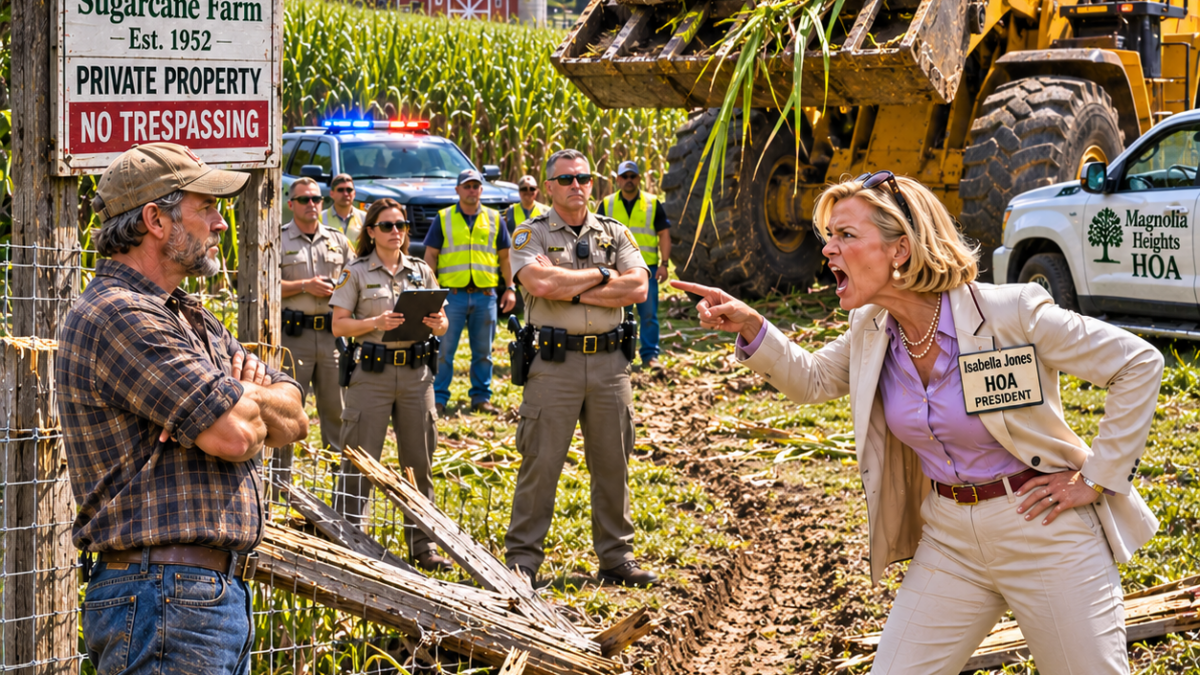
The morning I found sixty feet of my family’s fence smashed into the mud, fresh tire tracks running straight from Magnolia Heights onto my sugarcane farm, I still wanted to believe somebody had lost control—until the security camera showed HOA president Isabella Jones stopping her white Lexus, turning deliberately toward the fence, and accelerating hard enough to scatter boards across the field. Less than three hours later, Isabella emailed me a formal “inspection notice” claiming she had discovered that same fence illegally blocking a public easement, attached photographs she had taken while standing on my land after the impact, and demanded that I remove the rest of the boundary within forty-eight hours or face a five-thousand-dollar penalty. What she did not know was that the camera footage was only the first piece of evidence I had, and before the week was over she was going to put herself, her HOA board, and that white Lexus in the middle of a confrontation where every lie she had told about my property would be tested in front of witnesses.
My name is David Wilson, and my family has farmed fifty acres of Louisiana sugarcane since my grandfather bought the land in 1952. My father expanded the operation and left it to me eight years ago with one instruction: “Don’t let anybody take what we built.”
For most of my life, that sounded like something a tired farmer said because he loved his land. After Isabella Jones moved into Magnolia Heights, it started sounding like a warning.
Magnolia Heights sat along my eastern boundary, a polished subdivision built decades after the Wilson farm. I had never joined its homeowners association, signed its covenants, or agreed to obey its rules. Most residents understood that. Isabella did not.
She became HOA president within months of moving in and started treating the title like a county office. Her first complaint came while I was spreading fertilizer.
“Mr. Wilson, this odor is unacceptable,” she announced, standing inside my gate in heels.
“It’s fertilizer.”
“It violates our air-quality standards.”
“My farm isn’t in your HOA.”
Her face changed at the word no.
After that came letters about tractor noise, barn lights, fence color, and employee trucks parked on my gravel. I answered every one with the same documents: deed, survey, county records. She called the sheriff twice. Both complaints went nowhere. She sent a lawyer once. My lawyer answered, and that disappeared too.
Then my neighbor Tom told me Isabella had spent half an HOA meeting presenting a slideshow called “The Wilson Farm Problem.” Three board members refused to support legal action. I thought losing that vote would make her stop.
Instead, Monday morning came.
I was outside before sunrise checking irrigation when I saw the eastern fence. Posts were snapped at ground level. Boards lay across the grass. Wire had been dragged into the field. Fresh tracks came from Magnolia Heights, crossed the destroyed section, continued about fifteen feet onto my property, then backed out.
At first I thought accident.
Then I saw footprints.
Small shoes had stepped out near the tracks, walked toward a survey marker, and returned.
That wasn’t panic after a crash.
I called the sheriff, then went to the equipment barn and opened the security recorder I had installed after Isabella’s complaints started escalating.
6:04 a.m.
A white Lexus entered the frame.
It slowed.
Stopped.
Then the front wheels turned.
The SUV accelerated.
Wood exploded across the camera view.
I leaned closer as the Lexus pushed through and stopped inside the field.
The driver’s door opened.
Isabella stepped out holding her phone.
I watched her photograph the broken boards, the property marker, the equipment shed, and the walking path on the Magnolia Heights side. She spent almost five minutes creating a record of the scene she had just created herself.
Then she backed out and drove home.
Twenty minutes later, Deputy Rodriguez was watching the same footage beside me.
“That’s Mrs. Jones?”
“Yes.”
“You want to make a property-damage and trespass complaint?”
“Absolutely.”
At 8:17, my email chimed.
Magnolia Heights HOA.
NOTICE OF VIOLATION — IMMEDIATE ACTION REQUIRED.
The first attachment was one of Isabella’s photographs.
The letter claimed her “routine HOA inspection” had uncovered an illegal fence encroachment onto a public easement.
I opened my recorded survey.
My fence sat three feet inside my land.
There was no public easement.
And in that moment I understood that ramming the fence had never been the end of Isabella’s plan.
It had been the beginning.
PART 2
I printed Isabella’s email before I did anything else.
Not because I needed paper.
Because my father had always taught me that when somebody starts changing reality, you make copies.
He had a file cabinet full of receipts going back to tractors he no longer owned.
Every cattle purchase.
Every seed invoice.
Every boundary survey.
Every handwritten agreement.
When I was younger, I teased him about it.
“Dad, nobody cares what you paid for fence wire in 1987.”
He would stare at me over his glasses.
“You don’t know that.”
Now, standing in my kitchen with Isabella’s notice in one hand and a screenshot of her Lexus destroying my fence in the other, I finally understood.
I called Bill Henderson.
Bill had handled my father’s estate and several land matters over the years. He was the kind of attorney who never sounded impressed by anything, which was exactly why I trusted him.
I emailed everything before he answered.
“Tell me that video is not what I think it is.”
“It is.”
“She drove through your fence?”
“Yes.”
“Then claimed she was performing an HOA inspection?”
“Yes.”
“On land outside the HOA?”
“Yes.”
“And she emailed you photographs taken during that entry?”
“Yes.”
Bill went silent.
I waited.
Finally he said, “David, I don’t often get clients whose opponents package evidence against themselves this neatly.”
“That good?”
“It’s good for your case. It’s terrible for my faith in humanity.”
I almost laughed.
Then he got serious.
“Do not contact her.”
“I wasn’t planning to.”
“Do not threaten her.”
“I haven’t.”
“Do not retaliate.”
I looked out at the broken fence.
“What counts as retaliation?”
“That question worries me.”
“She destroyed my property.”
“I know.”
“And now she’s ordering me to remove the rest of it.”
“I know.”
“So what happens?”
“I send a cease-and-desist. We preserve the footage. We pursue damages. If the sheriff’s office forwards the criminal complaint, that process is separate.”
“How long?”
“For the civil part?”
“Yes.”
“Months.”
I closed my eyes.
“Six?”
“Could be.”
“Longer?”
“Could be.”
I walked to the window.
The eastern field stretched toward Magnolia Heights. Beyond my damaged fence, the subdivision looked perfect.
White sidewalks.
Crepe myrtles.
Brick entrances.
A fountain nobody needed.
Everything neat.
Everything controlled.
Six months sounded unbearable.
Six more months of letters.
Complaints.
Inspections.
Threats.
Isabella standing at that fence telling herself she had jurisdiction simply because nobody stopped her fast enough.
Bill must have heard something in my breathing.
“David.”
“Yeah?”
“Do not turn a strong case into a bad one because you’re impatient.”
“I’m not impatient.”
“You own three tractors, a cane loader, a dump trailer, and a temper.”
“That seems unfair.”
“I’ve represented you for eleven years.”
“Fine.”
“Go repair the fence.”
I almost hung up.
Then I said, “Bill.”
“What?”
“I think this is about more than HOA rules.”
“So do I.”
That surprised me.
“What do you mean?”
“You said she photographed survey stakes.”
“Yes.”
“She photographed your equipment access.”
“Yes.”
“She photographed the Magnolia Heights walking path.”
“Yes.”
“That sounds like boundary documentation.”
“Exactly.”
“But don’t speculate. Find records.”
That became the plan.
Not revenge.
Records.
I called Engineer Dave Reeves.
His real name was David, same as mine, which meant everyone in the county had called him Engineer Dave for twenty years.
He had worked with planning and development records long enough to know where documents disappeared when developers changed names.
I explained the fence.
Then the email.
He interrupted.
“Wait. She’s claiming public easement?”
“Yes.”
“Which easement?”
“That’s what I’m asking.”
“Send me the parcel numbers.”
I did.
“Give me until tomorrow.”
That afternoon I repaired the fence enough to secure the property.
Not permanently.
The broken posts needed replacement.
Wire had been stretched.
One corner brace was twisted.
I worked until after dark because physical work gave my anger somewhere safe to go.
At one point, Tom walked over from Magnolia Heights.
He stopped outside the damaged section.
“Jesus, David.”
“Morning was worse.”
“She really did that?”
I looked at him.
“You already heard?”
“Everybody heard.”
“That fast?”
“Isabella told people there was an accident during a boundary inspection.”
I stopped tightening wire.
“Accident?”
“That’s her story.”
“She stopped before hitting it.”
Tom looked uncomfortable.
“I’m not saying I believe her.”
“Did she tell the board?”
“Not exactly.”
“What does that mean?”
“She emailed Mark and Carol something about an unsafe farm fence creating access problems.”
I dropped the fencing pliers into my bucket.
“She created the access problem.”
“I know.”
“No. I mean literally. She drove through it.”
Tom rubbed the back of his neck.
“People are nervous.”
“About me?”
“About the HOA.”
That caught me.
“What’s going on over there?”
He looked toward the subdivision.
“Isabella has been worse lately.”
“Worse than threatening to sue a farm she doesn’t control?”
“You’d be surprised.”
I waited.
“She fined Mrs. Patterson over her mailbox.”
“Okay.”
“The mailbox color was approved when she painted it.”
“So?”
“Isabella changed the approved palette afterward and applied it backward.”
“That can’t be right.”
“She paid because fighting it would cost more.”
Tom continued.
“The Kowalskis got a violation over their son’s basketball hoop.”
“I’ve seen it.”
“Isabella said it lowered the architectural consistency of the street.”
“That sentence should be illegal.”
Tom laughed.
Then became serious.
“Mr. Harrison wanted solar panels.”
“I heard about that.”
“State law protected him.”
“So Isabella cited his grass the next week.”
I stared at him.
“How tall?”
“Three-point-two inches.”
“Tom.”
“I swear.”
“And your board allows this?”
He looked away.
“That’s the problem.”
I understood more than he said.
People did not necessarily support Isabella.
They were tired of fighting her.
That is how control often grows.
Not because everyone agrees.
Because resistance takes energy.
I went back to my fence.
“You should tell people what happened here.”
Tom nodded.
“I will.”
“Facts only.”
He smiled faintly.
“Your lawyer train you already?”
“He’s trying.”
Engineer Dave called the next morning at 8:03.
“David.”
“Tell me you found something.”
“I found something.”
I sat at the kitchen table.
“When Magnolia Heights was originally developed, the county required boundary acknowledgments for adjacent agricultural parcels.”
“My father signed one?”
“Yes. 2010.”
“That sounds like him.”
“More importantly, each purchaser received disclosures identifying neighboring parcels and existing recorded boundaries.”
I leaned forward.
“Isabella?”
“I’m looking at her 2018 closing package.”
“What does it say?”
He read slowly.
“Purchaser acknowledges existing Wilson agricultural parcel boundary as reflected in recorded county survey materials and agrees that no Magnolia Heights covenant or association authority extends beyond the subdivision parcel.”
I stopped breathing for a second.
“She signed that?”
“Yep.”
“Her actual signature?”
“Looks like it.”
“Send it.”
Already sent.
The email appeared while we were talking.
PDF.
Recorded.
Signature.
Isabella Marie Jones.
2018.
I read the paragraph twice.
Then a third time.
She had acknowledged the exact boundary she was now claiming to inspect.
I called Bill.
His first words:
“Oh, this is beautiful.”
“That’s what I thought.”
“Do not get creative.”
“You always ruin moments.”
“I’m serious.”
“So am I.”
“David.”
“I want a meeting.”
“With her?”
“Yes.”
“Why?”
“To put the survey in front of her.”
“Send it through counsel.”
“She’ll ignore it.”
“Then she ignores it on paper.”
“She needs to answer in front of her own board.”
Bill sighed.
I could practically hear him rubbing his forehead.
“You want witnesses.”
“Yes.”
“You want cameras.”
“Yes.”
“You want her to contradict herself.”
“I don’t have to make her do that.”
“No. She seems talented.”
I smiled.
He continued.
“You may invite her to discuss the boundary. You may not lure her into anything.”
“I know.”
“You may not obstruct her departure.”
“I know.”
“You may not touch her.”
“I know.”
“You may not damage her property.”
There was a pause.
“David.”
“I heard you.”
“That pause had hydraulics in it.”
“I own farm equipment.”
“I hate this conversation.”
I sent the email anyway.
Professional.
Short.
No threat.
No sarcasm.
Mrs. Jones,
I dispute the fence violation notice and have documentation establishing the legal boundary. In the interest of resolving the issue directly, I am willing to meet with you and HOA representatives at my farm Thursday at 2:00 p.m. to review the survey and recorded county documents.
Please confirm.
David Wilson.
Her answer arrived thirty-three minutes later.
Mr. Wilson,
I will attend with two board members. This meeting will determine whether the HOA proceeds with legal enforcement.
Please have your removal plan and all relevant property documents prepared.
Isabella Jones
President, Magnolia Heights HOA.
I read it aloud to Bill.
He said:
“She still thinks she has enforcement authority over you?”
“Apparently.”
“Bring copies.”
“I’m bringing Engineer Dave.”
“Even better.”
Then I called Marcus Hayes.
Marcus had retired after twenty-eight years with the sheriff’s department.
We had known each other since high school.
He had a calm way of looking at bad ideas until they became embarrassed and left the room.
I told him everything.
He listened without interrupting.
When I finished, he asked:
“What do you want from me?”
“Witness.”
“Not legal advice?”
“Maybe a little.”
“No.”
“Why?”
“Because retired deputy is not lawyer.”
“You’ve ruined your own legend.”
“I’m comfortable.”
I explained that Isabella would likely come aggressive.
That I wanted someone who understood procedure nearby.
Marcus said:
“I’ll come.”
“Good.”
“And David?”
“Yeah?”
“If she parks badly, call a tow truck.”
I said nothing.
He laughed.
“You’re thinking about the Caterpillar.”
“I didn’t say that.”
“You didn’t need to.”
“I’m not damaging anything.”
“That is not the point.”
“What is?”
“You’re angry.”
“So?”
“Angry men love machines because machines make anger feel productive.”
That irritated me.
Mostly because it sounded like something my father would have said.
The Caterpillar TH414C sat in my equipment yard.
We called it the sugarcane loader even though it handled everything from palletized fertilizer to bundled cane.
Big yellow machine.
Telescoping boom.
Fork attachment.
Capable of moving loads far heavier than Isabella’s Lexus.
I had no intention of doing anything reckless with it.
But I also knew Isabella.
She had already driven through a fence because a boundary told her no.
If she came onto my farm and parked wherever she pleased, I doubted a sign would suddenly teach her humility.
Still, Marcus was right.
I needed the facts to create the consequence.
Not my temper.
Wednesday afternoon I walked the equipment yard with Jorge Martinez, my most experienced operator.
He had worked for us almost fourteen years.
I pointed toward the barn entrance.
“Keep this clear Thursday.”
“Delivery?”
“HOA.”
Jorge stopped.
“Worse than delivery.”
“Probably.”
He knew about the fence.
Everybody did.
“What do you need from me?”
“Normal operations.”
He looked at me.
“Normal?”
“Normal.”
“You saying normal too much.”
I laughed.
“I’ll explain if something happens.”
I replaced a faded safety sign near the equipment entrance.
ACTIVE FARM OPERATIONS
KEEP ACCESS CLEAR
NO UNAUTHORIZED PARKING
Nothing invented.
Nothing targeted at Isabella.
That area needed to stay open during harvest preparation.
I checked every camera.
Main driveway.
Barn.
Equipment yard.
Eastern boundary.
Backup recorder.
Phone charged.
Engineer Dave would bring the county folder.
Marcus would sit near the drive.
Bill would remain available by phone.
Thursday came.
I barely ate lunch.
At 1:45, I walked the yard once more.
Jorge was checking hydraulic lines.
Engineer Dave sat at my kitchen table with documents spread in neat stacks.
Marcus parked his pickup along the outer edge of the property and pretended to drink coffee.
At 1:58, the white Lexus appeared.
Behind it came a silver Honda Accord.
I stood on the porch.
The Lexus passed the visitor parking area.
Passed the open gravel shoulder.
Continued directly toward the barn.
Then stopped in front of the equipment entrance.
Five feet from the sign.
I closed my eyes for half a second.
Marcus, still in his truck, looked at me through the windshield and slowly shook his head.
I could almost hear him.
Don’t.
Two people got out of the Honda.
Mark Stevens.
Carol Reed.
Both HOA board members.
I knew them from around town.
Mark was an accountant.
Carol volunteered at the parish library.
Reasonable people, as far as I knew.
Both already looked uncomfortable.
Isabella stepped out of the Lexus wearing a cream pantsuit, heels, pearl earrings, and the expression of a woman arriving to accept surrender.
Leather portfolio in one hand.
Phone in the other.
“Mr. Wilson.”
“Mrs. Jones.”
Mark nodded.
Carol smiled nervously.
“David.”
“Afternoon.”
Isabella looked past me toward the broken eastern fence.
“We should get started. I assume you’ve prepared the removal plan.”
“I’ve prepared records proving there’s nothing to remove.”
Her lips tightened.
“Then we’ll begin with the inspection.”
“Before we do, move your Lexus.”
She glanced over her shoulder.
“It’s fine.”
“It’s blocking equipment access.”
“This won’t take long.”
“Still needs to move.”
She stared at the safety sign.
I watched her read it.
Then she looked back at me.
“I’m here on official HOA business.”
“My loader doesn’t know what that means.”
Mark cleared his throat.
“Isabella, I can move it if you want.”
“No.”
“It’ll take thirty seconds.”
“I said it’s fine.”
Carol tried.
“He’s asking politely.”
Isabella turned toward her.
“And I’m telling him this meeting concerns a more important violation.”
There it was.
Yielding had become defeat.
I said:
“Mrs. Jones, I’m documenting that I asked you to move it.”
Her eyes flicked toward the barn camera.
“Are you recording this?”
“Yes.”
“You need consent.”
“You’re standing on my property after agreeing to a meeting.”
“That does not give you permission to surveil me.”
“The cameras were here before you arrived.”
She waved a hand.
“Enough. The fence.”
I looked at Mark.
He shrugged helplessly.
“Fine.”
We started walking.
Halfway across the yard I asked:
“When you inspected Monday morning, did you bring a licensed surveyor?”
Isabella’s shoulders tightened.
“I conducted the inspection based on association records.”
“That wasn’t my question.”
She kept walking.
“Did you bring a surveyor?”
“No.”
“County official?”
“No.”
“Engineer?”
“No.”
“Permission from me?”
She stopped.
“I did not need your permission to examine a condition affecting Magnolia Heights property.”
“You needed permission to enter mine.”
“The fence was creating a safety problem.”
“What safety problem?”
“Potential public-easement obstruction.”
“That you discovered after hitting it?”
She turned.
“What did you say?”
I took out my phone.
Opened the video.
Pressed play.
White Lexus.
Pause.
Turn.
Acceleration.
Fence exploding.
Nobody spoke.
Isabella watched herself step out of the SUV.
Mark moved closer.
Carol covered her mouth.
Isabella’s face went pale.
The video showed her photographing the scene.
Then walking toward the survey marker.
Then backing out.
I stopped playback.
Mark looked at her.
“Isabella.”
She said nothing.
“Did you drive through his fence?”
“That video is misleading.”
Carol stared.
“Misleading how?”
“It doesn’t show the condition of the fence beforehand.”
I almost admired it.
She didn’t deny being there.
She tried to redefine what we saw.
I said:
“You stopped first.”
“I was inspecting.”
“Then accelerated.”
“The ground was uneven.”
“You turned directly into the fence.”
“I misjudged the distance.”
“Then why didn’t you report the accident?”
She looked at me.
“I did.”
“No.”
I held up the HOA notice.
“You called it an inspection.”
Her breathing changed.
Shallower.
Mark said:
“Isabella, did you tell the board about the collision?”
“This conversation is becoming hostile.”
Carol’s voice sharpened.
“Answer him.”
Isabella turned on her.
“I am the president of this association, Carol. I do not answer to you during an external enforcement action.”
Mark actually took a step back.
I said:
“You don’t have an external enforcement action.”
She snapped toward me.
“Yes, we do.”
I unfolded the 2021 survey.
“This fence sits three feet inside my property.”
“Your survey is not definitive.”
“It’s recorded.”
“Surveys can be challenged.”
Engineer Dave was still waiting at the house.
I almost enjoyed the timing.
“True.”
I looked toward the porch.
“Dave?”
He came out carrying the county folder.
Isabella stared at him.
“Who is this?”
“David Reeves.”
Engineer Dave nodded.
“Former county planning department.”
Her expression changed slightly.
He handed Mark the first document.
“Recorded Wilson boundary acknowledgment from the Magnolia Heights development file.”
Mark began reading.
Carol looked over his shoulder.
Isabella said:
“This is irrelevant.”
Engineer Dave pulled another page.
“2018 purchaser disclosure for Lot Forty-Seven.”
Isabella froze.
He handed it to her.
“Your closing paperwork.”
She looked down.
Her signature sat at the bottom.
I watched her eyes move up the page.
Paragraph seven.
Adjacent Wilson agricultural parcel.
Recorded boundary.
No Magnolia HOA authority outside subdivision lines.
Mark whispered:
“Oh, no.”
Isabella looked up.
“I don’t remember this.”
Engineer Dave said:
“That doesn’t make the filing disappear.”
“I signed hundreds of documents.”
Carol answered:
“You still signed it.”
Isabella folded the page.
“This does not address the fence encroachment.”
I pointed to the survey.
“It does.”
“The HOA map shows—”
“Your HOA map cannot move my deed.”
Her face hardened.
“Your attitude is exactly why this issue escalated.”
I actually laughed.
“My attitude drove your Lexus through my fence?”
“You’re twisting this.”
“No.”
I stepped closer, but kept distance between us.
“For six months you’ve complained about a farm outside your HOA. You called the sheriff over legal equipment noise. You threatened me over trucks on my property. You proposed suing me because my barn doesn’t match Magnolia Heights. When your board refused, you drove through my fence and tried to turn the damage into evidence.”
Her eyes flashed.
“You have no idea what you’re talking about.”
“Then explain it.”
“I do not owe you an explanation.”
“On my land?”
“This affects my community.”
“My farm isn’t your community.”
“That’s exactly the problem.”
The words came out before she could stop them.
Silence.
I looked at Mark.
He heard it.
Carol heard it.
Engineer Dave heard it.
Marcus heard it from a distance.
I said:
“Say that again.”
Isabella’s mouth tightened.
She changed direction.
“I’m not going to stand here while you intimidate me.”
“Then leave.”
Her eyebrows lifted.
“This inspection isn’t complete.”
“It’s over.”
“You invited us here.”
“Yes.”
“And now you’re terminating the meeting because your evidence doesn’t support your argument.”
“My evidence proves you lied.”
“That’s defamatory.”
“Leave.”
Mark stepped between us—not aggressively, just trying to cool the room that wasn’t a room.
“Maybe we should all go.”
Carol nodded.
“Yes.”
Isabella looked at them like they had betrayed her.
“We are not leaving until Mr. Wilson agrees to correct the violation.”
I said:
“No violation.”
“You don’t decide that.”
“Neither do you.”
She smiled then.
Not friendly.
Not even angry.
A smile people use when they think authority is about to rescue them.
“Make me.”
Marcus rubbed his face from across the yard.
I pointed toward her Lexus.
“Move your vehicle and leave.”
“No.”
“You are no longer welcome on the property.”
“I came by appointment.”
“Appointment’s over.”
“No.”
Mark said:
“Isabella, please.”
She ignored him.
I called Bill.
Put the phone on speaker.
He answered:
“If there’s a machine running, hang up.”
“There isn’t.”
“Yet.”
“Isabella is refusing to leave and her Lexus is blocking the equipment barn.”
Bill sighed.
“Call the sheriff.”
“I’m doing that.”
“Good.”
“And the car?”
“Do not turn your farm into a YouTube video.”
“I wasn’t planning to.”
“Your voice says otherwise.”
I called the sheriff’s office.
Explained the situation.
Existing property-damage report.
Person involved now refusing to leave.
Vehicle blocking active farm access.
Dispatcher said a deputy was on the way.
Isabella folded her arms.
“Excellent.”
I stared.
“What?”
“Let the sheriff explain that you can’t remove an HOA officer conducting official business.”
Mark looked at me.
I looked at Mark.
Neither of us said anything.
Twenty minutes later, Deputy Rodriguez’s cruiser came up the drive.
He parked beside Marcus.
When he saw Isabella, his expression became instantly professional.
“Mrs. Jones.”
“Deputy.”
Then she pointed at me.
“This man invited us to inspect a boundary violation and is now refusing to cooperate.”
Rodriguez looked at the Lexus.
“Is that your vehicle?”
“Yes.”
“Mr. Wilson says it’s blocking his barn access.”
“It is temporarily parked.”
“He asked you to move it?”
“He’s trying to distract from the inspection.”
Rodriguez’s eyes narrowed.
“That wasn’t my question.”
I almost smiled.
She noticed.
“Stop smirking.”
I wasn’t.
Now I was.
Rodriguez said:
“Mrs. Jones, please move your vehicle.”
Her face changed.
“Excuse me?”
“Move the vehicle.”
“I have a right to be here.”
“You had permission for a meeting. Mr. Wilson has ended the meeting.”
“I am investigating an HOA violation.”
“His property is outside your HOA.”
“That is disputed.”
Rodriguez looked toward Engineer Dave.
“Is it?”
Dave handed him the survey.
Then the boundary acknowledgment.
Rodriguez read enough to understand.
He looked back at Isabella.
“Move your vehicle.”
She shook her head.
“No.”
Carol whispered:
“Oh, God.”
Mark said:
“Isabella.”
She turned.
“Do not tell me what to do.”
Mark held up both hands.
“I’m trying to keep this from getting worse.”
“I am president of Magnolia Heights.”
Rodriguez said:
“Not relevant to where your car is parked.”
She stared at him.
Then at me.
Then at the barn.
“You planned this.”
I said:
“I planned a document meeting.”
“You knew I would park there.”
“I knew you might ignore the sign.”
“That’s entrapment.”
Marcus coughed into his fist.
Rodriguez glanced at him.
“Marcus.”
“Luis.”
“Retirement boring?”
“Usually.”
Rodriguez looked back at Isabella.
“Last time. Move the Lexus.”
She smiled tightly.
“No.”
Rodriguez radioed his supervisor.
While we waited, Jorge came out of the equipment shed.
He looked at me.
Then at the Lexus.
Then at Rodriguez.
“Can I move the trailer?”
“Not yet,” I said.
Isabella said:
“See? Nothing is happening. He doesn’t need this space.”
Jorge frowned.
“I need the barn.”
She ignored him.
The cane trailer inside carried equipment we needed to reposition before afternoon rain.
Not an emergency.
But the Lexus was still an obstruction.
Sergeant Ellis arrived eighteen minutes later.
He reviewed the situation from the beginning.
He watched the fence video.
Read Isabella’s HOA notice.
Read the survey.
Read the 2018 disclosure.
Listened to Mark and Carol confirm I had asked Isabella to move the vehicle before the confrontation began.
Then he turned to her.
“Mrs. Jones, are you willing to drive your vehicle to the visitor area?”
“No.”
“Why?”
“Because doing so would validate his attempt to interfere with official HOA enforcement.”
Sergeant Ellis blinked.
“Moving a car does not validate anything.”
“It does symbolically.”
I looked at Marcus.
He looked back.
There it was.
The whole conflict.
Symbolically.
Moving the Lexus fifteen yards had become surrender.
Sergeant Ellis said:
“Ma’am, you are on private agricultural property. The owner has withdrawn permission for you to remain. You need to leave.”
“I will after the inspection.”
“No.”
“I’m not leaving.”
Sergeant Ellis became very still.
“Are you refusing a lawful direction to leave private property?”
Her attorney brain finally seemed to arrive.
She hesitated.
Then:
“I am refusing to be bullied.”
Sergeant Ellis said:
“That wasn’t what I asked.”
No answer.
He looked at me.
“Mr. Wilson, do you have a towing service?”
“Closest heavy tow is probably forty-five minutes.”
Jorge glanced toward the Caterpillar.
I saw it.
Isabella saw me see it.
She pointed.
“Don’t even think about it.”
I said nothing.
Bill was still on speaker in my pocket.
His voice came through:
“David.”
Marcus started laughing.
I pulled out the phone.
“What?”
“I know that silence.”
“You don’t know anything.”
“I know you.”
Sergeant Ellis said:
“Let’s keep this calm.”
I nodded.
“No problem.”
We discussed the obstruction.
Not with Isabella.
With Rodriguez, Ellis, Jorge, and Bill.
I wasn’t looking for instructions on how to move a specific vehicle with machinery.
I wanted a safe, documented way to clear a working access lane without damage.
The simplest option remained obvious.
Isabella could move it herself.
Sergeant Ellis gave her another opportunity.
She refused.
Then another.
She refused again.
Finally Jorge said quietly:
“I can relocate it to the packed dirt staging area without taking it higher than necessary.”
Isabella’s face went red.
“You will not touch my Lexus.”
Sergeant Ellis told her to stay clear of any equipment movement.
She shouted:
“You’re allowing this?”
He answered carefully.
“I am not authorizing damage. You have been repeatedly directed to move the vehicle yourself.”
She turned to me.
“If there is one scratch on that car, I will take your entire farm.”
My anger disappeared.
That sentence was so perfect it felt written.
“You keep saying things like that.”
“Like what?”
“Take your farm.”
She realized.
Too late.
Jorge climbed into the loader.
The engine turned over.
Deep diesel rumble.
Everyone moved back.
Isabella did not.
Rodriguez said:
“Ma’am, stay behind me.”
“That’s my car.”
“Stay back.”
The loader approached slowly.
No sudden movement.
No drama from Jorge.
He had operated heavy machinery most of his adult life and treated every load like it could embarrass him if he got careless.
The Lexus was empty.
That mattered.
Isabella stood beside Mark, yelling.
“Stop him!”
Mark didn’t.
“Mark!”
He looked at her.
“You could have moved it.”
Her mouth fell open.
Jorge positioned the machine carefully.
The Lexus lifted just enough to clear the ground.
Isabella screamed.
Not fear.
Rage.
“PUT IT DOWN!”
The vehicle rose another small amount so Jorge could reposition it safely.
From where I stood, the white Lexus looked bizarre against the yellow machine and green cane fields.
Not a trophy.
Not exactly.
More like a physical representation of every conversation we’d had for six months.
Move.
No.
Respect the line.
No.
Your rules don’t apply here.
No.
You are not in charge of this property.
No.
Then gravity entered the argument.
Mark pulled out his phone.
Carol stared at him.
“Are you recording?”
“For documentation.”
“You’re smiling.”
“I’m not.”
He was.
Isabella shouted:
“This is theft!”
Marcus said:
“No one is stealing your car.”
“You stay out of this!”
“I’m trying.”
“You’re all against me!”
“No,” Carol said.
That stopped everyone.
Isabella turned.
Carol’s voice trembled, but she continued.
“No one is against you.”
“Then stop this.”
“You were asked to move it.”
“Carol—”
“You drove through his fence.”
“That video—”
“I watched it.”
“You’re supposed to support the board.”
“I am the board.”
Carol’s voice strengthened.
“And you never told us you hit his fence.”
Isabella stared.
The Lexus moved slowly toward the staging area.
No one spoke for several seconds.
Then the tires touched down.
Jorge backed away.
Finished.
No scratch visible.
No broken glass.
Nothing crushed.
The loader stopped.
Silence.
I walked toward Isabella.
Not close.
Close enough to speak normally.
“Your vehicle is no longer blocking farm operations.”
Her hands were shaking.
“You humiliated me.”
“No.”
“You knew exactly what you were doing.”
“I asked you to move it.”
“You wanted this.”
I considered lying.
Then didn’t.
“Part of me wanted you to understand what it feels like when somebody ignores your boundaries.”
She laughed bitterly.
“You think that makes you better?”
“No.”
That surprised her.
I continued.
“What makes this different is that I gave you a choice.”
Her face tightened.
“You gave me an ultimatum.”
“I asked you to move your car.”
“You challenged my authority.”
“On my farm, you don’t have authority.”
There it was again.
That sentence.
The one she could never tolerate.
Rodriguez stepped forward.
“Mrs. Jones, we need to address Monday’s property-damage report.”
Her anger disappeared behind calculation.
“What about it?”
“You gave a statement earlier that the fence collision was accidental?”
She hesitated.
“Yes.”
I looked at Mark.
He looked back.
Rodriguez continued.
“Your HOA email describes the same event as a routine boundary inspection.”
“I inspected after the accident.”
“Why didn’t you report the collision to Mr. Wilson?”
“I intended to.”
“When?”
“I was gathering information.”
“Why did you leave?”
“I was shaken.”
“Your footage shows you photographing the scene for several minutes.”
“That doesn’t mean I wasn’t shaken.”
Fair.
Rodriguez continued.
“Why did your violation notice omit the collision?”
“My attorney can answer further questions.”
Finally.
The smartest thing Isabella had said all afternoon.
Sergeant Ellis nodded.
“That is your right.”
She walked toward the Lexus.
Stopped beside Mark.
“You’re coming with me.”
Mark looked at Carol.
Then at Isabella.
“No.”
Her face hardened.
“What?”
“I rode with Carol.”
“You’re on my board.”
“And I need to talk to the board.”
Her eyes widened.
“You’re holding an emergency meeting behind my back?”
Mark answered:
“I wasn’t.”
Pause.
“Now I am.”
Isabella climbed into her Lexus.
She sat behind the wheel for several seconds.
Hands gripping it.
Then drove away.
Rodriguez followed after telling her the sheriff’s office would coordinate further contact through counsel.
When the dust settled, I looked at the loader.
Then Marcus.
He raised one eyebrow.
“You satisfied?”
“For about thirty seconds.”
“And now?”
“Now I have a headache.”
“Good.”
“Why good?”
“Means you’re not a sociopath.”
Engineer Dave approached with his folder.
“I would like everyone to acknowledge that county documents did most of the work.”
“No one cares, Dave.”
“I care.”
Carol walked over.
Her face looked gray.
“David.”
“Yeah?”
“I’m sorry.”
“You didn’t do this.”
“We let her get this far.”
I didn’t answer.
She looked toward the broken fence.
“She told us you were threatening the neighborhood.”
“I know.”
“She said the sheriff had refused to act because you had friends there.”
“I know.”
“She said you were trying to expand your agricultural operation into HOA common space.”
I stared.
“What?”
Mark joined us.
“That was new to us too.”
I pointed east.
“My farm existed before Magnolia Heights.”
“We know.”
“Your common space ends on your side.”
“We know.”
I exhaled.
Carol said:
“We’re meeting tonight.”
“HOA members?”
“Yes.”
“I don’t want to be part of it.”
“You won’t be.”
“Good.”
She paused.
“But Engineer Dave?”
He looked delighted.
“I have a folder.”
I laughed despite myself.
“Take him.”
That night I ate dinner alone at my father’s table.
The adrenaline had disappeared.
Without it, the day felt different.
Less funny.
I kept seeing Isabella’s face when the Lexus lifted.
People would tell the story later like that was victory.
It didn’t feel like victory.
Victory would have been her never hitting the fence.
Victory would have been six months earlier when I said, “My farm isn’t in your HOA,” and she answered, “Understood.”
Instead we had police reports.
Lawyers.
Broken wood.
Board meetings.
One expensive SUV temporarily floating over a Louisiana equipment yard.
My father would have laughed at the picture.
Then asked whether the crop was on schedule.
That thought steadied me.
My phone rang at 9:42.
Tom.
“You awake?”
“It’s not ten.”
“You sound eighty.”
“I feel eighty.”
“You’re going to want to hear this.”
I leaned back.
“Meeting?”
“Yeah.”
“How bad?”
“Depends who you are.”
He started from the beginning.
Thirty-six homeowners attended.
More than any meeting in years.
Isabella arrived with a binder and an attorney.
She reportedly opened with a statement accusing me of harassment and attempting to interfere with association governance.
Then Mark stood up.
He played the fence video.
The room went silent.
Carol read Isabella’s Monday violation notice aloud.
Then Engineer Dave displayed the recorded survey and Isabella’s signed 2018 boundary acknowledgment.
According to Tom, Isabella’s attorney asked for a recess.
Homeowners refused to stop talking.
Mrs. Patterson stood first.
Five hundred dollars over a mailbox color.
Then the Kowalskis.
Basketball hoop.
Then Mr. Harrison.
Solar panels followed by retaliatory grass-height enforcement.
Then a widow named Grace Bell.
She had been fined because her daughter stayed overnight for two weeks after Grace’s knee replacement and parked a second car in the driveway.
Tom said Grace’s voice shook.
“I was afraid to ask my own daughter to keep helping me because the fines kept coming.”
That changed the room.
More people stood.
A veteran cited for a flag light.
A family threatened over children’s chalk drawings.
A couple fined over temporary moving boxes visible through their garage.
Nothing criminal.
Nothing spectacular.
Just little exercises of authority that had accumulated until people started arranging their lives around one person’s moods.
Tom said Isabella tried to defend each one.
Rule.
Procedure.
Standards.
Community expectations.
Then Mark asked a simple question.
“Why did you drive through David Wilson’s fence?”
She reportedly answered:
“This meeting is not about one unfortunate accident.”
Carol said:
“It is when you used the accident to create a violation.”
Engineer Dave explained that Isabella’s false boundary claim potentially exposed Magnolia Heights to legal costs because she had acted as HOA president.
Then Mark moved to suspend her pending legal and financial review.
Carol seconded.
The vote wasn’t close.
Thirty-four in favor through the process available to them.
Two abstentions.
Zero opposed.
Tom lowered his voice.
“She stood there for maybe ten seconds.”
“What did she say?”
“‘You people have no idea what I’ve done for this community.’”
I closed my eyes.
“And?”
“She walked out.”
“That’s it?”
“That’s it.”
I looked toward the dark eastern boundary.
“Tom.”
“Yeah?”
“Don’t turn this into a celebration.”
Silence.
“Why?”
“Because she’s still a person.”
“You’re defending her?”
“No.”
“After everything?”
“I said don’t celebrate.”
He sighed.
“You’re impossible.”
“I’m tired.”
That was closer to the truth.
Three days later, Rodriguez called.
The district attorney’s office had reviewed the initial evidence.
They wanted a formal supplemental statement.
I went in.
Not because I enjoyed it.
Because if I expected the law to matter when Isabella used it against me, it had to matter when I used it against her.
The prosecutor’s office separated issues carefully.
Property damage.
Unauthorized entry.
The allegedly false code claims.
Nobody stood up and announced Isabella was guilty of four crimes before breakfast.
That was how people told the story later.
Reality took longer.
Her attorney argued the fence collision was accidental.
They argued she believed she was investigating a genuine boundary issue.
They argued her email was aggressive but not criminal.
Some claims were stronger than others.
The video mattered.
The survey mattered.
But the document that hurt her most was the one she signed years earlier.
2018.
She knew the Wilson boundary was established.
That made her later claim much harder to explain as an innocent mistake.
The criminal matter did not go to a dramatic jury trial.
She took a negotiated resolution.
Probation.
Restitution for verified fence damage.
Court-required anger-management counseling.
Formal acknowledgment of wrongdoing related to the entry and property damage.
Not prison.
No handcuffs on courthouse steps.
No judge delivering a speech written for television.
Some people were disappointed.
I wasn’t.
I wanted my fence fixed.
I wanted the harassment stopped.
I wanted the record to reflect that being HOA president did not create authority over land outside the HOA.
I got those things.
The association investigation became uglier.
Carol called me about two weeks after Isabella’s suspension.
“David.”
“Morning.”
“We found financial problems.”
I sat down.
“What kind?”
“Reimbursements.”
“For?”
“Her vehicle.”
I laughed once.
“Of course.”
“Landscaping.”
“Personal?”
“Looks that way.”
“What else?”
“A trip she categorized as conference travel.”
“Was there a conference?”
“There was.”
“Did she attend?”
“One afternoon.”
I closed my eyes.
“Carol.”
“I know.”
Then:
“Some fine payments aren’t reconciling properly.”
That was more serious.
“How much?”
“We don’t know yet.”
“Get an outside accountant.”
“We already did.”
“Good.”
She paused.
“There are expenses coded to boundary enforcement.”
“What expenses?”
“Photography.”
I stared at the wall.
“She billed Magnolia Heights for photographing the fence she drove through?”
“That appears to be one reimbursement.”
“You can’t make that up.”
“I wish we had.”
The audit ultimately found roughly forty-seven thousand dollars in improper expenses, reimbursements, and funds that needed to be restored or accounted for.
The association pursued recovery separately.
Several homeowners received refunds after the new board reviewed fines Isabella had issued outside proper procedure.
That was when the story stopped being about me.
People I barely knew started knocking on my door.
Not to complain.
To talk.
Mrs. Patterson came first.
Seventy, maybe.
White hair.
Purple cardigan.
She held an envelope.
“I’m getting my five hundred dollars back.”
“Good.”
She smiled.
“My husband painted that mailbox before he died.”
That changed everything.
I had assumed it was just a petty fine.
To her, repainting the mailbox meant covering the last home project her husband completed.
“I paid instead.”
She looked embarrassed.
“I told myself five hundred dollars was cheaper than fighting.”
I nodded.
“Sometimes it is.”
“No.”
She shook her head.
“It cost more.”
I understood.
Not money.
Something in her.
Permission to say no.
The Kowalskis came later.
Their son, Jake, stood beside them.
Sixteen.
Tall.
Awkward.
He told me Isabella had threatened daily fines over his basketball hoop.
His parents planted shrubs to hide it.
Jake said:
“I stopped playing because every time I used it, I felt like I was getting my parents in trouble.”
I didn’t know what to say.
His father did.
“You standing up changed things.”
I shook my head.
“I stood up because my fence got hit.”
“Doesn’t matter why.”
Maybe.
But I didn’t want to become a hero in a story where most of the work had been done by cameras, surveys, deputies, lawyers, board members, and neighbors finally speaking.
Isabella’s power hadn’t come from magic.
People had handed her little pieces of it because confronting her was exhausting.
Then everyone looked around and realized how much she had collected.
The civil side of my case settled.
Fence repairs.
Cleanup.
Attorney fees.
Other documented costs.
I rebuilt the eastern boundary completely.
Treated posts.
Improved fencing.
Better lighting.
Additional cameras.
The project cost around eighty-five hundred dollars.
The restitution and settlement covered it.
Five hundred remained after the main work.
I used it toward paving part of the drive I had been putting off for years.
Jorge looked at the new surface.
“Isabella bought you asphalt.”
“Don’t say that.”
“She did.”
“She paid restitution.”
“Same money.”
“I don’t want to thank her.”
“You should send picture.”
I stared at him.
He laughed and went back to work.
Then came the real estate call.
Three weeks after the board meeting.
Patricia Gomez.
Polite voice.
Professional.
“Mr. Wilson, I represent a party interested in acquiring your agricultural parcel.”
“Not for sale.”
“My client has authorized an offer of two-point-five million dollars.”
I stopped walking.
“What?”
“Two-point-five million.”
That was well above agricultural value.
“Who’s your client?”
“I’m not authorized to disclose that at this stage.”
“Isabella Jones?”
Silence.
There are many kinds of silence.
That one said yes.
I laughed.
Patricia remained professional.
“Would you consider reviewing the written offer?”
“No.”
“Even at that valuation?”
“No.”
“There may be room for negotiation.”
“No.”
She paused.
“May I ask why?”
I looked across the cane.
“My grandfather bought this farm in 1952.”
“That doesn’t necessarily—”
“It answers your question.”
She understood.
“I’ll relay your response.”
“Tell her something else.”
“Yes?”
“Do not contact me directly or through another agent about this property again.”
“I’ll pass that along.”
Two days later, another agent called.
Different company.
Three million.
Anonymous buyer.
I sent the information to Bill.
He traced the development company through public corporate filings.
One of its principals had a business relationship with Isabella’s husband.
Bill sent letters.
The offers stopped.
That episode made me rethink the whole conflict.
Was Isabella trying to force me into selling from the beginning?
Maybe.
Could I prove it?
No.
She may have simply seen development potential after the fight began.
The farm sat beside an upscale subdivision.
Fifty acres near infrastructure can make developers imaginative.
But I refused to rewrite the story just because a theory felt satisfying.
The things I knew were enough.
She wanted control over my land.
She tried HOA rules.
Noise complaints.
A lawyer.
A board vote.
When those failed, she crossed the line physically.
Whether the final goal was aesthetics, expansion, money, or all three did not change the deed.
The farm remained mine.
A FOR SALE sign appeared in front of Isabella’s Magnolia Heights house a month later.
Tom called immediately.
“She’s moving.”
“Okay.”
“That’s all you’ve got?”
“What do you want?”
“Some joy.”
“I’ve got irrigation problems.”
“You’re the least satisfying revenge story in Louisiana.”
“I’m trying.”
He told me people had stopped inviting Isabella to social groups.
Book club.
Yoga class.
Volunteer committee.
I didn’t celebrate that.
Isolation can teach reflection.
It can also make people worse.
I had no interest in building a community around hating someone who had abused community power.
Carol seemed to understand the same thing.
At the next Magnolia Heights meeting, she reportedly told residents:
“We are correcting what happened. We are not replacing one form of bullying with another.”
I liked her after that.
Isabella’s house sold to Evan and Rachel Parker.
Young couple.
Two kids.
I saw the moving truck one Saturday.
Then remembered what my father always did when someone new moved nearby.
He brought something from the farm.
So I cut a small bundle of sugarcane, tied it, and walked over.
Evan opened the door.
He looked at the cane.
“Is that… sugarcane?”
“That would be embarrassing if it wasn’t.”
Rachel laughed from behind him.
Their daughter came running.
“Can you eat it?”
“Yes.”
Evan looked skeptical.
I showed them how to peel a section and chew the fibrous stalk without swallowing it.
The little girl loved it.
The boy made a face like I had poisoned him.
Rachel said:
“We heard the farm can be noisy.”
“Yes.”
“And there’s a smell sometimes.”
“Yes.”
“Okay.”
I waited.
That was it.
No demand.
No complaint.
No declaration of property values.
Just knowledge.
I liked them immediately.
Five months after the fence incident, I ran into Mark Stevens at the hardware store.
He had a cart full of mulch.
“David.”
“Mark.”
“Farm okay?”
“Still growing.”
“Fence?”
“Better than before.”
He laughed.
“I don’t think anyone’s driving through it now.”
“I’d prefer not to test that.”
He shifted a bag.
“Magnolia Heights is different.”
“How’s Carol?”
“Good president.”
“That sounds unfortunate.”
“She hates meetings.”
“Excellent sign.”
“She asks the attorney before inventing powers.”
“Even better.”
He smiled.
Then became serious.
“I wanted to thank you.”
“For what?”
“Standing up.”
“I didn’t live in your HOA.”
“I know.”
“That made it easier.”
“What do you mean?”
“I could tell Isabella no and go back to work. You all had assessments, fines, board procedures, neighbors. Different problem.”
Mark stared at me for a second.
“You know, that’s the first time someone outside has said that.”
“What?”
“Everyone asks why we put up with her.”
I shrugged.
“Because fights are tiring.”
He nodded.
“Exactly.”
Then:
“But seeing someone refuse her changed something.”
“I had evidence.”
“We had evidence too.”
“Then why didn’t you use it?”
He smiled sadly.
“Maybe we needed to see that she wasn’t invincible.”
That stayed with me.
The new board rewrote its procedures.
Term limits.
Financial oversight.
Formal appeals.
Two-signature requirements for significant spending.
Board members barred from deciding cases they personally initiated.
Independent survey required before any boundary claim involving neighboring property.
Carol called me while they worked on the section dealing with farms outside Magnolia Heights.
“David, can you read something?”
“I’m not joining.”
“I would rather resign than recruit you.”
“Good.”
She read:
“Nothing within these covenants shall be construed to impose association standards upon adjacent parcels not subject to the recorded declaration.”
I smiled.
“That should have been obvious.”
“It apparently wasn’t.”
“Add permission before entry.”
“We did.”
“No association officer may enter neighboring private property except with express permission or lawful emergency authority.”
“Perfect.”
Carol laughed.
“Mark calls it the Isabella Prevention Act.”
“Do not call it that.”
“I don’t.”
“Good.”
“I call it Section Twelve.”
“Better.”
Spring came.
The farm moved forward.
It always does.
Sugarcane does not care who is HOA president.
Rain doesn’t care about court filings.
A broken irrigation pump does not pause because your neighbor is in therapy.
That ordinary rhythm healed me more than winning anything.
Parents from Magnolia Heights started stopping at the fence with their children.
They asked permission.
That was new.
“Mr. Wilson, can my daughter see the harvester?”
“If I’m with you.”
“Can we take pictures?”
“Yes.”
“Can we walk into the field?”
“Not today. Equipment moving.”
“Okay.”
Okay.
That word became beautiful.
Not because everyone agreed.
Because they accepted limits.
In March, a local elementary school invited me to speak about agriculture.
I brought cane stalks.
Old photographs.
A jar of soil.
A small piece of the broken fence I had saved.
One girl asked:
“Why do you love your farm so much?”
I looked at the picture of my grandfather.
Then my father.
Granddad beside a worn tractor.
Dad standing in young cane.
“Because it’s not only land.”
She waited.
“It’s time.”
The teacher tilted her head.
I continued.
“My grandfather worked here. My father worked here. I work here. When you take care of a place for a long time, you’re not just owning it. You’re carrying everybody who took care of it before you.”
The girl looked at the broken fence piece.
“Is that why you got mad when somebody broke it?”
Kids are very efficient.
“Yes.”
She nodded.
“Did you yell?”
“Probably.”
The teacher laughed.
Another child raised his hand.
“Did you really pick a car up with a giant tractor?”
The entire class lit up.
I looked at the teacher.
She covered her smile.
“Who told you?”
“My dad.”
“Your dad exaggerates.”
“How high?”
“Not very.”
“My dad said over the roof.”
“Your dad definitely exaggerates.”
“Was the lady in it?”
“No.”
That mattered enough to say clearly.
“The car was empty.”
“Was she mad?”
“Yes.”
“How mad?”
The teacher rescued me.
“Next question about sugarcane.”
I thanked her later.
By summer, the Lexus incident had become a local legend.
At the feed store, somebody told the story while I was standing three feet away.
In his version, I lifted Isabella’s SUV twelve feet.
Held it there for an hour.
Made her sign an apology before lowering it.
I said:
“That didn’t happen.”
He turned.
“David.”
“Yep.”
“My cousin said—”
“Your cousin lies.”
The clerk laughed.
The story got bigger anyway.
The loader got larger.
The SUV rose higher.
Isabella screamed louder.
Someone added that Marcus flashed a badge and declared the move legal.
That did not happen either.
He was retired.
A reporter eventually called.
I refused twice.
Then agreed on one condition.
“No hero story.”
He came to the farm.
Young guy.
Nervous energy.
“Mr. Wilson, people are fascinated by what happened.”
“People need hobbies.”
“Was lifting the Lexus revenge?”
I leaned against the fence.
“Partly.”
He stopped writing.
“Really?”
“I was angry.”
“Did you plan it?”
“I planned the meeting.”
“And the loader?”
“The loader lives here.”
He smiled.
“Did you think she would block the barn?”
“I thought she might ignore instructions.”
“So you anticipated the opportunity.”
“That’s different.”
“Is it?”
I looked at him.
“Fair question.”
We were quiet.
Then I said:
“The problem with the popular version is everybody remembers the Lexus.”
“What should they remember?”
“The camera.”
“The survey.”
“The boundary acknowledgment she signed.”
“The email.”
“The witnesses.”
“The board members who finally spoke.”
“The police report.”
“The loader made a picture.”
I tapped the fence.
“The paperwork made the picture matter.”
He wrote that.
I appreciated him more after that.
The article was surprisingly measured.
No “crazy HOA Karen.”
No “farmer destroys entitled woman.”
Just:
FENCE DISPUTE EXPOSES YEARS OF HOA CONFLICT AT MAGNOLIA HEIGHTS.
The Lexus was in the middle.
Not the whole story.
Then, late that August, my phone rang.
Unknown Baton Rouge number.
I almost let it go.
Something made me answer.
“David Wilson.”
Silence.
Then a woman.
“Mr. Wilson?”
I knew immediately.
“Isabella.”
She exhaled.
“Yes.”
“What do you want?”
“I can hang up.”
I waited.
“I’ve been seeing a therapist.”
I said nothing.
“Actual therapy. Not only the anger-management requirement.”
“Okay.”
“My therapist suggested I make amends.”
I leaned against the new fence.
Sunset burned gold across the cane.
“I’m listening.”
She sounded different.
Not weak.
Careful.
“I was wrong.”
Simple.
No speech.
No legal wording.
“I was wrong about the fence.”
“Yes.”
“The HOA.”
“Yes.”
“What I thought being president meant.”
I waited.
“I told myself I was protecting Magnolia Heights.”
“From fertilizer?”
A small, embarrassed laugh.
“Among other things.”
“Why?”
“I liked order.”
“I noticed.”
“I liked people asking me what to do.”
That was more honest.
“I liked being the person who decided.”
She paused.
“At first it felt like helping.”
“And later?”
“Later I couldn’t tell the difference between helping and controlling.”
Wind moved through the cane.
I looked toward the exact stretch where the old fence had been destroyed.
“What made you drive through it?”
Long silence.
“I went there intending to photograph it.”
“That’s not what I asked.”
“I know.”
Another silence.
“You had told me no so many times.”
“That usually means no.”
“I know that now.”
“What did it mean then?”
Her voice lowered.
“That you were humiliating me.”
I closed my eyes.
“By owning your own land?”
“By not caring about my authority.”
There it was.
Maybe the most important truth she ever told me.
She continued.
“I sat in the Lexus looking at the fence and got angry.”
“So you hit it.”
“Yes.”
“On purpose?”
“Yes.”
I held the phone tighter.
Not because I was angry.
Because after a year of lawyers and arguments, hearing the truth said plainly felt almost unreal.
“Then you got out and took pictures.”
“Yes.”
“Why?”
“I wanted evidence that the fence was a problem.”
“You made the problem.”
“I know.”
“Then you emailed me.”
“I know.”
“Did you actually believe the easement claim?”
She hesitated.
“I believed I could make a case for it.”
“That’s not the same thing.”
“No.”
I looked toward Magnolia Heights.
“You tried to buy the farm.”
She was quiet.
“You know about that.”
“Yes.”
“My husband knew developers.”
“I know.”
“After everything happened, I thought if we bought the land, the problem would go away.”
“The problem being me?”
“The problem being something I couldn’t control.”
That answer surprised me.
She continued.
“I thought ownership would make me right after the fact.”
“That’s expensive logic.”
“I know.”
We both almost laughed.
Then she said:
“The Lexus…”
“What about it?”
“I hated you for that.”
“Fair.”
“For months.”
“Also fair.”
“My therapist asked me why I didn’t just move it.”
I waited.
“I had no answer at first.”
“And now?”
“Because you asked me to.”
I looked down.
“That sounds about right.”
“I thought moving it meant you had won.”
“It meant the barn door wasn’t blocked.”
“I know.”
She breathed out.
“I turned every request into a contest.”
“Yes.”
“Every boundary into disrespect.”
“Yes.”
“Every disagreement into somebody trying to take power from me.”
I didn’t answer.
Then:
“I’m sorry.”
I had imagined this conversation many times.
In most versions, I said something devastating.
Something she could carry forever.
The perfect line.
A farmer’s final word.
Reality gave me nothing clever.
So I said:
“Thank you.”
That seemed to hurt her more than anger might have.
“I’m not asking you to forgive me.”
“Good.”
“I just wanted you to know I understand.”
“Understand what?”
“That the fence wasn’t against me.”
I looked at the new treated posts.
Straight.
Strong.
Three feet inside my actual property line.
“No.”
I said.
“It was just a fence.”
Silence.
Then Isabella said:
“I hope the farm does well.”
“It usually does.”
“I moved to Baton Rouge.”
“I heard.”
“Condo.”
“No HOA?”
“Building management.”
I smiled.
“How’s that?”
“I have no authority.”
“Sounds healthy.”
She laughed.
Actually laughed.
Then:
“Goodbye, Mr. Wilson.”
“Goodbye, Isabella.”
The call ended.
I stood there with the phone in my hand.
I didn’t forgive everything in that moment.
I didn’t forget the fence.
The fear.
The police reports.
The months of being treated like a problem on my own land.
But something ended.
Not the legal case.
That was already done.
The argument inside my head.
For months I had carried Isabella around even after she moved.
Every time I checked a camera.
Every time a vehicle slowed near the eastern boundary.
Every time an HOA envelope appeared in Tom’s hand.
I had kept fighting someone who was no longer there.
Her apology let me stop.
That fall, I finally dealt with the old broken fence post.
The crew had saved it for me.
It sat behind the barn, split through the middle from the Lexus impact.
I carried it into my workshop intending to cut it for scrap.
Then I saw the initials.
DW.
Near the bottom.
My father’s handwriting carved into the wood.
I remembered installing that section with him.
Twenty years earlier.
August heat.
Mosquitoes.
Dad insisting the post wasn’t deep enough.
I told him:
“It’s close enough.”
He answered:
“Close enough is what people say about things they don’t plan to keep.”
At the time, I thought he was being dramatic.
Now I sat on an overturned bucket holding the broken piece in both hands.
The fence was never sacred.
Wood rots.
Wire rusts.
Posts break.
What mattered was the care.
The decision to build something straight because you expected someone after you to depend on it.
I mounted the old post section above my workbench.
No Isabella plaque.
No Lexus photograph.
Just Dad’s initials.
The next year, Magnolia Heights held a block party.
Carol invited me.
I said no.
Then she mentioned pecan pie.
I reconsidered.
When I arrived, Mark Stevens was grilling.
Mrs. Patterson’s mailbox was whatever color she wanted.
Jake Kowalski’s basketball hoop remained visible from the street.
Mr. Harrison’s solar panels reflected late-afternoon sun.
No civilization collapsed.
Carol handed me sweet tea.
“See?”
“What?”
“Community.”
“Looks dangerous.”
She rolled her eyes.
“You know something strange?”
“What?”
“Compliance is better now.”
“That sounds suspicious.”
“I’m serious.”
“Why?”
“People trust the rules.”
I looked around.
“That’ll do it.”
She nodded.
“When rules feel fair, people stop spending all their energy looking for ways around them.”
I thought about Isabella.
“How are finances?”
“Boring.”
“Perfect.”
“Meetings?”
“Boring.”
“Even better.”
“President?”
“Miserable.”
“Then you’re qualified.”
She laughed.
A little girl ran past us.
Rachel Parker’s daughter.
The family that bought Isabella’s house.
She stopped.
“Mr. Wilson!”
“Yes?”
“My dad says your tractor picked up a whole car.”
“Your dad exaggerates.”
Evan shouted from across the lawn:
“I heard it from Mark!”
Mark immediately looked away.
I pointed.
“There’s your unreliable source.”
Everyone laughed.
It felt good.
Not because Isabella was gone.
Because nobody needed an enemy to enjoy being together.
Months later, Evan and Rachel came to my farm with a framed photograph.
Sugarcane at sunset.
Taken from their backyard.
My fence crossed the foreground.
Rachel said:
“We thought you might like seeing your farm from our side.”
I studied the picture.
Gold cane.
Purple sky.
Straight fence.
“I do.”
Evan pointed.
“Can I ask you something?”
“Sure.”
“Why is the fence inside your property instead of right on the line?”
“Maintenance room.”
“So you intentionally set it back?”
“Three feet.”
His eyes widened.
“So Isabella was fighting over a fence that was actually farther from her property than it needed to be?”
“Yes.”
He shook his head.
“That makes everything worse.”
“It does.”
I hung their photograph in the farmhouse.
Across from an old one of my grandfather.
Two views.
Same land.
Different sides.
Maybe that was the part Isabella had forgotten.
A boundary doesn’t mean the other side has to disappear.
It lets both sides exist.
Years passed.
The Caterpillar kept working.
Jorge retired.
We threw him a barbecue.
He told the Lexus story so dramatically I almost asked him to leave.
“You raised it twelve feet.”
“No.”
“Ten.”
“No.”
“Eight.”
“No.”
Jorge looked at the crowd.
“He’s embarrassed.”
“I’m accurate.”
One of the younger workers asked:
“Could we actually move a car like that again?”
I became serious.
“No.”
He blinked.
“But you did.”
“Once.”
“Why not?”
“Because heavy equipment isn’t for making points.”
The younger men stopped laughing.
I continued.
“Jorge knew what he was doing. The vehicle was empty. We had witnesses. We had law enforcement there. We had a blocked work area.”
I looked at the loader.
“And I was still angrier than I should’ve been.”
Jorge nodded.
“That part true.”
“Thank you.”
He raised his beer.
“You welcome.”
The older I got, the more I separated two parts of that day.
The spectacle.
And the lesson.
The spectacle was the Lexus rising.
That’s what people remembered.
The lesson was everything that came before and after.
Camera footage.
Recorded deed.
Survey.
Signed acknowledgment.
Witnesses.
People finally telling the truth in a room where they had been afraid to disagree.
The car came down after minutes.
The records stayed.
My father’s sentence changed for me too.
Don’t let anybody take what we built.
When I was younger, I heard a command to fight.
Now I hear responsibility.
Protect the farm without becoming reckless with it.
Protect your dignity without needing to destroy someone else’s.
Know when to stand.
Know when to document.
Know when to call the sheriff.
Know when to call your lawyer.
And most importantly, know when the fight is over.
One late-August evening, years after Isabella left, I walked the eastern boundary.
Cicadas screamed in the trees.
The sugarcane had grown high enough to hide most of Magnolia Heights.
Through a break, I could see children riding bikes.
Somebody was grilling.
A dog barked at nothing.
Ordinary life.
I stopped at the place where the Lexus had broken through.
No tire marks.
No snapped boards.
Grass had erased all of it.
The new fence was still straight.
Motion light above.
Camera nearby.
I rested my hand on the top rail.
Dad would have liked those posts.
Overbuilt.
Of course.
I could almost hear him.
“Told you.”
I laughed.
Then Mark’s voice came from the Magnolia Heights path.
“David!”
I looked over.
“Evening.”
“Block party Saturday.”
“I heard.”
“You coming?”
“Maybe.”
“Carol says there’s pecan pie.”
“That changes things.”
He smiled.
Then looked at the fence.
“You ever think about how different all this would’ve been if Isabella had just moved her car?”
“All the time.”
“No loader story.”
“No.”
“No local legend.”
“No.”
“Kind of a shame.”
I looked at him.
“No.”
He laughed.
“Fair.”
He continued down the path.
I stayed there a while.
People remembered Isabella’s Lexus.
I remembered 6:04 on a Monday morning.
A white SUV pausing.
Turning.
Accelerating.
I remembered my father’s broken post.
Isabella’s signed acknowledgment.
Carol saying the board had stayed quiet too long.
Mark telling me I had shown people they were still allowed to say no.
And Isabella, almost a year later, finally admitting that the fence had never really been the problem.
It was the fact that I had a line she could not control.
The sun dropped behind the cane.
I walked to the gate.
Closed it.
The latch clicked.
Nothing lifted.
Nobody shouted.
No sheriff arrived.
No HOA letter waited on my porch.
Just a farmer closing a gate at the end of the day.
On my side was sugarcane, equipment, family history, and the responsibility to take care of it.
On the other side were homes, families, lawns, children, and lives that belonged to people who had every right to enjoy them.
Neither side needed to conquer the other.
We only needed the line.
I turned toward the farmhouse.
The cane moved softly in the evening wind, the same way it had before Magnolia Heights existed and, if I did my job right, the same way it would long after I was gone.
For the first time, my father’s words no longer sounded like a warning.
They sounded like permission.
Don’t let anybody take what we built.
I hadn’t.
And now I could finally stop standing at the fence waiting for someone to try.
[END OF STORY]








