PART 2: HOA President Smashed My Satellite Dish for Being “Ugly” — She Had No Idea What She’d Just Destroyed
PART 2
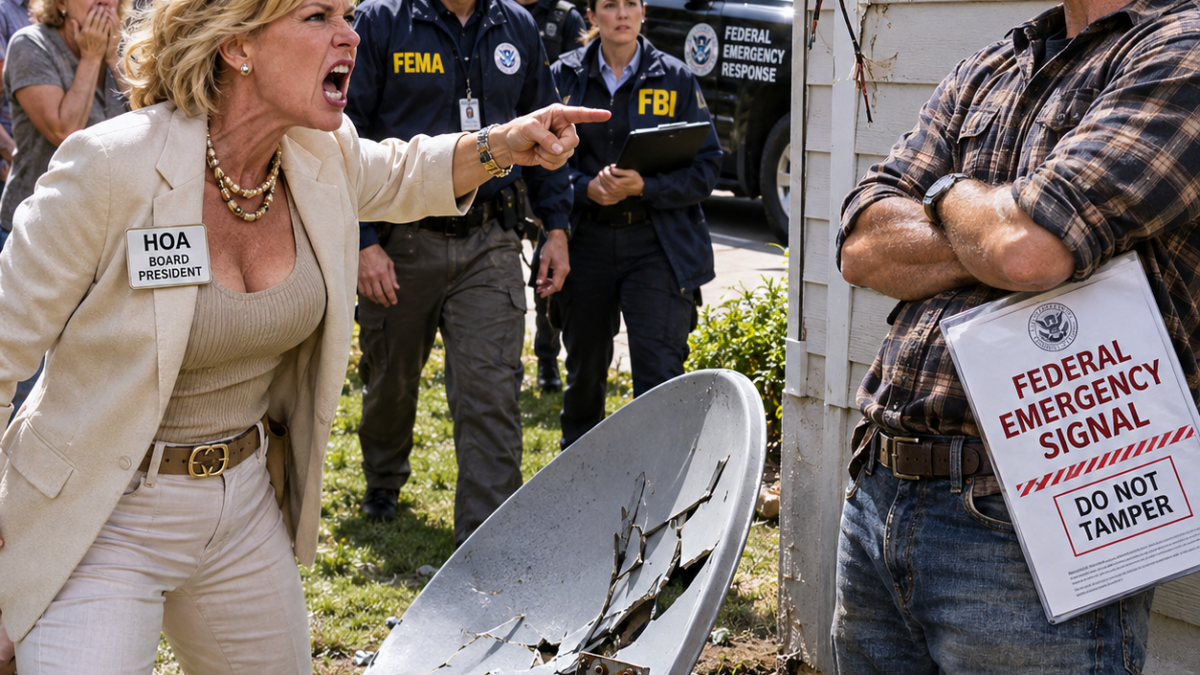
Beverly noticed where I was looking.
Her eyes moved upward.
For the first time that morning, the satisfaction disappeared from her face.
Not completely.
Just enough.
“What?” she said.
I pointed toward the camera.
“It’s recording.”
She looked back at me.
“So?”
“So keep talking.”
Her grip tightened around the broom handle.
“I was enforcing an HOA violation.”
“On my property?”
“The board authorized removal.”
“No.”
“The board authorized enforcement.”
“That isn’t the same thing.”
Her chin lifted.
“Your refusal to comply created this situation.”
I looked down at the pieces again.
The LNB housing had split.
The modified relay assembly I had built over two weekends had broken at the mount.
One cable hung from the garage wall.
Metal fragments lay across the concrete.
Beverly had not simply knocked something loose.
She had destroyed it.
“I’m not arguing with you,” I said.
“Good.”
She started to walk away.
I called after her.
“Beverly.”
She stopped.
I held up my phone.
“I’m saving the footage before you reach your house.”
She stared at me for a second.
Then left.
I watched her disappear down the alley.
Only after she was gone did I feel my hands shaking.
—
I called Terence first.
He arrived in under five minutes wearing jeans, work boots, and a faded fire-department sweatshirt.
He looked at the debris.
Then at me.
“She did this?”
“Yes.”
“With what?”
“Broom handle.”
He crouched beside the bracket.
“Camera?”
“Got all of it.”
Terence let out a slow breath.
“Well.”
“What?”
“She finally did something too stupid to write a letter around.”
That was exactly it.
For eighteen months, Beverly had hidden behind paper.
Violation notices.
Fine schedules.
Meeting minutes.
Code complaints.
Nothing direct enough to force consequences beyond another appeal.
This was different.
Physical.
Recorded.
Unambiguous.
I called my attorney, Sloane Whitfield.
She handled property disputes, association law, and the sort of civil cases that begin with somebody saying, “They can’t possibly do that,” followed by months proving that yes, they did.
She answered on the second ring.
“Garrett?”
“She broke it.”
“What?”
“The dish.”
Silence.
“How?”
“Broom handle from the alley.”
“On video?”
“Yes.”
“Clear?”
“1080p. Face, clothing, everything.”
Another pause.
“Do not send it to anybody except me and law enforcement yet.”
“Understood.”
“Do not confront her.”
“I already spoke to her.”
“What did you say?”
“Told her the camera was recording.”
“That’s all?”
“Pretty much.”
“Good.”
Then I called Deputy Marcus Tull.
He was the community liaison officer for Millbrook Crossing and somebody I knew through county emergency-management events.
He arrived about twenty minutes later.
Calm.
Methodical.
Exactly the kind of deputy you want when emotions are high.
He did not speculate.
Did not lecture.
Did not announce charges before investigating.
He watched the footage.
Twice.
Then he walked outside with a camera.
Photographed the broken dish.
The bracket.
The cables.
The alley.
The fence.
He asked:
“Registered value?”
“Equipment replacement, probably fourteen hundred.”
“Dish itself?”
“Less. The modified relay hardware is the expensive part.”
“Emergency use?”
“Yes.”
“Documented?”
“County emergency-management registration.”
“Who can confirm?”
“Doug Piersol.”
Marcus wrote that down.
“Any reason she’d claim permission?”
“HOA fines.”
“Board vote to remove it?”
“Board voted to fine me. Not destroy property.”
“Do you have the minutes?”
I almost laughed.
“Three copies.”
Marcus looked up.
“Of course you do.”
He knew me.
—
Doug Piersol came that afternoon.
County emergency-management coordinator.
We had trained together.
He stood in my driveway staring at the broken assembly.
“Beverly?”
“Yep.”
“You have video?”
“Yep.”
He shook his head.
“Unbelievable.”
“Can you document the equipment?”
“I can document what it was registered for and how we used it.”
“That’s what Sloane wants.”
Doug looked at the mounting point.
“This was part of your auxiliary communications setup.”
“Yes.”
“Still active registration?”
“Yes.”
He nodded.
“I’ll write it.”
By six that evening, I had:
Security footage.
Photographs.
Deputy report number.
Doug’s statement.
Equipment documentation.
The existing HOA notices.
Board minutes.
My prior appeals.
Beverly had spent eighteen months building my evidence file for me.
The dish destruction simply gave it a center.
—
Sloane filed the communications complaint through the appropriate federal channel and sent Beverly a demand letter.
Replacement cost.
Legal fees.
Preservation notice.
No direct contact with me.
No additional interference.
She also filed a complaint with Virginia’s professional licensing authorities because Beverly was a real estate agent and the conduct raised questions far beyond a neighborhood disagreement.
When I asked Sloane whether that was excessive, she said:
“She used her HOA role while acting as a licensed real-estate professional in the community.”
“She wasn’t selling a house when she broke it.”
“No. But licensing boards care about professional conduct and honesty.”
“Do you think they’ll do anything?”
“I think they’ll read it.”
That was enough.
I bought a replacement dish.
Mounted it on the same bracket.
Registered it again.
Beverly sent another fine notice.
I signed for it.
Added it to the folder.
Then started a second folder.
Terence laughed when he saw it.
“Beverly’s Greatest Hits, Volume Two?”
“Exactly.”
—
Three weeks later, Sloane called.
Not about the dish.
“Do you have your original covenants?”
“Yes.”
“Section 7.4.”
I pulled the binder from the cabinet.
“What am I looking for?”
“Reserve fund.”
The section required the HOA to maintain a capital reserve for major repairs.
Entrance fencing.
Community center roof.
Parking surfaces.
Shared infrastructure.
Minimum balance:
Thirty thousand dollars.
“And?”
“When did you last receive an independent audit?”
I thought about it.
“Years.”
“How many?”
“Three, maybe.”
“Check.”
I did.
Three years.
Annual reports before that.
Then nothing.
Sloane became quiet.
“I requested financial records.”
“You can do that?”
“As a member, you can. I did it through your authorization.”
“What did they show?”
“The reserve balance is sixty-four hundred.”
I sat down.
“From thirty thousand?”
“Yes.”
“What happened to the rest?”
“That’s why I’m calling.”
She explained the transactions.
Administrative expenses.
Professional services.
Repeated small payments.
Nothing huge enough individually to scream theft.
But several payments went to an LLC.
Sloane had traced the registration.
Address:
Beverly Hartstone’s house.
I stared at the wall.
“How much?”
“Roughly twenty-four thousand over three years.”
“To her?”
“To an entity connected to her address and household. We still need to establish purpose, authorization, and beneficial ownership.”
“You think she paid herself.”
“I think the records need an independent audit.”
I looked at the folder full of fifty-dollar fines.
“How much did the HOA collect in fines during the same period?”
“I’m calculating that.”
Terence had paid one.
The Nuen family had paid several.
People had paid because fighting seemed harder.
All while the reserve fund shrank.
“This isn’t about my dish anymore.”
“No,” Sloane said.
“It hasn’t been for a while.”
—
That evening, I sat alone in my kitchen.
The replacement dish was already outside.
Operational again.
The television murmured from the living room.
Rain tapped softly against the windows.
I thought about my two tours overseas.
There had been emergencies there that made Millbrook Crossing look absurdly safe.
But systems fail in the same way everywhere.
Small exceptions.
Unchecked authority.
Nobody asking for records.
People assuming someone else already verified the numbers.
Beverly’s power came from boredom.
Financial reports are boring.
Meeting minutes are boring.
Vendor invoices are boring.
She counted on nobody reading them.
I had spent a career maintaining communication systems precisely because boring things become important when everything else fails.
The irony was almost funny.
—
Sloane told me not to rush.
“Let her keep making decisions.”
“Why?”
“Because right now we have suspicious payments.”
“You want more?”
“I want clarity.”
“You sound like you enjoy this.”
“Only professionally.”
I doubted that.
We started preparing for the annual HOA meeting six weeks away.
Dex Hollingsworth helped from inside the board.
Dex had voted against Beverly on the dish.
So had Patrice Okafor.
Three-to-two votes had kept Beverly in control.
But Dex had his own file.
Meeting minutes.
Unexplained expenses.
Votes that did not match what was later recorded.
Requests for invoices ignored.
When I told him what Sloane found, he took off his glasses.
“You’re serious.”
“Yeah.”
“Twenty-four?”
“Approximately.”
He rubbed his face.
“I knew something was wrong.”
“Why didn’t you push?”
“I did.”
“No. Why didn’t you really push?”
He looked toward the street.
“Because I thought I was the only one.”
That sentence mattered.
I had thought the same thing for a while.
Beverly’s strength was not majority support.
It was fragmented opposition.
She only needed everybody to believe everybody else had already accepted her.
—
Dex filed a formal motion demanding an independent financial audit.
Certified mail.
Board member request.
Documented.
Beverly rejected it.
In writing.
Administrative burden.
Unnecessary expense.
She claimed an internal review had found no issues.
Dex asked for the review.
She did not produce it.
There was no review.
Sloane loved that letter.
“Frame it.”
“I thought lawyers hated dramatic evidence.”
“We hate dramatic people. Evidence can be dramatic.”
—
We installed two more cameras.
Visible.
Side gate.
Rear driveway.
Cloud backup.
Not a hidden trap.
A record.
I set notifications to my phone.
Terence had a secondary alert if somebody crossed the rear property line.
Deputy Tull knew about the escalating dispute.
Nothing dangerous.
No confrontation plan.
No retaliation.
If Beverly came back, we wanted police notified before I ever reached the yard.
Terence approved.
“Best fight is the one you don’t personally have to fight.”
“Firefighter philosophy?”
“Old man philosophy.”
—
The neighborhood slowly changed.
Terence talked to residents Beverly had been cultivating.
Not campaigning.
Explaining.
This was the dish.
This was the county emergency registration.
This was the video.
These were the financial questions.
Patrice started asking more questions at board meetings.
Dex requested minutes in writing.
A few homeowners requested their own enforcement records.
Then people compared them.
Sandra Pruitt had been fined over a wind chime.
Calvin Dorsett had paid a monthly “administrative surcharge” that did not appear anywhere in the covenants.
The Beauchamp family had been cited over a damaged gutter.
None of these things alone mattered much.
Together they showed a style.
Constant enforcement.
Constant money.
Minimal transparency.
—
Three weeks before the annual meeting, Beverly panicked.
She called an emergency board session.
Her three-member majority approved a new fine schedule for communications equipment.
Five hundred dollars per week.
Doubling every fourteen days.
By the annual meeting, she claimed I could owe more than eight thousand dollars.
I read the letter twice.
Then called Sloane.
She sounded delighted.
“What?”
“Date of notice?”
I told her.
“Date of board vote?”
I told her.
She laughed.
“What?”
“Thirty-day notice requirement.”
I checked the covenants.
She was right.
The new schedule had not been properly noticed.
Sloane sent a one-paragraph response.
Procedurally defective.
Unenforceable.
Any collection attempt challenged.
Beverly had tried to increase pressure.
Instead, she produced another document showing how casually she treated her own rules.
—
Then she contacted my mortgage servicer.
That one made my stomach drop.
Dex forwarded me an HOA email referring to “coordination with lenders regarding delinquent obligations.”
My regular HOA dues were current.
Every month.
The fines were disputed.
Still, anything involving a mortgage feels heavier than an HOA letter.
I called the servicer.
Explained.
Sent documentation.
The representative reviewed the file.
“Your assessments are current.”
“Yes.”
“These fines are under dispute?”
“Yes.”
“We’ll note it.”
“Can the HOA trigger default?”
“Not on the facts you’re describing without additional legal steps.”
I exhaled.
She added:
“We receive HOA communications frequently. Keep your documentation.”
That became the sentence of my year.
Keep your documentation.
—
Then Beverly went after my emergency-management credentials.
That was the first time I stopped finding any of this funny.
Doug Piersol called.
“I got a letter.”
“From Beverly?”
“Yes.”
“What now?”
“She claims your station has caused interference complaints.”
“That’s false.”
“I know.”
“She says multiple neighbors.”
“I ran your emissions records.”
He paused.
“Clean.”
“Any complaints?”
“None.”
“Then what happens?”
“I document the letter.”
“That’s it?”
“For you.”
His voice sharpened.
“For her, I’m keeping the original.”
I leaned against the kitchen counter.
Doug continued.
“Garrett, this program depends on volunteers who know what they’re doing.”
“I know.”
“I take interference with that seriously.”
That mattered more than he knew.
Not because Beverly might somehow get my certification revoked.
Because emergency communications had given me purpose after leaving the military.
I had lost the uniform.
Lost the daily structure.
My body had changed.
My knee had changed.
But I could still be useful when storms hit.
Beverly had tried to reach into that too.
That crossed something personal.
I added the letter to the box.
Folder wasn’t enough anymore.
Box.
—
Two weeks before the annual meeting, an anonymous text arrived.
**She’s offering money to vote.**
Five words.
No name.
I forwarded it to Sloane.
She told me not to chase the sender.
So I didn’t.
We had enough.
The week of the meeting, Beverly mailed a color flyer to the entire neighborhood.
My photo wasn’t on it.
My dish was.
Cropped.
Zoomed.
Made to look enormous.
The flyer described me as a repeat violator owing more than eight thousand dollars.
Wrong.
It called the fines outstanding obligations.
Disputed.
It accused me of exploiting procedures to evade accountability.
Sloane added the flyer to the box.
I did not respond.
Terence did.
Dex did.
Patrice did.
Other residents did.
That was better.
If I answered, it was one homeowner defending himself.
When neighbors answered, it became something else.
—
I formally requested complete HOA financial records.
Beverly delayed.
Said they were being prepared for an audit.
Day ten passed.
Then eleven.
Twelve.
Thirteen.
No records.
Sloane documented every day.
Meanwhile, Calvin gathered bank statements showing the mysterious surcharge.
Sandra found her wind-chime fine.
The Beauchamps brought gutter notices.
Four other homeowners found questionable penalties.
Then Lyla Strand from the regional paper contacted us.
She covered county community issues.
HOA disputes, she said, were becoming more common.
I gave her documents.
Not conclusions.
Documents.
She asked to attend the annual meeting.
“Open to members and guests.”
“I’ll be there.”
Good.
—
The night before the meeting, my rear motion sensor triggered at 11:42.
I opened the camera feed.
Figure in the alley.
Standing near the fence.
Ninety seconds.
Too dark for positive identification.
I sent the video to Deputy Tull.
Then to Sloane.
No accusations.
No guesses.
Timestamp.
Location.
That was it.
I slept badly.
Not fear.
Readiness.
The same sensation I remembered from deployment nights when everything had been checked twice and there was nothing left to do except wait for morning.
I got up at five.
Coffee.
Clean shirt.
Binder.
Box of supporting documents.
Meeting agenda.
Copies.
I drove to the community center.
The parking lot was already filling.
Usually twenty-five people came.
That morning:
Sixty-three signed in.
Beverly’s flyer had accomplished something she never intended.
It reminded everybody there was an election.
—
The room was built for forty.
People stood against walls.
Coffee.
Wet coats.
Buzzing fluorescent lights.
Lyla stood near the back.
Deputy Tull had been invited as community liaison.
Terence sat beside me.
Calvin behind us.
Sandra.
The Beauchamps.
Patrice and Dex sat at the board table.
Beverly arrived eight minutes late with Harold Finch and Constance Drury, her two usual allies.
She entered.
Saw the crowd.
Paused.
Then recovered.
That was Beverly.
Composure was a weapon.
She sat.
Called the meeting to order.
Tried immediately to move past member comment.
Patrice interrupted.
“Point of order.”
Beverly looked at her.
“Member comment has been moved to the conclusion of business.”
“Was that amendment noticed thirty days in advance?”
“We’re facilitating efficiency.”
“That isn’t an answer.”
The room became quiet.
Patrice repeated:
“Was the agenda change properly noticed?”
Beverly’s eyes moved toward Dex.
He looked down at the bylaws.
“No,” he said.
Harold shifted.
Constance stared at the table.
Patrice folded her hands.
“Then member comment proceeds.”
For six years, Beverly had used procedure to silence people.
Now procedure opened the microphone.
—
Calvin spoke first.
Seventy-one.
Retired middle-school principal.
Calm voice.
He brought bank statements.
“Can the board show me the covenant provision authorizing the monthly administrative surcharge I’ve paid for twenty-eight months?”
Beverly answered:
“It was previously approved.”
“By which vote?”
“I don’t have the date in front of me.”
“Meeting minutes?”
“Records are being revised.”
Calvin tilted his head.
“Revised?”
The room stirred.
He sat.
Sandra stood.
Wind chime.
Fifty-dollar fine.
No written rule matching the citation.
The Beauchamps stood.
Gutter fine.
Then three more people.
Mailbox.
Truck.
Holiday decoration.
Small things.
Real money.
Beverly’s face hardened.
Then I stood.
—
I carried the binder to the front.
Opened it.
“Most people here know about the dish.”
A few people murmured.
I held up the original photo Beverly had used at the board meeting.
“This is the antenna.”
Then I showed the county registration documentation.
“It supports part of my licensed emergency communications setup.”
I explained the federal communications protections applicable to qualifying equipment and the complaint process Sloane had initiated.
No legal lecture.
No dramatics.
Then I turned the laptop toward the room.
Thirty seconds.
That was all.
Beverly in the alley.
Orange blazer.
Broom handle.
Dish breaking.
Metal striking concrete.
The sound seemed louder in that room than it had outside.
Someone gasped.
I stopped the video.
Beverly stood.
“This footage is being presented without context.”
Terence said:
“What context makes that okay?”
Beverly ignored him.
I continued.
“Deputy Tull documented the incident.”
Marcus nodded from the back.
“County emergency management documented the equipment.”
Doug wasn’t there, but his statement was.
“The professional licensing complaint is active.”
Beverly sat slowly.
Then I opened the financial tab.
This was the moment Sloane had warned me about.
Do not call her a thief.
Do not call it embezzlement.
State the records.
Only the records.
So I did.
“The association’s governing documents require a capital reserve.”
I showed the section.
“Thirty thousand dollars.”
Then the most recent disclosed balance.
“Approximately sixty-four hundred.”
The room moved.
I continued.
“Financial records reviewed by counsel show approximately twenty-four thousand dollars in payments over three years categorized as administrative and professional expenses.”
Beverly’s lips pressed together.
I turned one page.
“Several payments went to an LLC registered at Ms. Hartstone’s residential address.”
Silence.
Not outrage.
Silence.
Much stronger.
“Those records have been provided to counsel and are under review. I am not here to accuse anyone of a crime.”
Dex watched Beverly.
Patrice watched Beverly.
Harold looked like he wanted to disappear.
Constance looked physically ill.
Then Dex said:
“I have a motion.”
Beverly turned.
“No.”
Dex stopped.
The room heard it.
She had said no before the motion existed.
Dex continued anyway.
“I move that all substantive agenda items be tabled pending an independent financial audit and that the membership hold a vote of confidence in the current board.”
Patrice:
“Second.”
Beverly stood.
“You do not have authority to hijack this meeting.”
Patrice opened the bylaws.
“We have quorum.”
Dex:
“We have a second.”
Calvin:
“Call the vote.”
Beverly looked around.
Sixty-three people.
For years, she had counted on twenty-five.
—
Fifty-one hands went up.
Four opposed.
Harold did not vote.
Constance voted yes.
Beverly looked at her.
“You voted for this?”
Constance swallowed.
“Yes.”
That hurt Beverly more than the numbers.
You could see it.
Not losing strangers.
Losing obedience.
She gathered her papers.
“I reserve every legal right available to me.”
Sloane had told me not to speak unless necessary.
So I said nothing.
Lyla Strand waited near the door.
“Ms. Hartstone, would you like to comment?”
Beverly walked past her.
Outside, rain had started.
Cold November rain under parking-lot lights.
Beverly crossed the asphalt alone.
Nobody followed.
Inside, people began talking all at once.
Terence leaned toward me.
“You okay?”
I looked at the empty chair at the front.
“Ask me tomorrow.”
—
The audit began within days.
Independent firm.
Full access.
Three years.
Vendor records.
Reserve transfers.
Expense classifications.
Meeting authorization.
It took weeks.
The final discrepancy was worse than Sloane’s estimate.
$26,800.
Payments tied to entities Beverly controlled or benefited from.
Expenses lacking proper approval.
Records inconsistent with meeting minutes.
The audit went to members.
Then to the county Commonwealth’s Attorney.
Beverly’s world narrowed quickly.
Not instantly.
Real consequences rarely happen that way.
Lawyers.
Interviews.
Documents.
Account records.
Licensing review.
Eventually charges followed.
The criminal case ended in a plea.
Restitution.
Substantial financial penalties.
Suspended sentence.
Supervised probation.
Her real-estate license was suspended for eighteen months.
The licensing decision cited the broader pattern of professional misconduct, including false complaints and harassment tied to her HOA activity.
I read the decision once.
Then closed it.
I expected satisfaction.
I felt mostly relief.
—
My civil claim over the destroyed equipment settled.
$3,200.
Replacement cost.
Associated expenses.
Legal component.
The federal communications complaint also closed with a formal finding and warning connected to the interference.
The replacement dish stayed on my garage.
Same location.
Same purpose.
Beverly had destroyed the first one to prove she controlled the neighborhood.
The second one stayed because she didn’t.
That was satisfying.
—
Dex became HOA president after the special election.
Patrice became vice president.
Their first major decision was not dramatic.
They hired an independent property-management company.
Board members would no longer directly control certain financial processes.
Checks required documentation.
Vendor relationships required disclosure.
Reports went to members.
Boring.
Exactly what we needed.
Second:
The administrative surcharge disappeared.
Refunds went out.
Roughly three thousand dollars across eleven households.
Calvin received his money.
Beauchamps got theirs.
Sandra got her wind-chime fine refunded.
The wind chime remained.
Cold mornings, when the wind came through Millbrook Crossing, I could hear it from half a block away.
Terence once said:
“That thing is obnoxious.”
I said:
“Best sound in Virginia.”
He laughed.
—
Then the new board created an emergency-preparedness committee.
Terence chaired it.
Naturally.
We identified seven households with useful training.
Nurse.
Firefighter.
Amateur radio.
Former EMT.
Generator owner.
One retired electrician.
Quarterly drills.
Emergency contact cards.
Weather procedures.
Backup communications.
What Beverly had called ugly equipment became part of a community plan.
That irony never got old.
—
Recovered reserve money finally went where reserve money was supposed to go.
Walking path resurfaced.
Community center roof repairs.
A covered outdoor shelter.
Nothing fancy.
Roof.
Benches.
Tables.
A place where people could gather without fluorescent lights.
They named it the Millbrook Crossing Community Shelter.
First summer:
Two cookouts.
Back-to-school event.
Emergency-preparedness class.
Kids running between picnic tables.
Older residents playing cards.
Normal community life.
I sat near the edge during the first cookout.
Terence handed me a plate.
“You look suspicious.”
“I’m thinking.”
“Dangerous.”
I watched Sandra’s wind chime move on her porch in the distance.
“This neighborhood feels different.”
“Because nobody’s scared of mail anymore.”
He was right.
—
A small scholarship fund came next.
Fine refunds.
Voluntary donations.
No forced assessment.
First recipient:
Young man from the far end of Millbrook Crossing.
Family had been fined repeatedly under Beverly.
He used the scholarship toward community college.
Emergency management.
Volunteer firefighter on weekends.
At the ceremony, he thanked everyone.
Then found me afterward.
“Mr. Winslow?”
“Garrett.”
He pointed toward the emergency-preparedness display.
“I heard about your antenna.”
“I’m sure you heard the dramatic version.”
“Did it really help during outages?”
“Yes.”
“Can you show me sometime?”
“Absolutely.”
A month later, he sat at my kitchen table while I explained emergency nets.
Not glamorous.
Check-ins.
Repeaters.
Backup frequencies.
Message accuracy.
He listened like it mattered.
That mattered to me.
—
The first real test came the following spring.
Severe weather.
Thunderstorms.
High winds.
Cell service failed in parts of the county for roughly four hours.
Power flickered repeatedly.
Doug called.
“Net activation.”
“I’m ready.”
I sat at the kitchen table.
Headset.
Log sheet.
Radio.
The dish and relay system doing exactly what Beverly had once called a visual violation.
For six hours, I helped move emergency traffic.
Shelter status.
Weather observations.
Road closures.
Medical coordination.
No heroics.
No dramatic rescues.
Just information moving where information needed to go.
At one point, the lights blinked twice.
Then went out.
Backup power took over.
Radio stayed live.
I thought about the shattered pieces on my driveway.
Then stopped thinking about Beverly.
Too busy.
After the net shut down, my phone buzzed.
Doug.
Two words:
**Good work.**
I stared at the message.
That meant more than the settlement.
More than the vote.
More than the newspaper article.
I saved it.
—
Beverly sold her house later.
Not immediately.
Eventually.
She stopped attending community events long before the sale.
I saw her only once after the legal cases ended.
Grocery store.
Produce aisle.
Of course.
That seems to be where old neighborhood wars go to die.
She saw me.
I saw her.
For a moment, neither moved.
Then she said:
“You got what you wanted.”
I picked up an apple.
“What do you think I wanted?”
“To humiliate me.”
“No.”
“You played that video in front of everybody.”
“You broke my equipment in front of a camera.”
Her mouth tightened.
“You could have handled it privately.”
“I appealed every notice privately.”
“You were constantly defiant.”
“I followed the rules.”
“Your interpretation.”
“Federal registration isn’t an interpretation.”
She looked away.
For the first time, Beverly seemed smaller.
Not physically.
Contextually.
No board table.
No binder.
No title.
Just a woman standing beside oranges.
“I was trying to maintain standards,” she said.
I thought about the reserve fund.
The fines.
The wind chime.
My accessibility ramp.
My emergency credentials.
“Whose standards?”
She didn’t answer.
I put the apple in my cart.
“Take care, Beverly.”
Then I walked away.
That was the last conversation we had.
—
Terence kept running the emergency committee.
He loved it.
Pretended he didn’t.
Every quarter:
Agenda.
Drill.
Coffee.
Too many handouts.
He was a retired firefighter; retirement had only removed the firehouse, not the need to organize people.
We became better friends.
One afternoon, he stood beside the replacement dish.
“You know, it is kind of ugly.”
I stared at him.
He laughed.
“I’m kidding.”
“You’re lucky I’m disabled.”
“You were slower before the knee.”
“Get off my property.”
He stayed for dinner.
—
Years passed.
The dish weathered.
I upgraded components.
Replaced cables.
The bracket remained.
I stopped thinking of Beverly whenever I looked at it.
That was progress.
For a while, the dish had become a symbol.
Of winning.
Of federal rules.
Of documentation.
Of Beverly losing control.
Eventually it became equipment again.
Much healthier.
—
My knee got worse.
Another surgery.
Then another ramp modification.
The new board approved everything without drama.
Actually, Dex called and said:
“You don’t technically need board approval for the medical modification, but we’re documenting it correctly.”
I laughed.
“Who are you and what have you done with the HOA?”
“New management.”
The ramp went in.
No certified letters.
No aesthetic emergency.
Nobody died from looking at aluminum.
—
The scholarship fund grew modestly.
Never huge.
Enough.
One recipient studied nursing.
Another electrical trades.
Another emergency management.
The board deliberately expanded eligibility beyond children of homeowners.
Local students.
Service emphasis.
Practical fields.
I donated some of the civil settlement.
Not all.
I had bills too.
But enough.
I did not ask to name anything after me.
Nobody tried.
Good.
—
Patrice eventually became president after Dex stepped down.
Her first meeting ended twenty-two minutes early.
This was considered a miracle.
She introduced a rule that every board action involving money had to answer three written questions:
What is being purchased?
Who approved it?
Where is it in the budget?
Terence called it revolutionary.
It should not have been.
That was the problem.
—
One winter morning, Sandra’s wind chime disappeared.
I noticed because I had become used to hearing it.
I knocked on her door.
“Everything okay?”
She laughed.
“Yes.”
“Wind chime?”
“String broke.”
“Oh.”
“You came over because you missed it?”
“No.”
“Garrett.”
“Maybe.”
She held up the chime.
“I’m fixing it.”
“Good.”
That afternoon, it was back.
Cold wind.
Tiny metal notes.
Sweetest sound in Millbrook Crossing.
Still.
—
The young man who received the first scholarship eventually joined the county emergency-management office as a part-time coordinator while finishing school.
His name was Matthew.
One afternoon he called.
“We’re updating the volunteer equipment list.”
“Okay.”
“Your dish still active?”
“Yes.”
“Registration current?”
“Yes.”
“Backup power?”
“Yes.”
“Availability during severe weather?”
“Unless I’m dead.”
Pause.
“Can I write ‘yes’?”
“Yes.”
He laughed.
I realized something afterward.
Beverly had tried to erase that equipment.
Years later, a kid partly supported by money reclaimed from her system was formally adding it to the county’s preparedness inventory.
That felt like the right kind of ending.
Except life kept going.
—
Terence died five years after the original incident.
Heart attack.
Sudden.
He had been at an emergency committee meeting three days before.
Argued about generator fuel storage.
Drank terrible coffee.
Complained the new members were too dependent on apps.
Then gone.
His daughter asked me to speak at the funeral.
I said no.
Then yes.
I hate speaking at funerals.
You have to turn an entire person into sentences.
Impossible.
I told the story of him arriving six minutes after my dish was smashed.
Coffee mug.
No questions about whether I had provoked Beverly.
No lecture.
Just:
“Show me.”
That was Terence.
Show me the problem.
Then we fix what we can.
Afterward, his daughter gave me his old red firefighter hoodie.
I keep it in the workshop.
—
The emergency committee renamed its annual preparedness award after him.
**Terence Beaumont Community Readiness Award.**
First recipient was a fourteen-year-old girl who had organized emergency-contact cards for elderly neighbors.
He would have pretended to hate the attention.
Then laminated the certificate himself.
—
The dish stayed.
One year, I considered replacing it with newer technology.
Smaller hardware.
Cleaner.
More efficient.
Doug said:
“Technically, we don’t need your old configuration anymore.”
I looked at it from the backyard.
“You want it gone?”
“No. I’m saying you can modernize.”
I almost resisted because of what it represented.
Then realized that would be ridiculous.
Equipment exists to work.
Not to carry grudges.
We upgraded.
New relay.
Different receiver.
Smaller antenna footprint.
The original damaged dish pieces had been stored in my garage as evidence long after the cases ended.
I finally threw most of them away.
Kept one bent mounting plate.
Not as a trophy.
History.
There’s a difference.
—
At a preparedness class, a teenager once asked me:
“Were you scared when she broke it?”
Nobody had ever asked that.
People asked if I was angry.
People asked if I knew the law.
People asked how much money I won.
Scared?
“Yes.”
He looked surprised.
“Why?”
“Because when somebody shows you they’re willing to walk onto your property and destroy something, you don’t know where their limit is.”
He nodded.
“Then why didn’t you yell?”
“I wanted to.”
“Why not?”
“Because yelling would’ve helped her.”
“How?”
“She could tell everyone I was dangerous.”
He thought about that.
“So you just waited?”
“No.”
I smiled.
“I documented.”
He laughed.
It sounded boring.
It was.
That’s why it worked.
—
The emergency shelter eventually got expanded.
Solar lights.
Weather radio.
Locked supply cabinet.
Basic charging station.
Somebody proposed mounting an emergency antenna there.
The board voted yes unanimously.
I installed it with Matthew.
Patrice watched from below.
“Any aesthetic concerns?” I asked.
She stared at me.
“Keep working.”
Matthew had no idea why that was funny.
Better that way.
—
One Saturday, the community held an open house.
Kids.
Families.
Free first-aid demos.
Radio station.
Fire department.
Matthew let children try sending practice messages.
A boy asked:
“Is this like the antenna that lady broke?”
I closed my eyes.
“How do children know this story?”
Patrice pointed toward Terence’s daughter.
“Blame her.”
The boy looked worried.
“Did she go to jail?”
“Life is more complicated than that.”
“Did she get punished?”
“Yes.”
“Good.”
He put the headset back on.
Kids appreciate efficient justice.
—
I went home that evening.
Rain started.
Not severe.
Just steady.
The kind of rain we had the night Beverly walked out of that annual meeting.
I made coffee.
Sat near the kitchen window.
The updated antenna system was visible from the backyard.
Barely.
Green status light.
Connected.
Ready.
There had been a time when every blink from that system reminded me of Beverly.
Now it reminded me of storms.
Training.
Terence.
Matthew.
Doug’s text.
Useful things.
That was better.
—
I opened the old evidence box.
Why?
No reason.
Age does that.
You revisit things because they’re there.
Volume One.
Violation letters.
Accessibility ramp.
Garden edging.
Flagpole.
Truck.
Dish.
Volume Two.
Fine escalation.
Code complaint.
Security photos.
Deputy report.
Doug’s statement.
Sloane’s letters.
Audit.
Meeting minutes.
Court papers.
Then the community documents.
Refunds.
Emergency committee.
Scholarship.
Shelter.
I realized I had kept the bad and good in separate folders.
I moved them into one box.
One history.
Because one produced the other.
Not because Beverly deserved credit.
She didn’t.
But consequences sometimes grow beyond the people who start them.
—
The final document I put on top was not a legal paper.
It was a photograph.
Terence and me at the first emergency-preparedness drill.
He was holding a clipboard.
I was pointing toward the antenna.
Both of us looked annoyed.
Probably arguing.
On the back, his daughter had written:
**TWO OLD MEN WHO COULD NOT LEAVE ANYTHING ALONE.**
Accurate.
I closed the box.
—
The next major storm arrived that summer.
Fast.
Violent.
Trees down.
Power out.
Cell service intermittent.
County activated the emergency net.
I took my place at the kitchen table.
Headset.
Log.
Backup battery.
Coffee.
The neighborhood outside went dark.
My radio stayed alive.
Traffic came in.
Shelter open.
Tree blocking county road.
Medical transport delayed.
Weather warning.
Damage report.
Six hours.
Then seven.
At some point, wind shook the garage.
The antenna held.
Just before midnight, commercial power returned.
Internet followed.
Cell service recovered.
Doug had retired by then.
Matthew was coordinating.
My phone buzzed.
**Good work tonight.**
Same words Doug had sent years earlier.
I smiled.
Maybe Matthew knew.
Maybe he didn’t.
Didn’t matter.
I looked through the kitchen window.
Rain slid down the glass.
The emergency shelter across the development had lights.
People charging phones.
Neighbors checking on one another.
The community was doing what it was supposed to do.
Not policing flagpoles.
Not measuring wind chimes.
Not weaponizing fines.
Helping.
—
Morning came gray and wet.
I walked outside.
Knee complaining.
Coffee steaming.
The air smelled like mud, pine, and wet asphalt.
I checked the antenna.
Still there.
No damage.
No drama.
Just equipment that had done its job.
Sandra’s wind chime moved in the damp breeze.
One soft note.
Then another.
I stood in the driveway where the first dish had shattered years earlier.
For a moment I could still see the pieces.
Metal on concrete.
Beverly walking away.
Terence arriving with coffee.
The camera blinking red.
But the memory no longer made me angry.
That surprised me.
Maybe anger has a useful lifespan.
Maybe once the work is done, holding onto it becomes another kind of maintenance nobody needs.
I looked toward the shelter.
Then toward the small antenna on my garage.
Beverly had once smashed it because she thought being president meant she could decide what belonged in the neighborhood.
Years later, that same neighborhood had an emergency committee, a transparent budget, restored reserve funds, a scholarship program, a community shelter, and enough trained volunteers that no single person had to carry everything alone.
That was the part she never understood.
A neighborhood is not orderly because everybody obeys one person.
It works because people know when to trust one another.
I went inside.
Set the coffee beside the radio.
Turned off the backup equipment.
And for the first time all night, the house became completely quiet.
Not powerless.
Not disconnected.
Just quiet.
Exactly the way home is supposed to feel.
[END OF STORY]








