PART 2: HOA President Shut Off Water to My 2,000 Apple Trees—She Had No Idea I Ran the Irrigation District
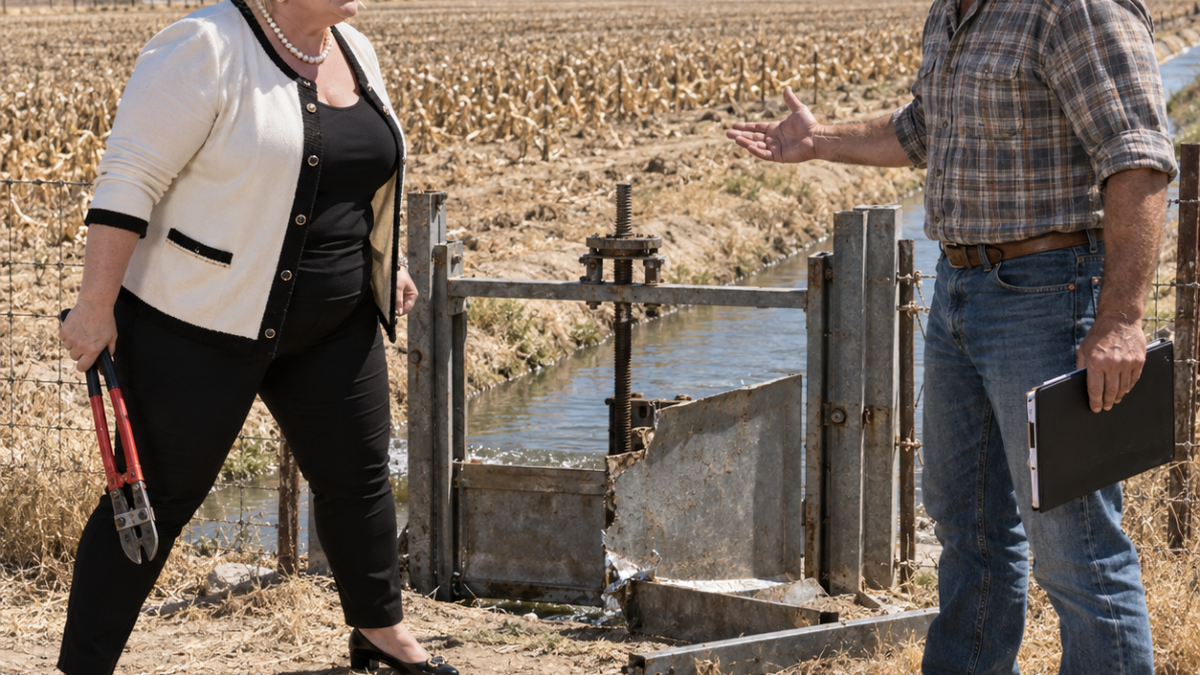
PART 2:
The title beneath my name read:
**Alex Travers
District Manager
Tri-County Irrigation District**
I looked at it for several seconds before I began typing.
I had never told Karen what I did for the district.
There had been no reason.
When I bought the farm, all I’d wanted was to disappear into thirty acres of trees, old lumber, tractor grease, and quiet mornings.
For twenty years before that, I’d served as an engineer with the Army Corps of Engineers.
My life had been systems.
Flood-control structures.
Water distribution.
Emergency repairs.
Concrete.
Steel.
Pressure calculations.
Redundancies.
Permits.
Inspection reports.
And, above everything else, consequences.
If you made a mistake around water infrastructure, nature rarely cared whether the mistake came from ignorance or arrogance.
When I retired, I thought I was finished managing large systems.
Then I bought the farm.
The property came with something more important than the barn, house, or acreage.
It came with senior irrigation rights.
The rights had been attached to the land for generations, long before anyone had imagined rows of beige houses and decorative fountains where Oak Haven Estates now stood.
Before closing on the property, I’d attended a Tri-County Irrigation District meeting to understand exactly what I was buying.
The meeting was held in a low brick building behind the county equipment yard.
Eight farmers sat around folding tables drinking terrible coffee while an elderly district manager named Walt explained sediment removal and spring flow estimates.
Halfway through the meeting, Walt announced his retirement.
The board needed someone who understood infrastructure, regulation, and field operations.
Frank Delaney, an old cattleman with hands like fence posts, looked across the table at me.
“Army Corps?”
“Twenty years.”
“You know water?”
“Enough to respect it.”
He smiled.
“That already puts you ahead of half the people who want to control it.”
Two weeks later, the board voted unanimously to appoint me district manager.
The position wasn’t glamorous.
It paid a modest stipend.
Most weeks it meant inspecting gates, checking flow meters, settling arguments between farmers, and driving miles of dusty canal roads.
But legally, it carried real authority.
The district controlled distribution from the Tri-County Canal.
We enforced allocations.
We investigated unauthorized diversions.
We coordinated with the county and state water offices.
And nobody—farmer, developer, corporation, or HOA president—had the right to interfere with district infrastructure.
Karen had crossed a line she couldn’t repaint, regulate, or fine her way out of.
So I did what twenty years of engineering had taught me to do.
I documented.
I printed the photographs.
I noted the date.
Temperature.
Estimated duration of interruption.
Soil condition.
Approximate agricultural exposure.
The exact gate setting before and after restoration.
The footprints.
The recovered pen.
I sealed the pen in an evidence bag.
Then I wrote a formal incident report.
I didn’t write Karen’s name in the accusation field.
Evidence should lead to conclusions, not the other way around.
But I did attach a photograph from a previous public HOA meeting where Karen could clearly be seen holding the same ridiculous gold-and-pink pen.
Then I drafted a notice addressed to:
**Oak Haven Estates Homeowners Association
Attention: Board of Directors**
The language was deliberately dry.
That was important.
Angry letters can be dismissed as personal disputes.
Official notices are harder to ignore.
I stated that unauthorized manipulation of irrigation infrastructure had occurred at a district-controlled diversion point.
I explained that an investigation had been opened.
I informed the HOA that interfering with irrigation infrastructure could result in substantial civil liability and criminal referral depending on the circumstances and damage involved.
I also reminded them that Oak Haven received district water for its common landscaping.
Their fountain.
The grass around the clubhouse.
The landscaped entrance.
The decorative trees along the boulevard.
That made the HOA not merely my neighbor.
It made them one of the entities I was responsible for overseeing.
I printed the letter on district letterhead.
Signed it.
Made two copies.
Then I drove into town and sent it certified mail.
When the postal clerk handed me the receipt, I slipped it into the folder.
That afternoon, I walked the orchard twice.
Most of the saplings had recovered.
A few looked stressed, but the flow had returned quickly enough.
I touched the leaves of one young Winesap tree and felt something inside me settle.
Karen hadn’t won anything.
Not yet.
Two days later, she answered.
Not directly.
I found three envelopes in my mailbox.
All bore the Oak Haven logo.
The first informed me that my barn was painted an unauthorized shade of red.
Fine: $500.
The second said my tractor constituted an improperly stored commercial vehicle.
Fine: $500.
The third accused me of maintaining “unapproved landscaping.”
The landscaping in question was my orchard.
Fine: $1,000.
Corrective action required within thirty days.
I read that one twice.
Then I laughed.
It wasn’t amusement.
It was the kind of laugh a man makes when someone has just confirmed every suspicion he had about them.
My land was not part of Oak Haven.
The HOA had no authority over my barn.
My tractor.
My trees.
Or the color of my socks.
Karen knew that.
I had already shown her the county parcel map.
But facts had never been the point.
Control was.
She couldn’t legally govern my farm, so she’d created paper pretending she could.
I placed all three notices in the Oak Haven file.
Then my phone rang.
Unknown number.
I answered.
“Alex Travers?”
“Yes.”
“This is Richard Hale. I represent Oak Haven Estates Homeowners Association.”
Of course he did.
“What can I do for you, Mr. Hale?”
“I think it’s more a matter of what you can stop doing.”
I leaned back in my chair.
“Go on.”
“I understand you’ve been making accusations regarding the association’s president.”
“I’ve made no accusation.”
There was a pause.
“You sent a threatening letter.”
“I sent a regulatory notice concerning tampering with district infrastructure.”
“The implication was obvious.”
“The evidence is obvious. The conclusion remains under investigation.”
He exhaled.
“You need to understand that Mrs. Miller is prepared to defend herself.”
“She should.”
“Additionally, your farming operation may constitute a nuisance under county regulations.”
“No.”
Another pause.
“Excuse me?”
“It doesn’t.”
“Mr. Travers—”
“My parcel is zoned agricultural. The use predates Oak Haven. My water right predates Oak Haven. The barn predates Oak Haven. If your office intends to argue otherwise, send me the relevant ordinance in writing.”
His tone changed.
Not dramatically.
But enough.
People sound different when they discover the person they’re trying to intimidate has read the rules.
“We’ll communicate through correspondence.”
“Please do.”
I hung up.
The cease-and-desist letter arrived the next afternoon.
I filed that too.
Then I called Frank.
He answered on the third ring.
“Delaney.”
“Frank, it’s Alex.”
“Something break?”
“Depends how you define break.”
I explained everything.
The gate.
The pen.
The HOA notices.
The lawyer.
Frank remained silent for several seconds.
Then he whistled.
“She shut a headgate?”
“Somebody did.”
“And her pen happened to crawl there by itself?”
“I haven’t completed the investigation.”
“Right.”
I could hear the smile in his voice.
“Good district-manager answer.”
“I need to know whether the board supports enforcement if this escalates.”
Frank’s voice became serious.
“Alex, listen to me. You were elected manager because we trust you. If somebody interferes with a district gate, you document it and enforce the rules. Doesn’t matter if they’re wearing overalls, a business suit, or a crown.”
“I thought so.”
“You worried about pressure?”
“I’m expecting it.”
“Then keep your records clean.”
“They are.”
“And don’t make it personal.”
I looked through my kitchen window toward Oak Haven.
Karen’s subdivision appeared almost unreal from the farm.
Identical rooflines.
Perfect lawns.
Decorative trees planted at mathematically regular distances.
“I’m trying very hard not to.”
Frank laughed.
“That usually means it already is.”
He wasn’t wrong.
But what happened next changed the entire fight.
Until then, I thought Karen’s behavior was aimed at me.
I didn’t understand that I was simply the newest name on a very long list.
The first person who showed me that list was George Stanton.
He lived directly across from my front gate.
I’d seen him dozens of times.
Late sixties.
Thin.
Gray hair.
Always outside doing something precise.
Trimming an already straight hedge.
Cleaning an already clean driveway.
Adjusting sprinklers by fractions of an inch.
One afternoon, I walked across the road while he was kneeling beside a flower bed.
“George?”
He looked up cautiously.
“Alex.”
“So you do know my name.”
“Everybody knows your name this week.”
“That bad?”
“Depends who you ask.”
He glanced toward the clubhouse.
“Karen?”
George gave me a tired smile.
“I didn’t say that.”
“You didn’t have to.”
I crouched beside him.
“Can I ask you something?”
He put down the hand trowel.
“About the HOA?”
“Yes.”
He looked over his shoulder again.
That reaction bothered me more than anything Karen had done to me.
George wasn’t cautious because he thought someone might overhear gossip.
He looked like a man checking whether his supervisor was watching him.
“Come into the garage,” he said.
Inside, everything was organized with engineering precision.
Wrenches arranged by size.
Extension cords coiled identically.
Plastic bins labeled in block letters.
George opened a metal filing cabinet.
Then he pulled out an accordion folder so thick the sides bowed.
He dropped it onto his workbench.
“That,” he said, “is two years of my life.”
I opened it.
Violation notices.
Dozens.
Maybe more than a hundred pages.
Satellite dish partially visible.
Garden hose not stored promptly.
Garbage bin returned from curb too late.
Front door painted Forest Green 214 instead of newly approved Hunter Green 216.
A decorative bird feeder allegedly positioned eight inches too close to the property line.
I looked up.
“How much?”
“Fines?”
“Yes.”
“Just over four thousand.”
“For this?”
“For questioning her.”
George said it quietly.
I closed the folder.
“What happened?”
“At first, nothing dramatic. I challenged a satellite-dish violation because the dish couldn’t be seen from the street. I had photographs. Measurements. I showed them everything.”
“You’re an engineer?”
“Electrical.”
“That explains the garage.”
He almost smiled.
“The board dismissed that violation.”
“And then?”
“Two weeks later, the hose.”
He pointed to another notice.
“Then my door.”
Another.
“Then Christmas lights three days past the removal deadline.”
Another.
“Then a flower pot.”
“A flower pot?”
“Wrong material.”
I stared at him.
“She does this to anyone who challenges her?”
George’s jaw tightened.
“Not everyone. Just enough people.”
He began pulling more folders from the cabinet.
“These aren’t all mine.”
“What are they?”
“Copies people gave me.”
Names were handwritten across the tabs.
Morrison.
Ramirez.
Taylor.
Beckett.
Nguyen.
Cooper.
“What was Karen doing with the money?”
“Projects.”
“What projects?”
George laughed bitterly.
“Have you seen the entrance fountain?”
“Yes.”
“Forty-two thousand dollars.”
“For that?”
“Nobody asked for it.”
He continued.
“New clubhouse countertops. Decorative lighting. Landscaping contracts. A tennis court refurbishment that mysteriously became urgent after Linda Carver joined the board.”
“Linda plays tennis.”
“Every morning.”
I leaned against the workbench.
“Who controls the board?”
“Karen. Bob Keeler handles finances. Linda backs Karen on everything. Two other members barely speak.”
“And everybody tolerates it?”
George’s face changed.
Not anger this time.
Weariness.
“People have jobs, Alex. Kids. Mortgages. Sick parents. They don’t have time to fight a woman who treats the covenants like scripture and has the HOA attorney sending letters whenever somebody questions her.”
He looked down at his folder.
“Most people decide two hundred dollars is cheaper than two months of stress.”
“And after enough people decide that?”
“You get Karen.”
That sentence stayed with me.
I told George about the headgate.
Not every evidentiary detail.
But enough.
When I finished, he had stopped leaning against the workbench.
He was standing straight.
“She could have killed your orchard.”
“Yes.”
“Can you prove it was her?”
“I can prove somebody deliberately closed the gate. I have evidence connecting her to the scene.”
“How serious is that?”
“Serious enough that the district’s attorney is involved.”
George stared at me.
Then he said, “You work for them?”
“I run the district.”
He blinked.
“The irrigation district?”
“Yes.”
For the first time since I’d entered the garage, George laughed.
A real laugh.
It came out so suddenly that I almost laughed too.
“Oh, my God.”
“What?”
“She picked you.”
“Apparently.”
“She could have picked anyone in this county, and she picked the man who controls the canal.”
“I don’t control it personally.”
“Don’t ruin the moment, Alex.”
I smiled.
Then he became serious again.
“What are you going to do?”
I looked at the folders.
“I was going to ask you that.”
“Me?”
“This isn’t just my problem anymore.”
George studied my face.
“What do you need?”
“People willing to stop being afraid.”
He rested both hands on the workbench.
“How many?”
“As many as you’ve got.”
His expression slowly changed.
Something returned to his eyes that I suspected Karen had spent two years grinding out of him.
Purpose.
“Give me forty-eight hours.”
Two nights later, my barn was full.
George had told people only that there would be a private meeting about HOA governance.
Twenty-nine residents came.
They arrived separately.
Some parked inside the property so their cars wouldn’t be visible from Oak Haven.
That detail told me everything.
I set folding chairs between the tractor and stacks of lumber.
A nurse named Rachel Morales arrived still wearing scrubs.
A young couple, Evan and Sophie Bennett, brought their baby because they couldn’t find a sitter.
A retired Army sergeant named Walter Boone walked with a cane.
An elementary-school teacher.
A mechanic.
Two accountants.
A widower.
A software engineer.
People who, individually, had decided fighting wasn’t worth it.
Together, they looked different.
George opened the meeting.
He held up his accordion folder.
“You’ve all seen one of these.”
Quiet laughter.
Then Rachel spoke.
She had been fined because a plastic playhouse could be seen above her privacy fence.
“My son was five.”
She looked embarrassed to be angry, which somehow made the anger in the room sharper.
“I work twelve-hour hospital shifts. Karen sent three notices while I was covering nights. By the time I answered, there were late fees.”
“How much?” someone asked.
“Eleven hundred.”
A murmur ran through the barn.
Walter Boone spoke next.
His problem had been the accessibility ramp at his front door.
“I lost part of my left leg after I left the service,” he said.
He tapped his cane against the floor.
“The ramp meets county code. They didn’t tell me to remove it.”
He paused.
“They told me to repaint it.”
“What color?”
“Beige.”
Someone groaned.
Walter’s mouth twisted.
“It was gray.”
Story after story followed.
A drought-resistant garden forced to be replaced with water-hungry ornamental plants.
A basketball hoop violation.
A flag bracket.
A shed door.
A work van.
A porch chair.
The details were petty.
The pattern was not.
Karen had discovered that rules didn’t need to be important to be powerful.
They only needed to be expensive to resist.
When everyone finished, I stood.
“My situation started with water.”
The barn became quiet.
I explained the orchard.
The headgate.
The interrupted irrigation.
The evidence.
Then I told them my position.
Rachel’s mouth actually fell open.
George had apparently kept that detail to himself.
“Wait,” she said. “You run the district?”
“Yes.”
“And she shut off your district-controlled gate?”
“Yes.”
Walter shook his head slowly.
“That is one spectacularly bad decision.”
A few people laughed.
I didn’t.
“It’s worse than that.”
I had brought copies of Oak Haven’s historical water-allocation reports.
I placed them on a folding table.
“After the incident, I reviewed the HOA’s district account.”
George came closer.
“What did you find?”
“Overuse.”
“How much?”
“Last year, roughly fifteen percent beyond its common-area allocation.”
The room went still.
“This year they’re trending closer to twenty.”
Sophie looked confused.
“Is that illegal?”
“Taking more district water than you’re allocated isn’t a landscaping disagreement. It affects downstream users.”
“Farmers?”
“Farmers. Ranchers. Everyone.”
Evan folded his arms.
“So we’re paying Karen to fine us for using the wrong plants while she’s stealing water to keep the approved plants alive?”
“That is one interpretation.”
George looked at me.
“What’s yours?”
“That we need complete records before making accusations.”
“Still giving the district-manager answer?”
“Always.”
That earned another laugh.
It mattered.
People who had arrived frightened were beginning to laugh at the thing that had frightened them.
That was when I knew Karen’s real power was already weakening.
I laid a copy of Oak Haven’s bylaws on the table.
“I’ve read this.”
George raised an eyebrow.
“All of it?”
“All 150 pages.”
“Voluntarily?”
“I’ve had worse evenings.”
I opened to a marked section.
“Karen’s strongest weapon is procedure. So we’re not going around procedure.”
I looked around the barn.
“We’re going through it.”
Then we built the plan.
Not revenge in the way Karen would understand revenge.
No vandalism.
No screaming at her house.
No anonymous threats.
No social-media humiliation.
We would use the structure she claimed to worship.
George would demand an independent financial audit under the association’s bylaws.
Rachel would document selective enforcement.
Evan and Sophie would present comparative water-use figures for native landscaping.
Walter would raise accessibility and accommodation issues.
Two accountants would challenge reserve expenditures.
Other homeowners would request meeting minutes, legal invoices, vendor contracts, and records of fine collections.
Every question would be calm.
Every motion would cite a rule.
Every challenge would be documented.
“What happens when she shuts us down?” Rachel asked.
“Let her.”
She stared at me.
“That’s the plan?”
“Yes.”
“Why?”
“Because everyone needs to see it.”
I closed the binder.
“A bully survives by convincing each victim that the problem is private. Tonight, everyone learned it isn’t. The next step is letting the rest of the neighborhood learn the same thing.”
Walter smiled.
“And you?”
“I’ll handle the water.”
The following morning, I installed a motion-triggered trail camera near the headgate.
I disguised it in brush overlooking the canal road and gate wheel.
I doubted Karen would return.
But I also knew arrogance had a way of repeating itself.
Then I drove to the district office to meet Maria Chen, our attorney.
Maria was in her forties, precise, impatient with theatrics, and frighteningly good at finding weak points in badly constructed arguments.
She read my incident file without speaking.
When she reached the photograph of Karen’s pen, one eyebrow rose.
“That is an unfortunate pen to lose at a crime scene.”
“I’m not calling it a crime scene yet.”
“You wrote ‘infrastructure tampering investigation’ on the folder.”
“That’s what it is.”
She continued reading.
Then she reached Oak Haven’s water-use records.
Her expression changed.
“You checked the meter calibration?”
“Twice.”
“Allocation amendments?”
“None.”
“Emergency authorizations?”
“None.”
“Prior manager notices?”
“One informal warning eighteen months ago.”
Maria looked up.
“They kept exceeding the allocation after being warned?”
“Looks that way.”
“And this headgate controls your senior-right diversion?”
“Yes.”
“Any permanent crop loss?”
“Not that I can prove yet.”
“Potential?”
“Substantial.”
She leaned back.
“This gives the district leverage, Alex.”
“I know.”
“What do you want to do with it?”
That question was harder than I expected.
The image of those curling leaves returned.
For twenty minutes that morning, I’d believed Karen might destroy the future I’d spent years building.
Part of me wanted maximum consequences.
I wanted her frightened.
I wanted her to understand what it felt like to watch something important die because another person had decided they were entitled to control it.
But then I remembered Rachel.
Walter.
George.
Twenty-nine people sitting in my barn.
If Karen disappeared tomorrow, the board she built could replace her.
The machinery would remain.
“I don’t want one person punished while the system stays intact.”
Maria nodded.
“So?”
“I want the board changed.”
“Legally?”
“Yes.”
“Financial audit?”
“Yes.”
“Restitution?”
“Yes.”
“District penalties?”
“Yes.”
“And Karen?”
I looked through Maria’s office window at the canal maps pinned to the wall.
“Gone from HOA leadership.”
“Voluntarily?”
“If she likes the alternative better.”
Maria’s smile was small.
“Now we are negotiating.”
We spent hours building a proposed settlement framework.
It didn’t promise immunity for every conceivable offense.
Maria was careful about that.
But the district could condition its civil resolution and enforcement posture on corrective action.
The HOA would acknowledge unauthorized interference with district infrastructure.
It would pay penalties and documented costs.
It would submit to a water-use compliance plan.
An independent audit would review finances.
Improper fines would be refunded where legally warranted.
Board officers involved in misconduct would resign.
Future interference with district facilities would trigger immediate referral.
It wasn’t theatrical.
That made it stronger.
The document didn’t threaten to destroy Oak Haven.
It showed, line by line, what could happen if the HOA chose escalation.
Maria slid the draft toward me.
“Do not wave this around like a weapon.”
“I won’t.”
“Do not tell them you can send anybody to prison.”
“I know.”
“You can refer evidence. Prosecutors decide criminal charges.”
“I know that too.”
She studied me.
“Good. Because you’re angry.”
“Yes.”
“Angry engineers scare me.”
“Why?”
“You people make diagrams.”
I laughed for the first time that day.
One week later, Oak Haven held its regular board meeting.
Except nothing about it was regular.
Cars filled the clubhouse lot and overflowed onto both sides of Primrose Lane.
More than a hundred residents showed up.
Karen entered ten minutes before the scheduled start.
She wore a navy blazer, pearls, and the expression of someone arriving at a ceremony being held in her honor.
Then she saw the crowd.
Her smile became cautious.
I stood at the back.
George came beside me.
“Nervous?”
“No.”
“Liar.”
“A little.”
“Good.”
He handed me a bottle of water.
“Wouldn’t want the water-district man getting dehydrated.”
I looked at him.
He grinned.
The meeting began at seven.
Karen struck her gavel.
“I’m delighted,” she said, “to see so much participation.”
Nobody responded.
She continued with minutes from the previous meeting.
Treasurer’s report.
Landscaping committee.
Pool maintenance.
Then:
“New business.”
George stood.
“Madam President.”
Karen’s eyes found him.
Her posture tightened.
“Mr. Stanton.”
“Pursuant to Article Eleven, Section Four, I move for an independent forensic audit of association finances covering the previous twenty-four months.”
The room changed instantly.
Karen forced a laugh.
“A forensic audit? George, really.”
“I have a petition.”
He held it up.
“Forty-seven association members.”
Bob Keeler, the treasurer, leaned toward his microphone.
“This is completely unnecessary.”
George didn’t look at him.
“The bylaws provide a mechanism. We’ve met the threshold.”
Karen tapped her gavel.
“The chair declines to entertain a frivolous motion.”
Rachel stood.
“Point of order.”
Karen stared.
Rachel continued.
“The chair doesn’t have authority to deny a properly submitted member motion that meets the petition requirement.”
People began murmuring.
Karen looked toward the HOA attorney seated beside the board.
Richard Hale avoided her eyes for half a second.
That half-second told me plenty.
“The motion will be reviewed,” Karen said sharply.
“When?” somebody called.
“We’re not taking questions from the floor.”
Evan stood.
“Then I’d like clarification regarding common-area water expenses.”
Karen froze.
Just slightly.
“What about them?”
“Our family was ordered to remove native drought-resistant plants because they weren’t approved. Why has the HOA increased irrigation spending while requiring residents to install higher-water landscaping?”
Applause broke out.
Karen hammered the gavel.
“No demonstrations.”
Walter stood.
“I have a question about selective enforcement.”
Another resident stood behind him.
“I have a question about attorney’s fees.”
Another.
“Vendor contracts.”
Another.
“Fine revenue.”
Another.
“Meeting minutes.”
For twenty-five minutes, Karen tried to contain them.
She ruled questions irrelevant.
Residents cited bylaws.
She interrupted motions.
Residents requested written rulings.
Bob accused people of hostility.
George calmly requested that his statement be entered into the minutes.
Every time Karen raised her voice, the homeowners got quieter.
That made her look worse.
Finally, a man near the front shouted:
“How much did you spend on the lawyer fighting the farmer?”
The room erupted.
Karen stood.
“That matter is confidential.”
“It’s our money!”
“Sit down!”
“You sent him fines and he doesn’t even belong to the HOA!”
Karen hit the gavel so hard the microphone jumped.
“ORDER!”
Silence fell.
Her face was red.
She looked across the room.
Then she saw me.
Something almost like relief passed over her expression.
At last, a target.
“You.”
She pointed.
“You have no standing here.”
Nobody moved.
“You are not a member of this association.”
“Correct.”
“Then leave.”
I remained where I was.
Richard Hale leaned toward her.
He whispered something.
She ignored him.
“I am asking you to leave this private association meeting.”
I lifted the Manila folder in my hand.
“I’m here on official district business.”
That changed the room.
Karen’s eyes narrowed.
“What business?”
I walked slowly toward the front.
Not because I wanted drama.
Because rushing would have looked like anger, and I had promised myself I wouldn’t give her that.
“My name is Alex Travers.”
Most people knew that already.
“What some of you may not know is that I serve as district manager for the Tri-County Irrigation District.”
Whispers spread.
I continued.
“The district supplies and regulates irrigation water used throughout this area, including water allocated to Oak Haven’s common property.”
Bob leaned toward his microphone.
“What does that have to do with an HOA meeting?”
“A great deal.”
I placed the folder on the front table.
“One week ago, someone deliberately shut a district-regulated headgate feeding my agricultural diversion.”
Karen crossed her arms.
“That’s your allegation.”
“Yes.”
“And you have no proof I did anything.”
“I didn’t say your name.”
Her mouth closed.
I let the silence sit.
Then I continued.
“The district documented the gate position, physical evidence at the scene, interruption of agricultural delivery, and subsequent circumstances.”
Nobody moved.
“In the course of reviewing the incident, we also reviewed Oak Haven’s water-account history.”
This time I watched Bob.
His face changed before Karen’s did.
“The HOA exceeded its common-area water allocation last year and is on pace for a larger exceedance this year.”
Karen shook her head.
“No. Absolutely not.”
“The records are available for board review.”
“You’re lying.”
Richard Hale touched her arm.
“Karen.”
She pulled away.
“I said he’s lying.”
I opened the folder.
“Mr. Hale, I believe you’ll want this.”
I handed him the settlement framework.
He read the first page.
Then the second.
His expression lost every trace of professional boredom.
Bob leaned toward him.
“What is it?”
Hale didn’t answer immediately.
Karen reached for the document.
He held onto it.
“Karen, I need to review this.”
“Give it to me.”
He handed her a copy.
She scanned the opening section.
Her face hardened.
“This is blackmail.”
“No,” Maria’s voice said from the rear of the room.
Every head turned.
I hadn’t told the residents she would attend.
Maria stepped forward carrying her legal pad.
“I’m Maria Chen, counsel for the Tri-County Irrigation District.”
Karen looked at Richard.
He closed his eyes for one second.
Maria continued.
“This is a proposed civil and administrative resolution. Your counsel can review it fully before anyone makes a decision.”
That mattered.
No theatrical five-minute ultimatum.
No pretending we controlled criminal prosecution.
Just pressure based on evidence and lawful authority.
And somehow, that was more devastating.
Maria summarized the terms.
Independent financial review.
Repayment or cancellation of improperly imposed penalties as established through that review.
Water-usage compliance.
District penalties.
Governance changes.
Resignations from board leadership by those shown to have participated in or concealed misconduct.
Karen stared around the room.
“This is because of him.”
She pointed at me.
“He’s been poisoning you against me.”
Nobody answered.
“I protected this neighborhood!”
George stood.
“From what?”
Karen turned on him.
“Declining property values. Disorder. People who think rules don’t apply to them.”
George held up his folder.
“Four thousand dollars because I questioned a satellite dish notice.”
“You violated standards.”
“My garden hose violated standards?”
“You repeatedly demonstrated noncompliance.”
“My front door was the wrong shade of green.”
Laughter moved through the room.
Karen’s cheeks darkened.
Walter stood slowly using his cane.
“You fined me over the color of my wheelchair ramp.”
“That was not related to your disability.”
“You’re right.”
His voice was steady.
“It was related to your need to control everything you could see.”
No one laughed at that.
Rachel rose.
“You took eleven hundred dollars from me over my son’s playhouse.”
Sophie followed.
“You made us tear out a garden that used less water while the HOA exceeded its allotment.”
Another resident stood.
Then another.
The attack Karen had always feared wasn’t coming from me.
It was coming from the people she’d trained to stay silent.
She turned toward the board.
“Bob?”
Bob was studying the water records Maria had provided.
“Karen…”
“What?”
He swallowed.
“Did you authorize additional irrigation hours?”
The room went silent.
Her eyes flicked toward him.
“What are you talking about?”
“The entrance landscaping.”
“Don’t be ridiculous.”
“Last summer. You told maintenance to run overnight because the median was browning.”
“That has nothing to do with this.”
Bob stared at her.
“It does if the additional usage exceeded our allocation.”
Karen’s voice sharpened.
“You’re the treasurer. You approved the bills.”
“I approved invoices. You handled operations.”
“Don’t you dare.”
There it was.
The moment alliances built on fear began to fail.
Linda shifted in her chair.
“Karen, maybe we should recess.”
“No.”
“We need to talk privately.”
“No!”
The gavel struck.
“No recess.”
Richard Hale leaned toward her.
“I strongly recommend one.”
Karen pushed her chair back.
“I will not be ambushed in my own clubhouse.”
George answered quietly.
“That’s the problem.”
She stared at him.
“You think this belongs to you.”
Something changed in her face.
For years, people had argued about fines.
Paint.
Landscaping.
Procedures.
Nobody had named the thing underneath.
Ownership.
Karen had begun treating the neighborhood as if every mailbox, lawn, wall, plant, resident, and dollar existed inside her personal jurisdiction.
Now somebody had said it aloud.
“I built this community,” she said.
“No,” George replied. “You chaired a board.”
A murmur of agreement moved through the room.
Karen’s hands trembled.
“You people begged me to serve.”
“And now we’re asking you to stop.”
The words came from somewhere behind me.
I never learned who said them.
They landed harder than anything I could have said.
Karen looked around the clubhouse.
Maybe for the first time, she saw the residents as people rather than governed properties.
People she’d fined.
Dismissed.
Lectured.
Threatened.
Embarrassed.
People who remembered.
She looked down at the proposed agreement.
Then at Maria.
“You can’t prove I touched that gate.”
Maria didn’t react.
“The district will proceed according to evidence.”
Karen looked at me.
“The pen?”
I said nothing.
Her face changed.
Only for a second.
But Richard Hale saw it.
So did I.
She had just revealed she knew what evidence mattered.
Hale whispered, “Karen, stop talking.”
Too late.
George looked at me.
I could see the realization in his eyes.
Karen slammed both palms against the table.
“This meeting is adjourned.”
She reached for the gavel.
George spoke immediately.
“Point of order. The bylaws require a vote to adjourn while a properly presented motion is pending.”
Karen stared at him.
He smiled without humor.
“You wrote the rules.”
The room erupted.
Not violently.
Not chaotically.
People laughed.
Applauded.
Some simply stood.
And Karen, who had spent years weaponizing procedure, discovered that procedure worked both ways.
The audit motion went to a vote.
Passed overwhelmingly.
Then came a motion to call a special membership meeting for removal of officers.
Passed.
A temporary finance committee was appointed.
Passed.
A request for immediate preservation of financial records and electronic correspondence.
Passed.
With each vote, Karen became less powerful.
No screaming confrontation could have achieved what those motions did.
Her authority was being removed piece by piece.
Legally.
Publicly.
By the people from whom it came.
Three days later, the situation became worse for her.
My trail camera alerted at 5:18 in the morning.
I was already awake.
I opened the image.
A man in an Oak Haven maintenance shirt stood beside the headgate.
My chest tightened.
Then the next image loaded.
He wasn’t closing it.
He was photographing it.
The third image showed him looking directly toward the trail camera.
Ten minutes later, my phone rang.
“Mr. Travers?”
“Yes.”
“My name is Dean Parker. I work maintenance for Oak Haven.”
I sat down.
“How did you get this number?”
“It was on the district sign near the gate.”
“What can I do for you?”
He was silent.
Then:
“I need to tell you something before they make me part of it.”
“Part of what?”
“The gate.”
My grip tightened on the phone.
“Go on.”
“I didn’t shut it.”
“I didn’t say you did.”
“No. Karen did.”
The room seemed suddenly smaller.
“You witnessed it?”
Another pause.
“Yes.”
“Where are you?”
“By the canal.”
“I’ll be there in five minutes.”
Dean was standing beside his utility cart when I arrived.
Early forties.
Sunburned neck.
Work gloves hanging from his back pocket.
He looked exhausted.
“I should’ve come sooner,” he said.
“Tell me what happened.”
He rubbed a hand over his face.
“She’d been complaining about your place for months.”
“Why?”
“Said your barn lowered property values. Said the tractor made Oak Haven look rural.”
“It is rural.”
“I know.”
He looked toward the orchard.
“She wanted screening trees planted along the boundary so residents couldn’t see your farm.”
I almost smiled.
“Then?”
“She started asking questions about your irrigation schedule.”
My anger returned.
“How would she know it?”
“She saw you opening the gate.”
Dean stared at the water.
“The morning it happened, I was checking sprinklers by the west entrance. I saw her golf cart near the maintenance path.”
“What time?”
“A little after six.”
“Did you see her at the headgate?”
“Yes.”
“Doing what?”
“Turning the wheel.”
I let the answer hang.
“Did she say why?”
“Later.”
Dean swallowed.
“She called me to the clubhouse around eight. Told me your agricultural runoff was threatening HOA landscaping and she’d shut off an unauthorized diversion.”
“There is no runoff from that system.”
“I know.”
“Did she ask you to document anything?”
“She told me if anyone asked, maintenance had observed leakage from your equipment.”
I stared at him.
“Was there leakage?”
“No.”
“Did you write that?”
“No.”
“Why not?”
“Because it wasn’t true.”
He pulled his phone from his pocket.
“I have messages.”
My pulse quickened.
He opened a text thread.
Karen’s name appeared at the top.
One message read:
**If district asks, say farmer gate was leaking into HOA drainage area. We corrected an emergency hazard.**
Another:
**Do not discuss with residents.**
Dean looked ashamed.
“I didn’t answer.”
“Can you preserve these?”
“I already took screenshots.”
“Would you give a statement to district counsel?”
He looked toward Oak Haven.
“I’ll probably lose my job.”
“Maybe.”
“My wife is pregnant.”
That stopped me.
He wasn’t George.
He wasn’t a retired engineer with savings.
He was a man calculating what truth might cost his family.
“Dean, don’t give me anything because you’re angry with Karen.”
“I’m not.”
“Don’t do it because you think I can protect you.”
“Can you?”
“Not from everything.”
He nodded slowly.
“Then I’ll do it because it’s true.”
That afternoon, Dean gave Maria a sworn statement.
The case changed.
Until then, we had circumstantial evidence.
Now we had a witness.
Texts.
A timeline.
And evidence of an attempted cover story.
Maria looked at me after Dean left.
“She’s finished.”
“Legally?”
“Don’t get ahead of yourself.”
I nodded.
“But?”
“But she has a very serious problem.”
Oak Haven’s special meeting was scheduled for the following Thursday.
Before that meeting could happen, the independent auditor made an emergency request for expanded access.
George called me.
“You need to hear this.”
“What?”
“They found vendor payments.”
“To whom?”
“A landscaping company called Millstone Outdoor.”
“Never heard of it.”
“Neither had I.”
“And?”
“Registered agent is Karen’s brother-in-law.”
I closed my eyes.
“How much?”
“Over ninety thousand in eighteen months.”
“For legitimate work?”
“Some work happened. But invoices are vague. No competing bids. Several charges don’t match anything we can identify.”
“This just became bigger than water.”
“Much bigger.”
I reminded George that the audit needed to establish the facts.
We couldn’t assume fraud because of family ties.
He knew.
But Oak Haven residents no longer needed assumptions.
They wanted records.
And once people started looking, they found years of decisions nobody had questioned.
Landscaping contracts.
Clubhouse renovations.
Decorative projects.
Legal expenses.
Fine revenue.
Late fees.
Selective waivers.
One resident discovered Bob’s property had received approval for an unlisted roof material three weeks after another homeowner had been fined for the same product.
Linda’s fence exceeded the height restriction.
No citation.
A board ally’s work truck remained parked outside every night.
No citation.
Karen’s own backyard had an unapproved pergola.
No citation.
The rules had never been absolute.
Only the power was.
The night before the special meeting, someone knocked on my farmhouse door.
It was almost nine.
I opened it.
Karen stood on the porch.
Alone.
No blazer.
No pearls.
Just jeans, a cream sweater, and an expression I’d never seen before.
Tired.
“May I come in?”
“No.”
She flinched.
Then looked past me toward the kitchen.
“I need five minutes.”
“You have them here.”
Cold wind moved through the porch.
She wrapped her arms around herself.
“You’ve made your point.”
“I wasn’t trying to make a point.”
“Yes, you were.”
“No. I was trying to keep water running to my trees.”
Her jaw tightened.
“You’re enjoying this.”
“I’m not.”
“Don’t lie.”
I looked at her.
“Karen, I spent twenty years around disasters. Real ones. People losing houses. Farms. Bridges. Sometimes lives. I don’t enjoy watching systems fail.”
“You’re destroying mine.”
“It’s not yours.”
That sentence hit her exactly as George’s had.
Her eyes moved toward the orchard.
“I worked for years to make Oak Haven what it is.”
“What is it?”
Her face hardened.
“A desirable community.”
“George was afraid to talk to me in his driveway.”
She said nothing.
“Rachel paid more than a thousand dollars because her kid had a playhouse.”
“Rules exist for a reason.”
“You told Dean to lie.”
Her face went pale.
That was confirmation enough.
I continued.
“You shut off my water.”
“I thought your gate was unauthorized.”
“No, you didn’t.”
“You can’t know what I thought.”
“I know you had already been shown the parcel records.”
She looked away.
“Your farm is an eyesore.”
I almost laughed.
There it was.
No legal language.
No community standards.
No emergency hazard.
Just the truth.
“You tried to dry out 2,000 trees because you didn’t like looking at a farm.”
“I didn’t know it would hurt them that quickly.”
“But you knew it would hurt me.”
She said nothing.
I stepped onto the porch and closed the door behind me.
“Why are you here?”
Her eyes glistened.
“To stop this.”
“How?”
“Withdraw the district complaint.”
“It’s not a personal complaint anymore.”
“You’re the manager.”
“Which means I’m legally obligated to handle it correctly.”
“I’ll resign.”
I stared at her.
“Tomorrow?”
“Tonight.”
“And the audit?”
“Stop pushing it.”
“No.”
“Alex.”
“No.”
“You’ve already won.”
“This isn’t about winning.”
“Then what do you want?”
I thought about Dean risking his job.
Walter painting his ramp because somebody else preferred beige.
Rachel working night shifts while fines accumulated in her mailbox.
George keeping two years of notices locked in a metal cabinet.
“I want the truth written down where everybody can see it.”
Her eyes hardened again.
“You want humiliation.”
“No.”
“You want me punished.”
“I wanted my trees watered.”
For once, Karen had no answer.
She stepped off the porch.
At the walkway she turned.
“You think those people are your friends now?”
“I think they’re your neighbors.”
“They’ll turn on each other the minute I’m gone.”
“Maybe.”
“You don’t understand them.”
“Maybe not.”
“I kept them under control.”
I looked toward the dark subdivision.
“That’s the part you still don’t understand.”
She waited.
I said, “They didn’t need to be controlled.”
Karen left without another word.
The next evening, Oak Haven’s clubhouse was more crowded than before.
But the energy was different.
Nobody whispered when Karen entered.
Nobody looked down.
She took her seat at the board table.
Bob sat two chairs away from her.
Linda avoided her eyes.
The two quieter board members had already announced they would support new elections.
Richard Hale wasn’t there.
The HOA had hired separate temporary counsel to oversee the removal meeting.
That fact alone seemed to shrink Karen.
George made the motion.
Removal of Karen Miller as president and director for misconduct, misuse of authority, breach of fiduciary responsibility subject to final audit findings, and actions exposing the association to substantial liability.
Karen was allowed to speak.
She stood.
For a moment, she looked like the old Karen.
Back straight.
Chin lifted.
“I have given years of my life to Oak Haven.”
Nobody interrupted.
“I attended every meeting. Every landscaping review. Every budget session. Every complaint.”
Her voice trembled slightly.
“While many of you were busy with your own lives, I was protecting this community.”
Rachel lowered her eyes.
Not in submission.
Sadness.
Karen continued.
“Were mistakes made? Perhaps. But every decision I made was intended to preserve standards.”
George asked quietly, “Including the irrigation gate?”
Karen looked at him.
The room waited.
Her mouth opened.
Closed.
George didn’t press.
He didn’t have to.
The ballot was secret.
When counting finished, the result wasn’t close.
Karen was removed.
Bob resigned before his own removal vote.
Linda followed fifteen minutes later.
George was asked to serve temporarily.
He accepted only after making everyone promise there would be new elections within sixty days.
The homeowners applauded.
I stood against the back wall.
Karen walked past me on her way out.
She stopped.
For one second, I expected anger.
Instead she looked toward me and whispered:
“Was it worth it?”
I knew what she meant.
Was the gate worth losing her board position?
Her influence?
Her reputation?
Possibly much more once the audit was completed?
I answered quietly.
“You’ll have to decide that.”
She left.
The audit took seven weeks.
It did not reveal some Hollywood-sized secret account filled with stolen millions.
Reality was messier.
And, in a way, more believable.
Karen had treated HOA funds as though proper procedures were optional when she believed her objective benefited the community.
Contracts had gone to favored vendors without adequate bidding.
Some vendors had personal connections to board members.
Recordkeeping was poor.
Legal expenses had been authorized with minimal oversight.
Fine revenue had been aggressively pursued while hardship appeals were inconsistently handled.
Several expenditures lacked sufficient board documentation.
The auditors could substantiate mismanagement, conflicts of interest, and procedural violations.
They referred certain issues to association counsel and recommended additional review.
Bob escaped any dramatic arrest.
So did Linda.
Real life doesn’t always end with handcuffs.
But the consequences still hurt.
Insurance carriers demanded governance reforms.
Reserve contributions increased to correct accounting weaknesses.
Improper fines and fees identified by the review were refunded or credited.
Some vendor payments were recovered through settlements.
New conflict-of-interest policies were adopted.
Every board vote involving significant spending would now be published in detailed minutes.
Legal invoices required review by multiple directors.
And no single board officer could direct maintenance staff to take action outside Oak Haven property without written authorization.
Dean kept his job.
That mattered to me almost more than anything.
The new board promoted him to maintenance supervisor after discovering how many times he’d quietly prevented questionable directives from becoming worse.
When his daughter was born that winter, George collected money from half the neighborhood for a stroller.
I contributed.
Walter brought a tiny blue blanket.
Rachel brought enough diapers to supply an infantry platoon.
The district resolved its own matter separately.
Oak Haven paid a substantial civil penalty for the unauthorized interference and water-allocation violations.
The association agreed to install upgraded metering and automatic shutoff controls for common-area irrigation.
They converted several acres of ornamental turf to lower-water landscaping.
The entrance fountain was placed on a recirculating system with strict make-up limits.
For the first time in years, Oak Haven finished the irrigation season below its allocation.
Maria showed me the report.
“You’ve created environmentalists.”
“I created accountants.”
“Close enough.”
“What happens with Karen?”
“The district has documented compliance with the settlement.”
“And the witness statement?”
“Preserved.”
“Criminal referral?”
She watched me carefully.
“That’s still an option if the district believes referral serves the public interest.”
I thought about it.
For weeks, that question had sat in the back of my mind.
Part of me wanted the spectacle.
A charge.
A courtroom.
Karen finally being forced to sit quietly while someone else read rules to her.
But another part of me remembered why I’d bought the farm.
I hadn’t come there to spend retirement feeding anger.
The gate was repaired.
The district had been compensated.
New protections were in place.
The HOA had been reformed.
The witness was safe.
Residents had gotten money back.
And Karen no longer held power over them.
“What does the board think?” I asked.
“Frank thinks hanging is too lenient.”
I laughed.
“And the others?”
“They’re comfortable resolving it administratively provided the agreement is fully honored.”
“Then that’s where I am.”
Maria nodded.
“Closure?”
“Something like that.”
“Forgiveness?”
I considered it.
“No.”
She raised an eyebrow.
“Different thing.”
That fall, Karen and her husband listed their house.
I heard about it from George.
I didn’t ask.
A month later, the moving truck arrived.
I happened to be fixing a section of fence near the road.
Karen’s SUV pulled out behind it.
She stopped beside my gate.
The driver’s window came down.
I walked over.
For several seconds neither of us spoke.
Finally, she looked across my shoulder.
The orchard stretched behind me in orderly green rows.
The trees had grown.
Not dramatically.
Young orchards require patience.
But they were alive.
That was enough.
“They look healthy,” Karen said.
“They are.”
She nodded.
“I didn’t think they’d die.”
I waited.
“I thought you’d lose some leaves.”
“Why?”
Her mouth tightened.
“I was angry.”
“At what?”
“That you wouldn’t listen.”
“I listened.”
“You wouldn’t obey.”
There it was again.
But softer now.
Not pride.
Recognition.
She looked down at her steering wheel.
“I spent so long thinking if I wasn’t strict, everything would fall apart.”
I didn’t know what to say to that.
She continued.
“My mother lived in a neighborhood where nobody maintained anything. Houses deteriorated. People fought. She lost most of the value in the only property she owned.”
For the first time, I understood something about Karen.
Not an excuse.
Understanding isn’t absolution.
But it was a reason she might have started down that road.
“You decided control would keep you safe,” I said.
She gave a small, humorless laugh.
“Something like that.”
“And then?”
“I got good at it.”
We stood in silence.
A bird landed on the fence post between us.
Karen wiped beneath one eye before the tear could fall.
“I hated you.”
“I know.”
“You embarrassed me.”
“I didn’t intend to.”
“I know that now.”
She looked toward Oak Haven.
“But you were right about one thing.”
“What?”
“It wasn’t mine.”
Then she drove away.
I never saw her again.
Winter came.
The orchard went dormant.
I pruned branches.
Checked irrigation lines.
Repaired the barn roof.
For the first time since the fight began, my life became boring again.
It was wonderful.
Oak Haven changed too.
Not overnight.
Not perfectly.
There were still arguments.
People disagreed about budgets.
Some wanted stricter standards.
Others wanted almost no restrictions.
George discovered that being board president was mostly answering emails from people furious about dog waste.
He called me one night.
“I owe Karen an apology.”
“For what?”
“I now understand why she looked angry all the time.”
“You’re not shutting off anyone’s water, are you?”
“Not yet.”
“Then you’re fine.”
The board approved broader choices for exterior paint.
Sophie and Evan replanted their native garden.
By midsummer it filled with purple coneflower, little bluestem, black-eyed Susans, and humming bees.
Their water usage dropped sharply.
Other residents copied them.
Walter painted his ramp blue again.
Nobody fined him.
Rachel’s son put his plastic playhouse back in the yard.
Someone jokingly submitted an architectural request for it.
The board approved the request unanimously.
George framed the approval letter.
The biggest change, though, wasn’t visible.
People attended meetings.
They read budgets.
They asked questions.
They disagreed without acting like disagreement was insubordination.
Power became boring again.
That was exactly what power should be.
My second spring on the farm arrived warm.
The apple trees broke dormancy almost simultaneously.
Tiny green buds appeared on branches I’d worried might never survive their first year.
Then came blossoms.
Thousands of them.
Pink.
White.
Pale rose.
One morning I walked outside before sunrise and stopped at the top of the hill.
The orchard was covered in flowers.
For a moment, I couldn’t move.
I’d imagined that view before I bought the first sapling.
I’d imagined walking between mature trees someday with baskets of fruit.
I’d imagined cider barrels in the barn.
Friends around a long table.
Maybe grandchildren running between rows if life was generous.
But I’d never pictured how fragile the beginning would be.
How much hope could depend on something as ordinary as water moving through a pipe.
I walked down to the first row.
The same row that had begun curling the morning Karen shut the gate.
I touched one blossom.
“Made it,” I whispered.
Behind me, somebody said, “Talking to trees now?”
George.
He walked toward me carrying a bottle in one hand and two small glasses in the other.
“You’re trespassing.”
“I brought whiskey.”
“Authorized.”
He handed me a glass.
We walked through the rows.
He’d aged somehow during his short term as president.
“Still enjoying public service?” I asked.
“I’d rather lick a nine-volt battery.”
“That good?”
“A man emailed me six paragraphs because his neighbor’s wind chime is emotionally aggressive.”
I laughed.
“What did you do?”
“Asked them to talk to each other.”
“And?”
“They did.”
“Problem solved?”
“They moved the wind chime.”
“Revolutionary.”
We reached the canal.
The headgate stood where it always had.
I had installed a lockable district enclosure around the adjustment mechanism after the incident.
A small metal plaque identified it as protected irrigation infrastructure.
No fancy warnings.
No threats.
Just facts.
Water moved beneath us.
Steady.
Controlled.
Necessary.
George leaned on the railing.
“You know what I keep thinking about?”
“What?”
“If she hadn’t touched this gate, she’d probably still be president.”
I nodded.
“Maybe.”
“She beat herself.”
“Mostly.”
“We just gave her room.”
He looked back toward Oak Haven.
“Some of the refunded fines went out last week.”
“I heard.”
“Rachel got almost nine hundred back.”
“Good.”
“Walter got twelve hundred.”
“Better.”
“Mine was thirty-six hundred.”
I looked at him.
“What are you going to do with it?”
“Paint my door.”
I laughed.
“What color?”
“Whatever color I damn well want.”
We touched glasses.
The following autumn, I harvested my first real crop.
It wasn’t huge.
Young trees weren’t ready for huge.
But there were enough apples to fill crates along one wall of the barn.
Arkansas Blacks.
Winesaps.
Golden Russets.
Northern Spies.
I borrowed cider equipment from another farmer.
George volunteered.
Then Rachel.
Then Walter.
Then Sophie and Evan.
By noon, half the old “barn brigade” had returned to the building where we’d held that first secret meeting.
Only now nobody hid their cars.
Children ran outside.
Someone brought chili.
Someone else brought cornbread.
Dean arrived with his wife and baby girl.
Walter sat beside the press peeling apples with a pocketknife.
Rachel’s son climbed onto a hay bale and announced that he was “quality control.”
The barn smelled like fruit, wood, spice, and autumn.
I stood near the open doors watching them.
George came beside me.
“You’re doing it again.”
“What?”
“Staring like some old philosopher.”
“I am an old philosopher.”
“You’re fifty-eight.”
“Ancient.”
He handed me a bottle.
My first batch of cider.
Cloudy.
Amber.
Imperfect.
I tasted it.
Too tart.
A little rough.
Best thing I’d ever made.
George watched my face.
“Well?”
“Needs work.”
“That’s disappointing.”
“Want another glass?”
“Absolutely.”
As the sun lowered behind Oak Haven, the clubhouse roof caught the light.
A few years earlier, I might have looked at those houses and seen intrusion.
Karen had looked at my farm and seen disorder.
We had both been wrong in different ways.
The neighborhood didn’t have to destroy the farm.
The farm didn’t have to fight the neighborhood.
They simply needed boundaries people respected.
Water flowed where it was legally supposed to flow.
Homeowners governed the property they actually owned.
Farmers worked the land they actually owned.
People argued.
Then they went home.
That was civilization.
Not perfect agreement.
Boundaries.
The next morning, after everyone left, I walked the orchard alone.
A few apples remained on the trees.
The air was cold enough that my breath showed.
I reached the headgate.
The wheel was still open exactly where it should be.
Seven and a half turns.
I smiled.
For months, I’d thought the story of Karen Miller and Oak Haven was about revenge.
At first, maybe it was.
When I found that jeweled pen in the mud, revenge had felt simple.
Make her afraid.
Make her pay.
Make her experience the helplessness she’d inflicted on me.
But revenge would have ended with two angry people.
Justice did something different.
Justice forced records open.
It put money back into residents’ pockets.
It protected Dean when he told the truth.
It gave Walter his blue ramp.
It put Rachel’s son’s playhouse back in his yard.
It let Sophie grow flowers that belonged in our climate.
It made the HOA measure its water.
It made people read the rules instead of fear the person holding them.
And it let 2,000 apple trees keep growing.
I knelt beside one of the young trunks.
The bark was thicker now.
Roots deep enough that a few hours without irrigation wouldn’t threaten its life.
Trees learn resilience slowly.
So do communities.
So do people.
I stood and looked across the property.
My red barn still stood exactly where it had for eighty years.
My tractor was parked beside it.
No violation notices waited in the mailbox.
Beyond the fence, Oak Haven lawns were a little less unnaturally green.
Native plants filled several front yards.
Walter’s blue ramp could be seen from halfway down the road.
And near the clubhouse, somebody had removed an enormous patch of decorative grass and planted wildflowers instead.
George later told me the vote had been unanimous.
I found that funny.
The woman who had tried to shut off my water because she couldn’t tolerate a farm had accidentally pushed her neighborhood toward using less water and accepting more individuality than it ever had before.
Life sometimes has a sense of humor.
I heard footsteps behind me.
George was coming down the orchard road.
No whiskey this time.
He carried an envelope.
“What now?”
“Official HOA correspondence.”
I groaned.
“You people never learn.”
He handed it to me.
I opened it cautiously.
Inside was a single sheet.
Oak Haven’s board was inviting me to its annual fall picnic.
I looked at George.
“This is suspicious.”
“We need cider.”
“Ah.”
“And apples.”
“Extortion.”
“We learned from the best.”
I folded the letter.
“You know my attendance fee is expensive.”
“What do you want?”
I pointed toward the canal.
“Stay under your water allocation.”
George nodded solemnly.
“You drive a hard bargain.”
We walked toward the barn together.
Behind us, water continued moving through the gate.
Quietly.
Persistently.
Exactly where it belonged.
And I finally understood something that twenty years of engineering had taught me without my realizing it.
The strongest systems aren’t the ones controlled by the strongest person.
They’re the ones designed so no single person can control them.
Karen believed authority meant deciding what everyone else had to do.
George learned that authority meant being accountable to the people who gave it to him.
And I learned that having the power to destroy someone doesn’t mean destroying them is the best use of that power.
Sometimes the most satisfying victory isn’t watching your enemy fall.
It’s watching everything they tried to damage recover after they’re gone.
My trees recovered.
Oak Haven recovered.
Even I recovered.
The following year, the orchard produced enough fruit for nearly a hundred gallons of cider.
The year after that, twice as much.
Every October, Oak Haven held its picnic beside the clubhouse.
And every October, somebody from the neighborhood walked across the road carrying an empty jug.
I always filled it.
Even Walter’s.
Especially Walter’s.
He claimed cider tasted better when poured by “the man who beat the HOA with a water meter.”
I always corrected him.
“I didn’t beat the HOA.”
He’d grin.
“No?”
“No.”
“The homeowners fixed their HOA.”
Then he’d raise his glass.
“And the water guy?”
“The water guy protected the water.”
That answer never satisfied him.
But it satisfied me.
Years later, whenever I walked past the oldest row of apple trees, I could still identify the ones that had curled their leaves that morning.
You had to know what you were looking for.
A slight difference in early growth.
A bend in one trunk.
A scar where a stressed branch had been removed.
Nothing dramatic.
Trees carry history quietly.
So do people.
I never threw away Karen’s jeweled pen.
After the district closed the case and Maria confirmed the evidence no longer needed to be retained, she asked whether I wanted it.
I almost said no.
Then I brought it home.
Not as a trophy.
I didn’t display it.
I put it in the back of the Oak Haven file.
Years later, while cleaning the office, I found it again.
Pink crystals.
Gold barrel.
Still ridiculous.
For a moment, I remembered kneeling in the mud.
The dead silence.
The curling leaves.
My shaking hands.
Then I heard something through the open window.
The orchard irrigation.
Hiss.
Pause.
Hiss.
Pause.
Water reaching every tree.
I closed the folder and put it away.
Some battles leave monuments.
That one left roots.
Deep ones.
And every autumn, when the branches bent beneath red and gold apples, I was reminded of the morning someone tried to dry my future out of the ground.
She failed.
Not because I was more powerful.
Not because I shouted louder.
Not because I found some clever way to humiliate her.
She failed because she believed rules existed only for the people beneath her.
The moment everyone else learned those rules belonged to them too, her kingdom disappeared.
The orchard remained.
The water remained.
The community remained.
And on quiet evenings, when the sun dropped behind the barn and the last irrigation cycle whispered through the rows, I could finally hear the kind of silence I’d moved there to find.
Not the dead silence of a sabotaged field.
The peaceful silence of growing things.
The silence of neighbors who no longer feared their own board.
The silence of a system working as it should.
The silence of knowing that the gate was open, the trees were alive, and nobody would ever again confuse my patience for permission.
George once asked what I’d call the first cider made entirely from those original 2,000 trees.
I thought about it for several days.
Then I printed a small handwritten label for the bottles we gave away at the fall picnic.
Only two words.
**Seven Turns.**
George stared at it.
“Wasn’t the gate seven and a half?”
I smiled.
“Seven and a Half Turns wouldn’t fit on the label.”
He laughed so hard he nearly dropped the bottle.
That evening, we sat outside the barn while families crossed back toward Oak Haven carrying apples, cider, tired children, and folding chairs.
Walter lifted his bottle as he passed.
Rachel waved.
Dean pushed his daughter’s stroller.
Sophie carried a bundle of flowers from the native garden Karen once made her tear out.
Nothing about the scene was dramatic.
There were no lawyers.
No gavels.
No accusations.
No board members shouting.
Just people going home.
I watched until the last porch lights came on across the road.
Then I walked down to the canal.
The gate stood beneath the stars.
I placed one hand on the iron wheel.
Cold metal.
Solid.
Ordinary.
Once, that wheel had been used as a weapon.
Now it was simply a gate again.
That might have been the most satisfying ending of all.
I left it open exactly seven and a half turns and walked home.








