PART 2: HOA PRESIDENT SENT ME A CEASE-AND-DESIST TO SHUT DOWN MY WORKSHOP—THEN I PUT $8,250 OF HER OWN FURNITURE RECEIPTS IN FRONT OF THE BOARD
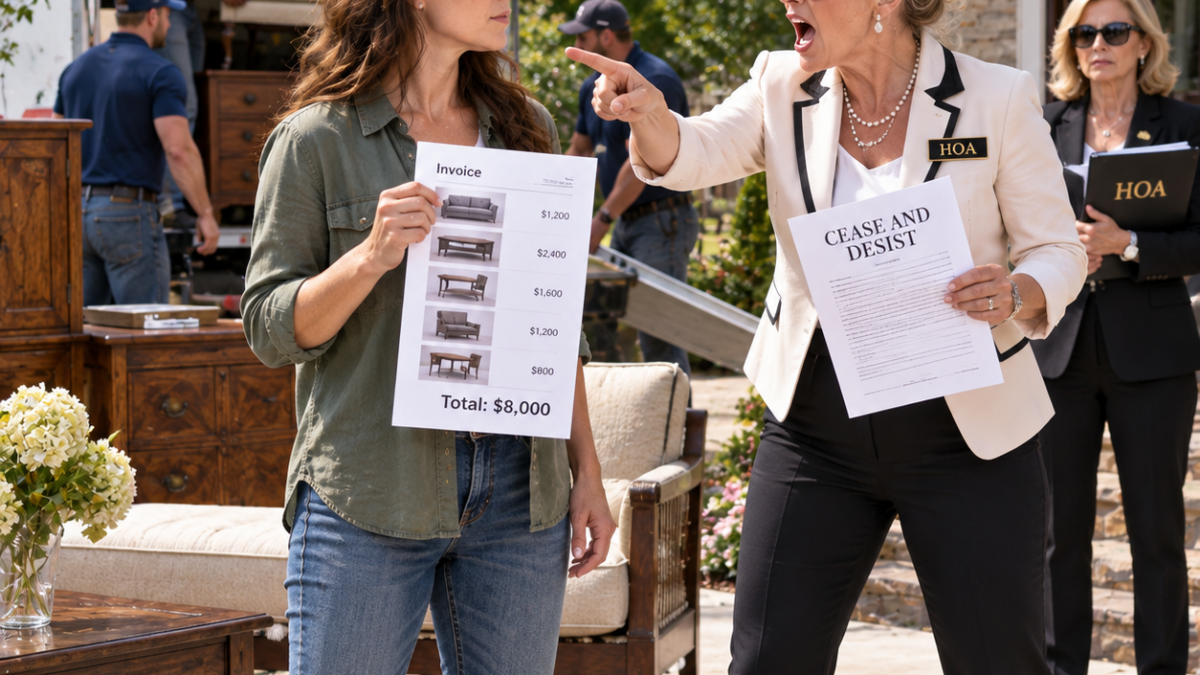
The HOA president stood in my driveway, handed me a cease-and-desist, and told me the woodworking shop that had helped put my life back together was officially a “commercial nuisance.”
She gave me seventy-two hours to shut it down before the fines reached five hundred dollars a day and threatened a lien against the home I had bought after twenty years of military service.
What she had forgotten was one detail from the previous eighteen months, and the moment I remembered it, I stopped being afraid of the paper in my hand.
“Your little hobby is over, Mr. Evans,” Karen Miller said.
She held her clipboard against her chest and smiled.
Not a neighborly smile.
The smile of someone who believed the argument had already ended.
Behind me, the garage door was open just enough for the smell of walnut and tung oil to drift into the humid afternoon. Inside sat the half-finished sideboard I had spent three weeks building, its dovetail drawers lined neatly across my workbench.
Karen pointed toward the garage.
“That operation violates Article Nine of the Oakmont Meadows covenants. You are conducting commercial activity in a residential neighborhood.”
“My workshop has been here for years.”
“That doesn’t make it legal.”
“It’s licensed by the city.”
“That doesn’t make it acceptable to the HOA.”
I looked down at the letter.
Noise complaints.
Traffic concerns.
Industrial machinery.
Disturbance of residential character.
Almost every allegation was either exaggerated or completely false.
I had sound-insulated the garage before I started taking commissions. I never ran power tools before nine in the morning or after five in the afternoon. Customers rarely visited because most of my pieces were commissioned through photographs, drawings, and email. Materials arrived maybe once or twice a month.
My closest neighbors had never complained.
But Karen had apparently decided facts were optional.
“Who complained about the noise?” I asked.
“That information is confidential.”
“How many complaints?”
“Enough.”
“Traffic?”
“Multiple concerns.”
“From whom?”
Her smile disappeared.
“You don’t get to interrogate the board.”
I almost laughed.
Twenty years in the Army Corps of Engineers had taught me to recognize weak positions wrapped in strong language.
But woodworking had taught me something else.
Slow hands make cleaner cuts.
So I kept my voice calm.
“What exactly are you ordering me to do?”
“Cease all commercial woodworking immediately.”
“And if I don’t?”
“Five hundred dollars per day.”
She paused deliberately.
“Retroactive to the beginning of this month.”
I did the math.
Thousands of dollars.
Then she added the real threat.
“If the balance remains unpaid, the association may pursue a lien against your home.”
That landed differently.
The house was not simply property to me.
After my wife, Sarah, died from cancer two years before my final overseas tour, I had spent a long time believing I would never feel at home anywhere again.
Then an explosion in Afghanistan damaged nerves along my left side and ended my military career sooner than I expected.
I came home to silence.
Physical therapy.
Empty rooms.
A pension that paid the bills.
And no idea what I was supposed to do with the rest of my life.
Woodworking saved me.
My father’s old hand plane gave my hands something to do when my mind refused to settle.
A picture frame for Sarah’s photograph became a cutting board for my sister.
Then a coffee table.
Then a neighbor asked me to build something.
Then another.
Eventually Valor Woodcrafts became a real business.
Small.
Quiet.
Mine.
Karen knew all of that.
Or at least she knew the workshop.
She had stood inside it many times.
She had run her hand across freshly sanded walnut and praised my joinery.
She had watched me build bookshelves, a credenza, a cherry four-poster bed, and the largest dining table I had ever made.
I suddenly remembered her standing beside that twelve-foot mahogany table three months earlier, smiling while she texted her husband that it was “absolutely perfect.”
Karen was still talking.
Something about compliance.
Something about community standards.
I barely heard her.
Because the fear was gone.
I folded the cease-and-desist carefully.
“Seventy-two hours?”
Her smile returned.
“Seventy-two.”
“All right.”
She blinked.
“That’s it?”
“That’s it.”
Karen climbed into her golf cart and drove away looking almost disappointed that I had not shouted.
I waited until she disappeared around the corner.
Then I walked into my house, opened the accounting program on my laptop, and typed two words into the customer search box.
Karen Miller.
Five invoices appeared.
And when I saw the total at the bottom of the screen, I knew exactly where my answer to her cease-and-desist was going to begin.
PART 2
$8,250.
I stared at the number.
It should not have surprised me. I had created every invoice myself, collected every payment, ordered every board foot of lumber, and spent hundreds of hours shaping the pieces she now kept inside her house.
Still, seeing the total in one place changed something.
Eight thousand two hundred fifty dollars.
Karen Miller had spent more money with Valor Woodcrafts than any other customer in Oakmont Meadows.
And now she wanted the same business shut down as a nuisance.
I printed the invoices.
Five pages slid from the printer.
CUSTOM OAK BOOKSHELVES.
CUSTOM ENTRY CREDENZA.
SOLID CHERRY FOUR-POSTER BED.
MAHOGANY DINING TABLE.
TEN MATCHING CHAIRS.
Each page contained her name.
Her address.
The date.
The price.
Paid in full.
I placed them across the maple dining table in my house.
The table itself had been one of the last projects Sarah and I discussed before she died.
I had shown her sketches while she sat at our old kitchen counter wearing a knit cap because chemotherapy had taken her hair.
“You always make everything too complicated,” she had told me.
“It’s a table.”
“It’s a table with six different joinery options.”
“I like options.”
Sarah smiled.
“You like control.”
She was right.
After she died, I stopped working on the design.
For years the drawings stayed folded in a toolbox.
Then, after the Army sent me home for good, I found them again.
Building that table became the first serious project of my second life.
Now Karen’s cease-and-desist rested on top of it.
I poured coffee and opened the Oakmont Meadows governing documents.
If she wanted a paperwork fight, paperwork was one language I understood.
Article Nine.
Section Four, paragraph B.
I read it once.
Then again.
“No noxious or offensive trade or activity shall be carried on upon any lot, nor shall any activity be conducted which may become an annoyance or nuisance to the neighborhood.”
That language alone was dangerously vague.
But the next sentence mattered.
“No residential lot shall be used in whole or part for commercial purposes resulting in increased traffic, noise, odors, or disturbance inconsistent with residential use.”
I underlined resulting in.
Karen could not simply dislike my work.
She had to show an actual disturbance.
Noise.
Traffic.
Odor.
Something measurable.
That was where she had made her first mistake.
Valor Woodcrafts was specifically designed not to disturb anyone.
My disability made long, chaotic production days impossible anyway. I worked slowly. Carefully. Usually alone.
I had insulated the garage walls with acoustic material.
Installed a modern dust-collection system.
Replaced several old machines with quieter models.
Never worked outside reasonable daytime hours.
Most of the time the loudest thing on my property was my neighbor Tom Jenkins’s riding mower.
So I started measuring.
I still owned a professional sound meter from earlier shop testing.
The next morning I set it up.
Table saw running.
Garage door shut.
Inside workshop: loud, obviously.
Front porch: ordinary background noise.
Property line: low.
Sidewalk near Tom and Sarah Jenkins’s house: barely noticeable.
I photographed every reading.
Date.
Time.
Location.
Tool operating.
Then I repeated the process with the planer and router.
By noon, I had a spreadsheet.
Inside the garage, the machines behaved exactly like woodworking machinery.
At the nearest property boundary, the sound dropped dramatically.
At the nearest neighboring residence, ordinary traffic passing at the end of the street registered louder than my shop.
I smiled.
The Army had trained me to love boring data.
Boring data wins arguments because it does not become offended.
Next came traffic.
That one was almost embarrassing.
I reviewed six months of calendar entries, invoices, delivery receipts, and camera footage.
Business-related visits averaged less than one per week.
A lumber delivery every few weeks.
An occasional customer consultation.
One freight delivery.
No employees.
No customer parking.
No retail hours.
No sign in the yard.
No constant stream of vans.
Ironically, the single most frequent business visitor during those months had been Karen.
I found security-camera clips.
Karen arriving.
Karen walking into the garage.
Karen leaning over the unfinished dining table.
Karen leaving.
Again.
Again.
Again.
Then I searched my emails.
There were dozens.
Mark, the finish on the oak samples is gorgeous.
Mark, Gerald prefers the darker cherry.
Mark, can we make the headboard four inches taller?
Mark, the dining table is magnificent.
Mark, could we add two more chairs before Thanksgiving?
And my personal favorite:
I tell everyone in Oakmont Meadows that we are lucky to have a craftsman like you living here.
Sent by Karen Miller eleven months earlier.
I printed it.
Then another.
Then another.
Text messages too.
She had taken photographs inside my workshop.
She had posted one on the neighborhood social-media group after receiving the bookshelves.
The caption praised my “extraordinary craftsmanship.”
I printed that too.
By evening, my evidence binder had five sections.
HOA NOTICE.
COVENANTS.
NOISE DATA.
TRAFFIC DATA.
KAREN MILLER CUSTOMER RECORD.
I placed her five paid invoices behind the final tab.
Then I leaned back.
The room was silent except for the refrigerator.
That silence used to bother me.
After Sarah died, quiet felt like absence.
Then Afghanistan made loud noises something different.
Woodworking eventually taught me to hear silence as concentration rather than emptiness.
That night it felt like control.
Not Karen’s kind.
Mine.
I did not have to react.
I could prepare.
The following morning I walked next door.
Tom Jenkins was pruning roses.
His wife, Sarah—not my Sarah, though hearing the name still caught me sometimes—was kneeling beside a flower bed.
“Morning, Mark,” Tom said.
“Can I ask both of you something?”
Sarah Jenkins looked up.
“That sounds ominous.”
“Has my workshop ever bothered you?”
They exchanged glances.
“No,” Tom said.
“Noise?”
“No.”
“Traffic?”
Sarah laughed.
“What traffic?”
“Any odors? Dust?”
“Mark, what happened?”
I handed Tom the cease-and-desist.
His expression changed as he read.
Then Sarah took it.
“She did this?”
“Yesterday.”
“This says neighbors complained.”
“I know.”
Tom looked toward my house.
“We’re your closest neighbors.”
“I know.”
“She never asked us.”
“Apparently.”
Tom’s face reddened.
“That woman.”
I had heard him complain about Karen before, but never with that tone.
Sarah folded the paper.
“You want us to write a statement?”
The offer surprised me.
“I came to ask whether the workshop bothered you.”
“It doesn’t.”
Tom nodded.
“I’ll put it in writing.”
I had planned to gather objective evidence.
I had not expected allies so quickly.
We sat on their porch.
They told me stories.
Trash can left out two hours late.
Twenty-five-dollar fine.
Deck stain allegedly too rustic.
Formal warning.
Flower pot deemed inconsistent with approved exterior colors.
“I know these sound stupid,” Sarah said.
“They’re supposed to sound stupid individually.”
She looked at me.
“What do you mean?”
“Small enough that fighting costs more energy than paying.”
Tom nodded slowly.
“That’s exactly it.”
“So you pay.”
“Yes.”
“Then next time she knows you will.”
His jaw tightened.
“She does it to everyone.”
That sentence mattered.
“Who else?”
The names began.
Rodriguez family.
Basketball hoop.
The Lees.
Garden lantern.
Mrs. Gable.
Something involving her porch.
I listened.
Then I spent the next two days doing something I normally avoided.
Talking to neighbors.
I did not tell them Karen was corrupt.
I did not ask them to join a revolt.
I asked questions.
“Have you had problems with the board?”
Most people glanced around before answering.
That told me almost everything.
The Rodriguez family had been fined because their son left a portable basketball hoop at the curb overnight.
The Lees had to remove a stone lantern from their garden because it did not fit Oakmont Meadows’ architectural theme.
A young mother had received a warning when her children drew chalk animals on the driveway.
A man recovering from surgery got a notice because his lawn exceeded the approved height while he was hospitalized.
Nobody’s complaint alone would destroy a board president.
Together they showed a culture.
Karen had learned that fear was more efficient than persuasion.
Then I visited Mrs. Gable.
Helen Gable was a widow in her seventies.
Small woman.
Soft voice.
Sharp eyes.
She invited me inside and made tea I did not want but drank anyway because refusing felt rude.
When I explained why I was asking about Karen, Helen became quiet.
Then she said:
“You’re the man with the furniture.”
“That is one description.”
“She tells everyone how beautiful that table is.”
“I built it.”
“I know.”
She smiled slightly.
“That’s why this whole thing seemed strange.”
“What thing?”
“The men.”
“What men?”
Her smile vanished.
She moved closer.
“Karen has been meeting with developers.”
I waited.
“There’s a company trying to expand toward the woods behind your house.”
I knew the woodland.
My backyard backed directly against it.
“What company?”
“I don’t know.”
“What did you hear?”
Helen looked uncomfortable.
“I was walking Penny one afternoon.”
Her little terrier slept under the table.
“Karen was on her porch. She talks loudly when she wants people to hear how important she is.”
That sounded accurate.
“She said they couldn’t move forward until the final obstacle was handled.”
My stomach tightened.
“What obstacle?”
“She mentioned your corner.”
I said nothing.
Helen continued.
“She said once the commercial nuisance was resolved, the parcel could become available and the luxury annex would finally connect to Oakmont Meadows.”
I felt the pieces move.
“Did she say anything about money?”
“Something about a consulting arrangement.”
There it was.
Not proof.
But motive.
Suddenly the absurd contradiction made sense.
Karen was not attacking my woodworking because she thought it was noisy.
She knew it was not.
She had commissioned furniture from me repeatedly.
The nuisance allegation was a tool.
If she could burden my property with escalating HOA fines, legal expenses, or a lien, maybe she could make living there intolerable.
Maybe I would sell.
Maybe a developer would get the parcel needed to connect the subdivision to another tract.
Maybe Karen would get paid.
I drove home slowly.
For the first time since receiving the cease-and-desist, I felt genuinely afraid.
Not of Karen.
Of how far this might go.
I sat in the garage with the lights off.
My workbench was visible through the evening shadows.
Sarah’s photograph stood on a shelf above my hand tools.
It showed her before the cancer.
Hair blowing across her face.
Eyes narrowed against sunlight.
I had taken it on a road trip through Tennessee.
“You’d hate this,” I said aloud.
Silence.
Then I corrected myself.
“No. You’d hate that I’m sitting here talking to your picture instead of calling a lawyer.”
That thought actually made me smile.
I picked up my phone.
Dave Mercer answered on the fourth ring.
Dave had been my platoon sergeant years earlier.
After retiring, he went to law school.
He now handled property, veterans’ issues, and civil disputes out of a small office in the next town.
“Mark Evans.”
“Dave.”
“Are you calling because you finally admitted lawyers are useful?”
“Temporary lapse in judgment.”
“Excellent. What happened?”
I told him.
Cease-and-desist.
$500 per day.
Lien threat.
Covenant language.
Noise measurements.
Traffic.
Karen’s furniture purchases.
Then Helen’s developer story.
Dave was quiet for several seconds.
Finally:
“You have the receipts?”
“Every one.”
“Emails?”
“Yes.”
“Her messages praising the work?”
“Yes.”
“Board notice?”
“Yes.”
“Developer evidence?”
“Only a witness statement right now.”
“Good.”
“Good?”
“Because you’re not going to accuse her of corruption based on neighborhood conversation.”
“I wasn’t planning to.”
“You were thinking about it.”
“Maybe.”
“Don’t.”
I sighed.
“So what do we do?”
“Separate the problems.”
He began counting.
“One: HOA nuisance allegation. We destroy it factually.”
“Okay.”
“Two: board process. We put every director on notice.”
“Okay.”
“Three: developer conflict. We investigate quietly.”
“And Karen?”
“She is going to defeat herself.”
“How?”
“People who believe authority can replace evidence usually keep escalating until they meet a system they don’t control.”
That sounded like Dave.
He asked me to email the documents.
An hour later he called back laughing.
“The furniture.”
“I know.”
“Eight grand.”
“Eight thousand two hundred fifty.”
“Even better.”
“What are you thinking?”
“Your response should never call her a hypocrite.”
“She is a hypocrite.”
“Obviously.”
“So why not say it?”
“Because letting the other board members reach that conclusion themselves is more effective.”
He drafted the opening.
Dear Members of the Oakmont Meadows Board of Directors:
I am writing in response to the cease-and-desist notice delivered by President Karen Miller regarding my home-based woodworking business, Valor Woodcrafts.
The tone was polite.
Respectful.
Almost painfully cooperative.
That was intentional.
We addressed Article 9.4B directly.
Noise readings.
Traffic logs.
Operating hours.
City license.
No employees.
No signage.
No exterior storage.
No complaints from adjacent neighbors.
Tom and Sarah Jenkins signed a statement confirming my workshop had never created a meaningful disturbance for them.
Then came the final section.
PERSONAL FAMILIARITY WITH VALOR WOODCRAFTS.
Dave read it aloud over the phone.
“Members of the board may be unfamiliar with the nature of my commissioned furniture business. Fortunately, President Miller has substantial first-hand experience with both my workshop and the quality of the work produced there.”
I laughed.
“That is evil.”
“It is factual.”
He continued.
“Over the preceding eighteen months, President Miller has commissioned multiple custom pieces manufactured in the same workshop now identified as a prohibited nuisance.”
Then the list.
Bookshelves.
Credenza.
Bed.
Dining table.
Ten chairs.
Total paid.
$8,250.
We attached invoices.
Emails.
Texts.
A screenshot of her social post praising the business.
The letter concluded:
Given President Miller’s extensive history as a satisfied customer, I believe the present notice may have resulted from incomplete or inaccurate information presented to the board. I respectfully request immediate rescission of the cease-and-desist and written confirmation that my compliant home occupation may continue.
No accusation.
No insult.
Just a trap built out of courtesy.
Five certified packets went out.
Karen.
George Riley, treasurer.
Linda Park.
Martin Shaw.
Beth Cooper.
Every director.
Everyone would see the same evidence.
Nobody could later say Karen had handled the issue alone.
The seventy-two-hour deadline passed.
No $500 fine appeared.
Nothing happened.
That bothered me more than another letter would have.
Three days of silence.
I worked.
Sanded.
Cut mortises.
Fitted drawer slides.
Every time my phone rang, I looked.
Every time a golf cart passed, my shoulders tightened.
Friday afternoon, George Riley called.
“Mark?”
“Yes.”
“This is George from the HOA board.”
“I know.”
A pause.
“We received your packet.”
“All of you?”
“Yes.”
“Including Karen?”
“Especially Karen.”
“How did she take it?”
George sighed.
“She is furious.”
“That doesn’t answer the question.”
“She called an emergency board meeting for Monday.”
“About me?”
“Yes.”
“What does she want?”
“Authorization for legal action.”
I looked toward the garage.
“She still wants to sue after seeing the invoices?”
“That’s part of the problem.”
“Explain.”
George lowered his voice.
“Several directors asked why she commissioned furniture from you if your business was violating the covenants.”
“Reasonable question.”
“She said her purchases are irrelevant.”
“They were made in the workshop.”
“I know.”
“She visited the workshop.”
“I know.”
“She publicly recommended the business.”
“I know, Mark.”
George sounded exhausted.
“Then what is she arguing?”
“That compliance is compliance regardless of her personal purchasing decisions.”
Technically, that was not completely ridiculous.
Hypocrisy did not automatically make my business legal.
But my other evidence did.
The invoices simply exposed how dishonest her sudden alarm seemed.
“Why are you calling me?”
“I think you should attend.”
“Am I allowed?”
“Homeowners can speak on enforcement actions affecting them.”
“She won’t like that.”
“Karen is starting to discover that not liking something and having the authority to stop it are different concepts.”
I liked George immediately.
“Will the board authorize litigation?”
“I don’t know.”
“Where do you stand?”
Another pause.
“I’m an accountant.”
“That is not an answer.”
“It is when the question involves spending association money on a lawsuit supported by evidence this weak.”
Monday night, the clubhouse was packed.
Far more people than attended normal HOA meetings.
My conversations around the neighborhood had traveled.
Tom and Sarah Jenkins sat in front.
The Rodriguezes came.
The Lees.
Helen Gable sat near the aisle clutching her purse.
Dave sat beside me.
“You didn’t have to come.”
“I know.”
“You charging me?”
“Absolutely.”
“Friendship is dead.”
“Billable friendship is still friendship.”
Karen entered last.
She wore a navy suit and carried the same thick binder she used at every meeting.
Her face looked composed.
Her eyes did not.
She sat in the center of the board table and struck the gavel.
“This emergency meeting of the Oakmont Meadows Homeowners Association is called to order.”
The room quieted.
“The sole purpose of tonight’s meeting is to address a flagrant and ongoing covenant violation threatening the residential character of our community.”
No name.
She did not need one.
Everyone looked at me.
Karen spoke for ten minutes.
“Commercial intrusion.”
“Industrial activity.”
“Precedent.”
“Property values.”
“Unchecked businesses.”
At one point she described Valor Woodcrafts as a “manufacturing enterprise.”
Dave wrote something on his legal pad and slid it toward me.
FORD MOTOR COMPANY SHOULD BE WORRIED.
I bit the inside of my cheek to keep from laughing.
Karen held up our response.
“The homeowner has attempted to distract the board with irrelevant personal information.”
There it was.
The invoices.
Except she never described them.
She simply called them irrelevant.
Then she made her motion.
Authorize counsel to seek an injunction.
Impose continuing fines.
Take all necessary action to compel compliance.
Linda seconded.
Karen leaned back.
“Discussion?”
Silence.
Then George cleared his throat.
“I have questions.”
Karen’s head turned.
“George.”
“I believe the homeowner should be allowed to respond.”
“The written response is in the record.”
“The written response contains material facts you haven’t addressed.”
A murmur traveled through the room.
Karen’s mouth tightened.
“Such as?”
George actually looked surprised.
“The noise readings.”
“They are self-generated.”
“The neighbor statement.”
“Anecdotal.”
“Traffic logs.”
“Self-reported.”
George waited.
Then:
“And your purchases.”
The room shifted.
Karen stared at him.
“My personal purchases have no bearing on covenant enforcement.”
George opened his copy of the packet.
“You commissioned more than eight thousand dollars of furniture.”
Someone behind me whispered, “What?”
Karen struck the gavel.
“That is irrelevant.”
George continued.
“The furniture was constructed in Mr. Evans’s workshop?”
She did not answer.
“Karen?”
“Yes.”
“You visited that workshop during production?”
“I was a customer.”
“You promoted his work online.”
Karen’s face reddened.
“I supported a neighbor. That does not give him permission to violate restrictions.”
George nodded.
“That would be reasonable if we had evidence of an actual nuisance.”
“I have complaints.”
“Can the board review them?”
“They are confidential.”
“Redacted?”
Karen stared at him.
George continued.
“How many?”
“That is executive information.”
Martin Shaw leaned toward his microphone.
“Why?”
Karen snapped, “Because complainants have privacy rights.”
Martin looked at the other directors.
“Can we at least know whether there are two? Ten? Twenty?”
Karen’s voice rose.
“This is getting off track.”
That was when Dave whispered:
“She has none.”
I believed him.
Karen tried moving to a vote.
George stopped her.
“We need to hear Mark.”
“That is not required.”
“It is appropriate.”
Residents began murmuring.
Someone called, “Let him speak.”
Then Tom Jenkins:
“He lives here too.”
Karen struck the gavel.
“Order.”
More voices.
Finally she said:
“Two minutes.”
I stood.
Dave remained seated.
I carried only the binder.
No slides.
No dramatic display.
“My name is Mark Evans.”
I looked at the board.
“I operate Valor Woodcrafts from my garage.”
Then at the residents.
“I’m not going to tell you Karen’s furniture purchases automatically make my business compliant. They don’t.”
That caught Karen off guard.
Her expression almost brightened.
I continued.
“What makes my business compliant is the evidence.”
I held up the noise report.
“Measured sound levels.”
Traffic log.
“Business traffic.”
License.
“City registration.”
Tom and Sarah’s letter.
“Nearest-neighbor statement.”
Then I placed the binder down.
“What Karen’s purchases show is something different.”
Now I turned toward her.
“They show she knew exactly what my business was.”
Silence.
“She knew where the furniture was made.”
Karen gripped her pen.
“She knew how often I worked.”
Her jaw tightened.
“She knew customers were not lining up outside my house.”
I paused.
“She knew the workshop was not an industrial factory because she stood inside it repeatedly while I built furniture for her.”
The room stayed still.
Then I asked:
“Karen, is the twelve-foot mahogany dining table in your house a nuisance?”
Someone gasped.
Her face reddened.
I continued.
“The cherry bed?”
“Out of order.”
“The oak bookshelves?”
“Mr. Evans—”
“The credenza?”
She struck the gavel.
“Your time is finished.”
Sarah Jenkins stood.
“No, Karen.”
The room went quiet again.
Sarah was usually soft-spoken.
That made her voice more powerful.
“I want an answer too.”
Karen stared.
Sarah continued.
“Why was his workshop wonderful when you were buying things from it?”
Applause.
Karen banged the gavel.
“This is not a public trial.”
Tom stood beside his wife.
“You made it one when you tried to shut down his livelihood.”
More voices.
“What complaints?”
“Show us!”
“Why are we paying a lawyer?”
“What is this really about?”
Karen lost control.
I watched it happen in seconds.
A board president used to everyone fearing her letters suddenly faced a room full of people comparing experiences.
Then she made her biggest mistake.
She pointed at me.
“Fine.”
Her voice shook.
“If this board is too cowardly to enforce its own rules, the city will.”
Dave became perfectly still.
Karen continued.
“I will file a formal code complaint tomorrow. We’ll see how confident Mr. Evans is when municipal enforcement shuts down his illegal workshop.”
Dave slowly smiled.
I almost felt sorry for her.
Almost.
The vote on litigation failed.
Karen and Linda supported it.
The others did not.
No authorization.
No board-funded lawsuit.
She stormed out.
George approached after the meeting.
“She’s going to the city.”
“I know.”
“Aren’t you concerned?”
“No.”
He looked at Dave.
Dave shrugged.
“You should probably be concerned for Karen.”
The reason was Ordinance 2011-B.
Oakmont had adopted it years earlier to support artists and craftspeople operating from residential properties.
Small artisanal home occupations were allowed if they satisfied several conditions.
Residential use remained primary.
No more than one outside employee.
No exterior business signage.
No detectable dust, excessive noise, fumes, or disruptive traffic beyond the property.
I met every standard.
More importantly, Valor Woodcrafts was already registered under that classification.
My city business license said so.
Karen had threatened to report me to the department that had issued my license.
Dave’s instruction was simple.
“Do nothing.”
“I hate doing nothing.”
“I know.”
“She’s filing a false complaint.”
“Let her.”
“What if the inspector believes her?”
“Then you show him evidence.”
“What if—”
“Mark.”
I stopped.
“You spent twenty years working inside large government systems. You know inspectors hate two things.”
“What?”
“Being lied to and having their time wasted.”
He was right.
We prepared another binder.
City ordinance.
License.
Tax registration.
Schedule C records.
Noise data.
Traffic logs.
Photos.
Workshop layout.
Operating hours.
Insurance.
Then waited.
A week later, a city pickup parked outside.
My pulse still jumped.
No amount of preparation completely eliminates the physical response to seeing authority arrive because somebody accused you of wrongdoing.
A man in a blue code-enforcement shirt walked toward the house.
I opened the door.
“Mr. Evans?”
“Yes.”
“Officer Daniel Ramirez, City of Oakmont.”
He showed identification.
“We’ve received a complaint regarding a potentially unlicensed industrial operation at this address.”
“I was expecting you.”
That surprised him.
“May I inspect the garage?”
“Absolutely.”
I led him around the side.
Opened the workshop.
Ramirez stopped just inside.
Everything was clean.
Machines organized.
Dust collection overhead.
Hand tools displayed.
Current project on the bench.
A walnut sideboard.
He walked slowly around the room.
“The complaint described industrial machinery.”
I pointed.
“Table saw.”
“Standard.”
“Planer.”
“Standard.”
“Jointer.”
He nodded.
“Dust collection?”
I showed him.
“Sound treatment?”
Walls.
Ceiling.
Door seals.
He examined everything.
“Employees?”
“None.”
“Signage?”
“None.”
“Walk-in customers?”
“No retail business.”
“Operating hours?”
“Nine to five maximum. Usually less.”
“Deliveries?”
“One or two most months.”
He typed notes.
Then I handed him the binder.
“This may help.”
Ramirez looked at the tabs.
“Did a lawyer prepare this?”
“No.”
“Engineer?”
“Former.”
He smiled slightly.
“That explains it.”
He read the ordinance page.
Then the license.
“You’re registered under 2011-B.”
“Yes.”
“The complaint states no permit exists.”
“I thought you might notice that.”
Ramirez’s expression changed.
He examined the noise readings.
“Who conducted these?”
“I did.”
“Equipment calibrated?”
I showed him the documentation.
He nodded.
Then we stepped outside.
He used his own meter while I ran the planer.
Property line.
Reading low.
He walked toward the sidewalk.
Lower.
Tom Jenkins happened to be watering roses.
Ramirez asked:
“Sir, do you live here?”
“Yes.”
“Any complaints regarding workshop noise?”
Tom looked at me, then Ramirez.
“Only complaint I have is Mark refuses to build me furniture for free.”
Ramirez tried not to smile.
“Any actual disturbance?”
“No.”
“Traffic?”
“No.”
“Dust?”
“No.”
“Odors?”
“Sometimes barbecue.”
“That from the workshop?”
“No. That’s me.”
Ramirez thanked him.
Back in my garage, he closed his tablet.
“Mr. Evans, you appear compliant.”
The tension left my chest.
“I appreciate that.”
He did not move.
“The complaint is unusually detailed.”
“I can imagine.”
“It alleges heavy manufacturing, constant truck traffic, chemical fumes, exterior storage, and unlicensed operation.”
“You’ve seen the property.”
“I have.”
“Any of those present?”
“No.”
He studied me.
“You mentioned expecting me.”
“My HOA president publicly announced she was filing a complaint.”
Ramirez’s eyebrows lifted.
“During a meeting?”
“In front of about fifty people.”
“Name?”
I hesitated.
“You probably know.”
“Karen Miller?”
I said nothing.
His expression told me enough.
He continued:
“I cannot discuss complainant information. I can tell you that knowingly submitting false information to trigger enforcement may create separate issues.”
“I understand.”
“I will close this as unfounded once the report is completed.”
“Thank you.”
He turned toward the door.
Then stopped beside the walnut sideboard.
“You made this?”
“Yes.”
“My wife would kill me if she saw it.”
“That can be arranged.”
He laughed.
“Not on a city salary.”
Then he left.
I sat on my shop stool after his truck disappeared.
My hands shook.
Not much.
Enough.
I hated that.
The nerve damage had given me a slight tremor long before Karen.
Stress made it worse.
I looked at Sarah’s photograph.
“I’m tired,” I told her.
The words came out before I intended them.
That was the truth beneath everything.
Not scared.
Not defeated.
Tired.
I had spent years overseas learning how to endure pressure.
But home was not supposed to require endurance.
Woodworking was supposed to be the peaceful part.
I picked up my hand plane.
Ran it along a scrap of walnut.
Thin curl of wood.
Again.
Again.
My hands steadied.
A week later, the city letter arrived.
Case closed.
No violation.
Fully compliant under Ordinance 2011-B.
Then George emailed me another document.
A separate letter from code enforcement addressed to the Oakmont Meadows board.
It was professional.
Measured.
Devastating.
The department noted a significant discrepancy between the allegations reported and conditions observed.
It cautioned against using municipal enforcement to pursue personal or association disputes.
It warned that knowingly false complaints could violate city code.
I read it twice.
Then called Dave.
“Can I frame this?”
“Legally?”
“Emotionally.”
“I encourage it.”
The next regular HOA meeting drew more people than the emergency one.
Word had spread.
Residents arrived carrying highlighted bylaws.
Petitions.
Folders.
Karen came late.
For the first time since I had known her, she avoided looking at me.
George opened the communications section.
First he read my clearance.
Then the warning to the board.
The phrases landed one after another.
Significant discrepancy.
Unfounded.
Misuse of municipal resources.
Knowingly false or misleading complaint.
Karen sat motionless.
When George finished, Frank Delgado stood.
Frank was a retired union organizer.
Large voice.
No fear.
“Point of order.”
Karen reached for the gavel.
Frank held up a petition.
“Article Four, Section Three permits a motion regarding removal of a director at a regular membership meeting provided the director receives an opportunity to respond.”
Karen’s face changed.
Frank continued.
“I move that Karen Miller be removed from the board for malfeasance, abuse of authority, misuse of HOA resources, and conduct detrimental to the association.”
“Second!”
The word came from several directions.
Karen slammed the gavel.
“Out of order!”
George looked down at the bylaws.
“No.”
She turned toward him.
“What?”
“The motion is procedurally valid.”
“You cannot be serious.”
“We have to address it.”
“I am the president.”
“For now,” someone said.
Laughter erupted.
Karen’s eyes searched the room.
For allies.
There were fewer than before.
The motion was placed on the agenda.
Frank presented the case.
My cease-and-desist.
Karen’s own customer history.
The failed legal vote.
The city complaint.
The official warning.
Pattern of homeowner disputes.
Then he raised the developer issue.
I had specifically told him not to state rumors as facts.
He did not.
Instead:
“There have also been concerns raised regarding possible undisclosed discussions between President Miller and development interests involving land adjacent to our community.”
Helen Gable stood.
Her hands trembled.
“I heard the conversation.”
Karen turned white.
Helen told the room exactly what she had told me.
Final obstacle.
Luxury annex.
Consulting arrangement.
Karen exploded.
“That woman misunderstood a private conversation!”
Frank asked:
“So you had a conversation with developers?”
Silence.
Karen realized her mistake.
“No.”
“But you just said she misunderstood it.”
“I meant—”
The room erupted.
George struck the gavel.
Karen looked at him with pure hatred.
He did not flinch.
The vote came later that evening.
Before it happened, Karen was allowed to speak.
She stood behind the microphone.
Her voice initially calm.
“I have devoted two years of my life to protecting Oakmont Meadows.”
Nobody reacted.
“I enforced rules previous boards ignored.”
Still nothing.
“I improved property values.”
A few murmurs.
“I maintained standards.”
Then her eyes found me.
“And I will not apologize for standing up to people who believe rules don’t apply to them.”
I almost stood.
Dave touched my arm.
“No.”
He was right.
Karen continued.
“This entire campaign is revenge by a disgruntled homeowner who manipulated neighbors with private business records and staged municipal inspections to embarrass me.”
That finally brought boos.
She raised her voice.
“You will regret this when this neighborhood deteriorates.”
Frank called for the vote.
Hands went up.
A sea.
Karen looked around.
Her husband Gerald raised his hand against removal.
One other resident hesitated, then did the same.
Everyone else supported it.
George announced the result.
“Karen Miller is removed from the Oakmont Meadows Board of Directors effective immediately.”
Nobody moved for a second.
Then applause.
Karen stared straight ahead.
The gavel rested inches from her hand.
Slowly, George picked it up.
That small gesture ended the era more completely than the vote.
Karen grabbed her purse.
She walked past me.
Stopped.
“You think you won?”
I looked at her.
“No.”
Her eyes narrowed.
“I think you lost.”
She left.
That could have been the ending.
It was not.
Because the developer question remained.
George became interim president.
Sarah Jenkins joined the board.
The new leadership immediately rescinded my cease-and-desist.
Every threatened fine vanished.
Two days later I received a signed apology.
Valor Woodcrafts, it said, was recognized as a lawful non-disruptive home occupation.
I showed the letter to Dave.
“Frame that too.”
“My walls are going to look ridiculous.”
“You’re a woodworker. Build more walls.”
The new board also hired independent counsel to review Karen’s outside communications.
That investigation found something significant.
Karen had been talking to the developer.
Not casually.
She had discussed a proposed expansion into the woodland behind my property.
The developer needed access and additional parcels.
Mine was strategically important.
And Karen had discussed receiving a consulting fee if the project moved forward.
The arrangement had not closed.
No payment had been made.
But the conflict was obvious.
The board released the findings to homeowners.
When I read them, I felt vindicated.
Then angry.
Then strangely sad.
All those months.
The threats.
The fear.
The stress.
Sarah Jenkins’s worried face.
Tom’s anger.
My shaking hands in the workshop.
All because Karen had looked at my home and seen a bargaining chip.
Dave asked whether I wanted to sue her over the developer conduct.
I considered it.
For days.
A part of me wanted everything.
Damages.
Depositions.
Discovery.
Court.
I wanted her forced to explain every email under oath.
Then one afternoon I was shaping a curved chair rail and caught myself thinking about Karen instead of the wood.
That bothered me.
I stopped the machine.
Looked around the garage.
This place had saved me once.
I was allowing her to occupy it again, just differently.
I called Dave.
“No lawsuit on the developer issue.”
“You sure?”
“Yes.”
“You have options.”
“I know.”
“Could be meaningful leverage.”
“I know.”
“Then why?”
“Because I want my life back more than I want her punished.”
Dave became quiet.
Finally:
“Good answer.”
The board handled the governance side.
A new conflict-of-interest provision passed.
No director could have undisclosed financial relationships with companies doing business with or seeking transactions involving the association.
Major development discussions required disclosure.
Meeting minutes became more detailed.
Financial records became easier to inspect.
Then Sarah Jenkins asked me to join the covenant-review committee.
My first response was:
“No.”
She stared.
“You didn’t even think.”
“I spent months reading those things.”
“That is why we need you.”
“I want to make furniture.”
“You can do both.”
“No human being has ever said that about an HOA committee and been happy afterward.”
She smiled.
“Please.”
I agreed.
For two months we reviewed the rules.
I expected to want them all deleted.
Instead, I learned something uncomfortable.
Some rules made sense.
Quiet hours.
Common-area maintenance.
Reasonable parking standards.
Safety provisions.
The problem had never been the existence of standards.
It was ambiguity plus unchecked discretion.
“Noxious or offensive.”
What did that mean?
Karen could make it mean whatever she wanted.
“Unreasonable disturbance.”
Define unreasonable.
“Unsightly.”
According to whom?
We replaced subjective language where possible with measurable standards.
Noise.
Times.
Traffic.
Evidence.
Written notice.
Appeal rights.
Complaints required factual support.
Board members with conflicts had to recuse themselves.
And we added a specific home-occupation section modeled after the city ordinance.
Small, licensed, non-disruptive home businesses were explicitly permitted.
When the revised package went to homeowners, ninety-eight percent approved it.
George called afterward.
“Congratulations.”
“For what?”
“You’re now permanently responsible for making HOAs better.”
“Take it back.”
“Too late.”
Valor Woodcrafts changed too.
The story had spread beyond Oakmont Meadows.
At first I hated that.
People contacted me because I was “the veteran who beat the HOA.”
I wanted them to care about the furniture.
Then they saw the furniture.
Orders increased.
A restaurant commissioned twelve tables.
A law firm wanted conference furniture.
A family from two counties away ordered a dining set.
I became busy enough to need help.
That terrified me more than Karen.
Hiring someone meant my little therapy workshop was becoming a real enterprise.
I almost refused the growth.
Then Dave mentioned a young veteran named Caleb who had recently separated from service.
Good with tools.
Struggling with transition.
That sounded familiar.
Caleb came by one morning.
Twenty-six.
Quiet.
Too alert.
He stood in my garage looking around.
“You built all this?”
“Over time.”
He ran a hand across a workbench.
“My grandfather did carpentry.”
“Ever done furniture?”
“Not like this.”
“Want to learn?”
He shrugged.
“Maybe.”
That meant yes.
I hired him part-time.
The first week he barely talked.
The second week he cursed at a dovetail joint for twenty straight minutes.
I knew he would be fine.
One afternoon he asked why Sarah’s photograph sat above my bench.
“My wife.”
“She passed?”
“Yes.”
“Sorry.”
“Me too.”
He nodded toward the photograph.
“She the reason you do this?”
“At first.”
“And now?”
I looked around.
Sawdust.
Tools.
Half-built chairs.
Caleb waiting.
“Now there are more reasons.”
That realization surprised me.
The shop had begun as survival.
Then business.
Then community conflict.
Now it was becoming something I could pass forward.
Karen had tried to shut it down.
Instead, she accidentally pushed me into defending it so publicly that more people found it.
There is a kind of justice in that.
Oakmont Meadows changed gradually.
Tom kept his trash cans in on time most weeks.
When he forgot, nobody issued a fine within thirty minutes.
The Rodriguez boy’s basketball hoop remained outside.
The Lees put their stone lantern back.
Helen Gable started attending every board meeting.
She sat in the front.
George once told me he was more afraid of disappointing Helen than any regulator.
“That woman takes notes.”
“She learned from watching Karen.”
“Terrifying.”
Neighbors talked more.
Not because everyone suddenly loved one another.
They did not.
There were still arguments.
Parking.
Dogs.
Landscape contracts.
Pool repairs.
One six-week debate about whether a shade structure counted as an architectural addition.
But people argued in the open.
That was healthier than quiet fear.
Karen still lived in the neighborhood.
At first, seeing her produced a physical response.
Tension.
Anger.
Then it faded.
She walked her dog.
Collected mail.
Drove past.
No board sticker.
No clipboard.
No gavel.
Just another homeowner.
She never spoke to me.
I never spoke to her.
Gerald once raised a hand in an awkward wave.
I returned it.
None of this was his war.
Six months after Karen’s removal, my phone rang.
Unknown number.
“Valor Woodcrafts?”
“Yes.”
“My name is Allison. I manage Heritage Consignment downtown.”
“What can I do for you?”
“We have a client offering several pieces bearing your maker’s mark.”
I leaned against the bench.
“What pieces?”
“Large mahogany dining table with ten chairs.”
My stomach tightened.
“And?”
“Cherry four-poster bed.”
I knew.
“Client name?”
She hesitated.
“Gerald Miller.”
Of course.
Allison continued.
“We’re verifying authenticity and approximate original pricing.”
“They’re mine.”
“Condition?”
“I’d need photographs.”
She emailed them.
I opened the images.
There was Karen’s dining room.
The table gleaming under the chandelier.
The same table she once stood beside telling me everyone would ask where she bought it.
The bed.
Bookshelves.
Credenza.
Her house had been filled with my work.
Now they were selling it.
Maybe Karen could not stand looking at the furniture anymore.
Maybe Gerald needed money.
Maybe they were redecorating.
I never asked.
Allison said:
“They’re beautiful.”
“Thank you.”
“What would the dining set have sold for originally?”
I gave her the figure.
“What would you estimate now?”
“Depends on condition and market.”
She paused.
“Anything we should know about provenance?”
I almost laughed.
“Long story.”
“Good story?”
“Depends who you ask.”
I confirmed the pieces were authentic.
Then hung up.
Caleb looked over from the bench.
“What?”
“Nothing.”
“You’re smiling.”
“Old customer selling furniture.”
“Bad customer?”
“Complicated.”
I returned to work.
That evening, though, I thought about those pieces.
For months they had represented Karen’s hypocrisy.
Evidence.
Ammunition.
Receipts.
But I remembered building them before any of that.
Selecting the mahogany.
Matching grain.
Laying out the tabletop.
Carving the subtle details at the apron.
Hours sanding until the surface felt like glass.
The table had done nothing wrong.
That sounds ridiculous.
But craftspeople understand.
Once a piece leaves the shop, part of your life leaves with it.
Karen’s behavior could not make the work ugly.
If another family bought that table and spent twenty years eating dinner around it, that was better than letting it remain a monument to conflict.
I hoped it sold.
A week later Allison called.
“The dining set sold.”
“Good.”
“Buyer loves it.”
“Better.”
“Thought you’d want to know.”
I did.
My own life moved forward.
On the anniversary of Sarah’s death, I closed the workshop early.
Caleb knew the date.
He did not mention it.
Just cleaned his bench and left.
I drove to the cemetery.
Brought no flowers.
Sarah hated cemetery flowers.
“They’re already dead,” she once said. “That seems unnecessarily on theme.”
So I brought a photograph.
A picture of the maple table.
The one from her drawings.
I sat beside the stone.
“I have an apprentice now.”
Wind moved through the grass.
“He’s terrible at dovetails.”
I smiled.
“You’d like him.”
I told her about the HOA.
Not every detail.
Just enough.
“You would have hated Karen.”
Then I reconsidered.
“No. You would have invited her inside and somehow made her apologize over coffee.”
That had been Sarah’s gift.
She could make people ashamed of bad behavior without humiliating them.
I had never learned it.
I stayed a while.
Then drove home.
The garage lights came on automatically as evening fell.
Through the window, I could see the tools.
The shop.
My second life.
No cease-and-desist.
No threats.
No lien.
Just work waiting.
A month later, Oakmont Meadows held its summer barbecue.
George insisted I attend.
“I live here. Of course I’m attending.”
“I mean attend socially. Don’t bring a binder.”
“I wasn’t planning to.”
“Good.”
I brought a cutting board as a raffle donation.
Caleb helped make it.
Walnut and maple.
Simple.
The Rodriguez boy won it.
His mother laughed.
“What is he going to do with a cutting board?”
“He can move out.”
“He’s twelve.”
“Planning ahead.”
The neighborhood looked different.
Not physically.
The same houses.
Same pool.
Same lawns.
But the tension had changed.
People stayed longer.
Children moved between tables.
Nobody watched for Karen.
George gave a short speech.
Too long, according to everyone except George.
Then he surprised me.
“One year ago, this association nearly spent thousands of dollars suing one of our own homeowners over a legal home business.”
People glanced toward me.
I hated public recognition.
George continued.
“That conflict exposed weaknesses in how we governed ourselves.”
He did not say Karen’s name.
I respected that.
“We fixed many of them because homeowners participated.”
He raised a plastic cup.
“To disagreement without intimidation.”
People cheered.
Frank shouted:
“And no more secret developer deals!”
Everyone laughed.
I looked toward Karen’s house across the street.
Curtains closed.
For once I felt no satisfaction from her absence.
I just felt finished.
Later Tom Jenkins joined me near the grill.
“You know what the best part is?”
“What?”
“My deck stain is technically still too rustic.”
I looked down.
“No SWAT team yet?”
“Board hasn’t mobilized.”
Sarah Jenkins approached.
“I’m on the board.”
Tom immediately corrected himself.
“The board is perfect.”
She slapped his arm.
We laughed.
That sound mattered.
When you spend long enough fighting someone, you start measuring victory by what happens to them.
Removed.
Embarrassed.
Defeated.
Punished.
But the better measurement is what returns to you afterward.
Sleep.
Work.
Friends.
Laughter.
Peace.
Sarah Jenkins once asked whether I regretted not suing Karen over the developer arrangement.
“No.”
“Really?”
“Yes.”
“She tried to force you out of your home.”
“I know.”
“She threatened your livelihood.”
“I know.”
“She used the city against you.”
“I know.”
“And you’re just okay?”
“No.”
That was the distinction.
Forgiveness and indifference are not the same thing.
I did not excuse what Karen did.
I simply stopped organizing my life around it.
The board had removed her.
The city documented the false complaint.
The developer arrangement collapsed.
The covenants changed.
My business survived.
What else would a lawsuit give me?
Another year thinking about Karen.
Depositions.
Documents.
Court dates.
Maybe money.
Maybe not.
I had already paid too much in attention.
So I stopped.
One rainy afternoon, Caleb and I were fitting legs to a dining table.
He asked:
“Why furniture?”
“What?”
“You were an engineer. You could have done construction. Consulting. Inspection work.”
I ran my fingers along the joint.
“Because wood tells the truth.”
He stared.
“That sounds like old-man nonsense.”
“It probably is.”
I smiled.
“But think about it. Grain tells you how it wants to move. A board tells you where stress will split it. If you force it, it cracks. If your joint is bad, the gap shows.”
“Metal tells the truth too.”
“Eventually.”
He nodded.
“So Karen was bad joinery?”
I looked at him.
“You’ve been spending too much time here.”
He grinned.
But he was not entirely wrong.
Oakmont Meadows had been held together by tension instead of structure.
Karen’s authority depended on people being afraid to challenge her.
Once pressure arrived from the right direction, everything separated.
A good joint carries load because the pieces support one another.
That was what the revised community became.
Not perfect.
Better.
Valor Woodcrafts kept growing.
I refused to turn it into a factory.
Two people.
Then sometimes three.
Commissions scheduled months ahead.
I remained selective.
One customer asked whether I wanted to move into a commercial building.
“No.”
“Why not?”
“This is home.”
I meant it.
The garage was still quiet enough that Tom’s mower drowned it out.
Still no sign.
Still no retail customers.
Still no morning tools before nine.
The business grew without consuming the place that had created it.
That balance became important.
One day Officer Ramirez drove by.
Not officially.
His wife was with him.
He stopped.
“Remember me?”
“Unfortunately.”
He laughed.
“This is Elena.”
His wife shook my hand.
“I finally saw the sideboard.”
Ramirez looked embarrassed.
“I told you this would happen.”
She commissioned one.
Small console table.
Nothing extravagant.
When I wrote the invoice, I paused at the customer name.
Not because of anything wrong.
Because I remembered Karen’s invoices.
I smiled.
Ramirez noticed.
“What?”
“Nothing.”
“Should I be worried?”
“Only if you become HOA president.”
He laughed.
His wife did not understand.
Later she did.
Most people in town knew some version of the story by then.
The details changed in retelling.
According to one customer, Karen had bought $30,000 of furniture.
According to another, I had presented her dining table at the board meeting.
A third insisted the mayor personally shut her down.
None of that happened.
Reality was better because it was smaller.
A woman tried to misuse authority.
Documents contradicted her.
Neighbors spoke.
Institutions checked facts.
A board corrected itself.
No miracle.
No superhero.
Just accountability.
That mattered to me.
Because dramatic stories can accidentally teach the wrong lesson.
People expect one perfect piece of evidence to destroy a bully.
My receipts mattered.
But without the noise data, Karen could have said personal purchases were irrelevant.
Without Tom and Sarah’s statement, she could have claimed hidden complaints.
Without the city license, she could have alleged illegality.
Without Officer Ramirez’s inspection, she could have continued spreading doubt.
Without residents showing up, the board might have stayed passive.
Without George questioning her, nothing might have reached a vote.
The $8,250 invoices were not magic.
They were the crack that allowed everyone else to look inside the wall.
The real power was accumulated truth.
That was something the Army had taught me too.
One accurate report rarely wins a campaign.
A pattern does.
Months later, George asked whether I would run for the board.
I laughed so hard I had to sit down.
“I’m serious.”
“I would rather sand oak end grain with a toothbrush.”
“You care about governance.”
“I care about furniture.”
“You rewrote half our covenants.”
“Under protest.”
“You’re respected.”
“Dangerous reason to put someone in office.”
“Think about it.”
“I have.”
“You just heard the question.”
“I thought about it very quickly.”
I never ran.
I did attend meetings.
Sometimes.
Especially budget meetings.
Karen had taught all of us that too little attention creates room for too much power.
George eventually stepped down.
Sarah Jenkins became president for one term.
She was almost annoyingly reasonable.
Tom complained.
“She makes me submit architectural requests.”
“She’s doing her job.”
“I’m her husband.”
“Especially you.”
He shook his head.
“Power corrupts.”
“What did you request?”
“A pergola.”
“Did you submit drawings?”
“No.”
“Denied.”
“You’re just like her.”
“Leave my workshop.”
The pergola was approved after he submitted drawings.
Democracy survived.
Two years after the cease-and-desist, I built something for myself.
That had become rare.
Customer work filled the schedule.
I decided to make a new chair for the maple dining table Sarah helped design.
One chair.
Cherry frame.
Woven leather seat.
Nothing dramatic.
I worked on it evenings after Caleb left.
Slowly.
No deadline.
When it was finished, I placed it at the head of the table.
Then I realized Sarah would have hated that.
“You’re not king,” she used to tell me when I sat there.
So I moved it to the side where she used to sit.
I stood looking at it.
Loss changes shape over time.
At first it is an explosion.
Then a wound.
Then a scar.
Eventually it becomes architecture.
Something built into the structure of who you are.
Sarah remained in my life that way.
The workshop.
The table.
The patience I had learned because she used to tell me anger made me stupid.
Karen never knew that.
She looked at me and saw a disabled widower alone in a garage.
Easy to pressure.
She did not understand that loneliness and weakness are not the same thing.
Sometimes a person who has already rebuilt his life once becomes very difficult to intimidate.
The consignment shop called again that winter.
Another Karen piece.
Oak bookshelves.
They wanted maker verification.
I confirmed.
“Everything okay?” Allison asked.
“Fine.”
“You know, your stuff holds value remarkably well.”
“That’s the goal.”
“Karen’s pieces are selling quickly.”
I paused.
“You’re calling them Karen’s pieces.”
“Sorry. The Miller collection.”
I laughed.
“Still sounds like a museum.”
After hanging up, I imagined those bookshelves in another house.
Different books.
Different family.
No connection to HOA politics.
That made me unexpectedly happy.
Karen wanted to erase my business.
Instead, the furniture outlasted the conflict.
That was the kind of revenge I could live with.
Build something good enough that it survives the person who tried to shame its existence.
One spring morning, I walked outside and saw Karen near the community mailbox.
We had not been close physically in months.
She looked older.
Maybe I did too.
She saw me.
Our eyes met.
I expected anger.
There was some.
But mostly exhaustion.
For half a second, I considered saying hello.
Then remembered the years Sarah had spent teaching me that not every silence needed fixing.
I nodded once.
Karen hesitated.
Then nodded back.
That was all.
I walked home.
No confrontation.
No final speech.
No apology.
Some conflicts end with justice, not reconciliation.
That is enough.
At the garage, Caleb was waiting.
“You’re late.”
“I own the business.”
“You taught me schedules matter.”
“I regret teaching you anything.”
He pointed toward a stack of walnut.
“Table client changed dimensions.”
“Of course they did.”
We went to work.
The planer started.
Low hum.
From outside, barely audible.
Exactly as it had always been.
By noon, sunlight came through the garage windows.
Sawdust drifted in the beam.
I thought about the cease-and-desist still stored in my files.
I had considered framing it once.
Never did.
The city clearance letter was not framed either.
Nor the HOA apology.
I kept them.
But not on walls.
Walls were for work.
Photographs.
Tools.
Sarah.
Caleb eventually asked about opening his own shop.
I encouraged him.
“You’ll lose your apprentice,” he said.
“That is the point.”
“I thought the point was cheap labor.”
“That too.”
We found him equipment.
Used table saw.
Jointer.
Dust collector.
I gave him my father’s old second workbench.
That one hurt.
Not because I wanted to keep it.
Because giving away things tied to people we love can feel like losing them again.
Then Caleb ran his hand across the scarred top.
“I’ll take care of it.”
That solved it.
The bench went.
A month later, Caleb sent me a photograph.
His new workspace.
Small.
Clean.
The old bench against the wall.
I showed Sarah’s photograph.
“Look at that.”
Silence.
“You started all this.”
Again, ridiculous.
Again, true.
Karen’s cease-and-desist had tried to define Valor Woodcrafts as a nuisance.
The community eventually defined it differently.
Customers defined it differently.
Caleb defined it differently.
I defined it differently.
That became one of the most important lessons.
Powerful people often try to win by defining you before you define yourself.
Troublemaker.
Nuisance.
Violation.
Problem.
Noncompliant.
Those words work when everyone accepts them without inspecting reality.
I had been called worse things in the Army.
But the difference at home was personal.
Valor Woodcrafts was built out of grief.
Recovery.
Discipline.
Memory.
Karen tried to reduce all of that to a line item on a violation letter.
She failed because paper cuts both ways.
Her cease-and-desist was paper.
So were my invoices.
Her allegation was paper.
So was my license.
Her complaints were paper.
So was the city’s finding.
Her rules were paper.
So were the revised covenants.
The most powerful document was never the loudest one.
It was the one supported by reality.
Years later, a new family moved into Karen’s old house.
She and Gerald eventually sold.
I did not ask where they went.
The new owners were young.
Two children.
They bought the house partly furnished.
One afternoon, the husband knocked on my door.
“You Mark Evans?”
“Yes.”
He looked embarrassed.
“My wife thinks you built our dining table.”
I smiled.
“Mahogany?”
“Huge.”
“Ten chairs?”
“Yes.”
“That’s mine.”
He brightened.
“We love it.”
“Good.”
He hesitated.
“We found a receipt in one of the drawers.”
I almost laughed.
“My receipt?”
“Eight—”
“Don’t tell me.”
He smiled.
“Okay.”
Then:
“Would you be willing to build a matching sideboard?”
For a moment the entire history folded in on itself.
Same house.
Same table.
Different family.
Different story.
I looked past him toward Karen’s former home.
Then back.
“Yes.”
His face brightened.
“Really?”
“Come by Saturday and we’ll look at wood.”
When he left, I sat on my porch.
The irony was almost too perfect.
Karen had once tried to shut down the business that furnished her home.
Years later, the people living in that same house were bringing the business another commission.
I did not need anything more satisfying than that.
Saturday morning, the couple came to the workshop.
They brought their daughter.
Maybe eight years old.
She wandered around staring at clamps.
“Do you make everything here?”
“Almost.”
“Is it loud?”
Her father looked embarrassed.
I smiled.
“Sometimes.”
She covered her ears dramatically.
“Does the neighborhood complain?”
I laughed.
“Not anymore.”
We chose walnut for the sideboard instead of mahogany.
A new piece.
Not a replica.
I liked that.
History does not need repeating exactly.
Sometimes the best ending is variation.
As they left, the little girl turned back.
“Mister Mark?”
“Yes?”
“Can you put a secret drawer in it?”
Her parents looked surprised.
I grinned.
“Absolutely.”
That sideboard became one of my favorite projects.
Not because it was technically extraordinary.
Because of what it represented.
Same address.
Same workshop.
But no Karen.
No threats.
No cease-and-desist.
Just a family asking a craftsman to make something they hoped to keep.
When I delivered it, the old mahogany dining table stood in the same room.
Different chandelier.
Different paint.
Children’s drawings on the refrigerator beyond the doorway.
The table had scratches now.
A faint ring from a hot dish.
One chair had a small dent.
Perfect.
Furniture should be lived with.
The new owner ran his hand over the sideboard.
“It’s beautiful.”
“Thank you.”
His daughter immediately searched for the secret drawer.
I had hidden it behind a spring-loaded panel.
She found it in four minutes.
I pretended disappointment.
“Terrible craftsmanship,” she said.
“Obviously.”
Driving home, I felt something close to closure.
Not because Karen had moved.
Not because her furniture remained.
Because the house no longer belonged to the story.
It was just a house again.
Like my workshop was just a workshop again.
That night I sat at the maple table.
Sarah’s old chair beside me.
I opened a drawer and found the original cease-and-desist.
I had moved it there months earlier while cleaning files.
The paper was slightly curled.
Karen’s name at the bottom.
Seventy-two hours.
Five hundred dollars per day.
Lien threat.
Commercial nuisance.
I read it one final time.
Then I opened another folder.
Karen Miller — Customer History.
Five invoices.
$8,250.
For years those pages had been my favorite irony.
Now they felt less important.
I did not throw them away.
Records matter.
But I stopped seeing them as weapons.
They were simply history.
The next morning I went into the garage before nine.
I did not turn on any machines.
Rules were rules, after all.
I sharpened a chisel.
Swept the floor.
Opened the blinds.
At exactly nine, I started the table saw.
The blade spun.
Walnut moved through.
A clean cut.
Outside, Oakmont Meadows continued its ordinary morning.
Dogs walked.
Cars left for work.
Tom argued with his sprinkler.
Children waited for a school bus.
Nobody cared about the quiet hum from my garage.
That was the ending I had wanted from the beginning.
Not Karen destroyed.
Not me celebrated.
Just the freedom to work.
The freedom to grieve.
The freedom to build.
The freedom to live in my own home without somebody converting personal ambition into authority.
I had fought wars before.
Real ones.
That is why I never liked calling the HOA fight a war, even when it felt that way.
Nobody was shooting.
Nobody was dying.
The stakes were different.
But peace still mattered.
And sometimes peace has to be defended with boring tools.
Decibel readings.
Invoices.
Meeting minutes.
City ordinances.
Neighbors willing to speak.
Receipts.
Especially receipts.
Karen had believed the cease-and-desist was the final word.
She handed it to me like a verdict.
But paperwork does not become truth merely because it arrives in a thick envelope from an expensive law firm.
Truth needs support.
Her complaint had none.
Mine had measurements.
Witnesses.
Licenses.
And five paid invoices with her own name printed at the top.
I sometimes wonder what would have happened if Karen had simply knocked on my door that first afternoon and said:
“Mark, I’m concerned about the workshop. Can we talk?”
I would have shown her the soundproofing.
The license.
The operating hours.
She already knew the traffic pattern.
She already knew the work.
Maybe she would have admitted the developer issue.
Maybe not.
But she chose threat before conversation.
That was her first real mistake.
Her second was believing everyone else would be too afraid to compare notes.
Her third was assuming government officials would accept her claims without looking.
Her fourth was forgetting the simplest fact of all.
She knew my business was legitimate before she ever called it a nuisance.
She knew because she had been my customer.
My best customer.
She had sat at the table she wanted to make illegal.
She slept in the bed she wanted to prohibit.
She stored books on shelves made by the business she called offensive.
Every night, every dinner party, every compliment she received on those pieces became evidence against her own story.
That was why the receipts mattered so much.
They did not prove she was a bad person.
They proved she knew better.
There is a difference.
Years after all of it, I still build furniture.
Slower now.
My left hand bothers me on cold mornings.
I have learned to let apprentices carry the heavy slabs.
Valor Woodcrafts never became a giant company.
I did not want that.
It became something better.
Sustainable.
Quiet.
Useful.
A place where veterans occasionally stop by because Caleb tells them woodworking helps.
Some stay.
Some do not.
One young Marine spent three weeks making a box for his daughter.
When he finished, he cried.
Pretended sawdust got in his eye.
I let him pretend.
I understood.
That is what Karen almost destroyed.
Not a factory.
Not a nuisance.
A place where broken pieces became useful again.
Including me.
Maybe that is why I fought so hard.
The workshop was not simply income.
It was proof that the life I thought ended after Sarah and the Army could become something else.
Karen saw machines.
I saw recovery.
She saw customer traffic.
I saw purpose.
She saw an obstacle to a development deal.
I saw home.
In the end, Oakmont Meadows learned the same lesson.
A community is not protected by making everything identical.
It is protected when people know the rules, understand why they exist, and trust that nobody gets to twist them for personal benefit.
George eventually moved closer to his grandchildren.
Sarah Jenkins finished her term and refused another.
Frank kept attending every meeting until he was nearly eighty.
Helen Gable died several years later.
Her niece told me she kept the revised HOA covenants in a drawer with important documents because she was proud she helped change them.
That one got me.
Tom still lives next door.
His deck stain remains too rustic.
Nobody cares.
Karen became a story old residents told new ones when explaining why the bylaws had so many specific due-process protections.
Not a monster.
Not a legend.
A caution.
That is probably the right fate for someone who wanted so badly to be important.
One evening, Tom and I sat on his porch.
He had a glass of bourbon.
I had coffee.
We could hear a saw briefly from my garage where Caleb’s replacement apprentice was finishing cleanup.
Tom said:
“Remember when she said that place was destroying property values?”
“Yes.”
“My house is worth twice what it was then.”
“Don’t tell her.”
“She doesn’t live here.”
“I know.”
He smiled.
“You ever miss the fight?”
“No.”
“Immediate answer.”
“I had time to think about it.”
He sipped his drink.
“What do you miss?”
I considered.
“Sarah.”
He nodded.
Not Sarah Jenkins.
He knew.
“Yeah.”
We sat quietly.
The best neighbors know when not to fill silence.
After a while I said:
“She would have loved the new sideboard.”
“The one for Karen’s old house?”
“Yes.”
Tom laughed.
“That is still the funniest thing I’ve ever heard.”
“It’s pretty funny.”
“You should charge them extra for historical significance.”
“I did not.”
“Missed opportunity.”
The sky darkened.
Porch lights appeared across Oakmont Meadows.
Different colors now.
Different fixtures.
Some probably technically ugly.
Life continued.
When I finally walked home, the garage was dark.
Through the window I could see the maple workbench and the outline of the next project.
I unlocked the door.
Turned on one small light.
Sarah’s photograph still sat above my tools.
Older frame now.
One of the first I ever built.
The miter joints were imperfect.
I could make it much better today.
I never will.
Some imperfections carry history.
I touched the corner.
Then looked at the room Karen once tried to silence.
It was still here.
So was I.
And somewhere in another home, her old dining table was probably covered in homework, plates, spilled milk, fingerprints, and ordinary family life.
Exactly what furniture is supposed to hold.
The cease-and-desist is still in my files.
So are the five invoices.
Every now and then, when a new apprentice complains about paperwork, I tell the story.
Not the long version.
Just this:
“A woman once tried to shut down this shop as a nuisance.”
They usually look around.
“What happened?”
“I checked my records.”
“That’s it?”
“Pretty much.”
Then I show them the invoice total.
$8,250.
Her name.
Paid.
They laugh.
So do I.
Because after all the threats, the lawyers, the meetings, the inspections, and the developer scheme, the beginning of Karen Miller’s downfall was astonishingly simple.
She sent me a piece of paper saying my work had no place in her community.
I answered with five pieces of paper proving she had spent eighteen months bringing that work into her own home.
And once everyone saw those receipts, the rest of her story started falling apart one lie at a time.
Karen thought she was handing me the document that would end Valor Woodcrafts.
Instead, she reminded me to check my records.
That was all I needed.
Because sometimes the truth does not arrive with a siren, a judge, or a dramatic speech.
Sometimes it is sitting quietly in an accounting program waiting for you to type in the right name.
And sometimes the most satisfying revenge is not destroying the person who tried to take away your peace.
It is keeping the workshop open.
Keeping the tools running.
Teaching someone else what you learned.
Building beautiful things.
Going home at the end of the day.
And realizing the person who once tried to control your life has become nothing more than an old receipt in a drawer.








