PART 2: HOA President Sent an Excavator to Demolish My Approved Workshop—Then the Crew Saw Her Own Signature and Walked Away
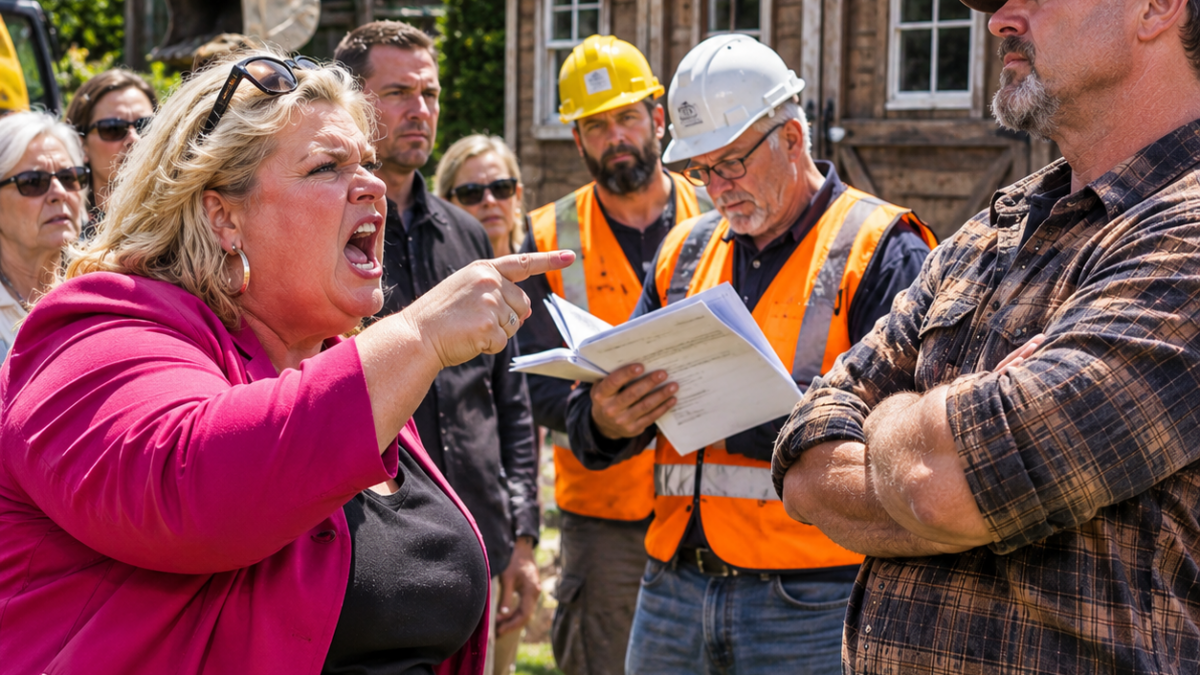
The HOA president stood in my driveway the night before demolition, pointed at the workshop I had spent six months planning for my son and me, and promised that by sunrise it would be nothing but splintered lumber—even though every permit, inspection, setback, material, paint color, and architectural drawing had already been approved.
At seven the next morning, she returned with a demolition crew and a small excavator, smiling like she had finally found a way to punish the one homeowner who had forced her to follow her own rules.
What Karen didn’t realize was that the first document the foreman would see inside my binder carried one very important signature at the bottom: hers.
The truck arrived at 6:58 a.m.
I know because I was sitting at the kitchen table watching the clock.
My coffee was black.
My binder was open.
Sarah stood behind the blinds.
“They actually came,” she whispered.
I heard the low diesel rumble before I saw the flatbed.
A small excavator sat chained to the trailer behind it.
Three workers climbed down wearing boots, hard hats, and the expressions of men who expected an ordinary demolition job.
Then Karen Miller rolled up in her golf cart.
Turquoise tracksuit.
Yellow construction helmet.
Clipboard.
And the most satisfied smile I’d seen on another human being in years.
Our son, Leo, appeared halfway down the stairs.
“Dad?”
“Stay inside with Mom.”
“Are they tearing down the workshop?”
“No.”
I said it with more confidence than I felt.
The workshop stood behind our house.
Twelve feet by sixteen.
Barn-red siding.
Dark asphalt shingles matching our home.
White trim.
Small workbench window facing the yard.
Nothing extravagant.
Nothing dangerous.
Nothing hidden.
I had built it because after twenty years with the Army Corps of Engineers, I wanted one place where construction wasn’t about schedules, military requirements, concrete quantities, logistics, or somebody else’s mission.
I wanted a room that smelled like lumber and machine oil.
A place where I could restore an old engine.
A place where Leo could learn how to hold a hammer without me worrying that I’d be transferred somewhere else before we finished the project.
That workshop wasn’t rebellion.
It was permanence.
The foreman walked toward the porch.
Big guy.
Gray beard.
Name patch said RICK.
“Morning.”
“Morning.”
“Got a work order to remove an unapproved shed.”
Karen came up beside him.
“This is the structure.”
She pointed toward my workshop.
“You can begin on the west wall. Once that’s down, the rest should collapse easily.”
I didn’t look at her.
I held out the binder.
“Rick, before you touch anything, I’d recommend reading this.”
Karen scoffed.
“He’s stalling.”
Rick took the binder anyway.
First page:
**OAK CREEK MEADOWS ARCHITECTURAL REVIEW COMMITTEE — FINAL APPROVAL**
He read it.
Then looked at Karen.
Then back at the page.
He turned it.
City building permit.
Foundation inspection.
Electrical permit.
Surveyed plot plan.
Setbacks.
Construction drawings.
Material specifications.
Paint approval.
Roofing approval.
Final inspection.
Everything.
Rick slowed down.
Karen stopped smiling.
He went back to the first page.
Ran his finger across the signature.
“Karen Miller?”
Karen folded her arms.
“I am the HOA president.”
“You signed this?”
“That approval was issued under incomplete information.”
Rick looked toward the workshop.
Then at me.
“Did you build what’s shown here?”
“To the inch.”
He checked the plot plan again.
Karen snapped:
“You’re not here to conduct a legal review. I hired your company to demolish that building.”
Rick closed the binder.
“Ma’am, I’m not touching it.”
Her mouth opened.
“What?”
“This structure has a city permit.”
“I know that.”
“Inspections.”
“The HOA has superior architectural authority.”
Rick frowned.
“And this says your architectural committee approved it.”
Karen’s face reddened.
“I revoked that approval.”
“Where?”
Silence.
Rick handed me the binder.
“If I damage a permitted private structure after seeing these documents, that becomes my problem.”
Karen stepped toward him.
“I am paying you.”
“Not enough.”
One of his workers coughed to hide a laugh.
Karen spun toward him.
“You will do the job you were contracted to perform.”
Rick stared at her for several seconds.
Then turned toward his crew.
“Load up.”
Karen looked like someone had struck her.
“You can’t leave!”
Rick kept walking.
“I can.”
“You’ll never work in this community again!”
He looked over his shoulder.
“Fine with me.”
The men climbed into the truck.
Chains rattled.
Engine started.
The excavator never came off the trailer.
As the truck pulled away, Leo appeared at the window.
I saw his face.
Relief.
Karen saw it too.
She slowly turned toward me.
“This isn’t over.”
I held the binder against my chest.
“No.”
I looked at her abandoned clipboard.
“I don’t think it is.”
She drove away.
By noon, the first retaliatory fine was already waiting at my door.
And that was when I understood she hadn’t come to demolish a shed.
She had come to prove she owned the neighborhood.
Now I was going to prove she didn’t.
PART 2
The first fine was fifty dollars.
**Improperly Stored Refuse Container.**
I stood in my driveway holding the notice and looked down the street.
Trash day.
Green and blue bins lined almost every curb.
Mine sat beside the garage.
Exactly where it had sat every Tuesday for two years.
Sarah read the notice over my shoulder.
“You’re kidding.”
“No.”
“She sent this after the crew left?”
“Looks that way.”
“What are you going to do?”
I looked toward Karen’s house at the far end of the block.
“Nothing emotional.”
Sarah laughed without humor.
“That wasn’t my question.”
“It was my answer.”
Twenty years in the Army Corps of Engineers had changed how I responded to conflict.
People like to imagine military experience makes a man aggressive.
Sometimes it does the opposite.
You learn that uncontrolled emotion creates mistakes.
Mistakes create casualties.
In engineering, one bad measurement could turn into tons of concrete in the wrong place.
One overlooked load calculation could turn into a collapsed structure.
One missing signature could stop a multimillion-dollar project.
Paper mattered.
Procedure mattered.
Precision mattered.
Karen wanted a shouting match.
I was going to give her certified mail.
I sat at my desk.
Opened the HOA bylaws.
Found the section on refuse containers.
Then wrote:
**Pursuant to the violation notice dated September 8, please identify the specific provision governing the precise storage location alleged to be violated. Please also provide the association’s written enforcement policy and documentation demonstrating consistent application of the provision to similarly situated properties.**
No accusation.
No threat.
Just questions.
Certified mail.
Return receipt.
The next morning, the second violation arrived.
Seventy-five dollars.
**Excessive Lawn Height.**
According to Karen, my grass exceeded three inches.
I went outside with a ruler.
Measured twenty locations.
Two and a quarter.
Two and a half.
One section near the mailbox reached two and three-quarters.
I photographed everything with date and time metadata.
Then sent another dispute.
**Enclosed please find photographs documenting lawn height below the stated three-inch standard. If the association contests these measurements, I request a joint inspection with a neutral landscaping professional.**
Certified mail.
Day three:
One hundred dollars.
**Nonconforming Mailbox Finish.**
The mailbox had been installed by the original developer.
Same model as half the street.
Karen claimed its black finish was insufficiently matte and that the red flag had faded beyond acceptable appearance.
I showed Sarah.
She sat at the kitchen table.
Stared.
Then laughed.
Not because it was funny.
Because there are moments when absurdity overwhelms fear.
“The flag is too faded?”
“Apparently.”
“Marcus.”
“Yes?”
“This woman tried to send an excavator to our house.”
“I remember.”
“Now she’s grading our mailbox.”
“She needs hobbies.”
“Can you please be serious?”
I sat across from her.
She wasn’t laughing anymore.
“This is two hundred twenty-five dollars in three days.”
“I know.”
“And if she keeps doing this?”
“We challenge every one.”
“What if she keeps adding fines faster than we can challenge them?”
“Bylaws say disputed violations are stayed pending review.”
“Will she obey that?”
“Probably not.”
Sarah stared at me.
That was the problem.
We both knew the rules.
Karen didn’t care.
Or worse—she cared only when the rules helped her.
I reached across the table.
“Sarah, listen to me.”
She did.
“We have the permits.”
“I know.”
“We have her signature.”
“I know.”
“We followed the process.”
“I know.”
“She wants us scared enough to surrender anyway.”
Sarah looked toward the backyard.
Through the kitchen window, we could see the workshop.
Leo’s bicycle leaned beside the door.
“I’m already scared,” she whispered.
That stopped me.
Not because I hadn’t noticed.
Because I’d been treating this like an operation.
Problem.
Objective.
Documentation.
Countermeasure.
Sarah was living inside it.
Every envelope made her stomach tighten.
Every time Karen’s golf cart slowed near our house, Sarah wondered what was coming next.
Leo had started asking why “the mean lady” kept photographing us.
A conflict I could compartmentalize was spilling into my family.
I squeezed Sarah’s hand.
“I’ll end it.”
“How?”
“I don’t know yet.”
“That’s reassuring.”
“I know how to find out.”
The mailbox dispute went out that afternoon.
I attached photographs showing identical developer-installed mailboxes.
Then requested the board resolution supposedly declaring the original mailbox noncompliant.
Certified.
Return receipt.
Three letters.
Three receipts.
Three formal disputes.
The following Monday, two more notices appeared.
Visible garden hose.
Fifty dollars.
Out-of-season decoration.
One hundred.
The decoration was a small patriotic wreath Sarah had left on the front door after Labor Day.
Karen was technically closer on that one.
The bylaw allowed patriotic decorations from Memorial Day through Labor Day.
We were two days over.
I could have removed it and accepted the warning.
Instead, Karen had gone straight to a hundred-dollar fine.
No warning.
No cure period.
I read the enforcement section.
She had skipped required steps.
I sent another dispute.
By the end of the week, our dining table looked like a law office.
Leo came in carrying a model car.
“Dad?”
“Yeah?”
“Can we work on this in the shop?”
I looked at the pile of certified receipts.
Then at him.
“Absolutely.”
We went outside.
The moment I opened the workshop door, the smell helped.
Fresh lumber.
Machine oil.
Paint.
Tools neatly arranged on pegboard.
The workbench I’d built along the back wall.
Leo placed his model car down.
“Mom says the shed almost got destroyed.”
“Workshop.”
He smiled.
“You always correct that.”
“Because it’s a workshop.”
“Karen calls it a shed.”
“Karen is wrong about many things.”
He picked up a screwdriver.
“Why does she hate it?”
I paused.
“I’m not sure she does.”
“She tried to break it.”
“Sometimes people hate being told they can’t control something.”
He thought about that.
“Like when Mom says I can’t control the TV?”
“Not exactly.”
“Sounds exactly.”
I laughed.
For forty minutes, we worked on the car.
No HOA.
No fines.
No strategy.
Just father and son.
That was when I remembered why the workshop mattered.
Karen saw a structure.
I saw Saturdays that hadn’t happened yet.
Years of them.
Leo learning to fix a bicycle.
Build a bookshelf.
Change oil.
Make mistakes safely.
Maybe one day bring his own child inside and say:
“Grandpa built this.”
Karen wasn’t taking that from me.
The next phase began by accident.
I started drinking my morning coffee on the front porch because I wanted to watch Karen’s patrol.
She drove the neighborhood almost every morning.
Golf cart.
Clipboard.
Same route.
At first I thought she was just nosy.
Then I noticed patterns.
Certain houses got a quick glance.
Others made her stop.
Mrs. Gable’s house three doors down was one of the stops.
Margaret Gable was seventy-eight.
Widow.
Small frame.
Huge garden.
Her yard was the opposite of Karen’s aesthetic.
Color.
Roses.
Lavender.
Daisies.
Hand-painted pots.
Six little garden gnomes hidden among the flowers.
I liked it.
One Saturday morning, I saw Karen leave Mrs. Gable’s driveway.
Margaret stood near the roses holding a white envelope.
She looked like she might cry.
I walked over.
“Morning, Mrs. Gable.”
She tried to smile.
“Marcus.”
“Everything okay?”
“Yes.”
Then her face folded.
“No.”
She handed me the notice.
Seventy-five dollars.
**Unapproved Garden Statuary.**
I looked toward the gnomes.
“Those?”
She nodded.
“She says they’re tacky.”
I stared at her.
“That’s the official reason?”
“It says aesthetically inconsistent.”
Of course it did.
“How long has this been going on?”
Margaret looked toward the street before answering.
“Months.”
“What else?”
“Weeds.”
“There aren’t any.”
“She found one.”
“One?”
“In the driveway crack.”
I closed my eyes.
“Anything else?”
“Cobweb on the porch lamp.”
“You were fined for a cobweb?”
“Warning first.”
“How much have you paid?”
She hesitated.
“Margaret.”
“Five hundred and some.”
“Why?”
Her voice became quiet.
“Because the letters say they can put a lien on the house.”
Her husband had died eight years earlier.
The house was paid off.
Her fixed income was enough if nothing unexpected happened.
Karen had turned garden ornaments into an unexpected monthly expense.
“Do you still have the letters?”
“Yes.”
“Show me.”
Inside, she brought out a shoebox.
Filled with notices.
Different dates.
Different violations.
Some warnings.
Some fines.
I arranged them chronologically.
Pattern.
Escalation.
Weak cure periods.
Inconsistent references to bylaws.
No clear hearings.
“Have you appealed?”
“I called Karen.”
“That isn’t an appeal.”
“She said appeals were pointless because the board had already decided.”
I felt anger move through me.
“Okay.”
Margaret looked frightened.
“Okay what?”
“You stop paying.”
Her eyes widened.
“What?”
“Don’t ignore anything. Don’t throw anything away. But don’t automatically pay another fine.”
“They’ll put a lien on my house.”
“Not without process.”
“Marcus, I can’t fight lawyers.”
“You won’t fight alone.”
She stared.
“You’d help me?”
“Yes.”
“Why?”
“Because that’s how bullies work.”
I took one of her notices.
“They isolate people.”
Then another.
“Make each person think they’re the only problem.”
I looked at her.
“We stop letting her do that.”
That afternoon, I drafted Margaret’s first formal dispute.
Certified mail.
Specific rule citation requested.
Hearing requested.
Evidence requested.
Collection stayed pending review.
Margaret signed it.
At the post office, she looked nervous.
“You sure?”
“No.”
She stared.
I smiled.
“I mean I’m sure about the process. I’m never sure what Karen will do.”
That actually made her laugh.
The next house was the Chengs.
David and Emily.
Two children under five.
I knew them enough to wave.
Karen’s golf cart stopped there frequently too.
David was mowing the lawn.
I introduced myself properly.
Told him about the demolition crew.
His reaction surprised me.
“She did what?”
“Sent a contractor.”
“To tear down your building?”
“Yep.”
“But she approved it.”
“Yep.”
David shut off the mower.
“You need to talk to my wife.”
Emily came outside.
Within ten minutes, I heard their story.
Swing set.
Simple wood structure.
Backyard.
Six-foot privacy fence.
Woods behind them.
Rejected because it would allegedly affect a neighbor’s sight line.
“What sight line?” I asked.
David pointed.
Fence.
Trees.
Nothing visible.
“Exactly.”
They appealed.
Karen warned that building without approval would trigger hundred-dollar-per-day fines.
Emily had cried after the meeting.
Not because she cared about winning.
Because their children kept asking when the swing set was coming.
“We told them maybe next year,” she said.
Her voice tightened.
“I hated saying that.”
“What if you didn’t have to fight alone?”
Both looked at me.
I explained what Margaret and I were doing.
Formal challenges.
Documented requests.
No phone arguments.
No hallway conversations.
Everything written.
David said:
“That works?”
“It creates accountability.”
Emily asked:
“And if she ignores it?”
“Then we prove she ignored it.”
That distinction became the foundation of everything that followed.
We weren’t trying to out-yell Karen.
We were building a record.
Over the next week, we talked to neighbors.
Not with speeches.
Questions.
“Have you had any trouble with the HOA?”
The answer was almost always yes.
Basketball hoop.
Vehicle parked overnight.
Sidewalk chalk.
Vegetable garden.
Unapproved flower pot.
Satellite dish.
Fence stain.
Children’s toys visible from street.
A man had been cited for washing his car on a Sunday because it created an “appearance of commercial activity.”
That one almost impressed me.
Karen could turn anything into a regulation.
I created a standard dispute template.
Neighbors customized facts.
Certified mail.
Hearing requests.
Evidence requests.
Bylaw citations.
Within two weeks, thirty households had joined a private online group.
That was almost a quarter of Oak Creek Meadows.
For the first time, people were comparing experiences.
The effect was immediate.
One woman posted:
**Wait, Karen told me nobody else had ever complained about this rule.**
Another replied:
**She told me the same thing.**
Isolation broke.
Fear followed.
Karen noticed.
Her retaliation against me intensified.
A notice claiming my driveway had an oil stain.
I photographed the concrete.
Nothing.
One for “unapproved exterior storage.”
Leo’s bicycle had been beside the workshop for forty minutes.
One for “excessive workshop activity.”
I couldn’t even find that phrase in the bylaws.
Every notice got a response.
Every response certified.
The binder grew.
Sarah’s anxiety remained.
But it changed.
At first, every envelope made her fearful.
Then annoyed.
Then analytical.
One evening she opened a notice before I got home.
“Marcus?”
“Yeah?”
“Apparently our porch light is thirty-five hundred Kelvin.”
I stared.
“And?”
“Approved range says twenty-seven hundred to three thousand.”
“You’re kidding.”
She held up the notice.
“We’re fifty dollars too blue.”
I looked at the bulb.
Then at her.
Sarah smiled.
“I already found the receipt.”
“You did?”
“It came with the house.”
She handed me the original developer specification.
**3500K exterior fixture package.**
I kissed her.
“That’s why I married you.”
“No.”
She pointed toward the kitchen.
“You married me because I fed you.”
Also true.
The real break came when I called Ben Carter.
Former JAG.
We had served together in Iraq.
Ben had a brain designed for finding weak points in language.
Contracts.
Regulations.
Bylaws.
After leaving service, he went into real-estate and contract law.
I emailed him the relevant documents.
He called two hours later.
“Marcus.”
“Yes?”
“Your HOA bylaws are garbage.”
“Good garbage or bad garbage?”
“Useful garbage.”
“What did you find?”
“Article Four. Section Eight.”
I opened it.
Indemnification.
Dense legal language.
Ben translated.
“The association protects directors acting in good faith within authorized board duties.”
“Okay.”
“It gets more specific.”
I read.
Major non-routine enforcement actions required board approval.
“Demolition.”
“Exactly.”
I sat straighter.
“Karen didn’t have a vote.”
“You sure?”
“George Thompson told me.”
“Who’s George?”
“Retired accountant. Board member. He supported my workshop appeal.”
“Would he testify?”
“I think.”
“Then Karen’s problem isn’t just that the demolition would’ve been wrongful.”
Ben paused.
“Her problem is that she may have acted personally outside the board’s authorization.”
I read the clause again.
“So HOA insurance doesn’t automatically shield her.”
“Correct.”
“Personally liable?”
“Potentially.”
“For attempted demolition?”
“For losses tied to unauthorized acts, depending facts.”
I smiled.
Ben heard it.
“Don’t get excited.”
“Too late.”
“Marcus, this isn’t revenge porn.”
“Ben.”
“I’m serious.”
“So am I.”
“We use this to isolate the conduct.”
“Meaning?”
“She hides behind the HOA.”
“Yes.”
“Take away the shield.”
That was the first prong.
Ben drafted a demand letter addressed to:
**Karen Miller, Individually.**
Not president.
Not HOA.
Karen Miller.
It described the unauthorized demolition order.
Referenced her own prior written approval.
Noted the contractor’s refusal after reviewing permits.
Identified costs already incurred.
Legal consultation.
Survey copies.
Time off work.
Document production.
Five thousand dollars demanded.
I laughed.
“She’ll never pay.”
“Of course not.”
“Then why?”
“Because we’re telling her, in writing, that the next consequences belong to her personally.”
That letter mattered psychologically more than financially.
Karen had spent years treating “the HOA” like armor.
Suddenly the letter said:
No.
This one may be yours.
Second prong:
Financial records.
Article Eleven.
Homeowners had inspection rights.
I could request as a member.
So could Margaret.
David.
We submitted a formal request.
Bank statements.
Invoices.
Vendor contracts.
Checks.
Credit-card statements.
Legal expenses.
Two years initially.
Karen responded:
Request too broad.
Ben laughed.
We replied with the actual bylaw.
No broadness restriction.
Ten days.
Karen tried another tactic.
Records available Wednesday mornings.
One hour.
Clubhouse only.
No photographs.
No photocopies.
David called.
“She thinks she’s clever.”
“She is clever.”
“That’s generous.”
“People are dangerous when we underestimate them.”
“So what do we do?”
“Follow her rule.”
Wednesday, ten a.m.
David.
Margaret.
Me.
Karen sat at a long clubhouse table.
Boxes behind her.
“You have one hour.”
“Understood.”
“No copies.”
“Understood.”
“No photography.”
“Understood.”
She smiled.
Then Margaret sat down with a stenography pad.
Karen looked at her.
“What is that?”
“Paper.”
“I can see that.”
Margaret smiled sweetly.
“I was a court stenographer for forty years.”
I almost felt bad for Karen.
Almost.
David opened the first bank statement.
“June fifth. Check 4052. Evergreen Landscaping. Seven thousand five hundred dollars.”
Margaret’s hand moved.
Fast.
I found invoice.
“Monthly grounds maintenance.”
David continued.
“July fourth. Check 4078. Evergreen. Seven thousand five hundred.”
Margaret’s pen flew.
Karen paced.
“What is she doing?”
“Taking notes.”
“You may not copy records.”
“We’re not.”
“That’s copying.”
“No.”
Margaret looked up.
“It’s transcription.”
Karen turned toward the clubhouse manager.
“Stop them.”
The manager looked terrified.
“Is there a rule?”
Karen didn’t answer.
I did.
“Show us.”
Her face flushed.
That hour changed everything.
Evergreen Landscaping:
$7,500 monthly.
Common areas didn’t justify it.
David worked logistics for a large company.
He’d seen grounds contracts.
“Two to three grand,” he whispered.
“Maybe more seasonally. Not seventy-five hundred every month.”
Invoice quality was poor.
Generic description.
No crew hours.
No service breakdown.
Address.
I searched public property records.
Owner:
Frank Miller.
Karen’s cousin.
I looked at David.
He looked at me.
Margaret kept writing.
Other charges:
“Board retreat.”
Thousands.
“Consulting.”
Vendor almost impossible to identify.
Expensive dinners.
Legal fees related to petty enforcement.
Event planning paid to someone with the same last name as Karen’s sister.
By the end of the hour, we had questions.
Important distinction.
Questions.
Not proof of theft.
Ben drilled that into us.
“Do not say embezzlement yet.”
“But—”
“No.”
“It’s obvious.”
“No.”
“Ben.”
“Suspicious related-party transactions.”
“That’s weak language.”
“That’s safe language.”
He leaned back.
“You want her removed or do you want a defamation counterclaim?”
“Removed.”
“Then boring wins.”
David obtained two confidential landscaping estimates.
Approximately $2,500 per month.
Evergreen:
$7,500.
Difference:
$5,000 monthly.
$60,000 annually.
Even if some premium service existed, the gap demanded explanation.
Meanwhile, Karen received Ben’s personal-liability letter.
George called me afterward.
“You lit a bomb.”
“What happened?”
“She brought it to executive session.”
“What did she say?”
“Demanded association counsel sue you.”
“Did they?”
“No.”
“Why?”
George lowered his voice.
“Because she admitted there was no board vote on the demolition.”
I stopped moving.
“Exactly?”
“She said, ‘I didn’t need a vote. I am president.’”
“George.”
“Yeah?”
“Will you put that in writing?”
Silence.
Then:
“Yes.”
That was courage.
Not dramatic.
But George had spent years sitting beside Karen.
Letting her dominate.
Now he was choosing a side.
Not mine.
Procedure’s.
He signed a statement confirming the board had never authorized demolition.
Ben called it:
“Beautiful.”
His favorite legal adjective.
We now had:
Karen’s signature approving the workshop.
Demolition work order.
Foreman’s account.
No board authorization.
Retaliatory fines.
Pattern of selective enforcement.
Record-inspection obstruction.
Related-party vendor payments.
Resident grievances.
Enough to act politically.
Ben found the special-meeting clause.
Twenty percent of homeowners could compel a meeting for removal.
Our private group already exceeded that.
I drafted the petition.
Cold language.
No “tyrant.”
No “corruption.”
No “Karen from hell.”
**We, the undersigned members of Oak Creek Meadows Homeowners Association, hereby petition for a special meeting regarding the conduct of President Karen Miller and a vote concerning removal from the board pursuant to Article Three, Section Five.**
David and Emily went with me door to door.
We didn’t reveal every financial finding yet.
We said:
“There are serious questions involving enforcement, unauthorized board actions, and related-party spending. We want a meeting.”
People signed.
Some asked nothing.
One man grabbed the pen before I finished.
“Where do I sign?”
Another said:
“I’ve been waiting six years.”
We needed twenty percent.
We got more than fifty.
Karen had created her own electorate against her.
The meeting was scheduled for three weeks later.
Tuesday evening.
She chose the date.
Probably hoping working families wouldn’t attend.
Emily created childcare coordination.
David organized carpools for older homeowners.
Margaret called people personally.
George worked from inside.
Sarah helped me build the presentation.
That became surprisingly emotional.
Slide one:
Photo of workshop.
Sarah stared at it.
“Remember before all this?”
“Yes.”
“You and Leo were so happy.”
“We still are.”
“Not the same.”
She was right.
For months the workshop had become a symbol of conflict.
Every time we looked at it, we saw Karen’s excavator.
“I want it back,” Sarah said.
“What?”
“Our normal life.”
I closed the laptop.
“We’ll get it.”
“No more war after this.”
“Agreed.”
“Promise?”
“Yes.”
We went back to the presentation.
Slide 2:
Karen’s approval.
Signature highlighted.
Slide 3:
Demolition work order.
Slide 4:
Board records showing no vote.
Slide 5:
Retaliatory violation timeline.
Slide 6:
Resident examples.
Slide 7:
Indemnification provision.
Slide 8:
Evergreen payments.
$7,500/month.
Slide 9:
Independent estimates.
Approximately $2,500/month.
Slide 10:
Ownership records.
Frank Miller.
Cousin.
Slide 11:
Other questioned expenses.
Slide 12:
**VOTE OF NO CONFIDENCE**
We rehearsed.
I had ten minutes.
Karen was likely to limit time.
I cut every unnecessary word.
No theatrics.
No insults.
Facts.
Leo watched one rehearsal from the couch.
When I finished, he said:
“Dad?”
“Yeah?”
“It’s boring.”
Sarah laughed so hard she almost fell over.
“Good,” I told him.
“Why?”
“Boring is harder to argue with.”
Meeting night arrived cold.
The clubhouse parking lot filled before seven.
Then overflowed.
Every chair occupied.
Residents stood against walls.
Karen entered wearing a navy blazer.
No tracksuit.
Professional armor.
For the first time since I’d known her, she looked uncertain.
She sat center stage.
George to her left.
Sandra and Bob, two other directors, nearby.
Her closest ally, Brenda, sat rigidly at the end.
Karen banged the gavel.
“Meeting called to order.”
The room quieted.
“This special meeting was demanded pursuant to the bylaws to hear complaints against the board.”
Complaints.
She made the word sound childish.
“Mr. Marcus Jackson has requested the floor.”
I hadn’t requested it alone.
But fine.
“You have fifteen minutes.”
I stood.
Laptop connected.
Projector on.
First slide.
The workshop.
“My name is Marcus Jackson.”
I looked around.
“I moved to Oak Creek Meadows because my wife Sarah and I wanted a permanent home for our son after twenty years of military moves.”
Karen shifted.
“This isn’t a biography.”
I ignored her.
“I built a twelve-by-sixteen-foot workshop.”
Next slide.
Plans.
“This structure was designed under HOA requirements.”
Next.
Survey.
“Setbacks exceeded.”
Next.
City permits.
“Building and electrical permits approved.”
Next.
ARC approval.
Karen’s signature filled the screen.
Gasps.
“This approval was signed by President Karen Miller.”
Karen leaned toward microphone.
“Under incomplete—”
George said:
“Let him finish.”
Karen stared at him.
I continued.
“After the workshop was completed to the approved plans, President Miller independently hired a demolition contractor.”
Next slide.
Work order.
“This action was not authorized by board vote.”
George spoke from stage.
“That is correct.”
The room shifted.
Karen’s face hardened.
“The president has enforcement discretion.”
I clicked next.
Indemnification language.
“Our bylaws distinguish routine enforcement from extraordinary action.”
I highlighted board-approval language.
“A demolition order is not routine.”
I looked at homeowners.
“The contractor refused the job after reviewing my permits and HOA approval.”
Next slide.
Fine timeline.
Trash bin.
Grass.
Mailbox.
Garden hose.
Wreath.
Bicycle.
Porch light.
People began murmuring.
“I formally disputed every violation.”
Next.
Certified receipts.
“These disputes were received.”
Next.
Additional fines.
“Enforcement continued.”
Margaret stood from front row.
Karen snapped:
“You’ll have your turn.”
Margaret didn’t sit.
“Will I?”
The room became silent.
Karen looked caught.
Margaret held up her shoebox.
“I’ve been paying fines for two months because I was afraid you would take my home.”
Karen rolled her eyes.
“Mrs. Gable, nobody is taking your home.”
“You threatened a lien.”
“Standard collection language.”
Margaret’s hands trembled.
“My husband and I bought that house in 1972.”
She pointed toward Karen.
“You made me afraid of my mailbox.”
That line hit harder than anything I had planned.
Karen looked away.
Emily Cheng stood.
“Our children were denied a swing set because Karen said their laughter could become a nuisance.”
Karen shouted:
“That is false!”
Emily’s husband David held up the rejection letter.
“We have it in writing.”
Noise rose.
Karen banged the gavel.
“Order!”
I raised my hand.
The room settled.
Then I clicked to:
**FINANCIAL QUESTIONS**
Karen stopped moving.
I displayed Evergreen Landscaping payments.
“Seventy-five hundred dollars per month.”
Next.
Independent quotes.
“Approximately twenty-five hundred.”
Next.
Annual difference.
“About sixty thousand dollars.”
People stared.
Karen said:
“Evergreen provides premium services.”
I clicked again.
County records.
Owner:
Frank Miller.
I said:
“Evergreen Landscaping is owned by President Miller’s cousin.”
The room exploded.
Not metaphorically.
People shouted.
“What?”
“You’ve got to be kidding!”
“That’s our money!”
“Did the board know?”
Brenda leaned toward Karen.
Sandra looked genuinely stunned.
Bob stared at the screen.
Karen stood.
“This is defamatory!”
I remained calm.
“No.”
I pointed at the document.
“This is a public ownership record.”
She shouted:
“You are implying criminal activity!”
“No.”
That surprised everyone.
I continued.
“I am stating that this association pays a related-party vendor approximately three times competing estimates.”
I pointed toward board.
“The members deserve an independent audit and an explanation.”
Karen grabbed microphone.
“My cousin is a respected businessman.”
“Then an audit will clear it up.”
Silence.
She hated that answer.
I displayed other expenses.
Consulting.
Board retreats.
Legal costs.
No accusations.
Just totals.
Then final slide.
**VOTE OF NO CONFIDENCE**
“I built a workshop.”
I looked around.
“It was approved.”
Then toward Karen.
“The president tried to demolish it anyway.”
Back to residents.
“When that failed, enforcement against my family escalated.”
I pointed toward Margaret.
“Then I learned we weren’t unique.”
Toward Chengs.
“Neither were they.”
I closed laptop.
“This isn’t about one shed.”
Workshop.
Leo would correct me.
“This is about whether authority inside this association comes from written rules and homeowner consent—or from one person’s preferences.”
I stepped back.
“I move for a vote of no confidence in Karen Miller and her removal from the board.”
George stood.
“I second.”
Karen stared at him.
“You traitor.”
George’s face changed.
“Karen.”
He leaned toward his microphone.
“I have been sitting beside you for four years.”
The room quieted.
“I should have spoken sooner.”
He looked toward Margaret.
“The fact that I didn’t is something I regret.”
Then at Karen.
“But I’m speaking now.”
That mattered.
More than people cheering me.
Because systems don’t change when outsiders win.
They change when insiders stop surrendering.
Karen grabbed the bylaws.
“This procedure is invalid.”
George already had the page open.
“No.”
Sandra looked toward the management representative.
“Is the motion valid?”
The representative nodded.
“Based on the petition, quorum, and governing documents, yes.”
Karen’s face lost color.
She had one weapon left.
Fear.
She looked at the homeowners.
“Think carefully.”
Nobody moved.
“If you remove experienced leadership, your property values will suffer.”
Someone laughed.
Karen snapped:
“You think this is funny?”
A man near the back shouted:
“What’s funny is paying ninety grand a year to your cousin!”
Applause.
Karen banged the gavel.
George took it gently from her hand.
“Enough.”
That was the moment her presidency ended, even before the vote.
The ballot method was debated.
Voice vote allowed.
Some residents requested written ballots.
Others wanted visible accountability.
The bylaws permitted a voice vote.
George called:
“All in favor of removing Karen Miller from the board?”
The response hit the room like thunder.
“Aye!”
Not a few voices.
Almost everyone.
George waited.
“All opposed?”
Silence.
Brenda didn’t speak.
Bob didn’t.
Sandra didn’t.
Karen herself didn’t.
George looked toward management representative.
Then announced:
“The motion carries.”
Karen sat frozen.
No tears.
No screaming.
Not yet.
She stared at the table.
Then:
“This is unbelievable.”
Nobody answered.
“You people have no idea what I’ve done for this community.”
Margaret said quietly:
“We do.”
Karen looked toward her.
That was worse than shouting.
She stood.
Gathered purse.
Papers.
Left through side door.
Nobody applauded her departure.
The absence of noise felt powerful.
The community was done feeding the performance.
George took the microphone.
“We still have business.”
First:
Terminate Evergreen contract pending review.
Passed overwhelmingly.
Second:
Suspend all disputed non-safety fines issued during the prior six months.
Passed.
Third:
Refund or credit improperly collected fines subject to audit.
Passed.
Margaret cried.
Emily hugged her.
Fourth:
Commission independent forensic audit of five years of association finances.
Passed.
Fifth:
Refer credible findings to law enforcement or appropriate authorities if warranted.
Passed.
I stood near the wall watching residents talk.
Not celebrating me.
Talking to one another.
That was the real shift.
David came over.
“You did it.”
“No.”
He looked around.
“We did.”
Sarah entered the room.
She had stayed near the back with Leo.
Leo ran toward me.
“Dad!”
I picked him up even though he was getting too big.
“Does this mean Karen can’t knock down the workshop?”
“Yes.”
“Forever?”
I laughed.
“As long as we keep following the rules.”
He thought.
“So probably forever.”
“Probably.”
The audit began the following week.
This is where reality became more complicated than neighborhood rumors.
Not every suspicious expenditure was theft.
Some board retreats were legitimate.
Some legal fees, while excessive, were authorized.
Some landscaping work included seasonal services David’s rough estimates hadn’t captured.
But enough remained unexplained.
Related-party contracting without disclosure.
Inflated invoices.
Personal expenses categorized as association costs.
Payments unsupported by adequate documentation.
A cash account with serious discrepancies.
The independent accountant referred specific findings to legal counsel.
Then authorities.
Weeks later, investigators requested records.
Karen’s cousin produced documents.
Additional inconsistencies emerged.
I stayed out of it.
That surprised people.
David asked:
“Don’t you want to see her arrested?”
“No.”
“You’re serious?”
“Yes.”
“After everything?”
I looked toward my workshop.
“I wanted that protected.”
Then toward Margaret’s house.
“I wanted people to stop being afraid.”
“That’s it?”
“That was enough.”
Ben agreed.
“Let investigators investigate.”
I said:
“You’re less fun than when this started.”
“Winning makes lawyers boring.”
Months passed.
The criminal case developed independently.
Karen eventually faced charges related to financial misconduct.
The precise story was less cinematic than gossip made it.
Records.
Interviews.
Subpoenas.
Hearings.
Plea negotiations.
In the end, she entered a guilty plea to serious financial charges tied to misuse of association funds and was ordered to pay restitution, with incarceration imposed as part of the sentence.
I never attended court.
Sarah asked once:
“You don’t want closure?”
“I have closure.”
I pointed outside.
Leo and David Cheng’s children were running between houses.
Their new swing set stood in the backyard.
Blue.
Very blue.
“I think that’s closure.”
The new board changed everything slowly.
George became president.
Reluctantly.
His first speech lasted three minutes.
“I am not here to redesign your lives.”
That got applause.
He introduced financial safeguards.
Competitive bidding.
Related-party disclosure.
Dual signatures above spending thresholds.
Online monthly statements.
Independent annual review.
Clear architectural guidelines.
Real appeal procedure.
Response deadlines.
No board president could chair both enforcement and appeal.
No unilateral demolition orders.
That rule became known unofficially as the Marcus Provision.
I hated it.
Leo loved it.
“Dad, there’s a rule named after you.”
“There is not.”
“Mr. Cheng said so.”
“Mr. Cheng is a liar.”
David overheard from his yard.
“I prefer historian.”
Mrs. Gable’s fines were reviewed.
Most refunded.
She celebrated by buying three more garden gnomes.
Then four.
Then, apparently out of spite, a ceramic frog wearing sunglasses.
I walked past one morning.
“Margaret.”
“Yes?”
“That’s hideous.”
She smiled.
“I know.”
“Good.”
The Chengs resubmitted their swing-set plan.
Approved in four days.
Emily called Sarah crying.
Happy crying.
The day David assembled it, half the neighborhood showed up.
I brought tools.
So did George.
Leo handed bolts to the younger kids.
When it was finished, the Cheng children climbed aboard.
Their laughter carried over the fence.
Emily stood beside me.
“Noise nuisance.”
I smiled.
“Terrible.”
“Absolutely awful.”
Then she started crying again.
The workshop changed too.
For months, I’d walked into it and remembered the excavator.
Eventually that memory faded.
Leo and I built birdhouses first.
Simple.
Then repaired his bike.
Then a pinewood derby car.
Then shelves for Sarah.
Then a small toolbox just for Leo.
I taught him:
Measure twice.
Cut once.
Keep fingers clear.
Wear eye protection.
Clean your tools.
Don’t force threads.
He taught me patience in a different way.
“Dad, why does everything have to be straight?”
“Because.”
“That’s not an answer.”
“It is in engineering.”
One Saturday, we found an old go-kart frame online.
Rusty.
No engine.
Leo looked at me.
“We can fix that.”
I looked at him.
He had the same expression I’d probably had as a boy.
“What makes you think that?”
“You built the shop.”
Fair.
We bought it.
That project lasted months.
Engine rebuild.
Brake cable.
Steering.
Paint.
Leo chose red.
Not approved rustic barn red.
Bright red.
Inside the workshop, Karen had no jurisdiction.
The day we started the engine, it coughed twice.
Then roared.
Leo screamed.
Sarah came running outside.
“What happened?”
“It works!”
He drove three slow laps around the driveway.
I had one hand hovering near the kill switch the entire time.
Sarah filmed it.
Later, she showed me a picture.
Me standing beside the workshop.
Leo in the go-kart.
Sun behind us.
She said:
“This is what we almost lost.”
I looked at her.
“No.”
She shook her head.
“Not the building.”
I understood.
Peace.
Routine.
Future.
That’s what harassment takes first.
Before money.
Before property.
It takes your expectation that tomorrow will be normal.
The new board gave that back.
Not perfectly.
There were still arguments.
One homeowner wanted a six-foot statue in the front yard.
Denied.
Another wanted to paint his house purple.
Architectural committee offered muted plum instead.
He called it oppression.
People laughed.
Normal disputes.
Difference was process.
Written standard.
Notice.
Hearing.
Appeal.
No revenge.
No personal vendetta.
That’s governance.
Karen’s house became quiet.
Her legal situation worsened.
Lawn grew.
Hedges became uneven.
For years she had photographed neighbors over half-inch grass differences.
Now dandelions covered her own front yard.
People noticed.
Some laughed.
George discouraged it.
“Don’t become her.”
That phrase spread.
Whenever somebody wanted to pile on:
Don’t become her.
Useful rule.
Eventually the house was sold.
A young family moved in.
First week, they placed children’s bicycles against the garage.
Nobody photographed them.
Second week, chalk drawings covered the driveway.
Nobody fined them.
Third week, their trash bins remained visible for almost an entire afternoon after pickup.
Civilization survived.
One afternoon, I was applying sealant to the workshop deck when a police cruiser stopped in front of Karen’s house.
Then another vehicle.
Detective.
Officers walked to door.
Minutes later, Karen came out.
No pink tracksuit.
No navy blazer.
Bathrobe.
Hair disheveled.
Handcuffed.
The source material had made this moment feel like the triumphant climax.
Reality felt different.
She looked small.
Not metaphorically.
Just human.
For months, I had imagined wanting to see her face when consequences arrived.
When it happened, I felt almost nothing.
She looked across the street.
Saw me.
Our eyes met.
No venom.
No defiance.
Just recognition.
I didn’t smile.
Didn’t nod.
Didn’t wave.
I went back to brushing sealant onto the deck.
Leo came out later.
“Was that Karen?”
“Yes.”
“Why were police here?”
“Adult problems.”
“Is she going to jail?”
“Maybe.”
“What did she do?”
I thought about how much to tell a child.
“She was trusted with other people’s money.”
He waited.
“And?”
“She didn’t handle that trust the way she was supposed to.”
“Like stealing?”
“Something like that.”
Leo looked toward her house.
“Is that why she was mean?”
“No.”
Important distinction.
“People can be mean without stealing.”
“And steal without being mean?”
“Yes.”
“Adults are weird.”
Correct.
Legal proceedings continued.
Eventually Karen’s guilty plea became public.
Restitution.
Sentence.
Her cousin also faced financial consequences related to the vendor arrangement.
The HOA recovered part of the losses through restitution, insurance, and civil remedies.
Not everything.
Communities pay when governance fails.
That part often gets lost in the satisfying endings.
Some money was gone.
Some legal expenses couldn’t be recovered.
Some residents had sold because of harassment.
Some relationships never repaired.
Victory wasn’t magical.
It was expensive cleanup.
George was honest about that.
At an annual meeting he said:
“We are not celebrating a financial scandal.”
The room went quiet.
“We’re learning from it.”
He displayed new controls.
Audits.
Contracts.
Reserve balances.
Budget.
People asked boring questions.
Excellent.
Boring questions prevent dramatic disasters.
Mrs. Gable became a fixture at meetings.
She sat front row.
Knitting.
Every time somebody proposed a new restriction, she’d look up and ask:
“Is this because something is actually dangerous, or because somebody doesn’t like looking at it?”
Most useful governance test I’ve ever heard.
Years passed.
Leo got taller.
The workshop didn’t.
At twelve, he could reach every tool.
At fourteen, he wanted a dirt bike.
Sarah said no.
He appealed to me.
I said:
“Your mother outranks me.”
“That’s not how marriage works.”
“It is in this house.”
We compromised on rebuilding a small motorcycle engine without buying the motorcycle.
He hated the compromise.
Then loved the engine.
At sixteen, he bought his first old pickup.
Rust around wheel wells.
Engine trouble.
We pushed it into the driveway.
For six months, the workshop became headquarters.
Parts labeled.
Manuals open.
Tools everywhere.
One night we were there past midnight.
Sarah came outside.
“You two know it’s Tuesday?”
Leo slid out from beneath the truck.
“It’ll start tonight.”
“It had better.”
At 12:47 a.m., it did.
Ugly engine rattle.
Then steady idle.
Leo stood still.
Eyes wide.
I remembered when he was seven asking if Karen could destroy the workshop.
Now he was sixteen, covered in grease, standing inside the future I’d imagined.
That was the real revenge.
Karen had wanted the building gone because it represented a limit to her control.
It survived long enough to become part of my son’s childhood.
No courtroom judgment could have given me more satisfaction.
Leo drove the truck to high school.
Then college.
Engineering.
Of course.
Civil.
Not military.
His decision.
I was proud.
The first semester he came home frustrated.
“Dad, statics is stupid.”
“Statics is beautiful.”
“No.”
“Yes.”
“Nobody cares about moments.”
“Until something falls down.”
He groaned.
We sat in the workshop.
I pulled out an old bridge problem.
Two hours later, he understood.
“This is why you built this place, isn’t it?”
“What?”
“To teach me stuff.”
“Partly.”
He looked around.
“And fix engines.”
“Mostly engines.”
He smiled.
Oak Creek Meadows evolved.
George eventually stepped down.
David Cheng joined the board.
Then became president.
The same man who once couldn’t get approval for his children’s swing set was now responsible for ensuring other families were treated fairly.
He took it seriously.
Maybe too seriously.
He called me constantly.
“Marcus.”
“What?”
“Fence issue.”
“I’m not on the board.”
“I need advice.”
“No.”
“Please.”
“No.”
“What if I buy beer?”
“What kind?”
Governance became neighborly instead of imperial.
Sarah planted a vegetable garden.
Karen’s old board had discouraged them in visible areas.
New standards allowed backyard gardens.
Tomatoes.
Peppers.
Herbs.
Too many zucchini.
Always too many zucchini.
She brought baskets to Margaret.
Margaret gave gnomes in return.
I told Sarah not to encourage her.
She ignored me.
Then life moved beyond the HOA story.
As it should.
Leo graduated.
Took a job two states away.
Workshop became quieter.
His tools remained on one section of pegboard.
I never moved them.
Sarah noticed.
“You know he’s coming home.”
“I know.”
“You can use that space.”
“I know.”
“You’re sentimental.”
“No.”
She smiled.
“Yes.”
When Leo visited, we still worked there.
Small projects.
Then larger.
One Christmas, he brought his girlfriend.
Later wife.
Her name was Anna.
First tour of the house ended in workshop.
Of course.
Leo said:
“This is the famous building.”
Anna looked around.
“Famous?”
I sighed.
Leo told her the demolition story.
Made it increasingly dramatic.
By his version, Karen arrived with three bulldozers and a SWAT team.
I corrected him.
“Small excavator.”
“Dad, don’t ruin it.”
Anna asked:
“Did the crew really refuse?”
“Yes.”
“Because of the permits?”
“And her signature.”
She laughed.
“That must have been incredible.”
At the time?
Yes.
Years later?
The crew’s refusal mattered less than what came after.
Because stopping one bad action is easier than repairing the culture that made the action possible.
Oak Creek Meadows changed because residents stopped outsourcing responsibility for governance.
They read minutes.
Attended meetings.
Asked for bids.
Reviewed budgets.
Rotated leadership.
Karen had been powerful because everyone else was busy living.
That’s understandable.
But institutions belong to whoever keeps showing up.
She did.
Until everybody else did too.
Mrs. Gable died at eighty-eight.
Peacefully.
Her niece asked me to come by.
Margaret had left instructions.
Her gnome collection was to be distributed among “the people who helped make Oak Creek Meadows tolerable.”
I received one.
Of course.
Red hat.
White beard.
Terrible.
Sarah placed it directly beside my workshop door.
“No.”
“Yes.”
“Absolutely not.”
“Margaret’s final wish.”
“She had six.”
“Now you have one.”
I moved it behind a shrub.
Sarah moved it back.
This battle lasted months.
I lost.
The gnome stayed.
David Cheng eventually passed a resolution allowing small garden statuary without architectural approval.
Unofficial title:
**The Gable Rule.**
That one I liked.
Years after Karen left, Oak Creek Meadows held its first community workshop day.
Not my workshop.
A neighborhood event.
Repair bicycles.
Build birdhouses.
Teach basic home maintenance.
I volunteered.
Kids rotated through stations.
Hammering.
Drilling.
Measuring.
Leo happened to be visiting.
He joined me.
At one point, a ten-year-old boy bent a nail.
He looked embarrassed.
Leo said:
“Good.”
The boy frowned.
“What?”
“Now you learn how to pull one out.”
I watched my son teach exactly the way I’d taught him.
Something tightened in my chest.
The building Karen called an eyesore had become the place where my son learned patience.
And now he was passing it on.
Sarah saw my face.
She whispered:
“Don’t cry.”
“I’m not.”
“You are.”
“Sawdust.”
“Outside?”
“Wind.”
She laughed.
We aged.
Workshop weathered.
Paint needed another coat.
Shingles replaced once.
I kept every permit anyway.
The original binder remained on a shelf.
Thick.
Tabs faded.
ARC approval still first page.
Karen’s signature still there.
Every few years someone new in the neighborhood heard the story and asked to see it.
I would open the binder.
Point.
“There.”
People laughed.
I stopped enjoying that part after a while.
Karen’s signature wasn’t a trophy.
It was a lesson.
Approval matters.
Process matters.
But process only works when people act in good faith.
No amount of paperwork guarantees someone won’t abuse authority.
The binder saved the workshop because the demolition foreman respected evidence.
If Rick had been careless, the excavator could have done serious damage before police or lawyers stopped anything.
That realization stayed with me.
So the board added a rule:
No association contractor could enter private property for non-emergency enforcement action without written board authorization, legal review where appropriate, and homeowner notice.
No solo president could dispatch equipment.
Common sense, written down because common sense had once failed.
Rick visited once years later.
He was working nearby.
Saw me outside.
Pulled over.
“Still standing?”
He pointed at workshop.
“Still standing.”
He laughed.
“You know, I almost took that job.”
“I know.”
“My dispatcher said it was an illegal shed.”
“I know.”
“Then I saw the permit.”
“Best five minutes of my year.”
He shook his head.
“That woman called our office twelve times after we left.”
“Only twelve?”
“She threatened to destroy our reputation.”
“How’d that work?”
“We’re still in business.”
I offered him coffee.
We sat inside workshop.
He looked at tools.
Projects.
Photos of Leo.
“You built all this for your kid?”
“Originally.”
He nodded.
“Glad I didn’t knock it down.”
“So am I.”
That sentence hit me harder than expected.
The demolition had once been a dramatic event.
Now the emotional truth was simple.
A decent contractor paused before causing irreversible harm.
Because he paused, thousands of ordinary moments happened afterward.
Birdhouses.
Go-kart.
Truck.
Engineering homework.
Coffee.
Family.
Sometimes justice is one person saying:
“I can’t touch this.”
Sarah got sick when we were in our late sixties.
Breast cancer.
Caught early.
Treatment worked.
But for almost a year, our world narrowed.
Appointments.
Surgery.
Medication.
Fatigue.
Leo came home frequently.
The workshop became my escape again.
Not from Sarah.
From fear.
I would sand wood.
Sharpen tools.
Fix things that could be fixed.
One evening Sarah came outside wearing a sweater despite warm weather.
She sat on stool.
“What are you building?”
“Nothing.”
“That’s a suspicious amount of lumber for nothing.”
I was making her a potting bench.
She knew.
Pretended not to.
After treatment ended, she used that bench for years.
Karen’s old fight had taught us something we didn’t appreciate until illness:
Having a peaceful place matters.
A home is more than square footage.
It’s control over small routines.
Where your tools hang.
Where your plants sit.
Where your child learns.
Where your spouse rests.
That’s why petty property conflicts can hurt so deeply.
Outsiders see a shed.
Mailbox.
Garden gnome.
Swing set.
The owner sees life.
Authority must understand that before it interferes.
Sarah recovered.
We celebrated quietly.
Dinner.
Wine.
Then she handed me a small gift.
A brass plaque.
It read:
**JACKSON WORKSHOP**
**PERMITTED, APPROVED, AND STILL STANDING**
I laughed until I cried.
We mounted it inside.
Not outside.
Too provocative.
Probably.
Leo eventually had a son.
His name was Noah.
At four, Noah entered workshop and immediately grabbed the wrong tool.
Family tradition.
I taught him a hammer.
Leo hovered.
“Dad, he’s four.”
“So were you emotionally.”
“Very funny.”
Noah hammered scrap wood.
Missed nail.
Hit board.
Then thumb.
Cried.
I felt terrible.
Leo said:
“Good lesson.”
“Your child is bleeding.”
“Barely.”
Anna glared at both of us.
Men were removed from instructional authority for ten minutes.
Years later, Noah built his first birdhouse on the same bench Leo used.
Three generations.
That’s when I finally understood what Karen almost demolished.
Not lumber.
Continuity.
The HOA story became legend in our family.
Noah exaggerated it more than Leo.
By age nine, Karen had arrived with “a giant bulldozer and twenty cops.”
I corrected him.
He ignored me.
Children prefer myths.
I tried to keep lesson simple:
“Grandpa followed the rules.”
“And Karen didn’t?”
“Eventually, yes.”
“And then police took her away.”
“For something different.”
“Money?”
“Yes.”
“So she was bad.”
I paused.
“People do bad things.”
“That isn’t what I asked.”
Smart kid.
“She abused power.”
“Why?”
“I don’t know.”
That was the most honest answer.
Maybe control.
Insecurity.
Money.
Habit.
Power can become identity.
When people challenge decisions, it feels like personal rejection.
Karen wasn’t born carrying a clipboard.
Somewhere along the line, she learned that being feared felt like being respected.
The neighborhood reinforced it by surrendering.
Until we didn’t.
One summer, Oak Creek Meadows debated dissolving the HOA entirely.
Some wanted no association after what happened.
I opposed dissolution.
That surprised people.
David called.
“You, of all people?”
“Yes.”
“Why?”
“Who maintains the retention pond?”
“HOA.”
“Playground?”
“HOA.”
“Common landscaping?”
“HOA.”
“Insurance?”
“HOA.”
He sighed.
“So your point is?”
“Bad governance doesn’t mean no governance is better.”
The association remained.
With reforms.
That decision mattered.
Revenge would’ve been destroying Karen’s institution.
Wisdom was repairing it.
I learned that late.
George died in his seventies.
At his memorial, his daughter told me he kept a copy of the special-meeting minutes in his desk.
“Why?”
“He said it was the first time in his life he stood up to somebody he should have challenged sooner.”
I swallowed.
George had always felt guilty.
I told her:
“He did stand up.”
“He knew.”
“He was the reason the vote worked.”
She smiled.
“I’ll tell Mom.”
We lose people.
Buildings remain longer.
Organizations remain.
Stories distort.
Documents help.
The original binder became increasingly important for that reason.
Years later, a new homeowner repeated the story:
“Didn’t Karen own the demolition company?”
“No.”
“I heard she forged the permits.”
“No.”
“Didn’t the excavator driver call the FBI?”
“Absolutely not.”
Truth is usually less cinematic.
But better.
Karen signed approval.
Later decided she hated what she’d approved.
Acted alone.
Crew checked documentation.
Refused.
She retaliated.
Residents organized.
Financial questions emerged.
Audit found serious misconduct.
Board removed.
Authorities acted.
Community reformed.
Enough drama already.
No need to invent helicopters.
One fall afternoon, Noah asked:
“Grandpa, what happened to Karen?”
“I don’t know.”
“Really?”
“Not anymore.”
“Why not?”
“Because her life stopped being my business.”
He didn’t understand.
I did.
That was perhaps the final victory.
There had been a time when I knew every Karen movement.
Golf cart route.
Meeting schedule.
Letters.
House.
Legal case.
My mind revolved around her.
That’s another kind of control.
Even after you beat someone, they can remain powerful if you keep organizing your thoughts around them.
Eventually, I stopped.
Forgot dates.
Stopped checking case updates.
Stopped enjoying stories about her lawn.
Moved on.
One day, years after Sarah and I retired fully, a piece of mail arrived addressed to Karen Miller.
Wrong house.
Postal error.
Sarah handed it to me.
“Ghost.”
I looked at name.
Felt nothing.
Marked:
**NOT AT THIS ADDRESS**
Put it back in mailbox.
That was freedom.
The workshop aged with me.
My hands became less steady.
Leo installed brighter lighting.
Against my wishes.
“You need it.”
“I can see.”
“You just measured three and seven-eighths as three and five-eighths.”
“The tape is defective.”
“Dad.”
He added lights.
Good decision.
Noah eventually inherited my old hammer.
The one Leo first used.
Handle worn.
Nothing special.
Tools become memory too.
Sarah’s potting bench remained near window.
Even after she stopped gardening as much.
Margaret’s gnome still beside door.
I stopped moving it.
One evening, Sarah and I sat in workshop while rain hit roof.
She looked around.
“Remember turquoise hard hat?”
I laughed.
“Yes.”
“She really wore that?”
“Yes.”
“You should’ve taken a photo.”
“I was busy protecting our home.”
“Still.”
We sat quietly.
Then she said:
“I was terrified.”
“I know.”
“No, you didn’t.”
I looked at her.
She continued.
“You were in mission mode.”
That hurt because it was true.
“I thought every letter might turn into a lien.”
She looked toward workshop door.
“I thought we’d have to move.”
“I wouldn’t have let that happen.”
“You couldn’t know.”
“No.”
“I needed you to say you were scared too.”
I swallowed.
“I was.”
“I know now.”
“I should’ve said it then.”
“Yes.”
Marriage is full of victories discovered years too late.
I reached for her hand.
“I was terrified the crew would damage it before we stopped them.”
She nodded.
“I was terrified Karen would keep escalating until something broke.”
“Me too.”
“We got lucky.”
“Yes.”
“Documents helped.”
“Yes.”
“Neighbors helped.”
“Yes.”
“The contractor helped.”
“Yes.”
“Not just you.”
“No.”
That was another myth I had to release.
I liked thinking discipline won.
It mattered.
But so did Rick refusing.
George speaking.
Margaret transcribing.
David organizing.
Emily pushing.
Ben reading bylaws.
Sarah keeping me human.
Communities defeat bullies collectively.
The hero story is easier.
Reality is better.
Years later, Oak Creek Meadows commemorated its fiftieth anniversary.
The board asked longtime residents to contribute stories.
David wanted mine.
“No.”
“Why?”
“Because everyone knows it.”
“New residents don’t.”
“Good.”
Sarah intervened.
“He’ll write it.”
I glared.
She smiled.
So I wrote one page.
Not about Karen.
About the workshop.
Why I built it.
Leo.
Permanence after military life.
The value of transparent approval.
The role of neighbors.
Final paragraph:
**The lesson was never that associations are bad or that rules are meaningless. The lesson was that rules must constrain the people enforcing them as much as the people subject to them.**
David printed that line in bold.
Of course.
Karen’s name appeared once.
Enough.
When I turned eighty, Leo asked if I wanted to move closer to him.
Sarah had died two years earlier.
That changed everything.
The house felt too big.
Workshop felt right.
I couldn’t imagine leaving.
But acreage wasn’t issue.
Neighborhood.
Memories.
Sarah everywhere.
Kitchen.
Garden.
Workshop doorway with lemonade.
Leo understood.
He didn’t push.
Eventually, compromise.
He and Anna moved closer instead.
Noah was in college by then.
Engineering too.
Mechanical.
Family finally corrected Leo’s civil-engineering error.
The workshop became our gathering place again.
One Christmas, Noah gave me a framed copy of the original ARC approval.
Karen’s signature highlighted.
I stared.
“Why would I want this?”
He grinned.
“Historical artifact.”
I laughed.
We hung it inside next to Sarah’s brass plaque.
**PERMITTED, APPROVED, AND STILL STANDING.**
Good pairing.
Oak Creek Meadows continued without drama.
Boards changed.
Rules updated.
There were arguments.
Normal.
One year, a president proposed banning basketball hoops visible from street.
Residents voted it down.
No crisis.
No revolt.
No secret network.
Just meeting.
Discussion.
Vote.
That’s institutional health.
One evening, David—older now—walked over.
“You know what I realized?”
“What?”
“We don’t need you anymore.”
“Finally.”
“I mean it.”
“Good.”
“When Karen was president, everyone needed somebody to save them.”
“That’s not what happened.”
“Close enough.”
“And now?”
“People know the process.”
He smiled.
“That’s the real win.”
Yes.
The goal of reform should be making heroes unnecessary.
I didn’t want another homeowner needing military discipline, legal friends, certified-mail campaigns, and a retired stenographer just to put up a swing set.
A good system handles ordinary disagreement ordinarily.
No legend required.
The last major project Leo and I did together in the workshop was restoring an old 1968 pickup.
Not valuable.
Rusty.
Bad wiring.
Perfect.
We worked for almost a year.
Noah joined during breaks.
Three generations.
At some point, Leo found an old photograph.
The morning of demolition.
Rick’s truck in background.
Karen in turquoise hard hat.
Apparently Sarah had taken one through the blinds after all.
I stared.
“She did photograph it.”
Leo laughed.
“Mom always won.”
Karen stood beside excavator trailer.
Arms crossed.
So confident.
Workshop behind her.
Complete.
I looked from photograph to actual building around us.
Decades later.
Still standing.
Pegboards fuller.
Floor stained.
Bench scarred.
Photos of children and grandchildren.
Sarah’s plaque.
Margaret’s gnome outside.
Life.
I put photograph in drawer.
No need to display it.
That image represented one morning.
The workshop represented everything after.
The restored truck started for first time on a cool October afternoon.
Engine rumbled.
Leo looked at me.
Noah cheered.
I stood in doorway.
For one moment, I could see every version of the building at once.
Plans on kitchen table.
Karen’s reluctant signature.
Fresh red siding.
Excavator arriving.
Rick closing binder.
Leo’s model car.
Go-kart.
Pickup.
Sarah’s potting bench.
Grandson’s birdhouse.
Old age.
All of it existed because the structure survived one woman’s need to win.
People ask me sometimes what I would’ve done if the demolition crew had ignored the permits.
Police.
Court.
Insurance.
Lawsuit.
Repair.
Whatever necessary.
But I’m grateful I never had to find out.
The foreman read.
Thought.
Refused.
That simple act redirected decades.
It taught me something I wish every contractor, official, board member, manager, and homeowner understood.
When somebody asks you to destroy something, pause.
Check.
Authority should survive verification.
If it can’t, it isn’t authority worth obeying.
Karen’s order failed the moment somebody outside her system asked:
“Do you actually have the right to do this?”
Everything after grew from that question.
The fines failed when residents asked:
“Show us the rule.”
The contracts failed when Arthur and others asked:
“Show us the numbers.”
Karen’s personal protection failed when Ben asked:
“Show us the board authorization.”
Her presidency failed when homeowners asked:
“Show us why we should trust you.”
Power hates questions when its foundation is weak.
Good leadership welcomes them.
I wasn’t always as wise about that as I sound now.
There were years when subordinates were probably scared to challenge me too.
Military rank can produce its own Karen tendencies if you’re careless.
I thought about that often after the HOA fight.
Did I ever confuse compliance with respect?
Probably.
Did I ever dismiss a younger engineer because I was certain?
Almost certainly.
The difference I hoped mattered was whether I could be corrected.
That became my test.
Not:
Am I in charge?
But:
Can someone safely tell me I’m wrong?
Karen built a system where the answer was no.
Oak Creek Meadows rebuilt one where the answer became yes.
That’s bigger than one workshop.
In my final years in the house, I spent less time building.
More time sitting.
The workshop door stayed open on good afternoons.
Neighbors walked past.
Kids waved.
Some didn’t know the story.
Perfect.
One little boy stopped once.
“Mr. Jackson?”
“Yeah?”
“My dad says you built this.”
“I did.”
“Can I see?”
“Ask your dad.”
His father came over.
We toured.
Boy stared at tools.
“What’s that?”
“Drill press.”
“That?”
“Bench grinder.”
“That?”
“Old man.”
He laughed.
I showed him a birdhouse template.
Twenty minutes later, we were building.
His father watched.
Maybe that’s what a workshop should be.
Not monument.
Not fortress.
Useful.
Living.
The day came when I knew it was time to sell.
Not because Karen won.
Not because neighborhood changed.
Because stairs were harder.
Sarah gone.
Leo wanted me closer.
I agreed.
New buyer:
Young family.
Father named Chris.
Daughter nine.
Son six.
During walkthrough, Chris stopped at workshop.
“This stays?”
“Unless you tear it down.”
He laughed.
Then saw my face.
“Was that a joke?”
“Long story.”
He looked around.
“My kids would love this.”
“Good.”
I gave him binder.
Original plans.
Permits.
Electrical diagrams.
Maintenance.
ARC approval.
He flipped.
“That’s a lot.”
“You have no idea.”
At first page, he saw Karen’s signature.
“Who’s Karen Miller?”
I smiled.
“Nobody important anymore.”
Closing day.
I walked through workshop alone.
Touched bench.
Leo’s first hammer mark.
Sarah’s plaque.
Photograph drawer.
I took plaque.
Left approval copy.
Took Margaret’s gnome.
That felt wrong to leave.
At door, I stopped.
I had imagined this building as something permanent.
Nothing is.
Permanence is relative.
But it lasted long enough.
Long enough to do its job.
Teach my son.
Hold my marriage’s memories.
Welcome grandson.
Give neighbors confidence.
Become ordinary.
That’s enough for any structure.
I shut the door.
Then reopened it.
Forgot gnome.
Old age.
As I drove away, I looked in mirror.
Barn-red workshop visible behind house.
No excavator.
No golf cart.
Kids already standing in driveway.
Future owners.
The story no longer belonged to me.
Months later, Chris texted a picture.
His daughter at workbench.
Safety glasses too big.
Building a wooden box.
Caption:
**WORKSHOP STILL DOING ITS JOB.**
I stared at it for a long time.
Then replied:
**GOOD. KEEP THE PERMITS.**
He sent laughing emoji.
He probably thought I was joking.
I wasn’t.
People sometimes ask what happened to Karen.
I know enough.
She faced consequences.
Lost office.
Lost reputation.
Faced criminal and financial penalties connected to association funds.
House sold.
Then life moved on.
I don’t know where she is now.
I hope she learned something.
Not because she deserves a sentimental ending.
Because everyone around her benefits if she did.
But her ending was never the important one.
The important ending was Oak Creek Meadows.
Margaret’s gnomes.
Cheng swing set.
Transparent budgets.
Ordinary elections.
Kids laughing.
My family.
Workshop.
The structure Karen called a pathetic little shack became exactly what I wanted before she ever appeared on my lawn.
A place for making things.
Fixing things.
Teaching.
Talking.
Failing safely.
Starting again.
That’s why her demolition threat hurt so much.
She thought she was threatening lumber.
She was threatening a future she couldn’t see.
And that’s why the most satisfying moment wasn’t the vote that removed her.
It wasn’t the audit.
It wasn’t the police car.
It wasn’t her lawn growing wild.
It was years later, when Leo stood beside me inside that workshop and showed his own son how to hold a hammer.
No shouting.
No board meeting.
No revenge.
Just three generations around the same scarred workbench.
Karen had wanted rubble by sunrise.
Instead, the building outlasted her presidency, her influence, and eventually even my ownership of the house.
And somewhere, as I write this, another kid is probably standing inside it making a crooked cut, bending a nail, or learning for the first time that good work requires patience.
That’s a better legacy than revenge.
But I won’t pretend there wasn’t satisfaction in the way it began.
Because sometimes a bully arrives with a clipboard, a contractor, and absolute certainty that nobody will question her authority.
And sometimes the contractor opens a binder.
Sees the permit.
Sees the inspections.
Sees the approval.
Looks at the signature at the bottom.
Then closes the binder and says the four words that change everything:
**“I’m not touching it.”**
That’s how the workshop survived.
The rest of us simply learned to do the same thing with Karen’s power.
We inspected it.
We checked the paperwork.
We found the limits.
And when it failed the test, the entire neighborhood finally stepped back and refused to touch that too.
[END OF STORY]








