PART 2: HOA PRESIDENT SENT A TOW TRUCK FOR MY FLATBED—THEN THE DRIVER READ MY DEED, REFUSED THE TOW, AND LEFT HER STANDING IN MY DRIVEWAY
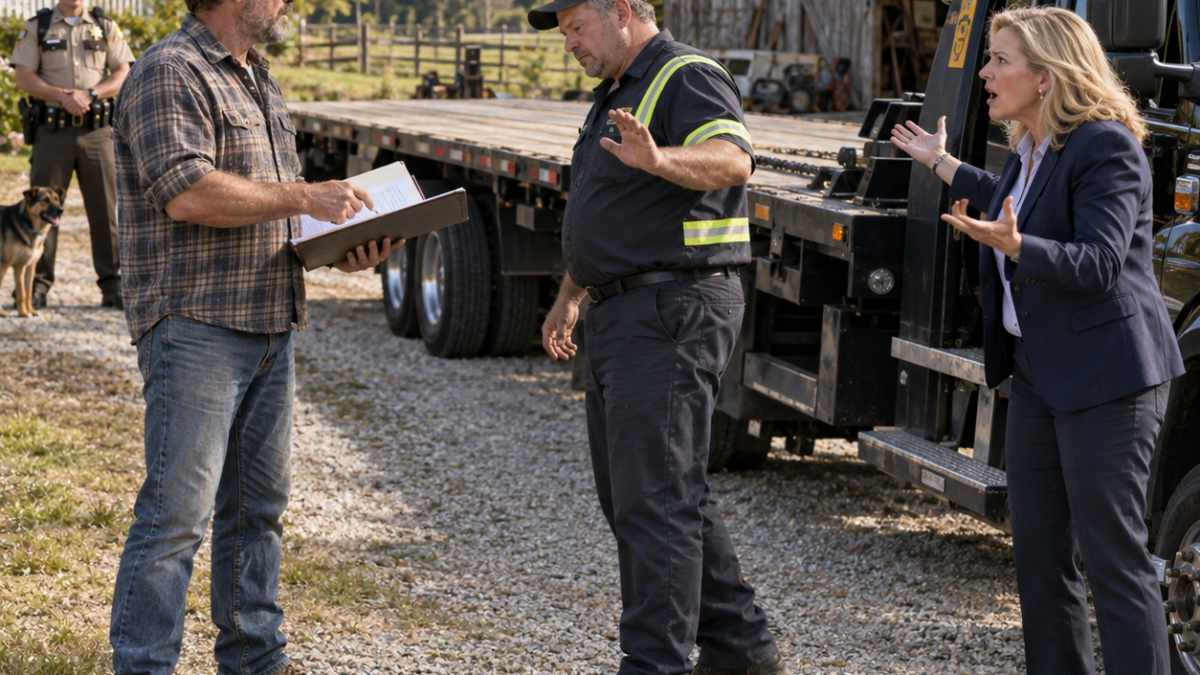
The HOA president brought a heavy-duty tow truck onto the edge of my property and ordered the driver to haul away the flatbed trailer that paid my family’s bills.
She kept insisting she controlled my land even while I stood there holding the county deed that proved her authority stopped fifty feet before she reached my equipment.
When the driver finally climbed down from his cab and walked toward me, Karen smiled like she had already won—and for a few seconds, I honestly wondered which one of us was about to discover we had made a very expensive mistake.
“That rust bucket is leaving today,” Karen said, pointing at my thirty-foot flatbed trailer as though she were sentencing a condemned building. “It violates community standards, it’s visible from our street, and I am done asking nicely.”
I set down the ratchet I had been using to tighten a load strap and wiped my hands on an old shop rag.
The flatbed sat exactly where it always sat, well inside my five-acre property, partly screened by a row of young pines. I used it for my small metal-fabrication business. It hauled steel into my workshop and carried finished gates, railings, equipment frames, and custom farm pieces out to customers.
To Karen, it was ugly.
To me, it was how I paid my mortgage.
Behind her, the tow truck idled with amber lights flashing. The driver leaned against the door with his arms folded, watching us with the weary expression of a man who had spent years being summoned into other people’s arguments.
“Karen,” I said, keeping my voice level, “you’re standing on private property.”
She scoffed.
“This is Oakwood Preserve.”
“No. Oakwood Preserve is over there.”
I pointed toward the property marker near her feet.
“My land begins here.”
“Your property still affects our property values.”
“That doesn’t give you jurisdiction.”
She planted both hands on her hips.
“You don’t understand how communities work.”
Fifteen years in the Marine Corps had taught me a lot of things, including how quickly a conversation can become useless when somebody confuses confidence with authority.
So I stopped debating.
I reached into the back pocket of my jeans and pulled out a clear plastic sleeve I had started carrying weeks earlier for exactly this kind of nonsense.
Inside was a certified copy of my deed and the county plat.
Karen had been sending me violation letters almost since the day my wife Sarah and I moved onto the old farmhouse property. First she complained about my galvanized mailbox because Oakwood Preserve required black mailboxes on wooden posts. Then she objected to my cedar fence because the subdivision preferred taupe. Then she began sending letters about my flatbed, claiming commercial vehicles were prohibited.
Each time, I sent back the same answer.
My property was not part of her HOA.
Each time, I included the survey.
She never cared.
But today she had brought a tow truck.
I unfolded the plat and held it toward her.
“This black line is the recorded boundary. My trailer is more than fifty feet inside it. It is not parked on your street, your common property, or anybody’s easement.”
Karen refused even to look.
Instead, she jabbed a finger toward the driver.
“I am president of the Oakwood Preserve Homeowners Association, and I am authorizing you to remove that commercial vehicle immediately.”
The driver pushed away from his truck.
Sarah had stepped onto our front porch by then. I saw her hands folded tightly against her stomach.
She hated conflict.
That was one reason Karen’s campaign had bothered me more than I admitted.
This was supposed to be the place where Sarah and I finally slowed down after years of moves, deployments, long absences, and plans postponed because duty came first.
I had promised her peace.
Now an HOA president who did not even govern us was standing in our driveway threatening our livelihood.
The driver walked toward me.
Karen’s expression brightened.
I held out the deed.
He took it.
For nearly half a minute, nobody spoke.
His calloused thumb followed the boundary line. Then he looked toward the survey marker. Then toward my flatbed. Then back at the map.
Karen finally lost patience.
“Well?”
He handed the document back to me.
Then he turned toward her.
And the first thing he said made the smile disappear completely from her face.
PART 2
“Ma’am, I’m not touching that trailer.”
For the first time since the tow truck had arrived, Karen had nothing to say.
The driver pointed toward the survey marker.
“That trailer is sitting on his private property. Clear as day.”
Karen blinked as though he had spoken another language.
“I hired you.”
“You called me for an impound.”
“I authorized an HOA tow.”
“You can authorize whatever you want on HOA property.”
He pointed toward me.
“This ain’t HOA property.”
Karen’s face darkened.
“You don’t understand the covenants.”
The driver gave her a tired look.
“Lady, I understand towing law well enough to know I’m not hooking onto a man’s equipment after he just showed me a deed proving you don’t control the ground underneath it.”
“You will do what you were hired to do.”
“No.”
The word landed harder than shouting would have.
Karen had apparently spent so many years surrounding herself with people who backed down that she had forgotten what a clean refusal sounded like.
The driver continued.
“And if you call my company again asking us to tow equipment off this parcel without legal authorization, the call-out fee is going to you personally. I’m not risking my license because you’re mad about somebody’s trailer.”
Her mouth opened.
He was not finished.
“If you represent a future tow as legally authorized when you know it isn’t, I’ll document it.”
Karen’s eyes widened.
“Are you threatening me?”
“No, ma’am. I’m explaining my paperwork.”
I almost smiled.
There are moments when two professions understand one another perfectly without introduction.
That driver was not interested in my feud.
He cared about liability.
So did I.
He climbed into his truck, released the brake with a hiss, turned carefully on the wide section of my gravel drive, and rolled away.
The amber lights disappeared down the road.
Diesel smoke drifted across the pines.
Silence returned.
Karen remained beside my property marker.
Sarah was still standing on the porch.
I folded the deed carefully and slid it back into the plastic sleeve.
“You need to leave.”
Karen stared at me.
“This isn’t over.”
“I know.”
“You think waving a piece of paper around makes you untouchable?”
“No. I think owning property outside your HOA makes your HOA rules irrelevant here.”
“You are damaging this community.”
“My family doesn’t live in your community.”
“You live beside it.”
“That is not the same thing.”
Her hands trembled.
“I will make you regret moving here.”
That sentence changed the tone of the entire conflict.
Before then, I could still pretend Karen was an overzealous HOA president who did not understand boundaries.
Now she had made it personal.
I took out my phone.
“Would you repeat that?”
She saw the camera and stiffened.
Then she turned away.
Her sandals ground against the gravel as she marched back toward Oakwood Preserve.
I watched until she crossed the line.
Sarah waited another moment before coming down the porch steps.
“That woman is insane.”
“She’s angry.”
“She brought a tow truck.”
“Fair point.”
Sarah looked toward the road.
“Jack, what happens now?”
I wanted to tell her nothing.
I wanted to say Karen had embarrassed herself, the driver had refused, and the problem was finished.
But I had spent fifteen years around people whose pride mattered more to them than good judgment.
Humiliation did not always teach them caution.
Sometimes it taught them revenge.
“She comes back harder,” I said.
Sarah closed her eyes briefly.
“That’s what I was afraid of.”
I put an arm around her.
“We’re going to be okay.”
“You always say that.”
“Usually right.”
“Usually after making things considerably more complicated first.”
That was also fair.
We stood beside the flatbed.
The afternoon light caught the steel deck.
It was ugly in the way useful things are often ugly.
Scratches.
Weld marks.
Chains.
Tie-down points.
Mud on the tires.
It had hauled the steel beams that became the first major contract of Riley Metal Works. It had carried the used milling machine I bought at auction. It had moved lumber when I began repairing the old barn.
The trailer was not decoration.
It was the backbone of the life I was trying to build.
That mattered because none of this had begun with Karen.
It began two years earlier, when Sarah and I decided we wanted somewhere permanent.
Marine life had trained both of us to treat permanence like a luxury.
Fifteen years.
Two combat tours.
Training rotations.
Long absences.
Temporary housing.
Boxes stored in garages belonging to relatives.
Birthdays attended through video calls.
Sarah teaching in one district, then another.
Our children learning that Dad’s duffel bag near the door meant another goodbye was coming.
When I finally left active service, I wanted something simple.
Land.
A workshop.
Enough room for Sarah to have a real garden.
Enough space for the kids to make noise without worrying whether a neighbor complained.
We searched for almost two years.
Then we found the Henderson property.
Five acres.
Old farmhouse.
Barn leaning just enough to look hopeless to everybody except me.
Mature oaks.
Protected woodland on three sides.
Oakwood Preserve on the fourth.
That last part nearly killed the deal.
I knew what an HOA could be.
Not every association was terrible.
Some did exactly what residents wanted: maintained roads, handled common landscaping, enforced clear agreements.
But I did not want to join one.
Not after fifteen years of being told where to park, what to wear, when to report, and which form required which signature.
My home was going to be mine.
So before closing, I became obsessive.
I walked every boundary with the surveyor.
I read the title report.
Then read it again.
My attorney confirmed there were no HOA covenants attached to the parcel.
No architectural-review agreement.
No shared-maintenance obligation.
No restrictive easement benefitting Oakwood Preserve.
The property existed before the subdivision.
The developers had tried for years to buy it from the Henderson family.
They refused.
After the final owner died, the heirs sold to us.
Our five acres became an island of old land beside new development.
That was precisely why Karen hated it.
She could look from her second-story window and see something she could not regulate.
My mailbox was different.
My cedar fence was different.
My barn was old.
My flatbed was visible through the trees.
We did not ask permission.
The first HOA letter arrived one month after we moved in.
Sarah brought it inside.
“Did we accidentally join something?”
I read the envelope.
OAKWOOD PRESERVE HOMEOWNERS ASSOCIATION.
Inside was a friendly reminder about mailbox standards.
Approved mailbox color: black.
Approved post style: stained wood.
My mailbox was galvanized steel on a metal post embedded in concrete.
I laughed.
Sarah did not.
“What?”
“They think we’re members.”
“Are you going to call them?”
“No.”
I wrote a short note.
Thank you for the information. Our property is not part of Oakwood Preserve and is not subject to association architectural requirements. For reference, I have enclosed a copy of the county survey.
Regards,
Jack Riley.
I sent it certified.
Military habit.
Verbal conversations evaporate.
Paper remains.
A week later, the fence letter arrived.
Oakwood Preserve required visible fencing to be painted a particular shade of taupe.
Mine was cedar.
Natural cedar.
I responded again.
Karen, please refer to the survey previously provided. Our property is not governed by Oakwood Preserve. Please update your records accordingly.
Certified.
Return receipt.
Karen signed.
Then came the flatbed letters.
The first one described it as a commercial vehicle incompatible with neighborhood residential character.
I ignored it.
The second claimed a community-wide restriction against commercial trailers.
That phrase bothered me.
Community-wide.
Not HOA-wide.
As if Karen believed she could turn subdivision policy into municipal law merely by changing vocabulary.
So I contacted the town.
“Is there an ordinance prohibiting commercial trailers on residential private property?”
The clerk checked.
“No, sir. There are placement rules near public rights-of-way and some zoning restrictions depending on use.”
I explained where mine sat.
She gave me the relevant ordinance.
I printed it.
Then sent it to Karen with another copy of my survey.
I thought that would be enough.
It was not.
Karen’s problem was no longer the flatbed.
It was me.
I was the one person visible from her neighborhood who could receive an order from Karen Miller and answer no without fear of a fine.
To somebody who built her identity around obedience, that must have felt unbearable.
The tow truck proved it.
And after the driver left, Karen escalated exactly as I expected.
Letters began arriving twice a week.
OFFICIAL NOTICE OF NUISANCE.
FINAL DEMAND FOR ABATEMENT.
WARNING OF CONTINUED NONCOMPLIANCE.
One claimed the flatbed created a vermin habitat.
Another argued that reflective safety tape along the trailer’s side presented a visual hazard to drivers.
That one almost impressed me.
The trailer sat behind trees, about eighty feet from the road.
Apparently Karen believed reflective tape could bend light around pine trunks and attack motorists.
She began citing county codes.
Incorrectly.
Then health regulations.
Incorrectly.
Then HOA language that did not apply to me.
Repeatedly.
Sarah would bring the envelopes inside like they contained something contagious.
One night she dropped a thick packet onto the kitchen table.
“What now?”
I opened it.
Photographs.
Grainy telephoto images of the flatbed.
Different dates.
Different angles.
One shot showed me loading steel.
Another showed the trailer empty.
Another showed Sarah carrying groceries past it.
Each photo included handwritten notes.
COMMERCIAL ACTIVITY.
CONTINUING NUISANCE.
VISIBLE FROM COMMUNITY.
I looked toward the window facing Oakwood Preserve.
Karen’s upstairs bedroom window had a direct angle through the trees.
“She’s photographing us.”
Sarah sat across from me.
“I know.”
“That doesn’t bother you?”
“It bothers me a lot.”
“You don’t act bothered.”
“I’m trying not to give her the reaction she wants.”
Sarah picked up one photo.
“My car is in this.”
“I see it.”
“She photographed me.”
“I see it.”
Her voice tightened.
“I’m tired of feeling watched in my own yard.”
That hurt more than Karen’s letters.
I had spent years promising Sarah that retirement would mean freedom from other people’s schedules.
Instead, she had started glancing toward a neighbor’s window before walking into her own driveway.
That night I ordered two security cameras.
One covered the flatbed.
One covered the property boundary.
I also went to an office-supply store the following morning.
Binder.
Dividers.
Document sleeves.
Printer paper.
External hard drive.
I labeled the first divider:
HOA COMMUNICATIONS.
Second:
PROPERTY DOCUMENTS.
Third:
PHOTOGRAPHS / VIDEO.
Fourth:
GOVERNMENT RESPONSES.
Fifth:
CERTIFIED MAIL.
Sarah saw it when she came home.
“Oh no.”
“What?”
“You made a binder.”
“I did.”
“She has no idea what she started.”
“That sounded almost supportive.”
“I’m married to a Marine with office supplies. I know when to surrender.”
I logged everything.
Date received.
Allegation.
Relevant law.
My response.
Certified mail number.
Delivery confirmation.
If Karen said my trailer was harboring vermin, I included the county nuisance definition and my quarterly pest-control receipt.
If she cited a setback rule, I included the actual setback.
If she claimed commercial equipment was prohibited town-wide, I attached the town’s written answer.
And every time, I included the survey.
Full color.
Property line highlighted.
Location of the trailer marked.
At the bottom I often added the same sentence:
For your continued reference, Oakwood Preserve has no recorded jurisdiction over my parcel.
Karen signed every certified receipt.
Her signature became the most important part of my file.
It proved she knew.
Not once.
Again and again.
The pressure began affecting Sarah more than I realized.
One evening she stood beside the flatbed while I was checking a wheel bearing.
“Could we move it?”
I looked up.
“Move what?”
“The trailer.”
“Where?”
“Behind the barn.”
“Why?”
“You know why.”
I stood and wiped my hands.
“If we move it because it works better for us, fine.”
“Jack.”
“If we move it because Karen ordered us to—”
“I just want her to stop.”
Sarah’s voice cracked slightly.
That stopped me.
She rarely cried.
She certainly did not cry over neighborhood disputes.
I put the wrench down.
She crossed her arms.
“I’m tired of mail making my stomach drop. I’m tired of wondering if she’s taking pictures when the kids are outside. I’m tired of every car slowing near the driveway making me wonder if it’s code enforcement or another tow truck.”
I pulled her close.
“I’m sorry.”
“I know you didn’t cause it.”
“But I keep fighting it.”
She looked up.
“Would moving the trailer actually stop her?”
“No.”
“How do you know?”
“Because the first letter was about the mailbox.”
Sarah said nothing.
“Then the fence.”
She looked toward the barn.
“Then the trailer.”
I continued.
“Next it’ll be shop noise. Welding light. Deliveries. The garden. The color of the barn. Smoke from the grill.”
“That sounds ridiculous.”
“So did towing my flatbed.”
That earned a tiny smile.
I held her tighter.
“This is our home. If I rearrange our lives every time she invents authority, then she effectively owns the property without paying the mortgage.”
Sarah took a breath.
“What do we do?”
“We document until she crosses a line that somebody with real authority can’t ignore.”
She nodded.
Then she looked at the binder through the kitchen window.
“You might need a bigger one.”
She was right.
My first ally arrived while I was replacing cedar boards along the eastern fence.
He was an older man named George Bennett.
I had seen him walking around Oakwood Preserve with a cane.
That morning he stopped on the neighborhood side of the fence.
“Good cedar.”
I looked up.
“Morning.”
“Pressure-treated?”
“Western red.”
He nodded approvingly.
“George.”
“Jack.”
We shook hands across the fence.
He glanced toward the flatbed.
“Heard about the tow truck.”
News traveled.
“So did half the county, apparently.”
George smiled.
“Our esteemed president does not handle embarrassment gracefully.”
“You know Karen well?”
“I have survived Karen.”
That told me enough.
George pointed toward the large oak near the boundary.
“That tree marked the Henderson line before the subdivision existed.”
“I know.”
“Old Mr. Henderson used to sit right over there.”
George pointed toward my side.
“Karen tried to make him trim every branch hanging toward the subdivision.”
“Branches crossing the line can sometimes—”
“No, no. She wanted the whole tree reshaped because she didn’t like leaves in homeowners’ yards.”
I laughed.
“She told him the HOA might assess him for cleanup.”
“What did he say?”
George’s smile widened.
“Something inappropriate for church.”
I liked Mr. Henderson already.
George’s expression turned serious.
“Don’t let her move you.”
“I’m not planning to.”
“People in here do.”
“Why?”
“Because she understands exhaustion.”
That was a good description.
“She sends letters until people stop fighting. Most fines are small enough that hiring a lawyer feels stupid. So people pay.”
“Does the board support her?”
“Some do. Some are scared of meetings becoming four hours long if they disagree.”
He sighed.
“She’s been president long enough that people have started confusing her personality with the association itself.”
George looked toward my property.
“You’re useful to them.”
“How?”
“You can say no without her having any direct leverage.”
That thought stayed with me.
A few weeks later I met Tom and Lisa Miller.
No relation to Karen.
They were standing beside a basketball hoop in their driveway.
Orange violation notice taped to the pole.
Their ten-year-old son sat on the curb holding a basketball.
“What happened?”
Tom held up the notice.
“One hundred dollars.”
“For what?”
“Improper storage of recreational equipment.”
The boy spoke.
“I was playing.”
Lisa looked furious.
“He came inside for water. Ten minutes.”
I asked for their bylaws.
Tom looked confused.
“Why?”
“I’ve become something of an unwilling specialist.”
We sat at their kitchen table.
The recreational-equipment clause required items to be stored out of public view “when not in use.”
No time definition.
No requirement that a basketball hoop disappear the instant a child stopped touching it.
“This is subjective,” I said.
Tom nodded.
“She says leaving it unattended means not in use.”
“Contest it.”
He laughed bitterly.
“We tried arguing with her about Christmas lights last year. Fine doubled.”
“Don’t argue verbally.”
I took a blank sheet.
“Write.”
He looked at me.
“Seriously?”
“Very.”
I dictated a short letter.
Reference the section.
State that the hoop was actively being used during the time period.
Ask for the factual basis supporting the alleged violation.
Request board review.
Send it to the entire board.
Certified.
Lisa stared at me.
“You do this a lot?”
“Recently.”
The letter worked.
Not immediately.
But it did something more important than canceling a fine.
Tom realized Karen could be challenged.
The three of us started a private email thread.
George joined.
Then two more homeowners.
Concerned Neighbors.
Nothing revolutionary.
Mostly questions.
Has anyone else received this kind of notice?
What do the bylaws actually say?
Does anyone have old meeting minutes?
When is the next election?
Karen did not know it yet, but her opposition had begun forming inside the community.
Then she made the mistake that finally gave my documentation real teeth.
She reported me to the county as an unlicensed salvage yard.
The notice arrived on Monday.
COUNTY ZONING AND PLANNING COMMISSION.
FORMAL COMPLAINT.
MANDATORY HEARING.
Sarah found me reading it.
“What now?”
“She says we’re running a junkyard.”
Sarah looked around our property.
Freshly mowed grass.
Farmhouse.
Restored fence.
Barn.
Flatbed.
Stacked steel under a covered rack.
“You’re joking.”
“I wish.”
“What happens?”
“Hearing.”
“Could they shut down the workshop?”
“If I were actually violating zoning, potentially.”
Her face changed.
Riley Metal Works was no hobby.
After leaving the Marines, I needed something I could build with my hands.
The shop had started slowly.
Farm repairs.
Custom brackets.
Handrails.
Then gates.
Equipment frames.
Decorative ironwork.
By then it was paying a meaningful portion of our household expenses.
Karen was no longer trying to irritate me.
She was attacking my livelihood.
I picked up my phone.
“Who are you calling?”
“An old friend.”
David Chen had served in my unit before leaving active duty and using the GI Bill to attend law school.
The last time I had seen him, he told me he handled civil litigation and property disputes.
“Come tomorrow,” he said after I explained the basics.
“Bring everything.”
“Everything?”
“Everything.”
I arrived at his office carrying a banker’s box.
David stared at it.
“What is that?”
“Everything.”
He opened the lid.
Binder.
Second binder.
Hard drive.
Certified receipts.
County correspondence.
Photographs.
Survey.
Town code.
Karen’s letters.
David looked at me.
“You documented all this yourself?”
“Yes.”
“You realize normal clients bring me screenshots from their phone and half a napkin with dates written on it?”
“I had time.”
“You had spite.”
“Discipline.”
“Sure.”
For the next hour, I explained the timeline.
David watched security footage showing Karen step over the property marker to photograph the flatbed.
He read her nuisance allegations.
He read the tow attempt documentation.
Then the salvage-yard complaint.
When he finished, he leaned back.
“Jack.”
“What?”
“This woman has done us an enormous favor.”
Sarah would not have appreciated that sentence.
“What favor?”
“She escalated into a formal government proceeding.”
“So?”
“So now we have a neutral record.”
He tapped the zoning notice.
“If the county dismisses this complaint, particularly after seeing evidence of her history, we have more than your word against hers.”
He stood.
“We’re not merely defending.”
“What are we doing?”
“We’re letting her prove our case.”
His strategy had two stages.
First, demolish the salvage-yard allegation.
Business license.
Insurance.
Tax records.
Customer invoices.
Photos of completed fabrication work.
Video of the flatbed hauling materials.
Evidence that stored steel was inventory, not junk.
Then, after the county ruling, David would send a cease-and-desist demand.
Not just to Karen.
Every board member.
Registered agent.
Management company.
Possibly insurer, depending on response.
“The board needs to understand Karen’s hobby is becoming their liability,” David said.
“What do we demand?”
“Stop all contact. Stop photographing the property. Stop entering the parcel. Stop asserting HOA jurisdiction. Withdraw false complaints.”
“And apology?”
“Eventually.”
He smiled.
“First I want them frightened enough to read carefully.”
The zoning hearing happened three weeks later.
Sarah wanted to come.
I told her she did not need to.
“That wasn’t permission I asked for.”
So she came.
Karen sat at the complainant’s table in a bright pink pantsuit.
Two board allies sat beside her.
Folders of photographs were arranged neatly before them.
She smiled when she saw us.
Then she noticed David.
The smile weakened.
When the case was called, Karen spoke first.
She described our property as an emerging industrial operation incompatible with surrounding residential use.
She spoke about metal.
Trailers.
Potential hazards.
Visual degradation.
She showed telephoto photographs.
She used phrases like “protective land-use integrity.”
If you did not know better, you might think I was building a steel mill beside a playground.
Then David stood.
He placed my business license on the projector.
“Mr. Riley operates Riley Metal Works, a properly licensed fabrication business permitted under the applicable zoning designation.”
Insurance certificate.
Tax documents.
Invoices.
Photographs of custom gates.
Railings.
Agricultural equipment.
Then video.
My flatbed arriving with raw steel.
Leaving with a completed gate.
Returning empty.
“This is a commercial work trailer,” David said. “It is not a scrap-storage platform and this property is not being operated as a salvage yard.”
He advanced the slide.
Karen’s first mailbox letter.
Then fence letter.
Then trailer letter.
Then county-code misquotations.
Then the survey.
Then certified delivery receipts.
The commissioners stopped looking at me.
They began looking at Karen.
David showed security video of her stepping over the marker.
The chairman leaned toward his microphone.
“Ms. Miller.”
Karen sat straighter.
“Is it correct that Mr. Riley’s property is not a member parcel in Oakwood Preserve?”
“Well, technically—”
“Yes or no.”
“Yes, but—”
“Were you provided his survey?”
“Yes.”
“More than once?”
She hesitated.
“Yes.”
“Were you asked to stop contacting him?”
“I have an obligation to protect—”
“That was not my question.”
Karen’s face reddened.
“Yes.”
The chairman leaned back.
Then looked at David.
“Anything further?”
“One point.”
David displayed Karen’s tow-truck correspondence.
“The HOA also attempted to remove Mr. Riley’s work trailer from his property. The towing operator refused after reviewing the deed.”
One commissioner actually removed his glasses.
The chairman stared at Karen.
“You attempted to tow property from a parcel outside your association?”
“It was visible from our street.”
The chairman’s expression became almost tired.
“Ms. Miller, visibility is not ownership.”
She opened her mouth.
He raised a hand.
“This commission handles zoning violations. It is not a venue for extending private association preferences onto neighboring land.”
He struck the gavel.
“Complaint dismissed.”
Then he looked at Karen again.
“And I strongly suggest that future complaints filed with this office contain a legitimate zoning basis. Filing public complaints as leverage in a private dispute wastes county resources.”
Karen gathered her papers.
No smile now.
No performance.
Sarah squeezed my hand under the table.
David leaned toward me.
“Phase one.”
I whispered, “You really say things like phase one now?”
“You infected me.”
The cease-and-desist packets went out the next morning.
Thick envelopes.
Law-firm letterhead.
Timeline.
Survey.
Photographs.
County dismissal.
Video stills.
Legal claims David believed could arise if the conduct continued.
Harassment.
Trespass.
Interference with business.
Conversion attempt connected to the tow.
Negligent supervision by the board.
The most important paragraph was directed at the directors.
They had now been formally notified.
Any future use of HOA funds or authority to continue Karen’s campaign could expose the organization—and potentially them—to liability.
That changed everything.
The next HOA meeting was packed.
George called me beforehand.
“Come early.”
“I’m not a member.”
“Public comment.”
Sarah came too.
Oakwood Preserve’s clubhouse was larger than I expected.
Residents filled folding chairs.
People stood along walls.
The board sat behind a long table.
Karen occupied the center.
She looked exhausted.
Before public comment, she gave a speech about “outside forces” attempting to intimidate volunteers.
She called David’s letter an attack on community self-governance.
That argument might have worked if the community had not spent weeks quietly comparing stories.
Then public comment opened.
I stood.
Karen immediately said, “Mr. Riley is not an association member.”
George rose before I answered.
“You made him association business.”
Murmurs spread.
Karen struck the gavel.
George did not sit.
“You spent our money on him. You filed complaints in our name. You tried to tow his property while claiming our authority. He gets to speak.”
Several residents applauded.
That sound shocked Karen more than the county hearing.
Open dissent.
Inside her own clubhouse.
I walked to the microphone.
“My name is Jack Riley.”
I held up the binder.
“For six months, your president has contacted my family regarding property that this HOA does not govern.”
Mailbox letter.
Fence letter.
Trailer letter.
I showed each.
“I responded repeatedly with documentation.”
Survey.
Certified receipts.
“She continued.”
I described the tow attempt.
A man near the back said, “She actually brought a tow truck?”
“Yes.”
Karen snapped, “It was a legitimate enforcement action.”
I looked at the crowd.
“The towing professional disagreed after reading my deed.”
Laughter.
Karen’s jaw tightened.
I continued.
“After the tow failed, the letters intensified.”
Photographs.
Claims.
Security footage.
Then the salvage-yard complaint.
“The county dismissed it.”
A woman asked, “Did we pay for any of this?”
That question changed the room.
I did not know.
So I answered honestly.
“I don’t know.”
Everyone looked toward the board.
The treasurer, Mark Holloway, shifted in his chair.
Karen said, “Routine enforcement expenses are association business.”
George shouted, “He’s not in the association!”
Applause erupted.
I raised one hand.
When the room quieted, I said what I had come to say.
“This was never really about my trailer.”
Karen stared at me.
“It was about whether one person could extend her authority beyond the place where that authority legally ends.”
I looked around.
“My family asked repeatedly to be left alone. We documented our property line. We answered every claim. We tried to resolve this without lawyers.”
I touched the binder.
“The legal notice your board received came after those efforts failed.”
I looked directly at the directors.
“You have a decision now. You can decide this behavior represents Oakwood Preserve, or you can decide it doesn’t.”
Then I sat.
For several seconds, nobody spoke.
Sarah put her hand on mine.
Karen attempted to move to the next agenda item.
The room would not let her.
People began asking questions.
How much had been spent?
Who authorized the county complaint?
Did the board approve the tow?
Had counsel reviewed jurisdiction?
Why were members paying for certified mail to somebody outside the HOA?
Mark, the treasurer, finally leaned into his microphone.
“I believe we need an independent review.”
Karen turned toward him.
“Excuse me?”
“An audit of expenses related to enforcement actions initiated by the president.”
Her face went white.
“That is unnecessary.”
“I disagree.”
“You’re treasurer. I’m president.”
“And I have a fiduciary obligation to the membership.”
The words hung in the room.
George whispered behind me.
“There it is.”
The motion passed.
Even directors who had defended Karen voted yes.
Fear of legal liability can produce remarkable independence.
The audit started small.
Mailing expenses.
Printing.
Legal consultation.
County filing preparation.
Then residents began submitting complaints of their own.
Tom and Lisa challenged their basketball-hoop fine.
Three other families joined them.
An elderly woman named Margaret brought letters Karen had sent about wind chimes.
A young couple produced correspondence showing Karen threatened contractors over a work van parked temporarily on the street.
Another homeowner had photographs of Karen measuring lawn height personally.
Someone else said she had followed a landscaping crew through the neighborhood writing notes.
The image changed.
Karen had spent years presenting herself as the guardian of standards.
Now residents saw a pattern.
The rules mattered only because they gave her a reason to control people.
The audit discovered roughly five hundred dollars in direct printing, mailing, and office costs tied specifically to my property.
Not massive.
But my property was outside the HOA.
The association had spent member money supporting a president’s personal campaign against a nonmember.
More concerning was legal-retainer time.
Karen had asked the HOA’s lawyer about ways to pressure me.
She had not presented the matter to residents as a personal boundary dispute.
She had treated it as association policy.
When David saw the audit findings, he called.
“We’re ready.”
“For what?”
“Filing.”
Sarah was sitting beside me.
She heard.
Her shoulders dropped slightly.
“We really have to sue?”
David’s voice softened.
“Sarah, if the board removes Karen and formally resolves this before filing, perhaps not. But right now, they’ve acknowledged misuse and still haven’t stopped her entirely.”
I looked at Sarah.
“What do you want?”
She thought.
Then said, “I want to open my mailbox without wondering what she did today.”
That answered it.
David filed.
Karen personally.
Oakwood Preserve HOA and board-related claims as appropriate based on their failure to supervise the conduct after notice.
I will not pretend filing suit felt triumphant.
Movies make lawsuits look like revenge delivered in a single document.
Real lawsuits feel like admitting something became serious enough that ordinary conversation failed.
Sarah worried about cost.
I worried about time.
We both worried Karen would escalate again.
But something unexpected happened instead.
She became quiet.
For the first time in months, no letters arrived.
No photographs.
No envelopes.
No surprise complaints.
Silence.
The HOA’s insurance carrier received notice of the suit.
Its risk-management team reviewed the record.
My survey.
The certified mail.
The tow attempt.
Karen crossing the property line.
County dismissal.
Audit.
Board notice.
David eventually explained the insurer’s position to us.
The association might receive defense protection for certain negligence allegations.
Karen’s intentional personal conduct was a different question.
If she had operated outside her official role or acted maliciously after clear notice, she could face major personal exposure.
The effect on the board was immediate.
Loyalty evaporated.
Another emergency meeting was called.
This one was formal.
Agenda:
REMOVAL OF PRESIDENT FOR MALFEASANCE AND BREACH OF FIDUCIARY DUTY.
Karen arrived in pink again.
Not the same suit.
But close enough that George nudged me.
“Battle colors.”
“Behave.”
“I’m eighty-one. Too late.”
The directors voted four to one.
Karen cast the one.
Just like that, she lost the presidency.
No dramatic sirens.
No police.
No crowd carrying torches.
A motion.
A second.
A recorded vote.
Years of authority disappeared in less than ten minutes.
Karen remained seated after the count.
Her face was expressionless.
The new acting president, Mark Holloway, thanked her for prior volunteer service and requested immediate transfer of passwords, files, keys, and association records.
She laughed.
Not happily.
“You people deserve what happens next.”
Mark answered quietly.
“We’re trying to prevent what happens next.”
She looked toward me.
For one second, our eyes met.
Months earlier, beside my flatbed, she had told me she would make me regret moving there.
Now she had been removed from power because she refused to stop trying.
I felt satisfaction.
Of course I did.
But it was not joy.
Power can make people ugly.
Losing it can make them small.
And seeing somebody become small is less exciting in real life than stories make it sound.
David leaned toward me.
“Don’t feel sorry for her yet.”
“I don’t.”
“You have that face.”
“What face?”
“Catholic guilt without being Catholic.”
I almost laughed.
The legal settlement followed quickly.
Without HOA authority behind her and with her own legal costs mounting, Karen hired private counsel.
The association wanted the case gone.
So did Sarah.
So did I.
Our terms were firm.
Formal apology to my family.
Legal fees.
Compensation for documented harassment-related damages and expenses.
Written recognition that Oakwood Preserve possessed no jurisdiction over our property.
No future HOA enforcement attempt against our parcel.
And, most importantly, an enforceable injunction against Karen.
No contact with me.
No contact with Sarah.
No letters.
No photographing our property.
No stepping onto our land.
No sending agents.
No using third parties to continue harassment.
Violation could place her in contempt.
David slid the final agreement across his desk.
“Read it.”
“I trust you.”
“Read it anyway.”
Marine habits and lawyer habits apparently overlap.
I read every word.
Then Sarah did.
When she finished, she touched the no-contact provision.
“This one.”
“What?”
“This is the one I care about.”
I understood.
Money replaced fees.
Apologies repaired reputation.
But silence gave Sarah back her home.
We signed.
Oakwood Preserve signed.
Karen signed.
The case ended.
A few weeks later, I was moving soil near the front garden with my tractor.
The flatbed sat where it always had.
Sarah wanted raised beds.
Tomatoes.
Peppers.
Herbs.
Maybe strawberries.
I had just dumped a bucket of topsoil when a car stopped near the property line.
Mark Holloway stepped out.
The new HOA president.
He walked toward me.
Then stopped exactly at the survey marker.
I noticed.
So did he.
“Jack.”
“Mark.”
He extended a hand across the line.
“I wanted to apologize personally.”
I shut off the tractor.
The engine rattled into silence.
“You don’t have to.”
“I do.”
He looked back toward Oakwood Preserve.
“We let it go too far.”
I shook his hand.
“You weren’t the one sending letters.”
“No. I was the one sitting at the table while she did.”
That reminded me of people I had served with.
Leadership failures are often less about the loud person doing the wrong thing than the quiet people deciding correction is inconvenient.
Mark handed me an envelope.
Settlement check.
“Board approved everything.”
“Thank you.”
“We’re rewriting procedures.”
“What kind?”
“No president can initiate outside legal or enforcement action without board approval.”
“Good.”
“Jurisdiction disputes require counsel review.”
“Better.”
“Fines get independent appeal.”
I nodded.
“And we’re cutting half the nonsense.”
“What counts as nonsense?”
He smiled.
“We had four pages regulating decorative lawn objects.”
“I hope the gnomes survive.”
“We’ve declared amnesty.”
For the first time, the president of Oakwood Preserve and I talked like neighbors.
Weather.
Garden.
My workshop.
His job.
Nothing about control.
Nothing about authority.
Nothing about property values.
Normal conversation.
That was all I ever wanted.
Then a town code-enforcement vehicle turned onto the street.
It slowed.
Mark and I both watched.
The vehicle stopped in front of Karen’s house.
An officer climbed out holding a clipboard.
He walked toward a ramshackle shed in her side yard.
I looked at Mark.
He gave me a tiny shrug.
“What’s that?”
“No idea.”
He was lying.
Not well.
Later, George confessed.
Karen had spent months invoking town code against me.
George decided the town might appreciate knowing about her unpermitted shed.
“George.”
“What?”
“You reported her?”
“I reported a structure.”
“You waited until after the settlement.”
“Coincidence.”
“You’re a menace.”
“I’m retired.”
The officer inspected the shed.
Karen eventually came outside.
I could not hear the conversation.
Did not need to.
She waved her arms.
Pointed.
Argued.
The officer kept writing.
I should say I felt above it all.
I did not.
I leaned against the tractor and enjoyed approximately thirty seconds of deeply immature satisfaction.
Then Sarah came outside.
“What are you staring at?”
“Nothing.”
She followed my gaze.
“Oh.”
“George.”
“Of course.”
We watched Karen receive a notice.
Sarah shook her head.
“Is it terrible that part of me enjoys this?”
“Yes.”
“Good.”
She smiled.
Eventually we learned the shed lacked permits and violated setback requirements.
Karen paid a fine.
Then paid to remove it.
The woman who had spent years weaponizing rules discovered that rules could operate without caring who believed herself important.
That was revenge enough.
But the real change came afterward.
Oakwood Preserve transformed slowly.
Tom’s son kept the basketball hoop.
Nobody taped orange violation notices to it.
Margaret kept her wind chimes.
Residents stopped whispering when discussing board decisions.
Meeting attendance increased.
Mark posted financial summaries.
People actually read them.
When somebody disagreed, the board explained.
Sometimes the resident was wrong.
Sometimes the board was wrong.
Both survived.
Karen stopped attending meetings.
For months, she rarely came outside.
I saw her occasionally through the upstairs window.
The same place from which she once photographed our flatbed.
Because of the injunction, she never contacted us.
Not once.
That legal silence became one of the best sounds on our property.
Sarah changed too.
I did not notice at first.
Then one Saturday morning I saw her walking toward the mailbox in slippers, coffee in one hand, humming.
Months earlier she had treated the mailbox like a possible explosive device.
Now she returned carrying catalogs and a utility bill.
“No HOA?”
She looked confused.
Then understood.
“No HOA.”
She smiled.
We built her garden.
Six raised beds.
More ambitious than planned.
“Six?”
“I survived Karen. I deserve six.”
Fair.
The kids helped plant tomatoes.
I welded decorative corner brackets.
Sarah painted small wooden signs.
Basil.
Rosemary.
Peppers.
Her garden sat close enough to the flatbed that Karen would once have found both offensive.
Nobody cared.
My workshop expanded.
Riley Metal Works picked up more customers.
A local ranch ordered custom gates.
A restaurant commissioned steel partitions.
A contractor began using me regularly for railing fabrication.
The flatbed spent more time moving than parked.
Whenever it returned, I backed it into the same place.
Not out of defiance.
Out of convenience.
That distinction mattered.
During the conflict, everything became symbolic.
The trailer.
The mailbox.
Fence color.
Where I parked.
Afterward they became objects again.
That felt like victory.
George visited often.
He never entered through our front driveway.
He liked leaning over the fence.
Old habit.
“You know your tomatoes need calcium.”
“Morning, George.”
“Blossom-end rot.”
“They’re fine.”
“Not for long.”
“Sarah invited you here to criticize vegetables?”
“Community service.”
Tom and Lisa began coming over too.
Their son and ours became friends.
One evening Tom brought beer.
We stood beside the flatbed.
“You know this thing is ugly.”
I stared at him.
He grinned.
“I’m kidding.”
“Leave.”
“It’s extremely ugly.”
“Get off my land.”
“But legally parked.”
Sarah laughed from the porch.
That was what Karen had never understood.
People can live beside things they do not personally like.
Civilization does not require universal aesthetic agreement.
Sometimes your neighbor’s trailer is ugly.
Sometimes their wind chime is annoying.
Sometimes their basketball hoop spends the night outside.
Sometimes their fence is cedar instead of taupe.
And everybody wakes up the next morning.
The HOA mailed its formal apology to every member.
Mark brought us a copy.
The letter acknowledged that the association had improperly asserted authority over nonmember property and apologized for conduct that caused unnecessary distress to our family.
No dramatic language.
No naming and shaming.
David approved.
Sarah framed it.
I stared at her.
“You’re serious?”
“It’s going in your office.”
“Why?”
“Because you framed your Marine certificates.”
“That is different.”
“Is it?”
“Yes.”
She framed it anyway.
David visited a few weeks later for dinner.
We sat on the back deck I had built using lumber hauled on the flatbed.
He held a beer and looked toward Oakwood Preserve.
“You realize something?”
“What?”
“If the tow driver had been an idiot, this case might have been much messier.”
I nodded.
“He saved himself.”
“And you.”
“Temporarily.”
David smiled.
“The deed scene was the moment Karen should have stopped.”
“She had a lot of moments.”
“She did.”
That stayed with me.
Karen always had an exit.
When I first sent the survey.
Exit.
When the town confirmed no trailer ordinance.
Exit.
When the tow driver refused.
Huge exit.
When my certified responses accumulated.
Exit.
When the county dismissed her salvage-yard claim.
Exit.
When David sent the cease-and-desist.
Exit.
When the audit began.
Exit.
At every stage she could have said:
I was wrong.
I overstepped.
This needs to stop.
Instead, she interpreted each opportunity to retreat as humiliation.
That was her real downfall.
Not ignorance.
Pride.
Months passed.
Autumn cooled the air.
The cedar fence weathered.
Our kids went back to school.
Riley Metal Works stayed busy.
Oakwood Preserve became quieter in a healthier way.
One evening George called me.
“Come outside.”
“Why?”
“Just do it.”
I walked toward the fence.
He stood on his side holding a beer.
“What?”
He pointed toward Tom’s house.
Basketball bounced.
A kid shouted.
Another laughed.
“Listen.”
“I hear basketball.”
“Exactly.”
I understood.
No Karen.
No warning letter.
No violation notice.
Just a child using his driveway.
George raised his beer.
“To dangerous recreational equipment.”
I laughed.
“To surviving it.”
The strangest thing about long conflicts is that when they end, normal life initially feels suspicious.
For weeks, I expected another letter.
Another complaint.
Another escalation.
None came.
I checked the cameras more than necessary.
Nothing.
Sarah noticed.
“You’re still waiting.”
“For what?”
“Her.”
“I’m not.”
“You checked the driveway camera during dinner.”
“Package delivery.”
“We weren’t expecting one.”
I sighed.
She sat beside me.
“You know you can stop fighting now.”
“I know.”
“Do you?”
That question hurt.
Conflict had become routine.
I had spent months building files and anticipating moves.
There is a strange comfort in having a clear adversary.
Every problem points in one direction.
Peace is less structured.
You have to remember what you were doing before somebody invaded your attention.
So I went back to work.
Real work.
Metal.
Steel.
Welds.
Measurements.
Jobs for customers.
Fence repairs.
Sarah’s garden.
Our children.
The barn.
Life.
I moved the giant binder from the kitchen shelf to my office.
Then from the office desk to a cabinet.
I kept it.
Of course.
But I stopped adding pages.
One afternoon, Sarah found me staring at it.
“You miss it?”
“Karen?”
“The fight.”
“No.”
She raised an eyebrow.
“Maybe a little.”
She laughed.
“Marine.”
“Teacher.”
We went outside.
By spring, I finished the back deck.
We decided to host a barbecue.
Not a victory party.
At least that was what Sarah insisted.
David and his family came.
George came.
Mark came with his wife.
Tom, Lisa, and their son came.
Our kids chased fireflies near the trees.
People stood around the grill.
Sarah’s garden was beginning to grow.
The flatbed rested beyond the pines, carrying lumber left over from the deck project.
At sunset, Tom raised his bottle.
“I have a toast.”
Everyone groaned.
“Short.”
“I promise.”
He looked toward me.
“To good neighbors.”
Then toward the property marker.
“And extremely clear boundaries.”
Everyone laughed.
We drank.
George added, “And illegally attractive flatbed trailers.”
“Go home, George.”
“I practically live here.”
Mark stood near the railing.
“I owe you something too.”
“You already apologized.”
“This isn’t an apology.”
He looked toward Oakwood Preserve.
“For years, some of us knew Karen had gone too far on smaller things.”
Nobody interrupted.
“We told ourselves it wasn’t worth a fight.”
George nodded.
Mark continued.
“Then she crossed your property line because nobody inside ours had made her understand there was a line she couldn’t cross.”
He looked at Tom.
“At Margaret.”
At the other residents.
“That part was on us.”
Tom raised his beer again.
“We fixed it.”
Mark nodded.
“We did.”
I looked around the deck.
Months earlier, Sarah had been afraid to walk to our mailbox.
Now she stood laughing with Lisa.
My children were racing Tom’s son across the yard.
George was trying to explain tomato fertilizer to David, who looked trapped.
Normal.
Messy.
Human.
That was the life I had wanted.
The flatbed caught the last orange light of sunset.
The trailer that Karen called a rust bucket had hauled the lumber beneath our feet.
It carried the steel I welded into the deck railing.
It had hauled soil for Sarah’s garden.
It kept Riley Metal Works moving.
Karen saw an eyesore.
I saw work.
A future.
A way to provide.
Maybe that was the lesson underneath everything.
People who become obsessed with appearances eventually stop asking what things are for.
The flatbed was not there to impress Karen.
My fence was not there to match her houses.
My mailbox was not there to complete her visual corridor.
My land was not a backdrop for Oakwood Preserve.
It was our home.
I thought back to the afternoon the tow truck arrived.
Karen’s finger pointed at my trailer.
The driver approaching.
Sarah on the porch.
My deed in his hands.
For thirty seconds, that man studied a piece of paper.
Then he did something very simple.
He respected the line.
Not because he liked me.
Not because he disliked Karen.
Not because he cared about HOA politics.
Because the line existed.
That was all.
People talk constantly about boundaries as though they are emotional abstractions.
Mine was literal.
Black ink on a county plat.
Metal survey marker in the dirt.
Old oak tree.
Cedar fence.
Yet Karen still believed her preference could erase it.
It could not.
The deed did not shout.
It did not threaten.
It did not get angry.
It just existed.
The more Karen fought reality, the more expensive reality became.
First embarrassment.
Then county rejection.
Then legal exposure.
Then audit.
Then loss of office.
Then settlement.
Then injunction.
Then the humiliation of a code officer standing beside her own unpermitted shed.
Every consequence began with the same refusal.
She would not accept one word.
No.
Years later, I suspect that is what I will remember most.
Not the lawsuit.
Not Karen’s pink suit.
Not the tow truck.
Not even the settlement.
I will remember standing beside a scratched flatbed trailer, holding my deed, while a professional tow driver looked at the property line and decided he was not going to become part of somebody else’s abuse of power.
He handed the paper back.
“I’m not touching that truck.”
That sentence gave me time.
Time to document.
Time to protect my business.
Time to gather allies.
Time to show the community what was happening.
Time for Karen to expose herself through her own choices.
People sometimes imagine justice arriving dramatically.
A judge pounding a gavel.
Police lights.
A huge check.
A villain being dragged away.
Sometimes it arrives as a tow truck driver deciding to leave.
Sometimes it looks like certified mail.
Sometimes it looks like neighbors finally raising their hands at a meeting.
Sometimes it is an old man leaning over a fence and saying, “Don’t give her an inch.”
Sometimes it is your wife opening the mailbox without being afraid.
That last one mattered most to me.
One Saturday, nearly a year after the tow attempt, Sarah and I sat on the deck after everyone else had gone home.
The kids were inside.
Fireflies flickered across the dark yard.
A faint breeze moved through the oaks.
Oakwood Preserve’s houses glowed beyond the fence.
Sarah rested her feet on the railing.
“You know what I realized?”
“What?”
“I don’t hate that neighborhood anymore.”
“I didn’t know you did.”
“I did for a while.”
She looked toward the houses.
“I thought everyone over there was like her.”
“They weren’t.”
“I know.”
She smiled.
“Mark’s nice.”
“Don’t tell him. He’s an HOA president now.”
She laughed.
Then became quiet.
“I almost asked you to sell.”
That surprised me.
“When?”
“After the salvage-yard complaint.”
“You never said anything.”
“You were already carrying enough.”
I took her hand.
“Would you still want to?”
She looked around.
Garden.
Workshop.
Old farmhouse.
Flatbed.
Trees.
“No.”
“Good.”
“Would you?”
I thought about it.
“No.”
She squeezed my fingers.
“This finally feels like home.”
That word landed deeper than she probably knew.
Home.
Not quarters.
Not temporary housing.
Not a rental near base.
Not another address I would eventually leave.
Home.
The place where Sarah planted too many tomatoes.
Where my children knew which oak was easiest to climb.
Where George yelled gardening advice across the fence.
Where Riley Metal Works began.
Where an HOA president tried to tell me my land belonged to her sense of order.
And where we proved it did not.
A few days later, I loaded the flatbed for a delivery.
Custom gate.
Black powder coat.
Sixteen feet wide.
Before pulling out, I checked straps.
Lights.
Tires.
Routine.
Mark happened to be walking along the edge of Oakwood Preserve.
He stopped.
“Morning.”
“Morning.”
He looked at the trailer.
“You know, I’m technically HOA president.”
“That sounds serious.”
“It is.”
He folded his arms.
“I think that trailer is visible from our street.”
I stared at him.
He maintained a straight face for almost two seconds.
Then laughed.
I pointed at the road.
“Keep walking.”
“Yes, sir.”
As he left, I looked down at the survey marker.
Still there.
It had been there before Karen.
It would probably be there after me.
A small piece of metal marking an invisible boundary people either respected or did not.
I climbed into my truck.
Sarah waved from the garden.
I pulled onto the road with the flatbed behind me.
Oakwood Preserve passed on my right.
George’s house.
Tom’s basketball hoop.
Mark’s driveway.
Karen’s house farther down, quieter now, no presidential sign, no parade of complaints.
I did not slow.
There was nothing left to prove.
The trailer followed smoothly behind me, doing exactly what it had always been meant to do.
Work.
Build.
Carry something useful from one place to another.
That was enough.
Karen had called it a rust bucket.
She had called it a commercial nuisance.
She had tried to have it hauled away because she believed anything she disliked could be converted into a violation.
But in the end, that scratched steel flatbed carried more than materials.
It carried our business through its first difficult years.
It carried the lumber that built our deck.
It carried soil for Sarah’s garden.
And, without ever moving an inch on the afternoon Karen tried to tow it, it helped expose exactly how far one person had been willing to go when nobody told her no.
The driver saw my deed and drove away.
Karen should have done the same.
If she had, she would probably still be president.
She might still have her little office, her gavel, her committee meetings, and all the authority the homeowners had legitimately given her.
But she wanted more than legitimate authority.
She wanted obedience.
That cost her everything she cared about.
As for me, I got exactly what I had wanted before she ever entered my driveway.
Not revenge.
Not fame.
Not control over Oakwood Preserve.
A workshop.
A working flatbed.
A garden for my wife.
Room for my children.
Good neighbors.
And the right to stand on my own property without asking anyone’s permission to live there.
Sometimes the most satisfying ending is not watching the person who attacked you fall.
It is realizing their shadow is no longer part of your life.
That evening, after my delivery, I backed the flatbed into its usual spot.
Fifty feet inside my property line.
Exactly where it had always belonged.
I shut off the truck.
The engine ticked as it cooled.
Sarah called me inside for dinner.
I looked once toward Oakwood Preserve.
Then at the deed sleeve sitting behind my seat.
I did not need to carry it in my pocket anymore.
The line had been established.
The neighborhood understood it.
The board understood it.
Karen understood it.
Most importantly, Sarah and I no longer had to think about it.
So I left the deed in the truck, walked toward my house, and closed the door behind me.
For the first time in a very long while, nobody on the other side of that property line mattered.
And that was the peace I had been fighting for all along.








