PART 2: HOA President Secretly Rerouted Water Toward My Foundation—Then My Engineer’s Report Put $380,000 and Her Entire Life on the Line
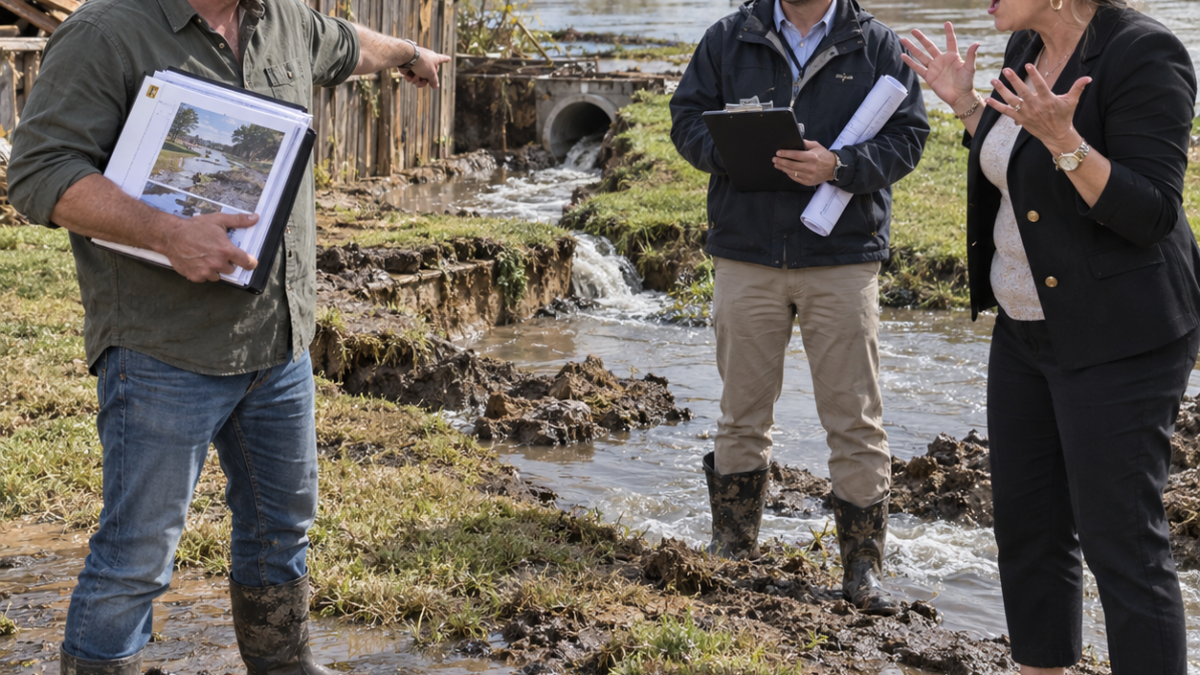
For three years, water had been quietly eating into the foundation of the house my wife and I had spent most of our adult lives saving for, and the woman next door knew exactly where it was coming from. When I finally uncovered a buried drainage pipe ending eleven feet from my basement wall, HOA president Karen Miller stood in her yard and told me the damage was my problem because I should have bought a better-built house. What she didn’t understand was that once I stopped arguing with her and started measuring what the water had done, the little black pipe under her decorative rocks was about to become the most expensive thing she had ever buried.
The first warning wasn’t a flood.
It was a smell.
Damp earth.
Mildew.
The kind of odor that doesn’t belong in a finished basement.
My wife, Sarah, noticed me standing at the bottom of the stairs one Saturday morning with my head tilted slightly.
“What?” she asked.
“You smell that?”
She sniffed.
“Basement.”
“No.”
She gave me the look she used whenever thirty years around engineering projects turned me into a human inspection checklist.
Our seventeen-year-old son, Leo, used the basement as his territory—video games, movies, friends, pizza boxes I pretended not to see. It should have smelled like teenage boy and electronics.
Instead, near the utility-room wall, the air was damp.
I started checking.
Sump pump.
Dry.
Water heater.
Fine.
Plumbing.
No leaks.
Then I pulled away a baseboard near the wall facing Karen’s property.
The drywall collapsed under my fingers.
Wet.
Soft.
Behind it, the concrete block was dark with moisture.
A thin crack climbed upward from the floor.
My stomach dropped.
I spent twenty years in the Army Corps of Engineers before retiring. I had seen what water could do when people underestimated it. It didn’t need drama. It didn’t need speed.
Give water enough time and pressure, and it would win.
Outside, everything on my property looked right. The house had been graded properly. My downspouts discharged away from the foundation. The drainage swale moved toward the street.
Then I looked uphill.
Karen’s property sat slightly higher than mine.
Her rear downspout disappeared into a decorative bed of gray river rock exactly along our property line.
No visible outlet.
No connection to the street.
I crouched and moved several rocks.
The soil beneath them was saturated.
I dug deeper.
My fingers struck black corrugated plastic.
A four-inch drainpipe.
I followed it through the mud until I uncovered the end.
It stopped underground.
Open.
Pointing directly toward my house.
I measured the distance.
Eleven feet from my foundation.
For several seconds, I simply stared at it.
Then I walked to Karen’s door.
She came outside wearing sunglasses on top of her head and crossed her arms before I said five words.
“Your downspout is buried toward my foundation.”
“That water has always flowed that way.”
“No, Karen. Your pipe ends underground facing my basement.”
She shrugged.
“If your foundation can’t handle a little runoff, that sounds like a you problem.”
“A roof dumps hundreds of gallons in a heavy storm.”
“Then maybe you should have invested in a better-built house.”
I felt my jaw tighten.
“Did you install that pipe?”
Her expression barely changed.
“I suggest you be very careful about what you accuse people of in this neighborhood, Sergeant.”
There was something in the way she said it.
Not surprise.
Not confusion.
A warning.
“I run things here,” she continued. “And I have a long memory.”
I could have shouted.
Instead, I walked home.
Sarah met me in the kitchen.
“Well?”
I washed mud from my hands.
Then I picked up my phone.
“I’m calling an engineer.”
Two days later, structural engineer Arthur Vance stood in my basement with a moisture meter pressed against the wall.
The digital reading maxed out.
He removed his glasses.
“That isn’t a leak,” he said.
Then he followed me outside, inspected the buried pipe, took soil cores, and measured the grade.
Finally he looked toward my house.
“With this clay, the water isn’t draining down.”
“Where is it going?”
He pointed at my basement.
“Straight there.”
His team opened ten feet of finished wall the following morning.
Behind it, cracks spread across the concrete block.
One long horizontal fracture ran through the center.
Arthur set up a laser.
He checked it twice.
Then he turned toward me.
“Your wall is bowing inward.”
“How much?”
“Half an inch.”
Sarah stopped breathing beside me.
Arthur looked at both of us.
“You caught it before failure.”
Then he paused.
“But fixing this correctly is not going to be cheap.”
A week later, his report arrived.
Twenty pages.
Photographs.
Moisture data.
Soil analysis.
Drainage diagrams.
Structural measurements.
And on the final page, an estimated repair cost approaching ninety thousand dollars.
I was still staring at that number when I noticed one sentence Arthur had underlined in the conclusion.
The damage was not consistent with natural drainage.
It was consistent with concentrated, redirected discharge from the neighboring property.
And for the first time since I uncovered that pipe, I understood exactly how much trouble Karen Miller was in.
PART 2
I read that sentence five times.
Sarah sat across from me at the kitchen table with both hands wrapped around a coffee mug that had gone cold.
Leo was at school.
For once, the house was quiet enough that I could hear the refrigerator compressor cycle on and off.
Arthur Vance’s report lay between us.
It looked harmless.
Blue cover.
White paper.
Stapled photographs.
Ordinary professional formatting.
But the final estimate made my stomach tighten every time my eyes returned to it.
Exterior excavation down to the footing.
Drainage correction.
Foundation waterproofing.
Carbon-fiber reinforcement.
Interior wall removal and reconstruction.
Electrical work.
Floor replacement.
Mold remediation if opening the remaining wall revealed contamination.
Preliminary total: $78,400 for structural and exterior work.
With the interior restoration, Arthur estimated the full cost could approach $90,000.
Sarah finally said, “That’s more than Leo’s college fund.”
“I know.”
“Almost twice.”
“I know.”
“And if we don’t do it?”
I flipped back to the structural section.
“Arthur says the wall keeps moving.”
“How fast?”
“He can’t guarantee that.”
She looked toward the basement door.
“What does ‘failure’ actually mean?”
I hated that question because I understood the answer.
“It could mean more cracking. Water intrusion. Permanent deformation.”
“And worst case?”
“Partial wall collapse.”
Sarah stared at me.
“While Leo is down there?”
“No.”
The word came out harder than I intended.
She flinched.
I reached across the table.
“Sorry.”
“You don’t know it won’t happen.”
“No.”
I closed the report.
“That’s why nobody uses that side of the basement until it’s stabilized.”
Leo took the news about losing half his basement with the kind of outrage only a seventeen-year-old can summon.
“You’re serious?”
“Yes.”
“But the Xbox is down there.”
“The Xbox can move.”
“My friends come over Friday.”
“Not downstairs.”
“Dad.”
“Leo.”
He recognized the tone.
Sarah stepped between us before the situation became a military briefing.
“It’s temporary.”
“How temporary?”
I looked at the repair report.
“That depends on someone next door.”
Leo followed my eyes toward the kitchen window.
“Karen?”
“Don’t get involved.”
“I didn’t say anything.”
“You were about to.”
He looked offended.
“I was going to say she’s insane.”
“Exactly.”
Sarah covered a smile.
I pointed toward him.
“Stay out of it.”
“Yes, Sergeant.”
I almost laughed.
Almost.
The next morning, I prepared my first formal complaint.
Not an emotional letter.
Not a threat.
Facts.
Date I discovered the moisture.
Location of the damage.
Photographs of the buried pipe.
Arthur’s findings.
Estimated repair cost.
The relevant HOA covenant stating that no owner could alter drainage in a way that caused material damage to another property.
I requested three things.
Immediate correction of Karen’s drainage.
Independent inspection if the board disputed Arthur’s conclusion.
Reimbursement for documented damage attributable to the redirected water.
I attached the entire engineering report.
Not selected pages.
Everything.
Then I sent the packet certified mail to the HOA board, architectural committee, and Karen personally.
Karen signed for one of the envelopes herself.
I had the green receipt within days.
Then nothing happened.
One week.
Two.
No inspection.
No phone call.
No request for additional documentation.
Arthur called twice asking whether the drainage had been corrected.
“No.”
“Then put a temporary surface diversion on your side.”
“Will that affect the evidence?”
“Not if we document existing conditions first.”
He came back.
Photographed the site.
Installed monitoring marks on the basement wall.
Then he helped design a temporary measure that reduced additional water without touching Karen’s pipe or property.
It was not a solution.
But it bought us time.
On day fifteen, I opened my mailbox.
Inside was an HOA envelope.
I actually felt relief.
That lasted perhaps three seconds.
The first page was a violation notice.
I read it standing at the curb.
Dear Mr. Henderson:
You are hereby notified that your property is in violation of Architectural Rule 7.4, which prohibits unauthorized modification or disturbance of landscaping features located adjacent to shared property boundaries.
I blinked.
Then kept reading.
The Architectural Control Committee had “observed” that I moved decorative river rock near the line separating my property from Lot 24.
Correct.
I moved rocks.
To uncover the pipe flooding my foundation.
Fine: $250.
Required action: restore the decorative bed.
Failure to comply: additional daily penalties.
I stood there in the afternoon sun reading it again.
Then I laughed.
Not because it was funny.
Because sometimes arrogance becomes so extreme your brain refuses to process it normally.
There was a second page.
This one was signed by Karen as HOA president.
Regarding your recent allegation concerning drainage from Lot 24, the board has reviewed your submission and finds insufficient basis to attribute the condition of your foundation to neighboring landscaping.
My grip tightened.
The letter continued.
The board believed the moisture represented either natural site drainage or a construction-related defect in my home.
Matter closed.
Then I saw the CC line.
COMMUNITY DISTRIBUTION LIST.
Karen had sent a summary of the dispute to the entire subdivision.
My address.
My complaint.
Her ruling.
My supposed violation.
All of it framed so that she appeared to be protecting the HOA from a troublesome homeowner demanding almost ninety thousand dollars.
Sarah read the letter in the kitchen.
She didn’t say anything for a long time.
Then she asked, “Did anyone from the board come inspect the wall?”
“No.”
“Did they call Arthur?”
“No.”
“Did they hire another engineer?”
“No.”
“How did they review it?”
“They read what Karen gave them.”
“How do you know they even got the whole report?”
I looked at her.
That was a good question.
I hadn’t considered it.
Sarah held up the fine.
“And she’s punishing you for finding the pipe.”
“Yes.”
“Can she do that?”
“She can send paper saying almost anything.”
“That’s not what I asked.”
“No.”
I took the letter from her.
“I don’t think she can make it stick.”
“Then what?”
I looked toward the basement.
The exposed concrete wall was still behind plastic sheeting.
I could almost smell the wet block from the kitchen.
“Then I stop treating this as a neighbor dispute.”
That evening, I sat downstairs alone.
The damaged wall looked worse under bare work lights.
Once drywall and insulation were removed, there was nothing cosmetic left to hide the problem.
Gray block.
Dark moisture stains.
Cracks.
The horizontal fissure bothered me most.
I ran my fingers near it without touching.
Half an inch of bow.
That sounded small.
It was not small.
Buildings fail in increments before they fail dramatically.
I thought about every paycheck Sarah and I had put toward that house.
Every move.
Every deployment.
Every time we said no to something because we were saving.
Leo’s first night in his basement bedroom during a sleepover.
Christmas mornings.
Sarah painting the upstairs hallway at midnight because she refused to leave a wall half finished.
A home is material.
Concrete.
Timber.
Wire.
Pipe.
But it is also accumulated life.
Karen had aimed water at both.
I folded her letters and placed them beside Arthur’s report.
Then I opened a new binder.
On the spine, I wrote:
MILLER / HOA — DOCUMENTATION.
The next morning, Dave Reynolds drove up in a golf cart while I was pressure-washing my driveway.
Dave was a retired Marine in his late sixties with white hair cropped shorter than most active-duty men I knew.
He shut off the cart.
“Heard you’re fighting the dragon.”
I killed the washer.
“Depends who you mean.”
“You know exactly who I mean.”
He climbed out.
“I got the email.”
I wiped water from my forearms.
“Sorry everyone got dragged into it.”
“Dragged?”
He snorted.
“She put you on display.”
“I noticed.”
Dave looked toward Karen’s house.
“She did the same thing to me.”
“What?”
He nodded toward the American flag mounted on the front of his home.
“Five years ago. Told me it was oversized.”
I looked at the flag.
It was large.
Not absurd.
A normal residential flag.
“She tried to fine me a thousand dollars. Said the proportions disrupted the visual harmony of the street.”
“You’re kidding.”
“I wish.”
“What happened?”
“I sent her a letter from a veterans legal group quoting the federal statute.”
He smiled.
“She decided harmony could survive.”
For the first time in two weeks, I laughed properly.
Then his expression changed.
“What she did to you is different.”
“Yes.”
“House really damaged?”
I nodded.
“How bad?”
“Potentially ninety grand.”
The humor disappeared from his face.
“Jesus.”
“Engineer says the buried discharge is the direct cause.”
“And she denied it.”
“Yes.”
“Then fined you.”
“Yes.”
Dave shook his head.
“She always does that.”
“Does what?”
“Makes the person complaining into the problem.”
That sentence stayed with me.
Before he left, Dave said, “If you need a witness, a statement, anything—call me.”
I thanked him.
I assumed that would be it.
It wasn’t.
Two days later, Mrs. Evelyn Gable approached me at the grocery store.
She was in her seventies, small enough that her shopping cart seemed oversized, and famous in Oak Ridge Meadows for the army of ceramic gnomes occupying her front garden.
“Mr. Henderson?”
“Yes, ma’am?”
She lowered her voice.
“I read that terrible letter.”
My first instinct was embarrassment.
“HOA letter?”
“Yes.”
She shook her head.
“She shouldn’t have sent that to everybody.”
“I agree.”
“Karen does things like that.”
Her fingers tightened around the purse hanging from her wrist.
“She made me remove fourteen gnomes.”
I waited.
I wasn’t sure I heard correctly.
“Fourteen?”
“The rules allow five decorative objects.”
She looked down.
“My husband gave me one every anniversary after we moved here.”
That changed the story immediately.
“They were gifts?”
“He died six years ago.”
Her eyes filled.
“She told me grief wasn’t an exemption to the landscaping guidelines.”
I stared at her.
“She actually said that?”
Mrs. Gable nodded.
“She made me send pictures after I removed them.”
I had no answer.
She touched my arm.
“I hope you beat her.”
Then she pushed her cart away.
Over the next week, the stories kept coming.
Not because I asked.
Because Karen had sent my dispute to everyone.
The Watsons, a young couple with two children, told me the architectural committee denied their backyard swing set because part of it might be visible from the road after the leaves fell.
Another homeowner had been fined because his trash cans remained curbside four hours after pickup while he was at a medical appointment.
A widow received violation notices over a faded fence six weeks after her husband died.
A teacher was threatened with daily fines for leaving a portable basketball hoop near the driveway overnight.
Some of the complaints were probably legitimate rule disputes.
Not every unhappy homeowner is automatically right.
I knew that.
So I started collecting documents rather than stories.
Letters.
Fine notices.
Appeals.
Responses.
Dates.
Patterns.
What emerged bothered me.
Karen often chaired the committee issuing the original notice.
Then she participated in reviewing the appeal.
Then she signed the board response.
Authority circled back to the same person.
Dave started introducing me to people.
“Talk to Mark,” he told them.
“My name is Mark Henderson,” I reminded him one afternoon.
“I know.”
“You just introduced me to a man as Jack.”
He stared.
“I’ve been calling you Jack for two years.”
“Why?”
“You look like a Jack.”
“I’m Mark.”
“Well, that’s disappointing.”
From then on, he called me Sergeant.
Probably safer.
We began meeting in Dave’s garage.
Nothing conspiratorial.
No secret passwords.
No revolution.
Just six or seven homeowners drinking coffee among neatly arranged tools and discussing documents.
Mrs. Gable brought cookies.
The Watsons brought their denial letter.
Dave brought every notice Karen had ever sent him.
I brought Arthur’s report.
I told them something at the first meeting.
“If we do this, we do it cleanly.”
Dave frowned.
“Meaning?”
“No lies. No exaggeration. No anonymous harassment. No social media pile-on.”
Mrs. Gable nodded.
The Watsons agreed.
Dave said, “Can we still call her Dragon Lady privately?”
“No.”
He looked betrayed.
“Fine.”
I continued.
“Some HOA rules are legitimate. Some fines may be legitimate. We’re documenting process abuse, not collecting every complaint from anybody who dislikes paying dues.”
Dave pointed at me.
“That’s why you’re running this.”
“I’m not running anything.”
Everyone looked at me.
I sighed.
“Fine.”
What I wanted most was still simple.
Fix my foundation.
Stop the water.
Reimburse the damage.
But by then I understood Karen’s power came partly from isolation.
One homeowner challenged her.
She framed them as difficult.
Another challenged her.
Same thing.
Nobody compared notes.
My public humiliation changed that.
By trying to isolate me, she connected everyone.
Sarah saw the binder getting thicker.
One night she came into my office.
“How far are you planning to take this?”
“As far as it needs to go.”
“That’s a military answer.”
“It’s an honest answer.”
She closed the door.
“I need a husband answer.”
I leaned back.
She sat opposite me.
“I know you’re angry.”
“Yes.”
“I am too.”
“I know.”
“But this cannot take over our life.”
I looked at the folders spread across my desk.
She was right.
It already was.
“Leo barely sees you except when you’re measuring cracks.”
“That’s not fair.”
“He said it.”
That hurt.
Sarah softened.
“I’m not asking you to quit.”
“Good.”
“I’m asking you to remember what you’re protecting.”
That sentence affected everything afterward.
I moved all HOA work into defined hours.
I stopped checking email after nine.
I took Leo fishing that weekend.
He complained for the first twenty minutes because there was no cell signal.
By lunch, he was asking me about the lawsuit.
“There isn’t one yet.”
“Are you going to sue Karen?”
“Probably.”
“Can you take her house?”
I looked at him.
“Why would you ask that?”
“Kids at school are talking.”
That was another consequence of Karen’s email.
Some Oak Ridge Meadows kids attended Leo’s school.
The adult dispute had reached teenagers.
“What are they saying?”
“That Mrs. Miller says you’re trying to scam the HOA.”
I set down my fishing rod.
“Leo, listen to me.”
He did.
“We’re going to prove what happened with evidence. We are not trying to destroy anybody.”
“She destroyed our basement.”
“She damaged our house.”
“Same thing.”
“No.”
I needed him to understand.
“Wanting repairs and accountability is different from wanting someone ruined.”
He stared at the water.
“What if she deserves it?”
“That is not our job to decide.”
He looked at me.
“A judge?”
“A judge decides legal consequences.”
“And you?”
“I tell the truth.”
He nodded slowly.
I would remember that conversation months later when the number $380,000 entered our lives.
The lawyer’s name was Jessica Ramirez.
Dave recommended her.
“She eats HOA bullies for breakfast,” he said.
“That sounds like advertising.”
“It’s good advertising.”
Jessica’s office was downtown, twenty floors above traffic.
She was younger than I expected, probably early forties, with dark hair tied back and the kind of attention that made you feel every unnecessary word was being silently deleted.
I laid out the documents.
She read more than she talked.
Arthur’s report.
Certified receipts.
Fine notice.
Board dismissal.
Community email.
Neighbor letters.
My photographs.
When she finally looked up, she tapped Arthur’s report.
“This is the center.”
“Not the retaliation?”
“That matters.”
She tapped the engineering conclusion again.
“But without causation, you have an ugly HOA dispute. With causation, you have property damage.”
She opened the photographs.
“The pipe installation is critical. Who installed it?”
“I don’t know.”
“When?”
“I don’t know.”
“Previous owner?”
“Possible.”
“Karen?”
“Possible.”
“Any permit?”
“I haven’t found one.”
She nodded.
“Good.”
“Good?”
“Good that you said you don’t know.”
She looked directly at me.
“Your biggest risk right now is becoming so convinced she acted maliciously that you start stating things we have not proved.”
I appreciated her immediately.
“She knew the pipe was there.”
“How do you know?”
“Her reaction.”
“That is not enough.”
I leaned back.
“What is enough?”
“Records. Contractor. Witness. Invoice. Admission.”
She flipped to Karen’s fine.
“This is useful.”
“Because it’s retaliation?”
“Potentially.”
She was careful even with that.
“Timing is strong. Especially if she personally chaired the committee.”
“She did.”
“We verify.”
Then she read the HOA dismissal.
“Did the board actually vote?”
“I don’t know.”
“Minutes?”
“I requested them.”
“Response?”
“None yet.”
Jessica smiled slightly.
“Then we request them again.”
She spent nearly two hours separating what I knew from what I believed.
At the end, she said, “You have a strong case for the drainage damage if Arthur’s findings withstand independent review.”
“And Karen?”
“Don’t get ahead of yourself.”
“What do we do first?”
“Demand.”
Jessica drafted a letter far sharper than mine.
It went to Karen and her husband, Tom, because the drainage system served jointly owned property.
It also went to the HOA and its management company.
The letter demanded preservation of records.
Drainage plans.
Landscaping invoices.
Emails.
Committee communications.
Inspection notes.
Board minutes.
It requested correction of the drainage and payment of documented repairs.
By then updated contractor estimates pushed the house restoration toward $94,500.
Jessica also put Karen on notice that retaliatory use of HOA powers could support additional claims.
She did not demand $380,000.
Not yet.
She deliberately avoided an inflated opening number.
“Why not hit hard?” Dave asked when I told him.
Jessica answered him herself at our next meeting.
“Because courts notice when people behave reasonably.”
Dave folded his arms.
“I prefer unreasonable.”
“I know.”
“She’s been unreasonable for years.”
“That’s why we don’t need to compete.”
The demand was served personally.
The process server later confirmed Karen accepted it at her front door.
Tom stood behind her.
According to the server, he read the first page over her shoulder and went pale.
Then the door closed.
The thirty-day response period began.
One week later, Karen called an emergency HOA meeting.
The agenda contained two items.
Pending legal matters.
Proposed protective bylaw amendments.
Gerald Morris, the HOA treasurer, contacted Dave privately.
Gerald was an accountant, quiet, cautious, and apparently terrified.
Dave called me that night.
“You’re going to like this.”
“That usually means I won’t.”
“She wants to change the drainage bylaws.”
“What?”
“She wants architectural committee decisions on runoff disputes to become binding.”
I sat up.
“During a live dispute?”
“Yep.”
“What else?”
There was a pause.
“She wants an assessment against you.”
I thought I misheard.
“Against the community?”
“No. You.”
“For what?”
“HOA legal expenses.”
I rubbed my forehead.
“How much?”
“Gerald says twenty grand.”
Sarah, sitting across the room, saw my expression.
“What?”
I held up one finger.
Dave continued.
“She told the board you’re threatening to bankrupt the association.”
“Our demand is directed primarily at Karen and the property owners responsible.”
“She didn’t show them the whole letter.”
There it was again.
Information control.
“What did she show?”
“Summary.”
I called Jessica.
She listened.
Then there was silence.
Finally she said, “Please tell me this meeting is being recorded.”
“HOA usually records audio.”
“Excellent.”
“You sound happy.”
“I am professionally delighted.”
“She can’t levy a one-person assessment, can she?”
“Not like this.”
“What about the bylaw?”
“Even if properly adopted, it cannot erase accrued legal claims or turn Karen into a court.”
“So we attend.”
“Oh, yes.”
The clubhouse was packed.
Normally HOA meetings attracted perhaps fifteen homeowners.
That night nearly one hundred people squeezed into the room.
Dave sat in front.
Mrs. Gable arrived with three friends.
The Watsons sat near the back.
Sarah sat beside me.
Jessica sat on my other side with one narrow briefcase.
Karen entered late.
That was unlike her.
She usually arrived early enough to control the room before anyone else sat down.
Tom came in separately.
He sat against the back wall.
Far from her.
I had met him only twice.
He was a quiet man.
Thinner than Karen.
Gray at the temples.
He looked exhausted.
Karen called the meeting to order.
Her voice was tighter than usual.
She began with a speech about volunteer service.
How difficult it was to lead.
How certain residents were abusing legal processes to intimidate unpaid board members.
She never said foundation.
Never said pipe.
Never said ninety-four thousand dollars.
She called our claim an “unprecedented legal attack.”
Then she introduced the proposed drainage bylaw.
“All disputes concerning runoff, grading, drainage, or water migration between properties shall be submitted to the Architectural Control Committee, whose determination shall be final and binding.”
People shifted.
Even without legal training, the problem was obvious.
Jessica rose.
“Point of order.”
Karen stared.
“Who are you?”
“Jessica Ramirez. Counsel for Mark Henderson.”
A murmur went through the room.
“This is a private HOA meeting.”
“My client is an owner and has requested my attendance because you are proposing a rule directly affecting his pending property claim.”
“You don’t have the floor.”
“I’m not asking to litigate.”
Jessica’s voice remained calm.
“I’m advising the board that retroactively attempting to strip a homeowner of legal remedies during an active dispute could expose the association and individual directors to significant additional claims.”
Gerald immediately looked at Karen.
Another board member, Carol Bennett, whispered, “You said legal approved this.”
Karen hissed something back.
Jessica continued.
“If the board has independent counsel who approved this language, I would be happy to speak with them.”
Silence.
Karen banged the gavel.
“This is exactly the intimidation I was referring to.”
Jessica sat.
She didn’t need to do more.
Karen could have stopped there.
She should have.
Instead, she moved to the second proposal.
“Given the significant legal costs created by Lot 23’s hostile actions, I propose a special assessment of twenty thousand dollars against Lot 23 to reimburse the association.”
The room made one sound.
A collective intake of breath.
Then Dave said loudly, “You’ve lost your mind.”
“Mr. Reynolds!”
“No, seriously.”
People started talking.
Karen struck the gavel repeatedly.
“This meeting will remain orderly.”
The Watsons stood.
“Why would he pay the HOA’s lawyer when his house is damaged?”
Mrs. Gable shouted something about extortion.
Jessica touched my arm.
“Now.”
I stood.
Karen saw me.
“No.”
I hadn’t said anything yet.
“You do not have the floor.”
I looked toward Carol.
“I was just named in a motion seeking twenty thousand dollars from me. I’m requesting five minutes to respond with the underlying facts.”
Carol looked at the audience.
Voices rose.
“Let him talk.”
“Show us the report.”
“What pipe?”
“Why are we paying lawyers?”
Karen looked around.
She had lost the room.
Finally she said, “Five minutes.”
Jessica whispered, “Facts only.”
I nodded.
I had prepared slides because Jessica told me never to attend an adversarial meeting without assuming I might need them.
The projector came on.
First photograph.
Karen’s decorative river-rock bed.
Second.
Rocks removed.
Third.
The exposed black pipe.
A dark open mouth beneath the soil.
“This pipe is connected to the rear downspout of Lot 24.”
I clicked.
A survey diagram.
“The termination is approximately eleven feet from my foundation.”
Click.
Arthur’s soil map.
“In our clay soil, concentrated water migrates laterally rather than quickly draining downward.”
Click.
Basement photograph.
Dark concrete.
Wet drywall.
Cracks.
Several people gasped.
I let the picture remain.
“This is my basement.”
Click.
Laser measurements.
“Independent structural engineer Arthur Vance measured a half-inch inward bow in the wall.”
Click.
The cost estimate.
“Ninety-four thousand five hundred dollars in current estimated repairs.”
The room went silent.
I looked toward Karen.
She stared at the table.
“I submitted this report to the HOA.”
Click.
Her $250 fine appeared on the screen.
Laughter broke out.
Not happy laughter.
Disbelief.
“This was the response.”
Then I displayed Karen’s dismissal letter.
Matter closed.
Community distribution.
“Instead of inspecting the damage or hiring another engineer, the committee fined me for moving rocks to expose the drainage pipe.”
Karen stood.
“That is a gross mischaracterization.”
Jessica said, “You’ll have an opportunity to respond.”
Karen glared.
I continued.
“I am not asking anyone here to believe me because I am a veteran or engineer or because you dislike Karen.”
I pointed at Arthur’s report.
“Hire another structural engineer.”
Then I looked at the board.
“Please.”
That mattered.
I did not want victory by applause.
I wanted independent confirmation.
Then Mrs. Gable stood.
“What about the rest of us?”
I hadn’t planned that.
She held up a folder.
“She made me remove fourteen anniversary gifts my husband gave me.”
Karen shouted, “This has nothing to do with drainage.”
Dave stood.
“She tried to fine me a thousand dollars for my flag.”
“Also irrelevant!”
The Watsons stood.
“She denied our kids a swing set.”
Within seconds, homeowners were speaking over each other.
Old grievances surfaced.
Some serious.
Some petty.
Jessica leaned toward me.
“This is getting away from the useful part.”
She was right.
I raised my hands.
“Everybody.”
My voice carried.
“This meeting is about the drainage proposal.”
The room slowly settled.
Karen stared at me, perhaps surprised I had given her that lifeline.
Then a chair scraped at the back.
Tom stood.
Karen’s expression changed instantly.
“Tom.”
He looked terrible.
His eyes were red.
Hands shaking.
“Sit down.”
He didn’t.
“Tom.”
He looked at me.
Then at the board.
Then at the homeowners.
“She’s lying.”
Everything stopped.
Karen’s face drained.
“What are you doing?”
Tom swallowed.
“The pipe wasn’t always there.”
Nobody moved.
“It was installed three years ago.”
Karen pushed away from the table.
“Tom, sit down.”
He ignored her.
“The previous owner of Mark’s house was named Bill Henderson.”
No relation to me.
Same surname.
Older couple.
They had moved out before we bought.
Tom continued.
“Bill fought Karen over the fence between our properties.”
Karen stepped toward him.
“Stop.”
“She was furious.”
“Tom.”
“She said he embarrassed her.”
Carol whispered, “Oh my God.”
Tom looked toward me.
“She hired a landscaper.”
My chest went cold.
“To reroute the rear downspout underground.”
Karen screamed, “That is not true.”
Tom flinched.
Then his voice became stronger.
“I watched them dig it.”
The silence was absolute.
“She told the landscaper to terminate it near the property line.”
Jessica was already taking notes.
Tom continued.
“I asked why.”
He rubbed both hands over his face.
“She said Bill complained about drainage all the time and she wanted him to have something real to complain about.”
The room seemed to tilt.
For months I had told myself not to assume malicious intent without proof.
Now the proof was standing ten yards away.
Karen rushed toward her husband.
“You’re lying because you’re angry at me.”
Tom stepped backward.
“No.”
“You’re trying to destroy me.”
“No.”
“After everything I’ve done for you—”
“You did this to yourself.”
Her face twisted.
Tom’s voice cracked.
“I told you to fix it when they sold the house.”
Karen froze.
He continued.
“I told you the new owners had nothing to do with Bill.”
I looked at Sarah.
Her hand covered her mouth.
Tom said, “She told me if the new owners ever complained, she’d say it was pre-existing drainage.”
That sentence broke whatever remained of Karen’s defense.
Gerald stood so abruptly his chair nearly fell.
“You knew?”
Karen spun.
“Gerald, don’t.”
“You knew the pipe was intentionally routed?”
“It’s not that simple.”
“It sounds extremely simple.”
Carol rose.
“Did you tell the board?”
Karen looked from one director to another.
“This is a personal matter between neighboring properties.”
“You used the board to deny his claim.”
“I was protecting the HOA.”
“You used my vote,” Gerald said.
His voice trembled.
“You told me his engineering report was speculative.”
“It is!”
Tom said quietly, “No, Karen.”
She looked at him with hatred.
“You shut your mouth.”
Jessica stood.
That was when the room truly changed.
Not because she shouted.
Jessica never needed to.
“Members of the board,” she said, “I strongly recommend that you recess immediately and contact independent counsel.”
Karen laughed sharply.
“Oh, please.”
Jessica looked toward Carol instead.
“You have now heard a direct witness allege that your president intentionally caused the drainage condition, concealed it, used association processes to reject a resulting damage claim, and proposed a targeted assessment against the affected homeowner.”
Carol looked sick.
Jessica continued.
“You need legal advice that does not come through Mrs. Miller.”
Karen screamed, “You are threatening them!”
“No.”
Jessica closed her notebook.
“I am telling them to get their own lawyer.”
Gerald looked at Carol.
“She has to step down.”
Karen turned on him.
“You spineless little—”
Carol struck the gavel once.
“Enough.”
The word echoed.
Karen stared.
Carol had never spoken to her that way.
“Karen, I am moving that you be suspended from all presidential and committee authority pending investigation.”
“You can’t.”
“Check the bylaws.”
“I wrote half those bylaws.”
“That is not the defense you think it is,” Dave said.
Despite everything, someone laughed.
Gerald seconded the motion.
The fourth board member, Alan Price, raised his hand.
“All in favor?”
Four hands.
Karen stood alone.
Her mouth opened.
Closed.
Then opened again.
“You people are making the biggest mistake of your lives.”
Carol’s face hardened.
“No.”
She looked toward the screen showing my cracked foundation.
“I think we already made it.”
The motion passed.
Karen was removed from her duties that night pending formal recall procedures.
Not expelled from the association.
Not legally convicted.
But her authority ended.
She picked up her purse.
Tom remained standing at the back.
“Are you coming?” she asked him.
He didn’t answer.
“Tom?”
He looked down.
“No.”
Something in Karen’s face collapsed.
For one second, she was not president.
Not bully.
Not defendant.
Just a woman realizing her husband would not leave the room with her.
Then anger returned.
She walked out alone.
The door slammed hard enough to rattle the glass.
Nobody celebrated.
That surprised me.
I thought Dave might clap.
He didn’t.
The room felt too heavy.
Tom sat.
His shoulders shook.
Sarah whispered, “I feel sorry for him.”
I did too.
That didn’t erase his silence for three years.
But I understood how fear works inside a marriage.
Jessica approached him.
“Mr. Miller.”
He looked up.
“You need your own attorney.”
“I know.”
“We will need your testimony.”
“I know.”
“Do not discuss facts with your wife without counsel.”
A broken laugh escaped him.
“She won’t speak to me.”
Then he looked at me.
“I’m sorry.”
I said nothing at first.
He continued.
“I should’ve stopped her.”
“Yes.”
Sarah squeezed my hand under the table.
Tom nodded.
“I know.”
I took a breath.
“Tell the truth now.”
“I will.”
“And don’t change it.”
“I won’t.”
The HOA retained independent counsel the next morning.
Its insurance carrier was notified.
Arthur Vance was contacted directly for his supporting data.
The board hired a second structural engineer, Dr. Lauren Beck, to review the foundation.
That was exactly what I had asked for from the beginning.
She spent six hours at my house.
She reviewed the pipe.
Soil.
Grades.
Foundation wall.
Moisture.
Original construction documents.
She did not simply rubber-stamp Arthur’s report.
Her numbers differed slightly.
Her causal conclusion did not.
Concentrated discharge from Lot 24 had created prolonged saturation adjacent to my foundation.
The saturation generated abnormal lateral pressure in the expansive clay.
That pressure materially caused the cracking and inward deformation.
Her estimated repair cost was worse.
Once she included mold testing, electrical replacement, flooring, and contingencies, the budget rose to approximately $128,000.
When Jessica called me with the number, I sat down.
“One twenty-eight?”
“Current estimate.”
“Arthur said ninety-four.”
“More wall has to be opened.”
I rubbed my eyes.
“What about the HOA insurer?”
“They are investigating coverage.”
“That means?”
“It means nobody writes a six-figure check the morning after a board meeting.”
“What about Karen?”
“Tom gave a sworn affidavit today.”
“Same story?”
“More detail.”
I didn’t ask immediately.
Jessica continued.
“He identified the landscaping company.”
My hand tightened around the phone.
“They still exist?”
“Yes.”
“And?”
“We subpoena records.”
The landscaping records were devastating.
Three years earlier, Karen Miller had paid a local contractor $1,850.
The invoice described:
REAR DOWNSPOUT EXTENSION / BURIED DISCHARGE / PROPERTY-LINE LANDSCAPE RESTORATION.
Cash notation.
Karen’s name.
Lot number.
There were also text messages.
The contractor still had an archived phone backup because his accounting software stored client communications.
One message from Karen read:
Run it underground so Bill can’t complain about seeing it.
Another:
End it near the boundary. Water naturally goes downhill anyway.
No message explicitly said, destroy his foundation.
No cartoon-villain confession.
Reality rarely gives you that.
But combined with Tom’s testimony about her motive, the evidence was powerful.
Then came the HOA emails.
Discovery showed Karen had received my full engineering report.
She forwarded only three pages to the board.
Not the conclusion.
Not the photographs of the pipe.
Not the repair estimate.
In her summary she wrote:
Owner appears to be attempting to assign a longstanding construction defect to neighboring landscaping. I have reviewed and recommend denial.
Gerald had replied:
Has an engineer reviewed this for HOA?
Karen answered:
Not necessary.
That email became nearly as important as Tom’s confession.
She was not simply wrong.
She prevented independent review.
Then fined me.
Then proposed charging me legal fees.
Jessica scheduled mediation before filing a full trial calendar.
Her reasoning was practical.
“My house needs fixing.”
“Yes.”
“Every month we fight means more monitoring and temporary stabilization.”
“Yes.”
“So why not sue immediately?”
“We have filed the complaint necessary to preserve your claims.”
She slid a legal pad across the conference table.
“But trial is not automatically victory. Trial means two years, experts, depositions, uncertainty, appeals.”
I looked at her.
“And mediation?”
“Pressure.”
“How much are we demanding?”
She didn’t answer immediately.
Then she turned the pad around.
$380,000.
I stared.
“How did we get there?”
She broke it down.
Approximately $130,000 in property repair and related remediation.
Temporary mitigation and monitoring expenses.
Engineering and expert costs.
Attorney fees recoverable under applicable claims or settlement structure.
Loss-of-use and interior restoration components.
Diminution and stigma arguments, though she warned those were disputed.
And a substantial punitive component tied to intentional conduct, concealment, and retaliation.
“Are we getting $380,000?”
“I didn’t say that.”
“The original story going around the neighborhood says you’re taking her for everything.”
Jessica’s expression went flat.
“Neighborhood stories are not legal strategy.”
“Fair.”
She pointed toward the number.
“This is a demand designed to value the full risk of taking the case to a jury.”
“Against Karen personally?”
“Against all legally responsible parties, allocated based on coverage and conduct.”
“What about the HOA?”
“The board is cooperating. That helps them.”
“Insurance?”
“The association’s carrier has indicated it may cover certain negligent board acts and defense costs, but it is reserving rights regarding Karen’s intentional conduct.”
“So Karen could be personally exposed.”
“Yes.”
I thought about Leo’s question.
Can you take her house?
I disliked how real that suddenly felt.
Jessica noticed.
“You’re allowed to want compensation without enjoying what the consequences might be.”
“I don’t want her homeless.”
“Then don’t confuse asking for accountability with choosing how she manages her assets.”
The mediation lasted eleven hours.
Karen arrived with her own attorney.
Tom arrived separately with counsel because divorce proceedings had started.
The HOA had counsel.
The insurers had counsel.
The landscaping contractor’s insurer had counsel.
I had never seen so many people spend so much money sitting in separate conference rooms.
The mediator moved between us.
First offer.
Insultingly low.
Jessica rejected it.
Second.
Higher.
Still inadequate to guarantee full foundation restoration.
Rejected.
By midafternoon, the HOA carrier agreed to fund the structural repairs.
That was the first breakthrough.
Approximately $130,000 earmarked to make my home whole.
The landscaping insurer contributed toward drainage and excavation costs.
Then the dispute narrowed.
Karen’s personal liability.
Retaliation.
Legal fees.
Punitive exposure.
Her attorney argued that she believed the drainage was permissible.
Jessica produced the invoice.
Then the text messages.
Then Tom’s affidavit.
Her attorney argued Karen acted partly in her capacity as HOA president.
Jessica produced the emails showing she concealed portions of Arthur’s report.
Then the fine.
Then the proposed targeted assessment.
By six that evening, I was exhausted.
Sarah sat beside me in the small conference room.
“Do you still want this?”
“What?”
“All of it.”
I knew what she meant.
The fight.
The punitive claim.
Karen’s personal money.
“I want our house fixed.”
“That part is covered now.”
“Yes.”
“What else do you want?”
I looked at the legal pad.
“I want the legal fees covered.”
“Reasonable.”
“I want Arthur paid.”
“Reasonable.”
“I want the board rules changed.”
“That’s not all.”
No.
It wasn’t.
I wanted Karen to lose.
The thought embarrassed me once I admitted it.
Not because she didn’t deserve consequences.
Because I could feel the point where justice and revenge overlapped.
Sarah knew.
“You don’t have to protect her,” she said.
“I know.”
“You also don’t have to become obsessed with hurting her.”
“I know.”
The mediator returned.
Karen was offering a consent judgment.
The total package across responsible parties and Karen’s personal obligation would resolve the claims at $380,000.
Not $380,000 cash handed to me.
The settlement structure included the $130,000 repair funding, covered expenses, legal costs, expert costs, and a significant personal judgment component against Karen.
Her share was large enough that she would almost certainly need to sell her interest in the house.
Jessica looked at me.
“Decision is yours.”
“What happens if we reject?”
“We litigate.”
“Chance we get more?”
“Yes.”
“Chance we get less?”
“Yes.”
“Chance we spend two years doing this?”
“High.”
I looked at Sarah.
She said, “I want our life back.”
So did I.
“Accept.”
Jessica nodded.
The settlement required signatures from everyone.
Karen refused for another hour.
Then Tom’s attorney entered her room.
I never learned what he told her.
At 8:42 p.m., Jessica came back carrying signed papers.
“It’s done.”
I stared at the signature.
Karen Miller.
The same name that had appeared on fines.
Dismissals.
Committee rulings.
HOA emails.
Now it appeared beneath a settlement and consent judgment totaling $380,000 across the resolution of my claims.
“Is that it?” I asked.
“For your case, mostly.”
“That sounds suspicious.”
“There are implementation details.”
“Of course.”
She smiled.
“But the fight over liability is over.”
Sarah started crying.
Quietly.
I put my arm around her.
I thought I would feel triumphant.
Instead I felt something leave my body.
Tension.
Months of it.
The constant readiness for another letter.
Another crack.
Another meeting.
Another threat.
Gone.
Not happiness yet.
Just release.
Karen resigned permanently from every HOA position as part of the broader association resolution.
The recall process became unnecessary.
The board withdrew my fine.
It reimbursed the small expenses I had paid defending it.
The proposed assessment vanished.
Then the HOA adopted temporary governance changes while an independent committee reviewed its bylaws.
Carol Bennett became acting president.
Gerald remained treasurer.
Both publicly acknowledged they had failed by relying too heavily on Karen’s summaries.
That mattered to me.
They did not pretend they were innocent.
At the next community meeting, Carol stood at the same table where Karen had tried to impose the twenty-thousand-dollar assessment.
“I owe Mark Henderson an apology.”
The room was quiet.
She looked at me.
“I voted to deny his claim without reading the complete engineering report.”
Gerald followed.
“So did I.”
He rubbed his forehead.
“We let one person control information because it was easier.”
Dave whispered beside me, “This is becoming suspiciously healthy.”
I elbowed him.
Carol continued.
“The board failed its process.”
She announced reforms.
No committee chair could decide their own property dispute.
Any board member with a personal financial interest had to recuse.
Structural, drainage, or safety disputes above a defined threshold required independent professional review.
Full expert reports had to be distributed to every director.
Appeals would be heard by members not involved in the initial ruling.
Targeted punitive assessments were prohibited unless specifically authorized under governing documents and law.
Then Mrs. Gable raised her hand.
“Yes, Evelyn?”
“What about gnomes?”
The room broke into laughter.
Carol smiled.
“The decorative-object rule is also under review.”
Mrs. Gable nodded firmly.
“Good.”
The foundation repair started three weeks later.
Watching a crew excavate beside your house is unsettling.
Even when you know it is necessary.
A long trench opened along the wall facing Karen’s property.
Soil came out in layers.
Near the bottom, the clay was still darker than surrounding material.
Saturated.
Arthur stood in the trench one morning examining the block from outside.
“Here.”
He pointed.
A horizontal crack mirrored the damage inside.
“That is pressure.”
I crouched above him.
“How close were we?”
“To losing the wall?”
“Yes.”
He removed his glasses.
“Impossible to say exactly.”
I gave him a look.
He knew what I wanted.
“Another few wet seasons would have been very bad.”
Sarah heard that.
She stood behind me.
“Define very bad.”
Arthur looked toward her.
“Full structural rebuild rather than stabilization.”
She closed her eyes.
That answer was enough.
The crew cleaned the foundation.
Repaired cracks.
Applied waterproofing.
Installed drainage board.
Laid a new perimeter drain.
Inside, they reinforced the wall.
Arthur initially recommended carbon-fiber straps because deformation was limited enough to stabilize without complete reconstruction.
Every strap was bonded from slab to framing according to the engineered plan.
Then came mold remediation.
Fortunately, contamination was localized.
Still expensive.
Still disruptive.
Leo lost the basement for nearly three months.
We moved his gaming setup into the dining room temporarily.
This produced one unexpected benefit.
I discovered just how loudly teenage boys communicate while wearing headsets.
“WHO THREW THAT?”
“Leo.”
“Sorry, Dad.”
“WHY ARE YOU BUILDING THERE?”
“Leo.”
“Sorry.”
One evening Sarah sat at the kitchen table listening to him yell at his friends.
“You miss the damp basement yet?”
“A little.”
Despite everything, home repair became strangely healing.
Broken material came out.
Dry material went in.
Damaged electrical outlets were replaced.
New insulation.
New drywall.
New flooring.
The basement smell disappeared.
Arthur returned for final structural measurements.
He placed the laser.
Checked the wall.
Then smiled.
“Stable.”
That one word was worth more than the settlement.
Sarah touched the finished wall.
“You’re sure?”
“Your wall isn’t moving.”
She looked at me.
I didn’t trust myself to speak.
For months, that wall had represented threat.
Money.
Anger.
Karen.
Now it was just a wall again.
Karen’s life unraveled more slowly.
Tom filed for divorce.
Not because the court magically rewarded him for confessing.
His situation was complicated too.
He had known about the pipe.
He had failed to stop it.
Jessica considered naming him more aggressively until his cooperation and evidence clarified that he had objected but remained silent afterward.
That silence mattered.
He ultimately contributed financially through the marital property settlement.
But Karen bore the bulk of the personal judgment under our agreement because the documentary evidence showed she directed the installation, concealed the report, issued the retaliatory fine, and attempted to use the HOA against me.
Their house went on the market.
I did not feel what I expected when I saw the sign.
No satisfaction.
Mostly exhaustion.
Sarah stood beside me at the kitchen window.
“Don’t stare.”
“I’m not.”
“You absolutely are.”
“I’m looking at the mailbox.”
“The mailbox is six feet from the sign.”
I moved away.
Tom came to our door a week later.
Alone.
He looked older.
Divorce will do that.
So will public shame.
“Can I talk to you?”
I stepped outside.
He did not ask to come in.
“I’m moving next week.”
“I heard.”
“I wanted to say something before I go.”
I waited.
He looked toward the ground.
“I’m not asking you to forgive me.”
“Good.”
He nodded.
“I knew enough to stop this.”
“Yes.”
“I told myself it was between Karen and Bill.”
I said nothing.
“Then Bill moved.”
“Yes.”
“I should have dug the pipe up myself before you bought the house.”
“Yes.”
Each yes hurt him.
I did not soften them.
He deserved honesty.
Tom continued.
“I was afraid of her.”
I looked at him.
He laughed once.
“She wasn’t physically abusive.”
“I didn’t think you meant that.”
“She controlled everything.”
Money.
Friends.
Decisions.
HOA.
He described a marriage where surrender became easier than conflict.
I understood without excusing him.
“Fear explains silence,” I said.
“It doesn’t erase what silence does.”
He nodded.
“I know.”
He handed me an envelope.
Inside was a photograph.
The side yard between the two homes three years earlier.
Two workers.
A trench.
Black pipe.
Karen standing beside them.
Tom said, “I found it on an old phone.”
I stared.
“Has Jessica seen this?”
“I emailed her.”
“Why bring me a copy?”
“Because I want you to know I’m done hiding things.”
I looked at him.
“Do that for yourself.”
He nodded.
Then he left.
I never saw him again.
Karen remained in the house several weeks longer.
She stopped attending community events.
Stopped driving the golf cart.
Stopped inspecting lawns.
The blinds stayed closed.
One afternoon I was checking the new drainage line when she came outside.
We had not spoken since the clubhouse meeting.
She stood on her side of the property line.
For once, neither of us pretended the line did not matter.
“Happy?”
I stood.
“No.”
She laughed bitterly.
“You got everything.”
“My wall is repaired.”
“You got money.”
“My house was damaged.”
“You got me kicked off the board.”
“Your board removed you.”
“You turned everyone against me.”
“You sent my private dispute to everyone first.”
Her mouth tightened.
“You always have an answer.”
“No.”
I looked at her.
“I have documents.”
That silenced her.
Wind moved through the ornamental grass where the old river-rock bed had been.
The buried pipe had been removed.
Her downspout now ran into a properly designed drainage system toward the street.
The solution had cost less than two thousand dollars.
That was the part I could never understand.
She could have corrected the drainage for a fraction of what her refusal eventually cost.
Karen crossed her arms.
“You ruined my marriage.”
“No.”
“You humiliated me.”
“No.”
“You took my house.”
“I didn’t take your house.”
“It has to be sold because of your judgment.”
“Because of the settlement you signed after the pipe you ordered damaged mine.”
She looked at me with such hatred that for a moment I saw the woman from the first day again.
“If you had just minded your own business—”
I laughed.
Actually laughed.
“My foundation was my business.”
She flinched.
Then looked away.
“I never thought it would do that much damage.”
That was the first honest sentence I had heard from her.
I let the anger in my chest settle.
“Did you intend to cause damage?”
She didn’t answer.
“Karen.”
“I wanted Bill to have drainage problems.”
There it was.
“But not this?”
“No.”
“Then why didn’t you fix it after he moved?”
She stared toward the street.
“Because removing it would mean admitting why it was there.”
That answer was worse than I expected.
Pride.
Not engineering.
Not money.
Pride.
“You watched our family move in.”
“I know.”
“You saw Leo.”
“I know.”
“You knew that pipe was still there.”
Her eyes filled.
For the first time, Karen Miller looked ashamed.
“I told myself it probably wasn’t doing anything.”
“Then when I brought you an engineer’s report?”
She wiped at one eye angrily.
“I panicked.”
“So you fined me.”
“Yes.”
“Why?”
“Because if I could make you back down, maybe it would stop.”
I stared.
“The water?”
“No.”
She looked directly at me.
“The problem.”
That sentence explained Karen better than anything else.
For years, whenever a problem appeared, she did not solve it.
She controlled the person naming it.
Mrs. Gable’s grief complicated the ornament rule.
Remove the gnomes.
Dave’s flag complicated aesthetics.
Fine Dave.
The Watsons challenged a pointless restriction.
Deny the swing set.
My foundation exposed her actions.
Punish me.
“If you had called me that first day,” I said, “and admitted what happened, we could have handled this differently.”
“I know.”
“You could have gone to insurance.”
“I know.”
“You could have offered to correct the drain.”
“I know.”
“You could have apologized.”
“I know.”
I had waited months to hear those words.
They gave me almost nothing.
That surprised me.
Karen asked, “Do you hate me?”
I thought before answering.
“No.”
She looked skeptical.
“I hated what you did.”
“That sounds like something people say when they want to feel superior.”
“Maybe.”
I looked toward our house.
“But I have better things to do with the rest of my life than hate you.”
Her face collapsed then.
Not dramatically.
Just enough that I saw how much power she had expected to continue occupying in my mind.
She turned away.
“I’m leaving Friday.”
I nodded.
“I hope you do better wherever you go.”
She looked back.
“Is that supposed to be kindness?”
“No.”
I meant it.
If Karen moved somewhere else and repeated the same behavior, nobody won.
She walked inside.
Friday morning, the moving truck arrived.
Dave called me at seven.
“Want lawn chairs?”
“No.”
“Coffee?”
“No.”
“Champagne?”
“Dave.”
“I’m asking.”
“Leave her alone.”
He was quiet.
“You’re serious.”
“Yes.”
“Fine.”
By afternoon, Karen’s furniture was gone.
She loaded the final boxes into her car.
Nobody gathered.
Nobody jeered.
No satisfying movie ending.
She simply left.
I watched from behind my living-room window.
Before getting into the car, she looked once toward our house.
Then toward the property line.
The place where the buried pipe had been.
She drove away.
The neighborhood felt different after Karen.
Not automatically better.
Power vacuums create their own problems.
Carol became interim president and wanted me to fill the vacant board seat.
I refused immediately.
“No.”
We stood after a meeting while people folded chairs around us.
“You haven’t heard me out.”
“I don’t need to.”
“You understand the bylaws better than half the board.”
“That is not persuasive.”
Dave appeared behind me.
“Do it.”
I turned.
“Were you eavesdropping?”
“Yes.”
Mrs. Gable joined us.
“You should.”
“Why is everyone here?”
She smiled.
“Because we organized.”
Carol said, “Mark, the problem was never that an HOA exists.”
“I’m aware.”
“The problem was concentration of power with no accountability.”
“I am very aware.”
“So help prevent that.”
I looked at Sarah across the room.
She was talking with the Watsons.
She noticed me staring.
“What?” she mouthed.
I gestured toward Carol.
Sarah immediately understood.
She shook her head.
Then paused.
Then shrugged.
Traitor.
I accepted the temporary seat.
Only until the next election.
That was the agreement.
Dave later claimed I said six months.
I said one term.
We still disagree.
My first proposal was not dramatic.
Conflict-of-interest policy.
If a board member’s property or personal dispute was involved, they recused.
Second.
Independent professional review for structural and drainage disputes.
Third.
No homeowner’s full engineering or legal submission could be summarized without the original being available to all voting directors.
Fourth.
A real appeal process.
Then came the fun part.
Mrs. Gable attended the bylaw review meeting carrying a cardboard box.
“What’s in there?” I asked.
She opened it.
Fourteen gnomes.
Dave nearly fell out of his chair laughing.
“I thought we were reviewing rules.”
“We are.”
She lined them along the wall.
Tiny miners.
Fishermen.
Gardeners.
One holding a lantern.
One on a mushroom.
One inexplicably playing accordion.
Carol stared.
Mrs. Gable folded her hands.
“I would like to discuss decorative-object limits.”
The five-object rule died that night.
Not because gnomes are a constitutional right.
Because nobody could explain what harm the number six created that the number five did not.
The swing-set restrictions were rewritten next.
Safety.
Setback.
Anchoring.
Reasonable visibility.
No nonsense about leafless winter trees.
The Watson children got their swing set.
Dave’s flag remained.
The community survived.
Slowly, people stopped treating HOA meetings like court appearances.
They still argued.
Of course they did.
People will argue about fences until the end of civilization.
But the culture changed.
Questions became normal.
Dissent stopped being treated like betrayal.
Carol once joked that Karen’s greatest accidental contribution was teaching two hundred homeowners to read their bylaws.
Leo’s basement reopened in the spring.
We let him help choose the new setup.
That was a mistake.
His first proposal included a television large enough to guide aircraft.
We compromised.
New flooring.
Better lighting.
Sectional sofa.
Game table.
A wall-mounted television that was still absurdly large.
On the first Friday his friends returned, Sarah and I sat upstairs.
We heard shouting from below.
“HE’S BEHIND YOU!”
“WHY DID YOU OPEN THAT DOOR?”
Sarah smiled.
“I never thought I’d be happy to hear this again.”
“Me either.”
Then Leo yelled, “DAD, WE NEED MORE PIZZA.”
I stood.
“There’s the nightmare.”
A month later, Arthur Vance came by for the final post-repair inspection.
He checked interior moisture.
Wall deflection.
Drain performance.
Exterior grade.
Then he joined me on the deck.
“You know the interesting part?”
“I’m afraid to ask.”
“That pipe was cheap.”
“I know.”
“Few hundred dollars in materials.”
“The invoice was eighteen-fifty.”
“And the fix would have been cheap too.”
“Less than two grand.”
Arthur shook his head.
“People will spend three hundred thousand dollars avoiding a two-thousand-dollar apology.”
“That sounds like something you should put on a business card.”
He laughed.
Then became serious.
“Wall’s good.”
“How good?”
“Better protected than before.”
“Stable?”
“Yes.”
“Long term?”
“With normal maintenance, I’d sleep fine.”
That was what I had been waiting to hear.
Not the settlement number.
Not Karen leaving.
That.
I called Sarah outside.
Arthur repeated it.
She hugged him.
Arthur froze exactly the way engineers do when they are unexpectedly hugged by clients.
Then he patted her shoulder.
“I take this as acceptance of the report.”
She laughed.
“Yes.”
The final settlement distributions arrived in stages.
Insurance repair funds had already gone largely to contractors.
Legal and expert costs were paid according to the agreement.
Karen’s personal portion came partly from liquid assets and later from her share of the house sale.
The number people repeated—$380,000—was real as the negotiated total resolution tied to my property and claims.
But the neighborhood version became exaggerated within weeks.
According to Dave, one rumor said Karen handed me a briefcase containing $380,000 in cash.
Another said federal marshals seized her house.
Another said I personally auctioned her golf cart.
None of those things happened.
“I like the golf-cart version,” Dave said.
“You started the golf-cart version.”
“That is impossible to prove.”
“It sounds exactly like you.”
“Circumstantial.”
The money left after repair obligations and fees was still substantial.
Sarah and I sat at the kitchen table with a financial adviser.
We did not feel rich.
That would have been a strange word for money connected to months of structural damage.
We paid down the remaining mortgage.
Set aside additional money for Leo’s college.
Upgraded drainage around the entire house beyond what insurance required.
And put most of the rest into boring investments.
Dave was disappointed.
“You won a revenge fortune and bought index funds?”
“We did not win a revenge fortune.”
“Still.”
“What would you do?”
“Motorcycle.”
“You already have one.”
“Second motorcycle.”
This was why Dave was not our financial adviser.
Leo eventually left for college.
The first night after we dropped him off, Sarah wandered into the basement.
I found her standing in the doorway of the rec room.
“You okay?”
“It’s too clean.”
“He took everything.”
“Not everything.”
She pointed toward a controller he had forgotten.
I picked it up.
“He’ll call within twenty-four hours.”
He called in four.
“Dad?”
“Yes?”
“Did I leave my controller?”
Sarah laughed so loudly he heard her through the phone.
Years after the dispute, the neighborhood barely resembled the place Karen had controlled.
Not physically.
The houses remained.
Lawns.
Mailboxes.
Pool.
Clubhouse.
But the social atmosphere was different.
Mrs. Gable’s gnomes returned.
All nineteen by then.
Dave added another flag on Memorial Day and took it down afterward without anyone ordering him.
The Watson kids outgrew the swing set Karen once prohibited.
Their father asked whether he needed approval to remove it.
Carol said, “Please don’t create paperwork unless necessary.”
That might have been our greatest reform.
One afternoon, a young couple moved into Karen’s old house.
Ethan and Molly Brooks.
They had a two-year-old daughter named Grace.
I watched the moving truck arrive and felt a strange uneasiness.
The house itself had done nothing.
Still, history clung to places.
A week later, Molly knocked on our door.
Sarah answered.
She held a plate of cookies.
“We wanted to introduce ourselves.”
Sarah invited them in.
Ethan had heard there had been a drainage dispute.
The seller disclosures referenced corrected drainage and prior litigation.
He looked embarrassed asking.
“I hope it isn’t rude.”
“It isn’t.”
I gave him the simple version.
Improper downspout.
Foundation damage.
Corrected drainage.
Engineering verification.
No active issue.
I did not give him Karen’s biography.
It was not his inheritance.
Ethan asked, “Would you mind if I had someone inspect the drain anyway?”
I smiled.
“I would insist.”
He laughed.
A plumber and drainage contractor checked everything.
Good.
One month later, Ethan installed a small swing set in the backyard.
The irony was so perfect Dave took a photograph.
He texted it to me.
KAREN’S HOUSE HAS FALLEN.
I replied:
Please get a hobby.
He answered:
This is my hobby.
Grace’s laughter often carried across the property line.
That became one of my favorite sounds.
The old pipe location disappeared beneath new landscaping.
Not river rocks.
Molly planted lavender.
Sometimes when I smelled it, I remembered wet concrete.
Then the memory faded.
There was one final thing I did with the money.
Not for revenge.
Not for the HOA.
For the house.
For us.
Sarah and I had always wanted a covered back porch.
Nothing extravagant.
Wide enough for two rocking chairs and a table.
After the repairs were done, I built most of it myself.
Leo came home during summer break and helped.
His idea of helping consisted largely of holding boards while checking his phone.
“Square that.”
“It is square.”
“It is absolutely not square.”
“It looks square.”
“That sentence is why buildings fail.”
“Dad.”
“Level.”
“You’re traumatized.”
“Level.”
Sarah watched us from the yard.
“You two are exactly the same.”
We both said, “No, we’re not.”
She laughed.
The porch took six weeks.
On the final evening, we sat beneath it while rain moved into the neighborhood.
Rain used to make me anxious after the pipe discovery.
I would go downstairs.
Check the wall.
Touch the concrete.
Listen to the sump system.
Now the new drains handled it.
Water came off our roof.
Moved where it was supposed to.
Karen’s old house discharged properly toward the street.
No hidden pipe.
No wet wall.
No problem.
Sarah sat beside me.
“Do you still check the basement?”
“Sometimes.”
“How often?”
“After big storms.”
“That means yes.”
“I’m an engineer.”
“That is not a medical exemption.”
I smiled.
Rain drummed on the porch roof.
Across the line, Ethan ran outside to pull a plastic toy into the garage.
Grace stood behind the glass door laughing at him.
Normal.
That word had once sounded boring.
Now it sounded luxurious.
I thought about the night Karen was removed.
Tom’s confession.
Jessica standing calmly while the board panicked.
The $380,000 figure.
The house sale.
All the moments people would tell if they wanted the story to sound like revenge.
But those were not the parts I remembered most.
I remembered Sarah standing beside the exposed basement wall asking whether it could collapse.
Leo asking if his friends were safe downstairs.
Mrs. Gable telling me those ridiculous gnomes were anniversary presents.
Tom saying he had been afraid.
Carol admitting she voted without reading everything.
Arthur saying the wall was finally stable.
Those were the real turning points.
Karen’s mistake was not merely rerouting water.
It was believing consequences disappeared if she had enough authority to declare the complaint invalid.
She treated truth like an HOA violation.
Something she could fine.
Suppress.
Summarize.
Vote away.
Water does not care who chairs the architectural committee.
Concrete does not care who controls the mailing list.
And evidence does not become false because the person reading it is inconvenient.
I learned something too.
I had spent much of my life believing being prepared meant not getting hurt.
That was wrong.
Sometimes damage happens anyway.
Prepared means you know what to do after.
Measure.
Document.
Ask for help.
Listen to people who know more than you.
Refuse to let anger make your decisions for you.
And understand the difference between justice and destruction.
Karen lost her board position.
Her marriage ended.
She sold her home.
A large judgment followed her out of Oak Ridge Meadows.
Those were consequences.
But by the time she left, I did not need her to suffer more.
I needed my wall dry.
My family safe.
My house whole.
That was enough.
Almost.
There was one more moment.
Years later, Mrs. Gable died peacefully in her sleep.
Her daughter sold the house.
Before the sale, she called me.
“Mom left something for the neighborhood.”
I went over.
In the garage were boxes.
Nineteen gnomes.
Every one labeled underneath with a year.
Anniversary dates.
Her husband’s handwriting on some.
Her handwriting on others.
Her daughter smiled through tears.
“She wanted some of them placed around the community garden.”
The HOA board approved it unanimously.
Of course we did.
We put five in the garden.
Three near the clubhouse.
One beside the playground.
Dave took the largest one.
“He’s going on my porch.”
“That violates your Marine image.”
“Nothing violates my Marine image.”
The remaining gnomes went to family.
At the dedication, Carol stood beside me.
“Karen would hate this.”
“Probably.”
“Do you ever wonder what happened to her?”
“No.”
That wasn’t entirely true.
Occasionally I did.
But I never searched.
People deserve the chance to become different somewhere else without old enemies watching.
Carol pointed toward one gnome beside the flowers.
“You realize this community went from fining her for these to memorializing her with them.”
“Progress.”
“Or madness.”
“Possibly both.”
We laughed.
That evening, I walked home.
I passed Dave’s flag.
The Watsons’ old house.
Karen’s former property.
Grace was older now, riding a bicycle in the driveway while Ethan watched.
She waved.
I waved back.
When I reached my yard, the grass along the foundation was thick and level.
No trench.
No equipment.
No plastic sheeting.
Just a house.
Our house.
Inside, Sarah was setting dinner on the table.
Rain clouds were building in the distance.
I stood outside for another moment.
Not worried.
Just listening.
A soft rumble of thunder rolled beyond the subdivision.
Water would come.
It always did.
That had never been the real problem.
The problem was where someone decided to send it—and what they were willing to do once the damage became impossible to hide.
I opened the door.
Sarah looked up.
“Storm coming?”
“Looks like it.”
“You checking the basement?”
I smiled.
“Not tonight.”
She raised one eyebrow.
“Growth.”
I sat beside her.
Outside, rain began tapping against the windows.
Somewhere beneath the soil, every drain carried it harmlessly away.
And for the first time in years, water was only water again.
[END OF STORY]
:::








