PART 2: HOA President Rewrote the Rules to Destroy Me—Then the State Attorney General Erased Every Bylaw She Passed
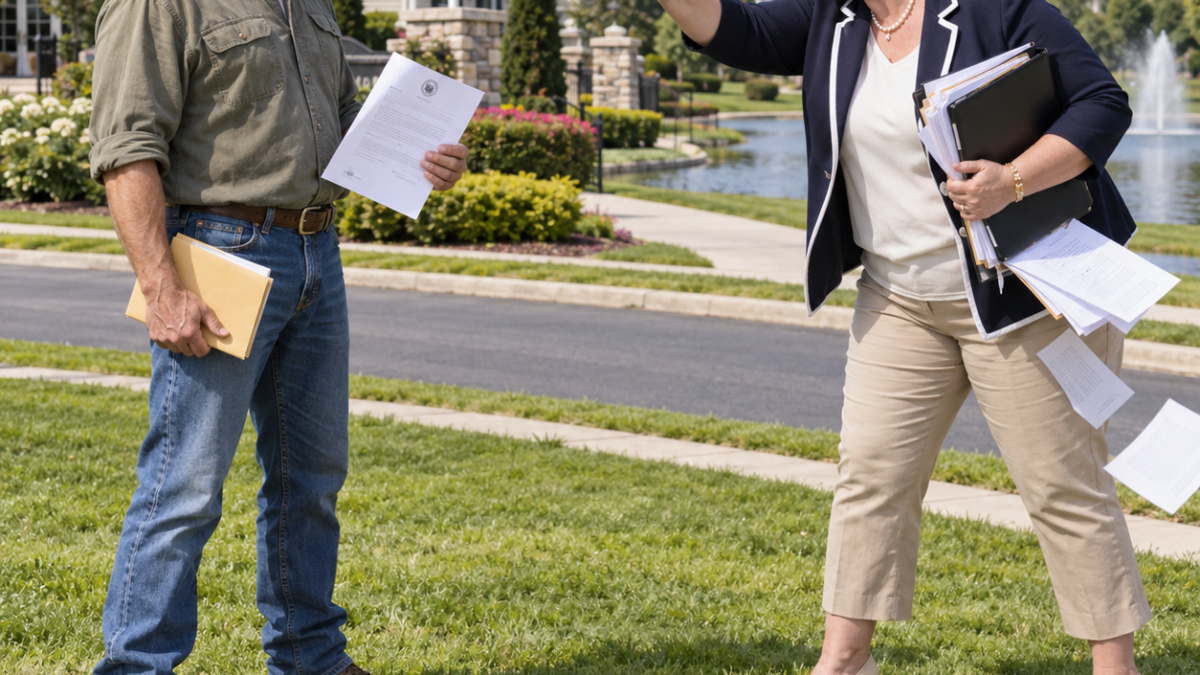
The HOA president stood in my driveway and told me I had thirty days to erase the last piece of my grandfather’s life from our property—or she would fine me until I couldn’t afford to stay.
I had spent years learning how to keep calm when somebody wanted a reaction, but when she threatened the memorial garden for a friend I buried after coming home from the Army, something inside me changed.
What Karen didn’t understand was that while she was rewriting the rules to trap me, I had already started collecting every page she would eventually wish had never existed.
“My decision is final, Mr. Davies.”
Karen Whitmore hugged a clipboard against her chest and stared past me at the detached three-bay garage behind my house.
Late-afternoon sunlight spilled across the concrete driveway. Inside the garage sat a partially restored 1967 Corvette, its hood raised, my tools arranged neatly along the wall.
Karen looked at it as if she were staring at a junkyard.
“That building is being used for commercial activity,” she said. “The board has determined that it negatively affects the character of Oak Ridge.”
“The board?”
“Yes.”
“You mean you?”
Her mouth tightened.
“I mean the Architectural Control Committee.”
“You appointed yourself chairman of that committee last week.”
“President.”
“Excuse me?”
“Chairwoman.”
I almost laughed.
Almost.
Then she handed me the notice.
Five hundred dollars a day if I failed to shut down Legacy Restorations within thirty days.
My grandfather had built that garage in the 1960s.
He had repaired tractors, pickups, family station wagons, and anything else his neighbors dragged through those doors. When developers bought the farmland around us decades later and turned it into Oak Ridge, he agreed to join the HOA only after they guaranteed—in writing—that his house, garage, and limited mechanical work would remain grandfathered.
That protection was written into his deed.
When he died, the property became mine.
After two Army deployments and years spent repairing military vehicles, that garage became more than a business.
It became the place where my hands stopped shaking.
Where complicated machines made more sense than complicated memories.
Where I could take something damaged, broken, or forgotten and make it run again.
Karen had lived in Oak Ridge less than a year.
Now she was telling me my grandfather’s garage had thirty days left.
I looked at the paper.
Then at her.
“I’ll keep this.”
She smiled.
“I suggest you take it seriously.”
Three days later, another certified letter arrived.
Then another.
My Ford F-250 became an “unauthorized commercial vehicle” because a small Legacy Restorations decal was on the rear window.
Fifty dollars a day.
Then my trash can supposedly remained visible too long.
Another violation.
Then a package stayed on my porch past whatever arbitrary deadline Karen claimed existed.
Another fine.
I documented everything.
Dates.
Photographs.
Certified envelopes.
Meeting notices.
Emails.
Every interaction went into a growing binder Sarah and I kept on our dining room table.
Then Karen made it personal.
There was a small garden near the front corner of our property. Yellow roses surrounded a granite bench and a modest stone plaque bearing the name of Daniel Mercer, a man I had served with who never made it home.
Daniel’s mother loved yellow roses.
I planted them after his funeral.
One evening I opened another HOA envelope and found an order demanding removal of the “unapproved stone structure and memorial display.”
I read that sentence twice.
Sarah found me outside after dark, sitting on Daniel’s bench with the letter folded in my hand.
For a while, she didn’t speak.
Then she sat beside me.
“She wants you angry,” Sarah said quietly.
“She got it.”
“No. Angry enough to make a mistake.”
I stared at Daniel’s name.
Sarah squeezed my hand.
“So don’t give her one.”
The next morning, I drove to the county records office.
I requested my deed, the original Oak Ridge covenants, every amendment, every recorded property agreement, and years of HOA meeting minutes.
A week later, a thick envelope arrived.
Sarah and I covered the dining room table with documents.
Near midnight, I found it.
One paragraph.
Old ink.
Clear language.
My grandfather’s garage and its historical mechanical use were specifically exempt from future HOA restrictions.
I leaned back in my chair.
Sarah read it again.
“She can’t shut you down.”
“No.”
“So we show her tomorrow.”
I looked at the growing stack of violation notices beside us.
Then I remembered something an old commanding officer used to say.
Never interrupt an opponent while they’re documenting their own mistake.
I closed the deed.
“No,” I said.
Sarah studied my face.
“What are you thinking?”
I picked up Karen’s latest certified letter and slid it into the binder.
“I’m thinking we let her keep going.”
PART 2
Sarah leaned against the dining room table and folded her arms.
For several seconds, the only sound in the kitchen was the low hum of the refrigerator.
“You’re serious?”
“Completely.”
“You have a document that could probably stop this tomorrow, and you want to let her continue?”
“I want to know what she’s actually doing.”
Sarah looked at the binder.
The folder was already thick enough that the metal rings strained when I closed it.
“What she’s doing seems pretty obvious.”
“It’s obvious she hates the garage. It’s not obvious why. And it’s not obvious whether I’m the only one.”
That part had been bothering me.
Karen’s behavior was too organized to be spontaneous.
The certified letters.
The strangely specific interpretations of obscure rules.
The new committees.
The increased enforcement budget I had noticed buried in the meeting minutes.
She hadn’t become HOA president and then suddenly discovered an interest in my property.
She had prepared for something.
I wanted to know what.
The next morning, I called Dave Sterling.
Dave had been my commanding officer years earlier.
Back then, he was the kind of man who could stand in the middle of mechanical chaos with alarms screaming and people shouting and somehow speak more quietly than everybody else.
After leaving the service, he went to law school.
By the time I came home for good, Dave had become a partner at a respected civil litigation firm two counties away.
He answered on the second ring.
“Davies.”
“Sterling.”
“That either means you miss me or somebody is suing you.”
“Worse.”
There was a pause.
“You joined a homeowners association?”
“I inherited one.”
He laughed.
“What happened?”
I told him.
All of it.
The driveway confrontation.
The garage.
The truck.
The package.
The trash can.
Daniel’s memorial.
Then I told him what Sarah and I had found in the deed.
Dave stopped joking.
“Read the clause.”
I did.
Slowly.
When I finished, he said, “Send me a scan.”
“What do you think?”
“I think your grandfather had excellent legal advice.”
“So Karen can’t touch the garage.”
“Probably not under those facts. But that isn’t the part I’m most interested in.”
“What is?”
“The pattern.”
I looked at the binder.
“What pattern?”
“She’s not just enforcing one questionable rule. She’s throwing everything she can find at you. That matters.”
Dave asked whether I had paid anything.
“No.”
“Good.”
“Responded?”
“No.”
“Even better.”
He asked how the rules had been enforced before Karen became president.
“They mostly weren’t.”
“Exactly.”
Then he asked a question that changed the entire direction of the fight.
“Who else is getting notices?”
“I don’t know.”
“Find out.”
I remembered Brenda at the county clerk’s office telling me I wasn’t the first Oak Ridge homeowner who had shown up recently asking for records.
Dave continued.
“One owner complaining about an HOA president can be dismissed as a personality conflict. Ten owners with documented examples of arbitrary enforcement becomes something else.”
I pulled a legal pad toward me.
“What else?”
“Financial records.”
“Why?”
“Because people who confuse authority with ownership tend to make the same mistake with money.”
“Can I get them?”
“You’re a dues-paying member. Start with whatever your governing documents entitle you to inspect. Budgets. Contracts. Meeting minutes. Approved expenditures.”
I wrote it down.
Then Dave went quiet.
“What?”
“I’m thinking.”
“That always worried me.”
“I’d also expect her to change the rules.”
I stopped writing.
“What do you mean?”
“If she realizes your grandfather clause defeats her, she has two choices. Back down or try to rewrite the bylaws to make herself look right.”
“Can she do that?”
“She can propose anything she wants.”
“That wasn’t my question.”
“I know.”
He let the silence sit.
“If she tries to write a new rule specifically around your property after months of documented enforcement against you, call me before you do anything.”
“Why?”
“Because then she stops arguing over a garage.”
Dave’s voice hardened.
“She starts creating evidence of intent.”
That sentence stayed with me.
For the next week, I became the friendliest man in Oak Ridge.
I stopped at mailboxes.
I talked to people while they walked their dogs.
I asked harmless questions.
It didn’t take long.
Maria Rodriguez lived with her husband, Luis, and their two boys in a brick house near the eastern entrance.
Their sons were ten and twelve.
A month earlier, Luis had installed a basketball hoop beside the driveway.
Not some rusted pole dragged out of a landfill.
A professional-looking adjustable hoop anchored into concrete.
Karen cited them.
The violation claimed the hoop was an unauthorized permanent recreational structure.
“They told us we could request a variance,” Maria said.
“How much?”
“Two hundred fifty dollars.”
“To ask?”
“To ask.”
“And if they reject it?”
“We lose the money.”
She shook her head.
“My boys saved for part of that hoop. Birthday money. Christmas money. Luis and I paid the rest.”
“Did anyone complain?”
“Not that we know of.”
“Did you get anything in writing?”
She disappeared into the house.
A minute later she returned with a white envelope.
Certified.
Same cream-colored HOA stationery.
Same signature.
Karen Whitmore.
I photographed it.
Maria watched me.
“Why?”
“Because I think she’s doing this to more people than either of us realizes.”
Her expression changed.
“You too?”
I smiled without humor.
“You might want coffee.”
Twenty minutes later, I had shown her photographs of my violations.
She stared at the memorial garden notice longest.
“She told you to remove that?”
“Yes.”
“That’s disgusting.”
“I need something from you.”
“What?”
“Keep every letter.”
“I already do.”
“Photograph everything before you change anything.”
She nodded.
“And don’t argue with Karen unless you absolutely have to.”
Maria looked offended.
“That one may be difficult.”
“I know.”
My next visit was Mrs. Gable.
Eleanor Gable was eighty-two and moved through Oak Ridge with the calm dignity of someone who had lived long enough to stop being impressed by loud people.
Her husband, Thomas, had planted rose bushes across the front of their house shortly after they moved there.
Over four decades, the bushes grew into arching walls of red, pink, and cream.
People took pictures of them.
Kids stopped to smell them.
Mrs. Gable knew every bush by the year Thomas had planted it.
Karen ordered them trimmed to two feet.
“What happens if you do that?” I asked.
Mrs. Gable touched one of the older stems.
“I kill half of them.”
“Did you tell her?”
“She told me sentimentality is not an exemption from community standards.”
I felt something cold settle in my chest.
“When did Thomas pass?”
“Seven years ago.”
She looked toward the roses.
“We planted the first one after our daughter was born.”
I said nothing.
“She lives in Oregon now,” Mrs. Gable continued. “Thomas used to say he wanted something beautiful here after we were both gone.”
I showed her my memorial garden notice.
Her eyes narrowed.
“She came after a dead soldier’s flowers too?”
“Yes.”
Mrs. Gable straightened.
The fragile widow disappeared.
In her place stood a woman whose husband had apparently spent fifty-six years learning never to underestimate her.
“What do you need from me?”
“A written statement.”
“When?”
“Whenever you’re comfortable.”
“Bring your notary tomorrow.”
Word spread quietly.
A plumber named Frank Delaney had been cited because his work van spent twenty minutes on the street while he unloaded tools.
A young couple had been warned about vegetables visible over their backyard fence.
Another family received a letter because their wooden swing set supposedly violated an approved-material standard nobody could remember voting on.
A widower named Mr. Henderson had been threatened over a bird feeder.
One family had been warned that their daughter’s chalk drawings on their own driveway constituted temporary visual clutter.
The examples ranged from infuriating to ridiculous.
But they had something in common.
Karen rarely targeted her closest supporters.
Gary Simmons, her vice president, had a fishing boat visible behind his fence for months despite a rule explicitly prohibiting recreational vehicles above the fence line.
Nothing.
Board secretary Brenda Hale had a decorative shed built six feet from her property line when the covenants required ten.
Nothing.
Karen herself left two giant holiday lawn displays standing until February.
Nothing.
The rules mattered when they could be used against somebody she disliked.
That was the pattern.
And now we could prove it.
Sarah came up with the idea for the barbecue.
“A conspiracy barbecue?”
“I prefer community information session.”
“You literally called it a barbecue of the damned ten minutes ago.”
“That was before I remembered teachers are supposed to model constructive civic language.”
We invited six families.
Nine came.
People arrived nervous.
Nobody wanted to be seen leading a rebellion against an HOA.
That fact alone told me how much control Karen had acquired.
We held the gathering behind our house.
At first, everybody talked about normal things.
School.
Weather.
Football.
Food.
Then I opened the garage doors.
Conversation stopped.
Several people stepped inside.
I watched them look around.
The garage Karen described as a dangerous commercial blight was cleaner than many kitchens.
The floor was sealed concrete.
Parts were labeled.
Fluids were stored in proper cabinets.
The Corvette rested on a lift with white protective cloth covering the seats.
An old Mustang occupied another bay.
My grandfather’s wooden toolbox sat against the back wall beneath a framed photograph of him standing beside the same building in 1971.
Frank whistled.
“This is the illegal chop shop?”
“Apparently.”
Maria laughed.
The tension broke.
I gathered everyone around my workbench.
Then I placed the certified deed in front of them.
“My grandfather agreed to enter the HOA when the subdivision was built around our property.”
I showed them the exemption.
“He made the developers protect this garage.”
Mrs. Gable adjusted her glasses.
“So Karen knows she can’t legally stop you?”
“I don’t know what she knows.”
Sarah spoke from behind me.
“But she knows he hasn’t paid the fines.”
That brought a few smiles.
I showed them the HOA budget.
Enforcement expenses had tripled after Karen became president.
Legal expenses increased sharply too.
“What legal work?” Frank asked.
“Good question.”
“Can we demand invoices?”
“Dave says we can request records we’re entitled to under the governing documents.”
Maria leaned closer to the page.
“Architectural committee administrative expenses. Twelve thousand dollars?”
“That committee is Karen, Gary, and Brenda.”
“For what?”
“Another good question.”
By the end of the night, we had an agreement.
Nobody would confront Karen unnecessarily.
Everybody would save documents.
Everybody would request information through proper channels.
Nobody would exaggerate.
Nobody would invent.
Facts only.
Because facts were something Karen couldn’t shout out of existence.
She made her next move twenty-six days later.
I found the envelope in my mailbox.
Every home received one.
SPECIAL MEMBERSHIP MEETING.
PROPOSED AMENDMENTS TO THE OAK RIDGE DECLARATION AND BYLAWS.
I opened it while standing beside the road.
The first proposed amendment changed the rules governing home businesses.
It prohibited repair, restoration, modification, or storage of motor vehicles on residential property when connected to any commercial activity.
Then it added something strange.
The prohibition applied even when the activity had historically existed before adoption of the rule.
I read it again.
The second amendment broadened the definition of commercial vehicles.
Any truck above a specified size.
Any lettering.
Any business identification.
My F-250.
Frank’s van.
Two landscaping contractors.
An electrician.
The third amendment imposed size restrictions on detached garages.
The proposed maximum?
Just below the square footage of mine.
Then came an annual special-use permit.
Two thousand dollars.
Approval granted at the Architectural Control Committee’s discretion.
Karen’s discretion.
But the last paragraph was the one that made my hands tighten around the pages.
The new rules claimed they would supersede prior exemptions and grandfathered agreements.
I stood beside the mailbox for a long time.
Dave had predicted it almost word for word.
Karen couldn’t beat my grandfather’s agreement.
So she intended to erase it.
I walked back to the house.
Sarah looked up from grading history essays.
“That bad?”
I handed her the packet.
She read silently.
Halfway down the third page, she muttered, “Oh, you have got to be kidding me.”
Then she reached the grandfather clause provision.
Her eyes lifted.
“She wrote this for you.”
“Yes.”
“This isn’t subtle.”
“No.”
“She actually put it in writing.”
“Yes.”
Sarah slowly lowered the papers.
Then she smiled.
It wasn’t a happy smile.
It was the expression she wore when a student confidently submitted an essay proving the exact opposite of what he intended.
“She just gave Dave what he wanted, didn’t she?”
I called him immediately.
He read the amendments.
There was a long silence.
Then he said, “Do not lose that envelope.”
“I won’t.”
“Photograph it.”
“Already did.”
“Scan everything.”
“Done.”
“Keep the metadata on any email version.”
“Done.”
Dave laughed.
“What?”
“I forgot how annoying you were when you followed instructions.”
“Is this as bad as it looks?”
“For her?”
“Yes.”
“Worse.”
We held another neighborhood meeting.
This time twenty-three people came.
There was no barbecue.
The garage became a war room.
I projected the proposed amendments onto a monitor and highlighted the wording.
Dave joined by video.
He explained that a homeowners association could amend rules through proper procedures, but new rules did not magically erase vested property rights, recorded deed protections, or every prior agreement simply because a board wanted them gone.
More importantly, he explained what the timeline suggested.
Karen had begun enforcement against my grandfathered garage.
I had refused to comply.
Then she drafted an amendment whose measurements, vehicle definitions, business restrictions, and grandfather-clause language corresponded almost perfectly with my property.
Whether that became unlawful discriminatory or arbitrary enforcement would depend on the governing state law and facts.
But it was powerful evidence that the new rules were not neutral modernization.
They were targeted.
Then Dave said the sentence that finally frightened everybody.
“If the association approves these provisions and litigation follows, the HOA pays lawyers with HOA money.”
Frank frowned.
“Our money.”
“Exactly.”
“And if the HOA loses?”
“Potentially damages, costs, attorney fees, corrective orders, and special assessments depending on the claims and jurisdiction.”
Maria looked around the garage.
“So Karen gets to start a personal war, and we get the bill?”
“That,” Dave said, “is why homeowners should read before they vote.”
Mrs. Gable raised her hand.
Dave smiled.
“Yes, ma’am?”
“If she knows all this and passes it anyway, can she personally be responsible?”
“Under some circumstances, board members can lose certain protections if they act outside their authority, engage in bad faith, self-dealing, or knowingly unlawful conduct.”
Mrs. Gable nodded.
“Good.”
Everyone laughed.
Nobody was laughing a week later.
The clubhouse was full.
Karen sat behind the long front table wearing a purple suit and an expression that told me she believed the evening had already been decided.
Gary sat on her right.
Brenda sat on her left.
Karen tapped the gavel.
“I call this special meeting to order.”
She delivered a fifteen-minute speech about modernization.
Community identity.
Property values.
Uniformity.
Closing loopholes.
Protecting standards.
Not once did she say my name.
She didn’t need to.
Then she opened the floor.
Mrs. Gable stood first.
Karen’s eyebrows rose.
Eleanor walked slowly toward the microphone.
“I have lived here longer than you have.”
Karen forced a smile.
“We value our longtime residents, Mrs. Gable.”
“Do you?”
“Of course.”
“My husband planted my roses.”
“I understand.”
“No, you don’t.”
The room became still.
“You sent me a letter telling me to cut them down to a height that would destroy them.”
“We asked that they conform to—”
“They have stood there forty years.”
“Standards evolve.”
“Grief doesn’t.”
Karen stared at her.
Mrs. Gable stepped away from the microphone.
Frank took her place.
“You want to ban my work van?”
“We want commercial vehicles kept from negatively affecting neighborhood appearance.”
“I’m a plumber.”
“No one is questioning your occupation.”
“My occupation is written on the van.”
Scattered laughter moved through the room.
Frank continued.
“I’ve lived here fifteen years. That van has parked at my house fifteen years. Nobody cared until you became president.”
Karen’s jaw tightened.
Maria went next.
“You charged us two hundred fifty dollars to apply for permission to let our sons keep a basketball hoop.”
“The application fee covers administrative review.”
“By whom?”
“The Architectural Control Committee.”
“You.”
“Among others.”
“And now you want two thousand dollars for special-use permits?”
“For complex structures.”
“At your discretion?”
“There must be standards.”
Maria turned toward the audience.
“Standards where one person chooses who gets to keep what they already own?”
Karen struck the gavel.
“Please address the chair.”
“I am.”
That got louder laughter.
Karen’s face turned red.
Then other residents stood.
The electrician.
The landscaper.
Mr. Henderson.
A retired nurse.
A young father who had received a warning because his children left bicycles near the porch.
People Karen believed she had intimidated into silence started speaking.
Fear works best in isolation.
Once everybody realized their neighbor was afraid too, the fear began evaporating.
Karen lost patience.
“These rules exist for a reason,” she snapped. “Residents who cannot meet Oak Ridge standards may need to consider whether Oak Ridge remains the appropriate community for them.”
A gasp moved across the clubhouse.
Gary turned toward her.
Even he knew.
She had said too much.
I stood.
Karen saw me and immediately gripped the gavel.
“Mr. Davies, you have three minutes.”
“I only need two.”
I walked to the microphone.
“My family owned our property before Oak Ridge existed.”
Silence.
“My grandfather signed the original agreement that allowed this subdivision to connect around our land. His garage and its historical use were expressly protected.”
I held up a certified copy.
Karen looked away.
“These proposed amendments were introduced only after the board began trying to shut that garage down.”
I placed the new rules beside the deed.
“Look at them.”
I addressed the homeowners, not Karen.
“The business restriction describes what I do.”
“The truck restriction describes what I drive.”
“The garage measurement describes what I own.”
“And the final provision tries to destroy the exact grandfather clause protecting my property.”
Murmurs spread.
“This is not neutral rulemaking.”
Karen hit the gavel.
“Your legal opinion is irrelevant.”
“It isn’t my legal opinion.”
That stopped her.
I continued.
“I’ve consulted counsel.”
Gary’s face changed.
“So before anybody votes tonight, understand what you are voting to fund.”
I explained the risk.
Litigation.
Legal expenses.
Challenges to the amendments.
Possible claims against the board.
I did not threaten.
I did not yell.
I simply described what Dave had explained.
Karen finally interrupted.
“Enough.”
I returned to my seat.
The vote began.
Paper ballots.
That bothered me.
Karen’s supporters collected proxy forms.
People whispered near the side wall.
Gary and Brenda counted with Karen.
Our coalition watched.
Twenty minutes later, Karen stood.
She was smiling again.
“The amendment package passes.”
My stomach tightened.
“Sixty-eight votes in favor.”
She paused.
“Sixty-one opposed.”
Maria lowered her head.
Frank cursed quietly.
Mrs. Gable closed her eyes.
Karen looked directly at me.
Her smile was unbearable.
I felt Sarah’s hand touch mine.
Karen believed she had just destroyed my grandfather’s protection.
What she had actually done was something far more useful.
She had taken a targeted proposal and turned it into official HOA law.
Evidence with signatures.
Minutes.
Ballots.
Dates.
A legislative record.
I looked at her.
Then I smiled.
Her expression faltered.
Just slightly.
Sarah leaned toward me.
“That smile scared me.”
“It scared her too.”
“What happens now?”
“Now?”
I watched Karen congratulate Gary.
“Now we stop fighting the HOA.”
Sarah waited.
I stood and buttoned my jacket.
“And start investigating it.”
The next morning, our dining room became a document center.
Maria arrived carrying two banker’s boxes.
Frank brought coffee.
Mrs. Gable arrived with homemade cinnamon rolls and a level of determination that made everybody sit straighter.
Dave joined us remotely.
We built the complaint in layers.
First, the land records.
My deed.
The developer agreement.
The grandfather provision.
The original covenants.
Second, the enforcement history.
Every certified letter.
Every fine.
Every notice.
Dates and photographs.
Third, the other residents.
Fifteen people signed sworn statements.
Mrs. Gable described her roses.
Maria described the basketball hoop and variance fee.
Frank described his work van.
Mr. Henderson described selective enforcement.
Each statement stood alone.
Together, they created a pattern.
Then came the money.
A former HOA treasurer named Linda Park contacted me.
She asked to meet privately.
We chose a diner outside Oak Ridge.
Linda was in her late sixties and spoke so softly I had to lean forward.
“I resigned two months after Karen became president.”
“Why?”
“She stopped treating the association account like association money.”
“What does that mean?”
Linda slid a folder toward me.
Inside were copies of bank statements and invoices.
“Where did you get these?”
“I was treasurer when these transactions began. I kept copies of records I was legally responsible for.”
I scanned the first pages.
Payments to Whitmore Landscape Solutions.
Same last name as Karen.
“Who owns this?”
“Her brother-in-law.”
“What did they do?”
“That’s what I kept asking.”
Invoice descriptions included landscaping modernization.
Entrance beautification.
Common-area plant replacement.
I knew those areas.
Nothing significant had changed.
Then I found legal charges.
Thousands of dollars to an aggressive collections firm.
Then office equipment.
Then a furniture expense.
One thousand eighty-seven dollars.
“What furniture?”
Linda looked embarrassed.
“A chair.”
“A chair?”
“Karen said she needed an ergonomic executive chair because she was conducting HOA business from home.”
Frank nearly choked on his coffee when I told him.
That single chair cost more than some families had paid in annual dues.
But the brother-in-law invoices were worse.
Dave examined the records.
“Do not accuse anyone publicly of theft.”
“I wasn’t planning to.”
“Good. We document. We refer. Investigators decide.”
We assembled a binder nearly three inches thick.
The complaint was not emotional.
That was deliberate.
Karen lived on emotion.
She provoked people and then used their reactions against them.
Our complaint was dates, documents, copies, sworn statements, financial records, voting materials, and recorded property instruments.
The opening summary was only four pages.
Dave made us cut adjectives.
“Don’t write ‘outrageous abuse,’” he said.
“Why not?”
“Because the documents should make the reader think it without you telling them.”
That lesson changed the entire package.
We submitted it to the state Attorney General’s office and copied the appropriate housing and nonprofit oversight authorities identified by counsel.
Then we waited.
Karen did not.
Within days, I received my first notice under the newly adopted bylaws.
Fourteen days to cease all restoration work.
Two thousand dollars for a special-use application.
One thousand dollars per day after the deadline.
I put the notice in the binder.
Day fourteen passed.
Nothing changed.
I worked with the garage doors open.
Karen drove past twice.
On the seventeenth day, she stopped her SUV at the bottom of the driveway.
I kept polishing a fender.
She got out.
“You have received the enforcement notice.”
“Yes.”
“You’re now accumulating daily penalties.”
“I received the notice.”
“That means your account is already more than three thousand dollars delinquent.”
I continued polishing.
“You should speak with counsel before this gets worse.”
“I already have.”
For the first time, she hesitated.
“Who?”
“My attorney.”
Her voice changed.
Softer.
“You retained an attorney?”
“I spoke with one.”
“Is he advising you to violate the bylaws?”
“He’s advising me.”
Karen stepped closer.
“You are making this much harder than necessary.”
I finally put the cloth down.
“No, Karen.”
I looked at her.
“You are.”
She stared at me for several seconds.
Then returned to her SUV.
The following week, her emails became aggressive.
She announced stricter enforcement.
She warned residents about misinformation.
She accused unnamed homeowners of creating division.
Then Maria received a phone call.
She called me immediately afterward.
“Mark.”
“What happened?”
“A state investigator.”
I stood.
“What did he ask?”
“Everything.”
Her voice shook.
“The basketball hoop. The fee. Karen’s comments. Dates. Copies.”
“Did you send him the documents?”
“He already had them.”
That sentence hit me harder than I expected.
They were looking.
Two days later, Frank received a call.
Then Mrs. Gable.
Then Linda.
Investigators requested additional financial records from the association.
Karen found out.
Everyone knew the moment she did.
At 8:17 that evening, Oak Ridge residents received an email titled DEFAMATION AND MALICIOUS INTERFERENCE.
Karen accused “a small faction of disgruntled residents” of spreading false information to state authorities.
She threatened legal action.
Dave read it.
Then sent me one sentence.
SAVE THIS EMAIL.
I did.
The next board meeting was bizarre.
Karen refused to discuss the investigation.
Gary barely spoke.
Brenda looked sick.
Residents asked where the financial records were.
Karen said confidentiality prevented disclosure.
Linda stood.
“No, it doesn’t.”
Karen froze.
Linda had never attended one of our coalition meetings publicly.
Now she walked toward the front.
“As former treasurer, I am requesting that the current board explain why payments were approved to a vendor related to the president without documented competitive review.”
The room erupted.
Karen struck the gavel repeatedly.
“That allegation is defamatory.”
“It’s a question.”
“You have no authority to examine current board decisions.”
“I’m a homeowner.”
“You surrendered your position.”
“I resigned because you refused financial controls.”
Gary whispered something to Karen.
She ignored him.
Linda continued.
“And I have already provided records to the state.”
Everything stopped.
I will never forget Karen’s face.
Not anger.
Not yet.
Fear.
Raw, immediate fear.
She looked at Linda as if the floor had disappeared.
“You what?”
“I provided records requested in the investigation.”
Karen slammed the gavel.
“This meeting is adjourned.”
People shouted.
She fled through the side door.
A month after we submitted the complaint, the letter arrived.
Tuesday.
9:12 in the morning.
I remember because Sarah was home late that day for a teacher training session.
She carried the mail inside.
“Mark.”
Something in her voice made me turn.
She held a large envelope.
Heavy paper.
Official state seal.
For a moment, neither of us moved.
“Open it,” she said.
I used the same pocketknife my grandfather used to sharpen pencils at his workbench.
The letter was several pages.
Dense.
Formal.
I read the first page silently.
Then again.
Sarah gripped the back of a chair.
“Well?”
I couldn’t answer.
Not immediately.
“Mark?”
I handed her the first page.
Her eyes moved across it.
She sat down.
“Oh my God.”
The state had completed its initial investigation.
The amendments Karen forced through were declared invalid and unenforceable.
The findings stated that the record showed they had been adopted through a pattern of targeted and arbitrary rulemaking aimed at stripping existing rights from specific owners rather than serving a legitimate neutral community purpose.
The provision claiming to eliminate recorded grandfathered protections was rejected.
My grandfather’s agreement survived.
My garage survived.
But that was only page two.
The state ordered the HOA to stop enforcing the challenged penalties against the complaining residents pending corrective action.
Fines connected to the unlawful enforcement campaign were to be rescinded.
My truck.
My garage.
Daniel’s memorial.
Maria’s basketball hoop.
Mrs. Gable’s roses.
Frank’s van.
Gone.
Sarah covered her mouth.
“They erased it.”
I nodded.
“All of it.”
Then I turned the page.
The financial section was worse for Karen.
Investigators had identified potential conflicts of interest, undocumented expenditures, inadequate accounting controls, and transactions requiring additional review.
The matter was being referred for further financial investigation.
Not allegations from angry neighbors.
Not gossip.
Not a Facebook argument.
A state referral.
The final directive required Oak Ridge to hold a special membership meeting.
The findings had to be presented to homeowners.
The board’s governance had to be addressed.
I sat down.
Sarah looked at me.
“You won.”
I looked through the kitchen window toward the garage.
“No.”
“What?”
“We survived.”
“That sounds like winning.”
“I’ll call it winning when Mrs. Gable can prune her roses because she wants to, not because someone threatens her.”
Sarah smiled.
“Teacher’s note.”
“What?”
“Very dramatic.”
“Thank you.”
“C-plus.”
I laughed for the first time in weeks.
Then I walked outside.
I crossed the yard.
I entered the garage.
My grandfather’s photograph hung where it always had.
He was twenty-nine in the picture.
Thin.
Grease on both hands.
Standing in front of newly laid cinder block.
I touched the wooden frame.
“You knew, didn’t you?”
Of course the photograph didn’t answer.
But I remembered something he told me when I was sixteen.
I had been furious because a customer blamed me for breaking a part that had already been cracked.
Granddad stopped me from arguing.
“Paper beats shouting,” he said.
I didn’t understand it then.
He made me write the repair condition on the invoice.
The customer apologized later.
Decades after his death, the old man had beaten Karen with the same lesson.
Paper beats shouting.
News of the letter spread before the official meeting notice even arrived.
Our private group chat exploded.
Maria sent fourteen exclamation points.
Frank wanted to bring champagne.
Mrs. Gable wrote:
I WILL BRING COOKIES.
Linda replied:
THIS IS NOT A PICNIC.
Mrs. Gable answered:
EVERY REVOLUTION NEEDS COOKIES.
Nobody argued.
Karen disappeared.
For almost a week, nobody saw her walking the neighborhood.
Gary stopped answering residents.
Brenda sent the special meeting notice.
Gone was Karen’s language about prestige and community distinction.
The notice was plain.
SPECIAL MEMBERSHIP MEETING REQUIRED PURSUANT TO STATE DIRECTIVE.
Attendance was enormous.
People stood along the walls.
Some brought folding chairs.
I sat in the front with Sarah.
Mrs. Gable sat beside me holding a plastic container of cookies.
“You actually brought them.”
“I said I would.”
“You’re eighty-two and terrifying.”
“That’s why I’ve lived this long.”
Karen entered five minutes late.
No purple suit.
No oversized sunglasses.
No clipboard.
Gray jacket.
Black pants.
She looked smaller.
Gary followed.
Brenda carried the state letter.
Karen sat.
She did not call the meeting to order immediately.
People whispered.
Finally she struck the gavel.
Once.
Weakly.
“This meeting is called pursuant to correspondence received from the Office of the Attorney General.”
Someone in the back shouted, “Read it!”
Karen’s face tightened.
“I intend to.”
She unfolded the pages.
Her hands trembled.
Then she began.
She had to read every major finding.
The invalid amendments.
The improper enforcement.
The rescinded fines.
The governance concerns.
The financial referral.
Each section was worse than the last.
When she read that the amendments were void, applause erupted.
She stopped.
Gary whispered to her.
She continued.
When she read the enforcement rescission, people stood.
Maria hugged Luis.
Frank punched the air.
Mrs. Gable simply closed her eyes.
I knew what she was thinking about.
Thomas’s roses.
Then Karen reached the financial section.
Her voice cracked.
The room went silent.
Potential conflicts.
Financial irregularities.
Referral for additional investigation.
Somebody yelled, “Where is our money?”
Another voice:
“Resign!”
Then several.
“Resign!”
“Resign!”
“RESIGN!”
Gary grabbed the gavel.
“Order!”
Nobody listened.
The anger had been stored for months.
Maybe years.
People stood.
Questions flew.
Who approved the contracts?
Why was Karen’s relative paid?
Where were the receipts?
Why were dues funding aggressive collections?
Who authorized the expensive office furniture?
Karen’s face turned white.
Gary tried to adjourn.
I stood.
Not because I wanted to rescue them.
Because chaos would let them escape accountability.
I walked toward the front.
Then waited.
Frank noticed me first.
“Let Mark speak!”
Others repeated it.
Slowly, the room quieted.
I faced my neighbors.
“For months, this place has been divided.”
No microphone needed.
Nobody moved.
“People stopped talking to each other because they were afraid the person next door might report them.”
I looked around.
“Families were threatened over basketball hoops.”
I nodded toward Frank.
“Working people were punished for the vehicles they use to earn a living.”
I looked at Mrs. Gable.
“A widow was told that forty years of roses planted by her husband mattered less than somebody’s interpretation of uniformity.”
Then I looked toward Karen.
“And I was told to erase my grandfather’s garage and a memorial to a man who never made it home.”
Karen lowered her eyes.
“I was angry.”
My voice tightened.
“I’m still angry.”
I took a breath.
“But if all we do tonight is humiliate somebody, then we haven’t fixed anything.”
Several people shifted.
“This cannot be about replacing one bully with another.”
I held up the state letter.
“This is about restoring rules that protect homeowners instead of threatening them.”
Karen finally looked at me.
I saw exhaustion.
Fear.
And something else.
Maybe the realization that the man she had tried hardest to destroy was now the only person preventing the meeting from becoming a mob.
Frank stood.
“Then let’s fix it.”
He faced the board.
“I move for a vote to remove the current directors under the removal provisions in our governing documents.”
Maria stood immediately.
“I second.”
Brenda whispered, “There has to be a membership count.”
Linda already had it.
“We have more than enough.”
For the first time all night, procedure mattered.
We verified attendance.
We verified voting rights.
We verified proxies.
No whispered collecting.
No hidden counting.
Everything happened in front of everyone.
When the hands went up to remove the board, the result was overwhelming.
Karen stared straight ahead.
Gary protested.
Brenda began crying quietly.
The motion passed.
Karen was no longer president.
For months, I had imagined what that moment might feel like.
Triumph.
Vindication.
Satisfaction.
Instead, I felt tired.
Karen picked up her purse.
She stood.
Then she looked at me.
“You destroyed me.”
Her voice was low enough that only the people nearest us heard.
I shook my head.
“No.”
Her eyes filled with anger.
“You did.”
“You sent the letters.”
“You turned everyone against me.”
“You wrote the bylaws.”
“You contacted the state.”
“You spent the money.”
Her lips parted.
Nothing came out.
“I documented it.”
She stared at me.
“That’s all I did.”
Karen left.
Nobody applauded.
I was grateful for that.
The story wasn’t over.
Removing three board members did not repair damaged trust.
It did not replace money.
It did not answer the financial questions.
It did not undo months of fear.
The interim board included Maria, Mr. Henderson, and a retired accountant named Paul Benson.
Their first meeting lasted four hours.
Their first official resolution recognized the recorded grandfather rights attached to my property.
Their second rescinded the improper violation history identified by the investigation.
Their third suspended discretionary fines until enforcement procedures could be reviewed.
Their fourth hired an independent forensic accountant.
Paul insisted.
“We don’t guess.”
That phrase became the new Oak Ridge philosophy.
“We verify.”
The accountant’s report took weeks.
During that time, Karen listed her house for sale.
Nobody knew whether she planned to move or simply wanted options.
Then investigators requested additional documents.
Subpoenas followed.
The landscaping company owned by Karen’s brother-in-law had received several HOA payments.
Some work had been completed.
Some documentation was questionable.
Some invoices lacked normal detail.
The expensive home-office items drew scrutiny too.
Gary claimed he believed Karen had authority.
Brenda said she signed documents without reading them carefully.
Neither explanation impressed Paul.
At an open meeting, he placed a stack of financial controls on the table.
“From now on, no director approves payment to a relative.”
Applause.
“Every material contract receives multiple bids unless an emergency is documented.”
More applause.
“No reimbursements without receipts.”
Frank shouted, “What about thousand-dollar chairs?”
Paul did not smile.
“Especially chairs.”
Even I laughed.
Then came the part that mattered most.
Residents rewrote the enforcement procedure.
Not to eliminate standards.
Most of us still wanted basic rules.
Nobody wanted abandoned cars leaking oil on lawns or somebody running a nightclub from a basement.
But rules needed guardrails.
Written notice.
Evidence.
A reasonable opportunity to correct.
A neutral hearing.
Conflict-of-interest disclosure.
Appeal rights.
No committee member could investigate, prosecute, and decide the same dispute alone.
Sarah read the draft.
“This is boring.”
“Good.”
“Very boring.”
“Excellent.”
“You know healthy government is supposed to be boring, right?”
“That’s the dream.”
The basketball hoop went back up on a Saturday.
I helped Luis pour a new footing because the original had been damaged during removal.
His boys hovered beside us.
“Is Mrs. Whitmore coming back?” the younger one asked.
“I don’t know.”
“Can she make us take it down again?”
“No.”
“Ever?”
I paused.
“Rules can change.”
He looked worried.
“But now your parents get a voice.”
That seemed to satisfy him.
Mrs. Gable’s roses survived.
Barely.
Karen’s landscaping deadline had frightened her enough that she had already cut several bushes before joining our group.
But the older plants recovered.
One Sunday, Sarah and I stopped by.
Mrs. Gable handed me pruning shears.
“No.”
“Yes.”
“I rebuild engines.”
“They are both mechanical.”
“A rose bush is not mechanical.”
“Everything has structure.”
Sarah walked away laughing.
Mrs. Gable showed me where to cut.
I ruined only one branch.
She called that progress.
Frank started parking his van at home again.
The electrician removed the tarp he had been throwing over his company logo every night.
Children left bicycles on porches.
Not permanently.
Just long enough to prove civilization would survive.
Daniel’s memorial garden remained untouched.
One afternoon, I replaced the yellow roses that had died during a summer heat wave.
Sarah came outside carrying lemonade.
“You realize something?”
“What?”
“You spent six months protecting a garage.”
I looked at her.
“And somehow ended up helping rewrite HOA governance.”
“Life is weird.”
“You could have avoided this by moving somewhere without an HOA.”
“My grandfather was here first.”
She raised her glass.
“Fair.”
The forensic audit eventually confirmed enough questionable transactions that the state continued its financial case.
Not every rumor was true.
That mattered to me.
Some expenditures that looked suspicious turned out to have legitimate explanations.
A large legal bill covered matters unrelated to us.
Several landscaping invoices corresponded to actual work.
We made sure residents heard that too.
Truth had defeated Karen.
We weren’t going to abandon truth when it became inconvenient.
But other transactions remained unsupported.
The related-party contracting had not been properly disclosed.
Personal-use office expenses had been charged to association funds.
Several reimbursements lacked documentation.
The state pursued repayment and penalties through the appropriate process, while investigators evaluated whether additional charges were warranted.
Karen hired a lawyer.
That was her right.
For months, she avoided me.
Then one cold morning in January, I was opening the garage when she walked up my driveway.
No clipboard.
No HOA badge.
No sunglasses.
Just Karen.
I placed the garage remote on the workbench.
“Morning.”
She stopped several feet away.
“I’m moving.”
“I heard.”
“My house closes Friday.”
I nodded.
“I wanted to say something before I left.”
I waited.
She looked toward the garage.
“I hated that building.”
“I know.”
“Do you know why?”
“No.”
She laughed once.
No humor.
“When I moved here, the realtor told me Oak Ridge was one of the most orderly neighborhoods in the county.”
I said nothing.
“My last job was chaos. Corporate restructurings. Layoffs. People fighting over budgets. I thought retirement would be peaceful.”
Her eyes moved toward the houses.
“When I got here, everybody did whatever they wanted.”
“That’s not exactly true.”
“That’s how it felt.”
“So you decided to control it.”
“I thought somebody needed to.”
I crossed my arms.
“Why me?”
“Because you wouldn’t listen.”
“I listened.”
“You wouldn’t obey.”
There it was.
Maybe she heard it too.
Her shoulders sagged.
“That sounds awful.”
“It does.”
“I kept thinking if I gave you one more notice, you would finally understand.”
“Understand what?”
“That rules mattered.”
“Rules do matter.”
She looked surprised.
“They matter enough that the people enforcing them have to follow them too.”
Karen stared at the concrete.
“I didn’t think it would go this far.”
“You passed a bylaw designed around the dimensions of my garage.”
Her cheeks reddened.
“I was angry.”
“You tried to erase a recorded property agreement because you were angry.”
“I know.”
“You threatened Daniel’s memorial.”
“I didn’t know who he was.”
“You didn’t ask.”
She swallowed.
“I’m sorry about that.”
I had imagined Karen apologizing.
In every imaginary version, I delivered the perfect devastating response.
Something sharp.
Something she would remember forever.
But standing there, she no longer looked like the HOA president who had ruled Oak Ridge with a clipboard.
She looked like a sixty-something woman who had destroyed her reputation because control became more important than judgment.
So I gave her the truth.
“You hurt a lot of people.”
“I know.”
“Some of them won’t forgive you.”
“I know.”
“I don’t know if I forgive you.”
She nodded.
“I understand.”
“But I hope wherever you go next, you remember something.”
“What?”
I pointed toward the neighborhood.
“These aren’t units.”
Karen looked at the houses.
“They’re people.”
Her eyes became wet.
She nodded.
Then she walked away.
I never saw her again.
The final state resolution came months later.
Oak Ridge agreed to corrective governance measures.
Improper assessments identified in the enforcement case were removed.
Financial controls became mandatory.
Certain disputed expenditures were repaid or resolved.
The former board remained out.
Whatever further consequences Karen faced became a matter between her, her attorney, investigators, and the state.
I didn’t need front-row seats.
That surprised me.
At the beginning, I had wanted revenge.
Not the civilized kind.
The kind you imagine late at night when somebody threatens the things you love.
I wanted Karen embarrassed.
I wanted her frightened.
I wanted her to feel helpless.
But somewhere between Mrs. Gable’s roses and Maria’s sons carrying that basketball hoop back outside, revenge stopped mattering.
Restoration mattered more.
Maybe that was because restoration was what I understood.
People bring me cars that look finished.
Rust under the floor.
Cracked wiring.
Seized engines.
Paint hiding old damage.
You don’t restore something by pretending the damage never happened.
You expose it.
You cut out what cannot be saved.
You repair what can.
You document what belongs.
Then you rebuild carefully enough that the finished machine carries its history without being trapped by it.
Oak Ridge became like that.
Not perfect.
Never perfect.
But healthier.
We stopped whispering at mailboxes.
People waved again.
Neighbors who had barely known each other started sharing tools.
Frank fixed Mrs. Gable’s leaking outdoor faucet without charging her.
Maria organized a block party.
Paul gave a thirty-minute presentation on association finances that may have been the most boring event in Oak Ridge history.
It received a standing ovation.
I stayed away from the board.
Several people asked me to run.
I refused.
“You’d be good,” Maria said.
“That’s exactly why I’m suspicious of the job.”
She laughed.
“Then serve on the document committee.”
“What’s that?”
“I just invented it.”
“No.”
Sarah volunteered me anyway.
Once a year, I reviewed property records with Paul to make sure archived exemptions, easements, and agreements were properly indexed.
It was the least glamorous civic responsibility imaginable.
My grandfather would have loved it.
The Corvette that had sat half-finished through most of the Karen war was finally completed the following spring.
Candy-apple red.
Original chrome.
Rebuilt 427.
When the engine started for the first time, the sound rolled through the garage like thunder.
I immediately shut it down.
Sarah appeared at the door.
“What?”
I listened.
“For Karen’s ghost.”
She threw a shop rag at me.
“Stop it.”
A few days later, the owner arrived.
He walked around the car twice without speaking.
Then he touched the hood.
“My father had one just like this.”
“That’s what you told me.”
“He died before I could show him I found another.”
I understood that feeling.
He looked toward my grandfather’s photograph.
“That your dad?”
“Grandfather.”
“He teach you?”
“Everything important.”
The man nodded.
Then he drove away.
I stood in the driveway listening until the Corvette disappeared beyond the Oak Ridge entrance.
There was a new sign there.
The old one Karen installed—OAK RIDGE: A COMMUNITY OF DISTINCTION—had been removed.
Residents voted on the replacement.
It simply said:
OAK RIDGE
ESTABLISHED 1998
No grand promise.
No prestige.
No perfection.
Just the truth.
That evening, I closed two garage bays but left the center one open.
Jazz played softly from the radio.
I cleaned my tools.
Outside, Mr. Henderson walked past.
He raised a hand.
I raised my wrench.
A basketball bounced somewhere down the street.
A work van passed.
Children laughed.
Nobody reported anybody.
The neighborhood sounded alive.
Sarah appeared in the doorway.
“Dinner.”
“Five minutes.”
“You said that fifteen minutes ago.”
“I was lying then.”
She leaned against the frame.
“You ever think about what would’ve happened if you had shown Karen the grandfather clause that first night?”
“All the time.”
“She probably would have backed off.”
“Maybe.”
“And everything else might have continued.”
I looked toward the houses.
Mrs. Gable might have lost her roses.
Maria might have paid for the variance.
Frank might have parked his van miles away.
Other families might have kept paying meaningless fines.
Karen might have learned to target people more carefully.
“I guess she picked the wrong garage.”
Sarah smiled.
“No.”
“What?”
“She picked the right one.”
I looked at her.
Sarah nodded toward my grandfather’s photograph.
“He spent his whole life fixing things.”
Then she looked outside.
“So did you.”
That one got me.
I turned back to my tools before she could see my eyes.
On the wall above the old wooden toolbox was the original certified violation Karen had handed me months earlier.
I had framed it.
Not as a trophy.
As a reminder.
Beside it was a photocopy of my grandfather’s deed.
And beneath both was a small brass plate Sarah gave me for our anniversary.
It contained four words.
PAPER BEATS SHOUTING.
I thought about that every time somebody asked how one mechanic defeated an HOA president.
I didn’t.
Not alone.
Karen defeated herself every time she chose intimidation over conversation.
Every time she sent another unjustified notice.
Every time she punished one neighbor while protecting an ally.
Every time she treated dues like her personal enforcement budget.
Every time she believed frightened people would remain isolated forever.
I simply kept the paperwork.
Maria kept hers.
Frank kept his.
Mrs. Gable kept hers.
Linda kept the financial records.
Dave knew where the law mattered.
Sarah kept me from losing my temper when losing it would have cost us everything.
And eventually, enough ordinary people compared notes.
That was the thing Karen never understood.
A bully’s greatest advantage is not strength.
It is separation.
Make one homeowner believe he is the problem.
Make one widow believe she has no choice.
Make one family believe everybody else supports the rule.
Make one contractor feel ashamed of the van that pays his mortgage.
Keep everyone isolated long enough, and unreasonable authority begins looking permanent.
But the moment people start talking?
The illusion collapses.
One story becomes five.
Five become fifteen.
Fifteen sworn statements become a pattern.
A pattern becomes evidence.
Evidence reaches someone with the authority to act.
And suddenly the person who seemed untouchable is standing in the same clubhouse where she once threatened everybody, reading aloud the official finding that the rules she created are worthless.
That was the revenge people expected me to enjoy.
Watching Karen read that letter.
Watching her hands shake.
Watching the room turn against her.
Watching her lose the presidency.
And yes, part of me felt vindicated.
I would be lying if I said otherwise.
But that was not the moment I remember most.
I remember a Saturday three weeks later.
I was backing my truck out of the garage when I saw Mrs. Gable kneeling beside her roses.
She was wearing gardening gloves.
Sunlight fell across the red blossoms.
I stopped.
She noticed me.
Then she pointed toward the tallest bush.
“Look.”
New growth.
Bright green.
Strong.
The bush Karen wanted cut down was recovering.
Mrs. Gable touched one of the new shoots.
“Thomas planted this one in 1989.”
I walked over.
“He had good taste.”
“He had terrible taste.”
I laughed.
“He planted red roses because he thought red was romantic.”
“Isn’t it?”
“He was color-blind.”
That made me laugh harder.
Mrs. Gable smiled.
Then her expression softened.
“He would have liked you.”
I looked away.
“Thank you.”
“No.”
She pointed at me with her pruning shears.
“Thank you.”
“For what?”
“For making us realize we were allowed to say no.”
I wanted to tell her it wasn’t me.
That everybody had done it.
That Linda’s records mattered.
That Maria’s courage mattered.
That Frank’s loud mouth mattered considerably more than anyone expected.
But Mrs. Gable seemed to know that already.
She just wanted me to accept the moment.
So I nodded.
“You’re welcome.”
Then she returned to her roses.
I drove out of Oak Ridge with my truck window down.
The Legacy Restorations decal was still on the rear glass.
Nobody fined me.
Nobody photographed it.
Nobody called it a commercial nuisance.
It was simply my truck.
My work.
My life.
And when I returned that evening, I drove past the basketball hoop, Frank’s van, Mrs. Gable’s roses, and the plain new neighborhood sign.
Then I turned onto the five acres my great-grandfather had purchased when everything around us was still farmland.
The house stood where it always had.
The garage stood behind it.
Cinder block.
Steel beams.
Three bays.
Built by a mechanic who apparently understood developers, lawyers, and human nature better than I ever gave him credit for.
I parked outside.
Before going inside, I walked into Daniel’s memorial garden.
The replacement roses were blooming.
I sat on the granite bench.
For years after coming home, silence had been difficult.
Silence left too much room for memories.
That garage had saved me because machines filled silence with something understandable.
A bad bearing had a reason.
A broken wire could be traced.
Compression could be measured.
Metal either fit or it didn’t.
People were harder.
Karen had been harder.
Anger had been harder.
But sitting beside Daniel’s plaque that evening, I understood something I hadn’t known when this began.
Standing your ground does not always mean fighting louder.
Sometimes it means refusing to be pushed into becoming the person your opponent needs you to be.
Karen needed me furious.
I became organized.
She needed me reckless.
I became patient.
She needed me alone.
I found neighbors.
She needed everything to remain her word against mine.
We found documents.
She needed us to seek revenge.
We demanded accountability.
And in the end, that was stronger.
I brushed a fallen yellow petal away from Daniel’s name.
“You would’ve enjoyed the meeting,” I said.
A breeze moved through the roses.
I smiled.
Then I walked back toward the garage.
Sarah stood on the porch.
“You talking to Daniel?”
“Maybe.”
“What did he say?”
“He thinks Karen’s thousand-dollar chair was excessive.”
Sarah laughed.
“I like his legal analysis.”
I climbed the porch steps.
Behind us, the garage lights glowed against the evening.
Safe.
Still ours.
Not because an HOA president suddenly became reasonable.
Not because powerful people voluntarily surrendered power.
And not because I was tougher than everyone else.
It survived because my grandfather had protected it in writing.
Because my wife convinced me not to fight angry.
Because neighbors finally talked to each other.
Because people documented what happened.
Because a former treasurer chose honesty over loyalty to a board.
Because a lawyer understood that timing mattered.
Because residents who thought they were powerless discovered they were the association.
The board was never the community.
We were.
That was Karen’s biggest mistake.
She thought being president meant Oak Ridge belonged to her.
She learned the hard way that authority borrowed from other people can be taken back by those same people.
Years from now, somebody else will probably become HOA president.
Somebody will complain about paint colors.
Somebody will leave a trash can out too long.
Someone will argue about a fence.
That is life around other people.
But inside a locked cabinet in the Oak Ridge clubhouse now sits a thick archive.
Property agreements.
Exemptions.
Financial controls.
Meeting procedures.
Conflict-of-interest policies.
Enforcement records.
And one very memorable state investigation.
Every new director is required to review it.
Maria tells me the section involving my garage has become unofficial mandatory reading.
I hate that.
Sarah loves it.
“You’re HOA history.”
“I restore cars.”
“You’re in the governance archive.”
“Please stop talking.”
“Future generations will study you.”
“Sarah.”
“Children will gather around your preserved work boots.”
I threaten to sleep in the garage.
She reminds me Karen can no longer prohibit it.
I married a dangerous woman.
But sometimes, late in the evening, when the garage doors are open and the radio is playing, I look at that framed violation notice.
Five hundred dollars a day.
Thirty days to shut down.
That had been Karen’s opening move.
She believed money would frighten me.
Then she believed paperwork would bury me.
Then she believed changing the bylaws would finally make her untouchable.
Instead, every new rule narrowed the trail leading back to her.
Every letter became an exhibit.
Every fine became a timestamp.
Every targeted amendment became evidence.
By the time the Attorney General’s office looked at Oak Ridge, Karen had documented the case more thoroughly than I ever could have.
She wrote the story herself.
We simply preserved the pages.
And that is how the garage my grandfather built survived the HOA president who tried to erase it.
That is how fifteen frightened households became a community.
That is how the bylaws Karen created specifically to destroy me were declared unenforceable while my grandfather’s protection remained exactly where he left it.
And that is how I learned that the most satisfying revenge isn’t watching somebody fall.
It is standing in the place they tried to take from you after they are gone.
One spring evening, almost a year after Karen first walked into my driveway, I rolled another classic Mustang into the center bay.
I stepped outside.
The sunset stretched across Oak Ridge.
Mrs. Gable was trimming roses.
Frank’s van was parked in his driveway.
Two boys were shooting baskets while their mother called them inside for dinner.
Mr. Henderson waved from the sidewalk.
Nothing extraordinary was happening.
That was what made it extraordinary.
No one was afraid.
I turned toward the garage.
My grandfather’s photograph watched from the wall.
The tools were waiting.
The Mustang needed work.
I switched on the lights.
And for the first time since Karen arrived in Oak Ridge, I didn’t feel like I was defending anything.
I was simply home.








