PART 2: HOA President Reported My Pond as a Federal Violation—Then Inspectors Followed a Chlorine Drain Back to Her Pool
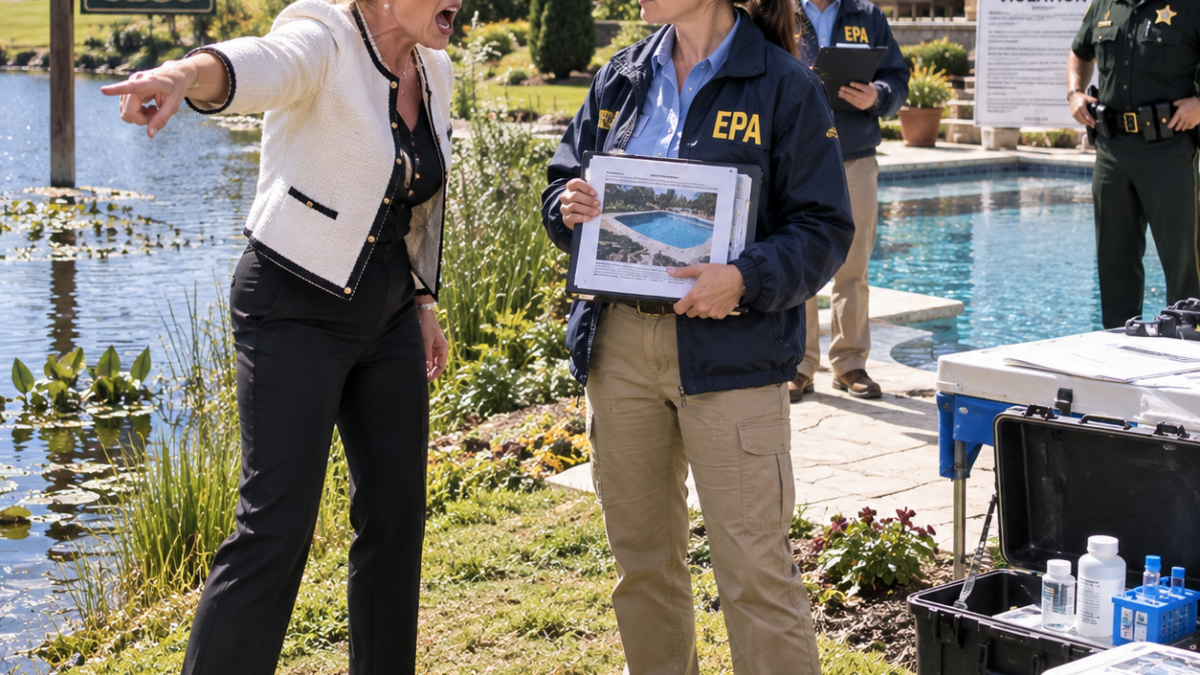
Karen Miller stood at the edge of my property and called the half-acre pond I had spent six months building a “federal crime scene,” wearing the kind of smile people usually reserve for finally defeating somebody they have hated for years. She had already reported me to the Army Corps of Engineers, claimed I had destroyed protected wetlands, and seemed almost eager to watch the government force me to tear apart the one place Sarah and I had built to help me feel normal after twenty-two years in the Army. What Karen did not realize was that the officials she summoned were about to inspect far more than the water she had accused me of contaminating.
“That’s not a pond, Sergeant.”
Karen folded her arms.
“That is evidence.”
I looked past her toward the water.
Dragonflies skimmed the surface.
A painted turtle rested on one of the native stones I had placed along the bank.
Pickerelweed had started filling the shallows, and beneath the lilies I could see the quick silver movement of minnows.
Six months of work.
A large portion of our retirement savings.
More importantly, six months in which my hands had finally learned how to build something without wondering whether somebody might shoot at me while I was doing it.
Karen pointed toward the pond.
“I reported you.”
Sarah stood beside me.
“To who?”
Karen’s smile widened.
“The federal government.”
For several seconds, nobody spoke.
Then I asked, “What exactly did you report?”
“Unauthorized destruction of protected wetlands.”
“That wetland existed before the pond.”
“Exactly.”
I almost laughed.
The pond had been designed specifically to enhance the spring-fed marsh already on our ten-acre property.
Before I moved a single bucket of soil, I had spent weeks at the county planning office.
Land-disturbance permit.
Topographic survey.
Soil evaluation.
Water-table study.
Drainage plan.
Native-plant consultation.
I had a three-inch binder of paperwork inside the house documenting every decision.
Karen knew that.
I had offered to show it to her the first time she drove her golf cart down our quarter-mile driveway.
She had waved it away.
“The county’s business is the county’s business,” she had told me. “The HOA’s business is mine.”
That was Karen Miller.
President of Cypress Creek Estates.
Self-appointed interpreter of every rule.
My parcel was one of the old estate lots on the edge of the development, grandfathered under older restrictions.
The HOA mostly had authority over shared roads and a handful of basic covenants.
Karen behaved as if that made her governor.
She had already cited me for naturally brown cypress mulch because it did not match an approved color chart.
She fined me because my garbage bin was supposedly visible from the street, even though our house could not be seen from the street.
My favorite was the unauthorized livestock warning.
The livestock turned out to be three bluebird houses.
I had learned to save every letter.
Photograph every envelope.
Record every conversation I legally could.
Twenty-two years as a combat engineer had taught me something Karen never understood.
Arguments are temporary.
Records survive.
“So what happens now?” Sarah asked.
Karen looked pleased that Sarah sounded worried.
“Federal inspectors come out.”
“And then?” I asked.
“They determine the extent of the violation.”
“What violation?”
Karen’s expression hardened.
“You excavated protected wetlands without HOA authorization.”
“HOA authorization and federal environmental law are not the same thing.”
“They are both laws.”
“No, Karen.”
Her cheeks darkened.
“You always think you know better.”
“I know the difference between a covenant and federal law.”
“We’ll see.”
She turned toward her golf cart.
Before climbing in, she looked back at the pond.
“You should prepare yourself, Sergeant. They may order you to fill the entire thing back in.”
Sarah’s hand tightened around mine.
Karen saw it.
That bothered me more than anything she said.
She wanted us afraid.
She drove away.
That evening, Sarah and I sat at the kitchen table with my permit binder between us.
She traced one finger along the edge.
“Marcus, can they really make us destroy it?”
I wanted to tell her no.
I wanted certainty.
But Army life had cured me of promising outcomes I did not control.
“If we did something wrong, we fix it.”
“And if we didn’t?”
“Then we prove it.”
A week later, the envelope arrived.
U.S. Army Corps of Engineers.
Savannah District.
NOTICE OF POTENTIAL VIOLATION.
REQUEST FOR SITE INSPECTION.
Sarah read over my shoulder.
For the first time since Karen made her threat, I felt something close to fear.
Not because I thought the pond was illegal.
Because I knew government investigations could become expensive even when you were right.
I read the complaint allegation twice.
Unauthorized discharge of dredged or fill material.
Potential protected wetland.
Possible Clean Water Act violation.
Sarah whispered, “She actually did it.”
I closed the letter.
“Yes.”
Then I noticed the inspection officer’s name and phone number.
I reached for my binder.
Sarah looked at me.
“What are you doing?”
“Calling him.”
“Right now?”
“Right now.”
Because if Karen wanted federal inspectors on my property, I intended to make sure they saw absolutely everything.
PART 2
The man who answered introduced himself as Daniel Henderson.
His voice had the flat, practiced tone of somebody who spent most of his day receiving calls from people who were either terrified, angry, or pretending they were not terrified and angry.
“Mr. Thorne?”
“That’s me.”
“You received our notice?”
“I did.”
“I assume you’re calling about the proposed inspection.”
“I’m calling to tell you I’ll cooperate fully.”
There was a slight pause.
That apparently was not the standard opening.
I continued.
“I have the county permits, pre-construction photographs, topographic maps, geological survey, soil analysis, water-table report, drainage calculations, and correspondence regarding native habitat planning.”
Another pause.
“You have all of that?”
“In one binder.”
“Okay.”
“I also have photographs showing the original spring-fed marsh before excavation.”
His tone changed.
Not friendlier exactly.
More engaged.
“What was the stated purpose of the project?”
“Wildlife habitat, water retention, erosion control, and recreational use.”
“Did you dam an active stream?”
“No.”
“Divert a creek?”
“No.”
“Place fill into an existing channel?”
“Not beyond stone stabilization associated with the approved spillway.”
“Who approved your land-disturbance work?”
I gave him the county department.
He typed while I spoke.
Then he asked:
“Are you familiar with Section 404?”
“Enough to know why your letter got my attention.”
That earned the smallest laugh.
“Fair answer.”
I told him I was retired Army Corps of Engineers.
Combat engineering.
Twenty-two years.
I did not say it expecting favors.
If anything, I knew it meant they might hold me to a higher standard because I should understand the importance of permits and documentation.
Henderson seemed to understand that too.
“We’ll inspect next Tuesday at ten.”
“Works for me.”
“I’m bringing a biologist.”
“I’ll have coffee.”
He laughed again.
“Black.”
“Understood.”
After I hung up, Sarah stood in the kitchen doorway.
“You sounded like you were scheduling a dental cleaning.”
“That was the goal.”
“Are you worried?”
“Yes.”
Her eyebrows lifted.
I had surprised her.
I rarely admitted it that quickly.
“What about?”
“Not knowing what they’ll find.”
“But you did everything correctly.”
“I think I did.”
“You think?”
“Engineering teaches you humility.”
She sat across from me.
“That sounds like something you say when you’re trying not to scare me.”
“No.”
I opened the binder.
“Rules overlap. County permit doesn’t automatically mean every federal issue is resolved. Environmental jurisdiction can be complicated.”
Sarah looked toward the pond through the kitchen window.
The afternoon light had turned the water almost copper.
“You built that place because you couldn’t sleep.”
I looked at her.
She rarely said it that directly.
The first year after retirement had been harder than I admitted.
Nothing dramatic.
I functioned.
I ate.
I worked around the house.
I went grocery shopping.
I laughed when I was supposed to.
But my body still lived like somebody might call at 0200 and tell me to pack.
I checked doors twice.
Sometimes three times.
I woke when trucks downshifted on the county road.
I could not sit on our back porch without automatically identifying lines of sight.
Then I found the spring.
The marshy ground annoyed most property owners.
To me it looked like possibility.
I rented an excavator.
Started shaping the basin.
For the first time in years, my mind became quiet because it had something useful to calculate.
Slope.
Depth.
Water flow.
Compaction.
Stone placement.
Every evening Sarah brought me coffee or beer and sat on an overturned bucket while I worked.
We had built more than a pond.
We had built a place where I could exist without scanning for danger.
Sarah knew that.
That was why Karen’s complaint hurt her differently.
“She doesn’t get to take it because she hates you,” Sarah said.
“She may not hate me.”
Sarah gave me a look.
“Fine. She hates not controlling you.”
That was probably closer.
For two days I organized the file.
Not because it was disorganized.
Because preparation calmed me.
I printed five-year satellite images.
County GIS maps.
Historic drainage.
Springhead photographs.
I labeled each one.
Then I created a separate folder for Karen.
Not revenge.
Context.
First visit.
Landscape application demand.
Cypress mulch violation.
Trash-can notice.
Bluebird-house livestock warning.
Every letter.
Every email.
Every time I explained the grandfathered status of the property.
One of the strangest things about Karen was how formal she made pettiness sound.
NONCOMPLIANT MULCH MATERIAL.
UNAUTHORIZED FAUNA HOUSING STRUCTURES.
VISUAL REFUSE CONTAINER EXPOSURE.
If bureaucracy could develop a personality disorder, it would write like Karen.
Sarah read the bluebird notice again.
“I still can’t believe she called these livestock.”
“She said structures intended to house animals.”
“By that logic, birdhouses are barns.”
“That was my argument.”
“What did she say?”
“That sarcasm did not excuse noncompliance.”
Sarah laughed.
It felt good hearing her laugh.
Then her expression softened.
“Promise me something.”
“What?”
“Don’t turn this into another deployment.”
I closed the folder.
“What does that mean?”
“You know exactly what it means.”
I did.
When I felt threatened, I became methodical to the point of obsession.
Information.
Redundancy.
Contingency.
Control.
Useful in the Army.
Less useful in marriage.
“I’ll try.”
“Not good enough.”
“I promise.”
She reached across the table and squeezed my hand.
That night I still woke at 3:12 and walked to the window.
The pond sat black under the moon.
I watched it for several minutes before returning to bed.
The next afternoon I walked the lower property line.
That was when I paid closer attention to Cypress Creek.
Calling it a creek made it sound more impressive than it was.
Most of the year it was perhaps eight or ten feet across.
Cold.
Clear.
Rocky bottom.
It ran along the rear boundary before eventually joining a larger tributary in the Chattahoochee basin.
I had pulled the state information during pond planning.
The creek had special monitoring status because of downstream drinking-water concerns.
I remembered that because it affected erosion-control practices.
As I walked, I noticed a white PVC pipe emerging from the opposite bank on Karen’s side.
I had seen it before.
Never thought much about it.
Four inches.
Maybe five.
Water trickled steadily from it.
Probably drainage, I thought.
French drain.
Roof discharge.
Pool overflow.
Something ordinary.
I filed the observation away.
Then Duke, our old shepherd mix, pulled me toward Art Donaldson’s place.
Art was seventy-six and had the posture of somebody who had spent forty years leaning over conference tables correcting other people.
Retired corporate lawyer.
Sharp mind.
Dry humor.
He was pruning roses.
“Marcus.”
“Art.”
“Heard you’re under federal investigation.”
Word traveled fast.
“Inspection Tuesday.”
He clipped a bloom.
“Karen?”
I nodded.
“Of course.”
He invited me onto his back porch.
His iced tea had enough lemon to dissolve metal.
I drank it anyway.
“She tried to fine me two years ago,” he said.
“For?”
“Mailbox.”
“Color?”
“Height.”
“Seriously?”
“Three-quarters of an inch too tall according to her.”
“What happened?”
“I asked her to show me the recorded standard.”
“And?”
“She stopped returning my emails.”
That made me smile.
Art leaned back.
“Most people don’t do that.”
“Do what?”
“Make her prove it.”
“Why?”
“Because fighting over three-quarters of an inch is exhausting.”
He was right.
“She counts on that.”
“Exactly.”
Art studied me.
“Your mistake would be treating the pond complaint like an isolated event.”
“It’s federal. I have to address the pond.”
“Yes, first.”
He tapped the porch rail.
“But Karen’s real weapon has never been a specific rule. It’s intimidation. She depends on everyone believing she knows more than they do.”
“I’m documenting the history.”
“Good.”
“Every notice.”
“Better.”
Art smiled slightly.
“Bullies are usually terrible archivists.”
“What does that mean?”
“They lie for the moment. They rarely think about how today’s lie looks beside last year’s letter.”
That line stayed with me.
Tuesday arrived clear and cool.
I was awake before sunrise.
Not because I needed to be.
Because I was me.
I walked the pond.
Mist hovered over the surface.
Bullfrogs called from the reeds.
A great blue heron lifted from the far bank when I approached.
Its wings moved slowly, almost lazily.
I stood there watching until it disappeared above the pines.
At 9:52, a white government sedan turned into our drive.
Henderson stepped out first.
Late forties.
Khaki pants.
Field boots.
The expression of a man who had spent too many years explaining regulations to people who had already decided regulations were stupid.
The second official was Dr. Elena Evans.
Aquatic biologist.
Early thirties.
Hair tied back.
Field notebook already in her hand.
I shook both hands.
“Coffee?”
Henderson smiled.
“You remembered.”
“Black.”
Dr. Evans said, “Anything with caffeine.”
Sarah had prepared a pot.
We sat at the dining-room table.
My binder waited.
Henderson looked at it.
“That the famous binder?”
“Yes.”
Dr. Evans laughed.
For twenty minutes I gave them the project history.
Original marsh.
Spring flow.
Excavation plan.
No diversion of Cypress Creek.
No dam across surface water.
Retention basin.
Native plants.
Overflow spillway.
Sediment controls.
They asked good questions.
Hard questions.
That actually reassured me.
Nobody was there to rubber-stamp anything.
Henderson flipped through the county permit.
“Who performed this soil analysis?”
I gave him the firm.
“You paid for wetland delineation?”
“Preliminary hydrology evaluation. Not a formal federal delineation.”
“Good distinction.”
I appreciated that he noticed.
Dr. Evans studied the before photographs.
“You left the upper marsh untouched?”
“Yes.”
“Why?”
“Best vegetation.”
“What species?”
I listed what I remembered.
She smiled.
“You really did your homework.”
“I had time.”
Henderson closed the binder.
“All right.”
He stood.
“Let’s see the crime scene.”
There was the smallest hint of humor.
Sarah heard it too.
Her shoulders dropped maybe half an inch.
Outside, we walked the slope.
When the pond appeared between the trees, Dr. Evans stopped.
“Oh.”
That one sound meant more to me than it should have.
She walked toward the shoreline.
“This is beautiful.”
“Thank you.”
She crouched near the pickerelweed.
“You planted all this?”
“Sarah helped.”
Sarah smiled.
“Mostly him.”
We spent over an hour inspecting.
Henderson checked grades.
Spillway.
Earthwork.
Dr. Evans examined aquatic vegetation.
Took samples.
Found tadpoles.
Macroinvertebrates.
She seemed genuinely pleased.
At one point she stood in ankle-deep water, studying the bank.
“This habitat is already functioning better than I expected for something this new.”
I tried not to look too relieved.
Henderson remained more reserved.
“The complaint alleges you filled a protected wetland.”
“I excavated the lowest saturated portion.”
I pointed.
“The original emergent vegetation remains along that edge.”
He studied it.
Dr. Evans walked over.
“He’s right.”
She pointed toward the intact wetland vegetation.
“Open water increased habitat diversity. I’m not seeing evidence of wholesale wetland destruction.”
Henderson nodded.
“We’ll still core.”
“Understood.”
They worked toward the rear property line.
That was when Karen appeared.
Golf cart.
Binoculars.
Floral dress.
She parked on her side and watched us.
Dr. Evans noticed first.
“Is that your neighbor?”
“Yes.”
“The complainant?”
Henderson asked without looking up.
“Correct.”
He sighed.
Not an angry sigh.
A professional sigh.
I knew that sigh.
It meant he had suddenly understood the human part of the file.
We moved toward the creek.
Henderson stopped.
“What’s that?”
He pointed across the water.
The white PVC pipe.
“The drain?”
“That’s what it looks like.”
“Whose property?”
“Karen’s.”
Water trickled from the outlet.
Dr. Evans walked closer.
She crouched.
Then looked back at Henderson.
“Daniel.”
He heard something in her voice.
“What?”
“Come smell this.”
He walked over.
I stayed where I was.
Dr. Evans leaned toward the outflow.
“Chlorine.”
Henderson crouched.
A second later he stood.
His entire expression changed.
Not dramatic.
Professional.
Focused.
“Do you know what that drains?”
“No.”
I looked uphill.
Karen’s swimming pool was visible through the trees.
Bright blue.
Perfectly rectangular.
Henderson followed my eyes.
“Pool?”
“Yes.”
“Backwash system?”
“I assume.”
Dr. Evans pulled out a test kit.
Collected from the pipe.
The reagent changed color almost immediately.
She looked at Henderson.
“That’s high.”
“How high?”
“High enough that I want additional samples.”
Henderson looked upstream.
Then downstream.
“Do it.”
They collected three sets.
Upstream control.
Pipe discharge.
Downstream.
GPS.
Photographs.
Flow estimate.
Karen lowered the binoculars.
She had realized something changed.
She got out of the golf cart.
Started pacing.
Henderson made a phone call.
His voice was too low for me to hear everything.
I caught:
“direct discharge.”
“chlorinated.”
“priority water.”
“private residential pool.”
He ended the call and walked back toward me.
“Mr. Thorne.”
“Yes?”
“Based on what we’ve seen so far, your pond does not appear to present the violation alleged in the complaint.”
Sarah exhaled beside me.
I had not realized she was holding her breath.
“We’ll send the formal finding after the samples and paperwork are completed,” Henderson continued. “But preliminarily, your project looks more like enhancement than destruction.”
“Thank you.”
He looked across the creek.
“However, this discharge needs further evaluation.”
I nodded.
“Understood.”
“Have you seen that pipe flowing before?”
“Yes.”
“How long?”
“Since we moved in.”
“Regularly?”
“Enough that I assumed it was drainage.”
“Would you provide a written statement?”
“Of course.”
Karen started walking toward the creek.
“What are you doing?”
Her voice carried easily.
Henderson turned.
“Ma’am?”
“This inspection concerns his property.”
Her finger stabbed toward me.
“I filed the complaint.”
“That’s correct.”
“So why are you photographing my yard?”
Dr. Evans stood.
“Because we observed a discharge.”
“A discharge of what?”
“We’re determining that.”
Karen crossed her arms.
“That’s my pool equipment.”
Henderson looked at her.
“Then we need to discuss how it drains.”
Her face changed.
“It’s always drained there.”
That sentence seemed to interest him.
“For how long?”
“I don’t know. Years.”
Dr. Evans and Henderson exchanged a glance.
Karen realized too late that she had answered something important.
“This is ridiculous,” she said.
“No one has ever complained.”
Henderson remained calm.
“Compliance isn’t dependent on a neighbor complaining.”
Karen looked at me.
“This is retaliation.”
I almost laughed.
“I haven’t said anything.”
“You caused this.”
“You reported me.”
“That doesn’t give you the right to—”
Henderson interrupted.
“Mrs. Miller.”
She stopped.
“This isn’t a dispute between you and Mr. Thorne.”
That was the first time someone with actual authority had said aloud what I had been trying to explain for months.
Karen’s HOA title did not matter here.
Her opinions did not matter.
Her golf cart did not matter.
The water mattered.
The facts mattered.
Henderson asked permission to access the drainage area from her side.
Karen resisted.
Then threatened to call her lawyer.
He told her she was free to do so.
She called someone.
We waited.
Five minutes later, she returned.
Less confident.
“Fine.”
They crossed at the stone shallows.
I remained on my land.
Sarah joined me.
We watched from a distance.
Karen gestured wildly.
Dr. Evans held up a sample tube.
Henderson pointed toward the pipe.
Karen pointed toward the pool company.
Then the ground.
Then the house.
At one point I heard her shout:
“I didn’t install it!”
Henderson said something quieter.
Karen went still.
Fifteen minutes later, he handed her a document.
She stared at it.
Then at us.
The triumphant woman who had announced my federal crime scene days earlier looked suddenly very small.
Henderson and Evans returned.
He handed me a witness form.
“Please note only what you personally observed.”
That sentence mattered.
Not guesses.
Not motives.
Facts.
I wrote:
Pipe present since moving onto property.
Observed intermittent flow.
No knowledge of installation date.
No prior knowledge of contents.
Signed.
Henderson read it.
“Perfect.”
Before leaving, Dr. Evans walked back to the pond once more.
“Keep doing what you’re doing here.”
I smiled.
“Planning to.”
Three days later the formal letter arrived.
File closed.
No enforcement action.
My pond was not the environmental crime Karen had alleged.
The agency’s findings described the site as consistent with habitat enhancement and permitted land management based on the information reviewed.
Sarah read the letter twice.
Then kissed me.
Then, to my surprise, started crying.
I held her.
“I thought they might make you destroy it.”
“So did I.”
“You didn’t say that.”
“I didn’t want to scare you.”
She pulled back.
“Marcus.”
“I know.”
“We’ve been married twenty-seven years.”
“I know.”
“You still think hiding fear makes me less afraid?”
Fair point.
We walked down to the pond that evening.
No binders.
No officials.
No Karen.
Just us.
Sarah sat on the wooden bench I had built near the water.
The pond reflected the pines.
A frog jumped from the bank.
“I don’t care what that letter says,” she said.
“What?”
“This place was always legal to me.”
“That is not how law works.”
“You know what I mean.”
I did.
Then Art called.
“So?”
“We’re cleared.”
“I knew it.”
“No, you didn’t.”
“I strongly hoped.”
“Different sentence.”
“And Karen?”
I looked toward the creek.
“That’s getting complicated.”
I told him.
He was silent.
Then I heard him laugh.
Slow at first.
Then harder.
I held the phone away.
“You done?”
“No.”
More laughter.
Finally:
“She called federal inspectors onto your land, and they found chlorinated pool discharge on hers?”
“Correct.”
“Marcus.”
“What?”
“If you wrote this as fiction, nobody would believe you.”
I smiled.
“What happens now?”
“With her environmental problem?”
“Yes.”
“That depends on jurisdiction, findings, enforcement, remediation. Don’t celebrate before the paperwork exists.”
That sounded exactly like something I would say.
“However,” Art continued, “politically?”
“What?”
“Her credibility is finished.”
I leaned against the porch rail.
“You think so?”
“She built her authority on being the person who knows every rule.”
“True.”
“She reported your pond as environmental destruction.”
“Yes.”
“Officials cleared you and then found a discharge from her property.”
“Yes.”
“Imagine what every person she has fined for a mailbox is going to think.”
I looked toward Cypress Creek Estates.
Art lowered his voice.
“This is bigger than your pond now.”
The environmental notice became community knowledge faster than I expected.
I did not leak it.
I did not need to.
Karen apparently told several board members that the government was “harassing” her.
One board member asked to see the paperwork.
Another began asking questions.
The next board packet accidentally included a reference to the violation notice.
Within forty-eight hours, everybody knew.
The exact legal language was dense.
But the basic problem was simple enough.
Chlorinated pool water had been draining through a pipe into the creek.
She was ordered to stop the discharge.
An environmental engineer had to evaluate the drainage.
A remediation plan was required.
Karen immediately began rewriting history.
At the next HOA meeting, she called it “a minor plumbing irregularity.”
She said her pool contractor had created the drainage years before.
She said she had no knowledge of any environmental concern.
Then she blamed me.
“This entire issue,” she announced, “arose because Mr. Thorne has pursued a personal vendetta against this board.”
I was sitting beside Sarah.
She whispered:
“She reported you.”
“I know.”
“She called the government.”
“I know.”
“And now you’re responsible because they looked at her yard?”
“Apparently.”
Karen continued.
“He constructed an unapproved retention pond without architectural review.”
I raised my hand.
She ignored it.
Art stood.
Karen noticed him because everybody noticed Art.
He had spent decades speaking in boardrooms without needing to raise his voice.
“Karen.”
“This is not public comment.”
“It will take thirty seconds.”
“No.”
Tom Wallace, the HOA vice president, cleared his throat.
“Our bylaws do permit homeowner comments before votes.”
Karen turned.
“We’re not voting.”
“Then why are we meeting?”
Several people laughed.
Karen’s face tightened.
Art stepped into the aisle.
“Mrs. Miller, you keep referring to Marcus’s pond as illegal.”
“It violates our landscape standards.”
“Federal officials disagree with your environmental claims.”
“This isn’t about federal officials.”
“You made it about federal officials.”
Silence.
Art continued.
“You filed the complaint.”
Karen looked at me.
I stayed seated.
Art held up a copy of my closure letter.
“Mr. Thorne’s project was inspected and cleared.”
“That letter does not address HOA architectural compliance.”
“Correct.”
Art nodded.
“Now let’s discuss your compliance.”
Karen slammed her palm against the table.
“My pool has nothing to do with this association.”
A voice came from the back.
“Neither did his pond until you made it your business.”
Mrs. Gable.
Eighty-three.
Tiny woman.
Silver hair.
Karen had once fined her because a ceramic gnome exceeded the HOA’s ornamental height standard by roughly a quarter inch.
I had heard the story.
Never believed the quarter-inch detail until Mrs. Gable showed me the letter.
Karen stared.
“Margaret, please sit down.”
“No.”
The room changed.
Mrs. Gable stood holding a folder.
“I have been afraid of you for three years.”
Karen blinked.
“That is absurd.”
“You threatened a lien over a garden decoration my husband gave me before he died.”
“That is not relevant.”
“It is to me.”
Another resident stood.
“My daughter’s playset.”
Another.
“Our front door.”
Another.
“My work van.”
Karen grabbed her gavel.
Bang.
“Order.”
Nobody stopped.
For years, every person had believed Karen’s attention was uniquely directed at them.
That was how intimidation survives.
Separately.
Quietly.
A homeowner pays fifty dollars rather than fight.
Another repaints a door.
Another removes a birdhouse.
Another hides a basketball hoop.
Nobody compares experiences.
Until one day they do.
Art had spent the week doing exactly that.
He had asked residents for copies of notices.
Not gossip.
Documents.
By the time of that meeting, we had more than forty.
Some contradicted one another.
Similar conduct.
Different fines.
Rules that appeared nowhere in the covenants.
Appeals ignored.
Late fees added without proper notice.
The environmental reversal did not create those problems.
It gave people permission to question Karen’s certainty.
That was enough.
Tom called for a recess.
Karen refused.
Tom looked at the other board members.
Two nodded.
He called it anyway.
In the hallway, people surrounded Art.
Mrs. Gable hugged Sarah.
Carlos Medina, father of three, handed me a violation notice.
“Read this.”
Unauthorized recreational apparatus.
A child’s basketball hoop.
“One hundred fifty dollars?”
“Then three hundred after I argued.”
“What rule?”
“That’s what I asked.”
The meeting reconvened forty minutes later.
Tom looked exhausted.
Karen looked furious.
Art returned to his seat.
Tom opened:
“I have received a petition requesting a special recall meeting.”
Karen froze.
“What petition?”
Art stood.
“This one.”
He handed over several pages.
Signatures.
More than two-thirds of the homeowners.
Karen flipped through them.
“You collected this tonight?”
“No.”
“When?”
“This week.”
Her eyes found me.
“You.”
“No,” I said.
“What?”
“I didn’t organize it.”
Art smiled.
“I did.”
Karen’s face turned crimson.
“You are trying to overthrow a duly elected board president.”
“No,” Art said.
“I’m asking homeowners to exercise the recall provision in their own bylaws.”
That was the difference between Karen and Art.
Karen loved rules when they moved power toward her.
Art loved rules when they limited power.
Tom reviewed the petition.
Valid.
Special meeting in two weeks.
Karen left early.
Not dramatically.
That was somehow more unsettling.
She simply gathered her papers and walked out.
Sarah watched the door close.
“What do you think she’ll do?”
I knew what Sarah meant.
People like Karen rarely became reflective when cornered.
They escalated.
“Something.”
I was right.
Two days later, another HOA violation arrived at our house.
UNAUTHORIZED WATER FEATURE.
Five hundred dollars.
Sarah held it up.
“You have got to be kidding.”
I read it.
The board supposedly found the pond violated aesthetic requirements.
Not environmental.
Aesthetic.
Karen had shifted battlefields.
I called Art.
“She fined me.”
“For?”
“Pond.”
“You’ve had the pond for months.”
“Now it’s aesthetically noncompliant.”
Art exhaled.
“She’s retaliating.”
“Looks like it.”
“Appeal.”
“Why?”
“Paper trail.”
Of course.
I submitted the appeal.
Certified mail.
Attached my deed exemptions.
Original estate-lot covenants.
County permits.
Federal closure letter.
Asked the board to identify the specific architectural provision giving jurisdiction.
Karen denied the appeal personally.
No board vote.
That was useful.
Then came a second notice.
Unauthorized bench near pond.
One hundred dollars.
Then:
unapproved native vegetation.
Two hundred.
Sarah read that one and laughed.
“She’s fining the plants now.”
“Pickerelweed is apparently insubordinate.”
I wanted to joke.
But I was tired.
The pond had stopped feeling peaceful again.
I would sit on the bench and think about certified mail.
That was what angered me most.
Karen had inserted herself into the one place I had built specifically to escape that state of constant readiness.
One evening, Sarah found me standing near the spillway.
“You’re doing it again.”
“What?”
“Turning this into a campaign.”
“I have to respond.”
“You do.”
She stepped closer.
“But don’t let her move into your head.”
“I’m not.”
“You are.”
That hurt because Sarah rarely said something unless she was sure.
She looked across the water.
“She can send letters. She can call meetings. She can yell. Don’t give her this.”
“What?”
“This.”
Sarah touched my chest.
“Your peace.”
I looked toward the pond.
A bullfrog called.
Then another.
The simplest sounds.
The reason I built it.
I nodded.
“Okay.”
The next week, the environmental engineering company arrived at Karen’s property.
Everyone knew because you could see the trucks from the road.
Surveyors.
Drainage specialists.
Vacuum equipment.
Test pits.
Karen’s perfect lawn began developing orange flags.
Then spray paint.
Then trenches.
The irony was impossible to miss.
She had tried to get officials to order me to tear apart my pond.
Now engineers were cutting into her landscaping.
I did not celebrate.
I watched once from our kitchen window.
Then I closed the curtain.
Sarah noticed.
“Progress.”
“Trying.”
The recall meeting drew nearly the entire neighborhood.
The clubhouse could not hold everyone.
People stood in the hall.
A local news van parked outside.
I did not like that.
Art did.
“Public scrutiny encourages procedural honesty.”
“It also encourages idiots with cameras.”
“Both can be true.”
Karen arrived with her husband.
One board loyalist.
Her attorney did not appear.
Tom chaired the meeting because Karen was the subject of the recall.
He read the petition.
Malfeasance.
Abuse of authority.
Retaliatory enforcement.
Failure to follow board procedures.
Loss of community confidence.
Karen received time to respond.
She walked to the front carrying three pages.
For the first minute, she sounded composed.
She spoke about service.
Property values.
Volunteer hours.
Landscaping contracts she had negotiated.
Pool maintenance savings.
She reminded everyone that the entrance flowers looked better since she took office.
All true.
That mattered.
Karen had not begun as a cartoon villain.
She had done real work.
She cared about the neighborhood.
The problem was that somewhere along the way caring became controlling.
Then she looked at me.
“This recall was orchestrated by one disgruntled homeowner.”
Murmurs.
Karen pointed.
“Mr. Thorne has never respected this association.”
I stood.
Tom said, “Marcus, wait.”
I sat.
Karen continued.
“He built a massive pond without board permission.”
Someone shouted:
“His deed doesn’t require it.”
She ignored them.
“He contacted federal officials—”
The room erupted.
Even Tom laughed involuntarily.
Karen stopped.
She had realized the mistake.
“You contacted them!” Carlos shouted.
“You reported him!”
Mrs. Gable called:
“They found your pipe because you called them!”
Tom banged the gavel.
“Please.”
Art stood when public comment opened.
He had organized his remarks in a thin folder.
No theatrics.
No insults.
“Karen says this is about Marcus Thorne.”
He looked around.
“Then I want everyone to ask themselves one question.”
He lifted a stack of notices.
“Why do I have forty-three enforcement letters from twenty-eight different households?”
Silence.
He began listing them.
Garden ornament.
Playset.
Door color.
Work vehicle.
Basketball hoop.
Flag bracket.
Bird feeder.
Mailbox.
Mulch.
The absurdity accumulated.
Then he held up my federal closure letter.
“Mr. Thorne cooperated with the government inspection Karen requested.”
Next document.
“The inspection cleared his pond.”
Then another.
“The same investigation discovered the discharge from Karen’s pool drainage into Cypress Creek.”
Karen crossed her arms.
“That was a contractor error.”
Art nodded.
“Perhaps.”
That surprised her.
“We are not here to determine criminal guilt.”
She relaxed slightly.
“We are here to determine whether homeowners trust you to exercise association authority fairly.”
Her expression tightened again.
Art continued.
“When an agency disagreed with Karen’s accusation, she did not apologize.”
He held up my new HOA violations.
“She issued new fines.”
Murmurs.
“For the same pond.”
He looked at Karen.
“That is retaliation.”
“It is enforcement.”
“Where is the board vote?”
She did not answer.
“Where is the architectural committee finding?”
Silence.
“Where is the clause giving the HOA jurisdiction over an exempt wildlife-management feature on his estate parcel?”
Karen turned toward Tom.
He looked down.
Art closed his folder.
“This is not about whether Karen ever did anything good.”
That line mattered.
Because she had.
“It is about whether power has limits.”
Nobody applauded immediately.
They listened.
Then Mrs. Gable stood.
“My husband bought me that stupid gnome in Gatlinburg thirty years ago.”
People laughed softly.
Her voice shook.
“I put it in the garage because I was afraid you’d put a lien on my house.”
Karen looked away.
Mrs. Gable continued.
“I’m eighty-three years old.”
Her hands trembled around the folder.
“I should not be afraid of a homeowners association.”
That was the moment the meeting was decided.
Not the chlorine pipe.
Not the federal letter.
Not my pond.
An eighty-three-year-old widow saying she had become afraid inside her own neighborhood.
The ballots were distributed.
Paper.
Private.
Counted by volunteers from both sides.
Karen sat beside her husband.
For the first time since I met her, she looked tired.
Not angry.
Tired.
The result:
98 for recall.
3 against.
One abstention.
Nobody cheered immediately.
Then someone started clapping.
Others joined.
Karen remained seated.
Tom approached her.
She handed him the gavel.
That image stayed with me.
Not because I enjoyed it.
Because for years she had held that small piece of wood as if it created authority.
Now it changed hands quietly.
No police.
No courtroom.
No drama.
Just a community saying:
Enough.
Karen stood.
She looked at me.
I expected another accusation.
Instead she asked:
“Are you happy now?”
The room became quiet.
I stood.
“No.”
She looked surprised.
“I wanted you to leave my pond alone.”
Her mouth tightened.
“That’s all?”
“That was always all.”
She grabbed her purse and left.
The news camera caught her walking across the parking lot.
I wished it hadn’t.
Public consequences are one thing.
Humiliation for entertainment is another.
Tom became interim president.
His first motion:
suspend all pond fines against me pending review.
Second:
review disputed enforcement actions from Karen’s tenure.
Third:
appoint a committee to simplify the covenants.
Art was put on it.
Naturally.
Mrs. Gable volunteered too.
That ensured the garden-gnome rules were doomed.
The environmental problem at Karen’s house became more expensive.
The engineering plan required eliminating direct discharge to the creek.
Old piping had to be removed.
A new system installed.
Sections of lawn excavated.
Drainage reconfigured.
Holding and infiltration components added.
Every few days another truck appeared.
Backhoe.
Pipe supplier.
Environmental consultant.
Karen’s backyard looked like a construction site.
One afternoon, I drove past and saw her standing in the middle of the torn lawn.
For one second I felt satisfaction.
Then I remembered my pond under excavation.
How vulnerable land looks when machines tear it open.
My satisfaction faded.
Consequences were necessary.
Enjoying every minute of somebody else’s misery was not.
Sarah heard me say that later.
“You’re growing.”
“Careful.”
“What?”
“You almost sounded proud of me.”
“I am proud of you.”
I looked at her.
She smiled.
“Don’t get used to it.”
The HOA review produced more refunds than anybody expected.
Mrs. Gable’s gnome fines canceled.
Carlos’s basketball-hoop fines refunded.
Several late fees reversed.
The ridiculous native-plant fine against me disappeared.
The bluebird-house livestock warning was formally withdrawn.
I framed that one beside the federal pond letter.
Sarah objected.
“Why?”
“Because it makes me laugh.”
“You have a strange idea of interior decorating.”
Art was elected to the new board.
Not president.
He refused.
“I’ve spent enough of my life in meetings.”
Tom stayed president after a proper election.
That was good.
Tom was boring.
Boring is underrated in governance.
He wanted agendas.
Minutes.
Votes.
Receipts.
If somebody proposed a new rule, his first question was:
“Why?”
Karen’s first question had usually been:
“How do we enforce it?”
That difference transformed Cypress Creek Estates.
The front-door color rule disappeared.
Garden-ornament height disappeared.
Portable basketball hoops became acceptable if stored safely.
Work vehicles could park temporarily.
Native landscaping received explicit protection.
Estate lots like ours had their exemptions clarified.
The covenants became shorter.
HOA meetings became longer for a while because everyone had opinions.
Then shorter once people trusted the process.
Kids started playing outside more.
Neighbors who had barely spoken began organizing cookouts.
Mrs. Gable returned all her gnomes to the yard.
Then bought four more out of spite.
Art called that “constitutionally protected overcorrection.”
Six months after her recall, a FOR SALE sign appeared in Karen’s yard.
I noticed it on my drive home.
I did not tell Sarah immediately.
She saw it the next day.
“She’s moving.”
“Looks like it.”
“How do you feel?”
I thought about the answer.
“Relieved.”
“Nothing else?”
“Maybe sad.”
Sarah looked surprised.
“Sad?”
“For what this became.”
We stood on the porch.
Karen’s house was barely visible through the trees.
“She wanted control,” I said. “She got a destroyed lawn, legal bills, lost office, and now she’s leaving.”
Sarah took my hand.
“She also made choices.”
“I know.”
“You can feel sorry for someone without pretending they didn’t choose.”
That was true.
The house took months to sell.
Environmental remediation disclosures complicated things.
So did the torn-up landscaping.
Eventually a buyer came.
Karen and her husband left quietly.
No farewell.
No final confrontation.
The golf cart disappeared.
The house emptied.
One morning it was simply someone else’s property.
That was almost disappointing.
Not because I wanted drama.
Because so much conflict had come from one person, and yet when she was gone the physical neighborhood looked nearly the same.
Trees.
Driveways.
Mailboxes.
Lawns.
The world does not build monuments to people who make everyone miserable.
It just keeps moving.
My pond thrived.
By the second year, the water lilies had spread.
Pickerelweed bloomed purple.
Wood ducks nested nearby.
We saw kingfishers.
Deer drank at dusk.
One morning Sarah woke me before sunrise.
“Marcus.”
I sat upright.
“What?”
“Come outside.”
“What happened?”
“Just come.”
I followed her barefoot to the porch.
Mist covered the pond.
Something moved in the water.
For a second I thought beaver.
Then a sleek brown head surfaced.
Otter.
It dove.
Appeared farther away.
Then another.
Sarah squeezed my arm.
“Two.”
We watched them play for nearly twenty minutes.
Slide from the bank.
Dive.
Surface.
Chase.
I laughed harder than I had in years.
Not because otters are inherently hilarious.
Because life had arrived in a place Karen called environmental destruction.
The irony was almost too perfect.
Dr. Evans visited once more as part of unrelated field monitoring in the area.
She asked permission to see the pond.
“Absolutely.”
She walked the shoreline.
Took a few photographs.
“More established.”
“Yes.”
She pointed toward frog eggs.
“Good sign.”
Sarah asked:
“Do you remember the original complaint?”
Dr. Evans smiled.
“I remember the chlorine pipe.”
We all laughed.
Then she became serious.
“This is functioning habitat.”
I looked across the water.
That sentence meant more than the federal closure letter.
Functioning habitat.
I had wanted a pond.
What we created had become something larger.
Not huge.
Not scientifically revolutionary.
Just half an acre of water supporting living things.
That was enough.
The pond also changed me.
Sarah noticed before I did.
One evening she asked:
“When was the last time you checked the front gate after midnight?”
I thought.
“I don’t know.”
“Exactly.”
I understood.
The hypervigilance had not vanished.
It probably never would completely.
But the pond gave my attention somewhere safe to go.
Instead of scanning tree lines for threats, I looked for herons.
Instead of listening for engines, I recognized frog calls.
Instead of memorizing exits from every room, I learned where turtles preferred to sun.
The habits of survival slowly became habits of observation.
That was healing in a form I understood.
No speeches.
No breakthrough.
Just repetition.
Morning coffee.
Water.
Birds.
Wind through pines.
Again.
Again.
Again.
One evening Art joined us.
He carried bourbon.
Sarah brought three glasses.
We sat near the pond.
The sun disappeared behind the trees.
Art watched a dragonfly settle on a reed.
“You know Karen accidentally did one useful thing.”
Sarah smiled.
“I told Marcus the same thing.”
I looked between them.
“You two have been conspiring.”
Art ignored me.
“She got people talking.”
“That wasn’t her intention.”
“Intent isn’t everything.”
He sipped his drink.
“For years, everyone thought their fight with her was private.”
Mrs. Gable.
Carlos.
Art.
Us.
“He isolated people without even trying,” Art said. “Every notice created shame. People thought maybe they were the difficult neighbor.”
Sarah nodded.
“When everyone compared notes, the spell broke.”
Spell.
That was the right word.
Karen’s power depended on certainty.
Her certainty.
Everyone else’s doubt.
Once the neighborhood reversed that—once they questioned her and trusted each other—her authority shrank to what it should always have been.
A volunteer office.
Nothing more.
A year later, Tom asked if I wanted to run for HOA president.
I laughed in his face.
He looked offended.
“I’m serious.”
“So am I.”
“You’d win.”
“That’s exactly why I’m not running.”
“Why?”
“Because I came here to retire.”
Tom sighed.
“Art said the same thing.”
“Smart man.”
“What am I supposed to do?”
“Find someone boring.”
“That’s insulting.”
“It’s a compliment.”
Tom served another year.
Then a nurse named Rebecca Shaw took over.
Extremely organized.
Very calm.
No interest in anyone’s mulch.
Perfect.
The pond became a place where neighborhood kids sometimes visited with permission.
That part surprised me.
I had built it for Sarah and me.
Then Leo Medina asked if he could bring his son fishing.
I said yes.
Then Mrs. Gable brought her granddaughter to look for frogs.
Then a group of children came with Dr. Evans during a small educational visit coordinated through a local conservation program.
Suddenly my private sanctuary included excited six-year-olds yelling about tadpoles.
At first I hated the noise.
Then I realized I loved it.
One little girl crouched beside the water and whispered:
“Is this natural?”
I considered the question.
“Mostly.”
“You made it?”
“I helped.”
“With a machine?”
“Yes.”
She stared at me.
“You can make nature?”
“No.”
That mattered.
“You can make room for it.”
She seemed to think about that.
Then a frog jumped.
She screamed.
Everyone laughed.
That evening Sarah repeated the line.
“You can make room for it.”
“Don’t.”
“That was good.”
“It was accidental.”
“Still good.”
Several years after Karen left, I received an envelope with no return address.
Inside was a short note.
Marcus,
I heard the pond is still there.
I hope you understand that I truly believed I was protecting Cypress Creek.
I was wrong about many things.
I am sorry for the way I handled it.
Karen
I read it twice.
No excuses beyond that one sentence.
No demand for forgiveness.
No attack.
I showed Sarah.
She sat quietly.
“What do you think?”
“I don’t know.”
“Going to answer?”
“Maybe.”
I carried the note to the pond.
Sat alone.
For a long time I had imagined what I would say if Karen ever apologized.
I had speeches.
Perfect sentences.
Sharp sentences.
Things that would make her understand how much she had disturbed our life.
How Sarah had worried.
How I had stopped sleeping.
How the pond became another battlefield because Karen could not tolerate a boundary.
Sitting there, none of those speeches felt necessary.
I wrote:
Karen,
The pond is still here.
It’s doing well.
I appreciate the apology.
I hope you’re doing well too.
Marcus
That was all.
Sarah read it.
“You sure?”
“Yes.”
“You don’t want to mention the bluebird livestock citation?”
I smiled.
“Tempting.”
“You framed it.”
“That was for me.”
I mailed the note.
Never heard from Karen again.
That was fine.
Forgiveness, I discovered, did not mean deciding what she did was acceptable.
It meant deciding I no longer needed the fight to remain active inside me.
The federal letter stayed framed.
Not as revenge.
As proof that preparation mattered.
Karen’s old notices eventually went into storage.
All except the bluebird one.
That one stayed in my office because life should contain humor.
Mrs. Gable passed away at eighty-seven.
Her family asked residents to take one gnome each from her yard.
I chose the one Karen had measured.
Quarter inch too tall.
I put it beside the pond.
Art saw it.
“Noncompliant.”
“Get off my property.”
He laughed.
The gnome became another quiet piece of the story.
A reminder that enormous power struggles often begin with ridiculous things.
Mailbox height.
Mulch.
Birdhouses.
A ceramic gnome.
A pond.
None of those objects created the conflict.
The conflict came from someone needing every object to prove they were in charge.
Years passed.
My hair went gray.
Sarah’s did too, though she claimed hers was “silver.”
The pond matured.
The banks softened.
Grass and native sedges filled the spaces between stones.
The water no longer looked constructed.
That pleased me.
My original goal had been to make it look as though it had always been there.
One evening our granddaughter, Emily, sat beside me.
She was seven.
Fishing rod in hand.
No patience.
“Grandpa.”
“Yes?”
“Are there fish?”
“Yes.”
“Then why aren’t they eating?”
“Because fish have rights.”
She stared.
“What?”
“They have the right not to eat your worm.”
“That’s stupid.”
“Tell the fish.”
She dropped the line again.
Sarah sat behind us reading.
A kingfisher called.
Emily looked toward the opposite bank.
“Dad said a mean lady tried to make you fill this in.”
I looked at Sarah.
She raised her book higher.
Coward.
“Something like that.”
“Why?”
“She thought I had broken a rule.”
“Did you?”
“No.”
“Then she was wrong.”
“Yes.”
“Did she say sorry?”
“Eventually.”
Emily considered that.
“Did you forgive her?”
Kids ask questions adults avoid.
“I stopped being angry.”
“That’s not what I asked.”
Sarah lowered her book.
She was enjoying this.
I thought carefully.
“Yes.”
Emily nodded.
Then her bobber disappeared.
“GRANDPA!”
She pulled.
A small bluegill flashed in the water.
I helped her land it.
She held the fish with both hands while I showed her how.
“Can we keep him?”
“No.”
“Why?”
“He lives here.”
“So?”
“So we’re visiting.”
That made sense to her.
She lowered the fish.
It disappeared beneath the surface.
Emily watched the rings spread.
“That’s cool.”
“Yes.”
She cast again.
I looked across the pond.
Karen once called it a federal crime scene.
Now my granddaughter was learning to release her first fish into it.
I could not imagine a more complete answer to Karen’s accusation than that.
The HOA eventually replaced the old rules binder.
The new version was less than half as thick.
Clear standards.
Limited discretion.
Written appeal rights.
Estate-lot exemptions acknowledged plainly.
Environmental and wildlife features evaluated based on permits and recorded property restrictions, not somebody’s taste.
Art called it “the anti-Karen edition.”
Rebecca refused to let him put that in the minutes.
Cypress Creek Estates became, thankfully, ordinary.
No news vans.
No environmental drama.
No golf-cart patrols.
People argued about the pool budget.
Landscaping bids.
Road resurfacing.
Real community problems.
One afternoon Tom stopped by.
“You realize nobody remembers half of what happened anymore.”
“Good.”
“You don’t care?”
“No.”
“I thought veterans loved memorials.”
“I’m not memorializing an HOA dispute.”
He laughed.
Then looked toward the pond.
“Looks good.”
“Thanks.”
“You ever think about what would have happened if Karen never reported you?”
“Sometimes.”
“What?”
I thought.
“No federal inspection.”
“No chlorine pipe discovery.”
“Probably.”
“She might still be president.”
“Maybe.”
Tom nodded.
“Funny.”
“What?”
“She destroyed herself.”
I shook my head.
“Not exactly.”
“What do you mean?”
“She exposed herself.”
There was a difference.
Karen’s complaint did not create her illegal drain.
It revealed it.
My resistance did not create homeowner resentment.
It revealed it.
The recall did not create her abuse of authority.
It gave residents a mechanism to respond.
For years, I had told the story as if Karen’s downfall was a perfect piece of revenge.
That made for an entertaining version.
But sitting beside the mature pond years later, revenge seemed too simple.
The real story was about exposure.
Water has a way of showing where everything flows.
Rain finds drainage channels.
Pollution follows pipes.
Authority follows whatever rules people allow it to follow.
And resentment flows quietly until it finds an outlet.
Karen thought she was exposing me.
Instead she opened a process that exposed everything.
Her drain.
Her methods.
Our neighborhood’s fear.
Even my own inability to stand down.
In that sense, the inspection changed all of us.
The most important change, though, happened gradually.
I stopped thinking of the pond as something I had to defend.
At first, every frog felt like evidence.
Every bird felt like proof I had been right.
That was exhausting.
Nature doesn’t exist to win arguments.
Eventually the pond became ordinary again.
Beautiful, but ordinary.
That was the best possible outcome.
One summer night, Sarah and I sat on the bench.
Fireflies blinked over the grass.
Frogs called from different corners.
The air smelled like water and pine.
Sarah rested her head on my shoulder.
“Remember the first time Karen stood here?”
“Yes.”
“You looked like you were about to invade Poland.”
“Georgia is closer.”
She laughed.
Then we sat quietly.
After a while she said:
“You’re different.”
“Older.”
“That too.”
“What do you mean?”
“You know how to sit still now.”
I almost argued.
Then realized she was right.
Years earlier, even sitting beside the pond, I would scan.
Listen.
Plan.
Measure.
Now I could simply watch.
A bat passed overhead.
Ripples moved near the lilies.
Nothing needed fixing.
Nothing needed proving.
No one needed defeating.
I put my arm around Sarah.
“What was it you said back then?” I asked.
“When?”
“After Karen got recalled.”
She thought.
“That we owed her a thank-you?”
“Yeah.”
“I was joking a little.”
“Only a little.”
Sarah smiled.
“She gave everyone a reason to stop being afraid.”
“No.”
“What?”
“She gave them a reason to talk.”
“That too.”
We watched fireflies.
Across the creek, Karen’s old house belonged to a family with two children and no swimming pool.
The new owners removed it.
Filled the hole.
Planted a garden.
No chlorine pipe remained.
Cypress Creek ran clear over the rocks.
The old discharge location had disappeared beneath vegetation.
If you didn’t know where to look, you would never know anything had happened there.
That seemed fitting.
Land heals when you stop abusing it.
Sometimes communities do too.
When the moon rose, its reflection stretched across the pond.
A silver path from the far shore to our feet.
I remembered Karen’s voice.
Federal crime scene.
The phrase no longer made me angry.
It almost made me smile.
Because the place she had tried to use against me had become exactly what I wanted.
A home for frogs.
Birds.
Turtles.
Deer.
Otters.
Children with fishing rods.
A tired old engineer and the woman who stayed beside him while he remembered how to live quietly.
I had spent twenty-two years learning how to build things under pressure.
Bridges.
Roads.
Barriers.
Positions.
The pond taught me something different.
How to build a place that asked nothing from me.
No rank.
No vigilance.
No mission.
Just presence.
The frogs grew louder.
Sarah squeezed my hand.
“You ready to go inside?”
“In a minute.”
She stayed.
She always did.
We sat until the first stars appeared.
No violation notices waited at the house.
No government sedan was coming down the drive.
No golf cart sat at the property line.
The water moved gently against the stones.
And for the first time in my life, finishing a mission did not mean leaving somewhere behind.
It meant realizing I no longer needed to go anywhere at all.
I was already home.
For a long time after that, I thought the story ended there.
Karen was gone.
The HOA had changed.
The pool drain no longer emptied into Cypress Creek.
My federal file was closed.
The pond had matured until even I could barely remember what the original excavation looked like.
But the older I got, the more I understood that some endings do not arrive with court orders, recall votes, or official letters.
They reveal themselves quietly, years later, when you realize the thing that once controlled your thoughts no longer has any power over an ordinary Tuesday afternoon.
That realization came one spring morning.
I was sitting beside the pond with coffee when I heard tires crunching along our gravel drive.
My first instinct was still to look.
Old habits.
But I did not stand.
A county pickup stopped near the house.
A young man stepped out wearing khaki work pants and a state environmental-services shirt.
Sarah appeared on the porch.
“You expecting someone?”
“No.”
The man walked toward us carrying a clipboard.
For half a second, the old tension returned.
Government vehicle.
Clipboard.
Water feature.
My mind instantly traveled backward.
Karen.
The complaint.
Henderson.
The inspection.
The white PVC pipe.
Then the young man smiled.
“Mr. Thorne?”
“That’s me.”
“My name’s Caleb Morris. I’m helping with a watershed habitat survey. Dr. Evans suggested we ask whether you’d let us include your pond as one of the privately managed reference sites.”
I stared at him.
“Dr. Evans?”
“Yes, sir.”
Sarah covered a smile.
“What exactly would you be studying?”
“Amphibian activity, native vegetation, water quality, habitat use. Nothing regulatory. Participation is voluntary.”
He looked toward the pond.
“She said your site was a good example of a small spring-fed habitat feature that matured well.”
I looked at Sarah.
She raised an eyebrow.
Years earlier, Karen had called the place a federal crime scene.
Now environmental researchers wanted to study it because it was working.
The irony had softened with age.
It no longer tasted like revenge.
It simply felt complete.
“You’re welcome to study it,” I said.
Caleb smiled.
“Thank you, sir.”
Over the next several months, he visited occasionally.
Sometimes alone.
Sometimes with two college students carrying nets, sample jars, and waterproof notebooks.
They counted frogs.
Identified insects.
Measured dissolved oxygen.
Cataloged plant growth.
One afternoon, one of the students found a spotted salamander beneath a damp log near the upper marsh.
You would have thought she had discovered buried treasure.
“Mr. Thorne!”
I walked over.
She was kneeling in the mud, grinning.
“Look.”
A small black salamander with bright yellow spots rested in her gloved hands.
Sarah came down from the house.
“Oh, he’s beautiful.”
The student explained that the species depended on healthy seasonal wetlands and surrounding woodland.
I listened.
Then looked toward the pond.
At the marsh Karen had accused me of destroying.
At the water I had supposedly contaminated.
At the habitat officials once came to investigate because one woman wanted to prove she was right.
The salamander disappeared beneath the leaves after they released it.
Nobody applauded.
Nobody needed to.
That tiny animal said enough.
Later that summer, Emily visited again.
She was nine by then and had developed the confidence of a child who believed grandparents existed primarily to answer impossible questions.
We sat on the dock with fishing rods.
She looked toward the researchers working along the far bank.
“Are they police?”
“No.”
“Scientists?”
“Sort of.”
“Are you in trouble again?”
Sarah laughed from the bench behind us.
I looked at my granddaughter.
“No.”
“Are you sure?”
“Very.”
She narrowed her eyes.
“What are they doing?”
“Studying the pond.”
“Why?”
“Because animals live here.”
She considered that.
“Animals live everywhere.”
“Not the same animals.”
“Why not?”
Different water.
Different plants.
Different habitat.
Different conditions.
I tried explaining.
She listened for maybe twenty seconds before interrupting.
“So you made a good pond?”
“I guess.”
“Then why did that lady say it was bad?”
Sarah went quiet.
Emily knew the simplified version of the story.
Mean HOA lady.
Complaint.
Pool pipe.
Grandpa won.
Children prefer clear villains.
Life rarely provides them.
“She thought she was right.”
“But she wasn’t.”
“No.”
“Then why didn’t she just say sorry?”
I looked at the bobber.
“Sometimes being wrong is harder for adults than it should be.”
Emily nodded solemnly.
“That’s why kids are better.”
“Obviously.”
Sarah laughed.
A few minutes later Emily caught a small bluegill.
I helped remove the hook.
She held the fish carefully.
“Can I name him?”
“You’re about to release him.”
“Still.”
“Fine.”
She thought.
“Karen.”
Sarah nearly dropped her coffee.
I stared at Emily.
“Why Karen?”
“Because she causes trouble.”
I laughed so hard the fish nearly escaped before we lowered it back into the water.
For years, Karen’s name had tightened something inside me.
That morning, it became the name of a six-inch bluegill swimming away from my granddaughter.
That might have been the moment the last part of the anger disappeared.
Time did what lawsuits could not.
It made the whole thing smaller.
The pond remained.
That mattered more.
Art aged badly during his final few years.
His mind stayed sharp, but his knees gave him trouble.
Eventually, he stopped walking over and Sarah and I started visiting him.
One afternoon I brought photographs from the habitat survey.
Frogs.
Salamander.
Wood ducks.
Otter tracks.
Art studied them from his recliner.
“You know what bothers me?”
“What?”
“Karen will never appreciate how funny this turned out.”
“She apologized.”
“I know.”
“She admitted she was wrong.”
“That ruins my preferred version.”
“What version?”
“The one where she spends eternity furious that the illegal pond became an environmental study site.”
I laughed.
“You were supposed to be the reasonable lawyer.”
“Retired.”
He handed the photographs back.
Then his expression softened.
“You did good here, Marcus.”
“With the pond?”
“With all of it.”
“I got lucky.”
“You prepared.”
“Henderson finding the pipe was luck.”
“Yes.”
He leaned back.
“But you didn’t create Karen’s drain.”
“No.”
“You didn’t make her file the complaint.”
“No.”
“You didn’t make the residents vote.”
“No.”
“You gave people facts.”
I looked down.
Art continued.
“That matters.”
He died the following winter.
At his memorial, Tom told the mailbox story.
Three-quarters of an inch.
Everyone laughed.
I realized how many of our neighborhood stories were now connected.
Karen.
Art.
Mrs. Gable.
The recall.
The pond.
What once felt like a war eventually became community history.
Not sacred.
Not forgotten.
Simply absorbed.
Years later, Sarah and I replaced the original bench beside the pond.
The first one had started rotting at the legs.
I wanted to build another.
Sarah bought one instead.
“You’re seventy,” she said.
“I can still build a bench.”
“I know.”
“Then why did you buy one?”
“Because you turn every weekend project into Normandy.”
“That is unfair.”
“It is accurate.”
We placed the new bench under the same pine.
On the underside, where nobody could see it unless they crawled beneath, I screwed a small brass plate.
No grand inscription.
Just:
HOME.
Sarah found it eventually.
She ran her finger over the letters.
“You’ve gotten sentimental.”
“Don’t tell anyone.”
“Your secret is safe.”
We sat together as the sun dropped.
Frogs started calling.
A heron landed near the shallow end.
The water darkened from blue to gray.
Across Cypress Creek, the house Karen once owned had changed again.
The family there had children now.
A swing set stood where her swimming pool used to be.
Sometimes I heard them laughing.
No hidden discharge pipe.
No chlorine.
Just children running across grass that had finally grown back.
Sarah leaned against me.
“Do you ever wish none of it happened?”
I knew what she meant.
Karen.
The complaint.
The inspections.
The meetings.
The stress.
For years my answer would have been yes.
That evening, I wasn’t sure.
“I wish she hadn’t hurt people.”
“That’s not what I asked.”
“I know.”
I watched the heron step through the shallows.
“I don’t think I’d choose the fight.”
“Of course not.”
“But I’m not sure I’d erase everything that came after it.”
Sarah nodded.
People found each other.
Rules changed.
Mrs. Gable stopped being afraid.
Children played outside again.
I learned how to sit still.
The pond became more alive than I had imagined when I first put an excavator bucket into wet Georgia clay.
Somewhere along the way, my final battle had stopped being a battle at all.
That was the part I had never understood while I was fighting Karen.
Winning was temporary.
Peace had to be practiced.
Morning after morning.
Season after season.
Until one day you noticed you had stopped rehearsing old arguments in your head.
Stopped checking the mailbox with suspicion.
Stopped looking toward the road when an unfamiliar vehicle slowed down.
Stopped needing the person who hurt you to suffer in order for your life to feel repaired.
You simply lived.
The pond taught me that better than the Army ever could.
Water does not hold yesterday’s shape.
Wind moves across it.
Rain disturbs it.
Animals enter.
Leaves fall.
Then the surface settles again.
Not because nothing happened.
Because movement is part of what water does.
One evening, long after the federal letters had yellowed inside my filing cabinet, I sat beside the pond alone.
Sarah was inside.
Emily was almost grown.
The neighborhood lights came on one by one through the trees.
A bullfrog called from the lilies.
Another answered.
Then another.
I closed my eyes.
For once, I wasn’t listening for danger.
I was simply listening.
The pond Karen once called a crime scene was alive in the darkness.
The creek beyond it ran clean.
The neighborhood was quiet.
And I finally understood that the best revenge had never been watching Karen lose her office, her pool, or her perfect lawn.
It was this.
A life that continued after her.
A place she tried to destroy becoming more beautiful each year.
A community learning to protect one another.
My wife beside me.
My granddaughter fishing in the water.
Frogs calling from reeds that had not existed before I dug the first bucket of earth.
Karen had tried to make the pond proof that I did not belong there.
In the end, it became the place that taught me I did.
I opened my eyes.
Moonlight lay across the water.
The old hypervigilance was gone.
No mission remained.
Nothing needed defending.
Nothing needed proving.
I sat there until Sarah called my name from the porch.
Then I stood, looked once across the dark water, and walked toward the light of our house.
Not because the fight was finished.
That had happened years earlier.
Because I finally understood there was no fight left inside me.
And that was the peace I had been looking for from the very beginning.
[END OF STORY]








