PART 2: HOA President Poisoned My Lake to Stop Me Fishing — Then I Found the Blueprint She Never Expected Me to Read
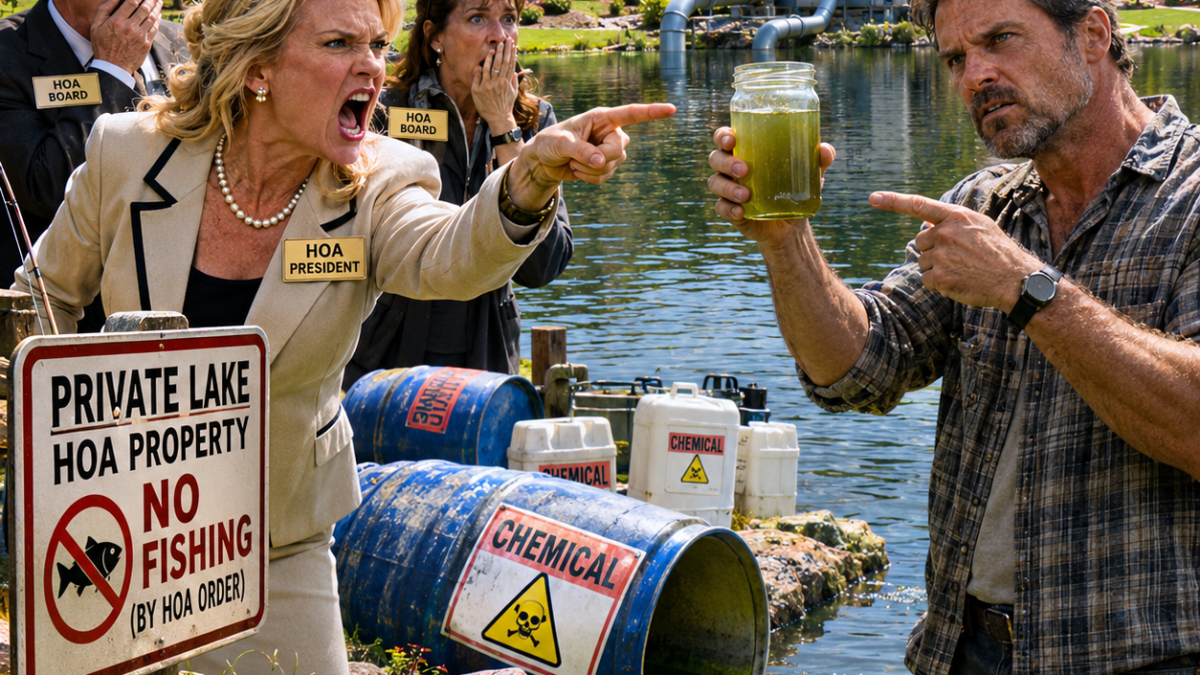
PART 2
Sarah crouched beside the dock with a sample bottle in one gloved hand.
“Where does your household water come from?”
“Private well.”
“Not what I mean.”
She stood.
“Where does Crystal Lake discharge?”
“There’s a creek at the eastern end.”
“Only there?”
I looked across the water.
“Springs feed it. Some subsurface flow. Why?”
She capped the sample.
“Because if somebody introduced enough chemical treatment into a spring-fed lake connected to public infrastructure, I need to know whether we’re looking at a private-property contamination event or a public-water problem.”
That changed the temperature of the morning.
Deputy Martinez had already called the sheriff.
The county had closed the access road.
Sarah’s assistant photographed dead fish, shoreline discoloration, tire tracks, and residue around the boat landing.
I kept replaying the security footage.
The men in the video were not Vivian.
That mattered.
Two wore work jackets.
One drove a landscaping truck I recognized from Meadowbrook.
They unloaded containers, carried them toward the water, and worked for less than fifteen minutes.
Then they left.
My camera did not capture labels clearly enough to identify the material.
I told Sarah:
“I saw a crew from that company here earlier in the week.”
“What company?”
“Mountain West Landscape Services.”
“Why?”
“They said they were preparing an algae treatment.”
Her head snapped toward me.
“Who authorized it?”
I showed her the photograph I had taken of the work order.
Vivian’s signature.
A nonexistent “Pine Ridge Water Management District.”
Sarah read it.
Then read it again.
“There is no agency by that name.”
“I know.”
“You verified?”
“With your office.”
She looked toward the road.
“Did you tell the sheriff?”
“Yesterday.”
“You stopped the first crew?”
“Yes.”
Sarah frowned.
“So this is a second attempt.”
“Looks like it.”
That distinction mattered too.
The first contractor had arrived openly.
Daylight.
Clipboards.
Legitimate company.
They had believed the paperwork.
When I objected, they called their supervisor and left without treating the water.
Somebody had returned at three in the morning instead.
That wasn’t confusion.
Sheriff Tom Rodriguez arrived twenty minutes later.
He was in his late fifties, gray at the temples, with the patient expression of somebody who had spent a career listening to people insist obvious things were misunderstandings.
He watched the footage.
“Can you give me the original files?”
“Yes.”
“Not clips?”
“Originals.”
“I’ll have a deputy collect a copy.”
Sarah said:
“I want the environmental lab looped in immediately.”
Rodriguez nodded.
Then looked at me.
“Anybody else know you had cameras?”
“Vivian knows I have security.”
“Does she know where?”
“Not all of them.”
“Good.”
He walked toward the water.
Dead trout bumped softly against the dock posts.
I hated that sound.
Emma had loved trout.
Not catching them.
Watching them.
When we traveled, she would stop on bridges and stare into mountain streams looking for fish shadows.
I picked one up with a net.
A beautiful cutthroat.
Gone.
Rodriguez said quietly:
“Don’t clean anything yet.”
“I know.”
He glanced at me.
“Sorry.”
That was the first time I nearly lost control.
Not when Vivian threatened me.
Not when she chained my boat.
Not when the newspaper made me look irresponsible.
Standing over that dead fish.
I turned away.
“Find out who did this.”
“We will.”
Sarah took me aside.
“Do you have any old infrastructure documents with your property?”
“Survey.”
“Water rights?”
“Some.”
“Utility records?”
“I don’t know.”
“Look.”
“Why?”
“Because I’m seeing intake references in the county GIS layer that don’t make sense.”
“What kind of intake?”
“Old municipal.”
That was when I remembered Vivian’s first visit.
Environmental impact regulations.
Water-rights allocations.
Municipal utility easements.
She had listed them too smoothly.
Like she knew the vocabulary.
I drove straight to the county archive.
The public library basement held older engineering records that had never been fully digitized.
I had volunteered there enough after Emma died that Janet, the archivist, knew me.
She looked at my face.
“What happened?”
“Crystal Lake got contaminated.”
She stopped sorting folders.
“What?”
“I need municipal water plans. Eighties. Maybe earlier.”
“What for?”
“Please.”
That was enough.
Forty minutes later, we found a rolled set of 1987 utility drawings.
I carried them to the long basement table.
Dust.
Old ink.
Yellowed paper.
Engineering lettering done by hand.
I flattened the first sheet.
Transmission line.
Treatment building.
Intake structure.
Then a note:
RAW WATER SOURCE — CRYSTAL LAKE SPRING BASIN
I stopped breathing for a second.
Janet leaned over.
“What?”
I traced the line.
The town treatment plant did not pump directly from the open lake the way modern systems might.
Instead, the plant collected spring-fed outflow from the same basin feeding Crystal Lake.
The lake and municipal source were hydrologically connected.
Not every molecule leaving my shoreline went directly into somebody’s faucet.
The system had treatment.
Monitoring.
Storage.
But contamination in the lake basin could absolutely create a problem for the municipal source.
I called Sarah.
She arrived twenty-five minutes later.
Studied the drawing.
Then said:
“Oh, hell.”
That was not reassuring.
“How bad?”
“We don’t know yet.”
“Could the treatment plant remove whatever was dumped?”
“Depends what it was and how much.”
“Could it reach the intake?”
“Yes.”
“Has it?”
“We’re testing now.”
She photographed the plans.
Then pointed to a notation near the basin.
“This is why the original development environmental report should have flagged chemical use.”
“Meadowbrook?”
“Any nearby development.”
We searched.
Found the 2019 Meadowbrook environmental study.
Clearwater Development.
That name appeared repeatedly.
Stormwater analysis.
Wetland impacts.
Water availability.
Emergency supply planning.
The report specifically referenced Crystal Lake’s connection to Pine Ridge’s raw-water basin.
Somebody involved with Meadowbrook absolutely should have known.
Then I saw a name.
Bradley Hartwell.
Vivian’s husband.
Consulting engineer.
Not primary author.
Not owner of the study.
But he had signed a technical certification attached to the development package.
I felt physically cold.
“Sarah.”
She leaned closer.
“Bradley knew.”
“At least he had access to this report.”
“He signed it.”
“Yes.”
I sat down.
“So Vivian knew too?”
“We cannot assume that.”
I hated that answer.
But she was right.
Evidence mattered.
Not intuition.
I called Rodriguez.
He told me not to contact either of them.
“Garrett.”
“I’m not planning to.”
“Good.”
“What do I do?”
“Go home.”
“My lake is full of dead fish.”
“I know.”
“Your answer is go home?”
“My answer is don’t help the people we’re investigating figure out what we know.”
That was Navy logic.
Need-to-know.
I understood it.
I still hated it.
When I returned to the cabin, Meadowbrook’s lights glowed downstream in the evening.
Forty-seven expensive homes.
Families eating dinner.
Kids taking baths.
People filling glasses at kitchen sinks.
If the contamination reached the municipal source, Vivian had not only damaged my property.
She had endangered her own neighborhood.
And everyone else in Pine Ridge.
That night, the town issued a precautionary advisory while testing continued.
Bottled water stations opened at the firehouse and high school.
Nobody announced why.
Not yet.
Sarah called at eleven.
“Good news first.”
“I need some.”
“The treatment plant’s upstream and finished-water tests are within safe limits right now.”
I exhaled.
“So nobody drank this?”
“We don’t have evidence of municipal exposure.”
“What’s the bad news?”
“The lake samples show an elevated copper-based algicide and another herbicidal compound.”
“How much?”
“Enough to explain the fish kill near the dump area.”
“Could it have moved into the source basin?”
“Potentially.”
I sat at my kitchen table.
Emma’s old mug was on the shelf above the sink.
I hadn’t used it since she died.
“Can the lake recover?”
“Yes.”
“How long?”
“We’ll know more after mapping concentrations.”
I stared into darkness outside.
“What about Meadowbrook?”
Sarah was silent.
Then:
“There’s something else.”
“What?”
“Clearwater Development owns several groundwater wells south of town.”
I remembered the name on the report.
“What does that have to do with anything?”
“Maybe nothing.”
That phrase from a scientist means definitely investigate.
She continued.
“The town studied them years ago as a backup source.”
“Did they buy water?”
“No. Cost was too high.”
“Who owns Clearwater?”
“I’m checking.”
I didn’t sleep much.
At sunrise, Sheriff Rodriguez called.
The landscaping truck had been identified.
Mountain West owned it.
The owner was cooperating.
Two employees admitted returning to my property after hours.
But they claimed they believed they were performing a valid emergency environmental treatment authorized by an official.
“Who hired them?”
Rodriguez asked me to come in.
At the sheriff’s office, he placed a photocopy on the table.
Invoice.
Client:
Clearwater Community Services
Contact:
V. Hartwell
Payment deposit.
Personal credit card ending in four digits.
“This doesn’t prove she ordered an illegal poisoning,” Rodriguez said.
“She hired them.”
“Yes.”
“After the first crew had already been told there was no authorization.”
“That part matters.”
He turned another page.
Email from an account associated with Vivian.
Owner has obstructed scheduled treatment. Proceed during low-traffic hours to avoid confrontation. Authorization attached.
I felt my hands tighten.
Rodriguez saw it.
“Breathe.”
“I’m fine.”
“You’re crushing my copy.”
I released the paper.
“Sorry.”
“She knew.”
“She knew you objected. That’s what we can say.”
“She fabricated an agency.”
“We’re investigating who created the authorization.”
I looked at him.
“You’re very annoying.”
“Good sheriffs often are.”
He asked about Bradley.
I told him about the engineering report.
His expression changed slightly.
“Do you have a copy?”
“Sarah does.”
“Send me one.”
Then he said something unexpected.
“Do not underestimate the possibility that Vivian thinks she’s protecting the subdivision.”
I stared at him.
“By chemically treating my lake?”
“People rationalize bad decisions.”
“That’s your defense of her?”
“No.”
He leaned forward.
“That’s me reminding you that the motive may be uglier or simpler than whatever story your anger is building.”
He was right.
I had begun imagining a grand conspiracy.
Clearwater wells.
Water monopoly.
Development politics.
Maybe it was true.
Maybe Vivian simply hated losing.
I needed proof either way.
The county environmental investigation became public that afternoon.
The Gazette headline:
FISH KILL INVESTIGATED AT CRYSTAL LAKE; TOWN WATER TESTING CONTINUES
No names.
Yet.
Vivian called me.
I did not answer.
She called again.
Then texted.
We need to resolve this privately before you damage the entire community.
I forwarded it to Rodriguez.
He replied:
Do not engage yet.
An hour later:
Save all messages.
That part I knew.
I created a timeline.
Fishing complaints.
Boat incident.
Environmental article.
My complaints against Meadowbrook.
First attempted chemical treatment.
County confirmation that the authorization was fake.
Second overnight treatment.
Fish kill.
Vivian’s payment.
Her email.
Water connection.
Bradley’s signature.
Clearwater wells.
No conclusions.
Only links.
That night Sarah came to the cabin carrying two binders.
“You were right to be suspicious.”
“About Clearwater?”
She placed a corporate filing on my table.
Clearwater Development was majority-owned by an investment partnership.
Bradley Hartwell held a minority interest through a consulting company.
Not full owner.
But financially involved.
“How much?”
“Enough that it should have been disclosed in some county filings.”
“And the wells?”
“Owned by Clearwater.”
I looked at the maps.
“Were they trying to sell water to Pine Ridge?”
She opened another document.
Two years earlier, Clearwater submitted an unsolicited proposal to provide backup municipal water.
Rejected.
Cost.
Capacity.
The town chose to continue upgrading its existing system instead.
I read the proposal.
“What would make this attractive?”
“If the current source became unreliable.”
We looked at each other.
Neither said it.
Sarah eventually broke the silence.
“This is still circumstantial.”
“I know.”
“Bradley owning part of a company with wells doesn’t prove he wanted your lake contaminated.”
“I know.”
“Vivian hiring a chemical crew does not automatically mean Bradley was involved.”
“I know.”
She closed the binder.
“You hate me right now.”
“A little.”
“Good.”
Emma had been like that too.
Whenever I built a theory too quickly, she would ask:
What do you know?
Not what do you think.
What do you know?
I missed her so badly in that moment I had to turn away.
Sarah noticed.
“Emma?”
I nodded.
“You okay?”
“No.”
She didn’t say anything comforting.
I appreciated that.
Instead, she walked to the window.
“The lake can recover.”
I swallowed.
“I know.”
“She mattered to you.”
“More than anything.”
“Then don’t let Vivian turn this place into only a crime scene.”
That sentence stayed with me.
The next morning, county crews began removing dead fish and setting containment booms near the affected shoreline.
Water samples every few hours.
The town advisory remained precautionary.
No municipal contamination had been detected.
That was the first real relief.
Then Meadowbrook exploded.
Homeowners learned Vivian had authorized the treatment connected to the fish kill.
Her own board members began distancing themselves.
One, a retired anesthesiologist named Carl Devlin, drove to my cabin.
He looked terrified.
“Garrett.”
“What?”
“The board never approved lake treatment.”
“I figured.”
“She told us the county requested it.”
“Did you see anything?”
“No.”
“Did anyone vote?”
“No.”
“Did Bradley attend?”
“Once.”
“When?”
“The emergency meeting after you filed the wetland complaints.”
That mattered.
“What did he say?”
Carl looked down.
“He said Crystal Lake was becoming a liability.”
“How?”
“Environmental exposure. Water-rights uncertainty. Lawsuits.”
“Anything about Clearwater?”
Carl shook his head.
“No.”
“Anything about wells?”
“No.”
Then he added:
“Vivian said if the lake became restricted, your fishing issue would disappear.”
I felt the anger return.
“Exact words?”
“I think so.”
“Would you tell the sheriff?”
He hesitated.
“Carl.”
“I have patients in this town.”
“So?”
“If this becomes a scandal—”
“It already is.”
He rubbed both hands over his face.
Then:
“Yes.”
That afternoon, Carl gave a statement.
The board’s treasurer followed.
Then the secretary.
Vivian’s support was collapsing.
But Bradley stayed silent.
He hired a lawyer.
Vivian hired one too.
The white BMW disappeared from my road.
For three days, nothing happened.
Then I received a letter.
Certified.
An offer to purchase my property.
Clearwater Development.
Not fifty thousand dollars.
A real offer.
Six hundred twenty-five thousand.
I had paid much less.
The letter called the purchase an opportunity to “resolve ongoing water-resource conflicts and facilitate regional infrastructure planning.”
I read it twice.
Then called Marcus Thompson.
Marcus was a reporter at the Pine Ridge Gazette.
Not my lawyer.
The source story later blurred those roles, but I knew exactly who Marcus was.
He had covered county development issues for years.
“Have you seen Clearwater trying to buy land around Crystal Lake?”
Silence.
“Why?”
“They just offered to buy mine.”
Another silence.
“Send it.”
“Why?”
“Because three ranchers south of town got similar offers last year.”
That was new.
“Near the wells?”
“Yes.”
“What are they building?”
“Nothing publicly.”
I sent the letter.
Then called Rodriguez.
He asked the same question.
“When did it arrive?”
“Today.”
“Do not respond.”
“Everybody’s favorite phrase.”
“Because it keeps you out of trouble.”
That evening, Sarah came over.
We walked the shoreline.
Most of the discoloration had faded.
Still too many dead fish.
But insects were active.
Water movement looked normal.
She said:
“Copper levels are falling.”
“Good.”
“Sediment will need monitoring.”
“How long?”
“Months.”
I looked at the offer letter in my hand.
“Would you sell?”
She looked surprised.
“Me?”
“If this were yours.”
“No.”
“Why?”
“Because you don’t want to.”
“That simple?”
“Usually.”
Emma would have said the same thing.
The offer expired unanswered.
Two days later, Vivian came in person.
No clipboard.
No board members.
No lawyer.
She carried a leather portfolio.
I almost didn’t open the door.
Then I saw Sheriff Rodriguez’s advice written in my head:
Don’t create a confrontation.
Document.
I stepped onto the porch.
My exterior camera was recording.
“What do you want?”
“To settle this.”
“You have attorneys.”
“So do you, apparently.”
“I don’t.”
“You’ve spoken to half the county.”
“You chemically treated my lake after being told not to.”
Her face tightened.
“That treatment was intended to prevent an environmental problem.”
“It caused one.”
“Because the contractor applied it improperly.”
“That’s your position?”
“Yes.”
“Then why did you send them at three in the morning?”
She paused.
“Because you had already interfered once.”
That was the closest thing to an admission I had heard.
I said nothing.
She continued.
“Garrett, this has gotten out of control.”
“No argument.”
“Meadowbrook homeowners are panicking.”
“So am I.”
“Families could lose property value.”
“Fish already lost more.”
Her eyes hardened.
“There it is.”
“What?”
“You enjoy this.”
“Enjoy what?”
“Watching successful people suffer because you couldn’t keep your little hobby from becoming everybody’s problem.”
That hurt less than she probably hoped.
“Fishing isn’t the problem anymore.”
She looked toward the lake.
“What do you want?”
“My lake repaired.”
“That can be arranged.”
“Your fake complaints withdrawn.”
“Fine.”
“Every document you used to authorize treatment turned over.”
Her expression changed.
“Why?”
“Because somebody fabricated government authority.”
“I relied on consultants.”
“Who?”
“I’m not discussing this without counsel.”
“Then this conversation is over.”
I turned.
“Wait.”
I looked back.
She opened the portfolio.
Purchase agreement.
Higher number.
Seven hundred thousand.
Clearwater Development.
“Take it.”
“No.”
“You haven’t even read it.”
“I know what my property is worth to me.”
Her voice softened artificially.
“This place is tied to grief.”
I stared at her.
“Don’t.”
“You could start over somewhere warmer.”
“Do not talk about Emma.”
“I’m trying to help.”
“No.”
Vivian’s mask slipped.
“Then understand something. You cannot afford to fight everyone connected to this.”
“Who is everyone?”
She realized the mistake immediately.
I watched it happen.
“Your board?”
Silence.
“Clearwater?”
Silence.
“Bradley?”
Her eyes hardened.
“I’m leaving.”
She walked down the steps.
I called after her.
“Vivian.”
She stopped.
“Crystal Lake supplies part of Pine Ridge’s raw water.”
She turned.
For the first time in six months, her face went completely blank.
That reaction told me more than any speech.
“You knew.”
She recovered quickly.
“Everybody knows the lake is part of the watershed.”
“No. This is specific.”
She said nothing.
“Bradley signed the 2019 study.”
That landed.
She walked to the BMW without another word.
I sent the recording to Rodriguez.
The investigation widened.
Not because of my accusation.
Because documents kept connecting.
Emails from Clearwater subpoenaed later would show Bradley discussing Pine Ridge’s dependence on the existing source.
Another email mentioned that “source instability” could make Clearwater’s backup-well proposal commercially viable.
That phrase became important.
It was not a confession.
It was context.
Then investigators found communications between Bradley and Vivian before the chemical treatment.
One message:
If Blackwood keeps pushing the wetland review, the lake becomes the pressure point.
Another:
A temporary water-quality restriction would change the conversation quickly.
That was worse.
Still not “poison the town.”
But enough to show the lake was being discussed strategically.
Bradley’s attorney argued those messages referred to regulatory pressure.
Maybe.
Then came the contractor testimony.
Rico, the crew chief from the first visit, produced texts.
Vivian instructed him to apply treatment even if I objected because “the county authority overrides the owner.”
After Rico refused to return without proper government confirmation, Vivian hired another subcontractor through a different company.
That crew performed the overnight application.
They believed the paperwork was legitimate.
The person who created the fake district letter was traced to a consulting assistant working for Clearwater.
That assistant agreed to cooperate.
That was when Bradley’s position collapsed.
The assistant said Bradley asked him to draft a “temporary authority letter” using old municipal formatting so contractors would treat it as official.
Bradley denied intending fraud.
Investigators now had enough to seek warrants.
Searches followed.
Clearwater offices.
Bradley’s home office.
Vivian’s HOA records.
Nobody was arrested at a dramatic town hall.
Real investigations don’t usually wait for the audience.
They move when warrants and evidence are ready.
But Pine Ridge did hold a town meeting.
That meeting became the emotional climax anyway.
The school gym was full.
Not six hundred forty-seven people packed dangerously into a four-hundred-person room.
About three hundred residents.
Still more than I had ever seen at a local meeting.
Mayor Patricia Walsh opened.
County health department.
Water utility manager.
Sarah.
Sheriff Rodriguez.
Clearwater representatives had been invited.
Bradley came with counsel.
Vivian did not.
Her attorney sent a statement.
The water manager spoke first.
“No contamination has been detected in finished municipal water.”
People exhaled.
Then:
“However, Crystal Lake’s spring basin is hydrologically connected to our primary raw-water source. The recent unauthorized chemical application presented a legitimate risk requiring emergency monitoring and temporary precautions.”
That was the sentence Pine Ridge needed.
Not hysteria.
Not speculation.
Risk.
Real.
Sarah presented the lake findings.
Fish mortality.
Localized contamination.
Recovery plan.
Long-term sediment monitoring.
Then the mayor asked me to speak.
I stood behind the school podium.
For months I had imagined what I would say if I ever got the room.
Vivian is corrupt.
Bradley is greedy.
Clearwater tried to steal our water.
All the satisfying lines.
I used none of them.
I looked at the people in the bleachers.
“Six months ago, this started because I wanted to fish.”
A few people laughed softly.
“I thought the argument was about a trout rod.”
Then I looked toward Meadowbrook families.
“It wasn’t.”
I told them about Emma.
Not everything.
Just enough.
How we had planned the lake together.
How she never saw it.
How I bought the property because I wanted somewhere quiet enough to remember her without feeling like grief had taken every room in my life.
Then:
“When those fish died, I wanted revenge.”
Silence.
“I wanted everyone who had bothered me to hurt.”
I glanced at Rodriguez.
“He can confirm I was not pleasant.”
The sheriff smiled slightly.
“But this town didn’t need revenge.”
I pointed toward Sarah’s water maps.
“It needed the truth.”
I put up the 1987 system drawing.
The spring basin.
Treatment plant.
Distribution system.
Then the 2019 Meadowbrook environmental study.
Bradley’s signature.
Then the fake authorization.
Then the contractor invoices.
Then the Clearwater purchase offers.
No accusations beyond what investigators had made public.
Just documents.
Bradley’s lawyer stood.
“My client disputes any suggestion that he intended contamination.”
I looked at him.
“I didn’t say he did.”
That stopped him.
I continued.
“I am saying people made decisions about water they did not own, using authority they did not have, while the rest of us were expected to trust paperwork nobody checked.”
That was the heart of it.
Not Vivian’s personality.
Not my fishing.
Authority without verification.
Mayor Walsh then announced the county had suspended all Clearwater negotiations pending the investigation.
Meadowbrook’s board announced Vivian had resigned as president that afternoon.
A homeowner from the development stood.
Her name was Rebecca Sloan.
Two kids.
Teacher.
She said:
“I owe Mr. Blackwood an apology.”
I was surprised.
“For what?”
“I believed the newsletter.”
She looked embarrassed.
“I thought you were some angry outsider trying to damage our neighborhood.”
I nodded.
“Fair.”
“No.”
She shook her head.
“I never came up here. Never saw your property. Never asked you anything.”
Then:
“I just believed the person with the title.”
That sentence hit me harder than an apology.
Because I had done versions of that too.
We all had.
The meeting ended without applause.
I was glad.
It wasn’t a movie.
People went home to children and dishes and bills.
But the balance had changed.
Two weeks later, state environmental regulators issued formal enforcement orders tied to the unauthorized lake treatment.
The county prosecutor charged several participants with offenses related to forged documents, unlawful entry, and environmental damage.
Federal environmental investigators became involved because of the public-water implications and falsified records affecting regulated water infrastructure.
Vivian and Bradley both eventually reached plea agreements rather than go through a long trial.
The final charges were narrower than town gossip had predicted.
No “environmental terrorism.”
No life sentences.
No million-dollar criminal fine personally imposed because somebody’s rose garden crossed a line.
But the consequences were serious.
Vivian pleaded to offenses related to fraudulent authorization and unlawful environmental treatment.
Bradley pleaded to charges tied to false documentation and conspiracy involving Clearwater’s effort to influence the town’s water decisions.
Both paid restitution through the criminal and civil cases.
Clearwater Development dissolved its Pine Ridge water venture and sold the backup wells to a regional public utility at a court-supervised price.
The HOA’s insurer funded part of the lake remediation.
Clearwater and the contractors paid additional amounts through settlement.
Meadowbrook owners were not personally saddled with Vivian’s decisions.
That mattered to me.
Most of them had done nothing wrong.
The wetland violations became their own issue.
County officials reviewed the original permits.
Some of the dramatic penalty numbers people had thrown around were wrong.
There was no automatic $847,000 bill on Vivian’s house.
There were compliance failures.
Several properties required mitigation.
Some landscaping had to be removed.
Drainage plans revised.
A few structures received variances after engineering review.
The world did not end.
The subdivision survived.
It simply stopped pretending paperwork could be bent around whoever had the most expensive lawyer.
Crystal Lake took longer.
Sarah supervised the monitoring plan.
For months, I watched technicians walk my shoreline carrying sample bottles.
Every time I saw them, I remembered the dead fish.
The first winter was quiet.
Too quiet.
Fish populations had dropped near the treatment area.
In spring, the state wildlife department helped restock native trout after water-quality benchmarks were met.
I stood at the dock as they released them.
Small silver bodies disappeared into clear water.
Sarah stood beside me.
“Don’t cry.”
“I’m not.”
“You’re absolutely crying.”
“Wind.”
“There is no wind.”
I looked at her.
“You’re very irritating.”
“I’ve heard.”
That was how Sarah and I became friends.
Not romance.
Not yet.
Coffee first.
Monitoring reports.
Arguments about lake ecology.
She was a county scientist who took work personally in the best way.
Her husband had died in a climbing accident years earlier.
I learned that slowly.
She learned Emma slowly too.
One evening we sat on the dock after sampling crews left.
The lake reflected the mountains.
Sarah asked:
“Do you ever feel guilty when you have a good day?”
I looked at her.
“Yes.”
She nodded.
“Me too.”
That was the first conversation we had that wasn’t about water.
Months later, I invited her to dinner.
She said:
“Is this a date?”
“I don’t know.”
“That’s a terrible invitation.”
“I’ve been out of practice.”
“Clearly.”
“So?”
She smiled.
“Yes.”
I worried about Emma.
Not logically.
Emotionally.
The first time Sarah stayed late enough to watch sunrise with me, we sat where Emma and I had once planned to sit.
I felt like I was stealing something from a dead woman.
Sarah must have seen it.
“She isn’t being replaced.”
I looked at her.
“I didn’t say anything.”
“You didn’t have to.”
I stared at the water.
“Emma wanted this place.”
“I know.”
“She should be here.”
“I know.”
“And I’m sitting here with you.”
Sarah waited.
Then:
“Both things can be true.”
That sentence saved me from a lot of unnecessary guilt.
We did not marry the following week.
Or the following spring in some giant town celebration.
We took our time.
Two years.
Then we married quietly beside the lake.
About sixty people.
Mayor Walsh.
Rodriguez.
Martinez.
Rebecca Sloan from Meadowbrook.
Rico, the contractor who had stopped the first chemical application and later testified.
Even Janet from the archive came.
She brought the old 1987 blueprint in a protective sleeve.
Not the original.
A copy.
The original belonged to the town.
She had written on the corner:
Sometimes dusty paperwork saves lives.
That made me laugh.
We started the Emma Blackwood Environmental Scholarship with part of the civil settlement money.
Not because I wanted Emma’s name attached to the scandal.
The opposite.
I wanted her name attached to what survived.
The scholarship supported local students studying environmental science, water systems, engineering, or conservation.
The first recipient was a girl named Ava Martinez.
Deputy Martinez’s niece.
She wanted to study watershed science.
At the award ceremony, she shook my hand.
“I grew up swimming in Crystal Lake.”
“Then you already know half the curriculum.”
She laughed.
Sarah handed her the certificate.
Ava said:
“I want to make sure nobody can ever do this again.”
Sarah answered:
“Then learn the system better than the people trying to misuse it.”
I loved her for that.
Pine Ridge upgraded the municipal water system too.
That was probably the most important legacy.
The town had relied too heavily on one natural source.
Crystal Lake was beautiful.
But beautiful is not the same as resilient.
The utility added more robust treatment.
Additional monitoring.
Alternative emergency supply agreements.
Automated contamination alerts.
Sarah helped design the monitoring program.
I consulted without charge.
The town council insisted on paying me one dollar.
I framed the check.
Because apparently I am that kind of man.
Meadowbrook changed too.
Vivian’s replacement as HOA president was Rebecca Sloan.
The teacher who had apologized at the town meeting.
She did not want the job.
That was probably why she was good at it.
Her first rule:
No HOA complaint against property outside Meadowbrook jurisdiction without board counsel confirming authority.
Second:
No board officer could submit a county complaint in the HOA’s name without a recorded vote except for an immediate safety emergency.
Third:
Every financial relationship involving a board member had to be disclosed.
Meetings became boring.
I considered that a victory.
Rebecca came to my cabin one summer afternoon.
I was cleaning fishing gear.
She stood at the dock.
“Can I ask you something?”
“Sure.”
“Do you still hate Meadowbrook?”
I thought about it.
“No.”
“Really?”
“I never hated Meadowbrook.”
“You called us the invasion.”
I laughed.
“Pine Ridge called you that.”
“You did too.”
“Probably.”
She sat.
“My kids love fishing.”
I looked at her.
“That a hint?”
“Maybe.”
“Bring them Saturday.”
Her daughter caught the first trout.
Sixteen inches.
Beautiful cutthroat.
The girl held it like treasure.
Then asked:
“Can we put it back?”
I smiled.
“Absolutely.”
Vivian had tried to end fishing.
Years later, her old neighborhood’s children were releasing trout from my dock.
Life has a sense of humor.
I saw Vivian once after her sentence.
She had served several months in custody, then completed the remainder under supervision after restitution arrangements and other conditions.
The specifics were public, but I had stopped following closely.
I saw her at a gas station outside Bozeman.
No BMW.
Older Subaru.
Hair shorter.
She recognized me.
We stood on opposite sides of the pumps.
“Garrett.”
“Vivian.”
I expected anger.
She looked tired.
“I heard you remarried.”
“Yes.”
“Congratulations.”
“Thank you.”
Silence.
Then:
“How’s the lake?”
“Better.”
She nodded.
“I’m sorry about the fish.”
I stared at her.
Not because the apology fixed anything.
Because it was so much smaller than the damage.
She seemed to understand.
“That sounds ridiculous.”
“A little.”
“I told myself the treatment was safe.”
I said nothing.
“I told myself the contractor knew what he was doing.”
Still nothing.
“I told myself you were forcing us into it.”
“That one is harder to believe.”
She looked down.
“I know.”
“Why, Vivian?”
She leaned against her car.
For a long time she didn’t answer.
Then:
“Control.”
I wasn’t expecting honesty.
“Bradley was convinced Clearwater could solve Pine Ridge’s future water problems. I was convinced Meadowbrook would be blamed for every environmental issue if your complaints continued. And you…”
“What about me?”
“You wouldn’t cooperate.”
I almost laughed.
“Meaning I wouldn’t surrender.”
“Yes.”
At least she said it.
She continued.
“Every time you pushed back, I felt like if I gave you one thing, everyone else would challenge everything.”
“That isn’t leadership.”
“I know that now.”
I looked at the traffic passing behind us.
“Did you know the chemical could reach the municipal source?”
“I knew Crystal Lake was connected.”
That answer still made me angry years later.
“But I believed the treatment amount was controlled.”
“You had no authority to make that gamble.”
“No.”
“Forty-seven houses in Meadowbrook.”
“I know.”
“Whole town.”
“I know.”
“My wife’s lake.”
Her face changed.
“I know.”
I stopped.
Emma’s lake.
Not legally.
Emotionally.
Vivian understood.
Then she said:
“I shouldn’t have talked about her.”
“What?”
“During our last argument.”
I remembered.
Words about grief.
About moving.
About memories.
The source story gives Vivian an even crueler speech than what actually fit the woman I had come to understand.
Reality was simpler.
She had told me I was “using my wife’s memory as an excuse to resist change.”
That was cruel enough.
“I was angry,” she said.
“So was I.”
“That doesn’t excuse it.”
“No.”
She looked toward the highway.
“Bradley and I divorced.”
I hadn’t known.
“Sorry.”
“Don’t be.”
Another silence.
Then the pump clicked.
Full.
Vivian removed the nozzle.
Before getting into her car she said:
“You won.”
I shook my head.
“No.”
She looked confused.
“The lake did.”
That sounded corny the second it left my mouth.
But it was true.
I didn’t beat Vivian.
The records did.
The water tests did.
The contractor who refused the first application did.
The cameras did.
The town’s engineers did.
The sheriff did.
The residents who stopped letting a title substitute for evidence did.
And the lake survived.
That was enough.
Sarah and I later started a small consulting practice.
Not some four-state crusade against corporate water thieves.
Mostly rural infrastructure.
Source-water protection.
Emergency planning.
Monitoring.
Small towns often have old systems built in layers over decades.
Nobody fully understands them until something goes wrong.
We helped communities map those systems before the emergency.
One town in Idaho discovered an abandoned industrial drain upstream of its municipal well field.
Another in Wyoming found its backup generator could not carry the treatment plant’s full load.
Unexciting problems.
Important problems.
Every job reminded me of Pine Ridge.
The danger was rarely one evil mastermind.
More often it was assumptions.
Old paperwork.
Institutional memory.
Nobody asking the boring question.
Where does this pipe go?
Who owns this easement?
Who signed this authorization?
What happens if this source fails?
Emma would have loved that work.
She liked questions.
Especially annoying ones.
The annual Pine Ridge Lake Day began three years after the contamination.
Not a giant environmental festival.
Just a local event.
Trash cleanup.
Water demonstrations.
Kids learning to cast.
Barbecue.
Sarah gave tours of the monitoring station.
I taught fishing.
Rebecca’s daughter became frighteningly good at it.
One year, she beat me in a trout-length competition.
I demanded a recount.
She said:
“Old men hate losing.”
I was sixty-two.
“Who told you I’m old?”
“My mom.”
Rebecca denied it.
Nobody believed her.
At sunset, volunteers gathered beside the dock.
The water was so clear we could see trout moving over the gravel.
A boy asked:
“Was it really poisoned?”
I looked at Sarah.
She nodded.
“Part of it was contaminated,” I said.
“Did all the fish die?”
“No.”
“Did people get poisoned?”
“No municipal exposure was confirmed.”
“Did the bad lady go to jail?”
Kids love direct questions.
“For a while.”
“Why?”
“Because she used fake authority to do something dangerous.”
He thought.
Then:
“Why would she do that?”
That was harder.
“Because she thought being in charge meant being right.”
He accepted that faster than adults usually do.
Then he asked:
“Can I fish?”
“Absolutely.”
Years passed.
The scholarship grew.
Ava returned after college and took a job with the state environmental department.
The first time she arrived at Crystal Lake wearing agency boots and carrying official sampling equipment, I almost laughed.
“What?”
She asked.
“Nothing.”
“You’re doing the old-man face.”
“What old-man face?”
“The proud one.”
Sarah said:
“He does have one.”
I ignored both of them.
Ava walked to the dock.
Took samples.
Logged temperature.
Dissolved oxygen.
Basic field measurements.
Then looked across the lake.
“I remember when there were dead fish here.”
“So do I.”
“I was fourteen.”
“Now you’re making me feel old.”
“Good.”
She grinned.
The Emma Blackwood scholarship had helped pay for part of her education.
Now she was protecting the same watershed.
That was the kind of ending Emma deserved.
Not Vivian in handcuffs.
Not Bradley losing his business.
Not settlement checks.
A young scientist standing in clean water because something terrible had been turned into something useful.
Sarah understood that.
One night after everyone left, we sat on the dock.
She rested her head against my shoulder.
“Do you ever think about selling?”
“The property?”
“Yes.”
“No.”
“Never?”
“Ask me when I’m ninety.”
“What if I want Arizona?”
“You hate Arizona.”
“I might change.”
“You hate dry heat.”
“I might change dramatically.”
“You married a lake.”
She laughed.
“I married an engineer with emotional problems.”
“Worse decision.”
The mountains were black against the fading sky.
A loon called from the far shore.
For a second, I could almost hear Emma laughing.
Not in some supernatural way.
Memory.
That’s all.
But memory can sit beside you without owning the chair.
I finally understood that.
Sarah squeezed my hand.
“What?”
“Nothing.”
“You’re doing the face.”
“What face?”
“The Emma face.”
I looked at her.
“You know all my faces?”
“Unfortunately.”
We sat until the air got cold.
The next morning I woke before sunrise.
Old habit.
Coffee.
Jacket.
Rod.
I walked to the dock.
Mist hovered over Crystal Lake.
No dead fish.
No blue-green stain.
No investigators.
No trucks.
The municipal monitoring station blinked quietly from the far shore.
Small green light.
Everything normal.
I cast.
The lure landed softly.
Ripples widened.
For years, I had thought peace meant nothing bad happening.
Emma’s illness taught me that was impossible.
Vivian taught me something else.
Peace is knowing what is worth protecting without becoming the thing you’re fighting.
I had wanted to destroy her.
Instead, I documented.
Called people who knew more than I did.
Waited.
Let investigators investigate.
Let scientists measure.
Let records speak.
That was slower.
Less satisfying in the moment.
Better in the end.
My line tightened.
I lifted the rod.
Fish.
Small cutthroat.
Healthy.
Bright.
I brought it alongside the dock.
For a second I imagined keeping it for breakfast.
Then I saw Emma in my head rolling her eyes.
I removed the hook.
Held the trout in the water until it kicked.
Then released it.
It disappeared into the clear lake.
Behind me, the cabin door opened.
Sarah called:
“Coffee’s getting cold.”
“Caught one.”
“Keeping it?”
“No.”
“Getting soft.”
“Environmental policy.”
“Sure.”
I reeled in.
The town below was waking.
Water moved unseen through rock, springs, treatment pipes, and kitchen faucets.
A whole system connecting people who rarely thought about where their morning glass came from.
Vivian had once tried to use that water as leverage.
Now Pine Ridge monitored it more carefully than ever.
The lake was still mine on paper.
But I no longer thought of it as something that belonged only to me.
Emma taught me to love it.
Vivian accidentally taught the town to protect it.
Sarah taught me there could still be another morning after grief.
I picked up my coffee and looked across water so clear I could see the bottom beneath the dock.
Then I noticed a trout moving through the shadow below me.
Alive.
Exactly where it belonged.
[END OF STORY]








