PART 2: HOA President Planted Kudzu Along My Fence to Force Me Out—Five Years Later It Swallowed Her Own Garage
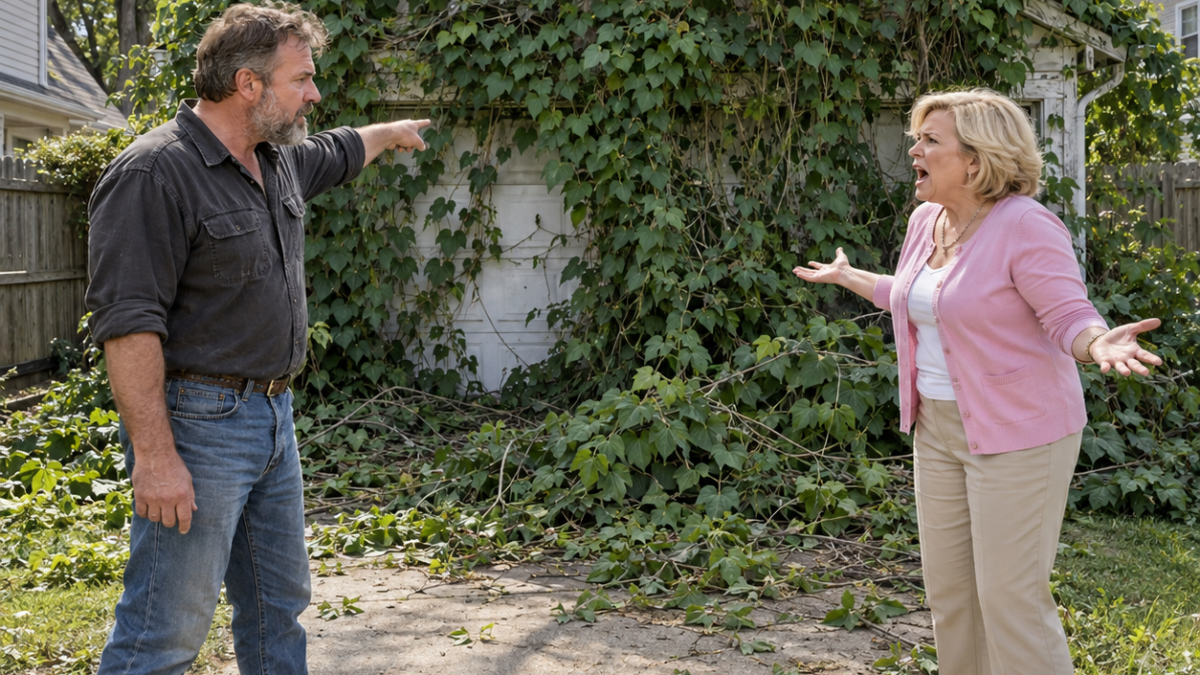
PART 2
Dave drove down two days later.
He did not trust photographs alone, and neither did I.
That mattered to me.
Karen had built half her authority on certainty without evidence. I was determined not to make the same mistake simply because I wanted my suspicion to be true.
Dave arrived in an old university pickup with sample bags, gloves, a hand lens, and the irritated expression of a man whose Saturday had been hijacked by a plant he already disliked.
Sarah made coffee.
Emily followed us outside even though I told her she didn’t need to.
She was sixteen then.
Old enough to understand tension.
Young enough to think every conflict could be solved if adults would simply stop being ridiculous.
She stood beside my fence and stared at the vines.
“So that’s the evil plant?”
Dave crouched.
“Plants aren’t evil.”
Emily pointed toward Karen’s house.
“People can be.”
“Emily.”
“What?”
Sarah covered a smile.
Dave collected several samples.
He examined the leaves.
Stem hairs.
Nodes.
Rooting pattern.
Then he stood.
“I’m about ninety-nine percent sure.”
“Kudzu?”
He nodded.
“Pueraria montana.”
Sarah folded her arms.
“How bad?”
Dave looked toward the tree line.
“Potentially very bad.”
He explained that kudzu could spread with astonishing speed under the right conditions.
It climbed.
Smothered.
Blanketed.
It could cover shrubs, young trees, fences, utility structures—anything that gave it vertical support.
Its root crowns became difficult to eradicate once established.
Control was possible, he emphasized, but usually required persistence.
Repeated cutting.
Targeted herbicide.
Monitoring.
Years, not weekends.
“Can we just dig it out?” Sarah asked.
“If it’s brand-new, maybe some of it.”
He looked over the fence.
“But this is HOA common property, correct?”
“Yes.”
“That complicates things.”
“I’m not touching their side without permission.”
“Good.”
Dave looked at me.
“I know what you’re thinking.”
“What?”
“That you want to prove who planted it.”
I did not answer.
He sighed.
“Jack, the priority should be stopping spread.”
“I agree.”
“Then notify them in writing.”
“I will.”
“And whoever planted this?”
His expression hardened.
“They made an unbelievably irresponsible decision.”
Dave helped me write the first plant report.
He was careful.
Preliminary identification consistent with kudzu.
Professional confirmation recommended.
Prompt assessment advised.
Potential risk to greenbelt vegetation and nearby private property.
No dramatic claims.
No accusations.
Just facts.
I sent the letter to the HOA.
Certified.
Copy to the property-management company.
Copy to every board member whose address was publicly listed.
Then I waited.
Karen responded in forty-eight hours.
Dear Mr. Riley,
The vegetation referenced in your letter is located on association common property and is part of ongoing natural landscape management. Homeowners are prohibited from altering, treating, or removing association vegetation without authorization.
No mention of kudzu.
No inspection.
No expert.
No concern.
I called Dave.
“She says it’s natural landscaping.”
There was silence.
Then:
“Do not let her make you reckless.”
“I’m not reckless.”
“You can be creative when you’re angry.”
“That sounds like a compliment.”
“It is not.”
I laughed.
Then he became serious.
“Protect your side. Document everything. If it’s spreading from common property, keep records of what you spend.”
That was when I bought the logbook.
Hardcover.
Numbered pages.
I had used maintenance books like it during my service years.
Date.
Time.
Observation.
Action.
Cost.
Photographs cross-referenced.
I wrote the first entry that night.
June 14.
Kudzu-like invasive vine observed along approximately fifty feet of rear fence line.
HOA notified by certified mail.
Then I installed cameras.
Not aimed at houses.
Only the greenbelt strip and fence line.
Trail cameras were common enough.
Motion activated.
Infrared.
Cloud backup on one.
Local storage on two.
Sarah watched me mount the third camera.
“You really think she’s going back there?”
“I don’t know.”
“Then why three cameras?”
“Coverage.”
She shook her head.
“You’ve been retired too long.”
“Not long enough.”
A week later, the first footage arrived.
6:43 p.m.
Karen.
Gardening gloves.
Watering can.
She moved along the planted line.
Not walking past.
Not inspecting casually.
Watering.
Plant by plant.
Then she opened a plastic bag.
Sprinkled something around several bases.
Fertilizer, possibly.
I watched the recording twice.
Sarah watched once.
“That’s enough,” she said.
“What?”
“You have proof she’s tending them.”
“Not proof she planted them.”
Sarah looked at me.
“Do you need proof she planted them before we insist they be removed?”
“No.”
“Then don’t turn this into revenge.”
That landed.
My wife had always been good at separating mission from emotion.
I nodded.
“You’re right.”
We sent the video to the board.
I requested immediate professional removal.
Karen replied through the management company.
The board did not consider the vegetation an urgent hazard and would evaluate it during the next scheduled landscape review.
Three months away.
Dave nearly yelled when I told him.
“Three months?”
“Yes.”
“That is not a schedule for an invasive vine.”
“I know.”
“Document it.”
“I am.”
By the end of the summer, the kudzu had reached my fence in earnest.
It climbed three posts in a week.
I cut everything that crossed onto my property.
For treatment, I used only methods and products recommended for the situation and followed label and local requirements.
That distinction became important later.
I did not dump chemicals into the greenbelt.
I did not trespass.
I controlled what crossed onto my land and kept asking the HOA to address the source.
Every Saturday morning became the same.
Gloves.
Loppers.
Sprayer where appropriate.
Bag vegetation.
Photograph.
Log.
Receipt.
Sarah hated the smell of herbicide.
Emily hated the entire ritual.
“Every weekend?”
“For now.”
“It’s a plant, Dad.”
“It’s a plant with excellent work ethic.”
“That sounded almost respectful.”
“I respect competent enemies.”
Sarah stared at me.
“Please don’t call vegetation the enemy at breakfast.”
The HOA’s landscape review came.
No meaningful action.
Karen claimed the greenbelt vegetation provided “natural screening.”
I contested the finding.
Nothing changed.
Meanwhile, something else did.
Bill Henderson stopped using his bird feeders.
Bill lived two houses away.
Seventy-eight.
Retired postal worker.
Gentle man.
Always outside.
He had a habit of identifying birds before you saw them.
“Cardinal.”
“Blue jay.”
“Carolina wren.”
He knew every sound.
Then one morning I realized his feeders were gone.
I asked why.
“New rule.”
“What new rule?”
“Potential rodent attraction.”
“Was there a rodent problem?”
“No.”
“Who complained?”
He looked toward Karen’s house.
I understood.
“How much?”
“One hundred first notice.”
“You fought it?”
“I tried.”
“And?”
“Two hundred.”
He shrugged.
“So I took them down.”
The shrug bothered me more than anger would have.
“You loved those feeders.”
He looked toward the empty hooks.
“I still like birds.”
“That’s not what I said.”
Bill sighed.
“Jack, I’m seventy-eight.”
“I know.”
“I don’t want every morning to be an argument.”
That sentence stayed with me.
Karen’s power did not come from strong rules.
It came from exhaustion.
She created friction until peace became something you purchased with obedience.
A week later, Mary Henderson brought us a lemon-meringue pie.
“Bill told me you’re fighting her.”
“I’m fighting kudzu.”
Mary gave me a look.
“All right.”
“Both.”
“Better.”
She pushed the pie into my hands.
“You tell us if you need something.”
I thanked her.
Then Maria Garcia joined the list.
Her daughter had drawn a rainbow in sidewalk chalk across their driveway.
Seven years old.
Big sun.
Purple dog.
Rainbow.
Karen photographed it.
Two hundred-dollar violation.
Unauthorized modification creating a visually chaotic streetscape.
Maria showed me the letter at the playground.
“You’re kidding.”
“I wish.”
“Did you pay?”
“We had to.”
Her voice changed.
“That was grocery money.”
I looked toward her daughter on the swings.
“Do you still have the letter?”
“Every one.”
“Photographs?”
“Yes.”
“Keep them.”
She stared at me.
“Why?”
“Because people need to stop thinking each incident is isolated.”
That became the beginning.
Not of some military campaign.
Despite the joking name we later gave ourselves.
It was neighbors comparing paper.
Bill’s bird feeders.
Maria’s chalk fine.
The Robinsons’ welcome sign.
A basketball hoop cited because the net was frayed.
A widow warned that her porch flowers were too bright.
A single mother photographed because her trash bin remained visible after pickup.
Individually, each incident sounded absurd.
Together, they demonstrated something larger.
Karen was not managing property.
She was managing people.
Through embarrassment.
Expense.
Fear.
A dozen homeowners began exchanging records privately.
Someone jokingly called us the Oakwood Liberation Front.
The name stuck.
Sarah hated it.
“It makes you all sound twelve.”
Bill loved it.
“We need shirts.”
“No shirts,” I said.
Maria laughed.
“We’re absolutely making shirts someday.”
While our little coalition grew, so did the kudzu.
The first winter slowed it.
I mistakenly felt hopeful.
Bare vines.
Dead-looking leaves.
Quiet.
Dave corrected me.
“Dormant isn’t dead.”
He came back in spring.
The vines returned faster.
New shoots emerged beyond where I had seen them the previous year.
Dave walked the fence with me.
“You need professional containment.”
“I’ve requested it four times.”
“What’s their answer?”
“Budget review.”
He looked toward the greenbelt.
“They’re going to regret that.”
By the second year, Karen no longer bothered pretending she was uninvolved.
One afternoon I confronted her after another camera clip showed her clearing competing weeds around the original crowns.
“What are you doing?”
She looked at the camera.
“You’re recording common property?”
“I’m recording my fence line.”
“That may violate privacy rules.”
“There is no expectation of privacy for a vine.”
“Cute.”
“Why are you helping it grow?”
“I am maintaining association landscaping.”
“That plant is kudzu.”
“So you keep saying.”
“I gave the board an expert report.”
“From your friend.”
“From an agricultural scientist.”
She smiled.
“You always need to be right, don’t you?”
“No.”
I pointed toward the vines.
“I need that gone.”
“Then replace your noncompliant fence.”
There it was.
Sarah had warned me not to chase revenge.
Karen just made the motive almost impossible to ignore.
“Are you saying the vine stays because of my fence?”
“I said no such thing.”
“You just did.”
Karen stepped closer.
“You made a choice, Jack.”
“So did you.”
She walked away.
I wrote the conversation in the logbook immediately.
Not reconstructed hours later.
Time.
Location.
Words as accurately as I remembered.
By the end of year two, I had two logbooks.
Receipts.
Certified letters.
Videos.
Photographs.
Expert emails.
Board denials.
My fence was still standing.
But the base had begun to discolor from repeated treatment.
Karen cited me for that.
I opened the notice at the kitchen table.
Sarah read over my shoulder.
NONUNIFORM FENCE FINISH.
She stared.
“You are joking.”
“No.”
“The discoloration is from treating the plant she refuses to remove.”
“Yes.”
“What are you going to do?”
I picked up my pen.
“Respond.”
Sarah closed her eyes.
“You enjoy the paperwork now.”
“I do not.”
“You labeled the evidence folders.”
“That’s organization.”
“You used tabs.”
“Tabs are not joy.”
She kissed my forehead.
“Whatever you say, Major.”
Emily went to college during the third year.
The house became quieter.
The kudzu did not.
By then, it had moved beyond the section behind my fence.
Bill found it behind his roses.
He called me at seven one morning.
“Jack.”
His voice was tight.
I was over in minutes.
Young shoots had emerged at the edge of the Henderson lot.
Bill stared as though something personal had invaded.
“It’s here.”
“I see.”
“Can we stop it?”
“On your side, yes.”
Mary appeared behind him.
She looked at the vines.
Then at me.
“That woman did this?”
“We can prove she tended the original planting.”
Mary’s jaw tightened.
“For a fence.”
I nodded.
She whispered something I won’t repeat.
Bill looked impressed.
We began helping them document.
Then the Garcias.
Then another family.
The HOA could no longer plausibly call it my private dispute.
We filed a collective request for professional remediation.
Karen responded with another committee.
Vegetation Study Working Group.
Bill read the email.
“They formed a committee for a plant that grows faster than committees meet.”
That was the best thing he ever said.
The working group held two meetings.
Produced no remediation.
The infestation continued.
By year four, the greenbelt looked different.
From the street, Oakwood Preserve remained manicured.
Trim lawns.
Matching mailboxes.
Beige fences.
Behind the houses, something else was happening.
Kudzu climbed trees.
Wrapped shrubs.
Spread laterally.
Some native undergrowth disappeared beneath it.
The greenbelt lost texture.
What used to be layers of oak, pine, dogwood, brush, and vines became increasingly one color.
Green.
Aggressive.
Blanketing.
Dave visited again.
He stood silently.
“That bad?”
“Yes.”
“How bad?”
“This should have been addressed years ago.”
I felt something sour in my throat.
“I know.”
“No.”
He looked at me.
“I’m not blaming you.”
“Feels like I should have done more.”
“You can’t legally manage association property by yourself.”
“I could have sued earlier.”
“Maybe.”
He studied me.
“But you’ve been documenting and controlling your side.”
“That doesn’t restore trees.”
“No.”
He looked at the dense vines.
“But blaming yourself doesn’t either.”
By then, our coalition had grown to thirty households.
Karen’s rulebook had grown too.
Oakwood Preserve’s original community guidelines had been modest.
Under her leadership, amendments and policy additions turned them into more than a hundred pages.
The website had a violation gallery residents called the Wall of Shame.
Photographs.
Addresses partially visible.
Grass.
Trash cans.
Hoses.
Paint.
Decorations.
People hated it.
But most still paid.
Still complied.
Fear remained stronger than anger.
Until the kudzu reached Karen’s property.
It happened in the fifth spring.
Her house sat farther along the same greenbelt.
The detached two-car garage stood near the rear boundary.
Karen had used it for storage and gardening equipment.
I first noticed kudzu on the back wall in April.
A few vines.
Then more.
By May, the siding was difficult to see.
By June, green covered most of the back elevation.
I did not celebrate.
That surprised me.
For five years I had imagined consequences reaching Karen.
Now, seeing the vines on her garage, I felt dread.
Because whatever happened there would become expensive.
And expense inside an HOA rarely stays personal.
Sarah stood beside me one evening.
“It reached her.”
“Yes.”
“You happy?”
“No.”
“Good.”
I looked at her.
“You thought I would be?”
“A few years ago?”
She considered.
“Maybe.”
She slipped her hand into mine.
“You’re tired.”
“I’ve spent five years fighting a vine.”
“No.”
She looked toward the greenbelt.
“You’ve spent five years fighting somebody else’s refusal to admit a mistake.”
That was worse.
Karen sent a community-wide email in June.
URGENT GREENBELT VEGETATION CONCERN.
She described an invasive-vine issue.
Called it an environmental challenge.
Announced creation of a remediation study committee.
Not one word about origin.
No mention of my five years of letters.
No mention of Dave.
No mention of videos.
I printed the email.
Placed it in Logbook Three.
Then called Arthur Vance.
Arthur had been recommended by my former commanding officer.
Former Marine JAG.
Semi-retired civil attorney.
Property disputes.
Association litigation.
He did not look dramatic.
Silver hair.
Dark suit.
Quiet voice.
The kind of lawyer who made other people lower theirs.
I brought one rolling case of evidence to his office.
He stared at it.
“All this is one HOA dispute?”
“Five years.”
He looked at me.
“Why did you wait?”
“Initially I wanted the plant removed.”
“And later?”
“I wanted proof.”
Arthur nodded.
“Fair.”
I walked him through the fence dispute.
Initial vine appearance.
Dave’s identification.
Certified notices.
Video of Karen watering and tending the vines.
Repeated refusal to remediate.
Spread.
Treatment costs.
Neighbor impacts.
Then the garage photographs.
Arthur said almost nothing.
When I finished, he asked:
“Did you ever encourage the spread?”
“No.”
“Did you treat only areas you had authority to treat?”
“Yes.”
“Did you ever enter common property to damage or cultivate it?”
“No.”
“Did you preserve originals?”
“Yes.”
“Metadata?”
“Yes.”
“Camera placement?”
I showed him diagrams.
He nodded.
“Expert willing to testify?”
“Dave said yes.”
“Independent expert?”
“Not yet.”
“We’ll get one.”
He leaned back.
“Good documentation.”
That compliment meant more than excitement would have.
“What now?”
“Now we stop treating this like a feud.”
“That’s what I want.”
Arthur pulled out the HOA bylaws.
Karen’s hundred-plus-page masterpiece.
He spent two days reading.
Then called.
“You’re going to enjoy this.”
“I’m trying not to.”
“Your president wrote her own trap.”
He showed me two provisions.
Duty to maintain common areas.
Hazardous-condition reporting.
Under Karen’s own expanded rules, the HOA had specific obligations to address safety and property hazards originating on common land after formal notice.
Arthur also researched applicable state and local invasive-plant laws.
He was far more cautious than Dave had been five years earlier.
“Do not repeat anything about criminal liability until we confirm the statute and exactly how it applies.”
“Agreed.”
“But civil responsibility?”
He tapped my records.
“That is already a serious issue.”
We hired an independent vegetation-management specialist.
She inspected the site.
Confirmed kudzu.
Mapped the infestation.
Documented damage.
Estimated remediation.
Her report was devastating because it was boring.
No anger.
No HOA politics.
Just acreage.
Density.
Tree impact.
Root crowns.
Control measures.
Monitoring period.
Cost.
Then she examined the garage.
Vines had invaded gaps.
Gutters were damaged.
Roofing had been lifted in places.
The structure already had moisture and framing issues made worse by years of vegetation growth.
She would not say kudzu alone caused every problem.
That mattered.
Accuracy mattered.
But she concluded the infestation had materially contributed to damage and accelerated deterioration.
Arthur smiled when he read it.
“Professionals who don’t overclaim are wonderful witnesses.”
Then he calculated my direct mitigation costs.
Materials alone exceeded seven thousand dollars.
Labor?
Five hundred documented hours.
I had never totaled it.
Sarah sat beside me while Arthur ran the numbers.
“Five hundred hours.”
Arthur nodded.
Sarah looked at me.
“That’s more than twelve full workweeks.”
I stared at the total.
Five years of Saturdays.
Missed trips.
Delayed projects.
Time with Emily before college.
Time with Sarah.
Suddenly the money felt secondary.
Arthur drafted the formal hazard notice.
It came not only from me.
Forty-three households signed.
Oakwood Preserve homeowners demanding remediation.
The letter invoked the association’s common-area obligations and hazardous-condition process.
It attached the independent expert report.
It demanded a written plan within the timeframe required by the governing documents.
Then came the separate section addressing responsibility.
Video evidence showing Karen tending the original planting.
Prior correspondence.
Her refusal to act.
My mitigation costs.
Potential claims.
Insurance notification.
Document preservation.
Arthur refused one thing I suggested.
“We should threaten to sue every homeowner through the association.”
“No.”
I looked at him.
“Why not?”
“Because they’re your neighbors.”
“The association would be defendant.”
“And who pays the association?”
I knew.
“Homeowners.”
“Exactly.”
Arthur folded his hands.
“We create pressure for responsible governance. We do not terrorize people who are already victims.”
That changed our approach.
The letter made clear that continued failure could expose the association to substantial claims.
But it also demanded the board investigate individual misconduct and pursue responsible parties where appropriate.
Fair.
Precise.
Hard.
Copies went separately to every director.
Management.
Association counsel.
Insurer notice where appropriate.
Karen could not bury it.
Three days later, delivery receipts came back.
Then silence.
One week.
Two.
Maria became nervous.
“What if they do nothing?”
“Then Arthur files.”
Bill asked:
“Against everybody?”
“No.”
He looked relieved.
“Good.”
“Arthur says we don’t bankrupt neighbors to punish Karen.”
Mary nodded.
“I like Arthur.”
Then George called.
Not my friend George.
George Talbot, HOA treasurer.
He had served under Karen for years.
He called after ten at night.
“Jack?”
“Yes.”
“This is George.”
“I know.”
“We received the letter.”
“I assumed.”
“My wife is terrified.”
I said nothing.
“Arthur cited personal exposure.”
“He cited the possibility if directors knowingly ignore duties after notice.”
“Karen says it’s bluff.”
“That is between Karen and her lawyer.”
“She says you’re bitter about the fence.”
I almost laughed.
“George.”
“Yes?”
“I have five years of video.”
Silence.
“Five years?”
“Time-lapse. Original planting area. Maintenance visits. Spread.”
“She said she never touched it.”
“I have footage showing otherwise.”
Another silence.
Then:
“She called an executive session Tuesday.”
“For what?”
“Landscape issue.”
“This isn’t a landscape issue anymore.”
“I know.”
That was the first crack.
Arthur told me not to publicize the call.
“Let them fight internally.”
So we waited.
At the board’s closed meeting, according to George later, association counsel asked Karen directly whether she had planted the kudzu.
She denied it.
Then someone mentioned the video.
Karen changed her answer.
She had “introduced a fast-growing screening vine” but had not understood its identity.
Then she claimed the nursery sold it to her without warning.
Then she said someone else selected the species.
Each answer created new questions.
Receipts were requested.
Nursery records.
Board authorization.
No clean answers existed.
The directors panicked.
Because what had been Karen versus me was now Karen versus the association’s insurance coverage, legal obligations, and potential remediation costs.
Arthur waited.
Then said:
“Now.”
We released information to our coalition.
Not a revenge video with dramatic music.
Arthur rejected that too.
“No editing that makes evidence look theatrical.”
Instead, we created a simple private information page for Oakwood homeowners.
Three-minute timeline.
Original photographs.
Short unaltered clips.
Independent expert identification.
Copies of notices.
Current infestation map.
Formal hazard letter.
No insults.
No memes.
No triumphant captions.
Password:
Pantone7527C.
That part Arthur reluctantly allowed.
“You people are children.”
“Former military children.”
“Worse.”
The link spread.
Forty-three households became eighty.
Then more.
By the next evening, residents were asking the board for a public meeting.
Not because we told them Karen was evil.
Because they saw her on video tending plants she later described as a natural greenbelt problem.
Trust collapsed.
The board scheduled an emergency community meeting three days later.
Nearly two hundred people came.
I had never seen the clubhouse that full.
Bill sat beside me.
Maria on the other side.
Sarah sat directly behind us.
Emily drove home from college.
“I’m not missing this.”
“You have class.”
“Recorded lecture.”
“Education has collapsed.”
She hugged me.
Karen entered through the side door.
Navy suit.
Stack of papers.
Gavel.
For the first time in five years, she looked tired.
Really tired.
The garage behind her house was now almost completely covered.
Contractors had warned her not to enter portions because of roof and structural concerns.
Her personal disaster had finally become visible.
She called the meeting to order.
“We are here to address the unfortunate rapid spread of an invasive vine throughout the association greenbelt.”
Murmurs.
“The board has been working diligently—”
Someone shouted:
“You planted it!”
Karen slammed the gavel.
“That accusation is false.”
Another voice:
“We saw the video!”
“Those videos are taken out of context.”
The room erupted.
I stayed seated.
Arthur had instructed:
“Do not fight the crowd. Let procedure work.”
Bill squeezed my arm.
“Go.”
I stood.
Karen saw me.
Her expression changed.
“You.”
No title.
No fake politeness.
Just:
“You.”
“My name is Jack Riley.”
“I know your name.”
“Then let me finish.”
The room quieted.
I carried one binder forward.
Not all three logbooks.
Not the rolling case.
One binder.
Timeline.
Key documents.
Karen leaned toward the microphone.
“This is a personal vendetta.”
“No.”
I looked at the residents.
“This began as a fence dispute.”
Then I looked back at her.
“But five years ago, kudzu appeared in a planted line along fifty feet of the greenbelt behind my cedar fence.”
I held up the first photographs.
“I notified the board.”
Then Dave’s written assessment.
“The board declined meaningful action.”
Karen interrupted.
“You treated it yourself!”
“Only when it crossed onto my property.”
I held up the log.
“I documented every treatment.”
Arthur stood along the wall.
Watching.
I continued.
“We also installed cameras.”
Karen’s face went pale.
Mr. Garcia operated the projector.
The first video played.
Karen.
Five years younger.
Watering.
Moving from plant to plant.
The room became completely silent.
No soundtrack.
No edits beyond dates between clips.
Next clip.
Karen pulling competing weeds.
Next.
More watering.
Next.
Time-lapse.
One season.
Two.
Three.
The vines moving across the greenbelt.
Trees disappearing.
My fence repeatedly cut clear.
The Henderson property.
The Garcia side.
Then Karen’s garage.
Early spring.
Green beginning.
May.
June.
July.
Roofline disappearing.
Gutter sagging.
Wall covered.
Someone whispered:
“My God.”
Karen stared at the screen.
Not at us.
At her own image.
The lights came up.
She stood.
“That proves nothing.”
Nobody spoke.
She continued.
“I was maintaining plants in the common area.”
Maria stood.
“Plants you said were natural.”
Karen pointed.
“Sit down.”
Maria didn’t.
“No.”
That single word changed the room.
Karen looked stunned.
Maria had once paid two hundred dollars because her daughter drew a rainbow.
Now she stood in front of two hundred neighbors and said no.
Bill rose next.
His voice shook with age, but not fear.
“For five years, you knew this plant existed.”
Karen said nothing.
“You knew homeowners complained.”
Nothing.
“You knew Jack spent his own money controlling it.”
“Bill—”
“You took away my bird feeders.”
The room shifted.
This wasn’t about kudzu anymore.
It was about everything.
“Because you said rules protect the community.”
Bill looked at the screen.
“Who protected us from you?”
Karen’s mouth opened.
No answer came.
George, the treasurer, stood behind the board table.
Karen turned.
“Sit down.”
He remained standing.
“I need to say something.”
“You are out of order.”
“Our lawyer told us last week that the association faces serious exposure.”
Karen stared at him.
“You’re discussing privileged matters.”
“I’m discussing that we need to act.”
Another director stood.
Then another.
Karen looked down the table.
For years they had followed her because resisting was uncomfortable.
Now remaining loyal was dangerous.
The balance changed.
Bill made the motion.
“Immediate removal of Karen Miller as president, subject to the procedures in our governing documents.”
Maria seconded.
Karen stood so fast her chair struck the wall.
“You cannot remove me.”
The association attorney moved toward the microphone.
“Ms. Miller—”
“I wrote these rules.”
That sentence landed like a confession.
Not of planting kudzu.
Of everything.
I wrote these rules.
Karen looked around.
Faces she had fined.
Shamed.
Threatened.
Photographed.
She expected fear.
There wasn’t any left.
“You people want chaos?”
Her voice cracked.
“You want ugly wood fences? Sidewalk chalk? Bird feeders attracting rats? Tacky signs? Fine.”
She shoved the gavel across the table.
“Have it.”
She grabbed her purse.
“I resign.”
Nobody stopped her.
She walked toward the exit.
Then turned.
Looked directly at me.
“You ruined this community.”
I answered quietly.
“No, Karen.”
She waited.
“I just stopped letting you define it.”
She left.
For several seconds, silence.
Then applause started.
Not cheering at first.
Relief.
Bill sat down beside me.
His hands trembled.
Mary walked forward from the second row and took them.
Karen’s resignation did not solve the kudzu.
That was the next lesson.
Removing a bad leader does not remove the damage left behind.
The board elected Bill interim president.
He looked horrified.
“I’m too old.”
Maria said, “Perfect.”
“Why?”
“You don’t want the job.”
People laughed.
His first action was not shredding rules.
Not refunds.
Not revenge.
Professional remediation.
The HOA hired an invasive-plant management contractor.
The estimate made everyone gasp.
More than $150,000 when long-term follow-up, tree work, damaged common-area restoration, and monitoring were included.
Five years of delay had consequences.
The contractor explained the plan at a public meeting.
Mechanical removal where practical.
Root-crown control.
Targeted herbicide applications.
Monitoring for regrowth.
Replanting native vegetation.
Repeated treatment.
Years.
Someone asked:
“Can’t you just spray it once?”
The contractor almost laughed.
“No.”
I understood.
The association also retained counsel to determine how costs should be allocated and whether claims could be pursued against people responsible for introducing or knowingly worsening the infestation.
Insurance coverage became complicated.
Some costs were covered.
Some weren’t.
The HOA pursued Karen individually for portions tied to her conduct.
Arthur handled my claim separately.
My documented mitigation costs.
Damage to my fence.
Professional expenses.
Five hundred hours of labor.
Not everything I asked for was automatically recoverable.
Arthur negotiated.
That was real law.
Not magic.
Eventually, a settlement compensated me approximately thirty-two thousand dollars for documented mitigation expense and agreed labor value.
When the check arrived, I stared at it.
Sarah stood beside me.
“Happy?”
“No.”
“Again with no.”
I looked toward the fence.
“Five years.”
“I know.”
“Emily left for college during this.”
“I know.”
“We skipped trips.”
“I know.”
“Thirty-two thousand doesn’t buy Saturdays back.”
Sarah rested her head against my shoulder.
“No.”
“Then why does it feel important?”
“Because somebody finally acknowledged those Saturdays belonged to you.”
That made sense.
Karen’s property became its own nightmare.
Her detached garage had suffered serious deterioration.
The kudzu had covered it for years.
Gutters torn.
Roof compromised.
Moisture.
Frame issues.
Other underlying problems complicated the assessment.
The new owners who eventually bought the property negotiated demolition as part of their deal.
Karen listed the house less than a month after resigning.
Between legal disputes, association claims, and the condition of the rear property, the sale was messy.
I did not track every dollar.
I didn’t need to.
She moved.
Quietly.
No farewell.
No golf-cart procession.
No final email.
One morning, the house was empty.
The garage remained.
Vines covering what was left.
A month later, an excavator arrived.
Sarah and I watched from our backyard.
Not with champagne.
Coffee.
The machine reached toward the garage roof.
Steel teeth caught the damaged structure.
Wood cracked.
Roofing tore.
Kudzu came down with it in heavy green mats.
For years, Karen had treated that plant like a weapon aimed at my fence.
Now the same growth hung from the machine as her garage disappeared piece by piece.
Sarah looked at me.
“You waited five years to see this.”
“No.”
“You did.”
“I waited five years for accountability.”
“That is the married-man answer.”
I smiled.
“What’s the correct answer?”
“You’re allowed to admit the irony is satisfying.”
I watched another section collapse.
“The irony is extremely satisfying.”
“Better.”
But the strongest feeling was relief.
Because the remediation crew had also begun clearing the source area.
My Saturdays were changing.
The sprayer stayed in the shed.
Loppers hung untouched.
The logbooks stopped growing.
The base of my fence remained stained.
I considered sanding it.
Then decided not to.
Sarah understood.
“A scar?”
“Something like that.”
“You going to turn dramatic now?”
“I’ve earned one dramatic fence.”
She laughed.
Bill’s first elected term as president began the following spring.
He had tried not to run.
Nobody cared.
He won easily.
His first full board meeting happened at the community picnic area.
Coffee.
Donuts.
Kids playing nearby.
No gavel.
Bill used a spoon against a coffee cup once.
Then apologized for the noise.
The old hundred-plus-page rulebook was reviewed.
Not ceremonially destroyed all at once—Arthur insisted records remain preserved—but the community replaced it with a far shorter set of practical standards.
Health.
Safety.
Common-property maintenance.
Reasonable nuisance rules.
Clear procedures.
The Pantone beige requirement disappeared.
No wall of shame.
No publication of petty violations.
The fine structure was narrowed.
Appeals became real.
Board decisions required documentation.
Bird feeders returned.
Bill put his back up the afternoon after the vote.
I walked over.
“Looks dangerous.”
He smiled.
A cardinal landed twenty minutes later.
Bill called me.
He did not say anything.
He just held the phone toward the yard.
I heard the bird.
That may have been the most emotional moment of the entire five-year fight.
Not Karen’s resignation.
Not the garage.
A cardinal.
Because five years earlier, Bill had told me Karen stole his joy.
Now something small had come back.
Maria’s daughter drew another rainbow.
Bigger this time.
It spread across half the driveway.
Maria photographed it.
Sent it to me.
Caption:
VISUAL CHAOS.
I printed it and put it in the last logbook.
The Robinsons rehung their welcome sign.
A family restored their basketball net.
Porches gained color.
Not chaos.
Life.
Oakwood Preserve did not collapse because everyone stopped matching.
Home values did not disappear.
Children did not become criminals because chalk remained until rain washed it away.
The community simply became less afraid.
The environmental recovery took longer.
Kudzu does not resign from an HOA.
The remediation contractor returned repeatedly.
New shoots appeared.
Crews treated them.
Monitoring continued.
Native plants were reintroduced.
Young trees planted.
Dave visited one year later.
We walked the greenbelt.
He crouched beside a new sapling.
“Good.”
“No kudzu?”
“Not here.”
“You sound disappointed.”
“I’m a scientist. I enjoy finding things.”
“Find something else.”
He laughed.
We reached the site where Karen’s garage had stood.
The new owners planted native wildflowers.
Black-eyed Susans.
Coneflowers.
Milkweed.
Goldenrod.
Color everywhere.
Dave looked at the garden.
“Five years.”
“Yeah.”
“You know you were lucky.”
“I know.”
“Another few years and control could have been much worse.”
“I know.”
He looked at my cedar fence.
Weather had turned the wood silver-gray.
“Still standing.”
“Still noncompliant.”
“There is no fence-color rule anymore.”
“Then I’m going to need another identity.”
Dave laughed.
That night, Bill, Mary, Maria, Carlos, Sarah, Emily, and I had a barbecue.
Emily was home from college.
The Garcia kids chased fireflies.
Bill told stories from his postal-route days.
Mary brought pie.
Sarah sat beside me.
I looked around.
This was what we had wanted seven years earlier when we moved to Oakwood Preserve.
Neighbors.
Quiet.
A yard.
A safe place for our daughter.
Karen had almost destroyed those things trying to make the neighborhood orderly.
That irony mattered more than the garage.
Control had made the community fragile.
Conflict made us finally speak to one another.
The Oakwood Liberation Front dissolved.
Officially.
Maria wanted to preserve the email list.
“For emergencies.”
Bill asked, “What kind?”
Maria smiled.
“Beige emergencies.”
Arthur closed my case.
His final invoice was painful.
Worth it.
I brought him a cedar box I built in my workshop.
He turned it over.
Examined the joints.
“This is beautiful.”
“Natural wood.”
“Risky.”
“Extremely.”
He smiled.
“What will you do with all the evidence?”
“Keep it.”
“Of course.”
“Family history.”
Arthur looked at me.
“Do me one favor.”
“What?”
“Don’t make Karen the hero of your life.”
I frowned.
“Hero?”
“The person who determines your next action.”
“She’s gone.”
“I know.”
He tapped the cedar box.
“So let her stay gone.”
That was harder than it sounded.
For five years, my routine had been built around resistance.
Wake.
Check cameras.
Inspect vines.
Cut.
Treat.
Document.
Answer notices.
Coordinate neighbors.
Prepare.
When the fight ended, I felt strangely empty.
No enemy.
No Saturday mission.
Sarah noticed before I did.
“You’re pacing.”
“I’m walking.”
“In the kitchen.”
“I can walk in the kitchen.”
“You checked the fence three times today.”
“Habit.”
She put down her book.
“Jack.”
“Yes?”
“You’re allowed to be done.”
I sat.
That sentence frightened me more than Karen ever had.
Military life teaches readiness.
Conflict teaches vigilance.
Peace requires trust.
I had forgotten how.
So Sarah made plans.
Not for the neighborhood.
For us.
Weekend away.
Then another.
Visit Emily.
Drive somewhere without checking the HOA email.
I used part of the settlement money for a family trip.
Mountains.
Cabin.
No beige fences.
No common property.
No kudzu.
At breakfast the first morning, Sarah asked:
“What are you thinking about?”
“Nothing.”
She smiled.
“Good.”
That felt like victory.
When we came home, Bill had installed a birdhouse near my fence.
“You’re trespassing aesthetically.”
He handed me another.
“This one’s yours.”
Cedar.
Rough.
Crooked roof.
“Did you make this?”
“Yes.”
“It shows.”
“Shut up.”
I mounted it on a post.
A week later, a wren nested there.
I began building birdhouses after that.
At first for Bill.
Then Maria.
Then whoever asked.
Natural cedar.
No approved color.
Each slightly different.
Emily teased me.
“You fought five years for a fence and became the neighborhood birdhouse guy.”
“Legacy.”
“Midlife crisis.”
“I’m past midlife.”
“That’s worse.”
One spring afternoon, I received a letter.
No HOA logo.
No lawyer.
Handwritten envelope.
Return address from another county.
Karen.
I almost threw it away.
Then Sarah said:
“You’ll wonder forever.”
So I opened it.
Jack,
I do not expect forgiveness.
I have spent a great deal of time thinking about what happened in Oakwood Preserve.
I was angry about the fence.
I believed allowing one visible exception would weaken every standard I had fought to create.
I planted the vine because I wanted you to regret ignoring me.
I did not understand what I was planting.
When I learned what it was, I was too proud and too frightened of admitting what I had done.
Every year made the truth harder to face.
By the time the garage was damaged, I had already lost control of the situation and of myself.
I am sorry for the damage to your property and for what I put your family and the neighborhood through.
Karen
I read it twice.
Then handed it to Sarah.
“Well?”
“I don’t know.”
“You wanted her to admit it.”
“For years.”
“And?”
“It doesn’t give the time back.”
“No.”
“Doesn’t rebuild the trees.”
“No.”
“Doesn’t undo what she did to Bill or Maria.”
“No.”
Sarah folded the letter.
“But truth is still better than denial.”
I nodded.
I waited a month before answering.
Three sentences.
Karen,
I received your letter.
I appreciate that you finally acknowledged what happened.
I hope we both use what remains of our lives better than we used those five years.
Jack
That was it.
No friendship.
No absolution.
No revenge.
Boundary.
Arthur would have approved.
Years passed.
Oakwood Preserve became known less for Karen and more for the recovery effort.
The greenbelt slowly returned.
Native saplings thickened.
Birds came back.
The new board added an invasive-plant monitoring line item to the annual budget.
Small.
Boring.
Necessary.
Bill called it “the Karen memorial fund.”
Mary told him to stop.
He did not.
The cedar fence aged beautifully.
Silver-gray.
Weathered.
Strong.
The discoloration along the bottom never vanished completely.
I left it.
Emily eventually married.
At her wedding, Bill danced badly.
Maria cried.
Dave drank too much bourbon and told everyone kudzu facts.
Arthur attended for twenty minutes, gave Emily an envelope, and disappeared before dessert.
Sarah and I danced.
She leaned into me.
“Remember when we moved here for peace?”
“I was misinformed.”
She laughed.
“Would you do it again?”
The question surprised me.
Move there?
Build the fence?
Fight?
I looked toward Emily.
Friends.
Neighbors.
People who would not have become family without the mess.
“Yes.”
Sarah pulled back.
“All of it?”
“No.”
“What would you change?”
“I’d call Arthur in year one.”
She laughed so loudly people looked.
Bill eventually stepped down as HOA president.
He served two terms.
Enough.
Maria became president after him.
The woman once afraid of a sidewalk-chalk fine now chaired meetings in jeans while her daughter, nearly grown, occasionally drew deliberately ridiculous chalk art before election season.
Maria’s first rule as president was unwritten:
“If your complaint begins with ‘I don’t personally like how that looks,’ take a walk before emailing me.”
It worked surprisingly well.
The new board faced real problems.
Storm damage.
Pool repairs.
Insurance increases.
A tree fell across a common path.
Those issues reminded everyone what an HOA was actually for.
Shared obligations.
Not aesthetic conquest.
One summer, a homeowner requested permission for a bright blue front door.
Under Karen, impossible.
The architectural committee approved it.
Bill drove by.
Called me.
“Civilization has ended.”
“What shade?”
“Very blue.”
“Thoughts and prayers.”
We laughed.
The neighborhood survived.
Five years after Karen left, I walked into the greenbelt with Dave again.
He had retired from the extension service.
We moved slowly.
Older.
Knees complaining.
He inspected the areas where the original kudzu crowns had been removed.
“Still clean.”
“Good.”
“You kept the original samples?”
“Of course.”
“Why?”
“Evidence.”
“The case is over.”
“History.”
He smiled.
“You know, Jack, the story everyone tells is that kudzu ate Karen’s garage.”
“It did a lot of damage.”
“That’s not what I mean.”
He stopped.
“They make it sound like cosmic justice.”
“It feels like that.”
“Nature doesn’t care about justice.”
“I know.”
“It just grows.”
I looked toward the wildflower garden where the garage had stood.
“So what’s the lesson, Professor?”
Dave thought.
“Consequences don’t need to understand why they happen.”
I laughed.
“That’s annoyingly good.”
He pointed toward me.
“You want your dramatic version?”
“Yes.”
“Fine.”
He looked toward the recovered woods.
“Don’t weaponize things you don’t understand.”
That was better.
I carried that line home.
Because that was what Karen had done.
Not only with kudzu.
With rules.
With embarrassment.
With money.
With community fear.
She treated every tool as a weapon because she assumed control was the objective.
But tools have consequences.
A fine can protect shared property.
Or terrorize a family.
A rule can preserve safety.
Or erase individuality.
A plant can provide shade.
Or swallow a garage.
Intent does not control outcome once something powerful is released.
That became the real story for me.
Not revenge.
Not a villain punished by her own vine.
Responsibility.
Karen eventually understood too late that she could not keep controlling what she had started.
The kudzu ignored her.
The board stopped obeying her.
The homeowners stopped fearing her.
Consequences spread beyond the lines she thought she could draw.
My cedar fence remained.
Funny how important that once seemed.
When I first built it, I saw craftsmanship.
Then defiance.
Then a battle line.
Eventually it became just a fence again.
That was healthy.
One afternoon, I found a loose board.
I replaced it.
No photographs.
No logbook.
No certified mail.
Just a drill.
Screw.
Done.
I stood back.
Sarah brought iced tea.
“You going to document that?”
“No.”
“Timestamp?”
“No.”
“Expert witness?”
“No.”
She smiled.
“Progress.”
We sat on the patio.
A cardinal landed on the cedar.
Then another.
Bill’s feeders were visible two houses away.
The Garcia driveway had chalk on it.
A basketball hoop leaned slightly at the curb.
One house had purple flowers Karen would have hated.
Another had a yellow door.
No one was screaming.
No one was posting violations online.
No one was measuring grass.
Oakwood Preserve looked less controlled.
And more alive.
Years later, Bill’s health began to fail.
He stopped mowing.
The new HOA sent no fine.
A neighbor mowed for him.
Maria organized a rotation.
When Bill saw us working, he came outside furious.
“I can mow my own lawn.”
“No,” I said.
“I’m still president emeritus.”
“That title is imaginary.”
“I’ll fine you.”
“Use the form.”
“There is no form.”
“Exactly.”
He sat on the porch and supervised badly.
When Bill died, the neighborhood filled the Henderson yard with bird feeders.
Dozens.
Mary cried.
So did I.
At the memorial, she handed me the first feeder Karen had forced him to remove years earlier.
“I found it in the garage.”
I held it.
Rusty.
Bent.
“Keep it.”
“You sure?”
“He’d want it where birds can use it.”
I mounted it on my cedar fence.
The next morning, a cardinal came.
I stood there longer than necessary.
Emily was visiting.
She walked beside me.
“Bill?”
“Yeah.”
She leaned her head against my shoulder.
“You guys went through a lot over some stupid rules.”
“Yes.”
“And a vine.”
“Yes.”
“Was it worth it?”
I looked toward the recovered greenbelt.
At Bill’s feeder.
At the fence.
“Fighting Karen?”
She nodded.
“I don’t know.”
That surprised her.
“You always say yes.”
“I know.”
“So?”
“The outcome was worth protecting.”
I thought about it.
“But I wish we hadn’t needed the fight.”
That was the truth.
Stories make conflict satisfying.
Life rarely does.
Five years of weekends.
Stress.
Money.
Fear.
Damaged trees.
A ruined garage.
Neighbors pushed around.
There is nothing beautiful about the cost.
The beauty comes afterward.
In what people rebuild.
Mary eventually moved closer to her son.
Before leaving, she brought one final lemon-meringue pie.
She stood at my fence.
“Funny.”
“What?”
“This was where it all started.”
“Not exactly.”
“For us.”
She touched the cedar.
“Karen hated this thing.”
“She hated the color.”
“She hated that you said no.”
Mary always understood people better than I did.
She hugged me.
“Keep the bird feeder.”
“I will.”
“Keep an eye on Maria.”
“Why?”
“She likes committees too much.”
I laughed.
“I’ll watch her.”
Sarah and I stayed.
Oakwood Preserve remained home.
Not because it became perfect.
Because no place is.
Neighbors still argued.
Dogs barked.
Someone parked badly.
Pool rules became a yearly debate.
A teenager drove too fast and received a very legitimate complaint from half the street.
But problems stayed proportional.
That was the difference.
One person did not become a crisis because another person held a clipboard.
The final remnant of the original kudzu infestation disappeared from my immediate fence line years after the professional cleanup began.
A contractor found one stubborn crown near an old stump.
Removed it.
Treated the area.
Monitored.
Gone.
He called me.
“Mr. Riley?”
“Yes?”
“I think that’s the last active crown in your section.”
I looked at my calendar.
Saturday.
Of course.
For five years, Saturdays had belonged to the plant.
I walked outside.
No vines.
No sprayer.
No loppers.
I opened the workshop.
Picked up cedar scraps.
Started building another birdhouse.
Nothing symbolic at first.
Then halfway through, I decided to make it for the community garden.
The finished house had a natural cedar roof.
No paint.
On the underside, where nobody would see unless they removed it, I carved:
PANTONE 7527C NOT REQUIRED.
Sarah found it.
“You’re never completely growing up.”
“Growth is overrated.”
She kissed my cheek.
We installed it on the edge of the restored greenbelt.
Within weeks, birds used it.
One evening I sat alone beside the fence.
The sun dropped through young trees planted after remediation.
Where Karen’s garage once stood, wildflowers moved in the wind.
Her house belonged to another family now.
They had two children.
Nice people.
They knew the history.
Not every detail.
Enough.
The father asked me once:
“Does it bother you looking at our yard?”
“No.”
“It was hers.”
“It’s yours.”
That distinction mattered.
People should not inherit someone else’s guilt with property.
They built a small patio where the garage had been.
No detached structure.
Just chairs.
Fire pit.
Native plants.
Sometimes we waved across the distance.
Normal neighbors.
That was the best outcome.
Eventually the story escaped Oakwood Preserve.
Friends told friends.
Someone called it:
THE HOA WOMAN WHO PLANTED THE VINE THAT ATE HER OWN GARAGE.
I hated the cartoon version at first.
Then accepted that stories simplify.
Still, when people asked me directly, I corrected what mattered.
The garage already had vulnerabilities.
The kudzu materially worsened conditions, but nature is complicated.
Karen faced financial and legal consequences, but not because the universe magically judged her.
The HOA paid enormous remediation costs, but homeowners worked hard to recover and manage them responsibly.
And I did not spend five years letting kudzu destroy the greenbelt just to make a point.
I begged for intervention.
Controlled my side.
Documented.
Warned.
That mattered.
Because revenge without responsibility is just another form of Karen’s mistake.
I never wanted destruction.
I wanted boundaries respected.
I wanted the plant gone.
I wanted my neighbors free from intimidation.
The irony that Karen’s own property suffered made the ending memorable.
But the satisfying part came later.
Bill’s feeders.
Maria’s daughter’s rainbow.
Wildflowers.
Native trees.
My daughter coming home and seeing a neighborhood that finally looked like people lived there.
One summer afternoon, Sarah and I watched a group of children draw chalk pictures across the sidewalk near the picnic area.
Dragon.
Spaceship.
Dog.
Rainbow.
No beige.
One little boy came to the edge of my yard.
“Mr. Riley?”
“Yes?”
“Can we draw by your fence?”
“Sidewalk only.”
“Why?”
“Because cedar is expensive.”
He nodded solemnly.
Fair.
Within an hour, the sidewalk outside my property looked like an explosion in a crayon factory.
Sarah brought lemonade.
Maria walked by.
She stopped.
Hands on hips.
For one terrifying second, she imitated Karen perfectly.
“This is visually chaotic.”
The children froze.
Then Maria laughed.
“Perfect.”
They cheered.
I looked at Sarah.
She looked at me.
That was the moment I knew the neighborhood had healed.
Not when Karen moved.
Not when the lawsuit settled.
Not when the last kudzu crown died.
When a joke about the old fear no longer frightened anyone.
The following autumn, Emily announced she was pregnant.
Sarah cried instantly.
I pretended dust was in my eye.
Months later, our granddaughter Ava arrived.
When she was old enough to walk, Emily brought her to the backyard.
Ava toddled toward the cedar fence.
Touched the weathered wood.
I stood behind her.
“Careful.”
Emily laughed.
“Dad, it’s a fence.”
“You don’t know what that fence has survived.”
“I very much do.”
Ava patted it.
Then pointed toward Bill’s old bird feeder.
“Bird.”
“Yes.”
Cardinal.
Bright red.
She watched it.
I thought of Bill.
Karen.
Five years.
The garage.
Everything.
Then Ava lost interest and chased a leaf.
That felt right.
Children do not owe our battles attention.
They deserve what comes after.
A safe yard.
Birds.
Color.
Neighbors who help.
Rules that make sense.
Stories available if they someday ask.
Not trauma inherited as obligation.
When Ava was five, she drew a rainbow on our driveway.
Emily sent me the picture.
No caption.
She didn’t need one.
I printed it.
Placed it inside the first kudzu logbook.
Beside the photograph of Karen watering the vines.
Beginning.
Ending.
One woman nurturing something destructive because she could not tolerate being told no.
One child creating something harmless because she never learned that color should make her afraid.
That was the arc.
I closed the book.
Put it away.
For good.
The cedar fence still stands today.
Weathered silver.
A few replaced boards.
Some old discoloration near the base.
If you didn’t know the story, you would never notice.
The greenbelt is green again for the right reasons.
Oak.
Pine.
Dogwood.
Native vines.
Wildflowers.
The absence of kudzu is not dramatic.
That is exactly what makes it beautiful.
No monster.
No war.
Just an ecosystem slowly becoming itself again.
Karen once thought she could punish me with something alive because she assumed she would control what happened next.
That was her fundamental error.
You can choose an action.
You do not get to choose all its consequences.
She planted vines beside my fence.
They spread into common land.
Into neighbors’ yards.
Toward her own property.
Into the roofline of her garage.
Into HOA budgets.
Insurance conversations.
Lawyer letters.
Board politics.
Community trust.
Her attempt to control one man eventually exposed how little control she actually had.
And that taught me something too.
For years, I thought winning meant defeating her.
It didn’t.
Winning was the day I stopped checking the fence every morning.
Winning was Sarah and me taking a vacation without checking cameras.
Winning was Bill hearing cardinals again.
Winning was Maria becoming president without becoming Karen.
Winning was the greenbelt recovering.
Winning was my granddaughter touching the cedar boards without knowing why anyone had once cared what color they were.
That is the kind of ending I trust now.
Quiet.
Ordinary.
Durable.
Karen’s garage is gone.
The kudzu is gone.
Her hundred-page rulebook is gone.
But my cedar fence?
Still there.
Not as a monument to spite.
Not as a trophy.
Just a fence.
Exactly what it should have been from the beginning.
Sometimes, when the late sun turns the weathered wood gold, I remember Karen standing on the other side in the first weeks of the fight.
“You should have painted it beige.”
I can hear her perfectly.
Back then, the sentence made me furious.
Now it makes me smile.
Because she was wrong about almost everything that mattered.
The fence never needed to be beige.
The neighborhood never needed to be uniform.
The people never needed to be afraid.
And the vine she thought would force me out eventually taught all of us the same lesson.
Anything you use to control other people can grow beyond your control.
Rules.
Fear.
Lies.
Even kudzu.
Especially kudzu.
[FULL STORY END]








