PART 2: HOA President Ordered My Flatbed Towed—Then the Driver Read My Deed and Refused to Touch It
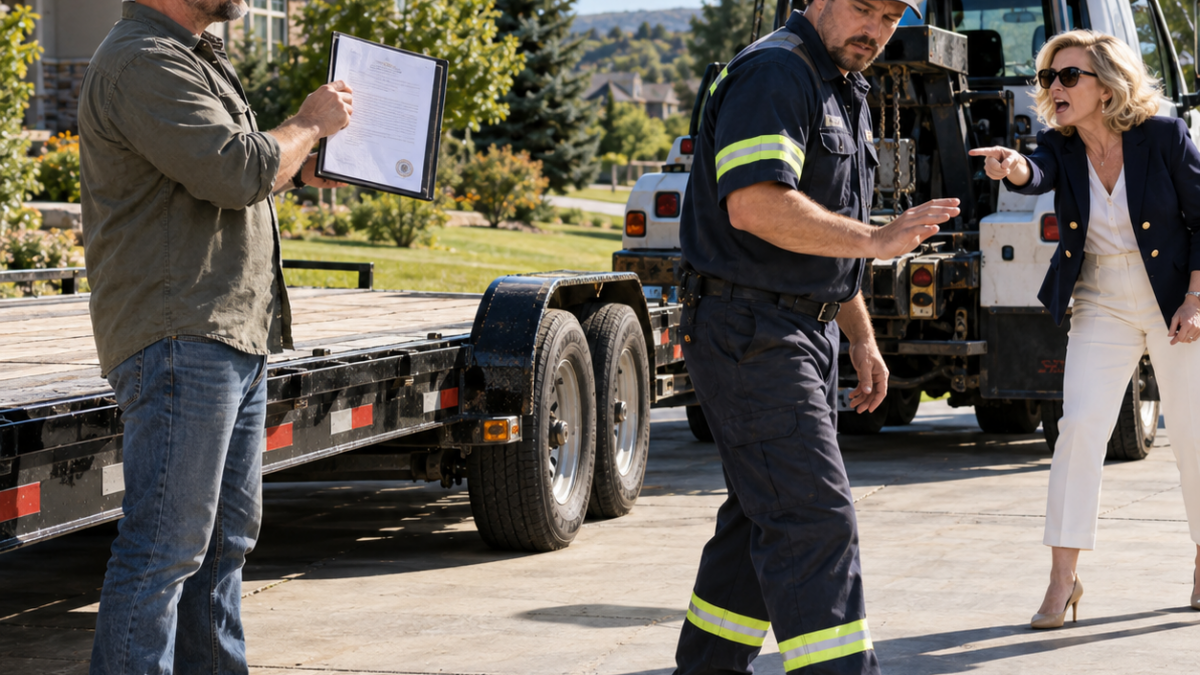
The HOA president brought a heavy-duty tow truck onto my gravel drive and ordered the driver to take the flatbed that fed my family, even after I told her she was standing on land she did not control.
She had spent weeks sending me threats about my mailbox, my cedar fence, my workshop, and finally my business trailer, but that afternoon she crossed a line that could no longer be explained away as a neighborhood disagreement.
Then the tow driver unfolded the document I handed him, looked from one black line on the page to the survey marker beside Karen’s shoe, and suddenly nobody was looking at my trailer anymore.
“That rust bucket is leaving today.”
Karen Miller stood at the edge of my driveway with one hand gripping a clipboard and the other pointed at my thirty-foot flatbed trailer.
Behind her, an industrial tow truck idled with amber lights flashing.
The driver remained beside his cab.
Arms crossed.
Watching.
I set down the ratchet strap I had been tightening.
“Karen, turn the truck around.”
Her lips curled.
“You don’t give orders here, Jack.”
“Actually, I do when someone brings heavy equipment onto my property without permission.”
Her face reddened.
“This is Oakwood Preserve.”
“No. That is Oakwood Preserve.”
I pointed toward the subdivision behind her.
“This is my land.”
She laughed.
The sound was sharp enough to make my wife Sarah look up from the porch.
“You people always say that when you don’t want to follow community standards.”
“You people?”
“Difficult homeowners.”
“I’m not a homeowner in your association.”
Karen slapped her clipboard against her thigh.
“Your property borders our community, your commercial equipment is visible from our homes, and therefore the association has authority to address the nuisance.”
I stared at her.
I had already mailed her my survey twice.
Certified.
Return receipt requested.
She had signed for both envelopes.
Still, there she was.
I reached into the back pocket of my work jeans.
The tow driver straightened slightly.
I pulled out a clear plastic sleeve.
Inside was a certified copy of my deed and the county plat map.
“You want authority?” I said. “Read this.”
Karen barely glanced at it.
“I have no interest in your homemade maps.”
“It came from the county.”
“I said the trailer is being removed.”
She turned toward the driver.
“Hook it.”
The driver didn’t move.
Karen pointed harder.
“I am Karen Miller, president of the Oakwood Preserve Homeowners Association, and I am authorizing this tow.”
The driver finally walked toward us.
He was probably in his fifties.
Sun-browned face.
Steel-toed boots.
The expression of a man who had spent twenty years listening to people insist that someone else’s car belonged to them.
He held out his hand.
“Can I see that?”
I gave him the deed.
He studied the plat.
Then he looked toward the paved HOA street.
Back to my gravel drive.
Then toward the brass survey pin beside Karen’s foot.
He crouched.
Checked the marker.
Walked twenty yards toward my trailer.
Stopped.
Came back.
Karen’s confidence began leaking away.
“Well?” she snapped.
He handed me the deed.
“I’m not touching that trailer.”
Karen blinked.
“What?”
“It’s fifty feet inside his boundary.”
“That is irrelevant.”
“It’s extremely relevant to me.”
“I called your company.”
“And you called us for a legal tow.”
“It is legal.”
“No, ma’am.”
His voice hardened.
“If I hook private property sitting on property controlled by the owner, I could lose my license.”
Karen looked at me.
Then back at him.
“This man is violating HOA rules.”
“He says he isn’t in your HOA.”
“He is adjacent to it.”
The driver stared at her.
“That doesn’t make him part of it.”
Something behind Sarah made a small sound.
I realized she was trying not to laugh.
Karen heard it.
Her face darkened.
“Do your job.”
“I am.”
The driver started toward his truck.
Karen followed.
“I will call your supervisor.”
“Go ahead.”
“I’ll have your contract revoked.”
“We don’t have a contract with your HOA.”
He climbed onto the running board, then paused.
“And, ma’am?”
Karen glared.
“If you knowingly call us again to tow vehicles you have no legal authority over, I’m billing the failed dispatch to you personally.”
She opened her mouth.
He wasn’t finished.
“And I’ll document why we refused.”
The door slammed.
Air brakes hissed.
The tow truck backed slowly out of my driveway.
Karen stood in its diesel haze, trembling.
“This isn’t over.”
I folded my deed.
“I know.”
“I will make you regret embarrassing me.”
“You embarrassed yourself.”
Her eyes narrowed.
Then she said the words that turned an absurd neighborhood dispute into something much darker.
“I’ll find another way.”
She marched toward Oakwood Preserve.
I watched until she disappeared around the curve.
Sarah came down from the porch and stood beside me.
“You think she means it?”
I looked at the deed in my hand.
At the survey marker.
At the tire tracks the tow truck had left across my gravel.
“Yes.”
And for the first time since buying those five quiet acres, I realized proving where my property ended might be the easy part.
PART 2
Sarah stood beside me for another few seconds after Karen disappeared.
Neither of us spoke.
The diesel smell drifted away.
The afternoon went quiet again.
Birds returned to the oak trees.
Somewhere behind the workshop, our youngest boy was bouncing a tennis ball against the barn wall.
Everything looked normal.
That was the unsettling part.
Our home looked exactly the same, but the feeling had changed.
Sarah picked up one of the tow truck’s tire impressions with her eyes and shook her head.
“She actually did it.”
“I know.”
“She really called somebody to take our trailer.”
“I know.”
“What if you hadn’t been here?”
That question stayed with me.
The flatbed wasn’t worth a fortune.
Maybe twelve or fifteen thousand dollars, depending on the market.
But that wasn’t the point.
It was how I moved steel.
How I delivered custom gates.
How I hauled equipment.
Without it, Riley Metal Works stopped moving.
For Karen, the flatbed was ugly.
For us, it paid the electric bill.
It bought groceries.
It put money into our kids’ college accounts.
It was part of the second life I had built after leaving the Marines.
“I’m putting another camera up,” I said.
Sarah folded her arms.
“We already have two.”
“Now we’ll have three.”
“Jack.”
I looked at her.
She had been married to me long enough to recognize when I moved into what she called mission mode.
She didn’t always like it.
Neither did I.
But fifteen years in uniform had wired certain responses too deeply to erase.
When something became a threat, I documented it.
Measured it.
Named it.
Built contingencies.
Sarah sighed.
“Promise me you’re not going to turn our house into a bunker.”
“I’m not.”
“You said that when you installed the first camera.”
“That was one camera.”
“Then the second.”
“Blind spot.”
“And now the third?”
“Tow-truck spot.”
She almost smiled.
Almost.
Then her expression softened.
“I don’t want to spend every evening talking about that woman.”
“Neither do I.”
“Then end it.”
“I’m trying.”
“No.”
She touched the deed still in my hand.
“I mean really end it.”
That night I sat at the kitchen table after the kids went to bed.
I spread out everything Karen had sent since we moved in.
The mailbox letter.
Fence letter.
Commercial vehicle warning.
The invented ordinance notice.
Two copies of my certified responses.
The postal receipts bearing her signature.
I added the tow company’s name, date, approximate arrival time, truck number, and description of the driver.
Then I wrote one sentence on a yellow legal pad.
Attempted removal of private property after repeated notice that land lies outside HOA jurisdiction.
I underlined “repeated notice.”
That distinction mattered.
A mistake is one thing.
Continuing after someone shows you official records is another.
The next morning, I called the tow company.
The dispatcher sounded nervous when I explained who I was.
“I need the name of yesterday’s driver.”
“Sir, we normally don’t release employee information.”
“I don’t need his home address. I’d like his first name and a copy of whatever notes your company made regarding the refused tow.”
There was a pause.
“May I ask why?”
“I expect litigation.”
Another pause.
Longer.
“Hold, please.”
A manager came on.
His name was Carl Donovan.
He had already heard about the incident.
“The driver was Mike Serrano,” he said. “Twenty-two years with us. He refused the tow because the requesting party couldn’t demonstrate possession or authority over the land.”
“Did he document that?”
“Yes.”
“Can I get a copy?”
“With a lawyer request, absolutely. Without one, I can provide you a service invoice marked no tow—property ownership dispute.”
“That’s enough for now.”
Carl hesitated.
“Mr. Riley?”
“Yes?”
“Your HOA lady threatened to report us.”
“She isn’t my HOA lady.”
He laughed.
“Understood.”
“What did she say?”
“She said we were aiding an illegal commercial operation.”
“That sounds like her.”
“She also demanded the name of our licensing agency.”
“Did you give it to her?”
“Sure.”
I smiled.
“Why?”
“Because Mike’s report is clean.”
I liked Carl Donovan immediately.
The invoice arrived by email that afternoon.
I printed three copies.
One went in the binder.
One went in our fireproof document box.
One went to Sarah.
She held it up.
“Why do I get one?”
“If I’m not around and someone shows up again, you show them this, the deed, and the survey.”
Her expression tightened.
“Jack.”
“I’m being practical.”
“Practical would be moving the trailer behind the workshop until this dies down.”
There it was.
The question neither of us had wanted to address.
I looked toward the kitchen window.
From there, I could see the front edge of the flatbed beyond the pines.
“Maybe.”
Sarah studied me.
“You’re considering it?”
“No.”
She stared.
I smiled.
That earned me a dish towel against the shoulder.
But later, after she went upstairs, I stood alone at the back door looking toward the trailer.
Moving it would have been easy.
Twenty minutes.
Maybe less.
It would disappear behind the barn.
Karen wouldn’t see it from her second-story window.
The letters might stop.
The tension might fade.
Sarah might sleep better.
Then I pictured the first mailbox notice.
Paint it black.
The fence.
Paint it taupe.
The trailer.
Hide it.
What came next?
My welding noise?
My work hours?
The workshop lights?
The American flag on the barn?
My kids’ dirt bikes?
There is a kind of peace you buy by surrendering one harmless thing at a time.
Eventually you wake up and realize you are renting your own life from the person who kept complaining.
I left the trailer where it was.
Karen waited exactly forty-eight hours.
Then the letters came.
Two in one day.
The first claimed my trailer constituted “visual industrial pollution.”
The second alleged that reflective safety tape on its sides created a traffic hazard.
I read both at the mailbox.
Sarah watched from the porch.
“Well?”
“Apparently my trailer is now blinding motorists.”
She looked toward it.
Eighty feet from the road.
Behind three pine trees.
“Powerful tape.”
“Military grade.”
That made her laugh.
Good.
I wanted her laughing.
But the third letter arrived two days later, and it wasn’t funny.
Karen had copied the town code enforcement office.
She claimed the flatbed, workshop, scrap pile, and welding equipment constituted an “unlicensed salvage operation.”
I owned a fabrication business.
Licensed.
Insured.
Tax-paying.
Small, but legitimate.
A salvage yard designation was different.
Depending on local zoning, it could trigger inspections, nuisance restrictions, storage requirements, environmental scrutiny, and potentially forced removal of equipment.
Karen had finally found something that sounded serious enough to scare an overworked official.
I called the town.
A clerk named Denise answered.
I gave her my address.
She typed.
“Yes, we received a complaint.”
“From Karen Miller?”
“I can’t discuss the complainant.”
“That’s okay. I already have her copy.”
Silence.
Then Denise sighed.
“What exactly do you do on the property?”
“Custom metal fabrication and welding.”
“Employees?”
“No.”
“Customers regularly visiting?”
“Occasionally, but mostly I deliver.”
“Scrap vehicles?”
“No.”
“Vehicle dismantling?”
“No.”
“Hazardous storage?”
“No.”
She clicked keys.
“You may receive an inspection request.”
“Fine.”
“Fine?”
“Yes.”
Most people fear inspectors because they fear finding out they broke a rule.
I had spent too much of my adult life around inspections to feel that way.
If my operation was wrong, I wanted to know.
If it was right, Karen was about to put her name on a false complaint.
Three days later, a county code officer drove onto my property.
His name was Marcus Hill.
I met him beside the workshop.
He was younger than I expected.
Late thirties.
Professional.
No attitude.
He looked at the flatbed.
Then the steel rack.
Then the barn.
“You mind if I look around?”
“No.”
I showed him everything.
Welding table.
Ventilation.
Compressed gas storage.
Fire extinguishers.
Raw steel stacked under cover.
Finished gate awaiting delivery.
Small scrap bin.
Business license.
Insurance.
He took pictures.
Measured setbacks.
Checked zoning on a tablet.
Finally he leaned against his truck.
“This isn’t a salvage yard.”
“I know.”
“You have a commercial business operating from rural residential property, but your zoning permits this scale as a home occupation with accessory workshop use.”
“I know.”
“Noise complaint?”
“None from actual neighbors.”
He looked toward Oakwood Preserve.
“I’m guessing I know where this came from.”
I smiled.
“She sent you pictures?”
“Enough to build a scrapbook.”
“Taken from her house?”
“Some.”
“Some from my land.”
Marcus looked up.
“What?”
I showed him security footage on my phone.
Karen stepping over the survey marker.
Walking approximately twelve feet onto my property.
Raising her phone.
Taking photographs.
He frowned.
“That your line?”
I pointed.
“Survey pin there. Another fifty yards down.”
He handed back the phone.
“You may want legal advice.”
“I’m getting there.”
His inspection report arrived the following week.
No salvage-yard violation.
No nuisance finding.
No enforcement action.
I printed that too.
Karen received a copy.
For six days, nothing happened.
It was the longest silence we had enjoyed in months.
Sarah relaxed.
The kids stopped asking whether “the HOA woman” was coming back.
I took the flatbed to deliver a custom steel gate to a horse farm south of town.
For one glorious afternoon, life felt normal.
Then I returned home and found an envelope taped to my mailbox.
Not mailed.
Taped.
Oakwood Preserve HOA letterhead.
FINAL DEMAND.
Karen had decided the county inspection was irrelevant.
She now claimed Oakwood Preserve possessed “aesthetic enforcement authority over immediately adjacent properties whose activities negatively affect association property values.”
I read the sentence twice.
Then a third time.
It was nonsense dressed in a necktie.
Sarah came outside.
“What now?”
I handed it over.
She read.
“Can they do this?”
“No.”
“You’re sure?”
“Yes.”
“Then why does it sound official?”
That was exactly how people like Karen operated.
Not by having authority.
By making authority sound exhausting to challenge.
I took the letter inside.
Opened the property file.
Added another divider.
HARASSMENT AFTER COUNTY CLEARANCE.
At the bottom of my response, I wrote:
Your association has no contractual, statutory, deed-based, easement-based, or other legal authority over my parcel. You have now received multiple surveys, a certified deed, county confirmation, and an official inspection showing lawful use. Further attempts to interfere with my property or business will be treated as intentional rather than mistaken.
Certified mail.
Return receipt.
Karen signed two days later.
The next morning, I found another violation notice.
Sarah stared at me across the breakfast table.
“You need a lawyer.”
“I know.”
“No more ‘I know.’ Call one.”
I had been avoiding David Chen.
Not because he wasn’t good.
Because he was too good.
David and I served together during my second deployment.
I was a staff sergeant then.
He was a young lieutenant with a brain that never stopped moving.
After leaving the Marines, he used the GI Bill to go to law school.
By the time I started Riley Metal Works, David was one of the most respected civil litigators in the state.
Property.
Contracts.
Business interference.
Complex disputes.
And if there was one category of human being David truly disliked, it was a bully with paperwork.
I called him at eight.
He answered on the third ring.
“Riley.”
“Chen.”
“How many years has it been?”
“Too many.”
“You calling because you miss me?”
“No.”
“Then somebody sued you.”
“Not yet.”
“That ‘yet’ worries me.”
“I need an hour.”
“My office. Tomorrow.”
“Can you do afternoon?”
“I said tomorrow.”
Still a lieutenant.
I arrived carrying a banker’s box.
His receptionist looked at it, then at me.
“Mr. Chen said you were bringing documents.”
“These are documents.”
David walked into the lobby.
He looked older.
Gray at the temples.
Expensive suit.
Same expression.
His eyes went to the box.
Then to me.
“Okay.”
“What?”
“You’re either in trouble or about to make somebody else miserable.”
“Possibly both.”
Inside his office, I laid everything out.
I began with the property history.
Five acres.
Old Henderson farm.
Protected woods on three sides.
Oakwood Preserve on the fourth.
Survey completed before purchase.
No HOA covenants.
No deed restrictions tied to Oakwood.
Then mailbox.
Fence.
Trailer.
Tow truck.
Letters.
Code complaints.
Trespass footage.
Certified receipts.
County inspection.
David barely interrupted.
That worried me.
When he got quiet, he was usually building something.
He read Karen’s “aesthetic enforcement authority” letter twice.
Then he looked up.
“She wrote this?”
“Yes.”
“With counsel?”
“I doubt it.”
“Please tell me she didn’t have counsel.”
“Why?”
“Because if an attorney drafted this, I’m embarrassed for the profession.”
I laughed.
He didn’t.
Then he opened my spreadsheet.
Rows of dates.
Claims.
Responses.
Supporting documents.
He scrolled.
“Jack.”
“What?”
“Most clients show up with twenty screenshots, nine missing emails, and a story beginning with, ‘Trust me, everybody knows.’”
He turned the laptop.
“This is beautiful.”
“Sarah says it’s obsessive.”
“Sarah is probably correct.”
He kept scrolling.
“But legally beautiful.”
He watched security footage of Karen crossing the survey marker.
Then he watched the tow incident.
One of my cameras had captured most of it from an angle.
Not perfect audio.
Enough.
When Mike Serrano refused to tow the trailer, David paused the video.
“Did the tow company document refusal?”
I handed him the invoice.
He smiled.
“Of course you got it.”
“Marine Corps.”
“Paperwork wins wars.”
“Thought Marines won wars.”
“Paperwork tells Congress who did it.”
Some things never changed.
Then his expression turned serious.
“Here’s what we’re going to do.”
I leaned forward.
“No lawsuit yet.”
“Why?”
“Because she wants conflict on terrain she controls.”
He tapped Karen’s letter.
“HOA rules. HOA meetings. HOA accusations.”
He tapped the county inspection report.
“The moment she went outside that system, she exposed herself.”
“How?”
“She filed accusations with public authorities after being repeatedly notified she lacked jurisdiction.”
“Okay.”
“She used a tow operator to attempt control over private property.”
“Okay.”
“She entered your land to collect evidence after notice.”
“Okay.”
“She’s interfering with a lawful business.”
“So we sue.”
“Eventually.”
I frowned.
David smiled.
“Still impatient.”
“I called you because Sarah told me to end it.”
“And I will.”
He slid the box closer.
“But first, we let Karen make one more mistake.”
“What mistake?”
“We give her a clean opportunity to stop.”
“That doesn’t sound satisfying.”
“It will in front of a judge.”
He outlined the plan.
First, we would respond to any official government complaint with facts.
No insults.
No emotional accusations.
Second, David would send a formal cease-and-desist notice to Karen personally.
It would summarize the property boundary, prior notices, tow attempt, trespasses, county clearance, business interference, and repeated communications.
Third, copies would go to every Oakwood Preserve board member.
The management company.
Registered agent.
And HOA counsel, if they had one.
David leaned back.
“Right now the board can claim they don’t know the extent of what she’s doing.”
“They do.”
“Can you prove that?”
“No.”
“Exactly. Once they receive my letter, they know.”
“And if they let her continue?”
“Then Karen’s personal obsession becomes an institutional governance problem.”
I understood.
“You’re giving them a choice.”
“Yes.”
“Control her or own her behavior.”
David smiled.
“Now you sound like a lawyer.”
“Take that back.”
A week later, Karen gave us exactly the opening David expected.
A certified letter arrived from the county zoning and planning commission.
Formal hearing.
Complaint: unlicensed salvage yard and incompatible commercial storage.
Sarah found me reading it on the porch.
She went pale.
“Jack?”
“It’s okay.”
“That doesn’t look okay.”
“It’s a hearing.”
“Can they shut us down?”
“They can if we’re violating the law.”
“Are we?”
“No.”
She hugged herself.
“What if Karen lies?”
“Then she lies in a room where other people ask questions.”
Sarah stared at me.
“You’re almost looking forward to this.”
“A little.”
“Men are strange.”
“Marines especially.”
The hearing took place three weeks later.
County Government Center.
Second floor.
Wood-paneled chamber.
Flags behind the commission desk.
Fluorescent lighting.
Coffee smell.
Karen arrived with Brenda Shaw and Nancy Cole, two Oakwood board members who rarely disagreed with her publicly.
Karen wore a bright pink pantsuit.
Sarah whispered, “She dressed for television.”
I squeezed her hand.
David wore charcoal gray.
I wore clean jeans, work boots, and a blue collared shirt with Riley Metal Works embroidered over the pocket.
David had asked whether I owned a suit.
“Yes.”
“Don’t wear it.”
“Why?”
“You are exactly what you say you are. A working fabricator running a lawful small operation from his land. I want them to see that.”
Karen presented first.
I will give her credit.
She was effective.
If I didn’t know the facts, I might have believed her.
She showed photographs of steel stock.
The flatbed.
My welding equipment.
A small pile of offcuts awaiting recycling.
She described “industrial activity encroaching on a high-value residential community.”
She mentioned noise.
Traffic.
Safety.
Potential contamination.
Visual blight.
She never mentioned that my property existed before Oakwood.
Never mentioned the survey.
Never mentioned that county code enforcement had already inspected me.
Never mentioned the tow attempt.
She saved her strongest line for last.
“We are simply asking this commission to protect families who invested their life savings in Oakwood Preserve from the unchecked expansion of an industrial operation.”
Then she sat.
Brenda touched her arm.
Karen smiled.
David stood.
No theatrics.
“Mr. Chairman, commissioners, my client owns Riley Metal Works, a licensed and insured custom fabrication business.”
He placed my license on the projector.
Then insurance.
Tax registration.
Property zoning.
Prior inspection.
“This county has already inspected the site.”
The chairman looked up.
“Already?”
“Yes, sir.”
David handed copies to the clerk.
“Result?”
“No violation.”
Karen shifted.
David continued.
“My client does not dismantle vehicles, buy scrap for resale, crush materials, stockpile junk, or operate anything meeting the county definition of salvage yard.”
He played security footage.
Me loading raw steel.
Me delivering a finished gate.
Flatbed returning empty.
Then footage of the scrap container.
Small.
Covered.
Organized.
The commissioners watched.
Then David changed direction.
“This hearing, however, did not begin with a zoning concern.”
Karen sat straighter.
“It began with a private dispute.”
He displayed her first mailbox letter.
Then fence letter.
Then my survey.
Then her certified receipt.
Then the tow footage.
The room changed.
I could feel it.
David played the clip where Mike Serrano studied the deed and refused the tow.
Karen whispered to Brenda.
David displayed another receipt.
“After Ms. Miller received the deed, survey, and written notice that Mr. Riley’s parcel lies outside Oakwood Preserve, she continued sending enforcement demands.”
Another.
“And another.”
Another.
“And another.”
Then footage of Karen crossing onto my property to photograph the flatbed.
The chairman leaned toward his microphone.
“Ms. Miller?”
Karen looked up.
“Is that you?”
Her mouth tightened.
“I was documenting a nuisance.”
“That wasn’t my question.”
She hesitated.
“Yes.”
“Were you standing on Mr. Riley’s land?”
“The line is disputed.”
I almost laughed.
David did not.
He placed the official plat beside the security frame.
“The line is not disputed by any licensed surveyor, county office, title document, or deed.”
The chairman looked at Karen.
“Were you provided this survey before the photographs were taken?”
She shifted.
“I receive a great deal of correspondence.”
David held up the green card.
“You signed for it.”
Silence.
The chairman’s face hardened.
“Answer.”
“Yes.”
“And you continued entering his property?”
“I was acting for the community.”
The chairman leaned back.
“That community does not own his land.”
Karen’s face flushed.
David finished in under twenty minutes.
The commissioners deliberated briefly.
Complaint dismissed.
No violation.
Then the chairman did something we hadn’t expected.
“Ms. Miller.”
Karen had started packing.
She froze.
“Yes?”
“This commission exists to resolve legitimate land-use issues.”
“I understand.”
“I am not convinced you do.”
Her hands stopped.
“You were repeatedly informed that this parcel lies outside your association. You possessed documentation. The site was inspected. Yet you escalated a personal neighborhood disagreement into a county proceeding alleging a salvage operation without evidence meeting the legal definition.”
Karen opened her mouth.
He raised his hand.
“Do not interrupt.”
The room became completely still.
“If future complaints come before this body, I strongly suggest you ensure they are based on genuine code concerns rather than private disputes.”
Karen stared at him.
“Complaint dismissed.”
Gavel.
Done.
Outside the chamber, Sarah took one long breath.
“I didn’t realize how tense I was.”
I hugged her.
“It’s over.”
David walked past us.
“No.”
Sarah looked at him.
“No?”
He smiled.
“Now it starts.”
The cease-and-desist packet went out the next morning.
Twenty-seven pages.
Karen.
Every Oakwood board member.
Management company.
Registered agent.
Insurance carrier’s notice address.
HOA counsel.
David attached exhibits.
Survey.
Deed.
Certified receipts.
Tow invoice.
County inspection.
Hearing dismissal.
Security stills.
He demanded:
No further direct contact except through counsel.
No entry onto our property.
No photographing from within our property.
No attempts to remove vehicles or equipment.
No false governmental complaints.
No interference with customers, vendors, deliveries, or business operations.
No use of HOA funds for Karen’s personal campaign.
He also demanded preservation of all records involving me.
Emails.
Texts.
Invoices.
Meeting notes.
Legal bills.
Printing.
Postage.
Management communications.
The effect inside Oakwood was immediate.
I knew because George told me.
George Sanders lived three houses into the subdivision.
Seventy-eight.
Widower.
Retired lineman.
He had watched Oakwood grow around his old house before joining the HOA under later development documents.
He began stopping beside my fence whenever I worked outside.
Three days after the letters went out, he leaned on the top rail.
“Boy, you kicked the anthill.”
“What happened?”
“Emergency board calls.”
“How do you know?”
“My daughter is friends with the treasurer’s wife.”
“Reliable intelligence network.”
“You laugh. Old people know everything.”
He lowered his voice.
“Karen is telling folks you’re trying to bankrupt the HOA.”
“Of course.”
“Says your lawyer demanded half a million dollars.”
“He didn’t demand any money.”
“I know.”
“How?”
“I read the letter.”
I stared at him.
George grinned.
“Mark showed me.”
Mark Ellison.
HOA treasurer.
Quiet accountant.
Rarely spoke at meetings.
“Why would Mark show you?”
“Because he’s scared.”
That mattered.
“What exactly is he scared of?”
“Insurance.”
George leaned closer.
“He wants to know whether their policy covers what she’s been doing.”
I nodded.
That was David’s pressure point.
Then George’s expression changed.
“Jack?”
“Yeah?”
“Folks are starting to talk.”
“About me?”
“About her.”
He told me Tom and Emily Miller had received a hundred-dollar fine because their ten-year-old son’s basketball hoop sat in the driveway forty minutes after he went inside for dinner.
Another couple had received warnings because a contractor’s van stayed curbside beyond an arbitrary two-hour limit.
A woman named Janet Price had been fined over wind chimes.
George himself had been warned that a bench under his oak tree constituted “unapproved exterior furniture.”
“Why didn’t anybody fight?”
I asked.
He shrugged.
“Same reason people don’t fight parking tickets.”
“Not worth it?”
“Not individually.”
That night I created a private email address.
concernedneighbors@—
Nothing dramatic.
I invited George.
Tom Miller.
Janet Price.
Within a week, there were twelve people.
By the end of the month, twenty-nine.
Nobody was planning a coup.
We compared documents.
That alone changed everything.
Tom posted his basketball notice.
Janet posted the wind-chime fine.
Another resident uploaded a warning about a doormat with an “excessively humorous slogan.”
I thought that one was satire.
It wasn’t.
The pattern became obvious.
Karen targeted people who challenged her.
Board allies received softer treatment.
Repeat offenders who stayed friendly with her somehow got warnings instead of fines.
One homeowner had an RV in his driveway for weeks despite rules stricter than anything Karen claimed against my flatbed.
He happened to be Brenda’s brother.
Tom came to my shop one Saturday.
He stood near the Mustang project I had been neglecting.
“She’s always been like this?”
George asked.
George had wandered over too.
Tom shook his head.
“She started small.”
“Everybody says that,” I said.
Tom looked embarrassed.
“We kept thinking, ‘It’s fifty bucks. Just pay it.’ Then ‘It’s a hundred. Just move the hoop.’”
He stared at the floor.
“I didn’t want my family to become a target.”
George snorted.
“You became one anyway.”
Tom nodded.
“That’s what I finally understood.”
Sarah came outside with lemonade.
She set the tray on my workbench.
“You boys organizing rebellion?”
George raised his glass.
“Absolutely.”
“No rebellion,” I said.
“Accountability.”
Sarah looked at me.
“You’ve been spending too much time with David.”
She wasn’t wrong.
The next Oakwood board meeting arrived two weeks after our cease-and-desist.
Technically I wasn’t a member.
Technically that meant Karen could have tried to exclude me.
But the agenda included “pending litigation exposure arising from adjacent property dispute.”
David sent notice that I would attend public comment.
George and Tom sat beside me.
The clubhouse room was packed.
Karen looked different.
Not defeated.
Cornered.
That can be more dangerous.
She opened with a speech.
“Certain outside parties are attempting to intimidate this community through aggressive legal threats.”
Murmurs.
She continued.
“These individuals do not live under our covenants. They do not pay our dues. Yet they are trying to dictate how Oakwood Preserve operates.”
I let her finish.
When public comment began, I stood.
Karen immediately raised her hand.
“Mr. Riley, you are not a member.”
George stood before I could speak.
“He’s on the agenda.”
Karen glared.
“Sit down, George.”
“No.”
The room shifted.
It was a tiny word.
But Karen wasn’t used to hearing it.
George continued.
“You used our HOA money, our letterhead, our board, and our management company in a six-month fight with that man.”
Karen’s jaw tightened.
“He gets to speak.”
Several residents nodded.
Mark, the treasurer, looked at the table.
Karen’s authority depended heavily on everyone pretending it was absolute.
That night, they stopped pretending.
I walked to the microphone.
“My name is Jack Riley.”
A few residents laughed quietly.
They knew.
“For six months, your president has attempted to apply Oakwood rules to property Oakwood does not own and that is not part of this association.”
I held up the mailbox notice.
“It started here.”
Fence notice.
“Then this.”
Tow invoice.
“Then she called a tow company.”
People whispered.
A man in the back said, “She did what?”
I displayed the county dismissal.
“Then she accused my licensed fabrication shop of being an illegal salvage yard.”
Karen interrupted.
“That complaint was made in good faith.”
The chairman’s warning was in the hearing record.
I didn’t argue.
Instead I continued.
“Every time I responded, I provided the deed and survey.”
Certified receipts.
“Every one of these was received.”
I looked toward the board.
“My lawyer’s letter wasn’t the beginning of this dispute. It was what happened after every reasonable effort failed.”
Then I paused.
“This isn’t about my trailer anymore.”
Nobody moved.
“It’s about whether one board officer can use community resources to pursue someone she personally dislikes.”
Mark finally looked at me.
Good.
“That question belongs to you,” I told the homeowners. “Not me.”
I sat.
For ten seconds, silence.
Then Janet Price stood.
“My wind chimes.”
Karen closed her eyes briefly.
Janet held up a file.
“You fined me six hundred dollars over wind chimes.”
“Mrs. Price—”
“They were my mother’s.”
Karen looked away.
Tom stood next.
“My son’s basketball hoop.”
Another resident.
“My contractor.”
Another.
“My Christmas lights.”
Then an older woman near the back raised a trembling hand.
Karen looked genuinely alarmed.
“I received eleven letters about my flower pots.”
The meeting stopped being about me.
That was the moment Karen lost control.
Not when Mike Serrano refused the tow.
Not when the county dismissed her complaint.
That night.
Because people realized their private shame was actually a shared pattern.
Mark called an executive session two days later.
I wasn’t there.
George’s intelligence network supplied details.
Karen wanted to keep fighting.
Mark wanted an audit of every expense connected to my property.
Another board member wanted counsel to review potential insurance exposure.
Brenda accused Mark of betrayal.
Karen accused everyone of cowardice.
Then Mark asked one simple question.
“How much association money have we spent on Jack Riley?”
Nobody knew.
That terrified them.
The board approved an internal audit.
Karen voted no.
The audit found:
Attorney consultation charges connected to me.
Management-company time.
Printing.
Certified mail.
Photography supplies.
Postage.
Administrative processing.
Over five hundred dollars in direct documented expenses.
Not a fortune.
But it proved something important.
Karen had taken a personal obsession and made neighbors pay for it.
Mark called me personally.
I was welding when the phone rang.
“Jack?”
“Yes.”
“This is Mark Ellison.”
“I know who you are.”
“I wanted you to hear something before the next meeting.”
I turned off the welder.
“Okay.”
“The audit confirmed HOA funds were used in connection with communications and legal questions involving your property.”
“I assumed so.”
“There’s more.”
His voice sounded tired.
“We reviewed Karen’s authority.”
“And?”
“She initiated several actions without formal board authorization.”
“Tow truck?”
“Yes.”
I leaned against the table.
“County complaint?”
“Yes.”
“Attorney consultation?”
“Some.”
I let that sit.
Mark continued.
“I’m sorry.”
“For what?”
“For not paying attention.”
That was not the apology I expected.
“You didn’t know me.”
“That’s not what I mean.”
He exhaled.
“I’m treasurer. I looked at totals. I didn’t ask why.”
He paused.
“That’s my job.”
That sentence made me respect him.
“What happens now?”
“We’re taking a removal vote.”
Karen’s formal removal meeting was the following Thursday.
David came.
So did Sarah.
I told her she didn’t need to.
“I lived through this too.”
She was right.
The clubhouse was overflowing.
Karen arrived late.
Pink blazer.
No smile.
She sat at the head table.
Mark read the motion.
Removal of Karen Miller as president for misuse of association resources, unilateral action beyond board authorization, repeated exposure of the association to legal risk, and breach of fiduciary duties.
Karen stared at him.
“You ungrateful little man.”
Mark’s hand trembled slightly.
But he continued.
The vote was four to one.
Karen voted for herself.
She remained on the board temporarily as an ordinary director pending additional procedures, but her presidency ended.
When Mark announced the result, nobody cheered.
I was glad.
It was serious.
Sarah squeezed my hand.
Karen stood.
She looked at every board member.
Then at me.
“You did this.”
I answered softly.
“No.”
Her eyes burned.
“Yes, you did.”
“You called the tow truck.”
Her face twitched.
“You sent the letters.”
Silence.
“You filed the county complaint.”
She looked away.
“You did this.”
For once, Karen had nothing.
The lawsuit was filed the following Monday.
I had resisted.
David insisted.
“Why now?” I asked.
“Because removal doesn’t undo damage.”
“We got what we wanted.”
“No.”
He pointed at Sarah.
“What did you want?”
I looked at her.
She answered.
“To stop being afraid someone will show up when Jack isn’t home.”
David nodded.
“That’s why.”
Our suit named Karen individually.
It also named the HOA for failure to supervise its officer after notice.
Claims included harassment-related causes of action, trespass, interference with business, attempted wrongful control over property, and other state-law claims David believed the evidence supported.
He warned me about litigation.
“It’s slow.”
“I know.”
“Ugly.”
“I know.”
“Expensive.”
“I know.”
“You may hate me by the end.”
“I already do.”
“Excellent.”
Then something changed everything.
Oakwood’s liability insurer reviewed the file.
Not my summary.
The actual evidence.
Surveys.
Receipts.
Tow refusal.
Security footage.
County hearing.
Audit.
Cease-and-desist.
They assigned defense counsel to the HOA.
Karen expected the policy to protect her too.
It didn’t work that simply.
Her personal conduct fell under serious coverage questions because the insurer considered portions potentially outside legitimate HOA duties.
For the first time, Karen faced the possibility that she might personally pay a lawyer.
Power feels different when the check comes to your own mailbox.
Her attorney contacted David within a month.
Settlement discussions began.
Karen initially refused every term.
No apology.
No injunction.
No admission.
No payment.
David didn’t argue.
He scheduled depositions.
That scared her more.
Depositions meant oath.
Questions.
Records.
Emails.
Her explanation for the tow.
Her explanation for ignoring the survey.
Her explanation for photographing our land.
Her explanation for telling the county we operated a salvage yard.
Her explanation for spending association money.
Three days before her deposition, her attorney called again.
Negotiations restarted.
I had three non-negotiable terms.
First, Karen could not contact Sarah, me, or our children directly.
Second, she could not enter our land.
Third, she could not use Oakwood, any resident, contractor, tow company, government office, or third party as a proxy to harass us.
David added more.
No photography taken from our property.
No interference with Riley Metal Works.
Formal written recognition that my parcel was not governed by Oakwood Preserve.
Contribution toward legal fees.
Written apology from the HOA board.
Court-enforceable injunction.
Karen hated the injunction.
That told me we needed it.
Mediation lasted nine hours.
At one point, David came into our conference room.
“She’ll agree not to enter the property but refuses the no-contact language.”
Sarah looked at me.
“Why?”
“Her attorney says it’s humiliating.”
Sarah laughed once.
No humor.
“She’s worried about humiliation?”
David waited.
Sarah continued.
“I spent months checking the driveway before I let our kids play outside.”
I looked at her.
She had never told me that.
Not exactly.
She looked down.
“When you went on deliveries, I kept wondering whether another tow truck would come.”
My chest tightened.
“Sarah—”
“No.”
She raised a hand.
“This is why we’re here.”
David nodded.
“I’ll tell them the no-contact provision stays.”
He left.
I sat beside my wife.
“You should’ve told me.”
“You were already carrying enough.”
“I’m your husband.”
“And I’m your wife.”
Her eyes filled.
“I didn’t want Karen taking over every part of our marriage too.”
That hurt because it was true.
For months, I had told myself my binder meant I controlled the problem.
But Sarah had been living with it differently.
Listening for engines.
Watching the mailbox.
Wondering if another accusation would arrive.
Harassment is strange that way.
Sometimes the person being directly attacked focuses so hard on fighting that he doesn’t see what the fight does to everyone standing behind him.
I took her hand.
“We don’t settle without it.”
“Good.”
We didn’t.
Karen signed.
The final agreement included a permanent injunction entered by the court.
No direct contact.
No entry.
No photography from our property.
No interference with business.
No attempts to tow or remove property.
No use of HOA authority against our parcel.
The HOA issued a written apology mailed to residents.
Part of my legal expenses were reimbursed.
Additional settlement compensation was paid.
The exact financial terms remained confidential.
I was fine with that.
Money had never been the point.
The first morning after the injunction became final, I walked out to the trailer.
Just stood there.
Sarah came up behind me.
“Feel different?”
I listened.
Wind through pines.
Birds.
A truck somewhere in the distance.
“No.”
She smiled.
“Give it time.”
Peace does not return like a switch.
It returns by repetition.
One uneventful morning.
Then another.
Then another.
Two weeks after the settlement, Mark came to my driveway.
He stopped exactly at the survey marker.
That made me smile.
“Permission to cross?”
“Granted.”
He stepped over.
“Wanted to do this correctly.”
He handed me an envelope.
Inside was the HOA’s formal apology.
I had already received one by mail.
“This one is from me.”
I opened it.
Short.
Handwritten.
Jack and Sarah,
I am sorry our board failed to act when we should have. Being uninvolved is not the same as being innocent when your position requires you to pay attention.
—Mark
I read it twice.
“That’s better than the official one.”
“I wrote that too.”
“Explains the grammar.”
He laughed.
Then looked toward the flatbed.
“I owe that thing an apology.”
“Don’t.”
“Why?”
“It’ll get arrogant.”
We walked toward the workshop.
Mark told me Oakwood was rewriting governance rules.
President could no longer initiate enforcement outside the subdivision without full board review and counsel.
Major legal expenses required recorded votes.
Complaints involving adjacent property needed documented jurisdiction.
Records requests would be tracked.
Homeowners would receive clearer appeal procedures.
“Karen hated all of it,” Mark said.
“She still on the board?”
“No.”
That surprised me.
“She resigned?”
“Members recalled her.”
I stopped.
“When?”
“Last week.”
I had intentionally stopped following Oakwood drama after settlement.
I wanted out.
Mark continued.
“Eighty-two percent voted for removal.”
“That many?”
“People started comparing stories.”
I nodded.
That was always her real weakness.
Isolation protected her.
Communication destroyed that protection.
Then Mark smiled.
“Want to hear something funny?”
“Probably.”
“Karen has a shed.”
“I know.”
“Side yard.”
“I know.”
“Unpermitted.”
I looked at him.
“How do you know that?”
“George.”
Of course.
I groaned.
“Tell him not to do anything stupid.”
Too late.
The code enforcement truck appeared the following Saturday.
Sarah and I were moving soil for a new garden bed.
My flatbed was loaded with mulch.
Mark happened to be there, discussing drainage along the Oakwood boundary.
We heard tires on pavement.
A town vehicle slowed.
Stopped.
Directly in front of Karen’s house.
A code officer got out.
Clipboard.
Camera.
Tape measure.
I looked at Mark.
Mark looked at me.
Neither said anything.
Then George appeared at the end of the sidewalk.
Hands in pockets.
Whistling.
I stared.
He raised both eyebrows.
“George.”
“Morning.”
“What did you do?”
“Me?”
“George.”
He came closer.
“Son, I am a civic-minded resident.”
Mark turned away because he was laughing.
“You reported her shed.”
“I merely asked whether the town applies its setback requirements evenly.”
“You’re enjoying this.”
“Immensely.”
Sarah walked up.
“What happened?”
George pointed.
The code officer was measuring Karen’s shed.
Sarah closed her eyes.
“George.”
“What?”
“We just spent months proving harassment is wrong.”
He looked genuinely wounded.
“That shed is actually illegal.”
I laughed despite myself.
“Did you trespass?”
“No.”
“Take pictures through her window?”
“No.”
“Make anything up?”
“No.”
“Then I’m staying out of it.”
George nodded.
“Exactly.”
Karen opened her front door.
She saw the code officer.
Then the measuring tape.
Then George.
Then me.
Her face changed.
For one dangerous second, old Karen returned.
I could almost hear the shout forming.
Then she looked toward my property line.
She remembered the injunction.
She went back inside.
The officer eventually issued a notice.
The shed had been built without a required permit and violated side-yard setback requirements.
Karen had to either obtain approval with modifications or remove it.
She ultimately tore it down.
George told everyone.
I told George to stop telling me.
He ignored me.
But the most meaningful change had nothing to do with Karen’s shed.
It was Oakwood.
Tom’s son kept his basketball hoop in the driveway.
Janet kept her mother’s wind chimes.
George’s bench stayed under the oak.
People still received notices.
Some rules were legitimate.
Lawns couldn’t become jungles.
Drainage couldn’t be blocked.
Dangerous structures needed repair.
Nobody wanted chaos.
What disappeared was the fear that a disagreement automatically meant financial punishment.
The new board created a warning-and-hearing process before most fines.
Homeowners could appeal.
Board votes were recorded.
Mark posted monthly financial reports online.
The entire atmosphere changed.
One Friday afternoon, Tom brought his son over to my shop.
The boy’s name was Ethan.
Ten years old.
Curious about everything.
He stared at the welding helmet.
“Can I try?”
“No.”
Tom laughed.
“Good answer.”
“I can show you how it works.”
That became a two-hour lesson.
Metal.
Heat.
Safety.
Measurements.
We built a small steel bracket.
Ethan took it home like treasure.
Tom stayed after his son ran toward the house.
“Thank you.”
“For what?”
“Not just this.”
He looked toward Oakwood.
“My wife and I were talking about moving.”
“I didn’t know.”
“Neither did anybody.”
He leaned against the workbench.
“We loved the house. Ethan had friends. But every envelope from the HOA made Emily sick.”
I understood.
“We thought maybe that was just life in a place like this.”
“It shouldn’t be.”
“I know that now.”
He smiled.
“Funny thing.”
“What?”
“We all thought you were crazy when you fought over the flatbed.”
“I was.”
“No.”
He shook his head.
“We thought, ‘Just move the stupid trailer.’”
“So did Sarah.”
From the doorway Sarah shouted, “I heard that!”
Tom laughed.
He continued.
“But if you moved it, none of us would have questioned anything.”
I looked at the flatbed.
Same trailer.
Same scratches.
Same reflective tape Karen once called a traffic hazard.
“It was never really about the trailer.”
“I know.”
That summer, we finished the deck behind the house.
The flatbed hauled lumber.
Concrete bags.
Railings.
Outdoor furniture.
When construction ended, Sarah planned a barbecue.
“Small,” she said.
It was not small.
David came with his wife.
Mark and his family.
Tom, Emily, and Ethan.
George.
Janet.
Mike Serrano, the tow driver.
That invitation had been my idea.
He arrived carrying beer.
When he saw the flatbed, he laughed.
“There’s the famous trailer.”
“Still here.”
“I noticed.”
“You know Karen threatened your license?”
“Oh, I got a complaint.”
“What happened?”
“State reviewed the dispatch notes and closed it.”
I shook his hand.
“Never thanked you properly.”
“You showed me the deed. Easy decision.”
“Not everybody makes easy decisions when someone loud is giving orders.”
Mike shrugged.
“My dad owned a towing company. First thing he taught me: a hook is power. If you’re wrong, you can wreck somebody’s day, job, maybe life.”
He looked toward the flatbed.
“You don’t touch property unless you know you have the right.”
That sentence belonged on every boardroom wall in America.
George raised his beer.
“To Mike!”
Everyone cheered.
Mike looked embarrassed.
Then Tom raised his bottle.
“To clear property lines.”
Laughter.
Sarah lifted lemonade.
“To no more certified mail.”
“That may be unrealistic,” David said.
She pointed at him.
“You’re not invited next year.”
Sunset spread across the property.
Kids chased fireflies.
George and Mike argued about towing regulations.
Mark talked with David about governance language.
Sarah sat beside Emily.
Normal people.
Normal conversations.
No one staring at a mailbox.
No amber tow lights.
No clipboard.
I stood near the railing and looked across our land.
Five acres.
Not enormous.
But ours.
We bought it because I wanted quiet after fifteen years of being told where to sleep, when to move, what road to take, what uniform to wear, and when to come home.
Service had been my choice.
I was proud of it.
But retirement had taught me the value of choosing your own boundaries.
Karen never understood that.
To her, boundaries existed only if she controlled them.
The strangest thing happened about six months later.
A letter arrived.
No HOA logo.
No certified sticker.
Just my name handwritten on the envelope.
Sarah saw the return address.
Karen Miller.
She looked at me.
“Do we open it?”
The injunction prohibited her from contacting us.
Technically the letter itself was a violation.
I called David.
“Don’t open it,” he said.
“Why?”
“Preserve it.”
“What if it’s an apology?”
“Then she violated an injunction to apologize.”
“Sounds very Karen.”
“Yes.”
He had the envelope collected and forwarded through counsel.
Two days later, he called.
“You want to know?”
“Yes.”
“She apologized.”
I sat quietly.
“For what?”
“Most of it.”
“Most?”
“She says she became convinced Oakwood would collapse if standards weren’t aggressively enforced.”
“Okay.”
“She says she started seeing disagreement as disrespect.”
“That sounds accurate.”
“She claims she believed your business would expand and hurt values.”
“Fine.”
“She admits the tow attempt was wrong.”
I looked toward the trailer.
“Anything else?”
“She says losing the presidency made her realize she had built her identity around being needed.”
That one landed differently.
“Do I respond?”
“No.”
“Why?”
“Because the court order says no contact.”
“Can you tell her through counsel that we received it?”
“Yes.”
“Tell her we received it.”
“Anything else?”
I thought about Sarah.
The kids.
Tow truck.
Letters.
Hearing.
Months of stress.
Then the people in Oakwood who had lived with Karen longer than I had.
“Tell her I hope she leaves us alone.”
David paused.
“That’s it?”
“That’s it.”
And she did.
For nearly a year, I didn’t see her.
Then one morning, a moving truck appeared at her house.
Oakwood gossip reached George before the truck finished backing in.
Karen was selling.
I didn’t celebrate.
Didn’t walk over.
Didn’t watch through binoculars.
I worked.
Around noon, I drove the flatbed out to pick up steel.
Karen stood near her mailbox.
For a moment, I thought she might step into the road.
She didn’t.
She simply watched me pass.
I gave no wave.
No smile.
No victory salute.
Nothing.
That felt better than anything dramatic could have.
By then, I didn’t need her defeat.
I needed indifference.
The ability to drive past without my pulse changing.
That was freedom.
Her house sold to a young couple with twins.
Before closing, Mark stopped by.
“New buyers are terrified.”
“Of what?”
“The HOA.”
I laughed.
“Already?”
“Their agent told them about the previous president.”
“What’d you say?”
“I gave them the new handbook.”
“How many pages?”
“Thirty-two.”
“Still too many.”
“Working on it.”
The new family moved in.
Their names were Caleb and Morgan.
First weekend, Caleb installed a swing in a front-yard oak tree.
George called me.
“Should we notify architectural review?”
“Don’t start.”
He laughed.
No violation letter came.
The swing stayed.
Months passed.
My business grew.
Not dramatically.
Just steadily.
A restaurant hired me for decorative railings.
A horse farm ordered gates.
A contractor asked for custom stairs.
The flatbed moved constantly.
Karen once claimed it reduced property values.
Ironically, Oakwood home values rose after the board reforms.
Not because of the trailer.
Not because Karen left.
Because the market changed, homes improved, and buyers liked the area.
That taught everyone another lesson.
People often use “property values” as magic words to justify whatever control they already want.
Real property value is complicated.
Schools.
Roads.
Taxes.
Condition.
Demand.
Location.
Not whether my reflective tape could be seen through someone’s upstairs curtains.
George died the following spring.
That part I did not expect.
He had complained about his knees.
His hearing.
His blood pressure.
But George seemed permanent.
Like the old oak by our fence.
One morning Mark called.
“Jack.”
I knew immediately.
George had suffered a stroke during the night.
He never woke.
The funeral was crowded.
His daughter asked me to speak.
I almost refused.
Then I remembered the first day he leaned across the fence.
Don’t you give her an inch.
So I stood in front of people from Oakwood.
Family.
Neighbors.
Mark.
Tom.
Janet.
Even the tow driver Mike came.
I told them George was the first person inside Oakwood who made me understand the problem wasn’t mine alone.
“He didn’t give me a legal argument,” I said.
“He gave me something more useful.”
I looked toward his empty front-row seat.
“He told me I wasn’t crazy for expecting my property line to mean something.”
People smiled through tears.
“George understood that good neighbors do not need identical houses, identical opinions, or identical gardens.”
I paused.
“They just need enough respect to let each other breathe.”
After the funeral, George’s daughter found me.
“Dad left you something.”
She handed me a small box.
Inside was a brass survey marker.
Not an official one.
Decorative.
Engraved.
PROPERTY LINE:
GOOD NEIGHBORS WELCOME.
TYRANTS TURN AROUND.
I laughed so hard I cried.
Sarah framed it.
We mounted it inside the workshop.
Not outside.
David said putting it at the line might be interpreted as provocative.
I told him George would have preferred provocative.
Years have passed since Karen first stood beside my flatbed with that tow truck behind her.
The trailer is older now.
More scratches.
New tires.
I replaced the deck boards.
Reflective tape still shines.
Mike Serrano eventually retired from towing.
Mark finished his term and stepped down.
Tom served two years on the board.
Janet chaired the landscaping committee and approved a wind-chime policy consisting of one sentence:
Please be considerate of your neighbors.
That was it.
No decibel chart.
No approved materials.
No color restrictions.
Common sense.
Imagine that.
Oakwood’s handbook dropped from dozens of pages to something people could actually read.
Complaints didn’t disappear.
Humans remain humans.
One guy hated another guy’s leaf blower.
Two families fought over pool chairs.
Somebody painted a front door orange and caused a three-week philosophical crisis.
But nobody feared losing their home over it.
That mattered.
And our property?
Still outside Oakwood.
Still five acres.
Still ours.
Sometimes new residents assume we’re part of the development.
Mark once suggested installing a small marker near the entrance to prevent confusion.
I declined.
The survey pins already say everything necessary.
Sarah and I built the garden she wanted.
Tomatoes.
Peppers.
Rosemary.
Too much zucchini.
The workshop expanded slightly after permits were approved.
Yes, Karen would have hated that.
No, I did not do it because she would have hated it.
That distinction matters.
Revenge keeps someone in your life.
Peace removes them from it.
For a long time, I thought winning meant making Karen understand she was wrong.
Eventually I realized she didn’t need to understand anything.
The tow driver understood.
The county understood.
The court understood.
The HOA board finally understood.
Sarah understood.
I understood.
That was enough.
On the tenth anniversary of buying the property, Sarah and I sat on the deck after sunset.
Our kids were older.
One away at college.
The other working a summer job.
The house felt quieter.
She rested her feet on the railing.
“You remember the tow truck?”
“How could I forget?”
“You looked terrifying.”
“I was extremely reasonable.”
“You were holding a ratchet strap like you wanted to strangle bureaucracy with it.”
“That would require a much longer strap.”
She laughed.
Then grew thoughtful.
“I almost made you move the trailer.”
“I know.”
“I really wanted you to.”
“I know.”
“I was afraid.”
I put down my coffee.
“So was I.”
She looked at me.
“No, you weren’t.”
“Yes.”
“Of Karen?”
“Not exactly.”
“Then what?”
I thought about that Tuesday afternoon.
Amber lights.
My livelihood sitting on the gravel.
A stranger deciding whether to hook it.
My wife watching.
Karen shouting authority she didn’t possess.
“I was afraid being right wouldn’t matter.”
Sarah nodded slowly.
That was the deepest part of it.
Most people believe documents protect them automatically.
Deeds.
Contracts.
Rules.
Laws.
But documents do not walk outside and stop a tow truck.
People do.
Mike had to read the deed.
The county chairman had to enforce jurisdiction.
Mark had to question Karen.
Residents had to speak.
David had to push.
A judge had to enter the injunction.
Rights written on paper matter.
Rights defended by people matter more.
Sarah leaned against me.
“You know what I remember?”
“What?”
“When he drove away.”
“Mike?”
“The tow truck.”
She smiled.
“You looked like you’d just watched the enemy retreat.”
“I was a Marine.”
“You were ridiculous.”
“I was magnificent.”
“Ridiculous.”
“Magnificently ridiculous.”
She laughed.
Down near the workshop, the flatbed sat under a security light.
Plain.
Useful.
Unremarkable.
Exactly what I had always wanted it to be.
The next morning, I loaded it with steel.
A new gate order.
As I tightened the straps, Caleb—the guy who bought Karen’s old house—walked over from Oakwood.
He stopped at the property line.
“Morning, Jack.”
“Morning.”
He pointed to the flatbed.
“You know, somebody told me there’s a whole story about that trailer.”
“There are always stories.”
“They said the old HOA president tried to tow it.”
“True.”
“From your land?”
“True.”
“And the driver refused after seeing the deed?”
“True.”
Caleb shook his head.
“What happened to her?”
I tightened the ratchet.
“She learned where the line was.”
He laughed.
“I mean after that.”
“I know.”
I looked toward the brass pin in the ground.
George’s oak tree beyond it.
Karen’s old house.
Caleb’s twins had left sidewalk chalk drawings across the driveway.
Nobody had fined them.
“That answer still works.”
He thought about it.
Then nodded.
“Fair enough.”
I climbed into my truck.
Before leaving, I looked once at our farmhouse.
Sarah stood on the porch holding coffee.
The workshop doors were open.
Morning sun touched the cedar fence Karen once complained about.
Nothing dramatic.
No crowd.
No courtroom.
No shouting.
Just home.
That is what all those binders and hearings and letters had been for.
Not revenge.
Not humiliation.
Not proving I was tougher.
The right to make ordinary life ordinary again.
Karen called a tow truck because she believed a title gave her ownership over anything she could see.
Mike Serrano looked at one piece of paper and refused to pretend her authority crossed a line where it did not.
Everything that followed came from that same basic question.
Where does your authority end?
For an HOA president.
For a neighbor.
For a government office.
For anyone.
Boundaries are not insults.
They are what make peaceful coexistence possible.
Oakwood had its rules.
I had my land.
Mark could govern his members.
I could run my fabrication shop.
Tom’s son could play basketball.
Janet could hang her mother’s wind chimes.
George could sit beneath his oak.
Nobody needed to conquer anybody else.
They simply had to respect the line.
I started the engine.
The flatbed rattled behind me.
At the end of the drive, the tires crossed the exact spot where Karen had once stood pointing at Mike and ordering him to take what wasn’t hers.
I could still see the scene if I tried.
Her clipboard.
Flashing lights.
The deed in his hand.
That long look at the survey marker.
Then his words.
I’m not touching that truck.
At the time, it felt like victory.
Now it feels like something better.
Common sense.
I pulled onto the road.
Sarah raised her coffee.
I raised two fingers from the steering wheel.
Then I drove toward another ordinary workday, towing the same flatbed Karen once tried to take from me.
And behind me, on five quiet acres bordered by old oaks, my home stayed exactly where the deed said it belonged.








