PART 2: HOA President Ordered Me to Unlock My Private Gate—So I Bought the Road Her Entire Neighborhood Depended On
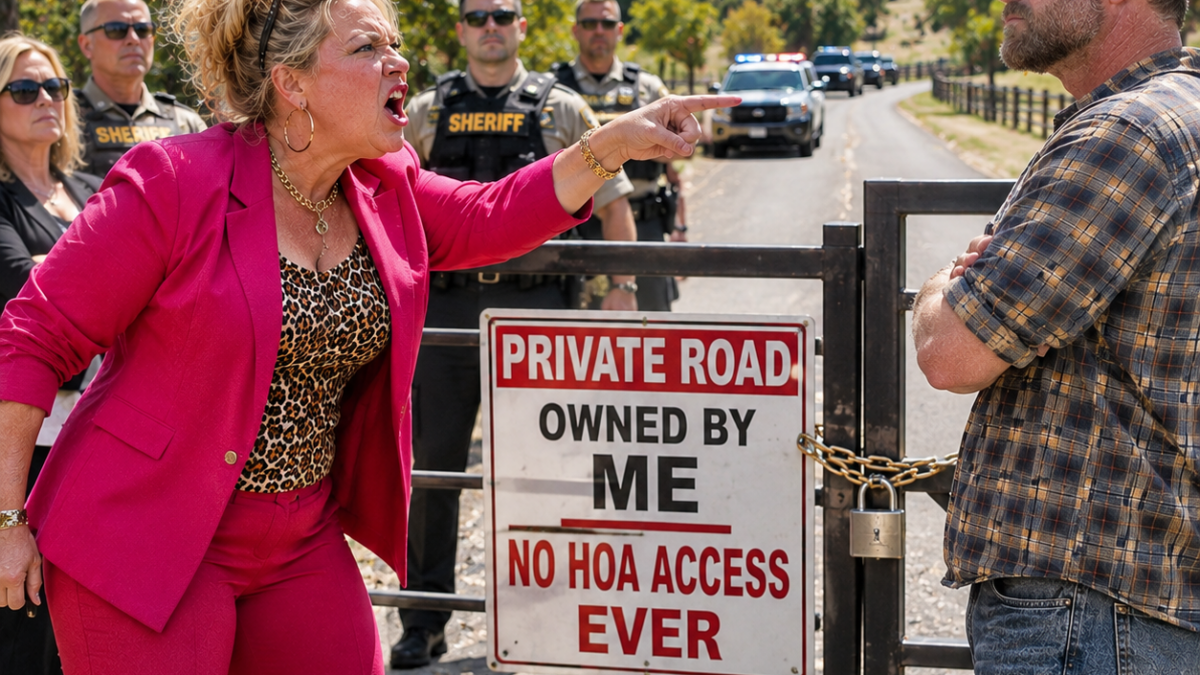
PART 2
I read the sentence three times.
*Developer agrees subdivision will build permanent access within its own property when construction is completed.*
Underneath it was Grandma’s signature.
Beside hers was another name.
Harold Bishop.
I didn’t know who he was.
Sarah did.
When I called her, she told me not to photograph the document, not to post it, and definitely not to confront Melody with it.
“Put it back in the box,” she said.
“Why?”
“Because if that signature belongs to someone connected to the original development, you may have something better than an argument.”
I looked through the kitchen window toward the road.
Cars moved through the gate one after another.
For almost forty years, people had treated that pavement like it had always belonged there.
“How much better?”
“Enough that I want to see the original before I say anything.”
The next morning I drove it to her office.
Sarah examined the paper under a desk lamp, then had her paralegal, Jenny Cole, pull the development records again.
Harold Bishop had been the construction manager for the original developer.
The county permit package showed the subdivision’s permanent access road was supposed to remain entirely inside subdivision-owned land.
But somebody had changed the plan during construction.
Not officially.
The road had simply been built across Grandma’s corner.
Sarah leaned back.
“This doesn’t automatically win everything,” she said. “But it gives us a very clean story. Your grandmother allowed temporary use. The developer promised replacement access. Instead, the temporary route became permanent without a recorded grant.”
“So I can close the gate.”
“You own the land. But don’t confuse owning the land with being immune from litigation.”
That was Sarah.
She could make good news sound like a warning label.
“Melody’s going to sue anyway.”
“Probably.”
“Then what’s the point of being careful?”
“Because people who are wrong can still cost you money.”
I had learned that during my divorce.
Being right and surviving the process of proving you’re right are two different things.
So I decided to do everything cleanly.
I requested a formal county boundary survey.
Three days later, survey trucks arrived.
Melody noticed within ten minutes.
She marched across the street wearing sunglasses large enough to qualify as structural additions.
“What are they doing?”
The surveyor, Steve Martinez, looked at me.
I nodded.
He said, “Establishing recorded property boundaries.”
“For what purpose?”
“That’s between the property owner and whoever ordered the survey.”
“I am HOA president.”
Steve adjusted his tripod.
“Congratulations.”
I had to turn away before she saw me smile.
For six hours, his crew measured, scanned, located old monuments, compared plats, and marked boundaries.
Melody paced.
At one point she called someone.
At another, she photographed my property markers.
When Steve finished, he handed me preliminary notes.
Thirty-seven feet, eight inches.
The road crossed my property exactly where Grandma’s old survey showed it did.
No mystery.
No ambiguity.
No alternate interpretation.
I posted the official boundary result in the neighborhood Facebook group with one sentence:
**For anyone confused about the gate, here is the county-confirmed property line.**
Melody responded twenty-eight minutes later.
**This survey is fraudulent and Mr. Blackwood is intentionally creating a dangerous situation for residents.**
Then she added:
**Residents should avoid direct confrontation with him.**
That got my attention.
I typed a response.
Deleted it.
Typed another.
Deleted that too.
Sarah had already warned me.
“Do not get into a digital mud fight with a woman who wants screenshots.”
So I saved hers instead.
By the end of the day, she’d accused me of threatening families, blocking emergency services, damaging property values, and possibly operating an illegal commercial facility because I occasionally worked on trucks in my garage.
The next morning, a county inspector named Pete Williams showed up.
He was in his late fifties, sunburned, patient-looking, and clearly unimpressed by neighborhood politics.
He inspected the gate.
Checked the setback.
Reviewed my permit records.
Tested the emergency code.
Then Melody appeared.
Of course she did.
“Officer—”
“Inspector,” Pete corrected.
She pointed at my gate.
“This structure prevents essential access.”
Pete looked at the open keypad box.
“Fire and EMS have the code?”
“Yes,” I said.
“Postal access?”
“Yes.”
“Utility access?”
“On request.”
He turned to Melody.
“Then I don’t see an access violation.”
Her eyes widened.
“What about resident convenience?”
Pete gave her the kind of look mechanics give customers who explain engine repair using something they saw on social media.
“Convenience isn’t a building code.”
She folded her arms.
“So he can just lock us out?”
Pete glanced at the survey stakes.
“If this is his property and there’s no legal access right overriding his ownership, that’s a civil question. Not mine.”
“But we’ve used this road for decades.”
“Then speak with an attorney.”
“I have.”
“Good.”
He closed his clipboard.
“Have a nice day.”
She did not have a nice day.
I did.
That afternoon Dorothy Chen knocked on my door carrying oatmeal cookies.
Dorothy lived two streets into Willowbrook. She was a retired middle-school teacher with silver hair, quick eyes, and the posture of somebody who had spent thirty-five years making twelve-year-olds stop talking by simply looking at them.
“I owe you an apology,” she said.
“For what?”
“I believed her.”
“Melody?”
Dorothy nodded.
“She told us you threatened to chain the road shut permanently unless the HOA paid you.”
“I’ve never asked the HOA for a dollar.”
“I know that now.”
She looked toward the gate.
“She fined me three hundred dollars once because my Christmas lights were still up January fifth.”
I blinked.
“Three hundred?”
“Technically, one hundred fifty for the lights and another one hundred fifty because the extension cord was visible from the street.”
I started laughing.
Dorothy didn’t.
“She threatened a lien.”
That stopped me.
Over the next week, people began showing up.
Marcus Reed, a firefighter.
Janet Kowalski, a CPA.
The Hendersons.
The Patels.
Even Brad Whitmore once drove slowly past my house, staring toward the porch without stopping.
The stories were all variations on the same theme.
Mailbox wrong color.
Bird feeder visible from street.
Trash cans out fourteen minutes early.
Grass half an inch too tall.
Visitor parked overnight.
Pickup truck “inconsistent with neighborhood aesthetic standards.”
Melody had turned petty authority into a full-time occupation.
But I still didn’t want a neighborhood war.
That mattered.
I hadn’t moved into Grandma’s house to become the guy everyone blamed for an extra half-hour commute.
So I kept the gate open most days while Sarah prepared a quiet-title filing.
Then Melody escalated.
A certified letter arrived from Whitman & Associates.
Three pages.
Dense legal language.
Permanent easement demand.
Fifty thousand dollars in claimed damages.
Threats of emergency injunctions.
I sat at my kitchen table reading it twice.
My stomach tightened the way it had during my divorce when every envelope from an attorney felt capable of changing my life.
For a moment, I considered giving in.
Not forever.
Just until things cooled down.
Then I saw Grandma’s yellow note sitting inside a clear evidence sleeve on the table.
Temporary road permission.
She had trusted a promise.
I wasn’t going to turn her temporary kindness into permanent surrender because somebody printed threats on expensive paper.
Sarah read the letter the next morning.
“They want you scared.”
“It’s working.”
She looked up.
“Good.”
I frowned.
“Good?”
“Fear keeps people from doing stupid things. Panic causes stupid things.”
“So what do we do?”
“We answer.”
Her reply was six pages.
Survey attached.
Chain of title attached.
County easement search attached.
Grandma’s contemporaneous note referenced, but not copied.
Request for documentation supporting any claimed right of access.
Notice that any intentional damage to my gate would be treated as trespass and reported.
Sarah sent it certified.
Melody’s lawyers went quiet for four days.
Then the HOA called an emergency meeting.
I wasn’t invited.
Dorothy attended.
So did Marcus.
Dorothy called me afterward.
“It was a disaster.”
“How bad?”
“She wants a five-hundred-dollar special assessment from every household for legal expenses.”
I whistled.
“Twenty-three thousand five hundred dollars.”
“Janet asked why homeowners are paying to fight over land the HOA doesn’t own.”
“What did Melody say?”
“She said questioning the board during active litigation could expose Janet to personal liability.”
I stood in my kitchen staring at nothing.
“Can she do that?”
“Janet laughed in her face, so I’m guessing no.”
Dorothy lowered her voice.
“People are starting to turn.”
That same night, Sarah called.
“Jenny found the original 1985 permit file.”
“You already had it.”
“We had copies from the property packet. She found the county planning archive version.”
“And?”
“The subdivision developer certified that all permanent road infrastructure would be located on land owned or controlled by the development.”
I sat straighter.
“But it wasn’t.”
“No.”
“What does that mean?”
“It means somebody built outside the approved plans.”
“Fraud?”
“Maybe. Don’t jump ahead. Records this old can get messy.”
“Does it help me?”
“Yes.”
“How much?”
“Enough that I want you to stop thinking defensively.”
I looked through the window toward the gate.
For weeks, I had been asking one question.
How do I stop Melody from taking something from me?
Sarah had just given me another.
What if Melody was the one standing on ground that couldn’t survive scrutiny?
That was the first real shift.
I stopped treating the gate like a problem I had to solve.
I started treating it like leverage.
Not against the neighbors.
Against her.
The next Monday, I locked the gate from seven to nine in the morning.
No dramatic announcement.
No argument.
Just locked.
At 7:08, the first car arrived.
At 7:11, there were six.
At 7:15, Melody’s Lexus appeared.
She got out before she’d even fully stopped.
“Open it.”
I remained on the other side of the gate.
“No.”
“We have people going to work.”
“Maple Street is open.”
“That’s thirty-five minutes during rush hour.”
“I know.”
“You’re doing this deliberately.”
“Yes.”
She stared at me.
That answer bothered her more than any excuse could have.
“You can’t punish forty-seven families because you hate me.”
“I don’t hate you.”
“Don’t lie.”
“I’m not punishing anyone. I’m using my property.”
“This is extortion.”
“Have your lawyer put that in writing.”
She stepped closer.
“You think some survey makes you powerful?”
“No.”
“What, then?”
“Owning the land helps.”
Her lips parted.
Behind her, cars began turning around.
Melody leaned close enough that I could smell her perfume through the fence.
“You are going to regret embarrassing me.”
I met her eyes.
“That sounds like a threat.”
Her jaw tightened.
Then she returned to the Lexus.
I kept the gate locked until nine.
That afternoon, three residents approached me separately offering to pay for access.
Fifty dollars a month.
Then seventy-five.
One offered a year in advance.
For about ten minutes, the idea sounded perfect.
Everybody gets convenience.
I get maintenance money.
Conflict over.
Sarah killed it immediately.
“Don’t collect informal access fees.”
“Why not?”
“Because you haven’t structured anything. Insurance, liability, zoning, tax treatment, implied rights—you’re creating facts we don’t need.”
“So free access is safer than paid access?”
“For now, yes.”
I leaned back in her office chair.
“Property law is weird.”
“Property law is history with receipts.”
I remembered that line.
Meanwhile, the HOA was fracturing.
Seven households refused to pay Melody’s legal assessment.
Janet demanded financial records.
Marcus publicly confirmed that emergency services had never complained about my gate.
Dorothy started posting meeting summaries.
Melody called them traitors.
Then she called me something worse.
A police cruiser arrived at my house on a Tuesday afternoon.
Captain Luis Rodriguez stepped out.
I knew him casually through my old employer.
He looked uncomfortable.
“Ezra.”
“Captain.”
“We got a complaint.”
“Let me guess.”
He sighed.
“Mrs. Whitmore says you threatened her with a weapon.”
I didn’t say anything for a moment.
Then I walked inside and returned with my phone.
My gate cameras stored thirty days.
I found the morning in question.
There was Melody.
There was me.
Thirty feet away.
Coffee mug in hand.
No weapon.
No threatening movement.
No raised voice.
Rodriguez watched the entire clip.
Then watched it again.
“Send me that.”
“Already doing it.”
He rubbed his forehead.
“Has she filed others?”
“Noise. Commercial vehicles. Illegal dumping. Gate obstruction. Probably more.”
He looked toward Willowbrook.
“This isn’t the first complaint from her that hasn’t matched what officers found.”
“False report?”
“I’m not making that call standing in your driveway. But keep everything.”
“I am.”
“Good.”
Three nights later, somebody cut my gate lock.
At 3:07 a.m., my phone buzzed with a motion alert.
I didn’t see it until sunrise.
The lock housing had been mangled.
My camera captured a figure in dark clothes, face mostly hidden.
No plate.
No clean facial shot.
But the person limped slightly on the left side.
I watched it twenty times.
Something about the walk felt familiar.
Not enough to accuse anyone.
Enough to upgrade security.
I installed a reinforced electronic lock, added a second camera angle, and set instant phone alerts.
Four hundred dollars I hadn’t planned to spend.
Worth every cent.
That Thursday, Dorothy secretly recorded another HOA meeting despite Melody’s new “no recording” policy.
Marcus stood.
“We are spending association money on one person’s feud.”
Melody cut him off.
“This is not a feud. This man is attempting to seize control of our neighborhood.”
“He’s standing on his land.”
“He is weaponizing access!”
“Because you threatened him.”
“I defended this community!”
Janet spoke from the second row.
“Then release the legal invoices.”
Silence.
Dorothy told me afterward that it was the first moment Melody looked frightened instead of angry.
“She didn’t answer,” Dorothy said.
“Maybe privileged attorney billing?”
“No. Janet didn’t ask for case strategy. She asked how much the HOA had spent.”
“And?”
“Melody adjourned the meeting.”
That was strange.
Stranger still, the following morning Sarah’s paralegal Jenny called me.
“Can you come in?”
“What happened?”
“I found a lien.”
“On my property?”
“No.”
She paused.
“On theirs.”
I drove straight to the office.
A mechanic’s lien had been filed by Green Valley Maintenance against portions of the HOA’s common property.
Forty-seven thousand dollars.
Unpaid storm cleanup, landscaping, emergency tree removal, and road clearing.
Invoices dating back more than a year.
I’d met the owner, Miguel Santos, once.
Quiet guy.
Family business.
His crews had apparently worked around the clock after a major storm.
The HOA hadn’t paid.
“Why would this matter to my gate?” I asked.
Jenny pushed another document toward me.
“Because look at the HOA budget summaries.”
The maintenance line showed the storm expenses as paid.
I looked at her.
“Where did the money go?”
“That’s the interesting question.”
Sarah entered carrying coffee.
“Janet’s been asking the same thing.”
The three of us stared at the numbers.
The gate dispute suddenly felt smaller.
Melody hadn’t merely been hiding something.
She might have been desperate.
That changed the emotional shape of the entire fight.
Anger had made her predictable.
Fear would make her dangerous.
I called Miguel.
He agreed to meet at my house.
He arrived in a work truck with Green Valley Maintenance faded across the door and brought a file box.
“I don’t want anyone losing their homes,” he said before he even sat down.
“I just want to get paid.”
“How long have you been trying?”
“Eighteen months.”
“Melody knew?”
He laughed once.
“She signed the work orders.”
He showed me copies.
Storm damage.
Emergency tree removal.
Drainage clearing.
Debris hauling.
All authorized.
“Did the board approve it?”
“I thought so. She told me they did.”
“Did you ever speak with anyone else?”
“She wouldn’t let me.”
That sentence landed harder than I expected.
Wouldn’t let him.
I thought of Janet asking for invoices and Melody ending the meeting.
“Would you work out a payment plan with a new board?”
Miguel looked at me.
“Is there going to be a new board?”
“I don’t know.”
“Then I don’t know either.”
Fair answer.
We invited Janet over.
She spent two hours comparing Miguel’s records to HOA documents residents had received.
By the time she finished, she had stopped making jokes.
“This isn’t just sloppy bookkeeping.”
“What is it?”
“Money is missing.”
“How much?”
“I need records.”
“Can you prove it?”
“Not yet.”
The next morning, Dorothy started calling neighbors.
Not campaigning.
Listening.
She discovered something important: people who had supported Melody didn’t necessarily like her.
They feared instability more than they disliked her.
They worried that if Melody fell, lawsuits would explode, the road would close, property values would drop, and special assessments would arrive.
I understood that.
People will tolerate a bully longer than you’d expect if they believe the bully is holding the roof up.
So we needed to prove the roof was already on fire.
Janet formally requested two years of financial records under the HOA bylaws.
Melody refused.
Then delayed.
Then produced partial statements missing multiple months.
Janet found hotel charges.
Credit-card cash advances.
Large “office supply” purchases.
Payments to vendors nobody recognized.
She called me at 10:30 one night.
“Ezra, are you awake?”
“I am now.”
“Twenty-three thousand dollars in miscellaneous spending.”
“Over how long?”
“Fourteen months.”
“Could it be legitimate?”
“Anything could be legitimate until you check it.”
“And after checking?”
“One hotel conference was supposedly in Phoenix.”
“So?”
“The conference didn’t exist.”
I sat on the edge of my bed.
“Maybe wrong date.”
“I checked six months in both directions.”
Silence.
“How bad is this?”
“I don’t know yet.”
There it was again.
Not knowing.
That became the worst part.
The gate was simple.
Land line.
Lock.
Access.
But now every new document opened another door.
Around that time, I called my cousin Tony, who worked in municipal records.
I asked him for nothing improper.
Only public records.
Everything the county had on Willowbrook’s original development.
Two days later, he met me at Chuck Morrison’s diesel shop with a folder thick enough to stop a fan.
“Your rich neighbors have been interesting for forty years.”
“What does that mean?”
“Road discrepancies. Drainage complaints. Old septic permits. Wetland notices. Nothing that necessarily blows the place up by itself.”
“But together?”
He shrugged.
“Together, it tells you the original developer liked shortcuts.”
That mattered because Melody’s lawyers had been portraying Willowbrook as a perfectly compliant planned community victimized by one unreasonable property owner.
It wasn’t.
The original developer had cut corners everywhere.
The road across Grandma’s property was part of a pattern.
I refused to use that information as a threat.
Sarah agreed.
“We don’t blackmail anybody with code violations.”
“I wasn’t planning to.”
“Good. We use relevant records in litigation. Anything involving public safety goes through proper channels.”
That distinction mattered.
I didn’t want to become Melody with better paperwork.
Then something happened that turned neighborhood gossip into strategy.
County tax-auction notices were published.
I had started reading them during my divorce, when I was looking for cheap workshop property.
Most were useless to me.
Abandoned lots.
Tiny strips.
Bad titles.
One description made me stop.
**Lot 47A. 1.2 acres.**
I opened the parcel map.
It was a narrow strip running along the main roadway serving Willowbrook.
Not my thirty-seven feet.
A different section.
The parcel had belonged to an elderly man whose estate had stalled after his death. Taxes went unpaid. No heir had resolved it. The county had scheduled a public sale.
I printed the map and drove to Sarah’s.
She stared at it for almost a minute.
“Where did you get this?”
“Public auction notice.”
She traced the parcel.
“This is the main internal connection.”
“That’s what I thought.”
“If you buy this, you don’t own every street.”
“I know.”
“But you own a critical road segment.”
“I know.”
She looked at me.
“Why do you want it?”
That question mattered more than the auction.
Six weeks earlier, I would’ve said revenge.
Now?
“I don’t want Melody getting it.”
“That’s not enough.”
“I want the road put under a legal structure that can’t be abused again.”
“Better.”
“And maybe it gives the homeowners leverage to remove her.”
Sarah nodded slowly.
“Then if you bid, we do this cleanly.”
The delinquent taxes and penalties totaled a little over twelve thousand dollars.
We estimated the sale could reach twenty.
Maybe more if someone cared.
I registered.
I told nobody except Sarah, Janet, Marcus, Dorothy, and Miguel.
Someone leaked it.
Two weeks before the auction, Brad Whitmore arrived at my garage.
He looked exhausted.
I’d always thought of Brad as Melody’s silent accessory.
He rarely spoke at meetings.
Rarely confronted anyone.
He carried himself like a successful insurance executive who’d mastered the art of being somewhere else mentally while his wife fought with people.
That morning, he carried a briefcase.
“Ezra.”
“Brad.”
“Can we talk privately?”
I set down my ratchet.
“Talk.”
He opened the case.
Cash.
Neatly stacked.
My first thought wasn’t greed.
It was disbelief.
“Thirty thousand,” he said.
“For what?”
“Permanent easement across your parcel. Signed today.”
I stared at the money.
Thirty thousand dollars was real money to me.
My roof needed work.
One truck needed a transmission.
I hadn’t taken a vacation since before my marriage ended.
“What happens with the HOA road parcel?” I asked.
Brad’s eyes flickered.
There.
That was the reason.
“That’s separate.”
“Is it?”
“Melody believes you’re trying to acquire it.”
“Does she?”
“Don’t play games.”
“I’m not.”
He closed the briefcase halfway.
“Thirty thousand is more than fair.”
“Based on what appraisal?”
His jaw tightened.
“Don’t make this difficult.”
“The easement would permanently burden my land.”
“You’ve allowed access already.”
“My grandmother allowed access.”
“Same difference.”
“No.”
That one word changed his expression.
For the first time, I saw anger.
“Things can get ugly.”
“They already are.”
“Melody knows people.”
“Everybody knows people.”
“City. County. State.”
I wiped my hands with a rag.
“Brad, if you’re trying to threaten me, at least say something specific enough for my camera to enjoy.”
His eyes darted toward the corner.
The red light on the security camera blinked.
He closed the briefcase.
“This was a mistake.”
“Probably.”
He left with the money.
That afternoon, anonymous letters arrived at my employer, my insurer, and at least one county office.
They described me as unstable.
Aggressive.
Anti-government.
Dangerous.
Chuck Morrison, owner of the diesel shop where I’d worked for years, handed me his copy.
“I’ve known you twenty years.”
“I know.”
“I’ve seen you angry.”
“That sounds bad.”
“You get quiet and reorganize tools.”
I laughed.
Chuck tore the letter in half.
“Whoever wrote this has never met you.”
The complaints intensified.
Building inspector.
Environmental complaint.
Noise enforcement.
Postal complaint.
Each investigation ended the same way.
Nothing.
But each one consumed time.
Each forced me to answer calls, produce paperwork, meet inspectors, explain facts.
That was Melody’s real weapon.
Not winning.
Exhaustion.
One Friday evening, after an inspector left, I sat alone in Grandma’s kitchen.
The light over the sink was the same yellow fixture she’d had since I was a kid.
Her lavender outside the window had gone dark in the sunset.
For the first time, I wondered whether keeping the house had been a mistake.
Maybe I should sell.
Walk away.
Let somebody else fight.
Then I remembered Grandma calling me during my divorce.
I had been sitting in a motel room because I couldn’t stand going home.
She had said, “Come sit on my porch. You don’t have to fix anything tonight.”
That house had been the one place where nobody expected me to solve a problem.
Now Melody was trying to turn it into another battlefield.
I couldn’t let that happen.
Not because of pride.
Because surrender wouldn’t bring peace.
It would only teach her that harassment worked.
Monday brought another phone call.
County Commissioner Elena Torres.
“I need to make you aware of something.”
My stomach tightened.
“Okay.”
“Mrs. Whitmore contacted my office regarding the upcoming tax auction.”
“That’s allowed.”
“She then suggested a campaign contribution might be appropriate if participation requirements were reviewed.”
I went quiet.
“Are you saying she tried to bribe you?”
“I’m saying I referred the communication to counsel and ethics staff.”
“Why tell me?”
“Because your name was specifically mentioned.”
I called Sarah immediately.
She told me the same thing she always did.
Document.
Do not speculate.
Do not retaliate.
Let the facts move.
Meanwhile, Janet found more.
The financial irregularities weren’t twenty-three thousand.
They were closer to eighty-seven.
Forged approval signatures.
Cash withdrawals.
Personal purchases disguised as HOA expenses.
Fake vendor invoices.
Unauthorized borrowing.
Nothing had yet been proven in court, but the pattern was strong enough that Sarah advised the residents to retain separate counsel and notify the association’s insurer.
Melody responded by calling an emergency meeting.
Dorothy streamed it from her phone.
Thirty-one households had signed a petition demanding full financial transparency and supporting my right to control my own property.
Janet walked to the front carrying a binder.
“I have questions regarding eighty-seven thousand dollars in unsupported expenditures.”
Melody snatched the microphone.
“This is defamatory.”
“Then show the receipts.”
“You are not qualified to conduct an official audit.”
“I’m a CPA.”
“You are a resident with a personal agenda.”
“Where’s the money?”
People started murmuring.
Melody’s face changed.
Not anger.
Fear.
She turned toward the room.
“This entire campaign is being orchestrated by Ezra Blackwood because he wants control of our neighborhood.”
Marcus stood.
“No. This started because you told a man he couldn’t lock his own gate.”
“Sit down.”
“No.”
“You are out of order.”
“This isn’t your courtroom.”
“It’s my meeting.”
“That’s the problem.”
Applause broke out.
Melody slammed the microphone down.
Meeting over.
That night, Brad called me.
I almost didn’t answer.
“You need to stop this,” he said.
“Stop what?”
“Janet. Dorothy. The audit.”
“I don’t control them.”
“You started it.”
“No, your wife did.”
He breathed heavily into the phone.
“You don’t know what you’re destroying.”
“Then tell me.”
Silence.
“Brad?”
He disconnected.
I replayed that conversation in my head for hours.
*You don’t know what you’re destroying.*
Not protecting.
Destroying.
The next day, Elena Santos—Miguel’s daughter, a law student—brought something else to Sarah.
She had searched public court records for Melody Whitmore.
There wasn’t much before a certain year.
Then she searched variants.
That was when she found Margaret Whitfield.
Same birth date.
Same middle name.
Old Ohio records.
A prior embezzlement conviction.
Eighteen months served.
Legal name change after release.
I sat across from Sarah while Elena explained it.
“Are you sure it’s her?”
Elena nodded.
“Photos match. Brad is listed on later public documents. Addresses connect.”
Sarah held up a hand.
“This stays private until law enforcement confirms it. We are not publishing criminal-history accusations based on internet research.”
Fair.
Still, something clicked.
Melody’s obsession with controlling the HOA finances.
Her panic when Janet asked questions.
Her refusal to pay Miguel.
The desperate effort to create new revenue from road access.
Maybe the gate had never really been the issue.
Maybe she needed control because control was the only thing keeping old behavior hidden.
The auction was seven days away.
My registration was complete.
Funds were approved.
Sarah had title professionals ready.
I thought we had reached peak insanity.
Then Thursday night happened.
2:47 a.m.
My phone alarm screamed.
**GATE MOTION.**
I sat up instantly.
Opened the live feed.
Two figures.
One crouched near the control box.
The other holding a flashlight.
I enlarged the image.
Melody.
Brad.
No masks this time.
No ambiguity.
My hands started shaking.
Not fear.
Adrenaline.
I called 911.
Then I stayed inside.
That was important.
I wanted no confrontation.
No heroic nonsense.
No excuse for them to claim I had threatened them.
On camera, Brad used cutters near the wiring.
The floodlights snapped on.
Melody jumped.
Brad looked directly into the camera.
For one frozen second, all three of us—me inside, them outside—understood the same thing.
They had been caught.
They ran.
Captain Rodriguez arrived less than ten minutes later.
I showed him the footage.
He watched in silence.
Then again.
“That’s clear.”
“Very.”
“You want to make a complaint?”
“Absolutely.”
He nodded.
“We’ll take it from here.”
In the original fight, I had thought winning would feel like satisfaction.
It didn’t.
Watching two middle-aged people flee my property at three in the morning felt sad.
Dangerous too.
But mostly sad.
Whatever Melody had convinced herself she was defending, she’d crossed from harassment into criminal conduct.
Brad had followed her.
Maybe willingly.
Maybe because he was trapped in the same web.
Either way, the cameras didn’t care about motives.
Evidence rarely does.
The next morning, Sarah made me promise something.
“No games.”
“What games?”
“No delaying charges because you want dramatic timing. No trying to coordinate arrests with the auction. No manipulating law enforcement for theater.”
I raised my hands.
“Understood.”
She studied me.
“I mean it.”
“So do I.”
That mattered.
I wasn’t going to become somebody who used the system for spectacle.
The auction would happen.
The criminal complaint would happen.
Each on its own timeline.
Three days later, I stood on the county courthouse steps with Sarah.
The air was cold enough to sting.
About forty people had gathered.
Neighbors.
Local reporters.
Investors who attended tax sales regularly.
Melody and Brad.
When she saw me, she pushed through the crowd.
“This is theft.”
I didn’t answer.
“You’re stealing our neighborhood.”
Sarah stepped between us.
“Mrs. Whitmore, direct all legal communication through counsel.”
“I’m talking to him.”
“He is represented.”
Melody looked around at the cameras.
Then raised her voice.
“This man manufactured an access crisis so he could buy our roads.”
I finally spoke.
“Your subdivision’s access problems existed before I inherited my house.”
“You locked the gate.”
“On my land.”
“You targeted us.”
“Melody.”
Brad touched her arm.
She jerked away.
The auctioneer called everyone to order.
Lot 47A opened at the amount necessary to satisfy taxes and penalties.
Melody bid fifteen thousand.
I waited.
“Seventeen-five.”
She turned.
“Twenty.”
“Twenty-two-five.”
Brad leaned close to her.
They argued in whispers.
“Twenty-five,” Melody said.
The auctioneer looked around.
My heart was hammering.
Not because I doubted the value.
Because thirty thousand dollars was almost every liquid dollar I was willing to put into this.
Sarah had told me my ceiling.
I had promised to respect it.
“Thirty thousand.”
Melody stared at me.
The auctioneer asked for more.
Nothing.
Again.
Nothing.
The gavel struck.
Sold.
For several seconds, I didn’t move.
Lot 47A was mine, subject to the legal procedures Sarah had already explained to me.
Melody stepped toward me.
“You think you’ve won?”
I looked at her.
“No.”
“You’ve just made forty-seven families your enemies.”
“No.”
“You’re going to charge them whatever you want.”
“No.”
“You’re going to close everything.”
“No.”
She stopped.
That wasn’t the reaction she’d expected.
I lowered my voice.
“I’m going to offer them a legal access agreement.”
Her face changed.
“And I’m going to insist the agreement be negotiated with a properly authorized HOA board.”
There.
That hit.
She understood instantly.
Not with her.
With whoever came after her.
“You can’t remove me.”
“I can’t.”
I glanced toward the residents behind her.
“But they can.”
That evening, the community center was packed.
Forty-five of forty-seven households attended.
So did attorneys representing several homeowners.
Sarah attended with me.
Miguel came.
Janet brought her audit binder.
Marcus stood near the back.
Dorothy sat in the front row.
Melody tried to call the meeting to order.
Janet stood before she finished.
“Before we discuss road access, I move that the membership hear the financial report.”
“Denied.”
“You can’t deny a properly raised motion under the bylaws.”
“I am chair.”
A homeowner shouted, “Let her talk.”
Another joined.
Then another.
Melody pounded the gavel.
“Order!”
Nobody stopped.
Brad sat at the side table staring down.
Janet walked to the projector.
The first bank statement appeared.
Then another.
Then a vendor invoice.
Then a credit-card statement.
She spoke calmly.
That made it worse.
“Eighty-seven thousand dollars in expenditures currently lack adequate supporting documentation or appear inconsistent with authorized HOA purposes.”
Melody stood.
“That is a lie.”
Janet clicked.
A hotel charge appeared.
“You listed this as an HOA governance conference.”
“It was.”
“No conference matching this name occurred at that hotel.”
“You don’t know what you’re talking about.”
Click.
Luxury retail purchase.
“Office supplies?”
“Board materials.”
“From a designer boutique?”
People laughed.
Melody’s face reddened.
Click.
Cash advance.
Click.
Another.
Click.
Miguel’s unpaid invoices.
“You reported these expenses as paid.”
“I was negotiating.”
“Yet the contractor filed a lien because he wasn’t paid.”
“He overbilled us.”
Miguel stood.
“I have signed work orders.”
Every head turned.
He placed copies on the table.
Melody looked at Brad.
Brad did not look back.
Janet continued.
Unauthorized loan documents.
Questionable signatures.
Charges nobody could explain.
The room changed as people realized the issue wasn’t a personality conflict.
Their money might actually be gone.
Melody grabbed the microphone.
“This is exactly what Ezra wanted!”
I didn’t move.
“He has manipulated all of you because he wants your road!”
Dorothy stood.
“No, Melody.”
Her voice wasn’t loud.
It didn’t need to be.
“You told us he was dangerous. He wasn’t. You told us emergency services couldn’t get through. They could. You told us his survey was fake. It wasn’t. You told us the HOA finances were healthy.”
She looked at the screen.
“They aren’t.”
Melody pointed at her.
“You’ve hated me for years.”
Dorothy almost smiled.
“I was afraid of you for years.”
That landed harder.
Marcus walked forward.
“There’s a petition signed by enough members to call a removal vote under the bylaws.”
Melody shook her head.
“No.”
Sarah quietly placed a copy of the bylaws in front of the interim secretary.
“The procedure is available here.”
Melody turned on me.
“You did this.”
I stood.
“I defended my property.”
“You destroyed my life.”
“No.”
My voice surprised even me with how calm it sounded.
“I locked a gate.”
The room went silent.
Everything else had been her choices.
Dorothy moved for removal.
The vote was overwhelming.
Only Melody and Brad opposed.
For six years she had controlled Willowbrook through procedure, intimidation, fines, threats, and the assumption that nobody would challenge her.
In less than ten minutes, the same bylaws she had used against everyone removed her from office.
She stood frozen.
Then she laughed.
Not a happy laugh.
A thin, exhausted sound.
“You people think he’s going to save you?”
Nobody answered.
She looked at me.
“Tell them, Ezra.”
I said nothing.
“Tell them what you’re charging.”
I walked to the front.
This was the moment I’d been thinking about since the auction.
Not revenge.
Terms.
“I own Lot 47A now,” I said. “I also own the thirty-seven-foot section near my gate. I’m willing to grant the community legally documented access.”
A man in the second row raised his hand.
“How much?”
“Initial proposal is fifty dollars per household per month while we price insurance, road maintenance, reserve funding, and legal costs.”
Murmurs.
Not angry ones.
Another resident called, “And the gate?”
“Emergency access always guaranteed. Resident access governed by the agreement. No surprise closures except safety emergencies or maintenance.”
“What about permanent rights?”
“That gets negotiated through attorneys.”
Janet asked, “Would you sell the road parcel to the HOA?”
“Possibly, later, at a fair independent valuation if the community wants that.”
Melody stared at me like I’d betrayed the villain she had invented.
“You bought it to control us.”
“I bought it so you couldn’t.”
Someone in the back applauded.
Then another.
Within seconds, half the room was standing.
I didn’t feel triumphant.
Mostly relieved.
Because for the first time, the road wasn’t being treated like somebody’s weapon.
It was becoming infrastructure.
A boring thing.
A thing with contracts, maintenance schedules, insurance, and written rights.
Exactly what it should have been in 1985.
Before the meeting ended, an interim board was elected.
Dorothy was chosen acting president.
Janet became treasurer.
Marcus accepted a board seat reluctantly after making everyone promise he wouldn’t have to discuss flower-bed regulations.
Miguel agreed to pause foreclosure action while the new board reviewed payment options.
The association’s attorney contacted its insurer.
Law enforcement continued its investigation separately.
Melody and Brad left before the meeting formally adjourned.
Nobody stopped them.
Two days later, investigators executed warrants related to the financial records.
The criminal case moved slower than neighborhood rumors wanted.
Months, not days.
That was real life.
Bank subpoenas.
Interviews.
Forensic accounting.
Authentication.
Charging decisions.
The dramatic part had ended.
Paperwork took over.
Our road agreement moved faster.
Sarah insisted on professional drafting.
The final number settled at thirty-five dollars per household per month.
Not profit for me.
A structured road fund.
Maintenance.
Insurance.
Snow and storm cleanup where applicable.
Legal administration.
Reserve.
I retained ownership.
Residents received documented access.
Emergency services had guaranteed entry.
The original gate remained, but with updated access controls.
My thirty-seven feet stopped being the neighborhood’s legal gray area.
For the first time in decades, everybody knew exactly what rights they had.
Miguel received partial payment from insurance-related funds and the HOA reserve.
The remainder went onto a board-approved schedule.
I asked him one afternoon whether he regretted getting involved.
He laughed.
“I regret answering my phone after storms.”
“Fair.”
“But no. My guys did the work.”
“They did.”
“That’s all I wanted people to remember.”
Dorothy won the permanent HOA presidency four months later.
She hated the phrase “landslide victory.”
Called it dramatic.
She received thirty-nine votes.
So I used the phrase anyway.
Her first major proposal required monthly financial statements for members.
Her second required member approval for expenditures above a set threshold.
Her third was recording all formal board meetings.
“Seems excessive,” I teased.
She gave me the teacher look.
I shut up.
Marcus convinced the board to simplify half the rules.
Mailbox colors remained regulated, but residents could now choose from several approved options.
Dorothy removed the rule about Christmas lights being gone by January second.
“January fifteenth,” she said.
“Revolutionary.”
“Don’t push me, Ezra.”
The criminal case eventually reached plea negotiations.
The evidence supported charges tied to financial misuse, false reports, and the attempted gate break-in.
Melody pleaded guilty to several counts, including embezzlement-related conduct and attempted unlawful entry.
She received eighteen months in a minimum-security facility plus restitution obligations.
Brad pleaded to a lesser role connected to the break-in and financial misconduct.
Probation.
Community service.
Restitution.
People asked me whether that felt satisfying.
I never knew how to answer.
I had imagined consequences would feel like revenge finally landing.
Instead, I kept thinking about that night at 2:47 a.m.
Two adults running from floodlights.
A marriage reduced to conspiracy and panic.
A neighborhood they had spent years trying to control watching them leave.
There was nothing satisfying about the waste of it.
Necessary?
Yes.
Satisfying?
Not really.
Six months after the auction, Willowbrook looked almost ordinary.
Which was the best possible outcome.
Cars crossed the road.
Kids rode bikes.
People complained about normal things again.
Potholes.
Dog barking.
Delivery trucks.
One Saturday morning, I was on Grandma’s porch replacing the handle on an old toolbox when Dorothy walked over carrying coffee.
“You know what annoys me?” she asked.
“That’s a dangerous question.”
“We have surplus road money.”
“How much?”
“Enough that Janet is getting excited.”
“CPAs get excited by surplus funds?”
“Apparently.”
She sat on the porch swing.
“We could lower the monthly amount.”
“Probably should.”
“Or build reserve.”
“Also smart.”
“Or do something useful.”
I waited.
She looked toward Grandma’s lavender.
“What would Rose have done?”
That question caught me.
Grandma had spent her life believing people could borrow things without stealing them.
Tools.
Time.
Land.
Trust.
Maybe that had made her vulnerable.
Maybe it had also been the reason half the county remembered her fondly.
“Trade-school scholarship,” I said.
Dorothy blinked.
“For local kids.”
“Why trade school?”
“Because everyone celebrates lawyers after a fight. Somebody still has to repair the roads.”
She laughed.
We created the Blackwood Community Scholarship that spring.
Small at first.
Nothing dramatic.
The first award went partly toward Elena Santos’s legal education because she had helped residents understand the records and wanted to study property and community law.
The second went to a young man training as an electrician.
Miguel cried during the presentation and denied it afterward.
Chuck Morrison hired me into a full-time equipment-management role at his diesel shop.
Miguel and I began taking occasional small projects together.
I also started installing basic security-camera systems for older homeowners who wanted the kind of protection that had saved me when accusations became evidence.
The county later asked me to serve on a planning advisory committee.
I accepted on one condition.
“No HOA politics.”
Commissioner Torres laughed.
“Land-use planning is HOA politics with maps.”
She wasn’t wrong.
One of the first recommendations I supported required new developments to demonstrate permanent legal access before final approval.
No handshake shortcuts.
No temporary road everybody mysteriously forgot was temporary.
Written rights.
Recorded documents.
Clear ownership.
The boring stuff.
Because boring paperwork would’ve prevented forty years of conflict.
A year after Melody first stood at my gate screaming at me, I sat on Grandma’s porch before work.
The morning smelled like pine and diesel.
Her lavender had come back thick along the steps.
At 7:02, the gate opened.
Dorothy drove through and waved.
Marcus followed in his pickup.
Then a school bus.
Then Miguel’s work truck.
Nobody honked.
Nobody shouted.
Nobody threatened police.
The electronic gate closed behind them with a quiet metallic click.
For months, that sound had meant conflict.
That morning, it meant something else.
A boundary.
Not a wall.
There is a difference.
Grandma had understood that long before any of us did.
She had allowed neighbors to cross her property because she trusted them to respect that kindness.
Melody mistook permission for weakness.
I nearly made the opposite mistake and treated ownership like permission to punish everyone.
Both would have destroyed something.
So the road remained open.
Legally.
Clearly.
Fairly.
And every morning, forty-seven families crossed thirty-seven feet of land that had once nearly torn the entire neighborhood apart.
I still owned it.
They still had access.
Nobody had to surrender for both things to be true.
I took one last sip of coffee, picked up my keys, and headed for the garage while the gate opened again behind me.
[END OF STORY]








