PART 2: HOA President Ordered Me to Tear Down My Grandfather’s Fruit Stand—Then 62% of Her Own Neighborhood Signed to Save It
PART 2
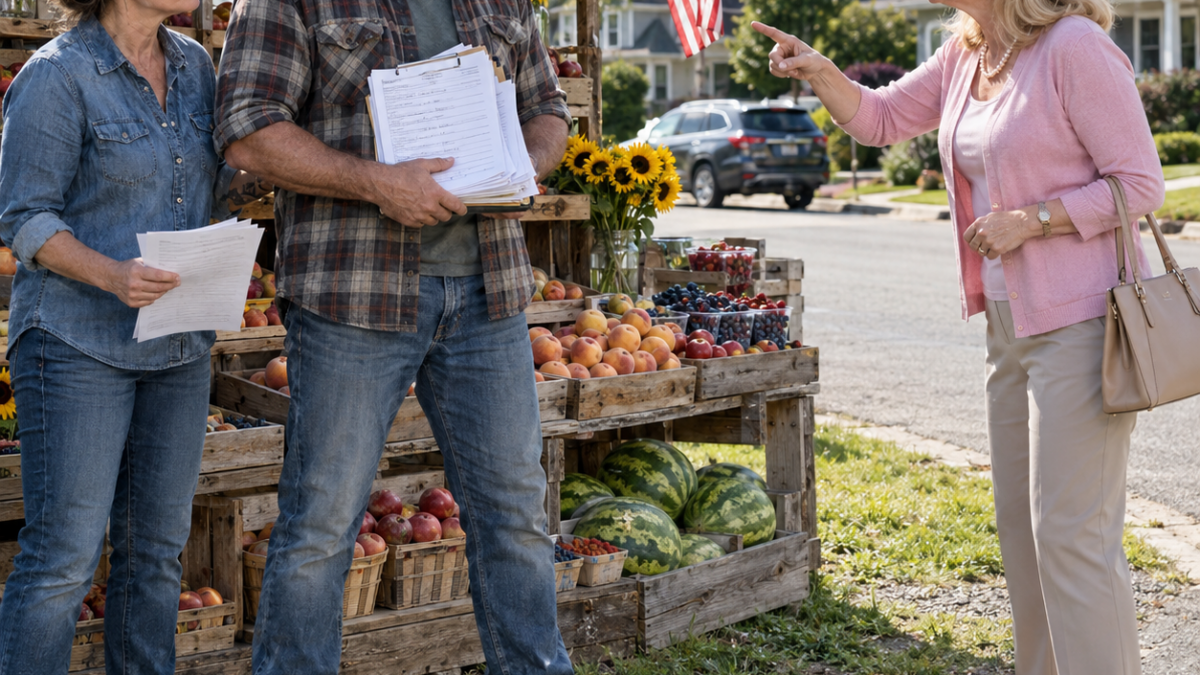
David stood beside my peach display reading Karen’s notice for the third time.
Emily watched him from behind the counter.
“Well?” she asked.
David looked up.
“Legally, this is mostly theater.”
“Mostly?”
“The HOA can send paper wherever it wants. That doesn’t mean the paper creates jurisdiction.”
He tapped the page.
“She cites Oakwood Bluffs bylaw 14.7B.”
“I saw that.”
“Does your deed include the HOA declaration?”
“No.”
“Did your grandfather ever sign into the association?”
“No.”
“Was this parcel annexed later?”
“No.”
“Then their covenant is irrelevant to you.”
Emily crossed her arms.
“So we throw it away?”
David shook his head.
“Absolutely not.”
I smiled.
“That was my thought.”
“You keep everything.”
He handed it back.
“Every envelope. Every photograph she takes. Every email. Every fine. Every certified-mail receipt. You build a paper trail so clean that if this becomes real litigation, nobody has to guess which side behaved reasonably.”
The Army had trained me to appreciate logistics.
David apparently spoke the same language.
That afternoon, I pulled an old metal file box from my grandfather’s storage room.
I labeled a folder:
OAKWOOD BLUFFS HOA.
Emily walked by.
“That’s too professional.”
“What would you call it?”
“KAREN’S FAN MAIL.”
I crossed out my label.
Wrote hers.
She laughed.
That was how the folder started.
The first official fine arrived four days later.
Five hundred dollars.
Unauthorized commercial structure.
I laid it on the stand next to my deed and county permit.
David came by after work.
Tie loosened.
Jacket over one shoulder.
He read the notice while eating a peach.
“She’s citing the same covenant.”
“Yes.”
“Good.”
“Good?”
“She’s repeating the same mistake after being informed.”
I drafted my response.
Polite.
Short.
My property was not a member of Oakwood Bluffs.
The cited covenant therefore did not apply.
Attached:
deed.
parcel map.
county permit.
historical agricultural-use documentation I already had.
I sent it certified.
Karen signed for it.
The next week, another envelope arrived.
Different violation.
Same five-hundred-dollar fine.
This time:
AESTHETIC NUISANCE.
The letter claimed my stand’s weathered cedar construction was inconsistent with the architectural character of surrounding homes and negatively affected property values.
It included a proposed remedy.
Paint the stand one of three approved colors.
Sandstone Beige.
Heritage Taupe.
Desert Linen.
I stared at the page.
Emily looked over my shoulder.
“Which beige speaks to you emotionally?”
“I’m torn.”
“Desert Linen feels brave.”
I laughed despite myself.
Then I walked to the edge of the property and planted sunflowers.
Not because I wanted to provoke Karen.
At least that is what I told myself.
But there was satisfaction in seeing those bright yellow heads rise along the border.
My grandfather loved sunflowers.
He used to say nothing that big and cheerful had any business growing from a seed that ugly.
For my official response, I sent Karen another certified letter.
The stand predated Oakwood Bluffs by decades.
My property was outside the association.
No architectural covenant controlled my paint choices.
I included photographs from my grandfather’s old albums showing an earlier version of the roadside stand on the same property.
Emily slipped a packet of sunflower seeds into the envelope before I sealed it.
I took them out.
“That’s harassment.”
“That’s agriculture.”
“No.”
She grinned.
Karen’s third notice involved my compost pile.
Fourth:
UNAUTHORIZED SIGNAGE.
The sign said:
PEACHES — $4 BASKET.
Fifth:
NONCOMPLIANT CUSTOMER PARKING.
The parking area was gravel on my property.
Sixth:
IMPROPER COMMERCIAL WASTE MANAGEMENT.
That referred to three flattened cardboard produce boxes waiting for recycling.
Each notice went into Karen’s Fan Mail.
Each received a calm written response.
Each response went certified.
The postman, Earl, eventually stopped pretending not to know.
He handed me another envelope one afternoon.
“She really likes you.”
“Apparently.”
“How much now?”
“Depends which imaginary jurisdiction we’re using.”
Earl shook his head.
“I just deliver them.”
“I know.”
“Personally, I like the peaches.”
That was how things went.
What Karen meant as pressure became a running joke at the stand.
But beneath the humor, I was paying attention.
Because harassment doesn’t have to be legally valid to exhaust someone.
Every letter stole time.
Every response cost money.
Every threat required checking.
Every rumor had to be answered carefully.
Karen began appearing near my boundary with her phone.
Photographing cars.
Customers.
The stand.
My compost.
Once she spent fifteen minutes photographing three pumpkins.
I finally walked over.
“Those pumpkins wanted privacy.”
She ignored me.
Her campaign inside the neighborhood was less funny.
Customers began mentioning things they had heard.
“Karen says the stand attracts outsiders.”
“Karen says you don’t have health permits.”
“Karen says the county is about to shut you down.”
None was true.
But lies don’t need to be convincing to everyone.
Only enough people to create uncertainty.
One Thursday, Mrs. Gable arrived without her usual smile.
She was seventy-six and had lived in Oakwood Bluffs since the early years.
She placed two jars of honey on the counter.
“Mark?”
“Yes, ma’am?”
“Is your food safe?”
The question hurt more than I expected.
“Why?”
She immediately looked embarrassed.
“I know it is.”
“Who said otherwise?”
She hesitated.
“Karen mentioned something at the pool. She said your produce isn’t inspected.”
“Mrs. Gable, most produce stands aren’t inspected crop by crop. My operation follows the county rules that apply to it. My packaged products are sourced and handled under the required regulations. You’ve been buying from me for three years.”
“I know.”
She touched my hand.
“I’m sorry.”
“You don’t owe me an apology.”
Her eyes became watery.
“I hate that she made me wonder.”
That sentence changed something in me.
A bogus fine was annoying.
Planting doubt in people who trusted me was different.
After Mrs. Gable left, I walked into the back shed and pulled out Grandpa’s old cash ledger.
He had written names instead of transaction numbers.
Mabel — tomatoes.
Clark — corn.
Pete — eggs traded.
The fruit stand had always been built on trust.
Karen understood that, even if she would never have used the word.
She wasn’t only attacking a building.
She was poisoning trust.
That evening, David arrived for peppers.
I showed him the newest notices.
Then told him about Mrs. Gable.
His expression hardened.
“Now we need to think beyond response letters.”
“What are you thinking?”
“Community.”
“I’m not in the HOA.”
“No.”
He looked toward the houses.
“But most of your customers are.”
He leaned against the counter.
“Karen’s actual power isn’t the binder.”
“It’s fear.”
“And perception.”
He nodded.
“She governs because people think everybody else supports her.”
“Do they?”
David laughed.
“Absolutely not.”
“How sure are you?”
“I spent eight months fighting her over six inches of fence height.”
I looked at his house in the distance.
His backyard fence seemed normal.
“She lost?”
“She eventually discovered the recorded architectural approval she claimed didn’t exist.”
He bit into a pepper.
Raw.
I stared.
“What?”
“You eat those like apples?”
“Focus, Mark.”
“I’m trying.”
He pointed toward the subdivision.
“She has a house of cards. Your advantage is that you don’t owe her obedience.”
“And?”
“And people are watching.”
I didn’t understand how much until Sarah Whitcomb came to the stand.
Sarah was sixty-nine.
Retired forensic accountant.
Small woman.
Soft voice.
Sharp eyes.
She bought strawberry jam.
Then stood there holding it after paying.
“Can I tell you something?”
“Of course.”
She looked toward Oakwood Bluffs before continuing.
“Karen fined me for wind chimes.”
I thought I had misheard.
“Wind chimes?”
“She called them excessively whimsical.”
Emily stopped arranging cucumbers.
“I’m sorry. What?”
Sarah’s face flushed.
“They’re blue glass.”
“Apparently dangerous,” I said.
Sarah almost smiled.
“The fine was two hundred dollars.”
“Did you pay?”
“Yes.”
Her smile vanished.
“Why?”
“Because she threatened additional enforcement.”
“For wind chimes?”
“It was easier.”
There it was again.
Easier.
Karen’s favorite invisible word.
Not legally correct.
Not fair.
Just easier.
Sarah’s hands shook slightly.
“She made me feel ridiculous for caring.”
I came around the counter.
“No.”
She looked at me.
“The ridiculous part is that someone charged you money because your wind chimes were too whimsical.”
Emily picked up a jar of jam.
“This one’s on us.”
Sarah protested.
Emily pushed it toward her.
“Emotional-damage reimbursement.”
That finally made Sarah laugh.
She sat under the shade canopy for nearly an hour.
By the time she left, I knew about the Millers’ play equipment.
An elderly couple’s memorial garden.
A young family cited for a toddler slide.
A homeowner threatened over a wheelchair ramp that didn’t match the approved exterior style.
That last story made my stomach turn.
“The ramp was necessary?”
Sarah nodded.
“Their son came home injured.”
“Was it permitted?”
“Yes.”
“The HOA still fought it?”
“For months.”
I stared toward the manicured entrance sign.
OAKWOOD BLUFFS.
COMMUNITY. QUALITY. PRIDE.
Three beautiful words.
Meaningless if the people behind them made a veteran explain why his wheelchair ramp offended the neighborhood less than his disability restricted his life.
The fruit stand changed after that.
People still bought produce.
But conversations lasted longer.
Someone would stop for tomatoes and quietly tell me about a fine.
A woman bought apples and described being publicly scolded during a meeting because her trash cans were visible from the street.
A father told me Karen once photographed his teenage daughter’s car three times in one week because it was parked overnight in front of their own home.
Nobody had connected their experiences.
That was Karen’s greatest advantage.
Every person believed they were being singled out alone.
The stand gave them somewhere to compare notes.
Saturday became the busiest day.
Tom Reynolds, the Navy veteran who bought onions, arrived carrying a portable grill.
“What are you doing?”
“Improving your commercial nuisance.”
He set up on the gravel.
“Tom.”
“Relax. I brought my own propane.”
“You’re not selling anything.”
“Correct.”
“Then why?”
He held up hot dogs.
“Morale.”
Within an hour, families had gathered.
Kids ran between the sunflower row and picnic tables.
Someone brought lemonade.
Mrs. Gable brought cookies.
Sarah arrived wearing her allegedly dangerous blue wind chimes around her neck like a necklace.
I nearly dropped a basket of tomatoes.
“What are you doing?”
“Being whimsical.”
The cookout wasn’t planned as a protest.
That was why it worked.
It was simply people choosing to spend time together.
Karen appeared around noon.
Golf cart.
Clipboard.
Phone.
She circled once.
Then twice.
Tom raised his spatula in salute.
She did not appreciate it.
David came by later.
He looked at the crowded gravel lot.
“You realize this is her nightmare.”
“Hot dogs?”
“No.”
He pointed toward laughing neighbors.
“This.”
“People enjoying themselves?”
“People discovering they like each other without needing her permission.”
Karen filed the county complaint the following week.
I knew before the letter arrived because David called me.
“Mark.”
“What?”
“She did it.”
“Did what?”
“County zoning complaint.”
The envelope arrived the next day.
Public hearing.
Six weeks.
Complaint:
illegal commercial operation.
Incompatible land use.
Traffic impacts.
Public nuisance.
Potential zoning violation.
For the first time, I stopped laughing.
HOA fines were paper threats from an organization without authority over me.
The county did have authority.
If Karen convinced officials that the stand violated zoning, I could lose the business.
Emily found me sitting alone behind the counter after closing.
“What happened?”
I handed her the notice.
She read it.
“Oh.”
“Yeah.”
“Can she win?”
“I don’t know.”
That was hard to say to my daughter.
Dad is supposed to know.
Especially when Dad spent twenty years being the man people came to when something broke.
Emily sat beside me.
“Grandpa ran this forever.”
“I know.”
“Doesn’t that matter?”
“It should.”
“Then prove it.”
I looked at her.
“You make that sound easy.”
She shrugged.
“You raised me.”
The next morning, the fruit stand became a research office.
David spread county documents across the counter between baskets of peaches.
“This is her smartest move so far,” he said.
“That’s not comforting.”
“She finally found an authority that actually has jurisdiction.”
“What does she argue?”
“That historical agricultural use doesn’t authorize the current scale of retail activity.”
“Is that true?”
“Depends on the records.”
My stomach tightened.
“What records?”
“Everything.”
So began six weeks of digging.
Not dirt.
Paper.
County archives.
Property assessments.
Plat books.
Historical zoning maps.
Agricultural-use records.
Commission minutes.
Old photographs.
I spent mornings at the stand.
Emily ran afternoons.
David and I spent hours downtown.
The county records building smelled like dust, old glue, and government budgets.
We searched property files from before Oakwood Bluffs existed.
Most days produced almost nothing.
Then we found a tax record from 1974.
The parcel was listed with a minor agricultural-commercial use notation.
Next came another from 1979.
Then 1982.
Continuity.
Not perfect proof.
But good.
At the public library, a historian helped us locate aerial photography.
1968.
The image was grainy.
Black and white.
But there it was beside Grandpa’s farmhouse.
A rectangle by the road.
His stand.
A pickup parked nearby.
David leaned closer.
“That’s gold.”
“It’s a blur.”
“It’s a historically useful blur.”
We enlarged it.
Then we found something better.
County commission minutes from 1985.
A zoning revision had been proposed for the surrounding area.
Several farmers appeared to request protection for existing roadside agricultural sales.
One speaker:
William Henderson.
My grandfather.
I read the minutes standing at the records counter.
Mr. Henderson requested assurance that existing agricultural sales conducted from his family parcel would remain permissible.
My chest tightened.
David noticed.
“You okay?”
“Yeah.”
I wasn’t.
Grandpa had been dead eight years.
But there he was.
Still defending the stand.
Still holding the line decades before I knew there would be a line to hold.
The commission minutes reflected protections for existing small agricultural operations.
David slapped my shoulder.
“There’s your history.”
I read Grandpa’s name again.
I wished I could call him.
Instead, that evening I went to his old tool room.
His hat still hung from a nail.
Dusty.
Sweat-stained.
I took his note from the deed folder.
Mark, the world gets loud. Stay grounded.
For years I had interpreted grounded as peaceful.
Maybe Grandpa meant something else too.
Know where your feet are.
Know what belongs beneath them.
Don’t let noise move you.
Sarah joined the research effort.
Her strength was numbers.
Once she saw what we were collecting, she built a timeline.
1950s.
Grandfather’s agricultural use.
1968 aerial photograph.
1970s assessments.
1985 county minutes.
Development construction.
My inheritance.
Current permits.
Each source supported the next.
She organized the evidence better than I ever could.
“You’re terrifying,” Emily told her.
Sarah smiled.
“I audited insurance companies.”
“That explains it.”
But Sarah was researching something else too.
Oakwood Bluffs itself.
“I’m curious,” she said one evening.
“About what?”
“Karen’s intensity.”
“You think this isn’t enough?”
“No.”
Sarah shook her head.
“Most petty power is emotional.”
“Control. Status. Ego.”
“Karen has that.”
“But she is spending too much energy trying to eliminate you.”
“Maybe she hates peaches.”
“I’m serious.”
“So am I.”
Sarah pulled out HOA financial disclosures.
“Look at landscaping.”
I did.
Numbers meant less to me than engineering drawings.
“What am I seeing?”
“Prestige Greenscapes.”
“The landscaper?”
“Annual cost.”
She showed me comparable bids from nearby companies.
“Nearly double.”
“Maybe they’re excellent.”
“They mow grass.”
“Exceptional grass?”
Sarah ignored me.
“Guess who owns Prestige Greenscapes LLC.”
I waited.
“Gary Miller.”
“Who?”
“Karen’s brother-in-law.”
I sat back.
“Conflict?”
“At minimum, something homeowners should have been told clearly and managed transparently.”
“Was it?”
“I can’t find disclosure.”
She kept looking.
Consulting charges.
Administrative services.
Emergency repairs.
Three community-pool pump repairs in one year.
Each nearly ten thousand dollars.
Perfectly round numbers.
“Is that proof?”
“No.”
Sarah’s voice became firm.
“Never confuse suspicion with proof.”
I liked her more every day.
“Then what is it?”
“A reason to request invoices.”
She did.
The board delayed.
Then sent incomplete documents.
David helped Sarah make a formal association-records request.
More paperwork came.
Redactions.
Vague descriptions.
Missing support.
The deeper Sarah looked, the more questions appeared.
Then Emily provided a detail none of us had considered.
She had been running the stand while we researched.
People talked to her.
A lot.
One afternoon she said, “What was last year’s five-hundred-dollar assessment for?”
Sarah looked up instantly.
“What assessment?”
“Every Oakwood house paid five hundred dollars.”
“How many houses?”
“One hundred eighty.”
Sarah did the math.
“Ninety thousand.”
“People said it was infrastructure.”
“What infrastructure?”
Emily shrugged.
“The entrance sign got replaced.”
We all looked toward Oakwood Bluffs.
The entrance sign was enormous.
Stone columns.
Decorative iron.
Lighting.
Landscaping.
Still not ninety thousand dollars enormous.
Sarah went back to the accounts.
The special-assessment period aligned with several vague expenditures.
Consulting.
Repairs.
Vendor payments.
More questions.
David stopped us before we ran too far.
“Our zoning hearing is about Mark’s stand.”
Sarah nodded.
“I know.”
“If financial misconduct exists, it gets handled separately.”
“I know.”
“Do not mix allegations into the zoning case unless directly relevant.”
Sarah looked offended.
“I know how evidence works.”
David smiled.
“I’m surrounded by terrifying retirees.”
“I’m not retired,” I said.
“You sell peaches.”
“That is work.”
The zoning case grew stronger.
But Karen kept telling residents she represented them.
That gave David an idea.
We were standing behind the fruit stand one evening while I turned the compost pile.
“We need a petition.”
I stopped.
“Against Karen?”
“No.”
He shook his head.
“For the stand.”
He explained.
Keep it positive.
No accusations.
No financial allegations.
No attack.
Just:
We support the fruit stand.
It benefits the community.
We ask the county to dismiss the complaint.
Simple.
Emily drafted the first version.
David edited out three emotional sentences.
Sarah removed two unnecessary adjectives.
I cut the whole thing down to one page.
At the bottom:
NAME.
ADDRESS.
SIGNATURE.
Oakwood Bluffs had 180 homes.
I would have been happy with thirty signatures.
David wanted fifty.
Emily said eighty.
Sarah said nothing.
“What do you think?” I asked.
“I prefer data to guesses.”
Of course she did.
We started door-to-door.
The first night was awkward.
Some homeowners would open the door only a few inches.
A few declined.
That was fine.
We never argued.
Never pressured.
“We’re asking whether you support the fruit stand.”
That was all.
At the Davidson home, the woman who had been ordered to remove certain flowers read the petition twice.
Then signed.
Her husband signed too.
“Karen will know?”
“Possibly.”
He looked at his wife.
She took the pen.
“She already knows we don’t like her.”
Two signatures.
At another home, an elderly couple invited us inside.
Photographs of a young man in uniform covered one wall.
Their son.
He had died years earlier.
They had planted a memorial garden.
Karen’s architectural committee ordered much of it removed because several flowers weren’t approved.
The woman’s voice shook while telling me.
“We weren’t trying to make a statement.”
“I know.”
“We just wanted somewhere to sit on his birthday.”
I did not know what to say.
She signed.
Then her husband.
At the home with the wheelchair ramp, the father opened the door.
Large man.
Quiet.
He listened.
Then read the petition.
His son appeared in the hallway behind him.
Wheelchair.
Maybe thirty.
The father signed first.
His son rolled forward.
“Can I sign?”
“You’re an owner?”
“My name’s on the house now.”
I handed him the clipboard.
He signed.
Then looked at me.
“Keep selling peaches.”
“I intend to.”
“Good.”
Night after night.
Street after street.
Emily was our best organizer.
People trusted her.
Sarah kept the master list.
David checked that addresses matched eligible households.
We refused duplicate signatures from the same property for counting purposes.
If we were going to say sixty percent, it would withstand checking.
Frank Willis surprised us.
He was on Karen’s board.
I expected him to shut the door.
Instead, he stepped outside.
“You shouldn’t be here.”
“We can leave.”
“No.”
He looked down the street.
“Come inside.”
His wife locked the door after us.
Frank sat at the kitchen table.
“I voted with her.”
Nobody responded.
“More times than I’m proud of.”
David asked, “Why?”
Frank laughed bitterly.
“Because saying no to Karen makes you the next project.”
“You were on the board.”
“Exactly.”
He rubbed his face.
“She controls the agenda. She controls the committees. She tells residents a united board protects property values.”
“Do you support the zoning complaint?”
“No.”
“Did the board vote to file it?”
Frank hesitated.
“No formal vote.”
That was significant.
He went to another room.
Returned with printed emails.
Karen discussing enforcement strategy.
One line mattered.
If Henderson continues defying us, stronger action is necessary so others understand there are consequences for challenging community standards.
David read it twice.
“She said ‘make an example’ elsewhere?”
Frank produced another email.
There it was.
We need to make an example before this attitude spreads.
I felt cold.
Not angry.
Cold.
My fruit stand was never really the danger.
Defiance was.
Frank signed the petition.
Then signed an affidavit confirming the emails and board discussions.
“Why now?” I asked.
He looked at me.
“Because my granddaughter likes your peaches.”
I waited.
He smiled sadly.
“And because I’m tired of being ashamed of myself.”
When we left, Emily was quiet.
Halfway down the street she said, “That was sad.”
“Yes.”
“You trust him?”
“Enough to verify what he gave us.”
“Not what I meant.”
I knew.
“People can be weak without being evil.”
She nodded.
Grandpa used to say something similar.
A fence post can lean for years and still hold wire if somebody finally braces it.
At the end of three weeks, Sarah gathered us around my kitchen table.
She had a spreadsheet open.
“How many?” I asked.
She looked at Emily.
Emily smiled.
“Guess.”
“No.”
“Guess.”
“Seventy?”
David grinned.
“Higher.”
“Ninety?”
Sarah turned the laptop.
112.
I stared.
“How many houses total?”
“180.”
I did the math anyway.
62.2 percent.
More than six out of ten households in Oakwood Bluffs had signed a document asking the county to keep my fruit stand open.
The irony almost made me laugh.
Karen had repeatedly said she represented the community.
The community had just put its name behind me.
I looked at the binder.
Every signed sheet.
Address.
Signature.
People who had once whispered.
Now writing their names.
“This is bigger than the zoning hearing,” Emily said.
David nodded.
“It is.”
Sarah closed the laptop.
“It’s measurable.”
Of course that was what mattered to her.
The county hearing arrived on a gray Tuesday.
I barely slept the night before.
Grandpa’s note stayed in my shirt pocket.
Not for luck.
For perspective.
David wore a dark suit.
I wore a clean blue collared shirt and jeans.
Emily told me to wear a tie.
I refused.
“If they shut down a fruit stand because the farmer didn’t wear a tie, we were doomed anyway.”
Sarah sat with Emily in the front row.
The room was colder than necessary.
Government-building cold.
Five zoning board members sat above us.
Karen arrived with an attorney.
That worried me.
He looked polished.
Prepared.
Expensive.
Karen wore navy.
No golf cart.
No clipboard.
Just folders.
Her lawyer began.
Traffic.
Commercial encroachment.
Residential character.
Visual impacts.
He displayed aerial photographs.
One showed cars parked at my stand on Saturday.
Another showed Tom’s cookout.
The image looked cheerful.
He described it as uncontrolled gathering activity.
David whispered, “That’s unfortunate.”
“For us?”
“For him.”
The lawyer produced a graph supposedly showing lower property values near my parcel.
David studied it.
“Sample is nonsense.”
I didn’t know.
But I trusted him.
Then Karen spoke.
She stood at the podium.
Voice controlled.
Expression wounded.
She didn’t sound like the woman who had ordered me to tear down the stand.
She sounded like a public servant forced into an unpleasant responsibility.
“I have volunteered countless hours to protect Oakwood Bluffs.”
She described me as an expanding commercial operator.
She claimed residents were concerned.
She said traffic was increasing.
She said my business undermined the residential nature of the area.
Then:
“I speak for homeowners who deserve peace.”
Emily shifted beside Sarah.
I stared at Karen.
Part of me wanted to interrupt.
I didn’t.
That was her mistake.
Not mine.
Let her say it.
Let her say she represented them.
When David’s turn came, he carried one folder to the podium.
No theatrics.
“The complaint asks you to decide whether Mr. Henderson’s agricultural stand is an unlawful new commercial use.”
He placed the 1968 aerial photograph on an easel.
“It isn’t new.”
Then the tax records.
1974.
1975.
1976.
The county commission minutes.
1985.
Grandpa’s name.
My permits.
Current parcel map.
Deed.
Historical continuity.
David explained the stand had evolved, yes.
Cedar instead of an old roadside table.
More produce.
A safer parking area.
But the essential agricultural sales use had existed for decades and had been repeatedly recognized.
Board members leaned forward.
One asked about traffic.
We had counts.
One asked about sanitation.
We had permits and sourcing records.
One asked about operating hours.
We had them.
The case was becoming boring.
That was good.
Good legal cases often become boring when facts replace fear.
Then David looked at Karen.
“Ms. Johnson testified that she speaks for the homeowners of Oakwood Bluffs.”
Her attorney stood.
“Counsel—”
David raised one hand.
“I’m addressing community-impact evidence she introduced.”
The chair allowed it.
David walked back to our table.
Picked up the petition binder.
It was heavier than it looked.
He placed it before the board.
Thud.
“This is a letter supporting the continued operation of Henderson Fruit Stand.”
He opened it.
“112 households.”
Silence.
“Out of 180 homes in Oakwood Bluffs.”
One board member adjusted his glasses.
“Verified addresses?”
“Yes.”
“Duplicates?”
“Excluded from the count.”
David nodded toward Sarah.
“A retired forensic accountant maintained the household list.”
Sarah looked almost embarrassed by the attention.
“That represents slightly more than sixty-two percent of the subdivision.”
I watched Karen.
At first she did not move.
Then her attorney whispered something.
She shook her head.
He whispered again.
She looked toward the gallery.
Several Oakwood Bluffs residents had come.
Mrs. Gable.
Tom.
The wheelchair-ramp family.
Frank.
The memorial-garden couple.
People Karen knew.
People whose lawns she had inspected.
People whose mailboxes she had judged.
They looked back.
David read the last sentence of the petition.
“We, the undersigned residents of Oakwood Bluffs, fully support Mark Henderson’s fruit stand and respectfully request dismissal of the complaint against it.”
The chair took the binder.
Pages turned.
Signatures.
Addresses.
More pages.
The board whispered.
Karen’s jaw tightened.
Her entire complaint had been framed as community protection.
Now the community had spoken more clearly than she had.
The board deliberated briefly.
The chairman spoke.
“The record demonstrates longstanding agricultural-commercial use on the Henderson parcel.”
My heart started pounding.
“The county materials submitted support legal continuity of that use.”
He touched the petition.
“Additionally, while neighborhood popularity is not by itself determinative of zoning legality, the petition significantly undermines assertions of widespread community harm.”
Karen’s face changed.
“The complaint is dismissed.”
Gavel.
Done.
For several seconds, I did not react.
Six weeks of research.
Threats.
Files.
Records.
Fear.
Then one sentence.
Dismissed.
Emily grabbed my hand.
Sarah exhaled.
David closed his folder.
Karen stood.
“This is outrageous.”
Her lawyer touched her arm.
She pulled away.
“The signatures are manipulated.”
The chairman frowned.
“Ms. Johnson.”
“Half those people don’t understand what they signed.”
Tom muttered from the gallery, “We can read.”
Laughter rippled.
Karen’s face reddened.
“You have allowed mob sentiment to override responsible planning.”
The chairman struck the gavel.
“The decision was based on documented historical use and current land-use evidence. The hearing is concluded.”
Karen remained standing.
For the first time, she had nowhere to direct her authority.
No employee.
No committee.
No frightened homeowner.
Just officials who had finished listening.
Her attorney gathered his papers.
Karen looked toward me.
“You think this is over.”
I didn’t respond.
David did.
“For the zoning matter, yes.”
That made it worse.
Karen stormed out.
Outside the building, people hugged me.
That felt strange.
I had never considered myself the type of person strangers hugged after government meetings.
Mrs. Gable held both my hands.
“I knew she was wrong.”
I smiled.
“You asked whether the food was safe.”
Her face fell.
“I’m sorry.”
“Don’t be.”
I squeezed her hands.
“That’s what rumors are designed to do.”
She hugged me anyway.
Tom announced we needed a victory barbecue.
Sarah immediately said, “Not until we discuss the financial records.”
Everybody groaned.
Sarah did not care.
The zoning fight was over.
The other fight was beginning.
That night, we met at Sarah’s house.
Roast chicken.
Potatoes.
A stack of documents where dessert should have been.
David looked at the financial summary.
“What can we prove?”
Sarah pointed.
“Inflated landscaping contract to Karen’s brother-in-law.”
“Conflict disclosed?”
“Not in the records I have.”
“What else?”
“Special assessment.”
“Ninety thousand dollars.”
“Approximately.”
“Where did it go?”
“Some is traceable.”
“And the rest?”
“Vague categories.”
“Emergency pool repairs?”
“Three separate ten-thousand-dollar payments.”
“Same vendor?”
“Yes.”
“Related?”
“Still checking.”
David leaned back.
“We need to be very careful.”
I nodded.
“We’re not accusing anyone publicly.”
“Correct.”
Sarah looked annoyed.
“I know.”
David smiled.
“You keep saying that.”
“Because you keep telling me things I taught auditors thirty years ago.”
Emily laughed.
We built a formal package.
Not revenge.
Questions.
Financial records.
Vendor ownership.
Undisclosed relationships.
Special assessments.
Meeting minutes.
Expense authorizations.
Frank provided internal emails.
Other residents provided notices showing the pattern of pressure used against dissent.
David recommended sending the evidence to the appropriate state office that handled nonprofit and association-related fraud complaints, along with any law-enforcement body the financial facts supported.
We did.
Then we waited.
Waiting was worse than fighting.
At least during the zoning case, we had tasks.
Now I sold peaches.
Watered sunflowers.
Turned compost.
Checked email.
Nothing.
A week.
Then another.
Karen became unusually quiet.
No golf cart.
No notices.
No photographs.
I should have enjoyed it.
Instead, the silence felt like weather before a storm.
Then an unmarked government sedan stopped outside Karen’s house.
Two investigators went inside.
The neighborhood knew within eleven minutes.
I know because Emily timed it.
“How?”
“Group chat.”
“There’s a neighborhood group chat?”
“Dad.”
“What?”
“You think people communicate by handwritten notes?”
I looked at my flip-style work phone.
She shook her head.
The investigators visited other board members.
Frank cooperated.
One longtime Karen ally allegedly began destroying paperwork after the visits.
A neighbor reported it.
The investigators handled whatever followed.
We stayed out of it.
Karen tried to call an emergency board meeting.
Frank refused.
Without enough participation, it stalled.
Then came Karen’s email.
Three pages.
Subject:
PROTECTING OUR COMMUNITY FROM OUTSIDE ATTACKS.
She accused unnamed agitators of attempting to destroy Oakwood Bluffs.
Claimed the zoning outcome threatened property values.
Described investigations as politically motivated harassment.
Urged residents to remain loyal to the board.
David forwarded it to investigators because portions potentially related to witnesses and pending inquiries.
The email backfired socially.
People who had once feared Karen started replying.
Not angrily.
With questions.
Where is the special-assessment accounting?
Was the landscaping relationship disclosed?
Who authorized the zoning complaint?
Why were HOA funds used for counsel concerning property outside the association?
When will full financial records be released?
Questions are hard to bully.
Especially when everybody asks at once.
Karen stopped replying.
The annual homeowners meeting was four weeks away.
Normally, fewer than thirty residents attended.
That year, our message was simple.
Be there.
We didn’t tell anyone how to vote.
We didn’t need to.
We told them:
If you care what happens, show up.
Emily made phone calls.
Sarah emailed financial questions.
David prepared bylaw references.
Frank quietly encouraged residents who still trusted him.
I stayed at the fruit stand.
People came to me.
“Are you running for president?”
“No.”
“You should.”
“No.”
“Why not?”
“Because I enjoy sleeping.”
Tom suggested printing shirts.
I vetoed it.
“No campaigns from the fruit stand.”
“This entire thing started at the fruit stand.”
“That doesn’t make it a political party.”
“What would we call it?”
“Tom.”
“The Peach Party.”
“Go home.”
He bought onions first.
The annual meeting night felt different from the moment I entered the clubhouse.
Standing room only.
Families.
Retirees.
Young couples.
People I had never seen at a meeting.
The memorial-garden couple sat near the front.
Sarah wore her blue wind chimes as earrings.
Not subtle.
Maria, mother of the toddler-slide violation, sat with her husband.
Frank occupied his board seat looking grim.
Karen arrived late.
For years, lateness had been part of her entrance.
Everyone waited.
Everyone watched.
That night nobody stopped talking when she came through the door.
She walked to the head table.
Saw the crowd.
And lost color.
Not much.
Enough.
She sat.
Picked up the gavel.
Banged once.
“Order.”
Conversations continued.
She banged again.
“Order!”
The room quieted.
Karen began with accomplishments.
Entrance beautification.
Landscape maintenance.
Pool operations.
Community standards.
She skipped the investigation.
Someone shouted:
“What happened to the ninety thousand dollars?”
Murmurs.
Karen’s shoulders stiffened.
“That is not on the agenda.”
Another voice:
“Why does your brother-in-law have the landscaping contract?”
“Order!”
Sarah raised her hand.
Karen ignored her.
David stood.
That made the room quiet.
He carried the bylaws.
“Madam President.”
Karen stared.
“Mr. Mercer, sit down.”
“I’m requesting recognition under the member-motion provision.”
“You are out of order.”
David opened the binder.
“Section 6.2 allows a majority of members present to amend the agenda.”
Karen turned toward Frank.
“Do something.”
Frank looked at her.
“No.”
One word.
Her face changed.
David continued.
“I move to amend the agenda to address board governance, financial transparency, and a vote of no confidence in the president.”
Sarah stood.
“I second.”
Karen slammed the gavel.
“This is not permitted.”
David read the section.
Word for word.
Karen interrupted.
He kept reading.
The crowd listened.
When he finished, he asked for a procedural vote to amend the agenda.
Hands rose.
Almost the entire room.
Karen looked left.
Right.
The two members beside her hesitated.
Then one raised his hand.
The other followed.
Even they knew.
The agenda changed.
Karen sat rigidly.
David did not make a speech.
Sarah did.
She walked to the front carrying a folder.
“I spent forty years as a forensic accountant.”
People became very quiet.
“I am not here to tell you anyone committed a crime.”
She looked at Karen.
“That determination belongs to investigators and courts.”
Then she turned to the residents.
“I am here to tell you that your financial records contain serious irregularities that require independent review.”
She walked through them.
No sensational language.
Landscaping contract.
Ownership relationship.
Lack of clear conflict disclosure.
Special assessment.
Vague expenditures.
Repeated repair charges.
Incomplete documentation.
Missing invoices.
People gasped at numbers.
Karen interrupted.
“These are lies.”
Sarah looked at her.
“Then an independent audit will clear them up.”
That silenced her.
It was brilliant.
Truth has confidence.
It doesn’t fear inspection.
Next came Frank.
He stood slowly.
“I owe everybody an apology.”
The room changed.
“I served on this board.”
He swallowed.
“I voted yes when I should have asked questions.”
Karen stared at him.
“You traitor.”
The word slipped out.
Everyone heard it.
Frank looked at her.
“No.”
He shook his head.
“I was a coward.”
That hurt more.
He described the pressure.
Closed discussions.
The desire to present unanimous decisions.
The internal emails about making an example of me.
He did not excuse himself.
“I signed things because arguing felt harder.”
He looked around.
“That is not leadership.”
Then David made the motion.
Vote of no confidence.
Removal according to the association’s procedures.
Ballots distributed.
Names verified.
Votes counted.
Karen sat at the table staring straight ahead.
The result was overwhelming.
Removed.
Not criminally convicted.
Not yet financially liable.
But politically finished.
Her presidency ended that night.
She looked at the gavel.
I expected a speech.
A threat.
Something.
Instead, she whispered:
“You’ll regret this.”
Nobody answered.
Frank was selected as interim president to oversee the transition and audit.
I walked toward the front after most people began talking.
Karen was still seated.
The gavel lay between us.
For a second, I thought about everything she had done.
The golf cart.
Forty-eight hours.
The fines.
The rumors.
The zoning complaint.
The county hearing.
The phrase ramshackle pile of rotting fruit.
I could have said something cruel.
Something memorable.
I didn’t.
I picked up the gavel.
Turned.
Placed it in front of Frank.
Then walked away.
Karen left alone.
Nobody applauded.
Nobody followed.
That was more final than humiliation.
Power only matters while people continue turning their heads toward it.
The forensic audit began the next week.
Sarah was not allowed to conduct it herself.
She insisted on that.
“Independent means independent.”
A firm from outside the county was hired.
They requested records.
Bank statements.
Invoices.
Contracts.
Emails.
Board approvals.
Vendor ownership.
The process took months.
During that time, Oakwood Bluffs existed in an awkward middle state.
Karen still lived there.
I still saw her occasionally.
She stopped driving the golf cart.
Once she came to the fruit stand.
That surprised me.
It was nearly closing.
No customers.
Emily had gone home.
Karen parked her car on the road.
Walked toward the counter.
I said nothing.
She stopped ten feet away.
“I suppose you’re pleased.”
“No.”
She laughed bitterly.
“Please.”
“I’m pleased the stand is open.”
“You destroyed my reputation.”
“I defended my property.”
“You turned everyone against me.”
“They signed their own names.”
“That petition was manipulation.”
“You had six weeks to make your case.”
She looked at the peaches.
“You really think this stupid stand was worth all of it?”
I felt something inside me settle.
For months, I had wanted her to understand.
At that moment, I realized I didn’t need her to.
“It was never just a stand.”
She rolled her eyes.
“Of course.”
“My grandfather ran one here before your subdivision existed.”
“I know.”
“No.”
I shook my head.
“You know that as a fact.”
“You don’t know what it meant.”
She looked impatient.
So I told her.
About twenty years in the Army.
Constant moves.
The first morning after retirement when I woke before dawn because my body still expected orders.
The months when silence felt wrong.
The first tomato crop.
Grandpa’s note.
The way customers stopped and talked.
The way the land slowly made civilian life feel real.
Karen did not interrupt.
When I finished, she looked away.
“I was protecting the neighborhood.”
“From what?”
She didn’t answer.
“Peaches?”
“Traffic.”
“Twelve cars on Saturday?”
“Commercialization.”
“On county land?”
“A precedent.”
There it was.
She was afraid of precedent.
One person outside her system living without her approval.
One person saying no and remaining fine.
“Karen.”
She looked at me.
“You weren’t protecting Oakwood Bluffs from my stand.”
I paused.
“You were protecting your authority from the idea that it had limits.”
Her face hardened.
“You always thought you were better than us.”
“No.”
“Army hero. Farmer. Everyone’s friend.”
“I never called myself a hero.”
“You liked making me look ridiculous.”
“I answered your letters.”
“You planted those sunflowers to mock me.”
I almost smiled.
“That one might be partly true.”
For half a second, her mouth twitched.
Then the anger returned.
She turned.
Before leaving, she said:
“When this neighborhood falls apart, they’ll remember I warned them.”
Oakwood Bluffs did not fall apart.
Quite the opposite.
The audit results were devastating.
More than two hundred thousand dollars in questioned or improperly handled expenditures over several years.
Some involved inflated related-party contracts.
Some involved inadequate documentation.
Some involved money that auditors concluded had been diverted or spent without proper authorization.
The exact legal classification of each transaction was left to investigators.
But the pattern was enough.
Karen’s brother-in-law’s landscaping company had received unusually favorable contracts.
Several payments moved through vendors connected to people in Karen’s circle.
The special assessment had not been used in the clean, transparent manner residents had been told.
The report went to the state investigators already reviewing the evidence.
Formal charges followed against Karen and others connected to the most serious transactions.
I did not celebrate.
Tom did.
He brought champagne to the fruit stand.
“No.”
“Why not?”
“This isn’t a football game.”
“She tried to destroy you.”
“And now she has lawyers.”
“That sounds celebratory.”
“Tom.”
He put the bottle back in his truck.
Then bought apples.
The case did not end like television.
No dramatic trial with a surprise witness.
Lawyers negotiated.
Records spoke.
Former board members cooperated.
Karen eventually accepted a plea agreement resolving the criminal case.
The final outcome included probation, restitution obligations, and restrictions preventing her from serving in similar nonprofit governance roles.
Her brother-in-law faced his own consequences connected to the contracts.
Some residents wanted prison.
Some wanted public humiliation.
I wanted the money returned.
Not mine.
Theirs.
The people who had paid assessments believing they were funding roads, repairs, and common property.
Restitution mattered.
The HOA pursued recovery where it could.
Insurance and civil claims covered additional losses.
The neighborhood budget stabilized slowly.
Nobody got every dollar back immediately.
But the bleeding stopped.
Karen put her house up for sale.
The FOR SALE sign felt strange.
The command center of Oakwood Bluffs looked ordinary.
One morning she drove past the stand.
She didn’t stop.
I lifted a hand.
She looked forward.
That was the last time I saw her.
The new board began rewriting the rules.
I was invited to serve.
“No.”
Frank laughed.
“You fought this hard and won’t join?”
“I fought this hard so I could sell fruit.”
Sarah accepted the treasurer position.
Perfect.
People joked the HOA would never lose another receipt.
She did not find that funny.
She required monthly reconciliations.
Competitive bids.
Conflict disclosures.
Published budgets.
No vendor contract without documentation.
Frank led governance reform.
David reviewed legal language but refused to become official HOA counsel.
“Conflict,” he explained.
I attended town halls.
That was enough.
The old binder of rules was absurdly thick.
We did not eliminate every standard.
That would have been another mistake.
Road maintenance required rules.
Common property needed protection.
Noise mattered.
Safety mattered.
What changed was philosophy.
Rules should solve real shared problems.
Not satisfy one person’s taste.
The approved color palette disappeared.
The wind-chime restrictions disappeared.
The rule that had complicated the wheelchair ramp was rewritten to prioritize accessibility and legal requirements.
Fines required documented notice.
Homeowners had appeal rights.
No president could unilaterally weaponize enforcement.
Serious penalties required multiple votes.
Conflict-of-interest rules became explicit.
Financial records became accessible.
Meetings became open and predictable.
Something strange happened.
People started attending them.
Not everyone.
Not every month.
But enough.
When you believe your voice matters, sitting through budget discussion becomes slightly less unbearable.
Sarah’s first treasurer report lasted forty-three minutes.
Tom whispered to me:
“I miss corruption.”
I nearly choked.
Sarah looked directly at us.
We stopped laughing.
The fruit stand changed too.
After the zoning hearing, business increased.
That concerned me.
I didn’t want to become a tourist attraction built around an HOA war.
I refused offers to sell shirts.
Tom designed one anyway.
PEACHES 1 — HOA 0.
I banned it.
Emily laughed.
“Dad, people like the story.”
“I sell food.”
“You sell stubbornness with vitamins.”
“Go arrange tomatoes.”
But the community kept coming.
Saturday cookouts became regular.
Tom handled the grill.
Families brought chairs.
Sarah occasionally brought wind chimes.
The memorial-garden couple started bringing flowers from their new garden.
They replanted after the rules changed.
Not identical to what they had lost.
But close.
One Saturday, they arrived carrying a bucket of flowers.
“For the stand,” the wife said.
They were every color.
Purple.
Orange.
Red.
Yellow.
Blue.
I stared.
“Are these approved?”
She smiled.
“Absolutely not.”
We put them on the counter.
The wheelchair-ramp family became regular customers.
Their son’s name was Michael.
He had served in Afghanistan.
Different years than me.
Different unit.
Same dry humor.
One afternoon he rolled to the counter.
“You know what I hate about this place?”
“What?”
“Gravel.”
I stared at the ground.
Then at his wheelchair.
I felt like an idiot.
Within two weeks, I added a smooth accessible path from the parking area to the stand.
Not because an HOA told me.
Because Michael was right.
He came back.
Rolled all the way up.
“Better.”
“You could have mentioned it sooner.”
“You were busy overthrowing governments.”
“Homeowners association.”
“Same paperwork.”
That path taught me something too.
Freedom from stupid rules does not mean freedom from responsibility.
Karen had made regulation feel like the enemy.
It wasn’t.
Bad regulation was.
The county required certain sanitation practices.
Good.
Accessibility improvements made sense.
Good.
Traffic safety mattered.
Good.
My business existed among other people.
The difference was consultation and legitimate authority.
Not preference dressed as law.
I began sourcing more from struggling local farms.
One was owned by the Rivera family.
Their peach crop had been excellent.
Wholesale prices weren’t.
I bought directly.
Another farm supplied eggs.
A beekeeper brought honey.
The stand became closer to what Grandpa had imagined decades earlier.
Local people selling food to local people.
Emily developed a system because my bookkeeping offended her.
“Dad, you cannot write ‘some apples’ in inventory.”
“I knew how many.”
“How?”
“I looked.”
“That is not accounting.”
Sarah overheard.
She took Emily’s side.
I lost immediately.
We installed a real point-of-sale system.
Grandpa would have hated it.
The first year after Karen left, the new HOA organized a community picnic.
They asked to hold it near my stand.
“On my land?”
Frank looked nervous.
“Yes.”
“Have you filed the proper forms?”
His face fell.
I let him suffer three seconds.
Then laughed.
“Of course.”
The picnic drew almost the whole neighborhood.
Someone hung a banner.
OAKWOOD BLUFFS SUMMER DAY.
Nothing about me.
Nothing about Karen.
Perfect.
Children painted rocks.
Tom burned hot dogs.
Sarah ran a raffle with terrifying financial controls.
David actually relaxed enough to wear shorts.
Mrs. Gable brought roses.
Emily stood beside me watching the crowd.
“Grandpa would have loved this.”
I knew which grandfather she meant.
Mine.
Her great-grandfather.
“He hated subdivisions.”
“He liked people.”
“True.”
She looked at the stand.
“You ever think about closing it?”
The question surprised me.
“Why?”
“You’re not getting younger.”
“Thank you.”
“I mean eventually.”
I looked around.
The fruit stand had become so tied to the fight that I sometimes forgot the land existed before any of it.
“Maybe.”
“What happens then?”
“I don’t know.”
“You could leave it to me.”
I looked at her.
“You want it?”
She shrugged.
“Maybe.”
Emily had a career in another city.
A life.
I had never expected her to care about the stand beyond helping me.
“Don’t inherit something because you think you owe me.”
“I know.”
“Grandpa left me land, not an obligation.”
“I know.”
“Good.”
She smiled.
“You’re emotional.”
“I’m holding a peach.”
“Very emotional peach.”
I threw a dish towel at her.
Later that evening, after everyone left, I found Grandpa’s note again.
Mark, the world gets loud. Stay grounded.
I finally understood that grounded did not mean hiding from the world.
The stand had connected me to it.
The world had gotten loud.
Karen.
Hearings.
Investigators.
Meetings.
But through all of it, I had kept doing the same basic things.
Plant.
Harvest.
Stack fruit.
Talk to neighbors.
That routine held me steady.
The following spring brought another surprise.
The family who bought Karen’s old house came to the stand.
Young couple.
Three children.
The oldest maybe eight.
The youngest still small enough to ride on his father’s shoulders.
The mother looked nervous.
“We’re the new people in the Johnson house.”
I smiled.
“The house doesn’t carry the surname.”
She laughed with relief.
“We heard the story.”
“Which version?”
“There are apparently several.”
“Most are exaggerated.”
“Did she really try to shut this down?”
“Yes.”
“Did sixty percent of the neighborhood sign something?”
“Sixty-two.”
Sarah would have corrected me from three blocks away if I rounded incorrectly.
The father smiled.
“That’s why we bought here.”
I frowned.
“The petition?”
“The community.”
He looked around.
Kids choosing apples.
Tom arguing about baseball.
Michael rolling up the paved path.
Mrs. Gable inspecting honey labels.
“We were deciding between two neighborhoods.”
He continued.
“Our realtor told us Oakwood Bluffs had gone through a big governance mess but the residents fixed it themselves.”
I looked toward the subdivision.
“That’s one way to say it.”
“She said people actually know each other here now.”
That sentence stayed with me.
Karen had spent years trying to create community through uniformity.
Matching paint.
Matching flowers.
Matching behavior.
The fruit stand built more community with crooked sunflowers and imperfect peaches than a thousand pages of aesthetic rules ever had.
The children returned every week that summer.
The little girl was named Lucy.
She loved peaches.
Not apples.
Not plums.
Peaches.
She stood on her toes at the counter every Saturday.
“Mr. Mark?”
“Yes?”
“Which one is sweetest?”
I always pretended to inspect the basket seriously.
“This is a difficult professional judgment.”
She waited.
I chose one.
She trusted me completely.
Near the end of summer, her father reached for his wallet.
I shook my head.
“Her peach is free.”
“You can’t do that every week.”
“My stand.”
He laughed.
“Fair.”
One afternoon Lucy asked about the sunflowers.
“Why are they right there?”
I looked at the property line.
The row Emily and I had planted during Karen’s beige-paint campaign had reseeded itself for years.
“Long story.”
“Tell me.”
Her father laughed.
“You’ve made a mistake.”
So I gave her the child-sized version.
“A woman once thought everything should look the same.”
Lucy frowned.
“Why?”
“She thought same meant beautiful.”
“That’s silly.”
“Yes.”
“She didn’t like the sunflowers?”
“No.”
Lucy looked at them.
“They’re pretty.”
“I agree.”
Case closed.
The legal cleanup took longer.
Restitution payments.
Insurance recovery.
Vendor disputes.
New accounting.
The association eventually recovered enough that the emergency assessment people feared was unnecessary.
That mattered.
Residents had already been financially hurt.
The last thing they needed was another surprise bill caused by the cleanup.
Sarah treated every dollar as personal.
Once, during a meeting, someone asked why she was arguing over a $47 discrepancy.
Sarah stared at him.
“Because if forty-seven dollars doesn’t matter, neither does four hundred seventy.”
Nobody asked again.
Frank served as interim president for a year.
Then declined to run permanently.
“I want my life back.”
I understood.
A woman named Denise Harper became president.
She was a pediatric nurse.
Calm.
Practical.
At her first meeting she said:
“If you bring me a complaint about someone’s flower color, I will assume you are volunteering to help with the drainage committee.”
Flower complaints vanished.
Oakwood Bluffs became boring.
Beautifully boring.
People still argued.
Parking.
Pool hours.
A barking dog.
Tree removal.
But disagreements followed procedure.
No one feared that challenging the president would trigger six new inspections.
No one whispered at the fruit stand about whether they could afford a fine.
The wind changed.
That is difficult to describe unless you have lived somewhere ruled by petty fear.
The roads looked the same.
Houses looked mostly the same.
But people stood differently.
They lingered outside.
They disagreed openly.
They laughed about meetings.
That was freedom in a very small, suburban form.
Five years after Grandpa died, I had repaired nearly every part of the stand except one post.
The post stood at the northwest corner.
Old cedar.
Not from my rebuild.
Grandpa’s original.
Crooked.
Sun-bleached.
Structurally unnecessary now because I had reinforced around it.
Emily wanted me to replace it.
“It’s ugly.”
I stared at her.
She immediately laughed.
“Wrong word.”
“Very wrong.”
“It’s rotten.”
“Historical character.”
“It has termites.”
“Legacy termites.”
Eventually a carpenter friend told me the truth.
Replace it or risk damage.
I removed it carefully.
Inside, near the base, I found pencil marks.
Dates.
Grandpa had recorded flood heights.
1972.
1973.
1974.
Next to 1984 he had written:
Still standing.
I sat on an overturned produce crate holding that piece of cedar for nearly an hour.
Emily found me.
“What happened?”
I showed her.
She ran her finger across the faded words.
“You keeping it?”
“Yes.”
“No argument.”
We cut a twelve-inch section containing the writing.
I mounted it behind the counter.
No plaque.
No explanation.
Just:
Still standing.
Customers asked what it meant.
I told some.
Not all.
Certain things can remain family property even when displayed publicly.
That piece of wood became my favorite part of the stand.
Not the zoning decision.
Not the petition binder.
Not a photograph of Karen.
Grandpa’s words.
Still standing.
Eventually, David asked what happened to the original petition.
“Sarah has it.”
“Of course she does.”
We decided it belonged in the community archive.
The new HOA board had created one.
Meeting minutes.
Budgets.
Major legal actions.
Historical documents.
The petition was added with a simple description:
Resident letter supporting continued operation of Henderson Fruit Stand, signed by 112 of 180 Oakwood Bluffs households during county zoning proceeding.
No dramatic language.
No victory statement.
Facts were enough.
I kept a copy.
Sometimes I looked at the signatures.
Not because I needed validation.
Because each name represented a moment when someone decided fear was less important than participation.
The memorial-garden couple.
Michael.
Mrs. Gable.
David.
Sarah.
Frank.
Families I barely knew.
Even homeowners who did not particularly care about peaches but disliked seeing authority stretched past its boundaries.
That was the part of the story people missed when they called it revenge.
Karen did face consequences.
Serious ones.
She lost office.
She faced investigation.
She had to repay money.
Her reputation collapsed.
But revenge was never the satisfying part.
The satisfying part was watching people recover their voices.
Mrs. Gable stopped apologizing when she disagreed.
Sarah became treasurer.
Frank admitted failure and helped repair it.
Michael got an accessible process written into the new rules.
The memorial garden returned.
The toddler slide came back out.
Children played.
Wind chimes chimed.
Those were the victories.
One evening, Tom and I sat behind the stand after closing.
He held a beer.
I had iced tea.
Sunset burned orange behind the sunflowers.
“You know what bothers me?” he asked.
“Everything.”
“That Karen probably still thinks she was right.”
I considered that.
“Maybe.”
“Doesn’t that bother you?”
“Not anymore.”
“How?”
I looked at the stand.
“Because she doesn’t have to understand for this to still be here.”
Tom nodded slowly.
“That’s annoyingly mature.”
“I’m old.”
“You’re younger than me.”
“Then you should be wiser.”
“Clearly not.”
We sat in silence.
A breeze moved through the wind chimes Sarah had hung from one corner.
Technically mine now.
Extremely whimsical.
I never removed them.
The following year, the county historical society contacted me.
Not because of the HOA.
Because of Grandpa’s agricultural history.
A researcher had found the 1985 commission minutes while cataloging preserved roadside farm businesses.
She wanted photographs.
Documents.
Stories.
I showed her Grandpa’s ledger.
The 1968 aerial photograph.
The old cedar post.
She loved the note.
Stay grounded.
“Did he know what this place would become?”
“No.”
“What do you think he’d say?”
“He’d complain my prices are too high.”
She laughed.
“And then?”
I looked around.
“He’d sit down and talk to everybody.”
That was who he was.
For years, I had thought my job was protecting his stand.
Eventually I understood that protecting the boards and roof was only half the inheritance.
The real legacy was openness.
A roadside table where strangers became neighbors.
Grandpa did not need an HOA committee to manufacture community.
He sold corn.
Asked about your mother.
Remembered your kid’s name.
Set aside the best tomatoes if he knew you were coming Thursday.
That was community.
Personal.
Messy.
Unregulated in all the harmless ways human relationships need to be.
I began keeping a small notebook like his.
Not sales.
People.
Mrs. Gable — honey Thursday.
Michael — peaches, accessible path.
Lucy — sweetest peach.
Tom — onions, complains about Yankees.
Sarah — strawberry jam, terrifying with receipts.
Emily found it.
“You’ve become Grandpa.”
“Could be worse.”
“You misspell everything.”
“Family tradition.”
By then Emily had become more involved.
Not full-time.
She still had her own career.
But she came weekends.
Improved inventory.
Created online preorders.
I complained.
Then secretly appreciated it.
One Saturday, she changed the sign.
HENDERSON FRUIT STAND.
EST. 1950s.
I stared.
“You don’t know the exact year.”
“That’s why it says 1950s.”
“Historically vague.”
“Emotionally accurate.”
David walked up.
“Looks good.”
“No one asked you.”
“I’m a customer.”
“You’re a lawyer. Different class of nuisance.”
He bought peppers.
Some things never changed.
The first time I realized the story had truly ended was not in court.
Not at Karen’s removal.
Not when the audit report arrived.
It happened on an ordinary Tuesday afternoon.
I was behind the stand.
No customers.
Radio playing quietly.
A white golf cart drove along the road.
My body tightened automatically.
For one second, I expected Karen.
Instead, Denise was driving.
New HOA president.
She stopped.
“Mark?”
“Yes?”
“I need to ask you something.”
Here we go.
“What?”
“We’re having the fall picnic.”
“Okay.”
“Can we buy twenty bushels of apples?”
I stared.
“That’s it?”
“What did you think?”
“Nothing.”
She smiled.
“I’ve read the files.”
“Then you understand.”
“Yes.”
She looked at the stand.
“I also understand your property isn’t in the HOA.”
“Good.”
“So I am asking as a customer.”
I relaxed.
“Twenty bushels.”
“Can you do it?”
“Yes.”
“Invoice us.”
“I will.”
She drove away.
I stood there laughing.
Same type of golf cart.
Same road.
Same fruit stand.
Completely different relationship.
Authority that understands its limit does not feel like weakness.
It feels like civilization.
The fall picnic used the apples for cider.
Kids bobbed for them.
Tom complained that apple games were inferior to grilling.
Sarah made sure my invoice was paid exactly on time.
The world continued.
Years later, Karen became less of a person in neighborhood stories and more of a cautionary tale.
New residents sometimes asked:
“Was she really that bad?”
Old residents exaggerated.
I corrected them.
“No, she did not have anyone arrested over petunias.”
“No, she never tried to bulldoze the stand.”
“No, there was no helicopter.”
Tom was responsible for the helicopter rumor.
Truth mattered.
If we turned Karen into a cartoon monster, we missed the actual warning.
She did not gain power because she was superhuman.
She gained it because ordinary people decided individual fights were not worth the trouble.
She used procedures nobody attended.
Budgets nobody read.
Rules people assumed someone else had checked.
Her power grew inside empty chairs.
That lesson became part of Oakwood Bluffs.
Meeting attendance eventually declined again.
Of course it did.
People have lives.
But not to zero.
There was always a core group.
Records stayed online.
Budgets stayed visible.
Conflicts disclosed.
Elections contested occasionally.
That was enough to keep power from becoming private property.
On the tenth anniversary of Grandpa’s death, Emily and I closed the stand early.
No announcement.
Just family.
We carried two chairs behind the sunflowers.
She brought his old note.
I brought his ledger.
“You okay?” she asked.
“Yeah.”
“You miss him.”
“Every day.”
“Me too.”
She had been young when he died.
But she remembered his hands.
His hat.
How he cut peaches for her with a pocketknife and pretended each slice was the wrong one until she laughed.
Emily looked toward the stand.
“Do you think he’d be proud?”
“Yes.”
“You didn’t even think.”
“I don’t need to.”
“Of the fight?”
I shook my head.
“Of this.”
A minivan stopped.
Family got out.
Even though we were technically closed.
A little boy pointed toward the CLOSED sign.
His mother apologized.
“We’ll come back tomorrow.”
I stood.
“Wait.”
I gave the boy two peaches.
The mother tried to pay.
“No.”
After they left, Emily smiled.
“Grandpa?”
“Probably.”
She folded his note.
“Dad.”
“What?”
“When you’re done with this someday, don’t sell it before asking me.”
I looked at her.
“You serious?”
“Yes.”
“You live forty minutes away.”
“I can move fruit forty minutes.”
“It’s work.”
“I know.”
“Hot work.”
“I know.”
“People ask stupid questions about tomatoes.”
“You do too.”
I laughed.
“You really want it?”
She looked at the cedar post with Grandpa’s writing.
Still standing.
“I want the choice.”
That was enough.
Maybe legacy should never be an obligation.
Only an offered door.
A few summers later, Lucy—the little girl from Karen’s old house—was tall enough to see over the counter without standing on her toes.
She still wanted peaches.
I made the usual performance.
“Hm.”
I examined three.
“Serious decision.”
She rolled her eyes.
“You always do this.”
“Quality control.”
“You just pick the biggest one.”
“That is proprietary methodology.”
Her father stood behind her smiling.
“You know, Mark, we moved here because we heard Oakwood Bluffs was a great community.”
I had heard him say something similar years earlier.
This time I looked around before answering.
The sunflowers moved in the breeze.
Cars came and went from the gravel lot.
Sarah, now in her seventies, was arguing with Tom about whether he had paid for a jar of relish.
Michael sat near the accessible path talking to another veteran.
Mrs. Gable’s roses had won another local prize.
Emily was writing inventory numbers correctly.
Children laughed near the apple baskets.
The wind chimes caught a gust.
Bright blue glass.
Far too whimsical.
Beyond the stand, Oakwood Bluffs looked like what it had always tried to look like.
Clean streets.
Trim lawns.
Nice homes.
But now it felt different.
Not because every rule was gone.
Because fear was.
I handed Lucy the peach.
Her father reached for his wallet.
I waved him off.
He smiled.
“You’re going to spoil her.”
“Probably.”
Lucy bit into the peach.
Juice ran down her wrist.
“Good?”
She nodded vigorously.
I looked at her father.
“You were right.”
“About what?”
“This is a good community.”
I thought about Grandpa.
His little roadside table.
Karen’s golf cart.
The forty-eight-hour threat.
The petition binder.
112 signatures.
The zoning gavel.
Sarah’s audit.
Frank’s confession.
The crowded annual meeting.
The old cedar post.
Still standing.
Then I looked at the people gathered around the place Karen once called a blight.
“No,” I corrected myself.
“It’s a very good one.”
That evening, after the last customer left, I turned the wooden sign from OPEN to CLOSED.
The sun was low.
The stand smelled like peaches, cedar, and warm dirt.
Emily had gone home.
The road was quiet.
I took Grandpa’s note from the drawer beneath the cash box.
The paper had softened from years of folding.
Mark, the world gets loud.
Stay grounded.
I stood barefoot in the gravel.
Just for a moment.
Felt the stones beneath my feet.
The land had survived development.
The stand had survived time.
I had survived twenty years of service, retirement, grief, and a woman who thought authority meant never hearing no.
The neighborhood had survived her too.
More importantly, it had learned something.
A community is not a row of matching houses.
It is not a color palette.
It is not a binder.
It is not a president.
It is people deciding that the place they share is worth participating in.
Sometimes that begins in a clubhouse.
Sometimes in a courtroom.
Sometimes at a county hearing.
And sometimes it begins beside a wooden fruit stand when one neighbor finally says quietly to another:
You know she did that to me too.
Karen tried to tear down my grandfather’s stand because she believed it stood outside her control.
She was right about one thing.
It did.
What she never understood was that the people inside Oakwood Bluffs did not belong to her either.
They were homeowners.
Neighbors.
Parents.
Veterans.
Widows.
Accountants.
Lawyers.
Families.
People who could sign their own names.
112 households did.
More than sixty percent.
That binder saved my stand at the moment Karen thought she spoke for everyone.
But the signatures did something bigger after that.
They reminded 180 households that an HOA only has the authority its documents and its members lawfully give it.
Not one inch more.
I put Grandpa’s note back beneath the register.
Locked the cash box.
Then turned off the lights.
Before walking toward the house, I stopped beside the old cedar post mounted behind the counter.
My fingers touched the faded pencil words.
Still standing.
I smiled.
“So are we, Grandpa.”
The sunflowers leaned toward the fading light.
The blue wind chimes moved softly above me.
And in the quiet after one of the loudest years of my life, I finally understood exactly what he had meant.
Stay grounded.
Not silent.
Not obedient.
Not afraid.
Grounded.
Know who you are.
Know where you stand.
And when someone tells you that the place you built your life around has no right to exist, make sure you know the truth before you let them tear it down.
The fruit stand stayed.
The community changed.
My grandfather’s land remained exactly where he had left it.
And every summer, when the first peaches turn red and gold beneath the sun, I still put the best basket right in the center of the counter.
Not as a trophy.
Not as revenge.
As proof.
Sometimes the thing one person calls an eyesore is the very place everyone else has been quietly gathering around.
[FULL STORY END]








