PART 2: HOA President Mowed Down My Late Wife’s Wildflower Meadow—Then the EPA Fine Ended Her Reign
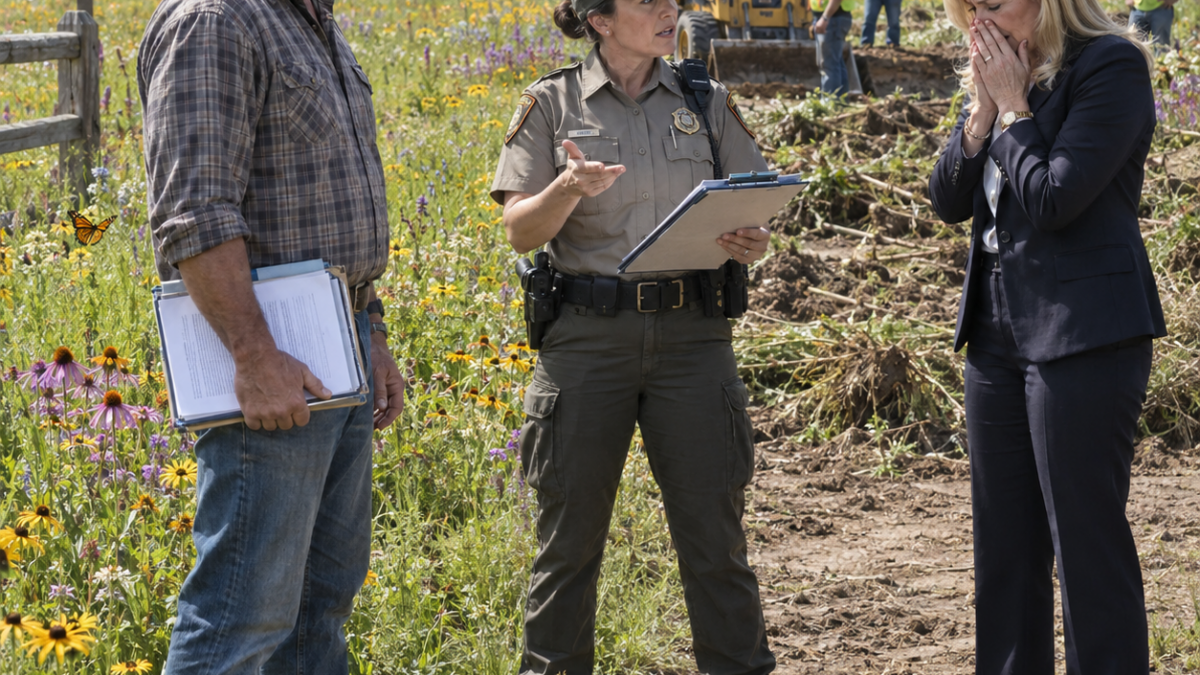
The first thing I saw was a monarch butterfly circling a field that no longer existed. The second was the HOA president standing in the middle of the destruction, smiling beside the machines that had just erased three years of work I had built in memory of my dead wife. And when Karen offered to help me pay for sod afterward, something inside me became so quiet that even she finally stopped smiling.
“This is a violation of community standards, Mr. Miller.”
Her voice barely registered over the diesel engines winding down behind her.
I stood at the edge of what had been my wildflower meadow that morning.
Purple coneflowers.
Black-eyed Susans.
Butterfly weed.
Milkweed.
Big bluestem.
Indian grass.
Gone.
Commercial brush cutters had shredded nearly an acre into a brown, muddy scar.
The men operating them were climbing down from their machines now, looking increasingly uncomfortable as they realized the man walking toward them was probably not the one who had hired them.
Karen Peters stood between us in a bright red blazer, holding her HOA clipboard against her chest.
My boots sank into torn soil.
“You hired these men?”
“The board authorized corrective landscaping.”
“On my property?”
“Your so-called meadow was an eyesore.”
I looked behind her.
Three years.
Three years of preparing soil, removing invasive plants, studying native seed mixes, waiting through seasons when almost nothing bloomed.
Three years of trying to finish the dream Sarah never got to see.
My wife had been a biologist.
She could identify a bird from three notes of its song and spot a native plant from fifty feet away.
Before cancer took her, before my final Army deployment ended, before I came home to a house that still held her clothes but not her voice, we had planned that meadow together.
One night at the kitchen table, Sarah had drawn it on a napkin.
“No sterile lawn,” she’d told me.
“What do you have against lawns?”
“Nothing.”
She smiled.
“I just want something alive.”
She drew flowers along the drainage swale.
“Milkweed here.”
A patch of native grasses near the road.
“Bluestem there.”
Then she looked at me.
“We’ll bring the butterflies back.”
I kept that napkin after she died.
At first, I couldn’t even look at it.
Then one morning I carried it outside and started digging.
The meadow became the only project that made the empty house bearable.
Every spring, when the first coneflowers opened, it felt like Sarah had left me a message in color.
And now it was gone.
Karen tapped her clipboard.
“We sent three notices.”
“I answered three notices.”
“You refused to comply.”
“Because these weren’t weeds.”
“They exceeded the permitted landscape height.”
“They were native plants.”
She gave me the same condescending smile I had seen at every HOA meeting.
“Native weeds are still weeds.”
One of the workers looked down at the ground.
I could tell even he knew how ugly that sentence sounded.
“You had no authority to enter my property,” I said.
Karen sighed.
“The board held an emergency vote.”
“You still needed permission.”
“We have a duty to protect property values.”
Her eyes swept across the ruined acre.
“Frankly, we did you a favor.”
For the first time, my hands clenched.
Twenty-five years in the Army Corps of Engineers had taught me something useful about anger.
When it rises fast, slow everything else down.
I breathed once.
Then again.
Karen mistook silence for surrender.
“You can put down proper sod now,” she said. “The HOA may even reimburse half the cost.”
I looked at her.
“Half?”
“As a gesture of goodwill.”
Something fluttered behind her.
A monarch.
It circled above the mud, descended once toward the place where the milkweed had stood that morning, then climbed again.
Searching.
That nearly broke me.
Not the machines.
Not Karen.
That butterfly.
I took out my phone.
Karen straightened.
“What are you doing?”
“Documenting.”
Her smile vanished slightly.
I slowly recorded the machines, the company logo on the truck, the torn earth, the tire ruts, and finally Karen herself standing twenty feet inside my property.
Then I asked one simple question.
“What company did you hire?”
Her eyes narrowed.
“Why?”
I stopped recording.
“Because I’m going to need their name for the report.”
“What report?”
I looked at the ruined meadow one more time.
Then back at her.
“The one that starts this.”
PART 2
Karen gave a short laugh.
It was the kind people use when they are afraid something might be serious but haven’t yet decided whether to show it.
“What exactly do you think you’re going to report?”
“Trespass.”
Her expression barely changed.
“Destruction of private property.”
A small twitch near her mouth.
“And whatever else my attorney finds when he looks at what you’ve done.”
That reached her.
“You can’t sue me.”
“I didn’t say I was suing you.”
“The HOA is indemnified.”
“I didn’t ask.”
“The board voted.”
“You keep saying that like five people voting gives you a deed to my land.”
Her face reddened.
Behind her, the older landscaper had shut off the last brush cutter.
The sudden silence was enormous.
For months, the meadow had been alive with insects.
Bees.
Finches.
Wind moving through grass.
Now all I heard was cooling machinery ticking in the afternoon air.
I walked toward the workers.
“Who’s in charge?”
The older man raised one hand.
“That’d be me.”
“Your name?”
“Mike Dalton.”
“Mr. Dalton, were you told I authorized this?”
He glanced at Karen.
Karen answered for him.
“They were given a lawful work order from the association.”
I kept my eyes on Mike.
“What were you told?”
His expression tightened.
“Ma’am said it was HOA-maintained frontage and the board had approved clearing.”
“It is not HOA-maintained frontage.”
“I understand that now.”
He looked genuinely sick.
“We weren’t trying to get in the middle of anything.”
“I know.”
That surprised Karen.
She had expected anger.
Probably hoped for it.
An angry widower threatening contractors would fit her version of me nicely.
Instead, I asked Mike for his company information.
He gave it.
I photographed the truck.
The equipment.
License plates.
The ruts.
Then I returned to Karen.
“You need to leave.”
She drew herself upright.
“I’m here in my official capacity.”
“You are standing on private property after directing people to destroy it.”
“This conversation is over.”
“Yes.”
I pointed toward the road.
“It is.”
For several seconds we stared at each other.
Karen’s whole identity depended on other people eventually looking away.
I didn’t.
Finally she stepped backward.
Her heel sank in the soft earth.
She stumbled.
Caught herself.
Then marched toward her SUV.
Before she got inside, she turned.
“You brought this on yourself, Jack.”
I felt something cold go through me.
Not because of the accusation.
Because she used my first name.
Sarah had always hated when people used familiarity as a weapon.
“You brought this on yourself.”
I heard those words in Sarah’s voice instead.
Not approving.
Warning.
Karen drove away.
I called the sheriff.
The deputy who arrived was named Cole Matthews.
Young enough that I briefly wondered whether he had been in middle school when I made major.
He walked the property with me.
Watched the video.
Looked at the letters.
He was sympathetic.
But careful.
“Mr. Miller, I’ll make a report.”
“That’s all I’m asking.”
“I need you to understand something.”
“Go ahead.”
“Because there’s an HOA relationship and they’re claiming covenant authority, the district attorney may look at most of this as civil.”
“She entered my land.”
“I agree.”
“She hired people to destroy twenty thousand dollars’ worth of cultivated plants.”
“I understand.”
“She had no court order.”
“I see that.”
“So why is this complicated?”
Deputy Matthews exhaled.
“Because law is complicated.”
I almost laughed.
That was exactly what my father used to say whenever the Army did something insane.
Matthews continued.
“I’ll document the trespass allegation and property damage. But if you’re expecting me to put handcuffs on your HOA president tonight, that probably isn’t happening.”
“I’m not asking you to.”
He looked relieved.
“Good.”
He finished writing.
Before leaving, he stopped beside the ruined meadow.
“My wife liked this place.”
I looked at him.
“She drove by?”
“Sometimes. She teaches at Oakmont Elementary.”
He nodded toward the mud.
“She used to slow down because the kids liked seeing the butterflies.”
That hurt more than it should have.
“Tell her I’m sorry.”
“You didn’t do it.”
“No.”
I looked at the torn earth.
“But I still feel like I failed it.”
Matthews studied me for a second.
“Doesn’t look dead to me.”
I frowned.
He pointed.
Near the edge of the destruction, a purple stem remained.
Bent.
Half stripped.
But standing.
“Looks hurt.”
He handed me the incident number.
“That’s different.”
Then he left.
I stayed outside until dark.
At one point I knelt in the mud.
I found a crushed butterfly weed stalk and turned it between my fingers.
That was when I noticed the channel.
Most people would have missed it.
Even I might have missed it if the vegetation had still been there.
A shallow depression crossed the lower corner of the meadow.
Maybe six inches at its deepest.
During dry weather, it looked like nothing.
During heavy rain, water moved through it from the higher lots, under the road through a culvert, then down toward Oakmont Creek.
I knew the drainage because I had reviewed the site plans when Sarah and I bought the property.
Army engineers notice water.
Ignore water, and sooner or later water teaches you why you shouldn’t.
Karen’s crew had driven directly across the swale.
The brush cutters had scraped sections of soil bare.
Tire ruts crossed the channel.
Mud had been pushed into the low point.
I stood slowly.
The anger changed shape.
Until then, I had been looking at a destroyed garden.
Now I was looking at disturbed drainage connected to a creek.
And Oakmont Creek fed Hatcher Reservoir.
Three counties drew drinking water from that reservoir.
I went inside.
The house smelled faintly like Sarah’s cedar chest.
It had been four years, and certain rooms still carried traces of her.
I opened the drawer beside the kitchen phone.
The napkin was there.
Protected now inside a clear plastic sleeve.
Her handwriting had faded slightly.
milkweed
coneflower
little path
birdbath?
At the bottom, Sarah had drawn a butterfly.
Terribly.
My wife was many things.
An artist was not one of them.
I sat down.
For the first time since coming home that afternoon, my anger cracked.
“I’m sorry.”
The words came out before I realized I had spoken.
The empty kitchen answered with silence.
“I tried.”
I ran my thumb across the plastic.
“I really tried, Sar.”
Grief is strange after enough years.
It stops being an ocean.
Becomes weather.
Most days you carry it without thinking.
Then something shifts pressure, and suddenly the storm is directly overhead.
I put my head down on the table.
For maybe five minutes, I was not Colonel Miller.
Not an engineer.
Not a homeowner building evidence.
Just a husband who had promised his dying wife he would plant flowers.
Eventually I sat up.
Wiped my face.
And called the one man I knew who might understand both water regulations and how angry I was.
David Riley answered on the fourth ring.
“Please tell me you are calling because you finally need help building that ridiculous footbridge you described ten years ago.”
“They destroyed Sarah’s meadow.”
Silence.
Every hint of humor disappeared.
“What?”
I told him.
The notices.
The HOA meeting.
Karen.
The crew.
The sheriff.
The drainage swale.
Dave had served as a JAG officer while I was with the Corps.
After leaving the Army, he had built a practice around environmental and land-use law.
He was one of those lawyers who could make federal regulations sound like battlefield coordinates.
When I finished, he said nothing for several seconds.
Then:
“Send me everything.”
“Tonight?”
“Now.”
I scanned the HOA letters.
My certified responses.
Photographs before and after.
The sheriff report number.
Video.
Property plans.
The old drainage survey.
Dave called again at 11:42.
“You awake?”
“You knew I would be.”
“I’ve looked at the drainage.”
“And?”
“Don’t get ahead of yourself.”
That was vintage Dave.
“You called me.”
“Yes, because there is potentially something here.”
“Federal?”
“Potentially.”
He emphasized the word.
“Water jurisdiction is technical and fact-specific. We need a qualified wetlands and drainage specialist. We need current site conditions. We need to know what was disturbed, where the material went, what the hydrology looks like, and what protections actually apply.”
“So Karen may have created an environmental problem.”
“She may have created several problems.”
I looked toward the dark window.
“Good.”
Dave went quiet.
“Jack.”
“What?”
“Don’t do that.”
“Do what?”
“Turn this into revenge.”
“She destroyed Sarah’s meadow.”
“I know.”
“You didn’t see it.”
“I don’t need to.”
His voice softened.
“But if you make this revenge, you’ll make mistakes.”
I leaned back.
“Then what do I make it?”
“A case.”
That word grounded me.
A case.
Facts.
Measurements.
Documentation.
Sequence.
I could do that.
Dave continued.
“Tomorrow you hire a wetland specialist.”
“Already know one.”
“Of course you do.”
“I was an engineer.”
“You were unbearable.”
“Still am.”
“Yes.”
For the first time that night, I smiled.
He continued.
“Second, do not touch the damaged area unless necessary to prevent further harm. Photograph everything.”
“I have.”
“Third, find out exactly what authority Karen claimed to the contractor.”
“Work order.”
“Get a copy.”
“Think they’ll give it?”
“They may once they understand they were possibly misled.”
“And then?”
“Then we decide whether this belongs with state environmental officials, federal regulators, civil court, or some combination.”
I looked at Sarah’s napkin.
“And the meadow?”
“Later.”
That answer angered me.
“What do you mean later?”
“You restore too early, you alter evidence.”
I closed my eyes.
Of course.
“So I have to leave it like this.”
“For now.”
I hated him for being right.
The next morning, I called Dr. Emily Park.
Emily was a wetlands scientist who had consulted on Corps projects before I retired.
She came out with two assistants.
They worked for almost two days.
Survey flags.
Soil cores.
GPS.
Elevation measurements.
Vegetation remnants.
Photographs.
Drainage mapping.
I followed until Emily finally turned.
“Jack.”
“Yes?”
“Go away.”
“This is my property.”
“And you are hovering.”
“I don’t hover.”
One of her assistants laughed.
Emily pointed toward the house.
“Coffee.”
I obeyed reluctantly.
When she finished, she sat with me on the porch.
“You were right that this low area is hydrologically significant.”
“How significant?”
“We need lab work and records.”
She opened her tablet.
“The swale connects seasonally through the culvert to the tributary network feeding Oakmont Creek.”
“So Dave was right.”
“Don’t tell him.”
“I intend to.”
She ignored me.
“There are also wetland indicators here.”
“How much area?”
“Enough that whoever ordered mechanical clearing without checking may have created regulatory exposure.”
That was careful scientist language.
“What kind?”
“I am not your lawyer.”
“Everyone has become very disappointing.”
Emily smiled slightly.
“What I can tell you is that running heavy equipment through drainage and wetland features without understanding permitting requirements is a terrible idea.”
“Put that in the report.”
“I’ll use more syllables.”
The report cost me almost three thousand dollars.
I would have paid twice that.
Thirty-four pages.
Maps.
Cross sections.
Soil profiles.
Photographs.
Hydrology.
A conclusion that the disturbed lowland and connected drainage required regulatory review.
Dave read it.
Then called.
“Now we have something.”
“How much?”
“Enough to notify agencies.”
“EPA?”
“Possibly EPA and other relevant regulators. We do this correctly.”
No drama.
No threats.
No calling Karen to brag.
Instead, Dave sent a preservation notice to the HOA.
He requested every document concerning my property.
Board minutes.
Emails.
Invoices.
Work orders.
Payments.
Communications with the landscaping company.
Voting records.
The legal basis they claimed for entry.
At the same time, I called Dalton Landscape Services.
Mike Dalton answered personally.
“Mr. Miller.”
“You remember me.”
“Believe me.”
“I’m not calling to threaten you.”
“That is not what our insurance carrier thinks.”
“I need the work order.”
Silence.
“You’ll need to talk to our attorney.”
“Fine.”
I gave him Dave’s information.
Then said:
“Mike, I know your crew didn’t wake up that morning looking for somebody’s memorial garden to destroy.”
He sighed.
“We were told the HOA had authority.”
“I believe you.”
“Karen showed us board paperwork.”
“Did she tell you permits were handled?”
A longer silence.
“Yes.”
“Was that written?”
“Probably.”
“Then give it to your lawyer.”
Two days later, Dave called.
“Christmas.”
“What?”
“I have the contract.”
I drove to his office.
The work authorization sat on his desk.
Client: Oakmont Creek Homeowners Association
Scope:
Clear noncompliant vegetation.
Grade disturbed frontage as necessary.
Prepare surface for turf restoration.
Then the certification.
The signer represented that all permissions and permits required for the work had been obtained.
Below it:
Karen Peters, HOA President
Her signature.
Large.
Looping.
Confident.
Dave tapped the page.
“This matters.”
“She lied.”
“Careful. We know her representation appears inconsistent with the facts. Intent is another question.”
“You really know how to ruin a good sentence.”
“Law school.”
We also obtained a statement from Mike.
He confirmed Karen personally directed the location.
Confirmed she told them the work was HOA-authorized.
Confirmed I had not been present.
Confirmed no one from his company had contacted me for consent.
That was enough for my civil claim.
But Dave wanted more.
“Karen is going to say the whole board authorized it.”
“She already did.”
“Then we find out.”
The HOA initially resisted our records demand.
They sent three recent meeting minutes.
Nothing else.
No checks.
No invoices.
No emails.
No complete voting record.
Dave read their lawyer’s response.
“Cute.”
“What?”
“They’re pretending your request is broader than your rights.”
“What do we do?”
“Ask properly again, cite the state association-records statute, and prepare to compel production if necessary.”
That sounded less cinematic than the war Karen probably imagined.
It was far more dangerous to her.
Paper.
The kind she couldn’t shout over.
Meanwhile, I started talking to neighbors.
Not campaigning.
Listening.
Mrs. Gable lived three houses down.
Seventy-four.
Widowed.
Rose garden so neat Sarah would have teased her relentlessly.
I brought tea.
She brought out a folder.
“You keep records?”
“I was married to an accountant.”
Inside were violation notices.
Garden gnome.
Wind chime.
Bird feeder.
One warning because her trash can had remained visible forty minutes beyond the permitted window.
I held up the bird-feeder notice.
“Attracting vermin?”
“Apparently cardinals are the first stage.”
I laughed.
She didn’t.
“My Henry gave me that feeder.”
Her voice changed.
“Last Christmas before he died.”
I understood immediately.
Grief attaches itself to objects.
A napkin.
A feeder.
A meadow.
The world sees things.
We see people.
“Did you remove it?”
“For a week.”
“Then?”
“I became angry.”
She smiled.
“Put it back.”
“Good.”
Her smile faded.
“Karen doesn’t understand that rules can hurt people.”
“No.”
“She thinks if she applies them to everyone, cruelty becomes fairness.”
That was exactly it.
Next I spoke to Jessica and Tom Reynolds.
They had supported me at the landscaping meeting.
Two kids.
Both with asthma.
Jessica let me inside.
Tom remained near the window.
“You’re asking us to go against the board.”
“I’m asking what you saw.”
“Same thing.”
“No.”
I leaned forward.
“You don’t have to choose me. Just tell the truth if anyone asks.”
Jessica looked at Tom.
“We heard the vote.”
“How did it happen?”
Tom sighed.
“She rushed it.”
“No count?”
“No.”
“Did everyone vote?”
“No.”
“Did the board vote separately?”
“I couldn’t tell.”
Jessica added:
“She already had the amendment printed like it was decided.”
That fit Karen.
I collected statements.
Others came quietly.
A basketball hoop violation.
Door color.
Holiday lights removed one day late.
A couple fined because their native shrubs looked “unstructured.”
Nothing on its own proved my environmental case.
Together, it explained Karen’s style.
Pressure.
Humiliation.
Certainty.
A belief that authority meant she didn’t need consent.
I installed cameras.
That was one of the saddest moments.
Sarah had loved our front yard because it felt open.
No tall fence.
No surveillance signs.
“We should trust where we live,” she used to say.
Now I mounted cameras under the eaves.
Three nights later, they caught Karen’s SUV slowing outside.
Gary Harper, one of her board allies, leaned through the passenger window and photographed the damaged meadow.
A week later, Karen herself came after dark.
She stepped onto my property with her phone light on.
Photographed the mud.
Walked several yards toward the swale.
Then left.
I watched the footage twice.
Dave watched once.
“Save original.”
“Already did.”
“Back it up.”
“Already did.”
“You’re annoyingly competent.”
“Thank you.”
“It wasn’t praise.”
The first major confrontation after the destruction came at another HOA meeting.
Karen had proposed an amendment limiting tall non-turf plantings across front-facing areas.
Everyone knew why.
She wanted to make sure that even if I restored the meadow, she could call it noncompliant again.
I attended.
This time with photographs.
Water-use data.
Pollinator studies.
Before-and-after pictures.
Not to lecture.
To show people what had existed.
When the floor opened, I stood.
“My name is Jack Miller, 412 Aspen Lane.”
Karen looked as though she had swallowed vinegar.
“I know who you are.”
“I’m speaking for the record.”
That annoyed her more.
I projected the first photograph.
The meadow in June.
Purple.
Gold.
Butterflies everywhere.
A few people murmured.
“This was not abandoned land.”
Next photograph.
Milkweed with monarch caterpillars.
“This was cultivated.”
Next.
Root systems.
“This required less irrigation than turf.”
Next.
The drainage area.
“These plants stabilized the low ground without fertilizer.”
A woman raised her hand.
“My kids loved that field.”
Karen interrupted.
“We are not here to debate butterflies.”
Jessica spoke.
“Why not?”
Karen stared at her.
Jessica rarely spoke at meetings.
“My kids have asthma. Mr. Miller’s meadow didn’t get sprayed every month.”
Karen’s face darkened.
“This association cannot run on individual preferences.”
Mrs. Gable stood.
“Then why is your preference always the rule?”
The room went quiet.
I looked at Mrs. Gable.
So did Karen.
“What did you say?”
The old woman’s hands trembled.
Her voice did not.
“You don’t like Jack’s flowers, so you destroy them.”
“Martha—”
“You don’t like my gnome, so you fine me.”
“That is completely unrelated.”
“You don’t like Jessica’s yard signs, Tom’s basketball goal, Gary’s neighbor’s door color—”
Gary shifted awkwardly.
Karen hammered the gavel.
“Out of order.”
Mrs. Gable sat.
But something had changed.
People had heard themselves named as a pattern.
Karen forced the amendment through.
Three board allies voiced approval.
She ignored calls for a count.
Declared it passed.
Banged the gavel.
Meeting adjourned.
Outside, Jessica caught me.
“She can’t do that, can she?”
“Depends on the bylaws and voting procedure.”
“She just did.”
“That’s different.”
Mrs. Gable joined us.
“She’s scared.”
I looked through the clubhouse window.
Karen was gathering papers angrily.
“What makes you say that?”
“She never used to rush.”
Mrs. Gable adjusted her purse.
“She used to enjoy watching people lose.”
The environmental report went out the next morning.
Not as a threat.
As part of a formal demand letter.
Dave drafted it.
Damage estimate:
Twenty-eight thousand dollars to restore the meadow properly.
The letter laid out unauthorized entry.
Destruction.
Environmental disturbance.
The drainage findings.
The contractor’s work order.
The permit representation.
The new amendment.
It went to every board member individually.
Not because Dave was theatrically “piercing a corporate veil,” as I joked.
Because he wanted no one later claiming ignorance.
The final section gave the HOA a chance.
Fund restoration.
Rescind improper enforcement related to the meadow.
Review the amendment.
Cooperate with environmental remediation.
Preserve records.
Ten business days.
No press.
No lawsuit filed yet.
No public humiliation.
Just an exit ramp.
On day three, Frank Nolan, one of the quieter board members, drove to my house.
I had never spoken to him alone.
He stayed in his car at first.
Then got out.
“Jack.”
“Frank.”
“Can we talk?”
We sat on the porch.
He looked toward the destroyed field.
“I didn’t know.”
“About what?”
“The drainage.”
“Neither did Karen.”
“She says it’s made up.”
“It isn’t.”
“I read the report.”
“Then why are you here?”
Frank rubbed both hands over his face.
“Because Karen is telling us not to respond.”
My stomach tightened.
“Your lawyer?”
“She doesn’t want him involved beyond sending rejection language.”
“Why?”
“She says engaging legitimizes your claim.”
“That’s an interesting legal theory.”
Frank looked miserable.
“I voted for the cleanup.”
That surprised me.
“You?”
“I thought they were going to mow.”
I stared at him.
“She said corrective landscaping.”
“Yes.”
“You approved contractors entering my property?”
He looked down.
“I thought the covenants allowed it.”
“Did you read them?”
His silence answered.
I stood.
“I think you should leave.”
“Jack.”
“I’m serious.”
“I’m trying to tell you—”
“You voted to send people onto my land without asking me.”
“I know.”
“No, Frank. I don’t think you do.”
My voice rose for the first time.
“I came home and watched a monarch circle mud where my wife’s milkweed had been that morning.”
Frank went still.
I continued.
“My wife died while I was still in uniform.”
His face changed.
“That field was hers.”
“I didn’t know.”
“Exactly.”
I stepped toward the porch rail.
“You didn’t know because nobody asked.”
Silence.
I regretted the volume.
Not the words.
Frank stood slowly.
“I’m sorry.”
“I believe you.”
He looked relieved.
“I’m still angry.”
Relief vanished.
“I understand.”
“Good.”
He left.
On day nine, the HOA’s attorney responded.
Rejected.
Called our environmental concerns speculative.
Characterized restoration demands as excessive.
Defended the board’s landscaping authority.
Dave read the letter aloud over speakerphone.
Sarah would have laughed at his dramatic voice.
I didn’t.
When he finished, he said:
“Well.”
“They chose no.”
“They chose no.”
“Now what?”
“Now we report the environmental disturbance.”
I looked at the napkin in its little frame.
“Do it.”
The package went to the appropriate environmental authorities, including EPA regional staff.
Survey.
Photos.
Contractor affidavit.
Work authorization.
Drainage maps.
Video.
HOA communications.
Everything.
Then nothing happened.
One day.
Three.
Five.
I began checking my email constantly.
Dave yelled at me.
“Stop.”
“You said they may respond.”
“I said may.”
“They should.”
“Government does not schedule itself around widowers glaring at inboxes.”
Day eight.
I was in my workshop cleaning one of Sarah’s old garden tools when a dark sedan stopped outside.
Government plate.
A man got out wearing khakis and a polo with an agency insignia.
No drama.
No tactical vest.
No flashing lights.
He walked toward the meadow.
I set down the tool.
Went outside.
“Mr. Miller?”
“Yes.”
“Daniel Davies. Environmental Protection Agency.”
There it was.
Not triumph.
Not relief.
Something heavier.
Because federal officials do not come to admire flowers.
“We received a referral concerning possible unauthorized disturbance affecting a protected drainage feature.”
“I have the survey.”
“I’ve seen it.”
That surprised me.
He held up a tablet.
“I’m here for field verification and documentation.”
“Tell me what you need.”
For more than an hour, he worked.
Measurements.
Photos.
Soil.
Questions.
Where were machines operating?
Which direction?
How deep were ruts?
Had fill been added?
Had soil been moved?
When did it rain afterward?
Did runoff leave the property?
I answered only what I knew.
When I didn’t know, I said so.
At one point he crouched beside the swale.
“What grew here before?”
“Sedges on the lower edge. Prairie plants above.”
“Any pictures?”
“Thousands.”
That almost made him smile.
“Widower?”
I looked at him.
“How did you know?”
He pointed toward the porch.
The framed napkin was visible through the window.
“Someone doesn’t frame landscaping plans unless they matter.”
I nodded.
“My wife drew it.”
He stood.
“I’m sorry.”
“Thank you.”
He remained professional.
No promises.
No comments about Karen.
Finally he closed his tablet.
“I have enough for today.”
I expected him to return to the car.
Instead he crossed the road.
Toward Karen’s house.
I sat on the porch.
Not because I wanted entertainment.
That is what I told myself.
The truth was less dignified.
I absolutely wanted to see her face.
Karen was watering hanging flowers.
Perfect petunias.
Perfect porch.
Perfect lawn.
She saw Agent Davies and straightened.
Even from a distance, I could recognize the posture.
The Karen posture.
Shoulders back.
Chin up.
Who are you to inconvenience me?
He introduced himself.
Her body stiffened.
He pointed toward my property.
She began gesturing.
I could not hear most of it.
Then her voice rose.
“HOA AUTHORITY.”
Another fragment.
“HE REFUSED.”
Then:
“RIDICULOUS.”
Agent Davies barely moved.
He waited.
When she finished, he showed her something on the tablet.
Probably the work authorization.
Karen leaned in.
I saw her face change.
She looked toward me.
Across the road.
For one second, our eyes met.
I didn’t smile.
That mattered to me.
I wanted to.
God help me, I wanted to.
Instead I lifted my glass of iced tea and drank.
Agent Davies handed her an envelope.
Then left.
Karen remained in the driveway.
Still.
The watering can lay on its side.
Water ran across her immaculate concrete.
Jessica called within an hour.
“There was an EPA guy at Karen’s.”
“Yes.”
“What happened?”
“Investigation.”
“Is she in trouble?”
“I don’t know.”
“You sound like you know.”
“I know she hired the crew.”
“Jack.”
“I’m serious.”
I looked across the road.
Her blinds were closed.
“We let the process work.”
That evening the HOA board met privately.
Frank’s truck.
Gary’s sedan.
Two other cars.
All at Karen’s.
They stayed until nearly midnight.
The next morning a notice appeared on the clubhouse board.
EMERGENCY COMMUNITY MEETING
Agenda:
Environmental enforcement matter.
Board governance.
Potential financial exposure.
Karen’s reign was finally being discussed in language she couldn’t rewrite as landscaping taste.
The official preliminary enforcement notice arrived before the meeting.
The numbers moved through Oakmont Creek faster than wildfire.
Potential association penalty:
$150,000.
Personal penalty associated with authorization:
$37,500.
The final amounts could change through process, review, negotiation, or enforcement.
Nobody cared about nuance by lunchtime.
People heard:
Karen’s meadow cleanup may cost us six figures.
That night the clubhouse overflowed.
I sat in the back.
Mrs. Gable on my left.
Jessica and Tom on my right.
Karen sat at the board table in black.
No red blazer.
No triumphant smile.
Frank opened.
His hand shook slightly.
“As homeowners are aware, the association has received a notice from federal environmental regulators concerning work performed at 412 Aspen Lane.”
Murmurs.
“The notice alleges unauthorized disturbance within a protected drainage and wetland area.”
Louder murmurs.
“Preliminary penalties against the association may reach one hundred fifty thousand dollars.”
The room exploded.
“What?”
“Are you kidding?”
“That’s our money!”
Frank raised both hands.
“Please.”
Someone shouted:
“Who authorized it?”
Everybody already knew.
Frank continued.
“The agency also identified potential individual liability for the person who executed the work authorization.”
Karen grabbed the microphone.
“This is absurd.”
Frank tried to stop her.
She pulled it closer.
“This entire situation has been manufactured by Mr. Miller.”
Every head turned toward me.
“There it is,” Mrs. Gable whispered.
Karen pointed.
“He refused to follow landscaping standards. He deliberately created an illegal environmental condition and then weaponized federal agencies against his own neighbors.”
I stood.
Not fast.
Not angry.
Frank looked at me.
“Mr. Miller?”
“I’d like five minutes.”
Karen shouted:
“No.”
Frank looked at his fellow directors.
Then toward the furious crowd.
“Yes.”
I walked forward with my laptop.
The projector screen lowered.
First photograph.
Sarah’s meadow.
Full bloom.
The room changed.
People had seen it from the road.
Few had seen it close.
Monarchs covered milkweed.
Purple coneflower stood waist-high.
Goldfinches clung to seed heads.
“This is what Karen called an illegal weed field.”
Next slide.
My first HOA response.
Certified.
Species list.
Environmental information.
Next.
Second notice.
Next.
My response.
Next.
The amendment meeting recording.
I played Karen’s voice.
The ayes have it.
Then Tom’s voice.
You didn’t count.
Then Karen:
The decision is made.
Someone in the room muttered:
“Jesus.”
Next slide.
The morning of destruction.
Machines.
Mud.
Shredded plants.
Karen standing in the middle.
Next.
Work authorization.
I zoomed in.
Her signature.
The permit certification.
Silence.
“This is the document provided by the contractor.”
Karen yelled:
“They were responsible for permits!”
Dave had prepared me for that.
I displayed the next paragraph.
Client certifies required permissions and authorizations have been obtained.
I looked at the room.
“I never gave permission.”
Next slide.
Wetland and drainage report.
Not every technical detail.
Just the map.
Blue line.
Swale.
Culvert.
Creek.
Reservoir.
“The environmental issue is not that my flowers were special.”
That surprised people.
“It is that heavy equipment was directed across a regulated drainage area without first determining what authorization was required.”
I looked toward Karen.
“That decision was not mine.”
Next slide.
Our settlement letter.
Date.
Ten business days.
Restoration request.
Cooperation request.
Board review request.
Then the HOA response.
Rejected.
I let both sit side by side.
“We tried to solve this before the agency complaint.”
Frank looked down.
Gary looked sick.
“We gave the board the environmental report.”
I looked at Frank.
“To his credit, one director came to me privately because he was worried.”
Frank’s head lifted.
I continued.
“But the formal board response rejected the issue.”
Karen stood.
“You threatened us!”
“No.”
“You extorted this board.”
“No.”
“You said you would report us if we didn’t pay you.”
Dave had also prepared me for that.
“We said we would pursue available legal and regulatory remedies if the damage was not addressed.”
Karen laughed bitterly.
“Same thing.”
“No.”
I closed the laptop.
“You spent months believing everything was the same thing as your authority.”
The room became still.
“A vote meant consent.”
I pointed toward the screen.
“A rule meant ownership.”
Another.
“A fine meant guilt.”
Another.
“A title meant expertise.”
I looked at her.
“And a meadow meant weeds because you said it did.”
Karen’s mouth opened.
I didn’t let her interrupt.
“You weren’t punished because I planted flowers.”
My voice cracked slightly.
“You are here because you sent machines onto property you didn’t own and never stopped once to ask what you were cutting through.”
Then I stepped back.
“That’s the timeline.”
I returned to my seat.
Mrs. Gable stood before I even sat.
Her hands trembled.
“My husband Henry gave me a garden gnome twenty-two years ago.”
Half the room looked confused.
Karen closed her eyes.
Mrs. Gable continued.
“Karen fined me because she said it was tacky.”
People laughed nervously.
“It is tacky.”
More laughter.
Even I smiled.
Mrs. Gable raised her voice.
“But it was Henry’s.”
The room quieted.
“He died six years ago.”
She looked at Karen.
“You knew that.”
Karen said nothing.
“You told me sentiment did not override community standards.”
A woman near the front whispered:
“Oh my God.”
Mrs. Gable’s eyes filled.
“That is what you told Jack too, isn’t it?”
Karen stared down.
“That anything we love becomes worthless the moment you disapprove of how it looks.”
Jessica stood.
“She rammed through the amendment.”
Tom stood.
“She didn’t count votes.”
A man across the room raised his hand.
“She fined me for a basketball hoop.”
Another:
“My Christmas lights.”
Another:
“Trash cans.”
Another:
“My door color.”
Gary Harper, one of Karen’s most reliable supporters, remained seated.
People looked toward him.
Finally he spoke.
“She told me the clearing was legal.”
Karen snapped:
“It was.”
Gary stood.
“Then why is there a federal fine?”
“You voted for it too!”
His face went pale.
There it was.
The split.
Karen finally understood what happened when collective power produced individual consequences.
Frank reached for the gavel.
“I would like to make a motion.”
Karen turned.
“What motion?”
His voice strengthened.
“A motion of no confidence in the president.”
“You can’t.”
“The bylaws permit officer removal.”
“I am elected.”
“As director, yes. As president, you serve at board pleasure.”
Karen stared.
Frank continued.
“I further move that the association initiate the process required to remove Karen Peters from the board entirely.”
A woman director immediately said:
“Second.”
Karen looked at Gary.
“Gary.”
He would not look at her.
“Gary.”
Silence.
She looked at the fourth director.
Nothing.
The vote to remove her as president passed.
Then homeowners demanded the broader removal procedure begin immediately.
The room had become chaos.
Not violence.
Not a mob.
Something more dangerous to Karen.
Participation.
People reading bylaws on phones.
Asking procedure.
Demanding recorded votes.
The same homeowners who had once let her define the rules now wanted to read them themselves.
Karen lost the presidency that night.
Weeks later, after the required association process, she lost the board seat too.
When Frank banged the gavel and announced she was no longer president, the room did not erupt the way I expected.
There was applause.
Then it faded.
Karen remained seated.
For the first time, she looked genuinely confused.
Not angry.
Not indignant.
Lost.
She had spent so many years making the title part of herself that I think she had forgotten what remained without it.
She gathered her binder.
One sheet fell.
Nobody picked it up.
She bent down herself.
Then walked out.
Mrs. Gable squeezed my arm.
“You won.”
I watched Karen disappear through the clubhouse doors.
“No.”
“What?”
“We stopped her.”
“That sounds like winning.”
“Maybe.”
But the meadow was still dead.
That mattered.
The regulatory case moved more slowly after the spectacular beginning.
Lawyers negotiated.
Experts submitted restoration plans.
The HOA’s new counsel cooperated.
Insurance became involved.
Final financial responsibility was split through agreements I never fully cared to understand.
The association absorbed a painful six-figure environmental penalty and remediation expense.
Karen remained personally responsible for a separate penalty tied to her authorization.
The exact figure everyone remembered was $37,500.
For months, people called it “the thirty-seven-five.”
I hated that.
It turned something complicated into gossip.
So I stopped discussing her fine.
My demand was simpler.
Restore the meadow.
Properly.
Not Home Depot seed thrown over mud.
Not cosmetic flowers.
Restoration.
The HOA’s insurer paid approximately twenty-eight thousand dollars toward the work.
Emily Park designed the plan.
When she showed me the first draft, I stared at it.
“This is not Sarah’s plan.”
“No.”
I looked up.
“Why not?”
“Because the site changed.”
That hurt.
She continued gently.
“Jack, restoration isn’t pretending disturbance never happened.”
I looked at the map.
New sedges around the drainage.
More milkweed.
A wider native grass buffer.
Additional species Sarah had never drawn.
Emily sat beside me.
“You can rebuild the old meadow.”
She touched one plan.
“Or you can build the next version.”
I stared at Sarah’s napkin lying beside the report.
“She wanted it alive.”
“Then let it change.”
That night I put the napkin and the new plan together.
For the first time, I noticed Sarah had written something at the edge.
Small.
Almost lost under a coffee stain.
room to grow
I laughed.
Then cried.
Then called Emily.
“Use the new plan.”
Restoration began in early fall.
Something happened I did not expect.
People came.
Jessica and Tom brought their children.
Mrs. Gable brought lemonade.
Deputy Matthews stopped while off duty.
Even Frank showed up in work gloves.
I looked at him.
“You sure?”
“No.”
“Good answer.”
He spent four hours spreading seed.
At one point he stopped beside me.
“I’m sorry.”
“You said that already.”
“I know.”
“Then stop.”
“I need you to understand.”
“I do.”
“No.”
He took off his gloves.
“I kept telling myself Karen knew the rules better than I did.”
I waited.
“So I stopped reading them.”
That was one of the most honest things anyone said.
“She was confident,” Frank continued. “Confidence is convenient. You can outsource your judgment to it.”
I looked toward Mrs. Gable helping one of Jessica’s kids scatter seed.
“What will you do differently?”
“Read.”
I smiled.
“That’s a start.”
The HOA repealed Karen’s landscape amendment.
Then they rewrote the original rule.
Native plantings.
Pollinator gardens.
Rain gardens.
Professionally maintained natural landscapes.
All explicitly permitted with reasonable safety standards.
Not everybody loved it.
Gary still preferred turf.
That was fine.
Freedom to plant wildflowers also meant freedom to love boring grass.
The new board also adopted stricter procedures for entering private lots.
Written notice.
Legal review.
Defined emergencies.
Owner consent or valid authority.
No more president deciding a contractor could “correct” somebody’s property.
Mrs. Gable put her gnome back.
Henry, apparently, had terrible taste.
The thing wore a blue coat, red hat, and held a tiny ceramic mushroom.
I visited one afternoon.
She pointed proudly.
“Well?”
“Karen may have had one valid complaint.”
Mrs. Gable hit me with a gardening glove.
Jessica’s children named part of the restored meadow “Butterfly Alley.”
The name was awful.
It stuck.
The first winter looked bleak.
Restoration always does.
Brown stems.
Bare earth.
Tiny markers.
Karen’s old lawn across the road remained perfectly green until the cold finally took it.
She still lived there.
For a while.
We avoided each other.
Then one February morning I found her standing near my mailbox.
Not on my property.
Road shoulder.
She looked tired.
No makeup.
Heavy coat.
“You called the EPA on me.”
It wasn’t a question.
“I reported environmental damage.”
“You knew what would happen.”
“No.”
“Your friend did.”
“No.”
She laughed bitterly.
“Everything is technical with you.”
“I’m an engineer.”
“You ruined me.”
There it was.
I had expected the sentence.
Still didn’t know what to do with it.
“I did not hire the crew.”
“You knew I couldn’t pay that fine.”
“I didn’t set it.”
“You turned the neighborhood against me.”
“I showed them what happened.”
“You humiliated me.”
“You removed my wife’s memorial while I was at the VA.”
Karen’s face tightened.
“You never told me it was a memorial.”
“I sent you documentation about what it was.”
“That is not the same thing.”
“No.”
I stepped closer to the property line.
“It isn’t.”
She looked toward the frozen meadow.
“If you had told me about your wife—”
“What?”
She stopped.
“You would have spared it?”
Karen didn’t answer.
“That is not the defense you think it is.”
Her eyes flashed.
“I was enforcing rules.”
“No. You were enforcing yourself.”
“You don’t know how hard that job was.”
I said nothing.
“Everyone complained.”
Her voice grew faster.
“Everybody wanted exceptions. Everybody thought their yard was special. Their dog was special. Their decoration was special.”
She pointed toward Mrs. Gable’s house.
“You know how many stupid arguments I dealt with?”
“Probably too many.”
“Nobody thanked me.”
“That happens.”
“Then the moment something went wrong, they all turned on me.”
For the first time, I heard what existed underneath the arrogance.
Resentment.
Karen had volunteered to manage things.
Then people used her willingness.
Then responsibility became identity.
Identity became control.
Control became entitlement.
Understanding it did not excuse her.
But it made her less mysterious.
“My wife used to say something,” I told her.
Karen stared.
“She said systems fail when one part starts believing it is the whole organism.”
A faint, bitter smile.
“Sounds like something a biologist would say.”
“She was annoying.”
Karen looked toward the meadow.
“Was she sick long?”
“Two years.”
“I didn’t know.”
“No.”
“You were deployed?”
“At the end.”
“That must have been…”
She didn’t finish.
I appreciated that.
Some things become smaller when strangers label them.
“Yes.”
She looked at me.
“I didn’t know.”
I nodded.
Then I said:
“But you didn’t need to.”
Her brow tightened.
“You didn’t need my tragedy to respect my property.”
Silence.
“You didn’t need Sarah’s cancer to make trespass wrong.”
She looked down.
“You didn’t need to like my meadow.”
I pointed toward her house.
“I never liked those petunias.”
She almost smiled.
Almost.
“But I didn’t mow them.”
That landed.
Karen pulled her coat tighter.
“My house is listed.”
“I saw the sign.”
“I’m leaving.”
I didn’t know whether to say I was sorry.
So I said nothing.
“You happy?”
“No.”
She studied me.
“Really?”
“Really.”
“Why?”
I looked at the frozen field.
“Because Sarah still didn’t get to see it.”
That ended everything.
Karen opened her mouth.
Closed it.
Then walked away.
I never spoke to her again.
The moving truck arrived in March.
I was repairing irrigation near the house.
Karen carried boxes out.
Once, she looked across the road.
I nodded.
She nodded back.
No forgiveness scene.
No apology.
No dramatic collapse.
Just two people who had spent a year occupying far too much space in each other’s lives.
Then she got into her car.
Drove away.
And Oakmont Creek became quieter.
Spring came slowly.
The first green appeared near the swale.
Sedges.
Then grasses.
Then tiny coneflower rosettes.
One morning Jessica’s daughter, Lily, knocked on my door at 7:10.
I opened it half asleep.
“Mr. Jack!”
“What’s on fire?”
“Nothing.”
“Then why are you here before coffee?”
“Come.”
She grabbed my hand.
Her mother was jogging behind her apologizing.
“Lily, leave him alone.”
“What happened?”
The girl dragged me toward the meadow.
“There!”
I looked.
At first I saw nothing.
Then movement.
A monarch.
Early.
Probably passing through.
It landed on a small milkweed plant barely a foot high.
Nobody spoke.
Jessica put both hands over her mouth.
Lily whispered:
“It came back.”
That sentence undid me.
I sat down right there in the grass.
The butterfly opened and closed its wings.
Orange.
Black.
Alive.
Sarah’s terrible napkin drawing flashed in my mind.
I could hear her laughing.
We’ll bring the butterflies back.
Lily looked worried.
“Mr. Jack?”
“I’m okay.”
“You’re crying.”
“Old people do that.”
“My dad says men cry.”
“Your dad has become dangerously enlightened.”
Jessica laughed through her own tears.
The monarch stayed less than a minute.
Then lifted.
Circled.
Disappeared over the houses.
But it had landed.
That was enough.
By June, the meadow exploded.
Not like the old one.
Emily was right.
You cannot recreate exactly what existed.
This meadow was different.
More textured.
Wetter near the low channel.
Taller grass farther back.
A wider mix of flowers.
Purple coneflower.
Black-eyed Susan.
Bee balm.
Butterfly weed.
Asters.
Goldenrod.
Milkweed.
Sedges.
Bluestem.
Life everywhere.
The restored drainage handled a heavy storm in July better than before.
Water slowed.
Spread.
Filtered.
No erosion.
Emily came out after the storm.
I showed her.
She pretended not to be pleased.
“You engineers are insufferable when water goes where you predicted.”
“We deserve joy.”
“You drew arrows on a map.”
“Correct arrows.”
Mrs. Gable arrived carrying lemonade.
Behind her waddled Henry the gnome in a wheelbarrow.
“What are you doing?”
“He needs to see the meadow.”
“He is ceramic.”
“He has feelings.”
Emily whispered:
“Your neighborhood is strange.”
“You have no idea.”
The new board organized a pollinator day that fall.
I nearly refused.
Then Frank asked:
“Would Sarah have?”
That was unfair.
“Yes.”
So I agreed.
Kids from the elementary school came.
Including Deputy Matthews’s wife’s class.
They walked through a mowed path.
Looked for caterpillars.
Counted bees.
Learned why dead stems sometimes stay through winter.
One boy asked:
“Why did you make all this?”
I looked at twenty children waiting.
There were several answers.
Environmental value.
Drainage.
Pollinators.
Water.
But the true answer was simpler.
“My wife asked me to.”
The teacher smiled.
“Where is she?”
Kids ask questions adults avoid.
“She died.”
The boy lowered his eyes.
“Oh.”
“It’s okay.”
I knelt.
“She loved flowers.”
“Did she plant them?”
“Sort of.”
“How?”
“She drew the plan.”
I showed them a copy of the napkin.
They laughed at the butterfly.
Good.
Sarah would have laughed too.
The boy pointed.
“That butterfly is bad.”
“Terrible.”
“Mine is better.”
“I believe you.”
He looked across the meadow.
“So this is like her garden?”
“Yes.”
Then he thought.
“No.”
I waited.
“It’s bigger.”
I smiled.
“Yes.”
“Maybe she’d like it more.”
That was the kindest thing anyone had said to me in years.
That evening, after everyone left, I sat alone on the porch.
The meadow moved in the wind.
No applause.
No board meeting.
No federal agents.
No legal documents.
No contractors.
Just the quiet hum of insects.
For months I had believed justice would feel like Karen being fined.
Then I believed it would feel like her removal.
Then I thought watching the moving truck would bring closure.
None did.
Justice felt like this.
Flowers where there had been mud.
Children following butterflies.
Water flowing cleanly through the swale.
Mrs. Gable’s ugly gnome visible three houses away.
Jessica’s children playing outside.
Frank reading bylaws before voting.
An HOA board that asked before acting.
Restoration.
That was the word I had missed.
My entire adult life had been built around construction.
Bridges.
Roads.
Drainage.
Fortifications.
Systems.
When something failed, you rebuilt.
Grief taught me something engineering never did.
Some things cannot be rebuilt.
Sarah could not.
Our life together could not.
The meadow I originally made for her could not.
But restoration was not rebuilding the past.
It was carrying something from the past into whatever came next.
The second year, monarch numbers increased.
Lily and her brother started keeping count.
They made a notebook.
Every time they saw one, they marked the date.
By August, the cover was bent and dirty.
Lily showed me proudly.
“Forty-three.”
“That many?”
“Yes.”
“Are you counting the same butterfly twice?”
She looked offended.
“We have rules.”
“Sorry.”
“Mom says you like rules when they’re good rules.”
Her mother, standing twenty feet away, suddenly found the sky fascinating.
I smiled.
“She’s right.”
“What’s a bad rule?”
That question deserved care.
“A rule that forgets why it exists.”
Lily frowned.
“What?”
“Rules are supposed to help people live together safely and fairly.”
I pointed toward the road.
“Stop signs are useful.”
She nodded.
“Rules about not poisoning the creek?”
“Useful.”
“Rules about gnomes?”
“Dangerous territory.”
She laughed.
I continued.
“But when people care more about enforcing a rule than whether it makes sense, sometimes the rule becomes the problem.”
She looked at the meadow.
“Like Karen?”
Children also say names adults avoid.
“Sometimes.”
“Mom says she was mean.”
“Your mom should stop talking around you.”
Lily grinned.
The third spring, a new family moved into Karen’s house.
Michael and Priya Desai.
Two daughters.
No interest in HOA politics.
Their first weekend, Michael walked over.
“I should introduce myself.”
“Jack.”
“Michael.”
We shook hands.
He glanced toward the meadow.
“So this is the famous meadow.”
“That depends on who’s talking.”
“My realtor.”
“That is concerning.”
“She said there was some kind of lawsuit.”
“Of course she did.”
“EPA?”
“Long story.”
He looked across the flowers.
“My wife loves it.”
“Good.”
“My oldest wants to plant milkweed.”
“Better.”
He hesitated.
“Is that allowed?”
The question hit me harder than it should have.
“On your property?”
“Yes.”
I smiled.
“Ask your HOA.”
His face fell.
Then he realized I was joking.
“You’re terrible.”
“So I’m told.”
The Desais planted a small native garden beside the house Karen had kept obsessively manicured.
Not a meadow.
Just a curved bed.
Milkweed.
Coneflower.
Asters.
The new HOA approved it without controversy.
Mrs. Gable called me.
“Have you seen Karen’s old yard?”
“Yes.”
“Flowers.”
“Yes.”
“Native flowers.”
“Yes.”
“Do you appreciate the irony?”
“Deeply.”
She sighed contentedly.
“I may live forever now.”
“Please don’t threaten us.”
Years began softening the whole story.
The fine stopped being front-page neighborhood gossip.
The destroyed meadow became something newcomers only vaguely knew about.
Karen’s name disappeared from board meetings.
Policies changed.
People changed.
I changed.
For a long time, every flower carried Sarah.
That sounds beautiful.
Sometimes it wasn’t.
Sometimes it meant I couldn’t enjoy the meadow without feeling her absence.
Then slowly, almost without noticing, the place became mine too.
And Lily’s.
And Mrs. Gable’s.
And the bees’.
And the schoolchildren’s.
And the neighbors who helped spread seed.
That didn’t dilute Sarah’s memory.
It fulfilled it.
We’ll be custodians, not conquerors.
I understood the sentence differently now.
At first, I thought Sarah had meant the land.
Take care of it.
Don’t dominate it.
But maybe she meant life.
You cannot own every outcome.
You cannot force every season.
You cannot keep everything you love exactly as it was.
You tend it while it is yours.
Then you let it become whatever comes next.
One October afternoon, I found the original framed napkin slightly faded from sunlight.
I took it down.
For years, I had treated it like a relic.
Sacred.
Untouchable.
Then I did something I never expected.
I took it to a local framing shop.
Asked them to preserve the original properly.
Beside it, I placed a photograph.
Not of the first meadow.
The second.
The restored one.
In the photograph, Jessica’s kids were scattering seed.
Mrs. Gable stood behind them.
Frank carried a rake.
Emily was pointing at something.
And I was kneeling near the swale.
Under both pieces, I added a small brass plate.
It read:
SARAH’S MEADOW
Started by two. Restored by many.
When I hung it in the living room, I stood there for a long time.
Then I heard Sarah’s imagined voice.
Too sentimental, Jack.
Probably.
She would have loved it.
A few months later, Frank knocked on my door.
He had a folder.
That still made me nervous.
“What?”
“Relax.”
“Folders caused problems here.”
He sat.
“The board wants to purchase conservation signage for the common drainage area.”
“That sounds responsible.”
“We also want to create a voluntary native-yard program.”
I stared.
“Who are you people?”
He laughed.
“Things change.”
“They do.”
He looked toward the framed napkin.
“Can we name the program after Sarah?”
I didn’t answer immediately.
My instinct was no.
Sarah didn’t belong to an HOA initiative.
Then I imagined her reaction.
She would have hated the ceremony.
Loved the result.
“What would it do?”
“Small grants for native plants.”
“Education?”
“Yes.”
“No mandatory participation?”
“No.”
“No telling people they’re morally inferior because they have lawns?”
Frank smiled.
“No.”
“Then yes.”
The Sarah Miller Native Habitat Fund started with HOA money recovered through insurance and donations.
Tiny.
A few hundred dollars.
Then local businesses contributed.
The university extension office joined.
Within two years, twenty-seven homes in Oakmont Creek had native plant beds.
Not meadows.
Not everyone wanted one.
That was never the goal.
Choice was.
One summer, I drove through the neighborhood and saw milkweed beside Karen’s old house.
Coneflowers near Jessica’s driveway.
A rain garden beside the clubhouse.
Even Gary Harper had planted three black-eyed Susans near his mailbox.
I stopped my truck.
Gary saw me staring.
“They were on sale.”
“Of course.”
“My wife likes them.”
“Naturally.”
“I still prefer lawn.”
“You are allowed.”
He pointed at me.
“Don’t get smug.”
“I wouldn’t dream of it.”
I drove away smiling.
Karen once feared that my meadow would spread.
In a way, she had been right.
Not because rules forced anybody.
Because people saw something beautiful and chose some of it for themselves.
That was the difference she never understood.
Control can produce uniformity.
It cannot produce community.
Community grows sideways.
Through invitation.
Example.
Trust.
Help.
One afternoon, several years after everything happened, Deputy Matthews stopped again.
No uniform this time.
Gray at the temples now.
His wife was with him.
“You remember me?”
“Unfortunately.”
He laughed.
“She made me stop.”
His wife walked toward the meadow.
“I used to bring my class past here before…”
She hesitated.
“Before it was destroyed.”
“Yes.”
“They loved it.”
“So I heard.”
She turned.
“It’s better now.”
I looked across the flowers.
“Different.”
“Better.”
I accepted it.
Matthews pointed toward the lower edge.
“That where the drainage issue was?”
“Yes.”
“So if Karen hadn’t destroyed it…”
“No investigation.”
“She wouldn’t have been fined.”
“Probably not.”
“She wouldn’t have been removed?”
“Maybe not.”
He shook his head.
“She destroyed the thing that exposed her.”
I thought about it.
For years, that had sounded like poetic justice.
Now it sounded sad.
“She could have just left it alone.”
He nodded.
“People have trouble doing that.”
After they left, I sat on the porch.
The sun was low.
A monarch moved between milkweed blossoms.
Then another.
Then another.
I counted without meaning to.
Three.
Sarah would have corrected me.
Monarchs, Jack. Not butterflies. Specificity matters.
I smiled.
“I know.”
The meadow answered with wind.
That was the final thing Karen gave me without intending to.
For years after Sarah died, I thought holding onto her meant protecting what she had left exactly as I remembered it.
The napkin.
The house.
The plans.
The meadow.
Karen’s destruction felt unbearable because I believed she had destroyed one of the last pieces of Sarah still physically present.
But she hadn’t.
She couldn’t.
Sarah wasn’t in the flowers.
She was in why I planted them.
She was in my decision to rebuild.
She was in Lily learning milkweed from clover.
She was in Jessica’s children breathing easier beside gardens without constant chemicals.
She was in Frank learning that leadership meant asking questions.
She was in Mrs. Gable refusing to throw away something ridiculous because love had made it valuable.
She was in the neighbor who planted three flowers beside a mailbox simply because his wife liked them.
You cannot mow that down.
You cannot fine it.
You cannot regulate it out of existence.
Karen took a brush cutter to my meadow because she believed power meant the ability to remove whatever refused to conform.
The EPA penalty ended her presidency.
The homeowners ended her control.
The moving truck ended her time in Oakmont Creek.
But none of those things were the ending that mattered.
The ending came the morning I stepped outside years later and found a monarch resting on the same species of milkweed Karen had ordered destroyed.
I stood there quietly.
No phone.
No photograph.
No evidence.
Nothing to prove.
Just me.
The butterfly opened its wings.
Closed them.
Opened them again.
Then lifted into the morning air.
It circled once above Sarah’s meadow and disappeared toward the creek.
I watched until I could no longer see it.
Then I went back inside.
The framed napkin hung on the wall beside the photograph of everyone restoring the land.
Two versions of the same dream.
One imagined by Sarah.
One built after loss.
For the first time since she died, I looked at both without feeling like something had been taken from me.
The meadow had survived.
Not because every original plant survived.
Most didn’t.
Not because I stopped change.
I couldn’t.
It survived because enough roots remained beneath the damage to begin again.
Maybe people are like that too.
Karen thought she had erased a field.
Instead she uncovered everything beneath it.
The law.
The neighbors.
The water.
The truth about her leadership.
And, eventually, the part of me that had spent years believing grief meant guarding ruins.
She forced me to learn that the strongest answer to destruction is not destruction in return.
It is restoration.
And every summer, when Sarah’s meadow turns purple and gold again, I am reminded that something beautiful does not have to remain untouched to remain alive.
Sometimes it gets cut down.
Sometimes it looks gone.
Sometimes all you can see is mud.
Then the season changes.
The roots wake up.
And the butterflies come home.








