PART 2: HOA President Locked Me Out of My Own Land—Her $485 Gate Stunt Ended in an $88,635 Judgment
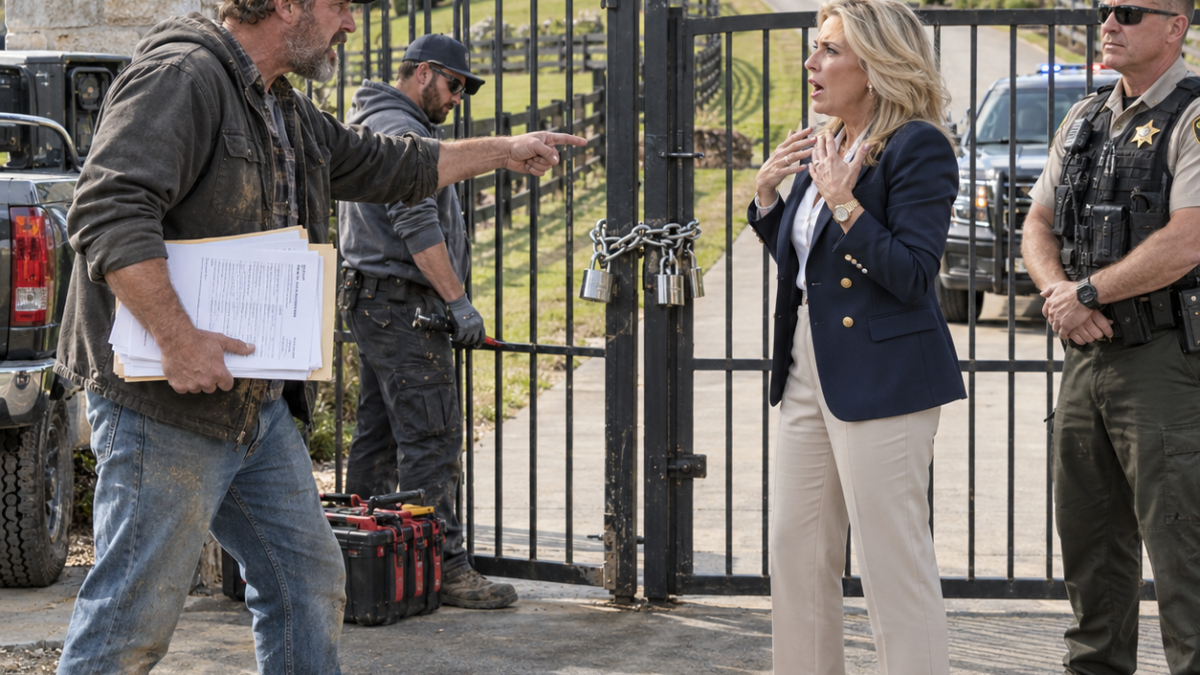
The new HOA president changed the lock on the only gate to my property and stood there smiling while my truck idled on the wrong side.
She told me my sixty-year-old deeded access rights no longer mattered because her board had “voted on it.”
What she didn’t understand was that one piece of paper sitting in my filing cabinet was about to turn her little power move into the most expensive gate change of her life.
I stared through the windshield of my old F-250 at the heavy wrought-iron gate I had driven through thousands of times.
Something was different.
A thick, industrial chain had been wrapped through the bars.
A massive new padlock hung from it.
My key—the same brass key I had used that morning—wouldn’t fit.
Then Karen Smith stepped into view.
She had been elected president of the Harmony Creek Homeowners Association less than two months earlier, and she already carried herself like the subdivision had been deeded directly to her.
Pastel-pink tracksuit.
Oversized sunglasses.
Clipboard tucked beneath one arm.
A smile that told me she had been waiting for this moment.
“This entrance is now restricted to Harmony Creek residents,” she said.
I lowered my window.
“Open the gate.”
“You’re not a member of the HOA.”
“I know.”
“Then you’re no longer authorized to use HOA property.”
Sarah sat beside me and slowly turned her head.
I could feel her looking at me.
She knew that tone in my voice.
“Karen,” I said, “this road is the only legal access to my land.”
She shrugged.
“That sounds like a problem you should have considered before deciding not to join the association.”
I almost laughed.
Not because anything was funny.
Because the statement was so breathtakingly ignorant.
My family had owned our ten-acre parcel since the 1950s.
Harmony Creek didn’t exist when my grandfather bought the land.
There were no identical stucco houses.
No decorative entrance sign.
No HOA.
When my father sold the surrounding acreage to the developer decades later, he agreed to let them build the subdivision’s road across part of the old family tract.
But he was careful.
He retained a permanent recorded easement guaranteeing our parcel access over that road forever.
The agreement also made the gate a shared asset.
My father had helped pay for it.
His signature was on the maintenance agreement.
The easement was filed with the county.
It was referenced in the development records.
Karen’s board could no more vote it away than they could vote to move the property line.
I held up my useless key.
“You changed the lock without notifying me?”
“We secured HOA property.”
“You changed a shared gate.”
“The board made a decision.”
“When?”
“That’s association business.”
“Who advised you that you could block a recorded easement?”
Her smile widened.
“Our next board meeting is in three months. You’re welcome to submit your concerns in writing.”
Three months.
I looked past the gate toward the gravel road winding into the trees.
My house sat beyond it.
So did my workshop.
I made custom furniture for a living.
A truck carrying nearly twelve thousand dollars’ worth of black walnut was scheduled to arrive the next morning.
There was no second road.
No service entrance.
No alternate delivery point.
Karen hadn’t just inconvenienced me.
She had cut my business off from the outside world.
Sarah leaned toward me.
“Mark, don’t do anything stupid.”
“I’m not going to.”
Karen crossed her arms.
“You’ll need to move your truck. You’re blocking the entrance.”
That was the moment something inside me became perfectly calm.
I had spent twenty years with the Army Corps of Engineers.
I had learned that when a structure failed, anger didn’t fix it.
You identified the weak point.
You documented the damage.
Then you applied force exactly where it mattered.
I switched off the engine.
The sudden silence seemed to unsettle Karen.
I pulled out my phone.
She smirked.
“Calling the police?”
“No.”
I scrolled through my contacts.
“First I’m calling an emergency locksmith.”
Her smile disappeared slightly.
“You cannot cut an HOA lock.”
“Then I’m calling my property attorney.”
“You’re threatening me?”
“No.”
I looked directly at her.
“I’m explaining what happens next.”
Sarah said nothing now.
Neither did Karen.
I continued.
“The locksmith bill will be itemized. Any delivery losses will be documented. My attorney’s time will be documented. Every dollar this costs because you interfered with a recorded easement will go into the same file.”
Karen laughed.
“You seriously think I’m personally paying for your tantrum?”
“I don’t know yet.”
I hit CALL.
“But I have a feeling we’re going to find out.”
Forty minutes later, a locksmith named Gus climbed out of a battered service van, took one look at Karen’s new chain, and whistled.
“Who put this monster on a residential gate?”
I pointed toward Karen.
She was still standing there.
Still watching.
Still convinced she was right.
Gus pulled an angle grinder from his van.
Orange sparks exploded across the evening air.
The chain screamed beneath the cutting wheel.
And for the first time since I’d arrived, Karen stopped smiling.
PART 2
The chain snapped with a sharp metallic crack.
Karen actually jumped.
Gus looked up from behind his face shield.
“You want me to keep going?”
“Yes.”
Karen rushed forward.
“You stop right now!”
Gus lowered the grinder.
He looked at me.
Then at her.
Then back at me.
“Who owns the gate?”
“It’s shared,” I said. “I have a recorded easement and a maintenance agreement.”
Karen pointed at me.
“He is not an HOA member.”
Gus scratched his beard.
“That wasn’t my question.”
Her mouth tightened.
“This gate belongs to Harmony Creek.”
I opened the folder I’d taken from behind the seat of my truck.
I had started carrying copies of my deed years earlier because delivery companies occasionally questioned the unusual access arrangement.
I pulled out the plat map.
Then the easement page.
Then the old shared-maintenance agreement.
Gus read enough to understand the basics.
He looked toward Karen.
“Lady, I’m not your lawyer.”
“Exactly.”
“But if this gentleman has legal access through this gate, I’m not leaving him locked outside his own house.”
“You are destroying association property.”
“No,” Gus said. “I’m removing a chain.”
Karen reached for her phone.
“I’m calling the sheriff.”
“Go ahead.”
Gus put his face shield back down.
The grinder screamed to life again.
The second cut went through the hardened shackle.
Sparks bounced across the pavement.
The lock dropped to the ground.
Karen made a sound like someone had kicked her dog.
Gus removed the new hardware without touching the old gate mechanism.
The original lock still worked.
My original key still opened it.
That detail mattered.
Karen hadn’t been repairing anything.
She had deliberately installed a second system to exclude me.
Gus handed me the destroyed chain.
“You keeping this?”
“I think I will.”
“Thought so.”
He wrote up the invoice on the hood of his van.
Emergency commercial callout.
Labor.
Industrial hardware removal.
After-hours surcharge.
Total: $485.
I paid him immediately.
Then I photographed the receipt.
Front.
Back.
Timestamp.
Karen watched from ten feet away.
I held the paper up just long enough for her to see the total.
“Four hundred eighty-five dollars,” I said.
Her expression twisted.
“You chose to destroy the lock.”
“No. You chose to install it.”
“That’s your opinion.”
“No.”
I folded the invoice.
“That’s going to be an exhibit.”
For the first time, I saw uncertainty.
Only for a second.
Then she covered it with contempt.
“You are going to regret challenging this association.”
I climbed into the truck.
Sarah waited until we were through the gate before speaking.
“That went well.”
“Depends how you define well.”
“You didn’t get arrested.”
“Strong start.”
She sighed.
“Mark.”
“I know.”
“No, I don’t think you do.”
I glanced at her.
“You have that look.”
“What look?”
“The Fallujah contractor look.”
Despite myself, I laughed.
Years earlier, a subcontractor had tried to pass weak concrete as structural grade on one of our projects.
I had shut down an entire pour and made him tear out a day’s work.
Sarah had heard the story too many times.
“I’m not going to war with the HOA.”
She stared at me.
“Say that again and listen to yourself.”
I didn’t answer.
Because she was right.
By the time we reached the house, I knew exactly what I was going to do.
Not fight emotionally.
Build a record.
That night, after dinner, I went into my office.
Most people stored family history in photo albums.
Mine was partly stored in land records.
Deeds.
Surveys.
Tax maps.
Old correspondence with the developer.
Maintenance invoices from the original gate.
My father kept everything.
He believed memory was useful, but paper won arguments.
At the bottom of a fireproof file box, I found the agreement.
The paper had yellowed slightly.
My father’s signature appeared on the last page beside the developer’s.
The central clause was exactly as I remembered it.
The easement granted permanent ingress and egress to our parcel.
Not temporary.
Not conditional on HOA membership.
Not subject to future association bylaws.
Permanent.
Recorded.
Binding.
There was also language establishing shared responsibility for the gate and road maintenance.
I sat back.
Sarah came into the doorway wearing her robe.
“You found it?”
“Yep.”
“Good?”
“Better than good.”
She walked in.
I pointed at the clause.
“Read that.”
She did.
Then she smiled.
“Oh.”
“Exactly.”
“So tomorrow you show Karen?”
“Tomorrow I give her one chance to fix this without lawyers.”
Sarah raised an eyebrow.
“One?”
“One.”
“You rehearsing that number?”
“No.”
“Because it sounded rehearsed.”
I kissed her forehead.
“Go to bed.”
“You coming?”
“Eventually.”
I spent another hour scanning every relevant document.
Then I made three copies.
One for Karen.
One for my lawyer.
One for the truck.
The following morning I walked down through Harmony Creek.
I could have driven.
I wanted time to cool down.
Karen lived in one of the larger homes near the clubhouse.
Her lawn looked like it had been trimmed with surgical instruments.
I rang the bell.
She opened the door wearing a turquoise tracksuit.
Apparently she owned the full spectrum.
Her expression soured.
“What do you want?”
“To solve this before it becomes expensive.”
I held out a manila envelope.
She didn’t take it.
“What is that?”
“The recorded easement.”
“I already told you—”
“Read it.”
“I don’t need to.”
“Yes, you do.”
Her eyes narrowed.
“Don’t tell me what I need to do on my own property.”
“This isn’t about your property.”
I opened the envelope and showed her the first page.
“The easement predates your subdivision. The gate is governed by a shared maintenance agreement. My access is permanent.”
She barely glanced at it.
“The community adopted new security rules.”
“HOA rules do not erase recorded property rights.”
“That is your interpretation.”
“No.”
I kept my voice calm.
“That is basic property law.”
Karen folded her arms.
“Our board voted.”
“Your board cannot vote to landlock my parcel.”
“You keep using dramatic language.”
“It’s the only access.”
“That’s not our fault.”
“It becomes your fault when you physically block it.”
She stepped closer.
“If you trespass on HOA property again, I will have you prosecuted.”
I stared at her.
“For driving through the gate my deed gives me legal access to?”
“For destroying HOA property.”
“I gave you a chance.”
“I don’t need your chances.”
“Take the papers.”
“No.”
“At least give them to your association attorney.”
She laughed.
“We know how to run our community.”
That sentence told me everything.
She didn’t care whether she was legally right.
She cared whether she could make me obey.
I slipped the documents back into the envelope.
“All right.”
“That’s right.”
“No, Karen. I mean all right.”
I turned to leave.
She called after me.
“Your locksmith stunt will be discussed by the board!”
I looked over my shoulder.
“Good. Put it in the minutes.”
Then I walked home and called Alan Shoreline.
Alan was the kind of lawyer who made calm sound threatening.
Former JAG.
Semi-retired.
Property and contract law.
White hair.
Wire-rim glasses.
Office furniture that looked older than I was.
One enormous marlin mounted behind his desk.
He listened without interrupting while I explained everything.
When I finished, he held out his hand.
“Documents.”
I slid the file across.
He read the easement.
Then read it again.
Then the maintenance agreement.
Then the deed.
Then Gus’s invoice.
Finally, he leaned back.
“Your father knew what he was doing.”
“He usually did.”
“This easement is extremely clear.”
“So she can’t lock me out.”
“She can physically lock you out.”
I frowned.
Alan smiled.
“The law cannot stop stupidity before it happens. It can make stupidity expensive afterward.”
That was the first moment I liked him.
“What are my options?”
“Immediate injunctive relief if necessary. Damages for business interruption if you can prove them. Recovery of reasonable legal costs under several possible theories. Potential bad-faith liability if she continues after notice.”
“Personally?”
“Maybe.”
He held up one finger.
“Do not get ahead of yourself.”
“I’m listening.”
“The association has its own legal identity. Board members usually have some protection when acting within authority and in good faith.”
“And if they’re not?”
“That protection gets much less comfortable.”
He picked up the locksmith receipt.
“First move is cheap.”
“How cheap?”
“Compared to litigation? Very.”
He dictated while I sat there.
Formal demand.
Cease interference with easement.
Restore all keys and access.
Reimburse $485.
Attorney preparation fee.
Preserve all board records.
Warning of litigation.
“Send it to Karen personally,” Alan said, “and the association.”
“Certified?”
“Certified with return receipt.”
“Why both?”
“Because later, when someone says nobody knew, paper will disagree.”
The letters went out two days later.
Both were signed for.
Then nothing happened.
Ten business days passed.
No reimbursement.
No apology.
No board lawyer calling Alan.
Instead, I received an HOA violation notice.
I opened it at the kitchen counter.
Sarah watched my face.
“What?”
I handed it to her.
She read.
Then looked at me.
“Your gravel?”
“My gravel.”
She read it again.
“They’re fining you for the color of rocks?”
“Apparently my quarry offended the aesthetic vision of Harmony Creek.”
The notice claimed my driveway contained “non-uniform aggregate materials visible from shared roadways.”
Fifty dollars per day.
My driveway had existed before every house in Harmony Creek.
Half of it was hidden behind trees.
I scanned the notice and sent it to Alan.
His reply arrived three minutes later.
Call me.
I called.
He sounded delighted.
“Excellent.”
“I’m sorry?”
“This is excellent.”
“I’m being fined fifty dollars a day.”
“You are not paying it.”
“Good.”
“This is retaliation.”
“I figured.”
“She issued this after receiving formal legal notice?”
“Yes.”
“Wonderful.”
“I’m glad somebody’s enjoying it.”
“Mark, bad defendants sometimes create good cases.”
He paused.
“Save the original envelope.”
“Already did.”
“Of course you did.”
The lawsuit was drafted that week.
Before it was filed, Karen escalated again.
I was returning from a lumber supplier Monday afternoon when I saw the gate from two hundred yards away.
New sign.
New chain.
New lock.
Bigger than the first.
I slowed the truck.
My hands tightened around the steering wheel.
Sarah wasn’t with me.
That was probably good.
Because for about three seconds, I considered putting the F-250 in low gear and dragging the gate out of the ground.
Then Alan’s voice returned to my head.
Documentation is your sword and shield.
I parked.
Hazards on.
Phone out.
Video recording.
I started with the road sign.
Then the chain.
Then the lock.
Then the whole gate.
I spoke slowly.
“Monday, August 12. Two-fifteen p.m. This is the second time the Harmony Creek HOA has physically blocked the recorded access easement to my residence and business.”
I showed the road behind the gate.
“My house is beyond this entrance. There is no alternate vehicular access.”
I filmed the sign.
PRIVATE PROPERTY OF HARMONY CREEK HOA.
NO TRESPASSING.
VIOLATORS WILL BE PROSECUTED.
Then I called the sheriff.
Deputy Miller arrived about twenty minutes later.
Young.
Professional.
Not impressed by neighborhood drama.
I handed him the folder.
He read the deed.
Easement.
Demand letter.
He looked toward the gate.
“So this is the second time?”
“Yes.”
“Same association?”
“Same president.”
“Did you remove the first obstruction?”
“Licensed locksmith.”
“Receipt?”
I handed it over.
He actually smiled.
“You carry everything?”
“Today I do.”
Karen appeared while he was still reading.
She marched toward us.
“Officer, thank goodness.”
Miller looked up.
“This man has destroyed association property before, and now he is threatening to do it again.”
I said nothing.
Miller held up the easement.
“Ma’am, I’ve reviewed his documents.”
“They’re outdated.”
“Recorded deeds don’t usually become outdated because an HOA adopts a rule.”
“You don’t understand our bylaws.”
“You may be right.”
Karen smiled.
Then Miller continued.
“But your bylaws are not something I enforce.”
Her smile disappeared.
“He is trespassing.”
“He appears to have documented access rights.”
“This is HOA land.”
“He has an easement.”
“An old easement.”
Miller sighed.
“Ma’am, I’m not a civil judge.”
“Then arrest him when he cuts the lock.”
“I’m not going to promise you that.”
Karen stared.
“The only problem I see right now is an escalating civil dispute that is probably going to become extremely expensive.”
She turned on me.
“You hear that? Civil.”
I nodded.
“I heard.”
“It means the police won’t help you.”
Deputy Miller gave her a tired look.
“I don’t think that’s what I said.”
He filed an incident report.
That was all I wanted.
Official date.
Official location.
Official witness.
Second obstruction.
When Gus returned, he climbed from the van, looked at the new chain, and started laughing.
“You’ve got to be kidding.”
“Nope.”
He bent closer.
“Grade ten.”
“Meaning?”
“Meaning somebody spent money.”
“Can you remove it?”
“Can I?”
He opened the back of his van.
“Watch me.”
Second bill: $650.
I paid it.
Saved the invoice.
Photographed the chain.
Photographed the damaged lock.
Photographed the restored gate.
Added the sheriff’s report number to my log.
Lost work time: documented.
Delayed delivery: documented.
Customer rescheduling: documented.
I even recorded fuel costs from rerouting my day.
By bedtime, direct losses and costs were already over two thousand dollars.
Alan called.
“How are you feeling?”
“Expensive.”
“Good.”
“That’s becoming your favorite word.”
“They did this after receiving our demand.”
“Yes.”
“In front of a deputy.”
“Yes.”
“After being told about the easement.”
“Yes.”
He sounded almost cheerful.
“We file tomorrow.”
The complaint named Harmony Creek HOA.
And Karen Smith personally.
That mattered.
Alan alleged she had acted knowingly, maliciously, and outside legitimate board authority.
Initial damages: fifty thousand dollars.
Subject to increase.
The complaint was served on every board member.
That should have forced sanity.
Instead, Karen put another sign at the gate.
SUPPORT YOUR HOA.
COMMUNITY UNDER ATTACK BY LITIGIOUS LANDOWNER.
Sarah read it.
“Oh, I hate her.”
I laughed.
“What?”
“You’re usually the diplomatic one.”
“I was.”
She pointed at the sign.
“Past tense.”
Karen had turned the dispute into propaganda.
According to her, I was an outsider threatening property values.
Never mind that my family had owned the land before Harmony Creek existed.
Never mind that their road depended on the agreement my father had signed.
Never mind that the lawsuit existed because she had changed the locks twice.
I called Alan.
“Can I take the sign down?”
“No.”
“It’s attached to the gate.”
“Photograph it.”
“I did.”
“Then enjoy it.”
“Enjoy it?”
“She is publishing evidence of her hostility.”
“I hate lawyers.”
“No, you don’t.”
Unfortunately, he was right.
My next ally arrived unexpectedly.
Carol Benton lived near the gate.
Late seventies.
Silver hair.
Roses so perfect they looked artificial.
She had watched the second confrontation with Deputy Miller.
One afternoon I stopped while she was deadheading blooms.
“I saw you watching the other day.”
She stiffened.
“I don’t want trouble.”
“I’m not asking you for trouble.”
“That woman lives for trouble.”
“Karen?”
Carol snipped another rose.
“She’s made this place miserable.”
I waited.
People spoke more when you didn’t rush them.
“She fined George because our trash can stayed at the curb until noon.”
“George is your husband?”
“Yes.”
“She cited the Simmons family because their trim was cream instead of ivory. She sent three notices to a widow because her Christmas wreath stayed up until January eighth.”
I shook my head.
“Why does everyone tolerate it?”
Carol looked toward Karen’s street.
“We’re old.”
The answer hit harder than I expected.
“We don’t want war every time we leave the garbage bin outside.”
I lowered my voice.
“I’m not trying to hurt Harmony Creek.”
“I know.”
“She says I am.”
“She says many things.”
I told Carol about the easement.
Her eyes sharpened.
“George knows about that.”
“He does?”
“He was on the original board.”
I froze.
“What original board?”
“When the subdivision opened.”
“Your husband was there?”
“For years.”
“Would he remember my father?”
Carol smiled.
“He liked your father.”
Twenty minutes later I was inside their kitchen.
George Benton moved slowly, but his mind was sharp.
He remembered everything.
The developer.
My father.
The gate.
The road.
“The deal wouldn’t have happened without that access agreement,” George said.
“Why?”
“Your family owned the strip the developer needed.”
“That matches the deed history.”
“Your father could have made it difficult.”
“What did he do?”
“He told us he wanted neighbors, not enemies.”
Something tightened in my chest.
That sounded exactly like him.
George continued.
“He allowed the road arrangement as long as his parcel had permanent access.”
“Did the board understand it?”
“Everyone understood it.”
“Did the HOA share gate costs?”
“For years.”
“Any records?”
Carol and George looked at each other.
Then Carol said, “Attic.”
The next day they produced a cardboard box full of old newsletters.
Meeting minutes.
Maintenance notices.
Budgets.
One document from 1992 thanked my father by name for his cooperation in the original access arrangement.
A 1995 newsletter reminded residents that gate maintenance was shared with the Rivera parcel.
It was devastating to Karen’s claim.
The association itself had acknowledged our rights for decades.
I called Alan.
“You’re going to like this.”
“Bring coffee.”
I brought the box.
Alan read.
Then he looked at me.
“Your neighbors just gave us history.”
“Useful?”
“Extremely.”
He tapped the newsletter.
“This shows institutional knowledge.”
“So Karen can’t pretend the HOA never knew.”
“She can pretend anything she wants.”
He smiled.
“That’s what depositions are for.”
Discovery began.
Alan requested everything.
Board minutes.
Emails.
Texts.
Gate invoices.
Communications about me.
Communications about my land.
Legal opinions.
Insurance policies.
Meeting recordings.
Financial records.
The first production from Harmony Creek was pathetic.
Thin.
Disorganized.
Suspiciously incomplete.
The minutes authorizing the gate restriction consisted of one vague paragraph:
Motion to secure HOA assets for resident-only use.
Passed unanimously.
No discussion of my easement.
No legal review.
No mention of landlocking a neighboring parcel.
No lawyer’s advice attached.
Alan read it.
“Either they’re hiding documents or they made this up after the fact.”
“Can we prove which?”
“Eventually.”
He filed a motion to compel.
Meanwhile, another neighbor approached me.
Robert Lane.
Accountant.
Home office two doors from Karen.
He caught me near the mailbox.
“Mr. Rivera?”
“Mark.”
He glanced around.
“I have something.”
“What kind of something?”
“You should probably hear it.”
Robert’s office window faced Karen’s rear patio.
Karen apparently spent hours outside making phone calls at a volume designed for stadium announcements.
After the lawsuit, Robert began hearing my name.
A lot.
“She says she’s going to break you.”
“Meaning?”
“Financially.”
He swallowed.
“She tells someone named Brenda that the fines are supposed to make you sell.”
I felt the air leave my lungs.
“What?”
“She wants the HOA to buy your property.”
“For what?”
“Parkland.”
I stared at him.
“That’s why she locked the gate?”
“That’s what she says.”
“How do you know?”
Robert held up his phone.
“I recorded some of it.”
“Did she know?”
“No.”
Alan would later analyze the admissibility question carefully based on how the recordings were made and what state law allowed.
I did not want to rely on assumptions.
But the content itself was explosive.
Robert played one file.
Karen’s voice.
Loud.
Clear.
“We’ll keep changing the locks if we have to. Let him spend money.”
Another voice responded faintly through speakerphone.
Karen continued.
“Eventually he’ll get sick of the legal bills.”
Pause.
“Then we buy the parcel cheap.”
My skin went cold.
Another recording.
Karen again.
“That agreement his father signed isn’t worth the paper it’s printed on.”
Another.
“He thinks because he was in the Army he can intimidate me.”
Another.
“We bury him in violations.”
Then the sentence that changed the entire case.
“By the time he realizes what’s happening, he’ll either sell or go broke.”
I stopped the recording.
Robert looked nervous.
“I don’t want my name everywhere.”
“I understand.”
“I have to live here.”
“I understand.”
“Karen scares people.”
I looked at him.
“She scared people because nobody knew what anyone else knew.”
He nodded slowly.
“Do you want the files?”
“Yes.”
At Alan’s office, we listened to everything.
He barely moved.
When the last recording ended, he removed his glasses.
“Mark.”
“Yeah.”
“Things just became very bad for her.”
He reviewed how the recordings had been obtained before deciding what could lawfully be used.
The usable material established something we had suspected but couldn’t prove.
Intent.
The lock changes weren’t misguided security measures.
They were part of a pressure campaign.
Harass.
Fine.
Block access.
Increase costs.
Force sale.
Alan amended the complaint.
The damages demand climbed sharply.
Punitive damages now entered the picture.
The HOA’s insurance carrier became interested.
Very interested.
Then came Karen’s deposition.
Alan warned me beforehand.
“Do not react.”
“To what?”
“To anything.”
“You expect her to lie?”
“I expect her to be herself.”
The deposition room was bland.
Beige walls.
Conference table.
Water bottles.
Court reporter.
Karen arrived wearing a navy blazer and pearls.
She looked like she was attending a campaign debate.
Her lawyer sat beside her.
Alan started gently.
Name.
Address.
Role.
Term.
Board procedures.
Then:
“Ms. Smith, did you direct that the gate lock be changed on August first?”
“It was a board decision.”
“Did you propose it?”
“As president, I regularly propose motions.”
“Were you aware Mr. Rivera held an easement over the road?”
“He claimed to.”
“Had you seen the document?”
“I had seen something.”
“Before or after the first lock change?”
Karen paused.
“Before.”
I looked at Alan.
He didn’t react.
“Did you seek legal advice?”
“Yes.”
“From whom?”
“Our association counsel.”
Her lawyer shifted.
Alan continued.
“And counsel advised you that the easement could be disregarded?”
“That we had authority to secure HOA property.”
“Did counsel say your bylaws superseded Mr. Rivera’s recorded deed?”
“Yes.”
Her lawyer looked visibly uncomfortable now.
Alan wrote something down.
“After you received my certified demand letter, what did you do with it?”
“I sent it to counsel.”
“Immediately?”
“Yes.”
“Did you read the enclosed easement?”
“I reviewed it.”
“Did you tell any other board member that you intended to continue changing the locks regardless of legal advice?”
“No.”
“Did you state that Mr. Rivera could be driven into financial distress?”
“Absolutely not.”
“Did you want his property?”
Karen laughed.
“No.”
“For a park?”
Her laugh stopped.
Silence.
Alan folded his hands.
“Did the association ever discuss acquiring Mr. Rivera’s parcel?”
“No.”
“Never?”
“Never.”
“Did you personally discuss it?”
“No.”
“Did you say that repeated lock changes and fines might pressure him to sell?”
“That is absurd.”
“Did you say his father’s easement agreement was worthless?”
“No.”
“Did you say you would bury him in violations?”
“No.”
“Did you state that by the time litigation ended he would be bankrupt?”
Her lawyer interrupted.
“Asked and answered.”
Alan nodded.
“One final area.”
He slid a copy of the gate meeting minutes forward.
“Who prepared these?”
“The secretary.”
“When?”
“At the meeting.”
“Were they altered afterward?”
“No.”
“Did the board discuss Mr. Rivera’s easement?”
“I don’t recall.”
“Did anyone warn that blocking the gate might violate property law?”
“No.”
“Did association counsel attend?”
“No.”
“Yet counsel had already approved your plan?”
“Yes.”
Alan sat back.
“Thank you.”
He looked at the court reporter.
“No further questions at this time.”
In the hallway, I exhaled.
“That was it?”
Alan packed his legal pad.
“That was plenty.”
“She lied.”
“Yes.”
“Repeatedly.”
“Yes.”
“About the recordings.”
“Yes.”
“What now?”
“Now her board learns what she said.”
The next letter did not go to Karen.
It went to the other directors.
And the insurer.
Alan created a comparison.
Deposition statement.
Contradictory document.
Deposition statement.
Contradictory recording.
Deposition statement.
Historical HOA record.
He explained potential personal exposure.
He explained the risk that willful misconduct might fall outside ordinary insurance protection.
Then he gave the board seventy-two hours.
Remove Karen.
Recognize my easement.
Stop enforcement retaliation.
Enter settlement negotiations.
Or we would seek summary judgment and sanctions.
The deadline expired Thursday afternoon.
The HOA meeting was Thursday night.
By six-thirty, the clubhouse parking lot was full.
Sarah walked beside me.
Carol and George joined us.
Robert stayed back.
He had done enough.
Inside, nearly every chair was occupied.
Karen sat at the front table.
Frank, one of the board members, looked sick.
Brenda stared at her notes.
Another director I barely knew sat rigidly with both hands folded.
Karen saw me.
“You are not a Harmony Creek homeowner.”
Carol immediately stood.
“He is my guest.”
“This meeting is closed.”
“No,” Carol said. “It isn’t.”
That tiny exchange told me something.
The fear had shifted.
Karen felt it too.
She slammed her gavel.
“Meeting to order.”
Routine agenda items lasted seven minutes.
Then one director interrupted.
“Before we continue, we need to discuss the litigation.”
Karen’s head snapped around.
“That is not on the agenda.”
“It needs to be.”
“Our attorney handles litigation.”
“The homeowners deserve to know the exposure.”
Karen’s face tightened.
“This discussion is inappropriate.”
I raised my hand.
She ignored me.
Carol stood.
“I yield my guest time to Mark Rivera.”
Karen laughed bitterly.
“You don’t have guest time.”
The room began murmuring.
The director spoke again.
“Let him speak.”
Karen turned.
“You do not control this meeting.”
“No.”
He looked around the room.
“The board does.”
That landed.
I walked to the front.
No podium.
No theatrics.
One folder.
“My name is Mark Rivera. My family has owned the property beyond your gate for six decades.”
Most people already knew.
Some did not.
I explained the easement.
Simple language.
Permanent access.
Shared gate.
Recorded agreement.
I showed the old 1992 minutes.
Then the 1995 newsletter.
George confirmed the original board’s understanding.
I described the first lock.
$485.
The second lock.
$650.
The sheriff’s report.
The retaliatory gravel citation.
Then the lawsuit.
People began whispering.
A man near the wall called out.
“How much are you suing us for?”
I turned toward him.
“More than I ever wanted to.”
That quieted the room.
“I did not want to sue Harmony Creek.”
Karen scoffed.
I looked at her.
“You changed the lock twice.”
“For security.”
“No.”
Her eyes hardened.
I continued.
“That is what you told everyone.”
I held up Alan’s letter.
“But your sworn deposition said something else, and your private statements said something else again.”
The room went still.
Karen stood.
“You will not play illegally obtained recordings in this meeting.”
I hadn’t said anything about recordings.
That was her mistake.
A few people turned toward her.
Carol’s eyes widened.
I said quietly, “I didn’t say recordings.”
Karen froze.
The director beside her shut his eyes.
I continued.
“My attorney has already provided the relevant evidence to the board and its insurer.”
Someone called out.
“What evidence?”
I looked toward the directors.
“This is your association. They should tell you.”
Frank swallowed.
Karen pointed at him.
“Do not.”
Frank looked at her.
Then at the homeowners.
Then down at his papers.
Finally, he spoke.
“The president made statements indicating the gate restrictions were intended to pressure Mr. Rivera financially.”
The room erupted.
Karen shouted.
“That is privileged!”
Frank flinched.
The other director spoke.
“It is not privileged when the evidence came from a third-party witness.”
“What did she say?” somebody yelled.
Carol read one of the verified excerpts.
“Let him sue. By the time it’s over, he’ll be bankrupt.”
Gasps.
Another.
“That land will be ours for a song.”
Karen slammed the gavel.
“Stop!”
Nobody stopped.
A retired teacher in the second row stood.
“You told us this was about crime.”
Another homeowner:
“You said he was a security threat.”
Another:
“You told us the easement wasn’t real.”
George raised his voice.
“I was on the original board. It was real then and it is real now.”
Karen pointed at him.
“You are confused.”
Carol stepped between them.
“Do not talk to my husband that way.”
The room exploded in applause.
Not because it was dramatic.
Because Carol had spent a year being afraid of Karen.
Now she wasn’t.
That frightened Karen more than my lawsuit ever had.
The board director stood.
“I move for an immediate vote of no confidence and removal of Karen Smith as president and director.”
“Second.”
Not one voice.
Several.
Karen stared.
“You cannot do that.”
The director read from the bylaws.
Karen shouted over him.
“I was elected!”
“So were we.”
“This requires notice!”
“Counsel confirmed the emergency provision after receiving the litigation letter.”
Her expression changed.
“You spoke to counsel without me?”
“Yes.”
“When?”
“Yesterday.”
“You had no authority.”
“We are directors.”
Karen looked around the table.
Frank would not meet her eyes.
Brenda stared down.
The other directors were finished protecting her.
“All in favor?”
Hands rose.
Board hands first.
Then homeowners, though only the board vote legally mattered.
Karen’s mouth opened.
No sound.
The motion carried.
The director looked at her.
“Karen, you are removed.”
She stood very still.
I expected screaming.
Instead, her face crumpled.
It was almost harder to watch.
For months, Karen had behaved as though Harmony Creek existed because she allowed it to.
Now the people she controlled were watching her authority disappear in real time.
She gathered her purse.
One folder fell.
Papers scattered.
Nobody moved to help.
Sarah squeezed my arm.
Karen shoved the documents back together.
Then she looked at me.
“This is what you wanted.”
I shook my head.
“No.”
“You ruined me.”
“You changed the lock.”
Her eyes filled with rage.
“You think this is over?”
Alan, who had been sitting quietly near the back, finally spoke.
“No, Ms. Smith.”
She turned.
He stood.
“This is the part where it gets expensive.”
Karen left.
The room remained silent for several seconds after the door closed.
Then everyone started talking at once.
The new acting president was Arthur Bennett, a retired judge.
I hadn’t known that before.
It explained the way he carried himself.
Arthur raised both hands.
“People.”
The room quieted.
“We have a serious financial problem.”
That was when reality replaced celebration.
The HOA was still a defendant.
My case did not disappear because Karen lost her title.
The association had allowed her actions.
Board records existed.
Insurance questions existed.
Legal fees were already piling up.
Arthur asked me directly.
“What do you want?”
I could have said money.
Instead I said, “Access.”
“You have it.”
“Permanently.”
He nodded.
“What else?”
“Reimbursement for actual losses.”
“Reasonable.”
“My legal fees.”
A few homeowners groaned.
Arthur held up one hand.
“He did not create those fees.”
The room quieted.
I continued.
“And I do not want the neighborhood destroyed because of Karen.”
Arthur studied me.
“That may be difficult.”
“I know.”
“Her actions were taken as president.”
“I know.”
“The association has exposure.”
“I know.”
“What are you asking?”
“That the person responsible bear as much responsibility as the law allows.”
Alan stepped forward.
“We can discuss structure.”
The next morning, the HOA’s attorney called Alan.
Settlement.
Immediately.
Their insurer had issued a reservation-of-rights letter.
Translation: coverage might be limited or denied for willful misconduct.
That terrified the board.
A huge judgment against the HOA could mean a special assessment.
I didn’t want eighty families paying thousands because Karen wanted my land.
But I also wasn’t walking away after months of deliberate harassment.
Alan filed for summary judgment.
Our evidence stack was enormous.
My deed.
Recorded easement.
Maintenance agreement.
Historical minutes.
Newsletters.
Locksmith invoices.
Sheriff report.
Business-loss records.
Retaliatory violation notices.
Board documents.
Discovery deficiencies.
Witness affidavits.
Deposition testimony.
Admissible portions of the recordings.
The HOA opposed weakly.
Karen retained separate counsel.
The hearing took place several weeks later.
I had spent years in military environments where tension was loud.
Court tension was different.
Quiet.
Paper.
Whispers.
A clock ticking.
The judge entered.
Everyone stood.
She had already read the filings.
That became obvious quickly.
Alan presented first.
He did not dramatize.
He didn’t need to.
He walked through the timeline.
Recorded property right.
Lock change.
Notice.
Legal demand.
Second lock change.
Police report.
Retaliation.
Admissions.
Intent.
The HOA lawyer stood next.
He conceded the easement.
That alone would have seemed impossible months earlier.
He argued the board had misunderstood its authority.
The judge interrupted.
“After receiving counsel’s demand letter?”
A pause.
“Yes, Your Honor.”
“And after the plaintiff produced the recorded easement?”
“Yes.”
“And then the gate was locked again?”
“Yes.”
The judge looked over her glasses.
“That is a remarkable misunderstanding.”
No one smiled.
Then Karen’s attorney argued that she had acted for community security.
Alan handed up the deposition excerpts.
Then the contradictory evidence.
The judge read silently.
The courtroom felt airless.
Finally, she looked toward Karen.
“Ms. Smith was told about the easement?”
“Yes, Your Honor.”
“She received a copy?”
“Yes.”
“Her board had historical documents acknowledging it?”
“Yes.”
“She nevertheless authorized repeated interference?”
“That is disputed.”
Alan stood.
“Your Honor, the second obstruction is documented by the sheriff’s department.”
The judge nodded.
“I am aware.”
She granted the permanent injunction first.
Harmony Creek and any agents, directors, officers, contractors, successors, or representatives were barred from interfering with my recorded access.
No lock change.
No gate restriction.
No resident-only rule.
No future president could repeat the same stunt.
I felt more relief from that paragraph than anything else.
Then came damages.
First locksmith: $485.
Second: $650.
Total: $1,135.
Awarded.
Documented business losses: $4,500.
Awarded.
Then legal fees.
Alan had warned me the number had become ugly.
Discovery fights.
Motions.
Depositions.
Research.
Hearings.
More than fifty thousand dollars.
The judge reviewed the billing records.
“Fifty-three thousand dollars.”
The HOA attorney stood.
“Your Honor, we contest the proportionality—”
She raised one hand.
“Counsel, your client forced extensive litigation after receiving clear notice of the property right.”
He sat.
Awarded.
Then punitive damages.
Thirty thousand dollars.
The number landed heavily.
Total judgment:
$88,635.
Almost eighty-nine thousand dollars.
I heard someone behind me whisper something.
Sarah reached for my hand.
But Alan wasn’t finished.
“Your Honor, there remains the issue of allocation.”
The judge looked at him.
“Proceed.”
Alan argued that Harmony Creek should not absorb every dollar.
The association bore responsibility for some conduct.
But Karen had acted maliciously.
Repeatedly.
She had ignored notice.
She had escalated after legal warning.
She had lied.
She had pursued a personal objective.
The bylaws protected board members only for good-faith acts.
He asked the court to impose the punitive component and substantial portions of escalated fees directly upon her.
The HOA lawyer stood immediately.
“We agree that Ms. Smith acted outside the interests of the association.”
Karen turned toward him.
The betrayal on her face was unmistakable.
For months, she had used the HOA as a shield.
Now the HOA was stepping away from her.
Her attorney objected.
Arguments followed.
Bylaws.
Insurance.
Indemnification.
Good faith.
Scope of authority.
The judge took a recess.
We waited forty minutes.
When she returned, she gave the ruling.
Harmony Creek: $28,635.
Karen Smith personally: $60,000.
A sound came from behind us.
I turned.
Karen had gone white.
Sixty thousand dollars.
Personally.
Not a community assessment.
Not an association expense she could hide inside a budget.
Hers.
The judge looked directly at her.
“The evidence demonstrates a sustained pattern of conduct after notice of the plaintiff’s rights.”
Karen stared ahead.
“The court does not find that the most egregious conduct was undertaken in good faith.”
She lowered her head.
The gavel fell.
Case concluded.
Outside the courthouse, reporters were not waiting.
There was no crowd.
No dramatic applause.
Real legal victories are quieter than people imagine.
Sarah and I stood beside the truck.
Alan walked over.
“Congratulations.”
I looked at him.
“I feel sick.”
He nodded.
“Normal.”
“She’s going to lose a lot.”
“She made decisions after repeated warnings.”
“I know.”
“She had opportunities to stop.”
“I know.”
“You offered resolution before litigation.”
“I know.”
Alan put a hand on my shoulder.
“Feeling the weight of consequences does not mean the consequences were wrong.”
That helped.
A little.
The HOA paid its portion.
Arthur sent every homeowner a letter.
No spin.
No propaganda.
He explained what the board had done wrong.
He explained the cost.
He apologized.
The required assessment ended up manageable.
Not pleasant.
But nowhere near the catastrophe residents had feared.
Then they changed the bylaws.
No unilateral gate decisions.
Mandatory legal review for property-right disputes.
Recorded votes.
Conflict-of-interest rules.
Access to minutes.
Limits on president authority.
Appeal rights.
Karen listed her house for sale two weeks later.
I did not celebrate that either.
Carol told us she was moving.
Robert said a moving truck arrived on a rainy Tuesday.
I stayed away.
I had no reason to watch someone leave.
The gate was enough.
Arthur approached me several weeks later.
“We want to replace it.”
“The lock?”
“The whole gate.”
I looked at the old iron structure.
It had become a symbol nobody wanted.
Scratched bars.
New holes from different hardware.
Marks where Gus had cut away Karen’s chains.
“What do you have in mind?”
“Shared system.”
I smiled.
“You finally read the agreement.”
Arthur laughed.
“Every word.”
Dave, an old Army friend who owned a construction company, helped source the system.
Commercial automatic opener.
Keypad.
Vehicle remotes.
Delivery codes.
Manual emergency release.
Camera.
Backup battery.
The HOA paid half.
I paid half.
Exactly as the original agreement intended.
Installation took one Saturday.
Neighbors came out to watch.
Not because it was exciting.
Because after months of conflict, ordinary cooperation felt significant.
Carol brought lemonade.
George sat under a canopy giving unsolicited engineering advice.
Dave ignored him.
Arthur walked around with a clipboard.
I accused him of becoming Karen.
He nearly dropped the clipboard.
“Take that back.”
“Just checking.”
At noon, the new gate opened for the first time.
Smooth.
Quiet.
No chain.
No confrontation.
No somebody deciding who belonged.
I handed Arthur a remote.
Then Carol.
Then George.
Residents received theirs.
My code worked.
Their codes worked.
Delivery access worked.
Shared access.
The way it had always been supposed to work.
Arthur shook my hand.
“I owe you an apology.”
“You already apologized.”
“Another one.”
“You’ll spoil me.”
“I was on the board.”
“You didn’t change the locks.”
“I didn’t stop her quickly enough.”
That was harder.
Because it was true.
Not just about Arthur.
About everyone.
People often imagine abusive authority is sustained entirely by one powerful person.
Usually it isn’t.
It survives because good people are tired.
Busy.
Conflict-averse.
Afraid of legal bills.
Afraid of becoming the next target.
Frank hadn’t been evil.
He had been scared.
Brenda had been loyal until loyalty became dangerous.
Carol had stayed quiet.
George had stopped attending meetings.
Robert listened through his window for months before finally deciding enough was enough.
Everyone had a reason.
Karen used those reasons.
The solution wasn’t finding better heroes.
It was building rules that didn’t require heroism every time something went wrong.
That became Harmony Creek’s real reform.
Months passed.
My woodworking business recovered.
The black walnut shipment from that first week became a dining table for a family outside Nashville.
Every time I looked at it during construction, I remembered the truck that almost couldn’t reach my shop.
I considered naming the piece Karen.
Sarah refused.
“You are not putting that woman’s name on walnut.”
“Fair.”
We called it Harmony instead.
That made us both laugh.
I framed Gus’s first invoice.
$485.
It hung in my workshop beside one severed piece of the original chain.
Not because I wanted a trophy.
Because that tiny bill started everything.
Karen thought changing one lock would be a cheap way to pressure me.
The $485 became $1,135.
Then business losses.
Then lawyer letters.
Then litigation.
Then discovery.
Then depositions.
Then fees.
Then punitive damages.
Finally:
$88,635.
All because she would not open a gate she had no legal right to close.
One evening Sarah and I sat on the porch.
The sunset spread orange across the tree line.
From the road came a faint mechanical hum.
The new gate opening.
Then closing.
Normal.
Sarah lifted her drink.
“To peace.”
I tapped mine against it.
“To boring gates.”
She laughed.
“You know what bothers me?”
“What?”
“If she had read one page…”
I knew exactly what she meant.
One page.
The easement.
If Karen had read it and said:
I was wrong.
Sorry.
Here’s the new key.
The entire story ends there.
Four hundred eighty-five dollars.
Maybe not even that if she reimbursed me.
No lawsuit.
No depositions.
No public removal.
No judgment.
No sixty-thousand-dollar personal liability.
No house sale.
Nothing.
Her destruction wasn’t caused by the document.
It was caused by the refusal to accept that the document applied to her.
That distinction stayed with me.
My father understood it instinctively.
He had negotiated the easement because he knew neighbors needed clarity.
Handshakes mattered to him.
But he still wrote things down.
“Good fences,” he used to say, “make better neighbors when everybody agrees where the fence is.”
I think he would have laughed at what happened.
Not at the damage.
At Karen’s theory that HOA bylaws could erase a recorded easement.
My father had little patience for people who confused paperwork with nonsense.
He saw good paperwork as memory.
A promise surviving the people who made it.
He had been gone several years when Karen changed that lock.
But his signature protected me.
That moved me more than the judgment.
One afternoon, I visited his grave.
I hadn’t planned to talk.
I stood there with my hands in my jacket pockets.
Finally I said:
“You were right about the easement.”
Wind moved through the grass.
“That woman tried to lock me out.”
I felt ridiculous.
Still, I continued.
“Cost her sixty grand personally.”
I could almost hear him.
He would not have been impressed by revenge.
He would have asked one question.
Did you get the gate fixed?
“Yes,” I said aloud.
A groundskeeper glanced toward me.
I ignored him.
“Gate’s fixed.”
That was the answer that mattered.
Not that Karen lost.
That access was restored.
That my business survived.
That the neighborhood changed.
That future homeowners wouldn’t have to repeat the same fight.
By the following year, Harmony Creek felt different.
Meetings became quieter.
Attendance actually increased.
People were less afraid to speak because disagreement no longer triggered retaliation.
Carol volunteered for the landscaping committee.
Her first proposal was eliminating three pages of prohibited plant varieties.
George called it “the rose liberation act.”
Arthur instituted an annual legal review of easements and shared-property agreements.
Robert became treasurer.
I asked whether he regretted speaking up.
He thought about it.
“No.”
“Even with Karen knowing it was you?”
“She left.”
“Before that.”
He stared toward the gate.
“I spent a year hearing her bully people through my window.”
He paused.
“I kept telling myself it wasn’t my business.”
“What changed?”
“You.”
I shook my head.
“No.”
“Yes.”
“How?”
“You didn’t have the option to ignore it. She put a chain on your road.”
He smiled sadly.
“The rest of us had options. That made cowardice easier.”
I appreciated his honesty.
But I didn’t think it was cowardice.
People endure small wrongs because life is crowded.
Jobs.
Families.
Bills.
Illness.
Most people do not wake up wanting to study HOA procedure.
Karen understood that.
She used exhaustion as leverage.
The gate mistake was different.
It made the abuse impossible to dismiss.
A closed gate is simple.
Either someone has the right to pass or they don’t.
Either the easement exists or it doesn’t.
Paper settled that question.
Her pride created the rest.
Three years later, the new gate still worked.
The keypad faded slightly from sun.
George complained that the opener was slower in winter.
Dave insisted that was impossible.
They argued about it every December.
I still had the old chain section in my shop.
The edges where Gus cut it remained bright beneath a light coating of rust.
Customers occasionally asked.
“What’s that?”
I usually said:
“An expensive mistake.”
One insisted on hearing the story.
When I finished, he stared at the chain.
“Almost ninety thousand dollars?”
“Judgment was eighty-eight six thirty-five.”
“For a gate lock?”
“For refusing to stop after the gate lock.”
That was the real answer.
Nobody gets hit with an $88,635 judgment because they made one ordinary mistake and corrected it.
The cost came from escalation.
First lock.
Warning.
Ignore.
Legal notice.
Ignore.
Second lock.
Police record.
Ignore.
Retaliatory fine.
Discovery.
Concealment.
Deposition.
False statements.
Evidence.
Punitive damages.
Each step offered an exit.
Karen rejected every one.
People sometimes destroy themselves gradually.
Then act shocked when the final bill arrives all at once.
I thought about that the day Arthur handed me a copy of the last revised HOA rules.
He had added a page documenting the Rivera easement.
Not because it needed new legal strength.
It already had that.
Because institutional memory matters.
Future boards would not need George.
Or Carol.
Or old newsletters in an attic.
It was now impossible to open the Harmony Creek property file without seeing the access agreement.
Arthur pointed at the page.
“Think that’s enough?”
“No.”
His face fell.
I turned the page.
“You forgot emergency contact numbers.”
He stared.
Then laughed.
“For one second I thought we were going back to court.”
“Not unless you change the lock.”
“Never again.”
“Good answer.”
Sarah and I eventually remodeled the workshop.
When we painted the office, she took down my framed $485 locksmith receipt.
“You putting this back?”
“Of course.”
She shook her head.
“It clashes with the room.”
“It’s historic.”
“It’s ugly.”
“History often is.”
She put it back.
Underneath, I added a small brass plaque.
Not dramatic.
Just the date.
The day Karen changed the lock.
I never framed the court judgment.
That stayed in the legal file.
The invoice was enough.
Because that was where the lesson began.
Karen looked at a shared gate and saw control.
My father had looked at the same piece of ground and seen cooperation.
One approach lasted decades.
The other lasted months and cost nearly ninety thousand dollars.
I know which one I’d rather inherit.
Every morning, I drive through that gate on the way to town.
Sometimes another Harmony Creek resident reaches it first.
They open it.
I follow.
Sometimes I open it.
They follow.
Nobody asks who owns more.
Nobody checks whether I belong to their association.
Nobody stands in the road with a clipboard.
The gate opens.
People pass.
It closes.
That simplicity cost us more than it should have.
But we got there.
And on quiet evenings, when I hear the soft motor from my porch, I sometimes remember Karen standing in front of the old chain with that satisfied smile.
She believed the lock proved she had power.
She was wrong.
The lock proved exactly the opposite.
Real authority survives scrutiny.
Real authority can show you the document.
Real authority knows where its limits are.
Karen had only intimidation.
And intimidation works until someone asks to see the paperwork.
My father had paperwork.
Alan had paperwork.
Gus gave me invoices.
Deputy Miller made a report.
Carol found old minutes.
George remembered the original agreement.
Robert preserved evidence.
Discovery produced records.
The court put everything together.
Karen tried to bury me under notices.
In the end, the paper buried her argument.
That is why the final $88,635 never felt like revenge to me.
Revenge would have been wanting her pain.
I wanted my road.
I wanted my business protected.
I wanted the promises my father had negotiated to mean something after he was gone.
I wanted the gate to open.
Everything else followed because Karen refused to let it.
One lock became two.
Two locksmith bills became litigation.
Litigation became discovery.
Discovery exposed motive.
Motive destroyed her good-faith defense.
And the woman who told me I would have to “find another way” to my own property eventually discovered there was no alternate route around a recorded deed, a competent lawyer, and the truth.
The new gate still opens for me every single time.
And that quiet mechanical hum remains one of the most satisfying sounds I have ever heard.
The judgment didn’t feel real until we stepped outside the courthouse.
For months, my life had been reduced to documents, photographs, certified letters, locksmith receipts, deposition transcripts, and arguments over a gate that should never have become an argument in the first place.
Now it was finished.
$88,635.
Harmony Creek was responsible for $28,635.
Karen Smith was personally responsible for the remaining $60,000 because the judge found that the worst of her conduct had been deliberate, malicious, and outside the good-faith protection normally given to board members.
Sarah stood beside me on the courthouse steps.
Alan was a few feet away talking quietly with someone from his office.
I should have felt triumphant.
Instead, I felt exhausted.
Sarah slipped her hand into mine.
“You won.”
“I know.”
“You don’t look like somebody who won.”
I watched cars move through the intersection across from the courthouse.
“I wanted my gate back.”
“You got it.”
“I wanted my business left alone.”
“You got that too.”
“I never wanted somebody to lose sixty thousand dollars.”
Sarah looked at me for a long moment.
“You gave her chances.”
I didn’t answer.
Because that was the part I kept replaying.
The first day.
The first chain.
The first $485 locksmith bill.
Karen could have stopped there.
She could have read the easement.
She could have called an attorney.
She could have admitted she had made a mistake.
She could have reimbursed the locksmith and handed me a new key.
Instead, she had laughed.
Then she changed the lock again.
Then came the fake driveway violation.
Then the threats.
Then the discovery fights.
Then the sworn testimony.
Then the recordings proving she had been trying to pressure me into selling my family land cheaply to the HOA.
Every new step had been another exit ramp.
And every time, Karen accelerated past it.
Alan walked over.
“The written order should be entered shortly.”
I nodded.
“And the injunction?”
“Permanent. Harmony Creek cannot interfere with that easement again. Not Karen, not the current board, not some future board twenty years from now.”
That was the first thing all day that made me breathe easier.
“Good.”
Alan smiled slightly.
“I figured that would matter more to you than the money.”
“It does.”
He shook my hand.
“You did this the right way, Mark.”
“I came close to driving through the gate with my truck.”
“But you didn’t.”
“Only because I like my bumper.”
He laughed.
Sarah didn’t.
“I’m serious,” I added.
“I know,” she said. “That’s why it wasn’t funny.”
The HOA paid its portion of the judgment quickly.
Arthur Bennett, now serving as board president, refused to hide what had happened.
Every homeowner received a letter explaining the lawsuit, the judgment, the board’s mistakes, and the reforms being adopted.
There would still be a special assessment.
Nobody was happy about it.
I wasn’t happy about it either.
But Arthur kept the amount as manageable as possible, and unlike Karen, he did not pretend the residents were too stupid to understand the truth.
He called a community meeting.
Sarah and I attended.
I sat near the back.
Arthur stood at the same folding table where Karen had once ruled with a gavel.
“There is no pleasant way to say this,” he began.
“The association failed.”
Nobody moved.
“Our former president violated a recorded property right. Other board members, myself included, did not stop the situation soon enough.”
Frank stared down at his hands.
Arthur continued.
“The resulting financial liability belongs partly to the association because the association allowed her to act in its name.”
A man near the front raised his hand.
“So we’re paying for her mistake?”
Arthur nodded.
“In part, yes.”
Angry whispers filled the room.
He didn’t run from them.
“I understand why that feels unfair.”
Someone said, “Because it is unfair.”
Arthur nodded again.
“It is. Mr. Rivera did not create this problem. He warned the association. His attorney warned the association. The easement was provided to us. The obstruction was repeated anyway.”
That quieted some people.
Then an elderly homeowner stood.
“What stops the next president from doing the same thing?”
Arthur looked toward me.
“That is what we are fixing.”
The new rules were boring.
That was exactly what I wanted.
No president could independently alter access to shared infrastructure.
Property-right disputes required legal review before enforcement.
Major decisions required recorded votes.
Board minutes had to be available to homeowners.
Any director with a personal interest in a matter had to disclose it.
Homeowners facing enforcement had formal appeal rights.
And most importantly for me, the Rivera easement was placed permanently in the HOA’s property records with a notation that no HOA rule could obstruct it.
I read the revised language twice.
Then I handed it back to Arthur.
“That works.”
“You sound disappointed.”
“I was hoping to find something wrong.”
He laughed.
“I had two attorneys review it.”
“Smart man.”
“I learn quickly.”
Karen’s situation moved differently.
Her personal judgment didn’t disappear just because she had lost her board position.
I didn’t follow every detail.
I didn’t ask Alan to update me unless something affected my case.
But in a neighborhood, news travels whether you request it or not.
Two weeks after the judgment, a real estate sign appeared in Karen’s front yard.
Carol told Sarah.
Sarah told me while we were eating breakfast.
“You know Karen listed the house?”
I stopped cutting my toast.
“No.”
“Carol said the sign went up yesterday.”
I looked out the kitchen window toward the trees.
For months I had imagined Karen facing consequences.
Now that those consequences were real, I didn’t feel the satisfaction I expected.
Sarah noticed.
“You feel bad.”
“I don’t know.”
“You do.”
“She tried to take my land.”
“I know.”
“She wanted to bankrupt me.”
“I know.”
“She lied under oath.”
Sarah waited.
I put the knife down.
“But that house was still her home.”
Sarah reached across the table.
“Consequences can be deserved and still be sad.”
That was probably the best explanation.
I never drove past Karen’s house just to look at the sign.
I never attended an open house.
I never asked what she sold it for.
The conflict had already taken enough of my time.
I wanted my life back.
About a month later, Carol mentioned that Karen had moved.
No farewell.
No neighborhood gathering.
A moving truck arrived in the morning.
By evening, she was gone.
That was it.
The woman who had once acted as though Harmony Creek belonged to her disappeared from the community without ceremony.
Her house sold to a young couple with two kids.
The first week they moved in, one of the children left a bicycle lying on the front lawn overnight.
Nothing happened.
No violation.
No warning letter.
Nobody measured anything.
Carol sent me a photo.
“This is progress,” her message said.
I laughed.
Then came the gate.
Arthur called me one morning.
“We want to replace it.”
“The lock?”
“The entire system.”
I drove down and met him beside the old wrought-iron structure.
Up close, the gate looked tired.
Scratches where chains had rubbed against the metal.
New holes from Karen’s added hardware.
Rust around one hinge.
Marks where Gus’s grinder had cut through two different sets of chains.
Arthur touched one of the scars.
“Bad memories.”
“Metal doesn’t care.”
“People do.”
He was right.
The gate had become a symbol.
Karen had used it as a weapon.
I didn’t want future residents driving through it and remembering the lawsuit.
“So what are you thinking?”
“Automatic system.”
“Commercial grade?”
“That’s what the contractor recommended.”
“Keypad?”
“Yes.”
“Remote openers?”
“Yes.”
“Delivery codes?”
“Yes.”
“Battery backup?”
Arthur sighed.
“Mark, do you want to design it?”
I smiled.
“I thought you’d never ask.”
Dave brought a crew from his construction company.
We replaced the old mechanism with a modern automatic system.
Quiet motor.
Emergency release.
Temporary access codes.
Keypad entry.
Remote controls.
A camera pointed toward the roadway, not anyone’s private yard.
Most importantly, both the Rivera property and Harmony Creek had equal operational access.
The HOA paid half.
I paid half.
Just like the original agreement said.
The morning we tested it, several neighbors gathered around.
George sat in a folding chair giving advice nobody requested.
“You need more clearance on that actuator.”
Dave looked at him.
“I’ve installed forty of these.”
George shrugged.
“I’ve been an engineer longer than you’ve been alive.”
“You were an architect.”
“Same family.”
“No.”
Carol handed George a lemonade.
“Leave the man alone.”
He grumbled but accepted the drink.
Arthur held one remote.
I held another.
“Ready?”
“Do it.”
He pressed the button.
The gate opened.
Smooth.
Quiet.
No chain dragging.
No metal screaming.
No Karen standing in front of it telling me I didn’t belong.
Just a gate doing what a gate was supposed to do.
When it reached the fully open position, nobody cheered.
That made the moment better.
It felt normal.
Finally.
Arthur handed me a second remote for Sarah.
“This is for everyone,” he said.
“Shared access.”
“The way it was always supposed to be.”
He nodded.
Then he surprised me.
“I owe you an apology.”
“You’ve already apologized.”
“Not personally.”
I waited.
“I was on that board while Karen was escalating this.”
“You voted against some of it.”
“Not soon enough.”
I looked toward the houses.
“Why didn’t you?”
Arthur took a long time answering.
“Because at first it seemed small.”
That sentence stayed with me.
A lock.
A fine.
A rude email.
A petty violation.
Small things.
Until they weren’t.
Arthur continued.
“I kept thinking somebody else would slow her down.”
“I did the same thing with people like her for years.”
“You?”
“Different circumstances. Same excuse.”
He looked surprised.
I shrugged.
“People are busy. Nobody wants conflict.”
“That’s how she got away with so much.”
“Exactly.”
The problem had never been that Karen possessed extraordinary power.
The problem was that everyone else had slowly surrendered ordinary responsibility.
One homeowner paid the fine.
Another stopped attending meetings.
Another decided speaking up wasn’t worth the argument.
Another assumed the board must know what it was doing.
Karen filled the empty space.
The lesson wasn’t that communities needed stronger people.
They needed stronger systems.
Months passed.
My business recovered.
The black walnut delivery Karen nearly blocked became one of my favorite projects.
A twelve-foot dining table.
Book-matched grain.
Hand-cut joinery.
Oil finish.
When the clients came to inspect it, the husband ran his hand across the surface.
“What are you calling this one?”
I usually didn’t name furniture.
But without thinking, I said, “Harmony.”
Sarah, standing behind them, nearly choked.
Later she cornered me in the shop.
“You named the table Harmony?”
“I panicked.”
“You could have called it anything.”
“It fits.”
She stared at me.
Then smiled.
“Fine.”
I framed Gus’s first $485 invoice.
Sarah hated it.
“It’s ugly.”
“It’s history.”
“It’s thermal receipt paper.”
“It represents something.”
“It represents that you need better decorations.”
I hung it anyway.
Beside it, I mounted one severed link from Karen’s first chain.
Customers occasionally asked about it.
Most got the short version.
“HOA president changed my gate lock.”
“How’d that go?”
I pointed at the invoice.
“Badly.”
One customer wanted the entire story.
When I finished, he stared at me.
“All that started with four hundred eighty-five dollars?”
“Yep.”
“And ended at almost eighty-nine thousand?”
“$88,635.”
He whistled.
“That’s insane.”
“Not really.”
He looked confused.
“The first mistake cost $485.”
I pointed toward the chain.
“The next eighty-eight thousand came from refusing to admit the first mistake.”
That was the part people misunderstood.
Karen hadn’t been destroyed by one bad decision.
She was destroyed by escalation.
Lock.
Warning.
Ignore.
Demand letter.
Ignore.
Second lock.
Sheriff’s report.
Ignore.
Retaliatory fine.
Lawsuit.
Discovery.
Recorded statements.
Deposition.
More lies.
Every stage offered her a chance to stop.
Every time, pride told her stopping would look weak.
Eventually stopping was no longer her choice.
A year after the judgment, I found myself standing at my father’s grave.
I hadn’t planned anything sentimental.
I had gone to clean the marker.
But after I finished, I stayed.
For a while I just listened to the wind moving through the trees.
Then I said, “Your easement held.”
I felt stupid talking to a stone.
I kept going anyway.
“Somebody tried to change the locks.”
A bird moved somewhere behind me.
“You probably would have laughed at her.”
I smiled.
My father had been patient until someone tried to use nonsense as authority.
Then he became remarkably direct.
“She said HOA rules overrode the deed.”
I could almost hear him.
Did you show her the agreement?
“Yes.”
Did she read it?
“No.
There would have been a long sigh.
Then probably:
Well, that’s her problem.
I laughed out loud.
A woman visiting another grave looked toward me.
I didn’t care.
“You were right to put it in writing,” I said.
That was the part that mattered most.
My father had been gone for years.
He could not stand beside me at the gate.
Could not argue with Karen.
Could not call Alan.
But decades earlier he had understood that good intentions needed documentation.
His signature survived him.
The promise survived him.
And when someone tried to pretend that promise didn’t exist, the paper spoke for him.
I put my hand on the top of the marker.
“Gate works fine now.”
Then I left.
Harmony Creek eventually became just another peaceful subdivision again.
Children rode bicycles through the streets.
Carol’s roses kept winning local garden awards.
George complained about the gate motor every winter.
Dave insisted cold weather wasn’t affecting it.
They argued about that annually.
Robert became HOA treasurer and published financial statements so detailed that even Arthur complained.
“No one needs twenty-seven pages.”
Robert adjusted his glasses.
“Transparency.”
Arthur looked at me.
“This is your fault.”
“Probably.”
Frank stayed on the board another year, then resigned.
Before he left, he came to my workshop.
“I should’ve spoken up sooner.”
“So should several people.”
“I knew Karen was going too far.”
“Then why didn’t you say something?”
He stared at the workbench.
“I was afraid she’d turn on me.”
I understood.
“That’s why the new rules matter.”
He nodded.
“I’m sorry.”
I held out my hand.
“We’re done with it.”
He shook it.
That felt better than making him feel guilty.
The whole point of the lawsuit had been to end the cycle.
Not create a new one.
Three years later, the automatic gate still opened every morning.
Sometimes I arrived at the same time as a Harmony Creek resident.
One of us pressed the remote.
Both vehicles passed through.
Nobody cared who went first.
Nobody inspected membership stickers.
Nobody stood there with crossed arms and a clipboard.
The gate opened.
We drove.
The gate closed.
Simple.
One evening Sarah and I sat on the porch watching the sky turn orange beyond the trees.
From far down the road came the soft hum of the gate motor.
She smiled.
“Still like that sound?”
“Every time.”
“You’re weird.”
“I know.”
A car passed through.
The gate closed again.
I thought about the first afternoon Karen stood in front of it smiling.
She had believed the new lock proved she had power.
She had been wrong.
A lock only proves somebody possesses a lock.
Authority is different.
Authority survives questions.
Authority survives documents.
Authority understands limits.
Karen’s authority vanished the moment the evidence had to survive scrutiny.
The easement survived.
My father’s agreement survived.
My business survived.
The neighborhood survived.
Even the HOA survived.
It just became less powerful and more accountable, which turned out to be healthier for everyone.
The $88,635 judgment was dramatic enough that people still talked about it.
But years later, the number mattered less to me.
What mattered was that I could drive home.
That delivery trucks could reach my workshop.
That Sarah didn’t have to wonder whether another chain would appear overnight.
That the people living in Harmony Creek understood their board worked for them, not above them.
And that somewhere in my workshop, behind a framed locksmith receipt and one severed chain link, sat proof of a lesson I never forgot.
A person can make one foolish decision and recover from it.
Pride is what makes th








