PART 2: HOA President Fined Me $500 for a Pile of Dirt—She Was Standing on My Grandfather’s Patented Mining Claim
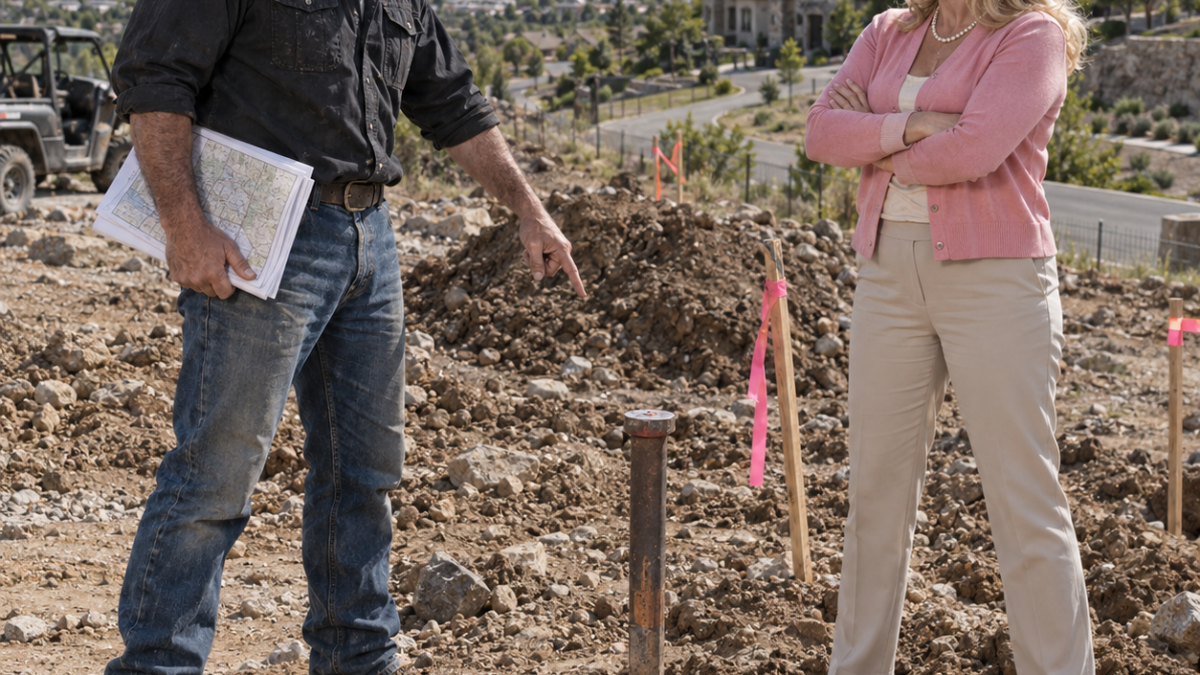
PART 2
The patent was dated 1958.
I had seen it before, but never under circumstances like these.
As a boy, I thought it looked like treasure-map paperwork.
Heavy paper.
Official seal.
Dense legal language.
My grandfather’s name typed beneath a description of bearings, corners, acreage, and mineral ground.
To him, it had been more valuable than gold.
Not because the Lucky Strike ever made him rich.
It didn’t.
He found enough color to keep believing.
A few promising quartz samples.
Some small pockets.
Stories that improved every time he told them.
But the claim gave him something he valued more than a jackpot.
A place of his own.
Grandpa had worked underground when he was young.
Then construction.
Then equipment repair.
His hands were so rough that when I was a child, I believed adults naturally developed skin like leather.
He built the cabin himself.
Every log had an imperfection.
Every floorboard creaked differently.
And every part of it carried some story he thought I should remember.
The patent tube usually stayed locked inside his footlocker.
“Paper matters,” he told me once.
I had been maybe ten.
“We’re standing on ten acres of rocks, Grandpa.”
He grinned.
“Rocks don’t tell judges who owns them.”
At ten, I had laughed.
At fifty-six, sitting at his oak table with Karen’s violation notice beside the patent, I finally appreciated the lesson.
I scanned everything.
The patent.
Survey.
Historical maps.
County records.
Tax documents.
Old correspondence relating to the surrounding development.
Then I searched my own closing and inheritance records.
Nothing tied the Lucky Strike parcel to Whispering Pines Estates.
No declaration.
No covenant attachment.
No HOA membership.
No recorded easement giving the association landscaping authority.
Nothing.
The subdivision simply stopped at my boundary.
I opened Karen’s violation notice again.
WHISPERING PINES ESTATES HOMEOWNERS ASSOCIATION.
Violation:
Unapproved soil accumulation.
Amount:
$500.
Required corrective action:
Removal and restoration of approved landscape condition.
I laughed.
Approved by whom?
The mountain?
I photographed the notice lying beside the federal patent.
Then I wrote my response.
No sarcasm.
That required discipline.
I identified the parcel.
Referenced the patent.
Included the current assessor information.
Attached the survey.
Explained that the property was outside the HOA.
Then I wrote one sentence twice before I was satisfied.
Whispering Pines Estates Homeowners Association has no contractual, covenant-based, ownership, maintenance, or enforcement authority over the Lucky Strike Load parcel.
I also documented Karen’s repeated unauthorized entries.
I demanded that the board cease sending violation notices and stop entering the land.
I sent the packet by certified mail.
Karen signed for it.
That mattered.
Then I walked my entire boundary.
Grandpa’s old survey markers were still where they belonged.
Some were buried under pine needles.
Some surrounded by brush.
I cleaned around each monument.
Next to each one, I installed a wooden stake with bright orange flagging.
Nothing aggressive.
Nothing threatening.
Just visible.
The effect was dramatic.
Whispering Pines had spent years pretending my property blended vaguely into its “natural buffer.”
Now there was no vagueness.
Orange flags ran along the edge.
Their world.
My world.
One afternoon, my nearest neighbor stopped while walking his golden retriever.
His name was Bob Collins.
Retired Air Force colonel.
Late sixties.
Dry sense of humor.
He let his dog sniff one of the stakes.
“New landscaping?”
“Very exclusive.”
“Karen approved orange?”
“I’m hoping for a violation.”
Bob chuckled.
“She’ll give you one.”
“She already did.”
I showed him the first notice.
He read it.
“Five hundred dollars for dirt?”
“My criminal empire begins with geology.”
He handed the paper back.
“She sent an email about you.”
“Already?”
“Emergency community meeting Saturday.”
I leaned against a pine.
“What’s the subject?”
Bob smiled without humor.
“Hostile adjacent landowner.”
“That’s impressive.”
“You have no idea.”
He glanced toward Karen’s street.
“People are tired of her.”
“Then why is she still president?”
“Because tired people stay home.”
That was more accurate than either of us wanted to admit.
Bob continued.
“She fined my wife over petunias.”
“What was wrong with them?”
“Apparently the pink was too vibrant.”
I stared at him.
“I spent twenty-eight years in the Air Force and survived three base-housing committees. Whispering Pines may be worse.”
His dog pulled the leash.
Bob lowered his voice.
“She has two loyal board members. They approve everything.”
“Good to know.”
“If you need information, ask.”
“I appreciate it.”
He held out his hand.
We shook across the property line.
“I’ve got your six, Jack.”
For the first time since Karen dropped the fine at my boots, I felt less alone.
The HOA’s response arrived six days later.
It was even better than I expected.
Another violation.
This time my orange boundary markers were the offense.
UNAPPROVED VISUAL DEMARCATIONS.
Fine:
$500.
Karen also maintained the original dirt fine and added daily penalties.
Total allegedly due:
$1,200.
I read the letter at the cabin table.
Then reached the paragraph where Karen addressed my patent.
She called the documents “historical materials of no current relevance.”
That sentence was almost art.
According to her, Whispering Pines possessed a “visual and environmental easement” over adjacent buffer areas.
No deed reference.
No recording number.
No attached easement.
Just declaration by confidence.
Then came the threat.
If I failed to comply within ten days, the HOA intended to take all necessary steps to correct the violations and secure its financial claims against the property.
I read it three times.
The wording bothered me.
Correct the violations.
Did she mean send another notice?
Or send someone onto my land?
I called a lawyer.
His name was Marcus Thorne.
Different Marcus Thorne from the attorney in my grandmother story—wait, that’s irrelevant in artifact; but source has Marcus. We shouldn’t mention meta. Let’s continue.
Marcus had been recommended by an Army friend who fought an eminent-domain dispute years earlier.
His office looked less like a law firm than a ranch headquarters.
Old maps.
Leather chairs.
A mounted photograph of him beside a horse.
Massive gray mustache.
He picked up Grandpa’s patent and read without speaking.
Ten minutes later, he leaned back.
“Well.”
“That good?”
“That old.”
“Does old help?”
“Old isn’t the point.”
He tapped the patent.
“Recorded ownership is the point.”
I gave him the HOA letters.
He read Karen’s reference to a visual and environmental easement.
“Where is the easement?”
“They didn’t attach one.”
“Did you grant one?”
“No.”
“Your grandfather?”
“He referred to developers as stucco locusts.”
Marcus laughed loudly enough to shake the windows.
“I’m going to take that as no.”
He read the threat to lien the property.
His expression changed.
“That part is more serious.”
“I assumed.”
“An HOA cannot simply manufacture authority because it likes the neighboring landscape.”
“That’s my technical legal analysis too.”
Marcus looked at me.
“Jack, don’t get cute with them.”
“I’m not.”
“Good. Because what you want now is clarity.”
He outlined a strategy.
First, a title action seeking a court declaration that Whispering Pines had no interest in my parcel.
Second, formal notice to the developer and relevant title interests that the HOA was asserting rights over an excluded neighboring tract.
Third, preserve every threat and every act.
“What about the fine?”
“Frame it.”
“I was considering it.”
“I’m serious.”
“So am I.”
He pointed at me.
“And do not remove those survey markers.”
“I wasn’t planning to.”
“Make them more obvious if anything.”
“They’re visible from orbit.”
“Excellent.”
Marcus filed.
The effect inside Whispering Pines was immediate.
Bob texted two days later.
CALL ME.
I did.
“All hell broke loose.”
“What happened?”
“Developer’s attorney contacted the board.”
“And?”
“They want Karen to stop.”
“Good.”
“She doesn’t.”
“Better.”
Bob groaned.
“You’re enjoying this.”
“Professionally.”
“You aren’t a lawyer.”
“Emotionally professional.”
He told me the developer’s legal team was alarmed by the HOA’s easement claim.
Title questions make developers nervous for good reason.
If Karen was asserting boundaries that didn’t exist, people would begin asking whether the subdivision’s original plats and descriptions had other problems.
The association’s outside counsel apparently advised restraint.
Karen interpreted restraint as betrayal.
That was her fatal personality flaw.
Any warning that contradicted her became proof somebody lacked courage.
She called another closed board meeting.
Bob’s information came through a director who was beginning to regret every vote he had cast beside Karen.
A beautification project was approved.
Common-area buffer cleanup.
Landscaping contractor.
HOA funds.
And a suspiciously detailed description of the work.
Remove soil piles.
Remove unauthorized markers.
Grade unsightly ground.
My ground.
I called Marcus.
“She’s going to send a contractor.”
“Do you have cameras?”
“Two.”
“Get more.”
That afternoon, I bought motion-activated trail cameras.
High-definition.
Cloud backup.
Time stamped.
I installed them where they covered the boundary without pointing into anyone’s home.
One watched the dirt pile.
Another watched the access path.
Two covered the stakes.
Then I waited.
Three days.
Every diesel engine made me look toward the road.
Nothing.
Thursday morning, at 8:17, my phone buzzed.
MOTION DETECTED.
Camera One.
I opened the feed.
White landscaping truck.
Trailer.
Compact skid-steer loader.
Garcia’s Landscaping and Lawn Care.
Two workers climbed out.
Then a white Lexus stopped behind them.
Karen.
She got out carrying a clipboard.
I watched from the cabin window.
She pointed.
The crew walked to the orange boundary line.
One worker hesitated.
Karen gestured again.
The worker stepped across.
Past the marker.
Onto my land.
I called Marcus.
“They’re here.”
“Machine?”
“Skid steer.”
“Cameras?”
“Recording.”
“Stay inside for the moment.”
He continued.
“Call the sheriff. Explain that contractors have entered clearly marked private property after written notice and are using machinery to remove material.”
“No dramatics?”
“Facts win.”
I called.
The dispatcher took the details.
I gave my name.
Parcel.
Patent history.
Current title dispute.
Contractor.
Vehicle description.
Then she said a unit was coming.
Outside, the skid steer started.
The engine echoed through the trees.
The operator lowered the bucket.
For one second, I hoped he would stop.
He didn’t.
The machine crossed my boundary.
Steel teeth entered the pile.
The bucket lifted a load of earth.
Grandpa’s earth.
My earth.
Not valuable in any commercial sense.
Mostly rock and decomposed granite.
But ownership isn’t measured by what strangers think something is worth.
The operator turned.
Dumped the material into the landscaping truck.
My camera saved the clip automatically.
I felt no triumph.
Not yet.
Mostly sadness.
Because Karen had been given so many chances.
Walk back across the line.
Withdraw the fine.
Read the patent.
Listen to the developer.
Listen to counsel.
Respect the marked stakes.
She had ignored every exit.
A sheriff’s cruiser arrived.
Young deputy.
Stevens.
Karen walked toward him immediately.
I could hear only fragments from the camera microphone.
“Community cleanup.”
“Buffer.”
“HOA authorization.”
The deputy looked confused.
That was understandable.
Nobody starts a patrol shift expecting to interpret a 1958 mining patent before breakfast.
Then a second county vehicle arrived.
Unmarked sedan.
Detective Miller.
Property crimes.
Older.
Gray at the temples.
He got out and looked at the scene before listening to anyone.
Orange boundary flags.
Machine beyond them.
Truck partly loaded with material.
Karen’s Lexus.
Contractor.
That alone told a story.
Then Marcus arrived.
Almost simultaneously, a government vehicle came down the road carrying two land-management officers who had been contacted after the patent issue was raised through the property dispute.
Karen’s posture changed.
Not much.
But enough.
She had expected a homeowner argument.
Now multiple people were looking at documents.
I walked down from the cabin.
Stopped on my side of the boundary.
Detective Miller approached.
“Mr. Henderson?”
“Yes.”
“You own this parcel?”
“Yes.”
I gave him my identification.
Marcus handed over a folder.
Patent copy.
Current assessor record.
Survey.
Our cease-and-desist.
Certified receipt.
HOA response.
Filed title action.
Photographs of the markers.
Detective Miller read.
One of the land officers checked the monuments against the mapped coordinates.
He walked to the skid steer.
Then back.
“The machine is well inside Henderson’s described parcel.”
Karen stepped forward.
“That is disputed.”
Marcus answered.
“The HOA is the only entity disputing it.”
Karen ignored him.
She addressed the detective.
“We have an easement.”
“Recorded where?” Miller asked.
“The developer established it.”
“Document?”
“The board has it.”
Marcus smiled slightly.
“No, they don’t.”
Karen’s face reddened.
“This man is exploiting obsolete mining paperwork to obstruct community maintenance.”
I felt Grandpa somewhere in that sentence.
Obsolete.
She said it the way people say useless.
Old land.
Old cabin.
Old rights.
Old man’s claim.
Marcus handed Detective Miller Karen’s latest letter.
“This is the association’s notice after receiving the patent and survey.”
Miller read the section threatening corrective action.
He looked at Karen.
“Did you hire this landscaping company?”
“Yes.”
“Did you direct them to this location?”
“Yes.”
“Did you tell them to cross these markers?”
Karen hesitated.
“I instructed them to clean the buffer.”
“That wasn’t my question.”
She looked at the workers.
Then at me.
“This is ridiculous.”
Detective Miller repeated it.
“Did you direct them to remove that soil?”
“Yes.”
There it was.
No screaming.
No dramatic confession.
Just one word.
Yes.
The crew foreman arrived soon afterward.
His name was Luis Garcia.
He looked furious, but not at me.
“Who told my guys this was HOA property?”
He looked straight at Karen.
“You did.”
Karen drew herself up.
“I hired your company to perform authorized work.”
“You told us it was common-area buffer.”
“It is.”
Marcus held up the survey.
“No.”
Luis looked at the bright flags.
“My operator asked about these.”
Karen said nothing.
“He called me.”
Luis continued.
“You told him they were unofficial.”
Silence.
Detective Miller wrote something.
The two workers were separated and interviewed.
Neither had any reason to protect Karen.
She hired them.
She identified the work area.
She said she had authority.
She told them to proceed.
The young operator looked sick.
“I thought we were landscaping.”
I believed him.
He wasn’t my enemy.
Neither was Luis.
People with machines trust clients to identify where work is authorized.
That trust had been abused too.
The detective’s tone hardened.
“Stop all work.”
The machine shut down.
For the first time that morning, the mountain became quiet.
Karen looked at me.
“Jack.”
She almost never used my first name.
“This has gotten completely out of hand.”
I stared at her.
“You sent a machine onto my property.”
“I was enforcing a board decision.”
“You were warned.”
“The board believes—”
“You were warned.”
She looked toward the officers.
“This could have been handled privately.”
Marcus spoke before I could.
“It was.”
Karen looked at him.
“For a month.”
He held up the certified receipt.
“My client tried privately.”
Then the HOA response.
“You rejected it.”
Then the court filing.
“He tried formally.”
Then he pointed toward the machine.
“You escalated physically.”
Karen’s certainty finally broke.
I watched it happen.
Not dramatically.
A small change around the eyes.
A person realizing everyone in the scene no longer accepts the premise on which she has been operating.
A person discovering a title does not expand a property line.
The officers continued their investigation.
The contractor’s equipment was documented.
The removed material was left pending instructions.
Karen was told she needed to accompany deputies for further questioning concerning trespass, property damage, and the authorization she had given the crew.
She protested.
Then argued.
Then demanded to call the HOA lawyer.
Nobody stopped her.
But nobody gave her control back either.
Neighbors began coming outside.
Bob stood at his mailbox.
Golden retriever beside him.
We made eye contact.
He gave me one slow nod.
Karen saw him.
Then saw other residents.
People who had spent years looking away.
Now they watched.
Not gleefully.
Curiously.
Some shocked.
Some relieved.
Karen looked suddenly smaller.
That surprised me.
Power is partly costume.
Clipboard.
Position.
Meeting gavel.
Official email account.
People moving when you tell them to.
Remove the costume and you discover how much of authority existed only because everyone agreed to behave as if it did.
When she was finally driven away for additional questioning, Marcus came beside me.
“You all right?”
I looked at the hole in the dirt pile.
“Yeah.”
“You don’t look happy.”
“I wanted her to stop.”
“She could have.”
“I know.”
Luis Garcia walked over.
“Mr. Henderson.”
“Jack.”
“I’m sorry.”
“You were given bad information.”
“We should’ve verified.”
“Yes.”
He nodded.
“I’ll restore everything.”
“Your company isn’t paying.”
He looked surprised.
“This wasn’t your fight.”
Marcus glanced at me.
“We’ll address it in the civil matter.”
The fallout inside Whispering Pines was immediate.
Karen’s remaining board allies panicked.
The developer’s attorney intervened.
The association’s insurer demanded documents.
Minutes.
Emails.
Work authorization.
Advice received.
Advice ignored.
That last category hurt Karen badly.
Evidence showed the board had been warned.
Not once.
Repeatedly.
My title action became simple.
The HOA’s interim leadership stopped contesting it.
The court entered a declaration recognizing the Lucky Strike parcel as separate from Whispering Pines and rejecting the HOA’s claimed visual or environmental easement.
I read the order twice.
Then brought it to Grandpa’s cabin.
Set it beside the patent.
1958.
Now.
Two documents separated by decades.
Same boundary.
I poured one small glass of whiskey.
“Still here, Grandpa.”
The civil settlement took longer.
Marcus demanded reimbursement for legal fees.
Survey verification.
Land restoration.
Damage caused by the machine.
And something else.
A permanent boundary improvement.
“A fence?” I asked.
“A very good fence.”
“I like seeing the woods open.”
“Fence doesn’t have to be solid.”
He showed me the design.
Black metal.
Elegant.
Strong.
Following the entire developed boundary.
Then he showed me his second proposal.
A bronze plaque.
I started laughing.
“No.”
“Yes.”
“Marcus.”
“It’s educational.”
“It’s revenge.”
“Those categories overlap.”
“What does it say?”
He handed me the draft.
THIS BOUNDARY MARKS THE EDGE OF THE LUCKY STRIKE LOAD, A PATENTED MINING CLAIM ESTABLISHED IN 1958.
PRIVATE PROPERTY.
NOT SUBJECT TO WHISPERING PINES ESTATES HOA COVENANTS OR JURISDICTION.
I kept reading.
Installation funded by Whispering Pines Estates Homeowners Association pursuant to civil settlement.
I looked up.
“That last line is cruel.”
“That last line prevents institutional amnesia.”
He had a point.
Settlement day arrived.
I did not wear my military uniform.
Marcus suggested it once.
I told him no.
My service had nothing to do with whether my deed was valid.
I wore a plain charcoal suit.
Across the conference table sat attorneys for the HOA, insurer, and developer interests.
Interim board president.
No Karen.
The first offer treated the event as an unfortunate misunderstanding.
Marcus let them finish.
Then he placed Karen’s written notices on the table.
First notice.
Patent response.
Second notice.
Threat of lien.
Threat of corrective action.
Court filing.
Video still showing the skid steer beyond orange markers.
“What part,” Marcus asked, “was misunderstood?”
Nobody answered.
They asked for a recess.
Returned.
Negotiated money.
Restoration.
Legal costs.
Fence.
Then the plaque.
One lawyer objected.
“The wording is unnecessarily humiliating.”
Marcus leaned back.
“Then remove the settlement reference.”
I looked at him.
He was bargaining.
The lawyer considered it.
I spoke.
“No.”
Everyone looked at me.
I hadn’t said much all day.
“The settlement line stays.”
The attorney sighed.
“Why?”
“Because the first thing Karen did was claim my markers were unauthorized.”
I pointed toward the paper.
“The next board should know exactly who authorized the permanent one.”
Silence.
Then the interim president nodded.
“Agreed.”
A month later, the fencing crew arrived.
They worked from survey data.
No guessing.
No buffer language.
No visual easements.
The black metal followed my legal boundary precisely.
When the final section went in, Bob walked over.
His dog older, slower.
“Looks expensive.”
“It was.”
“Your money?”
“No.”
He grinned.
“Beautiful.”
Then the stone pillar was built.
Bronze plaque mounted.
Bob read every line.
Then looked at me.
“You know new residents are going to ask about this forever.”
“That’s the idea.”
“It’s going to become a neighborhood legend.”
“Hopefully the boring version.”
“There is no boring version where Karen sends a Bobcat to steal dirt.”
I laughed.
The association also changed.
Karen was removed.
Her board allies resigned.
Bob was elected president months later.
He hated the idea.
Which was one reason people trusted him.
His first message to residents was short.
“We are neighbors before we are members.”
No threats.
No paragraphs about compliance.
No royal language.
He reviewed enforcement procedures.
Created appeals.
Required better board votes for major actions.
Expanded approved landscaping.
Eliminated rules that existed mostly because someone once enjoyed writing them.
Bob’s wife planted red flowers.
Very red.
The neighborhood survived.
As for Karen, her criminal case ended less dramatically than the morning by my dirt pile.
Lawyers negotiated.
Charges changed.
She ultimately accepted responsibility for unlawful entry-related conduct and property damage.
Probation.
Fines.
Restitution requirements.
Conditions preventing repeat behavior.
The HOA’s civil settlement remained separate.
She sold her house.
Moved away.
I saw her once before she left.
I was checking the new fence when a car stopped.
Karen lowered the window.
For several seconds, neither of us spoke.
Then:
“Happy?”
I looked at her.
“With what?”
“This.”
She gestured toward the fence.
“The plaque.”
“No.”
“That’s a lie.”
“The fence makes me happy.”
She looked away.
“The plaque makes Marcus happy.”
A faint expression crossed her face.
Almost a smile.
Then it disappeared.
“You destroyed my life over dirt.”
“No.”
Her eyes returned.
“You did this because of a dirt pile.”
“You walked onto land that wasn’t yours.”
“It looked terrible.”
“That wasn’t your decision.”
“I was trying to protect a community.”
“You threatened land outside it.”
She gripped the steering wheel.
“Everyone turned on me.”
“Because they were tired.”
“Bob poisoned them.”
“No.”
I stepped closer to the road but remained behind my fence.
“They were already angry. Bob just stopped being afraid of your reaction.”
Karen looked toward the plaque.
“I still think that pile was ugly.”
I laughed.
I couldn’t help it.
After everything.
She was still Karen.
“Then we finally agree on something.”
She frowned.
“What?”
“It was ugly.”
She stared.
“I never said beautiful.”
“Then why fight?”
“Because ugly things can still belong to someone.”
That silenced her.
She rolled up the window.
Drove away.
I never saw her again.
Peace returned slowly.
At first, I kept checking the cameras.
Every truck.
Every unfamiliar vehicle.
Then weeks passed.
Months.
No notices.
No inspectors.
No people measuring my land.
My camera alerts became deer.
Coyotes.
Bob’s golden retriever once escaping and exploring my side of the fence.
I returned him without issuing a fine.
The dirt pile remained.
Partly because moving it immediately would have felt wrong.
Not as a symbol of war.
As a reminder that the entire conflict had started over something absurdly ordinary.
Dirt.
Eventually rain softened it.
Snow compressed it.
Grass appeared around the edges.
Wind moved dust.
Nature did what Karen had demanded, but without paperwork.
One evening, Bob leaned on the fence.
“Your violation is shrinking.”
“I’m appealing.”
“To whom?”
“Geology.”
“How’s that process?”
“Slow.”
He laughed.
Then told me something I hadn’t expected.
The title insurer had ordered a broader review of Whispering Pines.
The developer’s original perimeter work contained small discrepancies.
Nothing as dramatic as my claim.
But slivers.
Feet.
Inches.
Places where recorded lines, fences, and assumed common areas didn’t perfectly agree.
The developer had to correct them.
Negotiate.
Resurvey.
Update descriptions.
The cost was substantial.
“The funny thing,” Bob said, “is your lawsuit probably saved us.”
“How?”
“If nobody checked until someone tried selling one of those houses, it could have been worse.”
I looked toward the subdivision.
All those perfect roofs.
Clean driveways.
Tiny legal descriptions under every one.
“Karen wanted clarity.”
Bob smiled.
“She got it.”
A few months later, I reopened part of one of Grandpa’s old horizontal workings.
Carefully.
Not mining.
Preservation.
I had structural experience, and I brought in another qualified person to evaluate what remained.
Most old workings were unsafe and stayed sealed.
One short section could be stabilized.
New timbers.
Lighting.
Ventilation.
I cleared years of debris.
About fifty feet inside, I found an old ammunition can on a rock ledge.
Green paint nearly gone.
Dust thick enough to write in.
I carried it outside.
The latches resisted.
Then opened.
No gold.
Journals.
Grandpa’s personal journals.
Not assay notes.
Not geology logs.
His life.
I spent nights reading them at the cabin table.
His handwriting changed over decades.
Strong at first.
Then shakier.
He wrote about Grandma.
My father.
Money problems.
Machines breaking.
Winters that seemed endless.
Years when he considered selling.
Then an entry dated 1978.
Developers are sniffing around the Johnson ranch.
They’ll want this claim someday because it ruins their pretty map.
They’ll call it useless ground.
Maybe it is to them.
But land doesn’t have to make you rich to make you free.
I stopped reading.
Poured whiskey.
Then continued.
I hope my boy understands.
And his boy after him.
This place isn’t about what comes out of the ground.
It’s about holding onto something honestly yours when somebody with more money says it would be more convenient if you disappeared.
I closed the journal.
For several minutes, I couldn’t move.
Grandpa had been dead for years.
Yet the words felt written for the morning Karen stood on my dirt pile.
I thought about how angry I had been.
How satisfying the court order felt.
The fence.
The plaque.
The collapse of her authority.
Suddenly none of that seemed like the important part.
The important part was simpler.
The parcel remained intact.
Not one foot surrendered because someone found it aesthetically inconvenient.
Not because land is sacred merely because we own it.
Because consent matters.
Boundaries matter.
History matters.
And convenience does not automatically become entitlement.
I placed Grandpa’s journal beside the patent.
Two pieces of the same inheritance.
One proved ownership.
The other explained why he cared.
A year after the lawsuit, I received a letter from the county historical society.
At first, I assumed somebody wanted money.
Instead, a historian had found the quiet-title records while researching mining properties.
He asked about the Lucky Strike Load.
According to him, the claim was an unusually well-preserved example of a small patented mining parcel surviving suburban development.
He wanted to document it.
I almost said no.
I liked privacy.
Grandpa had too.
Then I reread the journals.
Preservation mattered.
The historian came on a Tuesday.
Older man.
Canvas hat.
Camera equipment.
The excitement of a child every time I unfolded a map.
He photographed the patent.
Survey markers.
Cabin.
Old equipment.
Safe section of the workings.
Then I showed him the journals.
He put on gloves.
Read the 1978 entry.
Looked toward Whispering Pines.
“You can’t make this up.”
“I wish parts of it had been made up.”
He laughed.
“May we quote him?”
I thought about Grandpa.
The man who distrusted developers.
Committees.
Anyone who used the word synergy.
He would have hated becoming historical.
Which meant I absolutely had to let them.
“Yes.”
The book appeared the following year.
A chapter covered the Lucky Strike.
Grandpa.
The old mining district.
The suburban development around it.
Even the modern property dispute.
The historian used a photograph of the bronze plaque.
Bob bought three copies.
“Why three?”
“One for me. One for my son. One for the HOA office.”
“You put the book in the HOA office?”
“Required reading.”
I laughed.
“You’re becoming dangerous.”
“Power corrupts.”
He pointed toward the plaque.
“Fortunately, we have educational infrastructure.”
New residents began stopping to read it.
Most smiled.
Some asked questions.
Once, a teenager riding a bicycle pointed toward my land.
“Is there gold?”
“A little.”
“How much?”
“Not enough.”
“Then why keep it?”
That question stayed with me.
Children ask the cleanest questions.
Why keep ten acres that will never make you rich?
Why defend a dirt pile?
Why spend money on lawyers?
Why care about old paper?
I looked toward the cabin.
“Because my grandfather did.”
The kid nodded.
That answer was enough for him.
It had become enough for me too.
Years passed.
The fence weathered beautifully.
Black metal against pine trunks.
The bronze plaque darkened.
The letters remained readable.
The original dirt pile slowly flattened until only I knew exactly where it had been.
I kept prospecting.
Nothing ambitious.
A pan.
Small sluice.
Occasional test pit.
Every now and then, a tiny flash of gold appeared under water.
Grandpa called it color.
I understood why prospectors chased it.
Gold catches light differently.
Even a speck demands attention.
One autumn evening, Bob stopped during his walk.
His golden retriever was gone by then.
Old age.
Now he walked alone.
He rested his arms on the fence.
“Find anything?”
I held up a vial.
A few flakes.
Bob squinted.
“All that trouble for that?”
“All what trouble?”
“Karen. Lawyers. Federal paperwork. Fence.”
I shook the vial.
“This has nothing to do with any of that.”
“Then what was the fight really about?”
I looked across the property.
The pines.
Cabin smoke.
Rock.
Survey line.
Grandpa’s land.
“Permission.”
Bob nodded.
He understood immediately.
Karen believed proximity gave her permission.
She believed community preference gave her permission.
She believed office gave her permission.
She believed board votes gave her permission.
They didn’t.
That had always been the whole story.
Not gold.
Not dirt.
Not even the HOA.
Permission.
One person deciding somebody else’s no did not matter.
Bob looked toward Whispering Pines.
“Funny thing.”
“What?”
“She probably could have gotten along with you forever if she’d just stayed on her side.”
“Absolutely.”
“You weren’t bothering anyone.”
“No.”
“Your dirt was ugly.”
“I know.”
He smiled.
“Still is.”
We stood there until the sun disappeared.
I thought about the fence.
Some people saw victory in it.
Some revenge.
Some absurd suburban history.
I eventually saw something different.
A boundary is not hostility.
A fence is not hatred.
“No” is not an attack.
Sometimes the healthiest relationship between neighbors begins with knowing exactly where one person’s authority ends.
Whispering Pines became a better neighborhood once its board learned that.
Bob served two terms.
Refused a third.
His replacement was a woman named Denise Porter, accountant, mother of three, deeply boring in the best possible way.
At her first meeting, she called me.
“Mr. Henderson?”
“Jack.”
“Jack, I’m reviewing association maps.”
“Good.”
“There’s a note in red that says DO NOT CONTACT REGARDING LUCKY STRIKE PROPERTY.”
I laughed so hard I had to sit down.
“Who wrote that?”
“Bob, apparently.”
“Smart man.”
“I assume the fence remains the boundary.”
“Yes.”
“Any maintenance agreements?”
“No.”
“Any easements?”
“No.”
“Any HOA jurisdiction?”
“No.”
“Perfect.”
She paused.
“One more question.”
“Go ahead.”
“Is the dirt pile still there?”
“Mostly gone.”
“Oh.”
She sounded almost disappointed.
“We wanted to take the new board members to see it.”
I laughed again.
“Come see the plaque.”
They did.
Five adults.
Clipboards.
Denise read the plaque.
Then turned to the board.
“This is the cheapest legal training we’ll ever get.”
I liked her immediately.
Grandpa’s cabin became quieter as I got older.
I stopped opening test pits as often.
My knees objected.
The mountain did not care.
I spent more time reading journals.
Repairing tools.
Walking the fence.
Eventually my daughter began bringing her son.
His name was Ethan.
At eight, he asked the same questions I once asked Grandpa.
“What’s this gauge?”
“Why is that rock shiny?”
“Did great-great-grandpa really dig here?”
“Is there treasure?”
One afternoon I opened the document tube.
Showed him the patent.
He was unimpressed.
“It’s paper.”
“Yes.”
“Where’s the treasure map?”
“That is the treasure map.”
He frowned.
“No, like an X.”
I laughed.
Then showed him Grandpa’s hand-drawn workings map.
Better.
“Did he find gold?”
“Some.”
“Are we rich?”
“No.”
He looked betrayed.
“Then what’s the point?”
There it was again.
I took him outside.
We walked to the fence.
I showed him the plaque.
Told him the short version.
A woman once tried to tell me my land belonged under her neighborhood rules.
She didn’t check.
She crossed the line.
She sent workers.
The court corrected it.
Ethan listened.
Then pointed toward the HOA.
“Did she steal your dirt?”
“A little.”
“Did you get it back?”
“Mostly.”
“That’s good.”
We walked back.
He kicked a rock.
Then said, “So Grandpa gave you the land?”
“My grandfather, yes.”
“And you’ll give it to Mom?”
“Maybe.”
“And Mom gives it to me?”
“If she wants.”
He considered this.
“I’ll keep it.”
I smiled.
“You don’t have to.”
“I want the mine.”
“It isn’t much of a mine.”
“I’ll make it one.”
There was Grandpa again.
Not literally.
Something better.
Continuity.
That evening, after my daughter drove Ethan home, I sat on the porch.
The lights of Whispering Pines came on below.
Warm squares.
Families eating dinner.
Cars returning.
Nothing threatening.
Just neighbors.
That mattered.
For a while after Karen, I saw the subdivision as enemy territory.
That wasn’t fair.
Most residents never trespassed.
Never fined me.
Some feared her.
Some ignored her.
Some eventually helped.
The lesson wasn’t that HOAs were enemies.
It was that unaccountable authority can turn ordinary institutions into tools for personal obsession.
The solution wasn’t permanent war.
It was limits.
Documents.
Transparency.
People willing to say no.
Bob understood that.
Denise understood.
The new boards understood.
Peace became possible precisely because the boundary was no longer ambiguous.
Grandpa would have liked that.
Maybe.
He still would have called them stucco locusts.
One spring morning, I found myself standing where Karen had first dropped the violation notice.
The mound was gone.
Rain and time had spread it.
Wild grass covered the spot.
A few quartz fragments remained.
I picked one up.
White.
Milky.
A thin metallic streak ran across it.
Probably nothing valuable.
I turned it in my hand.
Then brought it into the cabin.
Grandpa used to keep interesting rocks on the windowsill.
I put it there.
Next to a photograph of him in 1959.
Young.
Dirty shirt.
Holding a shovel.
The resemblance between us bothered my daughter.
“You’re turning into him,” she said.
“Could do worse.”
“You both keep rocks indoors.”
“Specimens.”
“Rocks.”
“Geological specimens.”
“Rocks.”
Ethan sided with me.
Naturally.
The historical society eventually installed a small interpretive marker near the county trail several miles away describing old mining claims in the region.
Lucky Strike appeared by name.
No Karen.
No HOA drama.
Just history.
That pleased me.
The land deserved a story larger than the worst person who ever crossed its boundary.
Grandpa had spent decades here before Whispering Pines existed.
I wanted future people to know him first.
Not Karen.
Some conflicts feel enormous while you are living them.
Then time restores scale.
Karen once dominated my thoughts.
Every envelope.
Every passing car.
Every camera notification.
Years later, she became one chapter.
Grandpa remained the book.
That realization finally freed me from the last piece of the fight.
The anger.
I had won.
Legally.
Financially.
Publicly.
But if I kept replaying Karen’s arrogance forever, she would still occupy land inside my head.
I had defended ten acres.
No reason to give her mental acreage for free.
So I stopped.
The cameras remained for security.
The fence remained.
The plaque remained.
But the war ended.
Really ended.
One evening, I took Karen’s original violation notice from the file.
The paper had yellowed slightly.
$500.
Unapproved soil accumulation.
I considered framing it.
Marcus had suggested that years earlier.
Instead, I placed it inside Grandpa’s document tube behind the patent.
Not displayed.
Preserved.
Part of the history.
Ethan may find it someday.
He’ll probably laugh.
I hope he does.
A five-hundred-dollar fine for dirt.
On a mining claim.
Issued by someone standing on the dirt she was trying to regulate.
Absurdity deserves laughter once danger passes.
The bronze plaque catches the evening sun now.
Most days I barely notice it.
But sometimes a new homeowner stops.
Reads.
Looks toward my cabin.
If I’m outside, they might wave.
I wave back.
That is enough.
No hostility.
No fear.
No argument.
A fence between us.
And friendship when we choose it.
That may be the healthiest neighborhood arrangement I’ve ever known.
The last entry in Grandpa’s journal I return to often is not the one about developers.
It’s later.
1989.
His handwriting shaky.
He wrote:
A man spends his youth thinking ownership means being able to say, “This is mine.”
If he is lucky, he grows old enough to understand the better sentence is, “This was entrusted to me.”
Take care of the land.
Then leave it stronger than you found it.
I read that differently now.
When Karen arrived, I thought defending the Lucky Strike meant defeating someone.
Winning.
Holding the line.
Those things mattered.
But preserving the property is bigger.
Keeping the records.
Maintaining safe workings.
Protecting trees.
Teaching Ethan.
Remembering Grandpa.
Being a decent neighbor across the fence.
That is ownership too.
Maybe the most important part.
I never found the rich vein Grandpa dreamed about.
No hidden fortune.
No retirement-changing strike.
The gold in my little vial would barely pay for dinner.
But I found his journals.
His thoughts.
His hope that his grandson would understand.
I found neighbors willing to stand beside me.
I found a community capable of correcting itself.
I found the difference between authority and entitlement.
I found out exactly how valuable ten acres can become when someone else tells you they are inconvenient.
And I found peace.
Real peace.
Not the absence of people.
The absence of fear that someone can simply take what is yours because you are tired of fighting.
Sometimes, at sunset, I walk the fence.
My hand slides along cool black metal.
On one side:
Whispering Pines.
Trim lawns.
Stucco houses.
Families.
Streetlights.
On the other:
The Lucky Strike Load.
Pines.
Cabin.
Rock.
Old workings.
Grandpa’s history.
Two worlds.
Neither has to destroy the other.
They only have to respect the line.
I stop at the bronze plaque.
The wording still makes me smile.
PRIVATE PROPERTY.
NOT SUBJECT TO HOA COVENANTS OR JURISDICTION.
Simple.
Almost boring.
The kind of sentence Karen could have learned before any of this happened.
Then I look toward the spot where the dirt pile once stood.
It is grass now.
Nothing dramatic.
No monument.
That seems appropriate.
Karen thought the dirt itself was the problem.
It never was.
The problem was crossing a line and believing the person on the other side had no right to say no.
She learned otherwise.
So did Whispering Pines.
And so did I.
I learned that you can defend something fiercely without spending the rest of your life angry.
You can forgive without pretending the violation never happened.
You can build a fence without building a prison.
You can inherit land without being trapped by the past.
And you can search for gold your entire life only to discover that the richest thing your grandfather left you was never buried underground.
It was the right to stand on that mountain, look across ten acres of rock and pine, and know exactly where you belonged.
Grandpa called it the Lucky Strike.
For years, I thought the name was optimistic.
Now I think he knew exactly what he had found.
Not gold.
A place.
A boundary.
A legacy.
And when the HOA president tried to fine me for my own dirt, she accidentally reminded me what all of it was worth.
So I kept the land.
I kept the cabin.
I kept the patent.
I kept Grandpa’s journals.
And, yes, for as long as the rain allowed it, I even kept the dirt pile.
Not because it was beautiful.
Because it was mine.
[EXPANDED ENDING — APPROX. 3,000 WORDS]
For a while, I thought that was the end of it.
The fence was finished.
The bronze plaque stood at the entrance.
Karen was gone.
The court had confirmed what my grandfather’s patent had said all along.
The Lucky Strike Load belonged to me.
Whispering Pines did not have an easement over it.
The HOA could not regulate it.
No future board could pretend otherwise without first confronting a court order, a survey, a fence, and a bronze monument explaining exactly where its authority ended.
I should have been able to sit on the porch, drink my coffee, and forget the whole thing.
But peace after a fight is strange.
Your body doesn’t immediately believe the battle is over.
For months, every unfamiliar truck made me look toward the boundary.
Every motion alert made me reach for my phone.
Whenever an envelope appeared in the mailbox, some small part of me expected to see the Whispering Pines logo in the corner.
Usually it was insurance.
A catalog.
A utility bill.
Once, an advertisement for lawn treatment.
I laughed at that one longer than I should have.
Gradually, the tension left.
The trail cameras started capturing more deer than people.
One night, a black bear wandered along the fence and sniffed the bronze plaque.
I saved the clip.
Bob watched it the next morning.
“Think he read the sign?”
“Probably has better legal comprehension than Karen did.”
Bob nearly dropped his coffee laughing.
He had settled into the HOA presidency better than either of us expected.
People trusted him because he disliked authority almost as much as he disliked meetings.
At his first annual meeting, someone suggested creating a new architectural subcommittee.
Bob stared at the proposal for several seconds.
Then said, “Why?”
The woman presenting it looked confused.
“To ensure neighborhood consistency.”
“Do we have a problem with inconsistency?”
“Well, not yet.”
“Then congratulations. Motion denied before we invent one.”
According to three separate residents, that received applause.
Whispering Pines changed slowly.
The change wasn’t dramatic.
That was the best part.
Karen had governed through constant urgency.
Everything was a crisis.
Trash cans.
Mailbox paint.
Petunias.
Parking.
Garden hoses.
The slightest disagreement became a threat to property values.
Bob discovered something radical.
Most things could wait until Tuesday.
Some things could be ignored entirely.
The neighborhood did not collapse.
Property values did not disappear because one family planted bright red flowers.
Civilization survived a basketball hoop in a driveway.
No one’s mortgage became worthless because a child left a bicycle near the garage overnight.
People began laughing at old violation stories instead of whispering about them.
One Saturday, Bob organized what he called an “administrative cleanout.”
Residents brought years of old warning letters they no longer needed.
Someone jokingly suggested burning them.
That became an actual bonfire.
I stood near the back while people fed papers into the flames.
UNAPPROVED FLOWER COLOR.
Into the fire.
TRASH RECEPTACLE VISIBLE 2 HOURS, 17 MINUTES AFTER COLLECTION.
Into the fire.
EXCESSIVE HOLIDAY ILLUMINATION.
Fire.
NONCONFORMING PORCH FURNITURE.
Fire.
Bob held up one notice.
“Improper petunia pigmentation.”
His wife snatched it from him.
“You are never letting that go, are you?”
“No.”
She dropped it into the flames.
People cheered.
I had brought Karen’s original $500 dirt fine with me.
For a moment, I considered throwing it in.
Then I folded it and put it back in my pocket.
Bob noticed.
“Saving yours?”
“Evidence.”
“The case is closed.”
“History.”
He nodded.
That he understood.
A few weeks later, the first real surprise arrived.
Bob drove up to my cabin one evening looking unusually serious.
He climbed out holding a thick envelope.
“That expression usually means money.”
“Not yours.”
“Better.”
He handed me the envelope.
The return address belonged to a regional title company.
“What’s this?”
“The audit.”
I remembered.
After Karen’s imaginary-easement claims triggered the title dispute, the developer’s title insurer had started examining the original Whispering Pines survey.
I opened the envelope.
The first pages were technical.
Legal descriptions.
Boundary reconciliation.
Correction instruments.
Then came a map.
Red marks dotted the entire subdivision perimeter.
“What am I looking at?”
“Problems.”
“How many?”
“Depends how generous you are with the word problem.”
The original development survey had not swallowed another ten-acre mining claim.
Nothing that dramatic.
But it had been sloppy.
Small discrepancies appeared along multiple boundaries.
Six inches.
Fourteen inches.
Two feet.
A triangular sliver behind one backyard.
A drainage feature partially extending beyond what the developer actually owned.
One landscaping strip overlapped county land.
Another corner touched federal land differently than the development map suggested.
“Karen found all this?”
“Accidentally.”
“No.”
Bob shook his head.
“You found it because Karen couldn’t leave your dirt alone.”
The developer had to correct recorded descriptions.
Negotiate minor boundary agreements.
Pay surveyors.
Attorneys.
Title specialists.
One affected homeowner discovered his fence had technically been built sixteen inches outside his legal lot for years.
The adjacent owner agreed to a simple boundary adjustment.
Another discrepancy required the developer to purchase a narrow strip from a neighboring rancher.
Nobody lost a house.
Nobody went to war.
Professionals measured.
People talked.
Documents were corrected.
“That’s how Karen’s issue should have been handled,” I said.
Bob nodded.
“Survey first. Ego later.”
I looked again at the map.
“How much did this cost them?”
“Rumor?”
“Of course.”
“Seven figures by the time they finish.”
I whistled.
Bob smiled.
“So your ugly dirt pile may have exposed a million-dollar survey problem.”
“Please don’t call it ugly.”
“You admitted it was ugly.”
“Only under privileged conversation.”
“This isn’t privileged.”
I folded the map.
Grandpa would have loved the irony.
The developers had treated his claim as an inconvenient shape their subdivision had to wrap around.
Decades later, that same ten-acre island forced them to examine every line they had drawn around it.
The historical society contacted me not long afterward.
A letter arrived addressed by hand.
That alone made me open it before the bills.
Dr. Samuel Greer.
County Historical Society.
He was researching surviving patented mining properties from the region’s nineteenth- and twentieth-century mining era.
My quiet-title case had appeared during a records search.
He wanted to know whether the original Lucky Strike documents still existed.
I called him.
“You mean the patent?”
“Yes.”
“I have it.”
Silence.
“The original?”
“Yes.”
“Survey?”
“Yes.”
“Assay records?”
“Yes.”
“Family records?”
“Some.”
His voice rose.
“Mr. Henderson, may I come see you?”
Two weeks later Samuel arrived carrying more camera equipment than seemed necessary to photograph old paper.
He was thin, gray-haired, and incapable of hiding excitement.
The moment I unrolled the patent, he stopped talking.
That was impressive.
“You’ve kept this remarkably well.”
“My grandfather did.”
He photographed the seal.
The legal description.
Old survey sheets.
Assay notes.
Then I showed him Grandpa’s journals.
He put on cotton gloves before touching them.
“You found these in the mine?”
“One of the old workings.”
“You understand how unusual this is?”
“No.”
“Most family mining records disappear.”
“Grandpa saved everything.”
“I’m beginning to like your grandfather.”
“So did my lawyer.”
Samuel spent three days reading.
On the second afternoon, he found the 1978 entry.
The one about developers.
He read it once.
Then again.
They’ll want my claim. They see a blemish on their perfect map, but they don’t understand. This land isn’t just dirt and rock. It’s freedom.
Samuel looked toward the window.
The Whispering Pines roofs were visible through the pines.
“You realize this sounds prophetic.”
“He was suspicious, not psychic.”
“Sometimes suspicion ages well.”
He asked whether the historical society could scan the journals.
I hesitated.
Those were personal.
Grandpa wrote about arguments with Grandma.
Money trouble.
My father.
Fear.
Age.
Things never meant for public display.
Samuel understood immediately.
“We can restrict material.”
That helped.
Eventually I allowed selected entries to be documented.
Mining history.
Land history.
The development pressure.
Nothing that belonged only to the family.
When Samuel left, he stood beside the bronze plaque.
“May I photograph this too?”
“You have to.”
“Why?”
“Otherwise the story sounds unbelievable.”
The book appeared the following year.
I received six copies.
The chapter title was:
THE LUCKY STRIKE LOAD: A MINING PATENT SURROUNDED BY SUBURBIA.
Grandpa’s photograph opened the chapter.
He was thirty-seven.
Work shirt.
Hat pushed back.
Boot on a rock.
Expression halfway between exhaustion and amusement.
I stared at that photograph longer than I read the text.
The chapter discussed the original patent.
Regional mining.
The decline of small prospecting claims.
The development boom.
Then a short final section covered the modern boundary dispute.
Samuel was careful.
No cartoon villainy.
No exaggerated arrest story.
Just facts.
An HOA attempted to regulate an adjacent patented parcel.
The owner objected.
Documents confirmed exclusion.
A legal action clarified title.
The conflict resulted in improved boundary recognition.
It sounded almost respectable.
Bob hated it.
“This is terrible.”
“What?”
“I sound reasonable.”
“You occasionally are.”
“They left out the petunias.”
“It’s a history book.”
“That was historically significant.”
I gave him a copy.
He put it in the Whispering Pines clubhouse.
Under it he placed a handwritten card.
REQUIRED READING FOR FUTURE BOARD PRESIDENTS.
Denise Porter took over when Bob’s second term ended.
She was an accountant.
Quiet.
Methodical.
More interested in reserve funding than authority.
Perfect.
Three days after her election, she called me.
“Mr. Henderson?”
“Jack.”
“Jack, I’m reviewing the association maps.”
“Good.”
“There’s a handwritten note beside your parcel.”
I already knew.
“Red ink?”
“Yes.”
“What does it say?”
She cleared her throat.
“DO NOT CONTACT REGARDING LUCKY STRIKE PROPERTY WITHOUT COUNSEL.”
I laughed.
“Bob.”
“I assumed.”
“Smart policy.”
“I wanted to confirm the current status.”
“Independent private property.”
“No HOA jurisdiction?”
“No.”
“No landscaping rights?”
“No.”
“No visual easement?”
“Definitely no.”
She paused.
“Excellent.”
I liked Denise immediately.
Then she said, “Can the new board visit?”
That surprised me.
“Why?”
“Training.”
I looked toward the plaque.
“Sure.”
Six board members arrived Saturday morning.
Denise.
Treasurer.
Secretary.
Three committee chairs.
They stood at the fence.
I remained on my side.
Denise pointed at the bronze plaque.
“This is why I brought everyone.”
One man smiled.
“We know the story.”
“You know the funny version.”
She looked at me.
“Jack, mind giving them the useful version?”
I thought about it.
Then said, “Ask before assuming.”
They waited.
“That’s it?”
“That’s most of it.”
Denise laughed.
I continued.
“Check deeds. Check plats. Check easements. Check whether your covenants actually apply. If someone disputes jurisdiction, don’t answer with a bigger letter. Verify.”
The treasurer asked, “What about urgent situations?”
“Fire, flooding, immediate safety? Handle the emergency.”
“And aesthetics?”
“Nothing aesthetic is worth creating a legal emergency at eight in the morning.”
Even Denise laughed at that.
I showed them the survey monument.
Grandpa’s patent copy.
Court order.
Nothing confidential.
Just enough to make the lesson tangible.
Before they left, Denise looked at the dirt pile.
By then, nature had nearly erased it.
“That was it?”
“What’s left.”
“That caused everything?”
“No.”
I shook my head.
“A person caused everything.”
That distinction mattered.
The dirt pile became smaller every season.
Rain flattened it.
Snow pressed it down.
Weeds grew.
Pine needles collected.
One spring, I walked past and realized I could no longer see the mound unless I knew where to look.
For a moment, that saddened me.
Ridiculous.
It was dirt.
Then I understood.
The fight had attached meaning to it.
Meaning it never asked for.
Maybe letting it disappear was healthy.
Not every battlefield needs a monument.
The plaque already handled that.
Grandpa’s journals became more important as I grew older.
I read them slowly.
Not in order.
Some nights I opened a random year.
His younger entries chased gold.
Numbers.
Veins.
Assays.
Depths.
His older entries talked less about gold.
More about weather.
Trees.
Family.
One entry from 1989 changed the way I understood the claim.
A man starts out thinking ownership means saying, “This is mine.”
If he lives long enough, he learns the better sentence is, “This was entrusted to me.”
Land outlives pride.
Take care of it.
Leave it better.
I read those lines three times.
When Karen first came onto the property, I had thought exactly like the younger man Grandpa described.
Mine.
My dirt.
My line.
My claim.
My right.
And I had been correct.
But correctness wasn’t the whole responsibility.
After the fight, I started looking at the ten acres differently.
Drainage needed attention near one old working.
I stabilized it.
Deadfall had accumulated along one slope.
I cleared enough to reduce wildfire risk without stripping habitat.
Two old shafts were unsafe.
I had them professionally assessed and permanently secured.
I mapped historical features so nobody in the family would accidentally wander into unstable ground decades from now.
The safe horizontal section I had reopened became less of a mine and more of a small family archive.
New timber supports.
Lighting.
No digging beyond the assessed section.
I mounted copies of old photographs inside.
Grandpa beside his first truck.
My father with a gold pan.
Grandma sitting on the cabin porch.
Not a tourist attraction.
Just memory in the rock.
My daughter thought I was becoming sentimental.
“I’ve always been sentimental.”
“No.”
She looked around the cabin.
“You used to disguise it as property law.”
Her son Ethan became my favorite audience.
At eight, he had endless questions.
At nine, he wanted to know whether we could find enough gold to buy a dirt bike.
“No.”
“A used one?”
“No.”
“What if we dig deeper?”
“That is how expensive accidents start.”
He frowned.
“Grandpa found gold.”
“Your great-great-grandfather found enthusiasm with trace amounts of gold.”
“That sounds bad.”
“It was enough for him.”
One afternoon, I showed Ethan the original $500 violation notice.
He read slowly.
Then looked outside.
“Someone fined you because of dirt?”
“Yes.”
“Why?”
“She thought her HOA rules applied here.”
“They didn’t?”
“No.”
“Did you tell her?”
“Many times.”
“Then why didn’t she stop?”
There are questions adults make complicated because simple answers are uncomfortable.
I looked at him.
“Because she wanted to be right more than she wanted to know whether she was right.”
Ethan considered that.
“That’s dumb.”
“Yes.”
Children remain efficient philosophers.
Then he asked, “Did she hate you?”
“I don’t think so.”
“She tried to take your dirt.”
“That isn’t the same thing.”
“Were you enemies?”
“For a while, it felt that way.”
“What is she now?”
I looked toward Whispering Pines.
“Someone who used to live nearby.”
That answer surprised me.
It was true.
Karen no longer occupied much space in my life.
Years earlier, I had replayed every confrontation.
The fine.
The threat.
The skid steer.
Officers.
Settlement.
Her final drive past the fence.
Now I sometimes went months without thinking about her.
That felt like a better victory than the plaque.
Anger is useful during a boundary fight.
It gives energy.
Sharpens attention.
But anger makes a poor caretaker once the fight is over.
If I spent the rest of my life hating Karen, she would still own a small unauthorized parcel inside my mind.
I had fought too hard over boundaries to allow that.
So I let her go.
Not forgiveness in some dramatic movie sense.
I never decided what she did was acceptable.
I simply stopped rehearsing it.
Bob understood.
One evening, years after his presidency, we sat outside the cabin.
His old golden retriever had died.
Bob walked more slowly now.
He stared toward Whispering Pines.
“Do you ever miss the excitement?”
“No.”
“Immediate answer.”
“I spent twenty years in the Army Corps. I’ve had enough excitement.”
“You seemed pretty alive during the Karen war.”
“I was irritated.”
“You were delighted.”
“At moments.”
Bob drank his coffee.
“People still tell that story.”
“I know.”
“It has improved.”
“How bad?”
“I heard last week that Karen arrived with three bulldozers and tried to strip-mine your gold.”
I closed my eyes.
“No.”
“And you called the FBI.”
“No.”
“And helicopters came.”
“Absolutely not.”
“Pretty good story.”
“Terrible history.”
Bob laughed.
“Truth loses entertainment value over time.”
“No. People get lazy.”
That bothered me enough that I eventually wrote down my own account.
Not for publication.
For family.
Dates.
Documents.
What happened.
What did not.
What the court decided.
What the settlement required.
What Karen’s ultimate legal consequences actually were.
No invented federal raid.
No dramatic speeches that never happened.
Reality had been strange enough.
I placed the account with Grandpa’s journals.
Truth deserves maintenance too.
Samuel Greer returned years later with a graduate student researching property conflicts around historic mining lands.
She asked me something nobody had asked before.
“Was the fence worth it?”
“Financially?”
“Emotionally.”
I looked at the black metal line.
“Yes.”
“Why?”
“Before the fence, people treated the boundary as negotiable because they couldn’t see it.”
“And after?”
“It became boring.”
She smiled.
“Boring?”
“Best thing a boundary can become.”
That answer stayed with her.
It stayed with me too.
Healthy boundaries should be boring.
Not weapons.
Not symbols of hostility.
Just understood lines.
You stay there.
I stay here.
We can talk across them.
Wave across them.
Help each other across them when invited.
But neither side gets to pretend they don’t exist.
Whispering Pines eventually replaced part of its entrance landscaping.
Denise called first.
“Jack?”
“Yes?”
“We’re planting native shrubs along our side of the road.”
“Sounds good.”
“The contractor may need equipment near your fence.”
“Near or through?”
“Near.”
“Then fine.”
“I’ll send you the site map.”
“You don’t need permission if they stay on your land.”
“I know.”
She paused.
“I’m sending it anyway.”
I smiled.
“Good president.”
“Terrified president.”
“Also effective.”
The landscaping looked good.
Very good, actually.
Native grasses.
Low shrubs.
Wildflowers.
No beige decorative gravel.
Bob hated that I complimented it.
“You’re softening.”
“I like plants.”
“You fought the HOA over landscaping.”
“I fought the HOA over jurisdiction.”
“Nuance is disappointing.”
The relationship between the claim and subdivision became almost friendly.
One year, a wildfire started several ridges away.
Nothing catastrophic reached us.
But smoke filled the valley.
County officials issued evacuation warnings.
Whispering Pines residents prepared to leave.
I knew old access paths through the Lucky Strike better than anyone.
One path provided a secondary route for emergency personnel to reach a ridge behind the development.
The county asked whether crews could cross.
I unlocked the gate immediately.
No paperwork.
No argument.
Fire crews drove across my land.
Bob later stood beside me watching engines return.
“Imagine telling Karen.”
“What?”
“That you voluntarily allowed government trucks onto your sovereign kingdom.”
“It’s private land, Bob, not a medieval nation.”
“You used to call it your kingdom.”
“That was dramatic.”
“Growth.”
The crews helped protect the ridge.
Whispering Pines remained safe.
Afterward, Denise sent a thank-you letter.
Official stationery.
I almost framed that one.
Not because I needed gratitude.
Because it represented the difference between authority and respect.
They asked.
I said yes.
That was all.
Grandpa’s land had protected itself when necessary.
Now it helped protect neighbors.
That felt closer to what his 1989 journal entry meant.
Entrusted.
Not simply owned.
Ethan was twelve when I finally gave him a copy of Grandpa’s 1978 entry.
He read it on the cabin porch.
“This land isn’t just dirt and rock. It’s freedom.”
He looked up.
“That’s kind of dramatic.”
I laughed.
“Runs in the family.”
“He knew developers were coming?”
“He suspected.”
“And he wanted you to keep it.”
“Yes.”
Ethan looked across the ten acres.
“What if I don’t want to mine?”
“You don’t have to.”
“What if I want to build something?”
“Depends what.”
“What if I sell it?”
That question hurt more than I expected.
But I remembered Grandpa’s later journal.
Entrusted.
Not owned by the dead forever.
“If it’s yours someday, you decide.”
Ethan studied me.
“You wouldn’t be mad?”
“I’d haunt you responsibly.”
He laughed.
Then I became serious.
“The point isn’t that nobody can ever change this land.”
“What is the point?”
“That nobody should be bullied into giving it up.”
He nodded slowly.
That was the answer Grandpa might have missed when he was younger.
Legacy cannot become another form of control.
If I demanded future generations preserve every rock exactly as I remembered it, I would be doing my own version of Karen’s mistake.
Confusing what I valued with authority over other people’s choices.
I wanted them to understand the land.
Then choose freely.
That realization may have been the final lesson the dispute gave me.
Boundaries work in both directions.
Years later, Bob died.
Quietly.
At home.
His family asked me to speak at the memorial.
I hated public speaking outside professional settings.
Still, I agreed.
I told the petunia story.
His wife laughed hardest.
Then I talked about the morning he stood across my boundary with his dog and offered help.
“I’ve got your six.”
Four words.
Small thing.
But at that point in the fight, they mattered.
Bob had been the first person inside Whispering Pines who made clear that Karen did not represent everyone.
After the memorial, his wife gave me the old dog leash.
“Why me?”
“He always walked that fence with it.”
I kept it at the cabin.
Not in the safe.
On a hook by the door.
History doesn’t always need archival conditions.
Sometimes it can just hang where you see it.
Denise remained president another year.
Then stepped down.
The HOA kept changing.
Different people.
Different priorities.
The plaque remained.
Future boards treated it almost like folklore.
Nobody tested it.
Good.
The Lucky Strike became quieter again.
Exactly what I had wanted before Karen ever appeared.
One autumn evening, I walked to the survey marker where she had stood during our first argument.
The brass cap was still solid.
I brushed pine needles away.
Beyond the fence, a family I barely knew was decorating their yard for Halloween.
Too many lights.
Huge inflatable ghost.
Possibly against the old Karen-era standards.
Nobody cared.
A little boy waved.
I waved back.
Then I looked downhill at the last place the dirt pile had been.
Completely gone.
Grass.
Pine needles.
Quartz.
Nothing else.
I realized I was glad.
The land had reclaimed the argument.
That was the right ending.
Not a permanent crater.
Not a mountain of dirt maintained out of spite.
Nature smoothing something people had turned into conflict.
I walked back to the cabin.
Opened Grandpa’s journal.
Read the 1989 entry again.
Take care of the land.
Then leave it stronger than you found it.
I looked around.
The dangerous shafts secured.
Historical records preserved.
Boundaries clarified.
Neighbor relationship repaired.
Family involved.
Maybe I had.
Not alone.
Certainly not perfectly.
But enough.
The $500 notice still sits behind the patent.
Every few years, I unfold it.
Karen’s signature remains dramatic.
The violation still reads:
UNAPPROVED SOIL ACCUMULATION.
I smile every time.
Not because I beat her.
Because the phrase is so wonderfully ridiculous now.
Dirt.
On a mining claim.
Unapproved.
Sometimes the best proof that power has limits is seeing how absurd its claims look once nobody is afraid of them.
That’s what changed in Whispering Pines.
People stopped being afraid of the letterhead.
They still respected legitimate rules.
Paid dues.
Maintained common property.
Served on committees.
But they asked questions.
Where does the authority come from?
Does this rule apply?
Is this reasonable?
Are we solving a real problem?
Karen would have hated those questions.
Good leaders welcome them.
That may be her most useful legacy, though she never intended it.
She taught an entire neighborhood what unchecked authority looks like.
Then her downfall taught them how fragile it actually is.
And my grandfather’s mining claim?
It remained what it always had been.
Ten acres.
Pines.
Rock.
An old cabin.
Some quartz.
A little gold.
A lot of memory.
People occasionally ask whether I regret spending so much energy defending land that never made me wealthy.
They still assume value means price.
I point toward the cabin.
That is where Grandpa taught me to sharpen tools.
Where Dad taught me to split wood.
Where I came after the Army when noise had started following me even into sleep.
Where I found Grandpa’s journals.
Where Ethan learned to pan dirt and complain that gold was too small.
That land paid me long before anyone calculated its market value.
The gold was incidental.
One evening Ethan found a tiny flake in the bottom of his pan.
He shouted like he had discovered the Comstock Lode.
“Grandpa!”
I walked over.
“Don’t lose it.”
“It’s huge!”
It was almost microscopic.
“Enormous.”
“How much is it worth?”
“Maybe nothing.”
His face fell.
I tapped his pan.
“But you found it.”
He smiled again.
We put the flake in a tiny glass vial.
He wrote the date on masking tape.
Then:
LUCKY STRIKE.
I watched him place it on the shelf beside Grandpa’s old samples.
Four generations connected by a piece of gold too small to buy lunch.
That night, after everyone left, I sat on the porch.
The lights of Whispering Pines glowed below.
The bronze plaque was barely visible.
Wind moved through the pines.
No engines.
No shouting.
No violation notices.
I thought about Karen standing on my land all those years ago.
Hands on hips.
Certain she possessed authority because a badge said president.
I could almost hear her.
That pile of dirt is a violation.
Five hundred dollars.
Clear it by Friday.
At the time, her words made my blood boil.
Now they made me smile.
Not because I had become kinder toward what she did.
Because time had reduced her threat to its proper size.
Tiny.
The land was bigger.
The law was bigger.
The truth was bigger.
My grandfather’s life was bigger.
The community’s ability to change was bigger.
Even Karen herself eventually became bigger than the caricature I had once carried in my head.
She had been wrong.
Arrogant.
Reckless.
But human.
People become dangerous when they mistake certainty for correctness.
That can happen to anyone.
Even the person defending the right side of a boundary.
Remembering that kept the victory from turning me into another version of her.
Grandpa had written that land outlives pride.
He was right.
Karen’s pride disappeared.
Mine softened.
The dirt pile disappeared.
Bob passed away.
Boards changed.
Children grew.
The fence remained, but even it would rust someday.
The mountain would still be here.
That thought comforted me.
Ownership is temporary.
Stewardship is the part that matters.
I stood and walked down toward the fence.
At the stone pillar, I ran my fingers across the bronze letters.
LUCKY STRIKE LOAD.
PRIVATE PROPERTY.
I stopped there.
That was enough.
I didn’t need the rest to remember.
Then I looked back at the cabin.
Light glowing through the window.
Grandpa’s journals inside.
Ethan’s tiny vial of gold beside them.
A claim that began as one man searching a mountain had become a thread through generations.
Karen thought she was fighting over dirt.
For a while, I thought I was fighting over property.
We were both wrong.
I was fighting for the right to decide what happened to something entrusted to me.
And once that right was secure, the real responsibility began.
To preserve what deserved preserving.
To repair what needed repairing.
To share what could be shared.
To say no when no was necessary.
And to say yes when neighbors asked in good faith.
That was the wealth I eventually found on the Lucky Strike.
Not buried underground.
Not measured in ounces.
Not something an assayer could certify.
Freedom without responsibility becomes selfishness.
Authority without limits becomes tyranny.
Ownership without stewardship becomes consumption.
Grandpa understood all three before I did.
I’m still learning.
But I held the line when it mattered.
Then I learned that holding a line is not the same as living behind one forever.
Sometimes you build the fence.
Sometimes you open the gate.
The important thing is that the choice remains yours.
And that is why, after all these years, I still keep Karen Bishop’s $500 dirt fine tucked behind my grandfather’s mining patent.
The patent tells me what my family owned.
The fine reminds me why knowing that mattered.
Together, they tell the whole story.
One piece of paper came from the federal government and survived generations.
The other came from an HOA president and survived about five minutes in court.
I think Grandpa would have appreciated the comparison.
And if he were sitting beside me on the porch tonight, looking over his old claim while the sun disappeared behind the mountains, I know exactly what he would ask.
“Did you hold it?”
Yes, Grandpa.
Every acre.
Every boundary.
Every right that came with it.
Then, when the fight was over, I did something even harder.
I stopped fighting long enough to enjoy what I had defended.
The pines.
The silence.
The cabin.
The family.
The ridiculous little flakes of gold.
And the dirt.
Especially the dirt.
Because Karen was wrong about that too.
It never needed approval.
It only needed someone willing to remember whose ground it was sitting on.
[FULL STORY END]
[FULL STORY END]








