PART 2: HOA President Called the Cops While I Moved Out—She Never Asked Who Had Bought the Rest of the Block
PART 2
I clicked open the first record.
Meridian Property Solutions.
The registered manager was Daniel Meridian.
Dorothy had called him Danny.
Constance Blackwell’s brother-in-law.
I opened another.
Same company.
Another.
A different LLC this time, but the mailing address matched Meridian’s office.
I started building a spreadsheet.
Property.
Former owner.
HOA dispute.
Sale date.
Sale price.
Buyer.
Resale date.
Resale price.
By four in the morning, the pattern was ugly enough that I stopped pretending I was looking at coincidence.
One couple had sold for nearly fifty thousand dollars below what comparable homes were bringing at the time.
Meridian’s company resold the property seven months later.
Another family had been cited repeatedly for “excessive child noise,” an expression so ridiculous I read it twice.
Their house was purchased through an LLC tied to Meridian.
Another sale followed a dispute involving a wheelchair ramp.
I sat back.
That one bothered me.
My father had spent the final years of his life using a walker. I remembered how many ordinary things became difficult when mobility disappeared.
A ramp wasn’t a luxury.
It was the difference between entering your home and being trapped by it.
I found the previous owner’s name.
Harold Becker.
I located a public phone number and stared at it for almost a minute before deciding not to call at four in the morning.
At eight-thirty, I did.
A man answered cautiously.
“Mr. Becker?”
“Yes?”
“My name is Xavier Finley. I recently moved to Maple Ridge Drive.”
Silence.
Then his voice changed.
“I’m sorry.”
Not hello.
Not welcome.
I’m sorry.
“Why?”
“You met Constance.”
“I did.”
He laughed once.
There was no humor in it.
“What did she get you for?”
“Sprinkler head. Grass is apparently next.”
“You’re new. She starts small.”
I looked at my spreadsheet.
“Can I ask about your ramp?”
Long silence.
Then:
“Who told you?”
“County records show a dispute.”
“My wife had MS.”
His voice tightened.
“We installed the ramp with a city permit. Constance said the slope and railing were visually inconsistent with neighborhood character.”
“Was the HOA mandatory when you bought?”
“No. Not the way she runs it now.”
“What happened?”
“First the letters. Then fines. Then complaints to the city. Then she started telling people our house was dragging down values.”
“Did Meridian Property Solutions buy it?”
Another silence.
“Yes.”
“How much below market?”
He exhaled.
“Enough that I don’t like thinking about it.”
“Did Constance recommend them?”
“She said Danny could make our problem disappear.”
I closed my eyes.
“Mr. Becker, I’m sorry.”
“For what?”
“For making you talk about it.”
“No.”
His voice softened.
“If you’re fighting her, talk to everyone.”
That became the first rule of my campaign.
Talk to everyone.
Constance delivered my second violation at seven the next morning.
She stood on my porch holding a document with photographs of my lawn.
“Improper turf composition.”
I looked at the grass.
Then at her.
“I’m going to need more.”
“Your lawn contains fescue.”
“That’s a sentence I wasn’t expecting today.”
“The covenant specifies Kentucky bluegrass.”
“Which covenant?”
She handed me an attached report from Premium Turf Analysis.
According to the document, my lawn contained thirty-seven percent unacceptable fescue.
“Did somebody come onto my property to take samples?”
“We conduct routine compliance inspections.”
“That’s not what I asked.”
She gave me the smile I had already learned meant she was about to avoid answering.
“Full replacement is recommended.”
“How much?”
“That isn’t an HOA matter.”
“The fine?”
“Fifty dollars initially, twenty-five per day until cured.”
I nodded.
“Anything else?”
She blinked.
“That doesn’t concern you?”
“It concerns me enough to document it.”
Her eyes narrowed.
“I hope you’re not planning another one of your investigations.”
“I don’t have an investigation.”
I held up the report.
“I have reading material.”
She left without saying goodbye.
I had the lawn independently tested.
There was fescue.
There was also Kentucky bluegrass.
There were other grasses.
Normal lawn.
Then I walked the neighborhood with my camera, but I did something the original Constance probably wasn’t expecting.
I asked permission.
Dorothy opened her gate.
“Photograph everything.”
The Hendersons agreed.
So did Janet and Tom Henderson—not related to the old Henderson family Constance occasionally referenced in her own records.
One by one, neighbors showed me lawns that broke the supposed standard.
Clover.
Fescue.
Wildflower borders.
Native grasses.
Constance’s own property had a Dutch clover border around a maple tree.
I photographed it from the sidewalk.
Then I searched meeting minutes.
The grass rule had been adopted in 2019.
Original charter required eight affirmative homeowner votes for that kind of landscape amendment.
Five people attended.
Constance counted abstentions as approval.
I read that line three times.
No attorney needed to tell me five wasn’t eight.
Then I researched Premium Turf Analysis.
Registered address:
A small office suite across town.
Registered owner:
William Blackwell.
Constance’s cousin.
That was when irritation became interest.
I wasn’t ready to call it fraud.
Not yet.
But I had enough to ask questions.
I put together a fifteen-page packet.
The original voting requirement.
The 2019 minutes.
Photos showing selective enforcement.
The turf company registration.
My independent lawn test.
Then I gave a copy to every homeowner on Maple Ridge.
Dorothy called me twenty minutes later.
She was laughing so hard she had to stop twice.
“Xavier, honey, you just kicked a hornet nest wearing steel-toed boots.”
“I stated facts.”
“That woman hates facts.”
By evening, four households had contacted me.
The Hendersons told me Constance once tried to fine them because red roses beside pink roses created “visual discord.”
I thought Janet was joking.
She wasn’t.
Mrs. Carol Patterson had saved two years of violation letters.
Bird feeder height.
Wind chime noise.
Trash can visibility.
“Why did you keep all of these?” I asked.
Her answer was simple.
“My husband told me one day somebody might need them.”
Her husband had died the previous year.
The wind chime citations continued for six months after his funeral.
That angered me more than my own fines.
Dorothy launched what she called Project Wildflower.
I told her not to deliberately violate anything.
She ignored me.
Three front yards suddenly developed small patches of native flowers.
Constance sent warning letters.
The neighborhood began comparing them.
When intimidation operates in private, every victim wonders whether they’re overreacting.
When everybody puts their letters on the same kitchen table, intimidation becomes a pattern.
Constance sensed that.
Her next complaint went outside the HOA.
A city inspector appeared at my house on a Tuesday.
“Mr. Finley?”
“Yes.”
“Complaint says you’re operating a commercial construction business from the residence.”
I looked at my old pickup.
Faded logos remained from side jobs I’d done before retirement.
“I’m not.”
“Any employees?”
“No.”
“Material storage?”
“No.”
“Customer visits?”
“No.”
He inspected the garage.
Found tools.
My tools.
No business.
No inventory.
No employees.
No violation.
Before leaving, he looked at his tablet.
“She’s called more than once.”
“Constance?”
He didn’t answer directly.
“Report will say no commercial activity observed.”
“Can it also reflect repeated complaints?”
He considered that.
“Yes.”
“Thank you.”
The next HOA emergency meeting concerned my truck.
Apparently it had become a threat to the residential character of Maple Ridge.
Constance created a PowerPoint.
I wish I were exaggerating.
She had enlarged photographs of my truck.
A slide labeled:
**COMMERCIAL VEHICLE IMPACT ON PROPERTY VALUES.**
Another showed my pickup Photoshopped beside heavy construction equipment.
I sat in the back beside Dorothy.
She leaned toward me.
“That’s a good picture.”
“Of the truck?”
“No. You look younger through windshield.”
“Please concentrate.”
Constance proposed a new rule banning commercial vehicles, work trucks, RVs, and trailers from residential areas.
Two hundred dollars per day.
HOA towing authority after repeated violations.
Before the vote, I stood.
“Point of order.”
Constance’s face tightened.
“Sit down, Xavier.”
“I’d like clarification.”
“You’re not recognized.”
Dorothy raised her hand.
“I recognize him.”
A few people laughed.
Constance slammed her palm on the table.
“This is not a joke.”
“No,” I said. “It isn’t.”
I carried a folder forward.
“If you’re proposing parking enforcement, we should probably apply it consistently.”
I placed photographs on the table.
Margaret’s boat trailer blocking part of the sidewalk.
A recreational vehicle extending beyond a driveway.
Then Constance’s Lexus parked eighteen inches too close to the corner stop sign.
Her cheeks reddened.
“This is harassment.”
“They’re photographs from public streets.”
“You’ve been spying on me.”
“You filed twenty-three complaints about my legally parked truck.”
A few people murmured.
I placed the city inspector’s finding on the table.
“No commercial operation. No zoning violation.”
Constance’s attorney looked at the paper.
Then at her.
He started gathering his notes.
She noticed.
“Sit down.”
He whispered something.
“What?”
He whispered again.
I couldn’t hear.
Her face changed.
The proposed vote never happened.
People began asking why Constance had complained only about my vehicle while ignoring obvious issues elsewhere.
Margaret wanted to know whether her boat trailer would be fined.
The RV owner wanted to know whether he needed to move.
Ted asked to see the bylaws.
Within ten minutes, Constance lost control of the room.
Outside, Dorothy grabbed my arm.
“You’re winning.”
“No.”
She looked disappointed.
“Then what was that?”
“She’s getting careless.”
“That sounds like winning.”
“It sounds like a cornered person.”
Dorothy’s smile vanished.
“Cornered animals bite.”
Three mornings later, I found a boundary violation notice on my door.
According to Meridian Property Solutions, my backyard shed extended eighteen inches onto HOA common property.
That was interesting for two reasons.
First, I had built the shed after a professional setback measurement.
Second, I hadn’t found any common property on the original plat.
I walked to the backyard.
Three contractors arrived that afternoon.
One carried a pry bar.
“Can I help you?”
“HOA maintenance.”
“On what?”
“Common strip.”
He pointed behind my shed.
“That isn’t common land.”
“We’ve got authorization.”
“From?”
“HOA president.”
I took out my phone.
“I’m asking you not to enter my property until ownership is established.”
He glanced toward the street.
Constance stood beside her Lexus.
Arms crossed.
I knew instantly this was not maintenance.
I called my attorney.
Patricia Wong had handled a property dispute for a military friend and had the kind of calm voice that made irresponsible people nervous.
“Do not touch them,” she told me.
“I wasn’t going to.”
“Call police if they cross after you’ve denied permission.”
“They’re already crossing.”
“Camera?”
“Running.”
“Good.”
I made the call.
Unfortunately, the contractors moved faster than the officer.
One pulled two fence posts.
Another cut a sprinkler line.
Water began flooding the edge of the yard.
“Stop.”
They didn’t.
Then one of them said:
“Mrs. Blackwell told us to remove every unauthorized structure along the common line.”
My camera recorded the sentence.
Constance was visible in the distance.
She nodded toward them.
When the patrol officer arrived, everything stopped.
The contractors produced work orders.
The officer looked at me.
“Do you have proof this is your property?”
“I have my deed and current plat inside.”
He looked at Constance.
“Do you have proof it’s HOA land?”
She held up the Meridian survey.
The officer sighed.
“This is a civil boundary dispute. Nobody touches anything until it’s resolved.”
Constance pointed at my removed fence.
“Those are HOA improvements.”
“They’re my fence posts.”
“You can’t prove that.”
I almost laughed.
I had receipts.
Installation photographs.
Permit records.
What I didn’t have yet was the original survey.
Three days later, Patterson & Associates delivered it.
I spread the 1974 plat across my kitchen table.
Dorothy sat beside me eating one of her own cookies.
“What’s it say?”
“No common strip.”
“None?”
“No.”
Utility easements crossed the rear portions of several lots.
But title remained with individual property owners.
The HOA owned no backyard land.
No landscape strips.
No mysterious shared area behind my shed.
I looked at the maintenance assessments Constance had been collecting.
“Dorothy.”
“Yes?”
“What exactly does the HOA maintain?”
She thought.
“Flower beds near the entrance.”
“That’s city right-of-way.”
“Christmas decorations.”
“Anything else?”
She shrugged.
“Constance.”
That made me laugh.
Then I stopped.
If the HOA had been collecting fees specifically described as maintaining common land that didn’t exist, I needed to know where the money went.
Patricia requested financial records under the association documents.
Constance refused.
Patricia sent another letter.
Constance produced partial statements.
The numbers didn’t reconcile.
Premium Turf Analysis.
Meridian Property Solutions.
Blackwell Administrative Services.
Consulting fees.
Compliance inspections.
The same names repeated.
Patricia leaned back in her chair.
“Don’t accuse her publicly yet.”
“I wasn’t planning to.”
“Good.”
“What do you see?”
“Enough conflicts that I want an accountant.”
We hired one.
While he worked, I made another decision.
The Martinez house sat empty two properties down.
Foreclosure.
Overgrown lawn.
Mailbox stuffed with old flyers.
Dorothy told me that the Martinez family had lived there nine years.
Two kids.
Basketball hoop.
Constance complained about noise.
Then parking.
Then alleged truancy.
Then, according to Dorothy, a child welfare complaint that went nowhere.
“They were exhausted,” she said.
“They missed mortgage payments after Maria lost work dealing with everything.”
“Did Meridian approach them?”
“Yes.”
“They didn’t sell to him.”
“Bank foreclosed first.”
I called the bank.
The property was REO.
Owned outright after foreclosure.
I didn’t have a grand plan.
Not yet.
I asked the price.
It was lower than expected.
The next week, Maple Ridge Investments LLC bought the Martinez property.
I formed the company openly through Patricia.
No elaborate maze of secret corporations.
Privacy mattered.
So did clean paperwork.
The first time I entered the empty house alone, something shifted in me.
The kitchen walls still had faint marks where a growth chart had been removed.
One bedroom had glow-in-the-dark stars stuck to the ceiling.
In the garage, someone had left a basketball with no air.
I picked it up.
For months, I had treated Constance like a puzzle.
Rules.
Documents.
Patterns.
Systems.
Standing in that empty house, I saw the people behind the spreadsheet.
A family had built a life there.
Then they had been worn down until leaving felt easier than staying.
I found a forwarding address through the foreclosure file and wrote Maria Martinez a letter.
I didn’t promise anything.
I told her I had bought the house.
I told her I was investigating what had happened on Maple Ridge.
I gave her my number.
She called two days later.
“Why did you buy our house?”
Her voice was guarded.
“Because the bank was selling it.”
“That’s not an answer.”
Fair.
“Because I thought Constance had something to do with why you lost it.”
Silence.
Then Maria began crying.
Not loudly.
The kind of crying someone does when they are angry at themselves for doing it.
“She told everyone my boys were criminals.”
“How old?”
“Fourteen and sixteen.”
“What did they do?”
“Played basketball.”
That was all.
Maria described months of complaints.
Anonymous reports.
HOA fines.
Threats.
Her employer finally cut her hours because she kept leaving for school meetings and agency interviews triggered by complaints that proved baseless.
The mortgage fell behind.
Meridian offered to buy.
She refused.
The bank eventually foreclosed.
“Do you want the house back?” I asked.
Another silence.
“My boys won’t go back there.”
“I understand.”
“No, Mr. Finley. They still ask me if somebody is watching when they bounce a ball.”
I closed my eyes.
“I’m sorry.”
“Don’t be sorry.”
Her voice hardened.
“Stop her.”
That call changed my goal.
I had wanted Constance to leave me alone.
Now that wasn’t enough.
I needed the system she had built to stop working.
The accountant called the following week.
“Xavier, we found around fifteen thousand in HOA funds that can’t be supported by the records provided.”
“Stolen?”
“Don’t use that word yet.”
Patricia was apparently contagious.
“What word can I use?”
“Unexplained.”
“Where did it go?”
“Payments to related entities. Some appear to have come back to people connected to Blackwell.”
“Meridian?”
“Among others.”
The amount wasn’t enormous.
But the structure mattered.
Then I accidentally found the document that transformed my strategy.
I typed Blackwell into the county records database instead of my own parcel number.
Constance’s mortgage appeared.
Then a second mortgage.
Then delinquency notices.
Her house had more debt attached to it than I expected.
A failed catering venture appeared in business records.
Tax liens.
A temporary mortgage hardship agreement.
Constance was not living the financially untouchable life she projected.
She was barely holding it together.
Then I searched Meridian.
Eleven former Maple Ridge households connected to Meridian-controlled entities over several years.
Some were direct purchases.
Others involved assignments.
Investors.
Rapid resales.
Profit margins ranged from tens of thousands to much more.
Patricia and I spent two evenings reviewing the records.
Finally she said:
“If your theory is right, harassment may have been used to create distressed sellers.”
“Can we prove it?”
“Not from deeds alone.”
“What would prove it?”
“Communications. Witnesses. Financial records. Repeated conduct.”
“We have witnesses.”
“Then let investigators do the investigating.”
She helped several former residents submit information to the state attorney general’s consumer division and the county prosecutor.
The real-estate licensing board received complaints too.
That should have been enough.
It wasn’t enough for me.
Maybe that was my flaw.
I had spent twenty years in logistics. If a system failed, I didn’t just want to report the breakdown.
I wanted to reroute the entire supply chain.
Dorothy’s son Michael gave me the opportunity.
He was thirty-eight and owned a successful construction company.
He came to my kitchen one Saturday.
Big guy.
Quiet.
Angrier than Dorothy.
“Constance fined my mother for feeding cardinals.”
“So I’ve heard.”
“She tried to tell her bird seed attracted diseased wildlife.”
“I’ve also heard that.”
Michael looked at my map.
The Martinez property was highlighted.
“Mom says you’re buying houses.”
“One house.”
“For now.”
He stared at me.
“What are you thinking?”
I didn’t answer immediately because saying it aloud made it sound absurd.
“There are three distressed properties for sale or in foreclosure.”
“Okay.”
“Two owners have privately told Dorothy they want out.”
“Okay.”
“Constance’s system works because Meridian controls the distressed purchases.”
Michael leaned forward.
“You want to outbid him.”
“At fair prices.”
“How many?”
“Potentially all of them.”
He sat back.
Then smiled.
“That is insane.”
“Yes.”
“How much?”
“Too much for me alone.”
We spent the next two weeks doing math.
Not revenge math.
Actual math.
Purchase costs.
Rental income.
Repair budgets.
Financing.
Reserves.
Insurance.
Taxes.
If the numbers failed, the plan died.
I was not going to burn my retirement just to make Constance angry.
Michael could contribute capital through his company.
I had retirement savings, equity, and investment income.
Two local investors later joined after Patricia reviewed the structure.
All purchases had independent appraisals.
Sellers got their own counsel if they wanted it.
No below-market pressure.
No manipulation.
That point mattered to me.
At one meeting Michael said:
“We could probably get the Patterson place cheaper. Carol is desperate.”
I stared at him.
He stopped.
“Right.”
“We’re not becoming Meridian.”
“Right.”
“If fair market kills the deal, the deal dies.”
Michael nodded.
That moment scared me.
Not because Michael was malicious.
Because it showed how easily a righteous plan can start using the same language as the thing it claims to fight.
Desperate.
Opportunity.
Cheap.
Those were people.
Not positions on my board.
Over the next four months, Maple Ridge Investments acquired properties one by one.
Some vacant.
Some from homeowners who wanted to move anyway.
Some through lender sales.
A few owners preferred to stay.
We bought the house and leased it back at market or slightly below.
One family sold us only after Patricia made sure they understood they could reject the offer with no consequence.
Constance noticed ownership changes.
She did not see the common structure.
Maple Ridge Investments appeared on some filings.
Other properties were held through legitimate project entities created for financing purposes, all ultimately disclosed to lenders and regulators.
There was nothing illegal about privacy.
There was also nothing illegal about Constance failing to read county records carefully.
Meanwhile, she escalated.
My tomato garden became an “unauthorized excavation.”
Dorothy’s bird feeders became a “biohazard attraction.”
Mrs. Patterson received a violation because her late husband’s wind chimes produced excessive nighttime sound.
The more her authority slipped, the more violations appeared.
Then came the gas leak.
A utility crew arrived at my property one afternoon.
“Emergency locate.”
“For what?”
“Reported gas odor and possible underground damage.”
“There is no gas odor.”
“We have to check.”
I let the actual utility employees do their work.
Their instruments found nothing.
Their supervisor arrived after reviewing the dispatch.
He looked annoyed.
“Who filed this?”
I didn’t answer.
He checked.
Then walked across the street.
Constance stood beside her Lexus.
He spoke to her for several minutes.
Her hands began moving.
Pointing.
Defending.
He returned.
“She reported repeated gas odors near your irrigation work.”
“Did she smell them from her house?”
“Apparently.”
“Across the street?”
He sighed.
“False emergency reports are taken seriously.”
My cameras had recorded Constance telling Dorothy earlier that morning:
“Maybe the city will finally make Xavier dig that mess up.”
Patricia forwarded the footage and utility report to investigators.
For the first time, a detective contacted me directly.
“Mr. Finley, stop collecting anything beyond your normal security footage and public records.”
“I understand.”
“No following her.”
“I don’t.”
“No trying to bait her.”
“I haven’t.”
“Good.”
He paused.
“And don’t tell her there’s an investigation.”
I looked across the street at Constance measuring Dorothy’s bird feeder.
“That part will be easy.”
By month six, we controlled seven houses.
Constance started looking tired.
Still perfect hair.
Still expensive clothes.
But her movements became sharper.
Faster.
She began appearing at my door without warning.
One morning she held out an envelope.
“Peace offering.”
Inside was a cashier’s check for fifteen thousand dollars and a contract.
Meridian Property Solutions would buy my home.
Forty thousand below independent market value.
All HOA fines forgiven.
I would sign a nondisclosure agreement.
Leave within thirty days.
I looked up.
“You think this is peace?”
“I think it’s generous.”
“Why Meridian?”
“They can close quickly.”
“What happens if I say no?”
Her jaw tightened.
“I’ve been managing this neighborhood for eight years, Xavier.”
“That wasn’t my question.”
“You’ve made yourself very unpopular.”
“I’m aware.”
“The city inspections can become expensive.”
I said nothing.
“Tax reassessments can become complicated.”
Still nothing.
“Property disputes can drag for years.”
I let the silence sit.
Constance leaned closer.
“I know people.”
That was when I noticed my phone recording from the counter.
I had started it when she arrived.
Legal in my jurisdiction for a conversation I was participating in, Patricia had confirmed.
Constance continued.
“I can make your problems go away.”
“Problems you created?”
Her face changed.
“I didn’t say that.”
“No.”
“You’re twisting my words.”
“I haven’t said anything.”
She shoved the contract toward me.
“Sign it.”
“No.”
“Think carefully.”
“I have.”
Her hand tightened around her purse.
“You’re going to regret humiliating me.”
“I haven’t humiliated you.”
“Not yet.”
She turned and left.
Patricia listened to the recording.
“That’s useful.”
“Is it criminal?”
“Let investigators decide.”
“Lawyers ruin every satisfying sentence.”
“That is our core service.”
Two properties remained before our plan had practical control of the street.
Then three, because one family decided not to sell.
I told Michael the deal was over.
He frowned.
“One house ruins the majority?”
“No. We already have enough lots for most association votes if the documents are interpreted the way Patricia thinks.”
“Then why stop?”
“Because the goal wasn’t to own people.”
He looked at me.
I continued.
“If they want to stay independent, they stay independent.”
The family eventually called us two weeks later.
They had found another house near relatives and wanted an ordinary sale.
We bought at appraised value.
That left Constance.
And my own original house.
The bank holding Constance’s mortgage moved her delinquent loan into a distressed-asset portfolio.
Patricia told me before I did anything:
“Buying a mortgage note does not mean you own her house.”
“I know.”
“You cannot throw her belongings onto the curb.”
“I know.”
“You cannot change locks.”
“I know.”
“Foreclosure must follow state law, notices, cure periods, and judicial or trustee procedures depending on the instrument.”
“I know.”
She narrowed her eyes.
“I need you to keep saying that because I can see revenge in your face.”
Fair.
Maple Ridge Investments negotiated through the asset manager.
Weeks passed.
Constance knew the loan had been transferred.
She did not know to whom.
Eventually we acquired the nonperforming note at a discount reflecting the risk and arrears.
Again:
Not the house.
The debt secured by the house.
Patricia initiated the required notices.
Constance had the right to cure.
Her attorney responded.
Then came the morning from the beginning of my story.
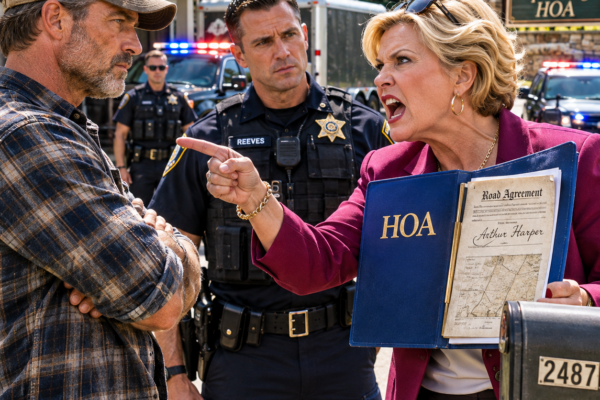
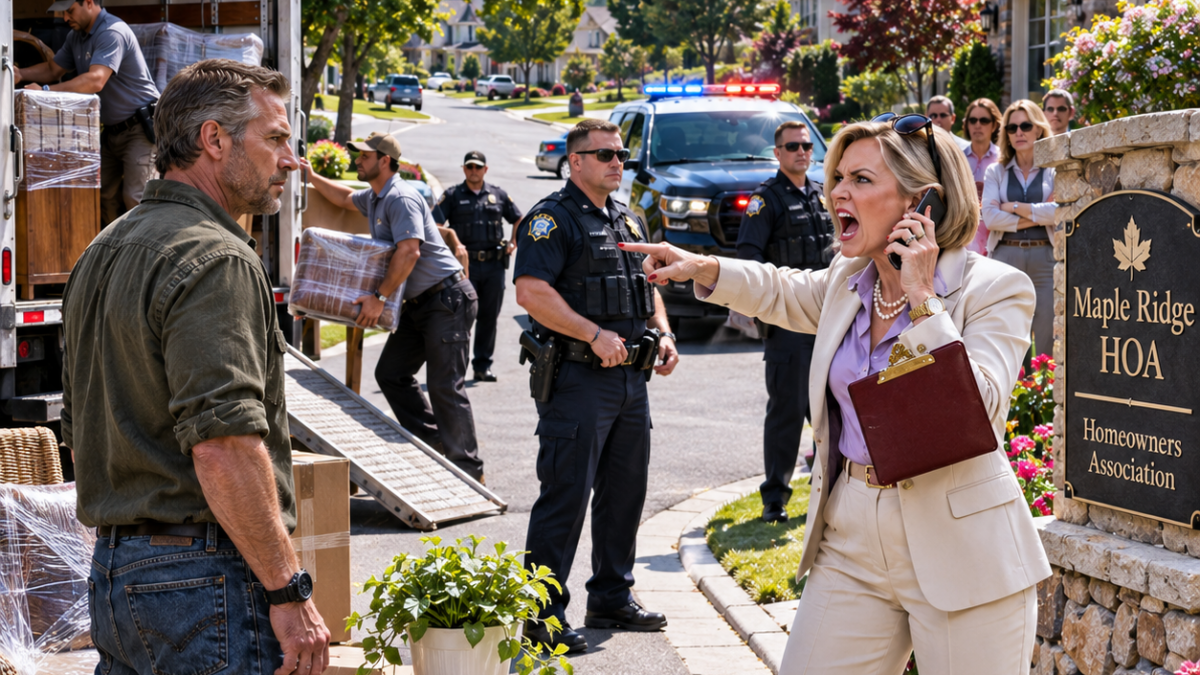
I was loading a moving truck.
I actually was moving out.
Just not out of Maple Ridge.
My original house needed repairs after months of contractor damage, and I had decided to turn part of it into a shared neighborhood workshop once the association dispute was resolved.
I was moving temporarily into the former Martinez house.
Number four.
A property I already owned.
Constance saw the truck and assumed she had won.
She walked across the street almost glowing.
“I knew you’d come to your senses.”
I carried a box past her.
“Morning, Constance.”
“So Meridian finally made you understand?”
“No.”
She watched the movers carry furniture.
“Where are you going?”
“Not far.”
Her eyes moved toward my patio set.
Two movers were carrying the chairs.
“Stop.”
They looked at me.
I looked at her.
“What?”
“You can’t take those.”
“My chairs?”
“They were installed as part of an approved exterior-use area.”
I stared.
“I’m sorry?”
“The HOA has assessed liens for unpaid fines. Exterior improvements become subject to the association’s property claim.”
That was nonsense.
Patricia had already challenged every fine.
No valid lien attached to my furniture.
I picked up another box.
“Constance, go home.”
She stepped in front of the truck.
“I am calling the police.”
“For what?”
“Theft of community property.”
I almost laughed.
Then I remembered the last eight months.
“Please do.”
Her face brightened.
She expected me to panic.
She dialed.
“I want to report a theft in progress.”
Dorothy appeared on her porch.
Then Michael walked over from the Martinez house.
He whispered:
“What’s happening?”
“She says my IKEA chairs belong to the HOA.”
Michael stared.
“You’re kidding.”
“I wish.”
Sirens came closer.
That was the moment from the beginning.
Constance folded her arms.
Smug.
Certain.
“You should’ve left quietly.”
I slid the last box into the truck.
“I am leaving quietly.”
The first cruiser stopped.
Officer Reed stepped out.
Another officer followed.
Constance rushed toward them.
“He’s removing property that belongs to the association.”
Officer Reed looked at the patio chairs.
“What property?”
“The furniture. Exterior improvements. Solar fixtures. There are outstanding assessments.”
He turned to me.
“Sir?”
I handed him receipts.
“These belong to me. The HOA assessments are disputed in civil proceedings. There is no court order or valid lien on these items.”
Constance interrupted.
“He’s also abandoning the property.”
Officer Reed looked at me.
“Are you?”
“I’m moving some belongings.”
“Where?”
I pointed four houses down.
“To number four.”
Constance frowned.
“The Martinez property?”
“Yes.”
“That house belongs to a bank.”
“Not anymore.”
Her face shifted.
Michael looked away so she wouldn’t see him smile.
Officer Reed asked:
“You own number four?”
“Yes.”
Constance stared at me.
“When did you buy it?”
“A while ago.”
She stepped closer.
“What are you doing?”
That question told me she finally sensed it.
But she still didn’t understand.
Officer Reed gave Constance her phone back.
“This is a civil matter. We don’t see evidence of theft.”
“You can’t just leave!”
I looked at her.
Five minutes earlier, she’d been celebrating my departure.
Now she didn’t want me to go.
“Apparently I can.”
I got into the truck.
Constance stood in the road.
Her voice followed me.
“You think buying one foreclosure changes anything?”
I lowered the window.
“No.”
Then I drove four houses down.
Dorothy told me later that Constance remained in the street for almost ten minutes.
She kept looking from my old house to the Martinez house.
Then she went inside.
The annual HOA meeting was that Monday.
Constance had been advertising it for weeks as the meeting where she would finally address what she called “organized disruption of legitimate community governance.”
Patricia advised me to keep the reveal simple.
“No speeches.”
“I wasn’t planning one.”
“Xavier.”
“What?”
“You absolutely were.”
“I had notes.”
“Burn them.”
Michael laughed.
The community center was packed.
Constance sat behind the folding table.
Margaret beside her.
Ted farther down.
The mayor’s liaison attended because of complaints involving city services.
Officer Reed was there off to the side at the request of building management after previous meetings became heated.
Two local reporters sat in the back.
Dorothy wore a blue dress and looked far too excited.
Constance began.
For twenty minutes, she presented photographs of my truck.
My cameras.
My garden.
The wildflowers.
She described a “coordinated effort to destabilize Maple Ridge.”
She wasn’t completely wrong about coordinated.
Just about who had destabilized it.
Then she motioned for emergency assessments against my original property.
Ten thousand dollars in combined penalties.
She wanted authorization to pursue liens.
I stood.
“Point of order.”
Constance closed her eyes.
“Mr. Finley.”
“Before the board votes, can we establish current voting rights?”
“This is not relevant.”
“It is if ownership changed.”
The room became quiet.
Patricia sat near the side wall.
She gave me one nod.
I opened the briefcase.
Eleven certified property records.
Constance stared.
I placed the first on the table.
“Number four.”
Second.
“Number six.”
Third.
“Number nine.”
I continued.
Some properties were held directly by Maple Ridge Investments.
Some by wholly owned project entities used for financing.
Patricia had prepared a simple ownership chart identifying the same controlling entity and voting authority.
Constance stopped me after the fifth.
“What is this?”
“Recorded deeds.”
“To what?”
“Maple Ridge properties.”
Her chair scraped.
“No.”
I placed another down.
Dorothy covered her mouth.
Ted leaned forward.
Margaret whispered:
“Oh my God.”
Constance picked up one deed.
Read it.
Then another.
Her hands began shaking.
“You bought these?”
“My investment company did.”
“How many?”
I placed the last record on the table.
“Eleven lots are now under common ownership or direct control.”
The room erupted.
Constance shouted over everyone.
“That is impossible!”
Patricia stood.
“It isn’t. Every transfer is recorded. The association’s own declaration assigns voting rights by lot ownership.”
Constance turned on her.
“Who are you?”
“His attorney.”
“You can’t do this.”
Patricia’s expression didn’t move.
“We already did.”
Constance looked around the room.
“These people sold to him?”
Several former owners were still present because leaseback agreements allowed them to remain.
Tom Henderson raised his hand.
“I sold at fair market value.”
Janet nodded.
“So did we.”
Mrs. Patterson said:
“He didn’t threaten me once.”
Dorothy added:
“Very refreshing business model.”
Laughter broke out.
Constance’s face went white.
Then red.
Then white again.
She pointed at me.
“You planned this.”
“Yes.”
“Why?”
I looked at the people around us.
“Because your authority depended on everyone believing they were alone.”
She slammed the deed down.
“This is coercion.”
“No. Every seller had independent terms and the right to say no.”
“You’re trying to take over the HOA.”
“No.”
I looked at Patricia.
She handed me the original 1974 charter.
“I want to restore what the association actually was.”
Voluntary.
Limited.
Basic shared coordination.
Not Constance’s private enforcement empire.
I made a motion to remove the existing board for cause and elect an interim board pending financial review.
Under the voting provisions, our owned lots represented enough votes to pass it.
But I didn’t use them alone.
I asked each current resident whether they wanted the motion.
One by one, hands rose.
Ted raised his too.
Constance stared at him.
“You owe me thirty thousand dollars.”
Ted flinched.
There it was.
In front of reporters.
In front of the mayor’s liaison.
Patricia immediately wrote something down.
Ted looked back at Constance.
“That’s exactly why I’m voting.”
Her mouth opened.
Nothing came out.
Margaret lowered her hand.
Then slowly raised it for the removal motion.
Constance whispered:
“You too?”
Margaret looked ashamed.
“I should’ve done it years ago.”
The motion passed.
Constance Blackwell was no longer HOA president.
For eight years, that title had been the center of her identity.
It disappeared in less than five minutes.
She gripped the edge of the table.
Then she looked at me.
“You still don’t own my house.”
“No.”
She smiled.
For one strange moment, I saw her old confidence return.
“At least you understand something.”
I reached into the briefcase.
Patricia’s eyes warned me not to dramatize this.
I kept my voice flat.
“Maple Ridge Investments also acquired the distressed note secured by your property.”
Constance stopped breathing.
I placed the notice on the table.
“This is not an eviction.”
Patricia looked relieved that I said it correctly.
“You retain every borrower protection required by law. You can cure the default, refinance, contest the process, sell, or exercise any other lawful option.”
Constance stared at the document.
“But the lender?”
“Transferred the note.”
“To you?”
“To our company.”
Her knees gave slightly.
She caught the chair.
Dorothy didn’t laugh.
Nobody did.
The moment was too serious.
For the first time since I’d met Constance, she looked genuinely afraid.
Not angry.
Afraid.
I hated how satisfying that felt.
Because fear had been her favorite tool.
Then I remembered the Martinez kitchen.
The stars on the bedroom ceiling.
Maria saying her boys still looked over their shoulders before bouncing a basketball.
My satisfaction vanished.
I said:
“You have options those families didn’t think they had.”
Constance looked up.
“What is that supposed to mean?”
“It means nobody is going to manufacture violations until you panic-sell.”
Silence.
“If you lose the house, it will happen through the same legal process every borrower is entitled to.”
Constance laughed.
Sharp.
Bitter.
“You think you’re better than me?”
“No.”
I glanced at the deeds.
“That’s why Patricia is here.”
The meeting ended without celebration.
Not immediately.
People talked.
Cried.
Compared old notices.
Ted apologized to Dorothy.
Margaret sat alone for several minutes before joining everyone.
Constance walked out.
The reporters followed.
I stayed.
Dorothy approached.
“You won.”
I shook my head.
“Not yet.”
“What else is there?”
I looked at the financial records Patricia was collecting.
“Answers.”
The answers took months.
County investigators reviewed the HOA accounts.
The state real-estate board examined Meridian Property Solutions and Blackwell-connected transactions.
The attorney general’s office contacted former homeowners.
City departments compared complaint logs.
Insurance investigators reviewed claims.
What emerged wasn’t one perfect master conspiracy.
Real misconduct is usually messier.
Some HOA disputes had been legitimate.
Some former residents simply wanted to move.
Not every Meridian purchase was fraudulent.
But enough transactions followed the same pattern to matter.
Investigators found communications between Constance and Danny Meridian discussing “pressure points” on certain owners.
One message about the Martinez family read:
**Noise complaints are working. Keep offer open but don’t increase yet.**
Another concerning Harold Becker’s accessibility ramp:
**He can’t afford a legal fight. Give it another month.**
I had to stop reading.
That sentence stayed with me.
He can’t afford a legal fight.
That was the entire system.
Constance didn’t need to be legally right.
She needed the other person to be too tired, poor, sick, old, grieving, or frightened to prove she was wrong.
Investigators also found evidence supporting misuse of association funds.
Not every dollar.
But enough.
Payments to related vendors.
Services not performed.
Inflated compliance charges.
Money routed through administrative companies.
The previously unexplained fifteen thousand dollars became part of the restitution calculation.
Then there were the false city complaints.
My business.
My truck.
My tomato garden.
The supposed gas leak.
Individually, they looked petty.
Together, they showed retaliation.
Patricia advised everyone to resist the temptation to turn the case into legend.
“Evidence is strong enough without making it bigger.”
That lesson mattered.
By then, neighborhood gossip had transformed Constance into a criminal mastermind who supposedly controlled judges, banks, police, satellites, and possibly weather patterns.
She didn’t.
She was a frightened, deeply controlling woman who had learned how much damage could be done with paperwork, financial leverage, and people who preferred silence.
That was bad enough.
Her brother-in-law eventually retained his own attorney.
Ted cooperated.
Margaret cooperated.
The turf-analysis company records were subpoenaed.
The city’s complaint files were preserved.
Constance’s real-estate license was placed under disciplinary review.
Meanwhile, her mortgage default continued.
She tried to refinance.
The numbers didn’t work.
She challenged the note transfer.
The court upheld the assignment.
She received additional cure time.
We offered a structured settlement.
Sell voluntarily.
Pay agreed arrears and restitution obligations from proceeds where legally applicable.
Avoid the costs of foreclosure.
She rejected it.
Then accepted a revised version two weeks before the scheduled sale.
Maple Ridge Investments purchased the property through the settlement.
Fair appraisal.
Debt credited.
Required closing disclosures.
No tricks.
No moving her furniture onto the road.
She moved to her sister’s home in another state while the criminal case continued.
The morning her moving truck arrived, Dorothy came to my kitchen.
“She called the cops when you moved.”
“I remember.”
Dorothy looked through my window at Constance carrying boxes.
“Are you going to call them now?”
“No.”
“Not even for symmetry?”
“No.”
“Disappointing.”
Constance saw me standing on the porch.
For a moment, we looked at each other across the street.
She walked over.
No clipboard.
No perfume strong enough to reach me from ten feet away.
No handbook.
Just Constance.
“You got what you wanted.”
I thought about that.
“No.”
She laughed bitterly.
“You own my house.”
“The company owns it.”
“You own the company.”
“Part of it.”
“Don’t play word games.”
I didn’t.
She looked at Maple Ridge.
“You bought everything.”
“Most of it.”
“Why?”
“You know why.”
“No. I really don’t.”
That surprised me.
Maybe it shouldn’t have.
“Because you wouldn’t stop.”
“I enforced standards.”
“You destroyed people.”
Her jaw tightened.
“People made their own decisions.”
“After you made staying unbearable.”
“I never forced anyone to sign a sales contract.”
That was legally true.
Morally incomplete.
I said:
“Maria Martinez lost her job hours because she spent months answering complaints you knew were baseless.”
Constance looked away.
“Harold Becker’s wife needed a wheelchair ramp.”
“The ramp violated—”
“Stop.”
My voice came out harder than I intended.
She looked at me.
“No handbook now. No meeting minutes. Just answer me as a person.”
She said nothing.
“Did you know Harold couldn’t afford the fight?”
Her eyes changed.
I knew she remembered the message.
“Did you?”
Finally:
“Yes.”
That one word did more to me than eight months of violations.
Because there it was.
Not misunderstanding.
Not incompetence.
Knowledge.
“Then that’s why.”
She looked toward her house.
Former house.
“I was going to lose everything.”
I waited.
“My catering company failed.”
“I know.”
“Robert left me with debts.”
I hadn’t known that.
Her ex-husband.
She continued.
“I had the mortgage. Second mortgage. Credit cards. Danny showed me how much distressed properties could make.”
Her voice became quieter.
“The first family was already leaving.”
“And the next?”
No answer.
“The next?”
She wiped at one eye angrily.
“You have no idea what it feels like to watch your entire life collapse.”
That sentence could have made me furious.
Instead, I thought about my divorce.
The empty apartment afterward.
The first night I slept alone.
“I do.”
Constance looked at me.
“Then you should understand.”
“No.”
I shook my head.
“I understand being afraid.”
Pause.
“I don’t understand making other families pay for it.”
She didn’t answer.
The movers called her name.
Constance turned.
Then looked back.
“Do you hate me?”
Months earlier, I would’ve said yes.
Now?
“No.”
Her face showed surprise.
“Why not?”
“Because I’m tired.”
She nodded.
Then crossed the street.
No dramatic defeat.
No screaming.
No police.
Just a woman carrying a box out of a house she could no longer afford.
The criminal case resolved nearly a year after the first sprinkler fine.
Constance entered pleas on fraud-related counts and false statements connected to the broader financial scheme.
Some allegations were dismissed as part of the agreement.
Others remained in civil proceedings.
She received three years of supervised probation, substantial restitution, financial penalties, and a prohibition on serving as an officer or director of a homeowners association during the supervision period and beyond under the settlement terms.
Her real-estate license was suspended through disciplinary action.
Danny Meridian faced his own penalties and restitution obligations.
The state required additional oversight for several transactions.
Was the sentence dramatic?
No.
Nobody slammed a gavel and sent Constance away for twenty years.
Real justice is often paperwork, payment schedules, supervision, restrictions, and a permanent record saying:
You cannot pretend this never happened.
Dorothy attended sentencing.
Afterward she whispered:
“Three years probation?”
“Yes.”
“I wanted prison.”
“I know.”
“She made me move my bird feeder.”
“That is not usually a sentencing enhancement.”
“It should be.”
I laughed.
Then Dorothy surprised me.
“Maybe probation is enough.”
I looked at her.
“Why the change?”
“Because now she has to spend three years doing what people tell her.”
Fair point.
Her community-service condition involved work through programs assisting elderly homeowners with basic maintenance coordination.
The irony was not lost on anyone.
Least of all Constance.
Maple Ridge changed more quickly.
The old HOA had always been voluntary under the original charter.
Once we confirmed that, we stopped pretending otherwise.
Mandatory-style dues ended.
The association was reorganized as an opt-in neighborhood group.
Fifty dollars a month for those who wanted shared landscaping at the entrance, social events, and small common expenses.
No architectural police.
No grass laboratory.
No daily fines.
No enforcement clipboard.
Actual city code remained actual city code.
If somebody blocked a hydrant, the city handled it.
If someone’s grass was three inches tall instead of two and a quarter?
Civilization survived.
Michael wanted me to become president.
“No.”
“You own most of the lots.”
“Exactly why I shouldn’t.”
“Then who?”
Dorothy nominated Janet Henderson.
Janet tried to decline.
Dorothy ignored her.
Janet won.
First meeting, she placed a clipboard on the table.
Dorothy stood.
“I object.”
Janet looked confused.
“To the clipboard.”
Everyone laughed.
We adopted a transparency policy anyway.
Published finances.
Annual independent review.
Recorded votes.
Conflict disclosures.
One vote per participating household on association matters regardless of how many properties an investor owned.
That last rule was my idea.
Michael stared at me.
“You’re voluntarily giving up voting control.”
“Yes.”
“After spending millions acquiring it.”
“Yes.”
“Why?”
“Because I didn’t buy the block to become Constance.”
He smiled.
“Good answer.”
The properties became the next question.
I didn’t want to be a landlord to an entire street.
That would’ve been another empire.
We kept three homes as rentals.
Six were sold to owner-occupants over the next two years.
Every sale included normal market terms.
No hidden HOA requirement.
No resale control.
No demand that people keep grass at an approved percentage of Kentucky bluegrass.
Two houses became community resources temporarily while renovations were completed.
My original home became the neighborhood workshop I had imagined.
Tools.
Workbenches.
A small meeting room.
Retired tradespeople volunteered on Saturdays.
Residents could borrow equipment.
The first workshop was led by Michael.
Topic:
“How to Repair a Sprinkler Head.”
Dorothy laughed for ten straight minutes.
I mounted the original five-hundred-dollar violation notice on the wall.
Under it:
**PART COST: $12.43**
That was the only memorial Constance’s rulebook received.
The Martinez house was harder.
I called Maria.
“We’re ready to decide what happens with it.”
“What are you thinking?”
“I can sell it. Rent it. If you wanted first option—”
“No.”
She answered immediately.
“My boys don’t want to go back.”
“I understand.”
“They’re doing better here.”
“Then what would you like?”
There was a long pause.
“You’re asking me?”
“It was your home.”
“Not anymore.”
“I know.”
She sighed.
“Put a family in it.”
“Okay.”
“A family Constance would’ve hated.”
I laughed.
“What does that mean?”
“Kids. Basketball hoop. Loud dog.”
We found a young couple with three children.
The father was a high-school science teacher.
The mother was a nurse.
They had a Labrador with no respect for noise ordinances.
We rented below market for the first year.
When they later qualified to buy, Maple Ridge Investments sold it to them.
The first thing the oldest son installed was a basketball hoop.
Maria sent me one message after I showed her the photo.
**Good.**
Nothing else.
It was enough.
The Hendersons never left.
Neither did Mrs. Patterson.
Dorothy certainly didn’t.
Her bird feeders multiplied.
At one point I counted nine.
“Dorothy.”
“What?”
“This is becoming an airport.”
“Cardinals need options.”
“No bird needs nine restaurants.”
“They are selective.”
I stopped arguing.
One year after the HOA collapse, we held the first Maple Ridge block party in almost a decade.
No permits from Constance.
No approved tablecloth colors.
No violation patrol.
Kids rode bicycles.
Music played.
Someone’s dog stole a hamburger.
Tom burned chicken.
Michael brought a smoker large enough to service a military battalion.
Dorothy sat beneath a canopy surrounded by bird-themed decorations she claimed were unrelated to her long campaign against Constance.
I stood beside my old driveway.
The same place where the police had arrived while I loaded my moving truck.
Officer Reed stopped by in uniform.
He pointed toward the patio chairs.
“Those the stolen HOA assets?”
“Recovered.”
“Good police work.”
“Exceptional.”
We laughed.
Then a moving truck turned onto Maple Ridge.
For half a second, everyone looked.
Old reflex.
The truck stopped at Constance’s former house.
A family climbed out.
Parents.
A teenage girl.
Young boy.
Two dogs.
The mother looked around nervously.
I remembered my first hour on the street.
The diesel smell.
Boxes.
Constance walking toward me with forty-seven pages of rules.
Dorothy appeared beside me carrying cookies.
“You going over?”
“Yes.”
She handed me the plate.
“Take these.”
“You made them?”
“Of course.”
I walked across the street.
The father looked up.
“Hi.”
“Xavier Finley. I live down there.”
I held out the cookies.
“Welcome to Maple Ridge.”
The woman smiled.
“Thank you.”
Then she glanced toward the community entrance.
“We were told there’s a neighborhood association.”
“There is.”
Her expression tightened slightly.
“What are the rules?”
I thought about Constance.
Grass tests.
Mailbox colors.
Truck hearings.
Fences.
Bird feeders.
Fines.
Foreclosures.
Police.
Then I looked at the boy.
He was holding a basketball.
I smiled.
“Don’t block fire hydrants.”
The father laughed.
“That’s it?”
“City has plenty of other rules. We try not to invent extras.”
The mother looked relieved.
Her son bounced the ball once.
Then froze.
“Is that okay?”
I looked toward the Martinez house.
Another basketball bounced in a driveway farther down.
“Yeah.”
He bounced it again.
That sound traveled down Maple Ridge.
Once.
Twice.
Then faster as the new kid began dribbling toward the driveway.
Nobody came outside with a clipboard.
Nobody photographed him.
Nobody measured the volume.
I went home.
My front porch faced the whole street.
I sat with coffee.
Dorothy’s bird feeders moved in the breeze next door.
Kids played.
A lawn mower started somewhere.
Someone had planted red roses beside pink ones.
The property values were fine.
Better, actually.
But I stopped checking the numbers after a while.
Constance had believed a neighborhood was valuable because everything looked controlled.
Same grass.
Same mailboxes.
Same behavior.
Quiet people.
Compliant people.
People too tired to object.
She was wrong.
The best thing about Maple Ridge was that it eventually became imperfect.
One yard had clover.
Another had wildflowers.
A family painted their front door blue.
Mrs. Patterson kept the wind chimes.
The new family at Constance’s old house put up holiday lights that would’ve violated at least four sections of her handbook.
I helped them hang the lights.
At some point, the teenage daughter asked:
“Didn’t some crazy HOA lady used to live here?”
I looked at her father.
He shrugged.
“They heard the story.”
“Something like that.”
“Did you really buy the whole street?”
“Most of it for a while.”
“Why?”
That’s harder to explain to a teenager without sounding insane.
“Because somebody was using property to control people.”
She waited.
“So you used property to control her?”
That stopped me.
Kids are good at finding the uncomfortable part.
“For a little while,” I said.
“Wasn’t that the same thing?”
“No.”
Then I thought.
“Almost.”
She raised an eyebrow.
I corrected myself.
“The difference was what happened afterward.”
I pointed down the street.
“I gave the control back.”
She considered that.
Then nodded.
“Okay.”
I thought about her question for days.
I had spent a lot of time telling myself I was different from Constance because my reasons were better.
Justice.
Protection.
Community.
Those reasons mattered.
But owning almost an entire block had given me enormous power.
If I had kept every property, controlled every vote, dictated rents, decided which families deserved homes, I could have built a kinder-looking version of the same problem.
The moment that mattered wasn’t buying Maple Ridge.
It was letting it go.
Years passed.
Michael and I eventually unwound most of the investment partnership.
He made money.
So did I.
Not the fortune people imagined.
Renovations cost more than expected.
Property taxes never sleep.
One roof failed during a hailstorm.
Another house needed a foundation repair that made my old Army logistics budgets look friendly.
But we finished positive.
The legal-assistance fund received part of the proceeds.
It helped homeowners in nearby communities pay for initial consultations, surveys, document retrieval, and mediation.
Not every HOA complaint turned out to involve corruption.
Some homeowners really had broken rules.
Some boards were perfectly reasonable.
Sometimes the legal advice was:
Yes, you actually do need to move the boat.
That mattered too.
Fairness is not automatically siding with the homeowner.
It’s applying the same rule to everyone.
Patricia volunteered occasionally.
Whenever someone arrived saying, “The HOA can’t do this to me,” she would ask:
“Show me the documents.”
No speeches.
No outrage.
Documents.
I loved that about her.
Ted eventually paid off the loan arrangement tied to Constance.
He kept his business.
He apologized publicly for every vote he’d cast under pressure.
Not everyone forgave him.
He accepted that.
Margaret did the same.
She once told me:
“I thought being close to Constance kept me safe.”
“Did it?”
“No.”
“What did it do?”
She stared at her coffee.
“Made other people less safe.”
That was enough.
Harold Becker returned once.
His wife had died by then.
He came to see the neighborhood workshop.
We had installed a fully accessible entrance.
He stood at the bottom of the ramp for several seconds.
I thought he might cry.
Instead, he ran one hand along the railing.
“Nice slope.”
“Code compliant.”
He smiled.
“Constance would’ve hated it.”
“She would’ve written a seven-page notice.”
Harold walked inside.
On the wall beside the sprinkler citation were photographs of former residents.
Not victims.
Residents.
Families who had lived there.
We kept their stories because neighborhoods have memory even when property changes hands.
Harold found his old house in one photo.
His wife stood beside the ramp.
He touched the picture.
“Thank you.”
“For what?”
“Not letting her make us disappear.”
I didn’t know what to say.
So I didn’t say anything.
Sometimes silence is the right answer.
Constance completed her probation.
I knew because I received a final restitution notice.
She had paid what the court required.
Her real-estate career never recovered.
Last I heard, she worked for a regional financial-services office in another state in a role with no client investment authority.
I never contacted her.
She never contacted me.
That was fine.
The most satisfying revenge is sometimes irrelevance.
For eight months, I woke up thinking about Constance.
What letter would arrive?
What complaint?
What inspection?
What lie?
Then I spent another year thinking about the case.
Eventually, whole weeks passed without her name entering my mind.
That was when I knew the neighborhood had actually healed.
Not when she lost the presidency.
Not when the deeds landed on the table.
Not when she moved.
When nobody cared where she was anymore.
Dorothy turned eighty.
Then eighty-one.
Then eighty-two.
Her son wanted her to move closer to him.
She refused.
“He can move here.”
Eventually he did.
Bought one of the houses Michael and I sold.
Dorothy claimed this proved she was the true mastermind of the entire operation.
Honestly, she had a case.
At her eighty-third birthday, she handed me the old forty-seven-page handbook Constance had given her years earlier.
“Why do you still have this?”
“Historical evidence.”
“What am I supposed to do with it?”
“Burn it.”
“No.”
“Shred it?”
“No.”
“Bird cage?”
I looked at her.
She smiled.
“That could work.”
We framed the cover instead.
It hangs in the community workshop next to the sprinkler citation.
Below it, someone added a small plaque:
**MAPLE RIDGE OPERATING MANUAL, 2014–2026
MOSTLY IGNORED SINCE.**
I don’t know who made the plaque.
I suspect Michael.
My divorce stopped feeling like the defining event of my fifties.
That surprised me most.
When I first moved to Maple Ridge, I believed I needed isolation.
I thought peace meant nobody needing anything from me.
No spouse.
No command.
No deadlines.
No responsibility.
Then a ridiculous sprinkler fine forced me to knock on doors.
I met Dorothy.
Michael.
The Hendersons.
Mrs. Patterson.
Maria Martinez, even if mostly by phone.
Harold.
Patricia.
People whose lives crossed mine because one woman thought control was the same thing as community.
In trying to isolate me, Constance accidentally gave me a neighborhood.
I never thanked her.
Some things don’t require gratitude.
One autumn morning, several years after the moving-truck incident, I stood at the end of my driveway watching leaves collect along the curb.
A small plastic sprinkler head stuck up from the grass strip.
The replacement I had installed on my first day had finally cracked.
I turned the water on.
It sprayed sideways.
Right into the street.
Dorothy happened to be walking by.
She stopped.
“Oh no.”
“What?”
“Destruction of community property.”
I looked at her.
“Five-hundred-dollar fine.”
“Plus administrative costs.”
“Of course.”
She folded her arms.
“Are you going to replace it?”
I pulled a new head from my pocket.
Already bought.
Army logistics.
Always have the part.
Dorothy laughed.
I knelt in the grass and unscrewed the broken sprinkler.
Twelve dollars and change.
That was how everything had started.
A tiny piece of plastic.
A huge fine.
A woman who believed nobody would read the rules closely enough to challenge her.
I screwed in the new head.
Turned the water back on.
The sprinkler rose.
Rotated.
Perfect arc.
Children shouted somewhere down the street.
A basketball bounced.
Wind chimes rang.
Dorothy’s cardinals fought over the feeder.
And nobody came outside to tell any of us we were doing it wrong.
[END OF STORY]