PART 2: HOA President Called the Cops on Me 14 Times—Then the District Attorney Used Her Own 911 Calls Against Her
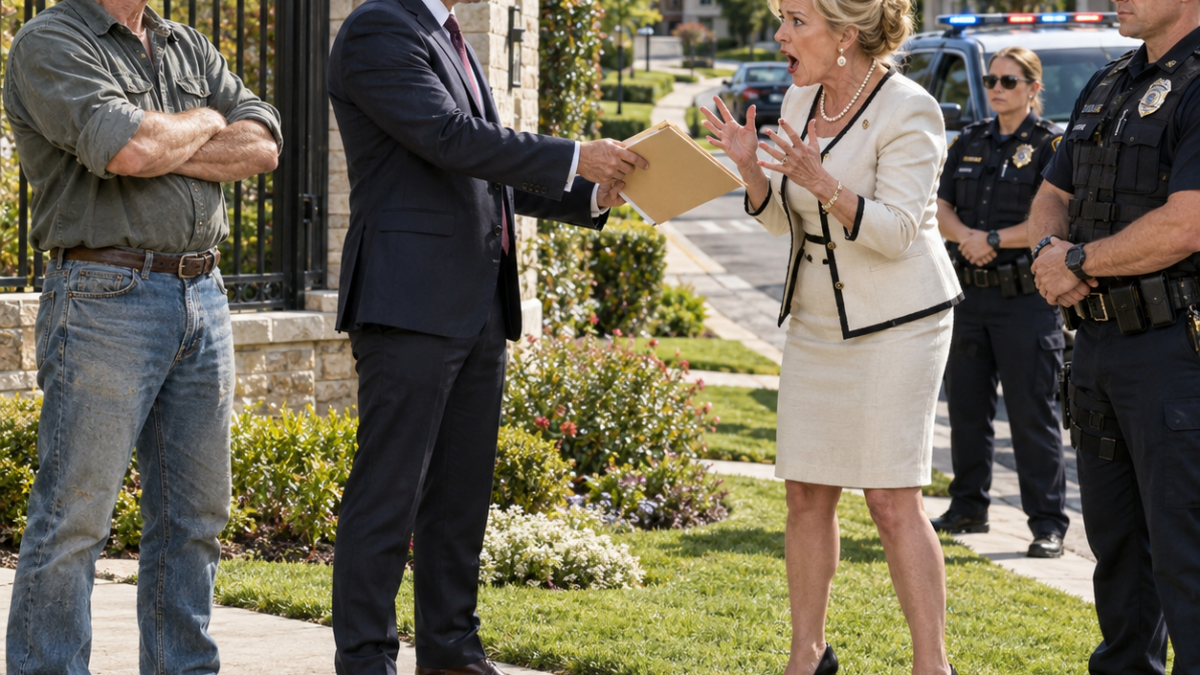
The fourteenth police cruiser pulled up in front of my house because the HOA president had reported my American flag as an “aggressive disturbance.”
For six months, Karen Donaldson had turned police officers, violation notices, fines, and anonymous complaints into weapons designed to make my wife and me regret ever moving into Northwood Estates.
But as I watched Officer Harris glance toward Karen’s twitching upstairs curtain that afternoon, I finally understood that the thing she believed would wear me down might become the very thing that destroyed her.
“Sir, I’m sorry.”
Officer Harris stood on my porch looking more embarrassed than I was angry.
Almost.
“What exactly was reported?”
He rubbed one hand over his jaw.
“Excessive noise.”
I looked toward the flagpole.
The breeze barely moved the three-by-five-foot flag.
“From that?”
Harris exhaled.
“The caller also described the pole as excessively tall and the display as… provocative.”
“Provocative?”
He stared at his notebook.
I could tell he hated every second of this.
“Her words were ‘aggressively patriotic.’”
For the first time, I almost laughed.
Almost.
Then I looked across the street.
Karen Donaldson’s beige colonial sat behind perfectly trimmed hedges.
One upstairs curtain shifted.
She was watching.
She was always watching.
“That makes fourteen,” I said.
Harris nodded.
“I know.”
Fourteen police visits in six months.
The first had been my truck.
Karen reported an unfamiliar suspicious vehicle parked in my driveway.
It was registered to me.
The second was a noise complaint during a Saturday afternoon barbecue with my wife, Sarah, and two friends.
The responding officer could barely hear our radio from the sidewalk.
Then came a welfare check because our curtains remained closed until noon.
Another call claimed I was abusing my dog because I washed him in the backyard.
One report accused me of operating some kind of chemical business from my garage.
I had been fertilizing roses.
Every call ended the same way.
An officer arrived.
An officer looked around.
An officer realized nothing was happening.
An officer left.
And somewhere across the street, Karen watched.
It hadn’t started with police.
It started with a garbage can.
Sarah and I had moved into Northwood Estates after I retired from the Army.
Twenty years of relocations, deployments, temporary housing, missed holidays, and plans built around orders had left us wanting one simple thing.
A permanent home.
Northwood looked perfect.
Big trees.
Quiet sidewalks.
Children riding bicycles.
Neighbors waving from driveways.
Three weeks after moving in, I put our garbage container at the curb at seven the evening before pickup.
At 7:31, Karen emailed me a photograph.
Rule 7.4B.
Trash containers could not appear curbside before five the following morning.
Fifty-dollar fine.
I paid it.
My mistake.
Then she measured my grass.
A quarter-inch too high.
Another fine.
Then an oil spot left by a friend’s pickup became a “hazardous automotive contaminant.”
Another fine.
By the fourth violation, I walked across the street with the letters in my hand.
Karen answered wearing a pink tracksuit and an expression that made it clear I was interrupting something far more important than basic human decency.
“I’m not looking for an argument,” I said. “I’m new here. I just think the enforcement seems excessive.”
“The rules are the rules, Mr. Miller.”
“I understand that.”
“Then comply.”
I explained that I had spent twenty years in the Army, that I understood structure better than most people, and that I wanted to be a good neighbor.
Her face hardened.
“Your military career doesn’t make you special.”
“I didn’t say it did.”
“Perhaps if you spent less time talking about uniforms and more time learning how civilized communities work, we wouldn’t be having this conversation.”
That was the moment I realized the fines were never really about grass or trash cans.
Karen wanted submission.
And when she didn’t get it, she found another weapon.
The police.
Officer Harris looked back at me.
“Mr. Miller, you know we’re required to respond.”
“I know.”
“I’m not saying you’re doing anything wrong.”
“I know that too.”
He hesitated.
“Start keeping the report numbers.”
Something in his tone changed everything.
I looked at him.
“All of them?”
“All of them.”
Across the street, Karen’s curtain moved again.
I thanked Harris, watched his cruiser disappear around the corner, and went inside.
Sarah was waiting in the hallway.
“What now?”
I looked toward my home office.
“The fines didn’t stop her.”
“No.”
“The police didn’t scare me.”
“No.”
“So she’ll keep escalating.”
Sarah studied my face.
“And?”
I opened the office door.
“And I’m done trying to convince her to act reasonably.”
I pulled an empty binder from the shelf.
On the cover, I wrote two words.
KAREN DONALDSON.
Then underneath them:
POLICE CALL #14.
Sarah stared at the page.
“What are you doing?”
I looked across the street one more time.
“Giving her exactly what she’s been giving me.”
Sarah frowned.
“What?”
“A record.”
PART 2
That night, Sarah and I covered the dining-room table with every piece of paper Karen had sent us since we moved into Northwood Estates.
Violation notices.
Certified letters.
Emails.
Photographs.
Receipts for fines I had stupidly paid during the first month.
I say stupidly because I had believed paying them would prove I was reasonable.
Instead, it proved something else to Karen.
That pressure worked.
The garbage-can fine had been fifty dollars.
The grass violation was seventy-five.
The driveway stain cost me one hundred.
She fined us for a wreath Sarah hung on the front door because the artificial berries were “outside the approved seasonal color palette.”
She fined me because our garden hose was not wound into what the letter called a “visually uniform circular configuration.”
That one had almost impressed me.
Someone had actually taken time out of a finite human life to write that sentence.
Sarah picked up the notice.
“Fifty dollars because a hose isn’t circular enough.”
“I fought in countries with simpler governments.”
She laughed.
Then her smile disappeared.
“This isn’t funny anymore.”
“No.”
“You’re checking the window every time you hear a car.”
I stopped organizing.
She was right.
I had begun recognizing the sound of Karen’s sedan.
I knew the pattern of her footsteps on the sidewalk.
Every time a police cruiser entered our block, my chest tightened before I even knew whether it was coming to our house.
I had spent years overseas learning how to recognize threats.
I never imagined retirement would require the same part of my brain because a middle-aged HOA president had too much free time.
Sarah reached across the table.
“Jack, I want our life back.”
“So do I.”
“Then what are we going to do?”
I looked at the pile.
“We stop reacting.”
“And?”
“We start documenting.”
The next morning, I drove to an office-supply store.
I bought a four-drawer fireproof filing cabinet.
Sarah stared at it when I unloaded it from the truck.
“That seems excessive.”
“Probably.”
“You bought hanging folders too?”
“Color-coded.”
She looked genuinely concerned.
“I married a dangerous man.”
We organized the cabinet.
Drawer one: HOA.
Drawer two: POLICE.
Drawer three: VIDEO.
Drawer four: LEGAL.
The fourth stayed empty.
For the moment.
Then I installed cameras.
Not cheap doorbell cameras.
A professional system covering every exterior section of the property.
Front porch.
Driveway.
Side yard.
Backyard.
Each recorded high-resolution video and audio with timestamps.
I wasn’t trying to spy on Karen.
I wanted an objective record of my own life.
If she said I was blasting music at eleven at night, I wanted video showing the house dark and quiet.
If she said my dog was loose, I wanted footage showing him asleep in the kitchen.
If she claimed strangers were entering our garage, I wanted proof the only stranger was the delivery driver bringing Sarah another package she swore she had forgotten ordering.
The system went live on a Saturday.
Karen noticed Sunday morning.
She stood on the public sidewalk staring up at the camera above my garage.
I watched from the kitchen.
Sarah joined me.
“She sees it.”
“Yes.”
“Think it’ll scare her?”
“No.”
“What will it do?”
“Make her careful.”
I was wrong.
Karen did not become careful.
She became furious.
Three days later, a violation notice arrived accusing us of installing “unapproved exterior surveillance equipment that altered the visual character of the residence.”
I read the bylaws.
Twice.
There was no rule prohibiting security cameras.
I wrote a short response.
Please identify the specific covenant provision violated.
Karen replied:
The board possesses broad discretionary authority over modifications affecting neighborhood aesthetics.
I printed both emails.
Filed them.
Two days later, Karen walked ten feet onto my lawn while photographing the side-yard camera.
The camera recorded her doing it.
Filed.
Then she sent a photograph of my hose.
Her angle could only have been taken from inside my property.
Filed.
She cited a brown patch in the lawn.
Video showed her kneeling beside it with a ruler.
Filed.
Sarah began calling the filing cabinet “the shrine.”
I corrected her.
“It’s the archive.”
“It’s creepy.”
“It’s organized.”
“It has tabs.”
“Tabs are civilization.”
The humor helped.
Because underneath it, both of us were exhausted.
Then Karen called police visit number fifteen.
I had hoped number fourteen might embarrass her enough to stop.
Instead, at 3:07 one morning, two officers knocked on our door.
I opened it wearing sweatpants.
“What happened?”
The older officer looked apologetic.
“We received a report of suspicious flashing lights inside the residence.”
Behind me, my home-office monitor rotated through a screen saver.
Blue.
Then green.
Then dark.
I stared at the officer.
He stared past me.
Then he closed his eyes for one second.
“Computer?”
“Computer.”
“Sorry.”
“Report number?”
He looked surprised.
Then nodded.
I had learned.
He gave it to me.
When the officers left, I stood in the dark foyer with the number written on a notepad.
Sarah appeared upstairs.
“Was it her?”
“Yes.”
She sat on the step.
“Jack, I can’t do this forever.”
I looked at her.
Neither could I.
That was the morning things changed.
Not because Karen escalated.
Because I noticed Tom and Jessica Reed three houses down.
They had moved into Northwood two months after us.
Jessica had given birth recently.
Around ten that morning, my driveway camera caught their minivan pulling in.
Tom wrestled a baby carrier from the back seat.
Jessica looked like she had not slept in a month.
They carried the baby inside.
The garage door remained open.
Five minutes.
Maybe six.
Karen crossed the street.
Clipboard.
Phone.
Photograph.
She never knocked.
Never asked if they needed help.
She simply documented them.
An hour later, Tom walked to the mailbox.
He opened an envelope.
His shoulders sank.
I knew that posture.
The posture of someone realizing a stranger had found a way to make his own home feel conditional.
I printed a still from my security footage.
Then I walked to their house.
Tom opened the door.
A baby cried behind him.
“Jack?”
“Sorry to bother you.”
“No, it’s okay.”
I held up the envelope-sized folder.
“You got something from Karen?”
His face darkened.
“How did you know?”
“Because I watched her photograph your garage.”
He stared at me.
“What?”
I showed him the still.
Timestamp visible.
Karen standing several feet inside the edge of his driveway.
His jaw tightened.
“She fined us a hundred dollars.”
“For what?”
“Garage door open longer than three minutes.”
He laughed bitterly.
“We were bringing Emma inside. Jessica was crying because Emma wouldn’t stop crying. We forgot the garage.”
“I figured.”
Tom looked again at the photograph.
“She came onto our property?”
“Yes.”
“Can she do that?”
“Not because she owns a clipboard.”
His eyes narrowed.
“What are you doing about her?”
That question mattered.
For the first time, someone else was asking it.
“Come over tonight.”
At seven, Tom sat in my office.
I opened drawer one.
His eyes widened.
Then drawer two.
Police reports.
Fifteen now.
“Fifteen?”
“Fifteen.”
“She called the cops fifteen times?”
“So far.”
“Why?”
I started listing them.
Truck.
Barbecue.
Curtains.
Dog bath.
Chemical smell.
Flag.
Flashing light.
Suspicious package.
Tom interrupted.
“Suspicious package?”
“Amazon.”
He stared.
“You’re kidding.”
“I wish.”
I showed him my incident log.
Dates.
Times.
Officers.
Report numbers.
Allegations.
Outcome.
Then I showed him video clips.
Karen photographing the hose.
Karen walking onto the lawn.
Karen sitting in her car across from the house.
Tom leaned back.
“Jesus.”
“This is what she counts on.”
“What?”
“Everyone thinking they’re alone.”
He looked at the fine in his hand.
“So what do I do?”
“Contest it.”
“She controls the board.”
“Contest it anyway.”
“Why?”
“Because process creates records.”
That sounded like something my old first sergeant would have said.
Maybe it was.
“Second, document everything.”
“Okay.”
“Third, write down exactly what happened today while you remember.”
“Why?”
“Because six months from now, memory becomes fuzzy. Paper doesn’t.”
He nodded slowly.
“What are you building?”
I looked toward the empty legal drawer.
“I don’t know yet.”
The answer came two days later.
Mr. Henderson lived next door to me on the other side.
Arthur Henderson was seventy-eight, widowed, and seemed to spend every daylight hour working among roses.
I had spoken with him casually.
He knew I was having problems with Karen.
I had not told him everything.
That afternoon, I did.
He listened while pruning a rose bush.
When I finished, he clipped one last stem and said, “You’ve made a classic mistake.”
I stared at him.
“What?”
“You think you’re fighting an HOA.”
“Aren’t I?”
“No.”
He wiped his pruning shears.
“You’re fighting a woman who may be committing crimes while using an HOA as camouflage.”
That got my attention.
Arthur had been a corporate attorney before retirement.
Not criminal law.
But enough law to recognize when something had moved beyond petty covenant enforcement.
“Come inside.”
His study looked like what you would expect from someone who still used the word jurisprudence in ordinary conversation.
Law books.
Old case reporters.
Leather chair.
Desk blotter.
He poured iced tea.
“Start with the police calls.”
“I have the reports.”
“Do you have the 911 recordings?”
“No.”
“Get them.”
“Can I?”
“Likely through public-records procedures, subject to whatever redactions state law requires.”
“What am I looking for?”
“Consistency.”
“Meaning?”
“Does she claim to observe something the objective evidence proves she could not have observed?”
I thought of my cameras.
Arthur continued.
“Anybody can be mistaken once.”
He held up one finger.
“Twice.”
Second finger.
“Even three times.”
Third.
“Fourteen or fifteen?”
He shook his head.
“That begins looking less like concern and more like intentional misuse.”
“What do I do with it?”
“If the evidence shows deliberate false reporting, you stop arguing with Karen.”
He leaned forward.
“You talk to law enforcement or the District Attorney’s office.”
The fourth drawer no longer felt premature.
The next morning, I went to the police records division.
The woman behind the glass looked at my request.
Then typed Karen’s name.
Her eyebrows rose.
“That’s… a lot.”
“Fifteen.”
She looked at me.
“You counted?”
“Yes, ma’am.”
She printed something.
“These will take time.”
“No problem.”
“There are duplication charges.”
“I’ll pay them.”
“You want audio too?”
“Every available recording.”
She studied me.
Most angry homeowners probably came into that office looking for someone to take their side.
I was not asking for that.
I wanted records.
Two weeks later, I returned.
Thick envelope.
Digital files.
Incident reports.
Call logs.
It cost a little over a hundred dollars.
Best money I spent during the entire fight.
Sarah and I started Friday night.
Wine for her.
Coffee for me.
We laid the reports across the dining-room table.
Call number two.
NOISE DISTURBANCE.
Officer note: no unreasonable noise observed.
Call number four.
SUSPICIOUS VEHICLE.
Officer note: vehicle registered to resident.
Call number seven.
POSSIBLE ANIMAL NEGLECT.
Officer note: dog healthy; resident washing animal in backyard.
Call number ten.
CHEMICAL ODOR.
Officer note: homeowner applying common garden fertilizer.
Call number fourteen.
FLAG NOISE / DISTURBANCE.
Officer note: no actionable violation observed.
Sarah put her head in her hands.
“This is insane.”
“We haven’t heard the calls.”
We started playing the audio.
Karen’s voice was different when she called 911.
Fragile.
Concerned.
Almost frightened.
“Hello, yes, I’m sorry to bother you, but the man across from me has been revving some kind of truck for at least ten minutes.”
I checked the timestamp.
Then the camera footage.
My truck sat dark.
Nobody near it.
I was inside.
Next call.
“There’s a terrible chemical smell coming from his garage. I’m concerned there may be something dangerous happening.”
Video showed me opening a bag of garden fertilizer.
Next.
“I think there’s an animal in distress. I’ve heard splashing and strange noises.”
My dog, Charlie, rolled around happily while I sprayed mud from his legs with a hose.
Sarah paused the recording.
“She lies so calmly.”
“Yes.”
“What if she really believes this stuff?”
That mattered.
Intent mattered.
Arthur had made that clear.
We kept going.
Then we reached report number nine.
The allegation was strange.
POSSIBLE DRUG ACTIVITY.
I remembered that night vaguely.
An officer had arrived around ten thirty.
He asked whether anyone had been visiting repeatedly.
No.
He walked around.
Nothing.
He apologized and left.
We played Karen’s call.
“There’s a vehicle coming and going from the house.”
Sarah looked at me.
“What vehicle?”
Karen continued.
“Someone pulls up, carries packages to the front door, stays a few minutes, then leaves. It’s happened several times. I’m worried they may be selling drugs.”
I checked the date.
Opened the security archive.
10:15 p.m.
A car pulled up.
Pizza delivery.
The driver carried two boxes.
I opened the door.
Paid.
He left.
One visit.
Less than two minutes.
I almost laughed.
Then I noticed something.
Across the street.
Karen’s upstairs bedroom.
Light came on.
A silhouette appeared.
Phone against her ear.
Timestamp: 10:16.
The 911 call began at 10:17.
I froze the image.
Sarah leaned toward the screen.
“Oh my God.”
I played the 911 recording again while watching the video.
Karen stood in her window looking directly at my house.
Nothing was happening.
No cars arriving.
No packages.
No strangers.
Yet on the recording, she described continuous traffic.
“She’s watching the empty street while saying it’s full of cars.”
Sarah’s voice was barely above a whisper.
I felt something cold settle through me.
This was different.
This wasn’t paranoia.
This wasn’t exaggeration.
The video appeared to show her watching reality while verbally inventing another reality to the dispatcher.
I exported the clip.
Backed it up twice.
Printed the timestamps.
Cross-referenced the police report.
Then I called Arthur.
He watched it once.
Then again.
“Jack.”
“Yes?”
“Now you talk to the District Attorney.”
Getting a prosecutor to care about what sounded like a ridiculous HOA feud was harder than I expected.
The receptionist tried sending me back to police.
Then to mediation.
Then to civil counsel.
I stayed polite.
“I understand.”
That became my most effective sentence.
“I understand this sounds like a neighborhood dispute.”
Pause.
“But I have official police records, emergency-call audio, corresponding timestamped video, and evidence suggesting a repeated pattern of knowingly false reports.”
Another pause.
“I’m not asking your office to mediate an HOA dispute.”
Silence.
“I’m asking whether repeated intentional false reporting and misuse of public resources should be reviewed for criminal violations.”
That wording changed the conversation.
An assistant district attorney named David Graves agreed to give me thirty minutes.
The following Tuesday, I walked into the county courthouse carrying a binder.
Not the whole filing cabinet.
Just the cleanest evidence.
Graves looked tired.
Late thirties.
Tie slightly loose.
Three files already open on his desk.
He looked at the clock.
“Mr. Miller, I’ve got a serious trial calendar, so let’s keep this focused.”
“Yes, sir.”
“If this is primarily an HOA issue—”
“It isn’t.”
His eyebrow moved.
Not offended.
Interested.
I placed the binder on his desk.
The cover read:
KAREN DONALDSON
PATTERN OF FALSE REPORTING AND DOCUMENTED HARASSMENT
“Brief me,” he said.
Military language.
That helped.
“Fifteen police responses to my home in approximately six months. Most initiated by the same complainant.”
I opened the timeline.
“Each incident has a police-report number.”
Next section.
“Where available, I obtained call audio.”
Next.
“My exterior security system provides timestamped video covering the property.”
Next.
“Several calls can be compared directly against video showing the alleged activity did not occur.”
Graves stopped me.
“Several?”
“Yes.”
“How many?”
“Enough that I stopped believing coincidence was a reasonable explanation.”
His eyes sharpened.
“Show me the best one.”
I opened my laptop.
Pizza night.
He watched Karen’s silhouette.
Listened to her describe repeated vehicles.
Saw the empty street.
Graves replayed it.
Then again.
“When did you install these cameras?”
“After the repeated calls started.”
“Continuous recording?”
“Motion-triggered with buffered recording. Original files preserved.”
“Edited?”
“The copy is clipped for convenience. Originals are available.”
“You keep metadata?”
“Yes.”
He looked at me.
“Military?”
“Retired Sergeant Major.”
“That explains the binder.”
“It usually explains worse things.”
A corner of his mouth moved.
Then he spent almost twenty minutes reading.
He stopped at the flag report.
“Aggressive patriotism?”
“That was number fourteen.”
He stared at the page.
“I’m sorry.”
“I know.”
“No, I mean I’m sorry I laughed.”
“So did I eventually.”
Graves closed the binder.
“I’m not promising charges.”
“I understand.”
“I’m not promising an investigation turns out the way you expect.”
“I understand.”
“But this warrants review.”
For the first time in six months, something inside me loosened.
Not victory.
Recognition.
The difference mattered.
I left the binder.
A week later, Detective Lily Chen called.
She worked with the DA’s investigative unit.
“Mr. Miller?”
“Yes.”
“I’m reviewing the Donaldson matter.”
I sat down.
She asked about chain of custody.
Camera system.
Original storage.
Whether timestamps synchronized automatically.
Whether Karen knew about the cameras.
Whether I had ever threatened her.
Whether I had encouraged officers not to respond.
No.
No.
No.
No.
Then:
“Has she done this to anyone else?”
“I know about Tom Reed.”
“Anyone before you?”
“I suspect plenty.”
“Suspect isn’t enough.”
“I know.”
“Find people willing to talk to us. Don’t coach them. Don’t tell them what to say.”
“Understood.”
That evening, I visited Arthur.
He knew names.
The Garzas.
They had owned our house before us.
Moved unexpectedly.
Mrs. Gable.
Eighty-three.
Bird feeders.
The Patels.
Sidewalk chalk.
A family on Oak Lane whose autistic son arranged toy trucks across the lawn.
An electrician fined repeatedly for parking his marked van in his own driveway.
One name bothered me.
The Garzas.
I found a forwarding address.
I wrote a letter.
No accusation.
No pressure.
I explained that Sarah and I had purchased their former home and were having repeated conflicts with Karen Donaldson.
I asked whether they had experienced anything similar.
Two weeks later, a four-page handwritten letter arrived.
Mr. Garza wrote that they had loved Northwood when they moved there.
Then Karen became president.
Violation notices began.
Children’s bicycles.
Barbecue smoke.
A mailbox decoration.
Their golden retriever.
Animal control came twice.
Police came three times.
One call alleged a domestic disturbance.
There had been no argument.
Eventually his wife started having anxiety whenever the doorbell rang.
They sold.
At the end, he wrote:
We told ourselves moving was easier than fighting her. I regret that now. If our experience can help stop this from happening to someone else, we will cooperate.
Sarah cried reading it.
Not because we knew them.
Because we recognized the feeling.
Mrs. Gable was harder.
She lived near the end of the cul-de-sac.
Sarah came with me.
We found her outside filling one remaining bird feeder.
When I mentioned Karen, she looked toward the street.
“She won’t like you talking to me.”
That sentence infuriated me.
“Mrs. Gable, she doesn’t get to decide who you talk to.”
“I don’t want trouble.”
“We’re not asking you to fight.”
Sarah took over.
She had always been better at softness.
“We just want to know what happened.”
Mrs. Gable’s eyes filled.
Her husband George had built six bird feeders before he died.
Cardinals every winter.
Finches in spring.
Karen declared them a rodent attraction.
Violation letters began.
Then escalating fines.
Mrs. Gable removed five.
“I kept one where she couldn’t see it.”
She said that like a child confessing.
Sarah touched her arm.
“You shouldn’t have been afraid to feed birds.”
Mrs. Gable wiped her cheek.
“I know that now.”
“Would you be willing to tell an investigator?”
Fear returned immediately.
“Will Karen know?”
“Eventually maybe,” I said. “I won’t lie to you.”
She looked toward the empty hooks where feeders used to hang.
Then at the one remaining feeder.
A cardinal landed.
Mrs. Gable watched it.
“Yes.”
The Patels agreed too.
Tom submitted a statement.
The Garzas spoke with Detective Chen remotely.
Then other names emerged.
Five households.
Then seven.
Then eleven.
Karen’s behavior had a shape.
The DA’s office began subpoenaing records.
Police call history.
HOA communications.
Fine ledgers.
Board minutes.
That was when Karen changed.
The police calls stopped.
Completely.
For months, she had treated 911 like an HOA extension line.
Now silence.
Her sedan drove past our house more often.
Slowly.
The cameras caught her.
But she did not call.
She knew something.
Or sensed it.
Then she tried another tactic.
The annual HOA meeting notice arrived.
The agenda included something Karen called the Aesthetic Harmony and Community Cohesion Initiative.
Sarah read it at breakfast.
“What does that even mean?”
“Apparently our front doors aren’t harmonious enough.”
New approved colors.
Mandatory mailbox standardization.
Restrictions on wreaths.
Expanded enforcement powers.
Increased fines.
Sarah dropped the packet.
“She’s actually trying to give herself more authority?”
“Yes.”
“Now?”
“Yes.”
“She’s insane.”
“I don’t think she understands anything is happening yet.”
The meeting was one week away.
Arthur came over that evening.
He read the agenda.
“She wants a coronation.”
“Looks like it.”
“Then we give her a meeting.”
He taught me parliamentary procedure.
Northwood’s bylaws adopted Robert’s Rules.
Karen used procedural confusion to dominate meetings.
Arthur knew every mechanism she abused.
“When new business opens, ask for the floor.”
“She’ll refuse.”
“Make a point of order.”
“She’ll hate that.”
“That is irrelevant.”
“I’m starting to understand why lawyers are annoying.”
“Good.”
He looked at me over his glasses.
“Do not turn it into a speech about revenge.”
“I wasn’t going to.”
“Do not threaten prosecution.”
“I won’t.”
“Do not say she is guilty.”
“Understood.”
“Describe facts.”
“Facts.”
“Then let neighbors speak.”
The night before the HOA meeting, Detective Chen called.
“We’re close.”
“To what?”
“I can’t discuss charging decisions before they’re made.”
“Then why call?”
“I want you to know something.”
I waited.
“The meeting tomorrow is your community process. Keep it that way.”
“I will.”
“Do not use our investigation as leverage.”
“I won’t.”
“Do not imply we’ve decided anything.”
“Understood.”
Then she added:
“But if people voluntarily describe similar experiences in a public meeting, we may be interested in speaking with them afterward.”
Message received.
The clubhouse held about sixty people.
Forty showed up.
That was considered huge.
Karen sat at the front wearing navy blue.
Gavel.
Printed binder.
Two board members beside her.
Arthur sat behind me.
Sarah on my right.
Tom on my left.
Mrs. Gable near the aisle.
The Patels toward the back.
Karen began.
Minutes.
Treasurer’s report.
Landscaping.
Pool rules.
Then she bragged that compliance revenue had increased twenty-seven percent.
I heard someone mutter, “That means fines.”
Karen smiled.
“We take standards seriously.”
Finally:
“New business.”
She introduced the Aesthetic Harmony proposal.
I stood.
“Point of order.”
Her face changed immediately.
“Mr. Miller, sit down.”
“Madam President, the bylaws allow a member to request recognition for urgent new business.”
“Your personal disputes are not on the agenda.”
“I haven’t stated the matter yet.”
Arthur whispered behind me.
“Good.”
Karen heard him.
Her eyes narrowed.
She flipped through her binder.
She knew I was right.
“The chair recognizes Mr. Miller for three minutes.”
I walked forward.
No binder.
One page.
Mostly blank.
“My name is Jack Miller.”
Everyone knew.
I needed to say it anyway.
“Sarah and I moved here expecting this to be our permanent home.”
Karen folded her arms.
“In the last six months, police officers have been sent to my house fifteen times because of complaints originating from one source.”
Whispers.
Karen stiffened.
“Fifteen.”
Someone repeated it.
I continued.
“Noise complaints.”
“Suspicious vehicles.”
“Animal abuse.”
“Chemical activity.”
“Drug activity.”
Then:
“One complaint about my American flag being aggressively patriotic.”
Laughter burst out.
Karen slammed the gavel.
“This is defamatory.”
I looked at her.
“I have the police reports.”
Silence.
“And the call recordings.”
Her face changed.
Just slightly.
“And time-stamped security video corresponding to several complaints.”
Her jaw tightened.
“I have submitted those materials to the proper authorities for review.”
The room went completely still.
Karen stood.
“This is a personal vendetta.”
Tom rose.
“No.”
She pointed at him.
“You are out of order.”
He ignored her.
“My name is Tom Reed.”
Jessica stood beside him.
“We were fined because our garage door stayed open while we carried our newborn daughter inside.”
He held up the notice.
“One hundred dollars.”
Karen reached for the gavel.
Mrs. Gable stood.
Slowly.
The room quieted on its own.
“My husband built my bird feeders.”
Her voice trembled.
“George died eight years ago.”
Karen stared.
“You made me take them down.”
“Mrs. Gable, this is not—”
“You frightened me.”
That sentence cut deeper than any accusation.
Karen stopped.
Mrs. Gable continued.
“I am eighty-three years old.”
Her hands shook.
“I should not be afraid of my neighbor because she is president of an association.”
The Patels stood.
“You called our daughter’s hopscotch graffiti.”
A man I didn’t know stood.
“You fined me eight hundred dollars over my work van.”
Another.
“You threatened a lien because my fence stain was one shade too dark.”
Another.
“You called animal control on my dog.”
Another.
“You photographed my backyard from behind the hedge.”
It spread.
Not chaos.
Confession.
For years, each person had believed Karen’s attention was uniquely focused on them.
Now they heard the same story repeated from every corner.
Karen’s authority had depended on isolation.
Isolation disappeared in under ten minutes.
She lost control.
“You ungrateful people!”
The room went silent.
Her lawyer wasn’t there.
Nobody had warned her not to talk.
“I have spent five years keeping this neighborhood from turning into a slum!”
Someone gasped.
“I have given thousands of hours to protecting your property values while you people complain about every reasonable standard!”
Her face was red.
Then she looked at me.
“You.”
I stayed still.
“You did this.”
“No.”
“You poisoned them against me.”
“No.”
“I will sue you.”
“I’ve heard that.”
“I will take your house.”
Sarah stood.
That was the first time she had moved.
Karen saw her.
“You think your little cameras make you untouchable?”
That sentence mattered.
She knew.
I said nothing.
Karen continued.
“You’ve been provoking me for months.”
“How?”
“You know exactly how.”
“By mowing my lawn?”
Laughter.
She slammed the gavel.
“Meeting adjourned.”
Arthur stood.
“Point of order.”
Karen froze.
“You cannot adjourn simply to avoid pending member business.”
“I am the president.”
Arthur’s voice remained calm.
“You are chairing a meeting governed by bylaws. Those are not the same thing.”
People applauded.
Karen grabbed her purse.
Then the gavel.
And walked out.
The door slammed.
For two seconds, nobody spoke.
Then Mrs. Gable started clapping.
Others joined.
I didn’t.
Neither did Sarah.
I looked around.
Those people were not applauding me.
They were applauding themselves.
The sound of people discovering fear had limits.
The next morning, Graves called.
“I heard your meeting was interesting.”
“I didn’t know prosecutors had HOA spies.”
“You’d be amazed what people call us about.”
I smiled.
Then his tone changed.
“We’re moving forward.”
My chest tightened.
“What does that mean?”
“It means investigators believe there is probable cause supporting charges relating to false reporting.”
I sat down.
He continued.
“The exact charging structure is still being finalized.”
“Okay.”
“Jack.”
“Yes?”
“You did the right thing bringing us evidence instead of trying to retaliate yourself.”
That mattered.
More than I expected.
“When?”
“I’m not giving you operational details.”
“Fair.”
“We’ll contact you.”
After I hung up, Sarah read my face.
“They’re charging her?”
“Looks like it.”
She covered her mouth.
For months, I had imagined this.
I expected triumph.
Instead, my hands shook.
Sarah came around the table and hugged me.
“It’s ending.”
“Maybe.”
“You don’t believe that?”
“I think endings take longer than arrests.”
I was right.
But the arrest came first.
Saturday afternoon.
Three o’clock.
I was washing my truck.
Karen drove slowly down the street in her beige sedan.
Clipboard on the passenger seat.
Even after that meeting, she was inspecting.
I almost admired the commitment.
Then two unmarked cars entered Northwood.
They stopped ahead of Karen.
Another vehicle stopped behind her.
Detective Chen stepped out.
I put the hose down.
Neighbors noticed.
Tom came onto his porch.
The Patels stepped outside.
Arthur stood beside his roses.
Karen rolled down her window.
Even from across the street, I could see irritation before confusion.
Chen showed identification.
They spoke.
Karen’s expression changed.
She pointed toward my house.
Of course she did.
Then the uniformed officer moved closer.
Karen stepped out.
Her voice carried.
“This is ridiculous!”
Nobody moved.
“I have done nothing wrong!”
Chen said something I could not hear.
Karen looked around.
Then louder:
“I am the president of this homeowners association!”
Arthur muttered from his yard:
“Not helping.”
I almost laughed.
The officer instructed Karen to turn around.
Her hands went behind her.
Handcuffs.
A small sound moved through the neighborhood.
Not cheering.
Shock.
For years, Karen had been the person who summoned authority.
Now authority had come for her.
Her eyes swept the street.
Tom.
Patels.
Arthur.
Mrs. Gable watching through her curtains.
Then me.
We looked at each other.
I did not smile.
Did not wave.
Did not salute.
Nothing.
She shouted:
“You did this!”
I shook my head.
Just once.
No.
She had made the calls.
She had supplied the lies.
She had created the record.
All I had done was preserve it.
The cars drove away.
Northwood remained silent.
Then my flag moved in the afternoon wind.
Softly.
Sarah walked outside.
She stood beside me.
“That aggressive enough for you?”
I finally laughed.
Hard.
For maybe thirty seconds.
Then I cried.
I did not expect that.
Twenty years in uniform.
Combat.
Retirement.
Funerals.
Moves.
I could handle pressure.
But harassment is different.
It does not hit once.
It drips.
Every envelope.
Every siren.
Every knock.
Every curtain twitch.
Every moment wondering whether police approaching your house know they are walking into a lie.
Every time Sarah flinched at the doorbell.
Every night checking cameras before bed.
Karen had made our home feel temporary.
Unsafe.
Contingent on her mood.
When the cars disappeared, all that pressure came out at once.
Sarah held me.
“Let it go.”
“I’m trying.”
“I know.”
The criminal case did not proceed the way neighborhood gossip predicted.
That is important.
By Monday, people were saying Karen would get ten years.
Someone said federal charges.
Someone else claimed she had stolen HOA money.
None of that was established.
Graves called me.
“Do not discuss the case with neighbors.”
“I haven’t.”
“Good.”
“People are making things up.”
“They always do.”
“What can I say?”
“That charges have been filed and the court process will determine the facts.”
Boring.
Correct.
I used exactly that line.
Then came the HOA problem.
Karen had been arrested.
She had not automatically ceased being president under every provision of the governing documents.
The remaining board panicked.
An emergency meeting was scheduled.
The clubhouse overflowed.
Karen was absent.
Arthur stood.
“I move that the membership initiate removal under the bylaws.”
Seconded.
The vote passed overwhelmingly.
Not unanimously.
Three homeowners defended her.
One argued everyone deserved due process.
He was right about that principle.
Another believed the neighborhood had turned into a mob.
He had a point too.
That was why I refused to turn the meeting into a celebration.
Then Arthur nominated me as interim president.
“No.”
People laughed.
“I’m serious.”
Tom stood.
“That’s why we want you.”
“No.”
Mrs. Gable raised her hand.
Nobody ignored Mrs. Gable anymore.
“Jack.”
I turned.
“You told me not to be afraid.”
“Yes.”
“So stop being afraid of a meeting.”
Laughter exploded.
I looked at Sarah.
She was laughing hardest.
Traitor.
Arthur spoke.
“You don’t want power.”
“Correct.”
“Excellent qualification.”
“I’m not doing this forever.”
“Nobody asked forever.”
The vote happened.
I became interim president of the HOA I had spent months fighting.
My first meeting lasted three hours.
I hated every minute.
It was magnificent.
We suspended discretionary fines pending review.
We created a temporary committee of five residents to examine enforcement records.
No single person could issue a fine.
Every proposed violation had to identify a specific covenant.
Photographs had to be taken from public space or with lawful permission.
No trespassing to document violations.
That received loud applause.
We abolished Karen’s proposed Aesthetic Harmony initiative before it could be adopted.
Then came older rules.
Garbage cans.
We kept reasonable timing but eliminated ridiculous same-morning requirements.
Grass height.
Simplified.
Garden hoses.
Deleted.
Approved wreath colors.
Deleted while Sarah stared directly at me.
I said:
“Motion to remove restrictions on berry color.”
Tom seconded.
Passed unanimously.
Then Mrs. Gable raised her hand.
I knew what she wanted before she said it.
“Bird feeders.”
“Yes, ma’am.”
We reviewed the rule.
It did not even prohibit feeders.
Karen had stretched a pest-control clause far beyond its language.
We adopted a clear provision allowing responsibly maintained bird feeders and baths.
Arthur called it the Bird Feeder Freedom Act.
That name never entered the official documents.
Unofficially, everyone used it.
The next Saturday, Sarah and I bought Mrs. Gable a cedar feeder.
Tom came.
The Patels came.
Arthur supervised while doing almost nothing.
We hung it exactly where George’s favorite feeder had once been.
Mrs. Gable carried out a small metal box.
Inside were two old hooks.
“These were his.”
She handed one to me.
“Can we use it?”
“Absolutely.”
I installed George’s hook.
Then we filled the feeder.
We waited.
Ten minutes.
Nothing.
Tom said, “Maybe they need legal notice.”
Mrs. Gable laughed.
Then a cardinal landed.
Bright red.
It sat on the edge.
Mrs. Gable covered her mouth.
Nobody spoke.
The bird took one seed.
Then another.
Mrs. Gable whispered:
“George loved cardinals.”
That moment meant more to me than Karen’s arrest.
A month later, another happened.
The Patels’ daughter drew a giant hopscotch course across the sidewalk.
Bright blue.
Yellow.
Pink.
Her father sent me a photograph.
Caption:
UNAUTHORIZED GRAFFITI IN PROGRESS.
I replied:
CASE DISMISSED.
Northwood started changing.
Not physically.
Socially.
People stood outside longer.
Neighbors who had been afraid of reporting each other began talking.
The Reeds hosted a barbecue.
Garage door stayed open most of the afternoon.
Nobody died.
Mike the electrician parked his van in his driveway.
Civilization survived.
Someone left a trash can visible until eight at night.
No property values collapsed.
The criminal process moved quietly.
Karen hired counsel.
Her attorney challenged aspects of the evidence.
As he should.
The original files were examined.
Camera metadata reviewed.
Dispatch records authenticated.
Witnesses interviewed separately.
I gave another statement.
So did Sarah.
So did Tom.
So did the Garzas.
Mrs. Gable surprised everyone.
Detective Chen told me later:
“She’s tougher than you.”
“I know.”
Eventually, negotiations began.
Graves called before the plea hearing.
“She has agreed to resolve the case.”
“What does that mean?”
He explained.
Some charges would not proceed.
Karen would plead to offenses supported by the final agreement.
The sentence recommendation included probation, fines, restitution relating to wasted public resources, and restrictions imposed by the court.
I felt disappointed.
I hated admitting that.
“So no trial.”
“Probably not.”
“She called police fifteen times.”
“I know.”
“She lied.”
“We believe the evidence establishes criminal conduct sufficient for this resolution.”
“She terrified people for years.”
“That conduct matters, but criminal sentencing is tied to charged offenses and provable elements.”
I knew he was right.
It still felt small.
Graves seemed to understand.
“Jack, criminal court is not designed to fix every harm a person causes.”
“What is?”
“Sometimes nothing.”
That was difficult to hear.
“Sometimes the community has to fix what court cannot.”
I looked through the window.
Mrs. Gable’s feeder was visible in the distance.
Maybe we already had.
Karen appeared in court two weeks later.
I attended with Sarah.
Not the entire neighborhood.
I asked people not to turn sentencing into theater.
Arthur came.
Mrs. Gable too.
Karen looked different.
No clipboard.
No HOA binder.
No bright tracksuit.
Gray jacket.
Hair simpler.
She avoided looking at me.
Her attorney spoke.
The prosecutor spoke.
The judge asked Karen whether she understood the plea.
Yes.
Whether anyone forced her.
No.
Whether she accepted responsibility.
A pause.
Then:
“Yes.”
The judge addressed the repeated misuse of police resources.
He spoke about the danger of false reports.
Every officer sent to a fabricated disturbance was unavailable for something real.
Every false allegation placed both responding officers and innocent residents into unnecessary situations with unpredictable risk.
That point hit me hardest.
I had spent months seeing those calls as attacks on me.
The judge saw the wider damage.
Public trust.
Emergency resources.
Risk.
Then he asked if I wanted to speak.
I walked to the podium.
I had prepared notes.
I left them folded.
“My name is Jack Miller.”
My voice echoed slightly.
“I served twenty years in the Army.”
Karen finally looked up.
“I’m not saying that because it makes me more deserving of peace than anyone else.”
I paused.
“In fact, that is one thing Mrs. Donaldson was right about. My service does not put me above my neighbors.”
Karen’s eyes flickered.
“But after twenty years of moving whenever the Army told us to move, my wife and I wanted one permanent home.”
Sarah’s hand tightened around Arthur’s beside her.
“We bought a house in Northwood because it looked peaceful.”
I looked toward the judge.
“Then every knock became something we feared.”
I described the police visits.
Not dramatically.
The 3 a.m. welfare check.
The drug accusation.
The animal-abuse claim.
The flag.
“I knew the officers were doing their jobs.”
I swallowed.
“But after enough visits, I started feeling like a suspect in my own home.”
I looked at Karen.
“That was the harm.”
She lowered her eyes.
“Not the embarrassment.”
“Not the fines.”
“Not even the time.”
“It was losing the feeling that my own front door separated the outside world from safety.”
The courtroom remained silent.
“I wanted revenge for a long time.”
Sarah looked at me.
“That is the truth.”
I continued.
“I imagined Mrs. Donaldson being embarrassed in front of everyone she had controlled.”
Karen’s eyes filled.
“And when she was arrested, I expected to feel satisfaction.”
I shook my head.
“I didn’t.”
“I mostly felt tired.”
I looked at the judge again.
“I don’t want the harshest punishment because it would make me feel powerful.”
“I want a consequence strong enough that she never does this to another family.”
Then I returned to my seat.
Karen’s attorney spoke quietly to her.
The judge imposed the agreed sentence with modifications.
Probation.
Financial penalties.
Restitution for public-resource costs determined through the process.
No contact with me except through legally necessary channels.
Restrictions related to certain community governance activities during supervision.
The neighborhood later adopted its own permanent rule that no person removed for proven misconduct could return to the board without an extraordinary membership vote.
Karen resigned before the removal paperwork fully finished.
Then her house went up for sale.
The apology arrived three weeks later.
White envelope.
No HOA logo.
I almost threw it away.
Sarah stopped me.
“Open it.”
“Why?”
“Because six months ago you would have killed for that letter.”
“That was six months ago.”
“Open it anyway.”
The wording was careful.
Probably lawyer-reviewed.
Karen acknowledged that her reports had caused disruption and distress.
She apologized to Sarah and me.
No excuses.
No accusation.
No request for forgiveness.
At the bottom, one handwritten sentence had been added.
I convinced myself I was protecting the neighborhood long after I knew I was only protecting my authority.
I read that line several times.
Sarah sat beside me.
“Do you believe her?”
“I believe she wrote it.”
“That isn’t what I asked.”
“I don’t know.”
“What are you going to do?”
I folded the letter.
“File it.”
Sarah laughed.
“Of course.”
Fourth drawer.
LEGAL.
The once-empty drawer now contained prosecutor correspondence, court records, HOA removal papers, reforms, and Karen’s apology.
I slid it shut.
Then I realized something.
I did not want that cabinet to become a monument.
I wanted it to become obsolete.
So at the next board meeting, I announced I would serve only until the upcoming election.
Groans.
“No.”
“Yes.”
Tom pointed at me.
“You can’t spend months fixing this and leave.”
“I’m not leaving the neighborhood.”
“We need you.”
“No.”
Arthur smiled.
He knew.
“What Northwood needs is a system that doesn’t depend on one good president.”
That quieted everyone.
“If our rules are only fair because I happen to be sitting here, we learned nothing.”
We spent the next two months creating procedures.
Transparent violation notices.
Specific rule citations.
Appeal rights.
Open board meetings.
Published agendas.
Recorded votes.
No anonymous complaints used as sole evidence for financial penalties.
Emergency services could never be used for HOA enforcement.
Board members had mandatory conflict-of-interest disclosure.
Fines went through review.
Residents had a cure period unless immediate safety was involved.
And my favorite:
No surveillance or photography from private property without consent.
When the election arrived, Arthur refused nomination.
“I’m old.”
“You use that excuse selectively.”
“Correct.”
Tom ran.
So did Maria Patel.
A retired accountant named Denise Cooper ran.
Three positions.
Three reasonable people.
I did not.
Sarah and I sat in the back of the clubhouse.
Tom won president.
He looked terrified.
I enjoyed that.
Afterward, he cornered me.
“You’re staying on the compliance committee.”
“No.”
“You created the committee.”
“Exactly. I know how awful it is.”
“Jack.”
Sarah walked past.
“He’ll do it.”
I stared at her.
Again.
Traitor.
I joined for one year.
The first complaint we reviewed involved a basketball hoop.
The homeowner had installed it beside the driveway.
The old Karen-era rules contained ambiguous language about permanent recreational structures.
Tom looked at me.
“What do you think?”
I looked at the photograph.
Kids.
Ball.
Normal house.
“Has anyone complained about safety?”
“No.”
“Traffic?”
“No.”
“Noise?”
“No.”
“Then why are we reviewing it?”
“Someone submitted a violation form.”
“Who?”
“Anonymous.”
I smiled.
“Case closed.”
Maria laughed.
“We’re definitely rewriting that section.”
We did.
That summer, Northwood held its first block party in years.
Officially it began at five.
Unofficially people started setting chairs out at three.
Children covered the sidewalks with chalk.
Mrs. Gable brought lemonade.
The Reeds brought Emma, now old enough to wobble around holding Tom’s fingers.
Someone played music.
Not loud.
Loud enough.
At seven thirty, Arthur walked over to me carrying a paper cup.
“Noise violation.”
“I’m off duty.”
“You’re compliance committee.”
“File it.”
“Anonymous?”
“Ignore it.”
He smiled.
Then he looked toward my house.
The American flag moved in the evening breeze.
“You ever think about taking that pole down?”
“No.”
“Good.”
We stood in silence.
After a while, Arthur said:
“She really called it aggressive patriotism?”
“Yes.”
“I wish I’d heard the 911 audio.”
“No, you don’t.”
“I do.”
“You absolutely don’t.”
“Historic document.”
I laughed.
Then Mrs. Gable called me over.
She had brought something.
A small wooden plaque.
Nothing expensive.
Handmade.
George’s style, she said, though one of her grandsons had built it.
The words were simple:
PEACE IS NOT SILENCE.
I stared at it.
“What am I supposed to do with this?”
“Put it in your office.”
“I already have too much stuff in there.”
“Throw away the filing cabinet.”
I laughed.
Then realized she wasn’t joking.
“You know,” she said, “for months you kept everything because you were afraid you wouldn’t be believed.”
That hit me.
She continued.
“You were believed.”
I looked at her.
“So maybe stop living like you’re still collecting proof.”
That evening, after the party, I opened the filing cabinet.
Drawer one.
HOA.
Drawer two.
POLICE.
Drawer three.
VIDEO.
Drawer four.
LEGAL.
Sarah stood behind me.
“You’re not throwing it away.”
“No.”
“Mrs. Gable got to you.”
“Yes.”
“She’s terrifying.”
“Yes.”
I pulled out the documents that needed to remain for legal or recordkeeping reasons.
Scanned what mattered.
Shredded duplicates.
Old photographs of hoses.
Wreath notices.
Grass measurements.
Pages of anger.
By midnight, half the cabinet was empty.
I found the original fifty-dollar trash-can fine.
The beginning.
I held it up.
Sarah smiled.
“Keep that one.”
“Why?”
“Humility.”
I put it in a small folder.
Then I found police report fourteen.
Flag disturbance.
I kept that too.
Not because it was funny.
Because it reminded me how far absurdity can travel when nobody challenges it.
A year later, Karen’s old house belonged to a family named Watkins.
Two children.
Golden retriever.
Blue front door.
Karen would have hated the blue.
Tom approved it anyway.
Actually, he didn’t approve it.
We had removed the approved-color rule.
The Watkins family simply painted their own door.
Revolutionary concept.
Their dog liked lying beneath my flagpole.
Mrs. Watkins apologized once.
“For what?”
“He wanders over.”
“He’s fine.”
“He likes the shade.”
“He has excellent judgment.”
Northwood became boring.
I mean that as the highest compliment.
The board argued about pool hours.
A drainage grate clogged.
Someone wanted speed bumps.
Someone else hated speed bumps.
People complained about landscaping costs.
Normal community disagreements.
Nobody trembled opening an HOA envelope.
Nobody watched curtains across the street.
Police cruisers came into the neighborhood only when someone genuinely needed help.
One evening Officer Harris drove past.
He saw me outside.
Stopped.
Rolled down his window.
“Everything quiet?”
“So far.”
He looked at the flag.
“Still aggressive?”
“Extremely.”
He laughed.
“I’m glad things worked out.”
“Me too.”
Then I remembered something.
“Officer.”
“Yeah?”
“Thanks.”
“For what?”
“For giving me the report-number advice.”
He shrugged.
“I figured you’d need it.”
“You knew?”
“I knew repeated unfounded calls eventually become their own story.”
He looked toward Karen’s old house.
“I just didn’t know how strange the story would get.”
He drove away.
I stood under the flagpole.
For years, I had associated peace with absence.
No gunfire.
No alarms.
No orders.
No deployment schedule.
No knock at the door.
But Northwood taught me something different.
Peace is not merely what happens when nobody bothers you.
Peace is what exists when systems are strong enough that one person cannot easily terrorize everyone else.
It needs rules.
But fair rules.
It needs enforcement.
But accountable enforcement.
It needs neighbors willing to speak.
It needs records when records matter.
And sometimes it needs one frightened eighty-three-year-old woman willing to say, “She made me afraid.”
That sentence did more to break Karen’s power than anything I said.
Two years after the arrest, George’s bird feeder was still hanging.
I was walking with Sarah when we passed Mrs. Gable’s house.
She was sitting on her porch.
Three cardinals crowded around the feeder.
She waved.
“Jack!”
“Yes?”
“Come here.”
We walked over.
She pointed toward a second feeder.
“When did you get that?”
“Yesterday.”
“Looks unauthorized.”
She stared at me.
I smiled.
Then she started laughing.
“I dare you to fine me.”
“I’m not president anymore.”
“Coward.”
Sarah nearly fell off the porch laughing.
Mrs. Gable reached for my hand.
Her skin was thin and warm.
“You know why I put up another one?”
“Because you can?”
“Yes.”
Then quieter:
“Because I finally stopped looking at her old house before I did things.”
I understood exactly.
For months after Karen left, I had still looked across the street instinctively.
Still expected a curtain to move.
Still expected consequences for ordinary life.
Freedom returns gradually.
First legally.
Then emotionally.
Mrs. Gable squeezed my hand.
“You gave that back to us.”
“No.”
I shook my head.
“We gave it back to each other.”
She smiled.
“Fine.”
Then she pointed at the feeder.
“But you bought the first one.”
“I did.”
“So you get partial credit.”
I accepted.
A few months later, Sarah and I finally took the trip we had postponed because of everything with Karen.
Two weeks.
Colorado.
Cabin.
No HOA.
No security cameras except the one at the rental entrance.
No violation notices.
No filing cabinet.
On our last morning, we sat outside drinking coffee.
Sarah asked:
“Would you do it again?”
“The trip?”
“Karen.”
I looked at her.
“Fight her.”
I thought for a long time.
“I’d start earlier.”
“Really?”
“Yes.”
“Why?”
“Because I spent too long trying to convince someone committed to misunderstanding me.”
Sarah nodded.
“I’d document sooner.”
“Definitely.”
“I’d talk to neighbors sooner.”
“Yes.”
“I’d pay fewer stupid fines.”
“Absolutely.”
She smiled.
“But would you fight?”
“Yes.”
No hesitation.
Not because I enjoyed it.
I hated most of it.
But because I knew what happened when everyone chose silence.
The Garzas moved.
Mrs. Gable dismantled her husband’s bird feeders.
Families paid fines they couldn’t afford.
People changed harmless parts of their lives because challenging Karen seemed harder.
That was how she accumulated power.
Not through genius.
Not through law.
Through exhaustion.
Every person decided one small surrender was cheaper than one large fight.
A garage door.
A bird feeder.
A wreath.
A hose.
A flag.
Then one day, nobody remembered why they were obeying.
Only that resisting felt dangerous.
Karen believed she defeated people one violation at a time.
In reality, she taught us how she could be defeated.
One record at a time.
One report number.
One audio file.
One camera clip.
One neighbor.
One affidavit.
One person willing to say:
This happened to me too.
When we returned from Colorado, I opened my office.
The filing cabinet stood in the corner.
Mostly empty now.
Mrs. Gable’s plaque hung above it.
PEACE IS NOT SILENCE.
On the shelf beside it sat a small framed photograph from the block party.
Sarah.
Tom and Jessica.
Little Emma.
The Patels.
Arthur.
Mrs. Gable.
Me.
Behind us, chalk covered the sidewalk.
Someone’s garage door was open.
A dog was off to one side chasing a tennis ball.
And above my roof, just visible in the corner, the flag was flying.
No police.
No fines.
No frightened glances.
Just neighbors.
That photograph became the final thing I put into the old KAREN DONALDSON binder.
I opened it one last time.
The first page still read:
POLICE CALL #14.
I turned past the reports.
Past the fine notices.
Past the screenshots.
Past the transcripts.
Then I placed the block-party photograph in a clear plastic sleeve at the end.
Sarah stood in the doorway.
“That’s sentimental.”
“Don’t tell anyone.”
“What does it prove?”
I looked at the picture.
“Everything.”
She smiled.
Then I closed the binder.
Karen Donaldson called the police on me fifteen times because she thought the repeated arrival of authority would eventually frighten me into obedience.
Instead, every call created another public record.
Every exaggeration gave us another comparison.
Every lie produced another timestamp.
Every frightened neighbor became another witness once they realized they were not alone.
By the time the District Attorney’s office looked at the case, Karen had unknowingly spent months building the evidence against herself.
That is the irony I still think about.
She loved rules because she believed rules gave her power.
But rules only work when they apply to everybody.
Including the person enforcing them.
She believed authority meant nobody could question her.
Real authority means questions have answers.
Records.
Review.
Accountability.
She believed police officers were tools she could summon.
They were public servants whose reports eventually became part of the case against her.
She believed neighbors were weak because they stayed quiet.
They were simply separated.
Once they stood together, her power evaporated almost overnight.
People sometimes ask whether seeing her arrested was satisfying.
For about five seconds, maybe.
The deeper satisfaction came later.
Watching Mrs. Gable hang a second bird feeder without checking the street.
Watching Tom leave his garage open while carrying groceries inside and never think about it.
Seeing sidewalk chalk after rain.
Watching a work van sit peacefully in a driveway.
Hearing music at the block party.
Seeing Sarah answer the door without tensing first.
Those were victories.
Small.
Ordinary.
Exactly the kind Karen never understood.
Because home is supposed to be ordinary.
Safe enough to become boring.
Private enough that you can make harmless mistakes.
Human enough that a hose can lie crooked.
A garage door can stay open.
A child can draw with chalk.
A widow can feed a cardinal.
And a flag can move in the wind without becoming evidence in somebody else’s war for control.
I retired from the Army believing the hardest fights of my life were behind me.
Maybe they were.
What happened in Northwood was not combat.
I would never compare it to that.
But it taught me something my military years had also taught me in another form.
You do not protect peace by pretending threats do not exist.
You protect it by staying disciplined enough not to become what you are fighting.
Karen screamed.
I documented.
Karen threatened.
I requested records.
Karen isolated people.
We introduced ourselves.
Karen used fear.
We used facts.
And when the final decision stopped being hers, all her authority disappeared because it had never belonged to her in the first place.
It belonged to the community.
The last time I saw Karen was not at court.
It was several months after her house went under contract.
Sarah and I were coming home from dinner.
Karen stood beside her car.
Most of her belongings were gone.
A moving truck had left earlier.
She saw me.
For a second, I considered continuing inside.
Then she said:
“Jack.”
I stopped.
Sarah stayed beside me.
Karen looked tired.
Not defeated.
Not monstrous.
Just tired.
“I suppose you’re happy.”
I thought about it.
“No.”
She seemed surprised.
“You won.”
“That’s not the same thing.”
“You got exactly what you wanted.”
“No.”
“What did you want?”
I looked toward our house.
“Peace.”
She gave a small bitter laugh.
“Well, you have it now.”
I looked at her old house.
“At a price.”
Her expression shifted.
“I didn’t think it would become all that.”
“Fifteen police calls?”
She looked away.
“I thought eventually you’d understand I wasn’t going away.”
“I understood.”
“Then why didn’t you just comply?”
There it was.
Even after everything.
Not cruelty.
Something more complicated.
A person who still believed obedience and peace were the same thing.
“Because sometimes compliance teaches the wrong person the wrong lesson.”
She stared at me.
I continued.
“You weren’t asking me to keep my property safe.”
“You wanted me afraid of you.”
Her face tightened.
“That’s not—”
“You called the police while looking at an empty street and described drug traffic.”
She stopped.
There was nowhere to go after that.
“I know.”
Two quiet words.
For the first time, no argument followed.
She looked toward my flag.
“I hated that pole.”
I almost smiled.
“I know.”
“Too tall.”
“It’s within code.”
“I know that now.”
A strange silence settled between us.
Then she said:
“I’m sorry about Sarah.”
Sarah spoke for herself.
“You should be.”
Karen nodded.
She opened her car door.
Before getting in, she looked at me one last time.
“Take care of Northwood.”
“I’m not president.”
“You know what I mean.”
Maybe I did.
She drove away.
I never saw her again.
The next morning, I walked outside before sunrise.
The street was quiet.
No curtain moving across from me.
No camera alert.
No clipboard.
The flag hung still because there was almost no wind.
Then morning air moved through the trees.
The fabric lifted.
Slowly.
One soft ripple.
Then another.
I thought about Officer Harris standing on my porch months earlier trying not to laugh at the phrase aggressive patriotism.
I thought about report numbers.
Arthur’s law books.
Tom’s exhausted face while his newborn cried.
Mrs. Gable’s trembling hands.
The Garzas’ letter.
Detective Chen.
Graves.
The clubhouse.
The handcuffs.
Then the bird feeder.
The chalk.
The block party.
All the ordinary things that came after.
Sarah stepped onto the porch carrying two coffees.
She handed one to me.
“What are you staring at?”
“The flag.”
“Is it behaving?”
“Barely.”
She leaned against me.
Across the street, the Watkins family’s golden retriever wandered onto their lawn.
Their little boy came running after him in pajamas.
Somewhere farther down the block, a garage door opened.
A trash can sat at the curb too early.
I noticed it.
Then laughed.
Sarah looked at me.
“What?”
“Nothing.”
And for once, that was true.
Nothing was wrong.
Nobody needed a binder.
Nobody needed a report number.
Nobody needed the police.
Nobody needed to be afraid.
The flag moved overhead.
Not aggressively.
Not provocatively.
Just freely.
And after everything Karen had done trying to control our street, freedom turned out to look remarkably ordinary.
That was exactly how I wanted it.








