PART 2: HOA President Called Police to Tear Down My Family’s Farm Gate — She Didn’t Know the “Farmer” Was the Sheriff
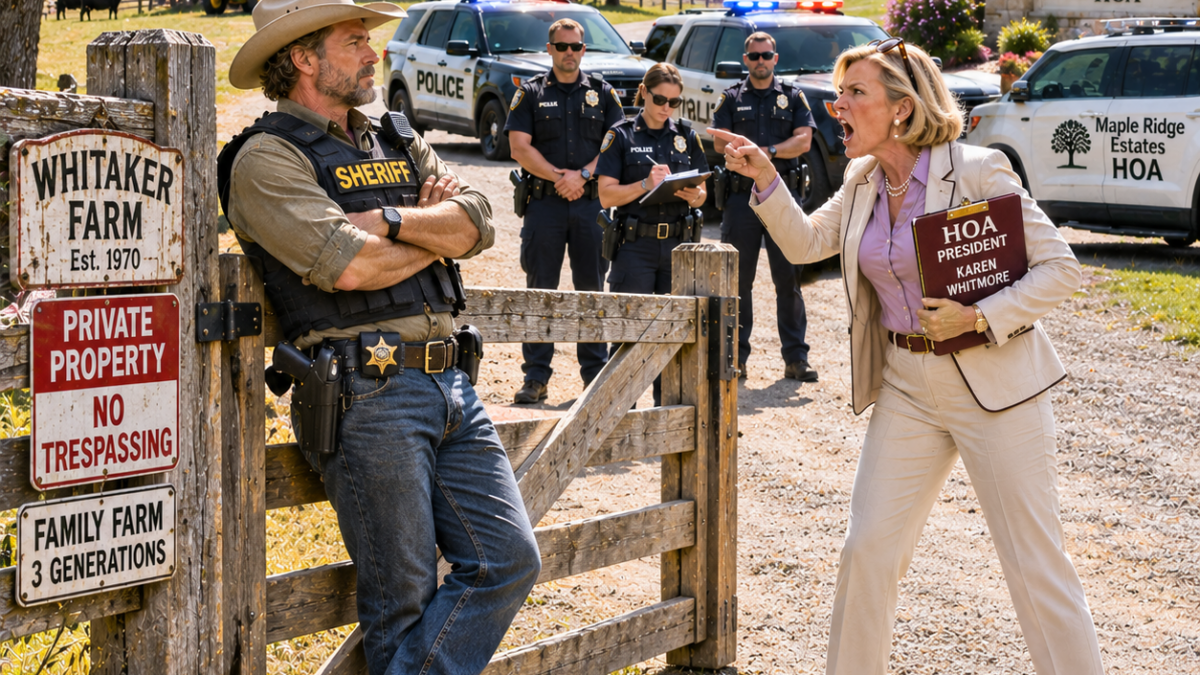
The morning Karen Whitmore brought three patrol cars to my farm gate and ordered the officers to tear it down, she had no idea the man leaning against the fence in work boots was the sheriff they all reported to. She had spent weeks sending fake notices, private “inspectors,” and HOA threats onto land my family had owned for three generations, convinced that enough paperwork could turn her neighborhood rules into county law. What she still didn’t understand was that I had stopped arguing with her days earlier, because by then I was no longer trying to win a dispute—I was documenting how far she was willing to go when nobody obeyed her.
My name is John Whitaker, and my wife Sarah and I live on the same farm my father built in the 1970s.
The gate at the end of our dirt road is older than Maple Ridge Estates. My grandfather installed the first version. My father rebuilt it after a storm, and I replaced the posts twelve years ago but kept the heavy cedar crossbeam because Dad used to say, “As long as that gate swings, this family stands.”
For most of my life, nobody cared about it.
Then developers bought the pasture east of us and built Maple Ridge Estates—rows of beige houses, matching mailboxes, and an HOA that seemed to discover a new emergency every week.
Karen became president during the neighborhood’s first year.
I’d see her silver SUV crawling past homes while she photographed trash cans or measured grass. Sarah and I joked about it from the porch.
“As long as she stays on her side of the fence,” I told Sarah, “we’ll be fine.”
I should have known better.
One Tuesday morning, Karen stopped beside my gate while I was replacing a hinge pin.
“Mr. Whitaker, we’ve received complaints about this obstruction.”
I looked behind me.
“My gate?”
“It interferes with community access.”
“This road goes to my barn.”
“It connects to Maple Ridge.”
“No, ma’am. Maple Ridge ends forty yards east of here.”
She lifted a binder from the passenger seat.
“Our bylaws require emergency access routes to remain unobstructed.”
“Your bylaws apply inside your HOA. This is a private farm road recorded with the county in 1971.”
Her smile disappeared.
“We’ll verify that.”
“Please do.”
Three days later, I received a $250 HOA violation.
I wasn’t a member.
A week after that, two men in reflective vests appeared near my fence measuring the gate.
“Can I help you?”
One of them glanced toward the white SUV behind them.
“Safety inspection.”
“County?”
He hesitated.
Before he could answer, Karen stepped out.
“They’re authorized to inspect the community access route.”
I looked at the men.
“Who employs you?”
“Maple Ridge compliance.”
“So not the county.”
Karen snapped, “They’re qualified.”
“To trespass?”
Her face hardened.
“You’re being hostile.”
“No. I’m asking you to leave private property.”
She pointed toward the gate.
“This will be removed one way or another.”
That was the first time Sarah told me to show her my badge.
I didn’t.
Using my office to win a private property argument would have been exactly the kind of abuse Karen kept accusing everyone else of.
Instead, I pulled the deed, the 1971 easement, the current parcel map, and every county filing tied to the road.
Then I installed cameras.
Over the next two weeks, Karen gave me everything I needed.
Emails claiming the gate was on HOA land.
Photographs taken from inside my boundary.
A fake “county compliance” notice signed by a private consultant.
A newsletter accusing me of blocking emergency vehicles.
And finally, a certified letter announcing that the HOA had scheduled my gate for “mandatory removal with police assistance.”
Sarah read it twice.
“She’s actually calling the police?”
“Looks that way.”
“You’re going to tell dispatch this is your house, right?”
I folded the notice.
“I’m going to notify my chief deputy and the county attorney that I’m personally involved, and I’m staying out of whatever response they choose.”
If Karen wanted law enforcement, she was going to get law enforcement—just not mine to manipulate.
Two mornings later, I was drinking coffee beside the gate when her silver SUV appeared at the end of the road.
Three patrol cruisers followed.
Karen stepped out first, already pointing at me.
“There he is. That’s the man refusing the lawful removal order.”
The youngest deputy looked from her to me.
Then his eyes dropped to the badge clipped at my belt.
His face changed instantly.
“Sheriff Whitaker?”
Karen stopped mid-sentence.
And for the first time since Maple Ridge was built, her clipboard slowly lowered.
PART 2
For several seconds, nobody said anything.
The engines of the three patrol cars idled behind Karen, exhaust drifting over the gravel. Somewhere beyond the pasture, one of our horses snorted.
Karen looked from the deputy to me.
Then back again.
“Sheriff?”
I took another sip of coffee.
“Morning.”
Her mouth opened.
Closed.
Then opened again.
“You’re the sheriff?”
“Yes, ma’am.”
“But you’re a farmer.”
“Also true.”
The youngest deputy looked as uncomfortable as a rookie at his first family disturbance.
I recognized him immediately.
Deputy Cole Harris. Twenty-four years old. Good kid. Six months out of the academy.
He glanced toward the senior deputy beside him.
Sergeant Miguel Gomez stepped forward.
Miguel had worked for the department for eleven years.
He already knew exactly where he was.
And unlike Karen, he understood the problem.
“Sheriff,” he said carefully, “since this involves your personal property, I’m taking the call.”
“Exactly what I expected.”
I unclipped my badge and slid it into my pocket.
Then I stepped back.
“Today I’m John Whitaker, property owner.”
Karen recovered just enough to grab onto the one thing that still made her feel powerful.
Her folder.
“Fine. Excellent. Then as property owner, Mr. Whitaker is refusing to obey a lawful community access order.”
Miguel looked at her.
“Who issued the order?”
“The Maple Ridge Estates Homeowners Association.”
“Is Mr. Whitaker a member?”
“That’s irrelevant.”
“It sounds pretty relevant.”
Her jaw tightened.
“This gate obstructs emergency access.”
Miguel looked at the gate.
Then down the dirt road behind it.
The road ran about half a mile to our barn, equipment shed, and lower pasture.
Nothing else.
“Emergency access to what?”
“The community.”
“Maple Ridge is the other direction.”
“There is an easement.”
I said nothing.
That was important.
Karen had claimed it.
Now she could prove it.
Miguel asked, “Do you have a recorded easement?”
She opened her folder.
“I have the HOA plat.”
“That isn’t what I asked.”
She pulled out a color photocopy.
Red lines.
Arrows.
A highlighted strip extending from Maple Ridge toward my road.
Miguel studied it.
“Who prepared this?”
“Our compliance consultant.”
“Licensed surveyor?”
“He’s qualified.”
“Is he a licensed surveyor?”
Her hesitation answered for her.
Miguel handed the page back.
“I need recorded county documentation.”
“This is county documentation.”
“No county seal.”
“It’s based on county records.”
“Then we’ll check the county records.”
Karen looked past him at the deputies.
“Why are you making this difficult? The removal was scheduled. The HOA was told police would assist.”
Miguel frowned.
“Told by who?”
“Dispatch.”
The young deputy shook his head.
“Dispatch said officers would respond to keep the peace. Nobody said we were dismantling anything.”
Karen turned on him.
“I specifically explained that the obstruction required removal.”
“Yes, ma’am. That doesn’t mean we remove private property.”
She looked furious.
Then she pointed at me.
“He’s intimidating you because he’s your boss.”
That landed harder than she probably expected.
Miguel’s face became serious.
I stepped farther away.
“Sergeant, call the county attorney if you need to. I’ll stay out of it.”
Miguel nodded once.
“Thank you.”
Karen watched me.
For the first time, she seemed uncertain.
She had expected one of two things.
Either anonymous farmer John Whitaker would be forced to obey.
Or Sheriff John Whitaker would throw his badge around and give her a perfect abuse-of-power story.
Instead, I had given the problem away.
And that meant she had to survive on evidence.
Twenty minutes later, Miguel had the parcel map open on his cruiser computer.
He walked Karen toward the screen.
“Here.”
He pointed.
“This is the Maple Ridge HOA boundary.”
A blue line stopped forty-two yards east of my gate.
He moved his finger.
“This is the Whitaker parcel.”
Then the road.
“Private access road recorded in 1971.”
Karen leaned closer.
“That can’t be right.”
Miguel said nothing.
“It connects to Maple Ridge.”
“No.”
“The development map shows it.”
“Development marketing maps aren’t deeds.”
She straightened.
“There must be an amendment.”
“Do you have one?”
“No.”
“Then we go with the recorded instrument.”
Her cheeks reddened.
“What about emergency access?”
Miguel pulled up another record.
“No public access easement here.”
“That’s impossible.”
“It’s official.”
She pointed toward me.
“He changed it.”
That almost made me laugh.
I didn’t.
Miguel looked at her.
“You’re saying the sheriff altered county land records?”
“When you say it like that—”
“How should I say it?”
She closed the folder.
“This is clearly a conflict of interest.”
“Yes,” I said.
She turned toward me.
I continued.
“That’s why I’m not handling it.”
She stared.
“You think this is funny.”
“No.”
I looked at the gate.
“My grandfather built the first version of that gate. My father maintained this road. You’ve sent strangers onto my property, invented authority you don’t have, and used emergency services to enforce HOA rules against a non-member.”
I paused.
“What part should I find funny?”
The smile disappeared from her face.
Miguel said, “Mrs. Whitmore, no officer here is removing this gate.”
Her shoulders stiffened.
“You’re refusing to enforce public safety.”
“We’re refusing to destroy private property without legal authority.”
“I want that in writing.”
“You’ll get a call report.”
“I’ll be contacting the state.”
“You have that right.”
Karen looked at me again.
“You can’t hide behind your position forever.”
I almost answered.
Then stopped.
That sentence bothered me.
Not because it threatened me.
Because she still didn’t understand.
“I’m not hiding behind it,” I said. “I’m trying very hard not to use it.”
She got into her SUV.
Gravel sprayed behind her tires as she left.
Miguel watched her disappear.
Then turned toward me.
“Boss.”
“Yeah?”
“You really never told her?”
“No.”
Cole finally laughed.
“I thought everybody in the county knew you.”
“Apparently my fame has limits.”
Miguel shook his head.
“I’m clearing the call as civil property dispute, no law-enforcement action. I’ll document that she was advised of the boundary records.”
“Good.”
“And John?”
I looked at him.
“If she keeps calling, you need to stay recused.”
“I know.”
“You know I’m saying that because the county attorney will say it too.”
“I know.”
He smiled.
“Good. I enjoy being employed.”
I laughed.
They left.
Sarah came down from the porch carrying her coffee.
“You enjoyed that.”
“No.”
“You enjoyed a little of that.”
“Maybe the badge part.”
She smiled.
Then her expression changed.
“You know she isn’t done.”
I looked toward the road.
“No.”
Sarah had lived with me long enough to recognize when I stopped joking.
“You worried?”
“Not yet.”
“You should be.”
That night, we found another orange notice attached to the gate.
FINAL REMOVAL ORDER.
Sarah held it up.
“She printed another one.”
“Apparently.”
“After police told her she was wrong.”
“Yes.”
“Is stubbornness a medical condition?”
“Not one insurance covers.”
She didn’t laugh.
“John.”
I took the paper from her.
“What?”
“I’m serious.”
I looked at her.
She glanced toward the dark road.
“She’s sending strangers here. She’s coming at night. She called police. What happens when she decides paper isn’t enough?”
That question stayed with me.
Sarah wasn’t easily frightened.
We had been married twenty-six years.
She had watched me leave home during tornado warnings, armed standoffs, missing-child calls, floods, and more domestic disputes than either of us could count.
But those dangers belonged to the job.
This one had entered our yard.
Our home.
Our quiet.
“I’ll add another camera,” I said.
“That isn’t what I asked.”
“I know.”
“Promise me you won’t turn this into some contest with her.”
I started to respond.
She touched my wrist.
“Your father loved that gate. I know. But I love you.”
That stopped me.
I nodded.
“No contests.”
“Good.”
“And if something happens, I call it in like anybody else.”
“Yes.”
“Let somebody else handle it.”
“Yes.”
She studied my face.
“Say it like you mean it.”
“I mean it.”
That promise mattered more than I knew.
The following Monday, Karen’s retaliation changed shape.
The HOA newsletter arrived in every Maple Ridge mailbox.
COMMUNITY SAFETY ALERT.
Below it was a photograph of my gate.
Then my name.
SHERIFF JOHN WHITAKER CONTINUES TO BLOCK POTENTIAL EMERGENCY ACCESS DESPITE COMMUNITY CONCERNS.
Not exactly an accusation of a crime.
Still misleading.
Especially after Karen had been shown the property records.
Within hours, people started calling the sheriff’s office.
Not emergency calls.
Administrative complaints.
“Does the sheriff own a private road?”
“Can a sheriff legally have a locked gate?”
“Why is law enforcement protecting him?”
My chief deputy, Marcus Reed, walked into my office with a stack of printed messages.
Marcus was fifty-one, built like a linebacker, and possessed the emotional range of an old fence post.
He dropped the papers on my desk.
“You’ve become controversial.”
“Finally.”
“Should I prepare your resignation?”
“After lunch.”
He sat.
Then became serious.
“County attorney wants to talk.”
“Expected.”
“State ethics liaison too.”
“That fast?”
“Karen emailed them.”
I leaned back.
“Of course she did.”
Marcus folded his arms.
“You want advice?”
“No.”
“I’m giving it anyway.”
“Of course.”
“Stop smiling.”
“I’m not smiling.”
“You are.”
I wasn’t anymore.
Marcus tapped the newsletter.
“This woman wants you to look like you’re using the badge to protect your own property.”
“I’ve recused.”
“I know.”
“Every call is assigned elsewhere.”
“I know.”
“I haven’t ordered anyone to do anything.”
“I know.”
“Then what’s the problem?”
“Perception.”
I hated that answer because sheriffs live and die by it.
Not popularity.
Trust.
People need to believe the badge is applied the same way whether the person behind the fence is a stranger or the sheriff himself.
Marcus leaned forward.
“From now on, any incident involving your property gets reviewed by the county attorney, and if it turns criminal, I want state investigators consulted.”
“Agreed.”
“No operational direction from you.”
“Agreed.”
“And stop baiting her.”
I frowned.
“I’m not baiting her.”
“You told Gomez last week, and I quote, ‘Let her dig.’”
“That was private.”
“Gomez repeats everything when coffee is involved.”
I sighed.
Marcus stood.
“John, you’re right about the gate.”
“I know.”
“That’s not enough.”
I looked at him.
He pointed at the badge on my desk.
“You have to be more careful because you’re right while wearing that.”
That landed.
I nodded.
“You’re right.”
“I usually am.”
“Get out.”
He left.
Two days later, Karen showed up with another inspector.
This one wore a polo shirt embroidered:
TODD BENNETT — ACCESS COMPLIANCE SERVICES.
He carried a clipboard and a measuring wheel.
Karen stayed on the public side of the boundary.
Progress.
“Mr. Whitaker,” Todd said, “I’m conducting a preliminary safety review.”
“For who?”
“Maple Ridge Estates.”
“You understand this isn’t HOA property.”
“I’ve been told there’s a disputed access claim.”
“By Karen?”
He looked uncomfortable.
“I work for the association.”
“Licensed surveyor?”
“No.”
“Engineer?”
“No.”
“County code official?”
“No.”
“What exactly are you reviewing?”
He cleared his throat.
“Accessibility.”
I pointed toward the boundary stake.
“You can observe from there.”
Karen said, “You can’t obstruct an inspection.”
I looked at her.
“You hired a private consultant. He has no right to enter my property.”
Todd held up a hand.
“That’s fine. I can work from the edge.”
Karen glared at him.
He pretended not to notice.
I went back to repairing a section of fence.
Ten minutes later, Todd approached me—but stopped outside the boundary.
“I need to ask something.”
“Go ahead.”
“Do you have a fire department review showing this gate blocks access?”
“No.”
“Ambulance complaint?”
“No.”
“Emergency management?”
“No.”
“Then what’s the basis of the HOA concern?”
I looked at Karen.
She heard.
“Our residents need secondary evacuation access.”
That was new.
I turned.
“Secondary evacuation access to where?”
“During wildfire or flood.”
“Across my farm?”
“If necessary.”
“Is that in the approved development emergency plan?”
She hesitated.
I knew the answer.
I’d already checked.
“No,” I said. “It isn’t.”
Todd slowly closed his clipboard.
Karen snapped, “We’re considering amendments.”
“Then consider them without pretending they already exist.”
Todd looked at her.
“Mrs. Whitmore, I think you need an attorney before you keep spending money on inspections.”
Her face went red.
“You work for me.”
“I work for the association.”
Same distinction.
Different day.
Todd packed up.
Karen followed him to the SUV.
I heard her say:
“You will finish the report.”
He answered:
“I’ll report what I observed.”
That evening, I emailed Todd requesting a copy if the report was distributed publicly or referenced in further complaints.
Three days later, a copy arrived from the HOA secretary.
Todd’s conclusion was one paragraph.
No evidence was identified establishing HOA ownership, public-road status, emergency-access designation, or a recorded right permitting Maple Ridge Estates residents to cross the Whitaker parcel.
I printed it.
Sarah magneted it to the refrigerator.
“Art.”
“Very expensive art.”
“How much did she pay him?”
“Association paid him.”
“That bothers me more.”
It should have.
Because Todd’s invoice became the first loose thread in a much bigger problem.
At the time, though, Karen remained focused on the gate.
One Friday morning, I found bright yellow stakes driven into the soil twenty yards east of my property line.
NEW COMMUNITY ACCESS ALIGNMENT.
The stakes crossed a shallow drainage channel.
Not my property.
County drainage easement.
I stared.
Sarah came up beside me.
“She’s building around your gate.”
“Trying.”
“What is that area?”
“Protected drainage.”
“Can she dig there?”
“Not without permits.”
“Does she have them?”
“If she did, we wouldn’t be having this conversation.”
I did not call my own department.
I called county public works.
As John Whitaker, landowner.
Not Sheriff Whitaker.
Then environmental compliance.
I gave them the stake locations.
Photographs.
No opinion beyond what I knew.
Two days later, a white county truck arrived.
Two inspectors got out.
Karen appeared ten minutes later wearing the expression of someone expecting approval.
It didn’t last.
I watched from my porch as the inspector pointed toward the channel.
Karen’s voice carried.
“This is association property.”
“No, ma’am.”
“The developer map—”
“County drainage easement.”
“We’re only grading.”
“Without a permit.”
“This is minor.”
“You installed stakes indicating a future road crossing.”
Karen looked toward my house.
I pretended not to notice.
The inspector continued.
“No disturbance until engineering review. No fill. No excavation. No culvert installation.”
“But residents need access.”
“Then submit a lawful application.”
By noon, red STOP WORK notices stood beside the yellow stakes.
Karen blamed me.
Naturally.
The HOA Facebook page posted:
Certain outside interests continue interfering with Maple Ridge safety improvements.
Sarah read it aloud at dinner.
“Outside interests.”
I took another bite.
“Sounds important.”
“You’re eating mashed potatoes.”
“Powerfully.”
She shook her head.
Then her phone buzzed.
Her smile disappeared.
“What?”
She turned the screen toward me.
Anonymous message.
YOUR HUSBAND WON’T BE SHERIFF FOREVER.
I put down my fork.
“When did this come?”
“Now.”
“Screenshot.”
“I did.”
“Don’t reply.”
“I know.”
I called Marcus.
That one changed the tone.
Criticizing me was one thing.
Dragging Sarah into it was another.
But even then, I couldn’t assume Karen had sent it.
The number was masked.
No direct proof.
Marcus forwarded it for review.
“Could be some idiot online,” he said.
“Could be.”
“You sound angry.”
“I am.”
“Don’t do anything angry.”
“I know.”
“Good.”
Sarah looked at me after I hung up.
“I’m not scared of her.”
“I am.”
She blinked.
I rarely admitted fear.
Not because I didn’t feel it.
Because twenty-nine years in law enforcement teaches you to put fear in the passenger seat.
But Sarah deserved the truth.
“I’m scared she’ll push this until someone gets hurt.”
She reached across the table.
“Then don’t help her push.”
That became my rule.
Document.
Report.
Step back.
Karen kept escalating anyway.
She filed a complaint with the state law-enforcement standards office accusing me of corruption.
I cooperated fully.
They requested incident reports.
Dispatch recordings.
Body-camera footage.
My written recusals.
County parcel records.
Two weeks later, an investigator named Rachel Monroe called.
“Sheriff Whitaker?”
“Yes.”
“I’ve reviewed the complaint.”
“Okay.”
“There’s no evidence you directed deputies to enforce your private claim.”
“Correct.”
“Actually, there’s evidence you repeatedly told them not to.”
I smiled.
“That sounds like Marcus.”
“Your chief deputy is thorough.”
“Painfully.”
“We’re closing the complaint unless new information arises.”
“Thank you.”
“Sheriff?”
“Yes?”
“She alleged you threatened to arrest her.”
I remembered the roadside argument.
“I told her false reporting can have consequences. I did not order or threaten an arrest.”
“Body camera supports that.”
Good.
Then Rachel added:
“Keep doing what you’re doing.”
“Meaning?”
“Stay out of your own investigation.”
That became more important a week later.
At 11:38 p.m., my phone buzzed.
Motion detected: Front Gate.
Sarah was asleep.
I opened the camera feed.
Two figures.
Flashlights low.
One crouched beside the hinge.
The other held something long.
I enlarged the image.
Karen.
Pink blazer.
Even at midnight.
The second person was Dennis Cole, Maple Ridge HOA vice president.
He held a cordless impact driver.
My pulse slowed.
That happens sometimes when danger becomes real.
Everything gets very clear.
I did not grab my service weapon.
I did not walk down there.
I called dispatch.
“This is John Whitaker at Whitaker Ranch. Two people are on my property tampering with the gate.”
The dispatcher started automatically.
“Sheriff—”
“I’m calling as the complainant. Notify Marcus.”
A pause.
“Copy.”
“I’m staying at the house.”
Sarah was awake now.
“What?”
I showed her the camera.
“Oh my God.”
Karen was kneeling beside the lower hinge.
Dennis whispered something.
The camera microphone caught it.
“If we take the hinge side off, he’ll have to replace it.”
Karen answered:
“Once it’s down, the access issue becomes moot.”
Dennis hesitated.
“Are you sure?”
“Stop worrying.”
The impact driver whined.
Metal clinked.
Sarah stared.
“She’s actually doing it.”
“Yeah.”
Headlights appeared at the far end of the road.
Not mine.
State patrol.
Marcus had done exactly what we’d agreed.
Because I was sheriff and the complainant, he requested an outside agency for the arrest decision.
Two state troopers and one county deputy arrived.
The first trooper parked across the exit.
The second came up dark until the last fifty yards.
Karen stood.
Dennis dropped the driver.
“State Police!” a voice shouted. “Step away from the gate!”
Karen froze.
She looked toward the farmhouse.
I was still on the porch.
She shouted:
“John!”
I didn’t answer.
“John, tell them!”
I stayed where I was.
The trooper approached.
“Ma’am, hands where I can see them.”
“This is HOA business.”
“Hands.”
Dennis raised his immediately.
Karen did not.
“This property is subject to an access dispute.”
The trooper said:
“Then you resolve that in court.”
“We’re authorized.”
“By who?”
“The association.”
“Turn around.”
Her voice cracked.
“You cannot arrest the HOA president for maintaining community infrastructure.”
The trooper looked at the half-removed hinge bolts.
“Is this your gate?”
“No.”
“Your land?”
“It affects the community.”
“That wasn’t my question.”
“No.”
“Did the owner give permission?”
“He’s unreasonable.”
“Ma’am.”
She finally turned.
Cuffs clicked.
Dennis looked sick.
“I told you this was a bad idea.”
Karen snapped:
“Shut up.”
The trooper looked toward my porch.
“Mr. Whitaker?”
I walked down slowly.
No badge.
No uniform.
Jeans.
Work boots.
Sweatshirt.
“That’s me.”
“Can you identify this gate as yours?”
“Yes.”
“Permission for either person to alter it?”
“No.”
“Do you want to provide the camera footage?”
“Yes.”
I handed him a prepared download link.
He looked surprised.
“You already exported it?”
“Engineer brain.”
“You’re the sheriff.”
“Also engineer brain.”
He almost smiled.
Then became professional again.
“You understand charging decisions are outside your control.”
“That’s why you’re here.”
Karen stared at me from beside the patrol car.
“You set me up.”
I looked at her.
“No.”
“You knew I would come.”
“I hoped you wouldn’t.”
“Liar.”
The trooper stepped between us.
“That’s enough.”
She was transported to the neighboring county intake facility pending processing because everyone agreed my own jail was the last place she should be booked.
Dennis went with her.
I stood beside the gate after the cars left.
One hinge plate was scratched.
Two bolts partly removed.
Nothing we couldn’t repair.
Sarah walked down.
“You kept your promise.”
“What promise?”
“You stayed on the porch.”
I looked at her.
“That was harder than it sounds.”
“I know.”
She slipped her arm around mine.
The old cedar beam rested above us.
Still standing.
The criminal case was referred to a special prosecutor from the next county.
That was Marcus’s recommendation.
I agreed.
No appearance that Sheriff Whitaker was prosecuting his own enemy.
No shortcuts.
Karen’s initial charges involved criminal trespass and attempted property damage.
The false-report issue remained under separate review because intent mattered.
Calling police while honestly mistaken is not automatically a crime.
Calling them while knowingly inventing authority is different.
Investigators had to prove which one happened.
Dennis hired a lawyer and started cooperating almost immediately.
That surprised nobody.
Three days after the arrest, Maple Ridge held an emergency board meeting.
Karen attended by video through her attorney.
She refused to resign.
“I have been targeted by an abusive county official because I dared challenge his private land claims.”
Her attorney visibly closed his eyes.
One board member asked:
“Were you at his gate at midnight with a power tool?”
Karen replied:
“I was inspecting an obstruction.”
Dennis, who was present with counsel, stared at the table.
Then said quietly:
“We were taking the hinge off.”
The room went silent.
Karen’s face appeared frozen on the screen.
“Dennis.”
His attorney touched his arm.
He continued.
“She told me if the gate came down, the HOA could claim the road was already functioning as open access.”
Karen shouted:
“That is privileged board strategy!”
Her attorney leaned toward the camera.
“Karen. Stop talking.”
Too late.
The board suspended her unanimously.
Dennis resigned.
Janet Ellis, the treasurer, became interim president.
I did not attend that meeting.
I watched none of it live.
Sarah and I were repairing the gate.
She held the new bolt while I tightened it.
“You realize people are probably yelling about you at the clubhouse right now.”
“Good.”
“You don’t want to watch?”
“No.”
“Who are you?”
I smiled.
“I’m tired.”
That was the truth.
Victory is exhausting when it takes months.
The next morning, Janet came to our farm.
No clipboard.
Just a folder.
She stopped outside the boundary.
“Can I come through?”
That simple question nearly made me laugh.
“Yes.”
She walked up.
“Sheriff—”
“John.”
“John. I owe you an apology.”
“You personally?”
“The board.”
“You weren’t the one doing this.”
“I voted for some of the inspection spending.”
I waited.
“I believed Karen.”
“Why?”
Janet looked toward Maple Ridge.
“Because she sounded certain.”
That answer was becoming familiar.
“She kept telling us the developer had promised a secondary emergency route across your land.”
“Developer didn’t own my land.”
“I know that now.”
“Did you ever see an easement?”
“No.”
“Then why approve money?”
Her face tightened.
“Because I was busy. Because Karen had been president four years. Because every time someone questioned her, she produced another document.”
“Real document?”
“Some.”
“Some?”
“That’s why I’m here.”
She handed me the folder.
Inside were invoices.
Todd Bennett’s inspection.
Two other consultants.
Survey work.
Community access planning.
Thousands of dollars.
The payee on several:
WHITMORE PROPERTY MANAGEMENT LLC.
I looked up.
“Karen?”
“Her family company.”
“How much?”
“We don’t know yet.”
“Board knew?”
“I didn’t.”
“Conflict disclosure?”
“None I can find.”
That moved beyond my gate.
I closed the folder.
“You need an accountant.”
“We hired one this morning.”
“Independent?”
“Yes.”
“You need counsel.”
“Already called.”
“Then why show me?”
Janet swallowed.
“Because some invoices describe work performed on your property.”
I looked again.
One line:
ACCESS STRUCTURE ASSESSMENT — WHITAKER CORRIDOR.
Another:
ROADWAY COMPLIANCE REVIEW.
Another:
EMERGENCY ACCESS MITIGATION.
All billed to the HOA.
Some on dates when nobody had visited my property.
“How much?”
“Twenty-four hundred a month in consulting fees for almost three years.”
My jaw tightened.
“For what?”
“We’re trying to find out.”
I handed the folder back.
“Don’t leave originals with me.”
“They’re copies.”
“Good.”
“John.”
“Yes?”
“Did Karen ever mention why she needed your road open?”
“Emergency access. Community safety. Depends on the day.”
Janet looked uneasy.
“There may be another reason.”
I waited.
“The developer promised prospective buyers two emergency egress routes.”
I stared.
“What?”
She opened another page.
Maple Ridge marketing plan.
Two arrows.
Primary entrance from County Route 18.
Secondary emergency route west.
The western arrow crossed my farm road.
My gate.
“That was never approved.”
“I know.”
“Fire marshal approved this?”
“No.”
“Planning commission?”
“Apparently not.”
“Then why is it in sales material?”
Janet shook her head.
“I don’t know.”
That was motive.
Not a secret highway.
Not some billion-dollar conspiracy.
Something more ordinary.
The development had been marketed with a secondary emergency route that did not legally exist.
As Maple Ridge expanded, residents began asking why the west access remained locked.
Karen had spent years promising the HOA would “resolve” it.
If she admitted the road wasn’t theirs, she admitted the neighborhood had been sold a feature nobody had secured.
And because Karen had built her identity around always having an answer, she chose escalation over embarrassment.
Sarah understood immediately.
“She wasn’t trying to take the gate because she loved rules.”
“No.”
“She was trying to fix somebody else’s mistake without admitting it.”
“Looks that way.”
“Does the developer know?”
“Lawyers will ask.”
“Does this make her less wrong?”
“No.”
“More understandable?”
I thought about it.
“Yes.”
Sarah nodded.
“That’s usually worse.”
She was right.
Monsters are easy.
People who keep making one bad decision to protect the last one are much more dangerous because they can explain every step to themselves.
The forensic audit took six weeks.
While it ran, Maple Ridge changed.
People talked.
Really talked.
A retired teacher named Allen told me Karen had fined him six hundred dollars over a mailbox color dispute.
A young couple said she had threatened collections over a landscaping bill they never received.
Another resident had paid for an “emergency fence inspection” conducted by Whitmore Property Management.
I kept telling everyone the same thing:
“Give documents to the auditor.”
Not me.
The last thing I needed was to become the center of an HOA rebellion while wearing a badge.
The audit findings went to the board first.
Then the association attorney.
Then the special prosecutor because some transactions appeared relevant to Karen’s criminal conduct.
About $86,000 in payments over several years required explanation.
Roughly $38,000 involved Whitmore Property Management or related vendors.
Not all of it was stolen.
Some services existed.
Some were overpriced.
Some had no documentation.
Several invoices appeared to charge the HOA for inspections that were never performed.
A few billed for work on county or private land the HOA had no authority to manage.
The most damaging records were emails.
Karen to Dennis:
We cannot let Whitaker formalize the gate as permanent. Once residents accept it, we lose the west-access argument.
Dennis:
County plat already shows his road private.
Karen:
Then we need a new interpretation.
Another:
Keep documenting until we have enough safety complaints to force county action.
And later:
If law enforcement sees this as emergency access, Whitaker will have no choice.
That email mattered because it undermined her claim that the police call had been an innocent misunderstanding.
She was trying to manufacture official pressure.
The special prosecutor added a false-report-related charge after reviewing the full record.
Not because she had simply been wrong.
Because evidence suggested she knowingly represented HOA documents as county authorization.
Then investigators looked at Whitmore Property Management.
Karen’s husband, Paul Whitmore, had formed the company years earlier for legitimate rental maintenance.
But Karen had approved HOA contracts with it without proper disclosure.
Paul claimed he believed the board knew.
Maybe some did.
The paper trail was messy.
The prosecutor focused on the clearest transactions.
Invoices Karen approved personally.
Work never performed.
Payments transferred to household accounts.
The case expanded into theft and falsification allegations.
That was when Karen tried to settle everything socially before it reached court.
She came to our farm one afternoon.
Her attorney was not with her.
I saw her on camera before opening the door.
Sarah stood behind me.
“Do you want me here?”
“Yes.”
Karen remained outside the gate.
Good.
“John.”
“Karen.”
“I need five minutes.”
“Go ahead.”
She looked at Sarah.
“Privately.”
Sarah said:
“No.”
Karen swallowed.
“Fine.”
No blazer.
No clipboard.
Jeans and a cardigan.
She looked older.
Not weak.
Just tired.
“I was wrong about the gate.”
I waited.
“I should have stopped after the first survey.”
“Yes.”
“I was under pressure.”
“From who?”
“The board. Residents. Developer.”
“Documents say you were pressuring the board.”
Her jaw tightened.
“I made mistakes.”
“That word is doing a lot of work.”
Sarah glanced at me.
Easy.
I breathed.
Karen continued.
“Maple Ridge was promised secondary access.”
“Not by me.”
“I know.”
“Not by my father.”
“I know.”
“Then why was it my responsibility?”
She looked toward the cedar beam.
“Because everyone expected me to fix it.”
“You could have said it wasn’t ours.”
“And then what?”
“Tell the truth.”
She laughed bitterly.
“You think leadership works like that?”
“Yes.”
She looked at my badge through the window behind me.
“Easy for you to say.”
“No.”
That came out sharper than I intended.
“You think being sheriff means people don’t expect miracles? Every flood, every overdose, every missing kid, every burglary—you think people don’t look at me like I’m supposed to fix everything?”
She looked away.
“The difference is I don’t get to invent authority when I don’t have it.”
Silence.
Karen’s eyes filled but she blinked it away.
“I didn’t steal from the HOA.”
“Then let the audit prove it.”
“Paul handled the company.”
“You approved invoices.”
“I thought they were legitimate.”
“Then tell investigators that.”
“They want to destroy me.”
“No.”
She looked at me.
“The prosecutor doesn’t care about your pride, Karen. Neither do the accountants. They care about records.”
Her mouth tightened.
“I came to ask if you’d tell them you don’t want charges.”
I felt Sarah tense.
“That isn’t my decision.”
“You could influence it.”
“Exactly why I won’t.”
Her face hardened again.
There was the old Karen.
“So you’ll hide behind ethics while they ruin my life.”
“No.”
I stepped closer to the gate.
“You’re still doing it.”
“Doing what?”
“Blaming the person who refuses to rescue you from consequences.”
She went completely still.
Then turned and walked back to her SUV.
Sarah waited until the car disappeared.
“That was mean.”
“I know.”
“Wrong?”
I thought about it.
“No.”
She nodded.
“Sometimes both things can be true.”
The criminal hearing came three months later.
Because of my position, the case was assigned to a judge outside our normal county rotation.
The prosecutor was from the neighboring judicial district.
I testified as a witness.
Nothing more.
Karen’s attorney attacked the obvious issue.
Power.
“Sheriff Whitaker, you control the department that originally responded to these complaints.”
“I am the elected sheriff, yes.”
“And the officers involved report to you.”
“Normally.”
“Normally?”
“I recused from incidents involving my property.”
“You still employed them.”
“Yes.”
“You spoke to them.”
“As a complainant when necessary.”
“Isn’t it true you told Sergeant Gomez to allow Mrs. Whitmore to continue making complaints so you could build a case?”
“No.”
That was one source detail I had specifically avoided.
Her lawyer held up a text.
Marcus had warned me this might come.
A message I’d sent Gomez weeks before the midnight arrest:
If she calls again, document everything. Do not decline response because this involves me.
The attorney read it dramatically.
“You wanted documentation.”
“Yes.”
“Because you were building a case.”
“No. Because refusing service to someone because she’s complaining about the sheriff would be improper.”
That quieted him.
He tried again.
“You enjoyed revealing your badge to her.”
I almost smiled.
Sarah was in the gallery.
I could feel her watching me.
“I enjoyed the irony for about five seconds.”
A couple of people laughed.
The judge didn’t.
I continued.
“Then I realized how carefully I needed to handle the rest.”
“Did you want Mrs. Whitmore punished?”
“I wanted her to stop coming onto my land.”
“That’s not what I asked.”
I thought about it.
“Yes.”
Her lawyer looked pleased.
“Thank you.”
I raised a hand slightly.
“But wanting consequences doesn’t give me authority to create them.”
That was the whole point.
The prosecutor presented the property records.
1971 private road.
HOA boundary forty-two yards away.
No recorded emergency easement.
The dispatcher testified that Karen had been told police would respond to maintain peace, not dismantle the gate.
Gomez testified she claimed county authorization she could not produce.
Todd Bennett testified Karen hired him as a private consultant and repeatedly pressured him to describe the road as a public-safety obstruction.
“Did you find one?”
“No.”
“Did you tell her that?”
“Yes.”
“What happened?”
“She told me to rewrite the conclusion.”
Karen’s attorney objected.
Email was produced.
Rewrite final paragraph to emphasize emergency necessity and de-emphasize ownership dispute.
Todd had responded:
I cannot state emergency access exists without supporting documentation.
That was damaging.
Then Dennis testified.
He looked miserable.
His plea arrangement required truthful cooperation on the trespass/property-damage case.
The prosecutor asked:
“Why did you go to Whitaker Ranch at approximately 11:30 p.m.?”
Dennis rubbed his hands together.
“To remove the gate.”
“Who proposed that?”
“Karen.”
“Did you believe you had permission?”
“No.”
“Why do it?”
“She said once the gate was physically gone, residents could start using the road. Then it would be harder to close again.”
A murmur moved through the courtroom.
Karen stared at him.
The prosecutor continued.
“Did Mrs. Whitmore tell you the sheriff had agreed?”
“No.”
“County?”
“No.”
“Court?”
“No.”
“So what authority did you believe you had?”
Dennis looked toward Karen.
“HOA.”
The prosecutor let the silence sit.
Then came the financial records.
The criminal case did not prosecute every questionable dollar.
Only specific transactions investigators believed they could prove.
Three invoices from Whitmore Property Management.
One for a road safety assessment never performed.
One for drainage work county records showed had not occurred.
One for “emergency access consultation” dated before Karen claimed the access issue existed publicly.
Total:
$14,600.
Deposited into the family company.
Some later transferred to household expenses.
Karen’s attorney argued Paul handled the accounts.
Then the prosecutor produced her approval signatures.
And emails.
Paul:
We need documentation for the access invoice.
Karen:
Use consulting. No one checks detail under $5k.
The courtroom became completely still.
Karen closed her eyes.
That was the moment.
Not the badge.
Not the midnight arrest.
Not the state troopers.
That email.
Her own words.
Everything after that felt inevitable.
The case ended in a negotiated plea rather than a dramatic jury verdict.
Karen pleaded guilty to criminal trespass-related conduct, attempted property damage, filing a false report tied to the gate-removal call, and one felony theft-related count involving HOA funds.
Other allegations were dismissed or resolved through restitution.
Dennis pleaded to a misdemeanor property offense and received probation after cooperation.
Paul resolved separate financial charges connected to the company.
Karen’s sentence was serious but not theatrical.
A suspended jail term conditioned on compliance.
Eighteen months supervised probation.
Three hundred hours of community service.
Restitution to Maple Ridge.
Restitution for damage and security expenses at my property.
Mandatory ethics and financial-responsibility conditions.
And through the HOA’s civil settlement, she agreed not to serve as an officer or financial signatory for a common-interest association for ten years.
Before sentencing, the judge asked if she wanted to speak.
Karen stood.
She looked at the Maple Ridge residents behind her.
Then at me.
“I thought being president meant I had to have an answer.”
Nobody moved.
“When people complained about the west gate, I promised I would fix it. I didn’t know how.”
She swallowed.
“Then every time someone showed me I was wrong, admitting it felt harder.”
Her voice cracked.
“So I made the next decision worse.”
That might have been the first completely honest thing I’d heard from her.
She continued.
“I told myself I was protecting the community.”
She looked at Janet.
“I wasn’t.”
Then at me.
“I was protecting the version of myself that never lost an argument.”
I lowered my eyes.
The judge let silence sit.
Then said:
“Leadership is not the ability to avoid being wrong. It is the responsibility to correct course when you are.”
Karen nodded.
The gavel came down.
No cheering.
I was glad.
There had already been enough humiliation.
Outside the courthouse, reporters waited.
One shouted:
“Sheriff Whitaker, do you feel vindicated?”
I stopped.
“Relieved.”
“Do you think Mrs. Whitmore got what she deserved?”
I looked toward the courthouse doors.
“I think the court handled the case.”
“Any message for HOA boards?”
That one almost made me laugh.
“Yes.”
The microphones moved closer.
“A homeowners association is not a government.”
Then I walked away.
Sarah caught up beside me.
“Very sheriff.”
“I hated every second.”
“Liar.”
“Most seconds.”
Maple Ridge held elections the following week.
Janet became president.
Her first board meeting lasted forty-three minutes.
People were suspicious.
The old meetings had lasted three hours.
She published every non-confidential invoice online.
Created a contract-bidding rule.
Required conflict disclosures.
Ended the “community compliance patrol.”
Reduced fines.
Established mediation before enforcement.
And passed one resolution unanimously:
Maple Ridge Estates recognizes that Whitaker Ranch, Whitaker Road, and the farm gate are outside HOA jurisdiction and have no obligation to provide public or resident access.
Janet brought me a certified copy.
She stopped outside the gate.
“Permission?”
I opened it.
“Come in.”
She smiled.
That small exchange meant more than the resolution.
We sat on the porch.
She handed me the document.
“It’s official.”
“It was official in 1971.”
“Fair.”
Sarah brought coffee.
Janet laughed.
“You know the embarrassing part?”
“There are several options.”
“We spent almost thirty thousand dollars over four years trying to establish access we never owned.”
Sarah almost choked.
“That much?”
“Consultants. Legal letters. mapping. Karen’s company.”
Janet looked embarrassed.
“Residents trusted the board.”
I said:
“Then make it easier for them to verify the board.”
She nodded.
“We’re trying.”
“I know.”
The community changed slowly.
Not overnight.
Some people had loved Karen.
Some still believed she had been treated unfairly.
A few believed I had used my position despite every recusal document.
That bothered me at first.
Then Marcus told me something.
“You aren’t entitled to everyone believing you.”
“I didn’t say I was.”
“Your face did.”
“Stop reading my face.”
“It’s county property.”
“Get out.”
He laughed.
But he was right.
Trust isn’t something you win once.
You keep earning it.
The state ethics office completed its review and found no evidence I had improperly used department authority in the property dispute.
The report specifically noted the early recusal and use of outside agencies for the criminal investigation.
I didn’t frame it.
Sarah did.
She hung it in my home office.
Underneath she taped a handwritten note:
CONGRATULATIONS ON NOT ARRESTING YOUR OWN NEIGHBOR.
I considered divorce.
Briefly.
Karen began community service at the county animal shelter.
I did not choose it.
The probation office did.
For the first several weeks, we never crossed paths.
Then one Saturday morning I drove out there because the shelter manager had asked the sheriff’s office to participate in an adoption event.
I arrived in uniform.
Karen was cleaning kennels.
She saw me.
Stopped.
I almost turned away.
Then she said:
“Sheriff.”
“Karen.”
An old beagle stood between us wagging his tail.
She looked thinner.
No makeup.
Hair pulled into a ponytail.
She nodded toward the dog.
“He’s been here six weeks.”
“Friendly?”
“Too friendly.”
“Problem?”
“People think he’s old.”
“How old?”
“Ten.”
“That isn’t old.”
“For a politician maybe.”
I looked at her.
She smiled faintly.
First joke I’d heard from her that wasn’t aimed like a knife.
“How’s community service?”
She looked around.
“Humbling.”
“I hear dogs don’t care about HOA titles.”
“They don’t care about much except breakfast.”
The beagle leaned against her leg.
Karen scratched behind his ear.
Then she looked at me.
“I wrote something.”
My shoulders tightened.
“What?”
“An apology.”
“You don’t have to give it to me now.”
“I know.”
She reached into her bag.
Not the old leather binder.
A plain canvas tote.
She handed me an envelope.
“I don’t expect anything.”
I took it.
“Okay.”
She went back to work.
I read the letter that night.
John,
I spent years believing authority came from being the person who knew the rules better than everyone else.
When you told me the gate was outside Maple Ridge, I already suspected you were right.
That is the part I am most ashamed of.
I kept going because I had promised residents I would open a second access route and because admitting the truth would have made me look incompetent.
Instead, I became dishonest.
I convinced myself that if I could create enough inspections, enough complaints, enough paperwork, somebody would eventually agree with me.
When that failed, I tried to force the result.
I was wrong.
Not only about your gate.
About people.
I treated disagreement like disobedience.
I treated fear like respect.
I used HOA money carelessly and then lied to protect myself.
I am sorry for what I did to you and Sarah.
I am also sorry for what I did to Maple Ridge.
You did not ruin me.
I kept saying that because blaming you was easier than looking at the decisions I made.
I don’t know whether I deserve forgiveness.
I’m learning that an apology is not a receipt you hand someone in exchange for peace.
Karen
I read it twice.
Sarah read it once.
Then folded it.
“What do you think?”
“I think she finally wrote something without a bylaw number.”
Sarah smiled.
“Are you going to answer?”
“I don’t know.”
“You don’t have to.”
“I know.”
A week later, Karen’s probation-required restitution work included repairing damage caused during the gate incident.
Not the whole gate.
I wasn’t going to have an untrained former HOA president rebuild a structural farm entrance.
But she was assigned, under supervision, to repaint the fence section Dennis had scratched and help clean roadside debris from the drainage area the HOA had tried to develop illegally.
She arrived at eight Saturday morning.
Work gloves.
Paint bucket.
No clipboard.
I stood beside the barn.
Sarah whispered:
“Don’t hover.”
“This is my fence.”
“John.”
“I am observing.”
“You are hovering professionally.”
I went inside.
Two hours later, Karen knocked.
I opened the door.
“I need you to check the color.”
I stared.
“Seriously?”
“Probation supervisor said restore original appearance.”
I walked out.
Chestnut brown.
Same as Dad used.
Karen touched the top rail.
“It’s a good fence.”
“Yes.”
“And gate.”
“Yes.”
She looked toward the road.
“I drove past it hundreds of times before Maple Ridge was built.”
I hadn’t known that.
“Where were you going?”
“My parents lived west of here.”
“So you knew the road was private?”
Her expression tightened.
“Not the records. But I knew it went to your farm.”
That admission mattered more emotionally than legally.
“You really convinced yourself.”
“Yes.”
“Why?”
She looked toward Maple Ridge.
“Because residents kept asking why the west exit wasn’t open.”
“And you couldn’t say the developer had promised something they didn’t own.”
“I thought I’d fix it before anybody noticed.”
One bad decision to cover another.
Exactly.
I nodded.
“Karen.”
“Yes?”
“The next time you’re wrong, try saying it early.”
She laughed softly.
“That seems cheaper.”
“Usually.”
She picked up the paint bucket.
Then paused.
“For what it’s worth, your father built a beautiful gate.”
“My grandfather started it.”
“Then both of them.”
I watched her walk away.
I didn’t forgive everything that afternoon.
Forgiveness isn’t a switch.
But something loosened.
Months passed.
Maple Ridge became boring.
That was wonderful.
No late-night patrols.
No anonymous notices.
No “compliance inspectors” measuring things they didn’t own.
Kids rode bicycles near the development entrance.
People repainted mailboxes different colors.
One was bright blue.
Janet received nine complaints.
Her response in the monthly newsletter:
Unless your mailbox is actively attacking pedestrians, the board has more important work.
Sarah framed that too.
The county drainage area was restored.
The HOA paid for the damage from the unauthorized grading attempt.
Native grass came back.
The yellow road stakes disappeared.
The red stop-work signs came down.
One afternoon, an emergency-management planner contacted me.
“We want to talk about Maple Ridge evacuation.”
I laughed.
“Not through my road.”
“Actually, no.”
“Good start.”
They developed a legitimate secondary emergency plan using a publicly owned route north of the subdivision.
Engineering.
Permits.
Easements.
Fire department approval.
All the boring things Karen had tried to skip.
When it opened, Janet invited us to the ribbon cutting.
I went.
Karen did not.
No one mentioned my gate.
That felt like progress.
The financial reforms mattered too.
The new board recovered some HOA funds through restitution and insurance.
Not every dollar.
Enough to repair the playground Carol’s grandchildren used.
They held a volunteer workday.
I helped set posts.
Marcus showed up wearing a T-shirt that read:
NOT HOA APPROVED.
I stared at it.
“Where did you get that?”
“Sarah.”
Of course.
At noon, kids filled the playground.
Janet stood beside me.
“This is where some of the money should’ve gone years ago.”
“Better late.”
She nodded.
Then:
“Would you ever join the board?”
“No.”
“You answered too fast.”
“No.”
“What about advisory—”
“No.”
“Emergency planning?”
“No.”
“Fence committee?”
I turned.
“You’re becoming Karen.”
She laughed.
“Point taken.”
The farm remained what it had always been.
Morning coffee.
Horses.
Fence repairs.
Sheriff’s office.
Dinner with Sarah.
The gate stood at the road.
Cedar beam weathered silver at the edges.
One hinge carried a shallow scratch from Dennis’s impact driver.
I could have replaced it.
I didn’t.
One evening Sarah asked why.
“Because I want to remember.”
“Karen?”
“No.”
She waited.
“Myself.”
“What about yourself?”
“How close I came to enjoying being right too much.”
Sarah looked at me.
“You did enjoy it.”
“I know.”
“The badge reveal?”
“Especially that.”
She smiled.
“Still funny.”
“Very.”
Then I became serious.
“If I’d handled it personally, if I’d ordered her arrest, threatened her, used deputies as muscle—I’d have proved something ugly.”
“That you’re human?”
“That power feels good.”
Sarah took my hand.
“That’s why you kept giving it away.”
I looked at her.
“To Marcus. State police. Prosecutor. Court.”
“Yes.”
She leaned against my shoulder.
“Your father would’ve understood.”
Dad.
The gate.
As long as that gate swings, this family stands.
For years I thought he meant stubbornness.
Hold the line.
Don’t move.
Don’t let anyone push you.
I understood it differently now.
A gate doesn’t only keep people out.
It opens.
It closes.
The person responsible for it decides when.
That’s the difference between a boundary and a wall.
A year after Karen’s arrest, Maple Ridge hosted a neighborhood barbecue.
Janet invited Sarah and me.
I almost declined.
Sarah made me go.
“Why?”
“Because you spent a year insisting they’re your neighbors.”
“They are.”
“Then act like it.”
We walked over.
No uniform.
No badge visible.
Just John and Sarah Whitaker.
Someone had baked cookies shaped like gates.
Marcus had apparently spread the story.
I ate three out of spite.
Allen, the retired teacher, raised a plastic cup.
“To the gate.”
Everyone laughed.
I shook my head.
“Don’t.”
“Too late.”
Janet tapped her spoon against a glass.
“Tiny speech.”
Groans.
“I promise.”
More groans.
She smiled.
“A year ago, Maple Ridge thought community meant rules.”
She looked around.
“Then we learned rules can help, but they aren’t community.”
She nodded toward me.
“And we learned something else.”
I braced myself.
“The sheriff’s farm is not our emergency exit.”
Laughter exploded.
I laughed too.
Then she became serious.
“We also learned that nobody should be afraid to question the person holding the gavel.”
People applauded.
Not for me.
For themselves.
That was better.
After the barbecue, Sarah and I walked home.
Sunset burned orange over the pasture.
The gate appeared ahead.
Same place.
Same cedar.
Same road.
Someone stood beside it.
Karen.
I stopped.
Sarah looked at me.
“Want me to stay?”
“Yes.”
We approached.
Karen held a small paper bag.
“No emergency,” she said quickly.
“Good.”
“I brought something.”
She opened the bag.
Cookies.
Gate-shaped.
I stared.
“You made these?”
“The shelter director did.”
“Safer.”
She laughed.
“I thought I should finally approach this gate with something other than a notice.”
I opened it.
“Permission granted.”
She stepped through.
Not far.
Just enough.
We stood beside the old cedar beam.
“How are you?” Sarah asked.
Karen seemed surprised by the question.
“Better.”
“Probation?”
“Six months left.”
“Shelter?”
“I still volunteer.”
“Even after the hours?”
“Yes.”
She smiled.
“I adopted the old beagle.”
I laughed.
“The too-friendly one?”
“Franklin.”
“Good name.”
Karen looked toward Maple Ridge.
“Janet invited me to the barbecue.”
“You didn’t go.”
“No.”
“Why?”
“Not ready.”
I understood.
She handed Sarah the cookies.
Then looked at me.
“I heard the new emergency road opened.”
“It did.”
“So everybody survived without stealing yours.”
“Barely.”
She smiled.
Then touched the gate lightly.
“I used to hate this thing.”
“I know.”
“I thought it was you telling me no every day.”
“It wasn’t.”
“I know that now.”
“What is it?”
She looked at the road beyond.
“A boundary.”
I nodded.
“That’s all.”
She stepped back outside.
“Good night, John.”
“Good night, Karen.”
“Sarah.”
“Good night.”
She walked toward Maple Ridge.
No dramatic reconciliation.
No friendship.
No need.
Peace doesn’t require everyone becoming close.
Sometimes peace is simply knowing where the boundary is and choosing not to cross it.
That night, after Sarah went inside, I stayed by the gate.
The pasture was dark.
Crickets in the grass.
A truck moved along the county highway far away.
I ran my hand along the cedar beam.
Three generations of scratches.
Weather.
Repairs.
Dad’s old bolt holes.
My newer steel brackets.
And one shallow mark from the night Karen tried to remove it.
I thought about all the paperwork that had passed across my desk during those months.
HOA notices.
Surveys.
Police reports.
Ethics complaints.
Invoices.
Court orders.
Restitution agreements.
All because one person had decided a boundary only mattered if she agreed with it.
The gate had never needed my badge.
It had a deed.
A survey.
A history.
The badge only made the situation more ironic.
And more dangerous for me.
Because when someone has power, the hardest thing isn’t using it.
It’s knowing when not to.
Sarah called from the porch.
“Sheriff?”
I turned.
“What?”
“You planning to spend the night talking to the fence?”
“Gate.”
“Come inside.”
I smiled.
“Yes, ma’am.”
I closed the gate.
The latch dropped into place with the same solid click I’d heard since I was a boy.
For months, that sound had meant conflict.
That night it sounded like what Dad had always intended.
Home.
[END OF STORY]








