PART 2: HOA President Buried My Private Gate in Concrete—Then She Was Served a $600,000 Lawsuit
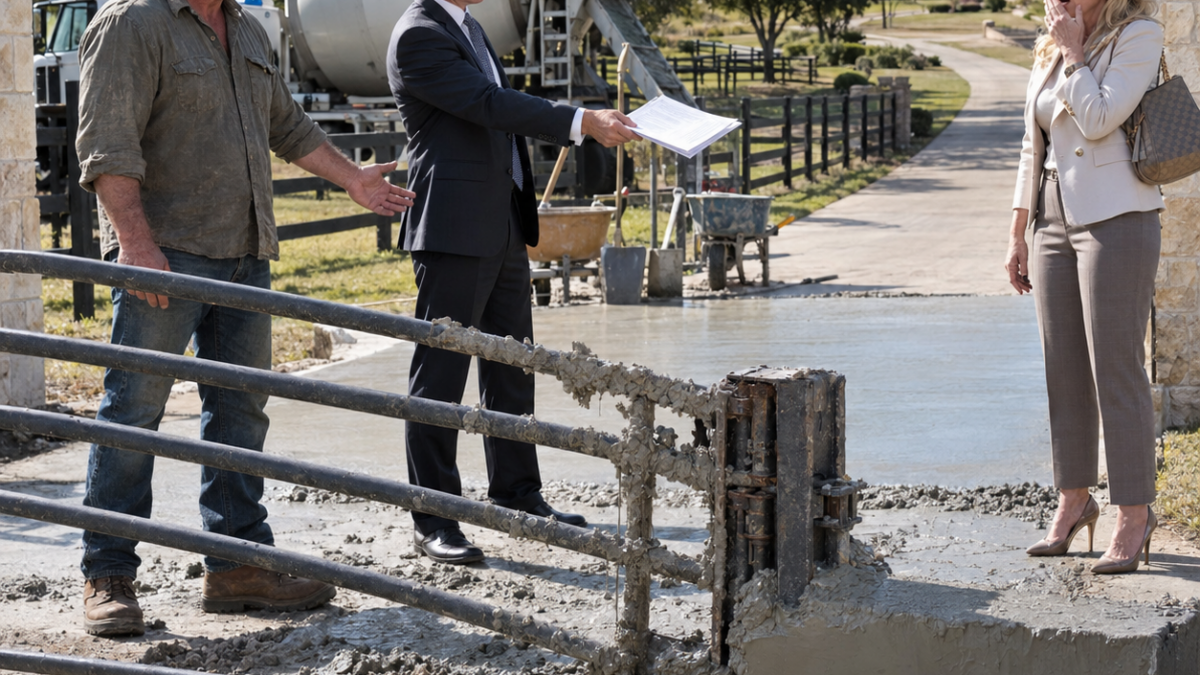
The HOA president stood on my land and watched wet concrete swallow the hinges of a gate I had built with my own hands, then smiled and told me she was “reclaiming community property.” I had already shown her the deed, the county survey, and the recorded plat proving the ground beneath her shoes belonged to me, which meant what I was watching wasn’t an innocent mistake anymore. But as the concrete climbed around the locking mechanism and she ordered the driver to keep pouring, I realized there was one question she had never expected me to ask in front of a camera.
“Keep it coming,” Karen Covington called to the concrete driver.
The chute rattled.
Gray concrete spilled onto the base of my wrought-iron gate.
“Karen.”
She looked over her shoulder at me.
“This is HOA common property now, Major.”
She always used my old rank when she wanted to sound insulting.
I had spent twenty-five years with the Army Corps of Engineers. I had built roads, bridges, barriers, and infrastructure in places where mistakes could get people killed.
Now I was retired.
All I wanted was peace.
Instead, I was watching an HOA president pour concrete onto land my deed said belonged to me.
My gate stood at the rear entrance to our property, opening onto an old dirt track beside forty acres of woods and rolling hills behind our house.
I had designed the gate myself.
Heavy steel.
Wrought-iron scrollwork.
Custom hinges.
Five thousand dollars in materials and fabrication before counting my own labor.
And Karen was burying it.
I took out my phone.
Sarah stood beside me.
“Jack,” she whispered, “do something.”
“I am.”
I started recording.
Karen noticed.
Her smile shifted.
Not much.
Enough.
I walked slowly toward the concrete truck, keeping the camera steady.
The truck’s company logo.
License plate.
Driver.
Karen.
Brenda and Gerald, the two board members standing behind her.
Then the gate.
Concrete had already reached the lower hinge.
“Karen, for the record, state your full name and your position.”
Her face tightened.
“You know who I am.”
“I’d like you to say it.”
“I am Karen Covington, president of the Maple Creek Homeowners Association.”
“And you authorized this work?”
“Yes.”
Brenda looked down.
Gerald suddenly seemed fascinated by his shoes.
I kept filming.
“What exactly are you authorizing?”
“The removal of an unauthorized structure from HOA common property.”
“This is my gate.”
“It is an illegal encroachment.”
“The land is on my deed.”
“You’ve been told repeatedly that this track is a community bridle path.”
“It isn’t.”
She pointed toward the concrete.
“The board disagrees.”
I almost smiled.
Boards can disagree about landscaping.
Pool hours.
Mailbox standards.
They cannot vote somebody else’s land into existence as common property.
I had already sent Karen the survey.
The official plat.
A letter from a real-estate attorney.
The fifteen-foot strip along the track was a utility easement.
That meant a utility had limited access rights.
It did not transfer ownership to the HOA.
Karen knew that.
She simply hated the answer.
“You received my attorney’s letter?” I asked.
“Yes.”
“And the survey?”
“Yes.”
“The county plat?”
“Yes.”
“Yes or no, Karen—the plat shows this gate inside my property line, correct?”
Her eyes narrowed.
“The HOA’s interpretation is different.”
“Different from the county land record?”
“The covenants are clear.”
Sarah stepped closer to me.
I could feel anger radiating from her.
“Jack, she’s destroying it.”
I kept the camera on Karen.
“Last question.”
Karen folded her arms.
“What?”
“You understand that my attorney warned you not to enter this property or damage this gate?”
For the first time, she hesitated.
Behind her, concrete kept pouring.
“Yes,” she finally said.
“And you decided to do it anyway?”
Her chin rose.
“I decided to enforce our rules.”
I stopped talking.
That was the answer I needed.
Karen smiled again, apparently believing she had won the exchange.
She hadn’t.
She had just admitted, on video, that she received written proof of my ownership, received a lawyer’s warning, entered the property anyway, and personally authorized destruction of my gate.
I uploaded the recording to cloud storage before the concrete truck even finished unloading.
Then I called the sheriff.
By the time the deputy arrived, the concrete had started to harden.
My gate was trapped inside an ugly gray block.
The deputy studied my deed.
Then the survey.
Then the slab.
Finally, he sighed.
“Mr. Morgan, I understand what you’re showing me.”
“But?”
“She says it’s HOA common property. Without a court ruling on the boundary, this is probably going to be treated as a civil dispute.”
I stared at the ruined gate.
Karen had known exactly where the property line was.
Now she had the county treating her deliberate destruction like a neighborhood disagreement.
I thanked the deputy, took the report number, and walked back toward Sarah.
She looked at the concrete.
“What now?”
I pulled out my phone again.
“There’s one person I haven’t called yet.”
“Who?”
“The lawyer who told Karen not to touch it.”
PART 2
David Chen answered on the third ring.
“Jack Morgan,” he said. “I thought retirement meant I’d finally stop hearing from you whenever somebody ignored a map.”
“Turns out civilians ignore maps too.”
“That bad?”
“Remember the gate?”
There was a pause.
“The one the HOA claimed was on common land?”
“That one.”
“What did they do?”
“They poured concrete over it.”
Silence.
Not confused silence.
David Chen silence.
I had heard it before in Iraq when somebody handed him a contract so badly written that he had to choose whether to laugh or swear.
Finally:
“They did what?”
“Concrete truck. Karen. Two board members. My gate is now attached to about several tons of what I assume is three-thousand-PSI stupidity.”
Sarah looked at me.
“This is not funny.”
“No,” David said through the phone. “It really isn’t.”
I walked farther from the concrete crew, though they were already cleaning the chute.
“I recorded the whole thing.”
“Of course you did.”
“She admitted she received your warning letter.”
Another pause.
“Jack.”
“Yeah?”
“Tell me exactly what she said.”
I repeated it.
David made me repeat the wording a second time.
Then:
“Send me the video immediately.”
“I already uploaded it.”
“Deed?”
“Scanned.”
“Survey?”
“Scanned.”
“County plat?”
“Scanned.”
“Every letter she ever sent you.”
“You want the mailbox one too?”
“I want everything.”
“Garden hose?”
“Everything.”
“The truck decal?”
“Jack.”
“I’m sending everything.”
His voice sharpened.
“And do not touch that concrete.”
“I wasn’t planning to.”
“Don’t try to break it. Don’t cut the gate free. Don’t remove anything. Photograph it from every angle. Get measurements. Get an estimate from an independent contractor for removal and restoration. And if Karen comes back, record her.”
“Understood.”
David exhaled.
“One more thing.”
“What?”
“Don’t threaten her.”
“I’m not sixteen.”
“You’re an angry retired major watching somebody destroy something you built. I’m being thorough.”
That was fair.
“I won’t threaten her.”
“Good.”
Then he said something that surprised me.
“Also don’t celebrate.”
“Celebrate what?”
“She just gave us a very good case.”
I looked at the block of concrete hardening around my gate.
At that moment, it didn’t feel good.
It felt like vandalism.
Like humiliation.
Like someone had stepped onto my land, looked straight at me, and decided that my ownership only mattered if Karen agreed with it.
Sarah walked up after I hung up.
“What did David say?”
“Don’t touch anything.”
“I could have told you that.”
“He also thinks Karen just helped our case.”
Sarah stared at the gate.
“I don’t care about the case right now.”
“I know.”
“I liked that gate.”
“So did I.”
“You built it the year after we moved here.”
“I remember.”
“No, I mean I really liked it.”
I looked at her.
Her eyes were wet.
That changed the shape of my anger.
The gate wasn’t merely steel.
I had built it during the first year after retirement, when I had no idea what to do with quiet.
For twenty-five years, somebody else had controlled my calendar.
Deployments.
Projects.
Orders.
Inspections.
Emergencies.
Then suddenly I was home.
Sarah used to find me awake at four in the morning because my body didn’t understand that nobody needed me anywhere.
The gate had become a project.
A harmless mission.
Sketch.
Measure.
Cut.
Weld.
Grind.
Fit.
Repeat.
Sarah had picked the final scroll pattern.
I had spent weeks making it.
When we finally hung it, she stood back and said, “There. Now you’ve officially retired.”
Karen didn’t know any of that.
To her it was simply unauthorized metal.
That evening, Sarah and I turned our dining table into a document station.
Deed.
Survey.
Plat.
HOA letters.
David’s previous warning.
Photos.
Video.
Sheriff’s report number.
I created a timeline.
Month one: mailbox flag.
Month three: garden hose.
Month five: truck decal.
Month eight: gate complaint.
Then escalation.
Karen first claimed the dirt track was a “community bridle path.”
I sent the survey.
She ignored it.
I sent the recorded plat.
She claimed it was outdated.
It wasn’t.
David sent the warning letter.
She called a concrete company.
Those facts formed a sequence.
And sequences matter.
Sarah sat opposite me reading one of Karen’s old letters.
“You kept this?”
“I keep everything.”
“It says your American flag decal was an unapproved vehicle modification.”
“Yes.”
“On your own truck.”
“Yes.”
She looked up.
“Why did we tolerate this woman?”
“Because every individual thing was too stupid to fight over.”
That was the truth.
The mailbox flag?
Paint it.
The hose?
Put it away.
Truck decal?
Ignore the letter.
Each incident alone seemed beneath the cost of conflict.
But people like Karen survive on that calculation.
Nobody wants to hire a lawyer over a garden hose.
Nobody wants to spend Saturday arguing at an HOA meeting over a mailbox.
So you yield.
Then yield again.
Eventually the bully mistakes fatigue for consent.
David sent the first formal demand two days later.
Ten business days.
Remove the concrete professionally.
Restore the land.
Replace the five-thousand-dollar gate.
Commission a new boundary survey.
Reimburse preliminary legal costs.
Cease all harassment and trespass.
Total immediate demand: a little over ten thousand dollars.
It was less than I expected.
“You’re giving them an exit,” I told David.
“Exactly.”
“You think they’ll take it?”
“A competent board would.”
“And this board?”
He smiled.
“We’re about to find out whether anyone around Karen has survival instincts.”
The response arrived a week later.
One page.
No lawyer.
Karen had written it herself.
She rejected every demand.
Called the path a long-established HOA bridle route.
Called my gate an unauthorized encroachment.
Claimed the board acted within its lawful authority.
Then she attached an invoice.
I read it twice.
Unauthorized Structure Removal Fee — $2,500.
Common Area Restoration Fee — $1,500.
Willful Disregard of Board Directive — $1,000.
TOTAL DUE — $5,000.
At the bottom:
FAILURE TO PAY MAY RESULT IN A LIEN AND FORECLOSURE PROCEEDINGS.
I called David.
He read it silently after I emailed it.
Then he laughed.
Not because it was funny.
It was the laugh of a lawyer receiving a gift from the opposing side.
“What?”
“She admitted everything.”
“We already have video.”
“Now we have official HOA letterhead.”
He started ticking points off.
“She claims authority. She claims the work was intentional. She identifies it as an association action. She invoices you for it. And now she threatens a lien if you don’t pay for the destruction of your own property.”
“So what do we do?”
“Nothing.”
“I’m sorry?”
“Nothing.”
“She threatened a lien.”
“I know.”
“You want me to let her file it?”
“I want to see whether she’s foolish enough.”
I walked to the window.
The concrete slab was visible from the house.
“You’re asking a lot.”
“I’m asking you to trust me.”
“I do.”
“Then don’t respond.”
For the next thirty days, I watched the calendar.
Day ten.
Day fifteen.
Day twenty.
Nothing.
Karen drove by twice in her golf cart.
She looked toward the house.
I refused to react.
Day twenty-nine, Sarah said:
“Maybe she’s backing off.”
“No.”
“How do you know?”
“Because she’d need to admit she was wrong.”
Day thirty-one, certified mail arrived.
NOTICE OF LIEN.
Five thousand dollars.
Recorded against my property.
I called David.
“She did it.”
He sounded almost cheerful.
“She actually filed?”
“I’m holding the notice.”
“Send it.”
I scanned it.
Ten minutes later he called back.
“Okay.”
“That doesn’t sound like an okay ‘okay.’”
“It’s an excellent okay.”
“What changed?”
“Everything.”
He explained carefully.
Once Karen moved from internal HOA threats to recording a lien against title, she had created a much larger legal problem.
Potential slander-of-title issues.
Wrongful lien claims.
Additional statutory remedies depending on the filing.
More importantly, she had put the disputed ownership claim into the public property record.
“Jack, we’re done asking her to fix this.”
“What now?”
“Now we file.”
While David drafted, I did something he hadn’t originally asked for.
I began walking the neighborhood.
Partly because Duke, our golden retriever, needed exercise.
Mostly because I needed to understand whether Karen treated everyone the way she treated us.
The first real conversation happened with Mrs. Gable.
Eighty-two.
Widowed.
Small white house near the cul-de-sac.
She was watering roses when Duke pulled toward her.
“Well, hello there.”
She crouched.
Duke immediately betrayed me and fell in love with her.
“You’re Jack Morgan.”
“Yes, ma’am.”
“The gate man.”
“Apparently that’s my new identity.”
She looked embarrassed.
“I didn’t mean—”
“It’s okay.”
She glanced toward the street.
Then lowered her voice.
“That woman has been after you.”
“Karen?”
Mrs. Gable gave me a look.
“Who else?”
She invited me onto her porch.
That was where I learned about the gnomes.
Her husband, Frank, had collected them.
Nothing valuable.
Painted ceramic.
One fishing.
One sleeping.
One carrying a lantern.
After Frank died, Mrs. Gable kept them because he had bought most of them during road trips.
Karen called them “tacky lawn ornaments.”
Fifty-dollar fine.
Then another.
Then late fees.
Eventually, a lien.
“How much?”
“Little over a thousand.”
“For garden gnomes?”
Her eyes filled.
“I know it sounds silly.”
“It doesn’t.”
“I put them in the garage.”
“Did the lien disappear?”
“No.”
That stopped me.
“Why not?”
“They said the balance remained due.”
I sat back.
“Can I see the letters?”
She hesitated.
“Why?”
“Because I’m dealing with something similar.”
She knew about my lien.
Everybody did.
She brought out a folder.
Karen’s signature was on almost every notice.
I photographed them with permission.
When I left, Mrs. Gable touched my arm.
“Don’t tell her I showed you.”
That sentence bothered me all night.
A woman in her eighties afraid of a volunteer board president.
Next came the Rodriguezes.
Leo was ten.
Loved basketball.
His portable hoop had become another target.
Two-hundred-dollar fine because Karen considered it a temporary structure inconsistent with community character.
Carlos appealed.
Karen ruled him out of order.
Then the fine doubled.
“Insubordination,” Carlos told me.
“Insubordination?”
“That’s literally what she called it.”
“You’re a homeowner, not a private.”
“I know.”
“Did you pay?”
He nodded.
“Four hundred.”
“Why?”
His wife answered.
“Because Leo heard us fighting about it.”
She looked toward the garage.
“He stopped playing.”
That was what finally changed the case for me.
Karen’s notices weren’t just annoying adults.
They were changing how people lived in their own homes.
I spoke to others.
A contractor fined for unloading tools from his own work van.
A family ordered to remove a porch sign.
Another warned over bird feeders.
The same structure appeared repeatedly.
Vague rule.
Karen interpretation.
Immediate fine.
Appeal blocked or ignored.
Threat of escalation.
People paid because fighting cost more.
Every story became a statement.
Every notice became an exhibit.
Then I met George Whitaker.
Retired surveyor.
Early seventies.
Dry sense of humor.
He was pruning roses when I introduced myself.
He didn’t bother pretending he didn’t know who I was.
“You’re Concrete Gate.”
I sighed.
“Apparently.”
He smiled.
“Knew Karen would eventually hit something that hit back.”
“What do you know about the track?”
George stopped trimming.
“A lot.”
He had lived in Maple Creek since the development’s early years.
More importantly, he had worked with the original survey records.
“The easement beside your track belongs to the county water authority.”
“That’s what my plat says.”
“Fifteen feet.”
“Yes.”
“Pumping-station access.”
“Yes.”
“Not HOA.”
“No.”
George nodded.
“Then nothing changed.”
I stared at him.
“What do you mean?”
“Karen tried this before.”
“When?”
“Five years ago.”
My stomach tightened.
He explained.
Karen had wanted the old dirt track formally designated as a private Maple Creek recreational path.
A bridle trail.
Walking path.
Something she could advertise as a community amenity.
George told the board they didn’t own it.
He brought copies of the plat.
Explained the utility easement.
Explained that recreational access existed only because the prior owner allowed neighbors through informally.
“What did Karen say?”
George laughed bitterly.
“That I didn’t understand the documents.”
“You’re a licensed surveyor.”
“Retired now.”
“You were licensed then.”
“Yes.”
“And she knew the HOA had no property interest?”
“She knew what I told her.”
“Would you sign an affidavit?”
He put down the clippers.
“That serious?”
“She poured concrete over my gate.”
“I know.”
“She filed a lien.”
His expression changed.
“She did what?”
I showed him the notice.
George read it.
Then looked toward Karen’s house.
“Oh, she’s in trouble.”
“Will you sign?”
“I’ll do better.”
He went inside and returned with an old folder.
Inside were copies of the five-year-old meeting materials.
Including an email George had sent to Karen afterward.
The message summarized the easement issue.
Plain language.
The HOA did not own the land.
County water authority held limited utility access.
Recreational use was permissive.
Karen had replied.
THANK YOU, GEORGE. THE BOARD WILL TAKE THIS UNDER ADVISEMENT.
I stared at that line.
She couldn’t claim ignorance anymore.
I called David from George’s driveway.
“You sitting down?” I asked.
“No.”
“You should.”
I explained.
David became very quiet.
Then:
“Get copies.”
“Already doing it.”
“Get George.”
“He’s willing.”
“Jack.”
“Yeah?”
“This changes intent.”
That night Sarah found me sitting at the dining table looking at George’s email.
“You okay?”
“She knew.”
“I thought we knew that.”
“No. We suspected she ignored the survey after I showed her. George told her five years ago.”
Sarah read the email.
Her jaw tightened.
“She wanted the trail.”
“Looks that way.”
“For what?”
“Community amenity. Exclusivity. Marketing. Control. Pick one.”
Sarah sat down.
“So this wasn’t really about the gate.”
“No.”
“What was it?”
I looked toward the back acreage.
“She couldn’t stand that access depended on my permission.”
David filed our quiet-title action and broader civil complaint.
Trespass.
Property destruction.
Wrongful lien claims.
Slander of title.
Declaratory relief.
Legal fees.
Punitive damages.
The HOA was named.
Karen.
Brenda.
Gerald.
The complaint described not just the concrete incident but the pattern behind it.
When David emailed me the final draft, I called him.
“Six hundred thousand?”
“That’s the pleaded damages demand.”
“That’s a very big number.”
“Yes.”
“Gate cost five.”
“This stopped being about a five-thousand-dollar gate when they knowingly destroyed property, filed an allegedly fraudulent lien, threatened foreclosure, and continued after notice.”
“You think we get six hundred?”
“That’s not how I want you thinking about it.”
“Then how?”
“We prove liability. We prove actual damage. We prove willfulness where the evidence supports it. We use the range of remedies available. The number tells them the exposure is no longer trivial.”
Sarah read over my shoulder.
“Karen is going to lose her mind.”
David heard her.
“That’s why Jack isn’t contacting her.”
“I wasn’t planning to.”
“Good.”
There was another issue.
The annual HOA meeting.
Six weeks away.
David didn’t want me discussing active litigation recklessly.
But the residents had a separate right to understand why Karen wanted association money for legal defense.
So we prepared facts.
No insults.
No accusation beyond evidence.
Deed.
Plat.
Utility easement.
George’s five-year-old warning.
The lien.
The gate.
Mrs. Gable.
Rodriguez.
Others.
Word spread.
The meeting room usually drew fifteen people.
That year, more than one hundred showed up.
Karen looked delighted when she saw the crowd.
That was almost sad.
She thought they were there for her.
Purple pantsuit.
Gavel.
Brenda beside her.
Gerald staring at financial sheets.
The meeting opened with minutes.
Budget.
Landscaping.
Pool chemicals.
Nobody cared.
Then Karen leaned toward the microphone.
“As many of you know, the board has recently been forced to undertake expensive legal action to protect Maple Creek’s common assets against a resident who refuses to respect community rules.”
Eyes shifted toward me.
Karen continued.
“To ensure we can defend your property values, the board proposes a special assessment of two hundred dollars per household.”
The room erupted in murmurs.
That was my cue.
I stood.
Karen saw me immediately.
“Mr. Morgan, you’ll wait until homeowner comments.”
“This concerns the assessment.”
“You are out of order.”
Gerald looked uncomfortable.
I remained standing.
“Before homeowners are asked to pay for litigation, they should know what the litigation is about.”
Karen struck the gavel.
“Sit down.”
Someone in the back shouted:
“Let him speak.”
Then another.
“Yeah.”
Mrs. Gable stood.
“I want to hear him.”
Karen froze.
Mrs. Gable rarely spoke at meetings.
That mattered.
I walked forward with the packet.
Gave copies to Karen, Brenda, Gerald.
Then turned toward the room.
“This is my deed.”
I held it up.
“This is the recorded county plat.”
Next page.
“This line is the boundary of my property.”
I traced it.
“The gate Karen ordered buried in concrete sits inside that boundary.”
Karen interrupted.
“That is your interpretation.”
George stood.
“No, Karen.”
The room turned.
George carried his own folder.
“It’s the county’s interpretation.”
Karen’s face hardened.
“You are not currently licensed.”
“I was when I explained this to you five years ago.”
Silence.
George held up the email.
“I told Karen and the board that the easement along Jack’s land was utility access for the county water authority. It was never HOA common property.”
Gerald turned toward Karen.
“You told us it was.”
She didn’t answer him.
I did.
“The HOA paid a concrete company to enter private property.”
Gerald looked pale.
I asked:
“Did you verify the property record before approving payment?”
“I—Karen said—”
“Did you look?”
“No.”
Brenda began flipping through my packet.
Her hands trembled.
Karen stood.
“This is an orchestrated ambush.”
Mrs. Gable’s voice came from the back.
“Like your lien on my house?”
Everyone turned.
She held her violation letters.
Karen looked genuinely startled.
“That has nothing to do with this.”
“It has everything to do with it.”
Mrs. Gable’s voice shook, but she kept going.
“My husband gave me those gnomes. You fined me until I put them away, then kept the lien after I complied.”
Karen rolled her eyes.
That was the moment she lost the room.
You could feel it.
Carlos Rodriguez stood.
“What about my son’s basketball hoop?”
Karen slammed the gavel.
“Order!”
Another resident rose.
“My work van.”
Another.
“My porch sign.”
Another.
“My bird feeder.”
People who had spent years believing they were alone discovered they had all been receiving different versions of the same intimidation.
Karen shouted over them.
“You signed covenants!”
George shouted back.
“Covenants don’t transfer Jack’s land to us!”
That silenced people.
I looked at Gerald.
“Do you still believe the association should collect two hundred dollars from every family to defend this?”
He looked at Karen.
Then at the documents.
“No.”
Karen turned toward him.
“What did you say?”
“I said no.”
“You’re treasurer!”
“Exactly.”
He pushed his chair back.
“And I never should have approved that concrete invoice without checking.”
Karen’s authority cracked visibly.
Brenda began crying.
Not dramatically.
Quietly.
She whispered:
“She said the lawyer had approved it.”
I looked at Karen.
“Which lawyer?”
Karen’s face flushed.
“Our counsel.”
David had already spoken to the HOA counsel.
He had never approved it.
I knew that.
But I let Karen’s statement sit.
The residents heard it too.
Then I made the motion.
Recall the board.
Karen immediately declared it improper.
George opened the bylaws.
The procedure was valid.
Petition support was confirmed in the room.
Vote.
Ninety-seven in favor.
Three against.
Karen stared at the count.
Her gavel rested on the table.
Unused.
For a woman who had spent years defining everyone else as noncompliant, she suddenly had no rule capable of restoring her power.
The interim board took over the next morning.
Arthur Hale, retired accountant, became acting president.
First action:
freeze disputed fines.
Second:
independent financial audit.
Third:
send my property records to independent counsel and the HOA insurer.
The reaction was immediate.
The association’s long-time attorney reviewed the file.
He wanted to know why Karen had ignored the survey.
Why she authorized physical work after David’s warning.
Why a lien had been recorded without clear ownership.
Why George Whitaker’s old easement correspondence had been omitted from the board packet.
He withdrew from representing the former board members personally.
The insurer sent a reservation-of-rights notice.
Willful acts might not be covered.
Intentional destruction might not be covered.
Wrongful lien exposure might be limited or excluded depending on findings.
When David explained it, Sarah looked at me.
“So Karen thought HOA insurance meant she could do whatever she wanted.”
“Apparently.”
David shook his head.
“Insurance is not a permission slip.”
Then came the lawsuit service.
David arranged professional service.
I did not know exactly when it would happen.
That was intentional.
“You do not need to be there,” he told me.
“I know.”
“You especially do not need to arrange an audience.”
“I know.”
But Maple Creek was small.
An audience happened anyway.
Saturday bake sale.
Clubhouse parking lot.
Karen still volunteered at events even after losing office.
She seemed determined to prove she remained socially important.
Sarah and I stopped by because Mrs. Gable had baked pecan cookies.
That was the only reason.
At least that’s what I told David later.
Karen stood behind a folding table arranging lemon squares.
Brenda was nearby.
Gerald too.
Then the process server walked in.
Large man.
Dark jacket.
Envelope under his arm.
“Karen Covington?”
The entire table went still.
“Yes?”
He handed her the documents.
“You’ve been served.”
Brenda received hers next.
Then Gerald.
People nearby stopped talking.
Karen looked down.
I was thirty feet away.
I watched her eyes scan the first page.
Jack Morgan versus Maple Creek Homeowners Association, Karen Covington, Brenda Miller, Gerald Finney.
Then she turned pages.
Slowly.
Her face changed.
The process server walked away.
Karen kept reading.
Brenda began crying almost immediately.
Gerald sat down.
Karen reached the demand section.
I knew the moment she saw the figure.
$600,000.
Her hand froze.
The metal cookie tongs slipped from her fingers.
They hit the table.
Clattered onto the pavement.
For several seconds, Karen didn’t move.
Then she looked up.
Her eyes found me.
No smug smile.
No gavel.
No binder.
No lecture.
Fear.
Real fear.
Sarah whispered:
“There it is.”
“What?”
“The moment she finally understands.”
I didn’t answer.
Because I understood something too.
This was not satisfying in the way I had imagined.
Seeing the number frighten Karen didn’t rebuild my gate.
It didn’t erase Mrs. Gable’s fear.
It didn’t give Leo Rodriguez back the afternoons he had stopped playing basketball.
Consequences mattered.
But spectacle was not repair.
Karen marched toward me.
Her lawyer had not yet told her not to.
“What have you done?”
Her voice shook.
“I filed a lawsuit.”
“Six hundred thousand dollars?”
“That’s the damages demand.”
“You’re trying to destroy me!”
I looked at her.
“You brought a concrete truck onto my property.”
“That gate was illegal!”
“The county record says otherwise.”
“I acted for the community.”
“The community removed you.”
Her face tightened.
“This is personal.”
“No.”
“You hate me.”
“I barely knew you before you started sending violation letters.”
“You’ve been plotting this.”
“Karen, I asked you to remove the concrete and replace my gate for roughly ten thousand dollars.”
She said nothing.
“My lawyer gave you ten business days.”
“You were threatening me.”
“He gave you an off-ramp.”
“This is extortion.”
“No. It’s a lawsuit. You have a lawyer now. Talk to them.”
I turned to Sarah.
Karen grabbed my sleeve.
Not hard.
Still enough.
I looked down at her hand.
She released me.
“You will regret this.”
David would later be delighted that three residents heard that sentence.
I wasn’t.
I just felt tired.
Brenda and Gerald folded quickly.
Their attorneys told them the documents were terrible.
Brenda admitted she had relied completely on Karen.
Gerald admitted he approved the concrete payment without independently checking ownership.
Both signed settlement agreements.
Personal contributions.
Written apologies.
Cooperation.
Sworn testimony about Karen’s representations.
They were removed from the case after satisfying agreed terms.
Karen fought.
Of course she did.
She countersued.
Harassment.
Emotional distress.
Defamation.
Claimed I had manipulated the neighborhood into turning against her.
Claimed the track had been treated as community land for decades.
Claimed I had installed the gate specifically to provoke the HOA.
David read the counterclaim.
Then put it down.
“She’s arguing tradition created ownership.”
“Can it?”
“Not like this.”
Depositions began.
Mine lasted four hours.
Karen’s lasted much longer.
David prepared for it with the patience of somebody sharpening a blade.
He began with county records.
“Mrs. Covington, do you recognize this?”
“The plat.”
“Official county plat?”
“I assume.”
“Not assume. Do you recognize it?”
“Yes.”
David pointed.
“This parcel?”
“Mr. Morgan’s property.”
“This fifteen-foot strip?”
“Community trail.”
“Where does the map say that?”
“It doesn’t use those exact words.”
“What words does it use?”
She resisted.
David waited.
Finally:
“Utility easement.”
“For whom?”
“I don’t know.”
David handed her the recorded instrument.
“Read the grantee.”
She looked.
“County Water Authority.”
“Maple Creek HOA appears anywhere?”
“No.”
“Does the easement transfer ownership?”
Her lawyer objected.
David rephrased.
“Do you see any language granting ownership to Maple Creek HOA?”
“No.”
“Any recreational easement?”
“No.”
“Any bridle-path designation?”
“No.”
Karen’s jaw tightened.
David continued.
“Did you authorize concrete to be poured around Mr. Morgan’s gate?”
“Yes, because—”
“Yes is sufficient.”
Her lawyer objected again.
David moved to the next exhibit.
My video.
Karen watched herself.
“This is HOA common property now, Major.”
David paused it.
“Your voice?”
“Yes.”
“You had received my letter before this video?”
“I believe so.”
“My letter included the plat.”
“Yes.”
“And warned you the gate stood on private property.”
“It represented your position.”
“It represented the recorded deed.”
“Your interpretation.”
David slid George Whitaker’s affidavit onto the table.
Karen stopped.
“Do you know Mr. Whitaker?”
“Yes.”
“Retired surveyor?”
“Yes.”
“Did he discuss this easement with you five years earlier?”
“I don’t remember.”
David produced the email.
“Is this your email address?”
“Yes.”
“Did you write, ‘Thank you, George. The board will take this under advisement’?”
“I don’t remember every email I sent.”
“That wasn’t my question.”
Karen’s lawyer shifted.
David repeated:
“Did you send this?”
“It appears so.”
“So five years before Mr. Morgan’s gate dispute, a professional surveyor told you the HOA did not own this land.”
“I don’t agree with that characterization.”
“What characterization do you agree with?”
“He gave an opinion.”
“The recorded plat is an opinion?”
“The interpretation is.”
David leaned back.
“Then let’s remove interpretation.”
He put the deed beside the plat.
“Show me where the HOA owns this land.”
Karen stared at the papers.
David waited.
Her lawyer finally said:
“She’s answered.”
“No,” David said. “She hasn’t.”
Karen whispered:
“I can’t.”
That was the deposition moment that broke her defense.
Not yelling.
Not humiliation.
Two words.
I can’t.
The quiet-title hearing came first.
David told me it would be straightforward.
I still barely slept the night before.
Sarah found me at the kitchen table at two in the morning.
“You think we’re going to lose?”
“No.”
“Then why are you awake?”
“Because nothing involving Karen has ever been as simple as it should be.”
She sat.
“You know what I miss?”
“What?”
“Before all this, when our biggest neighborhood crisis was somebody not pulling the trash cans in.”
I smiled.
“Karen sent me three notices for that.”
“I know.”
Sarah touched my hand.
“I want our house back.”
“We never lost it.”
“Yes, we did.”
I looked at her.
She explained.
“For months, every time a car slows down near the property, you go to the window. Every certified letter ruins dinner. You check the gate cameras before you go to bed.”
I had no answer.
“You’re winning the legal case,” she said. “But don’t make winning the only way you know you’re safe.”
That hurt because it was true.
The judge ruled for us on quiet title.
Deed.
Plat.
Recorded utility easement.
No HOA ownership.
No recreational interest.
No association jurisdiction over my gate location.
Clear.
Formal.
Recorded.
David handed me a certified copy outside court.
“There.”
I looked at the seal.
“What?”
“The argument is over.”
It felt strangely small.
Months of conflict reduced to a few pages stating what my deed had said all along.
The land was mine.
The lien became even harder for Karen to defend after that.
Settlement negotiations accelerated.
Brenda and Gerald were already cooperating.
George Whitaker was ready to testify.
The concrete contractor had produced records showing Karen personally ordered the work.
The HOA payment authorization pointed back to the former board.
The insurer disputed coverage for intentional conduct.
The new board filed its own cross-claims against the former leadership.
Karen’s personal attorney finally requested mediation.
The first offer was ridiculous.
Enough to replace the gate.
Nothing else.
David declined.
Second offer:
gate.
Concrete removal.
Partial fees.
No punitive payment.
Declined.
Third:
full restoration and fees.
Still not enough because the wrongful lien and willful conduct remained unresolved.
Sarah asked me one night:
“How much is enough?”
“That’s what David is negotiating.”
“No. I’m asking you.”
I understood.
“What do you want?”
“My gate back.”
“You can build another.”
“I know.”
“Then what?”
I thought about Mrs. Gable.
Leo.
George’s warning.
Karen pouring concrete after seeing the survey.
“I want the settlement to make it impossible for everybody to pretend this was a misunderstanding.”
Sarah nodded.
“That’s an answer.”
Final settlement:
The association covered the concrete removal.
Full site restoration.
Replacement of the gate.
My legal expenses.
Survey and title costs.
Release of the fraudulent lien.
Rescission of invalid fines issued during Karen’s regime.
Refunds to several residents.
Mrs. Gable’s lien removed.
Rodriguez fines refunded.
Governance reforms.
Karen’s individual punitive and settlement responsibility landed at just over $150,000.
Not six hundred thousand.
The lawsuit had demanded that much.
The actual resolution was lower.
That distinction mattered to me.
Consequences should be real.
Not fantasy.
Karen had to liquidate assets and ultimately sell her house.
I heard about the listing before I saw the sign.
Sarah and I were walking Duke.
At the corner, there it was.
FOR SALE.
Sarah stopped.
“You okay?”
“Yes.”
“You sure?”
I looked toward Karen’s house.
Months earlier, I would have expected joy.
Instead I felt something closer to sadness.
“She did all this over a gate.”
“No,” Sarah said.
“She did it over control.”
That was probably more accurate.
The concrete removal crew arrived the following Monday.
Hydraulic hammer.
Excavator.
Dump truck.
I stood near the property line wearing hearing protection.
The first strike landed.
BOOM.
A crack spread across the slab.
Second strike.
Another.
Gray chunks broke away.
After hours of work, the hinge emerged.
Bent.
Scarred.
Ruined.
I picked up a piece of the original ironwork.
Sarah came beside me.
“Can you save it?”
“No.”
“Anything?”
I turned the damaged hinge over.
“Maybe this.”
“For what?”
“I don’t know yet.”
We kept it.
The new gate took me longer than the first.
I could have hired someone.
The settlement would have paid.
I didn’t want that.
I needed to build it.
Again.
New steel.
Heavier posts.
Improved bearings.
A slightly different pattern because I did not want the replacement to pretend nothing had happened.
One Saturday, Leo Rodriguez came over with his father.
“What are you doing?” he asked.
“Grinding.”
“Can I watch?”
“With safety glasses.”
He stayed for three hours.
At some point he asked:
“Why didn’t you just buy a gate?”
I laughed.
“My wife asks the same thing.”
Sarah shouted from the porch:
“Yes, I do.”
I showed Leo how the hinge worked.
How weight transfers.
How a properly aligned post prevents sag.
He listened with the intense seriousness only ten-year-olds can manage.
Then he asked:
“Did that lady really pour concrete on the old one?”
“Yes.”
“Why?”
I looked toward Carlos.
He shrugged.
Your answer.
“Because sometimes adults convince themselves wanting something gives them permission to take it.”
Leo thought about that.
“That sounds dumb.”
“Usually is.”
When the gate was nearly finished, I welded the damaged hinge from the old gate onto a small steel plate.
Sarah saw it.
“What’s that?”
“A reminder.”
“For Karen?”
“For me.”
“What does it remind you?”
I looked at the scarred metal.
“To check the line before assuming somebody else will respect it.”
She frowned.
“That sounds like something you learned in the Army.”
“Probably.”
“I thought retirement was supposed to make you less intense.”
“Still working on it.”
The new gate went up in early fall.
Black steel.
Wrought scrollwork.
Better than the first.
Not because it was more expensive.
Because this time neighbors helped.
Carlos held one post while we aligned it.
George checked measurements even though I told him I didn’t need a surveyor.
“You always need a surveyor.”
Mrs. Gable brought lemonade.
Leo handed me bolts.
Arthur from the new board arrived with a copy of the revised community map acknowledging the property boundary.
When the gate finally swung closed, everyone applauded.
I hated that.
“Please don’t turn my gate into a ceremony.”
Mrs. Gable ignored me.
“Speech.”
“No.”
“Speech!”
Sarah laughed.
I raised my hands.
“Fine. The gate works.”
“That’s your speech?” Carlos asked.
“Yes.”
Leo shouted:
“Best speech ever.”
The neighborhood barbecue happened that evening.
Not planned as some grand victory party.
People just stayed.
Someone brought burgers.
Someone else potato salad.
Mrs. Gable appeared carrying one of her gnomes.
She placed it beside my new gate.
I stared.
“No.”
She smiled sweetly.
“Yes.”
“This is private property.”
“Then I’m giving it to you.”
The gnome held a tiny lantern.
Frank had bought it for her decades earlier.
“I can’t take this.”
“It’s not one of Frank’s favorites.”
“That does not help.”
She touched my arm.
“You helped me bring them out of the garage.”
That stopped me.
The lien against her home had been formally released the week before.
Her gnomes were back in the garden.
All of them.
She looked toward the little figure.
“Keep him by the gate for a while.”
So I did.
Leo and his father installed a permanent basketball hoop at their house.
This time the new HOA board approved it in one meeting.
No drama.
No doubled fine.
No “insubordination.”
The interim board rewrote the vaguest rules.
“Aesthetically harmonious” became measurable standards where standards were actually necessary.
Appeals became real.
Board members had conflict disclosures.
Major expenditures required documented votes.
Property disputes required professional review before enforcement.
No more Karen declaring ownership from a golf cart.
The audit also embarrassed a lot of people.
Not criminal corruption.
Mostly terrible governance.
Poor documentation.
Unnecessary legal costs.
Money wasted enforcing trivialities.
The biggest reform was cultural.
People started attending meetings.
That changed everything.
Karen had never possessed magical power.
She had possessed empty chairs.
Apathy had given her room.
Fear kept people from filling it.
Once residents showed up, asked questions, read documents, and voted, the empire disappeared remarkably fast.
Karen moved away before winter.
I saw her once before she left.
I was working near the gate when a car stopped on the road.
Her car.
She lowered the window.
For several seconds neither of us spoke.
Then:
“Happy?”
I set down the wrench.
“About what?”
“You got everything.”
I looked around.
The restored track.
New gate.
Mrs. Gable’s ridiculous gnome.
“What do you think I got?”
“My house.”
“I didn’t take your house.”
“You forced me to sell.”
“Your settlement forced you to pay damages.”
“You’re splitting hairs.”
“No.”
She gripped the steering wheel.
“Everyone hates me because of you.”
I shook my head.
“I didn’t fine Mrs. Gable.”
Her jaw tightened.
“I didn’t double the Rodriguez fine.”
Silence.
“I didn’t file the lien on my property.”
She looked away.
“You embarrassed me.”
“I showed people the documents.”
“That’s the same thing.”
“No, Karen.”
For once my voice wasn’t angry.
“If the truth embarrasses you, the problem isn’t the person holding the paper.”
She blinked.
I expected another argument.
Instead she looked at the new gate.
“You made another one.”
“Yes.”
“It looks expensive.”
“It was.”
“You always had to prove something.”
That surprised me.
“Maybe.”
I thought about Sarah’s warning.
About checking cameras.
About turning the whole conflict into a mission.
Karen wasn’t entirely wrong about me.
I had needed to prove something.
That my land was mine.
That evidence mattered.
That bullying could be answered.
But maybe, somewhere along the way, I had also needed to prove I was still useful after retirement.
Still capable of building an operation.
Still somebody who could fight.
I didn’t tell Karen all that.
Some truths are not owed to your opponent.
I simply said:
“I wanted you to leave it alone.”
Her eyes hardened again.
Then softened.
Barely.
“I thought the trail would be good for Maple Creek.”
“You could have asked.”
“You would have said no.”
“Maybe.”
“Then what difference would asking make?”
I looked at her.
“All the difference.”
She drove away.
That was the last time I saw Karen Covington.
A few weeks later, I received a handwritten card.
No return address I recognized.
Mrs. Gable.
Inside:
Jack,
Frank always said a good fence keeps peace only when everyone agrees where the line is.
Thank you for helping us find ours again.
And thank you for the gnomes.
— Margaret Gable
I kept that card.
Not the lawsuit cover sheet.
Not the settlement number.
Not Karen’s lien.
The card.
Because it explained the entire fight better than six hundred pages of legal filings ever could.
A boundary is not automatically hostility.
Sometimes it is the thing that allows neighbors to live together without resentment.
My gate never meant:
Stay away.
For years I had let people use the track.
Walkers.
Horse riders.
Neighbors heading toward the park.
I enjoyed seeing them.
The gate meant:
This is private land, and access exists because the owner allows it.
Karen could not tolerate that distinction.
Permission meant I retained control.
She wanted the community to possess a right that had never been granted.
That desire destroyed her presidency.
Cost her money.
Cost her home.
And almost destroyed the neighborhood’s trust.
The next spring, I walked to the gate early one morning.
Mist sat over the back acreage.
Duke was older and moved slower.
He stopped beside Mrs. Gable’s gnome and sniffed it like he did every morning.
I opened the gate.
The hinges moved perfectly.
No squeal.
No sag.
Behind one post, mounted where only I could see it, was the damaged hinge from the first gate.
I touched the rough gouge left by the concrete removal crew.
Sarah came up behind me carrying two coffees.
“You’re inspecting it again.”
“Preventive maintenance.”
“You inspected it yesterday.”
“Different weather conditions.”
“You are impossible.”
She handed me a mug.
We stood there looking across the track.
A couple of neighbors approached in the distance.
Morning walk.
They stopped at the gate.
“Morning, Jack.”
“Morning.”
“Mind if we cut through?”
That question mattered.
Not because I wanted people begging for access.
Because asking acknowledged something Karen had tried to erase.
Choice.
“Go ahead.”
I opened the gate wider.
They thanked me and continued toward the trail.
Sarah smiled.
“You know you could just leave it open.”
“I could.”
“But then you wouldn’t get to dramatically grant passage.”
“That is not what I’m doing.”
“Major.”
“Don’t call me that.”
She laughed.
I looked at the gate again.
Karen once thought concrete could settle a property dispute.
Pour enough of it, she seemed to believe, and reality would harden around her version of events.
But concrete does not change a deed.
A gavel does not move a property line.
An HOA vote does not create ownership.
And a threat does not become law just because somebody prints it on official letterhead.
The original gate was gone.
I regretted that.
There were still moments when I wished I had found a way to save it.
But the new gate carried something the old one never had.
A story.
Leo had helped hold the bolts.
George had checked the line.
Carlos had steadied the post.
Mrs. Gable’s gnome guarded the entrance.
Sarah had once again chosen the scroll pattern.
The first gate had been something I built after leaving the Army because I needed a project.
The second was something we built after Maple Creek learned what community actually meant.
That difference mattered.
The $600,000 lawsuit became neighborhood legend.
People exaggerated it.
Some said Karen had to pay the whole thing personally.
She didn’t.
Some said the lawsuit bankrupted the HOA.
It didn’t.
Some said she had been arrested at the bake sale.
She wasn’t.
Reality was less cinematic.
And, to me, more satisfying.
She was served.
She fought.
Evidence accumulated.
Her allies abandoned false claims when they saw the records.
The court confirmed my ownership.
The lien fell.
The gate was replaced.
Residents were reimbursed.
Karen paid serious personal damages.
The HOA survived under better leadership.
And Maple Creek learned that accountability does not require destroying an institution.
Sometimes it means forcing the institution to remember its limits.
Years after all of this, Arthur asked me to speak briefly at an HOA orientation for new residents.
I refused twice.
Sarah accepted for me the third time.
I stood at the clubhouse in front of twenty families.
Behind me was a projected map of Maple Creek.
Arthur had marked common areas.
Private lots.
Utility easements.
Actual association property.
Clear lines.
No mystery.
I said:
“This map is boring.”
A few people laughed.
“That’s good.”
More laughter.
I pointed to it.
“If a future board ever tells you something belongs to the HOA, this is where the conversation starts.”
I tapped the legend.
“Not with opinion. Not with history. Not with who used it last. Not with who wants it. Start with the record.”
A man in the front raised his hand.
“Are you the concrete gate guy?”
Sarah laughed from the back.
I closed my eyes.
“Yes.”
Everybody knew the story.
I shortened the rest of my remarks.
Afterward, a young couple approached.
They had just moved into Mrs. Gable’s old street.
The woman said:
“We bought because people here actually talk to each other.”
That stayed with me.
Karen had wanted Maple Creek to look perfect.
The new community was not perfect.
There were weeds.
Blue doors.
Basketball hoops.
Work vans.
Too many garden gnomes.
People disagreed at meetings.
Budgets ran long.
Arthur once spent forty-five minutes explaining pool-pump depreciation.
It was unbearable.
It was also healthy.
A real community does not require everyone to submit.
It requires everyone to participate.
One summer afternoon, Leo came by again.
He was sixteen now.
Taller than me.
Hard to believe he had once stood in my workshop asking why adults fought about gates.
He leaned against the post.
“You still have that old hinge?”
“Yep.”
“Why?”
“You asked me that six years ago.”
“You didn’t give a good answer.”
Teenagers.
I opened the small metal cover protecting it.
He looked at the scarred hinge.
“The concrete really messed it up.”
“Yes.”
“You ever think about getting rid of it?”
“No.”
“Why keep something broken?”
I looked at him.
That was the better question.
“Because not everything broken should be hidden.”
He nodded slowly.
Then:
“That’s annoyingly deep.”
“I’m old now.”
“You were old then.”
“Get off my property.”
He laughed.
Then picked up the basketball he had brought.
“Dad said you’re coming over Sunday.”
“For what?”
“Hoop’s leaning.”
“I told him those anchors were too small.”
“He said you’d say that.”
I locked the gate.
As Leo walked away, I looked at the old hinge again.
Karen had tried to bury the whole gate.
Instead, one damaged piece survived.
Not as a trophy.
Not as evidence anymore.
As perspective.
The lawsuit ended.
The checks cleared.
The legal files eventually went into storage.
Karen became somebody who used to live in Maple Creek.
The neighborhood moved on because neighborhoods always do.
But every time I swing that gate open, I remember the sound of concrete pouring.
Wet.
Heavy.
Final.
Karen believed finality belonged to whoever acted most aggressively.
She was wrong.
The concrete felt permanent that morning.
It wasn’t.
The lien felt dangerous when it appeared against my title.
It disappeared.
Her presidency felt untouchable.
Ninety-seven homeowners voted it away.
The six-hundred-thousand-dollar lawsuit looked terrifying when she read it at that bake-sale table.
Even that was only the beginning of negotiation, evidence, accountability, and repair.
Nothing was as permanent as it looked.
Except the record.
That was what ultimately defeated Karen.
Not me.
Not David.
Not the neighbors.
The record.
The deed recorded before she ever became president.
The plat filed before she decided the track belonged to the association.
George’s five-year-old email.
My video.
Her own letter.
Her invoice.
Her lien.
Her deposition.
Every time Karen had been offered a chance to slow down and verify the facts, she had instead created another document proving exactly what she had chosen to do.
That was her downfall.
She buried my gate in concrete.
But she documented her own path to the courtroom one page at a time.
On quiet mornings now, Sarah and I still walk the back acreage.
Duke is gone.
We lost him two winters ago.
I buried him beneath an oak overlooking the track.
Mrs. Gable passed away not long after.
Her daughter sent me another card.
Inside it said Margaret had wanted me to keep the lantern gnome.
It still sits beside the gate.
The paint has faded.
One corner of the little lantern chipped during a storm.
I will never repair it.
Some things should show their age.
One evening Sarah and I stopped beside it.
She touched the gate.
“Do you remember what you said the day Karen poured the concrete?”
“I said a lot.”
“You told me she picked the wrong fight.”
“I was angry.”
“You were right.”
I shook my head.
“No.”
“What?”
“She picked the wrong community.”
Sarah smiled.
That was closer to the truth.
If it had stayed Jack Morgan versus Karen Covington, maybe I would have gotten my gate replaced.
Maybe the lien removed.
Maybe damages.
But Mrs. Gable might still have hidden her gnomes.
Leo might still have kept his basketball hoop in the garage.
People might still have looked away every time Karen’s golf cart stopped in front of a neighbor’s house.
The larger victory happened only because everybody finally realized the fight was shared.
I unlocked the gate.
The sun was setting beyond the woods.
Sarah walked through first.
I followed.
Then I pulled the gate closed behind us.
Heavy steel met the latch with a solid click.
No concrete.
No HOA notice.
No camera recording.
Nothing dramatic.
Just a gate doing what a gate is supposed to do.
Marking a line.
Opening when invited.
Closing when necessary.
And standing exactly where the deed said it belonged.
The new gate had been standing for almost three months when I finally stopped checking it every morning.
At first, I couldn’t help myself.
I would carry my coffee out before sunrise, walk down the gravel track, put one hand against the steel, inspect the hinges, look at the posts, and make sure nobody had touched anything during the night.
Sarah noticed.
Of course she did.
One morning she followed me down wearing slippers and one of my old Army sweatshirts.
“You know,” she said, “normal retired people drink coffee on the porch.”
“I am drinking coffee.”
“You’re conducting a perimeter inspection.”
“I’m checking the gate.”
“You checked it yesterday.”
“Things can change overnight.”
She stared at me.
I knew that look.
Thirty years of marriage had taught me not to argue with it.
Finally she said, “Karen moved away two months ago.”
“I know.”
“The HOA voted in new rules.”
“I know.”
“The lien is gone.”
“I know.”
“The court says this is your property.”
“I know.”
“And there’s a three-foot-tall ceramic gnome guarding the entrance.”
I looked down.
Mrs. Gable’s lantern-holding gnome stared back at me.
“That thing isn’t stopping anybody.”
Sarah smiled.
“Neither is staring at the gate every morning.”
I knew what she meant.
Legally, the fight was over.
Financially, it was over.
Karen had signed the settlement. The HOA had reimbursed our costs. The concrete was gone. My title was clean. Mrs. Gable’s lien had been released. The Rodriguez family had received their money back.
But some fights stay in your body after the paperwork says they’re finished.
For months, every certified envelope had made my shoulders tighten.
Every slow-moving car near the property made me look up.
Every time I heard construction equipment in the distance, my first thought was the concrete truck.
I had spent twenty-five years learning how to remain alert when danger might come from anywhere.
Retirement had required me to learn something much harder.
How to stand down.
Sarah slipped her hand through my arm.
“You won, Jack.”
“I know.”
“Then come home.”
I turned toward her.
“We’re standing on our property.”
“That’s not what I meant.”
She started walking toward the house.
I stayed beside the gate for another few seconds.
Then I followed her.
That became my real ending to the fight.
Not the lawsuit.
Not the $600,000 number.
Not Karen’s face at the bake sale.
Learning how to walk away from the gate without looking back.
Maple Creek changed slowly after that.
There was no dramatic transformation where everyone suddenly became best friends and every disagreement disappeared.
People still argued.
At one meeting, two residents spent twenty minutes debating whether the pool should close at nine or ten.
Another meeting nearly collapsed over where to place a dog-waste station.
Arthur Hale, our new board president, once called me and said, “Jack, I owe Karen an apology.”
I almost dropped the phone.
“For what?”
“She somehow made this job look exciting.”
I laughed.
“How bad is it?”
“Three people have emailed me about mulch color.”
“You’re on your own.”
“Coward.”
But that was exactly what I wanted Maple Creek to become.
Boring.
Predictable.
Transparent.
Nobody feared a violation notice.
Nobody saw a golf cart stop in front of their house and wondered what part of their life was about to become somebody else’s business.
The board still enforced legitimate rules.
People couldn’t dump trash in common areas.
They couldn’t block fire access.
They couldn’t build into drainage corridors.
But if Arthur believed a resident had violated something, the letter quoted the actual rule.
There was an appeal process.
There were records.
No invented paragraphs.
No mystery fees.
No punishment for disagreeing with the president.
The first time Mrs. Gable attended a meeting after her lien was released, she brought one of Frank’s old garden gnomes.
She placed it on the table beside Arthur.
He stared at it.
“What is this?”
“Accountability.”
Everyone laughed.
Arthur left it there for the entire meeting.
Mrs. Gable’s front yard became famous.
Once her original gnomes came out of the garage, neighbors started giving her more.
Within a year she had twenty-three.
One held a fishing pole.
One pushed a wheelbarrow.
One slept under a mushroom.
Somebody gave her one dressed like a tiny judge.
That one sat beside the mailbox.
Karen would have suffered a stroke.
Mrs. Gable loved every second of it.
Leo Rodriguez started playing basketball again.
The first time I walked past their house and heard the ball hitting pavement, I stopped.
Bounce.
Bounce.
Bounce.
Normal neighborhood sound.
Leo saw me.
“Mr. Morgan!”
He threw me the ball.
I caught it.
“You play?”
“Not well.”
“Dad says old Army guys think they can do everything.”
“Your dad talks too much.”
Carlos shouted from the garage.
“I heard that.”
Leo pointed toward the hoop.
“One shot.”
I took it.
Missed badly.
Leo laughed so hard he nearly fell over.
“Engineers don’t do basketball,” I told him.
“You built a gate.”
“Different physics.”
“It’s literally still physics.”
The kid had me there.
That evening Sarah asked why my shoulder hurt.
I told her I had been helping the Rodriguezes.
She somehow knew I was lying.
The legal files eventually moved from our dining-room table to my study.
Then from my desk to a cabinet.
Then from the cabinet to a sealed archive box.
DEED.
SURVEY.
PLAT.
LIEN.
LAWSUIT.
SETTLEMENT.
I wrote the labels with a black marker.
Sarah stood in the doorway.
“You keeping all of it?”
“Absolutely.”
“For how long?”
“Forever.”
“Why?”
“Because records matter.”
She nodded toward the damaged hinge mounted above my workbench.
“And apparently so do broken pieces of metal.”
“That too.”
She smiled.
“Just checking.”
The hinge had become something different with time.
At first I kept it because it represented what Karen had done.
Later I realized that wasn’t why I still looked at it.
I kept it because I had almost made the same mistake she had.
Karen believed control was the same thing as safety.
During the lawsuit, I had come dangerously close to believing vigilance was the same thing as peace.
It isn’t.
A gate can protect a boundary.
It cannot teach you how to relax behind it.
That part had taken longer.
About a year after the settlement, Mrs. Gable died.
Quietly.
In her sleep.
Her daughter called us.
Sarah cried.
I did too, though I pretended for several minutes that I had something in my eye.
A week after the funeral, a small box arrived.
Inside was the lantern gnome from my gate.
I was confused.
It had disappeared shortly before Mrs. Gable became ill, and I had assumed one of her grandchildren had taken it home.
There was also a note from her daughter.
Mr. Morgan,
Mom wanted you to have this permanently.
She said Frank bought it in Tennessee during their twenty-fifth anniversary trip.
She said it should stay by your gate because, in her words, “Every proper border needs one ridiculous thing standing guard.”
Thank you for helping her feel safe in her home again.
—Emily
I sat in my workshop holding that stupid little gnome for a long time.
Then I carried it back outside.
The paint was faded.
The lantern had a chip.
The hat was crooked.
I put it beside the new gate exactly where Mrs. Gable had originally placed it.
Sarah found me there.
“You okay?”
“Yeah.”
She read the note.
Then leaned against me.
“She liked you.”
“I liked her.”
“She terrified Arthur.”
“That made two of us.”
We laughed.
Then Sarah wiped her eyes.
The gnome never moved again.
Years passed.
Duke got gray around the muzzle.
Leo became tall enough that I had to look slightly upward when talking to him, which I deeply resented.
Carlos eventually installed a permanent basketball hoop.
George Whitaker stopped doing survey work completely, though he continued correcting everybody’s property-line assumptions whether they asked or not.
Arthur served two terms and happily stepped down.
The board after him was uneventful.
Then another.
Nobody tried to turn the dirt track into common property.
People still asked permission before crossing.
Most of the time I said yes.
That was the funny part.
Karen had gone through lawsuits, liens, concrete, board votes, and eventually the sale of her own house over access I was usually happy to grant.
If she had come to my porch at the beginning and said, “Jack, neighbors enjoy using that track. Can we work out something formal?”
I probably would have listened.
We might have written a limited pedestrian-access agreement.
Maybe rules for hours.
Liability language.
No vehicles.
No permanent transfer of property rights.
A solution was possible.
But Karen didn’t want permission.
Permission meant someone else still had the right to say no.
That was the line she could never accept.
One autumn afternoon, years after she left, I received a letter.
The return address was from another county.
No name.
I almost threw it away.
Then I recognized the handwriting.
Karen.
Sarah saw the envelope.
“You opening that?”
“I don’t know.”
“Your choice.”
I stared at it for half a minute.
Then opened it.
The letter was short.
Jack,
I don’t expect forgiveness.
For a long time I told myself the neighborhood turned against me because you manipulated them. I told myself the lawsuit was revenge and that everyone had exaggerated what happened.
I don’t believe that anymore.
I still think I wanted what was best for Maple Creek. But somewhere along the way I started believing that wanting something good gave me the right to force it on everyone else.
It didn’t.
I should never have touched your gate.
I should never have filed that lien.
I should have listened when George showed me the map.
I am sorry.
—Karen
I read it twice.
Sarah waited.
“Well?”
I handed it to her.
She read it.
Then looked at me.
“You going to answer?”
“I don’t know.”
For several days, I didn’t.
I kept the letter on my desk.
Every time I saw it, I felt something different.
Suspicion.
Anger.
Satisfaction.
Sadness.
Then, eventually, nothing sharp at all.
I wrote back.
Karen,
I received your letter.
The gate has been rebuilt.
Maple Creek is doing well.
I appreciate you acknowledging what happened.
I hope things are better where you are now.
—Jack
That was it.
No lecture.
No victory lap.
No demand for more.
I had spent too much of my life carrying battles longer than necessary.
I mailed the letter.
Never heard from her again.
And that was fine.
The following winter, Duke died.
Sixteen years old.
He had slowed down during his last year, but every morning he still wanted to walk to the gate.
Sometimes it took us fifteen minutes to cover a distance he once ran in two.
On his final morning, he stopped beside Mrs. Gable’s gnome.
Sniffed it.
Then lay down.
I sat beside him in the cold grass.
His head rested on my boot.
I knew.
Sarah knew too.
We buried him beneath the big oak overlooking the track.
Leo—now nearly grown—helped me dig.
At one point he leaned on the shovel.
“You okay, Mr. Morgan?”
“No.”
He nodded.
“Yeah.”
No attempt to fix it.
Good kid.
Afterward, I installed a small brass plate on the inside of the gatepost.
DUKE
GOOD DOG
GOOD NEIGHBOR
Sarah read it.
“You realize Karen would have called that an unauthorized sign.”
I laughed through tears.
“She can file a complaint.”
We stood there a long time.
The neighborhood kept moving forward.
That is what communities do.
People arrive.
People leave.
Children grow.
Old neighbors disappear.
Rules get rewritten.
Houses change hands.
Stories become exaggerated.
The concrete-gate story became one of those Maple Creek legends that sounded less accurate every year.
By the tenth retelling, Karen supposedly arrived with three cement trucks and a bulldozer.
Someone claimed I had met the concrete crew wearing my Army uniform.
Another version had federal agents arresting half the HOA board.
None of that happened.
The truth was simpler.
A woman believed authority made her right.
I had documents showing she wasn’t.
She kept escalating until the difference between authority and ownership became too expensive to ignore.
That was enough.
One Saturday, Arthur convinced me to speak at a new-resident orientation.
I stood beside a projected copy of the neighborhood plat.
Twenty new homeowners sat in folding chairs.
“This,” I said, pointing at the map, “may be the most boring document you’ll ever see.”
People smiled.
“That’s a compliment.”
I showed them common areas.
Private lots.
Utility easements.
Drainage.
HOA property.
“If anybody ever tells you the association owns something, start here.”
A man in the second row raised his hand.
“Are you the guy with the six-hundred-thousand-dollar gate?”
The room laughed.
I sighed.
“My gate did not cost six hundred thousand dollars.”
“Internet says it did.”
“The internet is wrong.”
“How much was it?”
“Five thousand.”
Another hand.
“Then where did the six hundred thousand come from?”
“The lawsuit.”
“So she paid you six hundred thousand?”
“No.”
Several people looked disappointed.
I shook my head.
“This is why you read documents.”
More laughter.
I explained that the lawsuit demanded substantial damages because the dispute had expanded far beyond the cost of a gate.
Actual settlement.
Legal fees.
Restoration.
Punitive responsibility.
Different numbers.
Different legal meanings.
One woman said:
“So the viral version is exaggerated.”
“Yes.”
“Is the part where her cookie tongs fell true?”
I paused.
“Yes.”
The room erupted.
Sarah laughed from the back.
That evening we walked home through the neighborhood.
Not drove.
Walked.
A blue front door here.
Basketball hoop there.
Work van in a driveway.
Mrs. Gable’s old house had been sold to a young couple with a toddler.
They kept several of her gnomes.
I liked that.
When we reached our property, the sun was low.
The new gate cast long shadows across the track.
Sarah stopped.
“Still checking the hinges?”
“Monthly.”
“That’s progress.”
“I’m growing.”
“Slowly.”
I opened the gate.
We walked through.
Before closing it, I looked at the damaged hinge mounted discreetly behind the post.
Then the lantern gnome.
Then Duke’s little brass plate.
Three different reminders.
Conflict.
Community.
Loss.
The gate had become a place where pieces of our life collected.
Not because I had planned it.
Because time does that to objects.
It layers meaning onto them until they stop being only what they were built to be.
The first gate had represented retirement.
The concrete slab represented violation.
The second gate represented recovery.
Eventually, even that meaning softened.
Now it was simply the entrance to our home.
Which was exactly what I had wanted all along.
I pulled it closed.
The latch settled with a heavy metallic click.
Sarah took my hand.
“Coming?”
“Yeah.”
We walked toward the house.
Halfway up the track, I realized I hadn’t looked back.
I almost did.
Then I smiled and kept walking.
Behind us, the gate stood exactly where the county plat said it belonged.
Mrs. Gable’s ridiculous little guard waited beside it.
Duke rested beneath the oak.
And Maple Creek carried on without Karen, without fear, and without anyone needing to bury another person’s rights in concrete just to feel powerful.
The six-hundred-thousand-dollar lawsuit had once seemed like the ending.
It wasn’t.
The real ending came years later, on an ordinary evening, when I could close that gate behind me and no longer feel like I was defending anything.
I was simply going home.
[END OF STORY]








