PART 2: HOA President Built a Wall 5 Feet Onto My Land—After I Removed It, Her House Was Condemned and She Lost $520,000
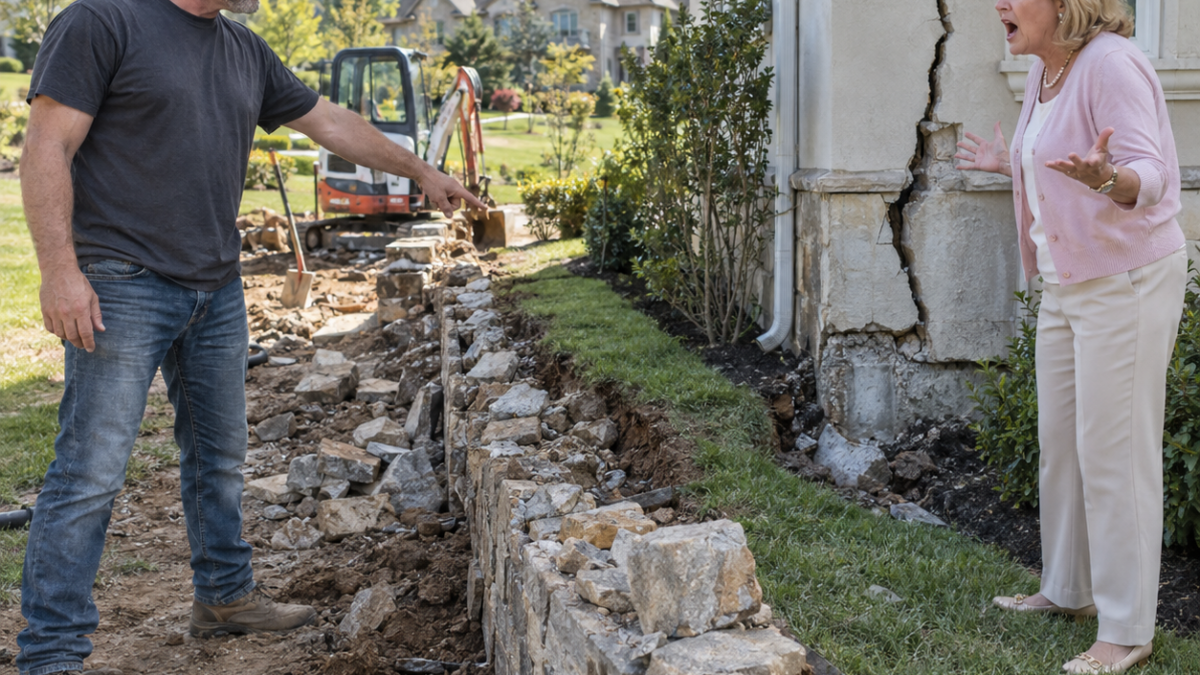
PART 2
The first violation notice appeared on my front door the following Monday.
I almost laughed when I opened it.
FAILURE TO MAINTAIN UNIFORM GRASS HEIGHT.
Fine: $50.
The attached photograph showed a section of lawn near my driveway.
The same lawn I had cut two days earlier.
I carried the notice into the kitchen.
Sarah was drinking coffee at the table.
“What now?”
I slid the paper toward her.
She read it.
Then looked through the window.
“Your grass?”
“My dangerous grass.”
“It’s shorter than ours has ever been.”
“I know.”
Sarah leaned back.
“This is because of the wall.”
“Of course it is.”
Two days later came another violation.
UNAPPROVED MAILBOX COLOR.
Fine: $75.
My mailbox was black.
It had been black since we bought the house.
At least half the street had black mailboxes.
Friday brought another.
IMPROPER STORAGE OF RECREATIONAL EQUIPMENT.
The evidence was a photograph of our son’s bicycle leaning against the garage.
Security footage showed it had been there for fifty-eight minutes after school.
Fine: $100.
Then came the garden hose.
The shrubs.
The porch lights.
A decorative item allegedly visible beyond the approved seasonal period.
By the end of two weeks, Karen had manufactured more than five hundred dollars in violations.
Sarah spread the notices across our dining room table.
“This is harassment.”
“Yes.”
“How long are we going to keep doing this?”
“As long as she does.”
She looked at me carefully.
I knew that expression.
Sarah wasn’t questioning whether I was right.
She was questioning what being right might cost us.
We had spent years restoring that house.
My grandfather bought the land after coming home from the war.
My father grew up there.
I grew up hearing stories about the apple trees that once stood near the road and the old chicken coop behind the barn.
Sarah and I had replaced wiring.
Repaired floors.
Rebuilt the porch.
We had put our life into the place.
And now a woman with an HOA title had decided she could redefine our property line because a wall looked better where she wanted it.
“I’m not going to turn this house into a battlefield,” I told Sarah.
“It already feels like one.”
“I know.”
“What if she keeps escalating?”
“Then we keep documenting.”
Sarah sighed.
“You always think paperwork can solve everything.”
“No.”
I gathered the violation notices into a folder.
“But paperwork gives liars less room to move.”
For every fine, I created a separate response.
Grass?
I photographed the lawn with a ruler.
Mailbox?
I photographed ten identical black mailboxes throughout Oak Creek Estates, including house numbers.
Bicycle?
I printed the security-camera timestamps.
Garden hose?
I quoted the exact bylaw language showing nothing prohibited temporary use.
Shrubs?
Same thing.
Every response was polite.
Every response was sent certified mail.
Every green return receipt went into a binder.
Karen signed for them.
Then ignored them.
At the next HOA meeting, I tried addressing the issue publicly.
I arrived early.
Twelve homeowners sat in folding chairs.
At the front table were Karen, the treasurer—a nervous accountant named Walter—and a retired teacher named Elaine who served as secretary.
When the agenda reached new business, I stood.
Karen didn’t even let me speak.
“Mr. Garrison, public comment is closed.”
“I’m here about the wall built on my property.”
“That matter is under committee review.”
“I have sent certified correspondence for weeks.”
“You were required to request agenda placement thirty days in advance.”
“I sent the first notice more than thirty days ago.”
Her jaw tightened.
“The board did not approve your request.”
“I didn’t ask for approval to discuss my own property.”
A few homeowners shifted in their chairs.
Karen noticed.
Her tone sharpened.
“This association follows parliamentary procedure. I am ruling your comments out of order.”
I held up the binder.
“You built a hundred-foot wall almost six feet inside my property line after receiving written notice to stop.”
“Sit down.”
“You are also issuing retaliatory fines.”
“Sit down, Mr. Garrison.”
A man near the back looked at me sympathetically.
Karen pointed toward the door.
“If you continue disrupting this meeting, I will have you removed.”
I looked at the other board members.
Walter stared at his notes.
Elaine wouldn’t meet my eyes.
That told me something important.
Karen wasn’t powerful because everybody agreed with her.
She was powerful because nobody around her wanted the trouble that came with disagreeing.
I sat.
And remained there through the entire meeting.
Afterward, an older man caught me in the parking lot.
His name was Tom.
“I’ve lived here twelve years,” he said quietly. “You’re not the first person she’s done this to.”
“The wall?”
“No.”
He glanced toward the clubhouse door.
“Everything else.”
“What do you mean?”
Tom shoved his hands into his jacket pockets.
“Fines. Selective enforcement. Threats. If she decides she doesn’t like you, suddenly your trash cans are visible or your flowers are the wrong species.”
“Why does nobody challenge her?”
Tom gave me a tired smile.
“Because most people just want to go home after work.”
That night, I called someone I hadn’t spoken to in years.
David Chen.
Dave and I had served together before I transferred fully into engineering work.
He was a former JAG officer who eventually built a private practice around property disputes and land-use litigation.
He answered on the fourth ring.
“Jack Garrison.”
“Still alive.”
“Unfortunately for opposing counsel.”
“I need help.”
His tone changed immediately.
“What happened?”
I gave him the condensed version.
By the time I reached the hundred-foot wall, he interrupted.
“Wait.”
“What?”
“She completed construction after receiving a certified cease-and-desist?”
“Yes.”
“You have the receipt?”
“Yes.”
“Survey?”
“Yes.”
“Photographs?”
“Hundreds.”
“Property markers?”
“Visible.”
“Any claimed easement?”
“Nothing recorded.”
“And now she’s fining you?”
“Constantly.”
Dave was quiet.
Then he said, “Jack, I need you to understand something.”
“I’m listening.”
“This woman is building our case for us.”
I smiled for the first time that day.
“Thought you might say that.”
“Send me everything.”
I scanned the entire binder.
Survey.
Photographs.
Certified receipts.
Violation notices.
My disputes.
Meeting notes.
Security-camera images.
Dave reviewed it overnight.
He called the next morning.
“She has a problem.”
“How big?”
“Depends how stupid she intends to be.”
“Assume maximum capacity.”
He laughed.
“Then we give the association one last opportunity.”
“Why the association?”
“Because right now Karen is hiding behind her office. If we immediately make this Jack-versus-Karen, she’ll frame it as personal.”
“It is personal.”
“Legally, I don’t care.”
He continued.
“We address Oak Creek Estates Homeowners Association. Every board member. Their registered agent. Their insurer if necessary. We make it an institutional issue.”
“What do we demand?”
“Everything reasonable.”
The letter Dave drafted was ten pages.
It began with dates.
Not adjectives.
Dates.
The day construction began.
The day I ordered it stopped.
The day Karen received my letter.
The day construction resumed.
The days each retaliatory fine arrived.
The date I was denied the opportunity to address the board.
Attached were survey pages.
Photographs.
Certified-mail receipts.
The letter defined the wall as an encroachment and continuing trespass.
Then came our demands.
The association had thirty calendar days to remove the wall at its own expense.
Restore my lawn professionally.
Rescind every fine issued after construction began.
Confirm in writing that my account was clear.
Then Dave explained what would happen if they refused.
Litigation.
Recovery of costs.
Property-damage claims.
Survey expenses.
Attorney fees.
Potential claims arising from bad-faith board conduct.
And a warning that directors acting outside their authority could potentially expose themselves to personal liability depending on the facts and governing law.
That last paragraph wasn’t written for Karen.
It was written for Walter and Elaine.
“This is where people discover how loyal they really are,” Dave told me.
We served each board member separately.
For a week, nothing happened.
No new violation notices.
No letters.
No phone calls.
The neighborhood seemed strangely peaceful.
Sarah noticed too.
“Maybe they’re finally listening.”
“Maybe.”
“You don’t sound convinced.”
“I know Karen.”
“You barely know her.”
“I know the type.”
Three days later, Tom called.
“You heard about the emergency board meeting?”
“No.”
“Closed session tomorrow.”
“What for?”
“Your letter.”
“How do you know?”
“A friend’s on the beautification committee.”
I leaned against the kitchen counter.
“What is Karen saying?”
Tom sighed.
“That you’re trying to extort the community.”
Of course.
“She says the wall is legal?”
“She says you verbally agreed.”
I went silent.
Tom continued.
“I assume that isn’t true.”
“I told her to leave my property.”
“That’s what I thought.”
Sarah was watching me.
“What?” she mouthed.
I held up one finger.
“Tom, will your friend put that in writing?”
“About Karen saying you consented?”
“Yes.”
“I’ll ask.”
The next afternoon, Oak Creek Estates posted a notice.
The board had “unanimously ratified” the retaining wall as an official community beautification project.
Retroactively.
I sent Dave a photograph.
He called immediately.
He was laughing.
“Why is this funny?”
“Because they just documented that they knew there was a dispute and decided to manufacture authority afterward.”
“They think the vote solves it.”
“It doesn’t move the property line.”
I looked through the window at the wall.
“So what now?”
“We wait.”
“For thirty days?”
“For thirty days.”
I hated that answer.
Patience is easy in theory.
Harder when a hundred feet of someone else’s concrete sits on land your grandfather once owned.
Harder when solar lights flicker across it every night.
Harder when your wife starts checking the front door for violation notices before opening it.
But Dave was right.
The more opportunities we gave them to correct the problem, the less room they would have later to claim confusion.
So I waited.
And while I waited, I started talking to neighbors.
Not campaigning.
Not ranting.
Talking.
Tom first.
I showed him the survey.
Then the Hendersons.
They were in their seventies and had lived in Oak Creek for almost thirty years.
Mrs. Henderson disappeared into the house after hearing my story.
She came back carrying a shoebox.
Inside were years of notices.
Birdbath violation.
Wind chime violation.
Sidewalk chalk.
Flowerpot placement.
Seasonal decoration.
Unapproved water feature.
Mr. Henderson shook his head.
“We paid most of them.”
“Why?”
“Because fighting her was worse.”
His wife looked embarrassed.
“We just wanted peace.”
At another house, a young couple told me they had spent three thousand dollars on a playset for their children.
Karen ordered it removed because the roof peak stood twelve inches above an architectural guideline.
A woman named Denise had been forced to dig up rosebushes her mother had given her because the variety was not on the HOA-approved planting list.
The stories sounded ridiculous individually.
Together, they formed a pattern.
Karen wasn’t administering rules.
She was using them as a pressure system.
And everyone had been isolated.
Each resident thought he or she was the only one being targeted.
That Saturday, Sarah and I hosted a barbecue.
Nothing formal.
Burgers.
Potato salad.
Lemonade.
About twenty people came.
I placed my binder on the picnic table.
Nobody was pressured to read it.
Everyone did.
Tom brought copies of his violations.
The Hendersons brought their shoebox.
Denise brought photographs of her roses before they were removed.
The young couple showed pictures of the playset.
At first, people spoke quietly.
Then louder.
Someone laughed bitterly.
Someone else cursed.
A woman said, “I thought I was the only one.”
Mrs. Henderson answered, “So did we.”
I looked around the yard.
That was Karen’s real system.
Isolation.
One homeowner versus the board.
One frightened family at a time.
Once people compared notes, the illusion changed.
By sunset, fifteen homeowners had agreed to sign a petition demanding an independent review of Karen’s conduct and formal resolution of my wall dispute.
Sarah stood beside me after everyone left.
“You knew this would happen?”
“No.”
“You hoped.”
“Maybe.”
She smiled faintly.
“For someone who hates politics, you’re becoming very political.”
“I’m an engineer.”
“That isn’t a defense.”
“It usually is.”
She leaned against me.
“Just promise me something.”
“What?”
“Don’t start enjoying this too much.”
I looked at the wall.
“I’m enjoying it exactly the right amount.”
“Jack.”
“Okay.”
The thirty-day deadline expired on a Monday.
No response.
No removal crew.
No lawyer.
No rescinded fines.
I called Dave.
“Time’s up.”
“Good.”
“That’s a strange response from my attorney.”
“It means we can stop asking.”
“What’s next?”
“A survey.”
“I already have one.”
“A second survey.”
“Why?”
“Because your first survey proves the line in court.”
“And the second?”
“Proves it in public.”
Three days later, Sterling Surveying agreed to come Saturday morning.
They were one of the oldest and most respected firms in the county.
Expensive.
Very expensive.
I paid anyway.
The day before, I delivered a simple notice to every house in the neighborhood.
A licensed survey would be conducted at my property beginning at nine Saturday morning.
The purpose was to clarify the boundary in connection with an ongoing HOA dispute.
No accusations.
No drama.
Just information.
Saturday dawned crisp and clear.
At 8:45, Sterling’s white pickup arrived.
Two surveyors stepped out carrying tripods, electronic instruments, wooden stakes, and rolls of fluorescent flagging.
Neighbors started appearing.
Coffee mugs.
Jackets.
Folded arms.
The Hendersons sat on their porch.
Tom leaned against his car.
Denise stood near her driveway.
The surveyors began at a county benchmark.
Then worked slowly toward my corner.
Nobody rushed them.
Nobody coached them.
That was the point.
At 9:38, Karen appeared.
She marched down the sidewalk in a tracksuit, face already red.
“What is happening?”
The lead surveyor, Frank, looked up.
“Boundary survey.”
“On whose authority?”
“My client’s.”
She pointed at me.
“He cannot authorize surveying of HOA common property.”
Frank looked at his clipboard.
“We’re surveying parcel 734-55-12.”
“This strip is an easement.”
“Do you have a recorded easement document?”
Karen hesitated.
“The board has recognized it.”
“That wasn’t my question.”
Her eyes narrowed.
“I am president of the homeowners association.”
Frank nodded.
“I’m Frank.”
Someone behind me laughed.
Karen heard it.
“This wall is association property.”
Frank adjusted the instrument.
“We’ll identify the legal boundary. Anything else is between you and Mr. Garrison.”
The second surveyor walked toward the wall carrying a stake.
He checked a measurement.
Adjusted his position.
Then set the stake.
Directly on the alignment running through the wall’s footprint.
He drove it home.
Thwack.
The bright flag fluttered.
People murmured.
Karen stared.
The crew moved ten feet.
Measured.
Another marker.
Then another.
And another.
A line of fluorescent flags marched along the wall.
The message was visual and brutal.
The wall was not merely near my property line.
It was built deep inside it.
Frank eventually walked over to me.
“Mr. Garrison?”
“Yes?”
“The prior survey is consistent.”
“How far is the maximum encroachment?”
He checked his notes.
“Just over five feet through most of the run. Slightly more in one section.”
Karen heard him.
“That is impossible.”
Frank looked at her.
“I can show you the measurements.”
“I don’t need your measurements.”
“Then I’m not sure what you want from me.”
She looked around.
Neighbors were no longer avoiding her eyes.
That was new.
Karen turned abruptly and walked home.
No speech.
No threat.
Just retreat.
Dave received Sterling’s formal report two days later.
He called me.
“Now we send the final notice.”
This letter was different.
The first had asked.
The second notified.
The HOA had failed to remove the encroachment after documented notice.
Sterling Surveying had independently confirmed the violation.
I intended to hire a licensed, bonded contractor to remove the structure from my property.
The letter gave them seventy-two hours before work began.
Then Dave included the paragraph that changed everything.
The wall appeared to be retaining soil from the adjacent lot.
That adjacent lot belonged to Karen.
Based on visible conditions, removal could expose unsupported soil.
If Karen’s property had been improperly graded or if structures on her lot depended on an unauthorized wall built on mine, additional engineering problems could result.
The HOA had seventy-two hours to address the situation lawfully.
I read the paragraph twice.
“Dave.”
“Yes?”
“Are you saying removing the wall could damage her house?”
“I’m saying nobody properly engineered this project.”
“That wasn’t my question.”
He sighed.
“Her yard sits higher than yours.”
“I know.”
“The wall is functioning as a retaining structure whether she admits it or not.”
“So if it comes out?”
“Her soil needs support.”
“Could her foundation move?”
“I am not a geotechnical engineer.”
“Dave.”
“It could.”
I stood in silence.
This no longer felt funny.
“What do we do?”
“You hire qualified people.”
“And if they say removal isn’t safe?”
“Then you follow their recommendation.”
The demolition company inspected the site.
So did an engineer.
The contractor explained that the wall could be removed from my side, but Karen’s lot required its own proper stabilization solution.
That responsibility belonged to the owner and association that had created the condition.
We sent the notice.
Personally served.
Karen received hers at the front door.
The other board members received theirs separately.
Within hours, I saw Walter’s car at Karen’s house.
Then Elaine’s.
Tom called that evening.
“They finally talked to the HOA attorney.”
“What did he say?”
“Take the wall down themselves and settle with you.”
“Good.”
“But Karen refuses.”
I closed my eyes.
“Why?”
“She says you’re bluffing.”
“What does Walter think?”
“Walter thinks she’s insane.”
“And Elaine?”
“Crying, apparently.”
Sarah was sitting across from me.
When I hung up, she said, “She’s not going to stop, is she?”
“No.”
“Then what happens Saturday?”
“The contractor removes the wall.”
“And her house?”
“If her property needs stabilization, she has seventy-two hours to arrange it.”
Sarah stared out the window.
“What if she does nothing?”
I didn’t answer.
Friday night, three old friends from my Army years came over.
Not as muscle.
As witnesses.
One had been logistics.
One military police.
One another engineer.
Dave hired an independent videographer.
The demolition contractor confirmed permits and insurance.
Our paperwork was copied into a waterproof binder.
I barely slept.
At 5:45 Saturday morning, I made coffee.
Sarah came into the kitchen.
“You’re really doing it.”
“I gave them every chance.”
“I know.”
She touched my arm.
“Just remember that when it gets ugly.”
At 6:03, diesel engines rolled down the street.
A flatbed carried a Caterpillar excavator.
Its warning lights flashed in the predawn darkness.
Bedroom lights switched on throughout Oak Creek Estates.
The machine unloaded slowly.
Tracks clanked against pavement.
My contractor, Gus, walked over.
“Morning.”
“Morning.”
“Ready?”
“As I’ll ever be.”
At 6:08, Karen’s front door flew open.
She came running outside in a bathrobe with her phone pressed against her ear.
“There is construction equipment destroying community property!”
She was screaming loudly enough for half the neighborhood to hear.
The excavator remained still.
We were waiting.
Five minutes later, a police cruiser arrived.
Two officers stepped out.
Karen rushed toward them.
“Arrest him!”
The older officer raised one hand.
“Ma’am, slow down.”
“He is about to destroy HOA property.”
The officer looked at the excavator.
Then at me.
“Sir?”
I handed him the binder.
“My name is Jack Garrison. I own parcel 734-55-12. The wall was constructed on my land without permission. That binder contains my deed, two professional surveys, photographic evidence, certified notices, correspondence from my attorney, proof of service, and the demolition contractor’s documentation.”
The officer opened it.
Karen continued talking.
He ignored her.
His partner looked over his shoulder.
Pages turned.
One minute.
Three.
Five.
The older officer walked back to his cruiser.
Checked something.
Returned.
Then handed me the binder.
“Your documentation appears consistent with a civil property dispute.”
Karen stepped forward.
“Then stop him.”
The officer looked at her.
“Do you have a court order preventing removal?”
“I am the HOA president.”
“That’s not a court order.”
“The board approved the wall.”
“Do you have a court order?”
“No, but—”
“Then we are not going to arrest this property owner based on what you’ve shown us.”
Her mouth opened.
“He’s destroying our property!”
“The surveys indicate the structure is on his parcel.”
“He’ll damage my house!”
The officer looked at her.
“Then you should contact your attorney and contractor regarding your property.”
“It’s Saturday morning!”
He gave her a tired expression.
“Ma’am, the notice in this binder says you were served three days ago.”
Karen said nothing.
The officer continued.
“We’ll remain nearby to keep the peace.”
She pointed at me.
“This is revenge.”
I finally spoke.
“No, Karen.”
She looked at me.
“This is removal.”
I turned to Gus.
He climbed into the excavator.
The engine deepened.
The boom rose.
Neighbors stood in driveways.
Some filmed.
Others simply watched.
The bucket touched the first section of beige block.
I felt Sarah take my hand.
The machine pushed.
Concrete cracked.
Blocks broke apart.
Dust rose.
Karen flinched.
Gus worked carefully.
He didn’t swing wildly.
He dismantled.
Section by section.
Break.
Scoop.
Load.
Break.
Scoop.
Load.
Years of Karen’s authority seemed to disappear with each section.
Not because the wall was powerful.
Because she had made it symbolic.
She had built it after being told no.
Finished it after receiving legal notice.
Defended it after two surveys.
Used the board to ratify it.
Threatened me over it.
The wall had become physical proof that Karen believed her title mattered more than a deed.
Thirty minutes later, the last section was gone.
I should have felt victorious.
Instead, I saw the soil.
Dark.
Wet.
Exposed.
Gus shut down the excavator.
My engineer stepped closer.
“Jack.”
I knew from his voice that something was wrong.
“What?”
He pointed.
The earth on Karen’s side was beginning to move.
Not much.
At first.
A thin stream of mud slid downward.
Then another.
Her yard sat several feet higher than mine.
The illegal wall had been installed in a way that effectively retained the raised soil.
But there was no proper engineered system behind it.
No drainage layer.
No tiebacks.
No professionally designed stabilization.
It had been holding back saturated earth through brute resistance.
Now that resistance was gone.
Gus looked at me.
“We stop here.”
“Agreed.”
We moved everyone back.
Karen saw the soil movement.
“What did you do?”
The engineer answered.
“Your slope is unstable.”
“You destroyed the support!”
I looked at her.
“You built the support on my land.”
Rain began.
Lightly.
A few drops.
Then steady.
Of all mornings.
The water darkened the soil.
A decorative shrub near Karen’s property line leaned.
Slowly.
Its roots exposed.
Then it fell.
Karen stared.
“Fix it.”
Nobody moved.
She pointed at Gus.
“Put the wall back!”
Gus looked at me.
Then at her.
“I’m not building anything without an engineered plan and legal authorization.”
“You just destroyed it!”
“I removed a structure from his parcel.”
Karen turned to the police officers.
“Do something!”
The older officer shook his head.
“This is now a building-safety issue.”
The rain continued.
A shelf of soil broke away.
Not dramatically.
It simply separated and slid downward.
Then came a sound.
Crack.
Sharp.
Dry.
Everyone looked toward Karen’s house.
A diagonal fracture appeared in the stucco near a corner window.
Sarah squeezed my hand.
“Oh, God.”
Karen ran toward her house.
Another section of patio dropped slightly.
Then another grinding sound.
The concrete slab behind the house fractured.
The crack widened toward the foundation.
Nobody cheered.
Nobody laughed.
Not anymore.
Tom called the city.
A building inspector arrived in a white pickup.
He walked the slope.
Examined the patio.
Measured cracks.
Looked beneath the foundation edge.
Spoke privately with Karen.
Her face went white.
The inspector returned to his truck.
When he came back, he carried a red placard.
He attached it to her front door.
UNSAFE TO OCCUPY.
Karen stared at it.
“No.”
The inspector spoke calmly.
“Ma’am, you cannot remain in the structure until a licensed engineer evaluates the foundation and slope.”
“This is my house.”
“I understand.”
“He did this!”
She pointed at me.
The inspector looked toward the removed wall area.
“Who constructed the retaining system?”
“The HOA.”
“Was it permitted?”
Karen hesitated.
The inspector repeated the question.
“Was it permitted?”
“I don’t know.”
“Who designed it?”
“Our contractor.”
“Which structural or geotechnical engineer?”
Silence.
He wrote something.
“Ma’am, I need those records.”
Walter arrived ten minutes later.
Elaine shortly after.
They saw the red tag.
Then the slope.
Then Karen.
Walter looked sick.
“What happened?”
Karen pointed at me.
“He destroyed my house.”
I had heard enough.
“No.”
Every face turned toward me.
“I removed a wall built illegally on my property after two surveys, multiple notices, a thirty-day demand, and a seventy-two-hour final warning.”
I pointed toward the unstable slope.
“Whatever was supporting Karen’s property should have been engineered and built on Karen’s property.”
Walter looked at her.
“You said the contractor handled permits.”
Karen didn’t answer.
“Karen.”
“I assumed they did.”
Walter stared.
“You assumed?”
“You voted to approve the project.”
“After you built it!”
“You supported me.”
“Because you told us Jack had consented!”
Several neighbors heard that.
Tom stepped forward.
“She told the beautification committee the same thing.”
Karen spun toward him.
“Stay out of this.”
“No.”
His answer was immediate.
Simple.
“No.”
More residents gathered.
Mrs. Henderson.
Denise.
The young couple.
People Karen had intimidated for years.
Nobody looked afraid now.
The wall wasn’t the only thing that had disappeared that morning.
By noon, Karen was staying in a hotel.
The city ordered emergency engineering evaluation of her lot.
Oak Creek Estates’ attorney contacted Dave.
Not Karen.
Dave.
The tone had changed.
“They want to settle,” he told me.
“What about the slope?”
“Separate issue.”
“Insurance?”
“Complicated.”
That turned out to be an understatement.
The HOA tendered a claim to its insurer.
The carrier investigated the construction.
They reviewed our certified letters.
The surveys.
The board’s retroactive approval.
The contractor records.
The warnings.
The insurer disputed coverage for substantial portions of the loss, arguing that the association had proceeded despite documented notice of the encroachment and legal risk.
Karen contacted her homeowner’s insurer.
Her carrier sent engineers.
They examined the wall.
The slope.
The grading.
The cracked foundation.
The patio.
The construction history.
Weeks passed.
Meanwhile, Dave prepared our settlement demand.
Demolition contractor: $4,200.
Sterling survey: $2,800.
Initial legal retainer and accumulated fees: $5,000.
Property restoration and damages: $10,000.
Total: $22,000.
“We could claim more,” Dave said.
“I know.”
“Why not?”
“Because I want this finished.”
He nodded.
“That helps us.”
“How?”
“We look reasonable.”
The HOA accepted.
No negotiation.
A special homeowners meeting was scheduled.
This time, Karen wasn’t behind the podium.
She sat in the back.
The clubhouse was packed.
Walter opened the meeting.
His hands shook.
“I owe everyone an apology.”
The room remained silent.
“The board failed in its duty.”
Karen stood.
“That is not—”
Walter slammed the gavel.
The entire room froze.
“Sit down, Karen.”
I had never heard him raise his voice.
Apparently neither had she.
She sat.
Walter continued.
“We allowed one officer to act without appropriate oversight. We approved decisions without conducting proper independent review. We ignored documented warnings.”
Elaine began crying quietly.
Then homeowners were invited to speak.
Tom went first.
He described Karen telling the beautification committee that I had verbally approved the wall.
“I believed her,” he said. “That was my mistake.”
Mrs. Henderson brought her shoebox.
She held up one notice after another.
“Birdbath.”
She dropped it on the table.
“Wind chimes.”
Another.
“My grandson’s chalk.”
Another.
“Christmas lights.”
Another.
“For years, we paid because we were afraid fighting would cost more.”
Denise spoke about her roses.
The young parents spoke about the playset.
Another homeowner described being fined because his trash bin remained visible for several hours after pickup.
Someone else described a warning over curtains.
A retired firefighter described being threatened with legal action because he parked a utility trailer in his own driveway overnight.
The stories kept coming.
Karen tried interrupting twice.
Nobody listened.
Finally, Walter called for a vote of no confidence.
Hands rose.
Nearly every hand in the room.
Karen stared around her.
The vote removing her from the presidency and board passed overwhelmingly.
Years of control ended in less than sixty seconds.
Then the association voted to pay our $22,000 settlement and issue a written apology to Sarah and me.
The payment would partly require a special assessment.
That angered people.
Not at me.
At Karen.
One homeowner stood.
“My family has to pay because you built a wall on somebody else’s land?”
Karen looked down.
Another shouted, “You were warned!”
A third said, “Twice surveyed!”
Walter stopped the shouting.
But the damage to Karen’s standing was complete.
The woman who once silenced meetings by clearing her throat could barely cross the room without someone turning away.
I should have enjoyed that more than I did.
Instead, Sarah and I went home.
We sat on the porch.
The lawn looked wounded.
A hundred-foot strip of torn earth marked where the wall had stood.
Sarah leaned against me.
“Is it over?”
“For us?”
“Yes.”
“Almost.”
“And her?”
I looked toward Karen’s dark house.
“I don’t think so.”
The structural report arrived about two weeks later.
Tom heard the number first.
Then everyone did.
Repairing Karen’s property wasn’t a simple matter of patching stucco.
The slope required major stabilization.
Deep piers.
Retaining systems.
Drainage correction.
Foundation work.
Patio reconstruction.
Structural monitoring.
The initial estimate exceeded $300,000.
And even after those repairs, engineers would not guarantee that future movement was impossible.
Her house had been valued around $750,000 before the incident.
Now it was condemned.
Uninhabitable.
Difficult to insure.
Impossible to sell normally.
Karen blamed me publicly.
For a while.
Then Dave sent her attorney a packet.
Every letter.
Every receipt.
Every survey.
The seventy-two-hour notice identifying the soil-support risk.
The contractor’s reports.
The board’s retroactive approval.
The police body-camera record documenting that we had proceeded openly.
After that, the public accusations stopped.
One evening, Karen came to my door.
Sarah opened it.
I was in the kitchen.
“Jack.”
I walked forward.
Karen stood on the porch.
She looked different.
No clipboard.
No makeup.
No official blazer.
Just exhaustion.
“Can we talk?”
Sarah looked at me.
I nodded.
Karen remained outside.
I stepped onto the porch.
For several seconds, neither of us spoke.
Then she said, “You ruined me.”
I expected anger.
Her voice contained almost none.
Just defeat.
“I protected my land.”
“You knew removing that wall could damage my house.”
“I warned you.”
“You knew.”
“My attorney’s notice specifically warned about soil movement and foundation risk.”
“You could have waited.”
“Thirty days.”
She looked away.
“Then another seventy-two hours.”
Silence.
“You could have gone to court.”
“So could you.”
Her eyes returned to mine.
“I thought you were bluffing.”
“I know.”
“That’s why you timed it for Saturday.”
That accusation was partly fair.
Dave had chosen a time when emergency legal interference would be more difficult.
But the notices had been clear.
We had not hidden anything.
“You had three days after the final notice,” I said.
“Your own lawyer told the board to remove the wall and stabilize the property.”
Her expression changed.
“How do you know that?”
“Because Walter told us afterward.”
Karen’s jaw tightened.
“They betrayed me.”
“No.”
I shook my head.
“They stopped protecting you from consequences.”
“You turned them against me.”
“You told them I gave consent.”
She said nothing.
“You knew I didn’t.”
Still nothing.
“You built on my land anyway.”
“I was trying to improve the entrance.”
“It wasn’t your land.”
“The whole corner looked terrible.”
“It wasn’t your land.”
She finally raised her voice.
“You keep saying that like it answers everything.”
“It does.”
She stared at me.
Then I understood something about Karen.
She truly did not understand boundaries the way most people did.
Not because she couldn’t read a survey.
Because somewhere along the way, she had decided that if she believed something was good for the neighborhood, then disagreement itself became illegitimate.
Her intention excused the method.
Her office excused the authority.
Her certainty excused the damage.
“You know what the saddest part is?” I asked.
“What?”
“I gave you an easy way out.”
She frowned.
“The first letter.”
I pointed toward my lawn.
“Remove the unfinished wall. Restore the grass. Done.”
“You embarrassed me in front of the workers.”
“I told people trespassing on my land to leave.”
“You challenged me.”
“No.”
I looked directly at her.
“I said no.”
That landed differently.
Karen looked toward the place where the wall had stood.
“I couldn’t let everyone see me back down.”
There it was.
The closest thing to truth she had ever given me.
Not landscaping.
Not aesthetics.
Not community standards.
Pride.
“If I allowed you to ignore the board,” she continued, “everyone would start doing whatever they wanted.”
“You weren’t enforcing a rule.”
“I was protecting authority.”
“At the expense of the truth.”
She looked tired.
“Maybe.”
I had imagined this conversation many times.
In those imaginary versions, I had the perfect line.
Something devastating.
Something that would make her understand.
Standing in front of the real Karen, I didn’t want it.
I just wanted her gone from my porch.
“I’m sorry about your house,” I said.
She looked surprised.
“I am.”
“You expect me to believe that?”
“You losing your house doesn’t put anything back on my property.”
For a moment, her eyes filled.
Then she blinked hard.
“I don’t have anywhere to go.”
I didn’t know what to say.
Sarah appeared behind me.
Karen looked at her.
Sarah’s expression softened, but only slightly.
“I’m sorry you’re going through that,” she said.
Karen swallowed.
Then nodded.
And left.
Afterward, Sarah stood beside me.
“You meant it.”
“What?”
“That you’re sorry.”
“Yes.”
“You spent months fighting her.”
“I wanted the wall gone.”
“Not her house.”
“No.”
Sarah took my hand.
“That matters.”
Karen’s financial situation deteriorated.
Her house remained condemned.
The mortgage did not disappear simply because the property was unlivable.
She still owed roughly $400,000.
Her equity before the failure had been substantial.
Now the house’s market value was devastated by structural instability.
She consulted engineers.
Contractors.
Attorneys.
Every solution involved money she didn’t have.
Eventually, the bank foreclosed.
The property went to auction.
A developer bought it for roughly $230,000, largely for the land.
The existing house was later demolished.
The sale proceeds went toward the loan.
A significant deficiency remained.
Between lost equity, remaining debt exposure, engineering consultations, legal costs, temporary housing, and related losses, people around the neighborhood calculated that Karen’s personal financial destruction exceeded $520,000.
I never celebrated that number.
Others did.
Tom once came over holding a beer and said, “Half a million dollars because she wouldn’t move a wall.”
I looked at him.
“No.”
“What?”
“Half a million because she wouldn’t admit the wall should never have been there.”
He thought about that.
“Fair distinction.”
Oak Creek Estates elected a new board.
Tom became one of the directors.
I teased him relentlessly.
“You’ve become the enemy.”
“I’m reforming it from inside.”
“That’s what they all say.”
One of their first changes required homeowner approval for major capital projects beyond a defined threshold.
Another required documented legal review before construction touching disputed boundaries.
Enforcement complaints had to include photographic evidence and could be appealed to people other than the person who issued the original violation.
They reviewed old fines.
Many were rescinded.
The Hendersons got money credited back to their account.
Denise replanted roses.
The young family bought another playset.
It was six inches taller than the old one.
Nobody measured it.
Our own lawn took several weeks to repair.
The HOA paid for professional grading and sod.
A proper drainage solution was installed along the boundary.
No wall.
No cheap solar lights.
Just grass.
The first evening after the new sod had settled, Sarah and I sat on the porch.
She carried two glasses of iced tea.
“Look.”
“At what?”
“Nothing.”
I smiled.
The view was open.
That was her point.
No beige blocks.
No flags.
No workers.
No Karen.
Just our front lawn stretching to the legal boundary it had always possessed.
Our son rode his bicycle up the driveway.
He left it beside the garage.
I looked at Sarah.
She looked at me.
“Don’t.”
“I wasn’t going to say anything.”
“You were.”
“Maybe.”
The bicycle remained there until dinner.
Nobody photographed it.
Nobody fined us.
Months passed.
The neighborhood changed slowly.
People waved more.
That sounds insignificant.
It wasn’t.
Before Karen fell, homeowners often spoke in lowered voices.
They worried that complaining about one violation would trigger three more.
Afterward, they stopped behaving as though the board lived above them.
Meetings became longer.
Messier.
Sometimes irritating.
But healthier.
People asked questions.
Requested financial statements.
Debated proposals.
Disagreed.
Nobody was threatened with removal because disagreement itself was inconvenient.
One night, Tom knocked on our door carrying a bottle of wine.
“What did you do?” I asked.
“Why do you assume something happened?”
“You’re on the HOA board and holding alcohol.”
“Fair.”
He sat on the porch with us.
“We passed the final governance amendments tonight.”
Sarah smiled.
“Congratulations.”
Tom raised his glass.
“No single officer can authorize a project like Karen’s again.”
“Good.”
“Major improvements require multiple bids.”
“Better.”
“And boundary projects require legal verification.”
I nodded.
“Very good.”
He looked across the lawn.
“You know what’s strange?”
“What?”
“If Karen had just moved that wall five feet before finishing it, none of this happens.”
“Probably.”
“She keeps her house.”
“Probably.”
“She stays president.”
“Maybe.”
“She wins.”
I shook my head.
“She didn’t need to win.”
Tom looked at me.
“She only needed to stop.”
A year after the wall came down, Sarah and I drove past the empty lot where Karen’s house had once stood.
The developer had cleared everything.
House.
Patio.
Damaged landscaping.
Broken foundation.
All gone.
Only raw earth remained.
Sarah looked out the passenger window.
“That’s sad.”
“Yeah.”
“You ever feel guilty?”
The question surprised me.
I drove another hundred yards before answering.
“Sometimes.”
She turned toward me.
“Really?”
“I wonder if I could have done something differently.”
“You sent letters.”
“I know.”
“More than one.”
“I know.”
“You gave deadlines.”
“I know.”
“You hired professionals.”
“Yes.”
“You warned her about the slope.”
“Yes.”
Sarah folded her arms.
“So what exactly should you have done?”
“Let her keep my land?”
“No.”
“Paid to stabilize her property?”
“No.”
“Backed down because she refused to?”
“No.”
I smiled.
“You’ve prepared this argument.”
“For months.”
She looked out the windshield.
“You didn’t crack her foundation with an excavator.”
“I know.”
“You removed an illegally constructed wall after repeatedly warning everyone involved that her property might depend on it.”
“I know.”
“The dangerous condition came from how the project was created.”
“I know.”
She looked at me.
“Then stop taking responsibility for choices you didn’t make.”
I reached over and squeezed her hand.
“Yes, ma’am.”
“Good.”
The developer eventually rebuilt on Karen’s old lot.
This time, they hired a geotechnical engineer.
The slope was excavated properly.
Drainage installed.
A structural retaining system was built entirely inside that parcel.
Deep foundations were used where necessary.
The project took months.
One afternoon, I watched crews drill piers.
Tom walked over.
“Funny.”
“What?”
“This is what should have happened the first time.”
“Yes.”
“Permits.”
“Yes.”
“Engineering.”
“Yes.”
“Property lines.”
“Radical concepts.”
He laughed.
The new house was smaller than Karen’s.
Tasteful.
The owners were a young couple with a little girl.
The first time they introduced themselves, the husband glanced toward the boundary.
“We heard there was some history here.”
“Depends who told you.”
“Tom.”
“Then it was exaggerated.”
Tom, standing behind them, said, “It was not.”
The wife looked embarrassed.
“We don’t want any trouble.”
I smiled.
“Stay on your side of the survey pins and we’ll get along beautifully.”
For a second, they looked worried.
Then I laughed.
So did they.
Their daughter eventually began drawing with sidewalk chalk.
Bright suns.
Purple houses.
Animals that looked like potatoes.
One afternoon, she drew a rainbow extending almost the entire width of their driveway.
Sarah saw it.
“Karen would have had a stroke.”
“Probably.”
“You think the new board will fine them?”
“Tom values his life.”
We sat watching the little girl add clouds.
It struck me how absurd the old atmosphere had been.
People had accepted fear as normal.
Fear of planting.
Fear of painting.
Fear of leaving a bicycle outside.
Fear of criticizing a volunteer board.
A neighborhood should not feel like that.
Rules can be useful.
Shared standards can be useful.
Associations can solve real problems.
But authority without accountability attracts exactly the wrong people.
That was the lesson Oak Creek Estates learned.
My lesson was different.
I learned that being correct doesn’t mean acting recklessly.
There were moments I wanted to tear the wall down myself.
The first afternoon, I could have taken a sledgehammer to the unfinished blocks.
I was angry enough.
Had I done that, Karen would have photographed me destroying what she claimed was HOA property.
She might have called the police.
She would have controlled the story.
Instead, I measured.
Photographed.
Wrote.
Waited.
Surveyed.
Warned.
Hired qualified people.
The process felt painfully slow.
But when the confrontation finally happened, I didn’t need to convince anyone.
The documents did it.
People sometimes imagine revenge as something explosive.
A dramatic act.
A clever trap.
A humiliating speech.
But the most satisfying consequence I watched Karen face wasn’t the excavator.
It wasn’t the red condemnation notice.
It wasn’t losing the board vote.
It wasn’t even foreclosure.
It was the morning of the public survey.
That moment when the fluorescent boundary markers made the truth impossible to talk around.
Karen had spent weeks telling everyone the wall was legal.
Community property.
Approved.
Necessary.
Then licensed professionals showed up with instruments that did not care who was HOA president.
A boundary is a boundary.
Five feet was five feet.
Her title couldn’t move it.
Her vote couldn’t move it.
Her anger couldn’t move it.
That was where her power really broke.
Everything afterward was consequence.
Years later, I still have the original wall file.
Sarah asked once why I keep it.
The dispute is over.
The wall is gone.
Karen moved away.
The board changed.
Why keep hundreds of pages?
I opened the binder.
The first photograph showed the unfinished wall.
Another showed my tape measure stretched across the grass.
Then the certified receipt with Karen’s signature.
The violation notices.
The Sterling survey.
The final warning.
The settlement.
At the back was a photograph Sarah had taken after the sod grew in.
Our yard.
Open.
Green.
Ordinary.
I showed it to her.
“That’s why.”
She smiled.
“You keep an inch-thick legal binder because you like a picture of grass?”
“Exactly.”
“You’re very strange.”
“I’ve heard.”
The truth was that the binder reminded me how easily a conflict can become about pride.
Karen’s pride made her keep escalating.
Mine could have done the same.
There were plenty of moments when I wanted to hurt her simply because she had tried to humiliate me.
Dave stopped me more than once.
“Don’t give her your anger,” he told me.
“Give her deadlines.”
That became the rule.
Deadlines instead of threats.
Evidence instead of shouting.
Qualified experts instead of assumptions.
And when the deadline passed?
Act exactly as promised.
Nothing more.
Nothing less.
Karen expected me to bluff because she bluffed constantly.
She threatened fines.
Threatened police.
Threatened enforcement.
Threatened legal consequences.
But many of those threats depended on homeowners surrendering before asking whether she could actually do what she claimed.
When I said the wall would be removed after seventy-two hours, she assumed it was another threat.
It wasn’t.
It was notice.
That distinction cost her dearly.
One summer evening, years after everything ended, I was trimming grass near the old boundary.
I found something sticking slightly above the soil.
A small piece of beige concrete.
One of the wall fragments the cleanup crew had missed.
I picked it up.
It fit in my palm.
Sarah saw me examining it.
“What’s that?”
“Ancient history.”
“Throw it away.”
I turned the fragment over.
For one childish second, I considered keeping it.
A trophy.
Then I remembered what Sarah had said about enjoying the fight too much.
I tossed it into the trash.
The wall didn’t deserve a monument.
That land had belonged to my family long before Karen.
It would remain after everyone involved in our argument was gone.
That thought became more meaningful as I got older.
My grandfather had saved for that property after war.
He didn’t buy it because it was glamorous.
He wanted somewhere that belonged to him.
A place where nobody else could suddenly tell him to move.
My father kept it.
Then it came to me.
When Karen built that wall, she probably saw five feet of grass.
I saw generations.
That was why I would not surrender it.
Not because two hundred square feet would change my life.
Because boundaries matter precisely when somebody tells you they don’t.
The next HOA president understood that.
So did the one after him.
Oak Creek eventually commissioned digital maps of every association boundary.
Capital projects required survey verification.
The new board even invited a property attorney to explain easements and encroachments at an annual meeting.
Tom called me afterward.
“Most boring presentation I’ve ever heard.”
“Excellent.”
“Forty-five minutes about recorded plats.”
“Beautiful.”
“I almost fell asleep.”
“That means civilization is healing.”
He laughed.
“I’ll put that in the minutes.”
Sarah and I still sit on the porch some evenings.
Cars pass.
Neighbors wave.
Children ride bicycles.
Someone plants flowers without asking permission from a committee.
The grass near the boundary grows.
Sometimes taller than the old standard.
Nobody arrives with a ruler.
And when I look across that open stretch where Karen’s wall once stood, I don’t think first about the $520,000.
I think about the first afternoon.
Karen standing beside half-finished concrete.
Certain.
Smiling.
Telling me I would be arrested if I touched “HOA property.”
She thought authority came from saying something loudly enough.
She thought repetition could turn a lie into a boundary.
She thought a board vote could rewrite a deed.
She thought warning letters were weakness.
She thought patience meant surrender.
And most importantly, she thought nobody would ever call her bluff.
I never set out to destroy her house.
I never wanted her foreclosed on.
I never wanted her financially ruined.
If she had stopped on the first afternoon, she would have lost almost nothing.
If she had stopped after my certified letter, she would have paid to remove an unfinished wall.
If she had stopped after Dave’s demand, the HOA could have corrected the property and moved on.
If she had stopped after the second survey, she still had time.
If she had followed her own attorney’s advice during the final seventy-two hours, engineers could have stabilized her lot before removal.
At every stage, there was an exit.
Karen walked past all of them.
That’s why I never considered what happened revenge in the end.
Revenge requires choosing someone else’s punishment.
I didn’t choose hers.
I chose my boundary.
The rest came from decisions she had already made.
The replacement house next door eventually sold.
The new family planted maple trees.
One stands near the corner where Karen’s patio once cracked.
Every fall, its leaves turn bright red.
The first year it happened, Sarah called me outside.
“You need to see this.”
I walked onto the porch.
The tree glowed in late-afternoon sunlight.
Behind it, our lawn stretched uninterrupted to the survey line.
Sarah slipped her arm through mine.
“Better than beige concrete.”
“Much.”
“Do you miss the solar lights?”
“Every night.”
She laughed.
We stood there quietly.
And I thought about foundations.
My career had taught me that foundations fail for reasons people often ignore until the visible damage appears.
Bad soil.
Poor drainage.
Improper loads.
Shortcuts hidden underground.
A house can look perfect while stress accumulates below it.
So can a community.
Karen’s power looked solid because nobody challenged it.
Her board looked functional because meetings still occurred.
Her enforcement system looked legitimate because notices carried logos and section numbers.
But beneath all of that was weak ground.
Fear.
Silence.
Unchecked authority.
The wall only exposed it.
When the concrete came down, both foundations failed at almost the same time.
Her house cracked because the soil supporting it had never been properly stabilized.
Her power cracked because the people supporting it finally stepped away.
That is the part of the story I remember most clearly.
Not the machine.
Not the money.
Not Karen standing beneath a red condemnation notice.
The moment people stopped being afraid.
Tom saying no.
Walter telling her to sit down.
Mrs. Henderson carrying her shoebox into the meeting.
Neighbors raising their hands.
People realizing that one loud person was only one person.
The wall came down in thirty minutes.
Fear took longer.
But it came down too.
And unlike Karen’s house, that community was worth rebuilding.
Today, there is no physical sign that the dispute ever happened.
The property line is marked discreetly.
Drainage works.
The slope next door is professionally supported.
My lawn is green.
The old binder stays in my office.
My grandfather’s discharge papers remain in the same safe.
Sometimes I imagine what he would have said.
He was a quiet man.
Not sentimental.
He probably would have listened to the entire story, stared at the boundary for a long time, and asked one question.
“Did you keep the land?”
Yes.
Every inch.
That would have been enough for him.
And ultimately, it was enough for me.
Karen once told me I would regret making an enemy of the HOA.
I never made an enemy of the HOA.
I made an enemy of one person who confused leadership with ownership.
Eventually the association itself understood the difference.
That distinction saved the neighborhood.
It saved other homeowners from years of the same harassment.
And it restored something far more important than two hundred square feet of grass.
People got their voices back.
My family got its peace back.
And the property line my grandfather paid for remained exactly where it had always been.
Five feet beyond the wall Karen never had the right to build.
In the end, I didn’t tear down Karen’s life.
I removed what never belonged on my land.
Everything standing behind that wall had been her responsibility.
The unstable soil.
The unsupported patio.
The damaged foundation.
The debt.
The pride.
The power she thought nobody would challenge.
All of it had been leaning against something that was never hers.
And once that illegal wall was gone, there was nowhere left for any of it to hide.
[FULL STORY END]








